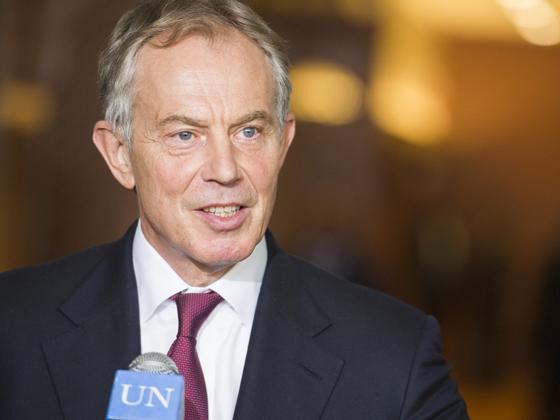
The speech made by Tony Blair, the then Prime Minister, in London on 21 March 2006.
Over these past nine years, Britain has pursued a markedly different foreign policy. We have been strongly activist, justifying our actions, even if not always successfully, at least as much by reference to values as interests. We have constructed a foreign policy agenda that has sought to link, in values, military action in Kosovo, Sierra Leone, Afghanistan and Iraq with diplomatic action on climate change, world trade, Africa and Palestine. I set out the basis for this in the Chicago speech of 1999 where I called for a doctrine of international community, and again in the speech to the US Congress in July 2003.
The basic thesis is that the defining characteristic of today’s world is its interdependence; that whereas the economics of globalisation are well matured, the politics of globalisation are not; and that unless we articulate a common global policy based on common values, we risk chaos threatening our stability, economic and political, through letting extremism, conflict or injustice go unchecked.
The consequence of this thesis is a policy of engagement not isolation; and one that is active not reactive.
Confusingly, its proponents and opponents come from all sides of the political spectrum. So it is apparently a “neo-conservative” ie right wing view, to be ardently in favour of spreading democracy round the world; whilst others on the right take the view that this is dangerous and deluded – the only thing that matters is an immediate view of national interest. Some progressives see intervention as humanitarian and necessary; others take the view that provided dictators don’t threaten our citizens directly, what they do with their own, is up to them.
The debate on world trade has thrown all sides into an orgy of political cross-dressing. Protectionist sentiment is rife on the left; on the right, there are calls for “economic patriotism”; meanwhile some voices left and right, are making the case for free trade not just on grounds of commerce but of justice.
The true division in foreign policy today is between: those who want the shop “open”, or those who want it “closed”; those who believe that the long-term interests of a country lie in it being out there, engaged, interactive and those who think the short-term pain of such a policy and its decisions, too great. This division has strong echoes in debates not just over foreign policy and trade but also over immigration.
Progressives may implement policy differently from conservatives, but the fault lines are the same.
Where progressive and conservative policy can differ is that progressives are stronger on the challenges of poverty, climate change and trade justice. I have no doubt at all it is impossible to gain support for our values, unless the demand for justice is as strong as the demand for freedom; and the willingness to work in partnership with others is an avowed preference to going it alone, even if that may sometimes be necessary.
I believe we will not ever get real support for the tough action that may well be essential to safeguard our way of life; unless we also attack global poverty and environmental degradation or injustice with equal vigour.
Neither in defending this interventionist policy do I pretend that mistakes have not been made or that major problems do not confront us and there are many areas in which we have not intervened as effectively as I would wish, even if only by political pressure. Sudan, for example; the appalling deterioration in the conditions of the people of Zimbabwe; human rights in Burma; the virtual enslavement of the people of North Korea.
I also acknowledge – and shall at a later time expand on this point – that the state of the MEPP and the stand-off between Israel and Palestine remains a, perhaps the, real, genuine source of anger in the Arab and Muslim world that goes far beyond usual anti-western feeling. The issue of “even handedness” rankles deeply. I will set out later how we should respond to Hamas in a way that acknowledges its democratic mandate but seeks to make progress peacefully.
So this is not an attempt to deflect criticism or ignore the huge challenges which remain; but to set out the thinking behind the foreign policy we have pursued.
Over the next few weeks, I will outline the implication of this agenda in three speeches, including this one. In this, the first, I will describe how I believe we can defeat global terrorism and why I believe victory for democracy in Iraq and Afghanistan is a vital element of doing that. In the second, I shall outline the importance of a broad global alliance to achieve our common goals. In the third, in America, I shall say how the international institutions need radical reform to make them capable of implementing such an agenda, in a strong and effective multilateral way. But throughout all three, I want to stress why this concept of an international community, based on core, shared values, prepared actively to intervene and resolve problems, is an essential pre-condition of our future prosperity and stability.
It is in confronting global terrorism today that the sharpest debate and disagreement is found. Nowhere is the supposed “folly” of the interventionist case so loudly trumpeted as in this case. Here, so it is said, as the third anniversary of the Iraq conflict takes place, is the wreckage of such a world view. Under Saddam Iraq was “stable”. Now its stability is in the balance. Ergo, it should never have been done.
This is essentially the product of the conventional view of foreign policy since the fall of the Berlin Wall. This view holds that there is no longer a defining issue in foreign policy. Countries should therefore manage their affairs and relationships according to their narrow national interests. The basic posture represented by this view is: not to provoke, to keep all as settled as it can be and cause no tectonic plates to move. It has its soft face in dealing with issues like global warming or Africa; and reserves its hard face only if directly attacked by another state, which is unlikely. It is a view which sees the world as not without challenge but basically calm, with a few nasty things lurking in deep waters, which it is best to avoid; but no major currents that inevitably threaten its placid surface. It believes the storms have been largely self-created.
This is the majority view of a large part of western opinion, certainly in Europe. According to this opinion, the policy of America since 9/11 has been a gross overreaction; George Bush is as much if not more of a threat to world peace as Osama bin Laden; and what is happening in Iraq, Afghanistan or anywhere else in the Middle East, is an entirely understandable consequence of US/UK imperialism or worse, of just plain stupidity. Leave it all alone or at least treat it with sensitivity and it would all resolve itself in time; “it” never quite being defined, but just generally felt as anything that causes disruption.
This world view – which I would characterise as a doctrine of benign inactivity – sits in the commentator’s seat, almost as a matter of principle. It has imposed a paradigm on world events that is extraordinary in its attraction and its scope. As we speak, Iraq is facing a crucial moment in its history: to unify and progress, under a government elected by its people for the first time in half a century; or to descend into sectarian strife, bringing a return to certain misery for millions. In Afghanistan, the same life choice for a nation, is being played out. And in many Arab and Muslim states, similar, though less publicised, struggles for democracy dominate their politics.
The effect of this paradigm is to see each setback in Iraq or Afghanistan, each revolting terrorist barbarity, each reverse for the forces of democracy or advance for the forces of tyranny as merely an illustration of the foolishness of our ever being there; as a reason why Saddam should have been left in place or the Taliban free to continue their alliance with Al Qaida. Those who still justify the interventions are treated with scorn.
Then, when terrorists strike in the nations like Britain or Spain, who supported such action, there is a groundswell of opinion formers keen to say, in effect, that it’s hardly surprising – after all, if we do this to “their” countries, is it any wonder they do it to “ours”?
So the statement that Iraq or Afghanistan or Palestine or indeed Chechnya, Kashmir or half a dozen other troublespots is seen by extremists as fertile ground for their recruiting – a statement of the obvious – is elided with the notion that we have “caused” such recruitment or made terrorism worse, a notion that, on any sane analysis, has the most profound implications for democracy.
The easiest line for any politician seeking office in the West today is to attack American policy. A couple of weeks ago as I was addressing young Slovak students, one got up, denouncing US/UK policy in Iraq, fully bought in to the demonisation of the US, utterly oblivious to the fact that without the US and the liberation of his country, he would have been unable to ask such a question, let alone get an answer to it.
There is an interesting debate going on inside government today about how to counter extremism in British communities. Ministers have been advised never to use the term “Islamist extremist”. It will give offence. It is true. It will. There are those – perfectly decent-minded people – who say the extremists who commit these acts of terrorism are not true Muslims. And, of course, they are right. They are no more proper Muslims than the Protestant bigot who murders a Catholic in Northern Ireland is a proper Christian. But, unfortunately, he is still a “Protestant” bigot. To say his religion is irrelevant is both completely to misunderstand his motive and to refuse to face up to the strain of extremism within his religion that has given rise to it.
Yet, in respect of radical Islam, the paradigm insists that to say what is true, is to provoke, to show insensitivity, to demonstrate the same qualities of purblind ignorance that leads us to suppose that Muslims view democracy or liberty in the same way we do.
Just as it lets go unchallenged the frequent refrain that it is to be expected that Muslim opinion will react violently to the invasion of Iraq: after all it is a Muslim country. Thus, the attitude is: we understand your sense of grievance; we acknowledge your anger at the invasion of a Muslim country; but to strike back through terrorism is wrong.
It is a posture of weakness, defeatism and most of all, deeply insulting to every Muslim who believes in freedom ie the majority. Instead of challenging the extremism, this attitude panders to it and therefore instead of choking it, feeds its growth.
None of this means, incidentally, that the invasion of Iraq or Afghanistan was right; merely that it is nonsense to suggest it was done because the countries are Muslim.
I recall the video footage of Mohammed Sadiq Khan, the man who was the ringleader of the 7/7 bombers. There he was, complaining about the suppression of Muslims, the wickedness of America and Britain, calling on all fellow Muslims to fight us. And I thought: here is someone, brought up in this country, free to practise his religion, free to speak out, free to vote, with a good standard of living and every chance to raise a family in a decent way of life, talking about “us”, the British, when his whole experience of “us” has been the very opposite of the message he is preaching. And in so far as he is angry about Muslims in Iraq or Afghanistan let Iraqi or Afghan Muslims decide whether to be angry or not by ballot.
There was something tragic, terrible but also ridiculous about such a diatribe. He may have been born here. But his ideology wasn’t. And that is why it has to be taken on, everywhere.
This terrorism will not be defeated until its ideas, the poison that warps the minds of its adherents, are confronted, head-on, in their essence, at their core. By this I don’t mean telling them terrorism is wrong. I mean telling them their attitude to America is absurd; their concept of governance pre-feudal; their positions on women and other faiths, reactionary and regressive; and then since only by Muslims can this be done: standing up for and supporting those within Islam who will tell them all of this but more, namely that the extremist view of Islam is not just theologically backward but completely contrary to the spirit and teaching of the Koran.
But in order to do this, we must reject the thought that somehow we are the authors of our own distress; that if only we altered this decision or that, the extremism would fade away. The only way to win is: to recognise this phenomenon is a global ideology; to see all areas, in which it operates, as linked; and to defeat it by values and ideas set in opposition to those of the terrorists.
The roots of global terrorism and extremism are indeed deep. They reach right down through decades of alienation, victimhood and political oppression in the Arab and Muslim world. Yet this is not and never has been inevitable. The most remarkable thing about reading the Koran – in so far as it can be truly translated from the original Arabic – is to understand how progressive it is. I speak with great diffidence and humility as a member of another faith. I am not qualified to make any judgements. But as an outsider, the Koran strikes me as a reforming book, trying to return Judaism and Christianity to their origins, rather as reformers attempted with the Christian Church centuries later. It is inclusive. It extols science and knowledge and abhors superstition. It is practical and way ahead of its time in attitudes to marriage, women and governance.
Under its guidance, the spread of Islam and its dominance over previously Christian or pagan lands was breathtaking. Over centuries it founded an Empire, leading the world in discovery, art and culture. The standard bearers of tolerance in the early Middle Ages were far more likely to be found in Muslim lands than in Christian.
This is not the place to digress into a history of what subsequently happened. But by the early 20th century, after renaissance, reformation and enlightenment had swept over the Western world, the Muslim and Arab world was uncertain, insecure and on the defensive. Some countries like Turkey went for a muscular move to secularism. Others found themselves caught between colonisation, nascent nationalism, political oppression and religious radicalism. Muslims began to see the sorry state of Muslim countries as symptomatic of the sorry state of Islam. Political radicals became religious radicals and vice versa. Those in power tried to accommodate the resurgent Islamic radicalism by incorporating some of its leaders and some of its ideology. The result was nearly always disastrous. The religious radicalism was made respectable; the political radicalism suppressed and so in the minds of many, the cause of the two came together to symbolise the need for change. So many came to believe that the way of restoring the confidence and stability of Islam was the combination of religious extremism and populist politics.
The true enemies became “the West” and those Islamic leaders who co-operated with them.
The extremism may have started through religious doctrine and thought. But soon, in offshoots of the Muslim brotherhood, supported by Wahabi extremists and taught in some of the Madrassas of the Middle East and Asia, an ideology was born and exported around the world.
The worst terrorist act was 9/11 in New York and Washington DC in 2001, where three thousand people were murdered. But the reality is that many more had already died not just in acts of terrorism against Western interests, but in political insurrection and turmoil round the world. Over 100,000 died in Algeria. In Chechnya and Kashmir political causes that could have been resolved became brutally incapable of resolution under the pressure of terrorism. Today, in well over 30 or 40 countries terrorists are plotting action loosely linked with this ideology. Its roots are not superficial, therefore, they are deep, embedded now in the culture of many nations and capable of an eruption at any time.
The different aspects of this terrorism are linked. The struggle against terrorism in Madrid or London or Paris is the same as the struggle against the terrorist acts of Hezbollah in Lebanon or the PIJ in Palestine or rejectionist groups in Iraq. The murder of the innocent in Beslan is part of the same ideology that takes innocent lives in Saudi Arabia, the Yemen or Libya. And when Iran gives support to such terrorism, it becomes part of the same battle with the same ideology at its heart.
True the conventional view is that, for example, Iran is hostile to Al Qaida and therefore would never support its activities. But as we know from our own history of conflict, under the pressure of battle, alliances shift and change. Fundamentally, for this ideology, we are the enemy.
Which brings me to the fundamental point. “We” is not the West. “We” are as much Muslim as Christian or Jew or Hindu. “We” are those who believe in religious tolerance, openness to others, to democracy, liberty and human rights administered by secular courts.
This is not a clash between civilisations. It is a clash about civilisation. It is the age-old battle between progress and reaction, between those who embrace and see opportunity in the modern world and those who reject its existence; between optimism and hope on the one hand; and pessimism and fear on the other. And in the era of globalisation where nations depend on each other and where our security is held in common or not at all, the outcome of this clash between extremism and progress is utterly determinative of our future here in Britain. We can no more opt out of this struggle than we can opt out of the climate changing around us. Inaction, pushing the responsibility on to America, deluding ourselves that this terrorism is an isolated series of individual incidents rather than a global movement and would go away if only we were more sensitive to its pretensions; this too is a policy. It is just that; it is a policy that is profoundly, fundamentally wrong.
And this is why the position of so much opinion on how to defeat this terrorism and on the continuing struggle in Iraq and Afghanistan and the Middle East is, in my judgement, so mistaken.
It ignores the true significance of the elections in Iraq and Afghanistan. The fact is: given the chance, the people wanted democracy. OK so they voted on religious or regional lines. That’s not surprising, given the history. But there’s not much doubt what all the main parties in both countries would prefer and it is neither theocratic nor secular dictatorship. The people – despite violence, intimidation, inexperience and often logistical nightmares – voted. Not a few. But in numbers large enough to shame many western democracies. They want Government decided by the people.
And who is trying to stop them? In Iraq, a mixture of foreign Jihadists, former Saddamists and rejectionist insurgents. In Afghanistan, a combination of drug barons, Taliban and Al Qaida.
In each case, US, UK and the forces of many other nations are there to help the indigenous security forces grow, to support the democratic process and to provide some clear bulwark against the terrorism that threatens it. In each case, full UN authority is in place. There was and is a debate about the legality of the original decision to remove Saddam. But since May 2003, the MNF has been in Iraq under a UN resolution and with the authority of the first ever elected Government. In Afghanistan throughout, UN authority has been in place.
In both countries, the armed forces and police service are taking shape so that in time a democratically elected government has, under its control, sufficient power to do the will of the democratic state. In each case again, people die queuing up to join such forces, determined whatever the risk, to be part of a new and different dispensation.
Of course, and wholly wrongly, there are abuses of human rights, mistakes made, things done that should not be done. There always were. But at least this time, someone demands redress; people are free to complain.
So here, in its most pure form, is a struggle between democracy and violence. People look back on the three years since the Iraq conflict; they point to the precarious nature of Iraq today and to those who have died – mainly in terrorist acts – and they say: how can it have been worth it?
But there is a different question to ask: why is it so important to the forces of reaction and violence to halt Iraq in its democratic tracks and tip it into sectarian war? Why do foreign terrorists from Al Qaida and its associates go across the border to kill and maim? Why does Syria not take stronger action to prevent them? Why does Iran meddle so furiously in the stability of Iraq?
Examine the propaganda poured into the minds of Arabs and Muslims. Every abuse at Abu Ghraib is exposed in detail; of course it is unacceptable but it is as if the only absence of due process in that part of the world is in prisons run by the Americans. Every conspiracy theory – from seizing Iraqi oil to imperial domination – is largely dusted down and repeated.
Why? The answer is that the reactionary elements know the importance of victory or defeat in Iraq. Right from the beginning, to them it was obvious. For sure, errors were made on our side. It is arguable that de-Baathification went too quickly and was spread too indiscriminately, especially amongst the armed forces. Though in parenthesis, the real worry, back in 2003 was a humanitarian crisis, which we avoided; and the pressure was all to de-Baathify faster.
But the basic problem from the murder of the United Nations staff in August 2003 onwards was simple: security. The reactionary elements were trying to de-rail both reconstruction and democracy by violence. Power and electricity became problems not through the indolence of either Iraqis or the MNF but through sabotage. People became frightened through terrorism and through criminal gangs, some deliberately released by Saddam.
These were not random acts. They were and are a strategy. When that strategy failed to push the MNF out of Iraq prematurely and failed to stop the voting; they turned to sectarian killing and outrage most notably February’s savage and blasphemous destruction of the Shia Shrine at Samarra.
They know that if they can succeed either in Iraq or Afghanistan or indeed in Lebanon or anywhere else wanting to go the democratic route, then the choice of a modern democratic future for the Arab or Muslim world is dealt a potentially mortal blow. Likewise if they fail, and those countries become democracies and make progress and, in the case of Iraq, prosper rapidly as it would; then not merely is that a blow against their whole value system; but it is the most effective message possible against their wretched propaganda about America, the West, the rest of the world.
That to me is the painful irony of what is happening. They have so much clearer a sense of what is at stake. They play our own media with a shrewdness that would be the envy of many a political party. Every act of carnage adds to the death toll. But somehow it serves to indicate our responsibility for disorder, rather than the act of wickedness that causes it. For us, so much of our opinion believes that what was done in Iraq in 2003 was so wrong, that it is reluctant to accept what is plainly right now.
What happens in Iraq or Afghanistan today is not just crucial for the people in those countries or even in those regions; but for our security here and round the world. It is a cause that has none of the debatable nature of the decisions to go for regime change; it is an entirely noble one – to help people in need of our help in pursuit of liberty; and a self-interested one, since in their salvation lies our own security.
Naturally, the debate over the wisdom of the original decisions, especially in respect of Iraq will continue. Opponents will say Iraq was never a threat; there were no WMD; the drug trade in Afghanistan continues. I will point out Iraq was indeed a threat as two regional wars, 14 UN resolutions and the final report of the Iraq Survey Group show; that in the aftermath of the Iraq War we secured major advances on WMD not least the new relationship with Libya and the shutting down of the AQ Khan network; and that it was the Taliban who manipulated the drug trade and in any event housed Al Qaida and its training camps.
But whatever the conclusion to this debate, if there ever is one, the fact is that now, whatever the rights and wrongs of how and why Saddam and the Taliban were removed, there is an obvious, clear and overwhelming reason for supporting the people of those countries in their desire for democracy.
I might point out too that in both countries supporters of the ideology represented by Saddam and Mullah Omar are free to stand in elections and on the rare occasions they dare to do so, don’t win many votes.
Across the Arab and Muslim world such a struggle for democracy and liberty continues. One reason I am so passionate about Turkey’s membership of the EU is precisely because it enhances the possibility of a good outcome to such a struggle. It should be our task to empower and support those in favour of uniting Islam and democracy, everywhere.
To do this, we must fight the ideas of the extremists, not just their actions; and stand up for and not walk away from those engaged in a life or death battle for freedom. The fact of their courage in doing so should give us courage; their determination should lend us strength; their embrace of democratic values, which do not belong to any race, religion or nation, but are universal, should reinforce our own confidence in those values.
Shortly after Saddam fell, I met in London a woman who after years of exile – and there were 4 million such exiles – had returned to Iraq to participate in modern politics there. A couple of months later, she was assassinated, one of the first to be so. I cannot tell what she would say now. But I do know it would not be: give up. She would not want her sacrifice for her beliefs to be in vain.
Two years later the same ideology killed people on the streets of London, and for the same reason. To stop cultures, faiths and races living in harmony; to deter those who see greater openness to others as a mark of humanity’s progress; to disrupt the very thing that makes London special would in time, if allowed to, set Iraq on a course of progress too.
This is, ultimately, a battle about modernity. Some of it can only be conducted and won within Islam itself. But don’t let us in our desire not to speak of what we can only imperfectly understand; or our wish not to trespass on sensitive feelings, end up accepting the premise of the very people fighting us.
The extremism is not the true voice of Islam. Neither is that voice necessarily to be found in those who are from one part only of Islamic thought, however assertively that voice makes itself heard. It is, as ever, to be found in the calm, but too often unheard beliefs of the many Muslims, millions of them the world over, including in Europe, who want what we all want: to be ourselves free and for others to be free also; who regard tolerance as a virtue and respect for the faith of others as part of our own faith. That is what this battle is about, within Islam and outside of it; it is a battle of values and progress; and therefore it is one we must win.
![PRESS RELEASE : UK secures additional £8 million in valuable fishing opportunities for 2026 [December 2025]](https://www.ukpol.co.uk/wp-content/uploads/2025/09/240a4f39-7383-43d9-a801-ea1b8999049e.png)
![PRESS RELEASE : Chancellor announces date of Spring Forecast [December 2025]](https://www.ukpol.co.uk/wp-content/uploads/2025/09/hmtreasury.png)
![PRESS RELEASE : WPP appointed to be UK Government’s lead media agency [December 2025]](https://www.ukpol.co.uk/wp-content/uploads/2025/09/cabinetoffice.png)