Blog

  • PRESS RELEASE : British satellite to map Earth’s forests in 3D for the first time to help combat climate change [April 2025]

    PRESS RELEASE : British satellite to map Earth’s forests in 3D for the first time to help combat climate change [April 2025]

    The press release issued by the Department for Science, Innovation and Technology on 25 April 2025.

    Satellite developed by British academics and engineers set to become the first in the world to measure condition of the Earth’s forests from space.

    • World’s first mission to map the world’s forests in 3D from space will use cutting edge tech to inform climate change policies and protect future generations.
    • Supports UK sector worth around £18.9 billion and likely to attract further investment that can grow the economy and help drive our Plan for Change.
    • Project has supported around 250 highly skilled jobs in Stevenage, bolstering UK’s 52,000 strong space workforce.

    A satellite developed by British academics and engineers is set to become the first in the world to measure the condition of the Earth’s forests from space.

    This work will be crucial to helping us understand how tropical forests are changing so we can protect future generations from climate breakdown and accelerate the transition to net zero under our Plan for Change.

    From conception to construction, the satellite – called Biomass – has been built in the UK, capitalising on our industrial and academic expertise in space technology while opening up new opportunities to attract future backing from global investors watching its landmark launch on 29 April.

    Throughout construction, it has supported approximately 250 highly skilled jobs at Airbus UK, in Stevenage, where it was manufactured, supporting the local economy and bolstering the UK’s 52,000 strong space workforce.

    The Biomass satellite will launch from Europe’s spaceport in Kourou, French Guiana. Since 2016, the UK has won almost 91 million Euros in contracts for Biomass through its membership of the European Space Agency (ESA).

    Conceived by University of Sheffield academic Professor Shaun Quegan, it is a hallmark of British innovation, facilitating jobs in everything from design and development to assembly integration and test. The satellite will create a 3D map of tropical forests after 17 months, then new (non-3D) maps every 9 months for the rest of the 5-year mission,  providing insights normally hidden from human sight because of the difficulty in accessing these environments.

    Its revolutionary technology will help scientists capture vital data on the changes to carbon in forests as ecosystems are increasingly impacted by deforestation.

    Minister for Space Sir Chris Bryant said:

    The Biomass mission showcases British ingenuity at its very best, from conception in Sheffield to construction in Stevenage.

    Britain is not only stepping to the forefront of the space industry, but of global climate action too.

    Contributing to such great extent to a European mission set to deliver vital global results is testament to the UK’s industrial and academic expertise in space technology and will attract global investment into our vibrant space ecosystem, helping us boost growth and deliver our Plan for Change.

    Both deforestation, which releases carbon dioxide, and forest growth, which soaks up CO2 from the atmosphere, are crucial parts of climate change.

    Data on the biomass of tropical forests is very limited because they are difficult to access.

    The Biomass satellite will be able to penetrate cloud cover and measure forest biomass more accurately than any current technology, which only see the top of the canopy. By providing better data it will help create a more accurate global carbon budget and better understanding of carbon sinks and sources which will help in developing and implementing effective strategies to achieve net-zero goals.

    Observations will also lead to better insight into the rates of habitat loss and, as a result, the effect this may have on biodiversity in the forest environment.

    Shaun Quegan, University of Sheffield’s Professor and lead proposer of the mission concept to the European Space Agency, said:

    It’s been a privilege to have led the team in the development of a pioneering mission that will revolutionise our understanding of the volume of carbon held in the most impenetrable tropical rainforests on the planet and, crucially, how this is changing over time. Our research has solved critical operational scientific problems in constructing the Biomass satellite.

    Conceived and built in the UK, Biomass is a brilliant example of what we can achieve in collaboration with our partners in industry and academia. The mission is the culmination of decades of highly innovative work in partnership with some of the best scientists in Europe and the US.

    Dr Paul Bate, CEO of the UK Space Agency said:

    The Biomass satellite represents a major leap forward in our ability to understand Earth’s carbon cycle. By mapping the world’s forests from space in unprecedented detail, it will provide critical insights into how our planet is responding to climate change — helping scientists, policymakers, and conservationists take informed action. We’re proud of the leading role the UK has played in this important mission.

    Kata Escott, Managing Director of Airbus Defence and Space in the UK, said:

    Biomass is a groundbreaking mission that will advance our understanding of how carbon is stored in the world’s forests – delivering crucial data in the fight against climate change. With more than 50 companies involved across 20 nations, the team in Stevenage has shown exceptional leadership in delivering this flagship ESA mission.

    Climate Minister, Kerry McCarthy, said:

    The UK is back in the business of climate leadership and protecting the world’s forests through emerging and cutting-edge technologies is crucial to tackling the climate crisis.

    This innovative tool shows how climate action attract investment in the UK, driving growth as part of our Plan for Change.

  • PRESS RELEASE : Public invited to line Mall for VE Day 80 procession and fly past [April 2025]

    PRESS RELEASE : Public invited to line Mall for VE Day 80 procession and fly past [April 2025]

    The press release issued by the Department of Culture, Media and Sport on 25 April 2025.

    Members of the public are able to watch the VE Day 80 military procession taking place on Monday 5 May.

    • More than 1,300 members of the Armed Forces, uniformed services and young people will march from Parliament Square to Buckingham Palace
    • Procession on Bank Holiday Monday begins with a performance of a Churchill speech and finishes with a flypast including the world-famous Red Arrows
    • Public encouraged to host a street party as part of the Great British Food Festival

    Commemorations to mark 80 years since the end of the Second World War in Europe, known as Victory in Europe (VE) Day, will kick off on Monday 5 May with a military procession featuring 1,300 members of the Armed Forces and thousands of members of the public watching along the Mall.

    The events will pay tribute to the millions of people across the UK and Commonwealth who served in the Second World War, telling the stories of those who fought, the children who were evacuated, and those who stepped into the essential roles on the Home Front.

    The procession will begin in Parliament Square when Big Ben strikes midday, and an actor will recite extracts from the iconic Winston Churchill VE Day speech. A young person will then pass the Commonwealth War Graves Torch for Peace to Alan Kennett, 100, a Second World War veteran who served in the Normandy campaign. The Torch for Peace is an enduring symbol, honouring the contributions made by individuals, which will act as a baton to pass and share stories to future generations.

    The Household Cavalry Mounted Regiment and The King’s Troop, Royal Horse Artillery will then lead the procession from Parliament Square, down Whitehall and past the Cenotaph which will be dressed in Union Flags, through Admiralty Arch and up The Mall through to Buckingham Palace where the procession will finish.

    They will be followed by a tri-service procession group featuring marching members of the Royal Navy, the Royal Marines, the British Army and the Royal Air Force. Cadets from all three services and other uniformed youth groups will also take part in the procession to ensure the message of VE Day is handed down to a new generation.

    The Prime Minister and Second World War veterans supported by the Royal British Legion will watch the procession from a specially built dais on the Queen Victoria Memorial.

    The procession will conclude with the Mall being filled with members of the public and a fly past featuring the Red Arrows and 23 current and historic military aircraft.

    VE Day 80 street parties, picnics and community get togethers are being encouraged to take place across the country as part of the Great British Food Festival, led by the Together Coalition and the Big Lunch in partnership with the Department for Culture, Media and Sport.

    Culture Secretary Lisa Nandy said:

    VE Day 80 is a chance for us to come together and celebrate our veterans and ensure their legacy of peace is passed on to future generations. Whether by watching on TV or having a street party with neighbours, everyone can take part. This is one of the last chances we have to say thank you to this generation of heroes and it is right that we do just that.

    Defence Secretary John Healey MP said:

    As we mark 80 years since the end of the Second World War in Europe, I look forward to joining our veterans, serving Armed Forces personnel and young people to remember the remarkable generation who defended the freedoms we enjoy today.

    Our whole nation is invited to join together to reflect on the sacrifices of all those who fought for peace and ensure their legacy is never forgotten.

    Alan Kennett, who travelled to Normandy with the Royal British Legion for D-Day 80, said:

    It is a huge honour to be part of the military procession to start the VE80 commemorations. I remember Battle of Britain pilot Johnnie Johnson bursting in and shouting ‘the war is over’. A big party soon followed, filled with lots of drinking and celebrating the news. The 80th anniversary of VE Day brings back so many memories, and it will be such a privilege to be there with everyone.

    Mark Atkinson, Director General of the Royal British Legion, said:

    The 80th anniversary of VE Day is a special moment for the country and the Royal British Legion is incredibly proud to put Second World War veterans at the heart of the commemorations. It’s important we remember those who went to war, who fought for the freedom of not just Europe but everywhere, and those who risked their lives and never made it back.

    Brendan Cox, co-Founder of the Together Coalition, said:

    VE Day 80 is a moment to celebrate our shared victory and remember the sacrifices it took. Whether it’s hosting a street party, sharing a meal, or writing a message of thanks to a veteran, this is a unique opportunity to thank those who served and to celebrate the values that hold us together. We’re proud to be supporting communities across the UK to mark this occasion in ways that are meaningful, joyful and inclusive. Most importantly, this is a moment for everyone to take part – regardless of background, age or postcode.

    The procession and flypast will be broadcast live on Monday 5 May. On Thursday 8 May, 80 years to the day since the end of the Second World War in Europe, a service will take place at Westminster Abbey followed by a concert in the evening on Horse Guards Parade in which stars of stage and screen will tell the story of the end of the war.

    Armed Forces of Commonwealth nations have been invited to join the procession to celebrate the contribution of people from throughout the Commonwealth to the allied effort during the Second World War. They will be led by The Band of the Irish Guards on parade.

    Military musicians on parade include The Band of the Household Cavalry Mounted Regiment, The Band of HM Royal Marines and a military band from the Royal Corps of Army Music.

    The flypast will include a Voyager transport aircraft, a P8 Poseidon surveillance aircraft, Typhoon and F-35 fighter jets  and will culminate with the iconic red, white, and blue smoke of the Royal Air Force’s Red Arrows.

    Historic Second World War-era aircraft from the Royal Air Force Battle of Britain Memorial Flight will also take part in the flypast.

  • NEWS STORY : UK Foreign Secretary Condemns Violence in El Fasher and Calls for Immediate Ceasefire and Humanitarian Access

    NEWS STORY : UK Foreign Secretary Condemns Violence in El Fasher and Calls for Immediate Ceasefire and Humanitarian Access

    STORY

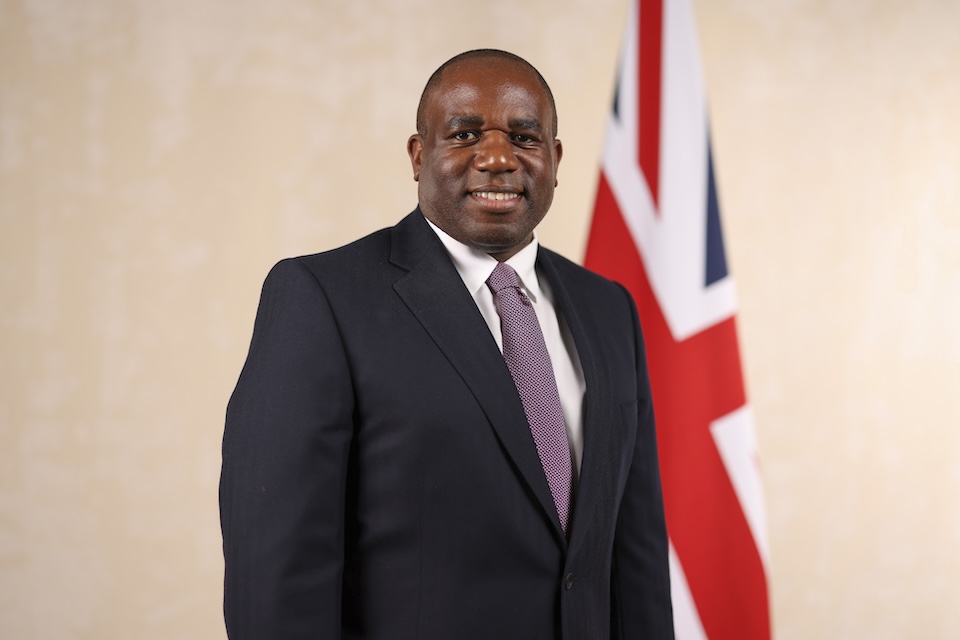
    UK Foreign Secretary David Lammy has issued a stark warning over the escalating violence in El Fasher, North Darfur, labelling recent atrocities as bearing the “hallmarks of ethnic cleansing” and potentially amounting to crimes against humanity.​ In a statement released by the Foreign, Commonwealth & Development Office, Lammy condemned the ongoing siege of El Fasher by the Rapid Support Forces (RSF) and the obstruction of civilians attempting to flee the conflict. He urged both the RSF and the Sudanese Armed Forces (SAF) to de-escalate hostilities immediately and to implement United Nations Security Council Resolution 2736, which calls for the cessation of fighting and the protection of civilians.​

    “The reports of violence in and around the city of El Fasher are appalling,” Lammy stated. “Both sides must de-escalate urgently in Darfur and implement UNSCR2736, which calls on the RSF to halt its siege of El Fasher and bring an immediate stop to the fighting.”

    The Foreign Secretary emphasised the responsibility of both parties to uphold international humanitarian law, highlighting their commitments made in the Jeddah Declaration to protect civilians and facilitate humanitarian access. He called for a 72-hour pause in fighting to allow for the delivery of aid and safe passage for civilians seeking refuge.​

    “Hundreds of thousands have been displaced; yet many more in Zamzam IDP camp and El Fasher are being blocked from fleeing this violence by the warring parties,” Lammy noted. “They must be free to seek safety wherever they think best and be protected as they do so.”

    The UK Government has pledged to use all available tools to hold those responsible for atrocities to account and continues to advocate for international efforts to address the humanitarian crisis in Sudan.

  • David Lammy – 2025 Statement on Events at El Fasher in Sudan

    David Lammy – 2025 Statement on Events at El Fasher in Sudan

    The statement made by David Lammy, the Foreign Secretary, on 24 April 2025.

    The reports of violence in and around the city of El Fasher are appalling.

    Last week, the UK gathered the international community in London to call for an end to the suffering of the Sudanese people. Yet some of the violence in Darfur has shown the hallmarks of ethnic cleansing and may amount to crimes against humanity. Both sides must de-escalate urgently in Darfur and implement UNSCR2736, which calls on the RSF to halt its siege of El Fasher and bring an immediate stop to the fighting.

    The UK will continue to use all tools available to us to us to hold those responsible for atrocities to account.

    The warring parties have a responsibility to end this suffering. There are no exceptions to the laws of war: both the Sudanese Armed Forces and the Rapid Support Forces agreed at Jeddah to protect civilians and facilitate humanitarian access.

    It is their responsibility to enforce these commitments, through command and control of their fighters and aligned militias. The RSF must immediately cease attacks on civilians, and the SAF and allied Joint Forces must allow safe passage for civilians to reach safety.

    Hundreds of thousands have been displaced; yet many more in Zamzam IDP camp and El Fasher are being blocked from fleeing this violence by the warring parties. They must be free to seek safety wherever they think best and be protected as they do so.

    The warring parties must give humanitarian actors the security guarantees needed to  deliver aid rapidly, safely and at scale, including through a 72-hour pause in fighting. This must be through transparent notification of movement, rather than permission, throughout North Darfur and beyond.

  • PRESS RELEASE : Polluting water bosses face up to two years in prison [April 2025]

    PRESS RELEASE : Polluting water bosses face up to two years in prison [April 2025]

    The press release issued by the Department for Environment, Food and Rural Affairs on 24 April 2025.

    New laws in force today mark the toughest sentencing powers against law-breaking water executives in history.

    • Powers introduced could see water bosses who cover up illegal sewage spills sent to prison for two years.
    • New measures will force water companies to end their disgraceful behaviour and clean up our rivers, lakes and seas for good.

    Water company bosses could face up to two years in prison due to new powers in force today (Friday 25 April 2025).

    The new powers, delivered by the Government’s landmark Water (Special Measures) Act 2025, mean water executives who cover up or hide illegal sewage spills can now be locked up.

    No prison sentences have been handed to water executives since privatisation despite widespread illegal sewage discharges into rivers, lakes and seas. These new, tougher penalties are essential because some water companies have obstructed investigations, failing to hand over vital evidence related to illegal sewage discharges. This has prevented crackdowns against law-breaking water companies.

    The new measures deliver on the Government’s promise to bring tougher criminal charges against lawbreakers in the water industry. As part of the Government’s Plan for Change, the threat of imprisonment will act as a powerful deterrent as water companies invest in upgrading broken water infrastructure and clean up our rivers, lakes and seas for good.

    Environment Secretary Steve Reed said:

    Bosses must face consequences if they commit crimes. There must be accountability.

    From today, there will be no more hiding places.

    As part of the Plan for Change, water companies must now focus on cleaning up our rivers, lakes and seas for good.

    In addition, new powers will mean that the polluters will pay for the cost of criminal investigations into wrongdoing. Authorities will now recover the costs of their enforcement activity, with the Environment Agency currently consulting on how they will use the powers.

    The payment of bonuses to water bosses will also be banned if they fail to meet high standards to protect the environment, their consumers, and their company’s finances.

    Philip Duffy, Chief Executive of the Environment Agency said:

    The Water (Special Measures) Act was a crucial step in making sure water companies take full responsibility for their impact on the environment.

    The tougher powers we have gained though this legislation will allow us, as the regulator, to close the justice gap, deliver swifter enforcement action and ultimately deter illegal activity.

    Alongside this, we’re modernising and expanding our approach to water company inspections – and it’s working. More people, powers, better data and inspections are yielding vital evidence so that we can reduce sewage pollution, hold water companies to account and protect the environment.

    The Government will continue to reform the water sector in order to clean up our rivers, lakes and seas once and for all.

    Alongside this, £104 billion of private sector investment has been secured to upgrade and build new water infrastructure across the country, supporting the building of 1.5 million new homes, creating thousands of jobs and powering new industries such as gigafactories and data centres as part of the government’s Plan for Change.

    Notes to editors:

    Criminal Liability

    • Until now, water regulators have faced significant challenges gathering evidence for prosecutions due to obstruction of their investigations.
    • This is a criminal offence, but since privatisation, only three water company officials have been criminally prosecuted for obstruction by the EA without appeal and the maximum punishment was merely a fine – though no fines were issued.
    • From now on, offences will be triable in both the Crown and Magistrates’ Courts and imprisonment will act as a powerful deterrent, bringing water regulation powers in line with other sectors, such as those covering fraud or health and safety investigations.

     The new provisions enable:

    • courts to include imprisonment as a sanction when investigations by water regulators (the Environment Agency, Natural Resources Wales and the Drinking Water Inspectorate) have been obstructed;
    • obstruction offences to be heard in the Crown Court;
    • directors and executives to be prosecuted where obstruction occurs with their consent, connivance or neglect.

    Previously:

    • obstructing regulators’ investigations was not always punishable by imprisonment;
    • cases could not always be heard in the Crown Court;
    • there were no straightforward routes for prosecuting directors or executives where obstruction was committed with their consent or connivance, or was attributable to their neglect.

    The Water Special Measures Act received Royal Assent in February – see press release here: New law to ban bonuses for polluting water bosses – GOV.UK

    Further detail on the measures in the Act can be found in the Policy Statement here: Water (Special Measures) Act: policy statement – GOV.UK

    Action on water

    • The government has taken immediate action to reset the water sector. Change is being delivered three stages:
    • In his first week in office, the Secretary of State for Environment Food and Rural Affairs Steve Reed announced a series of initial steps. This included immediately ringfencing funding for vital water infrastructure so that it can only be spent on upgrades benefiting the environment – not diverted for bonuses, dividends or salary increases. Where money is not spent, we will force water companies to return it to customers.
    • Second, the landmark Water (Special Measures) Act 2025 has been signed into law, marking the most significant increase in enforcement powers in a decade. The Act will:
    • Strengthen regulation to ensure water bosses face personal criminal liability for lawbreaking.
    • Give the water regulator new powers to ban the payment of bonuses if environmental standards are not met.
    • Boost accountability for water executives through a new ‘code of conduct’ for water companies, so customers can summon board members and hold executives to account.
    • Introduce new powers to bring automatic and severe fines.
    • Require water companies to install real-time monitors at every emergency sewage outlet with data independently scrutinised by the water regulators.
    • Third, the Independent Commission into the water sector, launched by the UK and Welsh governments, is carrying out the largest review of the industry since privatisation. Its recommendations, due later this summer, will shape further laws to attract the investment needed to clean up our waterways, accelerate infrastructure delivery and restore public confidence in the sector.
    • The next five years will see £104 billion in private sector investment into the water industry—the largest since privatisation. This will drive forward 150 major infrastructure projects, creating over 30,000 jobs across the country, and support the building of 1.5 million new homes and powering new industries such as gigafactories and data centres.
    • The Secretary of State and Water Minister recently completed a ‘Things Can Only Get Cleaner’ tour to see where this investment will underpin the building of new homes, create jobs and turbocharge local economies around the country – a cornerstone of the government’s Plan for Change. This included a pledge to end sewage discharges into the iconic lake Windermere.
  • Keir Starmer – 2025 Remarks at the IEA Future of Energy Security Summit

    Keir Starmer – 2025 Remarks at the IEA Future of Energy Security Summit

    The remarks made by Keir Starmer, the Prime Minister, at Lancaster House in London on 24 April 2025.

    Good afternoon, everyone – it’s really fantastic to see so many people here, in London, welcome to London, I’m so pleased we have got so many representatives from so many places and in a sense we’re here today for one simple reason:

    Because the world has changed.

    From defence and national security on the one hand, much discussed in recent months…

    To the economy and trade…

    Old assumptions have fallen away.

    We are living through an era of global instability…

    Which is felt by working people as an age of local insecurity.

    Factory workers, builders, carers, nurses, teachers…

    Working harder and harder for the pound in their pocket…

    But feeling at the same time that they have less control of their lives.

    *

    And energy security is right at the heart of this.

    Every family and business across the UK…

    Has paid the price for Russia weaponizing energy. And it has.

    But it’s not just that.

    *

    Let’s be frank.

    When it comes to energy…

    We’re also paying the price for our over-exposure…

    Over many years…

    To the rollercoaster of international fossil fuel markets.

    Leaving the economy – and therefore people’s household budgets…

    Vulnerable to the whims of dictators like Putin…

    To price spikes…

    And to volatility that is beyond our control.

    Since the 1970s, half of the UK’s recessions have been caused by fossil fuel shocks.

    That’s true for many of the other nations represented here this afternoon.

    So what’s different today is not the information we have.

    It’s not our awareness of the problem.

    No.

    What’s different now…

    Is our determination…

    In a more uncertain world…

    To fix it.

    It’s our determination that working people…

    Should not be exposed like this anymore.

    *

    So, to the British people, I say:

    This government will not sit back…

    We will step up.

    We will make energy a source…

    Not of vulnerability, but of strength.

    We will protect our critical infrastructure, energy networks and supply chains…

    And do whatever it takes…

    To protect the security of our people.

    Because this is the crucial point –

    Energy security is national security…

    And it is therefore a fundamental duty of government.

    And I’m very clear –

    We can’t deliver that by defending the status quo…

    Or trying to turn the clock back…

    To a world that no longer exists.

    *

    Of course, fossil fuels will be part of our energy mix for decades to come.

    But winning the fight for energy security depends on renewal –

    It depends on change…

    It depends on cooperation with others.

    And that’s why we’re all here today – so many countries, so many communities represented.

    *

    The IEA was founded in 1974,

    In the midst of an energy crisis,

    To help us work together to secure energy supplies…

    And reduce future energy shocks.

    Well, that has taken on a new urgency today.

    So our task is clear –

    To act – together…

    To seize the opportunity of the clean energy transition.

    Because homegrown clean energy…

    Is the only way…

    To take back control of our energy system…

    Deliver energy security…

    And bring down bills for the long term.

    *

    And I want to tell you –

    That is in the DNA of my government.

    When we came into office last year…

    We knew there was no time to waste.

    So in our first 100 days…

    We launched Great British Energy –

    As a national champion to drive investment and transform clean power.

    We scrapped the ban on onshore wind…

    And became the first G7 economy to phase out coal power.

    While we won’t turn off the taps…

    We’re going all out –

    Through our Plan for Change…

    To make Britain a clean energy superpower…

    To secure home grown energy…

    And set a path to achieving clean power by 2030.

    *

    Now, I know, some in the UK don’t agree with that.

    They think energy security can wait.

    They think tackling climate change can wait.

    But do they also think that billpayers can wait too?

    Do they think economic growth can wait?

    Do they think we can win the race for green jobs and investment by going slow?

    That would serve no one.

    Instead, this government is acting now…

    With a muscular industrial policy –

    To seize these opportunities…

    To boost investment…

    Build new industries…

    Drive UK competitiveness…

    And unlock export opportunities –

    In wind, nuclear, hydrogen, carbon capture, heat pumps and so much more.

    That is the change we need.

    We won’t wait –

    We’ll accelerate.

    *

    Because we’re already seeing the benefits.

    The UK’s net zero sectors are growing three times faster than the economy as a whole.

    They have attracted £43 billion of private investment since last July.

    And now they support around 600,000 jobs across the UK.

    That means more opportunities…

    And more money in people’s pockets.

    And we’re going further.

    We’ve stripped out unnecessary red tape…

    To put Britain back in the global race for nuclear energy…

    And allow for Small Modular Reactors for the first time.

    We’re speeding up planning for clean energy projects –

    Including onshore wind…

    To power millions of homes and unlock further investment of £40 billion each year.

    *

    It’s really clear to me –

    That investors want policy certainty.

    They want ambition.

    That is what we’re providing.

    And now we are raising our ambition even further.

    I am really pleased to announce today…

    That we’re creating a new Supply Chains Investment Fund –

    As part of Great British Energy.

    It will be backed by an initial £300 million of new funding…

    For domestic offshore wind…

    Leveraging billions of new private investment…

    Supporting tens of thousands of jobs…

    And driving economic growth.

    When companies are looking to invest in clean energy…

    When partners are looking to build new turbines, blades or cables…

    Our message is simple:

    Build it in Britain.

    I am determined to seize this opportunity –

    To win our share of this trillion-dollar market…

    And secure the next generation of great jobs.

    I’ve met apprentices at the docks in Grimsby – fantastic individuals…

    I’ve been to Holyhead in Wales…

    And the National Nuclear Laboratory in Preston…

    And I’ve seen the brilliant clean power infrastructure that we are building in this country.

    But more than that…

    I’ve seen the pride that these jobs bring.

    This is skilled, well-paid work…

    Meaningful work –

    A chance to reignite our industrial heartlands…

    To rekindle the sense of community pride and purpose…

    That comes from being part of something that is bigger than yourself.

    And so I’m pleased to tell you…

    That I can share some more good news this afternoon.

    Earlier today, we finalised a deal with ENI.

    It will see them award £2 billion in supply chain contracts…

    For the Hynet Carbon Capture and Storage project…

    Creating 2,000 jobs, across North Wales and the North West.

    I want to thank all those here today who are part of this success story.

    Because it is all built on stability, yes…

    But our ruthless focus on delivery…

    But it is also built on partnership.

    *

    So let me say –

    It is a real pleasure today to welcome my friend –

    President von der Leyen.

    Ursula – it is so good to have you with us this afternoon. Last time we were in this building, Ursula and I stood together with other colleagues here at Lancaster House, that was just last month, six weeks ago…

    Standing shoulder-to-shoulder with President Zelenskyy…

    Working together for European security.

    Today we stand, again together with Fatih and others and the IEA…

    United behind European energy security.

    Europe must never again be in a position where Russia thinks they can blackmail us on energy.

    And until Russia comes to the table and agrees a full and unconditional ceasefire…

    We must continue to crack down on their energy revenues which are still fuelling Putin’s war chest.

    This is the moment to act.

    And it is the moment to build a partnership with the EU that meets the needs of our time –

    Facing up to the global shocks of recent years…

    And working together to minimise the impact on hard-working people.

    So we’re doing more with the EU to improve our interconnections…

    And make the most of our shared energy systems…

    As well as building on the fantastic partnerships that we already have…

    With countries like the Netherlands, Germany, Norway and so many others.

    We have a common and important resource in the North Sea…

    Which can help us meet common challenges –

    To me, this is just common sense.

    So let’s seize this potential…

    To drive down bills…

    And drive up investment, growth and energy security.

    I was elected with a mandate to deliver change.

    So I make no apologies for pursuing every avenue…

    To deliver in the national interest and secure Britain’s future.

    That is always my priority.

    And of course this has to be a global effort as well.

    We need to see a wider coalition…

    That unites the north and south…

    In a global drive for clean power.

    That’s why I launched the Global Clean Power Alliance at the G20 last year…

    Working alongside the EU’s Global Energy Transitions Forum.

    And that’s why we’re joining forces to take this forward.

    We want to tackle the barriers and bottlenecks that are holding countries back.

    So I am pleased to announce today…

    That, under the Global Clean Power Alliance…

    We are establishing a first-of-its-kind global initiative…

    To unblock and diversify clean energy supply chains.

    We are harnessing the political leadership needed to make this happen.

    Because, ultimately…

    That is what this is about:

    Leadership.

    In this moment of instability and uncertainty…

    Where we are buffeted by global forces…

    We are taking control.

    We are working together with partners from around the world…

    With the IEA and all of you here today…

    To accelerate this vital global transition.

    And in the UK…

    We are stepping up now…

    To make energy a source…

    Not of vulnerability, and worry…

    Which it is at the moment and it has been for so long…

    But a source of strength, of security and pride.

    With British energy, powering British homes, creating British jobs –

    A collective effort, to boost our collective security…

    For generations to come.

    Thank you very much.

    *

    And now it is my very great pleasure and privilege to introduce…

    President von der Leyen, my friend Ursula, thank you very much for being here. Ursula, the stage is yours.

  • PRESS RELEASE : British-Irish Intergovernmental Conference (BIIGC) Joint Communiqué [April 2025]

    PRESS RELEASE : British-Irish Intergovernmental Conference (BIIGC) Joint Communiqué [April 2025]

    The press release issued by the Northern Ireland Office on 24 April 2025.

    Today the Secretary of State for Northern Ireland, Hilary Benn MP, and the Parliamentary Under-Secretary of State, Fleur Anderson MP, attended the British-Irish Intergovernmental Conference in Hillsborough Castle.

    A meeting of the British-Irish Intergovernmental Conference took place in Hillsborough Castle on 24 April 2025.

    The Government of the United Kingdom of Great Britain and Northern Ireland was represented by the Secretary of State for Northern Ireland, the Rt Hon Hilary Benn MP, and the Parliamentary Under-Secretary of State for Northern Ireland, Fleur Anderson MP.

    The Government of Ireland was represented by the Tánaiste, Minister for Foreign Affairs and Trade and Minister for Defence, Simon Harris TD, and the Minister for Justice, Jim O’Callaghan TD.

    Legacy

    The UK Government and the Government of Ireland noted that one of the aims of the Good Friday Agreement – to acknowledge and address the suffering of victims and survivors of the Troubles – remains unrealised. Both Governments reaffirmed their strong desire to work in partnership on this issue and expressed a mutual commitment to making timely progress so that families can obtain the information and accountability that they deserve and have long sought.

    Both Governments reflected on the positive and constructive bilateral discussions that had taken place since the last BIIGC on the Northern Ireland Troubles (Legacy & Reconciliation) Act 2023 and the Commission it established. They noted the substantive progress made and emphasised that their aim remains to reach agreement on a joint, comprehensive approach to legacy issues consistent with the principles of the Stormont House Agreement – including ensuring that legacy mechanisms are human rights compliant and balanced, proportionate, transparent, fair and equitable.

    The UK Government and the Government of Ireland agreed that any joint approach to legacy will require agreement on all key issues, including: fundamental reform of the Independent Commission for Reconciliation and Information Recovery to ensure its human rights compliance and to strengthen its practical independence, governance and oversight; the approach to legacy inquests and information retrieval; and ensuring that there are clear reciprocal commitments by both the UK Government and the Government of Ireland.

    It was agreed that both Governments would continue to work quickly and intensively in seeking to finalise a joint approach. The UK Government remains committed to introducing legislation to repeal and replace the Legacy Act when Parliamentary time allows, and the Government of Ireland will introduce its own legislation as necessary. Ultimately, securing the confidence of victims, survivors, and families will remain at the heart of the work of both Governments.

    Political stability

    The Governments discussed their shared commitment to the good operation of all three strands of the Good Friday Agreement. They affirmed the importance of the full and timely implementation of the Windsor Framework. They took stock of recent developments including US tariff measures and their respective engagement with stakeholders to date.

    The UK Government also provided an update on the ongoing efforts to support the Northern Ireland Executive with public service transformation.

    Security update

    The Governments discussed the current security situation, including the Northern Ireland-related terrorism (NIRT) threat. That the NIRT threat level remains unchanged at SUBSTANTIAL is testament to the work being done by agencies on both sides of the border. This cross-border cooperation remains a vital part of work to tackle the terrorist threat and wider harms.

    They discussed an update on the process underway jointly to appoint an Independent Expert to carry out a short scoping and engagement exercise to assess whether there is merit in, and support for, a formal process of engagement to bring about paramilitary group transition to disbandment.

    British-Irish cooperation

    Ministers reflected on the recent UK-Ireland Summit, including on how future meetings of the BIIGC could complement the programme of cooperation agreed at the Summit.

    They reaffirmed their shared commitment to protecting the Common Travel Area to the benefit of citizens across these islands and noted, in particular, the importance of continued engagement with all stakeholders to ensure the UK ETA scheme operates smoothly.

    The Governments agreed that the Conference would meet again in the coming months.

  • PRESS RELEASE : Scottish Secretary Increases Scottish Government Borrowing Powers [April 2025]

    PRESS RELEASE : Scottish Secretary Increases Scottish Government Borrowing Powers [April 2025]

    The press release issued by the Scotland Office on 24 April 2025.

    The Scottish Government will have increased borrowing powers following an Order made in Parliament this week by Scottish Secretary.

    Ian Murray has laid the ‘The Scotland Act 1998 (Increase of Borrowing Limits) Order 2025’ which increases the Scottish Government’s borrowing limits to a cumulative total of £3 billion for capital and £629 million for resource.

    The Scottish Government’s borrowing limits (both annual and cumulative) are uprated annually in line with inflation, as set out in the Fiscal Framework. As the cumulative limits are legislated for under the Scotland Act 1998, secondary legislation is required to make the annual changes. The annual limits are non-legislative so no legislative change is required to amend these.

    Speaking after laying the Order, Mr Murray said:

    “I’m very pleased to have laid this Scotland Act Order which increases the Scottish Government’s cumulative borrowing limits to a total of £3.6 billion. The Autumn Budget provided an additional £4.9 billion for the Scottish Government, ending austerity. These borrowing powers are on top of the Scottish Government’s record funding settlement of £47.7 billion this financial year. We have reset the relationship with the Scottish Government, and this order is a key part of our commitment to maintain the devolution settlement.”

    The Order will take effect on 30 June 2025. There will be a debate in the House of Commons before then.

    The 2023 Fiscal Framework Agreement between the Scottish and UK Governments sets out the Scottish Government’s funding arrangements, including budget management tools such as borrowing powers.

    Officials in both the UK Government and the Scottish Government worked together to deliver the Order, as they do with all Scotland Act Orders.

  • PRESS RELEASE : Windfarm Capable of Powering Half of Scotland’s Homes [April 2025]

    PRESS RELEASE : Windfarm Capable of Powering Half of Scotland’s Homes [April 2025]

    The press release issued by the Scotland Office on 24 April 2025.

    The UK’s drive towards clean power, which is a huge jobs and economic opportunity for Scotland, took a significant step forward today [24 April] when Scottish Secretary Ian Murray switched on full power at Ocean Winds’ new Moray West offshore windfarm.

    The windfarm, located 13 miles off the coast of Buckie, is one of Scotland’s largest offshore windfarms. It will generate up to 882MW output – enough to power 1.3 million homes – half of Scotland’s households. Upon full power, Ocean Winds will become the largest offshore wind operator in Scotland, running two windfarms off the North East coast and with a third in development.

    Clean energy represents the economic opportunity of the 21st century, with this project alone creating around 1,500 jobs during the construction phase. The developer, Ocean Winds, has used more than 80 UK suppliers in the project to date, which has involved installing the biggest turbines yet in British waters, spanning up to 257m above sea level.

    Speaking after his visit, Mr Murray said:

    “It was a huge moment today when I switched on full power for the Moray West Windfarm.

    “Investment like that being made by Ocean Winds is absolutely central to ensuring that Scotland and its workers benefit from the skilled jobs and economic growth that clean energy can bring.

    “With Great British energy located in Aberdeen, and billions of pounds of investment on the table, Scotland is at the very heart of the UK Government’s drive to make the UK a clean energy superpower.”

    Moray West takes the UK Government a step closer to achieving the 43-50GW offshore wind targets set for 2030, as published in the Clean Power Action Plan- helping deliver on its mission to make the UK a clean energy superpower.

    During his visit to Ocean Winds, Mr Murray met staff who have transitioned into renewables after careers in the oil and gas industry and the UK’s armed forces.

    Energy Secretary Ed Miliband said:

    “Offshore wind is the backbone of our plans for clean power by 2030, as the UK is blessed with thousands of miles of coastline.

    “Developments like Moray West take us a step closer to getting off the fossil fuel rollercoaster and help deliver on our Plan for Change, protecting households from volatile gas prices and creating good jobs.”

    After switching on the windfarm to full power, Mr Murray travelled to Aberdeen.

    There he visited Sarens PSG and ETZ Ltd.

    Sarens PSG were involved in the construction of the Moray West windfarm, marshalling 62 giant ‘monopiles’ – the wind turbine foundations. 10 metres in diameter and 84 metres long, the 2.000 tonne monopiles are the largest and heaviest ever to be handled in the United Kingdom. Mr Murray saw Sarens PSG’s new £1.6 million Aberdeen training facility for wind farm workers. The company opened the facility recently, saying that Great British Energy’s headquarters being located in Aberdeen made the city the ideal location for the facility⁠.

    Touring the Energy Transition Zone, Mr Murray visited the Floating Wind Innovation Centre, the UK’s first dedicated facility of its kind for floating wind technology, run by ORE Catapult.

    Also today [24 April 2025] Scotland Office Minister Kirsty McNeill visited the Port of Leith, located within the Forth Green Freeport, to mark the official opening of Forth Ports’ new Outer Berth. Forth Ports has invested a total of £100 million into transforming the Port of Leith into a world class renewables hub, which is already playing a key role in supporting Scotland’s energy transition. The Leith Renewables Hub is part of the Forth Green Freeport’s strategically located tax sites, which aim to reindustrialise central Scotland, generating thousands of high-quality green jobs by increasing trade and supporting the growth of businesses across the Firth of Forth.

    These visits are happening against the background of the UK Government co-hosting the International Energy Agency summit in London, a global event bringing together countries to discuss energy security.

  • Claire Hughes – 2025 Speech on Littering from Vehicles (Offences)

    Claire Hughes – 2025 Speech on Littering from Vehicles (Offences)

    The speech made by Claire Hughes, the Labour MP for Bangor Aberconwy, in the House of Commons on 22 April 2025.

    I beg to move,

    That leave be given to bring in a Bill to increase penalties for civil offences relating to littering from vehicles; to make provision about the use of technology in detecting and identifying persons who have committed such offences; and for connected purposes.

    I start by thanking the Minister for Food Security and Rural Affairs, my hon. Friend the Member for Cambridge (Daniel Zeichner), for being here today. When I was first elected last year, I did not expect that litter would be one of the first issues I would be campaigning on in Parliament, but over the past nine months it is something that constituents have raised with me again and again, because frankly, they are fed up. Roadside littering has become more than just an eyesore. For many, it is a visible sign of a lack of respect for our environment, for our communities and for each other. Right now, too many people seem to think it acceptable to buy a takeaway from a drive-through, to eat it, drink it on the go, and then throw the rubbish out the window.

    Research backs that up. The road safety charity IAM RoadSmart found in February this year that nearly 40% of motorcyclists had experienced car drivers or passengers throwing litter out their window while overtaking. National Highways found that 65% of drivers who admit to littering have thrown food and drink packaging from their vehicle. Keep Wales Tidy reported that fast-food litter hit its highest-ever levels in its latest annual report in 2023.

    It appears that while some people care a lot about keeping their cars clean, they are not nearly as bothered about keeping our communities clean. Scientific litter mapping carried out on road networks in and around Cardiff showed that litter was dropped every three seconds. That is the equivalent of 28,800 pieces of litter every day in just one city. When roadsides are already strewn with litter, it signals that littering is acceptable and it encourages more of the same. In rural and coastal areas, such as those I represent in north Wales, roadside litter adds to the growing sense that tourism, while vital to our local economy, places a disproportionate burden on local residents and the authorities tasked with cleaning up.

    To be clear, littering is already a criminal offence in England and Wales under the provisions of the Environmental Protection Act 1990. Local authorities can issue fixed penalty notices in lieu of prosecution of up to £500 in England and £150 in Wales. In England, if someone is caught throwing litter from a vehicle, litter authorities can also issue a civil penalty, even if they cannot establish the identity of the person who threw the litter. It is evident, though, that the current penalties are not acting as a sufficient deterrent. We only need to look out of our car window the next time we slow down near a roundabout or traffic lights to see the evidence.

    Litter is not just ugly; it puts those tasked with clearing it up at risk, and it costs UK taxpayers a massive £1 billion a year to clear it up. Many of us would agree that money could be better spent elsewhere, including on our NHS. Litter also has serious social and environmental consequences. It is estimated that 3 million animals die due to litter in the UK every year. Discarded food attracts wildlife such as deer and foxes to the side of the road, where they are more likely to be hit by cars. Small mammals get trapped in bottles and die. The Royal Society for the Prevention of Cruelty to Animals receives about 10 calls a day about animals injured or killed by waste, and it believes the actual number to be far higher. We are said to be a nation of animal lovers, but the figures suggest otherwise.

    Litter from vehicles makes its way to the sea. A staggering 350 kg of litter was collected in just one day by North Wales Wildlife Trust volunteers during their annual beach clean-up in January. Not all of that will have been thrown from vehicles, of course, but a significant proportion of that which gets thrown from cars ends up getting blown into watercourses and ends up in our rivers and streams. Microplastics are another huge concern as litter degrades in the environment. Bangor University conducted some of the world’s first-ever research looking at microplastics in the UK’s rivers and lakes and even found them in a remote lake near the summit of Yr Wyddfa.

    I am therefore pleased that both the UK and Welsh Governments are taking action to tackle this kind of pollution, including by restricting single-use plastics and introducing deposit return schemes. To truly get a grip of this problem, we need a multi-pronged approach, and tackling roadside littering has to be part of that. Some people might say that a lack of litter bins is to blame, and I do not disagree that more bins would help. The Road Haulage Association, which I have met, is calling for better facilities for long-distance lorry drivers, and I fully support that ask. However, a lack of bins does not make it okay for anyone to throw cans, food packaging or empty bottles on our roads knowing that somebody else will have to pick it up.

    I am sure that every Member of this House would join me in thanking the army of volunteers up and down the country who dedicate their time and energy to litter-picking week in, week out. In my constituency, groups such as the Friends of Mostyn Street in Llandudno, Trash Free Trails and Keep Bangor Tidy—to name just a few—remove huge quantities from our communities. We owe them all a huge debt of thanks, but we cannot keep expecting volunteers to clear up after the minority of people who have refused to act responsibly.

    One of the central missions of this Government is to take back our streets, tackling crime and restoring a sense of order. I strongly welcome the measures being introduced in the Crime and Policing Bill to crack down on antisocial behaviour and to stop turning a blind eye to what the last Government deemed “low-level crimes”. In a similar vein, this Bill proposes increased civil penalties for littering from vehicles, because I strongly believe that we need stronger deterrents. The Bill also allows for an expansion in the use of technology for the identification of offenders, which is currently a barrier to enforcement and further weakens the deterrent powers of fixed penalty notices. We need to ensure that the law keeps pace with advances in technology, which will not only increase the detection rate, but reduce the costs of enforcement.

    To conclude, this Labour Government are relentlessly focused on the priorities of working people in our country, and 81% of people in the UK say that litter makes them feel angry and frustrated. There are many pressing issues in the Government’s in-tray inherited from the last 14 years, but tackling roadside littering will help restore pride in our communities, protect biodiversity and support nature restoration. I hope that the House will support this Bill. I thank the House for giving its time and attention to this important matter.

    Question put and agreed to.

    Ordered,

    That Claire Hughes, Mr Alex Barros-Curtis, Andrew Ranger, Ann Davies, Becky Gittins, Catherine Fookes, Kanishka Narayan, Llinos Medi and Sarah Coombes present the Bill.

    Claire Hughes accordingly presented the Bill.