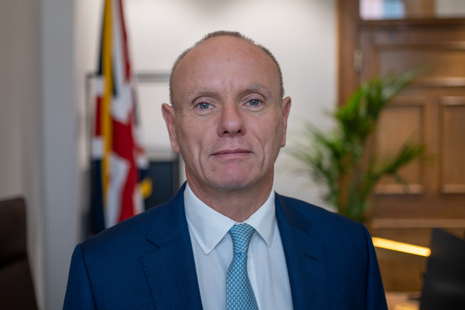
The speech made by Stephen Kinnock, the Labour MP for Aberavon, in the House of Commons on 17 July 2023.
On Tuesday, I described the way in which this Government have
“taken a sledgehammer to our asylum system”.—[Official Report, 11 July 2023; Vol. 736, c. 218.]
I outlined the massive and far-reaching costs and consequences of 13 years of Tory incompetence and indifference. I described this bigger backlog Bill as a “shambolic farce” that will only compound the chaos that Ministers have created. I urged the Government to accept the amendments proposed by the other place and to adopt Labour’s pragmatic, realistic and workable five-point plan to stop the boats and fix our broken asylum system.
I set out how the Bill’s unworkability centres on the fact that it orders the Home Secretary to detain asylum seekers where there is nowhere to detain them. It prevents her from processing and returning failed asylum seekers across the channel to their country of origin, instead forcing her to return them to a third country such as Rwanda. However, Rwanda can take only 0.3% of those who came here on small boats last year. The Rwanda plan is neither credible nor workable, because the tiny risk of being sent to Kigali will not deter those who have already risked life and limb to make dangerous journeys across the continent.
Yet here we are again today, responding to the realisation that, in their typically arrogant and tin-eared fashion, Ministers are once again refusing to listen. They are once again closing their eyes and ears to the reality of what is happening around them and choosing to carry on driving the car straight into a brick wall. But we on the Labour Benches refuse to give up. We shall continue in our attempts to persuade the Government to come to their senses. I shall seek to do that today by setting out why the arguments that the Immigration Minister has made against the amendments from the other place are both fundamentally flawed and dangerously counterproductive.
Laura Farris (Newbury) (Con)
If the principle of removal to a safe third country is not an adequate deterrent, why was that principle the flagship of the last Labour Government’s immigration policy in the Nationality, Immigration and Asylum Act 2002? What was the point of section 94—its most controversial provision—if it was not about the swift removal of failed asylum seekers?
Stephen Kinnock
The crucial point is that for a deterrent to be effective, it has to be credible. A deterrent based on a 0.3% risk of being sent to Rwanda is completely and utterly incredible. The only deterrent that works is a comprehensive returns deal with mainland Europe. If someone knows that, were they to come here on a small boat, they would be sent back to mainland Europe, they will not come and they will not pay €5,000 to the people smuggler. The only way to get that deal is to have a sensible and pragmatic negotiation with the European Union based on quid pro quo—give and take. That is the fundamental reality of the situation in which we find ourselves, but unfortunately those on the Conservative Benches keep closing their ears to that reality.
Laura Farris
I am grateful to the hon. Gentleman for giving way again—I will not take long. Does he not accept that, in reality, there is no such thing as a returns deal with mainland Europe? The reason the Dublin convention was such a disaster and never resulted in us removing more people than we took in was that it was so incredibly difficult to get European countries to accept removals and make that happen. It is just an unworkable suggestion.
Stephen Kinnock
Surely the hon. Lady sees the direct connection between us crashing out of the Dublin regulation because of the utterly botched Brexit of the Government she speaks for, and the number of small boat crossings starting to skyrocket. There is a direct correlation between crashing out of the Dublin regulation and skyrocketing small boat crossings. I hope that she will look at the data and realise the truth of the matter.
Tim Loughton (East Worthing and Shoreham) (Con)
We have had this conversation before. The hon. Gentleman knows that when we were covered by Dublin—before we came out of it through Brexit—there were more than 8,000 requests for people to be deported back to an EU country, and only 108 of those requests, or about 1.5%, were actually granted. So there was not some golden era when it worked under Dublin; it was not working then, and it certainly will not work now.
Stephen Kinnock
The hon. Gentleman is right, we have had this conversation before, and he consistently refuses to listen to the fact that the Dublin regulation acted as a deterrent, so the numbers that he talks about were small. The number of small boat crossings was small when we were part of the Dublin regulation. We left the Dublin regulation, and now the number is large—it is not rocket science. There is a clear connection, a correlation, a causal link between the two.
Sir Robert Buckland (South Swindon) (Con)
The hon. Gentleman is being very generous with his time. The reason the small boats problem has grown exponentially is that we dealt with the lorries issue. We closed the loophole when it came to lorries and the channel tunnel in particular, and that is why people are now resorting to small boats. It is nothing to do with Dublin. Surely those are the facts.
Stephen Kinnock
I simply say to the right hon. and learned Gentleman that last year, we had 45,000 people coming on small boats and goodness knows how many on lorries—of course, those coming by clandestine means in the back of a lorry are far more difficult to detect than those coming on small boats, so the small boats crisis is, by definition, far more visible. It is true that that juxtaposition and the new arrangements have had a positive impact, but we still do not know how many are coming. I have been to camps in Calais and spoken to many who are planning to come on lorries rather than on small boats—not least because it is a far cheaper alternative. The reality is that a very large number of people are coming to our country through irregular means, but it is also clear that that number was significantly smaller when we were part of the Dublin regulation. That is because it was a comprehensive deterrent, compared with the utterly insignificant power of the Rwanda programme as a deterrent.
Alexander Stafford (Rother Valley) (Con)
Will the hon. Member give way?
Stephen Kinnock
I will make a little bit of progress, and then I will allow the hon. Gentleman to intervene.
I will turn first to Lords amendment 1B, intended to ensure that the Bill is consistent with international law, which Labour fully supports. Last week, the Minister deemed the same amendment unnecessary, because:
“It goes without saying that the Government obey our international obligations, as we do with all pieces of legislation.”—[Official Report, 11 July 2023; Vol. 736, c. 198.]
That comment was typical of the Minister’s approach. He is constantly trying to calm his colleagues’ nerves by fobbing them off with that sort of soothing statement, but we all know that he does not really believe a word of it. He knows that the very first page of the Bill states that the Government are unable to confirm that it complies with our legal obligations. He also knows that the Government are more than happy to break international law—just look at how they played fast and loose with the Northern Ireland protocol. If the Minister really thinks that we will simply take his deeply misleading words at face value and trust him and his colleagues to uphold our legal obligations, he has another think coming.
Madam Deputy Speaker (Dame Eleanor Laing)
Order. I think that the hon. Gentleman did not mean to use the phrase “deeply misleading”. Knowing that he is an honourable gentleman, I suggest that he might want to use a slightly different phrase—“inadvertently misleading”, perhaps?
Stephen Kinnock
I thank you, Madam Deputy Speaker. Would “misleadingly soothing” work?
Madam Deputy Speaker
It will do for the time being.
Stephen Kinnock
As always, Madam Deputy Speaker, you are very gracious.
The late, great Denis Healey famously advised that when you are in a hole, you should stop digging. [Hon. Members: “Quite right!”] Hang on. He would certainly have approved of Lords amendment 9B, which goes right to the heart of the fundamental unworkability of this bigger backlog Bill and seeks to prevent it from becoming the indefinite limbo Bill.
Let us be clear: the current state of affairs represents both a mental health crisis for asylum seekers and a financial crisis for British taxpayers, who are already shouldering an asylum bill that is seven times higher than it was in 2010, at £3.6 billion a year. Indeed, the mid-range estimate for the hotels bill alone is greater than the latest round of levelling-up funding, and three times higher than the entire budget for tackling homelessness in this country. The only people who benefit from the inadmissibility provisions in the Bill are the people smugglers and human traffickers, who are laughing all the way to the bank. As such, it is essential that this House votes in favour of Lord German’s amendment, which seeks to ensure that inadmissibility can be applied to an asylum seeker only for a period of six months if they have not been removed to another country.
A major concern throughout the passage of the Bill has been its utter disregard for the mental wellbeing of unaccompanied children. Many of those children will have had to see their loved ones suffer unspeakable acts of violence, yet despite the Government’s concession, the Bill will mean that when they arrive in the UK, they will be detained like criminals for up to eight days before they can apply for bail. We are clear that that is unacceptable, and are in no doubt that the Government’s amendment is yet another example of their liking for performative cruelty. We urge the Minister to accept the compromise of 72 hours contained in Lords amendments 36C and 36D.
Alexander Stafford
Will the hon. Member give way?
Stephen Kinnock
Sorry, I meant to let the hon. Gentleman in earlier.
Alexander Stafford
I thank the hon. Member for giving way. The best thing for any person’s mental health, especially children, is to not put them on a dangerous small boat across the channel. Does the hon. Member agree that the best thing for any child’s mental health is for them to not make that dangerous journey, but instead use one of the many legal and safe routes? This Bill and its clauses will make sure that fewer children make that awful journey.
Stephen Kinnock
The hon. Gentleman is absolutely right that the only people who benefit from the small boat crossings are the people smugglers and human traffickers—that has to be brought to an end. Where we fundamentally disagree is about the means. Labour believes that the deterrence of the Rwanda scheme simply will not work, for the reasons I have already set out, and that the solution lies far more in pragmatism and quiet diplomacy, working with international partners to get the returns deal that I talked about, than in all the performative cruelty that is at the heart of this Bill.
Likewise, the Government should show some humility and support Lords amendment 33B, which states that accompanied children should be liable for detention only for up to 96 hours. This is a fair and reasonable compromise, given that Lords amendment 33 initially set the limit at 72 hours.
While we are on the subject of children, how utterly astonishing and deeply depressing it was to hear the Minister standing at the Dispatch Box last week and justifying the erasure of Disney cartoons on the basis of their not being age-appropriate. Quite apart from the fact that his nasty, bullying, performative cruelty will have absolutely no effect whatsoever in stopping the boats, it has since emerged that more than 9,000 of the children who passed through that building in the year to March 2023 were under the age of 14. Given that a significant proportion of those 9,000 would have been younger still, I just wonder whether the Minister would like to take this opportunity to withdraw his comments about the age-appropriateness of those cartoons.
Robert Jenrick indicated dissent.
Stephen Kinnock
No. Well, there we have it. This whole sorry episode really was a new low for this Minister and for the shameful, callous Government he represents.
We also support Lords amendment 23B, a compromise in lieu of Lords amendment 23, which seeks to protect LGBT asylum seekers from being removed to a country that persecutes them for their sexuality or gender. The Minister last week claimed that that was unnecessary because there is an appeals process, but why on earth would he put asylum seekers and the British taxpayer through an expensive and time-consuming appeals process when he could just rule out this scenario from the outset?
Nothing illustrates more clearly the indifference of this Government towards the most vulnerable people in society than their treatment of women being trafficked into our country for prostitution. I have already described this Bill as a traffickers charter—a gift to the slave drivers and the pimps—because it makes it harder for victims to come forward and therefore more difficult for the police to prosecute criminals. The Immigration Minister last week repeated the false claim that the UK Statistics Authority recently rebuked him for. It was his second rebuke this year by our national statistics watchdog for inaccurate claims made to this House. Thankfully, the right hon. Member for Maidenhead (Mrs May), who is not in her place today, called him out on it. She correctly pointed out that the proportion of small boats migrants claiming to be victims of modern slavery stands at just 7%. This was a profoundly embarrassing moment for the Minister, but I do hope he will now swallow his pride, listen to the wise counsel he is receiving from those on the Benches behind him and accept Lords amendment 56B in the name of Lord Randall.
Robert Jenrick
The hon. Member is right that I misspoke when citing those statistics on an earlier occasion, but in fact the statistics were worse than I said to the House. What I said was that, of foreign national offenders who are in the detained estate on the eve of their departure, over 70% made use of modern slavery legislation to put in a last-minute claim and delay their removal. However, it was not just FNOs; it was also small boat arrivals. So the point I was making was even more pertinent, and it is one that he should try to answer. What would he do to stop 70% of people in the detained estate, who we are trying to get out of the country, putting in a frivolous claim at the last minute?
Stephen Kinnock
Sir Robert Chote of the UK Statistics Authority said clearly that the figure is only 20%, not 70%. I do not know whether we want to invite Sir Robert to clarify those points himself, but the rebuke the Minister received from the UK Statistics Authority was pretty clear.
It is vitally important that the Minister’s position on this is not used as the basis for a policy that could cause profound harm to vulnerable women while feeding criminality in the United Kingdom. I therefore urge him to reflect on what he is trying to achieve, the proportionality of his actions and the unintended consequences he may be facilitating. Lords amendment 56B states that victims of trafficking who have been unlawfully exploited in the UK should be protected from the automatic duty to remove and should continue to be able to access the support currently available to them, but only for the duration of the statutory recovery period, which was set by the Nationality and Borders Act 2022 at 30 days.
On Second Reading, the right hon. Member for Maidenhead argued that the Bill as drafted would
“drive a coach and horses through the Modern Slavery Act, denying support to those who have been exploited and enslaved and, in doing so, making it much harder to catch and stop the traffickers and slave drivers.”—[Official Report, 28 March 2023; Vol. 730, c. 886.]
We strongly agree with her concerns and wholeheartedly support Lords amendment 56B, which I remind the Minister goes no further than to maintain the status quo of the basic protections and support currently available to all victims of trafficking and exportation.
I will now turn to the amendments that are underpinned by Labour’s five-point plan: end the dangerous small-boat crossings, defeat the criminal gangs, clear the backlog, end extortionate hotel use, and fix the asylum system that the Conservatives have spent 13 years destroying.
Sir Edward Leigh
Presumably it is the hon. Gentleman’s most devout hope if he takes power in 15 months’ time, but charming as he is, it is a mystery to me why he thinks when he asks President Macron to take these people back, he will do so. Of course he won’t! Nothing will happen. May I gently suggest that, if there is a Labour Government, they will quietly adopt this Bill once it is an Act?
Stephen Kinnock
I will come to that in my comments, but as the right hon. Gentleman will know, any negotiation requires give and take, quid pro quo. As I said in response to one of his hon. Friends, to get that deal with the European Union we of course have to do our bit and take our fair share, and that will be the negotiation that my right hon. and learned Friend the Member for Holborn and St Pancras (Keir Starmer) will be leading on when he becomes Prime Minister of the United Kingdom, following the next general election.
We are determined that the National Crime Agency will be strengthened so that it can tackle the criminal gangs upstream. Too much focus by this Government has been on slashing tents and puncturing dinghies along the French coastline, whereas Labour has set out its plan for an elite unit in the NCA to work directly with Europol and Interpol. The latest amendment from Lord Coaker, Lords amendment 103B, attempts to strengthen the NCA’s authority, and we support it without reservation. We are also clear that there is a direct link between gaining the returns agreement that we desperately need with the EU, and creating controlled and managed pathways to asylum, which would allow genuine refugees to reach the UK safely, particularly if they have family here. Conservative Members refuse to make that connection, but we know it is in the interests of the EU and France to strike a returns deal with the UK, and dissuade the tens of thousands of asylum seekers who are flowing through Europe and ending up on the beaches of Calais. The EU and its member states will never do a deal with the UK unless it is based on a give-and-take arrangement, whereby every country involved does its bit and shares responsibility.
Jeremy Corbyn (Islington North) (Ind)
On his visit to Calais, the hon. Gentleman will have met people who were trying to get to this country. Did it strike him how utterly desperate many of them were, and how they are fleeing from wars in Afghanistan, Libya, Iraq and other places? Does he think that we have to address the wider issue of the reasons why people are fleeing and searching for asylum, not just in Europe but all over the world?
Stephen Kinnock
I thank the right hon. Gentleman. As he rightly points out, the key point is that these people are already fleeing desperate situations and have risked life and limb to get as far as they have. The idea that a 0.3% chance of being sent to Rwanda acts as a deterrent is clearly for the birds. In addition, he makes important points about the need for international co-operation, and finding solutions to these problems alongside our partners across the channel.
Alexander Stafford
The hon. Gentleman clearly thinks that the Rwanda plan will not work or be a deterrent, but why not give it a go? If he is so confident that it will not work, let it get through. It could have got through months ago, and he could have come back to the House and proved us wrong. At the moment it comes across as if the hon. Gentleman and the Labour party are scared that it might work, and that is the problem.
Stephen Kinnock
I suppose the answer to the hon. Gentleman’s question is that if it walks like a duck and quacks like a duck, it probably is a duck, and the Rwanda plan is so clearly and utterly misconceived, misconstrued and counter-productive. Labour Members like to vote for things that are actually going to work, which is why we simply cannot support that hare-brained scheme.
With the Minister last week reiterating a deadline of December 2024—18 months from now—to lay out what safe and legal routes might look like, and by stating that those routes will not deal with the challenges facing Europe directly, he appears to be reducing the chances of getting the returns deal with the EU that we so urgently need. Let us not forget that this Government sent Britain tumbling out of the Dublin regulations during their botched Brexit negotiations, and it is no surprise that small boat crossings have skyrocketed since then. This Government must prioritise getting that returns deal. We therefore support Lords amendment 102B, which demands that the Government get on with setting out what these safe and legal routes might look like, not only to provide controlled and capped pathways to sanctuary for genuine refugees, but to break that deadlock in the negotiations with the EU over returns.
I note that the Minister loves to trot out his lines about the Ukraine, Hong Kong and Afghan resettlement schemes, but he neglects to mention that there are now thousands of homeless Ukrainian families, and we have the travesty of thousands of loyal-to-Britain Afghans who are set to be thrown on the streets at the end of August. More than 2,000 Afghans are stuck in Pakistan with the right to come here, but they are not being allowed to do so. He simply must fix those resettlement schemes.
Robert Jenrick
I am grateful to the hon. Gentleman for giving way, because this is an important point that all Members of the House should appreciate. The No. 1 reason why we are struggling to bring to the UK those people in Pakistan—we would like to bring them here, because we have a moral and historical obligation to them—is that illegal immigrants on small boats have taken all the capacity of local authorities to house them. If the hon. Gentleman truly wanted to support those people, he would back this Bill, he would stop the boats, and then he would help us to bring those much-needed people into the United Kingdom.
Stephen Kinnock
It beggars belief that the Immigration Minister says that, when he speaks for a party that has allowed our backlog to get to 180,000, costing £7 million a day in hotels. He should just get the processing system sorted out. The Conservatives downgraded the seniority of caseworkers and decision makers in 2013 and 2014. Surprise, surprise, productivity fell off a cliff, as did the quality of decisions. That is the fundamental problem, but we have to recognise that these Afghans have stood shoulder to shoulder with our defence, diplomacy and development effort in Afghanistan, and we owe them a debt of honour and gratitude.
Robert Jenrick
Does the hon. Gentleman know how many asylum seekers are housed in his constituency, or would he like me to tell him? It is none. There are no asylum seekers accommodated in Aberavon. If he would like us to bring in more people, whether on safe and legal routes, or on schemes such as the Afghan relocations and assistance policy, he should get on the phone to his local council and the Welsh Government this afternoon.
Stephen Kinnock
The Minister is talking absolute nonsense. I am proud of the fact we have many Syrians in our constituency. We have Ukrainians in our welcome centre. Discussions are ongoing between the Home Office and the Welsh Government. The incompetence of his Government means that they are not managing to house them. Wales is ready to have that dialogue with the Home Office.
Rachael Maskell
I find it a shocking admission from the Minister—we are fighting for the relatives of people in Afghanistan whose lives are at risk—that these Afghans are being blocked by him because he is not making available those safe routes to bring them to constituencies such as York, where we welcome refugees.
Stephen Kinnock
I completely agree with my hon. Friend. There are real concerns about the safety and security of those Afghans now in Pakistan. It is possible that they will be sent back. It is up to the Home Office to facilitate their transfer to the United Kingdom under ARAP and the Afghan citizens resettlement scheme, but like so many things with this Home Office, it is just a catastrophic failure of management.
In trotting out the lines about the schemes that I mentioned, the Minister conveniently ignores the fact that none of those schemes help those coming from other high grant-rate countries in the middle east and sub-Saharan Africa. Neither he nor the Home Secretary have been able to answer questions from their own Back Benchers on that precise point.
The final point of our plan is to tackle migration flows close to the conflict zones where they arise through targeting our aid spending. That is a longer-term mission, but it is no less important than any of the other steps we need to take to meet these migration challenges. I therefore see no reason for the Government not to support Lords amendment 107B in the name of the Archbishop of Canterbury, which would instruct the Government to develop a 10-year plan to manage migration.
I have lost count of the number of times we have come to the Chamber to debate the Government’s latest madcap Bill or hare-brained scheme. Not one of those Bills has helped to stop a single boat, and the Government have sent more Home Secretaries to Rwanda than they have asylum seekers. They are wasting their own time and the time of the House, and they really are trying the patience of the British people. It really is desperate stuff, and it has to stop.
In stark contrast to the hopeless, aimless and utterly self-defeating thrashing around that has come to define the Government’s approach to the asylum crisis, Labour recognises that there is a way through: a route based on hard graft, common sense and quiet diplomacy. It comes in the form of the Labour party’s comprehensive plan, based on core principles, with a commitment to returning asylum processing to the well managed, efficient, smooth-running system we had prior to the catastrophic changes brought in by Conservative Ministers in 2013, which downgraded decision makers and caseworkers, leading to poorer results. With that, we have a commitment to go further in fast-tracking applications from low grant-rate countries so that we can return those with no right to be here, and fast-tracking applications from high grant-rate countries so that genuine refugees can get on with their lives and start contributing to our economy, enriching our society and culture. A third, key principle is the need for international co-operation, as I have set out.
This is not rocket science; it is just sensible, pragmatic, serious governance. It is working in the United States, where the Biden Administration are winning the battle. They have introduced a combination of swift consequences for those who cross the border illegally; orderly paths and controls on which migrants can apply for asylum and where they do so; sensible, legal pathways for high grant-rate nations; and strong co-operation with Mexico. The result is that they are bringing numbers down significantly and quickly. The challenge is not over yet, and we would not see President Biden being foolish enough to go boasting at the border, but that shows that progress can be made.
The Labour party is not interested in performative cruelty, chasing headlines or government by gimmick. We have a plan that will stop the boats, fix our broken asylum system and deliver for the British people. In contrast, the Conservative party has run out of ideas and run out of road. It should get out of the way so that we can get to work.

![PRESS RELEASE : UK Professor Jim Skea elected Chair of the IPCC [July 2023]](https://www.ukpol.co.uk/wp-content/uploads/2020/01/fco.png)
![PRESS RELEASE : Hepatitis C prevalence falls by 45% in England [July 2023]](https://www.ukpol.co.uk/wp-content/uploads/2022/08/ukhealthsecurity.png)