Blog

  • Rachel Reeves – 2021 Speech on the State of the Economy

    Rachel Reeves – 2021 Speech on the State of the Economy

    The speech made by Rachel Reeves, the Shadow Chancellor of the Exchequer, on 16 June 2021.

    Five years ago, my friend and colleague Jo Cox was murdered. There is not a day goes by when I do not think of her, and I know that on both sides of the House she is missed dearly.

    All the way through this pandemic we have said that the economic and health responses must go together. That means keeping support in place for as long as the public health measures demand it. When the public health restrictions are extended, as they were by the Prime Minister on Monday, the economic support should be extended too; otherwise we risk falling at the final hurdle. Having spent billions of pounds supporting the economy, it would be tragic to see thousands of businesses go to the wall just because the Government withdrew support a few weeks too soon. We are not calling for forever support, but for economic support that matches the timetable for opening up that the Government have set. That is the right thing for business, for workers, and for our economy too.

    Let us be clear about why we are here today: the Government’s delay in putting India on to the red list has allowed a dangerous new variant to enter our country. That is why we have the highest covid infection rate per person across the whole of Europe—all because the Prime Minister wanted his VIP trip to India. It was vain and short-sighted and has been devastating for public health. As well as the health impact, our assessment, using Office for National Statistics data, tells us that the delay in reopening will cost the UK economy £4.7 billion. That is money that is not being spent in British businesses at a crucial time in our recovery. That £4.7 billion would have been used by businesses to pay commercial rents, to pay people’s wages, to invest, to take on new staff, and to pay taxes into the Treasury as well.

    Of course I welcome what the Chief Secretary has to say today on commercial evictions, but the truth is that if the Chancellor believed that this economic package was enough, he would be here announcing it himself. Whatever this is, it is not doing “whatever it takes” to support British businesses and our economy. Given that the Government have moved the goalposts, let me ask the Chief Secretary why Ministers have not delayed the employer contributions to furlough, due to start on 1 July. Employers are being asked to pay more when they cannot even properly open for business.

    The vast majority of the 1.8 million people still on furlough are in the very sectors most affected by the ongoing restrictions: hospitality, live events and travel. On 1 July, loans to those businesses start having to be repaid. The self-employed and those excluded from financial support will be worried about their futures. Grants are ending, business rate bills are arriving and furlough is tapering off—all immediately after the Government have announced an extension to restrictions. How on earth can the Treasury justify turning off support and sending businesses new tax bills when the Government are saying that those businesses cannot even open?

    On Monday, the Prime Minister told the country that we need to learn to live with the virus. Where is the much-needed plan that would enable us to do that? Where is the plan for greater ventilation in workplaces, including public buildings and schools? Where is the plan to shift contact tracing to a local level, where we know it works best—not in a centralised, Serco-led call centre? Where is the proper support for people needing to self-isolate? Those are all essential measures to save lives and livelihoods, and to avoid the stop-start approach that has characterised the Government’s response to the pandemic.

    Given the WhatsApp messages from the Prime Minister about his own Health Secretary that have been revealed today—Madam Deputy Speaker, I will use more diplomatic language than the Prime Minister could manage—how can we have confidence in Government Ministers when the Prime Minister thinks that the person in charge of the pandemic response is “hopeless”?

    Mr Toby Perkins (Chesterfield) (Lab)

    Not just “hopeless”.

    Rachel Reeves

    Not just “hopeless”. People have given up so much over the last year. We have pulled together and shown the best of our country. People have done everything that was asked of them and much, much more. We should not be in this position today. Businesses and workers do not deserve to have the rug pulled from under their feet at the eleventh hour. We want to see businesses make it through the pandemic and thrive again, because they are an important part of what makes our country so great and they are essential for our economic recovery. We need them and they need us today. That is why the economic support we have should match the health restrictions that are still in place, and that is what the Government have failed to deliver today.

  • Steve Barclay – 2021 Statement on the State of the Economy

    Steve Barclay – 2021 Statement on the State of the Economy

    The statement made by Steve Barclay, the Chief Secretary to the Treasury, on 16 June 2021.

    Before I make my statement, I add my appreciation to that of colleagues for Sir Roy Stone and the contribution he has made during his time in the House.

    There is little doubt that the four-week extension to restrictions announced on Monday will present additional challenges to thousands of people and businesses across the country. That is why at the Budget we went long and erred on the side of additional support. The package of support from my right hon. Friend the Chancellor was designed to accommodate short delays such as this. Indeed, he told the House at that time that we were

    “extending our support well beyond the end of the road map to accommodate even the most cautious view about the time that it might take to exit the restrictions.”—[Official Report, 3 March 2021; Vol. 690, c. 255.]

    Most of our economic support schemes do not end until September or after, providing crucial continuity and certainty for businesses and families—something that was welcomed by business leaders and sector leaders when it was announced. They praised the reassurance provided for the long term.

    Let me remind the House of the scale of support we have announced for British households and businesses over the past 15 months: £352 billion. We have protected jobs, with 11.5 million unique jobs supported by the furlough scheme, which will be in place until the end of September. At the Budget, we also extended the self-employment income support scheme, supporting nearly 3 million self-employed people and taking the total expected support offered through the scheme to nearly £3 billion.

    Businesses have been supported, too, with tax cuts, deferrals, loan schemes and cash grants worth over £100 billion. Our restart grants, worth up to £18,000 from April, have helped Britain’s businesses to get going, at a cost of £5 billion. Some £2.1 billion of discretionary grant funding has been provided for councils to help their local businesses. Last financial year, we provided an unprecedented 100% business rates holiday for all eligible businesses in the retail, hospitality and leisure centres—a tax cut worth £10 billion. This financial year, over 90% of these businesses will receive a 75% cut in their business rates bill across the year to March 2022, and we have extended the 5% reduced rate of VAT for a further six months. The loan guarantee schemes, including the bounce back loan scheme, have provided £70 billion of loans to 1.5 million companies.

    We have provided targeted sectoral support, too. At the Budget, for instance, we provided an additional £700 million to support local and national arts, culture and sports institutions as they reopen. That is on top of the £1.57 billion culture recovery fund, bringing our total support for sports and culture to more than £2 billion, with about £600 million yet to be distributed. It is businesses that will create jobs and grow the economy, and we have stood behind them since day one of this crisis.

    Just as we have supported jobs and businesses, so have we supported livelihoods too: the temporary £20 uplift to universal credit will continue until the end of September; we increased the national living wage to £8.91 from April and extended it to those over 23; we have increased the local housing allowance for housing benefit, meaning that more than 1.5 million households have benefited from an additional £600 a year, on average; and we provided a £670 million hardship fund to help more than 3 million people keep up with their council bills. This comprehensive package has helped to protect millions of jobs, businesses and livelihoods, and our plan is working. GDP is outperforming expectations: unemployment is forecast to be much lower than previously feared; consumer confidence has returned to pre-crisis levels; businesses insolvencies in 2020 were actually lower than in 2019; and signs in the labour market are encouraging, with 5.5 million fewer people on the furlough than in April 2020. In fact, figures released by Her Majesty’s Revenue and Customs just yesterday showed that the number of people employed has risen by more than 400,000 since November. Of course, covid has impacted different sectors in very different ways, and some particularly acutely, but it should be welcome news to everyone in this House that the early signs are of a recovery in our labour market.

    This plan has come at a cost, albeit one that has reduced economic scarring that would have been inflicted otherwise by covid. Last year saw the highest peacetime level of borrowing on record—£300 billion. We are forecast to borrow a further £234 billion this year and a further £107 billion next year, and at a higher level of debt the public finances are more vulnerable to changes in inflation and interest rates. Indeed, a sustained increase in inflation and interest rates of just 1% would increase debt interest level spending by more than £25 billion in 2025-26. As a result, at the next spending review, we will keep the public finances on a sustainable medium-term path, maintaining the trajectory established at the Budget, so that we have the resilience we need to respond to any future challenges.

    A huge and comprehensive economic shock has been met with a huge and comprehensive response—one that is working. I am pleased, however, to be able to make one further announcement today. Many businesses have accrued debts to landlords during the pandemic. Because of the threat that posed to jobs, we introduced protections to prevent the eviction of commercial tenants due to non-payment of rent. It is the Government’s firm position that landlords and their tenants should continue to resolve those debts through negotiations, and I welcome the various industry-led schemes already in place, and those being developed, to provide resolutions through arbitration. But in recognition of the importance of jobs in the many affected businesses at the heart of local communities, we launched a call for evidence in April on further actions to take to resolve those debts. As a result of that call for evidence, the Government now plan to introduce legislation to support the orderly resolution of these debts that have resulted from covid-19 business closures. We will introduce legislation in this parliamentary Session to establish a backstop so that where commercial negotiations between tenants and landlords are not successful, tenants and landlords go into binding arbitration. Until that legislation is on the statute book, existing measures will remain in place, including extending the current moratorium to protect commercial tenants from eviction to 25 March 2022.

    To be clear, all tenants should start to pay rent again in accordance with the terms of their lease, or as otherwise agreed with their landlord, as soon as restrictions are removed on their sector if they are not already doing so. We believe that that strikes the right balance between protecting landlords and supporting the businesses that are most in need. Based on the successful Australian approach, it sets out a long-term solution to the resolution of covid-19 rent, ensuring that many variable businesses can continue to operate and that debts accrued as a result of the pandemic are quickly resolved to mutual benefit. I thank those on both sides of the issue for their constructive engagement.

    Striking the right balance, just as we are doing with commercial rents, has been the key to our approach all along, and it will continue to shape our approach in the weeks ahead.

  • Lindsay Hoyle – 2021 Statement on Jo Cox

    Lindsay Hoyle – 2021 Statement on Jo Cox

    The statement made by Lindsay Hoyle, the Speaker of the House of Commons, on 16 June 2021.

    Today marks the fifth anniversary of the death of our friend and colleague Jo Cox, who was murdered on her way to meet constituents in her Batley and Spen constituency. She was doing what so many of us do as constituency MPs, and that made her death more shocking to us all. May I, on behalf of the whole House, express our sympathy with her family, friends and colleagues on this sad anniversary? We will never forget Jo or her legacy. We remember her wise words: that we have

    “far more in common than that which divides us.”—[Official Report, 3 June 2015; Vol. 596, c. 675.]

  • Simon Hart – 2021 Comments on the Bishop of St Davids

    Simon Hart – 2021 Comments on the Bishop of St Davids

    The comments made by Simon Hart, the Secretary of State for Wales, on 18 June 2021.

    I am incredibly grateful to the Archbishop of Canterbury and the Bishop of Bangor for taking the trouble to respond to concerns raised about the Bishop of St Davids’ unacceptable Twitter activity.

    Their comments should reassure the public – whether they are churchgoers or not – that the Church takes these concerns seriously and that there are no circumstances in which they can be justified.

    We hope, and expect, that the Church will continue to engage with politicians, to challenge us and to hold us to account, but to do so in a way that avoids legitimate views being demeaned.

  • Alistair Carmichael – 2021 Article on Priti Patel and Refugees

    Alistair Carmichael – 2021 Article on Priti Patel and Refugees

    The article by Alistair Carmichael, the Liberal Democrat MP for Orkney and Shetland, published on 15 June 2021.

    Priti Patel says refugees should come to the UK through safe and legal routes, and is threatening to punish any who don’t.

    But at the same time, the Conservative Government is failing to provide any safe and legal routes for refugees to take.

    The Government’s latest figures show that just 353 refugees were resettled in the UK in 2020-21 – a drop of 93% since the previous year.

    The UK has a proud history of providing sanctuary to those in need, but now the Conservatives are turning their backs on refugees.

    Their failure to provide safe and legal routes is pushing desperate, vulnerable people into the hands of people smugglers and human traffickers.

    Priti Patel’s tough rhetoric and cruel policies only increases their profit margins. “We thank your government for our full pockets,” one smuggler told the Guardian recently.

    That’s why the Liberal Democrats are calling on the Government to make an ambitious, ten-year commitment to resettle 10,000 vulnerable refugees a year from Syria and other dangerous conflict areas. Because that’s how we will actually combat these criminal gangs and prevent people from making dangerous attempts to cross the Channel and the Mediterranean.

    And what about the people who do come to the UK seeking sanctuary, having left their homes fleeing war or prosecution? They should be welcomed with compassion, not kept in limbo for months while their claims are processed.

    Those same statistics reveal that 50,084 asylum seekers have been waiting more than six months for a decision from the Home Office – a number that has doubled on Priti Patel’s watch. That’s the scandal she should be tackling, but none of her endless series of cruel proposals will actually help solve it. In fact, they’ll just cause even longer delays.

    The Home Office is clearly not fit for purpose. So instead of making it harder for refugees to claim asylum, let’s take these decisions away from the Home Office altogether.

    A new arms-length, non-political agency should take over, with the staff, training and resources to process applications quickly, decide cases fairly, and get them right first time. And let’s finally lift the ban and give asylum seekers the right to work. They should be enabled to contribute to our society, not trapped for months on just £5.66 a day.

    Liberal Democrats are fighting to fix the broken asylum system, so that everyone can have confidence in it, and everyone’s rights and dignity are respected.

  • Edwin Poots – 2021 Statement on Resignation

    Edwin Poots – 2021 Statement on Resignation

    The statement made by Edwin Poots on 17 June 2021.

    I have asked the Party Chairman to commence an electoral process within the Party to allow for a new leader of the Democratic Unionist Party to be elected.

    The Party has asked me to remain in post until my successor is elected.

    This has been a difficult period for the Party and the country and I have conveyed to the Chairman my determination to do everything I can to ensure both Unionism and Northern Ireland is able to move forward to a stronger place.

  • Matt Hancock – 2021 Speech at the Virtual NHS Confed Conference

    Matt Hancock – 2021 Speech at the Virtual NHS Confed Conference

    The speech made by Matt Hancock, the Secretary of State for Health and Social Care, on 17 June 2021.

    If I think about the last 18 months, one of the most striking moments for me was a nightshift I did at Basildon hospital in January.

    For me, nothing captures the extraordinary highs and lows of the past 18 months more than when I joined a night shift at Basildon Hospital.

    It was January – the height of the second wave.

    Our vaccine programme was still in its infancy.

    I started the evening by joining NHS colleagues as they got their jabs. It was right at the start of the vaccine programme

    And it was really inspiring to see colleague after colleague being made safe from a disease that, just a year before, didn’t even have a name.

    But that sense of joy gave way to determination, because I then I joined the team on the wards.

    And at that time – across the UK – there were more than 37,000 people in hospital with Covid.

    And they just kept on walking in.

    People. Short of breath. But still talking.

    As the night wore on, I saw some of those patients go onto ventilators.

    And some of them never walked out of that hospital.

    What I saw that night is what so many colleagues have had to endure – day after day, night after night.

    I saw the pressure that one of the most challenged hospitals in the country in terms of COVID was under at the worst moment.

    No matter what walk of life you choose to go in – nobody chooses the pressures that the team faced.

    I was in awe of the compassion – I think that’s the best word for it – and solidarity of colleagues that night in Basildon and everyone across the country who has helped us to face down this terrible disease.

    You have been the very best of us – and we owe you so much.

    And I commit today, to support colleagues across the NHS.

    To give you the support you need to fight for you as we recover, together.

    And as we face the future.

    Reflecting on that night, I’m struck not only by the suffering and the struggle but also by the remarkable fact that this was happening less than 6 months ago and it was happening more or less everywhere.

    We’ve come such a long way since then, to the point where, I can confirm that, as of this afternoon, we have given a first dose of vaccine to 4 out of every 5 adults in the UK.

    And the speed of deployment means that tomorrow we can open vaccination to everyone over the age of 18. I think it’s an incredible achievement on the vaccination side.

    And while there are still just over 1,000 people in hospital with COVID – I’ve just come from the Chelsea and Westminster, where there are none in intensive care, and just 3 in total – and so while there are still those pressures, especially in some parts of the country, we can also take this moment to look forward because we know the vaccine is our way out of this pandemic.

    And as we vaccinate our way out, the scale of the challenges left behind are not diminished.

    And that’s what I wanted to spend a few minutes talking about today.

    My view is that we’ve learned a huge amount together and we’ve got to make sure we embed those lessons as we recover.

    And as your excellent new Chief Executive Matthew Taylor said yesterday:

    “Now is the time to fulfil our duty to the 130,000 who have died – and the millions who have suffered or been bereaved by COVID” to “make this a turning point from which we build the best health system in the world.”

    And I agree with every word and I honestly believe, from the bottom of my heart that we can fulfil the NHS’s potential to be the best health service in the world.

    We have at our disposal what is needed to make that truly happen.

    And if we work together in that common mission, then we can make that dream a reality.

    So today I want to directly address this question: how do we discharge that duty, collectively and together?

    Because, this can only be done if we do work collectively together on that common mission.

    In fact, that common mission was one of the features of dealing with the pandemic and one of the reasons that people could come together, and people did come together in a remarkable way.

    I believe – from the conversations I’ve had with so many of you – that there is a remarkably strong consensus on what needs to happen to make the NHS the best it possibly can be.

    And I commit to you today to play my part in the reforms we all know we need.

    I want to take a few minutes to set out how I see it: the lessons we need to learn and what we need to do.

    But I promise you this in terms of attitude and my approach as Secretary of State: I have no utopian blueprint.

    I have no monopoly on the plan that we must co-create.

    I see my job as one of many, many people, driving the change we all want to see.

    I see my job as playing my part in making the system work for those who work in the system.

    And the way I think of it is this.

    The service the NHS provides is a function 3 things: the level of demand from citizens; resources that we have to serve that demand; and how we use those resources, innovatively and effectively.

    Demand. Resources. And innovation.

    It’s a triangle, if you like, where each side supports the other 2.

    We need to think about all 3, and how they interact.

    What’s going to happen to demand – and what we can do, through preventative action, to reduce it.

    The resources that we have – which means not just the money, important as that is, but the real-world resources like trained staff and capacity.

    And innovation: locking in the lessons we’ve learned through the pandemic and our vaccine rollout and embracing the chance to do things differently, to do things better, to make the changes that will help us take on other missions with the same sense of innovation and integration and passion and mission that we’ve seen these past 18 months.

    So let me just go through each of those 3 sides of that triangle.

    Recovery

    Of course, one of the great consequences, one of the significant consequences of the pandemic is the scale of the elective backlog.

    The size of that backlog and how quickly we can address it depends on all 3 of these factors: demand, resources and innovation.

    So we need to be clear about what we know and about what we don’t yet know.

    We can all see demand returning and our emergency departments filling up.

    We know there are already 5.1 million people in England waiting for care at this moment.

    Now, thankfully, the latest figures actually show a fall in the number of people waiting over a year which demonstrates the efforts already underway.

    And I know that as I sit here today, that recovery has begun, and I’m very, very grateful to everybody for their part in it.

    But we all know, there is so much more to do.

    Demand

    Let’s turn first to demand. The first part of this triangle is to think about both the demand that can return and also think about what we can do to prevent demand in the future.

    We know that our figures don’t yet include the returning demand of those people who have not come forward for care during the pandemic but are now regaining the confidence to approach the NHS.

    And we know that as people re-present with problems – problems they might not have wanted to bother the NHS with over the last 18 months – we will see the waiting list go up.

    What we don’t know is the exact scale of this pent-up demand.

    But to give a sense of the scale of the challenge, during the pandemic, 7.1 million fewer patients were added to the waiting list for diagnosis and elective treatment.

    So 7.1 million fewer clock-ons.

    Now some of those people will return.

    Some of the issued will have been resolved without the need for care.

    But we must be prepared.

    Even with the system running at 100 percent, even with everybody working incredibly hard, that if all of that demand came back, we would have the biggest pressure on the NHS in its history.

    I am determined that we rise to this challenge and I know, from everything we’ve done together, that we will.

    So we’re then turning to resources. We are putting in the extra resources, we’re hiring the extra people and building the extra capacity.

    But on the demand side, it’s also critical that we use preventative care to help reduce that demand.

    And then I’ll turn to the great promise of innovation because of new technology, that we have, possibly the greatest wave of innovation in the history of our NHS that is going on right now.

    Overall, I can you this: the direction of travel towards integration and population health – that journey we are all on, that will be critical to addressing these pressures too.

    Because our new approach, based on the concept of population health, will help us reduce future demand across primary care, emergency care and mental health across all areas

    By using the collective resources of the local system, the NHS, local authorities, the voluntary sector and all others who we can bring to bear on this to improve the health of the nation.

    So that’s the first part – demand – and it’s about acknowledging the scale of the demand that may come back and it’s about making sure that we use a population health approach and preventative measures to reduce the scale of demand in the future. Those 2 things are not inconsistent. On the contrary, they are vitally side by side and collaborative

    Resources

    The next question is resources.

    We’re providing the NHS with unprecedented levels of funding.

    Today, healthcare funding for COVID-19 alone stands at £92 billion.

    In March we committed £7 billion of further funding – including £1 billion of the Elective Recovery Fund.

    And the most important resource of all, is colleagues’ time.

    And in that spirit, we are bringing in more colleagues to join.

    Since last March we’ve recruited over 5,600 more doctors, over 10,800 nurses, and in total there are more than 58,300 more staff in hospital and community health services.

    So resources, both funding and people, are both absolutely critical to addressing the challenges that we face. And that is the second side of the triangle.

    Innovation

    But everybody knows, we’ve got to use our resources as wisely as possible.

    To truly change how we deliver care in this country, we have to make the changes that allow the spirit of innovation that was unleased by the pandemic and embraced by the workforce – to fly. We have to allow that spirit to fly.

    Reforming diagnostics, with community diagnostic hubs.

    Embracing telemedicine like never before.

    Using NHS 111 as a first port of call.

    The nation’s new-found love of NHS apps.

    Collaborative working within systems and across networks.

    Cancer alliances.

    The Orthopaedic Network.

    Getting it right first time.

    And collaboration. Collaboration. Collaboration. Like never before.

    In the pandemic, we worked as one team – and we must never let that go.

    So, if you think about it, we’re transforming more or less every aspect of health and care in this country art this moment.

    And I think it’s worth dwelling on a few of these big reforms.

    Starting with our Health and Care Bill.

    We know we’re at our best when we work as one.

    The best example is how we’ve deployed over 70 million jabs in little over 6 months by putting traditional organisational boundaries to one side.

    Every time you go to a vaccination centre, there are different people with different lanyards from different organisations: NHS organisations, primary care, secondary care, community care, people from outside the NHS, people from local authorities, the armed forces and volunteers, people with all sorts of organisational backgrounds coming together. We have done so much to break down silos.

    That’s the spirit of our Health and Care Bill.

    The Bill will make it easier to do the right thing, tackling bureaucracy and freeing up the system to innovate and to embrace technology, giving staff and patients a better platform for care.

    Just look at the work that’s already saved lives during the pandemic.

    The QCovid model used anonymous GP records to work out which patients would be a greatest risk from Coronavirus and it led to us adding 1.5 million people to our Shielded Patient List back in February and put them at the front of the queue for the vaccine.

    And I pay tribute to Dr Jenny Harries whose gone on to be the Chief Executive of UKSA in the work that she did.

    Or the remarkable things NHSX were doing with Dr Matthew Knight at Watford General Hospital with virtual wards: remotely monitoring patients’ heart rates, oxygen levels, temperatures and flagging to clinicians early when there was any deterioration. And now that model is being used so much more widely.

    Or ‘Everybody In’, where the NHS worked hand in hand with partners in local government to support 37,000 vulnerable people and rough sleepers.

    We can do more of this and we can do it together.

    And of course this team work, this partnership is delivered locally.

    And by god, if we’ve learned anything from the pandemic, we’ve learned the importance of working in partnership with others like local authorities, the NHS, and so many others.

    Integrated Care Systems are designed to support and drive this local partnership, draw on local expertise, and transform how we do public health in this country too.

    And they are put on a statutory footing in a bill that is forthcoming very soon. And by April 2022, the system approach, with its underpinning in law, will remove a huge amount of the barriers to integration that still exist, and help strengthen further that culture of collaboration which has built up so much over the past 18 months.

    That’s the second big reform that’s going on. Which is reforms to how we do public health in this country.

    We know prevention is better than cure – but rarely has it been so starkly apparent than in the past 18 months. For instance, when obesity emerged as a major factor in how ill you can get if you get COVID.

    So now we’re putting the power of the NHS budget in an area behind the prevention agenda,

    giving ICSs the statutory powers, and the budget, to help people stay healthy in the first place.

    Because we know a population health approach will be critical to managing that demand on the NHS in the years and decades ahead

    And with the new UKHSA taking the lead on our health security, that vital health promotion work – on obesity, diabetes, smoking, and so much else – all of that is finally getting the dedicated focus it deserves with national leadership, under the Chief Medical Officer, from the new Office for Health Promotion at a national level, and working with Local Authorities and directors of public health, and through systems, at a local level.

    The third area where there’s major reform going is of course in mental health, which is just as important as physical health is our mental health.

    There’s been over a generation, a revolution in how society thinks about mental health, and rightly so.

    We recommit today to the noble goal that mental and physical health should have parity.

    And to deliver that, we are increasing funding in mental health faster than elsewhere in the NHS and we will bring our mental health legislation into the 21st century.

    The reforms to the Mental Health Act will improve services for the most serious illnesses and support people to manage their own mental health better.

    The legislation will tackle the disparities and inequities of our system, improving how people with learning difficulties and autism are supported and ultimately, it’s going to be there for every single one of us, should we need it.

    And just as these changes in mental health have been needed for too long, later this year, we will also bring forward much-needed reforms in social care too.

    Data strategy

    And the golden thread that runs through all these changes, all of these areas of reform on integration, on public health, on mental health, on social care: the golden thread is better use of data.

    Even by the rapid standards of data-driven technologies, this has been a phenomenal period of progress when we’ve seen a decade of change packed into just over a year.

    At the start of the pandemic, 3 million people had an Enhanced Summary Care Record. Now that has increased to over 56 million people.

    And we know that data saves lives.

    It’s how we identified some the most vulnerable in this pandemic.

    It’s how hospitals supported each other across systems when they were under the greatest pressure they’ve ever faced.

    It’s how we found treatments for COVID. And we found them here in the UK because we have the data systems to support the best clinical trials in the world within the NHS.

    And across the health and care system, people are now using data more fluently, with more confidence, more effectively than ever before.

    The urgency of the pandemic has spurred us on and this is not the moment to slow. On the contrary.

    So we are publishing our new data strategy next week on how we can use the power of data to tackle the challenges ahead.

    And ultimately, it’s our use of data, – not simply legislation – that will drive the greatest reshaping of our health and care landscape and I’m excited about what we can achieve together in the years to come.

    And I want to tell you a story about how important this is that really brings this home for me. On a night shift a couple of years ago, I remember being in a room with a lady who had suffered a cardiac arrest and the alarm went off and a dozen or so people went into the room to support her, and she had a tracheotomy so she couldn’t speak and she was clearly in very significant trouble.

    But the problem was that no one knew her medical condition. They didn’t know what her status was. And they couldn’t find out until a consultant literally wheeled in a trolley with packs of paperwork on and started rifling through it to find her clinical records and then stood on a chair, reading out the crucial parts from these clinical record that were written by hand and she struggled to read the handwriting.

    That was 2 years ago, and it’s no way to run a modern health service.

    Thankfully it’s changing faster than it ever has done in the past. But imagine an NHS in which you can access right data, the right information, at the right time with the touch of a button, as easily as you can check the weather on your phone.

    That is where the NHS must be.

    Saving lives. Improving patient safety. Empowering our team to deliver the best care they can through the best data architecture: that is the fuel for innovation too.

    In its 73-year history, the NHS has faced countless challenges.

    But none can compare to what we have collectively faced over these past 18 months.

    Your extraordinary feats are unsurpassed, even in the proud history of the NHS.

    Not only have you risen to meet the most unimaginable kinds of pressures brought by the pandemic, but you’ve done it with a passion, determination and innovation and that will make us even better still.

    So let us “fulfil our duty to build the best health system in the world”.

    And I commit to you, to give you everything I can to deliver on this mission to build back better and, together, fulfil the promise of the NHS in brighter days ahead.

    Thank you very much indeed.
  • Dominic Raab – 2021 Statement on Death of Kenneth Kaunda

    Dominic Raab – 2021 Statement on Death of Kenneth Kaunda

    The statement made by Dominic Raab, the Foreign Secretary, on 17 June 2021.

    The UK Government extends its sincere condolences to the people of the Republic of Zambia on the death of former President Kenneth Kaunda.

    Dr Kaunda was the defining figure in Zambia’s independence movement and laid the successful foundations of your nation, through his leadership, vision, and famous mantra ‘One Zambia One Nation’.

    He was greatly admired too as a staunch activist against apartheid and a campaigner to address HIV/AIDS.

    Our thoughts are with his family and the people of Zambia at this time of mourning.

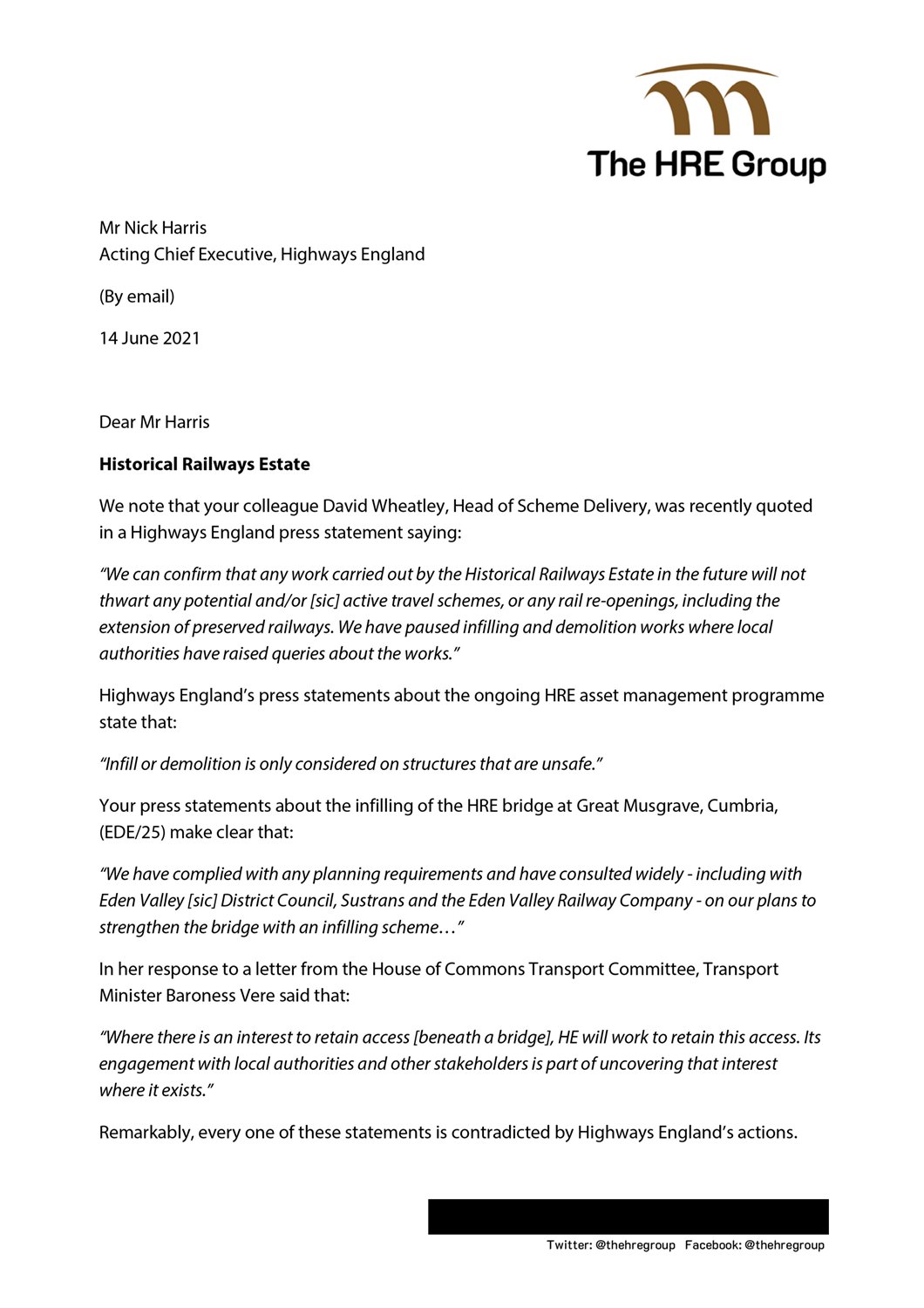
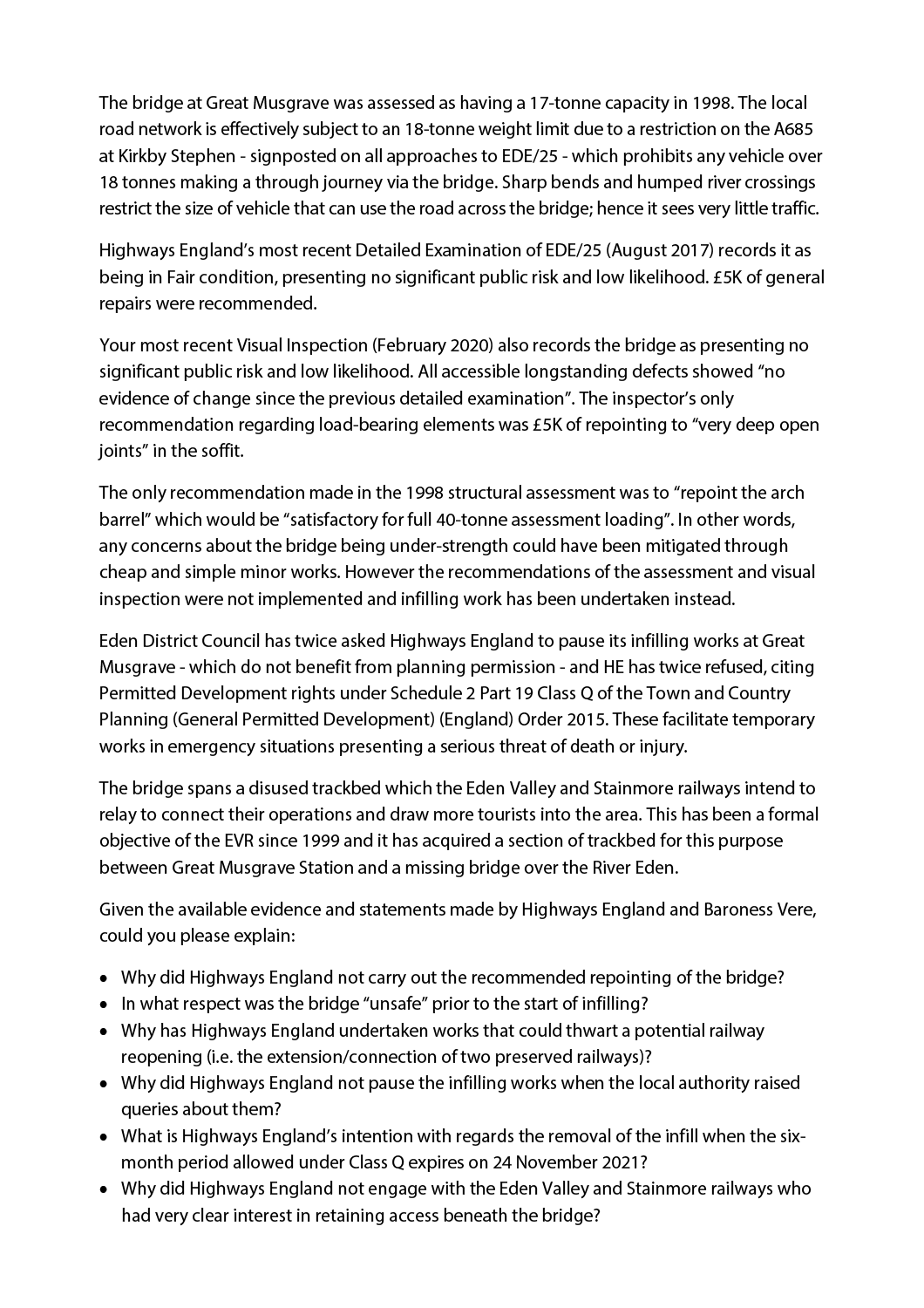
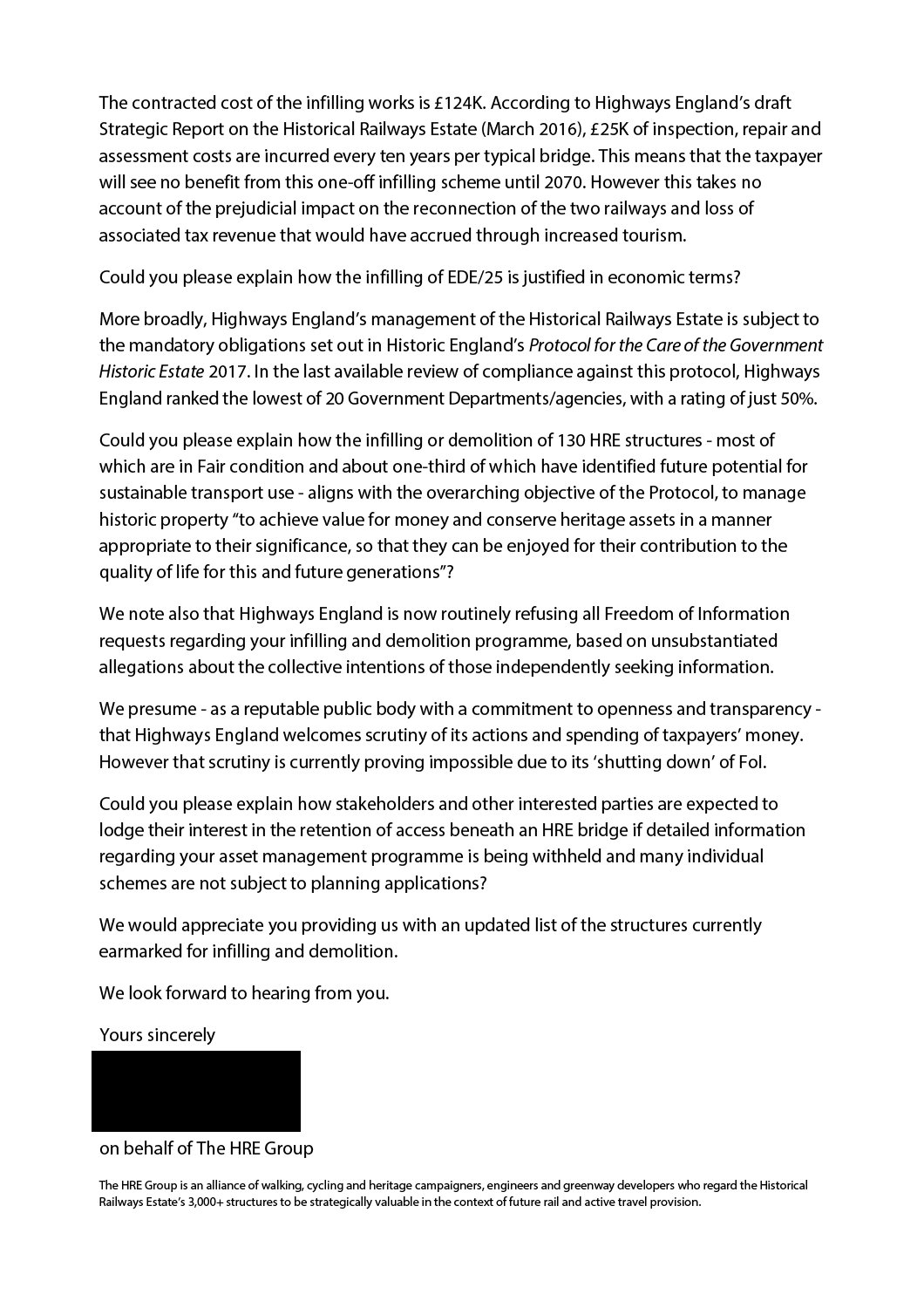
  • HRE Group – 2021 Letter to Nick Harris of Highways England Over Great Musgrave Railway Bridge

    HRE Group – 2021 Letter to Nick Harris of Highways England Over Great Musgrave Railway Bridge

    Below is the text of the letter sent by the HRE group to Nick Harris of Highways England, sent on 14 June 2021.

  • Eden District Council – 2021 Statement on Highways England Infilling Great Musgrave Railway Bridge

    Eden District Council – 2021 Statement on Highways England Infilling Great Musgrave Railway Bridge

    The statement issued by Eden District Council in June 2021.

    The matter of Highways England looking to infill former railway bridges is a national issue, and not just specific to the Eden district.

    In Eden there is one bridge affected by this, at Great Musgrave.

    Highways England has the responsibility for the management and maintenance of the country’s historical railway estate, which includes over 3000 such bridges, tunnels and viaducts across the country.

    Highways England is currently preparing to undertake works to infill the bridge at Great Musgrave.

    In relation to whether these works require planning permission, it is important to note that Highways England do have permitted development rights to carry out certain works, without the need for the prior grant of planning permission. These rights would be covered in Part 9 and Part 19 of the Town and Country Planning (General Permitted Development) (England) Order 2015.

    Eden District Council’s Planning Service has opened a dialogue with Highways England to understand the full extent, nature and reasoning for the proposed works at Great Musgrave, to ascertain whether the works do fall within Permitted Development Rights.

    This is an ongoing matter and discussions have not yet concluded.

    Once sufficient information has been provided by Highways England, the Planning Service will be able to judge whether these works do constitute a Permitted Development, or if they require the prior granting of planning permission. This information will inform what action, if any, can be taken in relation to these works.