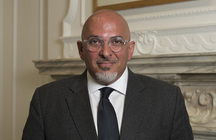
The speech made by Ben Wallace, the Secretary of State for Defence, at the National Army Museum in London on 9 May 2022.
Good morning, and can I just thank the Deputy Director General of the National Army Museum Mike O’Connor for hosting us here today in the National Army Museum. I’m sorry the Director General can’t be here for personal reasons, but I know he too had been very supportive of this event so thank you.
And it is a wonderful museum for anyone who wants to come and visit. I strongly recommend it, although it does make me feel a little old to see some of the exhibits actually above you, that I used to travel in, now sitting in a museum, as indeed the Challenger 1 tank is outside. So if you want to be reminded of your age, it’s a visit to come to.
It is important to be here in the National Army Museum because I cannot imagine a more appropriate backdrop to what I want to say today.
For here, amongst the amazing collections, are endless lessons from history. The successes and the failures.
We all know the adage: “Why do they only write books on lessons learned? Because the book on lessons unlearned would be too big.”
In this building are great tales of bravery, examples of great leadership and battle-winning technologies. But also in this museum are the stories of British failure on the battlefield.
And throughout the hundreds of years of history – whether of victory or defeat – there is one constant: the junior soldier. The Private, the Rifleman, the Guardsman or the Trooper.
Whatever you call them, they are the ones who rarely get to write their own history, or indeed get a say in their future, but it was their ranks that gave the most and bled the most.
And it’s why good officers revere them, as the Squaddie or the Tommy or the Jock. Often the last to know, but always the first to fight.
I know from my own time in uniform that to be young and to be in the service of your country is indeed a fine thing. It is even finer when the cause that you are serving is a just one.
But is it ever easy? Is it comfortable? Is it safe? Emphatically it is not.
It can be the most exciting thing in the world to be on operations, but luckily few of us know what it is like to be surrounded, outnumbered and attacked every day.
There are some brave souls left from the Korean War and even fewer from the Second World War who do know.
It’s why you also find here the permanent exhibition simply called the Soldier. Not just for learning about our past and our past battles but honouring the experiences and sacrifices of the private soldier who fought them.
Just over an hour ago and 1,500 miles away, the world was implored to listen and watch Red Square. This is the Victory Parade in honour of the 77th anniversary of the victory in the Great Patriotic War.
But really what President Putin wants is the Russian people, and the world, to be awed and intimidated by that ongoing memorial to militarism.
And I believe that his ongoing and unprovoked conflict in Ukraine does nothing but dishonour those same soldiers. Both the ones marching across Red Square as I speak and all the forebearers they supposedly march to commemorate.
Let me be clear, it is right to honour the sacrifice of those many, many millions who contributed to Europe’s liberation from fascism and the Nazi reign of terror.
It was a period of immeasurable destruction, atrocities and human suffering, particularly in Eastern Europe and the former Soviet Union, including Ukraine. There will be no mention in Moscow today, however, that much of the suffering was self-inflicted by Stalin and his Generals.
While in Moscow in February, I accepted the honour of laying a wreath at the Tomb of the Unknown Soldier, beneath the vast red walls of the Kremlin itself.
It stands in memory of those Russians who lost their lives fighting the invading Nazis. As the inscription proclaims – their names are unknown, but their deeds are immortal.
And as I stood in front of the Honour Guard – themselves so young and with such uncertain fates even those few weeks later – my thoughts were for those ordinary Russian soldiers, so many of them conscripts who found themselves in a battle for personal and national survival against the Nazi regime.
I thought about the scale of their suffering across the Soviet Union, but also how the suffering was used, then as it is now, to cover up the inadequacy of those ruling in safety and comfort from behind the Kremlin walls above and within the General Staff nearby.
Most Soviet conscripts hadn’t a chance. Their suffering was often needless. In the absence of effective military leadership, many of their best officers were purged by NKVD for “counter-revolutionary crimes”, while “barrier troops” executed swathes of retreating soldiers, deemed “unpatriotic” for failing to press on in the face of unassailable odds.
Fear and sycophancy dictated behaviours then, and today’s Russian Armed Forces still carry that Soviet imprint – the imprint of amorality and corruption.
Let us be honest with ourselves and be open to the inevitable charges of hypocrisy.
All armies risk failures of leadership and sliding into depravity, from the dehumanising of enemies and civilians, to the reckless discharging of that most solemn power, the power to take another human’s life.
Because the profession of arms is, at its heart, the use of violent force in the defence of civilisation and its most vulnerable members.
And that is why, in the British Army, our officers are instructed at Sandhurst under the motto ‘serve to lead’ to know that true leadership is service to their soldiers.
As Wellington himself put it “I consider nothing in this country so valuable as the life and health of the British soldier”.
So while there may be incidents of questionable competence, ill-discipline and unacceptable conduct, there is also, in this country, accountability and adaptation.
Could the same ever be said of Russian Forces, with their quantity supposedly a ‘quality all of its own’? Do their officers serve their soldiers? Do they learn and adapt? Or do they seek only to comply and satisfy their higher commanders?
Since February we have witnessed a systemic refusal to tell the truth up the chain of command, and it is playing out. Consider the fact alone that mobile crematoria trundle around the battlefields not just to hide Russian war crimes, they are for their own soldiers’ corpses as well.
Imagine what it must do to the morale of a private soldier to know your commanders have so little faith in their campaign that you are followed around by those horrific contraptions. Or let’s consider the fate of a single unit, such as the 331st Guards Parachute Regiment, allegedly the “best of the best” in the VDV. The so called ‘elite’ Russian Airborne Forces. Supposedly professional soldiers, reportedly well-equipped, well-trained, and well-led.
At the start of the invasion they were tasked with seizing Hostomel airfield on the outskirts of Kyiv, assessed to be planned as the airhead for reinforcement of subsequent operations to seize the capital.
A significant proportion of the Ukrainian defenders were reservists, and despite significant Russian advantages their resistance was ferocious and brave, with the airfield changing hands several times within the first 72 hours of the invasion.
As Russian Forces sought to consolidate the area they advanced into the nearby towns of Hostomel, Irpin and Bucha. Those places sadly, we now know, will forever be associated with the most despicable of war crimes.
The fighting within them was intense, and open source footage alone shows the dozens of destroyed Russian vehicles and streets littered with dead troops.
The 331st paid a particularly heavy price for having had to advance in haste, without a coherent operational plan, only light air-mobile armoured vehicles, and insufficient combat needed to sustain such fighting.
Back in the unit’s hometown of Kostroma, in Western Russia, worried family members began posting online.
Some confirmed the deaths of their loved ones with loving tributes. The wife of a Warrant Officer wrote “My most reliable, loving and caring husband. Now you are in heaven and you will protect us. You will always live in our hearts.”
And as news of growing casualties spread, some posted their increasing concern and condemned the Russian military for sending them to their deaths in Ukraine.
On the memorial wall for Sergeant Sergei Duganov one woman wrote: “nobody knows anything. The 331st Regiment is disappearing”.
Others wrote that “ordinary boys are dying for no good reason”. The accusations President Putin had decided to “play war” and “sent thousands of guys to die”.
And what were all those sacrifices allegedly for on that poorly planned and badly executed operation?
On 29th March, Russian Deputy Minister Alexander Fomin announced the withdrawal of Russian forces from the Kyiv area and the evacuation of Hostomel airfield.
The axis of advance from Belarus to Kyiv had been repelled and was abandoned for those shell-shocked troops to now support a new offensive in the East.
Ukraine’s moral component had led those brave fighters to defeat the Russian Army, poorly equipped and poorly led, and so it should have been.
Today in Moscow it should be a day of reflection. It should be a day to commemorate the suffering, all be it at such unnecessary levels, of the ordinary Russians in the Second World war.
And it should also be about the culpability of Stalin and his Generals whose 1939 non-aggression pact with the Nazi’s allowed both sides to dismember Poland, including the cold-blooded execution of Polish officers in the Katyn Massacre in March 1940.
In 2020, President Putin mentioned the infamous Molotov-Ribbentrop Pact in another one of his long essays, this time celebrating the 75th Anniversary of the end of the ‘Great Patriotic War’.
Even as President Putin’s essays go this was a masterpiece of fiction. He brushes aside the pact, which not only saw Soviet forces train and supply the Nazi troops that they would later fight, but it led to the systematic invasion, occupation, liquidation and transport of the occupants of Poland, Finland, Lithuania, Estonia, Latvia and Romania.
Putin dismisses these all, claiming Molotov’s pact was an “act of personal power that in no way reflected the will of the Soviet people.”
If that’s the case, then it would be yet another example of Russia’s elites deceiving and exploiting their long-suffering population.
But the governments did collude, with tragic consequences for their soldiers and all the citizens of the Soviet Union.
And Putin must not be allowed to erase such uncomfortable facts in an attempt to mythologise the official national history as one of simply ‘smashing’ Nazism.
Of course, such blatant rewriting of history is not unique to President Putin and the Kremlin propagandists. There’s even the proverb that ‘Russia is a country with a certain future, it is only its past that is unpredictable’.
But in going to such extremes to justify this current war of choice he and his generals are now ripping up both Russia’s past and its future.
Through their invasion of Ukraine, Putin, his inner circle and generals are now mirroring the fascism and tyranny of 77 years ago, repeating the errors of last century’s totalitarian regimes.
They are showing the same disregard for human life, national sovereignty, and the rules-based international system. The very system, not least the United Nations Charter itself, that we conceived together and for which we fought and were victorious together in the hope of saving future generations from the scourge of war.
Their unprovoked, illegal, senseless, and self-defeating invasion of Ukraine; their attacks against innocent civilians and their homes. Their widespread atrocities, including the deliberate targeting of women and children; they all corrupt the memory of past sacrifices and Russia’s once-proud global reputation.
The response to this failure by Russian Forces on the ground in Ukraine has itself been a disgraceful display of self-preservation, doubling down on failure, anger, dishonesty and scapegoating.
The behaviour of the Russian General staff has shown that their own self-preservation comes first. War crimes, targeting civilians, and the casualty rates in their own Battalion Tactical Groups are all secondary concerns.
The truth is that Russia’s General Staff are failing and they know it.
While I am angry at the behaviour of their army, I do not in any way remove culpability from the ordinary soldier for what horrors they are inflicting. I am equally angry at the General Staff’s absence of integrity and leadership – which should go up as well as down – and should be expected of all professional military officers.
All professional soldiers should be appalled at the behaviour of the Russian Army. Not only are they engaged in an illegal invasion and war crimes, but their top brass have failed their own rank and file to the extent they should face court martial.
I know soldiers in the Russian army will not get a voice and there will be thousands of mothers and wives who do not agree with this illegal war, who will be asking themselves why these things happened.
They will of course be shamed into silence by the FSB and others. But for them let me read the charge sheet that perhaps should be laid at the feet of the General Staff of the Russian Army:
Bad battle preparation, poor operational planning, inadequate equipment and support and most importantly corruption and the moral component.
First, battle preparation. Perhaps most importantly Russian forces were not told what their mission was until they crossed the border into Ukraine, so they weren’t even given the opportunity to prepare.
There were even reports of Russian troops in Belarus selling the fuel for their vehicles the week before the invasion because they had repeatedly been told it was all just an exercise.
It was no surprise that their logistics system collapsed after 70km, leaving the Russian army in the world’s longest traffic jam where they were not only vulnerable to attack but quickly ran out of food and fuel. I have no doubt that their resorting to raiding nearby communities led to many of the atrocities.
No meaningful Russian air support appeared for the first week and, unable to achieve air superiority, they had a limited role in the ground offence, having clearly not done any planning to support the Army or integrated land operations.
Likewise Russian special forces, who have made and promoted their own macho videos openly mocking western armies for being inclusive of minorities and women, were resoundingly defeated by Ukrainian militia forces, often incorporating minorities and women. The farce of their commanders’ failures has led to certain VDV and Marine units reportedly suffered up to 80% casualties against those non-regular Ukrainian forces.
And it’s all because in a military profession they failed to conduct adequate battle preparation. Why else were there such large numbers of first echelon supply trucks full of riot gear?
Poor operational planning is the second charge. The Russian’s original ‘thunder run’ plan was based on that nationalist imperialist view that Ukrainians aren’t a real culture with the determination to resist and it led to those countless videos of ambushed columns of vehicles being burnt out.
And despite that, the Russian generals’ refusal to report ground truth for fear of their own positions within the military has meant that ever more forces were pushed into the traffic jam of that Kyiv convoy, even days after it was clear that the strategy had failed.
The subsequent siege and bombardment strategy failed, after it became clear the levels of resistance meant that at least a third of the force was required to take a single city. As the brave defenders of Mariupol are demonstrating even now, modern weapons and the moral force of a people determined to be free, to ensure their state, to ensure defensive dominance is also possible through that moral component. And that is why the Russian forces are failing.
Throughout the Russian Forces’ operation and across all domains their commanders’ failures to conduct appropriate operational planning has been nothing but a betrayal of their soldiers and airmen who have paid the price with their lives.
Thirdly, inadequate equipment and support. Russian vehicles had not been maintained properly and immobilised many logistics vehicles, leading to cheap tyres being blown out and truck axle hub failures, all due to poor maintenance or the money for that maintenance being taken elsewhere.
As an aside, the sheer amount of footage from Ukrainian drones suggests to me that they also lack wider air defence and counter-UAV system.
Almost none of their vehicles contain situational awareness and digital battle management. Vehicles are frequently found with 1980s paper maps of Ukraine in them.
But it’s not just ground forces. ‘GPS’ receivers have been found taped to the dashboards of downed Russian SU-34s so the pilots knew where they were, due to the poor quality of their own systems.
The result is that whilst Russia have large amounts of artillery and armour that they like parading, they are unable to leverage them for combined arms manoeuvre and just resort to mass indiscriminate barrages.
Their limited stockpiles of air-delivered precision weapons, demonstrated by a steep drop off in use after the second week, has meant that the Air Force has also fallen back on dropping imprecise dumb munitions on urban areas.
On the ground, and despite knowing they were going to face Anti-Tank Guided Missiles, and all the lessons of the recent Karabakh conflict, the Russians didn’t invest in effective systems to protect even their most advanced tanks.
Remember the T-14? Presumably still just for victory parades.
Russian soldiers’ futile use of pine logs as makeshift protection on logistical trucks and attaching overhead ‘cope cages’ to their tanks, it’s nothing short of tragic. But their commanders’ failures to adapt before entering them into such a conflict is criminal.
And there is a complete shortage of all medical services, with overflowing civilian hospitals in Belarus and Ukrainian civilian surgeries being forced to provide medical aid to the same desperate Russian forces who invaded their homes.
And there’s the difference. Report after report I see of Ukrainian soldiers helping injured and wounded Russian forces. The noblest of all on the battlefield, to look after your enemy as sometimes they are your own. That leads me to the fourth and most serious charge that should be laid at the generals – of corruption and the failure of the moral component.
Caring for your own wounded – ‘never leaving a man behind’ – is one of the sacred tenets of all martial cultures, but apparently not the Russian Forces.
How could these Generals commit their own troops knowing they were without the necessary medical support to care for them when injured in the pursuit of the orders they themselves issued?
It is just another example of the moral decay in the Russian Forces. Rotten downwards, from the Chief of the General Staff down, where ultimately the blame must lie.
Conscripts taken into a conflict zone unknowingly and illegally against Russian law, despite recent government claims to their families that no such thing would be done.
Even when Ukrainian citizens have tried to indicate that buildings are sheltering civilians with signs marked out with ‘medical’ or ‘children’ the Russians have largely ignored them and then created false stories to try and cover the bombing.
Tens of thousands of Ukrainian civilians forcibly relocated Eastwards. A quarter of the population refugees, over two thirds of children.
Women and children raped and then murdered. A “terrifying echo of the Red Army’s mass rapes committed in 1945” according to historian Sir Antony Beevor.
Ukrainian mayors abducted and tortured for their non-violent resistance. Abandoned Russian vehicles found full of looted white goods. Russian soldiers filmed in post offices mailing home endless boxes of stolen goods.
But such open and shameless corruption does mean a complete record of who those soldiers are. We know who they are, where they have been and what crimes they have committed. It’s being created and filed and can be used to bring them and their commanders to justice as well.
Because the Generals’ ‘butcher’s bill’ is also being paid by the many thousands of innocent Ukrainian victims of this conflict.
Which, I just want to say, that the international community will hold to account all those responsible for these atrocities that the world is witnessing Russian Forces commit in Ukraine.
We are watching and, as I have said, we are recording.
Because we must protect civilians and their human rights, no matter their nationality, the cause of the conflict, or the perpetrator of their crime.
So, all those responsible, from Commander-in-Chief to deployed tactical commander, should know that their actions are not without consequence and that ‘to know is to be responsible’.
It is also important to recognise the countless thousands of young Russian men leaving their own mothers without sons, wives widowed, and children fatherless. Nothing more than a failure of leadership and a betrayal of command.
To characterise such a situation as anything other than a human tragedy for both sides denies the reality.
And to conflate it with the sacrifices of the Great Patriotic War disgraces the memories of the Immortal Regiment, each and every one of those family portraits held aloft in the parades held across Russia today should realise.
We all wish this senseless war did not need to be fought but – like the vast majority of the world – we cannot stand by without giving Ukrainians the means to defend themselves.
That is why the British Government – the whole United Kingdom – stands in solidarity with Ukraine, supporting their courageous defence of sovereignty, territorial integrity, and the simple right to a peaceful and prosperous future, just as we did for the Soviet Union all those years ago.
Their sacrifices in the past to defeat fascism should not be forgotten, but nor must the lessons about what lies in store for the perpetrators of such unprovoked brutality.
Shame on those who seek to use the suffering of ordinary Russians as a launchpad for their own imperial ambitions. They are the ones who truly insult the memory of the Immortal Regiment.
So let’s call out the absurdity of Russian generals – resplendent in their manicured parade uniforms, weighed down by their gold braid and glistening medals.
They are utterly complicit in Putin’s hijacking of their forebears’ proud history; of defending against a ruthless invasion; of repelling fascism; of sacrificing themselves for a higher purpose.
And now, they are the ones inflicting needless suffering in the service of lowly gangsterism.
And for them and for Putin there can be no ‘Victory Day’, only dishonour and surely defeat in Ukraine.
They might seek to control Russians’ futures through their past but in the end the past catches up with you.