Blog

  • PRESS RELEASE : Head of the Office of the President of Ukraine Andriy Yermak will hold talks with the delegation of the Republic of Poland

    PRESS RELEASE : Head of the Office of the President of Ukraine Andriy Yermak will hold talks with the delegation of the Republic of Poland

    The press release issued by the President of Ukraine on 31 January 2022.

    On Monday, January 31, the Office of the President will host a meeting of the delegations of Ukraine and the Republic of Poland with the participation of representatives of a number of ministries and departments of the two countries.

    The Polish delegation arrived in our country to fulfill the agreements reached during the visit of President of Ukraine Volodymyr Zelenskyy to the Republic of Poland on January 20-21, 2022.

    The Ukrainian delegation will be headed by Head of the President’s Office Andriy Yermak, and the Polish delegation will be headed by Secretary of State in the Chancellery of the President of Poland, Head of the Bureau for International Policy Jakub Kumoch. In particular, Minister of Infrastructure of Ukraine Oleksandr Kubrakov and Minister of Infrastructure of Poland Andrzej Adamczyk will take part in the talks.

    During the meeting, topical issues of bilateral cooperation in economy, energy and infrastructure will be discussed.

  • PRESS RELEASE : Every year on the Day of Remembrance of the Heroes of Kruty the best cadets will receive a monetary award from the President of Ukraine – Volodymyr Zelenskyy

    PRESS RELEASE : Every year on the Day of Remembrance of the Heroes of Kruty the best cadets will receive a monetary award from the President of Ukraine – Volodymyr Zelenskyy

    The press release issued by the President of Ukraine on 29 January 2022.

    On the Day of Remembrance of the Heroes of Kruty, President Volodymyr Zelenskyy visited the Ivan Bohun Kyiv Military Lyceum and met with cadets and lyceum students of military educational institutions of Ukraine.

    According to the Head of State, for more than a century the Heroes of Kruty have served as an example and, together with modern defenders of Ukraine, have inspired the next generations of Ukrainian warriors.

    “104 years ago on our land, in the Chernihiv region, there was a battle that went down in the history of our state as a great symbol of heroism, courage and steadfastness in the struggle for a free and independent Ukraine. As a feat of very young, inexperienced and not fully prepared cadets, students who nevertheless defended Ukraine and stopped the enemy, which had an advantage in numbers and weapons, at the cost of their own lives,” said the President.

    So today, as Volodymyr Zelenskyy noted, he honors the memory of the Heroes of Kruty together with the best cadets and lyceum students of educational institutions from all over Ukraine, who are mastering the military profession to join the ranks of the Ukrainian army in the future.

    “When the war broke out in Ukraine, many of you were 10-12 years old. In very difficult times, you have chosen the path of the military. This is a bold, adult decision. I want you to know that Ukraine knows, sees and notes this,” the Head of State stressed.

    According to him, starting this year, the best cadets will receive a monetary award from the President of Ukraine on this day every year.

    “And today, some of you will be the first to receive this award. I am sure that you are ready to defend Ukraine in the future, and certainly not for money. But you should know: your state values you,” Volodymyr Zelenskyy said.

    The President presented certificates for the monetary award and valuable gifts to the first cadets and lyceum students.

  • PRESS RELEASE : President honored the memory of the Heroes of Kruty

    PRESS RELEASE : President honored the memory of the Heroes of Kruty

    The press release issued by the President of Ukraine on 29 January 2022.

    President of Ukraine Volodymyr Zelenskyy took part in the ceremony of honoring the Heroes of Kruty. The Head of State laid flowers at the memorial cross to the Heroes of Kruty at Askold’s Grave in Kyiv.

    The attendees honored the memory of the deceased with a moment of silence. The National Anthem of Ukraine was played. Warriors of the honor guard saluted with personal weapons and marched near the memorial cross.

    The ceremony was also attended by Head of the Presidential Office Andriy Yermak, Minister of Defense Oleksiy Reznikov, Commander-in-Chief of the Armed Forces of Ukraine Valeriy Zaluzhny and cadets of higher military educational institutions.

  • PRESS RELEASE : Volodymyr Zelenskyy had a phone conversation with Emmanuel Macron

    PRESS RELEASE : Volodymyr Zelenskyy had a phone conversation with Emmanuel Macron

    The press release issued by the President of Ukraine on 29 January 2022.

    President of Ukraine Volodymyr Zelenskyy had a phone conversation with President of the French Republic Emmanuel Macron.

    The heads of state welcomed the intensification of the Normandy format and the holding of a meeting of political advisers to the leaders of the Normandy Four on January 26 in Paris. It was emphasized that for the first time since 2019, a document has been agreed following the negotiations.

    Volodymyr Zelenskyy noted the important personal role of Emmanuel Macron in organizing this meeting. He also thanked the French leader for his firm and consistent support for Ukraine, the sovereignty and territorial integrity of our state.

    The parties agreed to maintain the dynamic pace and accelerate the next meeting of advisers to the leaders of the countries participating in the Normandy format. The importance of intensifying the work of the TCG and its subgroups in order to make rapid progress in the implementation of the Minsk agreements was also discussed.

    “As long as there is a favorable climate for dialogue, we need to hold meetings and talks. As long as diplomatic efforts continue, the risk of further escalation is decreasing,” Volodymyr Zelenskyy stressed.

    The Presidents of Ukraine and France praised the visit of the Ukrainian delegation led by First Deputy Prime Minister and Minister of Economy Yulia Svyrydenko to Paris the day before.

    The President of Ukraine stressed the interest in the successful implementation of existing important bilateral economic agreements, as well as in the development of new specific projects.

  • PRESS RELEASE : To confirm the absence of intentions to attack Ukraine, Russia must take concrete steps – Volodymyr Zelenskyy

    PRESS RELEASE : To confirm the absence of intentions to attack Ukraine, Russia must take concrete steps – Volodymyr Zelenskyy

    The press release issued by the President of Ukraine on 28 January 2022.

    The Russian Federation must confirm the absence of intentions to attack Ukraine and its readiness to negotiate by taking concrete steps. This was stated by President Volodymyr Zelenskyy at a meeting with representatives of foreign media.

    The Head of State believes that the dialogue can begin at least with the issue of release of detainees.

    “Does anyone enjoy the fact that people are in prison? What’s the point? What is your historic victory? You went down in history because people were imprisoned?” said Volodymyr Zelenskyy.

    According to him, if Russia has any questions to Ukraine, it is necessary to meet and talk, not to bring troops to the Ukrainian borders and intimidate ordinary citizens.

    “I am willing to meet and I’m not afraid of any format. Bilateral format… I am ready for any format,” the Head of State said.

    Volodymyr Zelenskyy also noted that as President he has to knock on all the doors, appeal to all world leaders, put forward different formats and platforms to return peace to Ukraine. In particular, he would like the United States to join the negotiation process.

    “I would like President Biden to be able to do that, so that we have a negotiating platform in the United States – Ukraine – Russia format,” he said.

    According to the Head of State, this format could take place in parallel with the Normandy negotiation process.

    “Every time I propose certain steps from our state. And I believe that President Biden can help us,” Volodymyr Zelenskyy summed up.

  • PRESS RELEASE : Partner countries should invest more actively in Ukraine to provide practical support to our economy – Volodymyr Zelenskyy

    PRESS RELEASE : Partner countries should invest more actively in Ukraine to provide practical support to our economy – Volodymyr Zelenskyy

    The press release issued by the President of Ukraine on 28 January 2022.

    President Volodymyr Zelenskyy calls on business representatives of partner countries to actively invest in Ukraine to provide practical support to the Ukrainian economy. The Head of State said this during a meeting with representatives of foreign media.

    Volodymyr Zelenskyy stressed that any signals of support from partners are important for Ukraine.

    “Such signals are more important when investments from one or another state come to Ukraine. The question is not in the volume. But if this or that business wants to protect our state and believes in its stability and stands shoulder to shoulder, wants to be a friendly, powerful partner, then you are welcome. Then this business comes to us,” the President said.

    The Head of State noted that today it is not a question of obtaining a quick return on such investments, but it is a way to get a reliable partner – Ukraine.

    “There will be profit in the future. This profit is the attitude to Ukraine. Therefore – welcome! Invest in the state now, show that you believe in Ukraine!” Volodymyr Zelenskyy emphasized.

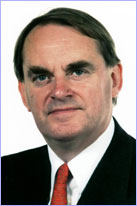
  • Timothy Kirkhope – 2003 Speech on the European Convention

    Timothy Kirkhope – 2003 Speech on the European Convention

    The speech made by Timothy Kirkhope in Copenhagen on 25 June 2003.

    Ladies and Gentlemen, the past eighteen months have been perhaps the most busy and interesting months of my political career.

    The Convention has succeeded. Not necessarily in the nature of its final text but certainly as an exercise in ‘opening up’ the debate in Europe by bringing together so many interests and views. I do not agree with the final outcome of the Convention – a European Constitution (I believe we should have had a new Treaty, like the old Treaties) – but I remain a keen support of the Convention model for European negotiations.

    Having had the privilege of representing the Conservative Party on both the Charter of Fundamental Rights Convention and the ‘Future of Europe’ Convention, I believe that the model provides a blueprint for bringing together representatives from different political opinions and countries to discuss issues in an open and accountable manner.

    I would like to begin by refreshing your memories about the events of the past eighteen months. Specifically, how we reached where we are now.

    The European Convention was, as you will recall, established at the Laeken European Council in December 2001 to bring together representatives from both the existing Member States and the new Accession States to work out how a European Union of 28 countries should operate in future – a necessary initiative.

    The Convention began its work last February under the chairmanship of former French President Valery Giscard d’Estaing.

    The first phase involved listening to the people of Europe. This was done both formally, through representations from Civil Society and the Youth Convention, and informally, through individual consultation exercises with our constituents and colleagues. Unfortunately, this was not as successful as it could have been.

    The second phase of the Convention involved studying specific issues in separate working groups. Each working group had around 30 members, broadly balanced according to political group and nationality.

    The first working group members served on studied institutional reform. The issues studied were the Charter of Fundamental Rights, complementary competencies, legal personality; national parliaments, simplification and finally subsidiarity.

    Convention members then studied specific policy areas: defence, economic governance, external action, Freedom Security and Justice, and finally, social Europe.

    The third phase of the Convention, which we are still technically in, has involved drafting the final document.

    At the beginning of February, the Praesidium unveiled a draft text of the first 16 Articles for Convention members to amend and discuss; and, week by week, new sections and drafts have been amended and discussed.

    The final document includes a:
    -Preamble, outlining the objectives of the Union.
    -Part One is essentially an overview of Part Three, which contains the detail of the Constitution.
    -Part Two incorporates the Charter of Fundamental Rights.
    -Part Three, entitled ‘The policies and functioning of the Union’ contains the detail of the Constitution.
    -Part Four covers the ‘General and final provisions.’

    And there follows protocols on:
    -the role of national parliaments,
    -the principles of subsidiarity and proportionality, and
    -representation in the European Parliament and voting in the Council.

    Submitting amendments to the drafts of the text over the past four months has been the toughest part of the Convention process.

    I have based my suggestions on Conservative principles and the opinions of Conservative people.

    My central principle is that the Conservative Party and Britain should remain engaged but vigilant in the European Union. And, of course, it is well known that the views of the British are somewhat anarchical to Europe!

    As well as consulting my constituents, I have consulted include Conservative MEPs and MPs, the Voluntary Party, young people in Conservative Future, and activists through a nationwide questionnaire.

    I would like to take this opportunity to acknowledge the support I have received over the past eighteen months and thank everybody for their contributions. I wouldn’t have been able to represent the Conservative Party as effectively as I hope I have done without the help of many other people.

    The Conservatives’ ‘Bottom Line’ for the Convention, which was published in the Spring 2003 edition of our magazine Delivering for Britain, is based on long-standing, traditional Conservative principles and philosophy. It is not ‘anti-Europe’ but it is a statement of our wishes for a sustainable Europe.

    Our first bottom line is to say:

    1. ‘No’ to a European Constitution for a Federal Superstate

    The United Kingdom has never had a codified constitution – that is to say, a ‘higher law’ bringing together the basic principles of government in one document. The British constitution is, in political science terms, uncodified. That is to say, it is drawn from many documents of ordinary statutory law and convention. Whereas I could walk into a bookshop in America and ask for a copy of the constitution, if I did so in the Britain, they would think I was mad. Therefore, because we have never had a codified constitution, accepting a codified European Constitution goes against the grain of our political traditions.

    Our second bottom line is to say:

    2. ‘No’ to a single legal personality for the European Union

    To some extent the EU already has legal personality, but this ‘departure’ takes it too far. Giving the European Union legal personality would sit uncomfortably with our political traditions. The British system of government is based on parliamentary sovereignty – Parliament, not the Prime Minister or the monarchy, is the source of political power in the UK. Tony Blair may have centralised power and ridden roughshod over Parliament, but the Conservative Party continues to believe in Parliamentary democracy. To establish an alternative powerbase would therefore run contrary to the political traditions that have served us well for so long. And can we envisage the UK or France willingly giving up a seat on the UN Security Council?

    Our third bottom line is:

    3. ‘No’ to a legally binding Charter of Fundamental Rights

    As a member of the Charter of Fundamental Rights Convention, I welcomed the emphasis placed on the protection of human rights, but I worry about its compatibility with the European Convention of Human Rights. We are in a situation where we have two sets of human rights law: we have the Convention set up by the Council of Europe and the Charter established by the European Union. Both the Charter and the Convention deal with the same area of law but with different wording. Why does the competence of the EU need to include an area that is dealt with satisfactorily by the Council of Europe? Two sets of human rights law will undoubtedly harm rather than help the very people it was designed to protect. It would also divide the membership of the Council of Europe. Incorporating the Charter would, I believe, create more problems than it cures.

    Our forth and fifth bottom lines cover the cutting-edge issues of integration – foreign and home affairs

    4. ‘No’ to a Common Foreign and Security Policy or a European Army

    European Democrats support cooperation on foreign and home affairs, but only in the context of the pillar structure, which guarantees intergovernmental decision-making. The European Union encompasses many countries with long and distinctive histories. Some Member States have a unique historical involvement in certain parts of the world, reinforced by ties of language, trade or blood. All Member States have specific memories and experiences which shape their ambitions today. Some states want neutrality, others participate in NATO, and France and the UK have a global military reach and the tradition of action. Enlargement will only increase these distinctions. For these reasons, whilst the European Democrats hope that we will continue to cooperate closely under NATO, we do not feel that it is appropriate to develop a Common Foreign Policy under the first pillar decision-making mechanism.

    Turning to Home Affairs, we also say:

    5. ‘No’ to a Common Home Affairs Policy or a Common Asylum Policy – perhaps the biggest issue of them all.

    As politicians, we are elected to represent the views of our constituents and opinion polls suggest that the public does not want more centralisation in justice and home affairs. The Eurobarometer carried out in April 2002 specifically for the Convention showed us that only a minority of those surveyed were in favour of European-level decisions being taken on justice (58% against) and police matters (63% against). Having said that, the same survey showed us that the fight against organised crime and drugs trafficking ranks third (after peace and security and the reduction of unemployment) in public priority and has the support of almost 9 out of 10 Europeans. To me, the message from Eurobarometer is clear: ‘yes’ to cooperation between member states’ judiciaries, police forces and Home Offices; but ‘no’ to greater harmonisation in this field. If we go ahead with a European Public Prosecutor, a European Border Guard, the abolition of the third pillar and greater qualified majority voting, I feel that we will be going against pubic opinion and fuelling the dissatisfaction that many people feel about politics and politicians in general.

    Having heard five things European Democrats are against, you may well be wondering what, if anything, are we in favour of for the future of Europe. What we do say is:

    6. ‘Yes’ to a new Treaty simplifying the existing Treaties

    At the beginning of the Convention, there were signs that we would conclude by proposing a new Treaty, simplifying the existing Treaties and making the European policy making process more understandable to the peoples of Europe.

    The German state, for instance, is based on a ‘Grundgesetz’ as opposed to a ‘Verfassung’ – a set of basic laws rather than a constitution. The European Union needs a new treaty nearer to a Grundgesetz than to a Verfassung because European citizens want a Europe of nation states rather than a United States of Europe. A Simplifying Treaty would both outline the boundaries of competence between European and national institutions and parliaments and also shift the balance from the undemocratic to the democratic components of the European Union. Sadly, this is not the basis of the draft European Constitution, but we are in favour of a new Treaty along these lines.

    We also say:

    7. ‘Yes’ to cooperation in foreign and home affairs on a bilateral basis

    I passionately believe that Member States should be able to cooperate together in areas falling outside the competence of the European Union, such as foreign and home affairs. My question to those who oppose this proposition is: How can we legitimately talk about national sovereignty if we attempt to prevent other countries from exercising their national sovereignty? Therefore I believe there is a need for a mechanism to allow Member States to cooperate together outside the Union.

    The mechanism I would suggest is through bilateral and multilateral treaties. Independent cooperation is, I believe, the way forward because enhanced cooperation as a process has been abused in the past as a trail-blazing mechanism with a bent to further integration beyond the Treaties. Participation in core issues such as the single market, the environment and some transport matters, for example, should be compulsory. But issues such as foreign and home affairs should be dealt with on a bilateral basis to avoid the ratchet effect of enhanced cooperation.

    The eighth bottom line is about promoting democracy and accountability:

    8. ‘Yes’ to more democracy and accountability in the EU

    The European Democrats believe that power should be moved from the unelected institutions of the European Union to the elected institutions. One change I have suggested is that the right of initiative should be shared between the unelected Commission to the elected European Parliament. Another change would involve improving the transposition process of European legislation into national law. So, Mr President, why does gold plating affect the UK more than any other member state? One important reason is because the UK, unlike many other member states, simply does not involve its MEPs in the transposition process.

    In Belgium, the Chamber of Representatives has an Advisory Committee on European Affairs which is made up of 10 MPs and 10 MEPs who enjoy equal status on the Committee. Belgian MEPs are also allowed to speak in Standing Committee meetings and to table written questions to the Government. The German Bundestag also has a Committee where MEPs are entitled to propose subjects for discussion and to give opinions on the proposals discussed. And the Greek Parliament has a similar arrangement.

    As an MEP who has been a UK MP, I now realise how little I and my colleagues knew about the regulations coming from Europe. Because we concentrated on national policy matters, we were often unable to spend very much time with the European legislation under consideration. As a result, Government Departments were able to ‘gold plate’ the legislation without MPs knowledge or involvement. This problem has got much worse under the present British Socialist Government as they reduce the powers of our House of Commons and the time available for any scrutiny.

    By establishing joint committees of MPs and MEPs to oversee the transposition of European laws there would be less gold plating and the government would be held to account.

    Our penultimate bottom line is to say:

    9. ‘Yes’ to international free trade and ‘yes’ to greater decentralisation

    Adam Smith, the great eighteenth century philosopher and economist, proved that economic freedom goes hand-in-hand with public prosperity. The lesson we should draw from The Wealth of Nations is that a low tax, lightly regulated economy helps both rich and poor alike by inducing entrepreneurship, creating jobs and generating wealth. I am a great believer in Adam Smith and free trade and I have attempted to inject some of this spirit I my amendments, by restating free trade as a major objective of the Union and an integral element of overseas aid. I hope this is a point with which unites us all here today.

    Our final bottom line is:

    10. ‘Yes’ to a referendum so the people of Europe can have the final say

    This principle is integral to our party policy and I’ll be referring back to it in my concluding remarks

    These 10 bottom lines have been the main inspiration for my amendments; and they encapsulate the beliefs of the European Democrats and our approach to the future of Europe debate.

    For those of you who are interested, my amendments – which reflect the bottom line – have been collated into a ‘Simplifying Treaty’ which is available on the internet at www.conservatives.com or www.kirkhope.org.uk.

    Ladies and gentlemen, I am the first to recognize that there are significant differences between the text which I have produced and that produced for the EPP by Elmar Brok. But I have done what I believe is right. As a Conservative, I have participated and argued for my beliefs for the future of Europe.

    There is one area where I hope we will be able to find consensus this week, and that is the issue of a referendum on the European Constitution.

    Last October, the Conservative delegation supported me in announcing our commitment to the principle of giving people a say on the next stage of the integration process.

    This is a cause which I know many of you here today have committed yourself to as well. It is a cause that unites many of us in our approach to Convention.

    So, I would like to leave you with one thought. The European People’s Party and the European Democrats must agree on one thing, it is this. We must be united on the need for a referendum.

  • Oliver Letwin – 2003 Speech on Crime and the Inner Cities

    Oliver Letwin – 2003 Speech on Crime and the Inner Cities

    The speech made by Oliver Letwin, the then Shadow Home Secretary, at the Ritzy cinema in Brixton on 25 June 2003.

    Some time ago, I made a speech about how we aspire to prevent crime in our inner cities. Instead of asking what were the causes of crime, I asked what are the causes of the neighbourly society?

    I argued that a strong neighbourly society is about the establishment and preservation of the right relationships between individuals and that only strong relationships can foster strong communities.

    Whilst many would agree with these aspirations, it is much harder to make them a concrete reality.

    My task as Shadow Home Secretary is to try to formulate a set of foundations on which the neighbourly society can build:

    First and foremost a neighbourly society must be one which fosters and encourages the networks of support between individuals, families, neighbourhoods and community associations. It depends on active citizens. and gains enormous benefits from voluntary activity.

    Second, a neighbourly society is one which welcomes the society we have today, not one that hankers after the society which existed fifty years ago. It means establishing a framework in which neighbours of differing creeds and colours, backgrounds and aspirations, lifestyles and mores, can agree to differ and live together in harmony. They share the common enterprise of sustaining a neighbourhood, and the common enterprise of ensuring that their children are brought up to be law abiding and active citizens. From the many one.

    Third, a neighbourly society requires providing young people with exit routes from the conveyer belt to crime. Parents of very young children facing difficulties need help. Persistent offenders need long term rehabilitation and young addicts need serious and effective drug treatment.

    Fourth, a neighbourly society depends on the police. We need to give them the ability to recapture our streets through the real and sustained neighbourhood policing that we have had in Brixton – actively pursued by Borough Commander Richard Quinn and Inspector Sean Wilson. We will support this commitment by allowing for a real and substantive increase in police numbers. We are pledged to increase police numbers by 40,000 – roughly a third – over eight years which would mean an extra 8,482 extra officers for London alone.

    The strange thing is that – in an age in which obligatory disagreement between politicians of differing Parties has become almost a religion (though not a religion of which I am an adherent) – these propositions have not attracted much opposition.

    I should love to believe that the lack of disagreement is wholly due to positive and enthusiastic agreement – a positive consensus.

    And I do believe there is a degree of consensus.

    There is agreement on the scale of the problem in our inner cities. There is agreement on the nature of the problem in our inner cities. There is even agreement on many of the particular things that we need to do to tackle the problems.

    But I fear there is another, much less comforting reason for the lack of opposition. I believe that my political opponents – and many of the commentators – think that the establishment of a neighbourly society in our inner cities is no more than a pleasing, nostalgic pipe-dream.

    They think that the problems of the inner cities are so vast as to be insoluble. They are happy for the Government to take initiatives – but, as Barbara Roche’s interesting commentary has recently emphasised, they do not really believe that these initiatives will do much more than to show willing by bringing about temporary improvements. They regard the idea of what I have called sustainable social progress in the inner cities as desirable but naïve.

    I do not agree with them.

    In another context, I recently described myself as a naïve optimist who believed in miracles.

    I am, and I do.

    I believe in the miracle of the establishment of a neighbourly society – the bringing about of sustainable social programmes in our inner cities.

    Yes. This is a dream. But only in the sense in which Martin Luther King used that term in his speech on the steps of the Lincoln Memorial. It was the greatest speech of the twentieth century, and the dream he dreamed that day has surely been coming true ever since.

    We too must have the capacity to dream – and the will to make our dreams come true.

    I say this as much to my own party as to any other. As Iain Duncan Smith has made abundantly plain, the Conservative Party cannot be seen merely as the Party of the leafy suburbs and of the rural shires.

    The Conservative Party is committed and has to be committed to a fair deal for everyone. No one held back and no one left behind.

    To fulfil that commitment, the Conservative Party has to be the Party of the Inner Cities.

    We have to believe in our dream of sustainable social progress in the inner cities. We have to believe in our dream of establishing a neighbourly society in the inner cities. We have to believe that we can lift young people off the conveyer belt to crime.

    Of course, we have to recognise that there are grounds for – at least reasons for – the pessimism and cynicism that is so prevalent.

    In just over fifty years, as we have vastly increased our national income, we have moved from a “deferential society” through a “liberated society” to a “celebrity society” in which David and Victoria Beckham’s comings and goings attract more attention than an earthquake in Algeria. We now live in a society in which millions of our citizens prefer to vote characters off reality TV programmes – using their mobile phones at 25 pence a shot – rather than turn up at polling booths for elections.

    The paradox is that this prosperity and celebrity are not enough. Behind the glitz and glamour of much of modern life there is an underbelly of material and spiritual poverty. One estimate from Dick Atkinson – an expert in urban renewal – suggests that 20% of the population live in 3,000 troubled inner and outer city neighbourhoods. A further 10% teeter on the brink.

    To have almost one in three of our fellow citizens facing such circumstances is shocking enough. Add to this the knowledge that a crime is committed every five seconds, that criminals only have a 3% chance of being convicted and that 75% of young offenders re-offend following their sentences, and the “celebrity society” begins to look very threadbare indeed.

    No wonder great pessimism abounds about the breakdown and, what some have termed, the ‘atomisation’ of our communities. No wonder there are some who believe that nothing can be done.

    And, beyond the spiritual poverty of the celebrity society, there lies another reason for pessimism: the all too frequent failure of well meaning Government initiatives and Whitehall sponsored schemes that offer a lot of hope – and money – but do not achieve what they set out to do.

    Take ‘zones’. Education zones. Health zones. New Deal zones. It sometimes feels as if we now live in a kaleidoscope of zones. And, as the kaleidoscope is shaken, as one zone turns into another, as Whitehall celebrates another initiative in another place, the troubled, hard-pressed neighbourhoods are left with the same fundamental problems that they had before the men from the ministry moved in.

    As Dick Atkinson says :

    “While we may end up with say 50 Education Action Zones, even 100 Health Zones and 40 New Deal communities, these will hardly touch the 3,000 troubled neighbourhoods and the 15,000,000 people who live in them…..
    …..the honest intentions of government risk being diverted again into icing the crumbling cake instead of helping bake a new one”.

    Or take another example of huge regeneration schemes. Earlier this year it was revealed by the Birmingham Evening Mail that an organisation set up in April 2001 – with £54 million cash – under a new deal project for Aston in Birmingham, managed to spend just £5 million of which £538,000 was spent on bureaucrats and hundreds of thousands more on consultants doing feasibility studies. 14,000 residents in Aston who had been told that their neighbourhoods would be transformed did not experience any changes at all.

    As the newspaper stated:

    “lots of bluster about holistic visions and overarching statements cloud the fact that in three years virtually nothing has been done”.

    No wonder the All-Party Commons Select Committee on Local Government warned in a Report earlier this year that “the targets and outcomes of area based regeneration programmes need to be aligned to the needs of the area concerned”.

    Or as Rachel Heywood puts it:

    “We want sustainable solutions; we’re weary of the quick fixes, parachuted in expertise, the plethoras of short term projects, bored of being an experiment. We know that we have expertise on the ground, we know that we could lead the way in best practice.. the community is aware of the scale and the complexity of what is going on and what needs to be done.”

    Rachel is right and the pessimists are clearly wrong. Community, not bureaucracy is the answer.

    But the fact that there are reasons for the pessimism and the cynicism does not mean that the pessimism or the cynicisms are justified.

    On the contrary, I know that the pessimism and the cynicism are unjustified.

    I know that they are unjustified because in some places the dream is becoming true.

    I know that miracles can occur, because in some places they are occurring.

    These miracles have not been bought about by politicians or by bureaucrats. They have not been brought about by plans, or initiatives, or targets. They have not been brought about by money or celebrity or glitz or spin.

    They have been brought about by faith and hope.

    They have been brought about by communal effort, by people determined to make, for themselves and their neighbours, sustainable social progress in the inner cities – the very commodity that the cynics and the pessimists believe cannot be manufactured.

    Three Miracles

    Brixton

    I have been taken to the Pulross Playground by Rachel Heywood and Inspector Sean Wilson, Head of the Brixton Town Centre Team. Rachel tells me that her activities began in 1996 with a campaign to save their dangerous playground from property developers. Not only did Rachel and other local residents ward off the developers, but they warded off the drug dealers as well. How was this done? Through sheer determination, courage and community action. The mess was cleared, gardens were planted and events organised. They have transformed a dangerous playground full of drug needles and other detritus into an oasis of tranquillity for the children who live nearby. They have restored a community spirit and pride in a neighbourhood that was previously known for its local crack houses.

    What is even more remarkable is that Rachel and others have moved on from rescuing a playground to helping to renew a whole community. Their work in building close relationships with the police, the anti drugs campaigns, the positive messages sent out to young people cannot be understated. This, coupled with the efforts of the Brixton Police to engage with the local community and build close relationships, is all having a dramatic effect.

    The result is undisputed both anecdotally and factually. For example, the leader of a Rastafarian temple invited police to clear out drug users from the temple – something that would have been unthinkable a few years ago.

    Over the past year, crime figures for Lambeth have radically improved. Since August 2002, robbery is down 36% and burglary down 50%. Over 140 abandoned cars have been removed, over 900 graffiti sites cleansed and 30,000 needles collected.

    Haringey

    Joel Edwards who has done such remarkable things with the Evangelical Alliance once said:

    “Christians are all called to be ambassadors – agents of reconciliation pointing people to forgiveness in Christ and reminding us of our obligations towards one another. In the book of Revelation, we read of the time when, the kingdom of this world will become “the kingdom of our Lord and of His Christ.” In the mean time, preacher, priest or politician – all of us – must seize every opportunity to work for that society. A society which anticipates the time when hostility and hatred ends. And it will start in our families, down our street and across our communities as we dare to think of ourselves as God’s ambassadors of reconciliation.”

    I was reminded of Joel’s powerful words, when I visited the Haringey Peace Alliance a few months ago – a remarkable organisation set up by Pastor Nims in 2001. The Haringey Peace Alliance has many qualities, but its key role is in building relationships between all sections of the community. The Alliance draws together local clergy (of all faiths), local authorities and the police and takes a lead role in organising campaigns against drugs, gangs and violent crime.

    When violent crime was at an all time high, the Alliance staged a Week of Peace which involved seven days of continuous activities including a youth festival. When young people needed support and advice, the Alliance set up a Pastor’s initiative, training a team of twelve committed individuals to go out to mentor troubled youngsters.

    When there was distrust between the police and local inhabitants, the Alliance worked with the police to arrange for local people to accompany them on night duties. When the police received funds from the Crime and Disorder Partnership, instead of just spending it on their own immediate and short term needs, they shared it round with the Alliance and other community groups. When a police officer died in a car crash, the Alliance gave a public show of solidarity by organising members of the public to turn up to the funeral.

    The Alliance applies for Government and agency funding wherever possible. But because the community from the grassroots are applying directly for funds, the money they receive, whilst not huge, is spent much more wisely. This is the Brixton story all over again.

    Asked what is the secret ingredient to the Alliance, Pastor Nims has a simple answer. The Alliance works because people with a passion are working together for the good of their neighbourhood and are establishing relationships which are strong because they are personal rather than bureaucratic.

    What has been the effect of the Alliance on crime? The first Peace Week led to a big decrease in violent crime, a fortnight after the event had ended. Firearm crimes involving murder and attempted murder have dropped by 47% over an eight month period. These figures speak for themselves.

    Birmingham

    Earlier in my speech, I gave an example of a bureaucratic top down regeneration scheme in Aston in Birmingham, which has clearly failed. Yet by contrast, just around the corner there are social entrepreneurs who are working from within their neighbourhoods to improve people’s lives.

    Recently, I visited Handsworth in Birmingham where I met two groups, Parents United and the Partnership Against Crime. These groups were set up in response to the violent gang culture in the area, exemplified by the tragic murder of teenagers Letisha Shakespeare and Charlene Ellis in Aston on New Year’s Day. They are determined to work with residents and existing groups such as local churches to draw their young people away from the gun and gang culture and off the conveyer belt to crime. They are doing everything possible to ensure that the tragedy that befell the families of Letisha Shakespeare and Charlene Ellis does not happen to another family. Because they have been established by local people within their neighbourhoods, they are able to build relationships where none existed before. They are able to offer young people exits from the conveyer belt to crime, because they know and understand the young people concerned.

    Although it is early days, there is every possibility that Parents United and Partnership against Crime will achieve the same success as the Brixton Crime Forum and the Haringey Peace Alliance.

    Conclusion

    What is my message to the miracle-workers? What is the message of my Party?

    It is that visiting these examples of extraordinary human achievement is not enough, and that politicians like me need to help the spiritual flowers we have found take root in other, currently barren soils.

    It is that the purpose of the state must be to recognize, to celebrate and to assist – but not to seek to replace or supplant their efforts.

    It is that, in their efforts, their successes, their miracles, lies the route to the establishment of the neighbourly society, the route to sustainable social progress in our inner cities.

    The pessimists will never be able to kill off their neighbourhood action and the renewal of the neighbourly society because it works. These are miracles, but they are not complex and they can be replicated. They do not involve splitting the atom, or inventing eternal motion. They involve human beings learning to feel differently about one another.

    Michael Groce has a very important message which I hope he won’t mind me quoting. He says:

    “I don’t think they can ever kill off the community of Brixton”.

    From what I have seen, I could not agree more.

    We have much to thank the optimists for…… for working miracles in our inner cities.

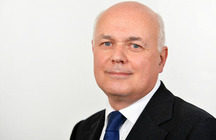
  • Iain Duncan Smith – 2003 Speech to Conservative Party Members in Birmingham

    Iain Duncan Smith – 2003 Speech to Conservative Party Members in Birmingham

    The speech made by Iain Duncan Smith, the then Leader of the Opposition, in Birmingham on 26 June 2003.

    The Conservative Party is committed to a fair deal for everyone.

    There are those, however, who claim this is little more than a dream.

    They argue that leadership is about choices.

    They say you have to penalise one group to help another. You soak the rich to help the poor or you neglect the poor to help the rich.

    This Government believes this argument.

    That became clear again last week when Peter Hain broke the golden rule of New Labour and told the truth about their tax raising agenda.

    But as Conservatives we reject this false choice. We recognise that you don’t help vulnerable people by making the rest poorer, and nor do you make our country richer by leaving large sections of society behind.

    Our fair deal for everyone demands that we are just as committed to leaving no one behind as we are to holding no one back. It is a realisable goal, but it requires leadership, vision and ambition.

    These are three qualities this party has shown before. And we have them again today.

    We have always been the party of one nation. The social and economic reforms of the 1980s were only possible because we built a coalition across social groups and reached out to the inner cities as much as to the leafy suburbs and the shires.

    Today we are still that party, but we must renew our commitment to solving and not merely managing the problems of places like Handsworth here in Birmingham.

    We believe the problems faced by parts of Britain’s inner cities are not insurmountable. No one should be excluded from society because of where they live.

    We believe in the creation of the neighbourly society – not as an unachievable utopia but as a real and possible vehicle of sustained social progress.

    We believe that we can transform our representation in our inner cities because by supporting community groups such as Parents United who I met earlier today, we are showing that only the Conservative Party believes in the potential of every single person who lives in some of the most deprived areas of our country.

    Our challenge is not to attack those who create our nation’s wealth, but to focus instead on ensuring everyone shares in that wealth to the benefit of society as a whole.

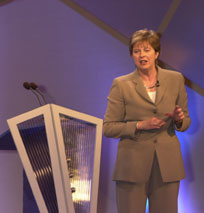
  • Theresa May – 2003 Speech to the Hansard Society’s Annual Lecture

    Theresa May – 2003 Speech to the Hansard Society’s Annual Lecture

    The speech made by Theresa May, the then Chair of the Conservative Party, on 26 June 2003.

    I’m very grateful to the Hansard Society for inviting me to deliver its fourth annual lecture.

    I’m pleased also to be following in the footsteps – I’ll resist the urge to say standing in the shoes – of Robin Cook, a distinguished parliamentarian and a long-serving member of the House.

    I strongly disagreed with Robin over his stance on Iraq, but I respect his decision to give up his Cabinet post because of his beliefs…

    …And I have to say, it makes a change to watch such an effective political operator focusing on his own government from the back-benches, rather than on the opposition from the front-bench.

    I looked back at the task Robin set himself in last year’s lecture and considered his legacy as Leader of the House.

    Clearly, the greatest disappointment is the stalling of real reform of the House of Lords. We have made no progress over the past year and indeed the whole issue seems to have been put on the back burner. The Conservative Party still stands ready to work with the Government to secure a lasting solution to this problem and to deliver a strengthened Parliament overall.

    I notice also that there was little mention in Robin’s lecture of the Government’s plans for the future of the Lord Chancellor and their effect on the House of Lords. It was quite a surprise to have these announced by press release one Thursday afternoon – not just for me, but also it seems for most people in the Government itself.

    It’s a great shame that the Prime Minister felt unable to apologise to Parliamentarians and to the public for the way that the entire fiasco was handled, with no consultation and seemingly no thought. It is, I fear, the hallmark of a man who has little but contempt for Parliament and by implication for the people themselves.

    But Robin Cook is certainly a House of Commons man, and some of the reforms he set out last year have indeed been put in place. The House of Commons now has new sitting hours; the process of appointing select committees has been changed; questions are now more topical and more effective.

    It is probably too early to give a full assessment of the benefits of these reforms, but I’m certain that his actions have ensured that Parliament will never be allowed to return to how it was when I joined the House in 1997.

    Yet I have always felt that the process of reconnecting Parliament with the people must go much wider than simply changing sitting hours and seemingly odd procedures.

    To highlight the ways in which people are turned off Parliament, proponents of parliamentary reform have often pointed to strange customs such as the wearing of a collapsible opera hat by an MP when they wanted to raise a point of order during a division.

    But this is to assume that anyone at all knew that this took place. Of course it was an odd tradition, but it was hardly one of the main reasons why people fail to take parliament seriously. Anyone who sat at home watching the House of Commons on their TV would have to be a serious political animal in the first place.

    I’m pleased that practices like that have gone, but let’s be honest: does anyone feel more connected to parliament now as a result of any of this Government’s reforms than they did before?

    I suspect the answer is no. We need to look at a wider problem.

    I would therefore like to talk about two things in particular tonight.

    Firstly, what procedural or substantive changes could we make to the House of Commons to bring it closer to the people?

    Secondly, what changes must we make to the level of political debate in this country to encourage people to take an interest again?

    Parliament and the people

    Let me take the first of those points.

    As I’ve said, the reforms so far under this Government have often been cosmetic rather than substantive. I believe we need to be far more radical in some of the things we do.

    Conservatives are too often portrayed as simply being resistant to change. This is not so. We simply believe that the benefits of change should be clear. We do not believe in change simply for change’s sake.

    It is in this spirit that as long ago as December 2001 we set out our principles for reform of the House of Commons.

    · We wish to see a strengthening of the role, status and powers of Parliament in general, and of the House of Commons in particular.

    · We wish to see debates and questions in the Commons become more topical and more relevant to the majority of people in the United Kingdom.

    · We believe that it is essential to enhance the ability of the House of Commons, and especially its Select Committees, to scrutinise the actions and decisions of Government.

    · We seek an enhancement in the role and influence of backbenchers on all sides, and a greater recognition of the important role performed by Opposition parties of whatever political colour at any given time.

    · And finally, our approach towards changing the procedures of Parliament is guided by this simple test – will such changes increase or diminish the ability of the legislature to hold the executive to account?

    With these principles in mind we were able to suggest and support some proposals to increase the topicality of parliamentary business, strengthen the powers of select committees (particularly with regard to the scrutiny of legislation) and ensure adequate time is put aside to debate primary and secondary legislation.

    Some of these proposals have since taken effect. We hope to see others coming into effect sooner rather than later.

    But important as these things are, if we’re honest I think the three things that erode the public’s faith in parliament specifically and in politics in general are excessive partisanship, a feeling that politicians are not like them and a belief that they are only in it for themselves and their friends – in other words, the prevalence of cronyism.

    To take the last point first, we live in an era where more and more key decisions about people’s lives are taken by un-elected bureaucrats and officials rather than elected politicians.

    We have a Monetary Policy Committee, a Strategic Rail Authority and a Food Standards Agency. Recently when a critical report about the NHS was published by the Audit Commission, the NHS Chief Executive – Sir Nigel Crisp – was rolled out to put the Government’s case.

    These organisations and individuals are anonymous to many people, but they wield tremendous influence.

    Many members of the public only hear about the people running these agencies and Quangos when they hit the headlines for doing something wrong.

    It’s about time we introduced some form of democracy and accountability to this system.

    In the US, they have done just that. Senior appointments to key bodies in the United States have to be confirmed by a Senate Committee – and only after the individuals concerned have been interviewed and investigated by that committee.

    I believe a similar system could work here in the UK and would go some way to alleviating people’s fears about the creep of cronyism throughout our system of government.

    People such as the heads of the Food Standards Agency and the Strategic Rail Authority together with people such as the NHS Chief Executive should appear before the relevant Select Committee of Parliament to answer its questions before their appointment is confirmed – and if the majority on the committee votes against the appointment it should not be made.

    Not only would this bring some democracy to the process, it would also strengthen the role of Select Committees.

    Similarly, Michael Howard has argued that members of the Monetary Policy Committee of the Bank of England – together with the Governor and Deputy Governor – should be vetted by a joint committee of both Houses of Parliament to bolster their independence, make the process more transparent and increase the power of Parliament.

    Politics also has a problem with representation. Parliament should reflect the country it serves – yet few would argue it achieves this in its current form.

    All political parties have a responsibility to do what they can to attract candidates from all walks of British society. This doesn’t simply mean more women and members of the Black and Minority Ethnic communities as is often argued. It also means getting more people from different professions with different skills and talents to come forward and stand for election to Parliament.

    For those of us charged with this responsibility there are two possible approaches: you can impose rigid structures from the top, or you can give people on the ground the choice of how they address the problem.

    The Labour Party tried the first approach. Their all-women shortlists programme achieved temporary success but it has not been sustained.

    I believe that in order to achieve long-term progress in this area we must work with local people and local parties and give them choice about how they deal with the problem.

    Centrally we have already made great strides. We have made the way we choose people for our candidates list more professional by employing assessment techniques from the world of business. We engaged the services of an occupational psychologist to put in place a rigorous selection procedure using cutting-edge assessment techniques.

    We now have to match these important changes to our national procedures with equally innovative changes at a local level.

    And to do this we are offering our associations the opportunity to pilot a series of new ideas to give local people a greater say in the selection of their local Conservative candidate.

    For example, in constituencies that have not yet selected their candidate and do not have a sitting MP we are offering the option of experimenting with US-style primaries. Under this plan, every registered Conservative voter in the constituency – or even all electors regardless of political affiliation – would have the opportunity to choose the candidate they want from a shortlist drawn up by the constituency party.

    We are also inviting associations to open selection committees up to non-party members. There could be huge value in including prominent local people such as chairmen of residents associations on these committees.

    We could expand the scope of the traditional selection process by allowing people to vote for their preferred candidate by post, rather than requiring them to turn up at the Special General Meeting.

    And we could look at the selection process itself and enhance the usual series of interviews with competency-based exercises to assess the best candidates.

    Fundamentally this is about choice: choice for constituency associations who want to try different ways of selecting candidates, and choice for local people who will receive a greater say in selecting their local candidate.

    Hopefully, some or all of these innovations will help us to match candidates with an appropriate constituency as well as encouraging more local people to take an interest in the politics in their area. They are a way of re-engaging people with politics, and we hope also that out of them we will see more representative candidates coming forward.

    In addition, we’re working closely with Simon Woolley and his team at Operation Black Vote to encourage greater involvement in both local and national politics among members of the Black and Minority Ethnic communities.

    But how to deal with the other point – the excessive partisanship?

    This is naturally more difficult. Politics is and always will be tribal. There is a reason I am Chairman of the Conservative Party and not of one of the other parties. It’s because of who I am and what I believe.

    But as well as being the Party Chairman I’m also the MP for Maidenhead, and I was elected to serve all the people of my constituency, whoever they are and however they voted. I am their representative at Westminster. They rightly want to know where I stand and what I think.

    Yet Westminster politics is run on a tightly controlled whipping system. Most votes are directed by the party whips. You see MPs wandering into the chamber when the division bells go, asking which way they should walk and duly obliging, sometimes without even knowing much about what they are voting on.

    We have all done it, but let me take a recent example. It is, I’m afraid, a partisan example, but I choose it simply because it is recent.

    Two weeks ago, we used one of our opposition day debates to raise an important issue – that of post office closures. The motion we chose to debate used exactly the same wording as an Early Day Motion which had been signed by 175 Labour MPs. But when it came to the vote at the end of the debate, 126 of those Labour MPs voted with the Government against our motion.

    It was not a vote that was going to change the world, yet they were simply unable to defy the whips and to vote in favour of something they had already supported.

    In any other walk of life this would be considered very odd indeed.

    And this strict approach leads to partisanship. It encourages MPs to take sides, shout at each other across the chamber and the despatch box, deliver speeches that are little more than a collection of sound-bites and party lines, and generally behave in a way that people outside politics would never dream of doing.

    Voters do not want yah-boo politics. They want can-do politics.

    So I’ve managed to escape the whip tonight to suggest something dangerously radical – wouldn’t it be good if we could find a way to lessen the power of the whips’ office and to allow more votes to take place on a free vote basis?

    I’m not proposing that this is anything that’s going to happen soon and of course the system remains valuable when it comes to allowing Government’s to meet their manifesto commitments and get things done, but I would like to see a system evolving where at other times MPs have more opportunity to speak their minds and to represent their constituents better.

    There is certainly a desire for this among the public. The presence of independent MPs in the House of Commons may be minimal at the moment, but I believe the coming years will see more and more single issue or independent candidates standing in elections.

    The lesson for political parties must be to allow their MPs to act as human beings more often, rather than continually asking them to obey religiously a party instruction with which they may disagree or which may run counter to the interests of their individual constituency.

    A new politics

    And this leads on to my second point: the need to raise the general level of political debate.

    Most of the things I’ve mentioned so far relate to parliament and the need to change conventions and procedures. But by themselves they will not be enough to reverse the decline in political participation in this country.

    I won’t go so far as to claim we are facing a crisis of democracy, but when more people are interested in voting in Big Brother than in parliamentary or local elections we have to ask ourselves the serious question of what’s gone wrong.

    It’s a familiar fact that the national turnout at the last general election was just 59%, but the really worrying statistic is that 61% of people aged between 18 and 24 chose not to cast a vote.

    That is, of course, their choice – and I do not agree with those, such as the new Leader of the Commons, who argue for compulsory voting here in the UK.

    But why did they make this choice?

    The instinctive answer is to say that young people just aren’t interested in politics. But I believe this is too simplistic a view.

    Look at the number of young people who marched through London and other UK cities to protest about the war in Iraq. Consider how many young people took part in similar demonstrations to protest about the problems in the countryside or the government’s policy on tuition fees. Think about the fact that the number of students enrolling for politics degrees last year was the highest on record.

    These examples show us that young people are not apathetic towards politics, but they are concerned that the traditional system of party politics fails to get things done.

    And I believe the reason for this is that we have failed to recognise or acknowledge the new nature of politics in the 21st century. These days people – particularly young people – are encouraged to question things more and more, and not to simply take things at face value.

    They’re used to questioning those in authority, rather than taking what they say on trust. We no longer live in an age of deference as we once did. Instead, we live in an age of reference – reference to one’s peers but not to those in authority.

    Nor is politics any longer a game played along strict ideological lines. Very few people these days choose their favoured party and stick with it for life. People who are more accustomed to making choices in their daily lives are also more discerning about politics.

    Elections become even more competitive than before when every vote is up for grabs. And the electorate themselves demand more from the political parties. They want to know what positive benefit the parties will bring to them personally, but they also want to know that the party they choose has a vision for society as a whole. It’s not all about self-interest.

    The implications of this for my party have been severe. We came to be seen as self-interested, and towards the end of our term in office many people who voted for us felt that they could do so only as long as no one else knew about it.

    Because our vision and our focus became too narrow, people felt that voting for us would tar them with the same brush. They felt uneasy about it and as a result they left us in droves.

    We’ve been working on broadening our approach again. To do this, we are trying to break out of the confines of the British political system.

    For too long, voters in this country have been faced with false choices and artificial divides. On the one side of British politics you have the Conservative Party – pro-business, good on the economy, strong on law and order. On the other you have the Labour Party – supportive of the workers and committed to health and education.

    Voters are asked to line themselves up on one side of the debate or another – the implication being that you can’t possibly agree with both.

    While the current Government managed to bridge this gap when they were in opposition before 1997 the artificial divides have returned since.

    Today we are told that you either want to improve public services or you can oppose ever-higher taxes – as if money alone were the answer to every problem in our public services, higher taxes were the only possible source of funding, and every penny already raised in taxes was spent as effectively as it could be.

    You are either a party that wants to help vulnerable communities or you are a party that wants to help businesses and encourage enterprise – as if vulnerable people are helped when the country as a whole is made poorer.

    On crime, you can either take the side of the victim or you can protect historic legal freedoms and deal with long-term trends in offending – as if you achieve justice by removing defendants’ rights from the courts system and offer no help to young offenders who’ve lost their way.

    It is time to change this sterile debate. The challenge of politics today is to recognise that prosperity and public services are partners, not opposites. That wealth and opportunity can be extended across society, not just to the few. And that a neighbourly society is a realistic vision for improving life in Britain’s most deprived communities.

    It’s little wonder people are turned off politics when the level of political discussion today displays such an astounding lack of ambition and lack of confidence in our country. And it is also a sad caricature of our political parties.

    I don’t believe any of the main parties do not have the best interests of the whole country at heart. I don’t think their intentions are wrong. On the whole, I think politicians of all parties are good people who are in politics to make people’s lives better.

    Of course I disagree with many of the methods and policies of the other parties – sometimes strongly – but I rarely think they are motivated by anything other than the desire to do some good.

    So these false and extreme divisions we create in British politics let down the people of this country who look to their politicians to take on the challenges of the day and to overcome them.

    If we are to genuinely reconnect people with politics and to rebuild their faith in parliament we have to seek a new political settlement – one which looks above these exaggerated and extreme opposites and delivers what the public wants:

    A Britain built on the principles of social justice with better public services, and a strong and thriving economy.

    There is no contradiction here. There is only a lack of political ambition and a resultant caricature of British politics leading to a sterile debate that simply turns people off.

    Who do we blame for this?

    The traditional target for politicians is the media and certainly they are not entirely blameless. Too often, they focus on personalities at the expense of policies. They look for sound-bites and catchy headlines. It’s not easy to change the nature of political debate when newspapers and broadcasters are prepared to repeat – without questioning – scare stories about ‘20% cuts across the board’ whenever someone tries to challenge the conventional thinking on the funding of public services.

    A few months ago we had an American intern working with us at Central Office. At the end of her stay she was asked what the main difference was between British and American politics, and she said the press. ‘In the US they report things, here they always try to interpret them’.

    Politicians know that everything they say and do will not just be reported, but interpreted. And as a result a politician’s greatest fear is going ‘off-message’. That’s why many political interviews these days take the form of an overly-aggressive interviewer demanding answers from an overly-defensive politician. Both participants know that any deviation from the party line – any slight difference in nuance – will be treated as a gaffe or the worst party split since the last one.

    The columnist Matthew Parris summed this up when he wrote:

    “If I could remove from the journalists’ lexicon a single word, and with it remove the moronism to which it gives throat, that word would be “gaffe”. Like a flock of demented parrots we shriek “gaffe! gaffe! gaffe!” whenever anyone in public life says anything interesting. What others would call speaking out, we call speaking out of turn. The voicing of unpalatable truth, we call indiscretion. Taking a flyer, we call dropping a brick. We peck to pieces any politician who breaks cover and speaks his mind. Soon only grey heads tucked below parapets and mouthing platitudes remain. Then the media parrots chorus “boring! boring” (The Times, 30 November 2002).

    More recently, another Times columnist, Danny Finkelstein, described how an ‘elaborate set of rules’ has grown up, determining how the political game is played. But he added that while: ‘The public has largely grown tired of the rules…politicians and the media have not’ (The Times, 3 June 2003).

    But you know politics is not a game – and many members of the press would do well to note that many people no longer read national newspapers or watch national news broadcasts. Research shows that 84 per cent of adults regularly read a regional or local newspaper, but 40 per cent of all adults who read a regional publication do not read a national paper – and if they do they no longer always believe them.

    But tempting though it is, I don’t want to blame the media entirely. The real problem lies with the politicians themselves.

    As I said earlier, politics is by nature tribal and this is never clearer than during a general election campaign, the point of which is to help people decide who they would prefer to run the country for the next five years. Here, amplifying the differences between parties can help to make that choice clear.

    The problem is that modern politics is becoming more and more like one long election campaign.

    Before allowing this trend to continue, politicians of all parties should consider the dangers it poses. Between elections, the differences that matter to people are not necessarily those that exist between the parties but those that exist between how things are and how things should be.

    The debate they would like to see is about how we can make things better.

    Now I certainly believe that Tony Blair’s government has introduced a range of policies that take us in the wrong direction. Others would say the same about policies introduced between 1979 and 1997. But no one in their right mind imagines that every problem in our schools or our health service originated with the election of one Government or another. Many of these problems are deep-seated and have been bubbling beneath the surface for decades. Finding solutions to these problems is what politics should be about and that is where the debate should be.

    My fear is that the five-year election campaign results in the victory of extreme and exaggerated rhetoric over the resolution of big and difficult challenges.

    And sadly this even happens when we’re dealing with some of the most important issues of the day.

    Europe

    Take for example the appalling way in which the important issues about Europe and the Euro have been treated in recent weeks.

    There is little doubt that the European Union and the European Parliament are taking on an increasingly important role in the life of this country.

    Recently the Convention on the Future of Europe published its draft proposals set to form the basis of a new European constitution. They plan:

    · A President of the European Council.

    · Tighter co-operation on foreign policy, including a European Minister for Foreign Affairs.

    · A legally binding Charter of Fundamental Rights, and

    · A common asylum and immigration policy across the community.

    At around the same time, the Government finally announced its decision (or more properly its non-decision) on Britain’s membership of the European Single Currency, with all the affect that decision has on interest rates, home-ownership, employment and UK trade.

    In short, it has been an important time in British politics when we have been facing major decisions about the future of our country.

    And yet, far from having the wide-ranging debate you would expect – far from setting out the economic, constitutional and political implications these issues have for the UK – the Government chose to conflate all these points into one single argument: you’re either in favour of the European Union or you want out of it.

    That’s it. No other vision of the EU’s future allowed, no debate permitted and certainly no consultation with the people.

    If I may be forgiven a brief moment of partisanship, this approach is ridiculous, it is cynical and it is a travesty of democracy.

    Rather than engage in a debate about the proposals from the European Convention, the Government has chosen to claim – quite alone of any of the European governments – that they have no real implications for Britain and anyone who questions them must want to withdraw from the EU.

    And rather than discuss the economic impact of the European Single Currency, the Government is seeking to portray anyone who does question it as being some sort of little-England isolationist.

    They are closing down the debate and instead deliberately creating that false divide of which I spoke earlier – you’re either part of their version of the pro-European consensus or you’re a dinosaur who wants to withdraw from the EU entirely and have nothing to do with it.

    Political debate can scarcely get much lower than that, when you’re prevented from discussing matters of such fundamental importance to the future of the country.

    It is emphatically not the policy of the Conservative Party to withdraw from the European Union. It is, quite simply, a lie – a scare story. Indeed, the only main party leader to ever stand for election on that platform is the Prime Minister himself.

    We have to be prepared to have an open and honest debate about the future of Europe, recognising that there are many different views among the current members and the accession countries.

    If we politicians are unable to have that full and frank debate on an issue of this importance it is no surprise that people have little faith in us and in the political institutions of this country.

    Conclusion

    At the end of the day, the task of reconnecting parliament with the people is about far more than the day-to-day workings of the Palace of Westminster.

    Parliament is not simply a building or even the conventions and traditions within the building – it is its members, the 659 MPs and the members of the House of Lords.

    For the people of Britain, that magnificent gothic looking building on the banks of the Thames is the repository of political power in this country, and people will only feel any connection with it if they feel part of the entire political process.

    If they feel politicians are like them, grown-up people with their own views and opinions who are serious about making a difference. If they think politicians are people who are prepared to consult them and listen to their views. If they think politicians trust them and are worthy of their trust in return.

    We no longer command respect simply because of who we are. In this day and age respect is something that has to be earned.

    If we can rise to that challenge and appear to be people who are prepared to put our ambition for our country ahead of our personal party prejudices then we just might encourage people to be proud of their politicians and their Parliament once again.