Blog

  • PRESS RELEASE : The Red Cross announced Russia’s approval of access for the humanitarian convoy to Mariupol, also corridors from Melitopol and Enerhodar were agreed – Iryna Vereshchuk

    PRESS RELEASE : The Red Cross announced Russia’s approval of access for the humanitarian convoy to Mariupol, also corridors from Melitopol and Enerhodar were agreed – Iryna Vereshchuk

    The press release issued by the President of Ukraine on 31 March 2022.

    Ukraine has received a message from the International Committee of the Red Cross that the Russian Federation confirms its readiness to open access for the humanitarian convoy to Mariupol in transit through Berdyansk. In addition, two humanitarian corridors in the Zaporizhzhia region have been agreed – from Melitopol and Enerhodar. This was announced by Deputy Prime Minister – Minister for Reintegration of the Temporarily Occupied Territories Iryna Vereshchuk.

    According to her, 45 buses were sent to Mariupol along the route. In particular, as of 9:00 am, 28 buses were to be allowed to pass through the Russian checkpoint in Vasylivka. In addition, 17 buses have already departed from Zaporizhzhia.

    “We will do everything possible to ensure that buses arrive in Mariupol today and pick up people who have not yet been able to get out of the city,” said the Deputy Prime Minister.

    Two humanitarian corridors in the Zaporizhzhia region have been agreed. In particular, for the delivery of humanitarian aid and the evacuation of people from the city of Melitopol. It is also planned to organize a column of citizens on their own transport from the city of Enerhodar to Zaporizhzhia.

    Iryna Vereshchuk added that people on their own transport will be able to join the humanitarian columns from Mariupol and Melitopol on the way to Zaporizhzhia.

    “Our military has fully confirmed and guarantees a full ceasefire. So, at 9:00 we will start the evacuation,” said the Deputy Prime Minister.

  • Liz Truss – 2015 Speech at Agrihive on UK Businesses Exporting Food

    Liz Truss – 2015 Speech at Agrihive on UK Businesses Exporting Food

    The speech made by Liz Truss, the then Secretary of State for Environment, Food and Rural Affairs, at the Agrihive Conference on 18 November 2015.

    We have some of the most exciting and inventive people in our food and farming industry in this country. And one of the things we’re doing is tonight, we’re launching Great British Food, which is a new campaign celebrating those pioneers, but also talking about how we can get the message out about how exciting British food is, how exciting British farming is, and what we are doing here in our industry to make sure that we can compete internationally, as well as make sure we’re buying selling and growing more British food here in our own country. And there’s been a lot of work in the dairy area.

    I know a lot of exciting innovations. Only a couple of weeks ago when I announced the extension of the Yorkshire Dales National Park, I visited the Wensleydale Creamery, and I think it’s a brilliant example of a business which operates within a national park. It succeeded in expanding and it does very good job with local farmers, so they are supplying the milk to the dairy. It also promotes itself as a visitor attraction and it’s attracting increasing visitors in the Yorkshire Dales.

    In fact I first came across the people from Wensleydale in Paris, when they were at the CL trade fair and their stand was being mobbed by Japanese buyers wanting to buy into that unique product from Yorkshire. It’s a protected product and I think success stories like Wensleydale who’ve now launched their first yoghurt product. This shows what can happen and where dairy businesses can succeed in the future. I’ve said before at the moment we’ve got a big opportunity on products, we still import the majority of our butter and our cheese. We import 40,000 tonnes of cheddar every year which after all, is a British product kicked off here in the UK.

    So I think there are opportunities, of course we know that many farmers are struggling at the moment and we’ve worked hard at a European level to secure that additional funding, which will be paid in December. We’re also making sure that the BPS payments go out on time which I know many farmers are concerned about, but what we also need to do whilst making sure we retain the strength of our industry in the short term is building up those longer term opportunities.

    So we’re working at looking at the grocery chain adjudicator now at a European level to reflect the nature of the food chain and the way it goes beyond national boundaries. We’re looking at futures markets in dairy to help farmers plan for the future. And we’re consulting on tax averaging over five years to help farmers maintain those long term businesses. We’re also very focused on exports and we’ve seen a 60% increase in dairy exports since 2009. I think there are many more opportunities out there. I’ve highlighted Wensleydale, but we’ve got a whole host of dairy companies coming with us next week on our visit to China on our trade mission to China.

    So there are lots of opportunities but I think an event like this Agrihive, that really involves the leaders of the industry. And those working with the industry is really important to get those ideas out there to look at the pioneering efforts across British dairy, because I’m absolutely clear that dairy is a core part of our food and farming industry. You know, we need to not just maintain it for the long term, but also help build up the industry and I think it is the pioneers. It’s the people with ideas, with new ways of doing things, to make sure that we can maintain our productivity, our competitiveness, and really win in those international markets.

    It’s really important of course, the government is a very big procurer of food. Last year we launched the Bonfield report, which is all about making it easier for public sector bodies like schools and hospitals to buy British food so they can now look at things like where it’s from, is it local, they can look at the quality of the product, rather than just going on the price and that is having an impact. We are seeing more British dairy bought across the public sector. And I want see more progress on that in the next few years.

    So we’re setting an example in government. I think there’s more we can do across the country to support our dairy industry and we are in discussions with supermarkets as well about that, but also, the industry has a major role to play in putting itself forward in grasping those potential. opportunities both here and overseas. But thank you very much for having me along today. It’s a great innovation and I hope to see you all soon. Thank you

  • PRESS RELEASE : It is very important to develop new packages of sanctions against Russia, as it is a powerful and effective mechanism for influencing the governing regime – Andriy Yermak

    PRESS RELEASE : It is very important to develop new packages of sanctions against Russia, as it is a powerful and effective mechanism for influencing the governing regime – Andriy Yermak

    The press release issued by the President of Ukraine on 31 March 2022.

    Sanctions are a powerful and effective mechanism for influencing Russia and those who support the ruling regime in the aggressor country. However, sanctions need to be deepened, so a new US package is expected to be announced soon. This was stated by Head of the Office of the President of Ukraine Andriy Yermak in an interview to TV presenter Vadym Karpyak, which was broadcast within the information marathon “United News #UArazom”.

    “It is very important to develop new packages of sanctions,” Andriy Yermak stressed.

    He said that during the recent conversation between President of Ukraine Volodymyr Zelenskyy and US President Joseph Biden, our state received a signal that a new package of sanctions from the United States will be introduced in the coming days.

    “We see that US sanctions are very effective today. This is a very powerful tool. It needs to be continued,” said the Head of the President’s Office.

    According to him, sanctions will primarily affect Russian politicians, deputies and people who supported the war against Ukraine and on whom this regime is based.

    “Certainly, it will be financial sanctions, economic ones,” Andriy Yermak said.

    The Head of the Office of the President of Ukraine stressed that sanctions should also be imposed on Russian energy sources and the largest banks.

    “These sanctions should include an embargo on energy, first of all I’m talking about an embargo on oil exports. If it takes a long time or there are some difficulties, we also said that sanctions should be introduced making it impossible for Russia to receive funds for the sale of oil, and this money could be used in some way in Ukraine’s interests,” Andriy Yermak said.

    He clarified that the issue of imposing an energy embargo concerns both gas and oil.

    The Head of the Office of the President added that Ukraine is making every effort to ensure that European countries also support the embargo on Russian energy.

    “Of course, it is a very complicated issue. We know that some EU countries are ready and they understand that today it is impossible to think of any benefit when children are killed. And it is impossible now to measure money, some income, when it concerns human life,” he said.

    At the same time, Andriy Yermak stated that there are countries that still have a different position. But the talks of the President of Ukraine with the leaders of these states, his addresses to the parliaments and nations, the work of Ukrainian diplomats are aimed at changing the attitude in these countries. After all, if the governments of some states are hesitant, they must listen to the opinion of their citizens.

    “The nations of the world have already made their choice today – they are all with Ukraine, they are all on the side of good. That is why it is very difficult now for the countries that still continue to “play” and do not have a clear position – today or tomorrow they will answer the questions of their people why they did nothing in eight years and what they did when Ukrainians were killed and when there was war,” said the Head of the Office of the President.

    Andriy Yermak also noted that sanctions are a powerful tool, but they need a very deep and rapid analysis. That is why there is an initiative to organize the work of a group of Ukrainian and international experts who will analyze the real impact of the restrictions imposed on Russia. He said that experts will not only study the sanctions already in place – what works and what doesn’t. They will also talk about it publicly.

    In addition, the Head of the Office of the President called important the direction of this group’s work to develop mechanisms that would make it impossible to circumvent the restrictions – both for individuals and for countries.

  • PRESS RELEASE : Ukraine needs more weapons, because we defend the values of a democratic world – Head of the President’s Office

    PRESS RELEASE : Ukraine needs more weapons, because we defend the values of a democratic world – Head of the President’s Office

    The press release issued by the President of Ukraine on 31 March 2022.

    Ukraine needs as big a supply of weapons as possible because our country pays a very high price every day defending the values of a democratic world in the fight against the aggressor. This was stated by Head of the President’s Office Andriy Yermak in an interview to leading international journalist of the American television company CNN Christiane Amanpour.

    Andriy Yermak noted that Ukraine does not see any real confirmation of Russia’s statements on the withdrawal of troops from certain areas of the frontline.

    “We believe they have changed their strategy and plans. Unfortunately, this does not mean stopping the war. I can say that the situation remains pretty difficult. I especially want to dwell on the humanitarian situation – everything is very bad,” he said.

    The Head of the President’s Office stressed that Mariupol is in a catastrophic situation, where people are dying without food and water, and the Russians do not allow them to leave the city.

    “The Russians did not allow the residents to leave the city. Russian troops have taken thousands of residents to Russia,” said Andriy Yermak.

    According to him, the catastrophe in Mariupol is very similar to the blockade of Leningrad during World War II.

    “Our Ukrainian position is very open and very transparent: we want to stop this war, we want Russian troops to be withdrawn from our territory. We insist on opening the humanitarian corridors, especially from Mariupol,” said the Head of the President’s Office.

    Andriy Yermak stressed that the Ukrainian delegation continues difficult talks with the Russians, and the meeting in Istanbul is a confirmation of such a dialogue.

    “I can say that we have very principled positions, and we do not want to compromise on our independence, territorial integrity and sovereignty. We are ready to continue the discussion, our delegation works around the clock seven days a week in a video format. Yesterday (March 29 – ed.) it happened live. I have a little optimism about that. We are continuing this conversation,” said the Head of the Office of the President.

    Andriy Yermak noted that in his addresses to the parliaments of the world, President Volodymyr Zelenskyy emphasizes the need to increase weaponry supplies to Ukraine.

    “We do not have enough weapons. And we need it to continue our struggle,” he said.

    The Head of the Office of the President hopes that all partner states of Ukraine understand that today our country pays an exorbitant price for its freedom, so the issue of weaponry supply is very important.

    “The whole world can see that Ukrainians are a nation that will never stop fighting because we are fighting for our land. We are fighting for our country. We are fighting for the whole democratic world,” he said.

    Andriy Yermak also emphasized that Volodymyr Zelenskyy is a very brave man focused on results.

    “He is the absolute leader of our nation. He is a man who gives the necessary energy and courage to all Ukrainians, the whole world, all people. Because I am absolutely convinced that the people of the world support Ukrainians, they made their choice. And we can see thousands of people on the streets in different cities around the world. And we will win, Ukraine will be the winner. We are sure of that. But it is necessary to do it as soon as possible,” the Head of the President’s Office stressed.

  • PRESS RELEASE : Toughest targets ever introduced will crack down on sewage spills

    PRESS RELEASE : Toughest targets ever introduced will crack down on sewage spills

    The press release issued by the Department for Environment, Food and Rural Affairs on 26 August 2022.

    Water companies will face the strictest targets on pollution from sewage ever under a new plan to tackle sewage discharges in our waters, set out by government today.

    The government’s plan will require them to deliver their largest ever environmental infrastructure investment – £56 billion capital investment over 25 years – into a long term programme to tackle storm sewage discharges by 2050. The plan frontloads action in particularly important and sensitive areas including designated bathing waters and high priority ecological sites.

    The targets will mean they need to take measures such as increasing the capacity of their networks and treating sewage before its discharged to protect public health and prevent pollution, whilst massively reducing all discharges. Failure to meet these targets could see them face substantial fines or having to return money to customers.

    The Storm Overflows Discharge Reduction Plan is the most significant investment and delivery programme ever undertaken by water companies to protect people and the environment.

    We are the first government to require water companies to take action to address these discharges, and the plan follows ongoing work by government, the Environment Agency and the regulator Ofwat to drive up water companies’ performance and monitoring and increase accountability. This includes a massive expansion in monitoring frequency and duration of discharges, from approximately 5% in 2016, to nearly 90% in 2021, which has been used to hold companies to account.

    Under the plans announced today, water companies will have to achieve a number of targets, so that discharges only happen when there is unusually heavy rain and when there is no immediate adverse impact to the local environment.

    1. By 2035, water companies will have to improve all storm overflows discharging into or near every designated bathing water; and improve 75% of overflows discharging to high priority nature sites.
    2. By 2050, this will apply to all remaining storm overflows covered by our targets, regardless of location.

    We will review this plan in 2027 to consider where we can go further, taking account of innovation and efficiencies.

    The plan also sets out that water companies will be required to publish discharge information in near real time as well as committing to tackling the root causes of the issue by taking steps to improve surface water drainage.

    In addition, the plan sets out our wider expectations for the water industry, to ensure their infrastructure keeps pace with increasing external pressures, such as urban growth and climate change, to ensure our water supplies remain clean and secure for the future.

    Environment Secretary George Eustice said:

    “This is the first government to take action to end the environmental damage caused by sewage spills. We will require water companies to protect everyone who uses our water for recreation, and ensure storm overflows pose no threat to the environment.

    “Water companies will need to invest to stop unacceptable sewage spills so our rivers and coast lines can have greater protection than ever before.”

    These plans strike the right balance between the need for investment and the impact on consumers. Under this plan there will be no changes to bills until 2025. The Government has ruled out options which could add up to £817 a year to average household water bills. The government will continue to monitor water affordability and take further action if needed, and will consult on a new water affordability scheme to help less well-off households.

    A raft of measures have also been brought forward in our Environment Act to tackle sewage discharges, including the requirement for greater transparency from water companies on their storm overflow data.

    As a result of this government’s policies to increase monitoring and transparency, the regulators (Environment Agency and Ofwat) last year launched the largest criminal and civil investigations into water company sewage discharges ever, at over 2200 treatment works, following new data coming to light as a result of increased monitoring. The investigations will look at where sites may be breaching their permits, and ensure that companies found to be acting illegally are held to account, up to and including prosecution, which can lead to unlimited fines and companies having to reimburse customers.

    This follows 54 prosecutions against water companies since 2015, securing fines of nearly £140 million. We will not let companies get away with illegal activity and where breaches are found, regulators will not hesitate to hold companies to account.

    The government has also been clear that companies cannot profit from environmental damage. Ofwat have outlined that water companies must be transparent about how executive pay and dividends align to delivery of services to customers, including environmental performance. The government supports Ofwat’s recent proposals which would provide extra powers for enforcement action against companies that don’t link dividend payments to their environmental performance, or who failed to be transparent about their dividend pay-outs.

  • PRESS RELEASE : Ukrainian cockerel jug gifted to the Prime Minister goes on display to delegates at Edinburgh International Culture Summit

    PRESS RELEASE : Ukrainian cockerel jug gifted to the Prime Minister goes on display to delegates at Edinburgh International Culture Summit

    The press release issued by the Department for Digital, Culture, Media and Sport on 26 August 2022.

    • Jug is now on display at the Culture Summit showing global solidarity with Ukraine

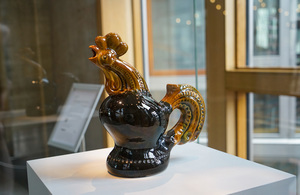
    A cockerel-shaped ceramic jug gifted to the Prime Minister in Kyiv has gone on display to delegates at the Edinburgh International Culture Summit.

    The jug, which has become a symbol of Ukrainian resistance, is being displayed at the biennial event to demonstrate the ongoing international solidarity with Ukraine following the illegal invasion of the country by Russia.

    The Prime Minister and Volodymyr Zelensky received a pair of matching jugs from a woman in Kharkiv while walking through the streets of the Ukrainian capital in April.

    This type of jug became emblematic of Ukraine’s strong resistance against the invading Russian forces after photographer Elizaveta Servatynska captured an image of a similar jug sitting undamaged on a kitchen cabinet in a high-rise apartment block in March. The building, in Borodyanka, had been badly hit by Russian bombing.

    In Ukrainian folklore, cockerels are believed to have powers of protection. When the image of the undamaged jug went viral on social media it quickly became a symbol of the country’s stand against the Russian invaders.

    The jug gifted to the Prime Minister is now on display at the Edinburgh International Culture Summit where it will be visible to delegates.

    Arts Minister Lord Parkinson said:

    “As we meet in Edinburgh, this jug will serve as a powerful reminder of Ukraine’s unflagging strength and resistance in the face of Russia’s barbaric invasion.

    The Ukrainian people and the preservation of their unique cultural identity will be at the forefront of our minds as ministers and cultural leaders from around the world  meet to discuss  international cultural collaboration.”

    The jug was made in the 1960s by prominent ceramists Valerii and Nadiia Protoriev from Vasylkiv, a town near Kyiv. The glazed earthenware jugs are an example of majolica pottery that were produced by a Vasylkix factory during the Soviet era.

    The biennial Edinburgh International Culture Summit is attended by politicians, artists and cultural leaders from around the world. It aims to promote international cultural and artistic exchange. Delegations from countries across the world will be in attendance at this year’s event.

    This year’s summit will have a particular focus on Ukraine through discussions on culture and freedom, which has been prompted by Russia’s invasion. The Ukrainian Institute and British Council are also convening a special Culture Leadership Dialogue event, which aims to forge partnerships between the cultural sectors in the UK and Ukraine in response to the challenges being faced as a result of the ongoing conflict.

    Arts Minister Lord Parkinson will be representing the UK Government at the summit.

    The Government Art Collection (DCMS) has assisted with the display of the jug and facilitated the loan between the PM and Scottish Parliamentary Building.

  • Damian Green – 2002 Speech to the Connect Think Tank

    Damian Green – 2002 Speech to the Connect Think Tank

    The speech made by Damian Green, the then Shadow Secretary of State for Education, to the Connect Think Tank on 1 June 2002.

    One of the symptoms of over-centralisation is the over-increasing complication and sheer number of tests that schoolchildren now go through. Let me make my attitude to this clear. Regular testing, in a simple and clear way, is essential.

    Publishing the results of the main national tests is also essential, to allow parents and others to know how schools are performing.

    But what is not essential, indeed what is actively harmful, is turning school years into a never-ending grind of exams. This is where we have now ended up, especially for 16-18 year-olds. The system after GCSEs has now reached saturation point.

    AS levels are one of those reforms that seemed like a good idea at the time. They have proved to be a failing attempt to widen the curriculum which has done more harm than good. They were meant to widen the experience of young people, but instead they have encouraged them to give up sport, music, drama, and other useful and enjoyable activities to make sure they succeed on the exam treadmill.

    Look at the figures. In 2000, 1,149 candidates complained about AS levels out of a total of 76, 427—a rate of 1.5%. In 2002 19,496 students complained out of 771, 893—a rate of 2.5%. One teacher from Suffolk who wrote to the Conservative Party Education Website summed it up perfectly: “The new AS exams are one set of exams too many.”

    Other correspondents to our website include two students: one, from Surrey, wrote

    ‘I have found that AS levels promote only anxiety concerning the burden of work and the inevitable exclusion of activities such as culture and sport. The system punishes the student who engages in either.’

    Another, from London, said: ‘I believe that pupils do sit too many exams which us preventing schools from giving children the rounded education they deserve. Summer sports such as cricket have virtually disappeared for the 15-18 year group in both state and independent schools due to the constant demands of the modular examination system.”

    There have been reports of individuals buckling under the stress. One girl fled from the exam hall in tears as she sat her fifth paper of the day. She had already faced her first four papers with only a ten-minute gap in between each. Another correspondent to our website said that at her college, in the first year of the introduction of AS levels, there were more cases of stress reported than ever before.

    In response to Parliamentary Questions from me Ministers have said that the number of external tests an average pupil will now take in a school career is over 45. Research by the Qualifications and Curriculum Authority has shown that a typical student of higher ability could face 95 exams through a school career.

    On the issue of AS levels I rather agree with John Dunford of the Secondary Heads Association, who said earlier this year: “If the Government is to introduce new reforms in secondary school qualifications it must address the problem of over-assessment and reduce the number of external exams.” My solution to this is to recognise that AS levels in their current form are the fifth wheel on the coach, and to get rid of them.

    After last year’s fiasco with exams, the Government promised a review. This year, they have promised another review. This is wholly inadequate. Our teenagers are being asked to do too many exams too often. Let’s act now to relieve the burden.

    There are a number of alternatives to the AS level system. We should be looking at the baccalaureate system as one option. Another is a General Studies Paper, which could encompass subjects not covered by the student’s main ‘A’ level subjects. A third is simply to encourage schools to teach non-examined subjects—exams are a measuring rod, not the purpose of education.’

  • Eric Pickles – 2002 Speech to the Chartered Institute of Housing

    Eric Pickles – 2002 Speech to the Chartered Institute of Housing

    The speech made by Eric Pickles to the Chartered Institute of Housing on 12 June 2002.

    Ten years ago this month, I made my maiden speech to the House of Commons as the newly elected MP for the constituency of Brentwood & Ongar.

    My contribution was made during a housing debate sponsored by the then Conservative Government. The debate was entitled Tenants’ Rights.

    What you have to understand is that a maiden speech is an intensely personal thing to an MP. It sets out what motivates the Member of Parliament, it lays down what he or she wants to achieve, puts markers down to the Party Whips office about areas of interest.

    What you have to understand about the Whips office of all parties is that it is run with the cold efficiency of the armed forces during a period of national conscription. So that professional cooks will find themselves assigned to transport, and painters and decorators to the kitchen.

    So you will understand my emotion in making my second public speech on housing in ten years, and my first speech as the new Shadow Secretary of State for Local Government and the Regions.

    Much as I have enjoyed the past few months chasing Stephen Byers, I am pleased now to be given the opportunity to focus on serious issues such as housing, which concern real people every day.

    Looking back over what I said ten years ago in the House of Commons, I recognise that much of it is just as relevant here today.

    If you will forgive a politician the ultimate vanity of quoting himself, in 1992 I said: ‘Any reasonable housing policy must be based on quality, diversity and choice’. The same is true today.

    But now I am acutely aware – perhaps more than in many other areas – the boundaries and the language of the debate have moved on.

    The old arguments about public versus private provision have largely been won. Today, there is some unity about providing good quality, affordable housing and reversing the migration from our inner cities, and about building stronger communities

    So I hope today, to outline to you my approach to housing policy and to try and explain what we will be considering in our policy review process, which is currently underway.

    In my speech in the House of Commons, I explained how public housing was largely responsible for forming my political views.

    As I looked around me on the council estate in West Riding in Yorkshire where my parents ran a small corner shop, I began to despair at some of the conditions in which my friends and neighbours lived. I realised that the fundamental problem was that they deserved a better landlord than they had.

    Many of them lived in properties owned and managed by the local authority. As a former councillor, I know that even when they are trying their hardest, they do not necessarily make good landlords.

    There never was a golden age of public housing. The fact is that most people wanted to own their own homes. This is what the Conservative Governments of the 80s and 90s recognised – and I’m pleased to say that so successful was the policy, that even most Labour politicians accept today.

    Conservatives believe in home-ownership. The importance of property ownership is marked out throughout the history of political thought. You may even say that it is at the heart of Conservatism.

    We are rightly proud of policies such as right-to-buy which empowered a new range of people.

    We are pleased to have introduced the notion of stock transfer.

    We were right to break down the barriers between the public and the private sectors.

    The principles that drove those policies will drive our future policies also. They are the principles I was elected on in 1992, and I hold true to them today.

    But I also recognise the new challenges and priorities we now face. Too often in the past, we have allowed ourselves to be portrayed as only caring about property and money.

    Conservatives may have been the party of property, but we recognised the obligations to the community that property brought with it.

    The priorities now must be to encourage more people to live in our cities to stop them from becoming lifeless ghettos and to look into ways of providing more affordable housing, particularly to young people.

    And we need too, to give greater focus to the war on homelessness.

    I was David Willetts’ deputy at social security for a couple of years; I have talked to him about his experience of seeing for himself the plight of people living on the streets. Something neglected by politicians for far too long.

    Remember what the Prime Minister promised? He said his Government would: ‘do everything in our power to end the scandal of homelessness’. But as we know, homelessness in England has soared since 1997.

    Worse still, the number of children who are living on the streets is rising. What chance does the child without a home have?

    And the number of people living in bed and breakfast accommodation has risen dramatically under this Government – up by as much as 200 per cent in London.

    I don’t pretend that things were perfect under Conservative Governments. We all need to give much greater thought to how we help these people out of their dire situation to give them a greater chance in life.

    It is not as if we have to look far to see the problem.

    David told me of visiting people sleeping in doorways and people seeking warmth in homeless shelters; he came across one group huddled by the side of Westminster Cathedral – less than a mile from the House of Commons and directly opposite the offices of the Government’s Rough Sleeper Unit.

    From where they lie they can see a sign that should mean something to them, but as often is the way: politicians try to help but it is remote and useless.

    Part of the problem is that we always look at the short-term. We just want to get people off the streets. We don’t think enough about them as individuals and families – we only think about them as statistics.

    And it’s not a problem that can be solved simply by throwing more money at it.

    We need to be more innovative in how we address the problem.

    I am sure you understand better than me why some homeless people reject the offer of a one-bedroom flat. On the streets sometimes the only family you have are those who sleep next to you.

    It may seem hard for us to comprehend, but some people would rather stay where they are instead of being sent off on their own to a flat somewhere.

    There is a social dimension to homelessness, and we cannot ignore it. We must address the street culture that exists, and consider making greater use of things like communal housing, so that groups of homeless people can be housed together.

    Successive governments have failed to grasp this nettle, but we are now in a position to do so because we are listening, learning and taking our time to get our policies right.

    But I also spoke earlier about the need to reverse the migration from our inner cities that is leading to increasing degrees of deprivation in urban areas.

    People are the lifeblood of cities, and encouraging people to live in urban areas is both a social necessity and also common sense.

    It is a social necessity because if we are to build communities in inner city areas we need to provide stability.

    It is common sense because if we are to improve the way we run our public services we need to build communities.

    The teacher, doctor or policeman who lives in the community they serve is naturally better able to deal with the needs of the area. When local residents witness the evening flight of influential people it reduces the sense of community. It signals that success lies elsewhere, and stigmatises those that remain.

    All areas need constancy, commitment and stability. Building communities will be the priority of the next Conservative Government.

    So housing policies, which force people to leave inner city areas, are simply wrong.

    The decrease in the amount of social housing constructed under this Government is a problem of Labour’s own making.

    So there are fewer houses to live in.

    But the houses that do exist are also less affordable.

    The decision to cut the right-to-buy discounts has resulted in many young people being unable to take their first step on the housing ladder.

    Labour has also made home ownership less affordable by increasing taxes on homeowners.

    And of course the huge increases in council tax we have seen under this Government – an additional £212 for a Band D property over four years – are hitting households on lower incomes the most. Particularly those just above entitlement to some form of income support in its general sense

    In my own constituency, I have seen the problems this last issue causes. An example of the law of unintended consequences

    In one area where people are living in social housing they have seen the value of their property rise. What would be a band A or B in West Yorkshire is much higher in the South East. The increased valuation with the higher Council Tax is the margin between being able to afford to live locally or not.

    The result of these policies is that the average deposit needed for a first time buyer in the UK has risen by £6,700 to £13,300 – and the average age of a first time buyer is now 34.

    So the Conservative Party’s policy review is considering how to address these problems. The answers are not easy, but by taking our time and talking to the people who matter – people such as your good selves – we aim to bring forward policies which answer these difficult questions, and which help to build strong communities

    And Conservatives know that good quality, affordable housing is inextricably linked to good public services.

    This is where the title of this session – ‘Is the Government delivering better public services’ – comes in.

    The evidence is clear. There is a clear linkage between the home environment and the reliance on public services.

    But of course there are more basic issues to consider.

    We simply can’t talk about improving the health service if we are not simultaneously considering what to do about housing. If we acknowledge that one of the major problems in the NHS today is the issue of so-called bed-blocking we have to realise that it is also linked to the need to provide good quality, warm and comfortable housing for elderly people.

    And if I may be so bold as to agree with a former Labour Health Minister, ‘anyone with a shred of common sense knows that housing affects people’s health’.

    Housing policy cannot exist in isolation. It is inter-connected with our policies on improving public services. And nowhere more so than when we think about who works in the public services.

    The Government has announced many new targets on teacher, nurse and police recruitment. They hope that throwing more money at the public services will help them to be achieved. But these people all need somewhere to live.

    Labour’s ‘Starter Homes Initiative’, while perhaps laudable in its intention, seems to be having little effect – no matter how many times the department re-announces it. Restricting it to ‘key’ workers hasn’t helped. Who decides what is and isn’t a ‘key’ worker? It seems that if you exist on some whimsical government target then you are ‘key’, but if not, you are on your own.
    And of course, subsidised loans do nothing to tackle the lack of available affordable housing.

    These are the issues I have to consider, and events such as this will help me in my task. But I hope also to be able to discuss them at greater length over the coming years on a more individual basis. No doubt, there will be things I have not mentioned today, but I hope you appreciate that for me and for my Party, the important thing is to develop our policies properly rather than quickly. Don’t be under any doubt that this is a serious undertaking.

    I am quite conscious that housing policy is complex and challenging. I know that you are calling on the Government to provide more money to housing in the forthcoming spending review. I watch with interest as to whether, to quote David Butler ‘John Prescott will add his voice to the increased case for increase housing investment’.

    But more than that, we need to think radically about the social aspects of housing policy – not just the economic aspects.

    I said at the start that the housing debate has moved on since my maiden speech in 1992. Certainly it has. Today we are not arguing about public or private provision. But this unfortunately does not mean that we have answered all the important questions.

    We are faced with new challenges. My Party’s focus is changing. We recognise those challenges and we plan to offer solutions to them.

    But our principles have not changed. In the debate ten years ago, the Minister wound up the exchanges by emphasising the Conservative watchwords: quality, diversity, choice, freedom, opportunity and empowerment.

    Now as we are engaged in our policy review, they continue to be at the forefront of our minds.

    I am grateful to have the opportunity to put them into practice, and I hope in the years ahead to return to you and outline precisely how Conservatives will apply them to today’s problems to make stronger communities.

  • Michael Ancram – 2002 Britain and Europe: A Conservative Renaissance? Speech

    Michael Ancram – 2002 Britain and Europe: A Conservative Renaissance? Speech

    The speech made by Michael Ancram on 12 June 2002.

    I am honoured by your invitation to address you. Over many years your Organisation has carried a great reputation for original thinking and for informed debate. We all honour the name and memory of Konrad Adenauer, whose vision and determination rescued Germany from the ruins of war and created a new, wider confidence in Europe as a whole. We are all in debt to him.

    I want to speak today about what I see to be a new confidence and dynamism in the politics of the Centre Right in Europe. I want to talk about what is happening in the British Conservative Party as it climbs back from two massive defeats and how that fits the changing political landscape of the United Kingdom. And I want to look at the British Conservative perspective view the European Union and the changes that are taking place there too.

    I ask whether there is a conservative renaissance in Britain and Europe. The signs are encouraging. Leaving aside the right wing victories in America and Australia, within Europe the picture is bright. Centre right governments in Spain, Austria and Italy; in Denmark and Norway; most recently in the Netherlands and France; looking good in the Czech Republic; and with respect and pleasure we watch the unfolding campaign here in Germany with Herr Stoiber looking set fair. Conventionally I should not comment on your elections, but I wish you every success. We are with you all the way.

    We meet in changing – not to say tumultuous – times, in both world and domestic politics. 11 September served as a tragically stark reminder of the seismic shift in the international scene triggered the end of the Cold War. Gone finally are the old foreign policy certainties of the counter-balancing cold war blocs, the security reassurance of known and measured opponents. Instead we face a time of fluidity, of change, of uncertainty.

    The cold war equilibrium of the symmetrical threat anchored by the doctrine of Mutually Assured Destruction (MAD) has given way to the asymmetry of the international terrorist threat. The Sumo-like embrace of known enemies has given way to the fear of the invisible enemy and the unknown threat. We face the possibility of potential nuclear conflict in the Indian sub-continent and of the use of weapons of mass destruction in the Middle East. We live with the constant knowledge that the international terrorist with total disregard for human life – including their own – could strike anywhere at any time and with catastrophic results.

    We are having to learn new rules, new methods and new objectives in pursuit of successful diplomacy; or more accurately perhaps we are having to rediscover those successfully deployed by our ancestors in the 19th Century when the world was last in so fluid a state.

    What is certain is that the world has changed and that we must change with it. Obstinate certainty must be replaced by more sensitive flexibility, the arrogant exercise of power by a more subtle agility, and the coalition of security by a coalition of national interests. There is a new tide in the affairs of men sweeping across Europe and we must ride it.

    Part of that tide undoubtedly is the renaissance of the Centre.

    People are realising that in this changing world the rigid dogma of the left ill serves their interests. They realise that the command economy and the corporate state can no longer deliver –if they ever could – and that it is people as individuals and within their communities who know best.

    The British Conservative Party under Iain Duncan Smith is changing to reflect this changing world. We as a party are seeking to show that we spring from the real world; the world as it is, not the world as we would necessarily like it to be. We seek to cut through spin and to face realities. And one of the starkest realities is that while our country prospers from its increasing wealth and burgeoning technology, it is still a country in which we witness daily the growing phenomenon of those who are being left behind.

    These are the new vulnerable, those who cannot get their children a decent education, or cannot get medical treatment when they need it, or who live in fear of crime and anti-social behaviour. These are our people. We are a party that genuinely cares about helping the vulnerable in our society. Nor is this position opportunist. Over 150 years ago the towering Conservative figure of Benjamin Disraeli wrote that it was the sole duty of power to ‘secure the social welfare of the people’. From this has always sprung our One Nation tradition, which is being given new life today.

    We are a party that seeks to give everyone the opportunity to succeed.

    A Party that recognises it is local people who know what is best for their locality not some centralised Government bureaucracy.

    A Party that trusts people.

    Tony Blair’s New Labour claimed to understand this when they came to power in 1997. They said that they would bring hope and that they would offer people a brighter future. They promised the earth.

    And they have failed to deliver. Failing public services as a result of over-regulation and constant interference, and failing trust as a result of continuous let down.

    This is par for the course with left-wing Governments across the western world. They re-brand themselves but at the end of the day they are still the over-centralising, bossy, all-controlling governments that they have always been.

    Why? Because in the end they don’t trust people – they don’t trust ordinary people to know what is best for their own localities, for their own communities. They always know best.

    We start from the other end. Conservatism trusts the people. This goes to the heart of modern conservatism: trusting individuals, standing up for individual freedoms. Helping those in our society who are vulnerable. Working with the world as we find it, addressing practicalities to make that world better and address the problems faced by millions of our citizens and those worldwide.

    We trust people to do their jobs. We trust them to know what’s best for their family. We trust them with their own money. We trust them to run their own lives.

    When people are trusted, they build communities. We support those local communities. Conservatives believe in the individual, and we believe in those individuals coming together to form communities. Communities that can respond to local needs and help the vulnerable in those communities far better than any impersonal and distant Government could.

    We trust teachers to teach. And in trusting the professionals we can better hope to deliver. Yet in the UK today we cannot find enough people who want to come into or stay in teaching, because the government does not trust them to do their jobs without constant interference. In the last year 4440 pages of regulations have gone to teachers, 17 pages for each working day of the year, all requiring some input from already hard-pressed teachers.

    Education is the source of hope for people. It is the means by which they can better their lives and change their futures, yet our education system consistently fails the most disadvantaged. Truancy is a serious problem. Up by 11% since 1997. The gap between the best and the worst schools is growing. 500% increase in the number of assaults on teachers by parents and pupils, mostly in the worst schools. Is it surprising that 39% more teachers are leaving the profession before retirement than in 1997. And now for the first time for many years we are seeing teachers on strike or threatening to do so.

    We have much to learn from countries like Germany on how to tackle these issues, and on how to improve our education system; and we are prepared to learn.

    And why should the law-abiding majority in our society suffer increasingly at the hands of a minority of vicious and violent and often surprisingly young criminals?

    The British Government has also taken away the local policeman’s discretion and freedom to tackle crime. Instead they have resorted to centralisation, less face to face human contact, more bureaucracy and less understanding of neighbourhoods.

    Neighbourhood policing is the way forward; personal interaction and local knowledge. A system where the police officer knows the people he or she is looking after – and the criminals in the area – and where they know him. Under conservative mayor Rudi Giuliani such an approach produced tremendous results in New York. We believe it could do the same for us. n contrast in London last year street crime roes by 38%. You are now more likely to be mugged in London than in Harlem, New York!

    But there is more to cracking crime than simply locking people up. We will as my colleague Oliver Letwin said offer people a way off the conveyor belt of crime. We will provide exit routes, not just by tackling crime and its causes but by exploring also the causes of good behaviour and law-abiding behaviour.

    At the core of this is the emerging concept of the neighbourly society. A society which is based around a respect for people. To build up and preserve the local relationships and networks of identity and self-worth that make people feel included, that make them an important and valued part of the community.

    In health care it is the same. Our local family doctors are part of the fabric of the local community. They know their neighbourhoods and the needs of those communities ands neighbourhoods far better than any central government department based miles away can ever hope to. We will trust doctors to know what is best for their patients.

    The British Government concentrates too much on its own political health rather than the health of patients around the country, on spin doctors rather than real doctors. And in the midst of it all they have, in our view, lost sight of what really matters – making sick people better.

    We have looked at health care provision in Europe. The best systems are those based on doctors and patients having choice. Having the flexibility and choice that enables them to react to their own needs and those of the locality. Once again we have looked at Germany. Your 5 year survival rate for leukaemia is 39% against ours of under 28%. For prostate cancer your survival rate is 68% against 44% in the UK. There is indeed a lot for us to learn.

    These are the main political challenges facing us in the United Kingdom today, and these are the ways in which we as a party are seeking politically to address them.

    We do so in a changed atmosphere. One which is based on a new sense of national self-confidence, of pride in our country and in our monarchy. This is politically our natural environment. Up to ten days ago this view was mocked by our own left-wing media. It was rubbished by one of your own well known publications. All now have red faces.

    The British people gave their answer. Last week they came out in their millions in London and across the UK as a whole to demonstrate their affection for the Queen, their support for the monarchy and their total pride in their country and what it stands for.

    At home, in the face of massive challenges the tide is finally turning slowly but steadily in our favour.

    As at home, so too abroad we face massive challenges. 11 September has vividly and tragically brought home to us many of the challenges that began with the end of the Cold War. As I said earlier, flexibility is the key to meeting these challenges in what is an increasingly changing international scene.

    After 11 September Tony Blair showed the value of flexibility. He was realistic about what was required to meet the threat, helping to build an international coalition which allowed nations to contribute at the level at which they felt happiest. The bureaucracy of a common position where all must conform to the lowest common denominator was avoided. Europe was able to react at different levels of enthusiasm and participation. The attempts of the most ardent European integrationist to seek a common foreign policy which would have meant sailing at the speed of the slowest ship in the convoy were resisted. And rightly so. It would have been totally unrealistic to have done otherwise.

    We as Conservatives believe in realism, not making promises you can’t keep, and in understanding our history – not denying it. These criteria will be the hallmark of a successful foreign policy in the coming decades. That is why we believe in the development of a Europe that works with America rather than in rivalry to it. America is in fact the greatest superpower the world has ever known; militarily, economically and educationally. It can and will work in partnership with Europe, but not with an antagonistic Europe. We must develop a Europe which is flexible and agile and which politically complements rather than politically competes.

    We need to work to create an EU that is modern, de-centralised, that trusts its members and is not constantly trying to aggregate more of their powers to itself. An EU that is outward looking.

    The Conservative Party is not interested in withdrawal from the EU – to do so would be a dangerous abdication of genuine influence. Nor should we follow the supranational approach beloved of so many in the EU, an approach that submerges everything in a vast supranational concept.

    Our long-held belief that Europe must change to bring it closer to the people that actually live within it is now matched by a realisation in Europe itself that all is not well with “le projet”. Recent referendums and other electoral tests have demonstrated the growing alienation of the peoples of Europe from its institutions. If Europe is to carry true democratic legitimacy and accountability it must find a way of reconnecting with its peoples again. And Europe has realised this need for itself.

    The Convention on the Future of Europe represents this realisation, a realisation first of all of the need for consultation. But that consultation must not be narrow either in scope or agenda. This convention must address all the fundamental problem facing the EU today and in particular the glaring democratic deficit. What we want, and what the Convention should concentrate on achieving, is a Europe of democracies – not a Europe of over-bearing bureaucrats.

    The only certainty in Europe today is that Europe is uncertain, more uncertain about itself than it has been since its inception.

    Against a backdrop of the threat of economic problems, a European demographic time-bomb, a technological gap between the EU and the US, a need for greater deregulation we can see the structural flaws of the European Union.

    That is why we call for a fundamental review of the way the EU is currently working. Such a review is necessary before genuine constructive reform. The twin nettles of review and reform must be grasped if the EU is to meet successfully the challenges of the 21st century.

    The EU stands at an historic crossroads. Recent political events in France stand as a warning of the potential outcome of that sense of detachment from a remote political elite felt by millions of people across Europe. In response to this sense of detachment various prescriptions have been offered.

    Some people suggest the supra-national solution. Some the withdrawal solution. Both are wrong. I have already mentioned the drawbacks of withdrawal. As for the supra-national approach one has but to look at the CFSP for an example of the pitfalls of moving too fast and too far. It is a policy initiative wracked by lack of clarity, weasel words, muddle and impracticality. It is a policy which in practice would require every member state to sign up to the lowest common denominator. The aspiration of a more effective foreign policy is a noble one, but the CFSP route is a misguided one, as indeed is any attempt to coerce what is naturally incoercible.

    An attempt to do so would make foreign policy far less effective. We saw the response to 11 September. Various countries had different views on the most appropriate response, and therefore a common line, a common policy, was impossible. I respect the right to disagree. Indeed I think it is vitally important that nations retain this basic right as national interests differ. But it serves to demonstrate the impracticality of a common policy.

    In the press over recent weeks we have seen the chaos that characterises European security policy. Commissioners Patten and Kinnock have been open in their criticism of the role being played by Javier Solana. Giscard D’Estaing has called for a common European diplomatic service. Romano Prodi wants to push ahead with a single European foreign policy. Jack Straw wants to redefine sovereignty to fit this model. Yet at the same time he and the Prime Minister are calling for a Europe of Nations.

    So who is right? Who do we believe? Who speaks for Britain and Europe on these important matters. So unclear is the message, so confused the language, so indistinct the objective, no wonder ordinary people feel cut off from their European masters. No wonder they are suspicious and distant.

    By contrast we offer a clear approach – a view of Europe that is constructive, positive and forward looking. Europe needs to change to bring it back in touch with the peoples and parliaments of the nations of Europe. They are the original and abiding source of its legitimacy. Reform should aim to put them back at the heart of the European Union again.

    We want to be constructive participants in that process of achieving reform, and our preferred way forward is clear.

    A partnership of sovereign nations, bound by the single market and the rules of free trade, but otherwise working at different levels of participation and involvement, tailoring common ventures and aspirations to the national interest and the national modus operandi. A Europe for all seasons, and all national traits and imperatives, which recognises and maximises national strengths in a constructive way.

    Defence co-operation on an flexible basis, working together as and when required, with each country contributing through NATO at the level with which it is most comfortable.

    The deeds and words of the EU leadership at this time all point, not so much to a desire to make the EU work for the citizens of its member states, but to their desire to submerge – or as some might somewhat disingenuously suggest ‘pool’ – British sovereignty and that of other European countries in an ever more centralised Europe. Whatever the word, and even ‘pooling’ by definition means diluting, their agenda remains quite clearly the creation of a supranational Europe. What Romano Prodi rather infelicitously described as “an advanced supranational democracy which must be strengthened”, but which in the language of ordinary people in concept, in structure and in power is a superstate by any other name.

    We believe profoundly that this is the wrong direction for Europe, and we reject it. It threatens not only the end of popular sovereignty, but also a further divorce of the political process from its legitimacy – through their national parliaments the people themselves. It either presages the unacceptable tyranny of the majority imposing common policies on a reluctant minority of member countries, or the equally unacceptable tyranny of the lowest common denominator.

    The coercion of conformity and harmonisation would stifle the diversity that is the very essence of Europe, and in doing so could give birth to the tensions which would be meat and drink to nationalist movements across Europe.

    These tensions will become even more apparent after enlargement. EU enlargement is a project that has always enjoyed the total support of the Conservative Party. But we must also recognise the need to plan properly for it.

    The tensions that this creates are beginning to show in the failure to face up to the shortcomings of the Common Agricultural Policy, and in the increasingly sharp exchanges between the accession countries and Brussels as the realisation dawns that the EU has taken insufficient account of their needs with regard to structural funds and agricultural subsidies. This is a salutary warning of the internal divisions we risk if we do not move swiftly to reform.

    We want to see genuine and constructive reform. We do not see it in Romano Prodi’s ‘advanced supranational democracy’. A supranational European state would undermine the goodwill and genuine co-operation required in Europe. It would also be harking back. It would be building a bloc when the era of blocs is ended.

    It would also be naively ambitious. To attempt to be a superpower bloc, rivalling America, is foolish. America is a sovereign superpower with vast resources. Europe is not. We need America far more than America needs us. We must stick to the partnership of Europe and America. We must reject the anti-American rhetoric of some leading Europeans who want to make it Europe or America. There are too many politicians in Europe today, and not only in the Commission, who seems to think there is something macho in being critical of America, in portraying its foreign policy as ‘simplistic’ against the perceived ‘sophistication’ of Europe’s. While quiet and well-based criticism can be an act of true friendship, this smug unpleasant anti-American undertone emanating from the upper echelons of Europe can only damage the interests of Europe. Nor would the description of European foreign policy as ‘sophisticated’ be readily recognised in the Middle East or in the Indian sub-continent at this point in time. Europe would be better engaged in examining critically itself rather than in being so ready to insult its friends.

    That is why the current debate on the future structure and shape of Europe is so vital.

    We need to use the current debate to look at what is working and what is not. That which is working and is consistent with the Europe of the future should be preserved and strengthened. That which is not working, or is out of date or is no longer consistent with the evolving nature of Europe should be reformed or discarded. Anything less than this rigorous approach will be a sham.

    The Treaties, the ‘acquis’, the directives, should all be open to re-examination to assess their effectiveness and continuing relevance – and open to change if necessary. A genuine review and reform process cannot object to revisiting those elements which appear either not to be working or not working as well as they should. There can be no sacred cows, no no-go areas, no sealed vaults

    By adapting to change and revisiting the treaties, the regulations and if necessary the ‘acquis’ and in making a constructive assessment of their continuing relevance and value to people as opposed to institutions, we can hope to move once again towards a ‘bottom-up’ Europe. A Europe that starts with the needs and aspirations of the people of Europe, not the ambitions of its bureaucrats, and which can once again make itself relevant to people’s lives.

    We are open to genuine reform. Not doctrinal reform to a set agenda, but reform to build a more workable Europe to meet enlargement. Not destructive reform, but constructive reform which works for the peoples of Europe. Not theoretical reform, but reform which reconnects people with what Europe means for them, and which will make a useful contribution to improving their lives.

    I have tried to give you a view about what is happening in my Party, in my country and our perception of current developments within the European Union. In a strangely inevitable way I have been led back in each case to the same fundamental democratic truth – the central importance of the people. But that is in the nature of democracy. It is what it means.

    It is a regrettably an endemic weakness of politicians to believe that they always know better than the people. Some of our political leaders tell me that it is not a politician’s job to listen but to lead. In fact it is possible to do both, but each action must be commensurate with the other. The 20th Century was essentially an era in which politicians worked to grand designs and built grand structures, where they sought to impose vaulting philosophies and ideologies, and expected people simply to follow, coercing them when they did not.

    However harsh the ideology, however draconian the philosophy, it was invariably pursued in the name of the people, often seeking spurious and unjustified legitimacy from that claim. Towards the end of the 20th Century we saw the worst of these totalitarian dictatorships overthrown by the very force from which they had sought to claim their legitimacy. It was the people who laid low the Berlin Wall. It was the people who brought to its knees and ultimately broke up the mighty Soviet Union. It was the people who liberated themselves and in doing so Eastern Europe. It was the people who reopened the gates of freedom and individual liberty.

    And it was in the name of the peoples of Europe and the determination to protect them from the ravages of any future European war that what is now the European union was begun. This was a dream which was civilised, democratic and well meaning, and many of my generation welcomed it with open arms. But it too has succumbed to the aggrandising ambitions of political journeymen. In so doing it has begun seriously to lose touch with the peoples who are through their parliaments the font of its legitimacy. These same people are making clear their frustration, and not always in the most comfortable democratic of ways.

    On a smaller scale the popular reaction to an increasingly remote and out of touch government in my country is the same. The residual corporate state, the surviving elements of the leviathan largely dismantled by the Thatcher years, still creates resentment through its continuing arrogant tendency to believe that come what may it knows best. Once again it is the people who are demonstrating the growing disenchantment and sense of alienation – in our case by not voting..

    And it is my Party too where the leadership had tended to become remote from its grass-roots, and where through radical democratic reform the link between the leadership and party members has now been revived.

    The message in each area is same. Heed the people. Trust the people. Work with and for the people.

    Democracy is a tender plant. Across Europe it is constantly under threat. Our goal is its entrenchment in the face of massive change. The Centre Right has never been better placed to help bring about that entrenchment. That is our common cause. I believe that together in a flexible Europe we can and will succeed.


  • Iain Duncan Smith – 2002 Speech to the Association of Chief Executives of Voluntary Organisations

    Iain Duncan Smith – 2002 Speech to the Association of Chief Executives of Voluntary Organisations

    The speech made by Iain Duncan Smith, the then Leader of the Opposition, on 13 June 2002.

    I am very grateful to Stephen Bubb and the Association of Chief Executives of Voluntary Organisations for the invitation to today’s conference.

    Members of ACEVO greatly strengthen our society, particularly at the local level, by enabling groups of people with a common vision to come together to work for a common cause.

    And because you tackle the causes as well as the consequences of social problems you reach vulnerable people who have often been failed by conventional approaches.

    Gathered in this room are a variety of organisations that serve diverse communities of people all over Britain.

    Leonard Cheshire supports and enables 19,000 people with disabilities in Britain.

    The hospice movement provides 3,215 beds for very sick and terminally-ill people.

    Victim Support offers help to over one million people whose lives have been struck by crime.

    Prison Fellowship equips and supports 2,000 volunteer visitors throughout Britain’s 136 prisons.

    This week is National Carers’ Week. This morning I visited the Princess Royal Trust Carers’ Centre in Hammersmith and Fulham, which provides support for those who care for relatives and friends when they can no longer look after themselves.

    Every 5th household in this country includes at least one carer. There are some seven million adults carers in Britain today. I watched my mother care for my dying father and I know the selfless dedication born out of love and obligation that is the cornerstone of so many families in this country.

    Informal care is the most effective and least expensive form of care there is. However it places an extraordinary amount of strain on those who give it. The voluntary support carers receive often makes the difference between a heavy burden and an intolerable one. I pay tribute to the work that they do and the support that you give them.

    Of course, there is also a need for paid professional help, especially where vulnerable people have no friends or relations to look after them. Here the state can step in with support for people who can’t afford this help themselves. But that doesn’t mean the state has to organise and provide the care itself, or that it does a very good job when it tries to.

    Last month a report from the Social Services Inspectorate made clear that many local authorities were failing to provide adequate levels of care to vulnerable people. I was struck by the testimony of one charity worker in the West Midlands:

    ‘Elderly people with mobility problems cannot get even the most basic help. If they want a grab rail for their toilet or bath, they go to social services for an assessment – which takes months… When we complain, the politicians blame it on the officers and vice versa.’

    This is illustrated by the case of a 71-year-old man who has not been able to have a bath or a shower since suffering a stroke in July 1997. He desperately needs a downstairs shower, but the council has said that it may be another three years before one is installed. As he said:

    ‘It is about my dignity. They don’t understand how traumatic it is to have a stroke, to not be able to go out for a walk. They don’t know how it feels not to be able to bathe. I feel absolutely terrible and I really feel as if I have been let down.’

    Some will say that the problem is resources. But it is not about resources alone. There is a huge variation in performance between different councils. As the inspector’s report said:

    ‘People are fitted to services, rather than services to people.’

    I believe that charities and the voluntary sector have so much to teach us about fitting services to people. Of course, many others have come to the same conclusion, which is why the voluntary sector has been called upon to play a bigger role in the public services. But charities must not be used to prop up crumbling state structures. And neither should vulnerable people have to wait and hope for the failing state to find the right partners from the voluntary sector.

    Rather, the true duty of the state is to help vulnerable people achieve dignity and this is best done by ensuring that they get help from those that understand their needs best. And very often that will be a charity or a community group or some other non-state body. It is vital that we establish a direct relationship between what people want and the support the voluntary sector gets from the public purse.

    People will benefit from more responsive public services, but the voluntary sector will also benefit. They will be held accountable by the people they help instead of by Whitehall. This is public funding with a human face that ensures freedom from political interference and a closer connection with the communities they serve.

    That is why an evolving partnership with the voluntary sector will be a high priority for the Conservative party.

    It will be vital for effective public service reform. It also lies at the core of the commitment which I set out at the Conservatives’ Harrogate conference to address the needs of vulnerable people within society.

    Of course you are used to be courted by politicians. We are meeting at a time when the boundaries between the public, private and voluntary sectors are becoming blurred beyond recognition.

    At first glance, this presents charities with unprecedented opportunities. It offers you the chance to expand your work, to gain access to policymaking and to secure new sources of income.

    But on deeper examination these opportunities present their own problems. If charities increasingly rely on government for their influence, their authority and their funding, at what point do they cease to act as agents for change and constancy, and start to become just another agency of the state?

    To improve the quality and the responsiveness of our public services we have to be more flexible about those organisations we use to deliver them. That is one very obvious lesson I have learned from travelling around Europe and America studying those countries who run better systems of healthcare and education than we do.

    But we must never lose sight of the fact that if we want to help the most vulnerable people in our society, then we also have to strengthen society around them and that means supporting institutions and groups whose reach extends beyond the state.

    I applaud the new spirit of professionalism in the charitable sector that you embody, but that should never lead to the professionalisation of voluntary impulses.

    To do so risks eroding the independence of charities and undermining the virtues of self-help, mutual obligation and social engagement. People must not believe that their obligations to neighbours in need begin and end with the payment of taxes.

    People give time and money to volunteering for any number of reasons. They may want others to think well of them, or to contribute to the well-being of those less fortunate than themselves. These sentiments make us who we are.

    That is why the expression of compassion through spontaneous co-operation is as old as society itself.

    It has survived the 20th century struggles between socialism and capitalism and the battle between the public and private sectors for the control over the economy.

    Now it must flourish in the 21st century as we seek to wrestle with the limitations of state power in tackling some of our most intractable social problems.

    This, I think, is where the Government and the Opposition part company. Both main parties talk about civil society, the need to replenish social capital and an enhanced role for the voluntary sector.

    But for my part we do so from a belief that the voluntary sector should not just be another branch office of central government.

    For us the sector is part of new political settlement. One which stresses the local over the central, diversity over uniformity, and innovation over control.

    Labour came into power offering the voluntary sector a new partnership. They were promised unprecedented access to Whitehall, a voice in decision-making and access to a panoply of government grants.

    But in return they were often required to submit themselves to target-setting, auditing and performance indicators that have become the defining feature of the way this Government runs the public sector.

    Too many voluntary groups fear becoming institutionalised. They devote more and more of their time to applying for grants and writing reports and less and less time to finding new ways of helping people.

    This Government’s bear-hug is as expensive as it is suffocating. The bureaucracy and the compliance costs risk excluding the smallest charities who are the most local and often the most innovative in meeting the needs of their communities.

    As Conservatives, we see things differently. Certainly Government has a duty to account for the way it spends its money and there are certain minimum standards which all organisations must adhere to.

    But the potential of the voluntary sector lies in what it alone can achieve.

    Voluntary groups can operate on a human scale, they are often run by members of the same communities they serve, they can demand more of the people they are trying to help.

    The lives they touch and change are not to be measured by statistics or read in annual reports, instead they are measured by the strength of our communities and they are written in faces of the people and the families they help.

    These are the things that give the voluntary sector its power. It is why charities reach the parts of our society that government has never reached in the half century since the universal welfare state was founded.

    If we are to tap into that power, we are going to have trust people; trust charities and the voluntary sector to do their job, not emasculate them with a series of contracts and regulations in the name of partnership.

    This is not a rallying cry for the voluntary sector to provide public services on the cheap: responsibility must be matched by resources and by results.

    All told, the voluntary sector receives a public income of more than £5 billion a year from central and local government, from the European Union and from the lottery.

    But currently this money comes at the price of the strings that politicians attach to it.

    You only have to look at the problems of residential care homes. Many face closure because of excessive regulation, disrupting the lives of vulnerable people.

    The rules governing the European Social Fund are drawn so tightly that voluntary groups are unable to offer assistance to those who fall just outside its rigidly-defined geographical boundaries.

    Muslim groups face discrimination if they bid for money as religious rather than cultural organisations. Christian and other faith-based groups sometimes face discrimination simply because of their faith.

    We have to find ways of involving the sector in transforming our public services without compromising its independence and integrity.

    That is going to mean fundamentally rethinking the way public money reaches the voluntary sector.

    Earlier this week, while I was in Washington DC I visited the Unique Learning Center. It looks after 40 children from broken homes whose parents are addicted to drugs or in prison. It coaches them through school, dealing with teachers and providing a place they can go to after school to do homework or play sport.

    The Center offers children a haven from disruptive neighbourhoods. It teaches children of the link between work and achievement and steers them away from the culture of instant gratification and criminality.

    Currently they receive no money from the central government for fear of interference. But the Bush Administration is backing the CARE Act. This would allow faith-based organisations to bid for Federal funds on a level playing field with non-religious organisations. It would also create a special fund that community-based organisations could bid for.

    We need to learn from the American experience. Michael Howard and I are examining carefully how we can reform our tax laws in a way that will help the voluntary sector.

    As things stand today, funding passes through the hands of too many people who have done nothing to produce it and who lack the expertise to spend it wisely.

    Voluntary groups aspire to serve real people and their real needs.

    But the current funding system gets in the way. It encourages mission creep; suffocates innovation; and it produces uniformity.

    Centralised and politicised funding systems produce grey uniformity.

    Government rarely tolerates alternative opinions. Charities with the temerity to challenge prevailing orthodoxies about drugs or marriage can suffer discrimination. The result is a one-dimensional approach to social problems which can never meet the diverse needs and beliefs of communities throughout Britain.

    The public has a right to demand that the money raised in its name goes to ensuring better access to higher quality services. The Government has duty to tell them where their money is going. But ultimately all governments are judged by results. Elaborate audit trails are no substitute for achievement.

    And as we know from every other walk of life, from every other country whose standards of public services exceed our own, these achievements are greatest when those closest to the communities they serve are given the power to get on with their jobs.

    To do this, we have to address a number of questions.

    How can we reform funding so that charities can stay loyal to their fundamental missions?

    How do we ensure that higher-risk, but more innovative projects, get funds?

    How do we make sure that small neighbourhood-based charities get support alongside larger, nationally based ones?

    The answers will come from a mix of innovative approaches. The NCVO’s interest in local charitable endowments is worthy of consideration.

    Some of the ideas we will look at would extend existing practice, some would depart from it.

    I would be grateful for your views in this search for a more democratic, more diverse and more devolved voluntary sector.

    We will have a robust and constructive debate with the Government as it develops its own responses to some of the issues I have discussed today.

    If good decisions come out of the voluntary sector reviews being carried out by the Treasury and the Performance and Innovation Unit, we will support them.

    But when the Government damages the voluntary sector, as it did by cutting your investment income through the ACT changes or imposing National Insurance increases on a sector which needs to employ more people on tight budgets, we will not hesitate to say they are wrong.

    Nor are we concerned to help only the voluntary sector. Families, community networks and places of worship must also play their part.

    If our society is serious about tackling some of its most deeply-rooted problems, then we must start by taking society seriously.”

    It is often those institutions that lie beyond the reach of the state who have the firmest grasp of what needs to be done. They bring a human touch to the healing of social ills that has eluded both material prosperity and the universal welfare state.

    Government has a role in supporting the voluntary sector and it should carry out that role actively, but it should not try to run your sector for you. It must give you the room to breathe and the space to work.

    That is the balance the Conservative Party will seek to strike in the years ahead.