Blog

  • PRESS RELEASE : President of Ukraine discussed with the President of the European Council support for Ukraine during the war

    PRESS RELEASE : President of Ukraine discussed with the President of the European Council support for Ukraine during the war

    The press release issued by the President of Ukraine on 9 May 2022.

    President of Ukraine Volodymyr Zelenskyy held a video conference with President of the European Council Charles Michel who visited Odesa. The meeting was also attended by Prime Minister Denys Shmyhal.

    The President congratulated the President of the European Council on the anniversary of the victory in World War II and thanked him for the visit to Ukraine.

    “I am very pleased that today, at the highest level, the European Union supports Ukraine, at a time when manifestations of Nazism, unfortunately, exist and are being revived. But they should not be spread, and we are doing everything for this together,” Volodymyr Zelenskyy said.

    He stressed the importance of preventing a food crisis in the world, which could be caused by Russia’s aggressive actions. After all, Russian warships in the Black Sea are blocking the passage of merchant ships to Ukrainian ports.

    According to the President, our country supplies grain to almost 400 million people on the planet. Blocking the export of Ukrainian agricultural products is already leading to rising food prices in the world. As a result, it could lead to growing famine and political instability in a number of regions of the world.

    For his part, the President of the European Council who visited the Odesa seaport where the blocked ship with Ukrainian grain is located stressed that wheat should be available to all people in the world so that famine does not spread across the planet.

    The interlocutors stressed the importance of taking immediate measures for Russia to unblock Ukrainian ports for grain exports.

    Volodymyr Zelenskyy also noted that in the difficult moment of the Russian invasion, Ukrainians are very grateful for the bold position of Charles Michel and his personal presence in Odesa.

    “The European Union supports Ukraine not in words but in deeds. Today, financial support is also very important for us,” the President said, noting that he counts on the assistance of the President of the European Council in the dialogue with African and Asian countries to support Ukraine.

    The President of Ukraine also thanked for the sanctions policy of the European Union. He stressed that Ukraine is waiting for the adoption of the next packages of sanctions against the aggressor country.

    “I am confident that the EU and the world will not stop at six sanctions packages. But what matters is not the number of these packages, but their effectiveness. I am convinced that the main result is peace on our land and therefore in Europe,” Volodymyr Zelenskyy said.

    The President also thanked Charles Michel for supporting Ukraine on its path to European integration.

    “I want to thank you for your political support, for being here. For the fact that you see Ukraine in the near future equal among other members of the European family,” he said.

    For his part, the President of the European Council assured that the European Union will continue to provide maximum financial and defense assistance to Ukraine. The EU has already approved a plan to support our state.

    “There must be a “Marshall Plan” for your initiatives. We must mobilize global support so that you can cope with humanitarian challenges and start rebuilding Ukraine’s economy,” said Charles Michel.

    He also said that in June the European Council will consider Ukraine’s application for EU candidate status.

    Charles Michel noted that the Ukrainian people today are fighting not only for their homeland, but also for the common European values of democracy and freedom. And the European Union supports Ukraine and is impressed by the resilience and courage of our people.

  • PRESS RELEASE : The people of Ukraine and Canada stand side by side in the struggle for freedom against Russian tyranny – Volodymyr Zelenskyy following a meeting with Justin Trudeau in Kyiv

    PRESS RELEASE : The people of Ukraine and Canada stand side by side in the struggle for freedom against Russian tyranny – Volodymyr Zelenskyy following a meeting with Justin Trudeau in Kyiv

    The press release issued by the President of Ukraine on 8 May 2022.

    President of Ukraine Volodymyr Zelenskyy met with Prime Minister of Canada Justin Trudeau who is on a visit to our country.

    During the negotiations, the parties discussed Canada’s support for our state in the struggle for independence and territorial integrity, as well as a number of bilateral issues.

    “The people of Ukraine and Canada stand side by side in the struggle for freedom against tyranny that Russia is trying to spread,” Volodymyr Zelenskyy said during a meeting with media representatives following negotiations with Justin Trudeau.

    “The subject of our talks today was what we must do to liberate our territory from the occupiers as soon as possible, to return normal life to all Ukrainians. Canada’s defense support for Ukraine was discussed in detail,” the President said.

    According to the President, he informed the Prime Minister of Canada about the weapons that Ukraine needs to move faster to victory.

    Volodymyr Zelenskyy noted that the Canadian delegation had the opportunity to visit today the suburbs of Kyiv, which was liberated from the occupiers, and see for themselves what destruction Russia leaves on our land. In this context, he called Canada’s support for demining the de-occupied territories extremely important.

    “The Russian occupiers left thousands of mines, thousands of tripwire mines and shells. They are a threat to our people, our children. And today we have agreed to establish maximum cooperation in this direction, so that there are no such “exclusion zones” left in Ukraine, which cannot be entered due to the threat of Russian mines,” the President said.

    The Head of State called economic support for Ukraine no less important.

    “Post-war reconstruction requires clear, bold, ambitious decisions comparable to the historic Marshall Plan. We agreed to work together to make this a reality,” he said.

    Volodymyr Zelenskyy also noted that negotiations are underway with the Canadian side to lift trade restrictions for Ukrainian exporters, which will greatly help our economy.

    In addition, the President announced his intention to continue discussions on the abolition of the visa regime for citizens of Ukraine.

    “I am grateful to your team, I am grateful to each and everyone who is here with us today in words, in deeds and in personal presence. Together with us at such a difficult time,” said Volodymyr Zelenskyy, addressing Justin Trudeau.

    For his part, the Prime Minister of Canada reaffirmed the unwavering support for Ukraine, including financial and humanitarian support. Regarding arms assistance, he said Canada would provide anti-tank systems, satellite communications equipment and more.

    “We will provide everything needed and fund demining efforts,” he added.

    The Prime Minister of Canada also assured of further assistance in the abolition of customs duties on imports from Ukraine.

    He noted that today he visited Irpin and saw with his own eyes the terrible consequences of the Russian occupation.

    “Obviously, Vladimir Putin is responsible for his heinous war crimes, and Canada will continue to support Ukraine in this war against Russia. We will stand side by side with you in this beautiful capital, which is full of light, culture and history. We will stay with you for years, decades and centuries to fight tyranny, and Putin and his allies will see that Ukraine will win,” said Justin Trudeau.

    He also announced the resumption of the work of the Canadian embassy in Kyiv.

    At the end of the meeting, Volodymyr Zelenskyy, in the presence of Justin Trudeau, presented state awards to Ukrainian rescuers who took part in the demining, using, in particular, Canadian equipment. Among the awarded was the dog Patron who was taught pyrotechnic work by his owner, Major of the Civil Protection Service Mykhailo Iliev. There are already 236 explosive devices found by Patron. In addition, the dog, along with pyrotechnics, is actively involved in mine security education. Children love him especially, and thanks to Patron they perceive information better.

    “Today I want to award those Ukrainian heroes who are already clearing our land of mines. And together with our heroes – a wonderful little sapper Patron who helps not only to neutralize explosives, but also to teach our children the necessary safety rules in areas where there is a mine threat,” said the President of Ukraine.

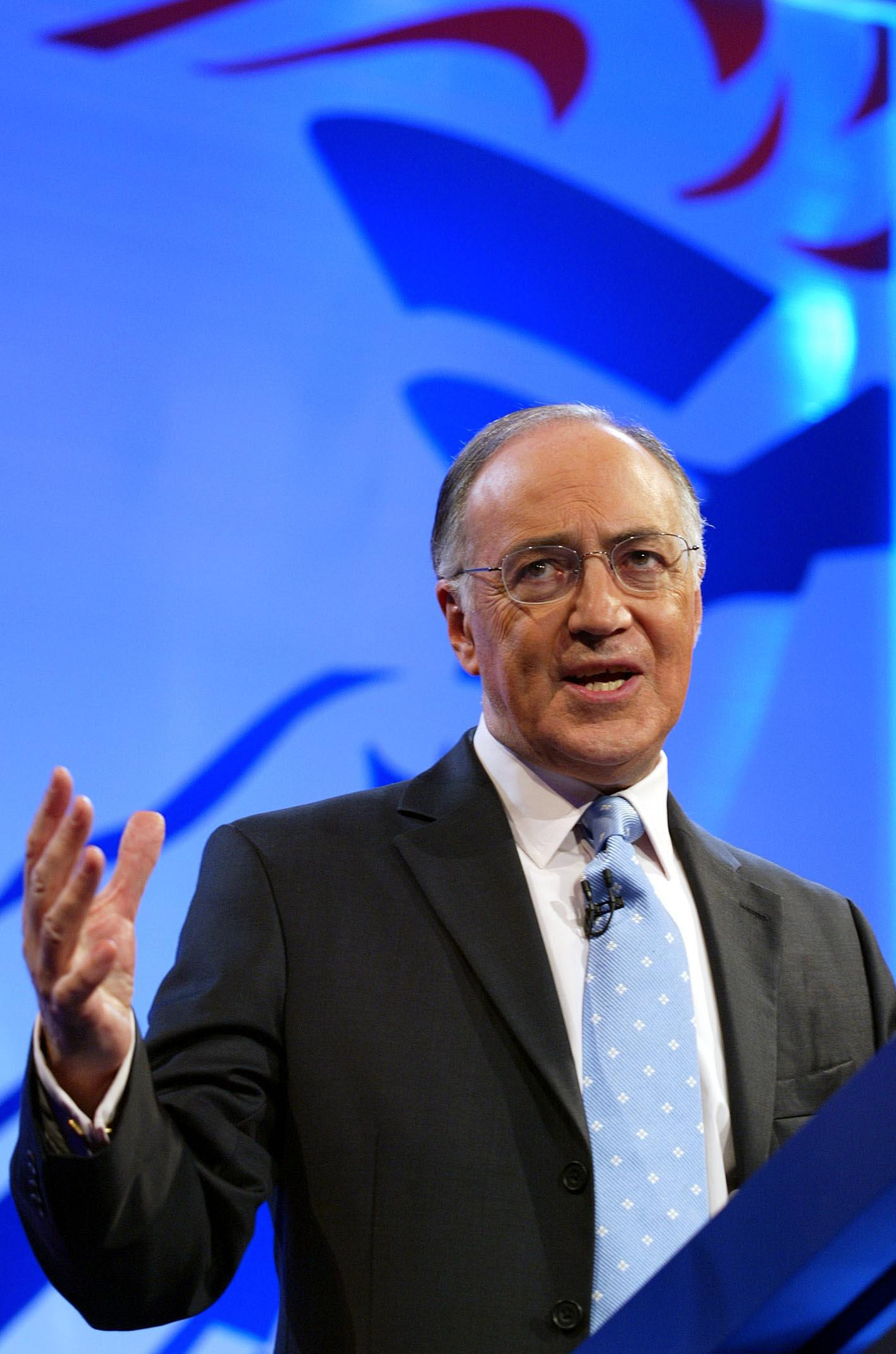
  • Michael Howard – 2002 Speech at the Centre for Policy Studies

    Michael Howard – 2002 Speech at the Centre for Policy Studies

    The speech made by Michael Howard, the then Shadow Chancellor of the Exchequer, on 12 April 2002.

    May I begin by expressing my gratitude to the Centre for Policy Studies for allowing me to give this, the second of a series of speeches on the framework of economic policy, at the Centre. The Centre has, of course, a long and distinguished history of offering a forum to Conservative economic policy makers. I am honoured to be following in that tradition this morning.

    Last month, I made the first of this series of speeches at the Institute of Public Policy Research which is, if not exactly a sister organisation of the CPS, then perhaps a cousin across the water.

    In that speech I made three points. First, that the current Government’s approach to monetary policy is an evolution of the policy that the Conservatives began to put in place in the 1990’s and not, as the Government maintains, a decisive break with the past. Secondly, that the transfer of responsibility for setting interest rates to the Monetary Policy Committee of the Bank of England has been a successful further stage in that policy, for which the Chancellor deserves credit. And thirdly, that that evolution must be maintained by implementing even greater objectivity and accountability in framing monetary policy.

    My main message was that, in monetary policy at least, there is now a very considerable degree of economic consensus. That consensus, and the stability and continuity which spring from it in economic affairs, is greatly to the advantage of our economy and is a matter for celebration.

    Today I want to talk about the framework for fiscal policy. Here too there are some points of consensus and here too that is to be welcomed. Unfortunately, however, the scope for consensus is somewhat more limited in this area for reasons which I hope to make clear in the course of this speech.

    In terms of short-term economic management, of course, monetary policy is a much more appropriate tool than fiscal policy. Fiscal policy, however, has a very important and powerful influence on the economy’s medium and long-term performance. And it must be conducted in a manner that supports the work of the central bank in running monetary policy directed at achieving an inflation target.

    This leads to one clear and rather obvious difference between the framework for monetary policy and the framework for fiscal policy. While the task of short-term economic management based on monetary policy is now broadly apolitical and the responsibility of the Bank of England’s Monetary Policy Committee, the conduct of fiscal policy remains clearly the political responsibility of the Chancellor of the Exchequer.

    But first, I perhaps ought to make clear that there is one area of fiscal policy which I shall not cover at any length or in any detail this morning. I have already set out my firm belief in the proposition that, other things being equal, low tax economies are best. They are, in general, the most dynamic economies, the most innovative economies and the economies which do most to enhance the material welfare of the people who live and work in those economies. Other things are not, however, always equal. There are from time to time moments in a nation’s economic history when other things have to take priority. As I have also said before the present crisis which we face in our public services is, I believe, one such moment. This does not mean that, as a nation, we should pour endless amounts of taxation into the bottomless pits of unreformed public services. It does mean that the public services must be put first and that the provision of the resources which are necessary in order to meet the current crisis may have to take priority over tax cuts.

    But today I intend to concentrate on the Government’s approach to the framework for fiscal policy and some of the key principles which Governments should apply in this area.

    THE PRINCIPLES OF FISCAL MANAGEMENT

    The current Government has set out five principles of fiscal management – transparency, stability, responsibility, fairness and efficiency.

    It implies that these principles are somehow new. And it makes yet more fundamental claims. In the recent Treasury book, “Reforming Britain’s Economic and Financial Policy”, which no doubt you have all read and which some of you may realise has now become my nightly bedside reading, the authors Ed Balls and Gus O’Donnell, assert that ‘a consensus has emerged in support of sound public finances as the principle medium-term objective of fiscal policy.’ Such a consensus, they claim, ‘grew out of the experience of the 1970’s and 1980’s which saw a relaxation of fiscal discipline.’

    Not for the first time in their volume, they claim too much. The very phrase, ‘sound public finances’ could have been lifted from virtually any of the speeches of Margaret Thatcher or any of her Chancellors. To the extent that there is now consensus around the need for sound public finances, that consensus hardly arose because of Labour’s actions. Indeed, even now, there seems in Government circles to be little recognition of the trade-off between high tax levels and economic competitiveness.

    But the principles are nevertheless welcome. And I am happy to endorse them.

    THE RULES OF FISCAL POLICY

    The principles, however, only take you so far. There is clearly room for huge differences of judgement in the way in which the principles are applied and it is in partial recognition of this that Gordon Brown has attempted to convey at least the impression of rigour by the introduction of his two fiscal rules. The first rule is that the Government will only borrow to finance net capital spending. This is the so-called ‘golden rule.’ The second – the ‘sustainable investment rule’ – is that, over the economic cycle, the ratio of net public sector debt to GDP should be set at a stable and prudent level, defined by the Chancellor as 40% of GDP.

    The Chancellor has, of course, made great play of these rules. When announcing them to Parliament in June 1998, he claimed that they would go a long way to ending ‘once and for all’ boom and bust, a claim with which manufacturers and others might currently take issue. This would, in turn, he said, enhance stability and long-term investment in public services, thus enabling the country to achieve its potential.

    The casual observer might therefore be left with the impression that these rules are rather powerful. In fact the gloss from the Treasury is such that Gordon Brown is often presented either as a modern day version of Gladstone or as the 21st Century reincarnation of Philip Snowden.

    But the principles behind these rules are not new. They build on the approach taken by the Government’s Conservative predecessors. Ken Clarke’s Red Book in November 1996 stated: ‘Fiscal policy’s role is to maintain sound public finances. The Government’s fiscal objective is to bring the PSBR back towards balance over the medium term, and in particular to ensure that when the economy is on trend the public sector borrows no more than is required to finance its net capital spending’ (parag 2.09). Not only was the PSBR projected to fall to close to balance in 1999-2000, with a surplus thereafter, but net public sector debt was forecast to fall below 40 per cent of GDP in 2001-2.

    The sustainable investment rule, which constrains public debt, has a particularly interesting pedigree. As early as 1976, Tim Congdon proposed, as part of a wider programme, a maximum ratio of public debt to GDP. He pointed out that a large deficit, which implied a rising ratio of debt to GDP, would result either in the crowding out of private sector investment or inflation. His analysis was incorporated into policy making in the 1980’s.

    It is indeed gratifying that the present Chancellor has recognised the fact that an excessive budget deficit might risk excessive debt interest and, consequently, unnecessary taxation. But belated recognition is one thing. Fresh discovery is another. This approach did not start in 1997.

    THE FLEXIBILITY OF THE RULES

    Nor are these rules the all-encompassing ‘final word’ on fiscal policy that Government rhetoric would imply. The Institute of Fiscal Studies, for example, has said the rules are not ‘sacrosanct.’ It refers to them as ‘probably best regarded as sensible rules of thumb, but they are no more than that.’ I rather agree with this view.

    At first sight, for example, there is some logic in terms of intergenerational fairness behind the golden rule. It seems equitable that each generation should pay fully for the spending that benefits them but should not have to pay for the spending that will benefit other generations. But even here, the rule is not perfect. Some spending that does not produce a durable physical asset nevertheless yields benefits to future generations – such as the defence spending during the last War, as Marc Robinson has pointed out in a paper for the IFS. Furthermore there may also be cases where future generations have to pick up the bill in a way that is acceptable under the golden rule – for example in respect of civil service pension liabilities.

    But there are yet bigger problems when we look at the rules in more detail.

    For example, the golden rule allows the ratio to be defined over the ‘economic cycle.’ This cycle is very difficult to define and as such gives the Chancellor considerable creative scope in assessing whether the rule has been met.

    When I recently asked the Chancellor, in a written Parliamentary Question, for clarity on this matter, he referred me to the Red Book. This is what the relevant passage of the Red Book says:

    ‘Given the closeness of output to trend throughout 1997 to 1999,possible measurement errors and the prospect of further data revisions, it remains difficult to conclude for certain that the UK economy has completed a full, albeit short and shallow, economic cycle between the first half of 1997 and mid-1999. For the purposes of the Budget and the assessment of performance against the fiscal rules, the provisional judgement remains that a cycle may have been completed by mid-1999 when the current cycle is assumed to begin’ (Budget 2001, March 2001, para 2.36).

    I am not sure that that makes it very much clearer what the Chancellor means but I hope you understand what I mean.

    How is anyone supposed to hold the Chancellor to his test of the golden rule – supposedly cast iron, water-tight, a lynchpin of his entire approach – when it is so difficult to determine, at least until well after it has been completed, when the cycle to which it refers has started or ended?

    And of course, the golden rule only constrains borrowing in relation to what is defined as current spending. This means that Governments can spend substantial amounts of money while keeping the golden rule. As the IFS have pointed out: `In the late 1960s and early 1970s, the golden rule was met. This was not because public sector net borrowing was particularly low, but because public investment at the time was high’ (Briefing Note, January 2001, p. 3).

    OUR APPROACH TO THE RULES – SCRUTINY AND TRANSPARENCY

    So what approach should an incoming Government take to these rules?

    The Treasury has itself acknowledged that there is a balance to be struck between ‘a rigid mechanical approach and an approach based on unfettered discretion.’ I agree. And actually achieving this balance – ensuring that the rules are neither unachievable in a recession, nor so loose as to be meaningless – is, I agree, extremely difficult.

    Two conclusions follow.

    First, no Chancellor should seek to load greater authority onto the rules than they will bear. Gordon Brown’s attempt to dress up these rules as a return to some form of exceptionally rigorous Gladstonian fiscal orthodoxy is, I am afraid, wholly bogus.

    Second, the rules need to be buttressed by other measures.

    THE NEED FOR SCRUTINY

    The best means of achieving this is through improved and more objective parliamentary scrutiny.

    I have already proposed improved scrutiny of appointments to the Monetary Policy Committee. What scope is there for improving parliamentary scrutiny in the fiscal area?

    One possibility would be to equip Parliament with an agency that could offer serious analysis of spending, borrowing and taxation in a manner comparable to that achieved by the Congressional Budget Office in the United States. It would mean that all the Treasury decisions could be authoritatively challenged by an objective agency accountable to Parliament.

    Under the present arrangements, the National Audit Office and the Public Accounts Committee enable the legislature to scrutinise the previous actions of the Executive after the event. This work is exceptionally valuable, but Parliament should also be intellectually equipped and capable of properly challenging the Government as it develops its policies. And there is no more central area for this task than fiscal policy: spending, taxing and borrowing.

    THE NEED FOR TRANSPARENCY

    But for scrutiny to be effective a degree of transparency is necessary. Indeed, transparency is the first of the Government’s five principles. If this principle is to be achieved it must be possible for the facts on which debate is based to be capable of being established and, if possible, agreed. But one of the worrying developments since 1997 has been the increase in obfuscation from the Treasury. I am not talking here about the repeated reannouncements of spending proposals – those spinning Balls are easily caught.

    I am talking about something much more insidious.

    As the Financial Times has said: `Unfortunately, in many respects Mr Brown has reduced Budget transparency to a new low. Important tax changes have been omitted from the speech… Statistics have rarely been quoted on a consistent basis. The Budget documentation has been filled with political point-scoring rather than factual analysis. And there has been a continued tendency to classify the collection of revenue as anything other than taxation’ (2 March 2001).

    Let us take a few of these points in turn.

    We have become accustomed to the phenomenon of discovering after a Budget Statement that some very important measure has been buried in some obscure footnote. The extent of the £5 billion a year raid on people’s pension funds was not mentioned in the relevant Budget statement, with a reference instead to `a long needed reform’ (Gordon Brown, col. 306, HC Debs, 2 July 1997). When the Chancellor introduced the new 10p starting rate in his 1999 Budget he neglected to mention that he was abolishing the existing 20p rate. And nor was his stealth tax on entrepreneurs – IR35 – mentioned in his 1999 speech. Instead, he said: ‘I want to recruit, motivate and reward Britain’s risk-takers’ (Gordon Brown, col. 177, HC Debs, 9 March 1999).

    Another example is the far too little known fact that the Government has deliberately excluded the impact of indirect taxes when illustrating the effects of Budget changes on specimen households.

    The public accounts themselves are now more opaque and confusing than for many years. The Budget Red Book has been transformed from a coherent document that lucidly explained economic policy to a discursive document that confuses more than it informs. Meanwhile its length has risen from 160 pages when we left office to 225 pages last year. The Finance Bill likewise has risen from 219 pages to 292 pages.

    It is little wonder that one of the most serious criticisms that can be levelled against the Chancellor is the increasing complexity of the tax system. The Institute of Chartered Accountants, for example, has said that the tax system has ‘spun out of democratic control’ because of complexity, the number of anomalies and the ‘culture of never-ending change.’

    I know that the CPS is looking at this problem of the ever-increasing complexity of the tax system and I very much look forward to your conclusions.

    Clearly this also has implications for two more of the principles which the Government has established for fiscal policy – efficiency and fairness.

    Complexity in the tax system does not lend itself to meeting either meaning of the term `efficient’: the efficient allocation of resources in the economy or the narrow definition in terms of efficient tax collection. Indeed it is a startling fact that the number of Inland Revenue staff has risen from fewer than 50,000 in 1997 to 64,000 now.

    One of the reasons behind this growing complexity is the tendency of the Chancellor to intervene in just about every area where intervention is possible. I accept that there is a proper place for the use of the tax system to encourage particular kinds of behaviour which are regarded as economically and socially desirable. But any such intervention should be used sparingly – both because any tax break for some effectively raises tax rates for others and also because this very process, unless it is firmly controlled, tends to constitute an impediment to transparency.

    Yet as the Economist has said: ‘The signs are, in fact, that in microeconomic policy Mr Brown’s every instinct drives him towards complication and activism….. The Chancellor is meddling because he thinks he knows best…. The Chancellor appears to forget that fiscal complexity feeds on itself; that it creates anomalies that call forth new rules and complications’ (The Economist, 13 March 1999).

    It is also clear that much of the opaqueness which has arisen in recent years is deliberate. The national accounts and public finances should in principle be presented on the basis of internationally agreed accounting conventions. That is why the Chancellor’s decision to score the Working Families Tax Credit as a credit that reduces income tax and the tax burden rather than for what it is, a social security benefit that increases public expenditure, is so reprehensible. His approach to this question is entirely inconsistent with the internally agreed accounting conventions. The Treasury Select Committee has also noted that, under accounting conventions employed by the ONS, the OECD and ESA95, `…WFTC counts as expenditure’ (report on Budget 2000, April 2000).

    Even if the Chancellor’s preference to score the measure as a tax credit rather than a social security benefit were acceptable, he has chosen to treat the WFTC and the old Family Credit benefit, which it replaced, in different ways. In historical data presented by Gordon Brown, Family Credit is scored as a social security benefit and is not netted off against income tax. This of course is the opposite of what he has chosen to do with the Working Families Tax Credit. The result is a higher total tax burden before the introduction of the change and lower one afterwards despite the fact that there has been no change of any kind in the essential approach. That is not transparency, that is deliberate obfuscation.

    Where statistics are not consistent Government documents should highlight this and explain the reason for it. This is particularly important where the Government is choosing to present numbers in a way that departs from the agreed international conventions. And where previously available information has been dropped, it should once again be made available and in an easily accessible form.

    CODE FOR FISCAL RESPONSIBILITY

    The Government has emphasised, in this context, the introduction of the Code for Fiscal Responsibility. Treasury advisers claim that the Code strengthens the openness, transparency and accountability of fiscal policy.

    However, it is clear that the principles in the Code – the fiscal principles I listed earlier – are not being observed. The Code itself, although approved by Parliament and supported by the Finance Act 1998, does not have the force of statute.

    We may need to look at ways to give effect to some of the rhetoric employed at the time of the Finance Act 1998 and ostensibly enshrined in the Code for Fiscal Responsibility.

    I would welcome a public discussion on the lessons that we can learn from our experience since the legislation of 1998, together with the experience of scrutiny that is available for example under the New Zealand Fiscal Responsibility Act and elsewhere.

    This would also help to meet the fifth principle of fiscal management: fairness. It is certainly a principle to which I would subscribe. But it is not a principle which is likely to be met under an opaque and complicated tax structure. And the Government’s general performance in this area leaves a great deal to be desired. The tax burden for the poorest fifth of households rose from 37% to 41% in the first three years of Labour Government – the latest figures which are available. That is hardly the record of a Government with an equitable tax policy.

    SPENDING

    The final point I wish to make about fiscal policy is, in many ways, one of the most important of all.

    Both the fiscal rules of course relate to inputs into the public spending equation. Yet the most important issue is the outcome of that spending – its effectiveness.

    The Chancellor in the foreword to the Treasury book states that there was a need for `better planned public spending’ in 1997, which focused on `the quality of public service provision’. Yet it is hardly credible to claim either that public spending over the last five years was in fact better planned, or that the quality of public service provision has improved as a result.

    There does need to be a rigorous approach to assessing the effectiveness of decisions about public spending and investment. Of course the Government claims that such an approach is already taken. And there is, indeed, Treasury guidance, set out in the `Green Book’, covering the need for cost-benefit analysis of spending decisions.

    Treasury advisers also highlight public service agreements as the means by which attention is focused on outcomes rather than inputs. Yet these have not achieved that goal, not least because many of the targets are not being met.

    An IMF working paper last year looked at these issues. It stated that UK Government authorities implicitly recognised that the golden rule was about how investment is financed, not about the optimum level of that investment. The paper went on to say: `it is particularly important that the details of how a “value for money” criterion will be implemented are clearly set out. But that is not yet the case in the United Kingdom’. It said, in relation to the Government’s requirement that each department publish a Departmental Investment Strategy, that the first strategies (in March 1999) contained little relevant information other than to refer to existing (non-mandatory) guidelines on investment appraisal.

    So it is clear that not enough attention is being given to this vital area, one which is often overlooked in discussion of the fiscal rules.

    CONCLUSION

    I have today focused on the framework for fiscal policy, and have set out some suggestions for how it might be strengthened.

    The Chancellor’s fiscal rules have an important role to play, but their limitations need to be acknowledged. They need to be buttressed through the introduction of a degree of objective scrutiny and transparency into fiscal policy. There also needs to be a greater focus on the outcome of the spending – rather than just the amount which is spent.

    I will be focusing in future speeches on non-fiscal aspects of the supply-side economy. But it is important at this stage to recognise that the combination of ever higher taxes along with ever worsening public services, a less transparent tax system and employment regulations that make the labour market less flexible will, in the medium-term, depress the economy’s growth rate.

    Beneficial supply-side reforms take a long time before their full effects on an economy are evident. The impact of damaging policies on the supply-side is also only clear after a lag, and the lags involved can be protracted. It is because these lags are so long that we need a properly informed debate about these issues now. The public finances should be accurately and intelligibly presented. And the institutional arrangements for presenting and scrutinising the government’s fiscal polices need to be strengthened.

    Measures of this kind will not guarantee halcyon economic performance forevermore. But they would represent a clear improvement on the arrangements that are presently in place. I hope they can form the basis of informed debate during the rest of this Parliament.
  • PRESS RELEASE : Volodymyr Zelenskyy together with Justin Trudeau took part in a video conference of G7 leaders

    PRESS RELEASE : Volodymyr Zelenskyy together with Justin Trudeau took part in a video conference of G7 leaders

    The press release issued by the President of Ukraine on 8 May 2022.

    After bilateral talks in Kyiv, President of Ukraine Volodymyr Zelenskyy and Prime Minister of Canada Justin Trudeau took part in a video conference of the G7 leaders.

    The President of Ukraine thanked Olaf Scholz, Federal Chancellor of Germany, who chairs the G7, for organizing this summit.

    “I believe that such a summit with the participation of Ukraine today proves that the free world is determined not only to defend freedom, but also to win, as it did 77 years ago. On behalf of the entire Ukrainian people, I am grateful to the leaders of the United States, Great Britain, France, Italy and Japan. I am grateful to the European Union and, of course, to the Prime Minister of Canada for this solidarity with us,” Volodymyr Zelenskyy told the media representatives after an online speech at the G7 summit.

    According to him, the G7 leaders agreed on a special summit declaration, which fixed the historical solidarity of the participating countries and their readiness to work together until security and observance of international law for Ukraine and the whole of Europe are restored.

    Also, as noted by the President of Ukraine, at the G7 meeting, he proposed specific tools needed now by Ukraine and everyone in the world “who values freedom, democracy and independence.”

    “The first is new steps in Ukraine’s defense support. Because it is on the battlefield that the fate of freedom in Europe is decided. Secondly, I stressed the need for new sanctions against Russia, as the war on our land continues, which means that the existing sanctions are not enough. Third, we discussed financial support for Ukraine now, when the war continues, and joint work to restore our state after the war. The scale of Russia’s current threat in Europe makes the return of concepts such as the Lend-Lease and the Marshall Plan quite natural,” he said.

    In the fourth point, Volodymyr Zelenskyy invited all the G7 states to join the post-war reconstruction of Ukraine, using the format of patronage over specific cities, towns, regions and industries affected by the Russian invasion.

    “It is this format that can give maximum efficiency to the work on the recovery and create new economic and technological ties within the democratic world,” said the President.

    The fifth point of the proposals of the President of Ukraine is to unite efforts to guarantee stability in the global food market.

    “We, the grain exporters, are able to do this on the basis of respect for human rights in such a way that there are no more price crises in the food market, so that each country is confident that it is not threatened by famine,” said Volodymyr Zelenskyy.

    The Prime Minister of Canada assured that his country will continue not only to provide assistance to Ukraine, but also to consolidate the efforts of international partners, including in the issue of sanctions.

    “On this anniversary of the victory in the war in Europe, we stand side by side and defend freedom, independence and international law. We will continue to impose severe sanctions, reduce our dependence on energy resources from Russia, and fight disinformation from Russia. We will also be there to overcome all of Putin’s challenges, including the food threat,” said Justin Trudeau.

    The President thanked the G7 leaders for their willingness to work together to protect and strengthen freedom and democracy in the world.

  • PRESS RELEASE : Volodymyr Zelenskyy met with the President of the Storting of Norway

    PRESS RELEASE : Volodymyr Zelenskyy met with the President of the Storting of Norway

    The press release issued by the President of Ukraine on 8 May 2022.

    President of Ukraine Volodymyr Zelenskyy met with President of the Norwegian Storting Masud Gharahkhani who paid a visit to Ukraine.

    “I am glad to meet you. I am grateful for the support of Ukraine’s sovereignty and territorial integrity, as well as for the opportunity to speak in your parliament,” the Head of State addressed his interlocutor.

    Volodymyr Zelenskyy also thanked Norwegian society for supporting the people of Ukraine from the first day of the war for their freedom.

    For his part, Masud Gharahkhani noted that it is an honor for him to visit Ukraine. He stressed that Volodymyr Zelenskyy’s speech at the Storting was historic.

    “Today, my country is celebrating the day when we managed to regain our democracy and independence after World War II. Unfortunately, today your country is once again going through aggression and violence,” said the President of the Norwegian Storting.

    Masud Gharahkhani said he was deeply shocked by the consequences of the Russian occupation in Irpin and Bucha in the Kyiv region.

    “I want to confirm to you that Norway always stands by Ukraine,” he said.

    The parties discussed the issue of increasing Norway’s security support for Ukraine. The President thanked Norway for the decision to provide defensive weapons to Ukraine and its practical implementation.

    During the meeting, Volodymyr Zelenskyy and Masud Gharahkhani discussed approaches to further strengthening sanctions on Russia. The parties also touched upon the possibility of cooperation in the field of energy security.

    The President noted the financial support of Ukraine and humanitarian aid from Norway, and invited to join the reconstruction of our country.

  • PRESS RELEASE : Head of State met with the President of the German Bundestag

    PRESS RELEASE : Head of State met with the President of the German Bundestag

    The press release issued by the President of Ukraine on 8 May 2022.

    President of Ukraine Volodymyr Zelenskyy met with President of the Bundestag of the Federal Republic of Germany Bärbel Bas who is on a visit to Kyiv.

    The Head of State noted the importance of her visit to Ukraine at this difficult time and on a special day – the Day of Remembrance and Reconciliation.

    Volodymyr Zelenskyy thanked Germany for supporting the sovereignty and territorial integrity of our state. The President stressed that Ukraine expects from Germany a strong and confident leadership in helping our country in the fight against the Russian aggressor.

    The parties discussed, first of all, further defense assistance to Ukraine by Germany, as well as the strengthening of sanctions against the Russian aggressor.

    The Head of State noted the adoption by the Bundestag of a resolution calling on the German government to expand and speed up the provision of heavy weapons to Ukraine.

    Particular attention was paid to the movement of our country towards EU membership. Volodymyr Zelenskyy expressed his conviction that official Berlin supports the provision of the candidate status to Ukraine.

    The Head of State thanked Germany for the financial support to Ukraine’s economy and called on Germany to play a leading role in rebuilding the Ukrainian territories destroyed by the Russian army.

    For her part, Bärbel Bas thanked Volodymyr Zelenskyy for the meeting. She noted that it is very important for her to be in Ukraine on May 8 and to be able to honor the memory of the victims of World War II.

  • PRESS RELEASE : Ukraine is interested in exchanging experience with EU and NATO countries in the field of modern armaments and technologies – Volodymyr Zelenskyy

    PRESS RELEASE : Ukraine is interested in exchanging experience with EU and NATO countries in the field of modern armaments and technologies – Volodymyr Zelenskyy

    The press release issued by the President of Ukraine on 8 May 2022.

    Ukraine would like to receive from the Allies not only samples of Soviet weapons, but also modern military equipment, weapons and technology. This was stated by President of Ukraine Volodymyr Zelenskyy during a conversation with media representatives following the negotiations with Prime Minister of Croatia Andrej Plenković in Kyiv.

    “Weapons must be powerful and modern, not only Soviet, although we are grateful for everything. We need technology. We need knowledge. We would like to gain this experience,” the President said.

    Volodymyr Zelenskyy noted that Ukraine has demonstrated success in the field of missile technology and is ready to share its experience. At the same time, it is interested in gaining access to European modern technologies in other spheres.

    “So far we do not have the same access as every European or NATO member state has. We do not have such opportunities yet. But I think we will get them,” the President of Ukraine summed up.

  • PRESS RELEASE : President of Ukraine discussed with the Prime Minister of Croatia the strengthening of sanctions, cooperation in the security, energy and European integration spheres

    PRESS RELEASE : President of Ukraine discussed with the Prime Minister of Croatia the strengthening of sanctions, cooperation in the security, energy and European integration spheres

    The press release issued by the President of Ukraine on 8 May 2022.

    President of Ukraine Volodymyr Zelenskyy met with Prime Minister of Croatia Andrej Plenković who is on a visit to our country.

    The President thanked the people and the Government of Croatia for their support of Ukraine during the difficult times of the war.

    “Croatia is a principled member of our anti-war coalition. Together we defend the right not only of our citizens, not only of the citizens of Ukraine, but also of every European nation to an independent and democratic life. Together, we are defending the future of a united Europe and are doing everything we can to restore the power of international law,” Volodymyr Zelenskyy said during talks with media representatives following the negotiations with Andrej Plenković in Kyiv.

    According to the President, the key topics of the meeting were security and steps needed to support Ukraine in the struggle for freedom.

    “In particular, these are steps in the defense, economic and energy spheres, as well as cooperation at the level of the European Union,” the President said.

    According to Volodymyr Zelenskyy, among other things, the talks focused on increasing sanctions on Russia. He thanked Croatia for its readiness to support the EU’s sixth sanctions package.

    “Until Russia stops this war against our state, against our people, until it liberates our land and begins to respect freedom in Europe, we need to raise the price of this aggression,” the President said.

    The parties also discussed cooperation in restoring full life in the de-occupied areas of our country.

    “Croatia has considerable experience in demining territories, and I asked to provide our state with the necessary assistance, especially in our program of Ukraine’s reconstruction,” he said, noting that during the retreat the Russian military left thousands of mines and tripwire mines on Ukrainian territory, which pose a threat to civilians.

    In addition, during the meeting, Volodymyr Zelenskyy and Andrej Plenković discussed Ukraine’s integration into the European Union.

    “I am grateful to Croatia and personally to Prime Minister Plenković for his consistent and strong support for Ukraine on its path to the European Union. Last December, we signed a Declaration with the Prime Minister on the European perspective of our country. I want to thank you again for that,” the President said.

    He expressed hope that at the European Council meeting in June this year, EU member states will support the decision on candidate status for our country.

    In addition, the President of Ukraine and the Prime Minister of Croatia have devoted a lot of time to the issue of ending the war on our land.

    “I told Andrej Plenković in detail what is happening in Donbas, what are the difficulties there and where Croatia could help us, etc. I would like to thank you once again for this visit,” the President said.

    For his part, the Prime Minister of Croatia noted that his country highly values the resilience and resistance of the Ukrainian people and respects the heroism of the Ukrainian servicemen, who defend their homes, families and Homeland. He assured of further support for our state.

    “Croatia has consistently supported Ukraine in political, diplomatic, legal, financial, humanitarian and technical matters. And we will continue to provide this assistance, clearly understanding that we are doing this as a country that has always been convinced that we are on the right side of history, on the right side of ethics,” said Andrej Plenković.

    He also said Croatia would support further restrictive measures against Russia at EU level.

    Andrej Plenković noted that he personally and his country support the European aspirations of Ukraine and its people. He praised the completion of our country’s application form for the EU candidate status and assured that Croatia would provide assistance to Ukraine in further steps at the level of the European Council.

    The Prime Minister also noted that his country is ready to share the experience of demining with Ukraine.

    In addition, Andrej Plenković said that as of today, the Ambassador Extraordinary and Plenipotentiary of Croatia to Ukraine is returning to Kyiv, which “is also a strong signal of support for Ukrainians.”

  • PRESS RELEASE : President held a meeting on fuel supply and execution of the state budget

    PRESS RELEASE : President held a meeting on fuel supply and execution of the state budget

    The press release issued by the President of Ukraine on 7 May 2022.

    President of Ukraine Volodymyr Zelenskyy chaired a meeting on topical issues of the executive branch. It was attended by Head of the Office of the President Andriy Yermak and his deputies, Prime Minister of Ukraine Denys Shmyhal and members of the government.

    The participants of the meeting first of all considered the issues of fuel security of the country. The President stressed the need to eliminate queues at Ukrainian gas stations.

    According to First Deputy Prime Minister and Minister of Economy Yulia Svyrydenko, work is underway in cooperation with the Ministry of Foreign Affairs to provide Ukraine with a green corridor in Eastern European ports, which is currently the main bottleneck in fuel supply logistics.

    The parties also stressed the need to sign long-term contracts and accumulate state fuel reserves.

    Minister of Finance of Ukraine Serhiy Marchenko reported on the execution of the state budget under martial law. Thus, the country ended April with a deficit of UAH 125 billion. At the same time, revenues from tax office and customs amounted to UAH 53 billion, which exceeded expectations. UAH 57 billion of revenues are planned for May.

    According to the Minister, the monthly deficit is planned to be repaid due to international grants and loans. Negotiations on international grants in the amount of 11 billion dollars are underway, of which 5 billion dollars have already been received by our state.

    The parties also discussed the preparation of a Plan for the Reconstruction and Development of Ukraine after the war.

    In addition, the Heads of State heard a report on the process of granting Ukraine the status of a candidate for membership in the European Union.

    Attention was also paid to the issue of cooperation between public authorities and international organizations in providing medical, psychological and social rehabilitation services to citizens affected by Russian aggression.

  • PRESS RELEASE : Defending Ukraine, the leaders of each state defend their country from war as well – Volodymyr Zelenskyy

    PRESS RELEASE : Defending Ukraine, the leaders of each state defend their country from war as well – Volodymyr Zelenskyy

    The press release issued by the President of Ukraine on 6 May 2022.

    When the world understands that the war in Ukraine is a common war, victory will become common as well. This was stated by President Volodymyr Zelenskyy during a video meeting at the Royal Institute of International Affairs Chatham House (UK).

    “In order for the world to hear, we need to constantly talk to the world and give concrete examples. Today, Europe and the world are united around Ukraine,” the President said.

    At the same time, he noted that not all countries have joined the anti-war coalition, but Ukraine continues to explain the importance of global consolidation, in particular by addressing through the media, social networks and directly to the people.

    “There are enough means in the world today to make our voice be heard. The world leaders do not have enough energy,” the President added.

    According to Volodymyr Zelenskyy, the leader of each country should powerfully help Ukraine in the fight against the invader, thus helping his or her own country avoid war.

    “By defending Ukraine, the leader will defend his or her state. Just like ordinary people who just take to the streets with our flags. And this victory will be common. Victory not over Putin, but over this terror and terrorism, because he and his troops are the face of it,” the President said.

    “When every leader understands this, it will not be my solo – it will be a chorus of powerful leaders who will be able to convey this energy to those societies that are still in doubt and unsure of their choice,” he said.

    Volodymyr Zelenskyy stressed: it is important to unite the world around the truth. Events in Ukraine should not leave the front pages of the world media, so that people in every country know what is happening in Ukraine every day.

    “Because there is a war in Ukraine. And this war is a common one. Therefore, the victory will be common as soon as we understand that this is a common war,” Volodymyr Zelenskyy added.