Category: Speeches

  • Michael Gove – 2018 Speech on the Future of Farming

    Below is the text of the speech made by Michael Gove, the Secretary of State for Environment, Food and Rural Affairs, at the 2018 Oxford Farming Conference on 4 January 2018.

    The age of acceleration

    For anyone wondering what the focus of this year’s Oxford Farming Conference might be, it was The Archers provided an answer just before Christmas.

    Brian Aldridge asked his step-son, Adam, whether he might be attending the conference. Adam replied wearily. ‘I think I’ll give it a miss this year. It’s probably going to be all about Brexit. I get enough of that at home.’

    I know how he feels.

    I suspect everyone in this room knows how he feels.

    And, of course, I’ll say something in a moment about the specific opportunities and challenges for agriculture on leaving the European Union.

    But if we’re going to make the most of those opportunities and overcome those challenges it’s critical that we recognise that there is much, much, more that is changing in our world than our relationship with the EU.

    As we saw in the presentation at the beginning of this session, the world’s population is growing at an unprecedented rate, with a worldwide migration from rural areas to cities and a growth in the global middle class which is driving demand for more, and better quality, food.

    Technological change is at an inflection point. Developments in big data, artificial intelligence and machine learning mean that processes which would have required the intellect and effort of thousands of humans over many hours in the past can be accomplished automatically by digital means in seconds.

    These technological breakthroughs raise political and moral questions as we consider how we deal with the transformation of a huge range of existing jobs. And alongside these changes in the world of information technology there are bio-tech changes coming which also challenge us to think about the future, and how best to shape it. Gene editing technology could help us to remove vulnerabilities to illness, develop higher yielding crops or more valuable livestock, indeed potentially even allow mankind to conquer the diseases to which we are vulnerable.

    Food in abundance, improved health, greater longevity: these are all goals to which our species has aspired since the first farmers waited for the first harvest. But in attempting to shape evolution more profoundly than any plant or animal breeder ever has done before are we biting off much more than we can chew? And these are not the only changes coming. Our global environment is affected as never before by the population growth I’ve referred to, and the consequent growth in demand for nutritious food, safe drinking water, comfortable housing, reliable energy and new consumer goods.

    The growth in trade which will meet those needs will depend on more packaging, more journeys by air, land and sea, more logistics hubs and more work by designers, marketers and, yes, regulators.

    The pressures placed on our global environment by this growth I’ve sketched briefly out will be formidable – whether it’s greenhouse gas emissions in our atmosphere contributing to global warming, desertification and soil erosion reducing the space for cultivation, deforestation leading to the disappearance of valuable carbon sinks and precious habitats, air pollution from traditional industry and intensive agriculture adding to health costs, waste poisoning our oceans or iconic landscapes under threat from the need for further development.

    Without action we face the progressive loss of the natural capital on which all growth – natural, human and economic – ultimately depends.

    So the imperative to husband, indeed wherever possible, enhance our natural capital – safeguarding our oceans, cleaning our rivers, keeping our soils fertile, protecting biodiversity – has to be at the heart of any plan for our country and our world.

    Because we cannot expect to live prosperous and civilised lives in the future unless we recognise that we have to care for that which gives us all life – our planet.

    And that knowledge is itself a catalyst for further change. The need to protect our planet better is already accelerating innovation- with entrepreneurs exploring how to develop autonomous electric vehicles, how to change the energy mix we all rely on, how to reduce our reliance on plastics, how to derive more protein from plants rather than animals, how to grow produce, whether hydroponically or by other means, which leaves a lighter imprint on the earth, how to use distributed ledger technology to protect habitats and so much more.

    So the reality of our times is not just change as the only constant but accelerating change as the new normal. Which is why the title of this conference – Embracing Change – is so appropriate.

    Because the changes which are shaping all our futures are so historically significant, technologically revolutionary and economically transformative that we have no choice but to embrace them and try to shape them in a progressive and judicious way.

    A state without the means of change is without the means of conservation
    Now I know there is, of course, a natural human desire to stick with what we know, trust to experience and hope things can go on much as before. To prefer the tried to the untried. You hear it when some in industry, and indeed some in the farming industry, say that what we need most at the moment is certainty.

    I understand that sentiment all too well. As I think does almost everyone in politics.

    But the truth is that if we try to avoid change, hold the future at bay and throw up barriers to progress then we don’t stop change coming, we simply leave ourselves less equipped to deal with change as it arrives.

    The history of nationalised industries, state subsidies for particular sectors, guilds to restrict access to trades, high tariff walls and all the other tools of so-called economic “protection” is a melancholy one. The road is paved with good intentions – preserving strategic assets, insulating communities from change, protecting our home market, guaranteeing a supply of essentials.

    But the path inevitably involves higher costs for consumers, lower productivity from producers, less pressure to husband scarce resources, less concern about sustainability, more rent-seeking and capital accumulation, less investment in innovation, less dynamism and ultimately, less security as others forge ahead economically, scientifically and socially.

    If we want to preserve that which we cherish – a thriving agriculture sector, a healthy rural economy, beautiful landscapes, rich habitats for wildlife, a just society and a fair economy – then we need to be able to shape change rather than seeking to resist it.

    And the best way to deal with change is to develop adaptability. As we know from the natural world, the best way to thrive in a new environment is to evolve. What we should, therefore be looking for in agriculture policy, indeed in all economic policy, is not an illusory fixity or a false sense of certainty, which by definition future events we cannot foresee will always upend.

    What we should instead be seeking to cultivate are the resources, policies and people that will allow us to adapt, evolve and embrace change as an ally.

    Taking back control

    Which takes me to Brexit.

    Of course Brexit will mean change.

    But, critically, what it means most of all is that we can once more decide how we shape change and how we meet the challenges ahead.

    It means we don’t need any longer to follow the path dictated by the Common Agricultural Policy. We can have our own – national – food policy, our own agriculture policy, our own environment policies, our own economic policies, shaped by our own collective interests.

    The CAP was designed, like so many aspects of the EU, for another world, the post-war period when memories of food shortages were hauntingly powerful and the desire to support a particular model of land use was wrapped up with ideas of a stable countryside that seemed reassuringly attractive after the trauma of industrial-scale conflict.

    Of course, the CAP has evolved, and indeed improved, over time. But it is still a fundamentally flawed design.

    Paying land owners for the amount of agricultural land they have is unjust, inefficient and drives perverse outcomes.

    It gives the most from the public purse to those who have the most private wealth.

    It bids up the price of land, distorting the market, creating a barrier to entry for innovative new farmers and entrenching lower productivity.

    Indeed, perversely, it rewards farmers for sticking to methods of production that are resource-inefficient and also incentivises an approach to environmental stewardship which is all about mathematically precise field margins and not truly ecologically healthy landscapes.

    As recent scholarship has shown, the so-called greening payments in Pillar One have scarcely brought any environmental benefits at all.

    We can, and must, do better.

    Reform begins at home

    And by we, I mean Defra most of all.

    Now I don’t want anyone to get hold of the wrong end of the stick.

    The Department I am privileged to lead has some of the finest public servants in the country working for it.

    Whether it’s the policy professionals, economic analysts, vets, IT engineers, botanists and horticulturalists or hydrologists and geologists, it is a pleasure to work with such dedicated, idealistic and passionate people. But while the people are brilliant, some of the processes are not.

    The ways in which we provide financial support to farmers have been far too bureaucratic – not helped by the ludicrous rules and red tape of the CAP that Defra must try to enforce.

    The Rural Payments Agency has historically taken far too long to get money from Government to farmers.

    And the Countryside Stewardship schemes we have run have been dizzyingly complex to apply for – I have made my views on this clear.

    All this when it’s our stated aim to allocate more funding for agri-environment schemes.

    We have taken action in the last few months to drive change in these areas, and will seize opportunities to develop a different regulatory culture once we have left the European Union.

    I am encouraged so far that the RPA paid over 91% of farmers their basic payment for this year by the end of December 2017. Encouraged but not satisfied. Which is why I am looking for a new chair of the RPA to work with the Chief Executive and his team to drive further improvement.

    On Countryside Stewardship, I want schemes simplified to the extent that any farmer – any farmer – can complete an application in a working day. Starting at the computer after breakfast the whole process has to be able to be finished by six o’clock when it will be time for a well-deserved pint.

    I’m pleased that Andrew Sells and his team have responded to the challenge with a set of simplified offers which have, already, received a warm response. But, again, we need to go further and develop a much more responsive and efficient model.

    And that’s not all we need to change.

    Related to the whole question of how we allocate support, we also in Defra need to change our approach to inspection.

    We inspect too often, too ineffectively and in far too many cases for the wrong things. At any moment, a farmer could be visited by the Rural Payments Agency, Natural England, The Animal Plant and Health Agency, the Environment Agency or their local authority. Each body may ask for slightly different information, or even the same information in a slightly different way. Each visit adds to the burden on farmers, yet there is much overlap without proper coordination. The CAP’s inflexibilities, including the ever present fear of disallowance, means we inspect rigidly for precise field margin dimensions and the exact locations of trees in a near-pointless exercise in bureaucratic box-ticking while, at the same time, we inspect haphazardly and inefficiently for genuine lapses such as poor slurry management or inadequate animal welfare.

    That is why I hope to look at how we can reduce the number of inspections overall, make them more genuinely risk-based and have them focus on those, limited, areas where standards are not where they should be.

    And there is much more we need to change across the board to make the Department more effective.

    Processes far beyond support payments and inspections are ripe for modernisation.

    Take our guidance on the provision of export health certificates still requires the use of carbon paper. While IT systems have been improved we are still some way away from exploiting advances in data analytics which we can use to shape and refine policy and delivery.

    And even at the most basic level we are not the champion we need to be for British food and farming. Despite hugely energetic efforts by my predecessors, we can still do more to improve the procurement of British food across the public sector.

    But I am determined to drive that change. Energetically. And across Government.

    As well as making Defra a more efficient, focused and, above all, innovative department I also want to drive change in 4 specific areas.

    I want to ensure we develop a coherent policy on food – integrating the needs of agriculture businesses, other enterprises, consumers, public health and the environment.

    Second, I want to give farmers and land managers time and the tools to adapt to the future, so we avoid a precipitate cliff edge but also prepare properly for the changes which are coming.

    Third, I want to develop a new method of providing financial support for farmers which moves away from subsidies for inefficiency to public money for public goods.

    And finally, I want to ensure that we build natural capital thinking into our approach towards all land use and management so we develop a truly sustainable future for the countryside.

    A lot on our plate

    On food, first of all, I want to underline that I recognise the heart of almost all farming businesses is food production. And a core element of Defra’s mission is supporting farmers in the provision of competitively-priced, healthy, sustainable and nutritious food, and pursuing greater market access.

    But I believe it’s critical as we think of food production and the role of farming in the future that we develop policy which looks at the food-chain as a whole, from farm to fork, and we also recognise the economic, health and environmental forces shaping the future of food.

    That’s why I’m glad that my colleague Greg Clark, the Business Secretary, announced the creation of a Food and Drink Sector Council in his recent Industrial Strategy White Paper, whose first task will be to develop the emerging proposals for a food and drink manufacturing Sector Deal. The White Paper also committed to a new challenge fund to transform food production. This will help support farmers and food manufacturers to improve the sustainability and nutritional benefit of food.

    Food and Drink is the UK’s biggest manufacturing sector and one of its fastest growing with an increase of 8% in exports to the EU and 10% in exports outside the EU in the first three quarters of last year alone.

    That success has been built on a reputation for quality and provenance, on the knowledge that we have among the highest environmental and animal welfare standards of any nation on earth. So people know when they’re buying British they’re buying food which is guaranteed to be high quality and more sustainable.

    That’s why it would be foolish for us to lower animal welfare or environmental standards in trade deals, and in so doing undercut our own reputation for quality. We will succeed in the global market place because we are competing at the top of the value chain not trying to win a race to the bottom.

    And Government can help in that process by under-writing that reputation for quality.

    Which is why I want us, outside the EU, to develop new approaches to food labelling. Not just badging food properly as British, but also creating a new gold-standard metric for food and farming quality.

    There are already a number of ways in which farmers can secure recognition for high animal welfare or environmental standards from the Red Tractor scheme to the Leaf mark. But while they’re all impressive and outstanding there’s still no single, scaled, measure of how a farmer or food producer performs against a sensible basket of indicators, taking into account such things as soil health, control of pollution, contribution to water quality as well as animal welfare. We’ve been in discussion with a number of farmers and food producers about how we might advance such a scheme and I think that, outside the EU, we could establish a measure of farm and food quality which would be world-leading.

    Because while price will always be a factor in the choices consumers make, they are also increasingly making choices based on other factors too. If we look at some of the fastest growing food brands, providing the most value added for both consumers and producers, then it’s being able to provide certainty over origins, traceability of ingredients, integrity in production and a distinctiveness in taste which matter more and more. Whether its Belvoir soft drinks or Botanist Gin, organic milk or West Country Farmhouse Cheddar, grass-fed beef from Devon or Welsh lamb, Cumberland sausages or Melton Mowbray pork pies, Tyrell’s crisps or Forman’s London cured smoked salmon, the future profits in food production lie in distinctive quality produce.

    And Government can help, by acting as a champion for British produce in foreign markets, operating a better procurement policy at home, keeping existing market access open and securing new free trade deals for producers.

    I understand that people in this room, and beyond, particularly want to know what will happen to access to our biggest export market – the EU 27. By definition, we cannot yet know the final outcome of a trade negotiation which is about to get underway, and Defra is preparing for every eventuality. But we are confident of building a new economic partnership with the EU that guarantees tariff-free access for agri-food goods across each other’s borders. We know that we have a deficit in agricultural and horticultural produce with the EU 27. Irish beef farmers, French butter and cheese producers, Dutch market gardeners and Spanish salad growers all have an interest just as, if not more acute, than Welsh sheep farmers or Ulster dairy farmers in securing continued tariff-free access between the UK and the EU.

    But we should be, and we are, more ambitious than that. Securing greater access to, and penetration of, other markets will be important to British agriculture’s further success. Increasing exports to, for example, China is not just a good in itself in trade terms it also helps the business model of many farmers to work even better. There are, as we all know, parts of the pig for example which don’t find favour with the British consumer but which are delicacies in China. Satisfying that demand means other parts of the carcase can be used to meet demand at home, or indeed elsewhere in Europe, which is currently met by Dutch and by Danish farmers. Pursuing new trade opportunities outside Europe can make us more competitive with Europe.

    Which is why it is so encouraging that my colleague Liam Fox has made boosting our trade in food and drink a central priority for 2018.

    Government can also intervene closer to home where there is market failure. When, for example some powerful players in the food chain use the scale of their market presence to demand low prices from primary producers who are much smaller and dis-aggregated. That is why my colleague George Eustice is looking now at overall fairness in the supply chain.

    We can ensure that our interventions as Government are designed to generate growth are applied fairly. So, for example, we can look at how the apprenticeship levy works to see how money identified for improving skills training can be spent more effectively across supply chains – helping smaller businesses as well as larger concerns.

    We can, and should, invest in both technology and infrastructure. We can direct public money to the public goods of scientific innovation, technology transfer and, crucially, decent universal super-fast broadband.

    And we must, of course, think about how to make sure the labour market works effectively as well, so businesses can continue to secure a proper return on their investment. That means not just a flexible migration policy overall, but as we leave the EU, ensuring access to seasonal agricultural labour.

    But while Government has a clear role to play in all of these areas in supporting food production it’s also important that we all appreciate that ultimately, quality food is generated not by Government, but by innovative and entrepreneurial producers responding to consumer preferences and market signals.

    And the best way to ensure consumers have the full choice of quality food they want is not to try to satisfy every need with home produce, but to pursue comparative advantage.

    So Government must recognise that its interventions need to be targeted, proportionate and limited.

    Subsidies linked to the size of land holding, or headage payments, reward incumbents, restrict new thinking and ultimately hold back innovation and efficiency.

    Industries which come to rely on importing cheap labour run the risk of failing to invest in the innovation required to become genuinely more productive. Labour-intensive production inevitably lags behind capital-intensive production.

    And having a subsidy system which incentivises farmers to place every acre they can into food production means that public money isn’t always being spent on renewing natural capital assets like forestry and wetlands.

    As well as thinking about how our interventions to support food production currently affect the environment, we also have to consider the impact on the nation’s health.

    Ours is the first generation where more people succumb to non-communicable conditions than to infectious diseases. The risk to public health from contagious conditions is diminishing, the rising dangers are obesity, diabetes, coronary failure, cancer and deteriorating mental health. And diet plays a part in all these conditions.

    Helping people to make better choices in what they eat is fraught territory politically. And looking at my own waistline I should bear in mind that it is incumbent on he who talks about dietary sins to lose the first stone.

    But Government does have a public health role. As Education Secretary I introduced a School Food Plan not just to ensure school meals were healthier but also to educate children about where food came from and how to make healthy choices about buying, preparing and enjoying food.

    And in this role now, I have a responsibility to ask if public money supporting food production is also contributing to improved public health.

    And indeed I also have a responsibility to ask if all the incentives and Government interventions everywhere in the food chain work towards economic justice and social inclusion.

    So that does mean on the one hand that means asking how we can support those farmers, for example upland sheep farmers, whose profit margins are more likely to be small but whose contribution to rural life and the maintenance of iconic landscapes is immense. And on the other it also involves taking action to end the currently indefensible situation we have at the moment where food producers are incentivised to send perfectly edible and nutritious surplus stock they have not sold to waste plants rather than charities who can distribute it to individuals in need.

    It is only, I believe, by looking at food policy in the round, developing an understanding of the economic, social, environmental, health and other issues at every stage in the food chain that we will develop the right coherent strategy for the future.

    And there are huge opportunities for those in agriculture to play the leading role in shaping this strategy. Rather than devoting intellectual energy and political capital to campaigning for policy interventions designed to insulate farming from change, agriculture’s leaders can respond to growing public interest in debates about food, animal welfare, the environment, health and economic justice by demonstrating, as so many in this room are doing, how their innovative and dynamic approaches are enhancing the environment, safeguarding animal welfare, producing food of the highest quality, improving public health and contributing to a fairer society.

    Managing change

    Now given the scale, and nature, of the change which is coming I recognise that farmers need to be given the time, and the tools, to become more adaptable.

    We’ll be saying more about our plans in a Command Paper to be published later this spring. And of course the proposals we outline will have to be subject to consultation. But I want to say a little about the direction of travel I think we should take.

    I believe we should help land owners and managers to make the transition from our current system of subsidy to a new approach of public money for public goods over time.

    We will formally leave the EU in March of 2019 but the Government anticipates that we will agree an implementation or transition period for the whole country with the EU lasting for around another two years.

    We have guaranteed that the amount we allocate to farming support – in cash terms – will be protected throughout and beyond this period right up until the end of this Parliament in 2022.

    We will continue support for Countryside Stewardship agreements entered into before we leave the EU and we will ensure that no one in an existing scheme is unfairly disadvantaged when we transition to new arrangements. We will pay the 2019 BPS scheme on the same basis as we do now.

    I then envisage guaranteeing that BPS payments continue for a transition period in England, which should last a number of years beyond the implementation period, depending on consultation.

    During these years, we propose to first reduce the largest BPS payments in England. We could do this through a straight cap at a maximum level or through a sliding scale of reductions, to the largest payments first.

    After the implementation period, this transitional payment could be paid to the recipient without the need to comply with all the onerous existing cross-compliance rules and procedures.

    Inspections would, of course, continue but in the streamlined and risk-based fashion I described earlier. Provided our own animal welfare, environmental and other laws were observed this payment would be guaranteed.

    This should provide every existing farmer who receives a BPS payment with a guaranteed income over this extended transition period.

    That guaranteed income should provide time for farmers to change their business model if necessary, help to make the investment necessary for any adjustments and prepare for the future.

    We will also look at ways to support farmers who may choose to leave the industry.

    And, after that transition, we will replace BPS with a system of public money for public goods.

    Paying for what we value

    The principal public good we will invest in is of course environmental enhancement.

    In thinking about how better to support farmers in the work of environmental protection and enhancement it’s critical – as everyone in this room but not everyone outside appreciates – to recognise that there is no inherent tension between productive farming and care for the natural world.

    Quite the opposite.

    I have seen for myself how many of our best farmers – our most productive and progressive farmers – place thoughtful environmental practice and careful husbanding of resources at the heart of their businesses.

    Take the vital question of soil health. Min or no till approaches, which require less expenditure on inputs and of course keep more carbon in the soil, are both economically more efficient and environmentally progressive.

    But under the CAP, farmers have been encouraged to focus on yield overall, rather than productivity specifically.

    This has led to decades of damage in the form of significant and destructive soil erosion – estimated in one study by Cranfield University to cost the economy around £1.2 billion every year.

    We now have opportunity to reverse this unhappy trend. Sustainably managed land is far more productive than land that is stressed and stripped of its nutrients.

    But moving to more sustainable and, ultimately, productive farming methods can involve transitional costs and pressures. So we plan to provide new support for those who choose to farm in the most sustainable fashion.

    And as well as supporting progressive and productive farming methods we also want to support what economists call the provision of ecosystem services.

    Building on previous countryside stewardship and agri-environment schemes, we will design a scheme accessible to almost any land owner or manager who wishes to enhance the natural environment by planting woodland, providing new habitats for wildlife, increasing biodiversity, contributing to improved water quality and returning cultivated land to wildflower meadows or other more natural states.

    We will also make additional money available for those who wish to collaborate to secure environmental improvements collectively at landscape scale.

    Enhancing our natural environment is a vital mission for this Government. We are committed to ensuring we leave the environment in a better condition than we found it. And leaving the European Union allows us to deliver the policies required to achieve that – to deliver a Green Brexit.

    But vital as investment in our environment is, it is not the only public good I think we should invest in – I believe we should also invest in technology and skills alongside infrastructure, public access and rural resilience.

    There is a tremendous opportunity for productivity improvement in our farms. We already have some of the best performing farms in the world and there is no reason why our farmers cannot lead the way globally in achieving better levels of productivity through adoption of best practice and new technologies.

    On technology, we should build on the innovations pioneered by our superb higher education institutions like Harper Adams University by investing more in automation and machine learning, moving from the hands-free hectare to the hands-free farm, with drilling, harvesting, picking and packaging all automated, precision mapping of every inch under cultivation with targeted laser treatment of pests and weeds and highly-focussed application of any other treatment required. We should invest more in the sensor technology that can tell where, when and how livestock should be fed, housed and bred to maximise both yield and individual animal health and welfare.

    And we should ensure the next generation of farmers are equipped to make the most of technological breakthroughs by better integrating the research work being undertaken by the most innovative institutions with the ongoing training those working on the land should receive. I hope to say more about how we can reform land-based education again later in the spring.

    Critical to making this new investment in tech and skills work is of course proper infrastructure – super-fast broadband and reliable 5G coverage. If I can get reliable and unbroken mobile phone and internet coverage in a tunnel under the Atlantic as I travel between one Faeroe Island and the next I should be able to get it in Oxfordshire. So I am delighted that my colleague Matt Hancock has made it a priority to ensure rural areas get the digital infrastructure they need and I will do whatever I can to help.

    Public access I know can be contentious and I won’t get into the weeds of the debate on rights of way now. But the more the public, and especially school children, get to visit, understand and appreciate our countryside the more I believe they will appreciate, support and champion our farmers. Open Farm Sunday and other great initiatives like it help reconnect urban dwellers with the earth. And they also help secure consent for investment in the countryside as well as support for British produce. So public access is a public good.

    Finally there is rural resilience. There are any number of smaller farm and rural businesses which help keep communities coherent and ensure the culture in agriculture is kept healthy. Whether it’s upland farmers in Wales or Cumbria, crofters in Scotland or small livestock farmers in Northern Ireland, we need to ensure support is there for those who keep rural life vital. The work of the Prince’s Countryside Fund has been invaluable here and the kind of enterprises that it supports are, I believe, worthy of public support.

    I recognise the list of public goods I have identified is not exhaustive. But then our budget is not unlimited. I look forward to consulting on these priorities but we must start from the presumption that we should only support clear public goods the market will not, left to itself, provide.

    Which takes me to the importance of natural capital.

    In thinking of our countryside, and of rural life overall, is that its overall worth to us goes far beyond its economic value alone.

    Like everyone here, I am moved by the beauty of our natural landscapes, feel a sense of awe and wonder at the richness and abundance of creation, value wild life as a good in its own right, admire those who work with nature and on our land, respect the skill and passion of farmers, growers, shepherds, stockmen, vets and agronomists who provide us with safe, high quality food and drink, and I want to see them prosper.

    I know these feelings are shared across the country. But capturing these values in public policy can sometimes be difficult. Which is why the natural capital approach can be so valuable. It allows us to bed into policy-making a direct appreciation of the importance of field and forest, river and wetland, healthy soil and air free from pollution.

    It is just one tool among many in the formation of policy but a very powerful one in ensuring that we think of our responsibility to future generations to hand on a country, and a planet, in a better state than we found it.

    And that has to be the aim for all our policies on food, farming, the landscape and our broader environment. We have to embrace change which secures a more sustainable future for those who will inherit what we have built.
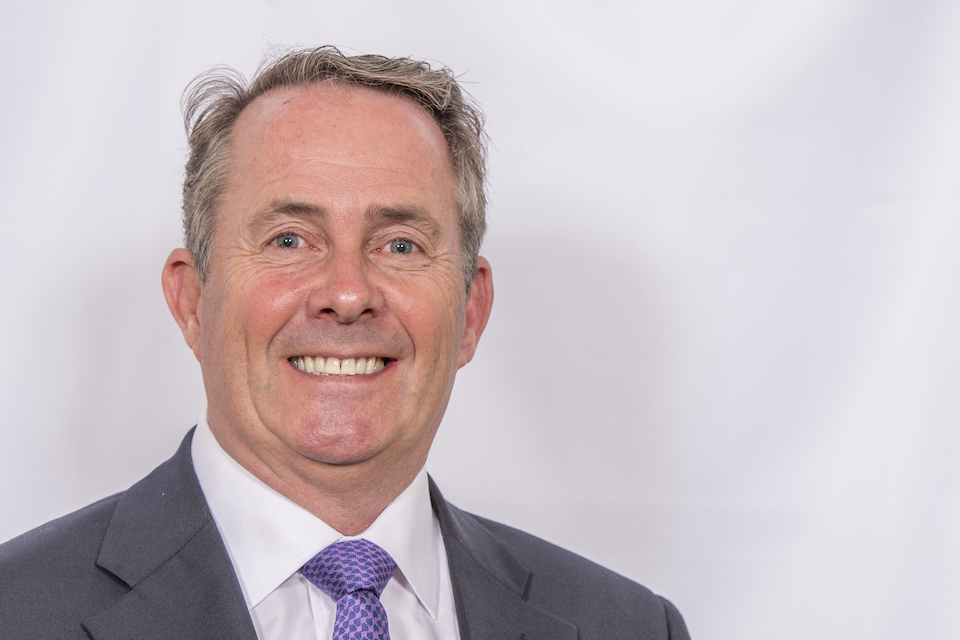
  • Liam Fox – 2018 Speech on Chinese and British Innovation

    Below is the text of the speech made by Liam Fox, the Secretary of State for International Trade, on 4 January 2018.

    Thank you all for being here tonight.

    This evening is an opportunity for Britain and China to come together. A chance to identify our shared ambitions, our mutual strengths and the opportunities we have to work together to shape the future of global trade.

    But, first and foremost, we are here tonight to celebrate the upcoming GREAT Festival of Innovation.

    The festival, which will take place in March just a few miles away in Hong Kong, will bring together some of the UK and Asia’s most pioneering companies.

    It will be a gathering like no other – an opportunity to share innovations that will drive the future of free trade and for businesses to build lifelong partnerships.

    It is this spirit of friendship and commonality that I wish to speak to you about tonight.

    It is fitting that this evening we are gathered in Shenzhen, a city with innovation in its DNA.

    Shenzhen, as the technological capital of China, is the engine room that will power China in the age of the fourth industrial revolution.

    In a matter of decades, Shenzhen has transformed from a small fishing village into a dynamic and youthful city with a population of more than 11 million.

    Much of this success has been down to this city’s dynamism, and its dedication to technical advancement.

    With research and development investment accounting for 4% of GDP – double the national average – and patent applications standing at the highest in China for 10 consecutive years, it cannot be denied that we stand in a city that is unapologetically focused on the future.

    Across this city, some of the world’s most talented minds are coming together to design tomorrow’s technology.

    Shenzhen is a world-leading producer of drones, electric cars and DNA sequencing machines.

    It is clear that this city has much to offer the world.

    But I am here this evening to talk about what the United Kingdom can offer Shenzhen.

    Yesterday, I had several hours of constructive and positive talks with Commerce Minister Zhong Shan where we discussed the opportunities that result from the complementary nature of our economies.

    Technology is clearly one but there are others. Another lies in food and drink.

    China will need to ensure that there is a sufficient supply of quality foodstuffs available for its growing population and especially its burgeoning middle class.

    Britain will want to ensure better and more predictable incomes for our farmers as we leave the EU so that we can attract investment and improve productivity.

    We must work together in the months ahead to ensure that we address any concerns that Chinese authorities have so that the Chinese people can enjoy the benefits that quality UK beef, lamb and poultry can bring. Our already growing exports of food and drink can improve further with the lifting of market access barriers.

    There is a great opportunity to be ambitious about our future trading relationship to the benefit of both sides. We will continue to explore all our options together.

    When the UK voted in 2016 to leave the European Union, there were many around the world that portrayed the result as a symptom of insularity.

    They predicted that Britain would be turning in on itself, abdicating its international responsibilities and severing global ties.

    I am here to tell you that nothing could be further from the truth.

    Instead, last year’s referendum vote to leave the European Union has offered us an unprecedented opportunity.

    For the first time in more than 4 decades, we have the opportunity to forge new trading partnerships around the world, with old friends and new allies alike.

    We are building a Global Britain – a country that champions commercial freedoms, prizes international talent, and helps the world’s most dynamic and innovative enterprises to reach their potential.

    We want to see companies, like those that join us today, succeed. We want to see Shenzhen succeed.

    As shown by figures from the Shenzhen Statistics Bureau, UK-Shenzhen trade is already worth more than US$6 billion a year and the UK is the largest EU source of Foreign Direct Investment to the city – with investments totalling around US$1.4 billion.

    Likewise, the innovative firms that have made Shenzhen their home are growing their businesses in the UK, with Huawei alone employing more than 1,500 staff across the UK.

    The UK and Shenzhen share common strengths. Fintech, information and communications technology, advanced healthcare, artificial intelligence, advanced manufacturing and clean energy are all industries in which we are both seeking to blaze a trail.

    These areas of commonality mean opportunities for our businesses. Opportunities for UK and Chinese firms of all sizes to trade with one another, to share expertise and to secure investment.

    Indeed this evening we’re very lucky to be joined by some of the excellent British food and drink manufacturers who are meeting the growing demand from Chinese consumers. If you haven’t done so already I would urge you to sample the delicious products being showcased today, including smoked salmon from H. Forman & Son, cider from Brothers, cheese from Somerdale, and ale from Badger.

    In 2016 China became the ninth largest importer of British food and drink and early figures for 2017 show a move to eighth place.

    Tonight, and all through the Great Festival of Innovation, we come together to fortify our bonds and fundamentally to support one another to achieve our ambitions.

    Britain’s decision to leave the European Union is our acknowledgement that our destiny lies not only in our valued friendship with Europe, but also the wider world.

    Earlier I quoted some rather impressive statistics relating to UK-Shenzhen trade and investment. These figures, while heartening, fail to show the real impact and value of trade.

    Trade and investment creates jobs, supports the livelihoods of real people, means the food and clothes that we buy in the shops are more affordable and that businesses can grow and thrive.

    In short, it means for us a more prosperous Britain and a more secure world.

    That is why, far from retreating from the world, we are extending the hand of friendship beyond the borders of Europe.

    Being a globally minded country is in our very nature. We are in the right time zone to trade with Asia in the morning and America in the afternoon. We champion business-friendly regulation, are home to the world’s leading financial sector, are the number one destination for inward investment in Europe and boast some of the world’s best universities that bring students from across the world together.

    In the first full year since the referendum we saw the highest number of foreign direct investment projects into the United Kingdom in our history, a 13.5% rise in our exports and record employment. A vote of confidence from global investors.

    Last year our government launched a modern industrial strategy for the United Kingdom. It is a long-term plan to boost the productivity and earning power of people throughout the UK.

    It focuses on the 5 foundations of productivity: ideas, people, infrastructure, business environment and places.

    The strategy sets out how we are building a Britain fit for the future and how we will respond to the technological revolution taking place across the world.

    Technology will disrupt nearly every sector in every country, creating new opportunities and challenges.

    We, like our partners in Shenzhen, are focused on seizing these opportunities. From the data-driven economy to the future of mobility, we want to back visionary businesses to make their mark.

    As you will see there are many parallels between the United Kingdom’s modern Industrial Strategy and the new area strategy for Guangdong.

    We both share the ambition of supporting our industries to be world leaders in research, manufacturing, life sciences and high technology.

    We also have a shared understanding of the vital role that transport and infrastructure play in driving productivity.

    While of course there any many ways in which our worlds differ, it is impossible not to be struck by the commonality.

    That is why I truly believe the UK and the Greater Bay Area can and should work together to achieve these great aims and to be partners as we nurture innovation-driven economies.

    The scale of opportunity for UK business to export to, partner with, and invest in this region is unrivalled.

    My department, which is responsible for trade and investment, wants to offer more support to those UK companies who see China as their trading partner of the future, and to do more to engage with Chinese investors, encouraging them to take advantage of opportunities in the UK.

    That is exactly why in March we will be hosting the GREAT Festival of Innovation in Hong Kong. I hope many of you will be there joining hundreds of other international business leaders and investors.

    The festival will showcase the very best of British and Asian innovations in how we will learn, live, work and play in the future across multiple sectors.

    It will be a meeting of brilliant minds. It will provide an opportunity for British and Asian visionaries to forge new trade links and strengthen existing relationships.

    The event will be the third in a series of successful GREAT festivals in 5 years, following the success of the GREAT Festivals of Creativity in Istanbul in 2014 and Shanghai in 2015, with the latter generating over £800 million in business.

    I look forward to welcoming you all to the festival, to join the most exciting, dynamic and successful companies that the Asian tech sector has to offer.

    I hope this evening I have imparted some of the optimism that my colleagues and I feel at this juncture in our history. It is a new, exciting chapter for the United Kingdom, but also for our valued friendship with Shenzhen and China. The opportunities and the prizes of the future are there to be shared together.

    Thank you.

  • Theresa May – 2017 Statement on Infected Blood Inquiry

    Below is the text of the statement made by Theresa May, the Prime Minister, in the House of Commons on 21 December 2017.

    As the Government announced last month, a full statutory inquiry into the infected blood scandal will be established under the Inquiries Act 2005, and sponsored by the Cabinet Office. The inquiry will have full powers, including the power to compel the production of documents, and to summon witnesses to give evidence on oath.

    We are today setting out the next steps.

    The Cabinet Office has now completed its analysis of the responses to the consultation on the format of the statutory inquiry into infected blood announced in July. In addition a series of roundtable meetings were held earlier this month with individuals and groups representing those affected.

    The Government committed to making an announcement regarding the chair of the inquiry before Christmas, taking into account the views we have received. We are therefore announcing today our intention to appoint a judge to chair the inquiry. We will make a further statement on who that judge will be in the new year and we will be discussing with them the composition of the inquiry panel.

    We would like to thank each and every person who took the time to respond to the consultation, and to share their views and experiences. We understand how difficult these issues must have been to describe and we are grateful for the frankness and honesty with which people have shared their experiences. The responses to the consultation have been carefully considered by Cabinet Office officials. We can assure the House and everyone who contributed that the findings will be passed to the proposed chair to help inform the discussions regarding the draft terms of reference, on which we expect there will be further consultation.

    In accordance with the Inquiries Act 2005, colleagues in the devolved Administrations will be consulted as the terms of reference are finalised.

    A further statement will be made in the new year.

  • Fabian Hamilton – 2017 Speech on Cycling Fatalities

    Below is the text of the speech made by Fabian Hamilton, the Labour MP for Leeds North East, in the House of Commons on 21 December 2017.

    This debate is the last parliamentary business before the recess and, indeed, the last business of the year, but it nevertheless deals with an issue that is of great seriousness and grave concern to my constituents and to many others, given the number of people who have been injured or killed when cycling on our roads.

    On 12 December last year, 58-year-old Ian Winterburn was cycling to work at 7.30 am, as he did every day. Ian was a keen and regular cyclist. As usual, he was wearing his cyclist’s high-visibility jacket, and all his bike lights were on. He always wore a cycling helmet. As he was passing the junction of Whitkirk Lane on the A6120 ring road in Halton, Leeds, a silver Skoda Fabia was signalling to turn right, but instead of waiting for Ian to cycle past, the driver went straight into him, knocking him off his bike and fatally injuring him. She claimed that she had not seen him. After 10 days in a coma, Ian died from his injuries on 22 December.

    Cyclist Charlie Alliston was famously sentenced to 18 months in prison recently for fatally injuring pedestrian Mrs Briggs in one of two such fatal accidents last year, yet any more cyclists have been killed or badly injured by cars during the same period. Alliston’s case justifiably received plenty of media coverage, but shocking deaths such as that of Ian Winterburn scarcely receive any, and public anger towards cyclists is now at an all-time high.

    The 51-year-old driver of the Skoda that killed Ian was sentenced on 20 October by Leeds magistrates court for causing death by careless driving.

    Ruth Cadbury (Brentford and Isleworth) (Lab)

    I congratulate my hon. Friend on initiating the debate. I co-chair the all-party parliamentary group on cycling, and I commend to him one of the recommendations of our report on justice for cyclists. We asked the Government to address

    “Confusion and overlap between ‘careless’ and ‘dangerous’ driving”

    in such cases.

    Fabian Hamilton

    I shall deal with the issue of careless versus dangerous driving and the different penalties involved. Indeed, I shall refer to the all-party parliamentary group that my hon. Friend so ably chairs, and of which I am currently the treasurer.

    The driver of the Skoda was given a four-month prison sentence suspended for two years, a £200 fine, 200 hours of community service and a two-year driving ban. Her licence had been suspended previously for 14 months for drink-driving.

    One of the most shocking aspects of this tragic case—apart from the loss of a much-loved husband, father and teacher—is the way that the family have been treated by the various authorities involved in dealing with the terrible and totally avoidable loss of such a valuable life. Ian Winterburn was hit at 7.30 am that day, but the West Yorkshire police crash investigation team did not arrive at the scene for more than an hour.

    The police and the Crown Prosecution Service believed that the driver did not adequately defrost her car windscreen before setting off from her home nearby. There was ​circumstantial evidence to support that, as her windscreen wipers and car heating were on full power although it was a dry day. However, because the crash investigation team took so long to arrive, they could not confirm the state of the windscreen at the time of the accident. Of course, had they arrived sooner, there could have been proof that the windscreen was not properly de-iced. The driver would then have faced a charge of causing death by dangerous driving, which carries a considerably higher sentence on conviction than the lesser charge of death by careless driving.

    There is only one crash team for the whole of West Yorkshire, an area with a population of 2.3 million. The family have asked a number of pertinent questions about that issue alone. They asked, for example, why there was only one crash team for such a large area, how many people were in that team, how many crash investigations they investigated each week and where the team was based.

    It took more than three hours for the police to contact Mrs Winterburn that day to inform her about the collision. When she asked why it had taken so long, the answer was that the crash team was too busy securing the crash site and collecting evidence, which was its main priority, and that there were not enough staff to contact Mrs Winterburn earlier. As Members may imagine, this was extremely traumatic for Mrs Winterburn and her family and greatly added to the trauma they experienced upon hearing such terrible news.

    But it gets worse. When the family arrived at the hospital, they spent a number of hours in the resuscitation unit, where no staff were available to keep them updated. Ian Winterburn was still wearing his cycling clothes, and it was to be another 16 hours before any member of staff gave the family information about the extent of Ian’s injuries, the prognosis or, indeed, the next steps in his treatment.

    Let me move on now to the role of the coroner service. Although Ian died on 22 December, just one year ago tomorrow, it took until 10 January to obtain a death certificate. That was apparently because of a backlog over the Christmas and new year holidays, but it meant that Ian’s body had to be kept at the Leeds General Infirmary mortuary for two weeks before a funeral could take place. As Members may imagine, this added considerably to the stress and trauma suffered by the family. Presumably, people still die from unknown causes or accidents over holiday periods, and although everyone deserves holidays and time off, especially public servants, surely it is important that the coroner service does not close, except perhaps on Christmas day itself.

    The Crown Prosecution Service told the family that the case against the driver who killed Ian was so serious that it would be heard in the Crown court and that they should not even attend the magistrates court hearing, which would be merely a formality and would only last for a few minutes. However, in the event, the driver was convicted, after two one-hour sessions, by the magistrates court, and no support whatsoever was given to the family.

    No help was even offered to the family in the preparation of their victim statements, which of course they had little knowledge of how to prepare and no previous experience of writing. This further added to the anxiety felt by Ian’s close family, and made them lose faith in the whole criminal justice system. One of the pertinent ​questions asked by Ian’s daughter, my constituent Alex Wilks, who is here today, when she came to see me about her father’s death and her family’s treatment by the various authorities was, “Why is the most senior CPS lawyer in West Yorkshire only employed for two days a week?”

    After the shock of the brief court case and what the family feels is the inadequate sentence for a driver who had previously been given a 14-month driving ban after a conviction for drink-driving, the family was told by the police that the coroner would now close the inquest because there had been a criminal conviction. A short while later, the coroner phoned Georgina, Ian’s widow, to tell her that there would still be an inquest and that a number of witnesses would attend it.

    As we can imagine, this came as a huge shock to the family, and Alex, Ian’s daughter, rang West Yorkshire Victim Support to ask what the family should expect from the hearing, only to be told that it knew nothing about the hearing. The next day the coroner’s office rang Georgina to tell her that there had been a “mix-up” and that there would not be an inquest after all. No apology has ever been offered for the further upset caused to the family by this so-called “mix-up”.

    Many Members will know that I am a keen cyclist, because I pester them every summer to donate to my annual charity bike ride, and I can often be seen arriving at the Palace of Westminster in my hideous, brightly coloured lycra on my carbon racing bike; indeed you, Mr Speaker, have generously seen me off on some of my cycling jaunts.

    I am also an officer of the all-party group on cycling, which last July published a report into cycling and the justice system. We took a huge amount of evidence from cycling groups, lawyers, the police, the CPS, Transport for London, local authorities and many others. Among our conclusions were the following recommendations. The police must ensure that a higher standard of investigation is maintained in all cases where serious injury has resulted. That includes eyesight testing, mobile phone records and assessments of speed, drink and drug driving. We received many examples of the police failing to investigate properly, or even to interview witnesses or victims. Too often, weak investigations have undermined subsequent cases. I hope that the Minister will want to comment on this.

    We also recommended that all police forces should ensure that evidence of common offences submitted by cyclists or other witnesses using bike-mounted or person-mounted cameras or smart phones should be put to use and not ignored. Too often, these bits of evidence are ignored. The confidence of cyclists that their safety is a priority for the police will be undermined if such evidence is dismissed and no action is taken. In some cases, just a written warning could be enough to change bad behaviour.

    The length of time required by the police to serve a notice of intended prosecution for a road traffic offence is currently just 14 days, and that must be extended. That was one of our strong recommendations. We believe that that period is too short to enable cases to be adequately processed. In some cases, it could enable offenders to escape justice altogether.

    We also said that there was confusion and overlap between careless and dangerous driving, a point echoed by my hon. Friend the Member for Brentford and ​Isleworth (Ruth Cadbury), so bad driving often does not receive the level of punishment that the public feel it should. New offences introduced over the past few years have started to plug some of the gaps in the legislation, but many problems remain, particularly when cyclists are the victims. We believe that the Ministry of Justice should examine in more detail how these offences are being used, including the penalties available for offences of careless and dangerous driving.

    The police and the CPS should ensure that victims and bereaved families are always kept adequately informed throughout the process of deciding charges. This is done in many cases, but we have heard of victims being ignored and informed only at a much later date that cases have been dropped or that guilty pleas for lesser offences have been accepted.

    Ruth Cadbury

    I am a member of the Justice Committee, and one of the issues that we have heard about—which applies not only to cases such as this one—is that the cutbacks in the Courts Service and the Ministry of Justice mean that there are fewer people to carry out these important administrative tasks. In too many cases, administrative failures mean that justice is not being served, either for the victims or for their families, because there are not enough people to make the kind of contact that is, as my hon. Friend says, so important at times like these.

    Fabian Hamilton

    Again, I thank my hon. Friend for her helpful intervention. I think that the first part of my speech clearly showed that the family of Ian Winterburn are just such a family. They had appallingly bad service from the CPS; they were not kept informed at all. They were given no assistance; there was no family support whatever. I do not know whether that was the result of cutbacks or of bad organisation and training. I think my hon. Friend probably knows more than I do about that, because she is a member of the Justice Committee, but I will leave it to the Minister to respond to that point.

    The final recommendation in our report involves the fact that the number and length of driving bans appears to have declined, with a 62% fall in driver disqualifications over the past 10 years. That is double the fall in convictions for driving offences. Furthermore, very large numbers of drivers are escaping disqualification on reaching 12 points or more on their licence. The Ministry of Justice should examine the reasons behind the decline in the use of the penalty of disqualification and in particular the effect of the so-called exceptional hardship scheme.

    I know that our report, which was published seven months after Ian Winterburn was killed, will ring many bells in the minds of his family, who still grieve for him every day. The family would like answers to a number of more specific questions, notwithstanding the recommendations I have just read out, so will the Minister answer the following questions? What is the current status of the review of guidelines for causing death by careless driving? Is a review even being carried out? Why do drivers who have caused death not face mandatory custodial sentences? How many complaints does the Ministry of Justice receive about the coroner service ​every year? What training is given to the coroner service staff? Who holds the coroner service to account? Is it the Ministry of Justice or is there any form of local accountability? When was the last review of the coroner service, and what were its findings? Finally, when will the coroner service website be improved to offer more and better information to grieving and unsupported families, which seems a simple, straightforward reform?

    In conclusion, if we truly care about our environment and about the growing public health crisis, surely we must do far more to encourage cycling, both as a healthy activity and as a way to reduce carbon emissions and congestion, but tragedies such as the death of cyclist Ian Winterburn do nothing but discourage the public from cycling. We need to make cycling far easier and much, much safer, and part of that task is about ensuring that when terrible fatal accidents do occur, the appropriate administration of justice can be relied upon. We all need the assurance that cycling is a safe activity and a good way to move around our towns and cities for everyone who is capable of using a bike. Meaningful answers to and action from the Winterburn family’s pertinent questions, born out of tragedy and grief, would be a good start.

  • Theresa May – 2017 Address to Troops at RAF Akrotiri

    Below is the text of the address to troops made by Theresa May, the Prime Minister, at RAF Akrotiri in Cyprus on 22 December 2017.

    I am delighted to be here in Cyprus with all of you today – and to have this opportunity to say a big thank you on behalf of our whole nation for everything that you are doing to keep our country safe by working to bring peace and stability to this region.

    And I am especially pleased to be here with you just before Christmas. For at this special time of year it is even more important that you know just how vital your work is – and just how much I appreciate the sacrifices that you and your families make in the service of our country.

    Here in Cyprus, you are at the epicentre of so much of our military activity in the region.

    It is from here that you have conducted more than 1600 air strikes against Daesh targets and supported more than 1450 personnel working with our allies and partners in Jordan and Iraq to fight Daesh and prevent its re-emergence.

    And let’s be clear just what a difference that has made. Just three years ago, Daesh declared a Caliphate in Iraq and Syria: a safe haven in which to carry out the most barbaric acts and from which to plot murder on our streets at home.

    But today, thanks in very large part to your efforts, that so-called Caliphate has been crushed and no longer holds significant territory in Iraq or Syria. You should be incredibly proud of that achievement.

    While we need to continue to deal directly with the threat they still pose in the region, we also need to focus on training the Iraqi Security Forces so they can keep Daesh out – which is why the work we are doing, and you are supporting, to train over 60,000 Iraqi security personnel is so vital, as I saw first-hand on my visit to Baghdad last month.

    It is also from here in Cyprus that you are sustaining our efforts to support the wider stability of our allies in the Middle East.

    This includes the expansion of the Quick Reaction Force in Jordan which I visited with King Abdullah in April and discussed with him again when I was in Amman late last month.

    Let’s be clear why this matters too. As conflicts and tensions fuel instability across the Middle East, it is not just the security of that region which is threatened, but the whole international order on which global security and prosperity depends.

    And as Daesh seeks new ungoverned spaces from which to plot and carry out attacks, it is not just in those spaces that security is at stake but in the UK too.

    So it is vital that we support the stability of our partners across the Middle East.

    It is also here in Cyprus that our armed forces are working for the United Nations on Operation TOSCA to help keep the peace at the buffer zone through Nicosia.

    This is an important part of the work that we are doing in fulfilling our international responsibilities as a permanent member of the United Nations Security Council.

    And I am clear that as a global Britain we will honour those responsibilities and continue to play a leading role in upholding the values and rules of the international order on which we depend.

    As part of this, I have committed to ensuring that we continue to meet our NATO commitment to invest 2 per cent of our GDP on defence and to spend 0.7 percent of GNI on development.

    But it is you – your professionalism, your courage and your sacrifices that give meaning to the pledges we make as a nation. It is you who take down our enemies and stand by our allies when the going gets tough.

    I also want to thank our hosts in Cyprus for all they do to enable you to operate from here. And I think I speak for everyone here when I say that this is a special place – something of a home from home – for the British armed forces.

    Finally, as we enter a year that marks the centenary of the end of the First World War – and of course the centenary of the Royal Air Force – I hope you can take great pride not just in what you do, but also in what you are part of.

    From its origins as the first entirely separate and independent national air force, fighting over the Western Front from 1st April 1918 – to the leading edge fighter, strike and transport aircraft of today, those of you in the RAF are the present day pioneers of the world’s most iconic air force.

    While every one of you here today is part of one of the greatest military forces in the world.

    And I hope that as a nation in this special year ahead, we can collectively raise the national consciousness of the work that you do and the sacrifices that you make in the service of others.

    As Prime Minister, I will do everything I can to lead the nation in this endeavour.

    For you are quite simply the pride of our nation. And that is how you should be treated.

    So let me start that mission by thanking you once again for everything that you are doing and by wishing you and your families the best possible Christmas and a happy, safe and successful 2018.

  • Jo Johnson – 2017 Speech on Free Speech in Universities

    Below is the text of the speech made by Jo Johnson, the Minister of State for Universities, Science, Research and Innovation, at the Limmud Conference held in Birmingham on 26 December 2017.

    It is a pleasure to join you at the Limmud Festival. This is my first Limmud Festival, and it is a revelation for me: I did not fully realise what a remarkable gathering the conference is.

    It is a banquet of ideas and discussion, a national institution for the community, and an international success story: since the first conference in Britain in 1980, it has been replicated by Jewish communities all over the world, from South Africa to New Zealand, and from Finland to Chile.

    There is one thing in particular I find admirable about the Festival, and it sits at the heart of what I want to say today.

    That is its focus on the free exchange of diverse, even conflicting views. There are few places where you can hear from a government minister and from Jon Lansman of Momentum, and from speakers on subjects ranging from Kafka to stand-up comedy to tech startups, all on the same platform.

    This spirit of open, frank and rigorous discussion is refreshing and invigorating.

    The liberal tradition

    And, of course, this love of open debate represents just one of many contributions that Britain’s Jewish community has made to our country’s tradition of liberalism and openness.

    As the historian Abigail Green has pointed out, the British liberal tradition owes a profound debt to so many members of the Jewish community.

    To Isaiah Berlin, who helped to reinvent Western liberalism in the post-war era.

    To Peter Benenson, the founder of Amnesty International.

    To Herscht Lauterpacht, one of the fathers of modern international law.

    To Rosalind Franklin, the chemist whose work informs our current understanding of DNA.

    To Herbert Samuel, the liberal politician and instigator of the Balfour Declaration, the 100th anniversary of which we celebrated in November.

    And to countless others.

    This is a tradition that is particularly important to me in my role as universities minister.

    A university is the quintessential liberal institution. Not liberal in a narrow party political sense, but in the true liberal of free and rigorous inquiry, of liberty and of tolerance.

    The liberal tradition is a noble and important one; but today it finds itself under threat. Liberal politics are under threat from national and populist parties around the world. Economic liberalism is under threat from those who turn to protectionism for quick-fix solutions to complex problems.

    And the liberal tradition in universities faces challenges too.

    Threats to freedom of speech

    A particularly worrying challenge to universities as bastions of liberalism comes from the threat to legal free speech and to open debate on our campuses.

    Our universities, rather like the Festival we are today, should be places that open minds not close them, where ideas can be freely challenged and prejudices exposed.

    But in universities in America and increasingly in the United Kingdom, there are countervailing forces of censorship, where groups have sought to stifle those who do not agree with them in every way under the banner of “safe spaces” or “no-platforming”.

    However well-intentioned, the proliferation of such safe spaces, the rise of no-platforming, the removal of ‘offensive’ books from libraries and the drawing up of ever more extensive lists of banned “trigger” words are undermining the principle of free speech in our universities.

    Without that basic liberal principle, our universities will be compromised.

    Spinoza, that forerunner of modern liberalism, said that intellectual freedom was “absolutely necessary for progress in science and the liberal arts”.

    Indeed, in 1673 Spinoza refused a prestigious appointment as professor of philosophy at the University of Heidelberg, because the job offer came with a restriction on what he could say – a stipulation that he must “not insult the principles of the established religion”.

    Shield young people from controversial opinions, views that challenge their most profoundly held beliefs or simply make them uncomfortable, and you are on the slippery slope that ends up with a society less able to make scientific breakthroughs, to be innovative and to resist injustice.

    I am glad to say that, for the time being at least, censorship in our universities is the exception, not the rule.

    A 2016 survey showed that 83% of students felt free to express views on campus. And I have been hearted by cases of students themselves standing in the way of attempts to restrict freedom of speech.

    But this is no time for complacency.

    Like me, you have no doubt read reports of examples of censorship, where groups have sought to stifle those who do not agree with them in every way under the banners of “safe spaces” or “no-platforming” in US, signs that it might be spreading to UK.

    Campaigns and protests against events featuring prominent gay rights and feminist campaigners such as Peter Tatchell and Julie Bindel, and more recently the proposal by some students at Oxford’s Balliol College to deny the Christian Union a space at Fresher’s Fair are examples of the threat to legal free speech from those who would rather shut down debate altogether than to confront dissenting ideas or uncomfortable arguments.

    That’s why the government is taking action now.

    As part of our reforms to higher education, we have set up a new regulator, the Office for Students (OfS), which, as its name suggests, will regulate the university sector in a way that puts the interests of students first.

    Created by the Higher Education & Research Act 2017, the OfS will come into being next week.

    Promoting freedom of speech within the law will be at the heart of its approach to the regulation of our higher education system.

    The OfS will go further than its predecessor in promoting freedom of speech.

    In the Act, we extended the existing statutory duty on universities to secure free speech in the Education (No.2) Act 1986 so that it will apply to all providers of higher education registered with the OfS.

    Furthermore, as a condition of registration with the new regulator, we are proposing that all universities benefitting from public money must demonstrate a clear commitment to free speech in their governance documents.

    And the OfS will in turn use its regulatory powers to hold them to account for ensuring that lawful freedom of speech is upheld by their staff and students.

    This is no authoritarian step.

    Nor is it somehow the “opposite” of free speech, as has been suggested by Harriet Harman, whose Joint Committee on Human Rights is gathering evidence on freedom of speech in UK higher education.

    On the contrary, it is simply Government playing its part in actively creating the conditions necessary for our universities to serve as the vibrant free-trading marketplaces for ideas that we need them to be.

    What do we mean by universities as ‘marketplaces of ideas’? It means our universities enabling truth to emerge and the frontiers of knowledge to expand as a result of the competition of ideas in free, transparent public discourse.

    Whether it’s Gallileo’s heretical rejection of geocentrism, Darwin’s godless theory of creation or the bravery of dissidents resisting oppression all over the world, history shows the right to disagree is the cornerstone of intellectual and political freedom.

    I am pleased to say that this freedom is as important to the OfS’s new chairman, Sir Michael Barber, as it is to me.

    In a recent article entitled “In Defence of Uncomfortable”, arguing that universities need to foster a climate of open inquiry in order to provide a truly valuable education, Michael pointed out that “Diversity of view and disagreement, is a vital ingredient of places of higher learning”.

    While he hoped the OfS never has to intervene in a university in relation to freedom of speech, he undertook that, if it does, it will be to widen it rather than restrict it.

    I’m confident freedom of speech in our universities has a bright future under the OfS.

    But we will continue to watch the system carefully.

    And I want to be clear about this: attempts to silence opinions that one disagrees with have no place in the English university system. Academics and students alike must not allow a culture to take hold where silence is preferable to a dissenting voice.

    If we want our universities to thrive, we must defend the liberal values of freedom of speech and diversity of opinion on which they depend.

    Freedom of speech within the law must prevail in our society, with only the narrowest necessary exceptions justified by specific countervailing public policies.

    Standing firm against antisemitism on campus

    One threat that you will be all too aware of comes from anti-semitism on campus. There is no doubt that for many Jewish students their experience at university is overwhelmingly positive.

    However, the number of anti-semitic incidents in the UK, including in our universities, remains a cause for concern. Anti-semitic incidents, whether from the far right, or from a virulent far left strain, have included Holocaust denial leaflets distributed at Cambridge University and swastikas at Exeter University.

    Last October, it was reported that police were called to University College London to quell a violent anti-Israel protest which left Jewish students barricaded in a room, after being told their safety could not be guaranteed if they left alone.

    I am concerned that there has been a climate on campus in which fewer than half (49 per cent) of Jewish students surveyed said they would feel comfortable attending NUS events.

    This is unacceptable.

    I’m encouraged that the NUS’s new leadership, under Shakira Martin, has taken a more positive direction, including a partnership with the Union of Jewish Students and Holocaust Education Trust for a Holocaust education campaign. I hope this continues.

    There is no place in our society – including within higher education – for hatred or any form of discrimination or racism such as anti-Semitism.

    A racist and anti-semitic environment is by definition an illiberal one that is totally antithetical to the idea of a university in a free society.

    Working together with universities, with bodies like Universities UK, and with campaigners such as Baroness Deech and Sir Eric Pickles, we are working to combat antisemitism on campus, and I believe we are making progress.

    I have been working hard to tackle this.

    In February I wrote to Universities UK, the representative body of the UK higher education sector, as well as to alternative providers, to ensure they had noted the Government’s adoption of the International Holocaust Remembrance Alliance definition of anti-Semitism.

    At my request, this has been shared throughout the higher education sector.

    It is essential that institutions must have robust procedures in place. I expect them to demonstrate how they will act quickly to investigate and address all allegations of hate crime, including allegations of anti-Semitism.

    This is an integral part of ensuring they provide a safe and inclusive environment for all students and that students do not face discrimination, harassment or victimisation.

    In June last year, at my request, Universities UK agreed to consider the issue of hate crime on campus on the basis of religion and belief as part of their Harassment Taskforce.

    Its key recommendations to universities included the adoption of a zero tolerance approach to anti-semitism, training for staff on antisemitism and development of close ties between universities and local Jewish community leaders.

    UUK has also published the first of their case studies looking at good practice at the sector on harassment and hate crime and I hope that institutions are aware, and making good use, of these.

    To support this work, I asked the Higher Education Funding Council (HEFCE) to prioritise working with Universities UK in 2017-2018 on these important issues.

    And as a result, they have provided over £4m funding for projects to tackle harassment and hate crime. This includes £1.8m of funding for over 40 universities and colleges for projects which aim to tackle online harassment and hate.

    But there is much more to do.

    Universities cannot afford to be complacent about complying either with their duties to protect freedom of speech, or anything less than vigilant against hate speech (or other unlawful activity) masquerading as the exercise of the right to freedom of speech.

    Both duties are vitally important to a civilised democratic society.

  • Theresa May – 2018 New Year’s Message

    Below is the text of Theresa May’s 2018 New Year Message made on 31 December 2017.

    2017 has been a year of progress for the United Kingdom.

    In January, I set out our objectives for the Brexit negotiations, and in the months since we have pursued them with steady purpose.

    In March we triggered Article 50, putting the decision of the British people into action.

    In December we reached agreement on the first phase of negotiations with our EU partners.

    Next year we will move on to the vital issues of trade and security, and I am determined that we will keep up our progress in 2018.

    Because whichever way you voted in the referendum, most people just want the government to get on and deliver a good Brexit, and that’s exactly what we are doing.

    Making a success of Brexit is crucial, but it will not be the limit of our ambitions.

    We also have to carry on making a difference here and now on the issues that matter to people’s daily lives.

    That means building an economy fit for the future and taking a balanced approach to government spending, so we get our debt falling but can also invest in the things that matter – our schools, our police and our precious NHS.

    Our goal is simple: more good jobs in every part of the country, and more opportunities for young people to get on in life.

    The first step to a better future is getting a place at a good school.

    It’s what every parent expects, and it’s what every child deserves.

    So we will build more good schools, keep a tight focus on standards and discipline, and give more help and support to our fantastic teachers.

    We will build more homes, so housing becomes more affordable and more families can get on – and climb up – the housing ladder.

    And we will protect and enhance our natural environment for the next generation.

    2018 is a special year in the life of one of our most cherished institutions, as we will celebrate the 70th birthday of our National Health Service.

    It is a year to rededicate ourselves to its founding ideal: that good healthcare should be available to everyone, regardless of income.

    And it’s a chance to celebrate the care and compassion of our wonderful NHS staff.

    We will continue to invest in our NHS and ensure it can deliver a world-class service now and for generations to come.

    As we mark the centenary of the end of the First World War, and remember the tremendous sacrifices of that conflict, the UK will remain a champion of peace and order around the world.

    Together with our allies, we will continue the fight against all forms of extremism, and support our security services as they work every day to keep us safe.

    When we host the Commonwealth Heads of Government Meeting in April we’ll work with our partners to tackle global problems like climate change and plastic waste in our oceans.

    And as we celebrate the 100th anniversary of the first votes for women, let’s vow to eliminate all prejudice and discrimination from our society.

    Because in the United Kingdom in 2018, everyone deserves the chance to succeed and everyone has a right to be treated with respect.

    That means safe workplaces, free from harassment.

    And it also means a public sphere where debate is constructive and courteous, and where we treat each other with decency.

    Of course any year brings its challenges – that is true for each of us personally, as much as for our country and the world.

    But the real test is not whether challenges come; it’s how you face them.

    Whether you allow a task to overcome you, or tackle it head on with purpose and resolve.

    I believe 2018 can be a year of renewed confidence and pride in our country.

    A year in which we continue to make good progress towards a successful Brexit deal, an economy that’s fit for the future, and a stronger and fairer society for everyone.

    And whatever challenges we may face, I know we will overcome them by standing united as one proud union of nations and people.

    I hope that 2018 is a great year for you and your family – and I wish everyone a very happy new year.

  • Kenneth Clarke – 2017 Speech on EU Withdrawal Bill

    Below is the text of the speech made by Ken Clarke, the Conservative MP for Rushcliffe, in the House of Commons on 13 December 2017.

    I rise to support new clause 3 and amendment 7. As mine is the second name attached to amendment 7, which was tabled by ​my right hon. and learned Friend the Member for Beaconsfield (Mr Grieve), who is mainly responsible for it, I also incline to the view that it is slightly the better drafted, but I will support either proposal if one or both are put to the vote.

    I might well succeed in being reasonably brief, because I agreed with every word of the speech made by the right hon. Member for Normanton, Pontefract and Castleford (Yvette Cooper) and I will not repeat what she said. A welcome note of cross-party consensus exists across a large part of the House, and it represents the cross-party consensus that is in favour of what is lazily called a soft Brexit and of having the best possible close relationship with the European Union after we leave.

    The main issue in this debate seems to turn on what we mean by a “meaningful vote”, which relates to our discussion on the role of parliamentary sovereignty in a situation of this kind. I accept that today the Prime Minister—not for the first time—promised us a meaningful vote, but she later went on to qualify that slightly by talking about the need for statutory instruments to be brought forward during the period of the Bill, within the extraordinary powers that the Bill gives Ministers to enact, by regulation, even changes to British statute law. We have to be clear what a meaningful vote is, and the key is the timing. It is quite obvious that if the British Government are to be responsible to the British Parliament, the vote must take place before the Government have committed themselves to the terms of the treaty-like agreement that is entered into with the other member states. Any other vote will not be meaningful.

    I will give way in just a second, but let me finish this point.

    That means that a meaningful vote cannot take place until a detailed agreement has been arrived at about certainly the precise nature of our trading and economic relationships with the single market of the European Union, and actually quite a lot else besides, because we still have to embark on the security discussions, the policing discussions and the discussions about which agencies we are going to remain in and which agency rules we are going to comply with. This is, we all agree, a huge and complex agreement, and it is going to determine this country’s relationships with the rest of the continent of Europe and the wider world for generations to come. Can that happen before March 2019?

    We face the genuine difficulty that it is quite obvious that we will not be remotely near to reaching that agreement by March 2019, and we have to think through what that actually means. The negotiators have been very optimistic in saying that they will have first a transition deal and then a deal by 2019. I am sure that they will try, but they have not a chance. I think that what they are actually saying—certainly the continental negotiators—is that they might be able to have some heads of agreement on the eventual destination by March 2019, which we can all carefully consider. They will ​certainly have to agree a transition deal of at least two years within which the rest of the process will have to be completed.

    I agree with the right hon. Member for Normanton, Pontefract and Castleford that everybody wants things to be speedy, because one of things that this country is suffering from most at the moment is the appalling uncertainty caused by the fact that we have taken a ridiculous length of time to reach three obvious conclusions on the three preliminary points that had to be determined as the basis of our withdrawal. At the moment, however, we do not quite know what the British Government are going to be seeking as their end goal in the negotiations that are about to start, because the British Government, within the Cabinet, have not yet been able to agree exactly what they are seeking.

    If I may say this to my desperately paranoid Eurosceptic friends, it is not as if I am somehow trying in some surreptitious remainer way to put a spoke in the wheels of the fast progress of the United Kingdom towards our destination. The Government do not know what leave means. Nobody discussed what leave meant when we were having the referendum. Our overriding duty is not just to our political allegiances and so on; it is to provide this country with a good, responsible Government who face up to the problems of the real world and, accountable to Parliament, can produce the best new order that they can for the benefit of future generations.

    Mr Lammy

    The right hon. and learned Gentleman is demonstrating why he is Father of the House, so I hesitate to interrupt him, but on his point about having a meaningful vote prior to the Prime Minister of the day making the deal, does he agree, with his wealth of experience, that if we are to keep the country together, it is important that that Prime Minister has in the back of her head when trying to pull off that agreement, “I have to get this through my Parliament”?

    Mr Clarke

    The right hon. Gentleman makes one of the points that I was going to make. The most important effect of passing either new clause 3 or amendment 7 —there is actually more to this than a meaningful vote, if we consider the various stages—and achieving proper parliamentary accountability is that that would affect the tenor of the negotiations. Like every other Head of Government in the European Union, our Prime Minister would need to have at the back of her mind, “Can I deliver to the House of Commons what I am thinking of conceding?” Every other political leader in Europe will do that, because they will have to sell what they sign up to to their own Parliaments. If we do not have a meaningful vote, we will be the only member state whose negotiators are not under a legally or constitutionally binding commitment to sell the deal, because they will be able to make the deal and then come back to the House of Commons and the House of Lords and say, “This is it. What do you think of it?”

    Chuka Umunna

    The Father of the House is absolutely right that the Bill essentially gives the Government a blank cheque. On timing, the only commitment I can see in today’s written ministerial statement from the Secretary of State for Exiting the European Union about what will happen before we leave the EU is that the proposed withdrawal agreement and implementation ​Bill will be introduced before we leave. That is clearly unacceptable. Any piece of legislation seeking to do what that Bill has in mind must be passed before we leave the European Union, even if that means extending the process to maintain parliamentary sovereignty.

    Mr Clarke

    I agree entirely, and my next point is linked to that. The nature of the parliamentary approval cannot just be a motion; it must have statutory basis, which is the route that the Prime Minister has followed. There are various reasons for that, but the obvious one is the extremely uncertain status of resolutions of this House under current parliamentary practice. The Brexit Secretary is only the latest example of someone saying that anything that is not statutory is not legally enforceable, but just a “statement of intent”. The House of Commons keeps passing all kinds of motions with which I ferociously disagree, but they get carried by this House and make all kinds of criticisms of what the Government are doing. We have moved into a new era in which the Government are allowed to keep saying, “Parliament may pass motions, but they are worthless expressions of opinion. They are not part of our being accountable to the elected body of the House.”

    Sir Oliver Heald

    Of course the original plan was not to have a Bill, but to rely on statutory instruments under clause 9 to effect changes of constitutional significance. It was then made clear recently—I think on 17 November—that we will in fact have a Bill. Does my right hon. and learned Friend agree that to try to make such changes by secondary legislation just is not on? It is very unlikely that the courts would say that such constitutionally significant changes could be made under secondary legislation.

    Mr Clarke

    Again, I agree entirely, and that takes me back to something that has occurred all the way through this process. I am obviously standing here in disagreement with the Government, of whom I am critical in many respects, due to both the policy and how it has been conducted, but I have had some sympathy with them since the election, because they are trying to carry through this enormous, controversial and historic measure when they do not have a parliamentary majority, except when they can persuade the Democratic Unionist party to turn up and support them.

    The process started with the extraordinary suggestion that the royal prerogative would be invoked, that treaty making was not going to involve Parliament at all, and that leaving did not require parliamentary consent. Rather astonishingly, that matter had to be taken to court, and it came to a fairly predictable conclusion. The next idea—I will not repeat what my right hon. and learned Friend the Member for North East Hertfordshire (Sir Oliver Heald) said—was that everything would be done by statutory instruments under broad powers. However, we are slowly getting to what I would have thought is the fundamental minimum that a real parliamentary democracy should be demanding: the country will not be able to enter into a binding treaty commitment until the details have received full parliamentary approval. How we get there is no doubt a matter of some difficulty, but it must be addressed.

    I will give way in a second.

    The debates on this Bill have typified this Government’s approach to parliamentary scrutiny. I understand their difficulties when they have no majority and their Members include people like me and those who are trying to interrupt me—we are allegedly on the same side of the House—who fundamentally disagree with each other.

    I have attended every day of our debates on this Bill. We spent yesterday discussing parliamentary scrutiny, but our proceedings have not been a great advertisement for such scrutiny. The Government’s reaction to each and every proposal is to say how carefully they have listened, how important it is and how they will go away and think about it, but then to explain why the drafting of the Bill will not currently be amended. I am sure that I have done that myself when taking legislation through the House, and it is always a joy to find out that one can get away with it for quite a long time. After a bit, one gets used to the fact that one can get away with it as long as one is suitably polite and flattering to those who are proposing amendments. The actual reasons that have been given for rejecting proposals have been all about administrative convenience—that they are obscure drafting amendments. I congratulate the parliamentary draftsmen on creating arguments of such extraordinary minutiae to support the amazing aspirations of civil servants who see a mountain of work before them and hope that most of it can proceed with the minimum of political scrutiny.

    What we have not heard, and I will have to hear it today, is the political argument against Parliament having a meaningful say. What is the constitutional argument that says Parliament should be denied a statute before the Government enter into all these commitments? I have not so far heard a word expressed to try to explain that to me. That should be the key, dominant thought in the Government’s mind as they negotiate. Of course they will have to think about what will satisfy the Foreign Secretary and the Environment Secretary, and of course they will have to get something for which the Daily Mail, The Daily Telegraph and The Sun will criticise them least, and so on, but I do not think Parliament is an afterthought to those vital considerations; I think it is the parliamentary process that matters. The rest is a problem for some press officer.

    Mr Marcus Fysh (Yeovil) (Con)

    My right hon. and learned Friend said earlier that other Parliaments across Europe will have a say and we will not, but I posit that that is not true. This is about the withdrawal agreement, which will be agreed under qualified majority voting by the European Council, so it is not true that every Parliament across Europe will get a say on this subject.

    Mr Clarke

    Qualified majority voting is an excellent innovation achieved by the Thatcher Government when we were explaining to the other Europeans how they could have an effective free trade agreement. The number of times that British Governments have ever been outvoted under qualified majority voting is tiny. Qualified majority voting could be extremely important in these negotiations, because otherwise a Government of some small state—I will not name any, because they are all friendly—could suddenly decide they have some great lobby group at home that does not want to concede to the British something that the British Government have set out to achieve. The whole thing could then be held up.​

    The agreement will have to go to all the Parliaments. The Parliament of Wallonia will no doubt be allowed to have a say, which, if this Government have their way, this Parliament will not. The Parliament of Wallonia will be allowed to have a say, and I am not sure whether the Scottish and Welsh Parliaments will—that remains to be seen. European Governments will all have to take a view and defend that view to their own Parliament in each and every case.

    Mr Fysh

    On a point of order, Dame Rosie. I seek your guidance on whether this is misleading the Committee. It is simply untrue to say that each Parliament will have a vote.

    The Second Deputy Chairman of Ways and Means (Dame Rosie Winterton)

    It is disorderly to say that an hon. Member is misleading the Committee. I suggest that the hon. Member for Yeovil (Mr Fysh) settles down and allows the Father of the House to continue.

    Mr Kenneth Clarke

    Qualified majority voting means that each Government cast a vote and, if we get a qualified majority, that is the effective decision. Each Minister who takes part in that vote is, of course, accountable to their own Parliament, to which they go home and defend their vote. If it is on a difficult, controversial subject, any sensible Minister—all those Ministers—will take the view of their Parliament before going to cast their vote on behalf of their country. It is utterly ludicrous to say that this Parliament should be denied a vote and not allowed a role because qualified majority voting somehow replaces it. My hon. Friend the Member for Yeovil (Mr Fysh) says that what I say is untrue and, with great respect, I would say that his argument is an absurdity.

    Mr Baron

    I respect my right hon. and learned Friend’s consistency on this issue. He is on public record as having once said that he looks forward to the day when the Westminster Parliament will be nothing more than a council chamber of the European Parliament.

    When my right hon. and learned Friend says that leavers did not know what they were voting for, he risks sounding very condescending, because we knew exactly what we were voting for: to reclaim our laws and to reclaim our finances. Although one accepts his point that one cannot predict the future in any detail, that is as much true for the EU as it is for this country.

    Mr Clarke

    My hon. Friend is not the sort who usually repeats the more scurrilous right-wing rubbish that fanatical Eurosceptics come up with about what I have and have not said in the past. I am not, and never have been, a federalist. I would not pursue a united states of Europe. It is social media stuff to start throwing in that kind of thing when we are in the middle of a serious parliamentary debate.

    When the public were invited to vote in a referendum, they were invited to take back control, which was not defined. It was mainly about the borders and about the 70 million Turks and all the rest of it. They were told in the campaign that our trade with the European Union would not be affected in any way. Indeed, that is still ​being held out as a prospect by the Brexit Secretary and others, who seem to believe that they will get unfettered trade without any of the obligations.

    The discussions we have had in Committee on previous days about the details of what “single market” and “customs union” mean, and so on, would have been a mystery to anybody whose knowledge of the subject is confined to the arguments reported in the national media on both sides. Those arguments are largely rubbish, and it is now for this House to turn to the real world and decide in detail what we will do.

    Anna Soubry

    The Father of the House is right that there will be a qualified majority vote on the withdrawal agreement. That agreement will not go to each individual Parliament in the same way that the actual trade agreement will. Does he share the concerns of many people, as that now dawns upon them? They had thought that this place would have some sort of say on the trade deal—the actual final relationship that we will have with the European Union—but, actually, we will have no such say because the deal will not be finalised until after we have left the European Union. Does he agree that that is now concerning many citizens across the length and breadth of this land who did indeed apparently vote to take back control?

    Mr Clarke

    I agree entirely. My right hon. Friend eloquently underlines the point that the right hon. Member for Normanton, Pontefract and Castleford raised and that I am trying to make. We must have a meaningful vote before the final trade deal—indeed, the whole deal—is agreed by the Government.

    Let me try to lower the temperature by going back, as I rarely do, to reminisce for a moment.

    Sir William Cash

    My right hon. and learned Friend and, I believe, my right hon. and learned Friend the Member for Beaconsfield (Mr Grieve), both concede that amendment 7, at this crucial moment, is defective and would not work for a variety of reasons. I have indulged what my right hon. and learned Friend the Member for Rushcliffe (Mr Clarke) has said about scrutiny and responsibility and the rest, but does he agree that it is not appropriate to press such an amendment to a vote when, in fact, it would make a nonsense of itself? It would be a meaningless vote about a meaningful vote.

    Mr Clarke

    No doubt my hon. Friend will catch your eye, Dame Rosie, when he will be able to explain why he thinks the amendment is technically defective, but this is the kind of argument we have had against every proposition that has been put forward throughout the passage of the Bill. I heard the Prime Minister personally promise us a meaningful vote and then go on to explain how the Bill would have to be used to make statutory instruments; so we are talking about the very wide powers in the Bill being used probably even before the end of the article 50 period—I think that is what she said. This amendment would prevent that; it would prevent those powers from being used until a statute has been passed by this House confirming its approval and also giving legal effect to whatever final agreement has been arrived at. I bow to my hon. Friend’s legal skill—he was indeed in parliamentary law when he practised—but I cannot for the life of me see why this is defective.​

    I was about to end with a little reminiscing. I do not normally do that, because it is the last thing a veteran should do, but I keep being reminded of the European Communities Act 1972, the mirror image of which we are now producing. I hope the Committee will forgive me for looking back a little to think about what the reaction of that House of Commons, a much more powerful House of Commons than the present one, would have been if the Government of the day had come along with the kind of propositions we keep facing about the role of Parliament. The reaction across the House to being told there was going to be no parliamentary vote and it was all a matter of the royal prerogative would have been unrepeatable, from Enoch Powell to Michael Foot.

    The key vote at that time was a vote in principle on the agreement that had been reached—it was different then, because we were applying for membership. The first thing was to get parliamentary approval. No one said that it was going to be non-binding or just a resolution, but there was a key resolution that determined whether we could go ahead at all. Some Conservatives voted against it, but a much bigger number of Labour Members voted in favour, giving it a very satisfactory majority. Then the whole process was subjected to debate on a Bill, at much greater length and in much greater detail than anything this House of Commons will ever be allowed, before there was the slightest prospect of the British Government thinking they would be able to ratify the agreement and commit us to European membership.

    The current situation is a sad contrast with all that in many ways. It comes at a time when there is the utmost confusion about what our policy is, as we seek whatever destination we are eventually going to take when we reach agreement. Either new clause 3 or amendment 7 is the absolute minimum the Committee should be passing at this stage, in order to make it clear that binding commitments that affect future generations, changing our law in substantial ways, can be made only with the proper approval of both Houses of Parliament, following the full procedures that are necessary for statutory law.

  • Hilary Benn – 2017 Speech on EU Withdrawal Bill

    Below is the text of the speech made by Hilary Benn, the Labour MP for Leeds Central, in the House of Commons on 13 December 2017.

    I rise to speak to amendment 47, which stands in my name. It is a great privilege to follow the right hon. and learned Member for Beaconsfield (Mr Grieve), who has shown great resolution, fortitude and reason in the face of unreasonable criticism. We admire him for it.

    We are debating the single most important question in the Bill: how the House can exercise its view on the withdrawal agreement in a way that gives us control. ​“Control”—there is a word we have heard before. It resonated throughout the referendum campaign, but when Members start to argue that Parliament should have some control over this process, it seems to send shivers down Ministers’ spines.

    Amendment 47 arises from an exchange that I had with the Secretary of State on Second Reading. When I asked him to give us a very simple assurance that clause 9 will not be used to implement the withdrawal agreement until Parliament has had the opportunity to vote on it, he replied:

    “It seems to me to be logical”.—[Official Report, 7 September 2017; Vol. 628, c. 354.]

    What has been set out in today’s written ministerial statement appears to give that undertaking, but if that is what Ministers are prepared to do, why not put that into the Bill? I similarly welcome the Secretary of State’s announcement that there will be separate legislation to implement the withdrawal agreement, but if Ministers are prepared to give that commitment, we want to see that in the Bill, too, which is why I shall vote for amendment 7.

    The question has been asked—I want to ask it, too, because it has exercised the Select Committee—“What is clause 9 now for?” It is a very simple question indeed. Timing and the order in which these things are done are absolutely crucial in this debate, and that point was made forensically and forcefully by the right hon. and learned Member for Beaconsfield. May I suggest a new principle? We often heard it said during reports back from the negotiations that nothing is agreed until everything is agreed, so I suggest that we agree that nothing should be implemented until everything is agreed.

    The written ministerial statement says something interesting, and rather puzzling:

    “The Bill will implement the terms of the Withdrawal Agreement in UK law…Similarly, we expect any steps taken through secondary legislation to implement any part of the Withdrawal Agreement will only be operational from the moment of exit, though preparatory provisions may be necessary in certain cases.”

    My simple question for Ministers is this: secondary legislation where, and arising from what? Does this refer to clause 9, which a lot of Members think should no longer be in the Bill, or is it advance notification that there will be provision for secondary legislation under the withdrawal agreement and implementation Bill that we have been promised? We need some clarification.

    My hon. Friend the Member for Greenwich and Woolwich (Matthew Pennycook), who spoke so ably from the Front Bench, drew attention to the statement by the Secretary of State on 13 November in which he said, in announcing that Bill:

    “This confirms that the major policies set out in the withdrawal agreement will be directly implemented into UK law by primary legislation”.—[Official Report, 13 November 2017; Vol. 631, c. 37.]

    That is very interesting. I must confess that I did not understand the full significance at the time, so will Ministers also enlighten us on this? What are the major policies and what are the minor policies, and in which Bill, and by what means, will those minor policies be implemented?

    The next issue of timing is the idea that exit day should be set as 11 o’clock in the evening of 29 March 2019. The Government amendment to implement that proposal would cause all sorts of trouble, not least ​because of the way that this Bill was originally drafted, as the Select Committee heard in evidence from Ministers, who confirmed that they would be able to set different exit days for different purposes. The Committee thought that that seemed to provide a great deal of flexibility, but the amendment would bring that possibility to an end, and in the process bind the Government’s hands to an hour of the clock on a day at the very moment when they may well need maximum flexibility so that they can bring the negotiations successfully to an end. The amendment really makes no sense.

    As the Committee said in its report, the proposal would cause “significant difficulties” if the negotiations went down to the wire. Of course, we had the famous evidence from the Secretary of State in which he suggested that the negotiations might go to the 59th minute of the 11th hour, although since then there has been a certain amount of rowing back, because that would not be consistent with the pledge that we have been given. That was why the Committee said that it would not be acceptable for Parliament to be asked to vote after we had actually left the European Union. The timing of all this is absolutely fundamental to making the vote meaningful. A vote may be meaningless unless at some point in the procedure the timing ensures that it is meaningful. We have to get the order right.

    Michel Barnier said at the start of the process that he wanted to bring the negotiations to an end next October. We have 11 months to go to deal with a very long list of issues that we have not even started to broach. The agreement that was reached last week, which we welcome, is the easy bit of this negotiation—the really difficult bit is about to begin. Those who had thought that leaving the European Union would be about keeping all the things they liked and getting rid of all the things they did not like are now in for a rude awakening as they come to realise that choices have consequences and trade-offs will need to be made.

    Hon. Members, including the right hon. Member for Broxtowe (Anna Soubry), have referred to the question of no deal. Without doubt, there is no majority in the House of Commons for no deal. Of course we hope that there will be a deal, because we want the best outcome for our country, but in the event that it all went wrong and Ministers came back to say, “I’m sorry, but no deal is on the horizon,” and all Parliament could do was to say, “We are going to reject this,” and be left with no other recourse, that would not constitute a meaningful vote, would it, not least because the clock would be running down?

    Sammy Wilson (East Antrim) (DUP)

    The right hon. Gentleman is getting to the nub of the issue. If a meaningful vote, by his definition, means that Parliament should be able to say to the Government, “We don’t like the deal that you have got, and we’re not accepting no deal, so go back to the EU and negotiate another deal,” what chance does he think there is that those who do not want us to leave in the first place will ever offer a deal that this House could buy into?

    Hilary Benn

    The hon. Gentleman anticipates precisely the point that I was going to make—[Interruption.] I was. As we have already heard, all the Ministers and ​Prime Ministers who negotiate in this process will say at some point, either in the main forum or in other discussions, “I’ll never get this through my Parliament.” That is the accountability we are talking about. It is called democracy, and it is really important that Ministers, Prime Ministers and negotiators have that thought in their minds when they are negotiating on behalf of the country and the House. In such circumstances, I think the House would first want to ask why we were facing no deal, and it might well wish to give the Government fresh negotiating instructions. The House might want to tell the Government to go back in and say, “On reflection, we would like to suggest that we do the following.” There must be sufficient time for that to take place if we are going to get a reasonable deal.

    Another point I want to make—I am conscious, Sir David, of what you said about the time—is that Ministers need to understand why they are having such difficulty with this fundamental debate on the Bill. It has to do with the history of the Government’s handling of the whole process. At every single stage, this House has had to demand our role and our voice. I remember the answer when people first asked what the Government’s negotiating objectives were: “Brexit means Brexit.” When a follow-up question was asked, we were told—

    Paul Farrelly

    A red, white and blue Brexit.

    Hilary Benn

    I am still wrestling with the concept of a red, white and blue Brexit, and I did not find it very enlightening.

    The second answer was, “No running commentary,” but that eventually had to give way to the Lancaster House speech and a White Paper. Then we asked, “Will Parliament get a vote?” Almost exactly a year ago, when the Prime Minister last appeared before the Liaison Committee, I asked her that question. She was unwilling to give me a commitment on that occasion, but we all pressed, and in the end the Government conceded that there would be a vote.

    We argued that there would need to be separate primary legislation to implement the withdrawal agreement, but what did the Government do? They produced this Bill, which says, “No, no. We’ll just do it all by statutory instrument.” That was until amendment 7 appeared on the horizon, at which point the Government changed their mind. If the Committee insists, as I hope it will, on amendment 7 later today, that will be because of our experience of the Government’s handling of the Bill so far. They have not acted in the spirit of seeking consensus, even though the Prime Minister said earlier that that was what she wanted to achieve.

    The final point I want to make is simply this. Parliament has no intention of being a bystander in this process. We intend to be a participant, as I have said on a number of occasions, because this decision affects every part of the country, every business and every family. Today’s debate and vote are all about control, which must ultimately rest not in Ministers’ hands but in our hands. It is up to us to make sure that that happens.

  • Justine Greening – 2017 Speech on Social Mobility

    Below is the text of the speech made by Justine Greening, the Secretary of State for Education, at the Reform social mobility conference on 14 December 2017.

    Thank you for that introduction and thank you to Reform, KPMG and the Joseph Rowntree Foundation for bringing us all together today. I’m so pleased to have this chance to speak to all of you.

    I’m going to talk about three things:

    Firstly, the problem: why Britain has never cracked social mobility;

    Secondly, solutions: my ambitions for helping everyone to become the best version of themselves through their education; and

    Thirdly, everyone’s problem needs everyone’s solution – if we’re going to achieve anything then social mobility, equality of opportunity needs to be a common ambition – with schools, colleges, universities, but also businesses, civil society, local communities all playing their part.

    The problem

    So, firstly, setting out the problem. And I think of all the speeches I’ve made, this might be the most personal.

    Because social mobility has been such an important part of my own life, I didn’t think I’d get to where I am now. Looking ahead as a child, I’m not sure I could ever have guessed I’d be doing what I’m doing.

    I went back to my old school last month, Oakwood Comprehensive in Rotherham. We all start somewhere and that school was my start.

    I spoke to some of the children who are there now, and met some of the teachers who taught me. It was a fantastic visit. And as I looked at the children there now, you can’t help ask a simple question: who could they be.

    And that questions matters because too often in this country the answer to that question – for any child – is too much about where they happen to start.

    The reality is that in modern Britain where you start still too often decides where you finish.

    This is a defining challenge for us as a nation. We have talent spread evenly across this great country – the problem is that opportunity isn’t.

    And for many people it’s a whole lifespan of missed opportunities. If you start school behind on your vocabulary and language skills, often you don’t catch up.

    By the time you’re 11 you’re on a different path to your better off classmates, by the time you’re 16 and leaving school – you’re in a totally different place.

    And once you enter the workforce, you may well have fallen too far behind to even think about competing for the most rewarding jobs. And, worst of all it’s always been like that for some people and some places in Britain.

    But it doesn’t have to be.

    And if we want to move things on from purely discussing the problem to articulating a real solution then we have to start by asking why haven’t we cracked it already? Why has social mobility been static for so long?

    And I think it comes down to a number of things:

    A simplistic search for the silver bullet policy, a magic wand that grants equality of opportunity at a stroke.

    The fact that so many worthy social mobility initiatives have been driven by government alone. And that has meant chopping and changing on policy – with no longevity to any approach.

    There’s been insufficient involvement from businesses, employers – who are, in any country, the opportunity makers.

    Too often improving social mobility has been done to local communities rather than with them. We’ve had one size fits all policies, when what works in Derby is often, generally, going to be different to what works in Scarborough.
    And for an individual, government’s attempts to improve their prospects have tended to come at sporadic moments in their life – sometimes when it’s already too late.

    A new approach

    So how do we move towards a solution?

    I’m an optimist – I was optimistic about what I could achieve in my life and I’m optimistic about us changing the status quo in Britain today, and making sure that every child can go as far as their talent and hard work takes them.

    To achieve this, I believe we need a new approach that’s:

    Comprehensive – not just one silver bullet, but a portfolio, a strategy.

    An approach that works across someone’s whole life.

    A national strategy – but tailored for different local areas.

    And a common mission that is shared not just by government but also by business, civil society and communities.

    And today, I’m launching a plan which puts improving social mobility at the heart of all our education policy, for the first time. Schools and teachers are at the centre of this but they can’t tackle this on their own.

    This will be driven by a Department for Education that finally now has all the right pieces under the same roof: from early years, to schools, to universities, to technical education, to apprenticeships, to adult learning.

    And our plan doesn’t shy away from the complexities of tackling social mobility but it does put a structure, an architecture to it, to enable us to work in a more coordinated way.

    So how does it fit together?

    This plan is about education but it sits alongside wider Government efforts to create jobs, invest in housing and our new Industrial Strategy.

    Crucially, the overarching ambition of this plan is to leave no community behind. We will relentlessly target effort and resources at the parts of our country where people have the toughest challenges and fewest opportunities.

    I’m talking about those places where disadvantage builds and then accumulates. Where the schools and colleges struggle. Teachers aren’t attracted to work there, businesses don’t grow and invest there because there isn’t a ready-made skilled workforce on their doorstep.

    And so talented young people, and these communities produce every bit as much talent as many others, have to leave to find opportunity elsewhere and the place stays as it was and local businesses still don’t do any better.

    We need to reverse these negative cycles and that starts with education.

    Right now we are now investing £41 billion in schools and that’s due to go up. Resourcing does matter. If we could buy our way out of this problem we’d have done it by now – but I’m determined to be more strategic about that investment and make sure our resources are targeted at those communities and schools that need them most.

    So we’ll be targeting over £800 million of our current investment towards the more disadvantaged people and places.

    I’m clear that this is the right thing to do – because everyone deserves a fair shot in life.

    But unlocking Britain’s hidden talent is also the smart thing if we want to build a Britain that’s fit for the future. It’s an economic imperative as well as a social one.

    Because if we could even just improve the attainment of disadvantaged children across the whole country to the same level as disadvantaged children in London, this alone would provide a boost of more than £20 billion to our economy.

    And, ultimately, there is no question that if we’re going to make the most of ourselves as a country, and make Brexit a success then we need to make sure every person and every place is fulfilling its potential.

    Lifestage ambitions

    So all that means that no community left behind is our first overarching ambition. We will also take a whole life approach with four core life stage ambitions for overcoming disadvantage at every stage of someone’s life.

    These ambitions are logical, they may seem obvious – but in the past we haven’t structured our work together like this. And if we achieve them, we can change this country for the better.

    So, Ambition One starts at the beginning with the early years, improving early language and literacy so all children have the best start to their education, and can get on the right path, literally from day one.

    And the research is clear – falling behind early on has a profound impact. Some children simply have less vocabulary, less reading ability, poorer language skills, so they can’t understand as much when they get to school and they can’t communicate as well as they need to.

    And, actually, it is incredibly difficult for them to ever to catch up. If you’re not at the expected standard in language aged 5 then you’re eleven times less likely to achieve the expected level in maths at age 11.

    That is why I am putting early language and literacy, closing the word gap, right at the top of my to do list.

    We’re introducing new English hubs that will train specialist teachers in literacy and closing the word gap – these specialists will focus on the schools that need this most, in the most disadvantaged areas of the country.

    Today I’m also announcing £50 million investment for nurseries in schools, which will be targeted at disadvantaged children so that the children who can benefit the most from high quality provision have more high quality places available.

    We are also investing £20 million in the development of early years professionals.

    And we will mobilise others who are in a position to help. We will train Health Visitors who routinely check on a child’s health at the age of two, on how to identify children who are already getting left behind on language skills – and how to support the parents who, overwhelmingly, want to do their best for their children but need to know better how.

    Ambition Two and we move into school years, a more established part of the strategy. Closing the attainment gap, and making sure every child is at a good school where they can achieve their true potential.

    We start here from a strong base – the reforms we’ve made over the last seven years have transformed much of the education system.

    And standards are rising:

    There are an 1.9 million more children in good or outstanding schools since 2010.

    And thanks to our increased emphasis on phonics pupils in English schools are rising up the international league table in reading and literacy.
    But it’s not everywhere and it’s not for every child.

    In eleven London boroughs all children attend a good or outstanding secondary school; but only one in five pupils in Blackpool and Knowsley do.

    This is a systemic problem and to change things we need to shift our focus. By investing in the teaching, the professionals on the frontline – developing the home grown teaching talent that’s already there and is the key to school improvement. And tomorrow I’ll be launching a consultation on strengthening Qualified Teacher Status.

    And we will make schools in the more challenged areas real career hotspots by investing in the development of the teachers who go to build a career there.

    And we’ll do more to make sure our strongest tools for school improvement are targeted towards the areas that need the most.

    At the same time, we’re working on a new targeted approach for the most vulnerable children – Looked After Children, Children in Need, Children with Special Educational Needs and Disabilities. It’s not acceptable that these children’s life chances are so much worse than their peers – they deserve a fair chance, like everyone else.

    And for those bright children from less well off backgrounds who need a bit of extra help to fulfil their potential, I’m announcing a £23 million Future Talent programme, something I know the Sutton Trust has called for, for some time.

    The attainment gap is closing but with our Ambition Two we need to work out how to close it once and for all.

    Ambition Three is improving post 16 choices so all young people have the world class skills and qualifications to get on.

    A key area here is technical education. We know that for too long, too many students going to Further Education colleges to gain a vocational or technical qualification have had to settle for second best.

    They’ve had to navigate between thousands and thousands of possible qualifications – many of which hold little value to employers and don’t actually lead to the job they were hoping for.

    And this, disproportionately, affects the most left behind places and people. Just under 75% of young people in Barnsley do Further Education – whereas in Kensington it’s 20%.

    So in the greatest shake-up of Technical Education in 70 years we are introducing new T-Levels for 16 to 19 year olds, a proper, high quality alternative to A-Levels focused on routes to skilled employment. These will be backed by £500 million investment per year, and goes alongside our wider investment in apprenticeships and new Institutes of Technology.

    And this is fundamental: unless we can strengthen post 16 education routes and make them gold standard for all our young people we won’t crack social mobility and we won’t make the most of our investment in those young people whilst they’re in schools and early years.

    In summary – no more compromising on quality in Technical Education.

    Ambition Four is making sure everyone can make smart career choices and progress in their careers so when young people do make the leap from education to the job market, it’s about more than just going into ‘work’. It’s about a career, not just a job.

    In the past, this has been an area where we’ve essentially let people walk down a career of blind alleys – and not just at age 16 or 18. We haven’t offered enough guidance or support to people in work either.

    And so too many people don’t get on the career path they’d like or that would suit or stretch them, because they lack the networks, the smart advice, the life skills and the confidence that employers look for.

    So instead of careers with progression, these people end up trapped in low paying jobs.

    We all lose from this.

    Because Britain needs more skilled workers. We need more trained engineers, more modern construction workers, more coders.

    But you can’t aim for an opportunity if you don’t know it exists – and that’s why we need businesses to show people the path forward into careers that they never thought were for people like them.

    Alongside our Ambition 3, work on technical education, it’s why for the first time my department is building an unprecedented partnership with businesses up and down the country,

    It’s why we held our first ever Skills Summit with major employers at the DfE two weeks ago.

    And I believe business is up for this. In fact, we’ve got leading businesses and employers who are Skills Partners – committed to work with us.

    And we will work together to create millions of career encounters for students, thousands of technical work placements, 3 million apprenticeships, many more in work retraining opportunities.

    To achieve all this we must inspire, incentivise and also insist businesses of all sizes to reach out to the places that need the most support, following the example of businesses like KPMG who are second in the Social Mobility Employers Index.

    All of this is a journey – but we have already made a start.

    A common ambition

    This leads me into my final point. This needs to be for everyone, everywhere, delivered by everybody.

    This plan I’m launching today is a call to arms to join our national mission: to make a better offer to everyone growing up in this country,

    To make life about what you can be – not where or how you start. For everyone to have the chance to become the best version of themselves.

    I’ve said that social mobility initiatives in the past have had no longevity – that’s why this time we want to focus on building lasting success through partnership.

    And so I’m asking employers, education professionals, communities, voluntary groups and many more to come together and join a united effort to put social mobility at the heart of your work.

    This partnership is particularly vital at local level, and I believe we can already point to places where working in Partnership works.

    I’ve established local Opportunity Areas in 12 of the places where poor social mobility is most entrenched, bringing together local schools, colleges, local businesses and local authorities to work with us and identify some of the key problems in their areas; be that the lack of good careers advice or too many children starting school behind on their vocabulary.

    And they’re coming up with practical, concrete solutions and priorities. This is what we need – last mile politics, with national policy, but tailored at a local level and making sure it works in practice.

    And it’s great to have some of the chairs and board members from Opportunity Areas here today. Thank you for everything you are already doing.

    Conclusion

    In conclusion, we all know what the prize is here. It’s every young person with opportunity on their doorstep – so they don’t have to move away from their roots to find it.

    It’s communities feeling they have an actual stake in this country, an equal shot – no longer having to watch their best talent get up and go.

    It’s businesses having the skilled workers they need to create prosperity and compete. It’s our economy finally operating to its true potential – a post-Brexit Britain that leads the world in skills, productivity and prosperity.

    This is about lifting all of us up, smoothing the path for everyone – it’s all of us doing better. I believe, together, we can do something transformative.

    I’ve said social mobility has been an important part of my own life. And one of the key things I’ve learnt is that optimism matters. A belief you can get to where you want to be.

    I have optimism now that as a country we can crack this and get to where we need to be. It will take collective determination, persistence, single-mindedness, sheer bloody-mindedness. And an unbreakable conviction that things can change.

    That’s how I think about this, that’s how I feel about this. If you care too, if you want equality of opportunity, now is the moment and you need to get involved.

    I want everyone to get on board. But for those who want to stay focused on talking about the problem rather than helping with solutions, I ask just one thing – don’t complain change isn’t happening fast enough.

    I want the widest coalition possible, one that goes way beyond government. It’s decision time if you want to play your part.

    No country has got this right yet – but Britain can lead the way.

    This should be what we stand for in the 21st century. A country like no other that has unlocked the talents of everyone for the benefit of all. It is possible, and it is now time to make it a reality.

    Thank you.