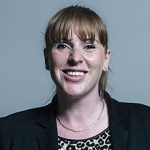
The evidence given by Anne-Marie Trevelyan, the then Secretary of State for International Trade, and Crawford Falconer, the Second Permanent Secretary at the Department for International Trade, on 6 July 2022.
Members present:
Angus Brendan MacNeil (Chair); Mark Garnier; Paul Girvan; Sir Mark Hendrick; Tony Lloyd; Lloyd Russell-Moyle; Mick Whitley.
Questions 251 – 345
Witnesses:
Rt Hon Anne-Marie Trevelyan MP, Secretary of State for International Trade; and Crawford Falconer, Second Permanent Secretary and Chief Trade Negotiation Adviser at the Department for International Trade.
Examination of witnesses:
Witnesses: Rt Hon Anne-Marie Trevelyan MP and Crawford Falconer.
Q251 Chair: Welcome to this International Trade Committee evidence session on the “UK trade negotiations: agreement with Australia” inquiry. The Secretary of State for International Trade is giving evidence again—we saw you this morning. Thank you for coming to this final session. We have had words about this in the New Zealand session, so maybe we will skip over that. I just want to ask you a number of things about this. Following our report last week and what has happened, and the subsequent correspondence, can you tell us whether the Government will consider extending the CRaG period to allow the House meaningful time to consider the report?
Anne-Marie Trevelyan: We will not be extending the CRaG period for this year, I am afraid. We want to crack on. We have followed the framework. I apologise for not having been able to read your report last night—circumstances overtook me. I look forward to doing so, and I will be reading it this evening and working with the team to give you a full and thorough response to it as quickly as we can. I have had a chance to have a quick look through some of the suggestions, and it looks like you have indeed pulled out some interesting and important questions: it being the first from scratch, there was a really important review to do. Thank you for what looks to me to be a very thorough review, testing some of those broader issues around trade deals, which we are very keen to accept.
Chair: We accept flattery at any time.
Anne-Marie Trevelyan: No, it is just an honest assessment.
Q252 Chair: So you have said no to my first question. Will the Government then table a substantive motion on the agreement for consideration and debate between 13 and 19 July, so that the House can decide to delay ratification for the same purpose?
Anne-Marie Trevelyan: I know that we have exchanged letters on this already. We have been clear that we will seek a scheduled debate and continue to discuss that with business managers, obviously subject to available parliamentary time, and I hope that we will be able to have a general debate on that. We will continue to press the business managers, as I am sure that you and your Clerks will do too.
Q253 Chair: That is somewhat unclear. Given that CRaG is due to expire in two weeks, when will you be clear and when will you be able to say?
Anne-Marie Trevelyan: As I say, Chair, I am afraid that it is not within my gift to set a date, but we continue to ask business managers if available Government time can be found for that.
Q254 Chair: You see the kind of difficulty that we have as a Committee.
Anne-Marie Trevelyan: I do, but sadly I am not all-powerful in matters of parliamentary time.
Q255 Chair: Should you not be cracking the whip at the Whips inside Government? It is really the tail wagging the dog here—wagging a number of dogs.
Anne-Marie Trevelyan: As I said, we continue, and we have set it out— you have raised it and we continue to raise it—with the business managers that we think it would be a good general debate to have and many colleagues would be interested in discussing what is a really interesting new part of Government policy and a new FTA. We continue to press, and we can work together. We can do it in a number of ways. We continue to do so, but we are always at the mercy of the available Government parliamentary time set by those other than departmental authorities.
Q256 Chair: Would it help scrutiny of this agreement if the Chamber of the House of Commons were to decide to delay CRaG, given that the Australians would not have ratified it by the first or the second date anyway?
Anne-Marie Trevelyan: The Australians are progressing. I had the pleasure of meeting my new counterpart, Don Farrell, in Geneva just a couple of weeks ago and was pleased to hear that they were very keen to crack on; they had no desire to reopen any parts of it; they were very comfortable with the treaty as it stands; and they would kick off with their parliamentary process—
Q257 Chair: When do you expect Australia to ratify?
Anne-Marie Trevelyan: He was unable to be fully precise but they hope to ratify through the course of the autumn. I think they will be ahead of us in that process. Obviously, we have to bring in the enabling legislation, and while we presented the Bill on 11 May, it is quite a small piece of legislation, as you know, but we need to push that all the way through the process, so that will be completed, with Royal Assent, probably after they have approved theirs. I hope that we will land as quickly as possible.
Q258 Chair: It will probably be about 22 November that they would conclude. Why is this rush going on in the UK to do this without proper scrutiny? What is driving you? Are you driving the Whips or are the Whips telling you that scrutiny doesn’t matter, just get it through the sausage factory of Parliament and that’s it?
Anne-Marie Trevelyan: No, quite the opposite.
Chair: So you are telling the Whips to get it through the sausage factory of Parliament.
Anne-Marie Trevelyan: No, I think that scrutiny is very thorough and intense. As I say, we have asked if they can find available parliamentary time for a debate, and we will continue to do so, but, sadly, I am not in charge of what is no doubt quite a complex juggling act. Not having been in the Whips Office, I have not experienced it personally, but it is an issue. We continue to do that and we hope that they will hear our request.
Q259 Chair: Secretary of State, this is all being done against the background of Brexit. Page 124 of our report sets out how this agreement will bring about a 0.08% increase in GDP. That has changed. It is a fourfold increase on your first estimate of 0.02% increase in GDP. That is against a 5% loss as a result of Brexit. I put this to you, Secretary of State. If you went to the Stock Exchange, the bookies or horse racing, or whatever you do with £500, and you came back with £8 or £2, which is equivalent to the 5% loss resulting from Brexit, would you think that a good day?
Anne-Marie Trevelyan: Fortunately, our amazing British exporters are not gambling when they look to find new export markets; they are looking to grow—
Q260 Chair: But they need the frameworks that you have replaced, and the frameworks that are in place mean that they have had a 5% hit and we know that trade with the European Union is down. So if you are given £500 and come back with £8 or £2—
Anne-Marie Trevelyan: I am afraid that isn’t true. Exports to the EU are up—
Chair: The trade gap is there.
Anne-Marie Trevelyan:—and continuing to go up, and we are seeing real growth—
Q261 Chair: Since when?
Anne-Marie Trevelyan: Since before covid, and we are seeing real growth again, which is exciting, and as I mentioned earlier today, in the export support service that we provide we have seen both a drop in some of the practical problems that we saw at the turnover point, and also—
Q262 Chair: We are going down a rabbit hole, Secretary of State. The reason I ask this question is that the Government are selling these trade deals as being something wonderful and there is bluster going out to the public about these trade deals, and about this first trade deal, because you do not have anything yet. You have committed yourselves in Brexit to losing 5% of GDP. You are coming back with the original figure of 0.02% of GDP and now you have 0.08%. This is equivalent to throwing away £500 and coming back with £8 or £2 and saying that you have had a good day. Does that strike you as being a good day?
Anne-Marie Trevelyan: As I say, Chair, the question of EU trade continues to grow again, which is really good news. These FTAs are opening up new markets, making it easier for our businesses either to export more in those markets or to discover new markets. That is one of the charges that the DIT is given.
Q263 Chair: People watching this will be amazed that the simple sum of losing 5% and gaining 0.08% does not strike you as a problem. Does this not strike you—
Anne-Marie Trevelyan: If you would be kind enough to let me complete the sentence, the EU trade continues, and is continuing, to grow now that we are past covid, and that is great news.
Chair: So there is GDP growth from Brexit.
Anne-Marie Trevelyan: However, when we look at the FTA programme that we are now able to roll out, as part of our freedom now that we have left the European Union, the Australia deal was our first and New Zealand the second, and we will be continuing to add to that. CPTPP will be, we hope, one that we will accede to this year where we open up enormous new markets where we see the growth for the years and decades ahead. We are building, and we have the opportunity with the freedom to own our own trade policy, to set in train vast new markets, stripping away market access barriers and tariffs, so that our UK exporters can find new economic opportunities so that we can see that growth in GDP across the board. Australia and New Zealand are just the first two in what will be a broad set of new tools to help businesses trade more easily across the world.
We will continue to have, as our EU neighbours—our European neighbours—the opportunity to trade there, and we have, under the TCA, a framework under which businesses can continue to do that. As the opportunities and the growth in young people and in middle-class consumers across the rest of the world continues, I want to make sure that our UK businesses have as easy an access as possible to those markets so that we can extend our opportunities, and not only to our European neighbours but to the rest of the world too. That is what the FTAs are for, and Australia and the New Zealand are just the first two of what will be, we hope in relatively short order, a really broad range of access to those markets that we have not reached into before.
Q264 Chair: I have heard a lot of words there, and heaven forfend that I use the phrase “Enid Blyton prose”, but let us go back to the numbers, Secretary of State. If you lose—and we accept the figures, as I think we must, given that these are Government figures—5% of GDP, and we equate that going to the Stock Exchange or wagering £500 and you come back holding 0.08% of GDP or £8, is it a good or a bad day for the UK that you have done that? This is what Brexit is equivalent to. When we strip away the words and we strip away the prose, you are losing £500, and for every £500 you lose for the UK you are coming back with £8 of this trade deal, at best, and maybe £2 at your other estimation. Is this good process or is there a better way of this being done?
Anne-Marie Trevelyan: With these new trade deals that we are negotiating, we are opening up new markets. Australia is the first and New Zealand is the second, and there will be many more to come. These will be creating new opportunities to add to UK export growth and that is really exciting, and we will be there—
Chair: Do they add up to 5% of GDP?
Anne-Marie Trevelyan: The DIT will be there to support businesses in a number of ways as they look to expand into those new markets. The relationship with our European partners continues to be robust and solid. As I said, the export figures post covid are back beyond those, and that is really good news as markets start to stabilise. The reality is, however, that the economic growth opportunities for the long term do not sit with our European partners, where we see that growth in—
Q265 Chair: Will you match 5% in GDP with all the trade deals that you can possibly imagine?
Anne-Marie Trevelyan: No, I hope that it will be more than that in the medium to long term, of course—
Chair: It can’t possibly be.
Anne-Marie Trevelyan:—because there are whole new markets to come. That is exactly why, in having this trade policy, we are working at pace to ensure that we free up those market access barriers—
Q266 Chair: America is a quarter of the world’s GDP. What is your GDP gain from a trade deal with America?
Anne-Marie Trevelyan: We do not have the details of it—
Q267 Chair: It is 0.02%.
Anne-Marie Trevelyan: When we come, we hope, to pick up and continue the negotiations that we started a number of years ago, we look forward to looking at what that offers, but the important thing is that those will all be tools to help businesses to export, more easily, fantastic British goods and services. That is DIT’s role, and the opportunity that we now have with the freedom of our own trade policy, to build that. What we will then be doing, of course, is supporting businesses to find and discover new export markets, to work in those growing markets in the Indo-Pacific, across Africa and growing mature markets like the one we have with America, to make sure that our exporters can reach everywhere where they want to export, with as few market access barriers as possible.
Q268 Chair: If the DIT crunches the numbers and knows the numbers, can you come back to me? It appears that even if you got trade deals with every country in the world, you will not make up for the Brexit damage, and that is a matter of fact.
Before I bring in Sir Mark, I have one other question, Secretary of State. You might think that Brexit is a done deal, and it may well be, but if it is not, where will this deal leave the Australians if the UK were to re-join the European Union? Has Australia been notified about that, or has that been any part of a warning, perhaps, given to Australia?
Anne-Marie Trevelyan: No.
Chair: No. Okay, thank you.
Q269 Sir Mark Hendrick: Two very quick points. First of all, yes, I think that, no doubt about it, exports to the EU are up, but a lot of it is liquefied natural gas. I am looking at an article here that says, “The UK energy system is drowning in natural gas. There is so much of the stuff in this country that for the time being at least, no one is quite sure what to do with it.” We know what is happening. The Germans are moving away, obviously, from energy supplies from Russia and it is being topped up by the rest of Europe. It is a very unusual situation, given Brexit, that there is actually that increase there. This accounts for £0.5 billion of it, just in the months to April.
The second point goes back to CRaG, and I wanted to intervene earlier before we moved on to exports. As someone who has served in the Whips Office, I know that there would be a good reason why you couldn’t move that date. Secretary of State, what reason have you been given as to why they cannot move the date so that we can get more time for scrutiny and the CRaG can be extended?
Anne-Marie Trevelyan: We have set the process in motion, and that is the choice that we have made, but in terms of having the opportunity for debate we will continue to see whether we can afford that.
Q270 Sir Mark Hendrick: But, you see, it is a meaningless debate, because nothing can be done. It is just discussion.
Anne-Marie Trevelyan: I hope that the debate would, as all our debates do, afford the opportunity to those who have particular constituency interests, or indeed sectoral interests, to discuss and share on the Floor of the House exactly what those are.
As we move through—obviously, we will have the enabling legislation on the procurement side, which will come through, I imagine, in September and October—we will have the opportunity to look into that in detail. We will be having opportunities to look at the issues around the Australian FTA in particular, but also, on the point that you have demonstrated, there is a really effective Committee. This is the first one, so the importance of thinking across the piece about what we have in it and the breadth of areas of co-operation that we are bringing together set the marker for the rest of the world to understand what doing an FTA with the UK means.
Q271 Sir Mark Hendrick: You understand as well that it sets a precedent for you to be able to do this again in the future because you have already made it such that you cannot do this the way that it should be done.
Anne-Marie Trevelyan: We have set this out, and there has been plenty of time with those various steps all the way through, and we continue to do that. We will look forward to getting back to you on your report, for which I thank you. We are, as with all these things, working to progress—
Q272 Sir Mark Hendrick: What reason have the Whips Office given you for not being able to extend the CRaG?
Anne-Marie Trevelyan: We have had discussions with them about the opportunities for debate. Having been in the Whips Office, Sir Mark, you will perhaps know that the outward-facing messaging does not come very often; it is very much a question for Departments. We continue to press for what we hope will be a useful debate.
Q273 Tony Lloyd: The agreement in principle noted that “neither side will seek additional access or faster tariff reduction through the UK’s accession to the CPTPP.” Why does the commitment not feature on the face of the agreement?
Anne-Marie Trevelyan: This is a question to which I do not have an answer.
Chair: We are hoping that you do, Crawford.
Crawford Falconer: In theory, it could have, but in actual fact it seemed a bit of a heavy way in which to have what is effectively a bilateral understanding about something else. It is a category thing. It would not have been stronger if it had been in the agreement. It is not an enduring feature of the agreement. It is a bilateral understanding between Australia and New Zealand that, in respect of another agreement, this is how we will behave. It seemed more appropriate that it belonged in a technically different environment.
Q274 Tony Lloyd: The agreement in principle looks particularly at additional access or fast tariff reduction. Are there any other areas where Australia could seek further concessions under the UK’s plans to accede to the CPTPP?
Anne-Marie Trevelyan: No, because that is the way that we negotiated. Is that right?
Crawford Falconer: It is very clear, not on goods and tariffs, but there are other things in CPTPP, like services market access, where, in fact, that would be an option, if the Australians wanted to try for that—and not only them; the New Zealanders as well, in theory. Theoretically, it could happen on services, but given that we have a pretty good balance on services, I would not expect it would be very significant.
Q275 Tony Lloyd: You did not think it was necessary to have that placed in the agreement in principle for services.
Crawford Falconer: No. The one that was most important to us and was a priority, and was worth paying for in the balance of the negotiation, was on goods. On services, the Australians might have services, but we are the services exporter par excellence. That is not to say that the Australians do not have services interests, but our view was that, on that, we can manage it, whereas on the goods there was no room for ambiguity because it was the most sensitive issue for us.
Tony Lloyd: Thank you.
Q276 Chair: Just picking up Tony Lloyd’s point and not getting things in the agreement that you might have wanted, you say it was not important enough. You said this morning that New Zealand was determined and dug in, and then we find out that it rolled over for the European Union on the same issue.
On trade deals, you talk about winners and losers, and we know that there are losers in the United Kingdom, particularly in the agricultural sector; they have been vociferous about that. With that in mind, I wrote to the High Commissioner of Australia on 5 April to help us to find some of the losers in Australia and received a response on 8 April from the then High Commissioner, George Brandis, telling us, “I am not aware of significant opposition to the UK-Australia free trade agreement within Australia.” We couldn’t get anywhere on the search for losers in Australia. Is it concerning, as Tony has mentioned, that the UK has perhaps been signing free trade agreements in haste, with an eye to CPTPP, and losing areas against New Zealand and Australia due to that haste? Does that give you pause for concern at all, Secretary of State?
Anne-Marie Trevelyan: No. I disagree with the premise, I am afraid, Chair. The frameworks around our agriculture are good. There are huge opportunities for export in a number of areas, but also, as Crawford said, in those most sensitive areas where we know that we wanted to provide protections, we have this triple-lock safeguard system which provides assurance and time—
Q277 Chair: You are saying that there are no known losers in the UK.
Anne-Marie Trevelyan: I do not disagree that there has been some anxiety and, as someone with a rural constituency, I have spent a long time talking to—
Q278 Chair: It is only anxiety; it is not a loss.
Anne-Marie Trevelyan: I genuinely believe that the safeguards that we have built in, which are extremely robust and can kick in should there be any kind of surge while the issues are resolved, are going to provide protection, should there be—
Q279 Chair: Can you think of any sectors in the UK that wish you had not signed this trade agreement?
Anne-Marie Trevelyan: None that have shared that thought with me.
Chair: Okay, excellent; thank you for that answer.
Q280 Mick Whitley: The agreement in principle referred to “best endeavours” commitments by Australia to tighten up its definition of whisky; and by the UK to implementing Australian proposals on technical barriers regarding wine imports, but these aren’t in the final agreement. Why is that, and what will you do to address these issues?
Crawford Falconer: Again, this is another one of those categories. On the whisky one with Australia, we reached the conclusion that they were going to change their system anyway and they were resistant to putting it in at this stage. We figure that it is something that we will actually obtain afterwards anyway, once they have their legislative changes in place, and it was not worth squandering our negotiating capital on something that was most likely to happen anyway. Therefore, in reciprocity, we did not give them something that they wanted, on the wine. So we have a balance there, which is one of those things that didn’t quite get to an agreement. It happens sometimes in a negotiation, and that was it.
Anne-Marie Trevelyan: That is a really interesting point. In every bilateral agreement—and we obviously now have a number running in different parts of the world—it is about the relationship and where you can land at this point in time with your bilateral partner. They will never all look the same, by definition. They will never all be as big or as small in different chapters because they are with the particular country with the political and legislative point that it is at, at the time. That is why I talk about the flexibility that we want in our trade policy. There is a really important framework that says we will set it out, and we are given a mandate from across Whitehall with the breadth of what we would like to achieve, knowing that the likelihood of achieving all of it is probably not realistic because we are going to be working with a bilateral partner for whom their own limitations or areas of sensitivity will require them to focus in on that.
A really important lesson that we all have to continue to think about is why we build in those next stages. A really good starting point is the FTA as it stands. We build in the Joint Committees and the dialogues. In those areas there will no doubt be glitches on the way through and issues that need resolving, but also as each country develops its own economy there is the opportunity to grow those roots. It is really important to remember that each one is genuinely bilateral, and that means that it will be where both countries can comfortably land at the point that we sign them.
Chair: It is a great privilege and pleasure to ask Mr Mark Garnier to take the stage.
Q281 Mark Garnier: I turn to food production standards. The original Trade and Agricultural Commission and Henry Dimbleby’s national food strategy review had a look at agrifood standards and proposed that tariffs should only be liberalised for imports that meet UK standards. But in this Australian trade agreement that is not the case, and it is not the case in the Government’s new food strategy. Why is that the case? Why have you ignored or not taken the advice of Henry Dimbleby and the original TAC?
Anne-Marie Trevelyan: We have been very clear that foods cannot be imported that do not meet our safety standards, so you have to meet the safety standards. That is very clear and unambiguous. Hormone-injected beef cannot be sold in the UK.
Q282 Mark Garnier: That is the run-of-the-mill sanitary and phytosanitary agreement run by DEFRA, but this is a slightly different thing.
Anne-Marie Trevelyan: In that overarching picture, the challenge is that we do not want to be importing foods that do not meet our standards. They will not, because foods must meet our food safety standards. That is very clear, and everyone is entirely unconfused by that. It is really important to bear in mind that it is not only Crawford and his team doing the negotiations. We also have experts from every part of the Government, including a number from DEFRA, the Food Standards Agency, and the veterinary and medicines groups, who are there to help us to ensure that what we are setting out in the complexity of the trade deal is very clear on that. I genuinely do not think that we are in a different place. I think the language sometimes suggests otherwise.
Q283 Mark Garnier: In that case, just for clarity, because this is an important point and a lot of people do not necessarily understand the relationship between our SPS regulations and our trade deals, what you are essentially saying is that it does not matter, on this particular point, that you do not specify what the standards are because everything is overridden by the SPS standards, which can update at any given time anyway.
Anne-Marie Trevelyan: Yes, we may indeed change ours at a domestic level. That is always a possibility. What we embed in the FTA is that our food safety standards are the ones that importers would have to meet.
Q284 Mark Garnier: Whatever those standards are.
Anne-Marie Trevelyan: Whatever those standards are. Crawford, do you want to expand on that?
Crawford Falconer: The only thing I would add is to draw attention to the fact that that is the one message that comes through very clearly from the independent Trade and Agriculture Commission in its report, which makes it very clear that there is nothing in the agreement that in any way undermines the capacity of the UK regulators—the food safety experts if it is the food safety experts, the vets if it is the vets, or anybody else who regulates—to do so, provided that we abide by our international obligations, which we take as read.
Q285 Mark Garnier: Moving on from that, the food and farming group Sustain says that UK farmers have voluntarily halved their use of antibiotics in the past five years, but that this progress could be undermined by liberalising imports produced to lower standards, forcing UK producers “to return to more intensive systems.” We were talking about this, I think, with Professor Bartels before, but it is this concept that if you have different environmental requirements on pesticides, for example, that is an environmental thing rather than a food standards thing. You could then have a different level. The idea is that they can produce more cheaply in New Zealand or Australia by having different standards set by environmental measures rather than food standards measures, and they then undercut UK producers. The implication from Sustain is that UK producers would then have to lower their voluntary standards in order to compete against imports from Australia or New Zealand or, in this particular case, Australia.
Anne-Marie Trevelyan: This is a really important area, and one that is always worthy of discussion. Every trade relationship that we have within an FTA or otherwise is our exporters choosing to sell to another country and, within the limits that we have set very clearly of our food safety standards, imports coming in. We have made very clear statements with Australia about best endeavours to continue to improve those environmental standards. Also—this is really important—have you been to Australia, Mark? Have you eaten their meat, and was it delicious?
Mark Garnier: Yes.
Anne-Marie Trevelyan: Precisely. You didn’t worry that, because—
Mark Garnier: New Zealand food is very good too.
Anne-Marie Trevelyan: I am just trying to be nice to you now. Did you, for a moment, consider that their standards were so poor that you would not choose to eat there? The challenge is that, while the environmental standards might be different, because the environment is different and they use different pesticides because they have different pests, the way they farm is not the way we farm in the UK. The argument is valid. We farm in small farms because of our land, so the marginal costs are different. There is a perfectly fair discussion about the size of farms and how business models look different, but the important thing is to ensure that what we have sold to our consumers, from our shelves, is good and fit for them to eat. The food and safety standards ensure that.
Q286 Mark Garnier: Anne-Marie, you have brilliantly avoided the question—
Anne-Marie Trevelyan: I didn’t mean to. I am so sorry.
Mark Garnier: So I am going to come back to the point. Let us use a neutral example. Let us talk about this wretched chlorinated chicken, where Kentucky Fried Chicken, if we do a free trade deal with America, might possibly actually come from Kentucky. The point there is that, in America, they have more intensive chicken-rearing methods than is acceptable in the UK because of our animal welfare standards. The result is that they chlorine-wash their chickens before they sell them. We find that offensive, for two different reasons. One is the animal welfare standards and the other is that we just do not want the chlorine, despite the fact that we wash ourselves with chlorine every time we go for a swim.
The important point is that, were we to reduce those standards, then chicken producers in the UK would be undermined because they would not be able to meet those economic standards, which we abide by. This is the point with this question. There are methods of farming in Australia, because of different factors—huge farms, less productivity per headcount and all the rest of it—which mean that, for one reason or another, they adopt certain standards of welfare that we would not have here.
But, on top of that, because of consumer pressure in the UK—because of the Waitrose brigade almost—our farmers have voluntarily increased their standards. You have a double-edged problem. One is a commercial challenge between our producers and their producers because of this, notwithstanding the food miles, and the other is what we as a society have driven through—Waitrose and other supermarkets chains with a conscience are also available—higher voluntary standards. That is the point. Are we now putting our voluntarily good, high-standard producers in jeopardy because of an economic imbalance in this trade deal?
Anne-Marie Trevelyan: I do not believe that we are, and we discussed this earlier. Some 81% of beef bought by your constituents and mine is British produced, and the consumer will have the choice, as they have now, and they tend to choose British beef. That is fantastic. They also buy other meat that is put on the shelf that already comes in through import methods. They all have to meet British food safety standards because the assurance that we as a Government provide is to ensure that they are healthy.
On your point about chlorinated chicken, it is different if you swim in the pool or you ingest the chlorine. It is two different things. Our standards say no ingestion of chlorine, and that will continue to be the case. If, in due course, a US chicken producer wished to export to the UK, they would need to produce chicken that was not chlorinated.
There are a whole series of things there, but the issue about how we choose to do our own standards is one for the UK, and we do that because we know that that makes our products the best in the world. That is why, as we create more, new export opportunities for our amazing British products, we will know that they will be wanted by those who want to have those higher-standard, fantastic products.
Mark Garnier: We could go on about this for hours. The Chair is channelling his inner John Bercow and trying to get short questions and short answers.
Anne-Marie Trevelyan: Very politely, if I may say so.
Chair: Yes, and the antibiotic resistance. Lloyd Russell-Moyle, you wanted to come in on this.
Q287 Lloyd Russell-Moyle: I wanted to challenge your response, which I found slightly offensive, about, “Have you been to Australia and eaten their food?” It is a response that does not enhance the debate. I have been to Uganda and eaten their food and not got ill. Would I want Ugandan standards? That is a discussion about standards; that is not a discussion about going on holiday somewhere and eating their food. Those kinds of answers do not help us move the debate on.
The second part of your answer was much better, so I did want to come in on that. Let us have the debate on some standards and how we import them into the UK. Sometimes, and what I wonder about this arrangement, is how the consumer can be—
Chair: I am flagging this because it seemed to be only a statement. Now it has moved to a question.
Lloyd Russell-Moyle: Sorry.
Anne-Marie Trevelyan: There is always a question at the end.
Lloyd Russell-Moyle: How can the consumer be reassured that products in produced goods—I do not mean if you are buying meat; that is very easy—pies, restaurants and so on, meet those high standards? You say the consumer will have choice. How do we ensure that the consumer has choice in restaurants and in produced goods?
Anne-Marie Trevelyan: No restaurant can legally use produce that has not met its safety standards. Our food standards authorities visit and check restaurant suppliers just as much as the supermarkets are required to do the same.
Chair: Thank you. Tony Lloyd, do you want to come in very briefly?
Q288 Tony Lloyd: Yes, please. Were we, for example, to move from voluntary use of antibiotics to compulsion, which is quite a reasonable demand given the concerns about the overuse of antibiotics on a global basis, how would you protect the consumer? You are saying the consumer has choice. How will you protect the consumer under this FTA against the importation of antibiotic-laden Australian meat?
Anne-Marie Trevelyan: The answer would be that if we changed to a legal framework and it is set for food safety standard reasons, which it would be, that would be the reason for doing it.
Tony Lloyd: We would be entitled to under the FTA.
Anne-Marie Trevelyan: That is the point. We would be altering our existing food safety standards in favour of different ones for food safety reasons, which are that we do not consider that ingesting that much antibiotic is good for us any more, and therefore changing that also. Those who wish to import would have to match our food safety requirements. Crawford, you might want to pick up on that one, in particular.
Crawford Falconer: That is absolutely correct. Again, I refer you back to the Trade and Agriculture Commission. It is really important to get this clear. If anything comes into us that has something in it that is contrary to our standards, then we are entirely free to regulate it and we are entitled to. There is nothing that can detract from that.
Q289 Tony Lloyd: We must have mechanics by which you can regulate it, Mr Falconer. It is not enough to say we are entirely free to do it, because clearly we are under the agreement. However, there have to be mechanics by which that freedom becomes operable.
Crawford Falconer: That is correct. Those mechanisms exist in the UK; they are not part of our free trade agreement, per se. The free trade agreement makes allowance for them to operate. They are operated by our experts, which is our food safety authorities and our veterinary scientists, who apply that. There is a domestic regime that enforces the regime from domestic production as well as from foreign suppliers.
Q290 Tony Lloyd: You are confident that it would.
Crawford Falconer: I am certainly confident of it because that is the basis upon which I shop myself. I have that confidence the same as any British consumer, but it is not a trade agreement that affects that. The trade agreement cannot get in the way of that; it cannot override that. I am confident that this agreement does not do that.
Chair: Paul Girvan, do you want to come in quickly?
Q291 Paul Girvan: It is on the back of exactly what Tony has just said. Trade agreements should be used as a tool to drive up standards, to ensure that our product, the product that we have, meets that standard and that we become probably a world leader in setting those standards as opposed to what is going on. I know that in Northern Ireland we have a very strong agrifood industry; it is a major part of our economy. In doing so, it is vitally important that we do sell our product with the quality that we have.
I will use the chicken industry. We have a major chicken producer that processes as well. Previously, chicken farmers were having to feed antibiotics. I mean that it was part of the feeding regime; it was added to the feed and chickens were fed it. As a consequence, we were consuming it. Whether or not you believe that that is going on, I believe it is going on throughout the world, but we made a conscious decision, “No antibiotics,” and changing our whole practice about density—all that process.
How can we have confidence in Australia, which will have food produced to one standard for export on to the Chinese market, one of their big markets, and that food making its way to our market? It has happened where pallets have been processed and shipped halfway around the world. I cannot work out this carbon footprint issue that we had earlier; it just does not make any sense, but that is beside the point.
It is frozen, put on to a refrigerated ship container and taken across the world, and a pallet of food that has made its way on to our market can well have been treated with all the antibiotics of the day. It might well meet our food safety standard, because you are not going to end up getting E. coli or whatever else from it, but potentially you are consuming drugs that we do not license. We have reduced the licensed numbers of antibiotics that can be administered; other countries have not reduced the numbers. There is now total resistance to various antibiotics because they have been so widely used.
How can we have confidence that our trade deal with Australia is going to protect our industry to the degree that the standard that we are setting becomes a world standard? I want to increase the standards.
Chair: And not cause pressures to push up the use of antibiotics.
Paul Girvan: Absolutely.
Anne-Marie Trevelyan: I would suggest that you would want to get the Food Standards Agency experts in and ask them.
Chair: You are the one who signed the trade agreement with a country that was—
Anne-Marie Trevelyan: Let us be clear: we have signed the agreement and we set out very clearly where the food safety standards are. We are, as we are now, as Crawford says, for the food that we—
Q292 Chair: The root of the question here is this: are we creating a situation that puts pressures on UK farmers to use more antibiotics? Do you think you are?
Anne-Marie Trevelyan: No, I do not believe so.
Chair: Okay.
Anne-Marie Trevelyan: Our farmers work to our UK standards and they are proud to do so. As Paul says, we want to continue to be world leaders and to help drive the change that provides sustainability.
Chair: There are plenty of fact-checkers around to check the veracity of the answer. I am sorry, but I am going to have to move on to Mick Whitley, who has been waiting as patiently as ever.
Q293 Mick Whitley: Agrifood stakeholders have suggested that this agreement will reduce UK food security by undermining domestic production and replacing imports from nearby countries with products from over 9,000 miles away. How do you respond to that?
Anne-Marie Trevelyan: I do not believe that it will. I also believe that consumers should have choice, as they do now. As you say, imports come from many countries. For instance, let us take beef. The vast proportion of the beef imported into the UK at the moment comes from Ireland. To your point that Australian beef might displace Irish beef, that is of course a possibility.
The UK consumer is very clear on what they want to buy and they do so. We like to ensure that we can provide them with choice. In taking away things like tariffs, we ensure that that brings the cost down as best we can to assist with what we see now in the cost of living crisis.
Importantly, we set the framework to ensure that there cannot be, from a producer’s perspective, the risk of a surge in an import for any particular reason. We have the safeguards in place so that there could not be an attack that would cause real harm to a particular sector in a short-term process. We have protected for that.
More importantly, we continue to want to have around the FTA a great relationship formulated around reducing tariffs and barriers with a country with whom we want to build that bilateral trade relationship. Do not forget that we import all the time now from countries with which we may or may not have trade relationships.
To your earlier point, the provision of protections that are available for our citizens, for yours and my constituents when they go to do their shopping, is that the Food Standards Agency, the customs people, do the checks that are set out to ensure that those things meet our standards. To protect any particular sector from any sudden surge in imports that might appear, we have built in a very robust set of safeguards to avoid that happening.
Q294 Mick Whitley: How far will the cuts in food and drink tariffs from the agreement help to offset the cost of living crisis?
Anne-Marie Trevelyan: That is a really good question. The reduction in tariffs is one of those key areas that can help do that. In the Australia case, it stripped away tariffs of about 5% on nearly everything. That will be a small contribution to the cost of living challenge for those imports coming now from Australia. The examples usually made to me are ones of wine, presumably for people who have quite a heavy shopping basket with bottles of wine. They are happy and excited at the prospect of buying slightly cheaper Australian wine.
Q295 Mick Whitley: I accept the point, but fuel costs are going up and up with the cost of living. Obviously, that is going to make that product more expensive, is it not?
Anne-Marie Trevelyan: Overall, the assessments are that transport costs, clearly on an individual basis, are relatively there. We have seen through covid, where all the shipping supply lines became so disrupted, that the costs of shipping have increased. That would, therefore, presumably increase the cost of the goods. It will be down to the consumer to make their decision on what they want to buy when they are in the shops. I always buy my meat from my butcher around the corner. That is the choice I make. Others who go to a supermarket might want a different choice.
Mick Whitley: And can afford it.
Anne-Marie Trevelyan: For those who enjoy restaurant food, which, from a wholesale market, you might buy from different areas, those will continue to be consumer choices. The impacts of the fuel costs at the moment are being fed across the board, absolutely; I do not disagree with you.
Q296 Mick Whitley: We spoke about this a couple of months ago when you were last here. The price of containers has gone up tenfold.
Anne-Marie Trevelyan: Absolutely—tenfold. It is terrifying.
Mick Whitley: You have fuel and you have the price of containers. That is going to make that product much more expensive.
Chair: Without a doubt.
Anne-Marie Trevelyan: That will be a cost borne by the Australian exporter.
Mick Whitley: Thank you, Chair.
Q297 Chair: Before I move to Tony Lloyd, Secretary of State, you said the Australian trade agreement would offset the cost of living a little bit and might be offset elsewhere. If it offsets the cost of living and it is a couple of hundred times less than Brexit in GDP, the damage caused by Brexit must be harming the cost of living. By the logic you have just employed to say that the Australia trade agreement will help the cost of living, Brexit is surely damaging people’s cost of living.
Anne-Marie Trevelyan: If you look at our basket of spending, there are costs that are putting us all under pressure. To Mick’s point, fuel is a very, very important one.
Q298 Chair: Can I stick with your logic? We can go through several places. If an Australian trade agreement, as you have told us, will help the cost of living because it is helping GDP by between 0.2% and 0.08%, if something is damaging the cost of living between 250 and 67 times more, will that not also be damaging to the cost of living? If the logic says this little bit of help is good for the cost of living, then that lot of damage from Brexit surely has to be damaging to the cost of living and detrimental.
Anne-Marie Trevelyan: Chair, we are looking at the Australia deal. In looking at that, and we challenge ourselves how it can help in the cost-of-living crisis—
Chair: You are the Secretary for International Trade.
Anne-Marie Trevelyan: —the reason why—
Chair: I would expect you to be across the brief on this.
Anne-Marie Trevelyan: The reason why Australia will help is, because in the reduction and stripping away of tariffs, those goods that we import now or might choose to import that we do not at the moment, and indeed those exports, are tariff-free. Therefore, those costs have come down. We have a tariff-free environment with our European neighbours through the TCA. In that sense, there is no change to that situation in the goods that our constituents will buy.
Q299 Chair: Although its leaders will be amazed that as Secretary of State for International Trade, you do not think there is a change in the trading regime.
Anne-Marie Trevelyan: There is no tariff. The differential we are talking about is around what the FTA does. It strips away some of the cost that would have been tariff. The wider questions about transport costs and others, which are affecting every part of the import and export trade groups, are ones that we are all trying to work to solve at a macro level.
Chair: Thank you.
Q300 Tony Lloyd: The Committee has been told that, because you have negotiated relatively low local origin thresholds in the agreement, this risks Australia becoming, in effect, a route through which others can circumvent UK tariffs. How will you monitor this?
Anne-Marie Trevelyan: That is a very technical question.
Crawford Falconer: The best way to describe this is that everybody has rules of origin, apart from agriculture, on which we have followed this model. It is basically wholly produced, so therefore the rule of origin is UK or Australian wholly produced. It is not an issue for agriculture, by and large, because you do not have to worry about what the rest of the componentry is; it has to be 100%. That is very unusual in international trade. People do not make things in one country and sell them whole in another. International trade is now such that everybody uses inputs from everywhere. So you cannot have 100% rule of origin across the board, because otherwise nobody would trade according to normal patterns. You would be back to the 1940s.
Everybody has a rule of origin. With that rule of origin, you pitch it at a level that you determine—and there is no abstract rule—makes the most sense for your industry to make sure they get the value-added component of the product, which will always be a percentage, in order to get the preference.
We are a manufacturing superpower still; Australia is not. The balance of manufacturing on rules of origin and having a relatively low rule of origin is massively in the United Kingdom’s favour.
Q301 Tony Lloyd: The problem with this, Mr Falconer, is precisely what you said: Australia is not a major manufacturer, but if Australia becomes a route through which a third party chooses to use the local origin thresholds, then they can avoid the bilateral tax by routeing through Australia. That has to be a consideration, and if it is a consideration, how do we monitor it? If it becomes excessive, what is the remedy? You have not really told us anything about that.
Crawford Falconer: Every country has this across the board. In your report there are concrete examples of a hypothetical situation, which I think is, “The Chinese might set up a factory in Australia and they might put parts of their shoes into Australia. The Australians will assemble these shoes and export them to the United Kingdom. In that way, they would have a proportion of Chinese content.”
For a start, there is a risk of that with everybody; you just carry that risk. It is not excessive. Frankly, China has no trouble trading over our MFN tariff for shoes. It would be an extraordinarily exaggerated situation to imagine that China would go to the trouble of setting up a manufacturing facility in Australia to get over a relatively low MFN tariff in the UK for its shoes. As always, I cannot rule out the theoretical possibility of it, but it is extremely unlikely. The Chinese would be perfectly happy to sell them as they are now over the MFN tariff into the UK.
It is not getting around your question. It is saying that you have to look at it in context. In context, it is very unlikely that that is the case given that, for instance, we are selling mostly into Australia’s manufactured goods and they are not selling them to us. They are not likely to sell them in significant amounts. As in everything, it is a balance. You accept that there is always going to be some third country content in the process. The other trading partner has to accept the same, and that is just the price you pay.
There is not a remedy for that except that, if it becomes intolerable, you have an unbalanced negotiation, but I do not think that is likely to be the case with Australia.
Q302 Tony Lloyd: There are no mechanics for monitoring and no mechanics in the agreement for remedy other than to abrogate the agreement.
Crawford Falconer: If there are false declarations of origin, which is a different matter, and people are mis-stating what the origin amount is, which is the real-world consideration, then you have recourse for that.
Tony Lloyd: I am not talking about false declarations.
Crawford Falconer: The only way you could eliminate what you described as a possibility is if you had 100% rule of origin, which nobody would have; otherwise you would not have trade.
Q303 Tony Lloyd: For the record, there is no system of monitoring under the agreement and no remedy other than to abrogate the agreement.
Crawford Falconer: For Australia, no, there is not. We are confident that there is not going to be anything grosso modo that would be disadvantageous in that, given the tariffs that are at stake. If there was a big tariff, you would be a bit more cautious about it. In a situation where the MFN tariff was not high, it is just not worth the trouble, frankly.
Tony Lloyd: Thank you.
Q304 Chair: I am going to move on to a couple of areas, Secretary of State. Our report, which of course I will praise, and I know you said you did not have enough time to look at it—
Anne-Marie Trevelyan: I will do, of course.
Chair: If you have a quick look at page 22, from some of the evidence we have there is an interesting sentence here, “Most tariffs will be removed on entry into force of the Agreement with phased liberalisation occurring only in respect of UK exports of steel to Australia.” Why has the UK not been so bothered about steel?
Anne-Marie Trevelyan: Do you want to pick that one up? You have been in deep in this recently.
Crawford Falconer: It is just one of those things. As in any negotiation, it is a balance. As you are undoubtedly aware, we are applying bilateral safeguards to steel across the world.
Chair: It is against that background that this jumps out.
Crawford Falconer: That is why the Australians say, “Because you’re applying bilateral safeguards on steel, it is a bit steep if you are actually expecting us to liberalise our steel on year zero when we are not applying any restrictions to you.” There is nothing wrong with that.
Q305 Chair: We had Australian diplomats appear in front of us telling us and assuring us that Australia was a very open economy with no tariffs here, there and everywhere, and it was all very easy to make a trade agreement with Australia. When it comes to UK steel, they seem to have a problem or the UK was unable to negotiate a solution.
Crawford Falconer: I am not here to defend the Australians’ negotiating position, but I can describe it to you again, which is for that one product for five years there is a phase-in. I pointed out that for our sensitive products there was a quite lengthy phase-in. From their point of view, when they are facing market restrictions in the UK, they had a domestic political interest to manage so they got one exception. You can draw your own judgment about whether that is excessive or not.
Q306 Chair: We will see what the EU manage when they come to their agreements with Australia.
On the mobility of persons, Secretary of State, the UK and Australia do not give identical commitments on the mobility of persons. For those who want to know, it turns up at page 74 of the excellent report into the agreement, just to help you. Why is that? What does it mean that these provisions do not give the same economic benefits to both sides? There is a pattern developing. I hope I am just being paranoid here, Secretary of State. I would like some fleshing out. We have tried, as a Committee and as a staff, to find out what exactly is going on in this; it is quite opaque. We are looking for light and some explanation.
Anne-Marie Trevelyan: There are two separate trade deals and, therefore, the negotiations were for two separate countries with different perspectives on mobility. What we have agreed with Australia is a really ambitious business mobility agreement.
Q307 Chair: I am talking about UK and Australia only.
Anne-Marie Trevelyan: Absolutely. You said they were not the same. They are not the same for—
Chair: No, between New Zealand and Australia, they do not seem to be reciprocal.
Anne-Marie Trevelyan: Between New Zealand and Australia?
Chair: They do not seem to fully mirror or give identical commitments on the mobility of persons in the agreement. The commitments on the mobility of persons are not identical.
Anne-Marie Trevelyan: No. One set we have negotiated with Australia and one with New Zealand. I am confused as to what you mean.
Q308 Chair: The UK list and the Australia list are different. There are not identical commitments in this.
Anne-Marie Trevelyan: I am not quite sure what you mean.
Chair: It is important.
Anne-Marie Trevelyan: We have negotiated some really good new terms—particularly around business—with Australia.
Chair: We know it will be good; we know its history.
Anne-Marie Trevelyan: Exactly.
Chair: What we want to know is the list. Can you come back to us with answers, if not today—
Anne-Marie Trevelyan: I am not sure I understand the question.
Q309 Chair: But from what we understand as a Committee, the commitments on the movement of people between the UK and Australia are not identical.
Anne-Marie Trevelyan: Right.
Chair: We do not know why that is; you seem unclear that that has been negotiated. We would like some clarity from the Government. This is one of the reasons why we want you here before we do reports, so we can clarify these things and before we go to Parliament with things. However, we do not know what this is; it is opaque. I would be grateful to you for clarity.
Anne-Marie Trevelyan: We will come back to you and set out—
Chair: Thank you. It may help us for time this afternoon. We are going to Mick Whitley.
Q310 Mick Whitley: This is on digital data. If this agreement enters into force, what guarantees will UK consumers have that their data will be protected to the same high standard in Australia as it is in the UK?
Anne-Marie Trevelyan: This is an area where the relationship is good and we have a very similar view. Obviously, we have secured the free flows of data that are necessary for those British services to be able to provide all those products and services to consumers. We have obviously locked in within the legal requirement that personal data protection in both countries. We have been very clear; it is very positive. We are not dealing with a country that has a very different perspective. We will be able to set that out and I can talk you through a number of ways that that works in practice. It is fair access for telecoms companies.
Interestingly, as I talk about those next layers of how this will work, we are working in great co-operation on 5G on cyber-security. So, within that digital space, we are working together to try to solve those challenges of the future.
What is really good and something that you will know, which is something that I believe is very important, is ensuring that businesses can benefit from the use of modern, digitised trading systems, which strip away costs. For SMEs, in particular, that is a really important set of tools to help them grow their businesses, saving time and money. We have both committed to promoting paperless trading and electronic transferable records. Again, all this is setting what we want to be those new international standards, something that we, the UK, led when we had the G7 presidency last year, setting out those digital trade principles that we believe are so important and that we want the rest of the world to set out.
We have embedded in the Australia deal some of those really key elements which you also see in the Singapore digital economy agreement. As we come forward and start new trade deals, we are very clear that we think this is important for other countries beyond Australia. It was a very easy conversation with Australia. In that sense, we were on the same page in this space. We look to think about how we use both those flows of data and the digital tools to enable businesses to thrive and achieve their economic growth as quickly as possible.
Crawford wants to add something else.
Crawford Falconer: Can I just add, because it might lie behind your question, a concern about personal data rather than data generally? To be absolutely clear so there is no ambiguity about it—often this arises because data covers such a huge range—on personal data, in this negotiation we are not changing anything on personal data restrictions between the United Kingdom and Australia. That remains a matter that will be resolved and is a decision by DCMS based on our own data protection policy. This agreement does not affect that or take away from it in any way whatsoever. That is a separate, distinct judgment that was made by our authorities.
In the meantime, or at the present time, they apply as they have applied yesterday, and they will apply, unless there is a decision that we could have a more liberal approach with Australia. But that will be made by our data protection authorities on the basis of their assessment of personal data protection. It is important that there is no misunderstanding around that personal stuff, because it has arisen in the past.
Mick Whitley: Thank you.
Chair: Thank you for that. I am sure that many people who are watching will be pleased with that answer.
Q311 Paul Girvan: I apologise if I jump in on Lloyd’s question here. All politics is really local, even though it is an international trade agreement.
Chair: That is the quote of the afternoon.
Paul Girvan: I am going to use an example: diversion of trade. We are suffering from that within Northern Ireland at present because of another so-called agreement that has caused us severe angst.
I am going to use the example where the DIT says it will monitor whether liberalisation of trade with Australia will cause harm to developing countries, where we have had preferential trading terms on goods such as sugar in the past. What threshold will the Department look at and will trigger that if there is a diversion of trade? What measures will be taken to address that to ensure that those developing countries are not left behind? Let’s be honest: we are a country that prides ourselves on being one of the leading economies of the world. We should be out there trying to help some of the more needy to climb the ladder. If we can use a trade agreement properly and set in place such tariffs and protections, it might help us in some way.
Anne-Marie Trevelyan: It is a really important question. Paul, you are quite right. We are a country with a strong economy, but we also want to make sure that we use our trade as a force for good. I made a speech earlier this morning about how the UK wants to use its trade rules to help Africa’s economies grow and build trusted relationships with UK businesses and UK technical assistance to help their economies to get the real value out of their assets and human capital. It is a fair challenge. Crawford, I do not know whether in technical terms there is a risk that we should ponder.
Crawford Falconer: We would not have entered into the agreement in an area where we knew that it would cause significant damage, and we do not believe it does. Therefore, this is for a trading partner which has pretty much the same outlook as we do on these matters. We have said, “Even though we have done best endeavours to make sure that it doesn’t have any unfortunate knock-on consequences, we want to make monitoring it a serious task,” and we will monitor it.
Speaking for the UK, it will always be an item on the agenda of the Joint Committee. We have our people in post in those economies who will be keeping an eye on that. We also have people working in the FCDO who do the developmental work. We keep a very close eye on this and will now add this to the issues that they look after. Indeed, I have no doubt we will hear from the Governments concerned and the businesses involved if there is an issue, so we will be tuned up to deal with that. It is not a hollow commitment; it is something we will follow up.
Q312 Paul Girvan: I appreciate that. I take on board what you are saying in relation to monitoring it, but with monitoring there needs to be some course of action to address. The key point is: what action can we take? I have used only one example of a potential area. For argument’s sake, let us say the Congo comes back to us and says, “You are no longer buying certain items from us.” It is a very wealthy country in terms of its minerals. Unfortunately, maybe the people are not getting much benefit of that mineral wealth, but Australia also has plenty of minerals. If we find that we are shipping more from one region of the world to another and putting people into starvation in the Democratic Republic of Congo, how can we ensure that we protect that? We need to have some mechanism to do that. If you are saying we are just monitoring it and waiting for somebody to raise it, we need to identify what action we are taking to address that.
Anne-Marie Trevelyan: You see that through things like the Joint Committee and the sub-committees that will meet regularly. That is exactly where an issue like that, if it was picked up by one of our trade teams in Congo—
Q313 Paul Girvan: Do we have one?
Anne-Marie Trevelyan: Not in the Congo as far as I know, but we have a large number across Africa; we have an amazing team. Those sorts of things will be highlighted. Those are the wider tools that we have and the conversations we would have with our businesses. The DIT is uniquely well placed to do that.
When we look at the work we are doing on supply chain resilience, we are thinking about how we can help British companies to step away from some things. Let us take those areas where the Chinese are taking all the value in terms of the minerals. We want to be working with like-minded countries in those countries where that investment needs to be in their own countries so they see the value.
In the round, this is the work that the UK does through the tools it has to support through things like UK export finance, where businesses want to work in those areas where the financial risk is higher. We can support them in that way. We work in the round. In a specific way, if there was something uniquely Australian-UK where the balance shifted dramatically, we would absolutely pick that up with the Joint Committee, but, more widely, it would be a conversation on which many other parts of government would want to weigh in.
Q314 Lloyd Russell-Moyle: The environment chapter contains provisions about the parties’ environmental laws. Whereas for the UK this covers all levels, including our devolved jurisdictions, in Australia it only covers federal laws. We have already heard this morning that, while you feel you have had a lot of consultation with them, they challenge that narrative; I am not arbitrating on who is right or wrong. So the states are completely exempt from any of the environmental provisions in this. What action will the UK take if there is any weakening of environmental laws that are decided at state level?
Anne-Marie Trevelyan: As you say, this is a UK Government to Australian federal state FTA.
Q315 Lloyd Russell-Moyle: No; it is an all-UK state to an Australian federal Government.
Anne-Marie Trevelyan: The UK is a country which has four separate parts to it. The DAs are clearly important in how they work to it, but the reserved power to make trade agreements sits with the UK Government.
Q316 Lloyd Russell-Moyle: The powers to make trade agreements in Australia sit with the federal Government.
Anne-Marie Trevelyan: Yes.
Lloyd Russell-Moyle: But this affects only federal Government laws, whereas this affects all laws at all levels in the UK. How will the UK Government take action if the environmental standards are weakened at a state level, which is actually where they are applied?
Anne-Marie Trevelyan: We have agreed in what was the first environmental chapter for Australia the embedding of the commitment to the Paris agreement and, therefore, the route to net zero. It has been interesting to see, since the change in Government and since we agreed this, that there has been an uptick—if that is the right way to describe it—in the new Australian Government’s commitment to what that net zero path will look like and they have raised their ambitions.
Q317 Lloyd Russell-Moyle: If a federal state or territory of Australia weakens its environmental rules and does not have to abide by the ratchet clauses in this, what action will we take?
Anne-Marie Trevelyan: My point is that they are going in the right direction, and I think we are all committed—
Q318 Lloyd Russell-Moyle: The federal Government are going in the right direction, but the states are of many different political hues. What do we do if and when states go in the wrong direction?
Anne-Marie Trevelyan: Because the commitment is to work together with best endeavours and continue to try to meet the Paris agreement, we would clearly be able to raise it through our Joint Committee discussions, if there was real anxiety. But also we are working together; as part of the FTA, that is a real commitment to work together. It will be UK businesses going to work in south Australia, for instance, to help put up offshore wind, or whatever those relationships are. Those bonds of business help to drive the commitment to the Paris agreement to keep 1.5 alive, alongside which we have our net zero path and Australia has theirs. As I say, theirs is going in a more ambitious direction than it was even when we negotiated this.
I am confident that we will be working together. We have reduced tariffs on things like wind turbine blades and electric vehicles. Those relationships are strong. As we know, so much of meeting our net-zero challenge will be driven by both the businesses that produce the new and clean energy sources and the consumer, and we will continue to see that.
Q319 Lloyd Russell-Moyle: In the negotiations did we seek a clause that would allow us to take action if federal states undermined that? It might not happen.
Chair: It is a political agreement.
Lloyd Russell-Moyle: A Labour Government is now in at federal level and a Labour Government is in most states. So things are probably turning around in Australia and are going in the right direction, because you have a decent party there, but the wrong thing may happen; it can happen anywhere. I buy your argument, Secretary of State, that things are going in a better direction now. I totally agree. I stood outside the Australian embassy numerous times during the elections canvassing for the Australian Labour party, but if things go in the wrong direction in a federal state, did we seek in the negotiations to put in clauses by which we would be able to protect ourselves?
Anne-Marie Trevelyan: What we sought was to have an environment chapter where we had that commitment to the Paris agreement.
On your point about political colours, I hope that pretty much all political colours are now on the journey to the net zero challenge, mostly because voters are very keen that their Governments meet it. The previous Government of a different political colour was the one that negotiated this. It is the first time that any Australian FTA has had any kind of environment chapter where these issues are highlighted and tariff reductions are made in order to facilitate and grow those relationships.
Q320 Lloyd Russell-Moyle: We did not ask for any provisions that would allow us to take action if states were regressing on environmental clauses.
Anne-Marie Trevelyan: I look to Crawford on state-level discussion.
Crawford Falconer: I do not think we were trying to negotiate with the states. That would be pretty bizarre.
Q321 Lloyd Russell-Moyle: I am not asking whether we were trying to negotiate with the states.
Crawford Falconer: Why do you take the view that the federal Government do not have an obligation to discharge towards the United Kingdom if one of the states does not act in accordance with what the Australian Government have committed to in the agreement with the UK? It is not clear to me why you take the view that somehow there is an exemption clause for the states.
Q322 Lloyd Russell-Moyle: Tell me if I have got this wrong and then hands up, but my advice and what I am reading here is that this binds the federal Government. In a federal state, the Government have clear powers as to where they can and cannot intervene, so they have no ability to restrict states in a federal system on what they can do. This is a trade deal only with the federal Government, but some provisions on environmental matters are reserved to the state level in Australia.
I was not asking whether we had entered into negotiation with the states; I was asking whether we had sought clauses to allow us to take protective action here in the UK if the state level was undermining the principles of some of the environmental agreements, even if the federal level was fulfilling its federal duties.
Crawford Falconer: The answer is that we did not.
Q323 Lloyd Russell-Moyle: Why not?
Crawford Falconer: The reason we did not is that we think it is quite appropriate that in a sovereign state to sovereign state agreement, the emphasis and responsibility is on the Australian Government. You may well be right that in terms of the separation of powers in Australia—it has certainly been the case in the past, even with multilateral law—Australia is unable for a time to enforce a finding at multilateral level on one of its states, but we felt it was appropriate that the way to do this, which was achievable, was to put it as a responsibility of the Australian Government.
That does not mean that if something was happening in New South Wales or Victoria we would not say, “We think this is inconsistent with your undertakings. What are you doing about it?” I do not for a minute think they would do nothing; as is the case with their multilateral obligations, undoubtedly they would need to go to the state and say, “Listen, this is in breach of our treaty obligations. You need to act accordingly.” That is a desirable and more practical way to get an agreement out of Australia; otherwise you probably would have got no agreement out of Australia. That was our judgment.
Lloyd Russell-Moyle: I am sure that your analysis has a point. I do wonder why we do not ask for a reciprocal element that is not binding on all our levels, and why in the US, where we have done some state to state negotiations that have been agreed recently, we do not consider that. I will leave those questions for a future day when we can explore the utility of the UK as a whole negotiating with parts of states.
Q324 Tony Lloyd: It would be worth adding that, in the event of negotiations with the US, where the states are very powerful, that consideration would have to be taken on board.
Anne-Marie Trevelyan: These are issues that any bilateral FTA considers. As Crawford says, Canada is another example where we are now in discussions. We are making a federal to UK Government relationship, but there are issues. In the case of the US MOUs that we are negotiating at the moment at state level, they tend to be about mutual recognition of qualifications. That is an area where, if you like, we are able to unlock a series of market access barriers at a state to UK level. That is great, if we are able to do so, but it is an interesting question to consider. The Paris agreement challenge that the world has set itself is for countries, and countries then work out how to try to make that happen within whatever is the framework of their nations. It is an interesting question and I would be very happy to pick that up.
Q325 Chair: When you look at page 90 of our report—
Anne-Marie Trevelyan: Which I will.
Chair: Unfortunately, you cannot respond to it because of the time, but it does say that it is applied at all levels of Government in the UK, but only at federal level in Australia. The point being made is a very good one; it is about reciprocity. The feeling—we have seen this—is that New Zealand gets one over the UK that the EU goes and sorts out. Again, it is a feeling that Australia has a different and perhaps more advantageous position. I am reminded of the old joke that I was told at the beginning of this—people are laughing less and less as this goes on—that if the UK was not in the room, would this agreement look much different? With stuff like that coming out, you get the feeling that maybe it wouldn’t.
The UK would be best to reflect that, but where we could have reflected this a lot better is in the scrutiny time to do this. I am not going to open that wound again because my blood pressure will rise. To bring my blood pressure down, I turn to the great Mr Mark Garnier.
Q326 Mark Garnier: On Government procurement, Australia and the UK are both part of the GPA of the WTO, but the FTA delivers access for UK suppliers to contracts of several other Australian public bodies, which I think comes under the Australian Financial Securities Authority opportunities. That opportunity is estimated in the impact assessment to be worth $10 billion a year, but Professor Sanchez-Graells has noted that it is very difficult to quantify that.
The first question is: can you talk a bit more about how you quantify that? The second question, which is probably more important, is: how did you decide which areas of extra-Government procurement you wanted to go for? How did you select the other areas?
Anne-Marie Trevelyan: On the technical question of the $10 billion, I will defer to Crawford because I cannot answer that question for you. You may need technical people to help.
Crawford Falconer: That was my understanding, and I confess that I cannot give you a complete answer.
Mark Garnier: It is a bit of a techie question.
Crawford Falconer: Where the economists are involved I would hesitate to say there is a single, unanimous view, but they made their estimates based on what they thought, talking to business, the scope of these markets was essentially and the competitiveness that the UK had in those sectors. That is the general answer, but we can go into more detail for you.
Anne-Marie Trevelyan: We will get you a better answer, if you like.
Q327 Mark Garnier: That would be fantastic. How did you come to the conclusion that you wanted specific sectors? How did you choose those sectors?
Anne-Marie Trevelyan: It covers procurement. Physically, all procurements are electronically covered. That is a very broad range; it is anything that is conducted electronically. The key is that UK suppliers will have the same access as Australian ones, so it is very broad in that sense. That is the offer; that is exactly your point. Drilling down on how that has been assessed, the $10 billion is the assessment of the opportunities that will be coming up, on which we will try to get you a much clearer and more detailed picture.
Q328 Mark Garnier: It is the decision-making process.
Anne-Marie Trevelyan: In doing that, hopefully it will answer how we got to $10 billion. Is that all right?
Mark Garnier: That would be fantastic.
Chair: I appreciate that, Secretary of State.
Q329 Lloyd Russell-Moyle: Secretary of State, the agreement established various committees, working groups and dialogues at all different levels: the Secretary of State, officials and other interested parties. Some of them are able to make equivalence decisions that will impact on regulation. How will you be able to measure their effectiveness, and how will we be able to scrutinise them?
Anne-Marie Trevelyan: That is a really good question. It is quite a complex picture. There is a big oversight board, if you like. You have the Joint Committee, which has representatives of both parties. That is ongoing, checking that we are all doing what we should be doing. It is also to assure smooth operation. It will be as much technical as anxiety-driven by some worst scenario coming at it—the day-to-day stuff.
We have six sub-committees, breaking down the Joint Committee from a practical perspective. To your point about environment, that sits under the co‑operation sub-committee that looks at those broader issues. There is an IP sub-committee. Clearly, that is a very important one. That will be extremely technical. Then you are looking at services and investments. That is cross-border trade and services, trade in goods, professional business services, the temporary movement of people, telecoms investment and digital trade. That is probably the meat of the day-to-day activity that this opens up. There is a specific SPS sub-committee and there is a technical barriers to trade sub-committee. Those will be formal sub-committees to hone down in those particular areas.
Then you have the dialogues, which are not formalised in any sense but there is the opportunity. You can look at dialogues that we have with other countries which may become a next-stage economic partnership. They are an opportunity to harness thinking, pick up anxieties and, importantly, bring new ideas to the fore.
As I keep saying, this is the starting point. It is a really good platform and we want it to live and breathe and develop together as new technologies come through and businesses want to grow. The dialogues are there.
A really important question is: how can you scrutinise this and see what is going on? If there is a big decision and the Joint Committee say, “We have to turn a bit right here because we have found that we need to do something else,” we would update the Committee, as we do with any number of other issues as they crystallise, and then there is the opportunity to discuss this.
Q330 Lloyd Russell-Moyle: Will minutes or notes of these sub-committees be made available to our Committee?
Anne-Marie Trevelyan: That is a very good question. Do we know the answer to that, Crawford?
Crawford Falconer: We have not decided that yet, but it is quite possible.
Anne-Marie Trevelyan: That is a really viable option.
Q331 Lloyd Russell-Moyle: Will they be made in public? We all understand that sometimes they are made in camera. That is understandable, but it would be good to know.
Will you be setting review timetables for each of these sub-committees to make sure they have covered areas and looked at different areas of the agreement and that there is a review of progress, or is the plan just to meet and put on the agenda whatever seems to be the pressing issue of the day? Does that make sense?
Anne-Marie Trevelyan: It will have to have clear direction because we have committed to a two-year and then five-year review. Clearly, we will want to make sure that we have assessed in the round.
Q332 Lloyd Russell-Moyle: Will that systematic timetable be provided to us?
Anne-Marie Trevelyan: That is a very good question. I think the answer is that we have not decided that yet, but these are useful thoughts as we go through. It might be something we want to pick up in the autumn as we move towards bringing it into force. We will talk to the STAGs and others to get a sense of where the relevant level of interest lies. I quite like the idea of the Joint Committee, at least in part, being in public. That would put them all under pressure to make sure they are pushing themselves. There are some very interesting ideas. Why don’t we pick that up in the autumn? We will do that and think about it. This is the first one. Let’s try to get transparency and the opportunity for those to know—
Chair: We are more than keen to work with the Government on this.
Anne-Marie Trevelyan: I think that would be an interesting discussion.
Q333 Lloyd Russell-Moyle: If there is a two-year and then five-year review, I think that is something for us jointly to programme in when we are doing a two-year review hearing and what levels of officials we should be interacting with—of course, we will want to get your views—and what officials you will be making available to us to have either Committee discussions or more informal discussions. Maybe that would follow on from the discussion or agreement you had this morning where your senior officials and parliamentary team meet. Maybe that is one of the agenda points so that those things can be timetabled and trust can start to be rebuilt. That would be really appreciated.
Anne-Marie Trevelyan: I think that is a good idea.
Chair: We are happy to help when we are given the time to help.
Anne-Marie Trevelyan: Noted.
Chair: Before I turn to Tony Lloyd, I do not know whether there are any green bottles left, but, in the spirit of environmental awareness, a number of Ministers have resigned, with five resigning on one side of an A4 piece of paper this afternoon. They have been sitting on it. This is some sort of record. They are coming thick and fast.
Tony Lloyd: Name names.
Chair: I will after you have done your turn, but there are so many.
Q334 Tony Lloyd: I want to turn to an area of very little controversy: our old friend the Northern Ireland protocol. Your deputy director of trade agreements analysis told us that your Department will “try to achieve” economic modelling for trade agreements to take into account the protocol. It is a fairly interesting question. How will you go about that given the uncertainty of where we go? Let us assume that there is certainty and that the protocol sticks in some way, shape or form.
Anne-Marie Trevelyan: We hope that we will find a better landing zone.
Q335 Tony Lloyd: It does matter because one of the concerns in the north of Ireland is that agriculture, on which Northern Ireland is massively dependent, will be impacted in a way that will not necessarily be seen in Great Britain, so that modelling will be absolutely fundamental in providing some kind of reassurance. Can you go about that at the moment given the uncertainty around the protocol anyway? Will this modelling take place at the earliest possible opportunity?
Anne-Marie Trevelyan: That is a good question. I do not know the answer. Crawford, I do not know whether you have managed to speak to the team on that in the near term.
Crawford Falconer: They can model on certain assumptions, but at the moment some of those assumptions will be a bit invidious to put out there as if they are serious assumptions. We have been able to model at the most general level—it is in the assessment that has been made of the agreement—the estimated overall impact on Northern Ireland as a region of the UK. Subtle variations of that, depending on how the protocol will be negotiated, revised or removed—however that ends up—are at a micro level which the modellers are just unable to deal with. They worked on the assumption that on that original model Northern Ireland was fully part of the overall impact of an FTA and it gave the kind of number that it does.
If there is a variation to that, your computable general equilibrium modelling will not be able to give you that because it is too high a generality, so it is not even a matter of whether they can really fine-tune it. You would have to supplement it with a much more sector-specific model, which would not have the coherence of a comprehensive one. None of the models is a completely reliable prediction, but it seems to me that it would be very unlikely it will cast enormous light on this area that was not previously available. Experts can make a reasonable judgment about what the impact will be.
Q336 Tony Lloyd: If I may make this obvious point, Northern Ireland is clearly a special case, whether one loves Northern Ireland or otherwise. It is a special case because its situation at the moment is different from the rest of the UK. Within that, given the sensitivities, can you give us some kind of modelling? I take Mr Falconer’s point that no model is perfect, but could we ask for your best endeavours to give us some early commentary along the lines that the deputy director undertook to give to the Committee, because at least it would be minimally helpful?
Anne-Marie Trevelyan: It is a perfectly fair challenge. Let us take it away. I am not an expert in this space, but clearly given the position we hope to negotiate with the EU, or bring into the Bill, that clarity or landing zone might be one we could ask the team to look at from that perspective, as opposed to the situation as it is now. We will take that away and talk to them, if that is all right, and see what we can get them to tackle within the confines of what is at the moment a very moveable feast.
Tony Lloyd: That is all I can ask at the moment.
Chair: Just for information and in case we lose any viewers of the important Committee session we are having this afternoon because of the drama that might be unfolding elsewhere, for the benefit of Committee members the five latest resignations are: Kemi Badenoch, Alex Burghart, Neil O’Brien, Lee Rowley and Julia Lopez, who was once a very esteemed member of this Committee. We are sorry to hear that. We wish her especially well since she was on the Committee. We think we might have Julia back.
Just for information, we have 23 resignations. Do not change to any other channel; keep watching the International Trade Committee. To keep us going and merrily entertained, Secretary of State, I will have to leave due to the nature of this reorganised afternoon. Hopefully, the Prime Minister is still in post, but I have to attend the Liaison Committee. No disrespect is intended to the Minister. I am sure you understand that I do not want anybody to think that I want to be outwith this room either.
(Mark Garnier took the Chair.)
Q337 Mick Whitley: Various stakeholders, particularly those within UK agriculture, have said that they would like to see an impact assessment for each UK trade agreement which estimates the cumulative impact of such agreements to date. What will you do to look into the feasibility of that?
Anne-Marie Trevelyan: In the first instance, we have made an impact assessment of the Australian FTA framework as it stands now. They are a bit like balance sheet snapshots because you can make your assessment only on the basis of the picture. The New Zealand impact assessment has effectively incorporated the impact of Australia’s FTA into it. As we keep negotiating new FTAs, those that we have already brought in will be part of that overall assessment landscape, so they are by default, if you like, factored in as we add new FTAs to the UK business market opportunities and the impacts it will have and where it will impact. Therefore, we start to be able to see that patchwork of impacts, if that is the right way of describing it, layer upon layer as we do them. Each time we do a new FTA, we will be able to have a holistic perspective on the impact of the new one having incorporated those that we have already negotiated.
Q338 Sir Mark Hendrick: Many of the agreement’s provisions entail parties aspiring to achieve things or committing themselves to co-operate in various ways, as opposed to having a binding commitment to do something. What will the Department do to monitor and evaluate those elements of the agreement to ensure that good intentions turn into action?
Anne-Marie Trevelyan: That is a really important question. For Australia, a lot of these chapters are about co-operation and working together to try to help improve international standards and work in those international fora together. The dialogues, if you like the non-binding parts of the committee structure, will be there precisely to stimulate and bring in voices to try to drive those forward. We are not necessarily in exactly the same place as two countries by virtue of our own journey so far, but the commitment is that we want to work together in the wider international fora where trade has a strong voice for setting standards to do that together. The dialogue where we see that will probably go on in the near term.
I have no doubt at all that, across civil society, the binding commitment we have made as two nations together will afford it the opportunity to use that as a challenge to both of us to push on and do better together. It will be a powerful element in that. It is a really good thing, because I always say that FTAs are the tool. It is about people, businesses and societies where the goods, services and commitments that we make land together. I think it is going to be really interesting.
Quite a lot of it, particularly in the environment chapters, is completely new for Australia. This is a new way of building on the gritty trade relationship. Stripping away tariffs on turbine blades is a practical trading issue, but those commitments we have all made to Paris, what that means in practice and how we think about how to use our trade flows to help meet a different goal from one that is, if you like, a straightforward trading one, will be really powerful.
I think the dialogue in the first instance will be where we see those opportunities for discussions on co-operation and that nudge in the right direction to make good on them. If in due course there is an opportunity where we might want to embed something else, obviously it would be through the Joint Committee. For additional perspectives on the FTA, we would have the opportunity to bring that through in due course.
Q339 Sir Mark Hendrick: What you describe is a good co-operation process and good dialogue. The impression you are giving is that it is more of a qualitative assessment of how it might work rather than necessarily a quantitative assessment of how you might try to measure those achievements and turn those intentions into actions. Will you look maybe at logging certain actions or agreements and add tick-boxes, or some method of trying to measure the degree of co-operation you get, rather than just saying, “There is pretty good co‑operation and we are getting on very well”?
Anne-Marie Trevelyan: That is a fair challenge to the point about how we publish minutes and think about how we push this forward, because the point of these FTAs is that we want them to be agile and have room for co‑operative development. That is an interesting challenge. How might the dialogue co-ordinators harness what are clearly particular issues that might be either a concern or an opportunity and find ways to push that forward?
This is instinct really. You say, “We have talked about this and this is great. Actually we want to go to the Joint Committee and set a new challenge for ourselves.” All of this still needs to be set out in gritty terms, but that is a really interesting challenge. Do we try to formalise a flow which says where a co-operative decision is made which will generate a real trade outcome or new opportunity? We should be finding ways to measure it properly. I think that is an interesting challenge.
Q340 Sir Mark Hendrick: Connected with that, the agreement allows the parties to amend the text of the agreement through the Joint Committee in some circumstances without engaging in formal parliamentary scrutiny here in the UK. Those changes that you can make obviously work in the direction of the approach you are talking about. One example you gave was regarding the amendment of tariff schedules. In that specific example, how will Parliament be involved? How will we be informed?
Anne-Marie Trevelyan: In the same way that tariff schedule changes are ongoing—I look to Crawford—we update on a regular basis on weird and wonderful things that are going on outside the Committee, but in terms of tariff schedules is there a particular format?
Crawford Falconer: They would still have to go through the same processes with any tariff change as we do at the moment. Usually, they are done by secondary statutory instruments, so those processes presumably will continue. They will be exactly the same. It is hard to predict. We are not going into this negotiation with a whole long list of things, once we have concluded this, that we want to change within a few months of actually having done it. Let us hope not.
It is hard to imagine, but obviously there will be some things that come up after a period of time and we will make some changes. If there was amendment outside that rather straightforward example, it is something that we would have to consider and a judgment would have to be made on a case-by-case basis about what is required. If it was meaningful change that would normally pass through scrutiny, then it would need to pass through scrutiny; if they were just making minor drafting changes to the agreement, maybe not, but that is not something you can answer in the abstract in advance.
We have quite a lot of existing agreements. Up to this point we have never had the need to make a change to them. I do not think there will be a lot of changes, but sooner or later it might well happen and we will just have to make a judgment as to the appropriate way to go about it. Clearly, if there is a significant change, it would be dealt with.
Q341 Sir Mark Hendrick: If there was a sudden jump in tariff rates, we would want to know about it and we would want to know why. What sort of reporting mechanism would you have for that, other than just pushing through an SI?
Anne-Marie Trevelyan: I guess it is an opportunity for you to discuss it with us at that point. I have not had any in my tenure so far, so I cannot speak from experience, but I guess that would be the logical process.
Sir Mark Hendrick: It is a bit of a new ball game.
Chair: Before we turn to Mick Whitley, there is breaking news: Mims Davies has resigned.
Q342 Mick Whitley: The agreement does not contain language on the protection of human rights either in the preamble or the main text. The Government have told the Joint Committee on Human Rights that this has been tackled in other ways in the agreement. How did this come to be negotiated?
Anne-Marie Trevelyan: Issues about human rights are, in an advocacy way, managed and run by the FCDO. That is something that our diplomats do when they are raising issues and continuing to promote those universal human rights that we as the UK believe are absolutely critical. That is not an area that sits within DIT’s competence at all; it is very much a Foreign Office activity.
There are aspects of trade policy where there is an opportunity to address some of the issues in a bilateral trading relationship. With Australia, we do not have concerns around forced labour or some of the issues that one might otherwise have. We are working with a similar economy and like-minded Governments and citizens, so we are in a very good place. As a nation, we will always continue to set out through the FCDO our view of human rights and anxiety around human rights abuses, but from the trade agreement perspective we would not include something like that because in and of itself it is not an area of policy that is directly relevant to trade.
Q343 Mick Whitley: In the New Zealand agreement there is a chapter on indigenous people. What about the indigenous people of Australia?
Anne-Marie Trevelyan: As I have always said, these are bilateral agreements and each party comes to it with the mandate of what it wants. Australia was not looking for any kind of indigenous peoples chapter, so we have not done it. It was a particular request of New Zealand, which we were very happy to accommodate. It was something that for them, within their own communities, was really important. They were very keen that the Māori voice and those cultural roots should be embedded in the FTA, as they have done with other FTAs of their own, but Australia was not asking for that, so that was not an area we looked at.
Q344 Chair: Can we turn to our Asia-Pacific tilt? Obviously, this helps us with CPTPP. How would you describe it in terms of the wider Asia-Pacific tilt and our exploiting, which is probably the wrong word, or taking advantage of the opportunities there?
Anne-Marie Trevelyan: We are very focused on looking for those new export markets which can help our UK businesses to grow. Part of the challenge the Prime Minister set of taking us to £1 trillion is that that is growing our economy. There is only so much UK businesses can sell to domestic citizens, or to one or another country, so the opportunity to find those new markets has driven us to this, as set out in the integrated review on the Indo-Pacific market opportunities.
There are others. Obviously, we will continue to work with Canada and the USA. Canada sits within the CPTPP family as well, which is why Canada and Mexico are in my early bird five stars this year, because they are important members of CPTPP. They wanted to be able to have an early upgrade of their FTAs which came through the EU roll-over programme.
That is a huge market opportunity; it is a growing market of some 2.3 billion people. We want to make sure that UK businesses have as good and as easy access to it as possible, hence the important focus on CPTPP. Those figures are sitting on a market of £9 trillion. It is an enormous market with a young population and massive growth in middle-class consumers, with opportunities for the sorts of goods and services at which the UK is world-class. We want to make sure that they have as much access with as few market access barriers as possible. That is why there has been a huge focus there. We are hopeful—we are in the throes of negotiations with them now—that we will be invited to accede around the end of the year. Anything is possible, but we hope that will afford the opportunity for all sorts of new business expansion.
We are already seeing businesses having interesting conversations with airports. They want to make sure that their routes match what will be offered when we have CPTPP accession hopefully, because those are the sorts of practical tools that help businesses to be able to reach new markets, which is where we can see that growth coming as quickly as possible.
Chair: Fantastic. Last but not least, Tony Lloyd.
Q345 Tony Lloyd: Secretary of State, the FTA has similarities with parts of the Australia and UK digital economy agreements with Singapore. Those digital economy agreements go a little bit further in some areas—for example, on online harm and so on—but where do you draw the line in negotiating what goes into a free trade agreement and what goes into a digital economy agreement? This is not meant as a philosophical question. Are there practical reasons for making that differentiation?
Anne-Marie Trevelyan: The digital chapter, which, as you say, is broad and extensive, is what we negotiated with them. The DEA with Singapore is, if you like, a new layer. We have an existing FTA with Singapore.
Tony Lloyd: It is a stand-alone.
Anne-Marie Trevelyan: It is a stand-alone. In the nicest possible way, it is not the most exciting FTA in the world, but under WTO rules you cannot do what I call extra agreements unless you have an FTA. The digital area is very important to Singapore and they are also world leaders on it too. We have created this agreement and what is in it is genuinely world-leading. This is effectively the UK’s poster child of what a digital economy would look like.
I would be very content—Crawford probably would be too; it means less work—to put that into every FTA we ever negotiated. That would be fantastic. All of that digital economy thinking in an FTA would be great. The reality is that, when you are doing a bilateral agreement with a particular country, they will not always be in a place where you can have that sort of negotiated position which would cover all those areas. Every FTA will be negotiated within the limits of each country’s mandate and capacity to move towards that stage.
Australia is pretty good and we have negotiated something that is great. It might lead to your point about doing more later, thinking, “There is some stuff in the UK-Singapore digital economy agreement that is good.” At the time, 2021, that seemed too far, but by the time we get to 2025—I do not know—in those areas that their businesses want to develop we would be open to doing that.
In my ideal world, from an efficiency perspective, every UK FTA—name a country—could have as much as is in the DEA in their digital data chapter, but the realities are the limitations of negotiation that each country has at any point.
At the moment we are talking to Ukraine, with which we have an FTA—it has a very digitally savvy environment, a very extensive, young population and it is very keen on digital development—on whether we can do a digital economy agreement of the type that we have with Singapore. It is very keen to leapfrog with a lot of these technologies and use those tools and work with the UK to help grow those economies. As you know, we are very keen to support them in every way we can, not only militarily but in helping them sustain and grow their economy.
The DEA in its present form is there to use as a template for other countries that already have FTAs with us and that might want to take this step. For us as the UK, driving as we did the digital trade principles through the G7 last year, we are absolutely of the view that this is so important to helping businesses, particularly SMEs, to move forward, jump to that next generation and strip away cost by using those digital tools in their business activities. This is in a way our poster child. This is the ultimate that we have with Singapore. It came into force just last week, so we are excited to see how businesses make use of it and take those opportunities.
Chair: Fantastic. Secretary of State and Crawford Falconer, thank you very much indeed. It has been a mammoth session combining one and a half hours this morning and two hours this afternoon. So it is quite something. Sadly, I suspect the Liaison Committee will probably occupy more space on the news wires tonight than this Committee. We appreciate your coming to see us. Such a long session is hard work; it certainly is for us and almost certainly for you as well. With that, we will draw this to a close.