Category: Parliament

  • Michael Gove – 2022 Statement on English Devolution

    Michael Gove – 2022 Statement on English Devolution

    The statement made by Michael Gove, the Secretary of State for Levelling Up, Housing and Communities, in the House of Commons on 8 December 2022.

    The levelling-up White Paper set out the Government’s ambition that, by 2030, every part of England that wants one will have a devolution deal with powers at or approaching the highest level of devolution and a simplified, long-term funding settlement. Stronger, more empowered, and more accountable local leadership is core to our levelling-up mission, to delivering on the ground, to growing our local economies and to improving public services.

    In summer 2022, the Government concluded devolution deals with York and North Yorkshire, and that part of the east midlands which includes Derby, Derbyshire, Nottingham, and Nottinghamshire. Subject to the ongoing local consultations and satisfactory completion of the statutory processes, including local consent by the councils and parliamentary approval of the secondary legislation to implement the deals, the inaugural mayoral elections are planned for May 2024. The east midlands deal is also dependent on the enactment of provisions in the Levelling Up and Regeneration Bill necessary for the establishment of the proposed East Midlands mayoral combined county authority.

    The Government have now concluded three more devolution deals with Cornwall, Norfolk and Suffolk. These are the first set of the new county deals that extend devolution to more of England. Each deal will result in the election of a Mayor or directly elected leader to champion the area with Government and business. These deals are subject to locally run consultations, resolution by each of Cornwall Council, Suffolk County Council and Norfolk County Council to change their governance models so that electors directly elect the council leader, and to the satisfactory conclusion of the statutory processes, including local consent from the councils and parliamentary approval to the secondary legislation to implement the deals. Inaugural elections for a Mayor or directly elected leader in each of the areas are planned for May 2024. They will have the choice of alternative titles to “Mayor” for these elections, subject to provisions in the Levelling Up and Regeneration Bill being enacted.

    These five new devolution deals will drive forward improved outcomes for the 5 million people that live in those areas. Taken together, they take the proportion of England now covered by a devolution deal to above 50% for the first time. They will deliver new funding including long-term investment funds to invest in local priorities that drive growth and levelling up, totalling over £3 billion over 30 years.

    The Government are also in advanced negotiations on a north east devolution deal that will supersede the current North of Tyne combined authority that covers only Newcastle, North Tyneside and Northumberland. A deal is expected to be concluded shortly and further details will be announced.

    Negotiations on trailblazer deeper devolution deals with the west midlands and Greater Manchester combined authorities are progressing well and expected to conclude early in 2023. These deals seek to devolve further powers in areas such as skills, transport, housing and net zero, alongside potential department-style single funding settlements and stronger accountability focused on outcomes. They will act as a blueprint for other areas to follow. We are interested in other MCAs coming forward with ideas for new functions. We will begin talks with other MCAs on deeper devolution from next year. The Government will set out more on plans for those talks soon.

    Effective devolution requires local leaders and institutions that are transparent and accountable. This is why the Government will be publishing the devolution accountability framework in early 2023, alongside a funding simplification plan, setting out the accountability mechanisms for MCAs, the Greater London Authority and other institutions that have agreed a devolution deal. It will set out how they are scrutinised and held to account by the UK Government, local politicians and business leaders and above all by the residents and voters of their area. This work will be supported by planned improvements to the broader local government accountability framework including the establishment of the office for local government.

    The Government will step ahead in extending devolution in England further. We will continue to work with local government in England to roll out further mayoral combined authorities, combined county authorities, and county deals. Discussions with places to identify potential candidates for the next set of new devolution deals will start in early 2023. The Government are particularly interested in exploring opportunities for devolution deals that will empower local leaders and communities where places want a directly elected leader, in line with the devolution framework published in the levelling-up White Paper.

    The above demonstrates strong progress towards achieving the 2030 local leadership mission, which is essential to levelling up. In these areas across England, more of the decisions which matter to people—on transport, housing, and skills—will be taken by locally elected, democratically accountable leaders rooted in their place and empowered to level up.
  • Lindsay Hoyle – 2022 Statement on the Breach of the Ministerial Code on the Woodhouse Colliery Parliamentary Debate

    Lindsay Hoyle – 2022 Statement on the Breach of the Ministerial Code on the Woodhouse Colliery Parliamentary Debate

    The third statement made by Lindsay Hoyle, the Speaker of the House of Commons, in the House on 8 December 2022.

    In a moment, we will resume proceedings on the statement started earlier by the Secretary of State for Levelling Up, Housing and Communities. Before we do so, I put on record my dismay that the Government have failed to follow not just the clear, long-established conventions of the House but their own rules. The “Ministerial Code” says:

    “A copy of the text of an oral statement should usually be shown to the Opposition shortly before it is made. For this purpose, 15 copies of the statement and associated documents should be sent to the Chief Whip’s Office at least 45 minutes before the statement is to be made. At the same time, a copy of the final text of an oral statement should in all cases be sent in advance to the Speaker.”

    The key point here is “final text”. It is not acceptable to provide a brief precis of a statement that is then significantly expanded by the Secretary of State at the Dispatch Box, as this means the Opposition have no meaningful advance notice and—this is my main concern—that Members do not have the detail they need in written form so they can properly ask questions of the Minister.

    This situation is simply not acceptable and has caused the House very serious inconvenience, and it must not happen again. I have decided to allow the proceedings on the statement to continue, for Members to question the Secretary of State. Given the exceptional nature of this morning’s events, I will call Members who were not present when the Secretary of State delivered his initial statement but who are present now.

    I am very grateful to Hansard for quickly producing a transcript of the Secretary of State’s statement, but I emphasise that it should not have to be expected to do so.

  • Lindsay Hoyle – 2022 Statement Following Breach of Ministerial Code by Michael Gove

    Lindsay Hoyle – 2022 Statement Following Breach of Ministerial Code by Michael Gove

    The second statement (first statement) made by Lindsay Hoyle, the Speaker of the House of Commons, in the House on 8 December 2022.

    I will suspend the House until 11.30, when we will have business questions. That will enable us to try to get a transcript of what has been said in the statement, so that all Members, whatever their opinions, can ask informed questions, as they would wish to. That is how we will play it: we will have business questions at 11.30, then we will come back to the statement. I am sorry about this; this is not the way to do good government.

  • Lindsay Hoyle – 2022 Statement on Michael Gove Breaking the Ministerial Code

    Lindsay Hoyle – 2022 Statement on Michael Gove Breaking the Ministerial Code

    The statement made by Lindsay Hoyle, the Speaker of the House of Commons, in the House on 8 December 2022.

    Order. The statement I received was the thinnest ever, but the Minister has gone long. Between that and what the Opposition and I have been provided with, there is something missing, which is not in accordance with the ministerial code. We do not work like that. The shadow Secretary of State has not been able to read what has just been said. I am going to suspend the House in order to try to find out what is in the statement.

  • Matt Hancock – 2022 Letter to the Prime Minister Confirming Not Standing for Re-Election

    Matt Hancock – 2022 Letter to the Prime Minister Confirming Not Standing for Re-Election

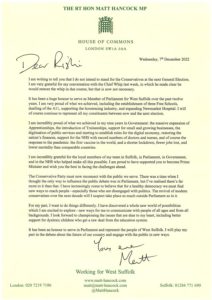
    The letter sent by Matt Hancock, the Conservative MP for West Suffolk, to Rishi Sunak, the Prime Minister, on 7 December 2022.

  • Rishi Sunak – 2022 Comments on Michelle Mone (Baroness Mone)

    Rishi Sunak – 2022 Comments on Michelle Mone (Baroness Mone)

    The comments made by Rishi Sunak, the Prime Minister, in the House of Commons on 7 December 2022.

    Like everyone else, I was absolutely shocked to read about the allegations. It is absolutely right that the baroness [Baroness Mone] is no longer attending the House of Lords and therefore no longer has the Conservative Whip. The one thing that we know about the right hon. and learned Gentleman is that he is a lawyer and should know that there is a process in place. It is right that that process concludes; I hope that it is resolved promptly

  • Keir Starmer – 2022 Comments on Labour’s Plan for the Constitution

    Keir Starmer – 2022 Comments on Labour’s Plan for the Constitution

    The comments made by Sir Keir Starmer, the Leader of the Opposition, on Twitter on 5 December 2022.

    My Labour government will place power in the hands of cities and regions across Britain.

    We will match the ambitions of people across the country to reignite our economy and build a better future.

  • Brendan O’Hara – 2022 Statement Calling for Suspension of Michelle Mone

    Brendan O’Hara – 2022 Statement Calling for Suspension of Michelle Mone

    The statement made by Brendan O’Hara, the SNP spokesperson for the Cabinet Office, on 4 December 2022.

    Rishi Sunak pledged when he took office that he would lead a government with integrity.

    It is now only right that he matches that rhetoric with action and suspends the whip from Baroness Mone and addresses the serious questions hanging over this entire shameful episode.

    Of course perhaps the reason the Tory government doesn’t want to talk about Baroness Mone’s millions is that she is only the tip of a very large iceberg of its politically connected pals who benefited like this.

    That is why there should be an independent investigation into the full extent of this profiteering at a time of national crisis.

    I think most fair-minded people would agree it is obscene that people were able to make such vast profits from a government PPE contract while the country suffered through the pandemic.

  • Sajid Javid – 2022 Statement Confirming Not Standing at the Next General Election

    Sajid Javid – 2022 Statement Confirming Not Standing at the Next General Election

    The statement made by Sajid Javid, the Conservative MP for Bromsgrove, on 2 December 2022.

  • John Lamont – 2022 Speech on an Independence Referendum for Scotland

    John Lamont – 2022 Speech on an Independence Referendum for Scotland

    The speech made by John Lamont, the Parliamentary Under-Secretary of State for Scotland, in Westminster Hall, the House of Commons on 30 November 2022.

    It is a privilege to respond to this debate with you in the Chair, Mr Bone. I congratulate the hon. Member for Kirkcaldy and Cowdenbeath (Neale Hanvey) on securing this debate. I am pleased to respond to my first Westminster Hall debate as a Scotland Office Minister. The hon. Gentleman chose to focus the debate on the issue of an independence referendum. I cannot help but feel that this valuable debating time could have been better focused on matters of immediate importance to his constituents, mine in the Scottish Borders, and the constituents of other Members across Scotland and the rest of the United Kingdom.

    Neale Hanvey

    Will the Minister give way?

    John Lamont

    I shall make some progress, if I may. The hon. Member had quite some time to make his points, and I want the opportunity to—

    Neale Hanvey

    On a point of order, Mr Bone. It is a shame that the Minister did not allow me to intervene. However, he makes assertions that are simply not possible. He is asking me in some way to manage the Scottish Government, or indeed to divorce myself from the reality experienced by my constituents, who voted for me to secure Scotland’s independence.

    Mr Peter Bone (in the Chair)

    I thank the hon. Gentleman for that point of order. It was clearly not a point of order, but his remarks are on the record.

    John Lamont

    I think our constituents would rather that this place, the Government and the Scottish Government concentrated all their attention and resources on the issues that matter to Scots and people across the United Kingdom.

    Let me respond to the issues that the hon. Gentleman raised. It is clear to this United Kingdom Government and people in Scotland that now is not the time to talk about another referendum. This Government have noted, and respect, the unanimous ruling of the United Kingdom Supreme Court. Its unanimous view on the substantive matter supports the United Kingdom Government’s long-standing position that a referendum is not within the powers of the Scottish Parliament. It is clear that Scotland has a strong and thriving democracy, but the power to have a referendum rests with this place. To suggest that Scotland does not have a thriving and strong democracy, and to suggest that only those who support leaving the UK support democracy, is an insult to the majority of Scots who wish to remain part of the United Kingdom. The nationalists’ rhetoric is irresponsible. The notion is absurd—so absurd that, in recent days, we have heard the absolute nonsense of some nationalists bemoaning the death of democracy in one breath and boasting of election victories with the next. I should be clear that the hon. Gentleman was not guilty of that, for perhaps obvious reasons.

    The Scottish Parliament is able to legislate in every area in which the Scotland Acts 1998, 2012 and 2016 give it the power to do so. That makes it one of the most powerful devolved Parliaments in the world. People want the Scottish Parliament and the Scottish Government to focus on the issues that matter to them, not on constitutional division. We should not forget that the people of Scotland voted decisively to remain part of the UK in 2014. The hon. Member made much of the people of Scotland’s need for self-determination; the vote in 2014 was the ultimate act of self-determination. The Scots voted in record numbers to remain part of the United Kingdom.

    On the hon. Member’s questions about the path to a referendum and whether the Union is based on consent, in 2014 both the UK and Scottish Governments agreed that it was right for the people to have their say in an independence referendum. If there is ever a referendum again, then it has to be based on consent and consensus across both Governments and all parts of civic Scotland.

    I will spend a little time pointing out some of the benefits of the Union, which the hon. Member failed to mention at all.

    David Duguid

    I want to comment on the previous point, which my hon. Friend the Minister made very well. The independence referendum in 2014 was agreed on through powers devolved temporarily to the Scottish Parliament. For the benefit of the House, will the Minister confirm, following last week’s Supreme Court ruling, that the democratic and legal position that led to consensus at the time of the independence referendum has not changed in any way? Will he confirm that nothing has changed in a democratic or legal sense since then?

    John Lamont

    My hon. Friend is absolutely right. This is about securing consensus, not just between the UK and Scottish Governments, but across all parts of society in Scotland. We are lacking that just now. As he knows, we face major challenges, including restoring economic stability, gripping inflation, supporting people with their energy bills, supporting the NHS, combating climate change, supporting Ukraine and levelling up. People across Scotland just do not accept that now is the time for another divisive referendum.

    At this time of unprecedented challenges, the benefits of being part of the United Kingdom have never been more apparent. For instance, the people of Scotland benefit from substantially higher public spending thanks to being part of the United Kingdom. That Union dividend means that remaining part of the UK is worth around £2,000 per year for every Scot. That is demonstrated in figures from the SNP Government in Edinburgh. Furthermore, the UK Government are providing the Scottish Government with a record block grant settlement of £41 billion per year over the next three years.

    There can be no question about this Government’s commitment to Scotland; it is best demonstrated by what we are delivering on the ground. That includes a multi billion-pound investment in Scotland’s defence and shipbuilding industries, which will safeguard not just the UK’s security, but tens of thousands of jobs on the Clyde and beyond.

    Kenny MacAskill (East Lothian) (Alba)

    Will the Minister give way?

    Mr Peter Bone (in the Chair)

    The Minister does not have to give way, but he might be under the impression that we have to keep this debate to half an hour. We have some extra time because the previous debate finished early, if that helps the hon. Member and the Minister.

    John Lamont

    I am grateful for that clarity, Mr Bone. I am keen to make the strong and positive case for Scotland remaining part of the United Kingdom. We have heard much nonsense from nationalist Members in this debate, and I want to make the record slightly more accurate.

    There has also been the record £1.5 billion city and growth deals programme, which invests in Scotland’s infrastructure and future. Another example would be the collaboration of local councils, which are delivering real devolution by levelling up communities and bringing local projects to life. Another divisive referendum is the wrong—

    Neale Hanvey

    On a point of order, Mr Bone.

    Mr Peter Bone (in the Chair)

    We have another point of order, which I am sure will be in order this time.

    Neale Hanvey

    The question that is being considered is the position on a further independence referendum for Scotland, not the Government’s alleged beneficence towards Scotland. That is not the matter under consideration. I would respectfully ask that the Minister restricts his comments to the subject of the debate.

    Mr Peter Bone (in the Chair)

    Thank you very much for that intervention, but I am afraid that is my job. If the Minister is wandering off, I will bring him to order. He is wandering, but not quite off the pitch yet.

    John Lamont

    Thank you, Mr Bone. Another divisive referendum is the wrong priority, at the worst possible time, and would be a complete distraction from the very real challenges that people across our country face.

    Kenny MacAskill

    I am listening to the Minister expound the great virtues. Can he explain to me why, when Scotland is energy-rich, more than half of our people are going to be fuel-poor this winter, and many will be in extreme fuel poverty?

    Mr Peter Bone (in the Chair)

    Order. I am just considering what the hon. Member said, and am remembering what the hon. Member for Kirkcaldy and Cowdenbeath said. I am not quite sure what that point has got to do with the referendum. I will leave it up to the Minister.

    John Lamont

    I am grateful for that clarification, Mr Bone.

    I fully understand and recognise the real pressures that people are facing just now with the rising cost of energy. We all know that is largely due to rising inflation, which is of course due to the illegal war in Ukraine.

    Kenny MacAskill indicated dissent.

    John Lamont

    The hon. Member for East Lothian shakes his head; I would like to know what evidence he has to suggest that the war in Ukraine is not causing rising energy prices.

    That is why this Government have taken action to support households in all parts of the United Kingdom, including Scotland, to deal with those rising energy bills. That is yet another benefit of the strength of the Union and the power that this Parliament and Government are able to take to support people during difficult and challenging times.

    Instead of divisive constitutional arguments, people in Scotland want and rightly expect both of their Governments, here and in Edinburgh, to be concentrating all their attention and resources on the issues that matter to them, their families and communities, such as the cost of living, working to drive down NHS backlogs, protecting jobs and securing our long-term energy security. The Prime Minister has been clear in his commitment to working collaboratively and constructively with the Scottish Government to tackle all the challenges we share and face. That is exactly what we want to do in vital areas, such as growing our economy, supporting our NHS and leading the international response to Russia’s illegal invasion of Ukraine. This Government remain focused on getting on with the job of delivering for the people of Scotland.