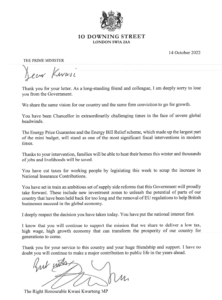
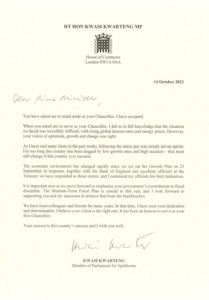
The letter sent by Kwasi Kwarteng, the Chancellor of the Exchequer, to Liz Truss, the Prime Minister, on 14 October 2022.


The letter sent by Kwasi Kwarteng, the Chancellor of the Exchequer, to Liz Truss, the Prime Minister, on 14 October 2022.


The statement made by Kwasi Kwarteng, the Chancellor of the Exchequer, in the House of Commons on 12 October 2022.
The Bank of England decided to carry out temporary purchases of long-dated UK Government bonds (gilts) from 28 September through the asset purchase facility (APF) on whatever scale is necessary to restore orderly conditions. These interventions will be strictly time limited, with auctions taking place until 14 October.
I have therefore authorised an increase in the total size of the APF by £100 billion. This will bring the maximum total size of the APF from £866 to £966 billion.
On 11 October, the Bank decided that that it will widen the scope of its daily gilt purchase operations to also include purchases of index-linked gilts. This was designed to act as a further backstop to restore orderly market conditions by temporarily absorbing selling of index-linked gilts in excess of market intermediation capacity, the purchasing of index-linked gilts was already covered by the existing indemnity for the APF.
The amendments to the APF that could affect the allocation of credit and pose risks to the Exchequer have been discussed with Treasury officials. The risk control framework for the APF previously agreed with the Treasury will remain in place, and HM Treasury will keep monitoring risks to public funds from the facility through regular risk oversight meetings and enhanced information sharing with the Bank.
The Government will continue to indemnify the Bank and the APF from any losses arising out of, or in connection with, the facility. If the liability is realised, provision for any payment will be sought through the normal supply procedure.
A full departmental minute has been laid in the House of Commons providing more detail on this contingent liability.

The statement made by Kwasi Kwarteng, the Chancellor of the Exchequer, in the House of Commons on 11 October 2022.
Today I can inform the House that I have asked the Office for Budget Responsibility to bring forward the date of its next forecast to 31 October.
Strong growth and sustainable public finances go hand in hand. Alongside the publication of the economic and fiscal outlook, I will set out the Government’s medium-term fiscal plan. This will set out further details on the Government’s fiscal rules, including ensuring that debt falls as a share of GDP in the medium term.
This forecast, in addition to the forecast that will be commissioned in spring, will fulfil the obligation for the OBR to produce at least two forecasts in a financial year, as is required by legislation.

The speech made by Alison Thewliss, the SNP’s Economic Spokesperson, in the House of Commons on 12 October 2022.
The Minister talks about the IMF, but not about its criticism yesterday or the pathetic growth it has projected for next year of just 0.3%—funny that.
The Treasury Committee took evidence this morning from a range of economists, all of whom echoed the concerns of the public about the chaos that this shambolic UK Tory Government have created. I am not sure whether the Minister considers Deutsche Bank as part of his anti-growth coalition, but its chief economist, Sanjay Raja, was very clear this morning that the UK has particular characteristics that are making this crisis worse. He said, “you’ve got a sidelined fiscal watchdog, you’ve got the lack of a medium-term fiscal plan, one of the largest unfunded tax cuts and package of measures since the early 1970s, and it’s sort of the straw that broke the camel’s back.”
This is chaos that the Minister and his colleagues have deliberately created, and it is impacting people and businesses across these islands, so I ask him: will he bring more money to the devolved institutions to help them tackle the chaos that he and his colleagues have created? Will he commit to uprating benefits by inflation and giving more support to those in the asylum system and those on “no recourse to public funds”? Will he bring certainty to businesses that do not yet know what will happen at the end of the six-month reprieve, because those bills have not gone away?
The Glasgow Centre for Population Health published some research that attributed about 330,000 excess deaths since 2010 to austerity—the Tory austerity by the Minister and his colleagues over the past 12 years—so will he cancel any further cuts, because they cost Scotland and our neighbours far more than we can ever afford? Scotland did not want this, did not vote for this and cannot trust in the financial stability of the UK, never mind this Tory Government.
Mr Speaker
Order. I have the greatest respect for the hon. Lady, but can I just say that she knows the rules give her one minute, not one minute and 45 seconds or two minutes? Please, let us stick to the rules of the House.
Chris Philp
The Scottish Government are of course receiving record levels of funding, and that will continue. The hon. Member asked about excess deaths. Well, I think the drug death record of the nationalist Government is, frankly, pretty terrible. She asked about the uprating to welfare. There is a statutory process that happens every year—every autumn—and that decision has not been taken. It will happen in the normal way, as it has been done for every year.
The hon. Member referenced the IMF’s growth forecast for next year. I have already pointed out that last year we had the highest growth in the G7 and this year we have the highest growth in the G7. If we take the three years together—last year, this year and next year—we will find that the UK, at 11.7% over those three years, still has the highest growth of any G7 country.
The hon. Member asked about institutions. The Chancellor and the Prime Minister have the highest regard for the OBR and the Bank of England. They are meeting both of those institutions regularly. She referenced the growth plan. Having a competitive tax system, supply-side reforms to unleash the productive potential of our economy and making our energy market function properly once again are essential prerequisites for growth, and I am proud that it is this Government who are promoting them.

The speech made by Rachel Reeves, the Shadow Chancellor of the Exchequer, in the House of Commons on 12 October 2022.
People are facing insecurity, instability and deep anxiety and they deserve answers. Conservative economic policy has caused mayhem with financial markets, pushed up mortgage costs and put pension funds in peril, and it has wiped £300 billion off the UK’s stock and bond markets—all directly caused by the choices of this Government. The mini-Budget, just 19 days ago, was a bonfire made up of unfunded tax cuts, excessive borrowing and repeated undermining of economic institutions. It was built and then set ablaze by a Conservative party totally out of control—not “disrupters” but pyromaniacs. And that fire has now spread. Yet Government deny all responsibility.
So will the Minister tell the House, what guarantees will the Government give that the currency slide will stop, and that people’s pensions are safe? How do they expect people to pay £500 more a month, on average, on their mortgages? How many more repossessions of family homes will there be if the Government do not change course? How much more are the Government spending on debt interest because of higher borrowing costs?
While Ministers desperately try to blame global conditions, why is it that no other central bank in the world has had to step in three times in less than three weeks to protect financial stability?
The country now faces a very serious situation. Ahead of the ending of the Bank of England’s emergency operations this Friday, what action will the Government take to ensure that their Budget does not have further consequences for financial stability, or for people’s pensions?
This is a Tory crisis made in Downing Street, but it is ordinary working people who are paying the price. It can be resolved only when the Conservatives put aside their pride and reverse this catastrophic mini-Budget, and they must do so now.
Chris Philp
The shadow Chancellor calls for a reversal of the growth plan, yet at the first opportunity—last night—the Labour party voted for it. She asks about mortgage rates, so let me point out to her that mortgage rates around the world have been on an upward trajectory all year. In fact, if we compare base rates in the United Kingdom with those in the United States, we see that in both countries, as she will be aware, the base rate started this year at 0.25%. In the UK the base rate is currently 2.25%, and in the US it is 3.25%, a full percentage point higher.
The shadow Chancellor referenced borrowing costs. I am sure she is aware that two-year Government bond yields are about the same in the US as they are in the UK—US bond yields have been going up over the course of this year as well. She referenced the currency: the dollar has shown strength against a basket of currencies throughout this calendar year. If she looks at the dollar strengthening against the euro, she will see that it strengthened about 15% this calendar year, and strengthened about 15% against sterling—very similar figures.
The shadow Chancellor also asked about the cost of living. We are very mindful of that, which is why we have introduced a £37 billion package to help people, disproportionately targeted at those on lower incomes, so that people on the lowest third of incomes receive £1,200. It is why we introduced the energy price guarantee on our second or third day in office, ensuring that people do not pay, on average, more than £2,500, instead of facing bills of £5,000 or £6,000—and not for six months, as the Labour party offered, but for two years. It is why the national minimum wage was increased by a large amount last April. It is why the national insurance threshold was increased to £12,500 in July, so people on lower incomes now pay virtually no national insurance or income tax. That is the package of measures that this Government have introduced, because we stand on the side of working people and have taken the steps needed to support them.


The statement made by Chris Philp, the Chief Secretary to the Treasury, in the House of Commons on 12 October 2022.
The Chancellor of the Exchequer is in Washington, having meetings with the IMF, and is—[Interruption.]—which have been—[Interruption.]—routine meetings, which have been long scheduled.
Mr Speaker
Order. I know it is the first Wednesday back; we are all excitable. Let us have a little calm, so that I can hear the Minister. Come on, Minister.
Chris Philp
Thank you, Mr Speaker. They are routine meetings that have been long scheduled, and are certainly not a cause for exuberance or over-excitement from the Opposition.
As we know, the world has faced surging energy prices since Putin’s illegal invasion of Ukraine. We have seen very high inflation across the western world, and we have seen a cycle of increasing interest rates across western economies as well—across many western economies. But let me reassure the House that the fundamentals of the United Kingdom’s economy remain resilient. Unemployment, at 3.5%, is the lowest it has been in my lifetime—and for the record, I was born in 1976. Economic growth last year, the calendar year 2021, was the highest of any G7 country—7.5%. Just yesterday the IMF forecast that economic growth—GDP growth—this current year in the UK would be at 3.6%—once again, for the second consecutive year, the highest of any G7 country. So our economy is in resilient condition.
But I know that many families are worried about the challenges we face, and that is why, just a few weeks ago—two or three weeks ago—we introduced the energy price guarantee. Families were genuinely fearful that they might face this winter energy bills of three, four, five, six or even seven thousand pounds per year, but that energy price guarantee will ensure that the average household sees energy prices no higher than £2,500 on average—not for six months, like the Labour plan, but for two years.
We also introduced a growth plan to get our economy growing, to see wages sustainably rising, to see good jobs created and to create a sustainable tax base to fund our public services. This Government have a growth plan; the Opposition have no plan.
We intend to do this in a way that is fiscally responsible, and that is why—[Interruption.]—and that is why, on 31 October, in less than three weeks’ time, the Chancellor of the Exchequer will set out the medium-term fiscal plan, explaining to the House exactly how he will do that, and how we will continue the UK’s track record of having the highest growth in the G7, not just last year but this year as well.

The speech made by Sharon Bowles, Baroness Bowles of Berkhamsted, in the House of Lords on 12 October 2022.
My Lords, the Government have U-turned on some of their insensitive Reaganomics, giving tax cuts and perks to the wealthy during a cost of living crisis for the wider population, but a harsh right-wing agenda is an integral part of the Tory Brexit plan. It may not have headlined beyond the Singapore-on-Thames misnomer—thought just to mean light-touch financial regulation—but disruption and asset price adjustment are part of it, as the Prime Minister has revealed in various things that have been said.
Those kinds of adjustments are painful and require a long policy horizon, broad and deep support and good communication, as do any challenges to market orthodoxy. But done naively, two years before an election, with none of the accompanying platform—no wonder the markets took flight. The mini-Budget and growth plan set in train faster and further falls in sterling and gilt prices, and rises in interest and mortgage rates, than would otherwise have happened.
The gilt glitch triggered Bank of England intervention to save defined benefit pension funds that had tried to manage mark-to-market gilt valuations with derivatives and borrowing, collateralised by the gilts themselves: an incestuous systemic linkage, which sounds crazy anyway, inherently vulnerable to a doom loop, created and perpetrated by and around regulated entities, warned about to the Bank of England, and deemed acceptable or untouchable by regulators.
This was a systemic accident waiting to happen. Dodgy derivatives, shifting risk horizons, timelines and effective ownership change—has nothing been learned from 2007? The issue that has driven the invention of liability-driven investments and the recent gilt-sale doom loop is the mark-to-market requirement of accounting standards and applying it to hold-to-maturity gilts within pension fund assets. It has caused 20 years of instability in the pensions sector.
Gilts held to maturity are not volatile; the coupon and end return are either fixed or linked to inflation. As Terry Smith pointed out in his opinion piece in the FT last week, LDIs are not hedging risk—which is the total realised end return—but attempting to hedge the accounting valuation with all its short-term noise and volatility. The only gainers are the peddlers of exotic products; the losers are the public and pensioners who foot the cost of the rescue and the finagling.
Why is this done? Because of universal mark-to-market accounting standards dogma, also embedded in other regulation. Maybe it makes audit less work, requiring less judgment, but what good is that when the consequences and get-arounds open the door to extreme systemic events?
I know that the noble Lord, Lord Callanan, follows the infallibility of accounting standards mantra of BEIS—it is probably being scribbled down in the Box right now—but there are dangerous flaws and absurdities, and it is negligent if government, BEIS, the Treasury, regulators and the Bank will not get their heads around issues in accounting standards. It is no defence to say that accounting standards are independent; they are a closed shop defended by their acolytes. We are not all bamboozled, but those with power must take off their blinkers.

The speech made by Roger Liddle, Baron Liddle, in the House of Lords on 11 October 2022.
I join the noble Lord, Lord Lamont, in welcoming the noble Baroness, Lady Neville-Rolfe, back to the ministerial Bench. There is much in the speech made by the noble Lord, Lord Lamont, with which I agree. We all want growth, and it is a realistic ambition to try to turn Britain back to the 2.5% growth figure that we enjoyed until the financial crisis. The question is how to do it in a way—I think this is an important point—where the whole of society benefits. The fact is that the growth we have seen since the financial crisis has not trickled down. People on median wages and below have not seen any increase in their standard of living. This is an important thing that future government policy has to address.
As for the details of the plan for growth, there are some things in it with which I agree, but it is limited in its vision. If the Government had paid attention to business, business would have put skills at the top of the list and said that what is needed is more apprenticeships and more people with higher technical qualifications. On pages 19 and 20, which talk about getting more people into work with the right skills, there is not a single mention of that agenda and what the Government are prepared to do about it.
On housing, there is the cut in stamp duty but no clarity on how planning law is to be changed. We know that Conservative MPs in the Commons hate this. There is no mention of any need for social housing.
On infrastructure, there is a sort of half-acknowledgement of guilt that it was the Conservative Back-Benchers, again, who stopped onshore wind—one of the most positive things we could have done to cut energy bills. Let us see whether the objections to onshore wind can now be overcome.
Things such as Northern Powerhouse Rail, which we have been talking about for a decade or more, are on the list of things that the Government might do, but what credibility is there that they will actually do them? Investment zones are an interesting idea, but I have read the academic evidence and it is not very positive on whether they produce results.
There is a point that I think is original. A lot of the Johnson levelling-up agenda was about how we reinvigorated our town centres. Lots of government money is being funnelled into that. These investment zones will be on brownfield sites outside town centres; this seems to be a fundamental contradiction. If I were to encourage investment in my home town of Carlisle, I would want to see it in the centre and on the fringes of the centre, not on some site outside.
The fundamental thing about this Government’s policy is that they have lost the reputation for macroeconomic stability that is fundamental to encouraging business to invest. It was the most irresponsible and reckless Budget since Barber’s in 1972. It caused turmoil in the markets, which threatened the future of people’s pensions. It will lead to spiralling mortgage costs. As the noble Lord, Lord Macpherson, pointed out, there are risks here of a contradiction with monetary policy.
On the fiscal plan that the Government are committed to coming up with, I do not believe the numbers can be made to add up by public spending cuts, which would be both counterproductive in their impact on growth and politically undeliverable. I agree with the noble Lord, Lord Macpherson, that some of the announced tax cuts should be cancelled.
This is not a plan for growth. It is an economic disaster.

The speech made by Norman Lamont, Baron Lamont of Lerwick, in the House of Lords on 11 October 2022.
My Lords, it is a personal pleasure to follow the noble Lord, Lord Burns, who always gave me very wise advice in the Treasury, just as he has to the House today. I also welcome my noble friend Lady Neville-Rolfe back to her position on the Front Bench. We have lost a doughty Back-Bencher but regained a formidable Minister.
I welcome many of the measures in the Government’s growth plan, particularly the radical deregulatory ones—IR35, the pensions cap and the planning reforms. Provided they can be delivered they are the sorts of measures that will make a real difference to our growth rate. I also welcome the energy price guarantee. It is a major intervention but, as the Minister said, one that, because of the death of the Queen, was not widely recognised and is still not widely known among the public. The package is very important not only for the relief it gives to hard-pressed consumers but economically, because of the 5% it knocks off the rate of inflation. This by itself could help to stave off a deep recession, as high energy prices can be both inflationary and deflationary.
However, it has to be recognised that the energy price guarantee is potentially a massive commitment and adds huge uncertainty to the borrowing figures. The Government’s support to consumers as a percentage of GDP, according to the Goethe Institut and Conservative Central Office, dwarfs that of other countries. It is, potentially, more than double that of Germany, which funded its package out of taxation. It was the hugeness of the money at stake, together with the absence of the OBR assessment of the cost of tax cuts, that produced the market reaction that it did. The Government also made something of a rod for their own back with some of the rhetoric that was carried forward from the leadership election about rejecting orthodoxy and the attacks on “bean counters” and people peddling “abacus economics”. I am sure it was not intended to, but it sounded very like a Conservative belief in the magic money tree. Since then, the Chancellor has emphasised that he believes in fiscal discipline and in a declining debt-to-GDP ratio.
Going for growth is a certainly laudable objective, but it has to be recognised that there can be a conflict between going for growth and getting inflation down. A stimulus to growth from unfunded tax cuts may mean that inflation stays higher for longer, and that could mean higher interest rates holding back growth. If fiscal and monetary policy point in opposite directions, the result is again likely to be higher interest rates and thus slower growth. So the stage is set for something of a battle between the Treasury and the Bank of England as the Government push for growth and the Bank raises interest rates to tame inflation.
This dilemma could of course be resolved if tax cuts always paid for themselves. That would be wonderful—we would never have to discuss taxation again—but as the noble Lord, Lord Burns, said, they do not always pay for themselves. It depends on whether the rates are set at confiscatory levels or, technically put, where precisely the rate is on the Laffer curve. Ronald Reagan’s tax cuts resulted in increased debt, a fact that he later acknowledged and regretted.
Fiscal responsibility is not the enemy of growth. It produces the stability that is essential for it. I welcome the fact that the Chancellor is drawing up a debt reduction plan and plans to bring forward the OBR assessment of that plan. It is very important that the plan set out is credible and does not consist of just easing the present fiscal rules or back-ending all the pain that is going to be necessary. If we do not face reality, reality is going to face us. Fortunately, the Chancellor has, I believe, the resolve and determination to face these challenges, and I wish him well.

The speech made by Alison McGovern, the Labour MP for Wirral South, in the House of Commons on 11 October 2022.
Before I get into the Bill, I want to note some of the remarks made by the Government on their energy package and the speed with which that was brought forward. Given that this is the first opportunity we have to discuss these financial matters, I want to record that it felt during recess as though almost every day in August people were begging the Government to act, and they did not. We waited and waited, while they had an internal debate when they could have acted. For 12 years, in fact, it has seemed that the British economy has had both deep-rooted problems and significant shocks. Given the situation before us and the chaos we face, would not any Government want to act?
That brings us to today’s Bill, which is essentially a U-turn. As colleagues have said, the Government are showing here that they can U-turn, but what we need now is much more significant action. We can say with certainty that the Chancellor has already made a considerable impression on the economy. He inherited a cost of living crisis and for good measure added a cost of borrowing crisis, an interest rate crisis, a mortgage crisis, a sterling crisis, a Government bond crisis and a pension funds crisis.
Inflation was already at its highest rate in 40 years, devouring household wages and savings; Shell, ExxonMobil and Chevron recorded their highest ever profits and household energy bills doubled within a year. Thanks to this Government, the pound has slumped to its lowest value against the dollar since Britain went decimal in 1971, and the Bank of England has been forced to launch an emergency £65 billion bond-buying scheme that, as we saw yesterday, has barely stopped the chaos.
Thanks to this Government, in the blink of an eye the average homeowner now faces a monthly mortgage payment that is £500 more expensive and food bank use has soared to such an extent—[Interruption.] Do not say it is global. The food bank increase is not global; it is a feature of the UK economy, and it has soared to such an extent that volunteers will need either to turn people away or to reduce the size of emergency rations. That is the situation we face, and that is why this Bill must not represent the last U-turn from this Government.
We have heard from various Conservative Members that they are the party of tradition, so let me commend the Government on respecting a long-standing Conservative tradition in their conduct relating to our economy. Just like on 16 September 1992, Conservative Governments always end up sacrificing family finances to pay for their chaos.
This Chancellor, in his airy disregard for experts, produced a Budget so complacent, so unfunded and so unconvincing to the markets that the cost of our long-term borrowing soared. His doubters are now not just the members of the Labour party; they include bond traders, the currency markets, the civil service, the OBR, the Bank of England, the IMF and the British public.
The Conservatives have pierced a hole in the British economy, and the effects are widespread and severe. Pension funds were brought to the edge of collapse and, before the Bank of England intervened, we risked falling into a self-perpetuating spiral,
“threatening severe disruption of core funding markets and consequent widespread financial instability.”
To be so ignorant, so high-handed and so willing to risk impoverishing people is unforgivable.
It is some small comfort that today the Tories are reversing their own rise in national insurance. U-turn follows U-turn and we return to square one. However, this zig-zagging incoherence is not just a waste of parliamentary time and energy, but damaging to our stability and our credibility. No matter whether they raise taxes or lower them, high-quality public services and economic growth will continue to elude the Conservatives. That is because, as has been said so often, economic strength does not come just from the top; it starts in the everyday lives of working people right across our great country. The hon. Member for South Suffolk (James Cartlidge) explained well what is happening right now for people trying to work. Thanks to the Conservatives, record waiting lists see acute conditions becoming chronic and more and more people having to leave the labour market. Do not crow about unemployment being at historically low levels when inactivity—people simply unable to work—is shooting up again, as we found today.
James Cartlidge
Just to clarify, what I said was that it was due to the pandemic—not entirely, but everything the Labour party says now is airbrushing out of history the greatest post-war trauma that the country faced, when there was an enormous surge in borrowing, which we all supported, to fund the support for businesses and people in our constituencies. At some point, will Labour recognise the impact that had and the action we had to take, which has led to decisions such as these tax increases?
Alison McGovern
The impact of the pandemic on our labour market and our health service has been profound. It should inspire us to see the capabilities of the people within our health service, and it should show us the undeniable truth that there will be no economic health in this country without securing the health of the people of this country. That is what the pandemic shows us. I simply ask that the party in government today, the Conservative party, learns that lesson.
If we look at what is going on with our labour market, we see that part of the growth plan must be to secure our health service, get waiting lists down and get people back to good health. We have heard that funding for health and social care services will be untouched, so let me assure the Government—already so elastic with their commitments—that their promise on the health service will be under heightened surveillance in months to come.
The Government say that they have a growth plan to end their cycle of stagnation and to radically overhaul what has been dragging us down, but that plan simply has no credibility. It is delayed and delayed. Until we see what they truly believe can help this country grow, all we see is the cost of borrowing growing, inflation growing, mortgage payments growing, food bank use growing and child poverty growing, while the true opportunities that this country has—its people and their talents—are left wasted.
Who asked for this? Who nodded happily at higher mortgage repayments? Who wanted public services to be slashed or spiralling inequality? There is no consent for this, as we have seen—not even consent on the Tory Back Benches. The resulting damage to our economy is immediate and sharp, but there is another danger that emerges slower but is just as great: the risk to our relationship with the British people.
I worry that we have short memories in this place. Only three months ago, more than 60 Ministers fled the Government of the right hon. Member for Uxbridge and South Ruislip (Boris Johnson). For some time, that Government were viewed with real anger by the public, who overcame the pandemic through shared sacrifice, only to feel cheated, insulted and taken for fools by their Government. Well, the British people are not fools, Madam Deputy Speaker. They understand that this winter, whether it is due to soaring energy bills, surging inflation or the war in Ukraine, shared sacrifice is needed again. In return, they are owed compassionate, responsible leadership and a Government who can look them in the eye.
This is not a time for economic hobbyism—for testing pet theories like schoolboys in the common room—and ignoring the country. Not even two people in every 1,000 voted for the Prime Minister or her Chancellor. Britain did not choose to be experimented on in this way. When the Chancellor delivered his crazy Budget on 23 September, everyone in this country was united in experiencing that act of economic vandalism. When children are hungry, pensioners colder and families fearful, the Chancellor avoided the profits of energy giants and signed off unfunded tax giveaways for millionaires. In waving through bigger bonuses for bankers, he took a torch to our social contract. Instead of shared sacrifice, this gang of fanatics on the Treasury Bench turned to casino economics and gambled away public trust.
It is an old, old saying that you can judge a person by what they choose to do with power. After 12 years of the Tories in power, the veneer has worn off, revealing the same old ideas that have been tested to destruction in this country: run the country on the cheap, leave public services crumbling and make working people pay the price. The big society—remember that?—has been and gone, one nation conservatism is a painted shell, and the façade of levelling up has been abandoned, as they cut taxes for millionaires and look set to cut benefits for the poor. It does not matter whether it is this Prime Minister or whoever soon replaces her—this is the Conservative project and it has been there all along.
It is the single greatest privilege in this country to sit on the Treasury Bench. Instead of living up to that honour, the Conservative party is hopeless, reckless, callous and weak. There is no consent for this Government’s ideas, and they should be driven out of office. If they really are such a confident group of free thinkers, surely they have nothing to fear from taking their pitch to the country.