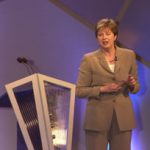
The speech made by Theresa May, the then Chair of the Conservative Party, on 26 June 2003.
I’m very grateful to the Hansard Society for inviting me to deliver its fourth annual lecture.
I’m pleased also to be following in the footsteps – I’ll resist the urge to say standing in the shoes – of Robin Cook, a distinguished parliamentarian and a long-serving member of the House.
I strongly disagreed with Robin over his stance on Iraq, but I respect his decision to give up his Cabinet post because of his beliefs…
…And I have to say, it makes a change to watch such an effective political operator focusing on his own government from the back-benches, rather than on the opposition from the front-bench.
I looked back at the task Robin set himself in last year’s lecture and considered his legacy as Leader of the House.
Clearly, the greatest disappointment is the stalling of real reform of the House of Lords. We have made no progress over the past year and indeed the whole issue seems to have been put on the back burner. The Conservative Party still stands ready to work with the Government to secure a lasting solution to this problem and to deliver a strengthened Parliament overall.
I notice also that there was little mention in Robin’s lecture of the Government’s plans for the future of the Lord Chancellor and their effect on the House of Lords. It was quite a surprise to have these announced by press release one Thursday afternoon – not just for me, but also it seems for most people in the Government itself.
It’s a great shame that the Prime Minister felt unable to apologise to Parliamentarians and to the public for the way that the entire fiasco was handled, with no consultation and seemingly no thought. It is, I fear, the hallmark of a man who has little but contempt for Parliament and by implication for the people themselves.
But Robin Cook is certainly a House of Commons man, and some of the reforms he set out last year have indeed been put in place. The House of Commons now has new sitting hours; the process of appointing select committees has been changed; questions are now more topical and more effective.
It is probably too early to give a full assessment of the benefits of these reforms, but I’m certain that his actions have ensured that Parliament will never be allowed to return to how it was when I joined the House in 1997.
Yet I have always felt that the process of reconnecting Parliament with the people must go much wider than simply changing sitting hours and seemingly odd procedures.
To highlight the ways in which people are turned off Parliament, proponents of parliamentary reform have often pointed to strange customs such as the wearing of a collapsible opera hat by an MP when they wanted to raise a point of order during a division.
But this is to assume that anyone at all knew that this took place. Of course it was an odd tradition, but it was hardly one of the main reasons why people fail to take parliament seriously. Anyone who sat at home watching the House of Commons on their TV would have to be a serious political animal in the first place.
I’m pleased that practices like that have gone, but let’s be honest: does anyone feel more connected to parliament now as a result of any of this Government’s reforms than they did before?
I suspect the answer is no. We need to look at a wider problem.
I would therefore like to talk about two things in particular tonight.
Firstly, what procedural or substantive changes could we make to the House of Commons to bring it closer to the people?
Secondly, what changes must we make to the level of political debate in this country to encourage people to take an interest again?
Parliament and the people
Let me take the first of those points.
As I’ve said, the reforms so far under this Government have often been cosmetic rather than substantive. I believe we need to be far more radical in some of the things we do.
Conservatives are too often portrayed as simply being resistant to change. This is not so. We simply believe that the benefits of change should be clear. We do not believe in change simply for change’s sake.
It is in this spirit that as long ago as December 2001 we set out our principles for reform of the House of Commons.
· We wish to see a strengthening of the role, status and powers of Parliament in general, and of the House of Commons in particular.
· We wish to see debates and questions in the Commons become more topical and more relevant to the majority of people in the United Kingdom.
· We believe that it is essential to enhance the ability of the House of Commons, and especially its Select Committees, to scrutinise the actions and decisions of Government.
· We seek an enhancement in the role and influence of backbenchers on all sides, and a greater recognition of the important role performed by Opposition parties of whatever political colour at any given time.
· And finally, our approach towards changing the procedures of Parliament is guided by this simple test – will such changes increase or diminish the ability of the legislature to hold the executive to account?
With these principles in mind we were able to suggest and support some proposals to increase the topicality of parliamentary business, strengthen the powers of select committees (particularly with regard to the scrutiny of legislation) and ensure adequate time is put aside to debate primary and secondary legislation.
Some of these proposals have since taken effect. We hope to see others coming into effect sooner rather than later.
But important as these things are, if we’re honest I think the three things that erode the public’s faith in parliament specifically and in politics in general are excessive partisanship, a feeling that politicians are not like them and a belief that they are only in it for themselves and their friends – in other words, the prevalence of cronyism.
To take the last point first, we live in an era where more and more key decisions about people’s lives are taken by un-elected bureaucrats and officials rather than elected politicians.
We have a Monetary Policy Committee, a Strategic Rail Authority and a Food Standards Agency. Recently when a critical report about the NHS was published by the Audit Commission, the NHS Chief Executive – Sir Nigel Crisp – was rolled out to put the Government’s case.
These organisations and individuals are anonymous to many people, but they wield tremendous influence.
Many members of the public only hear about the people running these agencies and Quangos when they hit the headlines for doing something wrong.
It’s about time we introduced some form of democracy and accountability to this system.
In the US, they have done just that. Senior appointments to key bodies in the United States have to be confirmed by a Senate Committee – and only after the individuals concerned have been interviewed and investigated by that committee.
I believe a similar system could work here in the UK and would go some way to alleviating people’s fears about the creep of cronyism throughout our system of government.
People such as the heads of the Food Standards Agency and the Strategic Rail Authority together with people such as the NHS Chief Executive should appear before the relevant Select Committee of Parliament to answer its questions before their appointment is confirmed – and if the majority on the committee votes against the appointment it should not be made.
Not only would this bring some democracy to the process, it would also strengthen the role of Select Committees.
Similarly, Michael Howard has argued that members of the Monetary Policy Committee of the Bank of England – together with the Governor and Deputy Governor – should be vetted by a joint committee of both Houses of Parliament to bolster their independence, make the process more transparent and increase the power of Parliament.
Politics also has a problem with representation. Parliament should reflect the country it serves – yet few would argue it achieves this in its current form.
All political parties have a responsibility to do what they can to attract candidates from all walks of British society. This doesn’t simply mean more women and members of the Black and Minority Ethnic communities as is often argued. It also means getting more people from different professions with different skills and talents to come forward and stand for election to Parliament.
For those of us charged with this responsibility there are two possible approaches: you can impose rigid structures from the top, or you can give people on the ground the choice of how they address the problem.
The Labour Party tried the first approach. Their all-women shortlists programme achieved temporary success but it has not been sustained.
I believe that in order to achieve long-term progress in this area we must work with local people and local parties and give them choice about how they deal with the problem.
Centrally we have already made great strides. We have made the way we choose people for our candidates list more professional by employing assessment techniques from the world of business. We engaged the services of an occupational psychologist to put in place a rigorous selection procedure using cutting-edge assessment techniques.
We now have to match these important changes to our national procedures with equally innovative changes at a local level.
And to do this we are offering our associations the opportunity to pilot a series of new ideas to give local people a greater say in the selection of their local Conservative candidate.
For example, in constituencies that have not yet selected their candidate and do not have a sitting MP we are offering the option of experimenting with US-style primaries. Under this plan, every registered Conservative voter in the constituency – or even all electors regardless of political affiliation – would have the opportunity to choose the candidate they want from a shortlist drawn up by the constituency party.
We are also inviting associations to open selection committees up to non-party members. There could be huge value in including prominent local people such as chairmen of residents associations on these committees.
We could expand the scope of the traditional selection process by allowing people to vote for their preferred candidate by post, rather than requiring them to turn up at the Special General Meeting.
And we could look at the selection process itself and enhance the usual series of interviews with competency-based exercises to assess the best candidates.
Fundamentally this is about choice: choice for constituency associations who want to try different ways of selecting candidates, and choice for local people who will receive a greater say in selecting their local candidate.
Hopefully, some or all of these innovations will help us to match candidates with an appropriate constituency as well as encouraging more local people to take an interest in the politics in their area. They are a way of re-engaging people with politics, and we hope also that out of them we will see more representative candidates coming forward.
In addition, we’re working closely with Simon Woolley and his team at Operation Black Vote to encourage greater involvement in both local and national politics among members of the Black and Minority Ethnic communities.
But how to deal with the other point – the excessive partisanship?
This is naturally more difficult. Politics is and always will be tribal. There is a reason I am Chairman of the Conservative Party and not of one of the other parties. It’s because of who I am and what I believe.
But as well as being the Party Chairman I’m also the MP for Maidenhead, and I was elected to serve all the people of my constituency, whoever they are and however they voted. I am their representative at Westminster. They rightly want to know where I stand and what I think.
Yet Westminster politics is run on a tightly controlled whipping system. Most votes are directed by the party whips. You see MPs wandering into the chamber when the division bells go, asking which way they should walk and duly obliging, sometimes without even knowing much about what they are voting on.
We have all done it, but let me take a recent example. It is, I’m afraid, a partisan example, but I choose it simply because it is recent.
Two weeks ago, we used one of our opposition day debates to raise an important issue – that of post office closures. The motion we chose to debate used exactly the same wording as an Early Day Motion which had been signed by 175 Labour MPs. But when it came to the vote at the end of the debate, 126 of those Labour MPs voted with the Government against our motion.
It was not a vote that was going to change the world, yet they were simply unable to defy the whips and to vote in favour of something they had already supported.
In any other walk of life this would be considered very odd indeed.
And this strict approach leads to partisanship. It encourages MPs to take sides, shout at each other across the chamber and the despatch box, deliver speeches that are little more than a collection of sound-bites and party lines, and generally behave in a way that people outside politics would never dream of doing.
Voters do not want yah-boo politics. They want can-do politics.
So I’ve managed to escape the whip tonight to suggest something dangerously radical – wouldn’t it be good if we could find a way to lessen the power of the whips’ office and to allow more votes to take place on a free vote basis?
I’m not proposing that this is anything that’s going to happen soon and of course the system remains valuable when it comes to allowing Government’s to meet their manifesto commitments and get things done, but I would like to see a system evolving where at other times MPs have more opportunity to speak their minds and to represent their constituents better.
There is certainly a desire for this among the public. The presence of independent MPs in the House of Commons may be minimal at the moment, but I believe the coming years will see more and more single issue or independent candidates standing in elections.
The lesson for political parties must be to allow their MPs to act as human beings more often, rather than continually asking them to obey religiously a party instruction with which they may disagree or which may run counter to the interests of their individual constituency.
A new politics
And this leads on to my second point: the need to raise the general level of political debate.
Most of the things I’ve mentioned so far relate to parliament and the need to change conventions and procedures. But by themselves they will not be enough to reverse the decline in political participation in this country.
I won’t go so far as to claim we are facing a crisis of democracy, but when more people are interested in voting in Big Brother than in parliamentary or local elections we have to ask ourselves the serious question of what’s gone wrong.
It’s a familiar fact that the national turnout at the last general election was just 59%, but the really worrying statistic is that 61% of people aged between 18 and 24 chose not to cast a vote.
That is, of course, their choice – and I do not agree with those, such as the new Leader of the Commons, who argue for compulsory voting here in the UK.
But why did they make this choice?
The instinctive answer is to say that young people just aren’t interested in politics. But I believe this is too simplistic a view.
Look at the number of young people who marched through London and other UK cities to protest about the war in Iraq. Consider how many young people took part in similar demonstrations to protest about the problems in the countryside or the government’s policy on tuition fees. Think about the fact that the number of students enrolling for politics degrees last year was the highest on record.
These examples show us that young people are not apathetic towards politics, but they are concerned that the traditional system of party politics fails to get things done.
And I believe the reason for this is that we have failed to recognise or acknowledge the new nature of politics in the 21st century. These days people – particularly young people – are encouraged to question things more and more, and not to simply take things at face value.
They’re used to questioning those in authority, rather than taking what they say on trust. We no longer live in an age of deference as we once did. Instead, we live in an age of reference – reference to one’s peers but not to those in authority.
Nor is politics any longer a game played along strict ideological lines. Very few people these days choose their favoured party and stick with it for life. People who are more accustomed to making choices in their daily lives are also more discerning about politics.
Elections become even more competitive than before when every vote is up for grabs. And the electorate themselves demand more from the political parties. They want to know what positive benefit the parties will bring to them personally, but they also want to know that the party they choose has a vision for society as a whole. It’s not all about self-interest.
The implications of this for my party have been severe. We came to be seen as self-interested, and towards the end of our term in office many people who voted for us felt that they could do so only as long as no one else knew about it.
Because our vision and our focus became too narrow, people felt that voting for us would tar them with the same brush. They felt uneasy about it and as a result they left us in droves.
We’ve been working on broadening our approach again. To do this, we are trying to break out of the confines of the British political system.
For too long, voters in this country have been faced with false choices and artificial divides. On the one side of British politics you have the Conservative Party – pro-business, good on the economy, strong on law and order. On the other you have the Labour Party – supportive of the workers and committed to health and education.
Voters are asked to line themselves up on one side of the debate or another – the implication being that you can’t possibly agree with both.
While the current Government managed to bridge this gap when they were in opposition before 1997 the artificial divides have returned since.
Today we are told that you either want to improve public services or you can oppose ever-higher taxes – as if money alone were the answer to every problem in our public services, higher taxes were the only possible source of funding, and every penny already raised in taxes was spent as effectively as it could be.
You are either a party that wants to help vulnerable communities or you are a party that wants to help businesses and encourage enterprise – as if vulnerable people are helped when the country as a whole is made poorer.
On crime, you can either take the side of the victim or you can protect historic legal freedoms and deal with long-term trends in offending – as if you achieve justice by removing defendants’ rights from the courts system and offer no help to young offenders who’ve lost their way.
It is time to change this sterile debate. The challenge of politics today is to recognise that prosperity and public services are partners, not opposites. That wealth and opportunity can be extended across society, not just to the few. And that a neighbourly society is a realistic vision for improving life in Britain’s most deprived communities.
It’s little wonder people are turned off politics when the level of political discussion today displays such an astounding lack of ambition and lack of confidence in our country. And it is also a sad caricature of our political parties.
I don’t believe any of the main parties do not have the best interests of the whole country at heart. I don’t think their intentions are wrong. On the whole, I think politicians of all parties are good people who are in politics to make people’s lives better.
Of course I disagree with many of the methods and policies of the other parties – sometimes strongly – but I rarely think they are motivated by anything other than the desire to do some good.
So these false and extreme divisions we create in British politics let down the people of this country who look to their politicians to take on the challenges of the day and to overcome them.
If we are to genuinely reconnect people with politics and to rebuild their faith in parliament we have to seek a new political settlement – one which looks above these exaggerated and extreme opposites and delivers what the public wants:
A Britain built on the principles of social justice with better public services, and a strong and thriving economy.
There is no contradiction here. There is only a lack of political ambition and a resultant caricature of British politics leading to a sterile debate that simply turns people off.
Who do we blame for this?
The traditional target for politicians is the media and certainly they are not entirely blameless. Too often, they focus on personalities at the expense of policies. They look for sound-bites and catchy headlines. It’s not easy to change the nature of political debate when newspapers and broadcasters are prepared to repeat – without questioning – scare stories about ‘20% cuts across the board’ whenever someone tries to challenge the conventional thinking on the funding of public services.
A few months ago we had an American intern working with us at Central Office. At the end of her stay she was asked what the main difference was between British and American politics, and she said the press. ‘In the US they report things, here they always try to interpret them’.
Politicians know that everything they say and do will not just be reported, but interpreted. And as a result a politician’s greatest fear is going ‘off-message’. That’s why many political interviews these days take the form of an overly-aggressive interviewer demanding answers from an overly-defensive politician. Both participants know that any deviation from the party line – any slight difference in nuance – will be treated as a gaffe or the worst party split since the last one.
The columnist Matthew Parris summed this up when he wrote:
“If I could remove from the journalists’ lexicon a single word, and with it remove the moronism to which it gives throat, that word would be “gaffe”. Like a flock of demented parrots we shriek “gaffe! gaffe! gaffe!” whenever anyone in public life says anything interesting. What others would call speaking out, we call speaking out of turn. The voicing of unpalatable truth, we call indiscretion. Taking a flyer, we call dropping a brick. We peck to pieces any politician who breaks cover and speaks his mind. Soon only grey heads tucked below parapets and mouthing platitudes remain. Then the media parrots chorus “boring! boring” (The Times, 30 November 2002).
More recently, another Times columnist, Danny Finkelstein, described how an ‘elaborate set of rules’ has grown up, determining how the political game is played. But he added that while: ‘The public has largely grown tired of the rules…politicians and the media have not’ (The Times, 3 June 2003).
But you know politics is not a game – and many members of the press would do well to note that many people no longer read national newspapers or watch national news broadcasts. Research shows that 84 per cent of adults regularly read a regional or local newspaper, but 40 per cent of all adults who read a regional publication do not read a national paper – and if they do they no longer always believe them.
But tempting though it is, I don’t want to blame the media entirely. The real problem lies with the politicians themselves.
As I said earlier, politics is by nature tribal and this is never clearer than during a general election campaign, the point of which is to help people decide who they would prefer to run the country for the next five years. Here, amplifying the differences between parties can help to make that choice clear.
The problem is that modern politics is becoming more and more like one long election campaign.
Before allowing this trend to continue, politicians of all parties should consider the dangers it poses. Between elections, the differences that matter to people are not necessarily those that exist between the parties but those that exist between how things are and how things should be.
The debate they would like to see is about how we can make things better.
Now I certainly believe that Tony Blair’s government has introduced a range of policies that take us in the wrong direction. Others would say the same about policies introduced between 1979 and 1997. But no one in their right mind imagines that every problem in our schools or our health service originated with the election of one Government or another. Many of these problems are deep-seated and have been bubbling beneath the surface for decades. Finding solutions to these problems is what politics should be about and that is where the debate should be.
My fear is that the five-year election campaign results in the victory of extreme and exaggerated rhetoric over the resolution of big and difficult challenges.
And sadly this even happens when we’re dealing with some of the most important issues of the day.
Europe
Take for example the appalling way in which the important issues about Europe and the Euro have been treated in recent weeks.
There is little doubt that the European Union and the European Parliament are taking on an increasingly important role in the life of this country.
Recently the Convention on the Future of Europe published its draft proposals set to form the basis of a new European constitution. They plan:
· A President of the European Council.
· Tighter co-operation on foreign policy, including a European Minister for Foreign Affairs.
· A legally binding Charter of Fundamental Rights, and
· A common asylum and immigration policy across the community.
At around the same time, the Government finally announced its decision (or more properly its non-decision) on Britain’s membership of the European Single Currency, with all the affect that decision has on interest rates, home-ownership, employment and UK trade.
In short, it has been an important time in British politics when we have been facing major decisions about the future of our country.
And yet, far from having the wide-ranging debate you would expect – far from setting out the economic, constitutional and political implications these issues have for the UK – the Government chose to conflate all these points into one single argument: you’re either in favour of the European Union or you want out of it.
That’s it. No other vision of the EU’s future allowed, no debate permitted and certainly no consultation with the people.
If I may be forgiven a brief moment of partisanship, this approach is ridiculous, it is cynical and it is a travesty of democracy.
Rather than engage in a debate about the proposals from the European Convention, the Government has chosen to claim – quite alone of any of the European governments – that they have no real implications for Britain and anyone who questions them must want to withdraw from the EU.
And rather than discuss the economic impact of the European Single Currency, the Government is seeking to portray anyone who does question it as being some sort of little-England isolationist.
They are closing down the debate and instead deliberately creating that false divide of which I spoke earlier – you’re either part of their version of the pro-European consensus or you’re a dinosaur who wants to withdraw from the EU entirely and have nothing to do with it.
Political debate can scarcely get much lower than that, when you’re prevented from discussing matters of such fundamental importance to the future of the country.
It is emphatically not the policy of the Conservative Party to withdraw from the European Union. It is, quite simply, a lie – a scare story. Indeed, the only main party leader to ever stand for election on that platform is the Prime Minister himself.
We have to be prepared to have an open and honest debate about the future of Europe, recognising that there are many different views among the current members and the accession countries.
If we politicians are unable to have that full and frank debate on an issue of this importance it is no surprise that people have little faith in us and in the political institutions of this country.
Conclusion
At the end of the day, the task of reconnecting parliament with the people is about far more than the day-to-day workings of the Palace of Westminster.
Parliament is not simply a building or even the conventions and traditions within the building – it is its members, the 659 MPs and the members of the House of Lords.
For the people of Britain, that magnificent gothic looking building on the banks of the Thames is the repository of political power in this country, and people will only feel any connection with it if they feel part of the entire political process.
If they feel politicians are like them, grown-up people with their own views and opinions who are serious about making a difference. If they think politicians are people who are prepared to consult them and listen to their views. If they think politicians trust them and are worthy of their trust in return.
We no longer command respect simply because of who we are. In this day and age respect is something that has to be earned.
If we can rise to that challenge and appear to be people who are prepared to put our ambition for our country ahead of our personal party prejudices then we just might encourage people to be proud of their politicians and their Parliament once again.