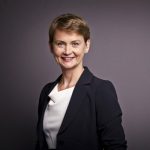
Tag: Yvette Cooper

  • Yvette Cooper – 2025 Speech on the 25th anniversary of the Women Peace and Security Agenda

    Yvette Cooper – 2025 Speech on the 25th anniversary of the Women Peace and Security Agenda

    The speech made by Yvette Cooper, the Foreign Secretary, on 24 November 2025.

    Can I just welcome all of you here today. You will have already seen on the video that we’ve seen before some of the inspiring women on whose shoulders we now stand in the work around Women, Peace and Security.

    And can I particularly welcome Her Royal Highness the Duchess of Edinburgh and to say thank you to you for being here today but also for the immensely powerful work that you have been doing across the world, shining a light on the experiences of women in some of the most challenging circumstances – thank you.

    And can I thank so many of you here today who have also been involved for many years in important and powerful work to champion women’s voices, to speak up for women and to challenge some of the most devastating circumstances that women can face across the world and the work that you do is hugely important. So thank you for being part of this event today and thank you for the important work that you do.

    Because today we mark an important anniversary…

    It is enabled by women who refused to be silenced in the face of war. 

    Because twenty-five years ago, the international community listened to those courageous women. 

    Listened and acknowledged that not only are women victims of war, women must be the architects of peace… 

    And have recognised that women are too often denied a seat at the table when it comes to resolving those very same conflicts that do such damage to women’s lives… 

    Accepted the clear evidence that when you exclude women then peace is more likely to flounder and violence to resume. 

    Because the UN Security Council Resolution 1325 was a genuine milestone.

    It was the first time that the world’s highest security body put in black and white what we know to be true… 

    That women’s roles, women’s experiences, women’s insights and contributions must be central to the world’s approaches to conflict. 

    Whether that be in our responses during war or our decision-making in order to build peace. 

    So I am very proud that twenty-five years ago, the UK played a leading role alongside civil society to secure Resolution 1325, and in the progress that  it helped to catalyse.

    I’m glad that the UK has carried forward that ambition reflected in 1325 in the years that followed.

    Be it as penholder, ensuring that the UN Security Council discussions uphold women, peace and security principles.

    And supporting women peacebuilders in the most challenging of contexts.

    So we adopted our first UK national action plan under the last Labour government almost twenty years ago and have carried plans through to this day.

    But of course, global progress does not rest simply on governments. 

    It rests on grassroots women’s rights organisations, on campaigners, on community networks, researchers, humanitarians, businesses, peacebuilders and above all on harnessing efforts across different countries, different communities and stakeholders too.

    It rests on you all of you here today who have played your roles in pushing for change. 

    Two and a half decades on, we have seen women play important roles in stopping violence and creating a more just peace for all. 

    Women like Monica McWilliams and Pearl Sagar in Northern Ireland who campaigned for women’s voices to be heard in ending the troubles in Northern Ireland. 

    Or Leymah Gbowee who led a non-violent movement to end Liberia’s civil war. 

    Or the many women of Ruta Pacífica de las Mujeres who helped broker the peace deal that ended Colombia’s protracted conflict.   

    These are so many examples to learn from and to build on. We’ll have an important discussion and I look forward to hearing from people today and women today and their views on the road ahead.

    Because the situation now is more challenging than ever. 

    We have women represented barely a sixth of those at the table in peace talks last year, and in many cases, were excluded entirely. 

    And at a time when we are living through an era of acute instability. 

    There are more countries engaged in violent conflict now than at any time since the Second World War. 

    And that has devastating consequences for all civilians. But too often the impact falls most heavily on women and girls. 

    And if we look at what is happening now in Sudan. 

    In El Fasher where rape is being used systematically as a weapon of war. 

    And where we have seen some of the most terrible stories.

    Women and teenagers and children subject to brutal sexual violence and torture.

    And the UN’s humanitarian chief Tom Fletcher recounted to me last week some of the unimaginable experiences of women survivors that he had met fleeing what he described as an epicentre of global suffering.  

    And suffering that we have seen most acutely in Sudan but more widely too.

    The number of women who live in or close to conflict has almost doubled in the last 15 years.  

    And from Syria to Sudan and from Yemen to Ukraine, it is estimated that in conflict zones up to 30% of women and girls have experienced sexual violence – including some appalling ordeals of rape, or abduction or sexual slavery. 

    And those are the kind of ordeals that can carry lasting stigma and trauma that reverberates for generations. 

    And so, as we have seen conflict getting worse, we have also seen progress stall and going backwards.

    And that is why it is now time to bring new momentum to the commitments captured in Resolution 1325 a quarter of a century ago.

    And as Foreign Secretary, I am determined that we must renew that global focus and ambition around women, peace and security and put it at the heart of UK foreign policy.

    First, by radically stepping up efforts to end impunity for sexual crimes in conflict. 

    Already, the UK is providing expert technical support to Ukrainian police, prosecutors and judges to support war crimes investigations. 

    We have funded specialist sexual investigators to assist in UN fact-finding missions not only in Ukraine, but in Sudan, in the Democratic Republic of Congo, and in Myanmar. 

    Just over a week ago, the UK secured international consensus at the UN Human Rights Council for an urgent UN inquiry into alleged crimes in El Fasher.  

    And the UK-built International Alliance for preventing sexual violence, currently chaired by Ukraine, will rally further support for tackling the silence and stigma faced by survivors of sexual violence.  

    Second, we need to ensure our humanitarian work goes further to address the particular impact of crises on women and girls.  

    In Gaza, pregnant and breastfeeding women are suffering from acute malnutrition and have lost access to critical reproductive health services.

    We have provided £3m to the UN to support pregnant women and new mothers.  

    And I want us to work with Jordan to ensure that the neonatal field hospital that they have can be moved into Gaza as well as part of opening access for humanitarian aid into Gaza.

    And essential wider provision needs to include safe shelter, adequate healthcare and support for survivors of sexual violence to help them recover.

    And third, by amplifying women’s voices and participation in building peace.

    And that’s why we have worked to support women peacebuilders including in Yemen, Afghanistan and Somalia, and will press for their inclusion in peace processes, such as in Syria and Sudan.

    And will initiate a no-tolerance approach to reprisals, working with the UN to condemn acts of violence against women, simply for speaking out. 

    So with these priorities and collective wider efforts, we can bring new energy to the commitments that were captured in UN Security Council Resolution 1325 all those years ago.

    Here at home in the UK, this government has set an unprecedented mission to tackle the epidemic of violence against women and girls including a mission to halve violence against women and girls within the next decade.

    As Foreign Secretary, I am determined to ensure that mission is reflected in our foreign policy too – standing with women across the globe in resisting violence, expanding opportunity and boosting political participation.  

    We will step up our international collaboration to address these horrific harms that should have been consigned to the history books.

    Because we know there cannot be peace, security or prosperity without women playing their part, free from violence and free from fear.

    Thank you very much.

  • Yvette Cooper – 2025 Statement on Gaza and Sudan

    Yvette Cooper – 2025 Statement on Gaza and Sudan

    The statement made by Yvette Cooper, the Foreign Secretary, in the House of Commons on 18 November 2025.

    I want to update the House on two of the world’s gravest conflicts—in Gaza and in Sudan—following recent resolutions in the UN and discussions at the G7, and on the action that the UK Government are taking to pursue peace.

    First, I turn to Gaza. After two years of the most horrendous suffering, the ceasefire agreement led by President Trump with the support of Qatar, Egypt and Türkiye has been in place for six weeks. Twenty hostages are now home with their loved ones, and the remains of 25 more have been returned so their families can grieve. More aid trucks are entering Gaza. But the ceasefire is highly fragile, and there is still a long journey ahead to implement the commitments made at Sharm el-Sheikh and to get to a lasting peace.

    Last night, the UN Security Council passed resolution 2803. The UK voted for this important resolution, which authorises the establishment of an international stabilisation force for Gaza, and transitional arrangements including the board of peace and a Palestinian committee. It underscores the essential need for humanitarian aid and reconstruction, and points the way to a path to Palestinian self-determination and statehood. Crucially, it is supported by the Palestinian Authority, and Arab and Muslim partners in the region and beyond. The resolution is a critical staging post that sustains the unity around President Trump’s 20-point plan.

    Momentum must now be maintained. It is essential that an international stabilisation force and trained Palestinian police can be deployed quickly to support the ceasefire and to avoid a vacuum being left that Hamas can exploit. We will also need the urgent formation of a Palestinian committee alongside the board of peace. As we made clear at the UN last night, these transitional arrangements must be implemented in accordance with international law, and respecting Palestinian sovereignty and self- determination. They should strengthen the unity of Gaza and the west bank, and empower Palestinian institutions to enable a reformed Palestinian Authority to resume governance in Gaza, because Palestine must be run by Palestinians.

    The work to implement the first phase of the ceasefire agreement must continue. That means work so that Hamas releases the bodies of the remaining three hostages taken in the terrorist attack on 7 October, so that their families can properly grieve. We urgently need a major increase in humanitarian aid, because aid into Gaza is still a trickle rather than a flood. Two weeks ago, I visited warehouses in Jordan holding UK aid for Gaza, including one run by the World Food Programme with enough wheat to feed 700,000 people for a month; yet it still sits there because the Jordanian route into Gaza is still closed. People there told me that there were 30 more warehouses nearby, with food, shelter kits, tents and medical supplies—less than 100 miles from Gaza but still not getting in.

    I welcome the very recent improvements in aid flows, and that one more border crossing, Zikim, is now partially open. But it is not nearly enough. We need all land crossings open—including the Rafah border with Egypt— with longer and consistent hours, and urgent work is needed immediately in all parts of Gaza to rebuild basic public services and to provide shelter as winter draws in. Medical staff must be allowed to enter and leave Gaza freely, and international non-governmental organisations need certainty that they can continue to operate. I spoke to the King of Jordan and to doctors in Amman about a maternity and neonatal field hospital unit that stands ready to be moved into Gaza—but, again, they cannot yet get it in. The Israeli Government can and must remove the restrictions and uncertainty now.

    As well as working with the US and others, we are drawing on distinct UK strengths to support a lasting peace. We are providing expertise on weapons decommissioning and ceasefire monitoring, based on the Northern Ireland experience. We are supporting on demining and unexploded ordnance, including with £4 million of new UK funding for the United Nations Mine Action Service, and we are funding to surge in experts, including from British organisations such as the HALO Trust and Mines Advisory Group, whose impressive work I recently saw at first hand. On civil-military co-ordination, we have UK deployments into a dedicated US-led hub for Gaza stabilisation efforts.

    Beyond Gaza, stability in the west bank is essential to any sustainable peace, and I am concerned that the PA faces an economic crisis induced by Israeli restrictions that are strangling the Palestinian economy. The Netanyahu Government should be extending, not threatening to end, the arrangements between Israeli and Palestinian banks—arrangements that are crucial to the everyday economy for Palestinians. This is crucial for stability, which is in Israel’s interests too.

    The pace of illegal settlement building continues. We have seen further appalling incidents of settler violence during the olive harvest. While I welcome Israeli President Herzog’s expression of concern, the response of the Israeli authorities is still completely insufficient—practically and legally. Tackling settlement expansion and settler violence is vital to protecting a two-state solution, in line with the UK’s historic decision to recognise the state of Palestine.

    Let me turn now to Sudan, where the worst humanitarian crisis in the 21st century is still unfolding, right now. The UN humanitarian chief, Tom Fletcher, who has just visited the area, has described it as:

    “the epicentre of suffering in the world”

    and he is right. Over 30 million people need lifesaving aid. Twelve million have been forced from their homes. Famine is spreading. Cholera and preventable disease are rampant. In El Fasher, following advances by the Rapid Support Forces, there are horrifying scenes of atrocities, with mass executions, starvation, and the systematic use of rape as a weapon of war—horrors so appalling they can be seen from space.

    As the United Nations Office for the Co-ordination of Humanitarian Affairs has put it, El Fasher is a crime scene. Satellite pictures show discolouration of sand consistent with pools of blood, multiple clusters of objects consistent with piles of human bodies, and the apparent burning of bodies and operations to dispose of bodies in mass graves. Further horrors will yet unfold unless greater action is taken.

    A year ago, Britain tabled a resolution at the UN Security Council demanding humanitarian access and civilian protection, but it was shamefully vetoed by Russia. Six months ago, at our London-Sudan conference, the UK brought together international partners and secured £800 million in funding, but the situation continues to deteriorate, including with North Kordofan now under threat and fighting moving to El Obeid.

    We need a complete step change in efforts to alleviate the suffering and bring about peace. That means more aid to those in need. The UK has committed over £125 million this year alone, delivering lifesaving support to over 650,000 people—treating children with severe malnutrition, providing water and medicine, and supporting survivors of rape—but the challenge is still access.

    The RSF still refuses safe passage to aid organisations around El Fasher. The Sudanese armed forces are bringing in new restrictions that stand to hinder aid. Both sides must allow unhindered passage for humanitarian workers, supplies and trapped civilians. We are urgently pressing for a three-month humanitarian truce to open routes for lifesaving supplies, but aid will not resolve a conflict wilfully driven by the warring parties, so we desperately need a lasting ceasefire underpinned by a serious political process.

    At the Manama dialogue conference in Bahrain two weeks ago, I called for the same intense international efforts to address the crisis in Sudan as we have seen around Gaza. At Niagara last week, I joined our G7 partners in calling for an immediate and permanent ceasefire, for the unimpeded access of humanitarian aid, and for external actors to contribute to the restoration of peace and security. We are engaging intensively with the Quad countries—the United Arab Emirates, Saudi Arabia, Egypt and the United States—which have now together called for an immediate humanitarian truce, and an end to external support and arms that are fuelling conflict. I strongly support Secretary Rubio’s latest comments regarding the need to end the weapons and support that the RSF is getting from outside Sudan.

    Last Friday, the UK called a special session of the United Nations Human Rights Council, in which a UK-drafted resolution was passed, securing international consensus for an urgent UN inquiry into alleged crimes in El Fasher, because impunity cannot be the outcome of these horrifying events. We need to ensure that teams can get in to investigate those atrocities and hold the perpetrators to account, and I have instructed my officials to bring forward potential sanctions relating to human rights violations and abuses in Sudan.

    The UK will play its full part to ensure that it is the Sudanese people, not any warring party, that determines Sudan’s future. Wars that rage unresolved do not just cause untold harm to civilians; they radiate instability, undermine the security of neighbouring states, and lead migrants to embark on dangerous journeys. We are striving to meet those urgent humanitarian needs, and striving to secure not just the absence of conflict, but the presence of lasting peace. From Gaza to Sudan that can only be done through international co-operation, and through countries coming together for peace. I commend this statement to the House.

  • Yvette Cooper – 2025 Statement on Rapid Support Forces in El Fasher

    Yvette Cooper – 2025 Statement on Rapid Support Forces in El Fasher

    The statement made by Yvette Cooper, the Foreign Secretary, on 27 October 2025.

    Further advances by the Rapid Support Forces (RSF) in El Fasher, Sudan, are having a horrifying and devastating impact on civilians. With hundreds of thousands of people trapped in the city, many facing forced displacement and indiscriminate violence, the humanitarian consequences are catastrophic. Civilians must be able to leave safely and access lifesaving aid without obstruction.

    We are witnessing a deeply disturbing pattern of abuses in El Fasher — including systematic killings, torture, and sexual violence. Women and girls are facing particularly horrific violations such as sexual violence and rape as a weapon of war, and their suffering must not be ignored.

    Both the RSF and the Sudanese Armed Forces have publicly committed to protecting civilians and enabling humanitarian access in line with international humanitarian law. These commitments must now be translated into immediate and concrete action. Orders must be issued to forces on the ground to ensure the safety of civilians, humanitarian personnel, and operations. The RSF leadership will be held accountable for the actions of their forces.

    All parties must urgently cooperate with the UN and humanitarian agencies to enable safe, rapid, and unimpeded access, in line with UN Security Council Resolution 2736. Attacks on civilians, aid workers, and civilian infrastructure — including hospitals — must stop now.

    UK aid is making a difference on the ground, including reaching the most vulnerable through organisations such as the International Committee of the Red Cross and the Sudan Humanitarian Fund. In total we are contributing by providing over £120 million in aid to Sudan, including allocating an additional £5 million to the Sudan Cash Consortium, with around two-thirds of this support for the most vulnerable in North Darfur.

    Bringing an end to the war in Sudan will also support security at home and help tackle illegal migration to the UK. The UK will continue to work with international partners, including the Quad, to push for an immediate ceasefire and a path toward peace. The suffering must end.

  • Yvette Cooper – 2025 Speech at the UN Security Council Meeting on Ukraine

    Yvette Cooper – 2025 Speech at the UN Security Council Meeting on Ukraine

    The speech made by Yvette Cooper, the Foreign Secretary, at the UN Security Council Meeting held in New York on 23 September 2025.

    Thank you, Mr. President. Thank you to the Secretary General for his briefing, and thank you to President Zelenskyy and Minister Sybiha. The United Kingdom commends you for your leadership and your determination.

    Thank you too for welcoming me to Kyiv two weeks ago, where I saw first-hand the impact of Russia’s brutal war and I met families whose lives had been uprooted, their homes destroyed, their children’s education torn apart.

    But as Putin cynically stalls on peace, I also saw a nation resolute in its fight, and I saw the strength and the courage of the Ukrainian people, the soldiers, civilians, the mothers and fathers, first responders, health care workers, who are standing up to defend their homes and their land.

    Russia’s illegal and unprovoked war of aggression is not just a test of Ukrainian resilience and security, it is an assault on the United Nations Charter and its most foundational principles: respect for sovereignty and for territorial integrity, principles on which we all depend every day and feel acutely whenever they are threatened. And it is an assault on the UN Charter by a member of this Security Council.

    President Zelenskyy has made clear that he wants peace and wants this war to end, that he and Ukraine have supported a full unconditional ceasefire and reaffirmed his readiness to meet President Putin.

    Alongside European partners, the US and President Trump are working to support a peace process, but Putin continues to choose war. He has rejected calls for a meaningful ceasefire. He has refused even to meet President Zelenskyy in a neutral venue.

    And Putin’s strategy includes the forced deportation, indoctrination, and militarisation of children. It includes the intensifying of targets against civilians, strikes on Ukrainian cities and critical infrastructure on families as they sleep in their beds at night.

    Civilian casualties have risen nearly 40% with children killed in playgrounds, diplomatic premises and government buildings damaged, hospitals and schools destroyed. And these are not accidents of war. They are the result of a cruel strategy targeting the people and communities of Ukraine.

    But anyone who knows Ukrainians knows that this will never succeed because their determination to hold on to their freedom to protect their families, their nation far exceeds Russia’s ability to take those things away.

    And indeed, what we have seen is Ukraine repeatedly, repeatedly, undermine Russia’s military goals, so that despite the huge Russian mobilisation attempts in the last three years, their overall impact on their military goals has been minimal.

    In this war that they started, their losses are now 20 times higher than were Soviet losses in Afghanistan.

    In this war that they are continuing to pursue, they’re struggling to recruit, and in some areas, their stocks are so low they have resorted to using military equipment from the 1950s.

    What is this for? Because, as Ukraine stands firm against Russia, the United Kingdom stands firm with Ukraine. We know that Ukraine’s security is our security, and all of us depend on upholding the UN Charter.

    We know that Russia exports interference, disinformation and instability, well beyond Ukraine. From cyber-attacks in Moldova to the deployment of mercenaries in the Sahel, Russia’s actions seek to undermine democracies, fuel conflict and spread instability far beyond Europe’s borders.

    And in recent weeks, we’ve seen provocative and reckless violations of NATO airspace in Estonia, Poland and Romania, against which NATO stands firm, and we will be ready to act.

    So the UK will continue to stand with Ukraine, providing the support it needs to defend itself now and to rebuild in the future. Rebuilding as a strong, prosperous nation, free to make its own choices.

    And so, I say to the representative of the Russian Federation, we will target your ailing economy, your oil and gas revenues that are paying for this war, the defence industry making your munitions and weapons, because we know for Russia, the price of war is piling up and the sanctions are tightening the screws.

    Falling energy revenues are squeezing the state budget, and oil revenues are now at a five-year low, but we will go further. Be in no doubt.

    And to our Ukrainian friends, I say you have the UK’s unwavering support now and for decades to come.

    And to this Council, I simply offer a reminder that 80 years ago, our predecessors came together as United Nations to save succeeding generations from the scourge of war. That mission remains as noble today as it was in 1945.

    Each generation is tested anew, and we must rise to this test for Ukraine and for us all. Thank you.

  • Yvette Cooper – 2025 Speech on Violence Against Women

    Yvette Cooper – 2025 Speech on Violence Against Women

    The speech made by Yvette Cooper, the Foreign Secretary, at the United Nations in New York, United States on 22 September 2025.

    I am honoured to join you today as the United Kingdom’s new Foreign Secretary.

    And to be here too, alongside the UK’s trailblazing Special Envoy for Women and Girls, Baroness Harriet Harman, who gave me one of my first jobs in politics more than 30 years ago, including research on women’s equality, not long before the Beijing Declaration was adopted.

    I remember at that time just how significant it felt to see countries coming together, from across the globe, committed to advancing women’s equality and women’s rights.

    So it is particularly special to be here three decades on to discuss an issue that has been so close to my heart since, and to be clear that this will be a priority for me now, in this role. 

    Supporting women across the globe, on leadership, on representation, on access to education and economic opportunity. 

    An agenda set by women, and supported by male allies, who are vital partners for progress. 

    But I particularly want to draw attention to the topic of Violence Against Women and Girls.

    Because we know that safety and security are the bedrock on which all opportunities in our lives are built. Women’s safety is an essential foundation for women’s equality.

    And while individual nations and UN agencies have helped to achieve great strides forward, with FGM and forced marriage less prevalent than they were three decades ago.

    The facts should still shame us all.

    Across the globe, 1 in 3 women will be beaten or sexually assaulted in their lifetime. 

    140 women and girls are killed every day by a partner or close relative. 

    And rape and sexual violence continue to be used as a weapon of war. 

    My Government has described violence against women and girls in the UK as a national emergency, and we have set out an unprecedented mission to halve it in a decade.

    But the truth is that this is an international emergency too.

    So today I make two calls for action.

    First, that we step up our efforts to eliminate violence against women and girls, because everyone has the right to live in freedom from fear. 

    Including challenging new forms of abuse and collaborating against devastating sexual abuse of children online.

    And second, we must ensure that the multilateral system remains a powerful force for the rights and equality of women and girls everywhere because we know that by doing so, we also strengthen our families, our communities, our economies and our nations too.

  • Yvette Cooper – 2025 Statement on Asylum Seekers, Borders and Migration

    Yvette Cooper – 2025 Statement on Asylum Seekers, Borders and Migration

    The statement made by Yvette Cooper, the Home Secretary, in the House of Commons on 1 September 2025.

    With permission, I will update the House on the actions we are taking with France to strengthen our border security and the next steps in our reforms to the asylum system.

    The House will be aware that when we came into government, we found an asylum and immigration system in chaos: for seven years, small boat gangs had been allowed to embed their criminal trade along the French coast; the asylum backlog was soaring; and illegal working was being ignored. The previous Government had lost control of the system and, as a result, opened many hundreds of asylum hotels across the country, while returns were a third lower than in 2010. Before leaving office, they deliberately cut asylum decision making by 70%, leaving behind a steeply rising backlog. It is little wonder that people across the country lost confidence in the system and demanded to know why they were paying the price of a system that was so out of control.

    However, that does not mean that people rejected the long and proud history of Britain doing our bit to help those fleeing persecution or conflict—including, in the past decade, families from Ukraine, Syria and Hong Kong. It is the British way to do our bit alongside other countries to help those who need sanctuary. However, the system has to be controlled and managed, based on fair and properly enforced rules, not chaos and exploitation driven by criminal smuggler gangs. It is exactly because of our important tradition that substantial reforms are needed now.

    In our first year in government, we have taken immediate action, laying the foundations for more fundamental reform. We restored asylum decision making and then rapidly increased the rate of decisions. Had we continued with the previous Government’s freeze on asylum decisions, thousands more people would have been in hotels and asylum accommodation by now. Instead, we removed 35,000 people with no right to be here, which included a 28% increase in returns of failed asylum seekers and a 14% increase in removals of foreign criminals. We have increased raids and arrests on illegal working by 50%, and we cut the annual hotel bill by almost a billion pounds in the last financial year. We are rolling out digital ID and biometric kits so that immigration enforcement can check on the spot whether someone has a right to work or a right to be in the UK. On channel crossings and organised immigration crime, we are putting in place new powers, new structures and new international agreements to help to dismantle the criminal industry behind the boats.

    I want to update the House on the further steps we are now taking. In August, I signed the new treaty with France allowing us, for the first time, to directly return those who arrive on small boats. The first detentions—of people immediately on arrival in Dover—took place the next day, and we expect the first returns to begin later this month. Applications have been opened for the reciprocal legal route, with the first cases under consideration, subject to strict security checks. We have made it clear that this is a pilot scheme, but the more that we prove the concept at the outset, the better we will be able to develop and grow it.

    The principles the treaty embodies are crucial. No one should be making these dangerous or illegal journeys on small boats; if they do, we want to see them swiftly returned. In return, we believe in doing our bit alongside other countries to help those who have fled persecution through managed and controlled legal programmes.

    This summer we have taken further action to strengthen enforcement against smuggling gangs. France has reviewed its maritime approach to allow for the interception of taxi boats in French waters, and we will continue to work with France to implement the change as soon as possible. In the past year, the National Crime Agency has led 347 disruptions of immigration crime networks—its highest level on record, and a 40% increase in a year.

    Over the summer, we announced a £100 million uplift in funding for border security and up to 300 more personnel in the National Crime Agency focusing on targeting the smuggler gangs. The Border Security, Asylum and Immigration Bill will give them stronger powers: counter-terrorism powers against smuggler gangs, powers to seize and download the mobile phones of small boat arrivals, and the power to ban sex offenders from the asylum system altogether. If Opposition parties work with us to speed the passage of the Bill through the other place, instead of opposing it, those powers could be in place within months, making our country safer and more secure.

    Let me turn to the major reforms that are needed to fix the broken asylum system that we inherited. Although we have increased decision making and returns, the overall system remains sclerotic, outdated and unfair. As we committed to in the immigration White Paper, we will shortly set out more radical reforms to modernise the asylum system and boost our border security. We will be tackling the pull factors, strengthening enforcement, making sure that people are treated fairly and reforming the way that the European convention on human rights is interpreted here at home. We will be speeding up the system, cutting numbers and ending the use of hotels, and developing controlled and managed routes for genuine refugees.

    At the heart of the reforms will be a complete overhaul of the appeals system—the biggest obstacle to reducing the size of the asylum system and ending hotel use. Tens of thousands of people in asylum accommodation are currently waiting for appeals, and under the current system that figure is to grow, with an average wait time already of 54 weeks. We have already funded thousands of additional sitting days this year, and the border security Bill will introduce a statutory timeframe of 24 weeks.

    However, we need to go further. We will introduce a new independent body to deal with immigration and asylum appeals. It will be fully independent of Government and staffed by professionally trained adjudicators, with safeguards to ensure high standards. It will be able to surge capacity as needed and to accelerate and prioritise cases, alongside new procedures to tackle repeat applications and unnecessary delays. We are also increasing detention and returns capacity, including a 1,000-bed expansion at Campsfield and Haslar, with the first tranche of additional beds coming online within months to support many thousands more enforced removals each year.

    Our reforms will also address the overly complex system for family migration, including changes to the way that article 8 of the ECHR is interpreted. We should be clear that international law is important. It is because other countries know that we abide by international law that we have been able to make new agreements with France, to return people who arrive on small boats, and with Germany, to stop the warehousing of small boats by criminal gangs, and it is why we have been able to explore return hubs partnerships with other European countries. However, we need the interpretation of international law to keep up with the realities and challenges of today’s world.

    There is one area where we need to make more immediate changes. The current rules for family reunion for refugees were designed many years ago to help families separated by war, conflict and persecution, but the way they are used has now changed. Even just before the pandemic, refugees who applied to bring family to the UK did so on average more than one or two years after they had been granted protection, which was long enough for them to get jobs, find housing and be able to provide their family with some support. In Denmark and Switzerland, those who are granted humanitarian protection are currently not able to apply to bring family for at least two years after protection has been granted.

    However, in the UK those family applications now come in, on average, around a month after protection has been granted, often even before a newly granted refugee has left asylum accommodation. As a consequence, refugee families who arrive are far more likely to seek homelessness assistance. Some councils are finding that more than a quarter of their family homelessness applications are linked to refugee family reunion. That is not sustainable. Currently, there are also no conditions on family reunion for refugee sponsors, unlike those in place if the sponsor is a British citizen or long-term UK resident. That is not fair.

    The proportion of migrants who have arrived on small boats and then applied to bring family has also increased sharply in recent years, with signs that smuggler gangs are now able to use the promise of family reunion to promote dangerous journeys to the UK. We continue to believe that families staying together is important, which is why we will seek to prioritise family groups among the applicants to come to Britain under our new deal with France, but reforms are needed. So in our asylum policy statement later this year, we will set out a new system for family migration, including looking at contribution requirements, longer periods before newly granted refugees can apply, and dedicated controlled arrangements for unaccompanied children and those fleeing persecution who have family in the UK.

    We aim to have some of those changes in place for the spring, but in the meantime we do need to address the immediate pressures on local authorities and the risks from criminal gangs using family reunion as a pull factor to encourage more people on to dangerous boats. Therefore, this week we are bringing forward new immigration rules to temporarily suspend new applications under the existing dedicated refugee family reunion route. Until the new framework is introduced, refugees will be covered by the same family migration rules and conditions as everyone else.

    Let me turn next to the action we are taking to ensure that every asylum hotel will be closed for good under this Government, not just by shifting individuals from hotels to other sites but by driving down the numbers in supported accommodation overall, and not in a chaotic way through piecemeal court judgments, but through a controlled, managed and orderly programme: driving down inflow into the asylum system, clearing the appeals backlog, which is crucial, and continuing to increase returns. Within the asylum estate, we are reconfiguring sites, increasing room sharing, tightening the test for accommodation and working at pace to identify alternative, cheaper and more appropriate accommodation with other Departments and with local authorities. We are increasing standards and security and joint public safety co-operation between the police, accommodation providers and the Home Office to ensure that laws and rules are enforced.

    I understand and agree with local councils and communities who want the asylum hotels in their communities closed, because we need to close all asylum hotels—we need to do so for good—but that must be done in a controlled and orderly manner, not through a return to the previous Government’s chaos that led to the opening of hotels in the first place.

    Finally, let me update the House on the continued legal and controlled support that we will provide for those facing conflict and persecution. We will continue to do our bit to support Ukraine, extending the Ukraine permission extension scheme by a further 24 months, with further details to be set out in due course. We are also taking immediate action to rescue children who have been seriously injured in the horrendous onslaught on civilians in Gaza so that they can get the health treatment they need. The Foreign Secretary will update the House shortly on the progress to get those children out.

    I confirm that the Home Office has put in place systems to issue expedited visas with biometric checks conducted prior to arrival for children and their immediate accompanying family members. We have done the same for all the Chevening scholars and are now in the process of doing so for the next group of students from Gaza who have been awarded fully funded scholarships and places at UK universities so that they can start their studies in autumn this year. Later this year, we will set out plans to establish a permanent framework for refugee students to come and study in the UK so that we can help more talented young people fleeing war and persecution to find a better future, alongside capped and managed ways for refugees to work here in the UK.

    The Government are determined to fix every aspect of the broken system we inherited and to restore the confidence of the British people, solving problems, not exploiting them, with a serious and comprehensive plan, not fantasy claims based on sums that do not add up or gimmicks that failed in the past. What we will never do is seek to stir up chaos, division or hate, because that is not who we are as a country, and that is not what Britain stands for.

    This is a practical plan to strengthen our border security, to fix the asylum chaos and to rebuild confidence in an asylum and immigration system that serves our national interests, protects our national security and reflects our national values. When we wave the Union flag, when we wave the St George’s flag, when we sing “God Save the King” and when we celebrate everything that is great about Britain and about our country, we do so with pride because of the values that our flags, our King and our country represent: togetherness, fairness and decency, respect for each other and respect for the rule of law. That is what our country stands for. That is the British way to fix the problems we face. I commend this statement to the House.

  • Yvette Cooper – 2025 Speech at the Police Bravery Awards

    Yvette Cooper – 2025 Speech at the Police Bravery Awards

    The speech made by Yvette Cooper, the Home Secretary, at the Royal Lancaster Hotel on 11 July 2025.

    Thank you very much, good evening everyone, and thank you as ever to the Police Federation and of course Police Mutual for organising the event this year, and thank you for the invitation to speak and to present this inspirational award.

    I’m very conscious as well of being asked to speak before everyone gets to eat as well.

    I’ve actually been an MP now for 28 years, of which 15 of them I have had the honour to be able to come here to this event.

    It was an early mistake that I tried to learn from in my first years as an MP, where I had been invited to the annual dinner from a local community organisation. I had all of the briefing notes from my new office, and they said, they wanted to speak for three quarters of an hour.

    Three quarters of an hour? And then they asked me to speak before dinner as well – seriously? And I got to 25 minutes into this speech, and I could see everybody just getting really, you know, picking up the glasses, getting increasingly irritable.

    We’ve got a chair next to me, obviously rustling bits of paper, and I’m thinking, and it still says speak for three quarters of an hour. And I kept going. I had said literally everything I could think of about this community organisation. And finally I sat down and the chair said to me, said “right, well, we’ve cancelled the first course. We’re going to move on.”

    I said – what have I done? He said “so we did ask your office if you could speak for four to five minutes.”

    So I will learn from that experience and try not to speak for too long. But I did want to just have a chance to pay some tributes and to say a huge thank you, because it’s many times I have been here in shadow roles, in different roles, and to see a huge amount of work that policing does, the bravery that policing shows.

    But this is my second time here and at the end of just my first year as a Home Secretary, and it has been a huge honour to see every single day this year the incredible work that policing does in so many different parts of the country, so many different ways.

    But I actually wanted to start by paying tribute not to the officers who’ve been nominated, not even to all of the officers and staff that support them, but to all the family members who are here and who do so much to support all of the officers, all of our police family in the work that they do.

    The policing family includes all of those family members who are here, who have to put up with, who have to get the kids to school, who have to sort out everything, and also deal with the stress and the worry and provide the support so that every one of you can do your job. So please join with me in saying a huge thank you and paying tribute to all of the family members.

    I want to say thank you as well to not just all of you, but everyone within policing and the the officers, the officers who’ve had to face the most difficult situations, but also all of the colleagues, all of the PCSOs, the staff, from the forensics officers to the family liaison support officers, everybody within policing who holds policing together, that in turn holds our communities together and keeps all of us safe.

    And we often talk about the way in which you have to run towards danger when the rest of us get to walk away, but you also have to run towards the trickiest, the most difficult situations that the rest of us can’t solve. And when everybody else has given up, it’s you that have to pick up the pieces. And as one officer that I spoke to this evening said, he was saying “well, it’s just the job we do.” He said “who else are you going to call?”

    And it’s true, when everything else goes belly up, you are the ones that we call. So I just wanted to say a huge thank you, because we owe you a huge debt of gratitude for being the ones we call when everything else has gone wrong, and for being the ones who are there to pick up the pieces too.

    So I want to thank you too to recognise the impact and the consequences that that can have for all of you, because I know too that this really isn’t an easy job, and it’s a special job, and you do it with the most incredible dedication, but it also has consequences, and there’s a price to be paid for doing such a difficult job as well.

    And so I wanted to just also say we’re drawing up now, and Diana Johnson, the Policing Minister, is here today as well. We’re drawing up now a policing reform white paper that recognises many of the challenges that are faced across policing. And we’re trying to do this in a different way, working with police forces, working with policing in a way that I don’t think governments previously have done.

    But we will also make sure that respect for the workforce and the support the workforce needs is also a part of that white paper.

    And I wanted to particularly to thank everyone for the work that has been done to roll out, based on some of the pilots that’s been done, the first police specific mental health crisis line, to be able to provide that added support that we will need to build on to make sure that we recognise the impact that this has, this incredible job also has on those who do this.

    I want to say a huge thank you to all of them, the award nominees here tonight, and to pay tribute and to honour the huge bravery shown. You will hear the stories later on. And some of those who I’ve spoken to have said, well, I’ve heard everybody else’s stories, but really, you know, I shouldn’t have been nominated, because look at the bravery that everybody else has shown. And I think everybody has, I’ve heard say something similar, and would really just say to all of you, please do, let us pay tribute to you, because the bravery you’ve shown in those split second moments has been truly incredible and has helped save lives and has helped change lives, and has been the crucial things that we depend on you to do. And we are saying thank you, both to you and also to all of your colleagues, through you as well.

    Those stories of total selflessness, where we’ve had people trapped in burning buildings or freezing waters with no hope of survival, until our police officers from Lincolnshire, Staffordshire, Derbyshire, Essex, Manchester and Sussex came running to their rescue.

    The stories of the sheer instinctive courage, where dangerous men were stopped from doing huge harm to others only because officers from Bedfordshire, Cheshire, Dorset, Durham, Hampshire, Leicestershire, Leyton, Suffolk, Surrey, Thames Valley, Tower Hamlets and Wiltshire were willing to put their own lives on the line to keep everybody else safe.

    And the stories of the incredible compassion where people who were ready to end their own lives were pulled back from the brink by the interventions from officers from Kent, from Humberside, from Norfolk, South Wales, West Yorkshire.

    And stories of officers from Cambridge and North Wales, Nottinghamshire, South Yorkshire, dealing with apparently routine cases, issues that they were responding to, suddenly found themselves dealing with the most serious and deadly situations that they had to respond to with the utmost calm as well.

    And if the stories tell us anything, it’s the way in which all of you need to respond and be ready to respond to anything that you face, whether it’s the off duty officers in Lancashire or Southall breaking up fights in the street. Or in Cleveland, Cumbria, West Mercia, West Midlands, dealing with the mobs or gas explosions or speeding vehicles or dangerous dogs. Or in Northumbria, responding to the disgraceful disorder that broke out on the streets last summer.

    I am so sorry that so many of you who had to deal with frankly that disgraceful way, you should never have had to face the attacks on police officers by mobs, by missiles, and I will always back you in the job that you do to keep people safe.

    I think what the awards also show us is the fine line, the close margins between the miracles and the tragedies, and between the lives that you were able to save and the lives that no one could have saved.

    But you were still there, and you still did your best to help them, and the stories that we have this evening from Avon and Somerset, from Dyfed-Powys, from Gwent, from Northamptonshire and Warwickshire of officers trying to rescue individuals trapped in the most terrible of situations.

    So as we celebrate the lives that were saved, we also mourn the lives that were lost, and think of the victims too, and thank every officer for the incredible, incredible courage that was shown.

    And the same is true, perhaps most of all for our colleagues here this evening from Merseyside police, and I know they would give anything not to be in the room tonight and not to have their story be one of those that we once again, remember or be forced to relive that awful day once again.

    But we all know, and we’re all so grateful, because it was if it was not for you, and if it was not for your courage or the instinct that told you and your colleagues to run towards danger that day, there would be many more mums and dads in Southport today without their little girls to hold.

    So it’s a reminder, it’s a recognition of what something Sir Robert Peel said in a speech in Parliament 180 years ago when he talked about recognising the very best of public service, but also recognising you and through you, all of those that you work with too, because the service you have given, in his words, was “remembered, marked and honoured by a grateful country.”

    So I’m hugely grateful, but I say this on behalf of people right across the country. We’re hugely grateful for the bravery that you’ve shown, not just to face the really difficult things, but also then to get back up the following morning and to face it all again.

    So thank you for doing that. Thank you for caring so much for the job that you do, and thank you so much for being part of the amazing thing that is British policing. Thank you for keeping us safe.

  • Yvette Cooper – 2025 Speech at the Organised Immigration Crime Summit

    Yvette Cooper – 2025 Speech at the Organised Immigration Crime Summit

    The speech made by Yvette Cooper, the Home Secretary, on 31 March 2025.

    Thank you very much. Thank you Prime Minister, thank you to the Italian Prime Minister and good morning everyone.

    Can I thank everyone for travelling here from all over the world. Interior ministers, senior law enforcement, delegations from over 40 countries and organisations, we are so pleased to welcome you to London and here to Lancaster House for this, the first summit of its kind on organised immigration crime and border security, and to have so many people come from across the world, shows the seriousness with which all our countries are taking these issues, but also, bluntly, how much more together we need to do.

    Of course, we are not the first generation to grapple with international migration, the societal, economic security consequences that flow through the centuries.

    Of course, people have travelled across borders to work, to study, join family, to flee war or persecution, to escape poverty, to seek a better life for a different future, to chase new resources, or to forge new nations.

    But in recent years, we have seen new and serious patterns and scales of irregular and illegal migration causing major challenges for border security, for national security, for the rule of law, for countries and the economy across so many of our countries, in source, in transit and in destination, countries alike.

    And 2 facts have accelerated and changed some of the challenges our countries face.

    Firstly, technology. The physical distances between nations and continents may not have changed, but technology has made the world feel a lot smaller.

    Organising journeys can be faster and easier than ever, and the details of a different future is suddenly right there on a smartphone in the palm of your hand.

    And the second factor is the emergence of a vast and ruthless criminal industry that stretches across borders and across continents worth billions of pounds.

    The criminal smuggler and trafficking gangs who profit from undermining our border security, our national security and the rule of law and from putting lives at risk, have grown and stretched across the globe.

    And every country here will have different stories to tell and insights to share, but across all of our countries, we’ve seen that organised immigration crime posing a significant and growing global threat with far reaching consequences for us all – breaking our laws, undermining our security and our cohesion.

    From the source countries where gangs prey on the vulnerable, to transit countries where people and equipment pass through towns and borders unchecked, to destination countries managing the financial, the social and the criminal fallout, no part of the journey is untouched.

    And those gangs profiting from what is a vile trade in human beings are exploiting more people than ever before.

    You have heard from our Prime Minister what that means for us here in the UK, and in just 6 years, we’ve seen a criminal industry organising the small boat crossings take hold along our borders.

    Three hundred people crossed the channel on flimsy, dangerous small boats 6, 7 years ago, but 4 years later, that rose to over 30,000, an increase, a 100 fold increase, powered by smuggler and trafficking gangs.

    The gangs who advertise on social media false promise of illegal jobs, gangs who organise the logistics, the fake papers, the illegal finance networks to take everyone’s money, have thousands of pounds, the supply chains, the flimsy rubber boats, the engines.

    And perhaps for us, one of the most disturbing things of all, for us and for France, for the Calais Group, to see some of the fake life jackets, including fake life jackets for children that would not keep anyone afloat in the cold sea.

    And then the organisation along the beaches of France, the violence, the increasing and outrageous violence, against law enforcement.

    And to give you the example of how they run some of those organisations, we’ve seen the small boats, the flimsy rubber boats, take off as taxi boats and make people wait in the freezing water, in the freezing sea, so they then wait to be picked up, to climb onto the boats and then they overcrowd the boats with women and children put in the centre of the boat, the boat can then fold in. There’s the women and children who get crushed and then if the fuel in flimsy containers then leaks and mixes with salt water that can cause terrible, terrible burns.

    And then we’ve seen children crushed to death, and yet the boat carries on and that shameful, disgraceful crime where people, criminal gangs have profited from those lives being lost.

    And that’s why we cannot let that carry on.

    All of your countries will have the different stories of the way in which the gangs are exploiting people into sexual exploitation, into slave labour, into crime.

    The way in which the gangs are using new technology, not just the phones, the social media to organise, but even the drones to spot where the border patrols are, the operations along the land borders, across continents.

    But it is governments, not gangs, who should be deciding who enters our country, and those gangs are operating and profiting across borders.

    So we and our law enforcement need to co-operate across borders now to take them down.

    That’s why, as you heard from our Prime Minister, we are strengthening our laws here in the UK, bringing in new counter-terror powers so we can seize phones, investigate preparatory acts, so we can crack down on the illegal working of modern slavery and establishing our new Border Security Command.

    But we know that strengthening our border security means working with all the countries on the other sides of our borders, not just standing on our shoreline, shouting at the sea.

    We know too that no country can do this alone, and that is why the partnerships and everyone gathering here is so important.

    So today we will talk about what to do to tackle this vile trade in human beings.

    How we choke off the supply chains, the false papers, how we go after the money, how we take down the advertising.

    And how we disrupt, how we pursue, how we prosecute, how we pursue this global battle against a trade in people.

    It is our determination to do this together, the alliances that we build across our borders can be stronger than the criminal gangs who seek to undermine us.

    Thank you all for joining with us in this event today, this first summit. We have so much work to do during the course of the day, so many conversations to have, but thank you so much for being part of it, and I look forward to hearing everyone’s views during the conference today.

    Thank you very much.

  • Yvette Cooper – 2025 Speech at the Community Security Trust

    Yvette Cooper – 2025 Speech at the Community Security Trust

    The speech made by Yvette Cooper, the Home Secretary, in London on 26 March 2025.

    Thank you, Sir Lloyd for those kind words, good evening everyone.

    And let me start by thanking everyone involved in CST for the remarkable, tireless and crucial work you have done not just this year, but day-in, day-out for the past 3 decades to keep our Jewish communities safe and secure. The work CST does makes the difference every single day between confidence and fear, between safety and danger, between life and death, and we owe you all a huge debt of thanks.

    For the research and analysis they undertake to expose the scourge of antisemitism. The critical security they provide for hundreds of Jewish communal buildings and events every year. The fact that every week, thousands of British Jews go to school, or to synagogue, more confident in the knowledge that CST are providing protection and support.

    And I particularly want to thank all the volunteers keeping us safe here tonight.

    It is a real honour for me to be here as Home Secretary and I want to talk tonight about why CST plays such a remarkable and important role not just in the security of Jewish families and communities across Britain, but also in the security of our entire nation. And why defending our national security – the first and foremost task of any government – means defending the security and safety of Britain’s Jews.

    But there is no way to pay tribute to this extraordinary organisation, without first paying tribute to its extraordinary founder and chairman, Sir Gerald Ronson. Gerald you have been the most formidable champion for CST and for the wider Jewish community, but also whose philanthropic work on causes from protecting children to older care has had such a profoundly positive impact on society.

    Since I came to Parliament in 1997, I have watched Gerald build CST into the pioneering and world-leading organisation that it is today. So Gerald thank you for being such an astonishing advocate – because without your determination and dedication, CST would not be what it is today.

    And on a personal note, Gerald and Gail, let me thank you for being such good friends to Ed and I over these last 25 years.

    Ed and I have come many times to CST dinners through the years in different roles. I think the first time we came was before 2010 government ministers, as shadow ministers. More recently for me as Home Affairs Select Committee Chair and for Ed as co-chair of the Holocaust Memorial Foundation. But we come not because of our jobs but because of what tonight is about – strongly supporting Britain’s Jewish communities and strongly supporting the remarkable work of CST.

    Many of you have asked where Ed is tonight. He does send his apologies tonight – and this is a sentence I never thought I would hear myself say, certainly not 10 years ago – he is in Hong Kong with George Osborne recording a special edition of their podcast. Such is the life of the former politician turned dancer turned glamorous media star.

    Although I did have a moment at a recent reception like this, when I introduced myself to a table of guests and started talking about my husband co-chairing the work on the memorial. Only for one of the older guests to nod wisely and tell her friends: “I knew I recognised her from somewhere – she’s married to Eric Pickles!”.

    But I do want to commend the work that the Holocaust Memorial Foundation is doing – chaired by Ed and Eric and backed by so many of you – to ensure that the Memorial and Learning Centre are built according to plan, next to the Palace of Westminster and the seat of our democracy, to ensure that future generations of young people in our country will learn about the evil of antisemitism and the horror of where it leads.

    This government will continue the work of our predecessors ensuring that the Holocaust Memorial is built for future generations. Just as we will continue our steadfast support for the CST and for the security of Jewish communities across the UK.

    And just as the Prime Minister was unrelenting in his mission to root out the stain of antisemitism from the Labour Party after that truly shameful period in our party’s history. Now in government, we will be equally unrelenting in our crackdown on those who spread the poison of antisemitism on our streets or online.

    We may have disagreed with the previous government on many things. And we may have inherited difficult decisions on the economy and spending. But when it comes to our support for CST and keeping our communities safe, there will be absolute continuity and certainty.

    I have spoken to 2 of my predecessors here tonight, Grant Schapps and James Cleverly here tonight and we have committed to maintaining the multi-year funding for CST that Rishi Sunak announced here last year. And why we will always seek to build the broadest cross-party consensus on public protection, so that no matter who has the keys to number 10 Downing Street, our Jewish communities know that the government is on their side.

    And I know that for the community this has been another extremely difficult year. In the short months I have been in the Home Office, I and other ministers in my department have met with many of you – just as we did many times when we were on the opposition benches.

    With the CST, the Board of Deputies, the Jewish Leadership Council, the Union of Jewish Students and many more. We’ve talked about the 3,500 incidents of anti-Jewish hate that were recorded by CST last year.

    The second highest total ever reported in a single calendar year. Threats to kill sent to synagogues. Individuals spat on or assaulted in the street. Graffiti daubed on religious sites. Antisemitic bullying in schools.

    And we’ve talked not just about the disgraceful crimes and the action needed, but about the real impact they have – for you and your families.

    I have heard some of your personal experiences of what recent years have felt like. Holding your child’s hand that bit more tightly on the way to school, the extra worry about your teenagers away at university. And the sickening jolt in the stomach from the antisemitic hatred posted online, waved on placards, worn on t-shirts, or shouted openly in the streets.

    It is those painful, personal experiences that lie behind the figures.

    And make no mistake – these horrific incidents are a stain on our society that simply will not be tolerated. Not now and not ever. Because there is no place for antisemitism in Britain.

    We all know that fear has grown since the barbaric terrorist attack by Hamas on October 7, 2023. The single deadliest day for Jewish people since the Holocaust. And the past 16 months have seen intense anguish. The living nightmare of hostages and their families. The appalling devastation and destruction we have seen in Gaza.

    The ceasefire deal agreed in January provided a glimmer of hope. I know the joy every one of us in this room will have felt seeing Emily Damari reunited with her mother Mandy, and the relief of so many hostage families, as well as the desperately needed aid flowed back into Gaza.

    But the breakdown of the ceasefire and resumption of airstrikes has devastating consequences – both for the remaining hostage families and for innocent civilians in Gaza, as this cycle of suffering continues.

    That’s why the Foreign Secretary has been clear that all parties must re-engage with negotiations, because diplomacy, not more bloodshed, is how we will achieve security for Israelis and for Palestinians. And that’s why the UK government will continue to strive for a return to a path of peace and the goal of a two-state solution.

    But as Home Secretary, I am clear that we must never allow conflict happening elsewhere to lead to greater tension or hatred here on our streets, and we will never allow antisemites to use this or any conflict as an opportunity or as an excuse to spread poisonous hatred against our Jewish community here at home.

    But let me be clear what zero tolerance means, because I know how wary you are of warm words that mean nothing in practice. Zero tolerance means that we cannot and will not accept people being abused, attacked or threatened because of who they are or what they believe.

    It means where antisemitic hate crimes are committed – whether in a local community, on a national protest or on the internet – we will back the police in the action they need to take. Arrests, charges and convictions. Whenever and wherever it takes place. But zero-tolerance also means ensuring that Jewish people in this country can take part in communal life free from intimidation and fear.

    Just as all communities are entitled to that right, but particularly when they attend their place of worship. Whether it’s going to synagogue for a Shabbat service; for a bar or bat mitzvah; for a wedding; to celebrate a festival or for any other community event. We know how sacred and special those moments are in the week, in the month and in the year for the family.

    And there is no shying away from the fact that over the last 18 months – for congregants of Central Synagogue, Western Marble Arch and Westminster – those sacred and special moments have been hugely disrupted by protest activity.

    On too many occasions, Shabbat services have been cancelled and people have stayed at home – worried to travel and attend shul as they normally would. We always say, and I say it again, so nobody is in any doubt. Protest and freedom of expression are cornerstones of our democracy, and of course that must always be protected.

    People have made use of that right to peaceful protest through generations, and they will do so for many more to come. But the right to protest is not the right to intimidate.

    And the right to protest must always be balanced against the freedom for everybody else to go about their daily lives. The police already have powers to place conditions on protests. And just as we supported officers last summer taking every possible action to defend mosques from appalling attacks violent disorder on Britain’s streets.

    I have strongly supported action taken by the Metropolitan Police in recent weeks and months to divert protest routes away from synagogues on Saturday mornings. But I know how hard the community has had to fight for those conditions – each and every time. And I have listened to your calls for change.

    So tonight I can announce that we will legislate in the Crime and Policing Bill currently going through Parliament to strengthen the law. And to give the police an explicit new power to prevent intimidating protests outside places of worship. To give the police total clarity – that where a protest has an intimidating effect, such that it prevents people from accessing or attending their place of worship – the full range of public order conditions will be available for the police to use.

    Because the right to protest must not undermine a person’s right to worship. And everybody has a right to live in freedom from fear.

    We will also never stand for the desecration of memorials and gravestones, or the vandalism and graffiti inflicted on synagogues, schools, shops and community centres. These are not minor acts of criminal damage, they are hateful acts of antisemitism and they will continue to be punished as such.

    And we will make a further amendment to the Crime and Policing Bill.

    We have carried over from the previous government an important new proposal to make it a criminal offence to climb the most significant memorials in our country, such as the Cenotaph, with a maximum penalty of 3 months’ imprisonment and a £1,000 fine. So I can tell you tonight that I plan to extend the proposed list of protected memorials to include the new Holocaust Memorial in Westminster, to demonstrate our commitment to ensure it is valued as a place of reflection and respect.

    And I don’t need to tell this audience why that matters so much. This year marks the 80th anniversary of the liberation of Auschwitz-Birkenau.

    And I had the enormous privilege of attending the special service at the Guildhall on Holocaust Memorial Day, to hear first-hand from those who witnessed those unimaginable horrors and still tell their stories.

    When you hear the testimony of survivors – they so often start with a description of a happy childhood. Going to the park, enjoying school, playing with friends. The joy of being children – free from worry and from fear.

    And they describe how quickly things changed. How almost overnight – peace became war; communities became ghettos; life became death.

    There are only a couple of generations separating those brave survivors from our children today. So when students feel compelled to remove their kippahs or their star of David necklaces, when organisations like CST say their workload has doubled, I understand why – for this community – freedom feels so fragile and safety does not feel guaranteed.

    But that is why understanding the history of antisemitism and where it can lead is so important. Not just for us to talk about tonight, but right across government and public services, and right across society.

    And certainly, for us in the Home Office where our core responsibility is to keep the country and communities safe.

    So I have agreed with the Permanent Secretary at the Home Office, that we will roll out antisemitism awareness training across the Home Office, and when Home Office staff seek to visit Auschwitz or other concentration camps with the Holocaust Educational Trust, March of the Living, and other organisations, that will not count towards their annual leave, because we will treat that experience as a crucial part and asset for their employment.

    I want to thank the Holocaust Educational Trust, the Holocaust Memorial Day Trust, the Anne Frank Trust and other brilliant organisations for the work they do to educate new generations about the horrors of the past, just as we thank the CST for its work to challenge antisemitism and keep our communities safe today.

    But there must be no doubt. CST’s work and the work of the police and the government is not just about public safety, it is about our national security.

    Because in the last few years we have seen the threats to UK national security change and become more complex.

    Not just here, but across the world, we face a series of rapidly evolving and overlapping threats, from terrorism to malign state actors.

    Just as we are updating our counter terrorism response to deal with the greatest threat from Islamist extremism, followed by far right extremism, including reforming Prevent and our counter terror laws.

    And we are also upgrading our response to state threats here on our shores. As our Security Minister, Dan Jarvis set out in the House of Commons earlier this month, it is no secret that there is a long-standing pattern of the Iranian intelligence services targeting Jewish and Israeli people across the world.

    And we are not prepared to stand for the increasingly brazen Iranian activity on British shores in recent years, with our security services thwarting an increasing number of direct plots.

    This month we have announced that the whole of the Iranian State – including Iran’s intelligence services, like the IRGC – will be placed on to the enhanced tier of our new Foreign Influence Registration Scheme. This is a critical disruptive tool that will mean those who are being directed by Iran to conduct activities in the UK must register that activity, whatever it is, or face 5 years in prison.

    And we will not hesitate to go further when we need to – to protect our communities and protect our communities and democracy from the malign influence of the Iranian state.

    And this government will continue to work in lockstep with the police, the security services, our partners overseas, we work too with partners in this country. And I speak on behalf of both the government and law enforcement when I say how important a partner CST is in that work.

    Be it the response to different extremist ideologies or the interaction with state threats, CST’s work identifies how antisemitism is the poison that pollutes so many of our wider national security challenges.

    And no one should be in any doubt about the unparalleled professionalism and extraordinary expertise with which Mark Gardner and all the teams and volunteers carry it out. The information and intelligence-sharing with police forces and government, which has contributed to the arrests and convictions of the removal of so many individuals intent on causing harm.

    And the SAFE programme, through which CST shares expertise with other minority groups who want to keep their communities safe and secure – building the bonds and bridges across different faiths that help to keep our society as a whole cohesive and strong.

    Through all of this work, CST play a pivotal role not just in securing the safety of the Jewish community but our country as a whole.

    And for that, again, to Sir Gerald, to Mark, to Sir Lloyd and everyone at CST, I want to say a heartfelt and enduring thank you. In a few short weeks, I know many people here will be gathering with family and friends to mark Passover. Gathering around the Seder (say-der) table to recount the story of the Jews’ liberation from Egypt.

    A story of hardship, of resilience and ultimately one of freedom. These are undoubtedly difficult and unstable times, we keep sight of the light in the darkness. And the light of the Jewish community continues to shine so brightly in our country.

    Just look at the thousands of volunteers who work with CST every day.

    The synagogues who, throughout the winter, have hosted homeless shelters or drop-in centres for refugees.

    The life-saving humanitarian work of World Jewish Relief in Ukraine and across the world.  The brilliance of Mitzvah Day, inspiring thousands of people to contribute to their communities. The fantastic and essential work of Jewish Women’s Aid, who support survivors of domestic abuse.

    And all of the other countless ways that our Jewish communities enrich and enhance communal life here in Britain.

    As Home Secretary, I know that security and safety are the bedrock on which all of these other opportunities in our lives are built.

    A Jewish community that feels secure means a Jewish community that can flourish. And a successful, vibrant, confident Jewish community means a better future for Britain.

    Thank you very much.

  • Yvette Cooper – 2024 Tribute to John Prescott

    Yvette Cooper – 2024 Tribute to John Prescott

    The tribute made by Yvette Cooper, the Home Secretary, on 21 November 2024.

    Such sad news about John Prescott. A campaigning Labour hero & a remarkable minister who transformed lives – upgrading millions of council homes, coalfield regeneration, tackling climate change. Fierce & warm hearted – there was no one like him. Thinking of Pauline and family today.