Tag: Winston Churchill

  • Winston Churchill – 1943 Statement on the War Situation

    Winston Churchill – 1943 Statement on the War Situation

    Below is the text of the statement made by Winston Churchill, the then Prime Minister, in the House of Commons on 11 February 1943.

    The dominating aim which we set before ourselves at the Conference at Casablanca was to engage the enemy’s forces on land, sea, and in the air on the largest possible scale and at the earliest possible moment. The importance of coming to ever closer grips with the enemy and intensifying the struggle outweighs a number of other considerations which ordinarily would be decisive in themselves. We have to make the enemy burn and bleed in every way that is physically and reasonably possible, in the same way as he is being made to burn and bleed along the vast Russian front from the White Sea to the Black Sea. But this is not so simple as it sounds. Great Britain and the United States were formerly peaceful countries, ill-armed and unprepared. They are now warrior nations, walking in the fear of the Lord, very heavily armed, and with an increasingly clear view of their salvation. We are actually possessed of very powerful and growing forces, with great masses of munitions coming along. The problem is to bring these forces into action. The United States has vast oceans to cross in order to close with her enemies. We also have seas or oceans to cross in the first instance, and then for both of us there is the daring and complicated enterprise of landing on defended coasts and also the building-up of all the supplies and communications necessary for vigorous campaigning when once a landing has been made.

    It is because of this that the U-boat warfare takes the first place in our thoughts. There is no need to exaggerate the danger of the U-boats or to worry our merchant seamen by harping upon it unduly, because the British and American Governments have known for some time past that there were these U-boats about and have given the task of overcoming them the first priority in all their plans. This was reaffirmed most explicitly by the Combined Staffs at Casablanca. The losses we suffer at sea are very heavy, and they hamper us and delay our operations. They prevent us from coming info action with our full strength, and thus they prolong the war, with its certain ​ waste and loss and all its unknowable hazards.

    Progress is being made in the war against the U-boats. We are holding our own, and more than holding our own. Before the United States came into the war, we made our calculations on the basis of British building and guaranteed Lend-Lease, which assured us of a steady and moderate improvement in our position by the end of 1943 on a very high scale of losses. There never was a moment in which we did not see our way through, provided that what the United States promised us was made good.

    Since then various things have happened. The United States have entered the war, and their shipbuilding has been stepped up to the present prodigious levels, amounting for the year 1943 to over 13,000,000 gross tons, or, as they would express it in American nomenclature, 18,000,000 or 19,000,000 dead weight tons. When the United States entered the war she brought with her a Mercantile Marine, American and American-controlled, of perhaps 10,000,000 gross tons, as compared with our then existing tonnage, British and British-controlled, of about—I am purposely not being precise—twice as much. On the other hand, the two Powers had more routes to guard, more jobs to do, and they therefore of course presented more numerous targets to the U-boats. Very serious depredations were committed by the U-boats off the East coast of America until the convoy system was put into proper order by the exertions of Admiral King. Heavy losses in the Far East were also incurred at the outset of the war against Japan when the Japanese pounced upon large quantities of British and United States shipping there. The great operation of landing in North Africa and maintaining the armies ashore naturally exposed the Anglo-American fleets to further losses, though there is a compensation for that which I will refer to later; and the Arctic convoys to Russia have also imposed a heavy toll, the main part of both these operational losses having fallen upon the British.

    In all these circumstances it was inevitable that the joint American and British, losses in the past 15 months should exceed the limits for which we British ourselves, in the days when we were ​ alone, had budgeted. However, when the vast expansion in the United States shipbuilding is added to the credit side, the position is very definitely improved. It is in my opinion desirable to leave the enemy guessing at our real figures, to let him be the victim of his own lies, and to deprive him of every means of checking the exaggerations of his U-boat captains or of associating particular losses with particular forms and occasions of attack. I therefore do not propose to give any exact figures. This, however, I may say, that in the last six months, which included some of those heavy operations which I have mentioned, the Anglo-American and the important Canadian new building, all taken together, exceeded all the losses of the United Nations by over 1,250,000 gross tons. That is to say, our joint fleet is 1,250,000 tons bigger to-day than it was six months ago. That is not much, but it is something, and something very important.

    But that statement by no means does justice to the achievement of the two countries, because the great American flow of shipbuilding is leaping up month by month, and the losses in the last two months are the lowest sustained for over a year. The number of U-boats is increasing, but so are their losses, and so also are the means of attacking them and protecting the convoys. It is, however, a horrible thing to plan ahead in cold blood on the basis of losing hundreds of thousands of tons a month, even if you can show a favourable balance at the end of a year. The waste of precious cargoes, the destruction of so many noble ships, the loss of heroic crews, all combine to constitute a repulsive and sombre panorama. We cannot possibly rest content with losses on this scale, even though they are outweighed by new building, even if they are not for that reason mortal in their character. Nothing is more clearly proved than that well-escorted convoys, especially when protected by long-distance aircraft, beat the U-boats. I do not say that they are a complete protection, but they are an enormous mitigation of losses. We have had hardly any losses at sea in our heavily escorted troop convoys. Out of about 3,000,000 soldiers who have been moved under the protection of the British Navy about the world, to and fro across the seas and ​ oceans, about 1,348 have been killed or drowned, including missing. It is about 2,200 to one against your being drowned if you travel in British troop convoys in this present war.

    Even if the U-boats increase in number, there is no doubt that a superior proportionate increase in the naval and air escort will be a remedy. A ship not sunk is better than a new ship built. Therefore, in order to reduce the waste in the merchant shipping convoys, we have decided, by successive steps during the last six months, to throw the emphasis rather more on the production of escort vessels, even though it means some impingement on new building. Very great numbers of escort vessels are being constructed in Great Britain and the United States, equipped with every new device of anti-U-boat warfare in all its latest refinements. We pool our resources with the United States, and we have been promised, and the promise is being executed in due course, our fair allocation of American-built escort vessels.

    There is another point. Everyone sees how much better it is to have fast ships than slow. This is also true of racehorses, as the Noble Lady was well aware in her unregenerate days. However, speed is a costly luxury. The most careful calculations are made and are repeatedly revised as between having fewer fast ships or more slow ones. The choice, however, is not entirely a free one. The moment you come into the sphere of fast ships, engine competition enters a new phase. It starts with the escort vessels but in other directions and also in the materials for the higher speed engines there come other complicated factors. I should strongly advise the House to have confidence in the extremely capable people who, with full knowledge of all the facts, are working day in day out on all these aspects and who would be delighted to fit an additional line of fast ships, even at some loss in aggregate tonnage, provided they could be sure that the engines would not clash with other even more urgent needs. In all these matters I should like the House to realise that we do have to aim at an optimum rather than at a maximum, which is not quite the same thing.

    On the offensive side the rate of killing U-boats has steadily improved. From ​ January to October, 1942, inclusive, a period of 10 months, the rate of sinkings, certain and probable, was the best we have seen so far in this war, but from November to the present day, a period of three months, that rate has improved more than half as much again.

    At the same time, the destructive power of the U-boat has undergone a steady diminution since the beginning of the war. In the first year, each operational U-boat that was at work accounted for an average of 19 ships; in the second year, for an average of 12, and in the third year for an average of 7½. These figures, I think, are, in themselves, a tribute to the Admiralty and to all others concerned.

    It is quite true that at the present time, as I said in answer to an inquiry by my hon. Friend the Member for Seaham (Mr. Shinwell) the other day, we are making inroads upon the reserves of food and raw materials which we prudently built up in the earlier years of the war. We are doing this for the sake of the military operations in Africa and Asia and in the Far Pacific. We are doing it for the sake of the Russian convoys, and for the sake of giving aid and supplies to India and to Persia and other Middle Eastern countries. We are doing this on the faith of President Roosevelt’s promise to me of large allocations of shipping coming to us, as the floods of American new building come upon the seas. Risks have to be run, but I can assure the House that these needs are not left to chance and to sudden and belated panic spurts.

    Provided that the present intense efforts are kept up here and in the United States, and that anti-U-boat warfare continues to hold first place in our thoughts and energies, I take the responsibility of assuring the House—and I have not misled them so far—that we shall be definitely better off, so far as shipping is concerned, at the end of 1943 than we are now, and while it is imprudent to try to peer so far ahead, all the tendencies show that unless something entirely new and unexpected happens in this well-explored field, we shall be still better off at the end of 1944, assuming that the war continues until then. It may be disappointing to Hitler to learn that we are upon a rising tide of tonnage and not upon an ebb or shrinkage, but it is the governing fact of the situation. Therefore, let everyone engaged in this sphere of operations bend to ​ his or her task and try to get the losses down and try to get the launchings up; and let them do this, not under the spur of fear or gloom, or patriotic jitters, but in the sure and exhilarating consciousness of a gigantic task which is forging steadily forward to successful accomplishment. The more the sinkings are reduced, the more vehement our Anglo-American war effort can be. The margin, improving and widening, means the power to strike heavier blows against the enemy. The greater the weight we can take off Russia, the quicker the war will come to an end. All depends upon the margin of new building forging ahead over the losses, which, although improving, are still, as I have said, a lamentable and grievous fact to meditate upon. Meanwhile, let the enemy if he will, nurse his Vain hopes of averting his doom by U-boat warfare. He cannot avert it, but he may delay it, and it is for us to shorten that delay by every conceivable effort we can make.

    It was only after full, cold, sober and mature consideration of all these facts, on which our lives and liberties certainly depend, that the President, with my full concurrence as agent of the War Cabinet, decided that the note of the Casablanca Conference should be the unconditional surrender of all our foes. But our inflexible insistence upon unconditional surrender does not mean that we shall stain our victorious arms by wrong and cruel treatment of whole populations. But justice must be done upon the wicked and the guilty, and, within her proper bounds, justice must be stern and implacable. No vestige of the Nazi or Fascist power, no vestige of the Japanese war-plotting machine, will be left by us when the work is done, as done it certainly will be.

    That disposes, I think, of two important features of the Casablanca Conference, the recognition that the defeat of the U-boat and the improvement of the margin of shipbuilding resources is the prelude to all effective aggressive operations, and, secondly, after considering all those facts, the statement which the President wished to be made on the subject of unconditional surrender. But the Casablanca Conference was, in my not inconsiderable experience of these functions, in various ways unparalleled. There never has been, in all the inter-Allied Conferences I have known, anything like the prolonged professional ​ examination of the whole scene of the world war in its military, its armament production and its economic aspects. This examination was conducted through the whole day, and far into the night, by the military, naval and air experts, sitting by themselves, without political influence thrust upon them, although general guidance was given by the President and by myself. But they were sitting by themselves talking all these matters out as experts and professionals. Some of these conferences in the last war, I remember, lasted a day or two days, but this was 11 days. If I speak of decisions taken, I can assure the House that they are based upon professional opinion and advice in their integrity. There never has been anything like that.

    When you have half a dozen theatres of war open in various parts of the globe there are bound to be divergences of view when the problem is studied from different angles. There were many divergences of view before we came together, and it was for that reason, that I had been pressing for so many months for the meeting of as many of the great Allies as possible. These divergences are of emphasis and priority rather than of principle. They can only be removed by the prolonged association of consenting and instructed minds. Human judgment is fallible. We may have taken decisions which will prove to be less good than we hoped, but at any rate anything is better than not having a plan. You must be able to answer every question in these matters of war and have a good, clear, plain answer to the question: what is your plan, what is your policy? But it does not follow that we always give the answer. It would be foolish.

    We have now a complete plan of action, which comprises the apportionment of forces as well as their direction, and the weight of the particular movements which have been decided upon; and this plan we are going to carry out according to our ability during the next nine months, before the end of which we shall certainly make efforts to meet again. I feel justified in asking the House to believe that their business is being conducted according to a definite design and, although there will surely be disappointments and failures—many disappointments and serious failures and frustrations—there is no question of drifting or indecision, ​ or being unable to form a scheme or waiting for something to turn up. For good or for ill, we know exactly what it is that we wish to do. We have the united and agreed advice of our experts behind it, and there is nothing now to be done but to work these plans out in their detail and put them into execution one after the other.

    I believe it was Bismarck—I have not been able to verify it, but I expect I shall be able to find out now—who said in the closing years of his life that the dominating fact in the modern world was that the people of Britain and of the United States both spoke the same language. If so, it was certainly a much more sensible remark than some of those that we have heard from those who now fill high positions in Germany. Certainly the British and American experts and their political chiefs gain an enormous advantage by the fact that they can interchange their thoughts so easily and freely and so frankly by a common medium of speech.

    This, however, did not in any way diminish our great regret that Premier Stalin and some of his distinguished generals could not be with us. The President, in spite of the physical disability which he has so heroically surmounted, was willing to go as far East as Khartoum in the hope that we could have a tripartite meeting. Premier Stalin is, however, the supreme director of the whole vast Russian offensive, which was already then in full swing and which is still rolling remorselessly and triumphantly forward. He could not leave his post, as he told us, even for a single day. But I can assure the House that, although he was absent, our duty to aid to the utmost in our power the magnificent, tremendous effort of Russia and to try to draw the enemy and the enemy’s air force from the Russian front was accepted as the first of our objectives once the needs of the anti-U-boat warfare were met in such a way as to enable us to act aggressively.

    We have made no secret of the fact that British and American strategists and leaders are unanimous in adhering to their decision of a year ago, namely, that the defeat of Hitler and the breaking of the German power must have priority over the decisive phase of the war against Japan. I have already some two months ago indicated that the defeat of the enemy ​ in Europe may be achieved before victory is won over Japan, and I made it clear that in that event all the forces of the British Empire, land, sea and air, will be moved to the Far Eastern theatre with the greatest possible speed, and that Great Britain will continue the war by the side of the United States with the utmost vigour until unconditional surrender has been enforced upon Japan. With the authority of the War Cabinet, I renewed this declaration in our Conference at Casablanca. I offered to make it in any form which might be desired, even embodying it in a special Treaty if that were thought advantageous. The President, however, stated that the word of Great Britain was quite enough for him. We have already, of course, bound ourselves, along with all the rest of the United Nations, to go on together to the end, however long it may take or however grievous the cost may be. I therefore think it only necessary to mention the matter to the House in order to give them the opportunity of registering their assent to that obvious and very necessary declaration. [HON. MEMBERS: “Hear, hear.”]

    We may now congratulate our American Allies upon their decisive victory at Guadalcanal, upon the taking of which the Japanese had expanded a serious part of their limited strength and largely irreplaceable equipment. We must also express our admiration for the hard-won successes of the Australian and American Forces, who, under their brilliant commander General MacArthur, have taken Buna in New Guinea and slaughtered the last of its defenders. The ingenious use of aircraft to solve the intricate tactical problems, by the transport of reinforcements, supplies and munitions, including field guns, is a prominent feature of MacArthur’s generalship and should be carefully studied in detail by all concerned in the technical conduct of the war. In the meantime, while Hitler is being destroyed in Europe, every endeavour will be made to keep Japan thoroughly occupied and force her to exhaust and expend her material strength against the far superior Allied and, above all, American resources. This war in the Pacific Ocean, although fought by both sides with comparatively small forces at the end of enormous distances, has already engaged a great part of the American resources employed overseas as well as those of Australia and New Zealand. ​ The effort to hold the dumbbell at arms length is so exhausting and costly to both sides that it would be a great mistake to try to judge the effort by the actual numbers that come into contact at particular points. It is a tremendous effort to fight at four, five and six thousand miles across the ocean under these conditions. It is the kind of effort which is most injurious to Japan, whose resources are incomparably weaker in material than those of which we dispose.

    For the time being, in the war against Japan the British effort is confined to the Indian theatre. Our Asiatic war effort is confined to operations to clear Burma, to open the Burma road and to give what aid can be given to the Chinese. That is the task which we have before us. We have been in close correspondence with Generalissimo Chiang Kai-shek, whom of course we should have been delighted to see at our Conference had it been possible for him to come. General Arnold, head of the United States Air Force, and Field-Marshal Dill are at present in Chungking concerting what we have in mind with the Chinese Generalissimo. We have already received from him an expression of his satisfaction about the strong additional help that will be provided for China at this stage in her long-drawn, undaunted struggle. The Generalissimo also concurs in the plans for future action in the Far East which we have submitted to him as the result of our deliberations. A communiqué about this Conference, received only a few minutes ago, declares the complete accord between the three Powers in their plans for the co-ordination of their Forces and in their determination in all their operations against Japan to ensure continued efforts and mutual assistance. Discussions between General MacArthur and Field-Marshal Wavell will follow in due course.

    So much for the Casablanca decisions and their repercussions as far as they can be made public. I must, however, add this. When I look at all that Russia is doing and the vast achievements of the Soviet Armies, I should feel myself below the level of events if I were not sure in my heart and conscience that everything in human power is being done and will be done to bring British and American Forces into action against the enemy with the utmost speed and energy and on the largest scale. This the ​ President and I have urgently and specifically enjoined upon our military advisers and experts. In approving their schemes and allocations of forces, we have asked for more weight to be put into the attacks and more speed into their dates. Intense efforts are now being made on both sides of the Atlantic for this purpose.

    From the Conference at Casablanca, with the full assent of the President, I flew to Cairo and thence to Turkey. I descended upon a Turkish airfield at Adana, already well stocked with British Hurricane fighters manned by Turkish airmen, and out of the snow-capped Taurus Mountains there crawled like an enamel caterpillar the Presidential train, bearing on board the head of the Turkish Republic, the Prime Minister, the Foreign Secretary, Marshal Chakmak, and the Party Leader—in fact, the High Executive of Turkey. I have already uttered a caution against reading anything into the communiqué which has already been published on this Conference, more than the communiqué conveys. It is no part of of our policy to get Turkey into trouble. On the contrary, a disaster to Turkey would be a disaster to Britain and to all the United Nations. Hitherto, Turkey has maintained a solid barrier against aggression from any quarter and by so doing, even in the darkest days, has rendered us invaluable service in preventing the spreading of the war through Turkey into Persia and Iraq, and in preventing the menace to the oilfields of Abadan which are of vital consequence to the whole Eastern war.

    It is an important interest of the United Nations and especially of Great Britain that Turkey should become well armed in all the apparatus of modem war and that her brave infantry shall not lack the essential, weapons which play a decisive part on the battlefields of to-day. These weapons we and the United States are now for the first time in a position to supply to the full capacity of the Turkish railways and other communications. We can give them as much as they are able to take, and we can give these weapons as fast as and faster than the Turkish troops can be trained to use them.

    At our Conference I made no request of Turkey except to get this rearmament business thoroughly well organised, and a British and Turkish Joint Military Mission is now sitting in Ankara ​ in order to press forward to the utmost the development of the general defensive strength of Turkey, the improvement of the communications and, by the reception of the new weapons, to bring its army up to the highest pitch of efficiency. I am sure it would not be possible to pry more closely into this part of our affairs. Turkey is our Ally. Turkey is our friend. We wish her well, and we wish to see her territory, rights and interests effectively preserved. We wish to see, in particular, warm and friendly relations established between Turkey and her great Russian Ally to the North-West, to whom we are bound by the 20-years Anglo-Russian Treaty. Whereas a little while ago it looked to superficial observers as if Turkey might be isolated by a German advance through the Caucasus on one side and by a German-Italian attack on Egypt on the other, a transformation scene has occurred. Turkey now finds on each side of her victorious Powers who are her friends. It will be interesting to see how the story unfolds chapter by chapter, and it would be very foolish to try to skip on too fast.

    After discharging our business in Turkey I had to come home, and I naturally stopped at the interesting places on the way where I had people to see and things to do. I think that the story I have to tell follows very naturally stage by stage along my homeward journey. I have already mentioned to the House, at Question time the other day, my very pleasant stay during my return journey at Cyprus, which has played its part so well and is enjoying a period of war-time prosperity. But how different was the situation in Cairo from what I found it in the early days of last year. Then the Desert Army was bewildered and dispirited, feeling themselves better men than the enemy and wondering why they had had to retreat with heavy losses for so many hundreds of miles while Rommel pursued them on their own captured transport and with their own food, petrol and ammunition. Then the enemy was 60 miles from Alexandria, and I had to give orders for every preparation to be made to defend the line of the Nile, exactly as if we were fighting in Kent. I had also to make a number of drastic changes in the High Command. Those changes have been vindicated ​ by the results.

    In a week an electrifying effect was produced upon the Desert Army by General Montgomery and by orders which he issued, and upon the whole situation by the appointment of General Alexander as Commander-in-Chief, Middle East. At the same time great reinforcements, despatched many weeks and even months before round the Cape of Good Hope, were steaming up the Red Sea and pouring into the Nile Valley. The American Sherman tank, which the President gave me in Washington on that dark morning when we learned of the fall of Tobruk and the surrender of its 25,000 defenders, came into the hands of troops thirsting to have good weapons to use against the enemy. As a consequence of those events and many others which could be cited, the enemy has been decisively defeated, first in the second Battle of El Alamein, where Rommells final thrust was repulsed, and, secondly, in the great battle for El Alamein, which will do down in history as the Battle of Egypt, for by it Egypt was delivered. On arriving in Cairo I found that now the enemy, who had boasted that he would enter Cairo and Alexandria and cross and cut the Suez Canal, and had even struck a medal to commemorate the event, of which I was handed a specimen, had been rolled back 1,500 miles, and it is probably 1,600 miles by now. What an amazing feat this has been. The battle is one story, the pursuit is another. So rapid an advance by such powerful, competent, heavily equipped forces over distances so enormous is, as far as I am aware, without parallel in modern war; and the Ancients had not the advantages of locomotion which we possess, so they are out of it anyway.

    Everywhere in Egypt there is a feeling that Britain has kept her word, that we have been a faithful and unfailing Ally, that we have preserved the Nile Valley and all its cities, villages and fertile lands from the horrors of invasion. It was always said that Egypt could never be invaded across the Western Desert, and certainly that historical fact has now been established upon modern and far stronger foundations.

    From Cairo I proceeded on my magic carpet to Tripoli, which 10 days before was in the possession of the enemy. Here I found General Montgomery. I must confess quite frankly that I had not ​ realised how magnificent a city and harbour Tripoli has been made. It is the first Italian city to be delivered by British arms from the grip of the Huns. Naturally there was lively enthusiasm among the Italian population, and I can hardly do justice to the effusiveness of the demonstrations of which I was the fortunate object. I had the honour as your servant to review two of our forward divisions. The 51st Highland Division is the successor of that brave division that was overwhelmed on the coast of France in the tragedies of 1940. It has already more than equalised the account which Scotland had open in this matter.

    In the afternoon I saw a mass of 10,000 New Zealanders, who, with a comparatively small portion of their vast equipment of cannon, tanks and technical vehicles, took one-and-a-half hours to march past. On that day I saw at least 40,000 troops, and as representing His Majesty’s Government I had the honour to receive their salutes and greetings.

    Meanwhile, of course, the front had rolled nearly another 100 miles farther to the West, and the beaten enemy were being pursued back to the new positions in Tunisia on which it is said they intend to make a stand. I do not wish to encourage the House or the country to look for any very speedy new results. They may come, or they may not come.

    The enemy have carried out very heavy demolitions and blockings in Tripoli harbour. Therefore, supply from the sea is greatly hampered, and I cannot tell what time will be required to clear the port and begin the building-up of a new base for supplies. It is not the slightest use being impatient with these processes. Meanwhile General Montgomery’s Army is feeding itself from its base at Cairo, 1,500 miles away, through Tobruk, 1,000 miles away, and Benghazi, 750 miles away, by a prodigious mass of mechanical transport, all organised in a manner truly wonderful.

    Presently we may be able to move forward again, but meanwhile the enemy may have time to consolidate his position and to bring in further reinforcements and further equipment. Let us just see how things go. But I should like to say this; I have never in my life, which from my youth up has been connected with military matters, seen troops who march with the style and air of those of the Desert Army. Talk about spit and polish. The ​ Highland and New Zealand Divisions paraded after their immense ordeal in the desert as if they had come out of Wellington Barracks. There was an air on the face of every private of that just and sober pride which comes from dear-bought victory and triumph after toil. I saw the same sort of marching smartness, and the same punctilio of saluting and discipline, in the Russian guard of honour which received me in Moscow six months ago. The fighting men of democracy feel that they are coming into their own.

    Let me also pay my tribute to this vehement and formidable General Montgomery, a Cromwellian figure, austere, severe, accomplished, tireless, his life given to the study of war, who has attracted to himself in an extraordinary measure the confidence and the devotion of his Army. Let me also pay, in the name of the House, my tribute to General Alexander, on whom the over-riding responsibility lay. I read to the House on 11th November the directive which in those critical days I gave to General Alexander. I may perhaps refresh the memory of hon. Members by reading it again:

    “1. Your prime and main duty will be to take or destroy at the earliest opportunity the German-Italian army commanded by Field-Marshal Rommel, together with all its supplies and establishments in Egypt and Libya.”

    “2. You will discharge, or cause to be discharged, such other duties as pertain to your Command without prejudice to the task described in paragraph 1, which must be considered paramount in His Majesty’s interests.”

    I have now received, when, as it chanced, I visited the Army again, the following official communication from General Alexander, in which General Montgomery took great pleasure, and to which it will be necessary for us to send a reply:

    “Sir, The Orders you gave me on August 15, 1942, have been fulfilled. His Majesty’s enemies, together with their impedimenta, have been completely eliminated from Egypt, Cyrenaica, Libya and Tripolitania. I now await your further instructions.”

    Well, obviously, we shall have to think of something else, and, indeed, this was one of the more detailed matters which we discussed in the Conference at Casablanca. I did not publish the original instructions to General Alexander until some months afterwards, when the Battle of Egypt had been won, and the House will naturally grant me a similar delay before I make public the reply to him which is now required.

    I should, however, inform the House and the country of the various changes in the High Command which the marked improvement in our affairs and the movements of the Armies have rendered suitable and necessary. This brings me to the general situation in French North-West Africa, on which I have a very few general remarks to make.

    The descent upon North Africa by the British and American Forces will, I believe, be judged in the words which Premier Stalin used to me when I told him about it in August last. He said that it was “militarily correct.” It certainly has altered the strategic axis of the war. By this very large-scale manœuvre, thought by many experts to be most hazardous before it was undertaken, we recovered the initiative in the West, and we recovered it at comparatively small cost of life and with less loss in shipping than we gained by what fell into our hands. Nearly half a million men have been landed successfully and safely in North-West Africa, and those fair and beautiful regions are now under the control of the United States. We agreed with the President many months ago that this should be an American enterprise, and I have gladly accepted, with the approval of the War Cabinet, the position of lieutenant in this sphere. The Americans attach the greatest importance to unity of command between Allies and to control over all these Services being in the hands of one supreme commander. We willingly and freely accepted this position, and we shall act loyally and faithfully up to it on all occasions and in every respect. Some people are busily concerned about the past records of various French functionaries whom the Americans have deemed it expedient to employ. For my part, I must confess that I am more interested in the safety of the Armies and in the success of the operations which will soon be again advancing to an important climax. I shall therefore not take up the time of the House with the tales which can be told of how these various Frenchmen acted in the forlorn and hideous situation in which they found themselves when their country collapsed. What matters to General Eisenhower and to our troops, who, in great numbers, are serving under him, and what matters throughout this vast ​ area of population of well over 16,000,000, 90 per cent. of whom are Moslems, is, first and foremost, a tranquil countryside, and, secondly, secure and unimpeded communications to the battle-front, which is now steadily developing on what I have called the Tunisian tip.

    I have not seen this battle front, I am sorry to say, because it is 400 miles distant by road from Algiers, where I spent last Friday and Saturday with General Eisenhower and Admiral Cunningham, and also with our Minister-Resident, the right hon. Member for Stockton-on-Tees (Mr. Harold Macmillan), who is doing admirable work and becoming a real solver of problems—friends with everyone—and taking, with Mr. Murphy’s co-operation, an increasingly heavy load off the shoulders of the Commander-in-Chief in regard to matters with which a military commander should not to be burdened.

    Although I did not have a chance to see this front—because one does get a number of communications from home from time to time—I can tell the House that conditions are absolutely different from those which the Desert Army has triumphantly surmounted. The Desert Army is the product of three years of trial and error and of continued perfecting of transport, communications, supplies and signals, and the rapid moving forward of airfields and the like. The Armies now fighting in Tunisia are still in a very early stage of building up their communications. The enemy opposite to them, although largely an improvised army, have something like the advantage which we had over Rommel in front of Cairo, I mean the advantage of lying 30 or 40 miles in front of your bases; while we have to go over very long, slender, tightly stretched and heavily strained approaches, in order to get at them. Very nearly did General Anderson, under General Eisenhower’s orders, clear the whole province at a run. Very little more, and we might have achieved everything. It was absolutely right to try, but it failed. The Germans effected their entry, and made good their bridge-heads. We had to fall back to gather strength and to gather our resources for heavy battle. I cannot pretend not to be disappointed that the full result was not achieved at the first bound, Still, our main object is to fight the Germans, and one cannot be blind to the fact that we have made them fight us ​ in a situation extremely costly to them and by no means disadvantageous to us. Although the enemy’s lines of supply on land are short, they are under constant attack by sea. Before they reach the battlefield they lose one-quarter, or one-third even, of everything they bring across the sea. Our power of reinforcement is far greater and more secure than theirs. The portentous apparition of the Desert Army, driving Rommel before them, is a new, most potent and possibly even decisive factor. Air fighting is developing on an ever-increasing scale, and this is, of course, greatly to our advantage, because it would pay us to lose two machines to one in order to wear down the German air force and draw it away from the Russian front. However, instead of losing two planes to one, the actual results are very nearly the other way round. Therefore, it seems to me that the House need not be unduly depressed because the fighting in North Africa is going to assume a very much larger scale and last a longer time than was originally anticipated and hoped. It is, indeed, quite remarkable that the Germans should have shown themselves ready to run the risk and pay the price required of them by their struggle to hold the Tunisian tip. While I always hesitate to say anything which might afterwards look like over-confidence, I cannot resist the remark that one seems to discern in this policy the touch of the master hand, the same master hand that planned the attack on Stalingrad and that has brought upon the German armies the greatest disaster they have ever suffered in all their military history. However, I am making no predictions and no promises. Very serious battles will have to be fought. Including Rommel’s army, there must be nearly a quarter of a million of the enemy in the Tunisian tip, and we must not in any way under-rate the hazards we have to dare or the burdens we have to carry. It is always folly to forecast the results of great trials of strength in war before they take place. I will say no more than this: All the disadvantages are not on one side, and certainly they are not all on our side. I think that conforms to the standards of the anti-complacency opinion in this country.

    French North-West Africa is, as I have said, a United States operation, under American command. We have agreed ​ that the boundary between our respective spheres shall be the existing frontier between Tripolitania and Tunisia, but the Desert Army is now crossing that frontier and driving forward on its quest, which is Rommel. Its movements must, therefore, be combined with those of the First Army and with the various powerful forces coming from the West. For some weeks past, the commanders have been in close touch with one another; these contacts must now be formalised.

    As the Desert Army passes into the American sphere it will naturally come under the orders of General Eisenhower. I have great confidence in General Eisenhower. I regard him as one of the finest men I have ever met. It was arranged at Casablanca that when this transfer of the Desert Army took place, General Alexander should become Deputy Commander-in-Chief under General Eisenhower. At the same time, Air Chief Marshal Tedder becomes Air Commander-in-Chief Mediterranean, responsible to General Eisenhower for all the air operations in his theatre. He will control also all the Air Forces throughout the whole of the Middle East. This is absolutely necessary, because our Air Forces of Egypt, Cyrenaica and Libya, and also our powerful Air Forces operating from Malta, are actually attacking the same targets, both by bomber and fighter aircraft, as the United States and British Air Forces now working from Algeria and Tunisia are attacking. You must have one control over all this, and that control must be exercised under the supreme command of one man—and who better, I ask, than the trusty and experienced Air Chief Marshal Tedder, for whom General Eisenhower so earnestly asked? Under him, Air Vice-Marshal Coningham, hitherto working with the Eighth Army, whose services have been so much admired, will concert the air operations in support of the British First and Eighth Armies and other troops on the Tunisian battlefield. At the same time, Admiral of the Fleet Sir Andrew Cunningham, who already commands all the British and American naval forces in this theatre, will extend his command Eastward so as to comprise effectively all the cognate operations inside the Mediterranean and the present Commander-in-Chief in the Mediterranean will become, with his headquarters in Egypt, Commander-in-Chief of the Levant, dealing also with the Red Sea and all approaches from that quarter. There is no need for me to announce exactly where the line of demarcation between those commands is drawn, but everything is arranged with precision. The vacancy in the Command of the Middle East created by General Alexander’s appointment as Deputy Commander-in-Chief to General Eisenhower, will be filled by General Sir Henry Maitland Wilson, now commanding in Persia and Iraq, where the Tenth Army, now become a very powerful force, is stationed. It is proposed to keep Persia and Iraq as a separate command for the present, and the new commander will shortly be appointed.

    Meanwhile, General Eisenhower has already obtained the consent of General Giraud, who commands the French Army fighting on the Tunisian front, an army which is being raised by American equipment to a very powerful force and which will play its part later on in liberating the French Motherland, to this Army being placed all under the command of General Anderson, together with the strong United States Forces, which have been moved forward into Tunisia. Thus we have a hierarchy established by international arrangement completely in accord with modern ideas of unity of command between various Allies and of the closest concert of the three Services.

    I make an appeal to the House, the Press and the country, that they will, I trust, be very careful not to criticise this arrangement. If they do so, I trust they will not do it on personal lines, or run one general against another, to the detriment of the smooth and harmonious relations which now prevail among this band of brothers who have got their teeth into the job. In General Eisenhower, as in General Alexander, you have two men remarkable for selflessness of character and disdain of purely personal advancement. Let them alone; give them a chance; and it is quite possible that one of these fine days the bells will have to be rung again. If not, we will address ourselves to the problem, in all loyalty and comradeship, and in the light of circumstances. [Interruption.] I have really tried to tell the House everything that I am sure the enemy knows and to tell them nothing that the enemy ought to know: [HON. MEMBERS: “Ought not to know.”] ​ There was a joke in that Still, I have been able to say something. At any rate, I appeal to all patriotic men on both sides of the Atlantic Ocean to stamp their feet on mischief-makers and sowers of tares wherever they may be found, and let the great machines roll into battle under the best possible conditions for our success. That is all I have to say at the present time.

    I am most grateful for the extreme kindness with which I am treated by the House. I accept, in the fullest degree, the responsibility of Minister of Defence and as the agent of the War Cabinet, for the plans we have devised. His Majesty’s Government ask no favours for themselves. We desire only to be judged by results. We await the unfolding of events with sober confidence, and we are sure that Parliament and the British nation will display in these hopeful days, which may nevertheless be clouded o’er, the same qualities of steadfastness as they did in that awful period when the life of Britain and of our Empire hung by a thread.
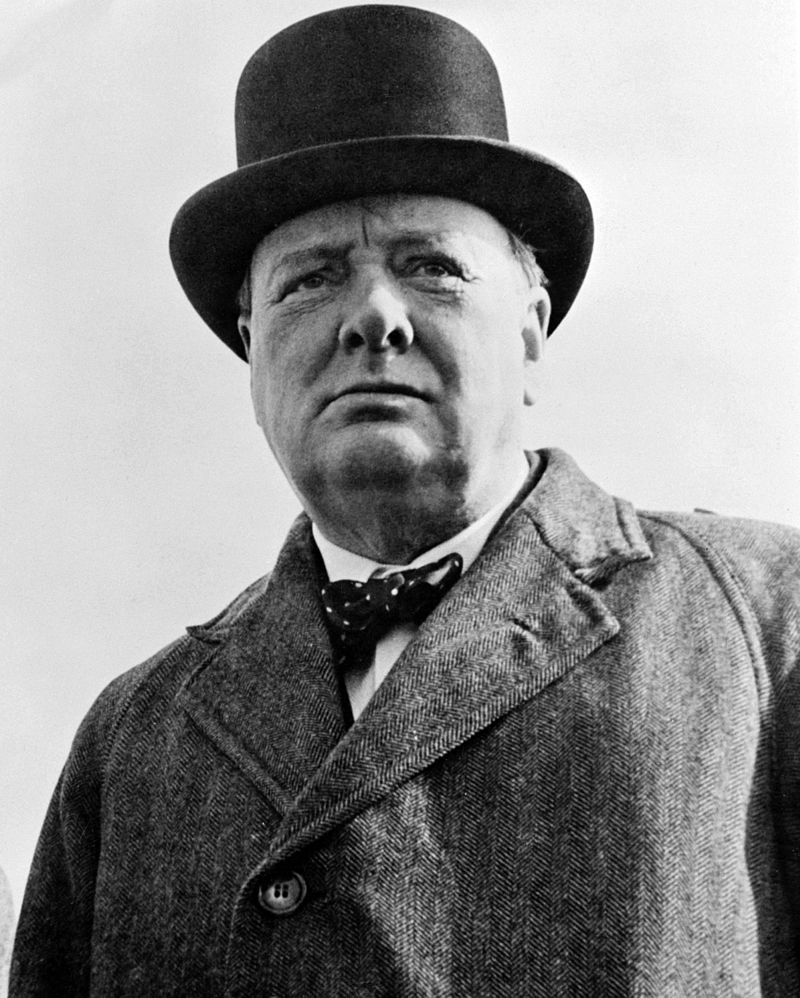
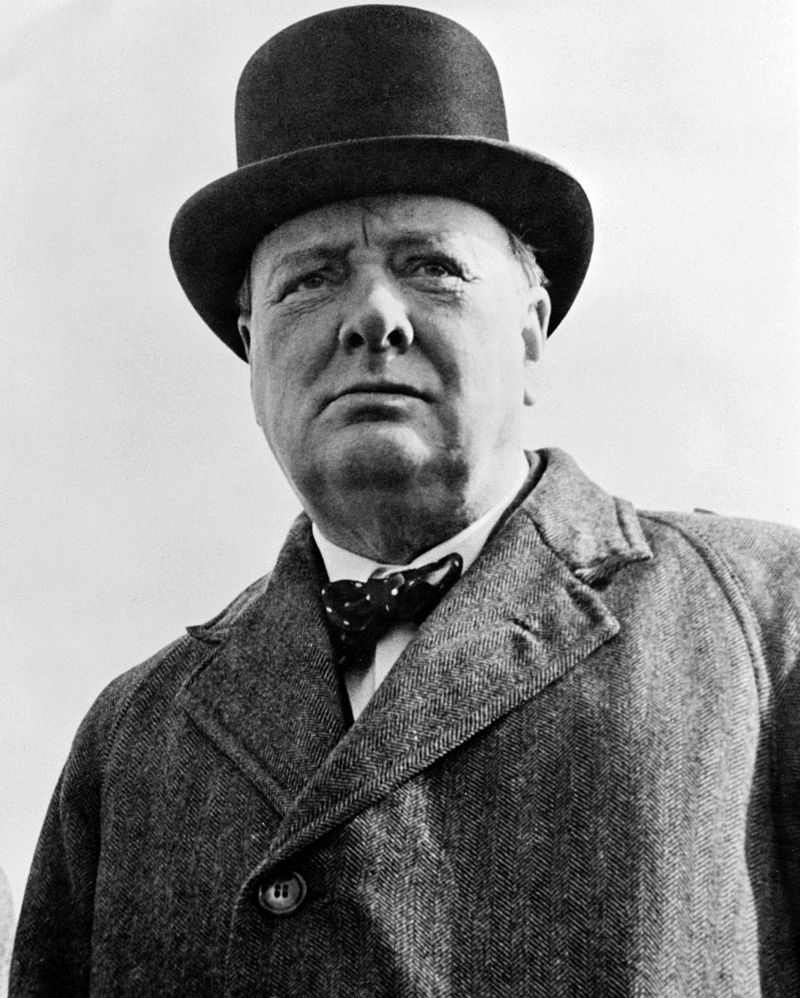
  • Winston Churchill – 1941 Statement on the Late Lord Lloyd

    Below is the text of the statement made by Winston Churchill, the then Prime Minister, in the House of Commons on 6 February 1941.

    The House will have learned with sorrow of the loss, not only that His Majesty’s Government, but our country and the whole Empire, have sustained in the sudden and unexpected death of the Secretary of State for the Colonies and newly-chosen Leader of the House of Lords. To me the loss is particularly painful. Lord Lloyd and I have been friends for many years and close political associates during the last 12 years. We championed several causes together which did not command the applause of large majorities; but it is just in that kind of cause, where one is swimming against the stream, that one learns the worth and quality of a comrade and friend.

    The late Lord Lloyd was a man of high ability. He had energy, he had industry; and these were spurred throughout his life by a consuming desire to serve the country and uphold the British name. He had travelled far and had acquired an immense mass of special knowledge, particularly knowledge of Egypt, East Africa, Arabia and India. He was deeply ​ versed in the affairs of the unhappy countries in the South-East of Europe, which now lie under the shadow of approaching danger and misery. In all these spheres, his opinion and advice were of the highest value. Having served under Lawrence in the Desert War, he had acquired a great love for the Arab race, and he devoted a large part of his life to their interest. His name is known and his death will be mourned in wide circles of the Moslem world. When we remember that the King-Emperor is the ruler of incomparably more Mohammedan subjects than any other Prince of Islam, we may, from this angle, measure the serious nature of the loss we have sustained.

    George Lloyd fought for his country on land and in the air. As honorary commodore of an air squadron, he learned to fly a Hurricane aeroplane and obtained a pilot’s certificate when almost 60 years of age, thus proving that it is possible for a man to maintain in very high efficiency eye and hand, even after a lifetime of keen intellectual work. He was a very good friend of the Royal Air Force, and, in recent years, was President of the Navy League. His was the voice which, as far back as 1934, moved a resolution at the National Union of Conservative Associations which led that body to urge upon the then Government a policy of immediate rearmament. Although an Imperialist and, in some ways, an authoritarian, he had a profound, instinctive aversion from Nazism. He foresaw from the beginning the danger of Hitler’s rise to power and above all to armed power, and he lived and acted during the last four or five years under a sense of the rapidly growing danger to this country.

    For two long and critical periods, covering together nearly 10 years, he represented the Crown, as Governor of Bombay, or as High Commissioner in Egypt. His administration of the Bombay Presidency was at once firm and progressive, and the Lloyd reservoir across the Indus River in Sind, which is the base of the largest irrigation scheme in the world and irrigates an area, formerly a wilderness, about the size of Wales—this great barrage, the Lloyd barrage, as it is called, is a monument which will link his name to the prosperity of millions yet unborn, who will see around them villages, townships, temples and fertile fields where all was formerly naught but savage scrub and ​ sand.

    Lord Lloyd took over the High Commissionership of Egypt in the dark hour after the murder of Sir Lee Stack. He restored, during his tenure, a very great measure of stability and tranquillity to the Nile Valley, and he achieved this without violence or bloodshed. He gained the good will of important elements in Egypt without sacrificing British interests and our relations with Egypt have progressively improved since those days, though other hands and other points of view have played their part in that. If he, like other British statesmen, promised to protect the people of the Egyptian Delta from foreign aggression, he lived long enough to see all the obligations and undertakings of Great Britain to the Egyptian people brilliantly vindicated by the decisions of war.

    When I was called upon to form the present Administration, in the heat of the great battle in France, it was a comfort to me to be able to reach out to so trusted a friend. Although his views, like perhaps some of mine, were very often opposed to the Labour party, I say, with the full assent of all his Labour colleagues, that he gained their respect and confidence and their regard in all those trying months, and that they found many deep points of agreement with him of which they had not previously been aware. The departure of Lord Halifax to the United States made it necessary to choose a new Leader for the House of Lords on behalf of the Government, and Lord Lloyd was selected for that important task. This gave him a great deal of satisfaction, and in the evening, two hours before his death, he conversed with others of his friends about the future work which lay before him in an expanding field and spoke with hopefulness and satisfaction about his ability to discharge it. Then, very suddenly, he was removed from us by death.

    I would like to think, as one likes to think of every man in this House and elsewhere, that he died at the apex, at the summit, of his career. It is sometimes said that good men are scarce. It is perhaps because the spate of events with which we attempt to cope and strive to control have far exceeded, in this modern age, the old bounds, that they have been swollen up to giant proportions, while, all the time, the stature and intellect of man remain unchanged. All the more, there- ​ fore, do we feel the loss of this high-minded and exceptionally gifted and experienced public servant. I feel I shall only be discharging my duties to the House when I express, in their name, our sympathy for his widow, who has shared so many of his journeys and all the ups and downs of his active life, and who, in her grief, may have the comfort of knowing what men and women of all parties think and feel about the good and faithful servant we have lost.

  • Winston Churchill – 1941 Statement on Personal Conduct of Robert Boothby

    Below is the text of the statement made by Winston Churchill, the then Prime Minister, in the House of Commons on 28 January 1941.

    I beg to move,

    “That this House doth agree with the Report of the Committee.”

    We cannot, I think, with any advantage attempt to re-try a matter to which the Committee have devoted so many days and so much thought and attention.

    The House, as a whole, cannot, in the nature of things, deal with these complicated matters except by the practice which is settled and has been so long adopted of referring them to a Committee of the House. It would be, I venture to think, fatal to the whole of that practice if the House were to disregard the opinion ​ of the Committee unless something had been brought to their notice which showed that the Committee had been misinformed, or unless they had reason to doubt the competence or the impartiality of their Committee. Therefore, I do not propose to enter upon the arguments, and I am bound to say that I do not believe any great advantage will be derived if that should be done in other quarters.

    The Committee commended itself to the House by its composition and its high character. It has discharged its distasteful task with efficiency and expedition, and it came unanimously to the conclusions which are contained in the Report. The Chairman of the Committee, one of the oldest Members in the House, is well known to all of us, and it is a tribute to our system and to him that all parties in the House should have agreed in appointing him. The task was an unenviable one, but everybody will agree that it has been discharged to the satisfaction of the House. I do not think that any choice was open to the head of the Government, when the evidence came into our possession by somewhat unusual events connected with war-time conditions, but to bring the matter before a Select Committee and to ask the House to concur in that course. My hon. Friend was a Minister, and the reputation of the Government as well as the House might have been seriously affected if we had neglected to take any further step.

    I shall not attempt to add anything to the Report or comment on it in any way. It sets a very high standard, but we have to set a very high standard for the House of Commons, and we have to try to live up to that standard. The fault of my hon. Friend may have been serious. The penalty is most severe. It is at least the interruption of a career of high Parliamentary promise. It causes pain to all.

    I am sure that the House has been quite exceptionally distressed by this affair and all that is connected with it; and especially it is a source of great pain to me because, over a good many years, my hon. Friend, as he has reminded the House, has been one of my personal friends, often a supporter at lonely and difficult moments, and I have always entertained a warm personal regard for him. If it is painful to us, it is also a loss to all. It is a loss to His Majesty’s Government, ​ who lose a highly competent and industrious Minister, one of the few of that generation who has attained advancement and who has discharged his tasks with admitted and recognised distinction. It is also a loss to the House. We are none too fertile in talents of the order that have just been displayed to us. Altogether it is a heartbreaking business. The popularity of my hon. Friend, his abilities, and the manner in which during his short tenure of office he conducted himself, all add to the poignancy of our feelings, but I do not think they can influence our course of action. There we must leave this matter. We should accept the Report of the Committee, and that is all we have to do. As for my hon. Friend, one can only say that there are paths of service open in war time which are not open in times of peace; and some of these paths may be paths to honour.

  • Winston Churchill – 1940 Speech on the Death of Neville Chamberlain

    Below is the text of the speech made by Winston Churchill, the then Prime Minister, in the House of Commons on 12 November 1940.

    Since we last met, the House has suffered a very grievous loss in the death of one of its most distinguished Members and of a statesman and public servant who, during the best part of three memorable years, was first Minister of the Crown.

    The fierce and bitter controversies which hung around him in recent times were hushed by the news of his illness and are silenced by his death. In paying a tribute of respect and of regard to an eminent man who has been taken from us, no one is obliged to alter the opinions which he has formed or expressed upon issues which have become a part of history; but at the Lychgate we may all pass our own conduct and our own judgments under a searching review. It is not given to human beings, happily for them, for otherwise life would be intolerable, to foresee or to predict to any large extent the unfolding course of events. In one phase men seem to have been right, in another they seem to have been wrong. Then again, a few years later, when the perspective of time has lengthened, all stands in a different setting. There is a new proportion. There is another scale of values. History with its flickering lamp stumbles along the trail of the past, trying to reconstruct its scenes, to revive its echoes, and kindle with pale gleams the passion of former days. What is the worth of all this? The only guide to a man is his conscience; the only shield to his memory is the rectitude and sincerity of his actions. It is very imprudent to walk through life without this shield, because we are so often mocked by the failure of our hopes and the upsetting of our calculations; but with this shield, however the fates may play, we march always in the ranks of honour.

    It fell to Neville Chamberlain in one of the supreme crises of the world to be contradicted by events, to be disappointed in his hopes, and to be deceived and cheated by a wicked man. But what were these hopes in which he was disappointed? What were these wishes in which he was frustrated? What was that faith that was abused? They were surely among the most noble and benevolent instincts of the human heart—the love of peace, the toil for peace, the strife for peace, the pursuit of peace, even at great peril and certainly to the utter disdain of popularity or clamour. Whatever else history may or may not say about these terrible, tremendous years, we can be sure that Neville Chamberlain acted with perfect sincerity according to his lights and strove to the utmost of his capacity and authority, which were powerful, to save the world from the awful, devastating struggle in which we are now engaged. This alone will stand him in good stead as far as what is called the verdict of history is concerned.

    But it is also a help to our country and to our whole Empire, and to our decent faithful way of living that, however long the struggle may last, or however dark may be the clouds which overhang our path, no future generation of English-speaking folks—for that is the tribunal to which we appeal—will doubt that, even at a great cost to ourselves in technical preparation, we were guiltless of the bloodshed, terror and misery which have engulfed so many lands and peoples, and yet seek new victims still. Herr Hitler protests with frantic words and gestures that he has only desired peace. What do these ravings and outpourings count before the silence of Neville Chamberlain’s tomb? Long and hard, hazardous years lie before us, but at least we entered upon them united and with clean hearts.

    I do not propose to give an appreciation of Neville Chamberlain’s life and character, but there were certain qualities, always admired in these Islands, which he possessed in an altogether exceptional degree. He had a physical and moral toughness of fibre which enabled him all through his varied career to endure misfortune and disappointment without being unduly discouraged or wearied. He had a precision of mind and an aptitude for business which raised him far above the ordinary levels of our generation. He had a firmness of spirit which was not often elated by success, seldom downcast by failure and never swayed by panic. When, contrary to all his hopes, beliefs and exertions, the war came upon him, and when, as he himself said, all that he had worked for was shattered, there was no man more resolved to pursue the unsought quarrel to the death. The same qualities which made him one of the last to enter the war, made him one of the last who would quit it until the full victory of a righteous cause was won.

    I had the singular experience of passing in a day from being one of his most prominent opponents and critics to being one of his principal lieutenants, and on another day of passing from serving under him to become the head of a Government of which, with perfect loyalty, he was content to be a member. Such relationships are unusual in our public life. I have before told the House on the morrow of the Debate which in the early days of May challenged his position, he declared to me and a few other friends that only a National Government could face the storm about to break upon us, and that if he were an obstacle to the formation of such a Government, he would instantly retire. Thereafter, he acted with that singleness of purpose and simplicity of conduct which at all times, and especially in great times, ought to be a model for us all.

    When he returned to duty a few weeks after a most severe operation, the bombardment of London and of the seat of Government had begun. I was a witness during that fortnight of his fortitude under the most grievous and painful bodily afflictions, and I can testify that, although physically only the wreck of a man, his nerve was unshaken and his remarkable mental faculties unimpaired.

    After he left the Government he refused all honours. He would die like his father, plain Mr. Chamberlain. I sought the permission of the King however to have him supplied with the Cabinet papers, and until a few days of his death he followed our affairs with keenness, interest and tenacity. He met the approach of death with a steady eye. If he grieved at all, it was that he could not be a spectator of our victory, but I think he died with the comfort of knowing that his country had, at least, turned the corner.

    At this time our thoughts must pass to the gracious and charming lady who shared his days of triumph and adversity with a courage and quality the equal of his own. He was, like his father and his brother, Austen, before him, a famous Member of the House of Commons, and we here assembled this morning, Members of all parties, without a single exception, feel that we do ourselves and our country honour in saluting the memory of one whom Disraeli would have called an “English worthy.”

  • Winston Churchill – 1944 Speech on Armed Forces in the Far East

    Below is the text of the speech made by Winston Churchill, the then Prime Minister, in the House of Commons on 20 December 1944.

    I have been asked to make a statement which I have prepared in conjunction with the Ministers at the head of the War Office and the India Office. Many Members of the House have very properly been concerned about the welfare of our Forces serving in the Far East. The Service Departments, and in particular the War Office, who have the greatest interest in this subject, have for many months made preparations in conjunction with the Government of India for the reception of the great Forces which are assembled and assembling in the Far Eastern theatre, and not least among their activities has been the provision of such stores and equipment as may be necessary on a reasonable basis for the well-being and contentment of those Forces. But in my view the time has now come when the influence of the Government machine as a whole, civil as well as military, must be brought to bear upon this important question. For this reason my Noble Friend the Parliamentary Under-Secretary of State for the Home Department has recently made a tour of India and the Burma front for the purpose of examining the situation on the spot and reporting to the Government about the improvements which are required. His report is being published as a White Paper, and will be available in the Vote Office before the House rises this evening.

    The Government and the House are indebted to my Noble Friend for the manner in which he has discharged this responsible task. His report calls attention to a considerable number of matters in which improvement is urgently required. At the same time, he has rightly recognised the difficulties which have had to be faced by the authorities charged with these matters and he has presented what is I think a very fair and helpful picture of the situation. It is important, in arriving at a judgment on these matters, to realise that the task of providing suitable amenities for troops serving in the East is far more intricate and harder than for troops serving under European conditions. The great spaces to be covered, the lack of ordinary European amenities of life anywhere except in large towns, and the small numbers of European women who can devote their services voluntarily to the provision of amenities are great handicaps. The Government of India, since 1942, have had to receive a very large increase in the number of European troops in India and their resources have been strained to the utmost to provide accommodation and to fulfil military construction programmes essential for operations. A great deal has been done to improve and expand welfare facilities for the British Forces, but clearly more can be achieved if additional resources and personnel can be provided from outside India.

    The Government will apply themselves energetically to this problem. The Government of India and the South-East Asia Command have already been asked for a detailed statement of the help they require to make good the deficiencies in the welfare field to which Lord Munster has drawn attention.

    One of our first concerns is, naturally, the welfare of the sick and wounded. My noble Friend visited 34 hospitals in the course of his tour. I am glad to say that he reports from a layman’s point of view that he is satisfied that the medical facilities are maintained at a high standard of efficiency in spite of the administrative difficulties of an extended front and poor communications. He has drawn attention to certain shortages of medical personnel in India. These are the reflection of general shortages. Every effort is being made to improve the position, but the Government have to pay regard to the many other claims, both civilian and Service, on the available supply of doctors and nurses. Consideration is being given urgently to my noble Friend’s proposal that further numbers of the Voluntary Aid Detachment should be sent out to India, and to the other proposals he makes to improve the present position.

    In some directions it will not be possible to achieve what we desire until the defeat of Germany enables greater resources to be diverted to the East. But plans have been made and directions are being given so that when these greater resources become available, they can be diverted without loss of time to the amelioration of the conditions of service of the men and women of the Services and the Merchant Navy who are called upon to continue the fight against Japan. At that stage a greater volume of air transport should become available and this will render practicable an improvement in the facilities for the conveyance of fresh food and other comforts to the troops in the forward areas, and the movement of men on urgent compassionate leave and to some extent on ordinary leave from the front. It will also make possible a wider use of air transport for the evacuation of casualties and the improvement of the transport of mails. A plan is being prepared under which the rapidity of mails can be progressively improved and the charges reduced. The immediate target is to carry by air all letter mail to the Far East and it is hoped to achieve this early in 1945. The Under-Secretary of State for the Home Department has drawn attention in his report to the inadequacy of accommodation in leave centres and static camps in the Far Eastern theatres. A thorough revision of the present scales of accommodation and amenities in these centres and camps has already been ordered. Attention is being given to the adoption of modern methods of construction, the extension of fly-proofing of buildings, and the provision in greater quantities of modern appurtenances including refrigerators, shower baths and good furniture. These improvements will proceed as far as resources permit. Special attention is also being given to the provision of a varied diet and up to date, hygienic systems of preparing and cooking food.

    Measures are being taken as a matter of urgency which will in due course improve the supplies of beer available for the Forces in India. Indian production of beer has already been expanded to the fullest extent which is practicable without the import of raw materials and plant, but I hope it will be found possible to increase further both imported supplies and Indian production. Arrangements are also well advanced to produce in India cigarettes of a type more palatable to British troops. Trial brands have already been issued with a view to large scale production when it is known which type is preferred by the men. Measures are also in hand to accelerate the provision of cinema apparatus and wireless equipment most of which I should mention can only be obtained from the U.S.A. The value of the work done by British women for the well-being of the troops in India has been proved. Steps are now being taken to encourage more British women, both those who are resident in India now and volunteers from home, to undertake this important and valuable contribution to the welfare of the troops. Canteen services are not the responsibility of N.A.A.F.I. in this theatre, but the Government of India are taking special steps to improve and to enlarge the local organisation.

    It has also been decided that special consideration will be given to Servicemen and their families in assessing priorities for the allotment of houses and furniture after the war. The wives and families of Servicemen engaged in the Far Eastern theatre will, of course, share in this preferential treatment. In order that Servicemen overseas may keep abreast of important developments in social policy at home, pamphlets explaining new legislation on matters of major importance will be prepared and distributed to Servicemen and merchant seamen.

    The House will have observed that in recent months a good deal more attention has been paid by the general public in this country to the efforts and achievements of our men in the Far East. The Ministry of Information and other authorities concerned recognise that this sympathetic interest must be fed by a service of reliable information as to what goes on there. Both the authorities at home and those in control of information on the spot will continue their efforts to maintain and improve the sources of such a service.

    Although it is not a matter referred to in his report, Lord Munster has drawn my attention to the uncertainty which prevails in the minds of many of the men on the subject of the length of time for which they will be required to serve in the East. The position seems to have been made clear by the Secretary of State for War on 26th September and by me on 17th November. But it would perhaps be useful if I restate the position so far as those serving in India and S.E.A.C. are concerned.

    British officers and men of the British Army serving in the East are eligible for posting to the Home Establishment under the Python scheme. This was explained by the Secretary of State for War in his statement. This scheme is not applicable to British officers of the Indian Army, but does apply to British Service officers and men attached to the Indian Army. The intention is to reduce the period of service in the Far East to the shortest period which is practicable, and, generally speaking, priority for posting to the Home Establishment under this scheme is given to those who have served longest away from this country. It is hoped before very long to have posted home all those who have served for more than four years in India and S.E.A.C. In fact the aim is to reduce the qualifying period for repatriation from those theatres to a few months under four years. There may be unavoidable exceptions to this in cases where individuals or specialist personnel cannot be spared for operational reasons or for whom trained replacements cannot yet be provided; but this is the general policy, which will be carried out to the furthest extent that war allows.

    In addition there is the 28-day leave scheme which I recently announced to the House. This is designed to give a short period of leave at home to men who have been engaged in exceptionally arduous conditions but who may not come within the scope of the Python scheme for some time. The selection is made at the discretion of the Commanders-in-Chief concerned. But, naturally, length of absence will be taken into account. Moreover, the current scheme whereby men are posted back to the United Kingdom on grounds of extreme compassion will continue to operate. Men who receive leave under the short leave scheme will return again to service in the Far East but as far as is practicable in present circumstances men repatriated under the Python scheme will not.

    British officers and men belonging to the Indian Army are not eligible for posting to this country under the Python scheme. Home posting is impossible because the Indian Army has no home establishment, and transfer to the British Army for this purpose would involve the loss to the Indian Army of an officer who has received special training for service with Indian troops. In lieu of the Python scheme a leave scheme has been introduced under which British officers of the Indian Army can receive 61 days’ leave at home. There are many officers of the Indian Army with very long periods of overseas service and at present no officer with less than five years’ service is considered for leave, as it is obviously equitable that those with the longest service abroad should receive leave first. The short leave scheme also applies to British officers and other ranks of the Indian Army and they are eligible on the same basis as those of the British Army.

    His Majesty’s Government is giving constant attention to the needs of the men and women serving in the Far East. I have issued instructions to those concerned on the spot and to Departments here that in relation to operational needs a higher priority must be given to the requirements for welfare and amenities for the Forces in the Far East than hitherto. I have also, at the desire of the Secretary of State for War, appointed Lieut.-General King to be my personal representative in the India and South East Asia Commands for welfare matters. It will be General King’s duty to ascertain how matters are progressing and to report to me on difficulties which may arise and on the assistance which is required from this country. He will be concerned with the welfare of all three Services and the Merchant Navy and will have a staff suitably composed for that purpose. The rapidity with which improvements can be effected must to a large extent depend on the progress of the war in Europe, but we shall press on in the meantime with every measure for which our resources are available.

    Mr. Bellenger Although the House will welcome the Government’s decision to publish Lord Munster’s report, may I ask the right hon. Gentleman whether he recognises that many of the points he has mentioned this morning will require serious consideration in view of the division of authority between the Government of India and the War Office at home; and as that raises a constitutional matter would it be possible for him to give the House an opportunity, after the Recess, of debating that White Paper and bringing to the attention of the Government very serious matters of which many hon. Members are cognisant?

    The Prime Minister That must be considered in relation to the general course of Business, but I should have thought there would be opportunities in the normal course of Business for discussing such a matter. If it is a question of taking extra Parliamentary time, that must be considered through the usual channels and with the Leader of the House.

    Mr. Geoffrey Hutchinson Will my right hon. Friend now consider appointing a Director of Welfare from the War Office to undertake the responsibility in this matter?

    The Prime Minister I am very reluctant to add to Ministerial posts at the present time.

    Mr. A. Bevan The conversations which some of us have had with soldiers, particularly in the welfare organisations of India, lead us to believe that one of the reasons why these difficulties have arisen is that there is no effective liaison between the India Office and the War Office here, and although my right hon. Friend has asked for Lieutenant-General King to report to him, that places a great burden upon him if he has to be approached on each occasion when General King is unable to move the War Office or the India Office effectively. Would it not therefore be better to have a welfare liaison between the India Office and the War Office here, which would take some of the burdens off the shoulders of my right hon. Friend?

    The Prime Minister My right hon. Friend the Secretary of State for India says that he has his own welfare officer in the War Office and that the War Office have their welfare——[Interruption]. Well, he had better say it himself.

    The Secretary of State for India and Burma (Mr. Amery) There is on the military side of the India Office an officer specially charged with welfare and specially charged with keeping in touch with the welfare side of the War Office.

    Mr. A. Bevan But the information we have is to the effect that representations from India which have been made over the course of years have run into a sort of vermiform appendix in both Departments and that nothing has come out except disease, and that is why the difficulties have arisen.

    Mr. John Dugdale Would it be possible to congratulate Lord Munster on his shrewdness and perspicacity in seeing through the great clouds of amenities which suddenly descended upon many units?

    Mr. Astor In view of the fact that the Prime Minister’s excellent statement has confirmed the substantial accuracy of many of the questions, may we suggest to the India Office that they should be even more responsive to questions of welfare when they are raised by Private Members in this House?

    The Prime Minister I should have thought that, though there may be criticism on the ground that there has been delay, the process of Parliamentary comment and criticism, followed by action of a far-reaching character on the part of the Government, was a course on which all parties and interests concerned had a right to congratulate themselves.

    Mr. S. O. Davies In view of the fact that many of the disabilities that our troops are suffering were disabilities referred to in the first part of the Prime Minister’s statement, is it not possible for an arrangement to be made for this White Paper to be debated, because it is the opinion of many hon. Members that those disabilities are due to the appalling social, economic and political conditions that obtain in India just now?

    The Prime Minister I do not wonder at all, considering that most of the British civil servants have been withdrawn.

  • Winston Churchill – 1944 Speech on Greece

    Below is the text of the speech made by Winston Churchill, the then Prime Minister, during a debate in the House of Commons on 8 December 1944.

    The value of the speech which has just ended was, I thought, that it showed how extremely complex these Greek politics are. The hon. Gentleman made a very large number of assertions, some of which were accurate, some of which were, according to my information, rather the reverse. At any rate, hours of debate, day after day, would be required if this House were to attempt to emulate the mastery of the details of the position in Greece, which he has been able to acquire in spite of other serious preoccupations.

    I address myself to the Amendment as a whole, and I must point out that it does not deal only with Greece, but with other parts of Europe, and with the suppression of those popular movements which have valorously assisted in the defeat of the enemy in other countries besides Greece. The House, I am sure, will therefore permit me to deal with the whole of this question of our intervention in Europe, the tone, character, temper and objects of our intervention where we have to intervene, by dealing with other countries besides this one which has been the main focus of the two speeches to which we have listened. Before I come to particular countries and places let me present to the House the charge which is made against us. It is that we are using His Majesty’s Forces to disarm the friends of democracy in Greece and in other parts of Europe, and to suppress those popular movements which have valorously assisted in the defeat of the enemy. Here is a pretty direct issue, and one on which the House will have to pronounce before we separate this evening. Certainly, His Majesty’s Government would he unworthy of confidence if His Majesty’s Forces were being used by them to disarm the friends of democracy in Greece and other parts of Europe.

    The question however arises, and one may be permitted to dwell on it for a moment, Who are the friends of democracy, and also how is the word “democracy” to be interpreted? My idea of it is that the plain, humble, common man, just the ordinary man who keeps a wife and family, who goes off to fight for his country when it is in trouble, and goes to the poll at the appropriate time, puts his cross on the ballot paper showing the candidate he wishes to be elected to Parliament—that is the foundation of democracy. And it is also essential to this foundation that this man——

    Dr. Edith Summerskill (Fulham, West) And woman.

    The Prime Minister I beg pardon. There is always the stock answer that man embraces woman, unless the contrary appears in the context. But this man, or woman, should do this without fear, and without any form of intimidation or victimisation. He marks his ballot paper in, strict secrecy, and then elected representatives meet and together decide what government, or even, in times of stress, what form of government they wish to have in their country. If that is democracy I salute it. I espouse it. I would work for it.

    Mr. Shinwell (Seaham) In Spain?

    The Prime Minister I am not at all afraid to go into that discussion, but I have a good deal of ground to cover. It is one of those gross misrepresentations in which a certain class of people indulge that I have spoken praising words about Franco. All I said was that Spanish politics did not merely consist in drawing rude cartoons about it. It is really no use for my hon. Friend to screw his face up as if he were taking a nasty dose of medicine.

    Mr. Shinwell The right hon. Gentleman is quite right. That is precisely what I am doing, and what many other people in the country are doing.

    The Prime Minister I do not know about many other people in the country, because everybody can have their opinion about that. But so far as the hon. Gentleman is concerned I expect there are some other nasty gulps to swallow in the course of what, with great respect, I shall endeavour to lay before them. I must say that I do not wish to be drawn into a discussion of Spain this morning. In the remarks I make about democracy and the attitude I have taken throughout the time I have been burdened with these high responsibilities, and broadly I believe throughout my life, in the remarks I have made, and in the statements representing the policy of His Majesty’s present Government, we stand upon the foundation of free elections based on universal suffrage, and that is what we consider the foundation for democracy.

    But I feel quite different about a swindle democracy, a democracy which calls itself democracy because it is Left Wing. It takes all sorts to make democracy, not only Left Wing, or even Communist. I do not expect a party or a body to call themselves democrats because they are stretching further and further into the most extreme forms of revolution. I do not accept a party as necessarily representing democracy because it becomes more violent as it becomes less numerous. I cannot accept any of these as democracy. One must have some respect for democracy and not use that word too lightly. The last thing which resembles democracy is mob law, with bands of gangsters, armed with deadly weapons, forcing their way into great cities, seizing the police stations and key points of government, endeavouring to introduce a totalitarian régime with an iron hand, and clamouring, as they can nowadays if they get the power——

    Mr. Gallacher That is not fair.

    The Prime Minister I am sorry to be causing so much distress. [Interruption.] I have plenty of time, and if any out-cries are wrung from hon. Members opposite I can always take a little longer in what I have to say, though I should regret to do so. I say that the last thing that represents democracy is mob law and the attempt to introduce a totalitarian régime and clamours to shoot everyone—there are lots of opportunities at the present time—who is politically inconvenient as part of a purge of those who are said to have—and very often have not—sought to collaborate with the Germans during the occupation. Do not let us rate democracy so low, do not let us rate democracy as if it were merely grabbing power and shooting those who do not agree with you. That is the antithesis of democracy; this is not what democracy is based on.

    Mr. Gallacher That is not what has happened.

    The Prime Minister The hon. Member should not get so excited because he is going to have much the worse of the argument and much the worse of the Division. I was eleven years a fairly solitary figure in this House and pursued my way in patience, and so there may be hope for the hon. Member. Democracy, I say, is not based on violence or terrorism, but on reason, on fair play, on freedom, on respecting other people’s rights as well as their ambitions. Democracy is no harlot to be picked up in the street by a man with a tommy gun. I trust the people, the mass of the people, in almost any country, but I like to make sure that it is the people and not a gang of bandits from the mountains or from the countryside who think that by violence they can overturn constituted authority, in some cases ancient Parliaments, Governments and States. That is my general description of the foundation upon which we should approach the various special instances on which I am going to dwell. During the war, of course, we have had to arm anyone who could shoot a Hun. Apart from their character, political convictions, past records and so forth, if they were out to shoot a Hun we accepted them as friends and tried to enable them to fulfil their healthy instincts.

    Mr. McGovern (Glasgow, Shettleston) Now you are paying for it.

    The Prime Minister We are paying for it in having this Debate to-day, which personally I have found rather enjoyable, so far. We are paying for it also with our treasure and our blood. We are not paying for it with our honour or by defeat But when countries are liberated it does not follow that those who have received our weapons should use them in order to engross to themselves by violence and murder and bloodshed all those powers and traditions and continuity which many countries have slowly developed and to which quite a large proportion of their people, I believe the great majority, are firmly attached. If what is called in this Amendment the action of “the friends of democracy” is to be interpreted as carefully planned coups d’ état by murder gangs and by the iron rule of ruffians seeking to climb into the seats of power, without a vote ever having been cast in their favour—if that is to masquerade as democracy I think the House will unite in condemning it as a mockery. I do not admit—I am keeping to the words of the Amendment—that those popular elements who so “valorously”—in some cases I must say—assisted the defeat of the enemy have the right to come forward and say, “We are the saviours of the nation; we must therefore henceforward be its rulers, its masters; that is our reward; we must now claim to sit in judgment over all”—that is, the vast mass of people in every occupied country who have had to live out their lives as well as they could under the iron rule and oppression of the Germans. These valorous elements are now to rule with dictatorial power gained by a coup d’état, by bloody street fighting and slaughter, and are to judge the high, the middle and the poor.

    Dr. Haden Guest (Islington, North) To whom are these generalisations addressed? Are they addressed to the Greeks?

    The Prime Minister So far I am generalising on the principles of what democracy should be and also some of the principles which it should not follow. War criminals, the betrayers of their countrymen, the men who sincerely wished that Germany might win—these may be the objects of popular disgust or boycott, and may in extreme cases be brought before the courts of law and punished with death, but I hope those will be courts of law, where fair trial may be had, and not mere expressions of mob juries or political rivals. But to those who try to establish the point that the men who went out into the hills and were given rifles or machine guns by the British Government have by fee simple acquired the right to govern vast complex communities such as Belgium or Holland—it may be Holland next—or Greece, I say I repulse that claim. They have done good service and it is for the State, and not for them, to judge of the regards they should receive. It is not for them to claim ownership of the State, which cannot be admitted.

    Mr. Gallacher Nobody does say that.

    The Prime Minister That is what is being fought out now. However long I laboured I could not hope to convert individual gentlemen opposite to the better course, but I am addressing my remarks not only to them but to other Members in the House, of whom there are quite a large number. I say we march along an onerous and painful path. Poor old England! Perhaps I ought to say “Poor old Britain.” We have to assume the burden of most thankless tasks and in undertaking them to be scoffed at, criticised and opposed from every quarter; but at least we know where we are making for, know the end of the road, know what is our objective. It is that these countries shall be freed from the German armed power and under conditions of normal tranquillity shall have a free universal vote to decide the Government of their country—except a Fascist régime—and whether that Government shall be of the Left or of the Right.

    There is our aim—and we are told that we seek to disarm the friends of democracy. We are told that because we do not allow gangs of heavily armed guerillas to descend from the mountains and install themselves, with all the bloody terror and vigour which they possess, in great capitals and in power, that we are traitors to democracy. I repulse that claim too. I shall call upon the House as a matter of confidence in His Majesty’s Government and confidence in the spirit with which we have marched from one peril to another till victory is in sight, to reject such pretensions with the scorn that they deserve.

    The Amendment on the Paper has particular reference to Greece, but it is a general attack on the whole policy of His Majesty’s Government which is represented as supporting reactionary forces everywhere, trying to install by force dictatorial government contrary to the wishes of the people. I deal, therefore, not only with Greece. I pin myself at this moment, in the first instance, on to other parts of Europe, because this theme has also to some extent been opened up with the last sentences of a recent American Press release with which we were confronted a few days ago. It is not only in Greece that we appear to some eyes, to the eyes of those who support this Amendment, to be disarming the friends of democracy and those popular movements which have assisted the defeat of the enemy. There is Italy, there is Belgium.

    Let me come to Belgium. Belgium is another case of what the Amendment calls the friends of democracy being disarmed in favour of the organised constitutional administration. If so, it is a grave case and deserves scrutiny. At the end of November there was to be what the Germans call a Putsch organised in Belgium in order to throw out the Government of M. Pierlot, which Government was the only constitutional link with the past, and the only link we have recognised during the war with the Belgian Government that was thrown out over four years ago by the Germans in their brutal invasion. This Government has received a vote of confidence of 132 against only 12, with six abstentions, from the Belgian Parliament, so far as it has been possible to reconstitute it, because some time is needed, after chaos, to set up some authority.

    However, the friends of democracy, the valorous assisters in the defeat of the enemy, take a different view. They organised an attack upon the Belgian State. A demonstration, largely attended by women and children, marched up to the Belgian Parliament House, and lorry loads of friends of democracy came hurrying in from Mons and other places, heavily armed. Here you see the hard-worked Britain, which you are asked to censure to-night. What does this reactionary, undemocratic country do? Orders were sent—I must confess it—to stop the lorries on the way, and to disarm their occupants. Moreover, we British placed light tanks and armoured cars in the side streets near the front of the Parliament House, which the Belgian gendarmerie were defending for the Belgian Government. Here was interference in a marked form. Here was an attempt to stand between the friends of democracy and the valorous, anarchic overthrow of the Belgian State. We British stood in the way of that; I have to admit these things to you.

    But under whose orders, and under whose authority, did we take this action? General Erskine, the British officer, made various proclamations, like those that General Scobie has made, on the needs of the situation. His proclamations had a highly salutary effect, and those concerned in the movement of Allied Forces acted accordingly. Who is General Erskine? He is the British head of the Anglo-American Mission, which has been set up to act as a link between the Supreme Commander of the Allied Expeditionary Force and the Belgian Government and people. He represents, is directly responsible to, and derives his authority from General Eisenhower, that remarkable American Supreme Commander, whose wisdom and good fellowship we admire, and whose orders we have promised to obey. The following are instances of General Eisenhower’s intervention in Belgian affairs

    On 28th October General Erskine handed a letter to M. Pierlot, in which, with the authority of General Eisenhower, he directed that all civilians in Belgium should be disarmed, and asked for the co-operation of the Belgian Government—that is the old Belgian Government, which had been installed in Brussels—in this matter. The letter concluded with the request that the Supreme Commander should receive the immediate assurance that this assistance would be forthcoming, and stating that the Army group commanders—in this instance, Field-Marshal Montgomery—would then be instructed to offer all assistance. On 11th November His Majesty’s representative in Brussels reported to the Supreme Commander that he had himself been in Brussels on the previous day, and had met the Belgian Prime Minister and Government. He had reaffirmed his decision to give them all the assistance they required in carrying out the disarmament of the Resistance Forces. On 29th November the Belgian Government received information that armed demonstrators were on their way in lorries from Mons, and intended to attack Government offices. The Belgian Government made an official appeal for Allied support—I am talking about Belgium now, not Greece, because the positions seem so very similar—and the necessary precautions were taken by S.H.A.E.F., and the measures I have described were taken by the British troops and Belgian gendarmerie.

    Personally, as the House will readily guess, I consider that General Eisenhower’s decisions were absolutely right, and that they stopped disorder and tumult along the lines of communication. After all, these lines of communication, from Antwerp forward, are those which will sustain several millions of men in their forward march into Germany in this war—which I should be sorry to see go on longer than is necessary. Not only did we obey General Eisenhower’s orders, but we thought these orders wise and sensible.

    Mr. A. Bevan rose——

    The Prime Minister Might I be permitted to continue this argument? [Interruption.] I will give the hon. Gentleman the opportunity when I have finished the particular phase of the argument that I am dealing with. I do not want to deny any courtesy—although it would be abusing that courtesy if the hon. Gentleman turned a question into a speech. After all, we British, who are now suggested to be poor friends of democracy, lost 35,000 to 40,000 men in opening up the great port of Antwerp, and our Navy has cleared the Scheldt river. The sacrifice of these men has always to be considered, as well as the friends of democracy advancing in lorries—in lorries—from Mons, to start a bloody revolution in Brussels.

    Mr. Bevan Did General Eisenhower or General Erskine receive any information confirming the threat, other than the appeal from the Belgian Prime Minister; and is it not a fact that the military authorities in Belgium are satisfied that the Belgian Prime Minister unwarrantedly asked for the intervention of British troops? Does not all the evidence now coming forward go to show that there was no such threat as the right hon. Gentleman pretends?

    The Prime Minister I should think it was hardly possible to state the opposite of the truth with more precision.

    Mr. Bevan Where is the evidence?

    The Prime Minister I back up those who seek to establish democracy and civilisation.—[Interruption.] The hon. Member for Ebbw Vale (Mr. Bevan) must learn to take as well as to give. There is no one more free with interruptions, taunts, and jibes than he is. I saw him—I heard him, not saw him—almost assailing some of the venerable figures on the bench immediately below him. He need not get so angry because the House laughs at him; he ought to be pleased when they only laugh at him. As I said, I back up all those who seek to establish democracy and civilisation on a basis of law, and also popular, untramelled, unintimidated, free, universal suffrage voting. It would be pretty hard on Europe if, after four or five years of German tyranny, she was liquidated and degenerated and plunged into a series of brutal social wars. If the friends of democracy and its various defenders believe that they express the wishes of the majority, why cannot they wait for the General Election; why cannot they await the free vote of the people—which is our sole policy in every country into which British and American Armies are advancing? There is the story of Belgium, which I submit, with the utmost respect and affection, to the American people, as well as to the House of Commons, carries many lessons which are applicable to other parts of the world.

    Now I come to the case of Italy, which is, I gather, oddly enough, embodied in the case of Count Sforza. The Amendment does not specifically mention his name, but other communications which have been given to the world seem to show that in this respect also we have offended against democracy. It is a great mistake, as the Foreign Secretary said, and quite untrue, that we have vetoed Count Sforza’s appointment to be Prime Minister or Foreign Secretary of the Italian Government. The Allies alone could do that. The Italians, having unconditionally surrendered, have a perfect right to choose anyone they please for any office of State. That, so they say, is one of their fundamental rights, and it belongs naturally to any country which has unconditionally surrendered, after having done most grievous injuries to its conquerors. We have not attempted to put our veto on the appointment of Count Sforza. If to-morrow the Italians were to make him Prime Minister or Foreign Secretary, we have no power to stop it, except with the agreement of the Allies. All that we would have to say about it is that we do not trust the man, we do not think he is a true and trustworthy man, nor do we put the slightest confidence in any Government of which he is a dominating member. I think we should have to put a great deal of responsibility for what might happen on those who called him to power.

    Mr. Shinwell The right hon. Gentleman said the same about de Gaulle.

    The Prime Minister How little helpful it is to the progress of our Debate to fling in other large questions. I am not speaking about France to-day. I certainly never felt about de Gaulle the sentiments which experience has engendered in me about Count Sforza. De Gaulle is a man of honour, and has never broken his word. That is what I am coming to, because these things have to come out. I say that we should have to put a great deal of responsibility on those who called him to power. We are not avid of becoming deeply involved in the politics of the conquered or liberated countries. All we require from them is a Government which will guarantee us the necessary protection, and facilities for the lines of communication, from Naples to Ravenna, lately taken, and to the North.

    Mr. McGovern On a point of Order. De Gaulle has been brought into the discussion. The Prime Minister made a statement in Private Session, reflecting on General de Gaulle. Is this House entitled to discuss that?

    Mr. Speaker That is not a point of Order. The name of General de Gaulle was brought in on a supplementary question.

    The Prime Minister Is it in Order for an hon. Member to refer to statements made in Secret Session?

    Mr. Speaker I never knew that any statement had been made in private. It is always the custom that when statements are made in Committees upstairs, they are regarded as private.

    The Prime Minister This statement was made on the Floor of the House, in Secret Session—that is the allegation. The allegation of the hon. Gentleman is that I made a certain statement here in Secret Session. I submit that I cannot reply to that statement, because of the strict Rules of the House.

    Mr. Speaker There is no question about it that any statement which refers to something said in Secret Session is distinctly out of Order, and should not be made. The hon. Member really must remember that we passed a particular Resolution, which makes it an offence.

    Mr. McGovern Have I the right, Mr. Speaker, to say that I am not the hon. Member responsible? The intervention was made by the hon. Member for Seaham (Mr. Shinwell) that the Prime Minister had said something about General de Gaulle, and I said that that statement had been made in Secret Session, and asked if the hon. Member was entitled to make this statement in the House.

    Mr. Speaker I think the hon. Member was somewhat unfortunate in that he drew attention to the fact that some statement was made in Secret Session. Indeed, to do so is definitely out of Order and a breach of our Rules.

    Mr. Shinwell On a point of Order. I did not make any reference to a Secret Session.

    The Prime Minister I make no comment at all. The hon. Gentleman, no doubt, has quoted many things I have said, as he has a right to do. As I say, our interest in Italy is in the front where we have Armies engaged under General Alexander and General Mark Clark, that daring and skillful American General under whom we have confidently placed an Army which is at least three-quarters British or British-controlled.

    At this point, I will take a little lubrication, if it is permissible. I think it is always a great pleasure to the Noble Lady the Member for the Sutton Division of Plymouth (Viscountess Astor) to see me drinking water.

    We have a joint arrangement with the Americans about Italy, and we should be very sorry if it were proved that we had broken away from this joint arrangement, and we have not done so, in any way. When, in the shifting tangles and contortions of Italian politics with six parties rolling over each other, with all their conflicts of political interests, none of them being hampered by having been elected by anybody, in this confused scene, we were suddenly told that Count Sforza was to become Prime Minister or Foreign Secretary. The British Minister, Mr. Hopkinson, who is under the Ambassador, did undoubtedly say to the Italian inquirer that we did not think this would be a particularly good choice, or words to that effect. We had a perfect right to say this. We could not stop his being chosen, but we had a right to say our say. We were entitled to say, as I say, that we did not think it would help the conduct of Italian affairs to choose for this office a man with whom Britain, if she counts for anything, would not care to establish cordial relations.

    What is the reason for this prejudice on our part? I would not like to make charges against public men without giving reasons, or one of the essential reasons. Why is it that we, and I particularly, say we have no trust in him, that we do not think he would be the sort of man we would like to have to do business with round the table? I must go back to the time of the Italian collapse and surrender in 1943.

    Count Sforza, who had been living for 20 years in America, was very anxious to get back to Italy. We did not think that this would be a good thing in the extremely disordered and tumultuous state in which Italy was left on the morrow of her revolt against Germany. However, on 23rd September Count Sforza sent the following message to Marshal Badoglio, and repeated it in a letter to Mr. Berle, from which I have the President’s permission to quote: I have read with extreme interest the statement of Marshal Badoglio of the 16th September, 1943, unequivocally stating that he considers the defeat of the Germans and their expulsion from Italy to be his primary duty and urging all Italians to join in this struggle. In my view, it now becomes the paramount duty of all Italians, irrespective of party or political differences, to support and assist in the struggle to crush German Arms and to drive every German soldier from Italian soil. So long as Marshal Badoglio is engaged in that task and is acceptable to Allies in devoting Italian military resources to that struggle, I consider it criminal to do anything to weaken his position or hamper his work in fighting for the liberation of Italy and the Italian people. I am prepared to offer my full support so long as he is thus engaged, all the more because it is the only way to destroy the last criminal remnants of Fascism. Matters of internal politics can, and should be, adjourned for the period of the struggle, and activities, military and political, of all Italians who seek freedom and the future of their Fatherland should be devoted to supporting the organised forces which are endeavouring to overthrow the common enemy. I pledge my honour to do this myself, and urge this course on my many friends and associates. As Count Sforza passed through London, I was anxious to ascertain whether this was his sincere resolve or not, because something had appeared in another paper which was of a different tenor. We had a meeting, at which the Minister of State and Sir Alexander Cadogan, of the Foreign Office, were present. I went through this letter with Count Sforza almost line by line, and he assured me that it represented his most profound conviction. No sooner, however, had he got back to Italy than he began that long series of intrigues which ended in the expulsion of Marshal Badoglio from office. Many may be very glad of this, but it is not the point I am considering. The point is whether he did not most completely, and without explanation, depart, at a very early day, from the solemn undertaking he gave, and without which we should have had power, I think, to convince our American friends, with whom we act in common, that it would not be a good thing for him to go back.

    Mr. Bowles – (Nuneaton) But the right hon. Gentleman supported Mussolini.

    The Prime Minister In 1928? I certainly did, in the sense of making speeches to say that it was a very good thing that Italy was not plunged into Bolshevism.

    Mr. Shinwell Where was the right hon. Gentleman’s democracy then?

    The Prime Minister I must be careful, because I am infringing on foreign affairs. It was because of armed violence threatened by one side and armed violence being used against it by the other.

    Mr. McGovern The right hon. Gentlemen thought that Fascism was better?

    The Prime Minister I am not a bit afraid of anything I have said in a long political life. I certainly thought, at that particular time, that the kind of regime set up in Italy at that time was better than a general slump of Italy into the furious Bolshevik civil war which was raging in many other parts of Europe. I never see the slightest good in going back on what you have said, and the hon. Member himself has views of his own which seem to be equally obnoxious to all parties in the House.

    I have no particular need to defend Marshal Badoglio. It does not arise in the course of the argument, except that we got from him the Italian Fleet, which came over intact, except for the loss of one ship and 1,700 men, and there was no moment in his tenure of office when he did not do his utmost to carry out his bond and help to drive the Germans from Italy and keep good order behind the lines. In other words, he helped Italy to work her passage home, which is by no means yet completely accomplished.

    Presently, he fell a victim to Count Sforza’s intrigues, and a six-party Government was formed under Signor Bonomi. Six parties were in the Government, but none had the slightest electoral foundation. They were merely parties like the Commonwealth Party here and had just about the same claim to represent democracy. We now did our best to help this new Government. I travelled to Italy and interviewed Signor Bonomi and others, and took the greatest trouble to draw up a series of mitigations in the treatment of Italy by the victorious Allies. These I proposed to the President by telegraph, and, when we met at Quebec, and when I stayed with him at his home at Hyde Park, we framed a joint declaration designed to give Italians a good chance of playing their part as co-belligerents, and also to make sure, as far as we could manage it, that the necessities of life were not lacking to the masses of the people.

    The six parties have now made another contortion. Signor Bonomi has fallen and I understand he has now formed another Government of four out of the previous six parties. We wish him well. We have no objection at all to his forming a Government of four parties. Indeed, it is a remarkable thing to keep together for so many years.

    Mr. Shinwell The best men of all parties?

    The Prime Minister I do not challenge the hon. Gentleman when the truth leaks out of him by accident from time to time.

    The House will be glad that I now come to Greece, which forms the mainspring of the Vote of Censure we have to meet to-day. I have taken great responsibilities for our foreign policy towards Greece and also in respect of what has taken place in Athens, and my right hon. Friend the Foreign Secretary and I have worked in the closest agreement. On or about 16th August, it became evident that the magnificent advance of the Russian Armies—[HON. MEMBERS: “Bolsheviks.”] Oh, no. That is a very mischievous remark. Some hon. Members are always trying to entrap me, when we have to have these difficult Debates on foreign affairs, into saying something which would seem to be disrespectful to the splendid patriot Armies which have cleansed the soil of Russia.

    I say that we have taken great responsibilities, and when in August it became evident that the Russian advance along the Black Sea shore, and their probable impact upon Romania and Bulgaria was imminent, and this taken together with the advance of the British and American Armies up the Italian Peninsula, and also with the growing power of Marshal Tito and his partisans—whom we have always supported—would make the position of the Germans in Greece untenable. I therefore proposed to the President that we should try to gather forces to enter Greece as and when the German position was sufficiently weakened, and, above all, to save Athens from the anarchy and starvation which threatened it. I pointed out that, if there was a long hiatus after the German authorities went from the city before an organised Government could be set up, it was very likely that the E.A.M. and the Communist extremists would attempt to seize the city and crush all other forms of Greek expression but their own.

    Mr. Gallacher The E.A.M. is the big democratic party.

    The Prime Minister But we had the right to express a point of view on the Greek question, because in an attempt to redeem our pledged word, we have sustained 30,000 casualties, in what may, perhaps, be called a chivalrous resolve to share the miseries of Greece when she was invaded by Italy and Germany in 1941. At this time we were all alone ourselves in the world. My honoured friend, the President, was of opinion that we should certainly have plans made and accordingly, at the Quebec Conference, it was proposed by the combined Chiefs of Staff that the British should prepare a Force to occupy the Athens area and so pave the way for the commencement of relief and for the establishment of law and order and for the installment of the Greek Government, which we and the great bulk of the United Nations had formally recognised. The Americans and ourselves began to accumulate large masses of food and shipping, and established U.N.R.R.A. U.N.R.R.A. began to grow up in Alexandria and other organisations for food distribution were actively engaged, and we gathered our much strained shipping vessels together at the cost of food to this country. A large part of these stores and medical relief were provided by America out of her riches. The rest of the burden fell upon us, and, of course, the diminution of shipping falls heavily upon us.
    The proposal of the combined Chiefs of Staff was initialled by the President and me, and on 14th September a directive was sent by the combined Chiefs of Staff to General Wilson, the Supreme Commander in the Mediterranean, with whom I had already consulted on the military aspects. He was instructed to take the necessary action as and when he thought fit. All through 1944 we have had the usual trouble with the Greek Government and Greek troops in Egypt. There were mutinies and disorders; there were repeated resignations of Ministers and repeated returns to office but out of this emerged a man, Papandreou, who had lived all this time in Greece without being in the slightest degree subservient to the enemy or losing his reputation in any way on such a charge, and when he came out he restored order to the Greek Government, which is the constitutional Government and which can only be displaced by a free vote of the people.

    At an hotel in the Lebanon in May, 1944, a long meeting was held between the Papandreou Government and leaders of all parties in Greece, including E.A.M., whom we brought out by air. An agreement was reached to establish a joint Government which could take over power in Athens when, with or without the power of the Allies, it was freed from the Germans. At the same time we prepared in deepest secrecy our British expedition. We did not think it necessary to tell anyone about it, not even the Greek Government. It was duly authorised by the British and American Chiefs of Staff and secrecy was all important, and secrecy in this case was also preserved. M. Papandreou repeatedly appealed to us in the name of his Government of all parties, including the Communists and E.A.M., to come to the rescue with armed forces and was much disappointed when I was unable to give him any definite reply. Our first move was to bring the Greek Government from Cairo, where they were living, to Caserta, which was the head-quarters in Italy, so that they might be ready to go in should we at any time find it possible to provide the troops, about which we said nothing. When all was in readiness and the right moment came, General Wilson struck by air and by sea, and this enterprise, like so many others, which the House must not forget in judging this afternoon the fate of the National Government, was marked by excellent timing and extreme efficiency and was also crowned with complete success.

    Mr. Gallacher Thanks to E.L.A.S.

    The Prime Minister The British troops were welcomed enthusiastically as they entered Athens and so also was the Greek Brigade, which had mutinied earlier in the year but was freed from the mutinous element. I took great trouble about this Brigade to give it a chance to redeem its reputation. It not only redeemed its reputation but won renown for the Greek Army by entering Rimini at the head of the Allied Forces. By wresting Rimini from the Germans, this Brigade now came back to Athens, having heaped coals of fire upon the Italian heads who had invited the Germans to ruin Greece. But now the Greeks helped the Italians to drive the Germans from Italy itself, and this Brigade was received with a great welcome in the streets of Athens. By this time M. Papandreou had gathered no less than six E.A.M. representatives into his Government, and the leader of the Liberal Party, Mr. Sophoulis, a veteran and venerable counsellor of 84 or 85 years of age.—[An HON. MEMBER: “You are getting on.”]—Oh yes, I am getting on; we are all getting on. Mr. Sophoulis was already complaining that too many E.A.M. and Communist representatives were already installed in places of power. M. Papandreou, however, is a man of the Left, a democrat, a Socialist, not a Liberal or anything like that, in fact almost everything that is supposed to be correct nowadays, M. Papandreou put his trust in those six gentlemen.

    Dr. Haden Guest (Islington, North) Can we not have the names?

    The Prime Minister I cannot pronounce any of those names rightly. Meanwhile, the forces of E.L.A.S., which is the military instrument of E.A.M., were planning a descent on Athens as a military and political operation and the seizure of power by armed force. E.L.A.S. is a mixed body and it would be unfair to stigmatise them all as being entirely self-seeking in their aims and actions. Nevertheless, during the years of Greek captivity I must say that E.L.A.S. devoted far more attention to beating up and destroying the representatives of the E.D.E.S., commanded by Colonel Zervas, a man of the Left by our standards.

    Mr. Gallacher A man of the Left?

    The Prime Minister Even extremes meet. He was less extreme than E.A.M. He was a man who was correct according to the current jargon. The wrong element of the E.A.M. devoted themselves more to attacking Zervas and his followers on the West side of Greece than they did to attacking the Germans themselves. For the past two years E.L.A.S. have devoted themselves principally to preparations for seizing power. We may, some of us, have underrated the extremes to which those preparations have been carried or the many privations and cruelties which have been inflicted on the village populations in the areas over which they prevail. [An HON. MEMBER: “What is the evidence?”] I have taken every pains to collect information and everything I say on fact in these matters has been most carefully examined beforehand by the officials who are thoroughly acquainted with the details.

    Mr. Hynd (Sheffield, Attercliffe) rose——

    The Prime Minister I really must be allowed to continue my argument. [Interruption.] Of course, in this House we are Conservatives, Labour, Liberal and so forth; we are not E.L.A.S. and E.D.E.S. as some gentlemen seem to imagine. They did not hesitate, on occasion, to help the Germans to catch and kill the representatives of E.D.E.S.

    Mr. Gallacher That is not true.

    The Prime Minister In this country we do try to have debate. The hon. Gentleman who, I am sure, has been treated with extraordinary and great consideration in this House in these times, should learn to keep his mouth shut. E.L.A.S. did not hesitate on occasion to help the Germans to catch and kill the supporters of E.D.E.S. The German rule in Greece was feeble and took the form mainly of hideous reprisals upon the unhappy countryside and it was from this that by a kind of tacit agreement the Security Battalions, some of which were a kind of local Home Guard of the villages against predatory E.L.A.S. bands, came into being. Others were formed and acted in a manner contrary to the interests of the country. From the depredations and ravages of E.L.A.S. there was, however, as we can now see, a fairly well organised plot or plan by which E.L.A.S. should march down upon Athens and seize it by armed force and establish a reign of terror under the plea that they were purging collaborationists.

    How much the Germans knew about this before they left I cannot tell, but a number of them have been left behind and are fighting in E.L.A.S. ranks. Faced by this prospect, the Greek Government containing the six E.A.M. Ministers tried to arrange for a general disarmament to be followed by the creation of a National Army or Home Guard of about 40,000 strong. This met with a ready response in all districts which E.L.A.S. could not dominate, but the formation of this national army had not advanced to a point where they could offer effective resistance to the organised movement of subversive forces intending to overwhelm the State by violence. Also, the police in Athens, who had lived through the vicissitudes of the German tyranny, were no sure guarantee of stability. While all this was coming to a head, peace and order reigned in the city of the violet crown. Sir David Waley and treasury experts toiled to save the drachma and to re-establish a stable currency, and the British Navy and merchant ships were landing at the Piraeus stores, mainly American, which actually reached a total, I am told, of 45,000 tons in a single week. We came therefore to Greece, with American and Russian consent, at the invitation of the Government of all parties, bearing with us such good gifts as liberty, order, food, and the assurance of an absolute right to determine their own future as soon as conditions of normal tranquillity were regained.

    I told the House that I would be frank with them. I have stated our action in detail. I must admit that not everyone agreed with the course we have taken, for which I accept the fullest responsibility. There were those who said, “Why worry about Greece?” I am not speaking of Cabinet discussions. I come in contact with many streaks of opinion. They said, “Why worry about Greece? If they have to starve, there are other countries in like plight. Haven’t we enough on our own hands without being lumbered into this job of International Red Cross, U.N.R.R.A., and maintaining order while the process of liberation and of distribution of food is going on? Why not let Athens take its chance? What does it matter to us if it falls under another tyranny when the Germans go, and if its people starve? We have full occupation for every man that we can call to our service for work against the German foe.” Well, Sir, these are powerful arguments, especially when put in a more attractive form than I have cast them, but His Majesty’s Government felt that having regard to the sacrifices that they made at the time of the German invasion of Greece, and to the long affection which has grown between the Greek and British people since their liberation in the last century, and having regard also to the decisions and agreements of our principal Allies, we should see what we could do to give these unfortunate people a fair chance of extricating themselves from their misery and starting on a clear road again. That is the only wish and ambition which we had, or anyone in the British Government had, for our entry into Greece and for the action forced upon us there. That is our only wish and, personally, I am not ashamed of it.

    However, events began to move. The carefully prepared forces of E.L.A.S. began to infiltrate into Athens and into the Piraeus. The other bodies began to move down from the Northern hills towards the city. The six E.A.M. Ministers resigned from the Government at this timely moment. One gentleman, I believe, was a little slow, but on being rung up on the telephone and told he would be killed if he did not come out, he made haste to follow the general practice. The intention of the “friends of democracy” who now entered the city was to overthrow by violence the constitutional Government of Greece and to install themselves without anything in the nature of an election, as the violent expression of the people’s will. And here the trouble came to a head. I repudiate, as I have said, the idea that democracy can stand upon a violent seizure of power by unrepresentative men, or that it can be maintained by terrorism and the killing of political opponents. No doubt there are others who have a different view. We, however, were now assured by General Wilson—who is up to the present moment in actual charge of the Mediterranean—that we had ample Forces in Greece and on the way. Moreover, we did not feel it compatible with our honour, or with the obligations into which we have entered with many people in Greece in the course of our presence there, to wash our hands of the whole business, make our way to the sea, as we easily could, and leave Athens to anarchy and misery, followed by tyranny established on murder. We may not be level with the strongest Powers in the modern world, but hitherto we have always been ready to risk our blood and such treasure as we have to defend our honour.

    In the small hours of Tuesday morning, with the full approval of my right hon. Friend the Foreign Secretary, I informed General Wilson that he was responsible for providing sufficient forces on the spot, and very substantial numbers of highly trained troops which he had already sent were being reinforced. At the same time I directed General Scobie, who has shown very great qualities of sobriety, poise, and at the same time martial vigour, to assume complete control of Athens and the district around it, and to use whatever force might be necessary to drive out and extirpate the E.L.A.S. bands by which the capital had then become infested. I also directed our Ambassador to do his utmost to prevail upon M. Papandreou, who seemed to wish to resign, to remain in power. I did this because nothing could be more silly or futile or dangerous than to have violent street fighting proceeding all around the Prime Minister’s hotel while he was endeavouring to transfer his powers to some other leader, perhaps M. Sophoulis, 84 years of age, and arranging with the five or six principal parties all the details of a new Administration. I thought it would be much better to have calm and peace and order in Athens before any question of political change in the Administration was embarked upon. It is a great pity to have everything in the melting pot at once, though this is one of the well-known subversive methods by which the undoing of States, great and small, has often been accomplished.

    If I am blamed for this action I will gladly accept my dismissal at the hands of the House; but if I am not so dismissed—make no mistake about it—we shall persist in this policy of clearing Athens and the Athens region of all who are rebels to the authority of the constitutional Government of Greece—[HON. MEMBERS: “‘Constitutional’”]—of mutineers to the orders of the supreme commander in the Mediterranean—[HON. MEMBERS: “Quislings.”]—under whom all the guerillas have undertaken to serve. I hope I have made the position clear, both generally as it affects the world and the war, and the Government. I have no fear at all that the most searching inquiries into the policy we have pursued in Europe—in Belgium, in Holland, in Italy and in Greece—the most searching examination will entitle any man into whose breast fairness and fair-play enter, to accuse us of pursuing reactionary policies, of hampering the free expression of the national will, or of not endeavouring to enable the countries that have suffered the curse of German occupation to resume again the normal, free, democratic life which they desire and which, as far as this House can act, we shall endeavour to secure for them.

  • Winston Churchill – 1945 Response to the Loyal Address

    winstonchurchill

    Below is the text of the speech made in the House of Commons by the then Leader of the Opposition, Winston Churchill. The speech was made on 16th August 1945 and was the response to the Loyal Address.

    It is customary, to an extent which has almost developed into routine, for the Leader of the Opposition on this occasion to begin by offering compliments to the mover and seconder of the Address, and I do not think I remember, in 42 years of service in this House, any occasion when that task has not been accomplished. But certainly I can recall few occasions when it was more easy to offer the unstinted compliments of the House than it is today to offer them to the two hon. and gallant Members who have addressed us. I say “two hon. and gallant Members” because service with the Fire Brigade will never be denied a meed of tribute to gallantry, except in the particular conventions which prevail in this Assembly. They have both made speeches which, if they have not plunged deeply into the matters which divide us or unite us, have nevertheless shown that, in achieving power in this country, the Labour Party have gathered most valuable elements into their body. We see, in these two Members who have addressed us for the first time with so much decorum and becoming taste, two who will, we hope, shine in our Debates. Their maiden speeches accomplished, they will wait other less favourable opportunities to take part in our Debates, and we trust that as the vicissitudes of British politics unfold, long and important political careers may await both of them.

    Our duty this afternoon is to congratulate His Majesty’s Government on the very great improvement in our prospects at home, which comes from the complete victory gained over Japan and the establishment of peace throughout the world. Only a month ago it was necessary to continue at full speed and at enormous cost all preparations for a long and bloody campaign in the Far East. In the first days of the Potsdam Conference President Truman and I approved the plans submitted to us by the combined Chiefs of Staff for a series of great battles and landings in Malaya, in the Netherlands East Indies and in the homeland of Japan itself. These operations involved an effort not surpassed in Europe, and no one could measure the cost in British and American life and treasure they would require. Still less could it be known how long the stamping out of the resistance of Japan in many territories she had conquered, and especially in her homeland, would last. All the while the whole process of turning the world from war to peace would be hampered and delayed. Every form of peace activity was half strangled by the overriding priorities of war. No clear-cut decisions could be taken in the presence of this harsh dominating uncertainty.

    During the last three months an element of baffling dualism has complicated every problem of policy and administration. We had to plan for peace and war at the same time. Immense armies were being demobilised; another powerful army was being prepared and despatched to the other side of the globe. All the personal stresses among millions of men eager to return to civil life, and hundreds of thousands of men who would have to be sent to new and severe campaigns in the Far East, presented themselves with growing tension. This dualism affected also every aspect of our economic and financial life.

    How to set people free to use their activities in reviving the life of Britain, and at the same time to meet the stern demands of the war against Japan, constituted one or the most perplexing and distressing puzzles that in a long life-time of experience I have ever faced.

    I confess it was with great anxiety that I surveyed this prospect a month ago. Since then I have been relieved of the burden. At the same time that burden, heavy though it still remains, has been immeasurably lightened. On 17th July there came to us at Potsdam the eagerly awaited news of the trial of the atomic bomb in the Mexican desert. Success beyond all dreams crowned this sombre, magnificent venture of our American Allies. The detailed reports of the Mexican desert experiment, which were brought to us a few days later by air, could leave no doubt in the minds of the very few who were informed, that we were in the presence of a new factor in human affairs, and possessed of powers which were irresistible. Great Britain had a right to be consulted in accordance with Anglo-American agreements. The decision to use the atomic bomb was taken by President Truman and myself at Potsdam, and we approved the military plans to unchain the dread, pent-up forces.

    From that moment our outlook on the future was transformed. In preparation for the results of this experiment, the statements of the President and of Mr. Stimson and my own statement, which by the courtesy of the Prime Minister was subsequently read out on the broadcast, were framed in common agreement. Marshal Stalin was informed by President Truman that we contemplated using an explosive of incomparable power against Japan, and action proceeded in the way we all now know. It is to this atomic bomb more than to any other factor that we may ascribe the sudden and speedy ending of the war against Japan.

    Before using it, it was necessary first of all to send a message in the form of an ultimatum to the Japanese which would apprise them of what unconditional surrender meant. This document was published on 26th July—the same day that another event, differently viewed on each side of the House, occurred. The assurances given to Japan about her future after her unconditional surrender had been made, were generous to a point. When we remember the cruel and treacherous nature of the utterly unprovoked attack made by the Japanese war lords upon the United States and Great Britain, these assurances must be considered magnanimous in a high degree. In a nutshell, they implied “Japan for the Japanese,” and even access to raw materials, apart from their control, was not denied to their densely-populated homeland. We felt that in view of the new and fearful agencies of war-power about to be employed, every inducement to surrender, compatible with our declared policy, should be set before them. This we owed to our consciences before using this awful weapon.

    Secondly, by repeated warnings, emphasised by heavy bombing attacks, an endeavour was made to procure the general exodus of the civil population from the threatened cities. Thus everything in human power, short of using the atomic bomb, was done to spare the civil population of Japan, though there are voices which assert that the bomb should never have been used at all. I cannot associate myself with such ideas. Six years of total war have convinced most people that had the Germans or Japanese discovered this new weapon, they would have used it upon us to our complete destruction with the utmost alacrity. I am surprised that very worthy people, but people who in most cases had no intention of proceeding to the Japanese front themselves, should adopt the position that rather than throw this bomb, we should have sacrificed a million American and a quarter of a million British lives in the desperate battles and massacres of an invasion of Japan. Future generations will judge these dire decisions, and I believe that if they find themselves dwelling in a happier world from which war has been banished, and where freedom reigns, they will not condemn those who struggled for their benefit amid the horrors and miseries of this gruesome and ferocious epoch.

    The bomb brought peace, but men alone can keep that peace, and henceforward they will keep it under penalties which threaten the survival, not only of civilisation, but of humanity itself. I may say that I am in entire agreement with the President that the secrets of the atomic bomb shall so far as possible not be imparted at the present time to any other country in the world. This is in no design or wish for arbitrary power but for the common safety of the world. Nothing can stop the progress of research and experiment in every country, but although research will no doubt proceed in many places, the construction of the immense plants necessary to transform theory into action cannot be improvised in any country.

    For this and many other reasons the United States stand at this moment at the summit of the world. I rejoice that this should be so. Let them act up to the level of their power and their responsibility, not for themselves but for others, for all men in all lands, and then a brighter day may dawn upon human history. So far as we know, there are at least three and perhaps four years before the concrete progress made in the United States can be overtaken. In these three years we must remould the relationships of all men, wherever they dwell, in all the nations. We must remould them in such a way that these men do not wish or dare to fall upon each other for the sake of vulgar and out-dated ambitions or for passionate differences in ideology, and that international bodies of supreme authority may give peace on earth and decree justice among men. Our pilgrimage has brought us to a sublime moment in the history of the world. From the least to the greatest, all must strive to be worthy of these supreme opportunities. There is not an hour to be wasted; there is not a day to be lost.

    It would in my opinion be a mistake to suggest that the Russian declaration of war upon Japan was hastened by the use of the atomic bomb. My understanding with Marshal Stalin in the talks which I had with him had been, for a considerable time past, that Russia would declare war upon Japan within three months of the surrender of the German armies. The reason for the delay of three months was, of course, the need to move over the trans-Siberian Railway the large reinforcements necessary to convert the Russian-Manchurian army from a defensive to an offensive strength. Three months was the time mentioned, and the fact that the German armies surrendered on 8th May, and the Russians declared war on Japan on 8th August, is no mere coincidence but another example of the fidelity and punctuality with which Marshal Stalin and his valiant armies always keep their military engagements.

    Mr. Evelyn Walkden (Doncaster) I suggest that the right hon. Gentleman should remind his hon. Friends on that side.

    Mr. Churchill It is not part of the duty of the speaker who for the moment has the honour to address the House, to regulate the applause on either side.

    I now turn to the results of the Potsdam Conference so far as they have been made public in the agreed communiqué and in President Truman’s very remarkable speech of a little more than a week ago. There has been general approval of the arrangements proposed for the administration of Germany by the Allied Control Commission during the provisional period of military government. This régime is both transitional and indefinite. The character of Hitler’s Nazi party was such as to destroy almost all independent elements in the German people. The struggle was fought to the bitter end. The mass of the people were forced to drain the cup of defeat to the dregs. A headless Germany has fallen into the hands of the conquerors. It may be many years before any structure of German national life will be possible, and there will be plenty of time for the victors to consider how the interests of world peace are affected thereby.

    In the meanwhile, it is in my view of the utmost importance that responsibility should be effectively assumed by German local bodies for carrying on under Allied supervision all the processes of production and of administration necessary to maintain the life of a vast population. It is not possible for the Allies to bear responsibility by themselves. We cannot have the German masses lying down upon our hands and expecting to be fed, organised and educated over a period of years, by the Allies. We must do our best to help to avert the tragedy of famine. But it would be in vain for us in our small island, which still needs to import half its food, to imagine that we can make any further appreciable contribution in that respect. The rationing of this country cannot be made more severe, without endangering the life and physical strength of our people, all of which will be needed for the immense tasks we have to do. I, therefore, most strongly advise the encouragement of the assumption of responsibility by trust-worthy German local bodies in proportion as they can be brought into existence.

    The Council which was set up at Potsdam of the Foreign Secretaries of the three, four or five Powers, meeting in various combinations as occasion served, affords a new and flexible machinery for the continuous further study of the immense problems that lie before us in Europe and Asia. I am very glad that the request that I made to the Conference, and which my right hon. Friend—I may perhaps be allowed so to refer to him on this comparatively innocuous occasion—supported at the Conference, that the seat of the Council’s permanent Secretariat should be London, was granted. I must say that my right hon. Friend the late Foreign Secretary, who has, over a long period, gained an increasing measure of confidence from the Foreign Secretaries of Russia, and the United States, and who through the European Advisory Committee which is located in London has always gained the feeling that things could be settled in a friendly and easy way, deserves some of the credit for the fact that these great Powers willingly accorded us the seat in London for the permanent Secretariat. It is high time that the place of London, one of the controlling centres of international world affairs, should at last be recognised. It is the oldest, the largest, the most battered capital, the capital which was first in the war and the time is certainly overdue when we should have our recognition.

    I am glad also that a beginning is to be made with the evacuation of Persia by the British and Russian armed forces, in accordance with the triple treaty which we made with each other and with Persia in 1941. Although it does not appear in the communiqué, we have since seen it announced that the first stage in the process, namely, the withdrawal of Russian and British troops from Teheran, has already begun or is about to begin. There are various other matters arising out of this Conference which should be noted as satisfactory. We should not, however, delude ourselves into supposing that the results of this first Conference of the victors were free from disappointment or anxiety, or that the most serious questions before us were brought to good solutions. Those which proved incapable of agreement at the Conference have been relegated to the Foreign Secretaries’ Council which, though most capable of relieving difficulties, is essentially one gifted with less far-reaching powers. Other grave questions are left for the final peace settlement, by which time many of them may have settled themselves, not necessarily in the best way.

    It would be at once wrong and impossible to conceal the divergencies of view which exist inevitably between the victors about the state of affairs in Eastern and Middle Europe. I do not at all blame the Prime Minister or the new Foreign Secretary, whose task it was to finish up the discussions which we had begun. I am sure they did their best. We have to realise that no one of the three leading Powers can impose its solutions upon others and that the only solutions possible are those which are in the nature of compromise. We British have had very early and increasingly to recognise the limitations of our own power and influence, great though it be, in the gaunt world arising from the ruins of this hideous war. It is not in the power of any British Government to bring home solutions which would be regarded as perfect by the great majority of Members of this House, wherever they may sit. I must put on record my own opinion that the provisional Western frontier agreed upon for Poland, running from Stettin on the Baltic, along the Oder and its tributary, the Western Neisse, comprising as it does one quarter of the arable land of all Germany, is not a good augury for the future map of Europe. We always had in the Coalition Government a desire that Poland should receive ample compensation in the West for the territory ceded to Russia East of the Curzon Line. But here I think a mistake has been made, in which the Provisional Government of Poland have been an ardent partner, by going far beyond what necessity or equity required. There are few virtues that the Poles do not possess—and there are few mistakes they have ever avoided.

    I am particularly concerned, at this moment, with the reports reaching us of the conditions under which the expulsion and exodus of Germans from the new Poland are being carried out. Between 8,000,000 and 9,000,000 persons dwelt in those regions before the war. The Polish Government say that there are still 1,500,000 of these not yet expelled within their new frontiers. Other millions must have taken refuge behind the British and American lines, thus increasing the food stringency in our sector. But enormous numbers are utterly unaccounted for. Where are they gone, and what has been their fate? The same conditions may reproduce themselves in a more modified form in the expulsion of great numbers of Sudeten and other Germans from Czechoslovakia. Sparse and guarded accounts of what has happened and is happening have filtered through, but it is not impossible that tragedy on a prodigious scale is unfolding itself behind the iron curtain which at the moment divides Europe in twain. I should welcome any statement which the Prime Minister can make which would relieve or at least inform us upon this very anxious and grievous matter.

    There is another sphere of anxiety. I remember that a fortnight or so before the last war, the Kaiser’s friend Herr Ballen, the great shipping magnate, told me that he had heard Bismarck say towards the end of his life, “If there is ever another war in Europe, it will come out of some damned silly thing in the Balkans.” The murder of the Archduke at Sarajevo in 1914 set the signal for the first world war. I cannot conceive that the elements for a new conflict exist in the Balkans to-day. I am not using the language of Bismarck, but nevertheless not many Members of the new House of Commons will be content with the new situation that prevails in those mountainous, turbulent, ill-organised and warlike regions. I do not intend to particularise, I am very glad to see the new Foreign Secretary sitting on the Front Bench opposite. I would like to say with what gratification I learned that the right hon. Gentleman had taken on this high and most profoundly difficult office, and we are sure he will do his best to preserve the great causes for which we have so long pulled together. But as I say, not many Members will be content with the situation in that region to which I have referred, for almost everywhere Communist forces have obtained, or are in process of obtaining, dictatorial powers. It does not mean that the Communist system is everywhere being established, nor does it mean that Soviet Russia seeks to reduce all those independent States to provinces of the Soviet Union. Mr. Stalin is a very wise man, and I would set no limits to the immense contributions that he and his associates have to make to the future.

    In those countries, torn and convulsed by war, there may be, for some months to come, the need of authoritarian Government. The alternative would be anarchy. Therefore it would be unreasonable to ask or expect that liberal Governments—as spelt with a small “l”—and British or United States democratic conditions, should be instituted immediately. They take their politics very seriously in those countries. A friend of mine, an officer, was in Zagreb, when the results of the late General Election came in. An old lady said to him, “Poor Mr. Churchill. I suppose now he will be shot” My friend was able to reassure her. He said the sentence might be mitigated to one of the various forms of hard labour which are always open to His Majesty’s subjects. Nevertheless we must know where we stand, and we must make clear where we stand in these affairs of the Balkans and of Eastern Europe, and indeed of any country which comes into this field. Our idea is government of the people, by the people, for the people—the people being free without duress to express, by secret ballot without intimidation, their deep-seated wish as to the form and conditions of the Government under which they are to live.

    At the present time—I trust a very fleeting time—”police governments” rule over a great number of countries. It is a case of the odious 18b, carried to a horrible excess. The family is gathered round the fireside to enjoy the scanty fruits of their toil and to recruit their exhausted strength by the little food that they have been able to gather. There they sit. Suddenly there is a knock at the door and a heavily armed policeman appears. He is not, of course, one who resembles in any way those functionaries whom we honour and obey in the London streets. It may be that the father or son, or a friend sitting in the cottage, is called out, and taken off into the dark and no one knows whether he will ever come back again, or what his fate has been. All they know is that they had better not inquire. There are millions of humble homes in Europe at the moment, in Poland, in Czechoslovakia, in Austria, in Hungary, in Yugoslavia, in Rumania, in Bulgaria—[Hon. Members: “In Spain”]—where this fear is the main preoccupation of the family life. President Roosevelt laid down the four freedoms and these are extant in the Atlantic Charter which we agreed together. “Freedom from fear”—but this has been interpreted as if it were only freedom from fear of invasion from a foreign country. That is the least of the fears of the common man. His patriotism arms him to withstand invasion or go down fighting; but that is not the fear of the ordinary family in Europe tonight. Their fear is of the policeman’s knock. It is not fear for the country, for all men can unite in comradeship for the defence of their native soil. It is for the life and liberty of the individual, for the fundamental rights of man, now menaced and precarious in so many lands that peoples tremble.

    Surely we can agree in this new Parliament or the great majority of us, wherever we sit—there are naturally and rightly differences and cleavages of thought—but surely we can agree in this new Parliament, which will either fail the world or once again play a part in saving it, that it is the will of the people, freely expressed by secret ballot, in universal suffrage elections, as to the form of their government and as to the laws which shall prevail, which is the first solution and safeguard. Let us then march steadily along that plain and simple linee. I avow my faith in democracy, whatever course or view it may take with individuals and parties. They may make their mistakes, and they may profit from their mistakes. Democracy is now on trial as it never was before, and in these islands we must uphold it, as we upheld it in the dark days of 1940 and 1941, with all our hearts, with all our vigilance and with all our enduring and inexhaustible strength. While the war was on and all the Allies were fighting for victory, the word “democracy,” like many people, had to work overtime, but now that peace has come we must search for more precise definitions. Elections have been proposed in some of these Balkan countries where only one set of candidates is allowed to appear, and where, if other parties are to express their opinion, it has to be arranged beforehand that the governing party, armed with its political police and all its propaganda, is the only one which has the slightest chance. Chance, did I say? It is a certainty.

    Now is the time for Britons to speak out. It is odious to us that Governments should seek to maintain their rule otherwise than by free, unfettered elections by the mass of the people. Governments derive their just powers from the consent of the governed, says the Constitution of the United States. This must not evaporate in swindles and lies propped up by servitude and murder. In our foreign policy let us strike continually the notes of freedom and fair play as we understand them in these islands. Then you will find there will be an overwhelming measure of agreement between us, and we shall in this House march forward on an honourable theme having within it all that invests human life with dignity and happiness. In saying all this, I have been trying to gather together and present in a direct form the things which, I believe, are dear to the great majority of us. I rejoiced to read them expressed in golden words by the President of the United States when he said: Our victory in Europe was more than a victory of arms. It was a victory of one way of life over another. It was a victory of an ideal founded on the right of the common man, on the dignity of the human being, and on the conception of the State as the servant, not the master, of its people. I think there is not such great disagreement between us. Emphasis may be cast this, way and that in particular incidents, but surely this is what the new Parliament on the whole means. This is what in our heart and conscience in foreign affairs and world issues we desire. Just as in the baleful glare of 1940, so now, when calmer lights shine, let us be united upon these resurgent principles and impulses of the good and generous hearts of men. Thus to all the material strength we possess and the honoured position we have acquired, we shall add those moral forces which glorify mankind and make even the weakest equals of the strong.

    I am anxious to-day to evade controversial topics as far as possible, though I am under no inhibition such as cramped the style of the two hon. and gallant Gentlemen to whom we have listened. There is one question which I hope the Prime Minister will be able to answer. What precisely is Mr Laski’s authority for all the statements he is making about our foreign policy? How far do his statements involve the agreement or responsibility of the Secretary of State for Foreign Affairs? We know that Mr. Laski is the Chairman of the Labour Party Executive Committee—[Hon. Members: “Gestapo.”] Everybody has a right to describe their own party machine as they choose. This is a very important body. I have been told—I am willing to be contradicted and to learn—that it has the power to summon Ministers before it. Let us find out whether it is true or not. Evidently it has got great power, and it has, even more evidently, a keen inclination to assert it. The House, the country and the world at large are entitled to know who are the authoritative spokesmen of His Majesty’s Government.

    I see that Mr. Laski said in Paris a few days ago that our policy in Greece was to be completely changed. What is the meaning of this? I thought we were agreed upon our policy towards Greece, especially after Sir Walter Citrine’s and the trade unions’ report. (Interruption.) I would say to hon. Members not to speak disrespectfully of the report or they may be brought up before that body. That policy in Greece is to help Greece to decide upon its own future by plebiscite and elections according to the full, free, untrammelled will of the Greek people, and that those elections shall be held as early as practicable. The Greek Government have invited official foreign observers to be present and report, so that everyone in the world may judge whether the vote and elections are a free, fair and honest expression of the popular wish. The British, United States and French Governments have accepted this invitation. I was sorry we could not persuade Russia to come along too. Has there been any change in this question, or are we to understand, as Mr. Laski seems to suggest, that, though the Greek people may vote freely, they must only vote the way which he and those who agree with him would like?

    Mr. George Griffiths (Hemsworth) That is what the right hon. Gentleman said in the General Election.

    Mr. Churchill I am sure the hon. Member will never find that I have ever said that people were only entitled to vote in the way I like. I never nursed such an illusion. It is that very freedom which was so vehemently exercised against me and my friends that I am defending now in respect of other countries.

    Mr. Laski also made a declaration about France which has most important and far-reaching effects, namely, that if the French people vote Socialist at the impending election, Great Britain will renew the offer which was made in June, 1940, that Britain and France should become one nation with a common citizenship. That offer was made in the anguish and compassion which we felt at the fate of France. It is remarkable that the Cabinet of those days, when we in this island were in such dire peril, really seemed more shocked and pained at the French disaster than at our own very dangerous plight. Much has happened in the five years that have passed, and I am of opinion that the idea of France and Britain becoming one single nation with common citizenship—alliance is another question—must, at the very least, be very carefully considered by the responsible Ministers before any such proposal is made to Parliament, still less to a foreign country. I ask, therefore, did the Prime Minister authorise this declaration? Does the Foreign Secretary endorse it? Were the Cabinet consulted? Is the offer to France open only if a Socialist Government is elected? I hope the Prime Minister will be able to give reassuring answers on those points.

    Broadly speaking, it is very much better that declarations about foreign policy should be made by Ministers of the Crown responsible to the House of Commons. I am sure the new Government will get into very great difficulties if they are not able to maintain this position firmly. Also, I consider it a great mistake for us to try to interfere in the affairs of foreign countries, except in so far as is necessary to wind up any obligations we may have contracted during the war. It is impossible to understand the domestic politics of other countries. It is hard enough to understand the domestic politics of one’s own. But Mr. Laski has spoken with great freedom about French, Spanish and United States affairs during the last fortnight. He has told the United States on the broadcast, for instance, that free enterprise is the most ingenious fallacy which American business men ever put over on the American people. At a time when we have vital need of the material aid of the United States, I cannot feel—and perhaps the Chancellor will agree with me—that such a remark is exceptionally helpful. To-day, we read that Mr. Laski says that the attitude of the British Government towards the United States is favouarble whereas towards Russia there is “a profoundly brotherly affection.” I wonder very much—and this is an extremely serious matter—whether these invidious distinctions are likely to bring about the good results which were anticipated and which are absolutely necessary.

    Somebody asked about General Franco. I am coming to him. Mr. Laski appears to contemplate vehement intervention in Spain against General Franco. Anybody who has had the opportunity to read the letter which I wrote, with the full agreement of my Coalition colleagues in the War Cabinet, to General Franco some months ago, in reply to one he wrote to me—and I should be very glad to see my letter published here as it has already been practically verbatim in the United States—will see what calumny it is to suggest that I or my friends on this side are supporters, admirers or partisans of the present régime in Spain. We are proud to be the foes of tyranny in every form, whether it comes from the Right or from the Left. Before I left Potsdam, the three major Powers had agreed upon the form of the public announcement about the exclusion of Spain, while under the Franco régime, from the world organisation of the United Nations. No alteration was made, as far as I am aware, by the new Prime Minister or the new Foreign Secretary in the terms of that most wounding, and deliberately calculated wounding, declaration against that régime.

    It would, however, be wrong to intervene in Spain in a forcible manner or to attempt to relight the civil war in that country which has already and quite recently lost between one and two millions of its none too numerous population in a horrible internal struggle. However, if that is the policy of His Majesty’s Government, it is they who ought to say so, and then we can debate the matter here in full freedom. Let me point out in leaving this unpleasant subject that I make no suggestion to the Government that they should endeavour to muzzle Mr. Laski. Anybody in a free country can say anything, however pernicious and nonsensical it may be, but it is necessary for the Government to let us know exactly where they stand with regard to him. Otherwise, I assure hon. Gentlemen opposite that their affairs will suffer and our affairs, which are mixed up inseparably with their affairs, will also suffer.

    I now turn to the domestic sphere, which takes up one part of the Gracious speech. I have already spoken of the enormous easement in their task which the new Government have obtained through the swift and sudden ending of the Japanese war. What thousands of millions of pounds sterling are saved from the waste of war, what scores and hundreds of thousands of lives are saved, what vast numbers of ships are set free to carry the soldiers home to all their lands, to carry about the world the food and raw materials vital to industry. What noble opportunities have the new Government inherited. Let them be worthy of their fortune, which is also the fortune of us all. To release and liberate the vital springs of British energy and inventiveness, to let the honest earnings of the nation fructify in the pockets of the people, to spread well-being and security against accident and misfortune throughout the whole nation, to plan, wherever State planning is imperative, and to guide into fertile and healthy channels the native British genius for comprehension and good will—all these are open to them, and all these ought to be open to all of us now. I hope we may go forward together, not only abroad but also at home, in all matters so far as we possibly can.

    During the period of the “Caretaker Government,” while we still had to contemplate 18 months of strenuous war with Japan, we reviewed the plans for demobilisation in such a way as to make a very great acceleration in the whole process of releasing men and women from the Armed Forces and from compulsory industrial employment. Now, all that is overtaken by the world-wide end of the war. I must say at once that the paragraph of the Gracious Speech referring to demobilisation and to the plans which were made in the autumn of 1944—with which I am in entire agreement in principle—gives a somewhat chilling impression. Now that we have had this wonderful windfall I am surprised that any Government should imagine that language of this kind is still appropriate or equal to the new situation. I see that in the United States the President has said that all the American troops that the American ships can carry home in the next year, will be brought home and set free. Are his Majesty’s Government now able to make any statement of that kind about our Armed Forces abroad? Or what statement can they make? I do not want to harass them unduly, but perhaps some time next week some statement could be made. No doubt the Prime Minister will think of that. Great hopes have been raised in the electoral campaign, and from those hopes has sprung their great political victory. Time will show whether those hopes are well founded, as we deeply trust they may be. But many decisions can be taken now, in the completely altered circumstances in which we find ourselves. The duty of the Government is to fix the minimum numbers who must be retained in the next 6 or 12 months period in all the foreign theatres, and to bring the rest home with the utmost speed that our immensely expanded shipping resources will permit.

    Even more is this releasing process important in the demobilisation of the home establishment. I quite agree that the feeling of the Class A men must ever be the dominant factor, but short of that the most extreme efforts should be made to release people who are standing about doing nothing. I hope the Public Expenditure Committee will be at once reconstituted, and that they will travel about the country examining home establishments and reporting frequently to the House. Now that the war is over there is no ground of military secrecy which should prevent the publication of the exact numerical ration strengths of our Army, Navy and Air Force in every theatre and at home, and we should certainly have weekly, or at least monthly, figures of the progressive demobilisation effected. It is an opportunity for the new Government to win distinction. At the end of the last war, when I was in charge of the Army and Air Force, I published periodically very precise information. I agree with the words used by the Foreign Secretary when he was Minister of Labour in my Administration, namely, that the tremendous winding-up process of the war must be followed by a methodical and regulated unwinding. We agree that if the process is to be pressed forward with the utmost speed it is necessary for the Government to wield exceptional powers for the time being, and so long as they use those powers to achieve the great administrative and executive tasks imposed upon them, we shall not attack them. It is only if, and in so far as, those powers are used to bring about by a side-wind a state of controlled society agreeable to Socialist doctrinaires, but which we deem odious to British freedom, that we shall be forced to resist them. So long as the exceptional powers are used as part of the war emergency, His Majesty’s Government may consider us as helpers and not as opponents, as friends and not as foes.

    To say this in no way relieves the Government of their duty to set the nation free as soon as possible, to bring home the soldiers in accordance with the scheme with the utmost rapidity, and to enable the mass of the people to resume their normal lives and employment in the best, easiest and speediest manner. There ought not to be a long-dragged-out period of many months when hundreds of thousands of Service men and women are kept waiting about under discipline, doing useless tasks at the public expense, and other tens of thousands, more highly paid, finding them sterile work to do. What we desire is freedom; what we need is abundance. Freedom and abundance—these must be our aims. The production of new wealth is far more beneficial, and on an incomparably larger scale, than class and party fights about the liquidation of old wealth. We must try to share blessings and not miseries.

    Mr G. Griffiths Say that again.

    Mr. Churchill The production of new wealth must precede commonwealth, otherwise there will only be common poverty. I am sorry these simple truisms should excite the hon. Member opposite—whom I watched so often during the course of the last Parliament and whose many agreeable qualities I have often admired—as if they had some sense of novelty for him.

    We do not propose to join issue immediately about the legislative proposals in the Gracious Speech. We do not know what is meant by the control of investment—[Laughter]—but apparently it is a subject for mirth. Evidently, in war you may do one thing, and in peace perhaps another must be considered. Allowance must also be made for the transitional period through which we are passing. The Debate on the Address should probe and elicit the Government’s intentions in this matter. The same is true of the proposal to nationalise the coalmines. If that is really the best way of securing a larger supply of coal at a cheaper price, and at an earlier moment than is now in view, I, for one, should approach the plan in a sympathetic spirit. It is by results, as the hon. and gallant Gentleman who moved the Motion for the Address said, that the Government will be judged, and it is by results that this policy must be judged The national ownership of the Bank of England does not in my opinion raise any matter of principle [Hon. Members: “Oh”]. I give my opinion—anybody else may give his own. There are important examples in the United States and in our Dominions of central banking institutions, but what matters is the use to be made of this public ownership. On this we must await the detailed statement by the Chancellor of the Exchequer, who, I am glad to say, has pledged himself to resist inflation. Meanwhile it may be helpful for me to express the opinion, as Leader of the Opposition, that foreign countries need not be alarmed by the language of the Gracious Speech on this subject, and that British credit will be resolutely upheld.

    Then there is the Trade Disputes Act. We are told that this is to be repealed. Personally, I feel that we owe an inestimable debt to the trade unions for all they have done for the country in the long struggle against the foreign foe. But they would surely be unwise to reinstitute the political levy on the old basis. If would also be very odd if they wished to regain full facilities for legalising and organising a general strike. It does not say much for the confidence with which the Trades Union Council view the brave new world, or for what they think about the progressive nationalisation of our industries, that they should deem it necessary on what the hon. and gallant Gentleman called “the D-Day of the new Britain” to restore and sharpen the general strike weapon, at this particular time of all others. Apparently nationalisation is not regarded by them as any security against conditions which would render a general strike imperative and justified in the interests of the workers. We are, I understand, after nationalising the coalmines, to deal with the railways, electricity and transport. Yet at the same time the trade unions feel it necessary to be heavily rearmed against State Socialism. Apparently the new age is not to be so happy for the wage-earners as we have been asked to believe. At any rate, there seems to be a fundamental incongruity in these conceptions to which the attention of the Socialist intelligentsia should speedily be directed. Perhaps it may be said that these powers will only be needed if the Tories come into office. Surely these are early days to get frightened. I will ask the Prime Minister if he will just tell us broadly what is meant by the word “repeal.”

    I have offered these comments to the House and I do not wish to end on a sombre or even slightly controversial note. As to the situation which exists to-day, it is evident that not only are the two parties in the House agreed in the main essentials of foreign policy and in our moral outlook on world affairs, but we also have an immense programme, prepared by our joint exertions during the Coalition, which requires to be brought into law and made an inherent part of the life of the people. Here and there there may be differences of emphasis and view, but in the main no Parliament ever assembled with such a mass of agreed legislation as lies before us this afternoon. I have great hopes of this Parliament and I shall do my utmost to make its work fruitful. It may heal the wounds of war, and turn to good account the new conceptions and powers which we have gathered amid the storm. I do not underrate the difficult and intricate complications of the task which lies before us; I know too much about it to cherish vain illusions, but the morrow of such a victory as we have gained is a splendid moment both in our small lives and in our great history. It is a time not only of rejoicing but even more of resolve. When we look back on all the perils through which we have passed and at the mighty foes we have laid low and all the dark and deadly designs we have frustrated, why should we fear for our future? We have come safely through the worst. Home is the sailor, home from sea, And the hunter home from the hill.

  • Winston Churchill – 1941 Speech in the House of Commons Following the Japan Attack on the USA

    winstonchurchill

    As soon as I heard, last night, that Japan had attacked the United States, I felt it necessary that Parliament should be immediately summoned. It is indispensable to our system of government that Parliament should play its full part in all the important acts of State and at all the crucial moments of the war; and I am glad to see that so many Members have been able to be in their places, despite the shortness of the notice. With the full approval of the nation, and of the Empire, I pledged the word of Great Britain, about a month ago, that should the United States be involved in war with Japan, a British declaration of war would follow within the hour. I, therefore, spoke to President Roosevelt on the Atlantic telephone last night, with a view to arranging the timing of our respective declarations. The President told me that he would this morning send a Message to Congress, which, of course, as is well known, can alone make a declaration of war on behalf of the United States, and I then assured him that we would follow immediately.

    However, it soon appeared that British territory in Malaya had also been the object of Japanese attack, and later on it was announced, from Tokyo, that the Japanese High Command—a curious form; not the Imperial Japanese Government—had declared that a state of war existed with Great Britain and the United States. That being so, there was no need to wait for the declaration by Congress. American time is very nearly six hours behind ours. The Cabinet, therefore, which met at 12.30 to-day, authorised an immediate declaration of war upon Japan. Instructions were sent to His Majesty’s Ambassador at Tokyo, and a communication was despatched to the Japanese Chargé de Affaires at 1 o’clock to-day to this effect:

    “Foreign Office, December 8th.

    SIR,

    (1) On the evening of December 7th His Majesty’s Government in the United Kingdom learned that Japanese forces, without previous warning, either in the form of a declaration of war or of an ultimatum with a conditional declaration of war, had attempted a landing on the coast of Malaya and bombed Singapore and Hong Kong.

    (2) In view of these wanton acts of unprovoked aggression, committed in flagrant violation of international law, and particularly of Article 1 of the Third Hague Convention, relative to the opening of hostilities, to which 1359 both Japan and the United Kingdom are parties, His Majesty’s Ambassador at Tokyo has been instructed to inform the Imperial Japanese Government, in the name of His Majesty’s Government in the United Kingdom that a state of war exists. between the two countries.

    I have the honour to be, with high consideration,

    Sir,

    Your obedient servant,

    (Sgd.) WINSTON S. CHURCHILL.”

    Meanwhile, hostilities have already begun. The Japanese began a landing in British territory in Northern Malaya at about 6 o’clock—1 a.m. local time—yesterday, and they were immediately engaged by our Forces, which were in readiness. The Home Office measures against Japanese nationals were set in motion at 10.45 last night. The House will see, therefore, that no time has been lost, and that we are actually ahead of our engagements.

    The Royal Netherlands Government at once marked their solidarity with Great Britain and the United States at 3 o’clock in the morning.

    The Netherlands Minister informed the Foreign Office that his Government were telling the Japanese Government that, in view of the hostile acts perpetrated by Japanese forces against two Powers with whom the Netherlands maintained particularly close relations, they considered that, as a consequence, a state of war now exists between the Kingdom of the Netherlands and Japan.

    I do not yet know what part Siam, or Thailand, will be called upon to play in this fresh war, but a report has reached us that the Japanese have landed troops at Singora, which is in Siamese territory, on the frontier of Malaya, not far from the landing they had made on the British side of the frontier. Meanwhile, just before Japan had gone to war, I had sent the Siamese Prime Minister the following message. It was sent off on Sunday, early in the morning: “There is a possibility of imminent Japanese invasion of your country. If you are attacked, defend yourself. The preservation of the full independence and sovereignty of Thailand is a British interest, and we shall regard an attack on you as an attack on ourselves.”

    It is worth while looking for a moment at the manner in which the Japanese have begun their assault upon the English-speaking world. Every circumstance of calculated and characteristic Japanese 1360 treachery was employed against the United States. The Japanese envoys, Nomura and Kurusu, were ordered to prolong their mission in the United States, in order to keep the conversations going while a surprise attack was being prepared, to be made before a declaration of war could be delivered. The President’s appeal to the Emperor, which I have no doubt many Members will have read—it has been published largely in the papers here—reminding him of their ancient friendship and of the importance of preserving the peace of the Pacific, has received only this base and brutal reply. No one can doubt that every effort to bring about a peaceful solution had been made by the Government of the United States, and that immense patience and composure had been shown in face of the growing Japanese menace.

    Now that the issue is joined in the most direct manner, it only remains for the two great democracies to face their task with whatever strength God may give them. We must hold ourselves very fortunate, and I think we may rate our affairs not wholly ill-guided, that we were not attacked alone by Japan in our period of weakness after Dunkirk, or at any time in 1940, before the United States had fully realised the dangers which threatened the whole world and had made much advance in its military preparation. So precarious and narrow was the margin upon which we then lived that we did not dare to express the sympathy which we have all along felt for the heroic people of China. We were even forced for a short time, in the summer of 1940, to agree to closing the Burma Road. But later on, at the beginning of this year, as soon as we could regather our strength, we reversed that policy, and the House will remember that both I and the Foreign Secretary have felt able to make increasingly outspoken declarations of friendship for the Chinese people and their great leader, General Chiang Kai-Shek.

    We have always been friends. Last night I cabled to the Generalissimo assuring him that henceforward we would face the common foe together. Although the imperative demands of the war in Europe and in Africa have strained our resources, vast and growing though they are, the House and the Empire will notice that some of the finest ships in the Royal Navy have reached their stations in the Far East at a very convenient moment. Every 1361 preparation in our power has been made, and I do not doubt that we shall give a good account of ourselves. The closest accord has been established with the powerful American forces, both naval and air, and also with the strong, efficient forces belonging to the Royal Netherlands Government in the Netherlands East Indies. We shall all do our best. When we think of the insane ambition and insatiable appetite which have caused this vast and melancholy extension of the war, we can only feel that Hitler’s madness has infected the Japanese mind, and that the root of the evil and its branch must be extirpated together.

    It is of the highest importance that there should be no under-rating of the gravity of the new dangers we have to meet, either here or in the United States. The enemy has attacked with an audacity which may spring from recklessness but which may also spring from a conviction of strength. The ordeal to which the English-speaking world and our heroic Russian Allies are being exposed will certainly be hard, especially at the outset, and will probably be long, yet when we look around us over the sombre panorama of the world, we have no reason to doubt the justice of our cause or that our strength and will-power will be sufficient to sustain it. We have at least four-fifths of the population of the globe upon our side. We are responsible for their safety and for their future. In the past we have had a light which flickered, in the present we have a light which flames, and in the future there will be a light which shines over all the land and sea.

  • Winston Churchill – 1940 Fight them on the Beaches Speech

    winstonchurchill

    Below is the text of the speech made by the then Prime Minister, Winston Churchill, in the House of Commons on 4th June 1940.

    From the moment that the French defenses at Sedan and on the Meuse were broken at the end of the second week of May, only a rapid retreat to Amiens and the south could have saved the British and French Armies who had entered Belgium at the appeal of the Belgian King; but this strategic fact was not immediately realized. The French High Command hoped they would be able to close the gap, and the Armies of the north were under their orders. Moreover, a retirement of this kind would have involved almost certainly the destruction of the fine Belgian Army of over 20 divisions and the abandonment of the whole of Belgium. Therefore, when the force and scope of the German penetration were realized and when a new French Generalissimo, General Weygand, assumed command in place of General Gamelin, an effort was made by the French and British Armies in Belgium to keep on holding the right hand of the Belgians and to give their own right hand to a newly created French Army which was to have advanced across the Somme in great strength to grasp it.

    However, the German eruption swept like a sharp scythe around the right and rear of the Armies of the north. Eight or nine armored divisions, each of about four hundred armored vehicles of different kinds, but carefully assorted to be complementary and divisible into small self-contained units, cut off all communications between us and the main French Armies. It severed our own communications for food and ammunition, which ran first to Amiens and afterwards through Abbeville, and it shore its way up the coast to Boulogne and Calais, and almost to Dunkirk. Behind this armored and mechanized onslaught came a number of German divisions in lorries, and behind them again there plodded comparatively slowly the dull brute mass of the ordinary German Army and German people, always so ready to be led to the trampling down in other lands of liberties and comforts which they have never known in their own.

    I have said this armored scythe-stroke almost reached Dunkirk-almost but not quite. Boulogne and Calais were the scenes of desperate fighting. The Guards defended Boulogne for a while and were then withdrawn by orders from this country. The Rifle Brigade, the 60th Rifles, and the Queen Victoria’s Rifles, with a battalion of British tanks and 1,000 Frenchmen, in all about four thousand strong, defended Calais to the last. The British Brigadier was given an hour to surrender. He spurned the offer, and four days of intense street fighting passed before silence reigned over Calais, which marked the end of a memorable resistance. Only 30 unwounded survivors were brought off by the Navy, and we do not know the fate of their comrades. Their sacrifice, however, was not in vain. At least two armored divisions, which otherwise would have been turned against the British Expeditionary Force, had to be sent to overcome them. They have added another page to the glories of the light divisions, and the time gained enabled the Graveline water lines to be flooded and to be held by the French troops.

    Thus it was that the port of Dunkirk was kept open. When it was found impossible for the Armies of the north to reopen their communications to Amiens with the main French Armies, only one choice remained. It seemed, indeed, forlorn. The Belgian, British and French Armies were almost surrounded. Their sole line of retreat was to a single port and to its neighboring beaches. They were pressed on every side by heavy attacks and far outnumbered in the air.

    When, a week ago today, I asked the House to fix this afternoon as the occasion for a statement, I feared it would be my hard lot to announce the greatest military disaster in our long history. I thought-and some good judges agreed with me-that perhaps 20,000 or 30,000 men might be re-embarked. But it certainly seemed that the whole of the French First Army and the whole of the British Expeditionary Force north of the Amiens-Abbeville gap would be broken up in the open field or else would have to capitulate for lack of food and ammunition. These were the hard and heavy tidings for which I called upon the House and the nation to prepare themselves a week ago. The whole root and core and brain of the British Army, on which and around which we were to build, and are to build, the great British Armies in the later years of the war, seemed about to perish upon the field or to be led into an ignominious and starving captivity.

    That was the prospect a week ago. But another blow which might well have proved final was yet to fall upon us. The King of the Belgians had called upon us to come to his aid. Had not this Ruler and his Government severed themselves from the Allies, who rescued their country from extinction in the late war, and had they not sought refuge in what was proved to be a fatal neutrality, the French and British Armies might well at the outset have saved not only Belgium but perhaps even Poland. Yet at the last moment, when Belgium was already invaded, King Leopold called upon us to come to his aid, and even at the last moment we came. He and his brave, efficient Army, nearly half a million strong, guarded our left flank and thus kept open our only line of retreat to the sea. Suddenly, without prior consultation, with the least possible notice, without the advice of his Ministers and upon his own personal act, he sent a plenipotentiary to the German Command, surrendered his Army, and exposed our whole flank and means of retreat.

    I asked the House a week ago to suspend its judgment because the facts were not clear, but I do not feel that any reason now exists why we should not form our own opinions upon this pitiful episode. The surrender of the Belgian Army compelled the British at the shortest notice to cover a flank to the sea more than 30 miles in length. Otherwise all would have been cut off, and all would have shared the fate to which King Leopold had condemned the finest Army his country had ever formed. So in doing this and in exposing this flank, as anyone who followed the operations on the map will see, contact was lost between the British and two out of the three corps forming the First French Army, who were still farther from the coast than we were, and it seemed impossible that any large number of Allied troops could reach the coast.

    The enemy attacked on all sides with great strength and fierceness, and their main power, the power of their far more numerous Air Force, was thrown into the battle or else concentrated upon Dunkirk and the beaches. Pressing in upon the narrow exit, both from the east and from the west, the enemy began to fire with cannon upon the beaches by which alone the shipping could approach or depart. They sowed magnetic mines in the channels and seas; they sent repeated waves of hostile aircraft, sometimes more than a hundred strong in one formation, to cast their bombs upon the single pier that remained, and upon the sand dunes upon which the troops had their eyes for shelter. Their U-boats, one of which was sunk, and their motor launches took their toll of the vast traffic which now began. For four or five days an intense struggle reigned. All their armored divisions-or what Was left of them-together with great masses of infantry and artillery, hurled themselves in vain upon the ever-narrowing, ever-contracting appendix within which the British and French Armies fought.

    Meanwhile, the Royal Navy, with the willing help of countless merchant seamen, strained every nerve to embark the British and Allied troops; 220 light warships and 650 other vessels were engaged. They had to operate upon the difficult coast, often in adverse weather, under an almost ceaseless hail of bombs and an increasing concentration of artillery fire. Nor were the seas, as I have said, themselves free from mines and torpedoes. It was in conditions such as these that our men carried on, with little or no rest, for days and nights on end, making trip after trip across the dangerous waters, bringing with them always men whom they had rescued. The numbers they have brought back are the measure of their devotion and their courage. The hospital ships, which brought off many thousands of British and French wounded, being so plainly marked were a special target for Nazi bombs; but the men and women on board them never faltered in their duty.

    Meanwhile, the Royal Air Force, which had already been intervening in the battle, so far as its range would allow, from home bases, now used part of its main metropolitan fighter strength, and struck at the German bombers and at the fighters which in large numbers protected them. This struggle was protracted and fierce. Suddenly the scene has cleared, the crash and thunder has for the moment-but only for the moment-died away. A miracle of deliverance, achieved by valor, by perseverance, by perfect discipline, by faultless service, by resource, by skill, by unconquerable fidelity, is manifest to us all. The enemy was hurled back by the retreating British and French troops. He was so roughly handled that he did not hurry their departure seriously. The Royal Air Force engaged the main strength of the German Air Force, and inflicted upon them losses of at least four to one; and the Navy, using nearly 1,000 ships of all kinds, carried over 335,000 men, French and British, out of the jaws of death and shame, to their native land and to the tasks which lie immediately ahead. We must be very careful not to assign to this deliverance the attributes of a victory. Wars are not won by evacuations. But there was a victory inside this deliverance, which should be noted. It was gained by the Air Force. Many of our soldiers coming back have not seen the Air Force at work; they saw only the bombers which escaped its protective attack. They underrate its achievements. I have heard much talk of this; that is why I go out of my way to say this. I will tell you about it.

    This was a great trial of strength between the British and German Air Forces. Can you conceive a greater objective for the Germans in the air than to make evacuation from these beaches impossible, and to sink all these ships which were displayed, almost to the extent of thousands? Could there have been an objective of greater military importance and significance for the whole purpose of the war than this? They tried hard, and they were beaten back; they were frustrated in their task. We got the Army away; and they have paid fourfold for any losses which they have inflicted. Very large formations of German aeroplanes-and we know that they are a very brave race-have turned on several occasions from the attack of one-quarter of their number of the Royal Air Force, and have dispersed in different directions. Twelve aeroplanes have been hunted by two. One aeroplane was driven into the water and cast away by the mere charge of a British aeroplane, which had no more ammunition. All of our types-the Hurricane, the Spitfire and the new Defiant-and all our pilots have been vindicated as superior to what they have at present to face.

    When we consider how much greater would be our advantage in defending the air above this Island against an overseas attack, I must say that I find in these facts a sure basis upon which practical and reassuring thoughts may rest. I will pay my tribute to these young airmen. The great French Army was very largely, for the time being, cast back and disturbed by the onrush of a few thousands of armored vehicles. May it not also be that the cause of civilization itself will be defended by the skill and devotion of a few thousand airmen? There never has been, I suppose, in all the world, in all the history of war, such an opportunity for youth. The Knights of the Round Table, the Crusaders, all fall back into the past-not only distant but prosaic; these young men, going forth every morn to guard their native land and all that we stand for, holding in their hands these instruments of colossal and shattering power, of whom it may be said that

    Every morn brought forth a noble chance

    And every chance brought forth a noble knight,

    deserve our gratitude, as do all the brave men who, in so many ways and on so many occasions, are ready, and continue ready to give life and all for their native land.

    I return to the Army. In the long series of very fierce battles, now on this front, now on that, fighting on three fronts at once, battles fought by two or three divisions against an equal or somewhat larger number of the enemy, and fought fiercely on some of the old grounds that so many of us knew so well-in these battles our losses in men have exceeded 30,000 killed, wounded and missing. I take occasion to express the sympathy of the House to all who have suffered bereavement or who are still anxious. The President of the Board of Trade is not here today. His son has been killed, and many in the House have felt the pangs of affliction in the sharpest form. But I will say this about the missing: We have had a large number of wounded come home safely to this country, but I would say about the missing that there may be very many reported missing who will come back home, some day, in one way or another. In the confusion of this fight it is inevitable that many have been left in positions where honor required no further resistance from them.

    Against this loss of over 30,000 men, we can set a far heavier loss certainly inflicted upon the enemy. But our losses in material are enormous. We have perhaps lost one-third of the men we lost in the opening days of the battle of 21st March, 1918, but we have lost nearly as many guns – nearly one thousand-and all our transport, all the armored vehicles that were with the Army in the north. This loss will impose a further delay on the expansion of our military strength. That expansion had not been proceeding as far as we had hoped. The best of all we had to give had gone to the British Expeditionary Force, and although they had not the numbers of tanks and some articles of equipment which were desirable, they were a very well and finely equipped Army. They had the first-fruits of all that our industry had to give, and that is gone. And now here is this further delay. How long it will be, how long it will last, depends upon the exertions which we make in this Island. An effort the like of which has never been seen in our records is now being made. Work is proceeding everywhere, night and day, Sundays and week days. Capital and Labor have cast aside their interests, rights, and customs and put them into the common stock. Already the flow of munitions has leaped forward. There is no reason why we should not in a few months overtake the sudden and serious loss that has come upon us, without retarding the development of our general program.

    Nevertheless, our thankfulness at the escape of our Army and so many men, whose loved ones have passed through an agonizing week, must not blind us to the fact that what has happened in France and Belgium is a colossal military disaster. The French Army has been weakened, the Belgian Army has been lost, a large part of those fortified lines upon which so much faith had been reposed is gone, many valuable mining districts and factories have passed into the enemy’s possession, the whole of the Channel ports are in his hands, with all the tragic consequences that follow from that, and we must expect another blow to be struck almost immediately at us or at France. We are told that Herr Hitler has a plan for invading the British Isles. This has often been thought of before. When Napoleon lay at Boulogne for a year with his flat-bottomed boats and his Grand Army, he was told by someone. “There are bitter weeds in England.” There are certainly a great many more of them since the British Expeditionary Force returned.

    The whole question of home defense against invasion is, of course, powerfully affected by the fact that we have for the time being in this Island incomparably more powerful military forces than we have ever had at any moment in this war or the last. But this will not continue. We shall not be content with a defensive war. We have our duty to our Ally. We have to reconstitute and build up the British Expeditionary Force once again, under its gallant Commander-in-Chief, Lord Gort. All this is in train; but in the interval we must put our defenses in this Island into such a high state of organization that the fewest possible numbers will be required to give effective security and that the largest possible potential of offensive effort may be realized. On this we are now engaged. It will be very convenient, if it be the desire of the House, to enter upon this subject in a secret Session. Not that the government would necessarily be able to reveal in very great detail military secrets, but we like to have our discussions free, without the restraint imposed by the fact that they will be read the next day by the enemy; and the Government would benefit by views freely expressed in all parts of the House by Members with their knowledge of so many different parts of the country. I understand that some request is to be made upon this subject, which will be readily acceded to by His Majesty’s Government.

    We have found it necessary to take measures of increasing stringency, not only against enemy aliens and suspicious characters of other nationalities, but also against British subjects who may become a danger or a nuisance should the war be transported to the United Kingdom. I know there are a great many people affected by the orders which we have made who are the passionate enemies of Nazi Germany. I am very sorry for them, but we cannot, at the present time and under the present stress, draw all the distinctions which we should like to do. If parachute landings were attempted and fierce fighting attendant upon them followed, these unfortunate people would be far better out of the way, for their own sakes as well as for ours. There is, however, another class, for which I feel not the slightest sympathy. Parliament has given us the powers to put down Fifth Column activities with a strong hand, and we shall use those powers subject to the supervision and correction of the House, without the slightest hesitation until we are satisfied, and more than satisfied, that this malignancy in our midst has been effectively stamped out.

    Turning once again, and this time more generally, to the question of invasion, I would observe that there has never been a period in all these long centuries of which we boast when an absolute guarantee against invasion, still less against serious raids, could have been given to our people. In the days of Napoleon the same wind which would have carried his transports across the Channel might have driven away the blockading fleet. There was always the chance, and it is that chance which has excited and befooled the imaginations of many Continental tyrants. Many are the tales that are told. We are assured that novel methods will be adopted, and when we see the originality of malice, the ingenuity of aggression, which our enemy displays, we may certainly prepare ourselves for every kind of novel stratagem and every kind of brutal and treacherous maneuver. I think that no idea is so outlandish that it should not be considered and viewed with a searching, but at the same time, I hope, with a steady eye. We must never forget the solid assurances of sea power and those which belong to air power if it can be locally exercised.

    I have, myself, full confidence that if all do their duty, if nothing is neglected, and if the best arrangements are made, as they are being made, we shall prove ourselves once again able to defend our Island home, to ride out the storm of war, and to outlive the menace of tyranny, if necessary for years, if necessary alone. At any rate, that is what we are going to try to do. That is the resolve of His Majesty’s Government-every man of them. That is the will of Parliament and the nation. The British Empire and the French Republic, linked together in their cause and in their need, will defend to the death their native soil, aiding each other like good comrades to the utmost of their strength. Even though large tracts of Europe and many old and famous States have fallen or may fall into the grip of the Gestapo and all the odious apparatus of Nazi rule, we shall not flag or fail. We shall go on to the end, we shall fight in France, we shall fight on the seas and oceans, we shall fight with growing confidence and growing strength in the air, we shall defend our Island, whatever the cost may be, we shall fight on the beaches, we shall fight on the landing grounds, we shall fight in the fields and in the streets, we shall fight in the hills; we shall never surrender, and even if, which I do not for a moment believe, this Island or a large part of it were subjugated and starving, then our Empire beyond the seas, armed and guarded by the British Fleet, would carry on the struggle, until, in God’s good time, the New World, with all its power and might, steps forth to the rescue and the liberation of the old.

  • Winston Churchill – 1939 ‘Hush Over Europe’ Speech

    winstonchurchill

    Below is the text of the speech made by Winston Churchill on 8th August 1939.

    Holiday time, ladies and gentlemen! Holiday time, my friends across the Atlantic! Holiday time, when the summer calls the toilers of all countries for an all too brief spell from the offices and mills and stiff routine of daily life and breadwinning, and sends them to seek if not rest at least change in new surroundings, to return refreshed and keep the myriad wheels of civilized society on the move.

    Let me look back-let me see. How did we spend our summer holidays twenty-five years ago? Why, those were the very days when the German advance guards were breaking into Belgium and trampling down its people on their march towards Paris! Those were the days when Prussian militarism was -to quote its own phrase-“hacking its way through the small, weak, neighbor country” whose neutrality and independence they had sworn not merely to respect but to defend.

    But perhaps we are wrong. Perhaps our memory deceives us. Dr. Goebbels and his Propaganda Machine have their own version of what happened twenty-five years ago. To hear them talk, you would suppose that it was Belgium that invaded Germany! There they were, these peaceful Prussians, gathering in their harvests, when this wicked

    Belgium – set on by England and the Jews – fell upon them; and would no doubt have taken Berlin, if Corporal Adolf Hitler had not come to the rescue and turned the tables. Indeed, the tale goes further. After four years of war by land and sea, when Germany was about to win an overwhelming victory, the Jews got at them again, this time from the rear. Armed with President Wilson’s Fourteen Points they stabbed, we are told, the German armies in the back, and induced them to ask for an armistice, and even persuaded them, in an unguarded moment, to sign a paper saying that it was they and not the Belgians who had been the ones to begin the War. Such is history as it is taught in topsy-turvydom. And now it is holiday again, and where are we now? Or, as you sometimes ask in the United States – where do we go from here?

    There is a hush over all Europe, nay, over all the world, broken only by the dull thud of Japanese bombs falling on Chinese cities, on Chinese Universities or near British and American ships. But then, China is a long way off, so why worry? The Chinese are fighting for what the founders of the American Constitution in their stately language called: “Life, liberty and the pursuit of happiness.” And they seem to be fighting very well. Many good judges think they are going to win. Anyhow, let’s wish them luck! Let’s give them a wave of encouragement – as your President did last week, when he gave notice about ending the commercial treaty. After all, the suffering Chinese are fighting our battle, the battle of democracy. They are defending the soil, the good earth, that has been theirs since the dawn of time against cruel and unprovoked aggression. Give them a cheer across the ocean – no one knows whose turn it may be next. If this habit of military dictatorships’ breaking into other people’s lands with bomb and shell and bullet, stealing the property and killing the proprietors, spreads too widely, we may none of us be able to think of summer holidays for quite a while.

    But to come back to the hush I said was hanging over Europe. What kind of a hush is it? Alas! it is the hush of suspense, and in many lands it is the hush of fear. Listen! No, listen carefully; I think I hear something-yes, there it was quite clear. Don’t you hear it? It is the tramp of armies crunching the gravel of the parade- grounds, splashing through rain-soaked fields, the tramp of two million German soldiers and more than a million Italians- “going on maneuvers”-yes, only on maneuvers! Of course it’s only maneuvers just like last year. After all, the Dictators must train their soldiers. They could scarcely do less in common prudence, when the Danes, the Dutch, the Swiss, the Albanians and of course the Jews may leap out upon them at any moment and rob them of their living-space, and make them sign another paper to say who began it. Besides, these German and Italian armies may have another work of Liberation to perform. It was only last year they liberated Austria from the horrors of self-government. It was only in March they freed the Czechoslovak Republic from the misery of independent existence. It is only two years ago that Signor Mussolini gave the ancient kingdom of Abyssinia its Magna Charta. It is only two months ago that little Albania got its writ of Habeas Corpus, and Mussolini sent in his Bill of Rights for King Zog to pay. Why, even at this moment, the mountaineers of the Tyrol, a German-speaking population who have dwelt in their beautiful valleys for a thousand years, are being liberated, that is to say, uprooted, from the land they love, from the soil which Andreas Hofer died to defend. No wonder the armies are tramping on when there is so much liberation to be done, and no wonder there is a hush among all the neighbors of Germany and Italy while they are wondering which one is going to be “liberated” next.

    The Nazis say that they are being encircled. They have encircled themselves with a ring of neighbors who have to keep on guessing who will be struck down next. This kind of guesswork is a very tiring game. Countries, especially small countries, have long ceased to find it amusing. Can you wonder that the neighbors of Germany, both great and small, have begun to think of stopping the game, by simply saying to the Nazis on the principle of the Covenant of the League of Nations: “He who attacks any. Attacks all. He who attacks the weakest will find he has attacked the strongest”? That is how we are spending our holiday over here, in poor weather, in a lot of clouds. We hope it is better with you.

    One thing has struck me as very strange, and that is the resurgence of the one-man power after all these centuries of experience and progress. It is curious how the English-speaking peoples have always had this horror of one-man power. They are quite ready to follow a leader for a time, as long as he is serviceable to them; but the idea of handing themselves over, lock, stock and barrel, body and soul, to one man, and worshiping him as if he were an idol? That has always been odious to the whole theme and nature of our civilization. The architects of the American Constitution were as careful as those who shaped the British Constitution to guard against the whole life and fortunes, and all the laws and freedom of the nation, being placed in the hands of a tyrant. Checks and counter-checks in the body politic, large devolutions of State government, instruments and processes of free debate, frequent recurrence to first principles, the right of opposition to the most powerful governments, and above all ceaseless vigilance, have preserved, and will preserve, the broad characteristics of British and American institutions. But in Germany, on a mountain peak, there sits one man who in a single day can release the world from the fear which now oppresses it; or in a single day can plunge all that we have and are into a volcano of smoke and flame.

    If Herr Hitler does not make war, there will be no war. No one else is going to make war. Britain and France are determined to shed no blood except in self-defense or in defense of their Allies. No one has ever dreamed of attacking Germany. If Germany desires to be reassured against attack by her neighbors, she has only to say the word and we will give her the fullest guarantees in accordance with the principles of the Covenant of the League. We have said repeatedly we ask nothing for ourselves in the way of security that we are not willing freely to share with the German people.

    Therefore, if war should come there can be no doubt upon whose head the blood-guiltiness will fall. Thus lies the great issue at this moment, and none can tell how itwill be settled.

    It is not, believe me, my American friends, from any ignoble shrinking from pain and death that the British and French peoples pray for peace. It is not because we have any doubts how a struggle between Nazi Germany and the civilized world would ultimately end that we pray tonight and every night for peace. But whether it be peace or war, peace with its broadening and brightening prosperity, now within our reach, or war with its measureless carnage and destruction-we must strive to frame some system of human relations in the future which will bring to an end this prolonged hideous uncertainty, which will let the working and creative forces of the world get on with their job, and which will no longer leave the whole life of mankind dependent upon the virtues, the caprice, or the wickedness of a single man.