Tag: William Hague

  • William Hague – 2013 Speech on Business and Human Rights

    williamhague

    Below is the text of the speech made by William Hague, the then Foreign Secretary, on 4 September 2013.

    Good evening ladies and gentlemen. It gives me great pleasure to join the Business Secretary and our distinguished guests to launch the UK’s Action Plan on Business and Human Rights, and I can think of no better place to do it than here at the Institute of Directors – an organisation which does a great deal to promote the corporate integrity which is at the heart of this Plan.

    You are here because we all share the same goal, which is to ensure that British companies succeed and that they do so in a manner that is consistent with this country’s deeply held values of human rights and individual dignity.

    In 1948 the UN General Assembly called on “every individual” and “every organ of society” to respect the rights and freedoms enshrined in the Universal Declaration of Human Rights.

    Today, the duty to uphold those rights cannot be the responsibility of governments alone. We live in a world where open markets and more equitable trading rules mean that British companies – large or small, public or private – are increasingly transnational; where it’s not unusual for our companies to purchase materials from Bangkok manufacture products in Bangalore, sell them in Bogota; and we live in a world where legal standards and practices for working conditions and the treatment of staff may differ from country to country.

    hmgb

    Today, business and government have to work together. The vast majority of companies, I believe, understand the moral imperative of respecting human rights, and they are active in ensuring that they do exactly that. This isn’t about imposing burdensome bureaucracy on them; it’s about Britain leading the way and the British Government helping our businesses to enhance their international reputations even further.

    The truth is that incorporating human rights properly into business operations across the world matters:

    It matters to companies, as weaving human rights deeply into corporate cultures not only protects and enhances reputations, but it also reassures shareholders, attracts investors, and increases the attractiveness of their brands.

    It matters to the reputation of this country and the prosperity of its people.

    And, perhaps most of all, it matters to the health, safety and livelihoods of employees, and the communities to whom they belong.

    That is why I believe that promoting business and respecting human rights are two sides of the same coin, and which determined that the UK will show leadership on this issue, and which all the ambassadors here will be telling their countries we did so, I am sure.

    So I am proud that we are the first country to present a National Action Plan for implementing the UN Guiding Principles developed by former Special Representative of the Secretary General, John Ruggie, who I am delighted to have with us this evening.

    This Action Plan responds to calls from business for greater clarity by setting out explicitly what the Government’s position is on business and human rights.

    It details this Government’s plans to implement our obligations to protect against human rights abuse by business enterprises within UK jurisdiction; to support our companies in meeting their responsibility to respect human rights throughout their operations at home and abroad; to provide access to effective remedy for victims of human rights abuse; to promote understanding of how addressing human rights risks can help build business success; and to ensure policy consistency across the British Government and all its departments But the plan also outlines the Governments expectations of business, such as complying with all applicable laws; honouring the principles of internationally recognised human rights when faced with conflicting requirements; adopting appropriate due diligence policies; consulting those who may be affected at all stages of project design and implementation; emphasising to supply chains in the UK and overseas the importance of behaving in line with the UN Guiding Principles; and participating in effective grievance mechanisms that are transparent, equitable and predictable.

    Launching the Plan today is just the beginning. We now need to take on the more challenging task of ensuring that it’s implemented with consistency.

    To do this, we need business leaders to work with us and to highlight challenges, and I urge companies to use the expertise that we have in our Embassies, High Commissions, and Consulates, who are standing ready to help you enact the Plan.

    We need those civil society groups who have contributed so much to developing this Action Plan to continue holding us to account and to lend your expertise to the companies that need it.

    We need our partners overseas to follow the UK’s lead and to develop their own Plans, so that we can generate real international momentum behind improving the rights of all people affected by business activity in all countries.

    And, for our part, we are determined to continue showing leadership by lobbying and influencing other states to follow this example, and by working together with British businesses to ensure that we achieve nothing short of comprehensive implementation of the UN Guiding Principles.

    That’s our objective, and the Foreign and Commonwealth Office, its Ministers, and its overseas network will do everything to ensure that this Action Plan lays a strong foundation for the long-term success and sustainability of British business.

  • William Hague – 2012 Speech on Latin America

    williamhague

    Below is the text of the speech made by William Hague, the then Foreign Secretary, in Rio de Janeiro on 19 January 2012.

    It is a great personal pleasure for me to be here in Brazil. I have wanted to make this visit for a long time, I attach great importance to it and I am pleased to say that it has gone extremely well.

    I have come with a message of warm friendship: our relations with Brazil are important to me, and important to my country. We wish to invest in our ties with you, and to look for new ways of working together as equal partners.

    This is part of our effort to transform our relations with Latin America and with other emerging powers. Today, when nations such as yours have a growing voice in world affairs and three quarters of global growth in 2012 is expected to come from non-OECD countries, there can be no doubt that this is the right direction for Britain to take.

    The history of our involvement with your region began with an auspicious start but was followed by many missed opportunities. We were among the very first countries to recognise the potential of Latin America in the 1800s, when Foreign Secretary George Canning helped negotiate Brazil’s independence. We enjoyed close trading links in the 19th century and played a big part in your early economic development – not to mention the fact that the first game of football in Brazil was arranged by a British man named Charles Miller in 1894. But in the late twentieth century Britain looked away: four of our Latin American Embassies were shut, diplomats were withdrawn and our links faltered just as your continent began its extraordinary rise.

    We have now opened a new chapter in this history. The days of our diplomatic retreat from your region are over. We have begun Britain’s most ambitious effort to strengthen ties with Latin America in 200 years, since the days of Canning.

    We are cementing this commitment in bricks and mortar, re-opening our Embassy in El Salvador, a new consulate here in Brazil in Recife, and expanding our diplomatic staff across Latin America. British Ministers have made 37 visits to the continent in the first 18 months – nearly half of them to Brazil, and we have set targets to double our trade with Brazil, Mexico and Colombia by 2015. We have moved our diplomatic engagement with Brazil to a wholly different level within British government, because we recognise your country’s growing impact on the economic and political landscape of the world. We have just signed a ‘Science without borders’ agreement which will bring 10,000 Brazilian students to British universities over the next four years. And the British Council has trebled its budget for your country, investing in cultural exchanges, English language training and education. In every way, Britain is back in Brazil and we are proud to be here.

    Today, no one can make the mistake of underestimating Brazil.

    I have the strongest admiration for your peaceful victory over dictatorship and the thriving, diverse democracy you have built since then;

    – for your achievements in raising 40 million of your citizens out of extreme poverty, giving them access to education and opportunity and empowering women;

    – for the economic growth which has made you one of the largest economies in the world;

    – for your ambition, expressed by your President, to be one of the most developed and least unequal nations in the world;

    – and for your commitment to environmental conservation, to clean and renewable energy, to development and to the fight against climate change, hunger and poverty.

    I was there in New York for the historic moment when your President became the first female leader to open the UN General Assembly.

    Your staging of the World Cup in 2014 and the Olympics in 2016 will put Brazil in the spotlight of a huge amount of world attention in the coming decade.

    All these things convince your friends around the world that the very best days for Brazil are still to come.

    We share your confidence in Brazil’s future, and are excited about the opportunities for stronger ties between our people and our economies.

    We are already the 4th largest investor here. Our exports to Brazil were up 23% in 2010 and a further 9% in 2011. UK companies such as British Gas, British Petroleum, Rolls Royce and Shell are investing heavily, including here in Rio.

    As you continue to develop your knowledge and skills base and invest in science, innovation, education, health and infrastructure, our strengths in all these areas make Britain a natural partner for you.

    Our back-to-back hosting of the Olympics provides huge opportunities for our companies to collaborate.

    Our membership of the European Union, combined with our competitive tax system and openness to inward investment make us an ideal springboard into European markets.

    And we are the leading voice in the European Union against protectionism and in favour of Free Trade Agreements, including the vitally important Free Trade Agreement between the EU and Mercosur which we attach great importance to, and the completion of the Doha Trade Round.

    For all these reasons I am optimistic that the best days in our relationship are ahead of us too. I am delighted to announce that Prince Harry will visit Rio in March to attend an event on Sugarloaf mountain that will celebrate all that is great about the relationship between Britain and Brazil.

    We also want to develop a better understanding between us in foreign policy.

    Your country’s role in international affairs is set to grow significantly this century. This flows naturally from your growing economic weight and the shifting international landscape.

    The world has changed profoundly since the end of the Cold War. International relations are no longer dominated by a handful of powerful states that can dictate terms for the rest, and never will be again. That era is over.

    We are in a new phase in the concert of nations, in which states that have not traditionally dominated or sought dominance have an equal role to play in world affairs.

    Ours is a networked world, in which economic and political power and influence are much more widely dispersed and tilting in the direction of the countries of the South and East. It is not a world that is settling into blocs or a north-south divide – but which has opened up the possibility of far more flexible groupings built on a latticework of connections between nations, societies, businesses and individuals.

    This is change that Britain does not fear, but that we welcome and embrace. It has transformed the lives of millions who have been lifted out of poverty and into the middle class by growth and development, and it supports a more stable and equitable world.

    And it is quite properly widening the circle of international decision-making. The problems of our time require collaborative responses. No single country holds the answer to how we create a sustainable global economy, address conflict or husband our planet’s resources for all. Today many of the innovative answers to these challenges are being developed in the emerging economies, just as many nations to look at Brazil as a model for successful political and economic development.

    In this new global environment our British government is looking further afield for opportunities for our citizens and new ways of working in foreign policy – not replacing our role in Europe and indispensable alliance with the United States, but running alongside them and indeed reinforcing them. Our aim is that the United Kingdom should be at the centre of the networks of the 21st century, including here in Latin America.

    We also strongly believe that the institutions of global governance must become more representative, which is why we support reform of the United Nations Security Council including a permanent seat for Brazil.

    We know that Brazil has long played a distinguished role in this region; that you prize your long history of peaceful relations with your neighbours and take your international responsibilities very seriously.

    In my country, we remember that just as we came to your aid during your wars of independence, so you came to our aid during the first and second World Wars, the only South American country to do so.

    As a founding member of the United Nations, your country is older as an entity than the majority of its members, including a significant number in Europe.

    You have played a leading role at the UN since its inception, as well as in other bodies such as the Organisation of American States.

    We warmly welcomed the decisive steps Brazil took in the 1990s to support the nuclear non-proliferation regime, and your participation in the Latin American nuclear weapon free zone.

    We support and admire your leadership in building peace in Haiti; and your skills and knowledge in eradicating poverty, addressing food security and protecting the environment, all of which have global application.

    We welcome the fact that you are expanding your diplomatic network around the world – including the opening of your newest European Embassy in Sarajevo.

    We therefore see it as very much in both our countries’ interests that we develop a strong and equal working relationship in foreign policy; one that reflects today’s world and our many shared values as fellow democracies.

    For the changes I have described also mean that maintaining international peace and security is becoming a broader responsibility. It rests on the shoulders of more nations than it has in the past.

    This means that we need to develop a better understanding of how to act together when that stable environment is threatened, and how we translate our democratic values into action.

    Brazil believes strongly in human rights. So do we. We both play a prominent role in the UN Human Rights Council, and recently worked together to help establish a UN Special Rapporteur on Human Rights in Iran.

    But of course no two countries think exactly the same way, and we respect your right to take a different view as you did over aspects of the international action in Libya.

    As we see it, in Libya limited military force was used to protect civilians and civilian-populated areas under threat of attack and to implement a no-fly zone, only after Colonel Qadhafi had refused to end the violence and when called for by all the countries of the region through the Arab League. It was action that was necessary, legal and right. It was carried on the legal basis of a UN Security Council mandate; it involved working directly with Libya’s neighbours, and it was done without NATO forces on the ground. These conditions – a legal mandate, regional participation and limited objectives – enabled us to be successful. They were consciously based on the lessons learnt not only from Iraq but also from Bosnia, where inaction led to the worst violence in Europe since the Second World War.

    Military action is always a last resort and can never be without risk. Each country is different and each case must be judged on its merits. But when human life is threatened and peaceful avenues fail, we argue that we must be prepared to intervene in the way best suited to the circumstances and to be able to do so quickly and decisively.

    So while we do not always draw the same conclusions about the best way to act when human rights at threatened at decisive moments, we have a strong common interest in building a better understanding for the future. Your President recently put forward the concept of ‘responsibility while protecting’ alongside the UN concept of the Responsibility to Protect. We welcome this contributing to the international debate and as I said to Foreign Minister Patriota yesterday, we look forward to discussing it and to finding common ground between our different perspectives.

    We may well face many more difficult and complex situations in the coming years. So we should try to build a stronger consensus about how we uphold our human rights responsibilities and maintain international security, especially as fellow democracies.

    2012 will be a critical year for the Arab Spring. We have a strong common interest in using every diplomatic means at our disposal to encourage positive change in the region while respecting the wishes and choices of its citizens.

    In Syria, we are confronted with an appalling threat to human life and regional stability. Protests by people seeking to claim their human rights and choose democracy and freedom have been met with tanks, snipers, torture and over 5,000 deaths. The deterioration of the system risks not only further casualties but a civil war in the most combustible conflict zone in the world.

    It is regrettable that the UN Security Council has been unable to speak out and we urge it to do so now. We welcome the leadership shown by the Arab League and it is vital that efforts are redoubled to support their mission and to achieve a political transition in Syria.

    2012 could also be a year of crisis over Iran’s nuclear programme. Like Brazil, our objective is to prevent nuclear proliferation in the Middle East, which could start an arms race in the region and call into question the very survival of the Nuclear Non Proliferation Treaty. Britain is seeking a negotiated solution with Iran and is not advocating confrontation. The best chance of averting either a nuclear armed Iran or the potentially devastating consequences of military action is to intensify the legitimate, peaceful pressure on Iran to return to negotiations.

    The main purpose of my visit was to open more intensive discussions about how we address these and other global problems. I am optimistic about this, particularly after my discussions in Brasilia yesterday, although such cooperation must be built on trust and shared experiences and will not come into existence overnight. But we share common values and interests that provide a strong foundation for us to build on over time.

    Like you we believe in a rules-based international system and more representative international organisations that strengthen multilateralism in the world.

    Like you, we think the international community must get better at peace building and tackling the root causes of conflict, which is why we are hosting a major conference on Somalia next month.

    Like you, we welcome a stronger role in world affairs for Latin American countries, although where we have our own views over issues such as the Falkland Islands we will always be frank about them. We will always uphold UK sovereignty and the rights of the Islanders to self-determination, while valuing the ability to discuss these issues with Brazil in a framework that respects international law and human rights.

    We also share the same deep commitment to tackling poverty, which is why in Britain we are standing firm to our commitment to raise aid to 0.7% of GNI, despite economic difficulties at home. We have promised that we will not build our economic recovery on the back of the world’s poor and we are showing that through our actions.

    We both believe in transparent and accountable government, and are working together with more than 50 other countries through the Open Government Partnership.

    We are developing new relations in defence and security, with British companies like BAE Systems supporting your procurement programme.

    And we work closely together on biodiversity and on climate change. The Rio+20 conference this June will be an important opportunity to set out a way forward on sustainable development and poverty reduction. Our experts are already working together in the field of development, where Brazil can emerge as a global force. Indeed, your knowledge and skills in development and environmental conservation are among your greatest contributions to the world.

    Let us build on this track record to become closer partners in support of international peace and security.

    Energy, perseverance, creativity, self-reliance, inventiveness, daring, and diversity – these are just some of the qualities that your friends in the world associate with the people of Brazil.

    How much easier it will be to address the challenges of insecurity, terrorism and prosperity if countries like Britain and Brazil are active partners in international affairs, and if Brazil brings all these qualities to bear in the world.

    Our values, our economic compatibility and our international roles give us great potential to be closer partners. This is our ambition and we will invest in it over the coming years.

  • William Hague – 2012 Speech on UK and Australia Relations

    williamhague

    Below is the text of the speech made by William Hague, the then Foreign Secretary, in Rio de Janeiro in Brazil on 24 January 2012.

    Over the last two days we have conducted the meetings we know as AUKMIN; which are detailed and substantive consultation between Britain and Australia’s Foreign and Defence Ministers.

    I am very grateful to Kevin Rudd and Stephen Smith for travelling here with such a senior delegation, and for the excellent tenor of our talks.

    We believe that close consultation between Britain and Australia has never been more important and I think I can confidently say that our approach to world affairs has seldom been more in step with each other.

    Our countries are strategic and global allies.

    We share democratic values and the will and determination to play a leading role in world affairs.

    Our membership of the Commonwealth means that we are not just allies, we are also family. But while this is a partnership rooted in history it is also relentlessly forward looking and practical, which is why we attach such importance to it in the British government.

    Australia’s neighbourhood is of growing importance in world affairs. We particularly appreciate Australia’s understanding the Asia-Pacific region and of the emerging powers, just as I know Kevin, Stephen and their colleagues appreciate our leading role in the foreign policy discussions of the European Union.

    Our talks reflected our interests and priorities over the next decade, including preventing the spread of nuclear weapons.

    Yesterday the European Union agreed to a phased ban on the import of Iranian oil, and action against Iran’s central bank. This is a significant increase – a major increase – in the peaceful, legitimate pressure on the Iranian government to return to negotiations over its nuclear programme. Until it does so, the pressure will only increase and Britain and Australia share the same sense of resolve about that.

    We have discussed cooperation in the Asia-Pacific. We share close views about the development of the region and we discuss it regularly among ourselves and with our mutual ally the United States of America.

    We have a valuable information-sharing relationship which is critical to our security. This morning Kevin and I have signed a new agreement which will increase this area of our cooperation.

    We exchanged views on cyber security, following last year’s London Conference on Cyberspace. We explored how better to protect our governments, our industry and our national infrastructure from cyber attacks, and how we can work with others to mitigate cyber threats while championing human rights and the social and economic benefits of the internet. Both our countries are committed to developing our partnership in the cyber arena.

    We discussed preparations for the London conference on Somalia next month, and later we will also discuss the situation in Nigeria, where we condemn the appalling acts of terrorism and stand behind the Nigerian government and people.

    We have agreed to work closely on the Arab Spring, including assistance to countries in transition to more open, democratic government.

    We support the work of the Arab League. Both our countries believe the United Nations Security Council has a responsibility to speak out and will work to that end.

    We looked ahead to the important NATO Summit in Chicago, as the next milestone in the transition of security in Afghanistan to Afghan control.

    And we discussed our bilateral ties. I am pleased that British exports to Australia increased by 30% in the first ten months of last year and we will take every opportunity to build on this success.

    The deep trust at the heart of our relationship will be reflected at the meeting of our National Security Council later today which both visiting Ministers will attend and fully participate in.

    I thank them both for the energy, friendship and intellectual rigour they have brought to our discussions and for the many areas where we have agreed we will work more closely this year; and am delighted to hand over the floor to Kevin Rudd.

  • William Hague – 2012 Speech on India

    williamhague

    Below is the text of the speech made by William Hague, the then Foreign Secretary, at King’s College in London on 26 January 2012.

    I am very grateful to Lord Duoro and Professor Khilnani for their very kind introduction; and to everyone at King’s College for the great privilege of inaugurating your venerable university’s newest Institute.

    When I travel overseas I am struck by how often the leaders I meet begin our discussions with stories of studying here in Britain. Shared educational experiences create a bond for life. The fact that so many people of other nationalities find the allure of British universities irresistible is a great asset to our nation. It contributes to our economy, to our reputation as an open society and to our cultural influence in the world. Conversely – although this is an impression rather than a hard and fast rule – I have noted that when I visit a country in which we do not traditionally have a close partnership in foreign policy, it is often the case that our educational links are at a low level as well.

    Foreign Policy is not just about international summits and resolutions. It rests on a web of connections, and more so as the twenty-first century goes on, between individuals, families, civil society, companies, and academic institutions like your own. And in order to have successful relations with a country like India we have to have the deepest possible understanding of its culture, its history and politics, its rich traditions and its complex geography. We need a strong awareness of all the factors that contribute to its policies and its relations with the rest of the world, and we must constantly update our assumptions as those factors change over time.

    This is why I have launched a new programme in the Foreign Office called Diplomatic Excellence, which is designed to foster and retain deep cultural knowledge and understanding of other nations among our diplomats, including their language skills. It is a programme which our diplomats have embraced with enthusiasm, and it includes the formation of a new cadre dealing with India and a new diplomatic training programme to deepen our expertise in contemporary India.

    One of the first to take up this programme was our new High Commissioner in India, who had just spent more than two months travelling across the country before taking up his post, to deepen his own understanding of the beautiful and fascinating country he now serves in – and in which I spent my honeymoon.

    So I applaud the thinking behind this Institute as being very much in tune with our own, and hope that the Foreign Office will also benefit from the fresh perspective you will bring to our understanding of India, and that we will be able to draw upon you as a source of expertise.

    We are working hard to champion British education overseas as a Government, including very recently signing an agreement with Brazil, which I visited last week, that will bring 10,000 Brazilian students to study here in Britain over the next four years. They will be joining the 400,000 foreign students who already do so, including 40,000 from India alone – not to mention the many others who are on joint programmes between British and Indian universities. Today British universities are developing closer ties with many first class institutions in India, and are champing at the bit to set up in India themselves once changes to Indian legislation permits them to do so.

    So it really is a promising moment for King’s College to open an Institute devoted to promoting intellectual and practical engagement with contemporary India.

    For this century will be shaped by India more than any other that has come before it.

    Now is the time to study India, to invest in India and to work with India. This applies to all of us; to those of us in Government seeking a stronger foreign policy and economic future for this country; to businesses seeking to expand, and to individuals seeking new opportunities and a deeper understanding of today’s world.

    India is making its mark on the global economy with electrifying skill, innovation and dynamism. It is already one of the largest economies in the world and will soon have the world’s largest population.

    It is leading the way in the development of renewable energy and green technologies.

    It is playing an increasingly important role in the affairs of the world – from tackling piracy off the Horn of Africa to United Nations peacekeeping and development support to Afghanistan.

    It stands as a beacon of successful democratic and economic development, one that many developing nations look to for an example to follow.

    And it enriches our shared culture in innumerable ways – from the prize-winning novels of Aravind Adiga to the sporting prowess of Sachin Tendulkar.

    I was delighted to be able to join the Prime Minister on his trip to India soon after we took office. There was a tangible sense of optimism in the air. People across India are justifiably proud of the direction that their country is taking, and their enthusiasm is infectious. At the same time, the Indian people and their representatives are rightly focused on ensuring that each one of the 1.2 billion Indians shares the benefits of this amazing development story.

    There can be few other countries anywhere in the world that are as genuinely optimistic and positive about India’s success as we are here in Britain.

    India’s success speaks for itself, but nonetheless I spent several years in opposition speaking at the parliamentary despatch box, describing the great and inexorable shift in the international landscape typified by the rise of India and the other emerging powers, and calling for British foreign policy to expand its reach and ambition in response to these changes.

    The rise of India and other nations is good for the people of those countries; it is good for the world; and it brings immense opportunities for a country like Britain that is able to seize them.

    We are at a crucial moment in the global economy, in which nations must adapt and compete successfully or risk falling behind.

    Here in Britain we have every confidence that we will be a nation that adapts and that thrives over the long term. We are reforming our welfare and education system, adopting the most competitive tax system in the G20, and using our foreign policy to plug Britain into the fastest-growing parts of the world economy and to boost exports and investment. This is an enormous challenge and it comes at a time of great economic difficulty, but we have brought all the energy of the Government to bear on these issues.

    It is why, alongside all the effort I devote as Foreign Secretary to global crises and problems, my Department is devoting more effort to supporting the British economy than at any time in our recent history. That means intensifying the relationship with India.
    We are investing far more diplomatic and resource into relations with the other rising economic and political powers, opening six new Embassies and up to seven new Consulates General, and sending more staff to over 20 countries. This is helping us to support British business, but it is also necessary in order to understand an influence the far greater number of centres of decision-making that exist today.

    India is very much at the forefront of our efforts.

    We came into Government seeking a new Special Relationship with India. We see enormous value in the ties between our countries; in our shared values, the living bonds between our citizens, our membership of the Commonwealth and the complementary nature of our economies.

    We want a relationship between India and Britain that is stronger, wider, and deeper.

    We want to be India’s partner of choice in a whole range of areas as it develops its economy, supporting jobs creation and growth in both our countries.

    We have set the target of doubling our trade with India by 2015 compared to 2010 and are making good progress: our exports were up more than 40% last year and India is now our third largest market outside the EU.

    And we also want to see India represented at the top table of international decision-making, working more closely with us and other nations to address global issues.

    That is why we support reform of the UN Security Council and a permanent seat for India. The time has come to make Security Council reform a reality. The institutions that underpin global governance must become more representative if they are to succeed in finding legitimate and sustainable solutions to the challenges of this century. This will not be easy to achieve, but it is essential. And while our countries do not always agree in foreign policy, we have a strong base to build on many shared values and a growing range of common interests that bind us.

    In building this stronger relationship we know, as our Prime Minister has said, that, as he put it, “Britain cannot rely on sentiment or on shared history for a place in India’s future”. It is something that we must work hard to achieve.

    Our Prime Ministers are in regular contact, seven British cabinet Ministers have visited India since May 2010, and I hope to visit again this year.

    We are increasing our frontline staff in India by thirty officers. This is a considerable diplomatic reinforcement.

    We have ambitious plans to open up to eight new British Trade Offices around the country, as part of a strategy to widen our focus beyond Delhi, Mumbai, Chennai, Kolkata and Bangalore.

    And we plan to open new Deputy High Commissions in some of India’s other fast-growing cities.

    We see many benefits for India in this stronger relationship.

    We support the greater international role and voice for India that I have described, at the UN and elsewhere.

    As India’s companies go global, reaching into new markets, the United Kingdom offers the brands, the creativity and the technology that Indian consumers and entrepreneurs want.

    As India develops the skills of its growing workforce, we have the expertise to help.

    We are a springboard into the European Single Market and the leading advocate of EU Free Trade Agreements, including that with India which we hope to see concluded this year.

    We have refocused our long-standing development relationship to focus on attracting pro-poor private investment into the poorest states, on women and girls; and on laying the foundations for an enduring partnership on global issues.

    Through the British Council and their Project English Initiative, and with support from Department for International Development, we have reached 17million learners and are helping train one million English teachers across India.

    And I must also say here a word about immigration. We want the brightest and the best to come to Britain. We have made our immigration system far more efficient and targeted. For too many years it was chaotic. Over the past two years this Government has put a stop to the abuse that had damaged the reputation of our immigration system. But we are clear that if you want to come to Britain legitimately as a student, a business person or a visitor, then you are very welcome in the UK.

    So for all these reasons this new Institute could not have come at a better time.

    I wish the King’s College India Institute and its students every success in the coming years.

    I congratulate Professor Khilnani and all those involved for the foresight and vision behind this project, and I share their great enthusiasm for it.

    It is inspiring to think of all those who will expand our intellectual horizons and cement our ties with India in the years to come by studying here.

    And it is a great pleasure, on India’s Republic Day and the 62nd anniversary of the signing of its Constitution, to express my sense of optimism and excitement about our relations with India and all that lies ahead for the citizens of both our countries, and the firm commitment of Her Majesty’s Government to even closer ties in the years to come and indeed we can hope throughout this century, which is very much India’s to shape.

  • William Hague – 2012 Speech on International Law

    williamhague

    Below is the text of the speech made by William Hague, the then Foreign Secretary, at the Hague in the Netherlands on 9 July 2012.

    It is an honour to be here: in a country that has done so much to develop the international legal order; in a city that is the leading address for international justice; in a hall that was once itself a court; and in the company of many distinguished legal practitioners including the Presidents of the Tribunals and the new Prosecutor of the International Criminal Court.

    I am also grateful to my colleague Foreign Minister Rosenthal for his kind words and warm reception. We are very lucky to have the Netherlands as such a reliable, like-minded and trusted friend, and I thank Uri for his part in that.

    Some people may wonder why I have chosen to speak about international law and justice today.

    This subject is more commonly the preserve of lawyers, academics and justice Ministers.

    But there are three compelling reasons why I think it is important to speak about it as Foreign Secretary, and to do so now.

    The first is that justice and international law are central to foreign policy.

    The rule of law is critical to the preservation of the rights of individuals and the protection of the interests of all states.

    To borrow Erasmus’s words, justice “restrains bloodshed, punishes guilt, defends possessions and keeps people safe from oppression”.

    It is the common thread binding many of the pressing issues we face, from building peace, widening democracy, and expanding free trade, to confronting terrorism while upholding the law and respecting human rights.

    We have learnt from history that you cannot have lasting peace without justice, accountability and reconciliation.

    The Arab Spring has shattered the idea that nations can maintain long-term stability and prosperity without human rights, political participation and economic freedom for their citizens.

    And international laws and agreements are the only durable framework to address problems without borders, from protecting our oceans to tackling terrorism and cyber crime.

    Such agreements – if they are upheld – are a unifying force in a divided world, and they underpin our collective security.

    That is why the UK attaches such importance to securing a Global Arms Trade Treaty this month that is robust and legally binding; that covers all types of conventional weapons including small arms, light weapons and all types of munitions, and that contains strong provisions on human rights, humanitarian law and sustainable development.

    It is also why it would be so damaging to peace and security if Iran were to develop a nuclear weapons capability, despite being party to the Nuclear Non-Proliferation Treaty. It would undermine the viability of this essential Treaty, and could lead to a new Cold War-style confrontation in the Middle East. A peaceful diplomatic solution, which we seek through negotiations, would respect Iran’s right to peaceful civil nuclear energy, but only if we can be confident that Iran is not seeking and will not seek nuclear weapons. Iran must be willing to negotiate seriously and to take concrete steps to demonstrate positive intentions. If it does not, the pressure and isolation it faces will only increase.

    My second reason for giving this speech is our growing reliance on a rules-based international system.

    We are far more vulnerable today than we ever have been to threats that no one nation can address alone, while our economic ties to other nations grown ever more complex. So we depend more and more on other countries abiding by international laws and agreements.

    Despite this, the international community still has a tendency to fire-fight international problems one conflagration at a time.

    We need to strengthen the international awareness and observance of laws and rules that are our best means of preventing the flames from bursting forth in the first place, or of beating them down before they spread and cause irreparable damage.

    We need to work to bridge the gap in thinking and policy between Western democracies and some of the emerging powers on the protection of human rights overseas. Some of these nations have a strong record on human rights and democracy at home, but do not agree with us about how to act when human rights are violated on a colossal scale abroad. Other powers do not subscribe to the basic values and principles of human rights in the first place.

    We can see the consequences of a divided international community very clearly in Syria.

    Once again, the world is being called upon to stop a state-sponsored killing and torture machine, which has already claimed thousands of victims, and to end a vicious cycle of violence. So far our efforts have not succeeded.

    The international community came together in an unprecedented way to address the crisis in Libya last year. The Arab League, the UN Security Council, the UN Human Rights Council, the European Union, NATO and the International Criminal Court all stepped forward and played their part to protect a civilian population.

    In Syria we are seeking tough, concerted diplomatic intervention rather than a military response. For we believe that if the full weight of the Security Council were to be put behind Kofi Annan’s plan for a political transition and then was enforced by the international community, it would lead to an end to the violence and a political settlement on the ground. We will continue to try to work with Russia and China to achieve that, but if the Kofi Annan plan fails no option to protect lives would be off the table.

    In the short term, the people of Syria are paying the devastating price for the lack of international unity. But in the longer term, the security and interests of all nations will be weakened by it. Looking ten or twenty years ahead, such strains are likely to grow and could undermine the international rules-based system if we do not begin to address them now.

    There is no easy answer to these questions. But my argument today is that the overriding missing ingredient is political will:

    The will to devote diplomatic resources to preventing conflict: giving early attention to crises, binding countries into peaceful solutions, being prepared to use force as a last resort in accordance with the UN Charter, and showing the strategic patience not to abandon countries which have emerged from war. We have to ensure that when we are trying to build peace, we don’t overlook the need for justice.

    We also need the will to deter leaders from committing crimes through fear of international justice, and if that fails, to hold those responsible to account. This includes determined efforts to apprehend fugitives from international justice.

    We need new commitment from nations which are not party to international treaties to join them, in particular the principal UN conventions on human rights, and those that are party to them should feel greater pressure to live up their responsibilities.

    And of course, we also need to muster the will to reform international institutions like the UN Security Council, so that they are more representative while at the same time being effective.

    This is a massive task. But it is the need to begin to generate this renewed political will that is the third and final reason why I am giving this speech today.

    Our starting point should be a sense of achievement about the past two decades.

    There has been a global revolution in accountability. It is an unfinished revolution, but it is unprecedented in history.

    We can trace its origins back to the Nuremberg Trials, when Chief Prosecutor Jackson described the decision by the Allied Powers to submit their enemies to the judgment of the law as “one of the most significant tributes that Power has ever paid to Reason”.

    But even twenty years ago, impunity for war crimes was still the norm.

    Since then we have built the architecture of international justice.

    Some of those responsible for appalling crimes have been and are being prosecuted, including Charles Taylor and former members of the Khmer Rouge.

    None of those indicted by the International Criminal Tribunal for the former Yugoslavia are free, and many have been convicted.

    The International Criminal Court has concluded its first ever trial in the case of Congolese rebel leader Thomas Lubanga, who will be sentenced tomorrow, and is due to issue a ground-breaking decision on reparations for victims. In August Laurent Gbagbo of Cote D’Ivoire will appear for a confirmation of charges hearing, the first former head of state to come before the ICC.

    There have been significant advances in international law, such as defining gender crimes and establishing that genocide can be committed through rape and sexual violence.

    The tribunals have made an immense contribution to judicial capacity-building. The Rwanda tribunal for example has created a corps of internationally-experienced African judges, prosecutors and investigators.

    And we have seen other encouraging developments, including a more robust approach from the UN Human Rights Council. Only last week it established a Special Rapporteur for Eritrea through an African-led resolution, the first time African states have brought forward such an initiative for one of their neighbours.

    These and many other efforts have had a profound effect:

    The presumption that leaders of nations are immune from prosecution has been eroded.

    The idea of sovereignty as a barricade against international justice has been all but eradicated.

    And the referrals of leaders in Libya and Sudan shows that not signing up to the Rome Statute cannot be relied upon as a way of avoiding being held to account.

    The lesson of the last two decades is that if you commit war crimes, crimes against humanity or genocide you will not be able to rest easily in your bed: the reach of international justice is long and patient, and once set in train, it is inexorable. There is no expiry date for these crimes, so that even if like Ratko Mladic you succeed in evading justice for 16 years, you will eventually be brought to account.

    Equally, we have sent the message to victims of crimes that access to justice is their right: if their country cannot or will not take action to accord them justice, there is real hope for redress for the worst crimes.

    These achievements are not the product of the history or values of just one part of the world – but of the whole world.

    And none of it would have happened without the non-governmental organisations that have driven the global human rights movement: documenting atrocities, rallying public opinion, running campaigns, urging governments to act and monitoring the implementation of commitments.

    I am also proud of the role played by British Judges sitting in the Courts and Tribunals based here in The Hague, including Sir Christopher Greenwood, Sir Adrian Fulford, Howard Morrison and Theresa Doherty.

    The International Criminal Court and the tribunals are of course far from perfect.

    They have been criticised for the length and cost of their proceedings.

    And it remains the case that billions of people in 70 countries are still outside the protection of the Rome Statute.

    Some of the criticism of the International Criminal Court is inevitable. It is an organisation that is the first of its kind, that breaks new ground with every case and ruling, that is required to cover most of the globe, and that is only ten years old.

    The United Nations, by comparison, is 67 years old, and yet we are still talking about the need for urgent reform.

    Some of these criticisms are fair and require action. The ICC must ensure that it learns the lessons of its first ten years, to refine its procedures and challenge those who argue that international justice is too costly or lengthy or that it has been solely focussed on Africa. The Court must also continue its efforts to become more efficient, particularly given the financial climate. And, as States Parties, we need to offer the best possible candidates for positions within the Court and help manage its cases.

    There are two other criticisms often levelled at the International Criminal Court and the tribunals which I would like to tackle head on:

    Some people have pointed to conflicts that have erupted since they were established and argued that they have failed to create a deterrent effect.

    But the responsibility for deterrence cannot be laid on Courts. By the time we get to the stage where they can act, the international community has already failed to stop bloodshed in the first place.

    The cycle of war is the product of the never-ending capacity of humans to be brutal to the powerless in the pursuit of power or wealth. It is the result of our collective failure to prevent conflict. And it has been fuelled by the uneven application of international law in different parts of the world, feeding a perception that governments that commit crimes still have a chance of getting away with it.

    The second charge sometimes levelled at the Courts is that their work complicates the search for peace.

    Each conflict is different and there have been times when local or regional agreements have been struck to persuade leaders to leave power. Such agreements may be reached again in the future.

    But those – and there were many – who argued that the international community should offer immunity to Slobodan Milosevic, Radovan Karadzic and others like them in order to stop the war in Bosnia-Herzegovina were wrong.

    Our coalition Government is firmly of the view that leaders who are responsible for atrocities should be held to account, whether nationally or internationally. Institutions of international justice are not foreign policy tools to be switched on and off at will.

    Our challenge now – and it is immense – is to complete the work of the Tribunals, to strive to universalise the Rome Statute and increase the capacities of the International Criminal Court, and to make irreversible the progress that has been made in ending the culture of impunity for the worst crimes.

    These are our collective responsibilities and achievements. But I would like to end with a few words about Britain’s own record and our commitment for the future.

    We approach this debate with a degree of humility and a consciousness of our own history.

    Having profited from and participated in the slave trade for hundreds of years, Britain led the world in abolishing it in 1807 and campaigning to eradicate it worldwide, and in doing so pioneered the introduction of ideas of human rights into the international law of the 19th century. But it was here in The Hague at the 1899 Peace Conference that Britain resisted calls to proscribe the general use of dum dum bullets, for fear that it would limit the freedom of action of military commanders in the British colonies.

    In recent history we have been heavily involved in the forging of agreements to ban cluster munitions, anti-personnel landmines and to stem the trade in conflict diamonds – to take just a few examples. But we have also been drawn into controversy, including allegations of UK complicity in extraordinary rendition, leading to torture and the mistreatment of detainees.

    The very making of these allegations undermined Britain’s standing in the world as a country that upholds international law and abhors torture. Torture is unacceptable in any circumstances. It is abhorrent, it is wrong, and we will never condone it.

    It does sometimes happen that we fall short of our own standards. Mistakes are made. Governments can follow bad policies based on mistaken assumptions, or make poor decisions when confronted by competing priorities or urgent crises. But the test of our democracy is our willingness to shine a light on the mistakes of the past and to take corrective action – as we are doing in many ways including through domestic legislation, independent inquiries, changes to our machinery of government and the issuing of new guidance to our staff.

    But there is no doubt where Britain stands: we are with those who say that international law is universal and that all nations are accountable to it, and we do not shy away from accountability to it ourselves.

    We are a country that believes in and upholds the Responsibility to Protect, and that is prepared to act to save lives – including through military action as a last resort.

    We actively support a rules-based international system. We champion the powerful role the Commonwealth plays to promote the rule of law internationally.

    We welcome the European Union’s achievements in defending and spreading fundamental freedoms through the enlargement process and by taking a principled stand on human rights from Burma to Zimbabwe.

    We are engaged in all six existing international criminal tribunals. We are one of only two Permanent Members of the United Nations Security Council to have ratified the Rome Statute. We are the only Permanent Member to accept the compulsory jurisdiction of the ICJ, and we exercise universal jurisdiction over the offence of torture.

    We went to great lengths to ensure that our intervention in Libya had the full authority and backing of a Chapter VII UN Security Council resolution, to minimise civilian casualties throughout our operations, and to work side by side with Arab nations.

    And our policies in other areas, such as the fact that we are the only member of the G8 to set out firm plans to invest 0.7% of gross national income as aid from 2013, support human rights and international law across the world.

    But we can and will do more.

    First, we pledge to recommit to the importance of fighting impunity for grave international crimes wherever they occur.

    We will be a robust supporter of the International Criminal Court in its investigations. We will encourage states party to provide the necessary political, strategic, practical and financial support the Court needs. This includes urging voluntary contributions to the ICC’s groundbreaking mechanism to help victims rebuild their lives, the Trust Fund for Victims. We donated £500,000 to the Trust Fund for Victims last year and I am pleased to announce that we will match that donation this year. We will also urge states outside the Rome Statute to consider acceding to the Treaty.

    Second, we will redouble our calls on all states to cooperate with the International Criminal Court and apprehend those it has indicted. Their names are known – Bosco, Bashir and Kony among them – and they should stand trial for the charges against them. There should be no hiding place or sanctuary for people indicted for crimes against humanity, war crimes or genocide. And states that are not party to the Rome Statute should consider the message they send to the outside world when they harbour or welcome indictees under the guise of regional solidarity. I pay particular tribute to President Joyce Banda of Malawi for her principled stance when she said recently that if President Bashir of Sudan travelled to her country for the African Union Summit he would be arrested.

    Third, we will use our role in the European Union, NATO, and the United Nations Security Council to support more effective conflict prevention and the UN rule of law efforts.

    We are pleased that the UN General Assembly will hold a landmark event on rule of law on 24th September. We can do more to help countries rebuild their legal systems and develop their economies after conflict, as we are doing in the UK through our own development budget. The event will also help to highlight the ICJ’s role as the principal judicial organ of the United Nations, and to encourage more member states to consider accepting the Court’s jurisdiction.

    Fourth, we will work to build greater consensus with emerging powers on how to translate shared values on human rights into action. In Britain we have made these discussions an explicit component of the stronger bilateral ties we are seeking with a range of countries. We believe that this conversation needs to be widened. I particularly call on NGOs to take up this issue and help mobilise public opinion in emerging powers, since the greatest hope of influencing government policy lies through an alliance of global civil society and concerned citizens.

    And fifth and finally, we will use our international role and diplomatic network to pursue initiatives that support peace, security and human rights worldwide.

    Last year we held the London Conference on Cyberspace, calling for agreement on ‘rules of the road’ governing the use of cyberspace, which is also emerging as an area of risk for human rights as well as of criminality that undermines economies worldwide.

    This year we hosted the London Conference on Somalia, which brought together more than 50 countries and organisations to pledge more effective support and assistance to Somalia as it strives to emerge from conflict.

    We have sent teams to Syria borders to help document human rights abuses, and the activists who uncovered the El-Houleh massacre received training from the United Kingdom. We will support the people of Syria as they seek accountability for the suffering they are enduring today.

    And I have also announced a new British initiative on preventing sexual violence in conflict and post conflict situations.

    We are setting up a new, dedicated team of experts in our Foreign and Commonwealth Office which will be devoted to investigating and preventing sexual violence in armed conflict. It will draw on the skills of doctors, lawyers, police, psychologists, social workers, gender advisers, forensic specialists and experts in the care and protection of victims and witnesses.

    It will be able to deploy overseas at short notice to gather evidence and testimony to support international and national investigations and prosecutions. It will be available to support UN and other international missions, and to provide training and mentoring to national authorities to help them develop the right laws and capabilities.

    We will use Britain’s Presidency of the G8, starting on January 1st 2013, to run a year-long diplomatic campaign on the need for stronger international action. We want to encourage others to follow suit, and increase the resources they devote in this area. We want to shift the view that sexual violence is an unavoidable consequence of armed conflict, to ensure that rape and sexual slavery in conflict are not given a lesser priority in investigations and prosecutions than other offences, and to secure an increase in prosecutions.

    To conclude, the path to justice can be long and difficult.

    It will always be a struggle to define and enforce rules of international conduct that promote the security, prosperity and just treatment of all nations and all people.

    But the maximum safety for the greatest number lies in the rule of international law.

    Having achieved so much over the last twenty years, we cannot say we have got this far but will go no further. We must continue to expand the frontiers of freedom and protection against human rights abuses. We have to maintain momentum and increase it if we can. We must show political will and commitment in the areas I have described, and demonstrate greater international resolve to prevent conflict, starting in Syria today.

    It is a sad truth that the biggest advances in international justice came about because of our revulsion at atrocities: the horror of the World Wars, the killing fields of Cambodia, the premeditated barbarity in Bosnia and Kosovo, the slaughter in Rwanda, and the mass rapes in the Democratic Republic of Congo, all of which were an unbearable affront to the conscience of humanity.

    Today, how much better it would be to look ahead and summon the political will to act to prevent conflict and expand human rights without needing to be shamed into doing so by the deaths and suffering of innocent people.

  • William Hague – 2012 Speech on Diplomatic Excellence

    williamhague

    Below is the text of the speech made by William Hague, the then Foreign Secretary, at the Hague in Netherlands on 9 July 2012.

    It is a great pleasure to be here. When Your Foreign Minister recently invited me to come to The Hague, I gladly accepted his invitation. We consider ourselves lucky to have such a strong and like-minded friend in the Netherlands. Our countries work extremely closely together in foreign policy. In the EU our countries are consistent champions of free trade, a deeper Single Market, and the fiscal discipline and structural reform which will be essential to future growth, and from Burma and the Western Balkans to Syria and Zimbabwe we work side by side.

    I also like to think that the Dutch and the British have much in common, in the way in which we look at the world and in the way we do business: we are direct, we want to see decisions and action rather than process for its own sake, and we are outward-looking. We understand each other’s sense of humour, and I am told by our Ambassador that British television comedies such as Yes Minister are very popular here. I visited Unilever and Shell this morning: two of our most successful multinationals and shining examples of how well we work together in business.

    I also believe that we share many of the same instincts and understanding of trends in the world. Your Foreign Minister has just spoken about some of these, and explained how the Netherlands is adapting to them. I congratulate him on this work and on his leadership, and I thank him for the chance to speak to you all.

    My message to you today is that we are witnessing a Renaissance in the importance of diplomacy.

    Some people thought that advances in technology, and the trend towards multilateralism, would lessen the demand for diplomats and Embassies in far-flung parts of the world.

    But that has turned not to be the case at all. On top of the stresses and strains we are all experiencing here in Europe and in our own economies, the world we are operating in is rapidly becoming more challenging.

    Today, there are far more centres of power and decision-making that we need to be present in, that we need to understand and to try to influence.

    For although the world has become more multilateral, it has also become more bilateral at the same time:

    In addition to the established ‘emerging powers’ such as the BRICs, many other countries are bursting onto the international scene, powered by a combination of economic dynamism, geographic location, youthful populations, natural resources, sovereign wealth, and the spread of global connectivity thanks to the internet and related technologies. We have moved irreversibly from a G8 world to a G20-plus world.

    It is also true that countries are not settling into rival geographic blocs of states that think and act the same way. There is a far more dynamic and complex lattice-work of connections at play between states in terms of trade and foreign policy interests; and also a rich web of overlapping connections between business, civil societies in those countries which contribute to their choices and actions.

    It also goes without saying that the same web of connections also applies increasingly to criminal gangs, cyber-criminals and terrorist groups, which now are often truly transitional in nature while rooted in local circumstances.

    Working out how to navigate this much more complex landscape of a networked world;

    How to protect our national interests and promote our common values and security;

    How to work with countries that are not natural allies;

    And how to address threats to our security and seek out economic
    opportunity when both lie further afield;

    All these things are the tasks of diplomacy today.

    Some of these changes are uncomfortable.

    We face the prospect of there being more situations in the world that we do not like but cannot easily change.

    We have to adapt to the fact that some of our traditional diplomatic measures, including EU sanctions, will have a weaker impact as the EU’s share of global GDP declines relative to the rest of the world.

    We have to expect more ambiguity in our foreign policy relations, as we work with countries that will be strong allies on some issues but vehemently opposed to us on others, or that do not share our values on human rights, democracy and the rule of law. Nonetheless we have to build confluences of interests with such countries over time, since they will be essential to achieving our common objectives.

    But there are also tremendous opportunities:

    This includes the potential to develop a broader sense of international responsibility among the emerging power, and to forge global on issues that matter to us all. Securing a robust and effective global Arms Trade Treaty this month would be one example of this.

    Vast new opportunities for the prosperity of our citizens are opening up, with the world economy projected to double from $60 trillion to $120 trillion over the next fifteen years.

    And as the Arab Spring shows, our model of democratic freedom under the rule of law remains a powerful aspiration for people everywhere, and gives renewed hope and impetus to our efforts to promote human rights.

    So whether it is to seek opportunity or defend ourselves against threats, for Britain these changes in the world lead to one inescapable conclusion:

    It is that there is no substitute for a global diplomatic network of Embassies that gives our country the reach and influence it needs.

    We need more skilled diplomats on the ground in the places that matter, who are able to get under the skin of those countries, who are immersed in their language, culture, politics and history, and who have access to decision-makers and can tap into informal networks of influence. We need a more expeditionary approach to foreign policy, particularly in the area of conflict prevention, but also to tap into new opportunities for commerce and trade.

    And so after a decade in which Britain closed many Embassies, we have begun a diplomatic advance that seeks to build up our presence and influence in the fast-growing parts of the world, and that strengthens our Foreign and Commonwealth Office as an effective institution for the long term. We think this is good for our country, but we also believe it will contribute to our ability to support peace, security and prosperity.

    We do want to see the European Union use its collective weight in the world to good effect, and argue strongly that it must not turn inwards but remains outward-looking and engaged in its neighbourhood and the wider world.

    I gave a recent speech in Asia calling for the EU to do more collectively in its relation with ASEAN. We want to see more EU Free Trade Agreements concluded, and an ambitious approach to the strengthening of human rights and democracy in our neighbourhood. And now the EAS has been established, we want to see it work efficiently. We are determined to play an active and activist role in all the Foreign Policy discussions and efforts by the European Union, from climate change to nuclear proliferation. But at the same time we believe that there is no substitute for our own national diplomatic network and capability.

    Our focus on strengthening the Foreign Office and expanding British diplomacy takes three principal forms, which I want to set out briefly.

    The first relates to policy. We are investing in our bilateral relationships with the fastest growing economies and the new powers of the 21st century. This means strengthening our ties beyond Europe and North America. We completely disagree with those who think that Britain has to choose between the EU and America. So while maintaining our close ties with the US and the European Union, we are tapping into our other networks and relationships with an intensity not seen in Britain in years.
    This includes the Commonwealth, which we see as a unique network that has been undervalued in recent years. We have invested significantly in our relationships with the Gulf – which stood us in good stead during operations in Libya where we worked in equal partnership with Arab nations. It includes our ties with India, Pakistan, Japan, New Zealand, Canada and Australia, and we have begun the biggest effort to build up our relationships in Latin America since the 19th century.

    The second change in our foreign policy relates to the first, and it is our conscious decision to expand our diplomatic network even at a time of budgetary constraint.

    By 2015 we will have deployed 300 extra staff in more than 20 countries. We will have opened up to eight new consulates or trade offices, including two new Deputy High Commissions in India which brings the number of our posts there to seven, and we will have opened up to 11 new British Embassies in Liberia, El Salvador, Paraguay, Haiti, Laos, South Sudan, Kyrgyzstan, Madagascar, Cote D’Ivoire, and Somalia if circumstances permit.

    The third change, which really binds this approach together, is a new focus on strengthening our Foreign and Commonwealth Office as a thriving institution at the heart of government. It must be as expert and effective as promoting our long terms interests as it undoubtedly is at being resilient and imaginative in dealing with urgent crises.

    Our goal is a Foreign Office that continues to be capable of attracting and retaining the very best and brightest minds in the country, that equips its staff with effective diplomatic skills and places a strong emphasis on languages, history and regional expertise as well as on management and effective use of modern technology. I have summed this up as striving for ‘diplomatic excellence’ in the pursuit of our three core objectives: safeguarding Britain’s national security, supporting British nationals overseas and building our country’s prosperity.

    This focus on skills and knowledge includes an increase in our budget for teaching languages to our staff by 30%. We are increasing the number of jobs overseas for which language skills will be an absolute requirement , and opening a new language centre in the building as well, so that our diplomats study together and foster a collegiate spirit. And I pleased that our Ambassador is a good example of this himself, being one of the few diplomats to master the Dutch language.

    I launched a new Expertise Fund to deepen the geographical and thematic expertise of staff; this year we have so far supported over 300 projects worth over £800k.

    We have introduced a sharper focus on commercial diplomacy, with a reinforced economics unit, more staff seconded to business, and Charter for Business.

    We have brought Foreign Office historians into our main building for the first time ever, with their proximity reflecting the increased emphasis we are giving to the perspective they bring along with our Research Analysts.

    We have adopted a new and much closer approach to Foreign Office Alumni so that we continue to draw on the skills and experience of our former diplomats. We have established alumni groups across different foreign policy areas, including my own Advisory Group of former senior FCO officials. As I put it to my colleagues, our staff should feel that they never really leave the Foreign Office, but are closely associated with it whatever else they go on to do.

    At the same time we are bringing in more ‘outsiders’ from think tanks, non-government organisations, businesses and civil society groups, to test ideas and new and innovative approaches, and to help ensure that our policies are robust and remain relevant.

    And as you are, we too are increasing our use of digital channels to discuss and inform our policy making: engaging on twitter personally, hosting Q&A sessions on foreign policy issues, and encouraging our Ambassadors to use twitter and Facebook. The FCO has 90 blogs, over 100 Twitter accounts and more than 130 Facebook pages. But there is still more that we can do to really harness the full power of digital diplomacy and we are studying this as I know you are.

    So this is how we are responding to the challenges and opportunities we see in the world around us: the expansion of British diplomacy, an active and engaged role in the European Union, a greater focus on bilateral relationships, a programme of Diplomatic Excellence to build up the Foreign Office for the long term, and embracing the digital technologies of the 21st century.

    We have a great sense of excitement and momentum about what we are doing. It is encouraging to know that others like the Netherlands are engaged in similar efforts. We have a lot that we can learn from each other and many areas in which we can work together, and I hope that we will collaborate even more closely in the years to come.

  • William Hague – 2012 Olympic Truce Speech

    williamhague

    Below is the text of the speech made by William Hague, the then Foreign Secretary, on 27 July 2012.

    It is a great pleasure and a proud moment for us in the country to welcome all our friends from around the world to London including our friends from the International Olympic Committee who are here with us today on the eve of the Olympic and Paralympic Games; and a particular honour to speak alongside UN Secretary General Ban Ki Moon. We’ve had some extremely good discussions this afternoon.

    The Games are a time of celebration and hope, and the Olympic Truce itself is a source of optimism and inspiration in a troubled world.

    We are proud that we set the first world record of these Olympic Games in October last year, when we managed to get all 193 Member States of the United Nations to co-sponsor our Olympic Truce Resolution – and that is the first time this has ever been possible.

    Since then, it has been our ambition to inspire and unite people in countries around the world with the ideals of the Truce and all this stands for. I will say a few words in a moment about how our Embassies and diplomats around the world have used the Truce to promote peace and conflict resolution around the world.

    But first, we should remember all those who are enduring the horrors of war: who are displaced, who are refugees, the child soldiers forced to fight against their will, those with their livelihoods and dreams destroyed, the families torn apart and the victims of rape. We should all remember all those valiant people in governments and civil society striving to rebuild societies emerging from conflict, or to stand up for human rights and freedom.

    War, I think we can agree is a scar on the conscience of humanity. It is because of the terrible cost of conflict that we believe that nations gathered in New York today have a duty to come together and agree a robust, legally-binding and ambitious Arms Trade Treaty. Our common interest in reducing conflict should be far greater than any differences that divide us. After six years of preparations and four weeks of intensive negotiations, we call for each nation around the table to make every effort possible to reach a historic agreement today which would, for the first time, regulate the global arms trade. It is time for governments of the world to fulfil their responsibilities and agree a strong Arms Trade Treaty.

    I also want to send a clear warning to the Syria regime as it masses its forces against the beleaguered city of Aleppo.

    This utterly unacceptable escalation of the conflict could lead to a devastating loss of civilian life and a humanitarian disaster. It will add to the misery being endured by the Syrian people, and plunge the country further into catastrophic civil war.

    The Assad regime must call off this assault. I call on all countries around the world, including all the Permanent Members of the Security Council, to join us in condemning these actions and to insist on a political process to end the violence in Syria. All those countries with influence on the Syrian regime should bring it to bear now. No nation should stand silent while people in Aleppo are threatened with a potential massacre.

    Throughout these Games the British Government will not relent for an instant in efforts to bring about an end to the conflict and increase the pressure on the Assad regime. This dire situation illustrates very strongly why the people of Syria needed the Security Council Resolution we proposed last week. The regime should be in no doubt that the world is watching its actions, including any intention to use chemical or biological weapons and that those responsible for the crimes being committed will one day be held to account.

    In a world that can sometimes seem bleak in the face of such atrocities, sport has the power to bring people together and remind them of their common humanity.

    All of us who have travelled overseas to conflict zones around the world will have marvelled at and admired the spirit, energy and tenacity with which people turn to sport.

    At Christmas in 1914, British and German troops abandoned their trenches and entered No-Man’s Land. They exchanged small gifts, and someone brought a football with them. Despite the enmity between their nations for that day they were men playing a game of football far from home.

    The Olympic Truce itself dates back to the 8th Century BC, when it was used to enable spectators and participants to travel safely to and from the Games.

    Today, the Truce, embodied in a United Nations resolution, calls on UN Member States of to promote those ideals at all levels in their societies, as well as internationally.

    Our Prime Minister described this Olympic Truce as a ‘historic opportunity, and we wanted to ensure that we made the most of it.

    On top of our Government’s financial and political commitment to conflict prevention and poverty reduction, we decided to mobilise the ideals of the Olympic Truce; development, participation education, to bring a diverse range of people together.

    Here in the United Kingdom, LOCOG have managed to bring the ideals of the Olympic Truce to more than 20,000 schools though their ambitious ‘Get Set’ programme.

    Internationally we sought ways to use our diplomatic network – one of the largest in the world – to bring people together from all parts of society including governments, international organisations, opposing parties, ex combatants, women, people with disabilities, politicians, the young and the old.

    In Thailand we organised a media development course for key reporters and commentators on the violence in Southern Thailand, encouraging more objective journalism, which can be consumed widely without fear of fuelling further discontent.
    In Sarajevo we worked with the Nansen Dialogue centre to bring together students from different communities to create short documentaries. The film they created about the Olympic Truce was played during the Sarajevo Film Festival in July.

    In Sri Lanka, our High Commission hosted a sports day, inspired by the Paralympics, for disabled soldiers, disabled ex-LTTE combatants and disabled civilians; bringing together former adversaries.

    And in the Philippines, alongside local representatives, we organised a coaching and football tournament to bring together Christian and Muslim communities.

    These are just a few examples of our work, and I am grateful to all of our diplomats and staff around the world who have played a part in these projects, and to all our friends and partners who have worked with us including British parliamentarians including Lord Bates who brilliantly over a few months walked from Olympia in Greece to London to raise awareness of the Olympic Truce.

    In June I also announced a major new UK initiative on preventing sexual violence in conflict. This will be a focus of our G8 Presidency next year. We must shatter the culture of impunity for those who use rape as a weapon of war.

    Of course it would be naive to expect all people, everywhere in the World to forget their grievances and lay enmity aside for a couple of months every two or four years.

    But if there is one thing that we can take from the Olympic motto, ‘Citius, Altius, Fortius’ – Higher, Faster, Stronger – is that in foreign policy we must always strive to build on the achievements of the past, whether it is to extend human rights and freedom, protect our global environment, or support peace in conflict-ravaged countries.

    I hope that Russia, Brazil and South Korea, as the future stewards of the Olympic Truce, also go on to use the spirit of the Olympics to bring communities together, and perhaps, during one Olympics in the future, we can be a world genuinely at peace.

  • William Hague – 2012 Speech on UK-China Relations

    williamhague

    Below is the text of the speech made by William Hague, the then Foreign Secretary, on China Business Day held at Lancaster House in London on 27 July 2012.

    It gives me great pleasure to welcome you all here just a few short hours before the opening of the London Olympic Games.

    This is the first time I have ever visited a British Embassy without having to leave the country. This historic building was where the independence of Zimbabwe was signed and two G8 summits have been hosted. However today and for the duration of these Games it has been transformed into an Embassy for British Business.

    We are holding 17 business summits over the course of the Olympics, but this is one of only two dedicated to a specific country. This is a signal of the importance we attach to our relationship with China, and the enormous potential that our economic and commercial ties have to benefit the citizens of both our countries.

    Today you can all consider yourselves ambassadors; whether you are visitors, eager to learn more about business in Britain, or representatives of British industry, envoys for the commercial sectors of which we are so justifiably proud.

    This is an opportunity to learn more about what you can offer one another. We hope you will develop relationships that stand you in good stead for the future and are part of the economic legacy of London 2012.

    This year is an important year for UK-China relations. We are celebrating the 40th anniversary of ambassadorial-level diplomatic relations between our countries.

    You could not be here at a more exciting time for London and the United Kingdom as a whole. It marks the culmination of all our efforts since 6th July 2005 when we were successful in our bid for these Olympics; and the years of preparation not just by our organisers and by British governments but by athletes around the world.

    Tonight, at the opening ceremony, we will have the opportunity to share with the world everything that is great about Britain, following the standard that was so impressively set at the Games in Beijing four years ago.

    China has brought hundreds of athletes, coaches and support staff to the UK, who have been based in Leeds for the last four weeks in my native Yorkshire as they prepare for the Games.

    It is an honour to welcome them, and all of you, to Britain.

    Whilst the attention of the world is currently on London, in our international relations Britain is looking East as never before.

    Asia is the engine of the world’s growth and we want to be part of that success, and we have spent our two years in office strengthening our ties with China and many other countries in Asia; opening new diplomatic posts, despatching more diplomats, and making a huge number of visits as Ministers.

    The growth in the Chinese economy is one of the most remarkable achievements in modern history. The Chinese economy is fifteen times larger than it was two decades ago and growth is expected to be around 8% this year. That is an increase in GDP of $580bn.

    Trade between the UK and China is also growing. Last year total exports in goods and services to China increased by 18%. In the first quarter of 2012 in comparison to the same period in 2011 they have increased by a further 12%.

    While those increases are impressive, there is opportunity to do much more. The share of the UK’s total exports that go to China has increased to 3%, but there is considerable scope for more growth; particularly in services, where the UK excels. It is clear that growth will not come from spending by the government or domestic consumers alone. Instead we must look outwards and to the expansion of globe trade as the engine of sustainable global growth.

    In 2010 the Prime Minister and Premier Wen agreed a bilateral trade target of $100 billion, and a goal of 250 more Chinese investment projects in the UK, by 2015 and we must make sure those targets are reached, if not exceeded.

    We want companies from China and across the world to thrive in the UK market. And we want our companies to do the same in China.

    We must continue to build a strong and transparent partnership between our two countries. Our shared interests outweigh our differences and they are growing all the time. We have much to learn from each other and it is a relationship that is mutually beneficial. I am pleased that China has pledged to open up more areas of its economy and encourage foreign investment.

    China’s Five Year Plan outlines some ambitious goals to turn China into an innovative knowledge economy. I hope that policy makers will find ideas to support their goal from within the UK.

    The British Government understands the needs of both our domestic business and those of other nations overseas. That is why we are putting a huge amount of energy, across the whole of Government, in to making the most of the opportunities in a world-wide economy.

    The United Kingdom is already a world-class location for international business. It is a global economic hub, and the most attractive destination for inward investment in Europe.

    But we want to make it an even better proposition for international investors which is why we are aiming to create the most competitive tax system in the G20, with lower corporation tax and no withholding tax, credits for research and development investment and ‘Patent Box’ measures to benefit the most innovative and high-tech firms.

    It is also why we will continue to support open and fair markets, resist protectionism, battle bribery and corruption and take a firm stance in enforcing intellectual property rights to support innovation and growth.

    We foster an open society, where debate and freedom have enabled innovation and creativity to flourish. This has made our creative industries world leaders. Our private sector is open and businesses from all over the world can invest and operate with confidence on a fair and equal basis with all competitors. This transparency is essential for business to thrive and inward investment to grow.

    We have a sound legal system for enforcing contracts, and our infrastructure investment systems should be encouraged and replicated in other developed countries.

    Britain is open for business and this Government is committed to removing the hurdles to trade. That is why we want to ensure that there are fewer barriers to business, less onerous regulation and more free trade. These are the crucial conditions in which a global economy can flourish.

    We are also identifying what the Foreign Office and UKTI can do to support this endeavour. In a time of economic uncertainty we are one of the few nations that are looking to expand their diplomatic network. We are opening eight new British diplomatic Posts in Asia by 2015, building stronger trade and investment, economic, scientific, political and cultural links across the whole of the region.

    We have already seen the gains that that these approaches have made. April saw the launch of the first Renminbi bond outside China here in London. China Investment Corporation recently made a successful investment in Thames Water, and the Agricultural Bank of China formally launched its London subsidiary in February. This is good news for both of our countries.

    As the relationship between our economies grows, Britain can be a springboard for China into European markets, and China’s appetite for British goods and services will only grow.

    At the Olympics in Beijing four years ago China won an impressive 51 gold medals. I am certain that the competition for medals at the Games in London will be fierce. Unlike the pursuit for sporting gold, the pursuit of global economic success is not a zero-sum game but an undertaking where both our nations can win. I hope that we can look forward to achieving that mutual success in the coming years, and may today’s event be both enjoyable and rewarding for you all.

    I hope that you enjoy the games and you have the strongest and warmest welcome possible from the government of the United Kingdom.

  • William Hague – 2001 Speech to Conservative Spring Forum

    williamhague

    Below is the text of the speech made by William Hague, the then Leader of the Opposition, to the Conservative Spring Forum on 4 March 2001.

    As we gather here this weekend, we think of our fellow members and friends who had planned to be with us today in Harrogate, but who have had to remain at home or on their farms.

    The thoughts and sympathy of the whole Conference are with all those whose livelihoods are at risk from the spread of the foot and mouth disease.

    The pall of black smoke from the funeral pyres of slaughtered animals across our nation today tells the desperate story of a countryside in crisis.

    I know from my own constituency that, for farmers already struggling in the depths of the worst agricultural depression for sixty years, this latest blow could not be more cruel or more bitter.

    We support all the Government is doing to eradicate the disease and we welcome the financial support they have announced.

    People have responded with calmness and restraint to this crisis. In postponing a protest in which they had invested months of preparation, the hundreds of thousands of people who were due to take part in the Countryside March for Liberty and Livelihood have shown great responsibility and courage.

    I believe it would show the nation’s solidarity with the countryside in this terrible hour if the Government were to suspend consideration of the Hunting Bill in Parliament at least until those who wish to protest against it are free to do so again.
    This morning we have also heard of a different kind of courage – the courage of one young man in a Burmese jail. James Mawdsley.

    We heard about his unwavering belief in freedom.

    We heard of his passionate commitment to democracy and hatred of oppression.

    We heard of his defiance in the face of the extraordinary efforts made to silence him.

    And we heard of his pride that he is part of this Conservative family.

    By his actions James Mawdsley reminded us of all that is best about our Party.

    We remember the enduring values that have run through two centuries of Tory history.

    The Tory values that stretch back to the days when Wilberforce freed the slaves, and Pitt led a war against tyranny, and Burke wrote his great tracts and Shaftsbury stood and watched the pauper’s funeral and dedicated his life to the poor.

    The values that animated the Conservative leaders of the Twentieth Century: the leadership of Winston Churchill, the resolve of Margaret Thatcher and the decency of John Major.

    All of us are proud to be part of this Conservative family.

    And the values that have shaped our past must also guide our future.

    The determination to fight for freedom and democracy.

    The resolve to protect our national independence.

    The courage to speak the truth in an age of spin and political correctness.

    The self confidence to fight for our beliefs even when the odds are against us and to fight so hard against those odds that we win.

    The boldness to fight the next election on the most ambitious Conservative programme for a generation.

    For we are going to go further than any government has ever gone before to hand back to individuals and families the ability to shape their own lives.

    At his Party’s Spring Conference, Tony Blair said that we were to blame for cynicism about politics. What a typically cynical attack from a man whose entire career has been built on one piece of cynicism after another.

    When a Cabinet Minister who is sacked for telling lies is re-appointed, in the face of every constitutional convention, only for the same man to be sacked again from the same Cabinet for the same offence by the same Prime Minister – no wonder the public are cynical about politics.

    When the Lord Chancellor violates the trust of his great office of state to solicit party donations from people whose careers he can control, and then says ‘I’m not sorry, and I’d do it again’ – no wonder the public think that power has gone to their heads.

    When we have a Deputy Prime Minister who tells people not to drive cars but has two Jags himself, and where the Minister who tells people not to have two homes turns out to have nine himself – no wonder the public believe politicians are hypocrites.

    And when the man who holds the highest office in politics will say anything and do anything to stay in power, when he thinks nothing of deceiving the public and Parliament, when he stuffs offices of the Crown with his cronies from Islington, breaking every promise on which he was elected, spinning yet another gimmick and yet another re-announcement in order to disguise his failure to deliver on anything at all – no wonder the public say they don’t trust their Government.

    This morning we read in the papers that, at the last election, the Labour Party hired American students to infiltrate our campaign.

    Well, we have a confession to make. They weren’t the only ones playing that game. We hired a bearded buffoon to infiltrate their campaign. But we never thought in our wildest dreams that he’d end up as Foreign Secretary.

    None of the worthless promises and miserable failure of Labour’s first term compares to what they have in store if we were to let them win again.

    Just imagine four more years of Labour. Try to picture what our country would look like.
    Let me take you on a journey to a foreign land – to Britain after a second term of Tony Blair.

    The Royal Mint melting down pound coins as the euro notes start to circulate. Our currency gone forever.

    The Chancellor returning from Brussels carrying instructions to raise taxes still further. Control over our own economy given away.

    The jail doors opening as thousands more serious criminals walk out early to offend again. Police morale at a new low.

    The price gauge on the petrol pump spinning ever faster as fuel taxes rise still further.

    Letters arriving on doorsteps cancelling yet another round of hospital operations under a Government that is all spin and no delivery.

    That’s Labour’s Britain four years from now.

    And if there are meant to be so many people enthusiastic for another four years of Labour, how come you never meet any of them?

    Labour’s Britain four years from now.

    Could anybody stomach it?

    The Dome still for sale.

    Peter Mandelson re-appointed to the Cabinet for a fourth time.

    The Liberals, on the edge of their seats, still convinced that a referendum on proportional representation is just around the corner.

    We’re not going to sit idly by and let this happen to our country.

    That’s why Michael Ancram has prepared us to fight the best organised, most vigorous, most spirited campaign we’ve ever fought in order to save Britain from this nightmare.

    We are going to say to all the people who have been hit by Labour’s stealth taxes: Can you afford another four years?

    To all the people who are still waiting for their operation: Can you really wait another four years?

    To all the people who are still waiting to see a policeman on their street: Can you really wait another four years?

    To all the parents who are waiting for better education: Can you really wait another four years?

    So we’re ready for the fight. We’re ready because of the changes you have made to our Party. We’re ready because of the victories that you have won in local and European elections.

    But above all we’re ready to speak for the people of Britain: for the mainstream majority who have no voice, for the hard-working people who feel they are ignored, for the men and women who despair that their country is being taken from them. We are not going to let them down.

    We’re ready and we can win.

    As the next election draws near, people are beginning only now to focus on what the two parties stand for.

    Well if there’s one thing above all that sets me apart from Tony Blair, it’s this: I’m not embarrassed to articulate the instincts of the British people.

    The governing of this country has drifted far away from the decent, plain speaking common sense of its people. Its time to bring it back. It’s time to bring Britain home.

    We have a Government that has contempt for the views of the people it governs.

    There is nothing that the British people can talk about, that this Labour Government doesn’t deride.

    Talk about Europe and they call you extreme. Talk about tax and they call you greedy. Talk about crime and they call you reactionary. Talk about asylum and they call you racist. Talk about your nation and they call you Little Englanders.

    This Government thinks Britain would be alright if only we had a different people.

    I think Britain would be alright, if only we had a different Government.

    A Conservative Government that speaks with the voice of the British people.

    A Conservative Government never embarrassed or ashamed of the British people.

    A Conservative Government that trusts the people.

    I trust the people.

    I trust the people on tax. People know that you can’t spend more than you have. And they know that that holds true for governments as well for them. It seems like common sense to you and me. But not to Gordon Brown.

    He’s already running up huge bills on your behalf. He’s promising to blow billions of pounds of your money. And what’s spent today will have to be paid for tomorrow.

    With Michael Portillo as Chancellor, Britain will spend no more than it can afford; and Britain will tax no more than it needs.

    We will scale back the waste and bureaucracy that has grown up like a fungus under this Government. We’ll cut the size of Whitehall and cut the number of politicians.

    I’m going to reduce the size of the Cabinet, cut the number of ministers, reduce the size of the House of Commons, campaign for a European Parliament with 100 fewer members, halve the number of political advisers, and abolish a huge swathe of Labour’s regional bureaucracies and agencies – and their offices in Brussels.

    It is the mission of the next Conservative Government to build the Responsible Society. That’s why I want to support the people who are trying to do the right thing.

    To the hard-working people who set a little bit aside each month, to provide for their children, or to fund their own retirement, I say: you should be rewarded not punished. You should be allowed to keep every penny of the interest on your savings. You’ve already paid tax on your money once; you shouldn’t have to do it twice. We’re going to make your savings tax free.

    And to the pensioners who have paid their contributions throughout their lives, and who now want the dignity of independence, I say: you have already done your bit. You shouldn’t have to go on paying. We’re going to take a million pensioners out of the tax system altogether.

    And to the younger people who don’t want to rely on the state in their retirement, I say: you should have the opportunity to build up your own pension fund. You should be able to use the National Insurance system to fund your own retirement. We’re going to give you the choice we never had to be independent of the Government.

    And to married couples, struggling and sacrificing to do their best for their children, I say: you are doing the right thing. You are providing the stable homes that children need. Your contribution should be recognised. That’s why we’re going to introduce a new Married Couple’s Allowance – a transferable allowance worth as much as £1000. It’s time we had a Government that supported the idea of marriage instead of doing everything it can to undermine it.

    Spending only what the country can afford, rewarding savings, encouraging independence, supporting marriage: people know that these things are common sense. And I trust the people.

    And I also trust our doctors and nurses and teachers and policemen. I say let them get on with their jobs without politicians peering over their shoulders.

    To the teacher weighed down with paperwork, I say: you’ve been messed around too often. You came into teaching to spend your time teaching children not filling in forms.

    Listen to Chris Woodhead, the former Chief Inspector of Schools: ‘David Blunkett has … wasted taxpayers’ money, distracted teachers from their real responsibilities and encapsulated the worst of the discredited ideology that has done so much damage since the 1960s. He has just not delivered. A generation of children has been betrayed’.

    The end of term report on a Labour Government. A generation of children has been betrayed.

    Labour have been listening for too long to the so-called experts who think that competition is a dirty word and that communicating facts to our children is elitist. Well, they’ve had their chance and, in all too many schools, we can see the result: poor discipline, declining standards and low expectations.

    Let’s not be afraid to speak the common sense truth: you can’t have high standards without good discipline.

    Let’s trust the common sense instinct that says that children need a structured day, that heads know most about their own school, and that teachers should be free to get on with teaching.

    When Theresa May is Education Secretary we’re going to set our schools free with their own admissions policies. Parents will get higher standards and a real choice about where to send their children. And teachers who run disciplined classrooms will get our support not end up in court.

    And what’s true for our schools is true for our hospitals. To the patient queuing up even to be allowed on to a waiting list, I say: you’ve waited long enough. Doctors, not politicians, should decide when you are treated.

    When Liam Fox is Health Secretary, there’ll be guaranteed waiting times and those with the most serious conditions will be treated first. Nurses will be nurses, not pen pushers. And instead of Labour’s dogmatic hostility to any form of private medicine, we’re going to expand the total health care available in the country by supporting instead of attacking those who take out personal medical insurance.

    People know that it’s just common sense. And I trust the people.

    And I trust the people on crime. Labour may dismiss the views of the mainstream majority as prejudiced and ignorant. They may scoff at our calls for punishment that fits the crime.

    But we know, and the British people know, that we will never defeat crime until we put more police on the street and given them the support they need to do their job.

    It seems common sense to you and me. But Labour, once again, prefers to listen to the self-appointed experts: to the liberal sociologists, who have so much to say about the rights of the criminal, and so little about the rights of the victim.

    I met a lady a few weeks ago on a housing estate in Newark who said to me: ‘I can’t remember when I last saw a policeman on my street. And I’m frightened to go out after 5 o’clock’.

    I say to her: every street should be safe. And to the people who feel that their own town centres are closed to them on a Friday night, I say: we will crack down on violence and yobbery.

    We will stop releasing prisoners early. We will reverse Labour’s cuts in police numbers. We will support our police where Labour has undermined them.

    And we will take on the compensation culture that pays out thousands of pounds to IRA terrorists who shoot their way out of jail. Such payments insult the victims of terrorism and disgrace our country: I believe it is an outrage.

    The people of Britain want a Home Secretary who will give them back their streets. They want a Home Secretary who will speak up for the victim, not the criminal. Ann Widdecombe will be that Home Secretary.

    And it’s common sense that when we’re dealing with an international trade in asylum seekers, we should make Britain a safe haven not a soft touch.

    So to the law-abiding citizen, who wants to help those genuinely fleeing persecution, but who also wants fairness in the system, I say: we will sort out the asylum crisis. The next Conservative Government will assess the validity of asylum claims within weeks, not years. And, where applications are unfounded, immediate deportation will follow.

    This country must always offer sanctuary to those fleeing from injustice – Conservative Governments always have, and always will. But it’s precisely those genuine refugees who are finding themselves elbowed aside by claimants who have been rehearsed in how to play the system.

    Once again, Labour despises the opinions of the people it is supposed to represent.

    But we trust the people. They are not bigoted or ungenerous. They understand that Britain has responsibilities to those who have been displaced by war or persecution. But they can also read maps. And they can tell that something is going badly wrong when tens of thousands of people are crossing the entire length of the European Continent, travelling through safe countries en route, before suddenly lodging an asylum claim in Britain.

    And they can tell that something is going badly wrong when desperate people hide in the undercarriage of high speed trains to get through the Channel Tunnel.

    We will clear up Labour’s asylum mess. We will welcome genuine refugees, but we will be a safe haven not a soft touch.

    That is not bigotry. It’s plain common sense. People know it. And I trust the people.

    Above all, the people of Britain believe in their country. They are not narrow nationalists. They are not xenophobes. But they take pride in what our country has achieved.

    No country has contributed as we have to the freedom of mankind. Through the centuries, we have aligned ourselves with the cause of nationhood everywhere. In the Nineteenth Century, we sponsored the independence of Italy and Greece and Hungary, and we nurtured the freedom of the South American Republics. In the Twentieth Century, we twice fought for the cause of all nations against tyranny.

    We introduced the world to free trade. We carried law and freedom to new continents. These were our achievements as a sovereign and united country. And they are achievements that we should be proud to teach in our schools.

    But now we have a government that scorns and despises all the things that have made our country what it is. A government that holds Britishness cheap.

    You can see it in their failure to defend the Union of the United Kingdom.

    It is because we believe in the Union that we have accepted the wishes of the peoples of Scotland and Wales to have a Scottish Parliament and a Welsh Assembly. But there is a logical consequence, also vital to the survival of the Union.

    In the opening days of our administration, we will change the rules so that when matters that only affect England come before the House of Commons only MPs from England will vote.

    And we have a Labour Government that scorns and despises the very Parliament to which they were elected.

    Prime Minister’s Questions reduced to once a week. The Speaker driven to complain because announcements are being leaked to the press, not made at the Dispatch Box. The Prime Minister and his MPs rarely even in the Chamber. Parliament’s powers parceled out in every direction – outwards to Brussels, downwards to the devolved assemblies, sideways to our judges through the Human Rights Act.
    Now, Tony Blair intends to give up the first and greatest of Parliament’s prerogatives, namely the right to control revenue.

    Within two years of winning an election, Tony Blair would force this country into the euro.

    It’s true that he’s had to promise us a referendum. But who will set the terms of that referendum? Tony Blair. Who will decide when to hold it? Tony Blair. Who will draft the question? Tony Blair.

    If anyone believes that we’ll be allowed a free and fair vote, just take a look at the way in which Labour have already rigged the rules.

    They’ve given themselves the right to use the Government’s resources to push for a “Yes” vote. They’ve fixed artificial spending limits, to give the “Yes” campaign a huge financial advantage. They’ve even written in a special exemption so that the “Yes” campaign can receive money from elsewhere in the EU.

    They’ll spend every pound they can lay their hands on, until there’s no Pound left at all. And I say to everyone who believes in our country: make no mistake about it, this election is your last chance to keep the Pound.

    And it’s your last chance to vote for a Britain that still controls its own destiny. Labour and their Liberal lapdogs have said that if they win the election, they will ratify the Nice Treaty, and establish a European constitution and the start of an EU legal system. And they’ll agree to the European Army.

    If taxes and defence policy and even criminal justice were run from Brussels, what would be left for Westminster? What would be the point of holding elections here?

    That is why the next election will be different. Because we won’t just be voting for the next government. We’ll be voting on whether the British Crown in Parliament should remain supreme in Britain. We’ll be voting to decide whether our people will remain sovereign their own country.

    With Francis Maude as Foreign Secretary, the next Conservative Government will defend the independence and integrity of our country. We will renegotiate the Common Fisheries Policy and the Common Agricultural Policy because, as Francis said, these outdated and failed policies have got to change.
    And our Reserved Powers Act will write into the law of our land the powers and rights that we hold today and which we will pass to the next generation, so that no stroke of a pen from Brussels, or retrospective court judgement, can take those rights away.

    In defending the sovereignty of our parliament, we defend the sovereignty of our people. We defend our right to live under our own laws.

    So I appeal today to all those people who may not have voted Conservative before, but who believe in an independent Britain. At this coming election, lend us your vote. Vote for us this time, so that your vote will mean something next time, and the time after, and the time after that.

    Each of you in this room will know people who are not Tory supporters, but who share our concerns about the way in which powers are draining away from our Parliament. Good, patriotic people, who may be lifelong supporters of another party, but who are not willing to watch their country being handed away.

    They are people we must reach out to between now and polling day. And we should carry this message to them: we are the only Party that believes in an independent Britain. We are the only Party that has confidence in the character of our people. We are the only party that will articulate their common sense instincts.

    The common sense instinct that the Government should be on the side of the victim not the criminal.

    The common sense instinct that Britain should be a safe haven, not a soft touch.

    The common sense instinct that we should not spend more than we can afford, nor tax more than we need.

    And the common sense instinct that we should be in Europe, not run by Europe.

    We are taking the fight to other parties that scorn and despise the instincts of the people they purport to represent. Other parties that dislike and mistrust all the things that make our country what it is.

    Only the Conservatives have faith in Britain as an independent country.

    Only the Conservatives want to pass on to our children the rights that we have inherited from our parents.

    So as we go out in the next few weeks to campaign, we will be setting out our bold promise.

    Elect a Conservative government and we will give you back your country.

    We say to the pensioner trapped at home after dark for fear of crime: we will give you back your country.

    We say to the pensioner trapped at home after dark for fear of crime, and the young woman afraid to walk down their own street at night – we will give you back your country.

    We say to the parent who despairs of the onward creep of political correctness, and the patriot who sees a political class embarrassed of our proud history: we will give you back your country.

    We say to businessmen overloaded with yet more red tape and regulation, and the family overburdened with extra tax: we will give you back your country.

    We say to the people of our countryside who see their livelihoods and lifestyles under attack, and the people of our deprived inner cities who live in hope: we will give you back your country.

    We say to millions of people who see our right to govern ourselves being steadily eroded, and the independence of our nation dismantled, and the currency of our people threatened with extinction: we will give you back your country.

    In the election about to commence, to all these people, in every part of our land, from every walk of life we say: come with us, and we will give you back your country.
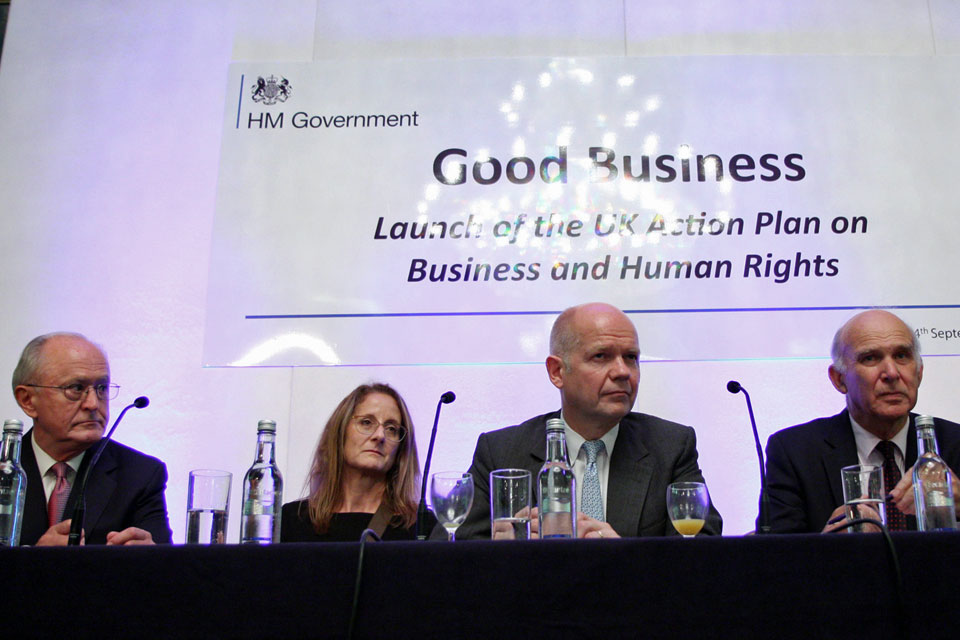
  • William Hague – 2014 Speech on Ukraine

    williamhague

    Below is the text of the speech made by William Hague, the Foreign Secretary, at Lancaster House in London on 29th April 2014.

    Good evening Ladies and Gentlemen. I am very pleased to welcome you here today at Lancaster House.

    I thank our co-host United States Attorney General Eric Holder for being with us today at this event and his commitment to this vital initiative, the World Bank for their important technical support and Ukraine’s Prosecutor-General Oleh Makhnitsky and Justice Minister Pavlo Petrenko who are here with us for their valued presence at this immensely difficult time for their country.

    I am also grateful to Interior Minister Arsen Avakov who I understand has had to return to Ukraine to help manage the very serious situation there. He has our very strong support. I am looking forward to visiting Ukraine next week.

    This Forum on Asset Recovery provides a vital opportunity to forge connections between law enforcement agencies, to share expertise and to agree practical steps to track down assets that were criminally looted from the Ukrainian state by former President Yanukovych and his associates.

    Twenty two individuals suspected of embezzlement have already had their assets frozen in the EU, as you know. But we know from our experience of asset recovery after the Arab Spring that moving from freezes to actually returning stolen funds requires rapid, coordinated and widespread international action, so I am very glad to see so many countries represented here today.

    The task ahead of us is complex and challenging, but it is essential for three reasons.

    First, as a matter of principle, we have a duty to do everything we can to return to the Ukrainian state the huge quantities of funds that Yanukovych and his cronies are thought to have embezzled. These assets should be working to the benefit of the people of Ukraine, not lining the pockets of corrupt former officials.

    Second, we must show there is no safe haven for the proceeds of corruption in order to deter those who might be tempted to steal from the public purse in any country in the future. The people of Ukraine rose up against Yanukovych in large part because corruption and theft of state assets had reached such an appalling level under his leadership. I pay tribute to the many civil society activists, journalists and parliamentarians who worked so hard to bring these abuses to light.

    The Ukrainian people deserve our strong support in tackling corruption, strengthening the rule of law and building a more prosperous future for their country. That is why the United Kingdom is supporting projects in Ukraine to improve governance and public financial management, and recovering stolen assets will also make an important contribution to that effort. And the third reason – we must support the interim Government in Ukraine in its efforts to restore stability, begin the process of reform and prepare for elections on 25 May in the face of enormous pressures and unacceptable actions by the Russian Government even after agreement was reached at Geneva on 17 April to reduce tensions.

    The Government of Ukraine has made some determined efforts to implement that agreement. It has collected illegal weapons, removed roadblocks, initiated an amnesty law for protesters and taken an inclusive approach to constitutional reform.

    But Russia for its part has done nothing to implement the agreement. On the contrary it has continually called it into question, while mounting huge military exercises on Ukraine’s eastern border and unleashing a continual barrage of propaganda and aggressive rhetoric that can only increase tensions.

    And that is why the EU is pressing ahead with additional sanctions and I welcome the new US measures announced yesterday.

    It is why the international community must be united in condemning Russia’s illegal violations of Ukraine’s sovereignty and territorial integrity, and why we must be committed in our support for the right of the Ukrainian people to chart their own course in the future.

    So, I hope that your combined expertise and resources allow us to make practical progress during this Forum to support the Ukrainian Government in identifying and recovering the assets that rightfully belong to it.

    If we are successful in this task, we will be making an important contribution to tackling corruption and to supporting the Ukrainian people in their desire to build a better, more prosperous and stable future. Thank you very much indeed for everything you do.