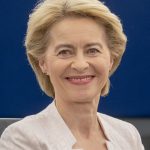
Tag: Ursula von der Leyen

  • Ursula von der Leyen – 2022 Statement at the End of COP27

    Ursula von der Leyen – 2022 Statement at the End of COP27

    The statement made by Ursula von der Leyen, the President of the European Commission, on 20 November 2022.

    COP27 marks a small step towards climate justice but much more is needed for the planet.

    We have treated some of the symptoms but not cured the patient from its fever.

    I am pleased that COP27 has opened a new chapter on financing loss and damage, and laid the foundations for a new method for solidarity between those in need and those in a position to help. We are rebuilding trust. This is crucial moving forward because there can be no lasting action against climate change without climate justice. The European Union is already the world’s leading contributor of international climate finance, and I am satisfied that we confirmed our commitment to support the most vulnerable on our planet through a first contribution on loss and damage.

    COP27 has kept alive the goal of 1.5C. Unfortunately however, it has not delivered on a commitment by the world’s major emitters to phase down fossil fuels, nor new commitments on climate mitigation. But the EU will stay the course, notably through the European Green Deal and REPowerEU, because it is essential to keep the ambition of the Paris Agreement within reach.

    I extend my heartfelt thanks to the EU’s negotiating team in Sharm El Sheikh for their determination and hard work throughout the conference.

  • Ursula von der Leyen – 2022 Speech to the International Institute for Strategic Studies Manama Dialogue

    Ursula von der Leyen – 2022 Speech to the International Institute for Strategic Studies Manama Dialogue

    The speech made by Ursula von der Leyen, the President of the European Commission, on 18 November 2022.

    Thank you Dr Chipman, dear John

    Your Royal Highness,

    Your Highnesses,

    Excellencies,

    Distinguished guests,

    Ladies and Gentlemen,

    Allow me to thank the IISS for its continued leadership in convening a regional dialogue. It is a pleasure to be back at the Manama Dialogue. And it is so good to see that Bahrain continues to be a driving force for dialogue between countries and cultures. Since my last visit four years ago, Bahrain’s achievements have been remarkable. In difficult times for the world, you have been a voice of wisdom and a voice for engagement.

    I have come to Bahrain, I have come to the Gulf, directly from the G20 Summit in Bali. This was the first G20 Summit since Russia invaded Ukraine. And of course, the Summit was dominated by the spillover effects of this atrocious war. Take food security, the Russian blockade of Ukraine’s ports, the deliberate bombing of grain silos and the disruption of Ukraine’s agriculture is having a devastating effect on global food security. Therefore, we welcome yesterday’s prolongation of the Black Sea grain deal for 120 days. However, given the uncertainties, we have to boost even more our alternative routes. That is why Europe just invested an additional billion euros into linking Ukraine’s granaries to our ports by rail, road and rivers. These solidarity lanes have – since the start of the war – taken more than 60% of Ukrainian food exports to the rest of the world. That is more than 17 million tonnes altogether.

    The second big topic was energy security. In energy, no one knows better than you in the Gulf that it is all about trust and reliability. For many years, you have supplied energy to the world to support its economic and social development. This has been transformative for many lives and livelihoods. We are in the middle of a difficult and turbulent period in history. Tectonic shifts in the energy landscape are happening right now. Before the war started, Europe was Russia’s biggest energy customer. Today, not even nine months later, this has changed fundamentally. Russia has unilaterally and deliberately cut 80% of its pipeline gas to Europe. But Europe has managed to replace most of it with gas from reliable suppliers. Our storages are full at 95% – and we are safe for this winter. Our challenge will be next year’s winter. At the same time, for emerging and developing countries, the energy crunch is happening right now. They are facing skyrocketing energy expenditures, soaring inflation, and the energy crisis is rapidly leading into an unsustainable debt crisis. Therefore, the world is looking to the key energy suppliers to ensure that these countries that rely on imported fuels and are vulnerable are substituted at reasonable prices.

    So much for the immediate crisis. But the tectonic shifts are running deeper. It is climate change that is the pacemaker. Desertification is rapidly swallowing fertile land, devastating floods covered one-third of Pakistan this summer, forest fires raged across Europe, even in Belgium and the UK. There is a reason why the largest economies in the world – the G20 – reaffirmed the Paris climate goals. The clean energy transformation will take place. And the winners will be those who invest now and massively in clean tech and infrastructure. Europe is massively investing into home-grown renewable energy. This is the European Green Deal – our fundamental growth strategy. But in addition, we will also continue to rely on energy imports. Many of the countries in this region have the natural resources for clean energy in abundance – wind, sun, etcetera – and have the know-how on existing and emerging technologies, such as carbon capture and storage. This change is creating opportunities for today’s major exporters to provide the fuels and energy services of tomorrow; to diversify into low-emission fuels such as hydrogen; to show leadership in areas such as CCUS; and as a result of these changes, to diversify also their broader economies and to provide a sustainable basis for long-term growth.

    Of course, what is behind these crises in food security and energy security is Russia’s war. Let me give you a European perspective on what is happening on European soil and the global implications. Almost nine months ago, Russian tanks rolled across an internationally recognised border with the declared objective to bring down a legitimate government and establish rule from Moscow. But Russia’s efforts have backfired spectacularly. It has proven to be a colossal strategic mistake.

    First of all, the people of Ukraine have fought bravely, with grit and determination, to defend their own freedom; to reaffirm their independence and their right to determine their own future. If Putin was aiming to wipe Ukraine off the map, he achieved the exact opposite: The Nation of Ukraine stands today stronger than ever. Second, if Putin wanted to divide Europe and its partners and allies, he failed yet again. Sweden and Finland will join NATO. Denmark has removed its defence opt-out. And Ukraine is now a candidate to join the European Union. Thirdly, this war is weakening Russia’s economic perspective for decades to come. Our technology sanctions are crippling Russia’s economy for the future. And its industry is in tatters.

    From an energy point of view, Russia has lost its biggest customer. Europe is ending its dependency on Russian fossil fuels – for good. From a military point of view, the Russian army has shown its weaknesses and appears overstretched. Its military industrial complex is lacking chips and spare parts to fix their hardware. The equipment Russia is throwing at the frontline is getting older and older. The conscripts, who arrive with it, are barely trained and younger and younger. And from a diplomatic point of view, Russia’s illegal annexation of four Ukrainian regions has been roundly rejected as a sham around the world. It was condemned by 143 countries in the UN General Assembly, including by the overwhelming majority of the Gulf, the Middle East and North Africa. In sum, Putin has achieved a weaker Russia domestically and abroad.

    The European Union is united and steadfast in its support to Ukraine. From the very beginning, we have provided a strategic answer. With massive and tailored sanctions; with broad humanitarian aid; with substantial financial support of over EUR 20 billion; and, for the first time ever, the European Union directly financed military assistance of over EUR 3.1 billion.

    Ladies and Gentlemen,

    My last point is about the international order and how to defend it. There is one recent development that I find very telling. Last January, exactly one month before Russia attacked Ukraine, civilians in Abu Dhabi came under fire of Iran-made Shahed-136 UAVs launched from Yemen. Just a few days ago, the oil tanker ‘Pacific Zircon’ was attacked off the coast of Oman by the very same Iranian drones. And now in Europe too, Russia has launched these very same Iranian drones, time and again, against civilian targets in Ukraine’s cities. These are blatant breaches of humanitarian law and qualify as war crimes. Several Gulf countries have been warning for years about the risk that Iran feeds rogue nations around the world with drones. It took us too long to understand a very simple fact that while we work to prevent Iran from developing nuclear weapons, we must also focus on other forms of weapons proliferation, from drones to ballistic missiles. It is a security risk, not just for the Middle East but for us all.

    This is why the European Union has already sanctioned Iranian individuals and entities linked to the Iranian Revolutionary Guard – that are responsible for providing drones to Russia. And we are coordinating with partners and allies to take further sanctions against Iran responding to the proliferation of Iranian drones. By teaming up, Iran and Russia are undermining the basic rules and principles of our global order. And where does this end, if left unchallenged? History shows that this is a recipe for perpetual war. It is a recipe for arms races and the proliferation of weapons of mass destruction. It is a recipe for constant foreign interference, for never-ending violence and instability. And we simply cannot accept this. And we will not accept this.

    Ladies and Gentlemen,

    The world needs a stronger security architecture, against the spread of chaos. We know this in Europe and it matters also here in the Gulf. Europe is willing to do its part. We want to strengthen our engagement with the region – both economically but also in terms of security. We want closer cooperation on maritime security – for instance to ensure safe shipping lanes. And I am also convinced that we should work on a coordinated approach to Iran – with a broader focus than nuclear. Gulf security matters to Europe, as Europe’s security matters to the Gulf. Therefore, we will appoint a Special Representative to the Gulf. Let us join forces for our collective security.

    Ladies and Gentlemen,

    I believe we face a historic opportunity to build new ties between our regions. For our mutual benefit. For today and for the long run. Thank you very much for hosting me, and I look forward to our discussion.

  • Ursula von der Leyen – 2022 Speech at the G20 Summit Session on Food and Energy Security

    Ursula von der Leyen – 2022 Speech at the G20 Summit Session on Food and Energy Security

    The speech made by Ursula von der Leyen, the President of the European Commission, on 15 November 2022.

    Dear President Widodo, colleagues, the G20 is a critical forum to address global issues.

    We must end this war.

    Russia’s war is not only unjustified, unprovoked and illegal, it is causing immense suffering in Ukraine and damage to the global economy.

    Like many around this table, the EU condemns this war.

    And the G20 must now work together to address the severe global consequences of the war.

    Let me address two points:

    First, the food crisis.

    The EU is doing its utmost to alleviate the situation:

    Just to set the record again straight. There are no sanctions on agri food products and fertilisers.

    We support full-heartedly the Black Sea Grain Initiative brokered by the Secretary General Guterres and President Erdoğan. It needs to be extended.

    In addition, in the European Union, we set up alternative transport routes to bring agri-food products out of Ukraine, which we call Solidarity Lanes. Since May, more than 15 million tonnes have been exported through these routes and we are further increasing their capacity.

    And we are stepping up our global food security aid by another 210 million euros, thus we are mobilising up to 8 billion euros over the next 3 years for food assistance and to increase local food production.

    On fertilisers, that of course include ammonia, we facilitate access and movement of fertilisers and we provide financial support. In addition, we are working with the African-Caribbean Pacific countries on innovation to develop the next generation of fertilisers.

    Second, the energy crisis.

    With regard to energy, Russia’s war was an eye-opener to the European Union. We see literally, that Russia – instead of selling gas – prefers to flare gas.

    This tightens the global energy market and leads to skyrocketing prices.

    We therefore support the introduction of an oil price cap. This will also strongly benefit the low- and middle- income countries

    Our best response to this is to speed up the green transition towards clean energy. Clean energy is the only answer to both the energy crisis and the climate crises.

    And there are huge global opportunities in this, too. In the next five alone Europe will invest at least 4 billion euros in renewable energy, like hydrogen, through our Global Gateway investment strategy. And this will unleash massive private investment as well.

    This all shows how relevant the G20 is in addressing these global issues.

    We are of course grateful to the Indonesian leaderships and I am looking forward to the upcoming Presidency of India.

  • Ursula von der Leyen – 2022 Speech at the Partnership for Global Infrastructure Summit

    Ursula von der Leyen – 2022 Speech at the Partnership for Global Infrastructure Summit

    The speech made by Ursula von der Leyen, the President of the European Commission, on 15 November 2022.

    Thank you very much President Biden, President Widodo,

    Throughout this day, we have discussed that we live in a truly volatile global economy with obviously a changing climate. And in addition, we see that Russia’s war is rubbing salt in the wound of economic recovery from COVID-19. So this mixture made us completely re-evaluate our energy, our trade and our security relationships. What is the situation for the European Union? We have decided to completely diversify away from the Russian fossil fuels. We have understood and learnt our lesson that it was an unhealthy and unsustainable dependency and we want reliable and forward-looking connections. This is why we launched the Partnership for Global Infrastructure and Investment – PGII. We are joining forces to give our partners a powerful and a positive offer. Dear Joe, you have said that the world needs a positive investment boost. This is what it is all about. To help build the global infrastructure that we all need for sustainable growth. So invest in renewable energy, in transport corridors, in digital connections that people can trust. On the European side, the contribution is the so-called Global Gateway. It is our EUR-300-billion investment programme for abroad for the next five years combined with the wish to harness the power and the knowledge of the private sector. And we are deeply convinced that this will be a game changer for two reasons.

    First of all, Global Gateway or PGII are not just investing massively in state-of-the-art infrastructure but they are also investing in the local capacities of our partners. This is crucial. We want to strengthen our shared resilience. In the last session, we have been discussing the vaccine manufacturing example. What is special about it? If we take the example from the European Union, there is a European-American company that is sharing its mRNA technology and training local professionals. So it is about skills. Then we have African and European financial institutions that are providing the investment. And we have our regulatory medicines agencies that are sharing their know-how. No single actor in this combination could have done this alone. But together, we are really able to deliver on the ground.

    And my second point is that the Partnership for Global Infrastructure and Investment is working because it is demand-driven. We see an enormously rising demand for renewable energy, and this is a good example. As I said, Europe has decided to completely diversify away from the Russian fossil fuels and we want to leapfrog to clean energy. We need this clean energy. Not only to have it home-grown but also to import it. Our partners in the Global South have an abundance of clean energy potential and resources. So Europe could turn into the world’s largest market for their energy exports. What is necessary is investment and infrastructure. That is where we have to team up. So here are some example: At COP27, we have signed hydrogen partnerships with Namibia, Egypt and Kazakhstan. With Namibia, we are building transport corridors from the Indian Ocean to the Atlantic port of Walvis Bay.

    And there is much more to be done. I am very happy that today we launched the Just Energy Transition Partnership with Indonesia – a big step forward. The European Union will contribute over EUR 1 billion. It is the roadmap for the country’s low-carbon future. And we are investing in developing geothermal energy. Or we are engaged in talks with India on renewable hydrogen; with Chile on critical raw materials. Or we are launching a digital alliance in Latin America to build fibre-optic cables and satellite connectivity. Many of these examples show exactly the direction of travel and the shared interest that we do have. So we are ready to contribute. If we align our investment strategies and crowd in the private sector –that is crucial –, I think we can maximise our joint impact. Let us bundle our forces and make a positive difference in investment globally.

    I now have the pleasure to invite Heads of State to deliver their remarks. And I hand over the floor to Japan’s Prime Minister Kishida. Fumio, you have the floor.

  • Ursula von der Leyen – 2022 Comments on Russian Attacks on Ukraine Energy

    Ursula von der Leyen – 2022 Comments on Russian Attacks on Ukraine Energy

    The comments made by Ursula von der Leyen, the President of the European Commission, on Twitter on 24 November 2022.

    As winter grips Europe, my thoughts are with our Ukrainian friends. Women, men, children are freezing in the dark because of Putin’s deliberate & barbaric targeting of the country’s civilian infrastructure. The sole purpose is to terrorise civilians. These acts are war crimes.

  • Ursula von der Leyen – 2022 Statement on the Occasion of the Signature of the Memorandum of Understanding with Kazakhstan

    Ursula von der Leyen – 2022 Statement on the Occasion of the Signature of the Memorandum of Understanding with Kazakhstan

    The statement made by Ursula von der Leyen, President of the European Commission, on 7 November 2022.

    Thank you very much Prime Minister Smailov,

    It is a great pleasure for me to sign with you this important Memorandum of Understanding between Kazakhstan and the European Union. We are basically opening a new chapter in our already deep relationship. The European Union and Kazakhstan have developed strong economic ties over the years. The European Union is by far the largest foreign investor in Kazakhstan, with 60% of the stock of foreign direct investment. The Memorandum of Understanding we have just signed will now further expand this relationship and align it with the shared priorities of both parties.

    Together, we will work to better integrate our strategic value chains related to raw materials, to batteries and to renewable hydrogen. These value chains are very important engines to power the green and the digital transition worldwide. We know for example how important batteries are to electrify our economy, for example for electric vehicles or the storage of renewable energy, so there is a great demand for that. Or if we take hydrogen: As European Union, we are determined to reach climate neutrality by 2050 and we have ambitious plans to move away from fossil fuels. And there, hydrogen will play a major role to be one of the big sources of renewable energy that we will need. We know that all of this requires an appropriate amount of specific raw materials, and in particular minerals of which Kazakhstan is so rich. So raw materials and renewable hydrogen are not only essential building blocks for our sustainable future but also for our shared prosperity.

    Finally, to be successful in the long term, MoUs must be rooted in ambitious, long-term partnerships that align well with the values of both parties. The Memorandum of Understanding that we have just signed is exemplary in this respect. First of all, because it emphasises that our cooperation must help align our high environmental, social and governance standards. Second, because it foresees that Kazakhstan and the European Union will for example cooperate on research and innovation, on the formation of skills, or on capacity building. And finally, because this will also attract private capital to these investments, the value chains we are developing together in Kazakhstan will serve the whole world. Because, of course, it is not exclusively for the European Union but it is open to everybody. And these value chains will be much needed worldwide.

    Let me conclude by emphasising that today is the first step in our common journey. The real work starts now. We will take stock in six months, by which time we aim to have designed an operational roadmap, in partnership with our Member States, with industry and with the stakeholders.

    So Prime Minister, I am very much looking forward to the next steps. And many thanks for being here with us today.

  • Ursula von der Leyen – 2022 Speech at the Berlin Process Summit for the Western Balkans

    Ursula von der Leyen – 2022 Speech at the Berlin Process Summit for the Western Balkans

    The speech made by Ursula von der Leyen, the President of the European Commission, on 3 November 2022.

    Indeed, we had a very good meeting today. And with Albania in the driving seat for next year, I know that the Berlin Process continues to be in very good hands. Our aim is very clear: It is the aim to bring our Western Balkan partners as close as possible, as fast as possible. And here we have two tracks: One track of work is of course the accession process. There, we have made good progress. The Commission has put enlargement back on the table, from the very first day of my mandate. We have been securing agreement on a new enlargement methodology that opened up ways, not only to unblock decisions – that was very important – but it also brought back credibility to the whole process. Then, we have put on the table a substantive Economic and Investment Plan. It brings EUR 30 billion of investment to the region, which is overall approximately one-third of the GDP of the whole region.

    In addition, last year, we had an Intergovernmental Conference with Montenegro. We opened one cluster with Serbia. And this year, we were very happy that we finally managed to have the first Intergovernmental Conference with Albania and North Macedonia and started the screening process. And we made the proposal to Council to give Bosnia and Herzegovina candidate status. I must say, this progress, which is good progress, dear Edi Rama, was possible because of the progress made in the Western Balkan countries themselves, so it is your success.

    Indeed, a second track of action is the Berlin Process. And here, the goal is to deepen our economic integration. And yes, we are facing manifold challenges, first and foremost Russia’s invasion of Ukraine that marks a geopolitical shift on our continent. But the longer the Russian war lasts, the more determined we are to stand together and to withstand. We know that our investments in the Western Balkans are not only important for a conducive business environment – this is also the case – but we also know that these investments are investments for peace, stability and prosperity of Europe as a whole.

    Against this backdrop, indeed, we discussed in depth the knock-on effects of the Russian war on energy. Therefore, today’s declaration on energy security and the green agenda for the Western Balkans marks a very important step. As the Chancellor already said, we are united in the goal of climate neutrality by 2050 and our climate targets by 2030. If we look at the immediate crisis, it is important that we synchronise our steps. We are in an energy community. Therefore, in the short term, this means for all of us: diversification of energy sources, the reduction of our dependency on Russian fossil fuels, and to keep energy prices in check with joint action.

    But we are also aware of the fact that unprecedented crises demand or need unprecedented steps and action. Therefore, I am pleased to announce that the Commission will put forward a substantial energy support package for the Western Balkans. It is EUR 1 billion in grants and it has two different parts. The first part is EUR 500 million in grants as a very immediate financial support for the six Western Balkan countries to put them in a position for the very short term to support vulnerable households and vulnerable businesses. This budget support will be adopted in December and available in January – in other ways: very shortly. The second part, the other EUR 500 million in grants, will be dedicated to investments in energy infrastructure. These are mainly investments in gas and electricity interconnectors to really have a common grid and interconnection in the region with the European Union. Very important is the emphasis on investments in renewable energy – because this gives us independence, it is clean energy and it creates good jobs at home – and, of course, energy efficiency measures.

    In addition, we will strengthen the security of supply by improving and facilitating the access in each other’s energy pipelines and storages. This is for the emergency. So that in case somebody is in trouble, there is solidarity from all of us. And the European Union and the Western Balkans will harmonise their crisis and emergency plans and measures, in a spirit of solidarity and increased neutral resilience. Finally, we are also inviting our partners from the Western Balkans to join us in our European attempt to have a joint procurement platform, so really to develop the strong market power we have if we stick together.

    And this brings me to the second point, the regional integration. That is the development of the common regional market. It is for us a very important stepping stone towards the EU Single Market. Indeed, in this regard, I welcome today’s signature of three very important agreements. The freedom of movement is key to both. It is of course key to the development of the common regional market, but it is also key to the integration of the Western Balkans in the European Single Market. It is about the people – be it students, be it professionals. They will bring the region forward.

    Therefore, the agreement is so important for 18 million people to move freely within the region. Professionals can tap their full potential, regardless of where they work. The professional qualifications – be it of skilled workers, students, researchers, medical doctors, dentists or architects – will all be recognised throughout the Western Balkans. Very important is also that the national ID cards will be accepted at every border. These measures will not only boost intra-regional travel in the Western Balkans, but it will also strengthen personal and cultural bonds between the people of the region. In the very end, it is always the same good old story that has always been at the heart of the European project. It is enhanced cooperation and harmonisation that bring peace and prosperity to all. We should use every opportunity to get closer with our Western Balkan friends.

    Thank you, once more, for a very good Berlin Process.

  • Ursula von der Leyen – 2022 Comments on Lula Winning Brazilian Election

    Ursula von der Leyen – 2022 Comments on Lula Winning Brazilian Election

    The comments made by Ursula von der Leyen, the President of the European Commission, on 31 October 2022.

    Congratulations, @LulaOficial , on your election as President of Brazil. I look forward to working with you to address pressing global challenges, from food security to trade and climate change.

  • Ursula von der Leyen – 2022 Statement on her Official Visit to Serbia

    Ursula von der Leyen – 2022 Statement on her Official Visit to Serbia

    The statement made by Ursula von der Leyen, the President of the European Commission, on 28 October 2022.

    Mr President, dear Aleksandar,

    It is wonderful to be back here in Serbia. I am very glad to be at this very special place, which I think shows the profound bonds we do have and our great cooperation. Today, we are watching the progress of the interconnector between Serbia and Bulgaria. It is great to see that this important project is taking shape. Indeed, you have just mentioned the funding that is coming from the European Commission and the European Investment Bank. It is round about 80%. And what we want to see is not only gas flowing from Bulgaria to Serbia, but this project will be one step further to bring us closer to each other. It will open Serbia’s gas market for diversification. It will improve Serbia’s energy security. And it will be important to see that we are very much looking forward to having this project now completed in hopefully one year. So we will press on both sides – I know that it takes two to tango, in this project, too – so that we are on time, because it is needed. We need to diversify our gas supplies. We see that dependency that is too much focused on Russian gas is not good. We have felt it bitterly during the last months. So the diversification away to reliable suppliers is paramount for us.

    I am very glad that we are also here today with an energy project, because we are already together in an Energy Union. By that I mean that, whatever the European Union does, the Western Balkans are included because we are so much interconnected that, in our Energy Union, whatever the one or the other does has an influence on us. If something happens in the European Union, it has an influence in the Western Balkans. If here something, for example an improvement with the gas interconnector, happens, it has a positive influence for the whole European Union because we are in an Energy Union.

    And we have been working very hard during the last months in this Energy Union to master the energy crisis. Just a reminder for you: Russia has cut 100 billion cubic metres of gas and we have been able to compensate. We have been able to compensate by diversifying away to other reliable suppliers. Now, we invite everyone, and Serbia too, to join us in our EU joint procurement of gas because we want to use our market power as the Energy Union to achieve better results on the global market where there is a lot of competition for gas, mainly LNG, and to be there as a European Energy Union exerting our market power for better results on the prices.

    You are here in Serbia as affected as the rest of the European Union by the difficulties we have in the energy market overall. So there is another step that we are taking forward. We have decided that we want to take two steps: One is a short-term support, not only for the Member States, but also for the Western Balkans. And here, I am happy to announce that EUR 165 million in grants for immediate budget support are available for Serbia. And I think this is absolutely necessary so that Serbia, like other countries, is able to support vulnerable families, vulnerable households and vulnerable businesses, small and medium enterprises, so that they can cope with the high energy prices. But this is not a long-term solution. It is not a sustainable solution. What we need is investment.

    And therefore, Mr President, dear Aleksandar, the second part, I think, is at least as important. These are EUR 500 million in grants in investment in infrastructure. Infrastructure like we see it here. Infrastructure that is badly needed. For example, if I may quote a few topics that are on our list, the Trans-Balkan Electricity Corridor – that is fascinating. It is going to be electricity from Italy to Bulgaria via Serbia, Montenegro, Bosnia and Herzegovina. All of it will be interconnected so that we can help each other, that we can serve each other and that we are never going to be again in such a bottleneck situation as we are today.

    Another project that is very dear to my heart is that we want to support Serbia together in building a new, a modern and more energy-efficient University Children’s Hospital in Belgrade. This is a project on which I am very glad that we can advance together. Let me give you one figure: 40% of the emissions we lose go through buildings that are badly insulated. So the other way round is also true: The better, the more energy efficient we build buildings, the better it is for the climate. But of course, the better it is also for our energy efficiency. This hospital should be completed by 2025.

    And then indeed what I just saw, and Mr President, you explained to me the third element that is so important, that is the gas interconnector between Serbia and North Macedonia. Here too, this will allow to complete the region. All this is in our projects and in this package.

    Finally, a last point: This energy crisis stems from the atrocious war that Russia is leading against Ukraine. And this war is redefining the security landscape of our entire continent. So it is for the European Union of utmost importance to invest even further in our Western Balkan partners – more than ever before because these investments are investments for the future. They are investments in peace. They are investment in the stability, in the prosperity of our shared continent. And let me assure you that the European Union is and will remain Serbia’s most important political and economic partner.

    Due to the good progress that was made in the past, Serbia is one of the most advanced countries on the European path. And as you know, we want you to take now the next further very important steps towards the European Union. We know the topics, we will discuss them later bilaterally – be it the independence and the accountability of the judiciary or the fight against corruption. I know that you are very engaged in that. And may I thank you, Mr President, for your latest announcement that the Serbian visa policy will be aligned with that of the European Union by the end of the year. This is an important announcement, many thanks for that. This is absolutely the right direction to head forward.

    Last but not least, we will have tonight a bilateral meeting. I think there are other topics on the agenda. If I may express a deep wish, that is the wish that we will have progress in the Dialogue between Kosovo and Serbia. Here too, I know it is always necessary to have two sides. But we all know by experience that only with dialogue are we able to solve conflicts and to move forward in an acceptable way for all of us. So my comment in the very end is: I know that Serbia’s future is in the European Union. I know that our European Union is not complete without Serbia. We share the same commitment to our common European future. Therefore, let us continue the hard work for this common future.

    Thank you very much for having invited me here today.

  • Ursula von der Leyen – 2022 Speech in Bosnia and Herzegovina

    Ursula von der Leyen – 2022 Speech in Bosnia and Herzegovina

    The speech made by Ursula von der Leyen, the President of the European Commission, on 28 October 2022.

    Dear Members of the Presidency-elect,

    Honourable Members of the joint collegium,

    Incoming Members of Parliament,

    Dear representatives of businesses and civil society,

    EU Ambassadors,

    And of course, Ladies and Gentlemen,

    It is such a pleasure for me to be here with you in Sarajevo at this historic moment for Bosnia and Herzegovina. But before I speak about this beautiful city and this wonderful country, allow me to take you for one small moment to the city where I was born and where I live today. And that is the city of Brussels. In the heart of Brussels, there is a piece of Bosnia and Herzegovina. It is a huge, colourful mural, painted by a young artist from Sarajevo – whose name is Rikardo Druškić. It brings light and it brings joy from the Balkans into the sometimes very grey weather of Brussels. But beyond the beauty of it, the mural sends a very clear message: It says that Bosnia and Herzegovina has a place in the heart of the European Union. You are part of Europe. So you belong in our Union. And it was so moving to see the European flag shine on three landmark monuments in Sarajevo, in Banja Luka and in Mostar – to celebrate our proposal to make Bosnia and Herzegovina a candidate country to join the European Union. This is your success. And you can be so proud of it. Because our flag, that was visible this night, will be your flag, too. It belongs in this country. And this is why I came here today. This is what I want to say to all the citizens of Bosnia and Herzegovina. You are the future of the European Union. Your future is the Europe Union.

    And this is not only because you achieved candidate status. It is also because the citizens of Bosnia and Herzegovina deeply believe in Europe. Over three quarters of your citizens support EU membership. There is a solid majority in favour of it in all parts of the country. And this faith in Europe is even stronger among young people. For young people in this country, among others, Europe means economic prosperity. It means, for example, freedom of movement. But it is not just that. The path towards our Union is also the path towards a better Bosnia and Herzegovina. It is about turning this country into the country of the young people’s dreams. There is an entire generation of citizens of Bosnia and Herzegovina who are born after the war. They respect the past. But they do not want their country only to be defined and divided by its tragic past. They want a country that is united. They want a country that has a common sense of purpose. Born from the experience of the past, but open and ready for the future. And membership to the European Union is part of this common purpose. And you, the new leadership of Bosnia and Herzegovina, of this country, you are the people who can make their dream come true. You are the ones who have the key for the dream of these young people in your hands. With your political work, and it is a huge responsibility, the country has a once-in-a-generation opportunity to move forward. This is Bosnia and Herzegovina’s moment, and I would like to encourage everyone here, everyone of you present here and working for this country, to seize this moment.

    This is also the meaning of our recommendation to grant candidate status to Bosnia and Herzegovina. Once again, from the bottom of my heart: My utmost congratulations to what you have achieved. It is your success. Without your work, it would not have been possible. The last four years, I know, have not always been easy. Because of COVID-19 for example, because of the war in Ukraine, because of deep political divisions. And yet, even in difficult circumstances, progress has been made – on public procurement for example, on achieving membership of the Union Civil Protection Mechanism for example. Or another success earlier this week on Europol cooperation – that you achieved. And these examples should teach a very simple lesson. The lesson is: If there is a political will, there is a way to make it happen. That is the lesson to learn from the past. Now is the time for the country to come together again and advance on the path towards the European Union. I will not dwell on the eight reform steps that we have clearly outlined in our recommendation. We all know that passing these reforms will not be easy. But I would like to invite you to always set your sights on what lies at the end of this path. Because Bosnia and Herzegovina, with your work, will be a country, for example, where everyone is equal before the law. It will be a country where young people unfold their talent and their hard work will lead into success. They do love their country. They want opportunities here in Bosnia and Herzegovina. It will be a country that is attractive for investors. You have the key in your hands for that. It will be a country where everyone feels represented – young and old, people who identify as Bosniaks, as Serbs and Croats, as well as people who just feel citizens of this country. The reforms do not only matter because they lead into the European Union, the reforms matter because they will make your country a better place for all its people.

    Ladies and Gentlemen,

    The door of the European Union is open. Please seize the opportunity and use this invitation. It is up to you now to walk together through this open door. The more you do that, the more you help me to support your country, Bosnia and Herzegovina, for example to defend the candidate status in the European Council and to advocate for your country. And I know I can rely on you. This is your historic responsibility as the new leaders of Bosnia and Herzegovina. That is a lot of responsibility on your shoulders – I know it. But I am positive that you are able to carry it. And rest assured: We will always be at your side. This is my personal promise. Our proposal for candidate status is a very clear political statement. And we will support you and your reforms and your work, and accompany you along the way.

    A good part of the work is already ongoing. I remember that, one year ago, during my last visit, I crossed an EU-funded bridge that links Croatia and Bosnia and Herzegovina. Later today, I will inaugurate the Ivan Tunnel. It will of course improve the connection of Mostar to Sarajevo and, further north, to Budapest. But this Ivan Tunnel is much more than that, it is very symbolic because it shows that Bosnia and Herzegovina lies at the heart of Europe, and you should also lie at the heart of our trade and our economic achievements. I think this cooperation – that we are enabling, that we are opening not only physically with the Ivan Tunnel but also by making sure that the trade and the economic exchange between us is getting more seamless and more intense – is even more crucial at a time when this horrible Russian war in Ukraine is raging. We see that Russia is not only waging war against Ukraine, it is also waging war on the energy side. And the energy problems are hitting vulnerable families as much as they are hitting for example businesses and small and medium enterprises. For us in the European Union, it is important to stick together with you. Therefore, as that in the European Union, I would like to announce here in Bosnia and Herzegovina, that we are putting together an energy security package for the Western Balkans. It will bring EUR 70 million of support in grants for Bosnia and Herzegovina. This is important now, as immediate support, for example to support vulnerable families and vulnerable businesses, small and medium enterprises which have a hard time. And there is a second part in it that is at least as important: This is – for the medium term, for the Western Balkans – EUR 500 million in grants for infrastructure. Infrastructure for the future so that together we get more energy independent. Investments in interconnectors, for example. Investments in renewables because every kilowatt hour from renewable energy that is produced here is clean energy at home that brings good jobs for the region and makes us energy independent and gives us security of supply. I am speaking about solar, I am speaking about wind or biomass power plants. These are energy projects that can be built in less than one year. So here is the opportunity to seize it and to really take this investment and to make a big step forward.

    I know that many people in the country feel anxious because of the war that is raging. Not only has Russia launched an assault on basic international rules that have been providing peace and security for the region since 1995, but it is also having a direct impact on the economic situation of our European Union and thus on all people in the Western Balkans and the people in Bosnia and Herzegovina. As much as the challenge is out there, I think the best solution is in an even closer cooperation and to stand together. It is in your immediate interest to work closer together in our Single Market and to work towards the EU membership. Because we all know by experience that, whatever the challenge is – and we have gone through many challenges in the last year –, if we stand together, if we work together, we are strong and we are unbeatable. And we should use this strength in this very crucial moment.

    Ladies and Gentlemen,

    These are times of rapid change in the Western Balkans and in Europe. As you know, we have opened accession negotiations with Albania and North Macedonia. We have also granted candidate status to Ukraine and Moldova, and we have recognised Georgia’s European perspective. What I want to say is that there is new momentum, there is a wind of change that brings the European family closer together. And now is the time for Bosnia and Herzegovina to move ahead, too. Let us be honest, it seemed impossible, we could not think about it, that we would reach the candidate status, if we think one year back [it seemed impossible one year ago, we could not think about it, that we would reach the candidate status]. And yet today, I am here with you in Sarajevo, we can celebrate together that you have achieved the candidate status. Therefore, let me tell you again: If there is a will, then there is a way to achieve your dream. And if Bosnia and Herzegovina finds unity of purpose, there is nothing that can stop you.

    Let me give you a little example for that, which is a big one in its effect. This summer, the success story of one young girl from Mostar literally made waves throughout the world. It was and is 16-year old swimmer Lana Pudar who won, as you know, the European gold medal in the women’s 200-metre butterfly and broke all Bosnia and Herzegovina’s records. Her story is the story of her country. It was not easy for her to train and to reach this enormous success. For example, she could not train in the city that lacks an Olympic-size swimming pool. But Lana has made it against all odds. And now, because of her success, a new Olympic swimming pool will be built in Mostar. Lana has become a symbol, not only for her hometown, not only for her community, but she has become a symbol all across the country. Her victory has been celebrated by all people of Bosnia and Herzegovina, in all entities and across all boundaries. This is the dream of your young people. This is the dream of your country. This is the dream to be united. United in Bosnia and Herzegovina’s diversity, united with your neighbours in one European family. And believe me, as with Lana, this dream can be realised. This dream can be realised if you take the responsibility, if we stand together and if we make the best of the responsibility the people have given you. So I want you to know that I will always be at your side. I know that a lot of work is ahead of you. But this is the moment to seize it.

    Many thanks for your patience, for listening to me. And please join us in working together.

    Thank you very much.