Tag: Theresa May

  • Theresa May – 2017 Speech in Bolton

    Below is the text of the speech made by Theresa May, the Prime Minister, in Bolton on 19 April 2017.

    It’s great to be here in Bolton, fresh from the House of Commons, fresh from winning a vote in the House of Commons which approved my decision to hold a general election on the 8th of June. It’s the right decision, it’s in the national interest. And that’s what this election is about providing the strong and stable leadership this country needs to take Britain through Brexit and beyond. It’s about strengthening our hand in the negotiations that lie ahead. And it’s about sticking to our plan for a stronger Britain that will enable us to secure that more stable and secure future for this country and take the right long term decision for the future. It’s about strong and stable leadership in the national interest. And you only get that strong and stable leadership by voting for the Conservatives. Because that’s what Conservatives government provides. And just look at what we’ve done.

    When I took over as Prime Minister, there were predictions of immediate financial crash, of economic danger. But we see consumer confidence remains high, we see record numbers of jobs, and economic growth that has exceeded all expectations. When I took over as Prime Minister people said the country was divided that it could never be brought together. But actually what I see today in this country is a unity of purpose – a desire for the Government to get on with the job of putting Brexit in to place and making a success of it.

    When I took over as Prime Minister, the country needed clear vision and strong leadership to ensure that we got on with that job of delivering on Brexit for the British people and that’s exactly what we did. We delivered that strong and stable leadership, we delivered the certainty that strong and stable leadership can give. And that’s what leadership looks like.

    Now there’s a very clear choice at this election. It’s a choice between strong and stable leadership under the Conservatives, or weak and unstable coalition of chaos led by Jeremy Corbyn. And that is very clear. Let’s look – the other parties are lining up to prop up Jeremy Corbyn. We’ve seen it with the Liberal Democrats, and we see it with Nicola Sturgeon’s Scottish nationalists. They’re very clear that they want to do everything they can to frustrate our Brexit negotiations. To undermine the job that we have to do, the task that lies ahead. Do everything to stop us from being able to take Britain forward. And it’s their tunnel vision focus on independence that actually provides uncertainty. They want to pull the strings, try to pull the strings of this election, prop up Jeremy Corbyn and provide more risk and uncertainty for the British people and that’s not in Britain’s interests.

    So it’s only a vote for the Conservatives that can deliver, and every vote for the Conservatives is a vote for me and local Conservative candidates, and it’s a vote to ensure that we have that strong and stable leadership that we need to take us through Brexit and beyond. Every vote for me and the local Conservative candidates here and across Britain is a vote to deliver on that plan for a stronger Britain and a more secure future for us all. And if we have that certainty of five more years of strong and stable leadership then we can ensure that we’re delivering for people, for ordinary working people up and down the country, across the whole United Kingdom.

    Yes getting the right deal with the European Union, ensuring that we get that good negotiation, that we deliver on that deep and special partnership with the European Union. Negotiating other deals for export of British goods and services. A country that is showing that we can be leaders in preventing terrorism and fighting modern slavery. But it’s also about getting the right deal for ordinary working people here at home, and that’s about building a strong Britain. Britain is the strongest country in Europe in terms of economic growth and national security.

    It’s about building a stronger economy. It’s about creating well paid secure jobs. It’s about ensuring that there is opportunity for all. That we provide a good school place for every child. That there is affordable housing. That people can get on in their lives. It’s about ensuring that we create a more united nation. That we take action against the extremists who want to divide us, and that we stand up to the separatists who want to break up our country. So it’s providing that strong and stable leadership.

    That certainty. That stability for the future, and that’s going to be our message as go out in to our election campaign. And I’m looking forward to it. We’re going to fight a positive and optimistic campaign about the future of this country. I’m going to be getting out and about around the country. I’m going to be visiting communities in every part of the United Kingdom. And I’m looking forward to taking our case out there to people. Because this is the case – that it is only with the Conservatives that you get the strong and stable leadership that this country needs to see us through Brexit and beyond.

    Only we can give that plan for a stronger Britain. For a more secure future. But only you can give us the mandate. So vote for a strong and stable leadership in this country. Vote for the strong and stable leadership this country needs. Give me the mandate to lead Britain. Give me the mandate to speak for Britain. Give me the mandate to fight for Britain, and give me the mandate to deliver for Britain.

  • Theresa May – 2017 General Election Announcement

    Below is the text of the statement made by Theresa May, the Prime Minister, on 18 April 2017, announcing a General Election.

    I have just chaired a meeting of the Cabinet, where we agreed that the Government should call a General Election, to be held on June 8.

    I want to explain the reasons for that decision, what will happen next and the choice facing the British people when you come to vote in this election. Last summer, after the country voted to leave the European Union, Britain needed certainty, stability and strong leadership, and since I became Prime Minister the Government has delivered precisely that.

    Despite predictions of immediate financial and economic danger, since the referendum we have seen consumer confidence remain high, record numbers of jobs, and economic growth that has exceeded all expectations.

    We have also delivered on the mandate that we were handed by the referendum result. Britain is leaving the European Union and there can be no turning back. And as we look to the future, the Government has the right plan for negotiating our new relationship with Europe.

    We want a deep and special partnership between a strong and successful European Union and a United Kingdom that is free to chart its own way in the world.

    That means we will regain control of our own money, our own laws and our own borders and we will be free to strike trade deals with old friends and new partners all around the world.

    This is the right approach, and it is in the national interest. But the other political parties oppose it. At this moment of enormous national significance there should be unity here in Westminster, but instead there is division.

    The country is coming together, but Westminster is not. In recent weeks Labour has threatened to vote against the deal we reach with the European Union. The Liberal Democrats have said they want to grind the business of government to a standstill.

    The Scottish National Party say they will vote against the legislation that formally repeals Britain’s membership of the European Union and unelected members of the House of Lords have vowed to fight us every step of the way.

    Our opponents believe that because the Government’s majority is so small, our resolve will weaken and that they can force us to change course. They are wrong.

    They under-estimate our determination to get the job done and I am not prepared to let them endanger the security of millions of working people across the country. Because what they are doing jeopardises the work we must do to prepare for Brexit at home and it weakens the Government’s negotiating position in Europe.

    If we do not hold a general election now their political game-playing will continue, and the negotiations with the European Union will reach their most difficult stage in the run-up to the next scheduled election. Division in Westminster will risk our ability to make a success of Brexit and it will cause damaging uncertainty and instability to the country.

    So we need a general election and we need one now, because we have at this moment a one-off chance to get this done while the European Union agrees its negotiating position and before the detailed talks begin. I have only recently and reluctantly come to this conclusion.

    Since I became Prime Minister I have said that there should be no election until 2020, but now I have concluded that the only way to guarantee certainty and stability for the years ahead is to hold this election and seek your support for the decisions I must take. And so tomorrow I will move a motion in the House of Commons calling for a general election to be held on the eighth of June.

    That motion, as set out by the Fixed-Term Parliaments Act, will require a two-thirds majority of the House of Commons. So I have a simple challenge to the opposition parties, you have criticised the Government’s vision for Brexit, you have challenged our objectives, you have threatened to block the legislation we put before Parliament.

  • Theresa May – 2017 Easter Message

    Below is the text of the Easter message given by Theresa May, the Prime Minister, on 16 April 2017.

    Easter is a moment to reflect and an important time for Christians and others to gather together with families and friends.

    This year, after a period of intense debate over the right future for our country, there is a sense that people are coming together and uniting behind the opportunities that lie ahead.

    For at heart, this country is one great union of people and nations with a proud history and a bright future. And as we face the opportunities ahead of us – the opportunities that stem from our decision to leave the European Union and embrace the world – our shared interests, our shared ambitions, and above all our shared values can, and must, bring us together.

    This Easter I think of those values that we share – values that I learnt in my own childhood, growing up in a vicarage. Values of compassion, community, citizenship. The sense of obligation we have to one another.

    These are values we all hold in common, and values that are visibly lived out everyday by Christians, as well as by people of other faiths or none.

    I think of those who go out of their way to visit the sick or bereaved, providing comfort and guidance to many in our country at some of the most difficult moments in their lives. I think of the sacrifices and service of aid workers who put themselves in harm’s way to bring much-needed relief in war-torn parts of the world.

    We should celebrate all these contributions and others like them, and the difference they make in our society and around the world.

    In doing so, we should be confident about the role that Christianity has to play in the lives of people in our country.

    And we should treasure the strong tradition that we have in this country of religious tolerance and freedom of speech.

    We must continue to ensure that people feel able to speak about their faith, and that absolutely includes their faith in Christ. We must be mindful of Christians and religious minorities around the world who do not enjoy these same freedoms, but who practise their religion in secret and often in fear.

    And we must do more to stand up for the freedom of people of all religions to practice their beliefs openly and in peace and safety.

    So this Easter, whatever our faith, let us come together as a nation confident in our values, and united in our commitment to fulfil the obligations that we have to one another.

    Let us work together to build that brighter future we want for our country. And let us together build a stronger, fairer Britain that truly does work for everyone. And let me wish you all a very happy Easter.

  • Theresa May – 2017 Letter to Donald Tusk

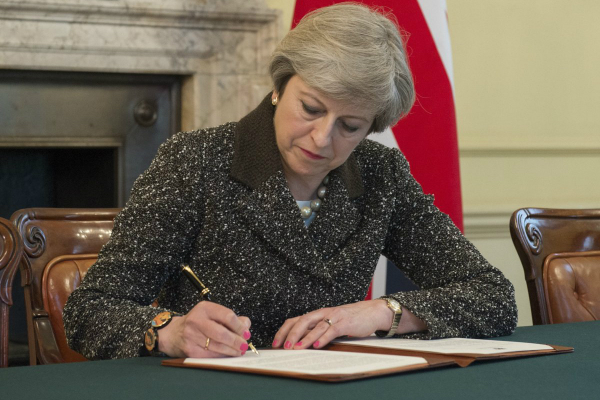
    Below is the text of the letter sent by Theresa May, the Prime Minister, to Donald Tusk on 29 March 2017.

    On 23 June last year, the people of the United Kingdom voted to leave the European Union. As I have said before, that decision was no rejection of the values we share as fellow Europeans. Nor was it an attempt to do harm to the European Union or any of the remaining member states. On the contrary, the United Kingdom wants the European Union to succeed and prosper. Instead, the referendum was a vote to restore, as we see it, our national self-determination. We are leaving the European Union, but we are not leaving Europe – and we want to remain committed partners and allies to our friends across the continent.

    Earlier this month, the United Kingdom Parliament confirmed the result of the referendum by voting with clear and convincing majorities in both of its Houses for the European Union (Notification of Withdrawal) Bill. The Bill was passed by Parliament on 13 March and it received Royal Assent from Her Majesty The Queen and became an Act of Parliament on 16 March.

    Today, therefore, I am writing to give effect to the democratic decision of the people of the United Kingdom. I hereby notify the European Council in accordance with Article 50(2) of the Treaty on European Union of the United Kingdom’s intention to withdraw from the European Union. In addition, in accordance with the same Article 50(2) as applied by Article 106a of the Treaty Establishing the European Atomic Energy Community, I hereby notify the European Council of the United Kingdom’s intention to withdraw from the European Atomic Energy Community. References in this letter to the European Union should therefore be taken to include a reference to the European Atomic Energy Community.

    This letter sets out the approach of Her Majesty’s Government to the discussions we will have about the United Kingdom’s departure from the European Union and about the deep and special partnership we hope to enjoy – as your closest friend and neighbour – with the European Union once we leave. We believe that these objectives are in the interests not only of the United Kingdom but of the European Union and the wider world too.

    It is in the best interests of both the United Kingdom and the European Union that we should use the forthcoming process to deliver these objectives in a fair and orderly manner, and with as little disruption as possible on each side. We want to make sure that Europe remains strong and prosperous and is capable of projecting its values, leading in the world, and defending itself from security threats. We want the United Kingdom, through a new deep and special partnership with a strong European Union, to play its full part in achieving these goals. We therefore believe it is necessary to agree the terms of our future partnership alongside those of our withdrawal from the European Union.

    The Government wants to approach our discussions with ambition, giving citizens and businesses in the United Kingdom and the European Union – and indeed from third countries around the world – as much certainty as possible, as early as possible. I would like to propose some principles that may help to shape our coming discussions, but before I do so, I should update you on the process we will be undertaking at home, in the United Kingdom.

    The process in the United Kingdom

    As I have announced already, the Government will bring forward legislation that will repeal the Act of Parliament – the European Communities Act 1972 – that gives effect to EU law in our country. This legislation will, wherever practical and appropriate, in effect convert the body of existing European Union law (the “acquis”) into UK law. This means there will be certainty for UK citizens and for anybody from the European Union who does business in the United Kingdom. The Government will consult on how we design and implement this legislation, and we will publish a White Paper tomorrow. We also intend to bring forward several other pieces of legislation that address specific issues relating to our departure from the European Union, also with a view to ensuring continuity and certainty, in particular for businesses. We will of course continue to fulfil our responsibilities as a member state while we remain a member of the European Union, and the legislation we propose will not come into effect until we leave.

    From the start and throughout the discussions, we will negotiate as one United Kingdom, taking due account of the specific interests of every nation and region of the UK as we do so. When it comes to the return of powers back to the United Kingdom, we will consult fully on which powers should reside in Westminster and which should be devolved to Scotland, Wales and Northern Ireland. But it is the expectation of the Government that the outcome of this process will be a significant increase in the decision-making power of each devolved administration.

    Negotiations between the United Kingdom and the European Union
    The United Kingdom wants to agree with the European Union a deep and special partnership that takes in both economic and security cooperation. To achieve this, we believe it is necessary to agree the terms of our future partnership alongside those of our withdrawal from the EU.

    If, however, we leave the European Union without an agreement the default position is that we would have to trade on World Trade Organisation terms. In security terms a failure to reach agreement would mean our cooperation in the fight against crime and terrorism would be weakened. In this kind of scenario, both the United Kingdom and the European Union would of course cope with the change, but it is not the outcome that either side should seek. We must therefore work hard to avoid that outcome.

    It is for these reasons that we want to be able to agree a deep and special partnership, taking in both economic and security cooperation, but it is also because we want to play our part in making sure that Europe remains strong and prosperous and able to lead in the world, projecting its values and defending itself from security threats. And we want the United Kingdom to play its full part in realising that vision for our continent.

    Proposed principles for our discussions

    Looking ahead to the discussions which we will soon begin, I would like to suggest some principles that we might agree to help make sure that the process is as smooth and successful as possible.

    i. We should engage with one another constructively and respectfully, in a spirit of sincere cooperation

    Since I became Prime Minister of the United Kingdom I have listened carefully to you, to my fellow EU Heads of Government and the Presidents of the European Commission and Parliament. That is why the United Kingdom does not seek membership of the single market: we understand and respect your position that the four freedoms of the single market are indivisible and there can be no “cherry picking”. We also understand that there will be consequences for the UK of leaving the EU: we know that we will lose influence over the rules that affect the European economy. We also know that UK companies will, as they trade within the EU, have to align with rules agreed by institutions of which we are no longer a part – just as UK companies do in other overseas markets.

    ii. We should always put our citizens first

    There is obvious complexity in the discussions we are about to undertake, but we should remember that at the heart of our talks are the interests of all our citizens. There are, for example, many citizens of the remaining member states living in the United Kingdom, and UK citizens living elsewhere in the European Union, and we should aim to strike an early agreement about their rights.

    iii. We should work towards securing a comprehensive agreement

    We want to agree a deep and special partnership between the UK and the EU, taking in both economic and security cooperation. We will need to discuss how we determine a fair settlement of the UK’s rights and obligations as a departing member state, in accordance with the law and in the spirit of the United Kingdom’s continuing partnership with the EU. But we believe it is necessary to agree the terms of our future partnership alongside those of our withdrawal from the EU.

    iv. We should work together to minimise disruption and give as much certainty as possible

    Investors, businesses and citizens in both the UK and across the remaining 27 member states – and those from third countries around the world – want to be able to plan. In order to avoid any cliff-edge as we move from our current relationship to our future partnership, people and businesses in both the UK and the EU would benefit from implementation periods to adjust in a smooth and orderly way to new arrangements. It would help both sides to minimise unnecessary disruption if we agree this principle early in the process.

    v. In particular, we must pay attention to the UK’s unique relationship with the Republic of Ireland and the importance of the peace process in Northern Ireland

    The Republic of Ireland is the only EU member state with a land border with the United Kingdom. We want to avoid a return to a hard border between our two countries, to be able to maintain the Common Travel Area between us, and to make sure that the UK’s withdrawal from the EU does not harm the Republic of Ireland. We also have an important responsibility to make sure that nothing is done to jeopardise the peace process in Northern Ireland, and to continue to uphold the Belfast Agreement.

    vi. We should begin technical talks on detailed policy areas as soon as possible, but we should prioritise the biggest challenges

    Agreeing a high-level approach to the issues arising from our withdrawal will of course be an early priority. But we also propose a bold and ambitious Free Trade Agreement between the United Kingdom and the European Union. This should be of greater scope and ambition than any such agreement before it so that it covers sectors crucial to our linked economies such as financial services and network industries. This will require detailed technical talks, but as the UK is an existing EU member state, both sides have regulatory frameworks and standards that already match. We should therefore prioritise how we manage the evolution of our regulatory frameworks to maintain a fair and open trading environment, and how we resolve disputes. On the scope of the partnership between us – on both economic and security matters – my officials will put forward detailed proposals for deep, broad and dynamic cooperation.

    vii. We should continue to work together to advance and protect our shared European values

    Perhaps now more than ever, the world needs the liberal, democratic values of Europe. We want to play our part to ensure that Europe remains strong and prosperous and able to lead in the world, projecting its values and defending itself from security threats.

    The task before us

    As I have said, the Government of the United Kingdom wants to agree a deep and special partnership between the UK and the EU, taking in both economic and security cooperation. At a time when the growth of global trade is slowing and there are signs that protectionist instincts are on the rise in many parts of the world, Europe has a responsibility to stand up for free trade in the interest of all our citizens. Likewise, Europe’s security is more fragile today than at any time since the end of the Cold War. Weakening our cooperation for the prosperity and protection of our citizens would be a costly mistake. The United Kingdom’s objectives for our future partnership remain those set out in my Lancaster House speech of 17 January and the subsequent White Paper published on 2 February.

    We recognise that it will be a challenge to reach such a comprehensive agreement within the two-year period set out for withdrawal discussions in the Treaty. But we believe it is necessary to agree the terms of our future partnership alongside those of our withdrawal from the EU. We start from a unique position in these discussions – close regulatory alignment, trust in one another’s institutions, and a spirit of cooperation stretching back decades. It is for these reasons, and because the future partnership between the UK and the EU is of such importance to both sides, that I am sure it can be agreed in the time period set out by the Treaty.

    The task before us is momentous but it should not be beyond us. After all, the institutions and the leaders of the European Union have succeeded in bringing together a continent blighted by war into a union of peaceful nations, and supported the transition of dictatorships to democracy. Together, I know we are capable of reaching an agreement about the UK’s rights and obligations as a departing member state, while establishing a deep and special partnership that contributes towards the prosperity, security and global power of our continent.

  • Theresa May – 2017 Statement on Westminster Terror Attack

    Below is the text of the statement made by Theresa May, the Prime Minister, in the House of Commons on 23 March 2017.

    Mr Speaker, yesterday an act of terrorism tried to silence our democracy.

    But today we meet as normal – as generations have done before us, and as future generations will continue to do – to deliver a simple message: we are not afraid. And our resolve will never waver in the face of terrorism.

    And we meet here, in the oldest of all Parliaments, because we know that democracy, and the values it entails, will always prevail.

    Those values – free speech, liberty, human rights and the rule of law – are embodied here in this place, but they are shared by free people around the world.

    A terrorist came to the place where people of all nationalities and cultures gather to celebrate what it means to be free. And he took out his rage indiscriminately against innocent men, women and children.

    Mr Speaker, this was an attack on free people everywhere – and on behalf of the British people, I would like to thank our friends and allies around the world who have made it clear that they stand with us at this time.

    What happened on the streets of Westminster yesterday afternoon sickened us all.

    While there is an ongoing police investigation, the House will understand that there are limits to what I can say.

    But having been updated by police and security officials let me set out what at this stage I can tell the House.

    At approximately 2:40pm yesterday, a single attacker drove his vehicle at speed into innocent pedestrians who were crossing Westminster Bridge, killing 2 people and injuring around 40 more.

    In addition to 12 Britons admitted to hospital, we know that the victims include 3 French children, 2 Romanians, 4 South Koreans, 1 German, 1 Pole, 1 Irish, 1 Chinese, 1 Italian, 1 American and 2 Greeks.

    And we are in close contact with the governments of the countries of all those affected.

    The injured also included 3 police officers who were returning from an event to recognise their bravery. Two of those 3 remain in a serious condition.

    Mr Speaker, the attacker then left the vehicle and approached a police officer at Carriage Gates, attacking that officer with a large knife, before he was shot dead by an armed police officer.

    Tragically, as the House will know, 48-year-old PC Keith Palmer, was killed.

    PC Palmer had devoted his life to the service of his country. He had been a member of the Parliamentary and Diplomatic Protection Command for 15 years, and a soldier in the Royal Artillery before that.

    He was a husband and a father, killed doing a job he loved.

    He was every inch a hero. And his actions will never be forgotten.

    I know the whole House will join me in sending our deepest condolences to his family – and to the families and friends of all those who have been killed or injured in yesterday’s awful attacks.

    I know also that the House will wish to thank all those who acted with such speed and professionalism yesterday to secure this place and ensure we are able to meet as we are doing today.

    Mr Speaker, at 7:30 last night, I chaired a meeting of the government’s emergency committee COBR and will have further briefings and meetings with security officials today.

    The threat level to the UK has been set at ‘severe’ – meaning an attack is highly likely – for some time.

    This is the second highest threat level. The highest level ‘critical’ means there is specific intelligence that an attack is imminent.

    As there is no such intelligence, the independent Joint Terrorism Analysis Centre has decided that the threat level will not change in the light of yesterday’s attack.

    Mr Speaker, the whole country will want to know who was responsible for this atrocity and the measures that we are taking to strengthen our security, including here in Westminster.

    A full counter-terrorism investigation is already underway.

    Hundreds of our police and security officers have been working through the night to establish everything possible about this attack – including its preparation, motivation and whether there were any associates involved in its planning.

    And while there remain limits on what I can say at this stage, I can confirm that overnight the police have searched 6 addresses and made 8 arrests in Birmingham and London.

    Mr Speaker, it is still believed that this attacker acted alone, and the police have no reason to believe there are imminent further attacks on the public.

    His identity is known to the police and MI5, and when operational considerations allow, he will be publicly identified.

    What I can confirm is that the man was British born and that some years ago, he was once investigated in relation to concerns about violent extremism. He was a peripheral figure.

    The case is historic – he was not part of the current intelligence picture.

    There was no prior intelligence of his intent – or of the plot. Intensive investigations continue.

    And as Acting Deputy Commissioner Rowley confirmed last night, our working assumption is that the attacker was inspired by Islamist ideology.

    Mr Speaker, we know the threat from Islamist terrorism is very real. But while the public should remain utterly vigilant they should not – and will not – be cowed by this threat.

    As Acting Deputy Commissioner Rowley has made clear, we are stepping up policing to protect communities across the country and to reassure the public.

    And as a precautionary measure, this will mean increasing the number of patrols in cities across the country with more police and more armed police on the streets.

    Since June 2013 our police, security and intelligence agencies have successfully disrupted 13 separate terrorist plots in Britain.

    Following the 2015 Strategic Defence and Security Review, we protected the police budgets for counter-terrorism and committed to increase cross-government spending on counter-terrorism by 30% in real terms over the course of this Parliament.

    And over the next 5 years we will invest an extra £2.5 billion in building our global security and intelligence network, employing over 1,900 additional staff at MI5, MI6 and GCHQ and more than doubling our global network of counter-terrorism experts working with priority countries across Europe, the Middle East, Africa and Asia.

    Mr Speaker, in terms of security here in Westminster, we should be clear first of all that an attacker attempted to break into Parliament and was shot dead within 20 yards of the gates.

    If his intention was to gain access to this building, we should be clear that he did not succeed.

    The police heroically did their job.

    But as is routine, the police together with the House authorities are reviewing the security of the Parliamentary estate, co-ordinated with the Cabinet Office, who have responsibility for the security measures in place around the government secure zone.

    All of us in this House have a responsibility for the security and safety of our staff and advice is available for Members who need it.

    Mr Speaker, yesterday we saw the worst of humanity, but we will remember the best.

    We will remember the extraordinary efforts to save the life of PC Keith Palmer, including those by my Rt Hon Friend the Member for Bournemouth East.

    And we will remember the exceptional bravery of our police, security and emergency services who once again ran towards the danger even as they encouraged others to move the other way.

    On behalf of the whole country I want to pay tribute to them for the work they have been doing to reassure the public, treat the injured and bring security back to the streets of our capital city.

    That they have lost one of their own in yesterday’s attack only makes their calmness and professionalism all the more remarkable.

    Mr Speaker, a lot has been said since terror struck London yesterday. Much more will be said in the coming days.

    But the greatest response lies not in the words of politicians, but in the everyday actions of ordinary people.

    For beyond these walls today – in scenes repeated in towns and cities across the country – millions of people are going about their days and getting on with their lives.

    The streets are as busy as ever.

    The offices full. The coffee shops and cafes bustling.

    As I speak millions will be boarding trains and aeroplanes to travel to London, and to see for themselves the greatest city on Earth.

    It is in these actions – millions of acts of normality – that we find the best response to terrorism.

    A response that denies our enemies their victory. That refuses to let them win. That shows we will never give in.

    A response driven by that same spirit that drove a husband and father to put himself between us and our attacker, and to pay the ultimate price.

    A response that says to the men and women who propagate this hate and evil: you will not defeat us.

    Mr Speaker, let this be the message from this House and this nation today: our values will prevail.

    And I commend this statement to the House.

  • Theresa May – 2017 Statement After Meeting Enda Kenny

    Below is the text of the statement made by Theresa May, the Prime Minister, after meeting Enda Kenny, the Irish Taoiseach, in Dublin on 30 January 2017.

    I am delighted to be in Dublin today. It is the third time I have met the Taoiseach since I became Prime Minister, and indeed the third time we have spoken in the past month.

    This is testament to the unique relationship between the UK and Ireland. Family ties and bonds of affection unite our 2 countries and I am personally committed to strengthening our relationship as the UK prepares to leave the EU. We are leaving the EU but not Europe.

    We will stay reliable partners, willing allies and close friends with our neighbours, when we have so many values and interests in common.

    I know that for the people of Ireland and Northern Ireland the ability to move freely across the border is an essential part of daily life, which is why the Taoiseach and I have both been clear that there will be no return to the borders of the past.

    Maintaining the common travel area and excellent economic links with Ireland will be important priorities for the UK in the talks ahead. Together we trade €1.2 billion worth of goods and services every week. No one wants to see this diminished.

    The Taoiseach and I both reaffirmed our commitment to the Belfast Agreement and its successors, including Stormont House and Fresh Start. An explicit objective of the UK government’s work on Brexit is to ensure that full account is taken of the particular circumstances of Northern Ireland.

    I am pleased that already, our European partners have demonstrated a clear understanding of the acute need to find a solution for Northern Ireland and Ireland so that thousands of our citizens can continue to move freely across Ireland every day. I want the reciprocal rights that our citizens enjoy in both countries to continue, including the rights guaranteed under the Belfast Agreement.

    But I also recognise that when the UK leaves the EU, Ireland will remain a member state and it is something I fully respect. It remains overwhelmingly and compellingly in the UK’s national interest that the EU, with Ireland in it, should succeed and prosper.

    Today we have committed to building on the track record of strong co-operation generated by our bilateral work programme. It’s important to me that, while we have plenty of work to do to deliver a smooth exit for the UK from the EU, we do not lose sight of the close links that benefit citizens in both countries.

    And so we have agreed to continue our bilateral work programme on a wide range of issues some of which have been mentioned by the Taoiseach.

    And of course discussed the political situation in Northern Ireland. Both the Taoiseach and I have been unequivocal in our support for the political process as the Northern Ireland parties navigate this electoral period. The difficulties we face today are serious and it is fundamentally important that we work with Northern Ireland’s political leadership to seek a solution.

    The Northern Ireland Secretary will be fully engaged over the next few days and months with the aim of ensuring that, once the election is over, a stable devolved government is established that works for everyone. I welcome the commitment of the Irish Minister for Foreign Affairs and Trade, Charlie Flanagan, in supporting that objective.

    Our discussions here in Dublin today have been very constructive. And I’m sure we will continue the close level of cooperation and friendship between the UK and Ireland in the coming months and years ahead.

  • Theresa May – 2017 Speech in Davos

    Below is the text of the speech made by Theresa May, the Prime Minister, in Davos on 19 January 2017.

    Thank you Professor Schwab for that introduction, and thank you for inviting me to speak here at the World Economic Forum this morning.

    This is an organisation that is, as it says in the very first line of your mission statement, committed to ‘improving the state of the world’. Those of us who meet here are all – by instinct and outlook – optimists who believe in the power of public and private co-operation to make the world of tomorrow better than the world of today. And we are all united in our belief that that world will be built on the foundations of free trade, partnership and globalisation.

    Yet beyond the confines of this hall, those forces for good that we so often take for granted are being called into question.

    The forces of liberalism, free trade and globalisation that have had – and continue to have – such an overwhelmingly positive impact on our world, that have harnessed unprecedented levels of wealth and opportunity, that have lifted millions out of poverty around the world, that have brought nations closer together, broken down barriers and improved standards of living and consumer choice, forces that underpin the rules-based international system that is key to our global prosperity and security, are somehow at risk of being undermined.

    And as we meet here this morning, across Europe parties of the Far Left and the Far Right are seeking to exploit this opportunity, gathering support by feeding off an underlying and keenly felt sense among some people – often those on modest to low incomes living in relatively rich countries around the west – that these forces are not working for them.

    And those parties – who embrace the politics of division and despair; who offer easy answers; who claim to understand people’s problems and always know what and who to blame – feed off something else too: the sense among the public that mainstream political and business leaders have failed to comprehend their legitimate concerns for too long.

    This morning, I want to set out a manifesto for change that responds to these concerns and shows that the politics of the mainstream can deliver the change people need.

    I want to show how, by taking a new approach that harnesses the good of what works and changes what does not, we can maintain – indeed we can build – support for the rules-based international system.

    And I want to explain how, as we do so, the United Kingdom – a country that has so often been at the forefront of economic and social change – will step up to a new leadership role as the strongest and most forceful advocate for business, free markets and free trade anywhere in the world.

    Brexit

    For that is the unique opportunity that Britain now has.

    I speak to you this morning as the Prime Minister of a country that faces the future with confidence.

    For a little over 6 months ago, millions of my fellow citizens upset the odds by voting, with determination and quiet resolve, to leave the European Union and embrace the world.

    Let us not underestimate the magnitude of that decision. It means Britain must face up to a period of momentous change. It means we must go through a tough negotiation and forge a new role for ourselves in the world. It means accepting that the road ahead will be uncertain at times, but believing that it leads towards a brighter future for our country’s children, and grandchildren too.

    So while it would have been easy for the British people to shy away from taking such a path, they fixed their eyes on that brighter future and chose a bold, ambitious course instead.

    They chose to build a truly Global Britain.

    I know that this, and the other reasons Britain took such a decision, is not always well understood internationally, particularly among our friends and allies in Europe. Some of our European partners feel that we have turned our back on them. And I know many fear what our decision means for the future of the EU itself.

    But as I said in my speech earlier this week, our decision to leave the European Union was no rejection of our friends in Europe, with whom we share common interests and values and so much else. It was no attempt to become more distant from them, or to cease the co-operation that has helped to keep our continent secure and strong.

    And nor was it an attempt to undermine the European Union itself. It remains overwhelmingly and compellingly in Britain’s national interest that the EU as an organisation should succeed.

    It was simply a vote to restore, as we see it, our parliamentary democracy and national self-determination. A vote to take control and make decisions for ourselves.

    And, crucially, to become even more global and internationalist in action and in spirit too.

    Because that is who we are as a nation. Britain’s history and culture is profoundly internationalist.

    We are a European country, and proud of our shared European heritage, but we are also a country that has always looked beyond Europe to the wider world.

    That is why we are among the most racially diverse countries in Europe, one of the most multicultural members of the European Union, and why – whether we are talking about India, Pakistan, Bangladesh, America, Australia, Canada, New Zealand, countries in Africa, Asia or those that are closer to home in Europe – so many of us have close friends and relatives from across the world.

    And it is why we are by instinct a great, global, trading nation that seeks to trade with countries not just in Europe but beyond Europe too.

    So at the heart of the plan I set out earlier this week, is a determination to pursue a bold and ambitious free trade agreement between the UK and the European Union. But, more than that, we seek the freedom to strike new trade deals with old friends and new allies right around the world as well.

    I am pleased that we have already started discussions on future trade ties with countries like Australia, New Zealand and India. While countries including China, Brazil, and the Gulf States have already expressed their interest in striking trade deals with us.

    That is why, as I said in my speech on Tuesday, I want the UK to emerge from this period of change as a truly Global Britain – the best friend and neighbour to our European partners, but a country that reaches beyond the borders of Europe too; a country that gets out into the world to build relationships with old friends and new allies alike.

    And that is exactly what we are going to do.

    Global Britain

    We are going to be a confident country that is in control of its own destiny once again.

    And it is because of that that we will be in a position to act in this global role.

    Because a country in control of its destiny is more, not less able to play a full role in underpinning and strengthening the multilateral rules-based system

    A Global Britain is no less British because we are a hub for foreign investment. Indeed, our biggest manufacturer, Tata, is Indian – and you still can’t get more British than a Jaguar or a Land Rover.

    Britain is no less British because it is home to people from around the world. In fact, we derive so much of our strength from our diversity – we are a multi-racial, multi-ethnic, multi-faith democracy, and we’re proud of it.

    And Britain is no less British because we have led the way in multilateral organisations like the UN, NATO, IMF and the World Bank over many years.

    Membership of these bodies magnifies all their members’ ability to advance the common goods of peace, prosperity and security.

    I believe strongly in a rules based global order. The establishment of the institutions that give effect to it in the mid-20th century was a crucial foundation for much of the growing peace and prosperity the world has enjoyed since. And the tragic history of the first half of the last century reminds us of the cost of those institutions’ absence.

    The litany of follies of that time are mistakes that we should never forget and never repeat.

    So we must uphold the institutions that enable the nations of the world to work together.

    And we must continue to promote international co-operation wherever we can.

    One example of that is modern slavery – a scourge of our world, which we can only defeat if we work together, changing attitudes, rooting out such abhorrent practices and prosecuting the perpetrators.

    That is why at Davos this year I have convened a high-level panel discussion to continue our co-ordinated effort to save those many lives which are, tragically, being stolen.

    International co-operation is vital. But we must never forget that our first responsibility as governments it to serve the people. And it is my firm belief that we – as governments, international institutions, businesses and individuals – need to do more to respond to the concerns of those who feel that the modern world has left them behind.

    Economic reform

    So in Britain, we have embarked on an ambitious programme of economic and social reform that aims to ensure that, as we build this Global Britain, we are able to take people with us. A programme that aims to show how a strong Britain abroad can be a better Britain at home.

    Because talk of greater globalisation can make people fearful. For many, it means their jobs being outsourced and wages undercut. It means having to sit back as they watch their communities change around them.

    And in their minds, it means watching as those who prosper seem to play by a different set of rules, while for many life remains a struggle as they get by, but don’t necessarily get on.

    And these tensions and differences are increasingly exposed and exploited through the expansion of new technologies and the growth of social media.

    But if we are to make the case for free markets, free trade and globalisation, as we must, those of us who believe in them must face up to and respond to the concerns people have.

    And we must work together to shape new policies and approaches that demonstrate their capacity to deliver for all of the people in our respective countries.

    I believe this challenge demands a new approach from government. And it requires a new approach from business too.

    For government, it means not just stepping back and, as the prevailing orthodoxy in many countries has argued for so many years, not just getting out of the way. Not just leaving businesses to get on with the job and assuming that problems will just fix themselves.

    It means stepping up to a new, active role that backs businesses and ensures more people in all corners of the country share in the benefits of its success.

    And for business, it means doing even more to spread those benefits to more people. It means playing by the same rules as everyone else when it comes to tax and behaviour, because in the UK trust in business runs at just 35% among those in the lowest income brackets. And it means putting aside short-term considerations and investing in people and communities for the long-term.

    These are all things that I know the vast majority of businesses do already. Not just by creating jobs, supporting smaller businesses, training and developing people, but also by working to give something back to communities and supporting the next generation.

    Businesses large and small are the backbone of our economies, and enterprise is the engine of our prosperity. That is why Britain is – and will always be – open for business: open to investment in our companies, infrastructure, universities and entrepreneurs. Open to those who want to buy our goods and services. And open to talent and opportunities, from the arts to technology, finance to manufacturing.

    But, at the same time as promoting this openness, we must heed the underlying feeling that there are some companies, particularly those with a global reach, who are playing by a different set of rules to ordinary, working people.

    So it is essential for business to demonstrate leadership. To show that, in this globalised world, everyone is playing by the same rules, and that the benefits of economic success are there for all our citizens.

    This work is absolutely crucial if we are to maintain public consent for a globalised economy and the businesses that operate within it.

    That is why I have talked a great deal about our country delivering yet higher standards of corporate governance, to help make the UK the best place to invest of any major economy.

    That means several things.

    It means businesses paying their fair share of tax, recognising their obligations and duties to their employees and supply chains, and trading in the right way; companies genuinely investing in – and becoming part of – the communities and nations in which they operate, and abiding by the responsibilities that implies; and all of us taking steps towards addressing executive pay and accountability to shareholders.

    And that is why I welcome the World Economic Forum’s ‘Compact for Responsive and Responsible Leadership’ that businesses are being asked to sign up to at this conference.

    It is this change – setting clear rules for businesses to operate by, while embracing the liberalism and free trade that enable them to thrive – which will allow us to conserve the ultimate good that is a globalised economy.

    I have no doubt at all about the vital role business plays, not just in the economic life of a nation, but in society too. But to respond to that sense of anxiety people feel, I believe we – business and government working together – need to do even more to make the case.

    That is why in Britain, we are developing a new Modern Industrial Strategy. The term ‘industrial strategy’ has fallen into something approaching disrepute in recent years, but I believe such a strategy – that addresses the long-standing and structural weaknesses in our economy – is essential if we are to promote the benefits of free markets and free trade as we wish.

    Our strategy is not about propping up failing industries or picking winners, but creating the conditions where winners can emerge and grow. It is about backing those winners all the way to encourage them to invest in the long-term future of Britain.

    And about delivering jobs and economic growth to every community and corner of the country.

    We can’t leave all this to international market forces alone, or just rely on an increase in overall prosperity.

    Instead, we have to be practical and proactive – in other words, we have to step up and take control – to ensure free trade and globalisation work for everyone.

    Social reform

    At the same time, we have embarked on an ambitious agenda of social reform that embraces the same principles. Active, engaged government that steps up and works for everyone.

    Because if you are someone who is just managing, just getting by, you don’t need a government that will get out of the way. You need an active government that will step up and champion the things that matter to you.

    Governments have traditionally been good at identifying, if not always addressing, the problems and challenges faced by the least disadvantaged in our societies.

    However, the mission I have laid out for the government I lead – to make Britain a country that works for everyone – goes further. It is to build something that I have called the shared society – one that doesn’t just value our individual rights but focuses rather more on the responsibilities we have to one another. That respects the bonds that people share – the bonds of family, community, citizenship and strong institutions.

    And that recognises the obligations we have as citizens – obligations that make our society work.

    It is these bonds and obligations that make our society strong and answer our basic human need for definition and identity.

    And I am absolutely clear that it is the job of government to encourage and nurture the relationships, networks and institutions that provide that definition, and to correct the injustice and unfairness that divides us wherever it is found.

    Too often today, the responsibilities we have to one another have been forgotten as the cult of individualism has taken hold, and globalisation and the democratisation of communications has encouraged people to look beyond their own communities and immediate networks in the name of joining a broader global community.

    To say this is not to argue against globalisation – nor the benefits it brings – from modern travel and modern media to new products in our shops and new opportunities for British companies to export their goods to millions of consumers all around the world.

    But just as we need to act to address the deeply felt sense of economic inequality that has emerged in recent years, so we also need to recognise the way in which a more global and individualistic world can sometimes loosen the ties that bind our society together, leaving some people feeling locked out and left behind.

    Conclusion

    I am determined to make sure that centre-ground, mainstream politics can respond to the concerns people have today. I am determined to stand up for free markets, free trade and globalisation, but also to show how these forces can work for everyone.

    And to do so, I turn to the words of the 18th century philosopher Edmund Burke who said “a state without the means of some change is without the means of its own conservation”.

    That great conservative principle – change in order to conserve – is more important than ever in today’s complex geopolitical environment.

    And I feel it is of huge relevance to those of us here in Davos this week.

    And it is the principle that guides me as I lead Britain through this period of change.

    As we build a new, bold, confident Global Britain and shape a new era of globalisation that genuinely works for all.

    As we harness the forces of globalisation so that the system works for everyone, and so maintain public support for that system for generations to come.

    I want that to be the legacy of our time. To use this moment to provide responsive, responsible leadership that will bring the benefits of free trade to every corner of the world; that will lift millions more out of poverty and towards prosperity; and that will deliver security, prosperity and belonging for all of our people.

    Thank you.

  • Theresa May – 2016 Speech to the Gulf Co-operation Council

    Below is the text of the speech made by Theresa May, the Prime Minister, in Manama on 7 December 2016.

    I am delighted to be here in Manama, following in the footsteps of His Royal Highness the Prince of Wales in celebrating 2 centuries of relations between Bahrain and the United Kingdom. And I am very grateful to His Majesty King Hamad for bestowing on me this special honour – to be invited to address the leaders of the Gulf Co-operation Council.

    We meet at a time of great change in the world. Political change, economic change, social change; in almost every sphere we are confronted with change and uncertainty.

    The risks to our shared security are growing and evolving, as terrorists operate across national borders to plot attacks against our people; as new threats emerge from the malevolent use of the internet, and as certain states continue to act in ways that undermine stability in your region – undermining, in turn, our own security in the West and further reinforcing the need for all of us to work together.

    We, in the West, face the challenge of trying to manage those forces of globalisation that have in recent times left some of our people behind.

    Here in the Gulf you, too, are facing the challenges of securing jobs and opportunities for your peoples and building what I call an economy that works for everyone.

    In this uncertain world, people are searching for direction and leadership and we have a responsibility to provide it. I believe it is more than a responsibility. For if we work together, it is also an unparalleled opportunity to show that we understand the scale of the change people need; understand truly what lies behind it; and most importantly of all; that we as leaders are trusted to deliver.

    One of the prevailing sentiments in all my conversations with GCC leaders over the last 5 months since I became Prime Minister has been this sense that in challenging times, you turn to your oldest and most dependable friends.

    That is the spirit in which I come here today.

    We have a rich history on which to build. From the very first treaties, in the mid-17th century, which saw the East India Company reach agreements on British trade and a military presence in Oman, to our deep partnership as Cold War allies, the UK has been proudly at the forefront of a relationship between the Gulf and the West that has been the bedrock of our shared prosperity and security.

    And as the United Kingdom leaves the European Union, I am determined that we should seize the opportunity to get out into the world and to shape an even bigger global role for my country: yes, to build new alliances but more importantly, to go even further in working with old friends, like our allies here in the Gulf, who have stood alongside us for centuries.

    There has never been a more important, or more challenging time to do so. In the face of growing extremism and radicalisation, not unique to this region but here in its most egregious form; in the face of threats to the rules-based order which has underpinned not just our shared security but also the foundations for our shared prosperity, the UK stands here today seeking not just to reaffirm a relationship that is of great historic value but to renew a partnership that is absolutely fundamental to our shared future.

    So in accepting the honour of addressing GCC leaders, I seek not just to offer a message of continuity, but to begin to build a bold new chapter in our co-operation; not to develop a transactional relationship but rather to forge a strategic relationship, a relationship based on true partnership and an enduring commitment between our countries and our peoples; a relationship through which together we can meet these great challenges to our shared security and prosperity, and grab this opportunity to build an exciting future for the generations that follow us.

    So let me set out some of the ways in which the UK will step up its relationship with the GCC. And let me start with security.

    Gulf security is our security

    Gulf security is our security. Extremists plotting terror attacks here in this region are not only targeting the Gulf but, as we have seen, targeting the streets of Europe too. Whether we are confronting the terrorism of Al Qaeda or the murderous barbarity of Daesh, no country is a more committed partner for you in this fight than the United Kingdom.

    Today UK servicemen and women are putting their lives on the line at the heart of the international mission against Daesh in Iraq and Syria. We are making progress. And as we are seeing with the current operations in Mosul, the days of Daesh as an occupying force are numbered.

    Through our close co-operation on counter-terrorism we are succeeding in foiling terrorist plots and a range of threats against citizens in all our countries. For example, intelligence we have received in the past from Saudi Arabia has saved potentially hundreds of lives in the UK.

    And by focusing not just on violent extremism, but on the whole spectrum of extremism, violent and non-violent, at home and abroad, we are not just going after the terrorists but working to address the causes of this terrorist threat by targeting the ideology of extremism and all those who seek to spread it.

    As we address new threats to our security, so we must also continue to confront state actors whose influence fuels instability in the region. So I want to assure you that I am clear-eyed about the threat that Iran poses to the Gulf and the wider Middle East.

    The UK is fully committed to our strategic partnership with the Gulf and working with you to counter that threat. We secured a deal which has neutralised the possibility of Iran acquiring nuclear weapons for over a decade. It has already seen Iran remove 13,000 centrifuges together with associated infrastructure and eliminate its stock of 20% enriched uranium. That was vitally important for regional security. But we must also work together to push back against Iran’s aggressive regional actions, whether in Lebanon, Iraq, Yemen, Syria or in the Gulf itself.

    We must also continue to work together to achieve a just and comprehensive settlement to the Israeli-Palestinian issue, building on efforts such as the Arab Peace Initiative and harnessing the influence of all of us around this table to bring together those with a stake in a lasting peace, built around a 2-state solution. This remains fundamental to the long-term security and prosperity of the whole Middle East.

    In recent years we have retained the ability to defend our mutual interests when threatened by deploying UK assets to the region, as we did when Saddam Hussein invaded Kuwait, and as we are continuing to do with HMS Ocean – which I visited yesterday – as it begins its deployment here in Bahrain.

    But as part of the renewed relationship that I want to forge with you, the United Kingdom will make a more permanent and more enduring commitment to the long-term security of the Gulf.

    We will invest in hard power, with over £3 billion of defence spending in the region over the next decade, spending more on defence in the Gulf than in any other region of the world.

    Through the construction of HMS Jufair, and thanks to the generosity of the Kingdom of Bahrain, we will create a permanent presence in the region, the first such facility east of Suez since 1971, with more British warships, aircraft and personnel deployed on operations in the Gulf than in any other part of the world.

    At the same time, a regional land training hub in Oman is establishing a permanent British army presence in the region. And I am delighted to announce that Saif Sareea 3 will take place in Oman in 2018 – the largest UK-Omani exercise for 15 years.

    We will also go further in deepening our defence co-operation through a new Strategic Partnership between the UK and the GCC, supporting the development of your defence capacity and capability, including for humanitarian operations and crisis response planning.

    As part of this we will establish a new British Defence Staff in Dubai to co-ordinate our regional activities and, here in Bahrain, we will embed a dedicated military officer with the Ministry of Interior bomb disposal unit to provide bomb scene management support and training.

    We will establish a new Joint Working Group on Counter-Terrorism and Border Security and a new National Security Dialogue at GCC level to protect critical national infrastructure, facilitate faster intelligence sharing on suspected foreign terrorist fighters and implement traveller screening systems to detect terrorists attempting to pass through any GCC airport.

    And because we know that our enemies are increasingly using the internet against us, we will use our expertise in cyber security technologies to build our resilience, and that of our international partners.

    So we are appointing world-leading cyber experts with extensive backgrounds in delivering cyber security in the UK to provide focused advice to Gulf States on developing your own capacity – as well as a new Cyber Industry Representative based in the region who will build links between cyber sectors in the UK and the Gulf.

    In all of these ways, I am determined that the UK will be at the forefront of a wider Western effort to step up our defence and security partnership. Not just to provide greater stability and security to the region but also to protect the rules-based order that has been so fundamental to our shared prosperity.

    When I think of the growth of this region over the past 50 years, from the transformation of Dubai to the position of the Gulf as the UK’s third largest export market, I never forget that the bedrock of this prosperity and stability has been the relationship between the Gulf and the West.

    Now, in this period of uncertainty, is the time to recommit to this relationship. That is why I am here – to signal my commitment to this relationship and to build on the foundations of our continued partnership in security and prosperity for decades to come.

    Your prosperity is our prosperity

    For just as Gulf security is our security, so your prosperity is also our prosperity.

    Already the Gulf is a special market for the United Kingdom. Last year alone, trade between the UK and GCC was worth more than £30 billion.

    At the same time Gulf investment in the UK is helping to regenerate cities from Aberdeen to Teeside, and from Manchester to London.

    I am determined that we should do everything possible to build on this and elevate our trade and investment to an even more ambitious level.

    So I will continue the work that the UK has been leading over the past 3 years to make London one of the great capitals of Islamic finance anywhere in the world. And as Britain leaves the European Union so we intend to take a leap forward, to look outwards and seek to become the most committed and most passionate advocate of free trade in the world.

    For free trade makes us all richer. It creates jobs. It increases investment. It improves productivity. It transforms living standards and creates opportunities for all of our citizens.

    And nowhere is that more important than here with our friends and allies in the Gulf.

    So first, I am delighted that we agreed yesterday to set up a new Joint Working Group to examine how we can unblock remaining barriers to trade and take steps to further liberalise our economies for the benefit of our mutual prosperity.

    For example, we have just reached a new agreement with Saudi Arabia to allow British businesses to obtain 5-year multiple entry visas for the first time, creating new opportunities for more bilateral business. And we have agreed that in March next year, the UK will host an event on Gulf national transformation and economic diversification plans at the Mansion House – for centuries, a home of finance and trade at the heart of the City of London.

    These steps are exactly the sort of measures that we can pursue together to advance everything that is possible from business and trade for the benefit of all of our economies and therefore all of our citizens.

    Second, I can confirm that the UK will take part in Dubai’s Expo 2020 continuing the tradition started in Britain with The Great Exhibition of the Works of Industry of All Nations in Hyde Park in 1851.

    Dubai 2020 will offer an enormous commercial opportunity. There will be over 180 nations taking part with more than 25 million visitors expected – from the world’s top business leaders to its biggest investors. It is an opportunity which I am determined we should seize together.

    And third, I want these talks at official level to pave the way for an ambitious trade arrangement for when the UK has left the EU. And I want us to be imaginative about the scale and reach of this.

    I want us to explore whether in this dynamic and diverse market, we could forge a new trade arrangement for the whole of the Gulf area.

    I want to leave no-one in any doubt about the scale of my ambition or the extent of my determination to establish the strongest possible trading relationships between the UK and the Gulf.

    Building societies that work for all

    Just as we take every possible step to break down the barriers that are restricting our trade and prosperity; it is also important that we continue the work to bring our peoples together and to ensure that the benefits of greater prosperity are shared by all.

    In Britain I have talked about the need to create a country that works for everyone.

    In doing so, I have set out Britain’s great global opportunity to lead the way in managing the unintended negative forces of globalisation so that large segments of our society are not left behind; and so we restore trust between citizens and institutions.

    Just as we face some major economic and social challenges in the West, so in your own economies you also face the challenge of helping to secure jobs and opportunities for your peoples.

    We all recognise that there is some way to go before we can say that these economies really work for everyone. But I have been encouraged by recent economic and social reforms you have taken forward and by the bold vision set out by all of the Gulf States for more fundamental and lasting change, most recently with Saudi Arabia’s vision for 2030.

    We in the UK are determined to continue to be your partner of choice as you embed international norms and see through the reforms which are so essential for all of your people.

    And this is only possible because the strength of the relationship between our countries, and the respect that we have for each other, enables us to speak frankly and honestly as friends.

    Together we can meet the challenges of these changing times and secure greater prosperity and security. But to do so will require more than an occasional meeting or a visit every few years. It will require a strengthening of relationships between our countries at every level.

    So I look forward to the next chapter of the Manama Dialogue run by the UK’s International Institute for Strategic Studies which the Foreign Secretary will attend later this week.

    This vital strategic relationship between the UK and the Gulf – a partnership steeped in so much history and so full of potential for our future – now demands even more concentrated efforts.

    That is why I want to continue the hugely positive discussions we are having this week in this first ever UK-GCC dialogue at leader level.

    I am delighted that you have agreed to make this an annual event. And I look forward to welcoming you to London next year.

    Conclusion

    In the face of some of the greatest challenges to our security and our prosperity, we will succeed together. We will succeed through our continued commitment to the rules-based order on which our prosperity has been built. And we will succeed by deepening our security co-operation, expanding our trade and working harder than ever to build economies and societies that work for everyone.

    I believe there has never been a more important moment for us to get this right. And under my leadership, Britain will play its full part in delivering on that vision.

  • Theresa May – 2016 Speech to CBI Annual Conference

    theresamay

    Below is the text of the speech made by Theresa May, the Prime Minister, at the CBI Annual Conference on 21 November 2016.

    A week ago, I spoke at the Lord Mayor’s Banquet at the Guildhall and set out Britain’s historic global opportunity – to lead the world in understanding the extent to which some people feel left behind by the forces of capitalism, and embracing a new approach that ensures everyone shares in the benefits of economic growth.

    Today, I want to talk about how – by working together – we can seize that opportunity and deliver the change that people want.

    But it is not just an opportunity. It is a responsibility too.

    For we believe in free markets. They are the means by which we spread opportunity and lift people out of poverty.

    We believe in capitalism – the means by which we drive economic growth, putting people into work to provide for their families.

    And we believe in business – the entrepreneurs and the innovators who employ millions of people up and down this country – the basis for our prosperity.

    The government I lead will always believe in these things.

    But I am here today not just to reaffirm these core beliefs, but to say that – if this is what we value – we need to be prepared to adapt and change.

    For if we support free markets, value capitalism and back business – and we do – we must do everything we can to keep faith with them.

    And with not enough people feeling that they share in the wealth created by capitalism – and with the recent behaviour of a small minority of businesses and business leaders undermining the reputation of the corporate world as a whole – the way to keep that faith is to embrace reform.

    To do things differently. To recognise that some people – particularly those on modest to low incomes – people worried about the future of their children and their grandchildren – see these forces working well for a privileged few, but not always for them.

    So today, I want to ask you to join me in shaping this new approach and seizing this opportunity.

    I want to ask you to work with me to show that the forces of capitalism, globalisation and free trade offer the best hope for the problems facing so many people in our country.

    I want you to help me show those who feel let down, left behind or marginalised that we can respond. We can change.

    And that together, we can meet this great national moment with a great national effort to seize the opportunities ahead and build a stronger, fairer Britain – a country that works for everyone.

    A new approach

    For this is a true national moment. The decision of the British people on 23rd June gives us a once-in-a-generation chance to shape a new future for our nation: the chance to build a stronger, fairer country.

    That’s the kind of change people voted for – not just to leave the European Union, but to change the way our country works – and the people for whom it works – forever.

    And I am determined that we will deliver the change they need.

    So we will do things differently. Not carrying on with ‘business as usual’, but opening our minds to new ways of thinking – those of us in government, and those in business too.

    For government, it means not just stepping back and leaving you to get on with the job, but stepping up to a new, active role that backs British business and ensures more people in all corners of the country share in the benefits of your success.

    For business, it means doing more to spread those benefits around the country, playing by the same rules as everyone else when it comes to tax and behaviour, and investing in Britain for the long-term.

    All things that I know the vast majority of businesses do already. Not just by creating jobs, by supporting smaller businesses, training and developing your people, but also by working to give something back to communities and supporting the next generation.

    I have no doubt at all about the vital role business plays – not just in the economic life of our nation, but in our society too. But as Prime Minister, I want to support you to do even more.

    That is why, when the Chancellor delivers the government’s Autumn Statement on Wednesday, he will lay out an agenda that is ambitious for business and ambitious for Britain.

    He will commit to providing a strong and stable foundation for our economy: continuing the task of bringing the deficit down and getting our debt falling so that we can live within our means once again. He will build on the actions that our independent Bank of England has already taken to support our economy. And he will do more to boost Britain’s long-term economic success, setting out how we will take the big decisions we need to invest in our nation’s infrastructure so that we can get the country – and business – moving.

    And he will show how we will do everything possible to make the UK outside the EU the most attractive place for businesses to grow and invest.

    Leaving the European Union

    I know that leaving the European Union creates uncertainty for business. I know that some are unsure about the road ahead or what your future operating environment will look like. And there will certainly be challenges – a negotiation like the one on which we are about to embark cannot be done quickly, or without give and take on both sides.

    But there are opportunities too. Opportunities to get out into the world and do new business with old allies and new partners. To use the freedoms that come from negotiating with partners directly, to be flexible, to set our own rules and forge new and dynamic trading agreements that work for the whole UK. Opportunities to become the true global champion of free trade.

    And opportunities to demonstrate how a free, flexible, ambitious country like Britain can trade freely with others according to what’s in their own best interests and those of their people.

    That is our aim and our ambition. And I am ambitious for Britain.

    I believe that if we approach the difficult negotiations to come in the right way, with the right spirit, we can strike a deal that’s right for Britain and right for the rest of Europe too.

    And the right approach is not to rush ahead without doing the ground work, but to take the time to get our negotiating position clear before we proceed. It’s not to seek to replicate the deal that any other country has, but to craft a new arrangement that’s right for us and right for Europe – recognising that a strong EU is good for Britain. It’s not to provide a running commentary on every twist and turn, but to acknowledge that businesses and others need some clarity – so where I can set out our plans without prejudicing the negotiation to come, I will.

    That’s why I have been able to set out the timetable for triggering Article 50 – before the end of March next year. Why I want an early agreement on the status of UK nationals in Europe and EU nationals here, so that you and they can plan with certainty. And why we have been engaging heavily with businesses over the past few months to understand your priorities and concerns, and why we will continue to do so.

    A modern industrial strategy

    But while the negotiation to come will be critical, we must not lose sight of the wider message people sent on 23rd June.

    And so, we must use this opportunity to build a more prosperous, more equal country – where prosperity is shared and there is genuine opportunity for all.

    We have already received massive votes of confidence in Britain’s long-term future from some of the world’s most innovative companies. Nissan’s decision to build 2 next-generation models at its plant in the North East, securing 7,000 jobs. A record £24 billion investment from Softbank in Britain’s future; a £500 million expansion and 3,000 jobs from Jaguar Land Rover; a £200 million investment from Honda, £275 million from GlaxoSmithKline; investment in a new headquarters from Apple; an estimated £1 billion investment and 3,000 new jobs from Google; and this morning Facebook have announced a 50% increase in their workforce in the UK by the end of 2017.

    Yet there is more that government can do – not just to encourage businesses to invest in Britain, but to ensure those investments benefit people in every corner of the country.

    That’s why one of my first actions as Prime Minister was to establish a new department with specific responsibility for developing a modern Industrial Strategy.

    A strategy that will back Britain’s strategic strengths and tackle our underlying weaknesses.

    Our strengths are clear. We are an open, competitive, trading economy. We compete with the best in autos, aerospace and advanced engineering. We are breaking new ground in life sciences and new fields like robotics, artificial intelligence, and quantum computing. We are leaders in global professional services from architecture to accountancy from law to consulting.

    We’ve world beating universities and the highest research productivity of the top research nations. We have a vibrant creative industry, producing an extraordinary level of talent recognised and respected the world over. And of course we’re leaders in global finance – not just banking, but investment management and insurance too.

    But as we celebrate these strengths, so we should also be frank about some of our weaknesses.

    We have more Nobel Laureates than any country outside the United States, but all too often great ideas developed here end up being commercialised elsewhere.

    We are home to one of the world’s financial capitals, but too frequently fast-growing firms can’t get the patient long-term capital investment they require, and have to sell-out to overseas investors to access the finance they need.

    We have truly world class sectors and firms, but overall business and government investment remains lower than our competitors.

    We have outstanding firms and clusters in every part of this country, but taken as a whole our economic success is still too unbalanced and focused on London and the south east.

    We have gold-standard universities, but we are not strong enough in STEM subjects, and our technical education isn’t good enough.

    And while the UK’s recovery since the financial crisis has been one of the strongest in the G7, our productivity is still too low. But if we want to increase our overall prosperity, if we want more people to share in that prosperity, if we want bigger real wages for people, if we want more opportunities for young people to get on, we have to improve the productivity of our economy.

    So these are the long-term, structural challenges the Industrial Strategy aims to address. It is not about propping up failing industries or picking winners, but creating the conditions where winners can emerge and grow. It is about backing those winners all the way to encourage them to invest in the long-term future of Britain. And about delivering jobs and economic growth to every community and corner of the country.

    That is the ambition – and we need your help to put it into practice. We cannot create a proper industrial strategy without listening to industry and we want to work with you and shape it together. So we will publish a green paper before the end of the year to seek your views before issuing a white paper early in the new year.

    Research and development

    But today I want to sketch out some of the first steps and spell out some specific things we will do to turn our ambition into reality.

    We’re ambitious for Britain to become the global go-to place for scientists, innovators and tech investors. We will continue to welcome the brightest and the best – but can only do so by bringing immigration down to sustainable levels overall so we maintain public faith in the system.

    Today, Britain has firms and researchers leading in some of the most exciting fields of human discovery. We need to back them and turn research strengths into commercial success.

    That means not only investing more in research and development, but ensuring we invest that money wisely. Supporting technologies and sectors that have the potential to deliver long-term benefits for Britain.

    In the last Parliament, despite the deficit we inherited, we protected the basic science budget, even when that meant we had to take difficult decisions to control other spending.

    But our competitors aren’t standing still. They’re investing heavily in research and development.

    So in the Autumn Statement on Wednesday, we will commit to substantial real terms increases in government investment in R&D – investing an extra £2 billion a year by the end of this Parliament to help put post-Brexit Britain at the cutting edge of science and tech.

    A new Industrial Strategy Challenge Fund will direct some of that investment to scientific research and the development of a number of priority technologies in particular, helping to address Britain’s historic weakness on commercialisation and turning our world-leading research into long-term success.

    And we will also review the support we give innovative firms through the tax system.

    Since 2010 we have made the Research and Development Credit more generous and easier to use – and support has risen from £1 billion to almost £2.5 billion a year.

    Now we want to go further, and look at how we can make our support even more effective – because my aim is not simply for the UK to have the lowest corporate tax rate in the G20, but also a tax system that is profoundly pro-innovation.

    Start-ups to scale-ups

    This is a comprehensive package designed to set us on the path to becoming one of the best places for research and development in the world.

    But there is no point having great ideas, great products, great start ups, if you can’t get the investment you need to grow your business here. For while the UK ranks 3rd in the OECD for the number of start-ups we create, we are only 13th for the number that go-on to become scale-up businesses.

    I want us to turn our bright start-ups into successful scale-ups by backing them for the long-term. To do this we need to better understand where the barriers are, so I am pleased to announce we will launch a new Patient Capital Review – led by the Treasury – that will examine how we can break down the obstacles to getting long-term investment into innovative firms. The review will be supported by a panel of experts, and I am pleased to announce that Sir Damon Buffini has agreed to chair that panel.

    So we are backing the innovators, and backing the long-term investors.

    But government can also step up to help drive innovative procurement, particularly from small businesses – just as the United States does so effectively. There, strategic use of government procurement not only spurs innovation in the public sector, it gives new firms a foot in the door. In fact, many of the technologies in your smartphone, from touchscreens to voice recognition, were originally commissioned, not by Apple or Microsoft, but by the US government.

    So I can announce today that we will review our Small Business Research Initiative and look at how we can increase its impact and give more innovators their first break. And that Cambridge entrepreneur David Connell will lead the review and report back next year.

    Our modern Industrial Strategy will be ambitious for business and ambitious for Britain.

    It is a new way of thinking for government – a new approach. It is about government stepping up, not stepping back, building on our strengths, and helping Britain overcome the long-standing challenges in our economy that have held us back for too long.

    It’s about making the most of the historic opportunity we now have to signal an important, determined change.

    Reforming corporate governance

    But just as government needs to change its approach, so business needs to do so too.

    For we all know that in recent years the reputation of business as a whole has been bruised. Trust in business runs at just 35% among those in the lowest income brackets.

    The behaviour of a limited few has damaged the reputation of the many. And fair or not, it is clear that something has to change.

    For when a small minority of businesses and business figures appear to game the system and work to a different set of rules, we have to recognise that the social contract between business and society fails – and the reputation of business as a whole is undermined.

    So just as government must open its mind to a new approach, so the business community must too.

    That is why we will shortly publish our plans to reform corporate governance, including executive pay and accountability to shareholders, and proposals to ensure the voice of employees is heard in the boardroom.

    The UK rightly has a strong reputation for corporate governance – the Cadbury, Greenbury and other reforms, built on the strong foundations of the Companies Act and the Corporate Governance Code, have made the UK a prime location for listing and headquartering.

    But we can’t stand still – we must continue to make improvements where these result in better companies and improved confidence in business on the part of investors and the public.

    Much can be done by voluntary improvements in practice – in the representation of women on company Boards and in senior positions for example, or in broadening diversity. But where we need to go further we will.

    So there will be a green paper later this autumn that addresses executive pay and accountability to shareholders, and how we can ensure the employee voice is heard in the boardroom.

    This will be a genuine consultation – we want to work with the grain of business and to draw from what works. But it will also be a consultation that will deliver results.

    And let me be clear about some important points.

    First, while it is important that the voices of workers and consumers should be represented, I can categorically tell you that this is not about mandating works councils, or the direct appointment of workers or trade union representatives on boards.

    Some companies may find that these models work best for them – but there are other routes that use existing board structures, complemented or supplemented by advisory councils or panels, to ensure all those with a stake in the company are properly represented. It will be a question of finding the model that works.

    Second, this is not about creating German-style binary boards which separate the running of the company from the inputs of shareholders, employees, customers or suppliers. Our unitary board system has served us well and will continue to do so.

    But it is about establishing the best corporate governance of any major economy, ensuring employees’ voices are properly represented in board deliberations, and that business maintains and – where necessary – regains the trust of the public.

    There is nothing anti-business about this agenda. Better governance will help companies to take better decisions, for their own long-term benefit and that of the economy overall.

    So this is an important task. We will work with you to achieve it, and I know you will rise to the challenge.

    Conclusion

    This amounts to a big and ambitious agenda: but the times we are living through demand nothing less.

    For change is in the air – and when people demand change it is the job of politicians to respond.

    But we cannot do so alone. You who employ the people and generate the prosperity on which our country depends, must be part of this endeavour. You who are so often on the frontline of our engagement with the world – whose actions so often project our values in the world – must also play your part.

    By joining us to shape this new approach, helping us put it into practice, and embracing the change we need.

    Investing in Britain for the long-term, generating wealth and opportunity in every corner of the country, and reforming corporate governance to call out the bad in order to promote the good.

    So let us join together and show that we can rise to meet this moment. Let us respond to the public’s demand for change.

    Let us restore their faith and prove that capitalism can deliver them a better future. And let us build a stronger, fairer Britain together. Thank you.