Tag: Suella Braverman

  • Suella Braverman – 2022 Comments on Rishi Sunak Becoming Prime Minister

    Suella Braverman – 2022 Comments on Rishi Sunak Becoming Prime Minister

    The comments made by Suella Braverman, the Conservative MP for Fareham, on Twitter on 23 October 2022.

    If we are to serve the British people successfully, the Conservative Party needs unity, stability and the skills to fix the challenges we face.

    That is why I am proud to support ⁦Rishi Sunak⁩ to be our Leader and Prime Minister.

  • Suella Braverman – 2022 Resignation Letter as Home Secretary Sent to Liz Truss

    Suella Braverman – 2022 Resignation Letter as Home Secretary Sent to Liz Truss

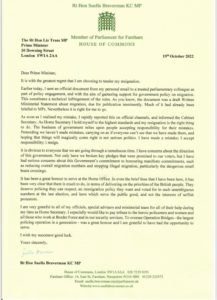
    The resignation letter sent by Suella Braverman, the Home Secretary, to Liz Truss, the Prime Minister, on 19 October 2022.

  • Suella Braverman – 2022 Statement on Standards in Policing

    Suella Braverman – 2022 Statement on Standards in Policing

    The statement made by Suella Braverman, the Home Secretary, on 17 October 2022.

    The public rightly expects the highest standards of behaviour from police officers and the vast majority meet this expectation.

    But recently too many high-profile incidents and reports, especially in London, have damaged trust.

    This cannot continue.

    It’s unfair on the public and lets down other serving officers.

    Culture and standards in the police must improve.

    And where an officer has fallen seriously short of these expectations, demonstrable, public action must be taken.

    It’s absolutely vital that the police act to restore trust, return to common sense policing and treat the public and victims with the respect they deserve.

    I welcome the Met Police’s commitment to tackling the issues raised in the Baroness Casey report and hope this review will also help to address underlying concerns.

  • Suella Braverman – 2022 Statement on Economic Crime and Corporate Transparency Bill

    Suella Braverman – 2022 Statement on Economic Crime and Corporate Transparency Bill

    The statement made by Suella Braverman, the Home Secretary, in the House of Commons on 13 October 2022.

    I beg to move, That the Bill be now read a Second time.

    Following Putin’s unconscionable invasion of Ukraine we acted immediately, cracking down on dirty money in the UK by passing the Economic Crime (Transparency and Enforcement) Act 2022. I am very grateful for the way that the whole House got behind that effort and I hope we can come together on this Bill, too. I am very grateful to the shadow Front Bench for its constructive engagement on the Bill and to party colleagues for their considerable input. I hope we can send a united message that dirty money, fraudsters and gangsters are not welcome in the UK.

    Andy Slaughter (Hammersmith) (Lab)

    I just wonder why it took a war in Europe for action to take place on this matter, why for years and years and years the right hon. and learned Lady’s Government and their predecessors did nothing about it, and whether it had anything to do with the millions going into Tory party coffers from Russian oligarchs?

    Suella Braverman

    I am not sure what point the hon. Gentleman is making. Important strides are being taken forward in the Bill and we should all be getting behind the swift action the Government took in response to the invasion of Ukraine. I am very grateful that we were able to pass that legislation and take powers in the Act earlier this year, which included taking the groundbreaking action of sanctioning hundreds if not thousands of Russian individuals and entities, freezing assets and really excluding the influence of Russian finance in the UK. I am proud of that effort and I hope that he is too.

    Stephen Doughty (Cardiff South and Penarth) (Lab/Co-op) rose—

    Suella Braverman

    If I can just make some progress, I will come back to the hon. Gentleman.

    Having acted immediately in response to Putin, we promised to go further. The Economic Crime and Corporate Transparency Bill will bear down even further on kleptocrats, criminals and terrorists, strengthening the UK’s reputation as a place where legitimate business can thrive but economic crime cannot. Economic crime is a serious problem. It threatens our prosperity, national security and global influence. The UK has one of the world’s largest and most open economies, and it is an extremely attractive place to do business. That is a good thing, but it also exposes us to economic crime, such as money laundering, corruption, the financing of organised crime and terrorism, and a growing range of state threats.

    Stephen Doughty

    I thank the Home Secretary for giving way. One issue I have raised with Foreign, Commonwealth and Development Office Ministers directly relates to the use of cryptocurrency and different mechanisms for those trying to evade sanctions or commit other crimes. There is a particular issue around mixers and tumblers—that is what they are called. The US Treasury took very, very severe action on this in August this year. My understanding is that we are yet to take that action. Will she look urgently at these issues with her colleagues in the Treasury and the FCDO to ensure that we bear down very strongly on those who are using crypto to avoid detection by our criminal investigation agencies?

    Suella Braverman

    The hon. Gentleman raises a really important and valid point. The Bill will go some way to dealing with cryptocurrency, but he is right that cryptoassets are increasingly being used for malign and terrorist purposes. We intend to crack down on that and will be bringing forward a Government amendment that will mirror the changes in Part 4 of this Bill in counter-terrorism legislation, but we are very happy to review that further.

    The Government have already undertaken unprecedented action to stop kleptocrats and criminals.

    Jim Shannon (Strangford) (DUP)

    Just last year, as everyone in the House will remember very well, the Police Service of Northern Ireland seized £215 million from a money laundering scheme that started in eastern Europe, came right across into the United Kingdom and ended up in Northern Ireland. The Home Secretary said clearly that money laundering will be addressed directly. In Northern Ireland we seem to have a problem in relation to that. Will she enter into discussions with the Finance and Justice Ministers back home in Northern Ireland to ensure that they can work together to beat money laundering everywhere?

    Suella Braverman

    I thank the hon. Gentleman for raising that point. I am very happy to build further and closer engagement with Northern Ireland on this particular issue. In the case of anti-money laundering and other investigations, and prosecutions in relation to standalone money laundering cases or where money laundering is the principal offence, the agencies have recovered considerable amounts. £1.3 billion has been recovered in those cases since 2015-16 using the Proceeds of Crime Act 2002 powers. That is good progress, but of course there is further to go and, as I said, I am very keen to engage more closely.

    Catherine West (Hornsey and Wood Green) (Lab)

    On the agencies, does the Home Secretary accept that it has taken an awfully long for the Government to get around to reforming Companies House, which is very open to abuse and which the Royal United Services Institute has been mentioning for years now as a danger to our national security?

    Suella Braverman

    I am very pleased that we are taking this action now. I take on board the point that this has been a long-standing matter that Members and Administrations have been talking about for some time. There has been progress over several years. We have the National Economic Crime Centre and new legislation, so there are greater powers, but I am focused on ensuring that the reforms in the Bill are implemented as quickly as possible. On reforms to Companies House, we seek to ensure that the level of change is balanced to avoid causing any confusion for legitimate customers and to ensure effective implementation. So yes, speed is essential, but not at the expense of undue disruption.

    Some of the action we have already undertaken includes being the first G20 country to establish, in 2016, a public register of domestic company beneficial ownership; the publication of the economic crime plan in 2019 and the progress made against it; and establishing, as I said to the hon. Lady, the National Economic Crime Centre and the combating kleptocracy cell in the National Crime Agency. The Bill is just one component of a wider Government approach to tackling economic crime, including fraud. It sits alongside the National Security Bill and the Online Safety Bill, and the forthcoming second economic crime plan and fraud strategy.

    Layla Moran (Oxford West and Abingdon) (LD)

    One of the areas this place will struggle to scrutinise is golden visas. It has now been four years since that review was commissioned. We understand it is ready, yet we have not seen it to be able to scrutinise it and hold the Government to account on it. Will the right hon. and learned Lady be the Home Secretary who finally releases that review?

    Suella Braverman

    When it comes to golden visas, I was very proud of the action the Government took in relation to Russian individuals following the invasion, where we stopped the sale of golden visas to particular individuals—

    Chris Bryant (Rhondda) (Lab)

    The sale? You were selling them?

    Suella Braverman

    The issuance—excuse me—of golden visas to particular individuals from Russia. I agree that there is further work we can do and I am very keen to look at it.

    Chris Bryant

    I think the Home Secretary said the sale of tier 1 visas, as if the Government or the Conservative party were somehow selling these things. Is it not absolutely shocking that 10 of the people the Government sanctioned this year were people to whom the Conservative Government had given tier 1 visas? We were inviting crooks and Putin’s cronies to come into this country, make their lives here and carry on their criminal activities here.

    Suella Braverman

    I think the hon. Gentleman will find that this has actually been a long-standing issue for Administrations of both colours, and we have been vulnerable for some time. However, I am incredibly proud of and make no apology for the robust, tough and unapologetic action that this country took in response to the invasion of Ukraine by Russia. That includes, along with the EU and the US, sanctioning thousands of Russian individuals and entities; taking aggressive, prohibitive action to stop them taking part in the UK financial system; freezing the assets of all Russian banks; barring Russian firms from borrowing money; and, importantly, ensuring that we take a strong stance to affect and disable, to a degree, the Russian economy. That is how we will win this war, not by cheap political points.

    Chris Bryant

    Look, some of us have been battling on this for a very long time. Some of us said in 2014 that if we did not sanction Putin properly then, he would not only take the Crimea, but try to take the whole of Ukraine. Some of us fear that the Government’s refusal to act in this area is part of what has emboldened Putin. The biggest problem is that, in many cases, the UK’s sanction regime has been much weaker than that of other countries. The Home Secretary is wrong: we have not sanctioned all the Russian banks. There are still others to be sanctioned. We have sanctioned 20% of the people who have been sanctioned by the United States of America. For most of the people we have sanctioned, we are relying on EU legislation—we are just copying it. Honestly, I think she needs to do her work a bit more carefully.

    Suella Braverman

    No, I disagree. I will not repeat the points that I have made, but I am very proud of our record. The action was tough, unprecedented and far-reaching, and I am very glad that other countries followed suit soon after.

    The Bill includes essential reforms of Companies House and measures to prevent the abuse of limited partnerships. It creates additional powers to seize cryptoassets more quickly and easily. The Bill will enable more effective and targeted information sharing to tackle money laundering and economic crime.

    Kevin Hollinrake (Thirsk and Malton) (Con)

    Late last year, NatWest was fined £265 million for facilitating money laundering through its UK branches. Sacks of cash, literally, were being taken into NatWest branches. Despite the £265 million fine, no person at NatWest has personally been held to account. Does my right hon. and learned Friend not agree that these fines are simply a cost of doing business, because this is profitable business? The only way in which we will clamp down on this is to hold individual executives at the top of organisations to account and, if necessary, put these people in jail.

    Suella Braverman

    I agree with my hon. Friend, who has a huge amount of expertise and has achieved a huge amount in Parliament to crack down on fraud and economic crime. I will come to the Bill’s anti-money laundering measures, so I will have to detain him a bit longer until I get there. I agree, however: we have to make sure that we can build on the regime, powers and law enforcement frameworks that are in place. We can go further.

    Dame Margaret Hodge (Barking) (Lab)

    If the Home Secretary does agree with what was said by the hon. Member for Thirsk and Malton (Kevin Hollinrake), with whom I have worked closely on these matters, why is she not reforming corporate criminal liability in the Bill to bring into effect the very change that he has promoted?

    Suella Braverman

    I accept what the right hon. Lady says, but the Government have already taken steps to establish the case for change on corporate criminal liability. In 2020, we commissioned the Law Commission to undertake a detailed review of how the legislative system could be improved to appropriately capture and punish criminal offences committed by corporations, with a particular focus on economic crime. The Law Commission published that paper on 10 June 2022. The Government are carefully assessing the options that were presented and are committed to working quickly to reform criminal corporate liability.

    Jim Shannon

    I thank the Secretary of State for generously giving way again. I understand that 929 companies registered with Companies House were identified as taking part in 89 economic crime incidents, which amounted to £137 billion of potential economic damage. I know that the Secretary of State, like me and others in the House, is keen to ensure that we get the change we want, but will that mean that that can no longer happen in relation to Companies House?

    Suella Braverman

    We want to ensure that there are more restrictions on who can register with Companies House so that we prevent the abuse of the regime. As I said, we have one of the most open, liberal and business-friendly economies, but we are exposed to some degree. The reforms in the Bill very much address the issue that the hon. Member raises.

    Furthermore, the Bill introduces a regulatory objective into the Legal Services Act 2007; removes the statutory cap on the Solicitors Regulation Authority’s fining power for disciplinary matters relating to economic crime offences; extends pre-investigation powers to all Serious Fraud Office cases; and streamlines the process for updating the UK’s high-risk third country list. The Bill will also ensure that we have more effective and targeted information sharing to tackle money laundering and economic crime. It provides new intelligence-gathering powers for law enforcement and removes regulatory burdens on businesses. Altogether, the Bill is a formidable tool in the fight against illicit finance.

    The Government have consulted widely on the Bill and won broad support from business and professional groups, law enforcement agencies and civil society. We are, of course, working closely with the devolved Administrations on this legislation, as the Bill contains several provisions that engage devolved powers in Wales, Scotland and Northern Ireland.

    I will now set out the Bill’s measures in more detail, turning first to Companies House reform. Companies House is one of the foundations of the UK’s business environment. It operates the UK’s open and flexible corporate registration framework. The UK’s business community enjoys a simple system for creating and maintaining companies and other legal entities. Information on those entities is made available for the benefit of investors, lenders, regulators and the public. The companies register was accessed 12 billion times last year. Inevitably, that makes it a target. In recent years, the Companies House framework has been manipulated, particularly with the use of anonymous or fraudulent shell companies and partnerships. That gives criminals a veneer of legitimacy to help them to commit crimes, ranging from grand corruption and money laundering to fraud and identity theft.

    We will reform the role of Companies House and improve the transparency of UK companies. The Bill will ensure that we can bear down on the use of thousands of UK companies and other corporate structures as vehicles for economic crime, including fraud, international money laundering, illicit Russian finance, corruption, terrorist financing and illegal arms movements. These are the most significant reforms to the UK’s framework for registering companies in 170 years. We will introduce identity verification for new and existing directors.

    Kevin Hollinrake

    It is very good news that we are moving from a register to a regulator. On the capacity of Companies House to do that, there are around 5 million companies in the UK, with probably two directors on average, and 500,000 companies are registered every year. Does Companies House today honestly have the capacity to properly verify the ID of all those directors?

    Suella Braverman

    Resourcing the agencies and organisations, such as Companies House, to better fight the threat of fraud and economic crime will be part of the equation. I am pleased to be in constant discussion with the various agencies, although, obviously, Companies House is the responsibility of other Departments. However, we have to ensure that it has the tools, operationally and from a resource point of view, to be able to carry out its legal duties.

    Yvette Cooper (Normanton, Pontefract and Castleford) (Lab)

    The Home Secretary is being generous in giving way. The point about institutions being able to carry out enforcement is immensely important. As well as Companies House, there is also an issue for the National Crime Agency. She may be aware that her predecessor asked the National Crime Agency to draw up plans for 20% staffing cuts. Has the Home Secretary now ruled that out?

    Suella Braverman

    Last year’s spending review settlement set out that the economic crime levy would provide funding totalling approximately £400 million over the spending review period. Law enforcement activity on economic crime is conducted by a number of agencies, including the National Crime Agency, as the right hon. Lady says. I want to ensure that those agencies have the proper resources, personnel and tools to be at the forefront of fighting crime effectively.

    Catherine West

    Will the Home Secretary give way?

    Suella Braverman

    I will make some progress. As hon. Members have said, I have been very generous, but I am struggling to get through my speech. I know that everybody wants to speak, so I will take no more interventions for now.

    We will introduce identity verification for new and existing directors, beneficial owners and those who file information with Companies House. That will improve the accuracy of Companies House data and will ensure that we know who is really acting for and benefiting from companies.

    Chris Bryant

    Will the Home Secretary give way on that point?

    Suella Braverman

    I am sorry, but I will not.

    The powers of the registrar of companies will be broadened, making the registrar a more active gatekeeper for company creation and a custodian of more reliable data. The registrar will receive new powers to check, remove or decline information that is submitted to or already on the company register. The Bill will improve the financial information on the register so that it is more reliable, complete and accurate, and enables better business decisions. Companies House will be given more effective investigation and enforcement powers, including by enabling it proactively to share information with law enforcement bodies about higher-risk corporate bodies, or where there is evidence of anomalous filings or other suspicious behaviour. To protect individuals from fraud and other harm, we will also enhance the protection of personal information and addresses provided to Companies House.

    We will introduce broader reforms to clamp down on the misuse of corporate entities. These reforms will support enterprise by enabling Companies House to deliver a better service for more than 4 million UK companies. They will help us to maintain our swift and low-cost routes for company creation. They will also improve the collection of data to inform business transactions and lending decisions across our economy.

    Catherine West

    The Witanhurst property, a 500-room mansion in Highgate, is the second largest property in the UK after Buckingham Palace. Its ownership is contested, so it has not been seized. Will the Bill cover such difficult and anomalous situations? Local residents feel that people should be brought to account. Considering the links with the regime in Russia, there is no way that that house was bought in an honest way.

    Suella Braverman

    Without knowing the details of that case, what is clear is that the reforms to Companies House will ensure not only that more investigation and enforcement powers are afforded to it, but that there will be new powers for checking, removing and declining information submitted to the company register if there are grounds for concern.

    Chris Bryant

    The Home Secretary is being generous in giving way; I am very grateful. I warmly welcome all these changes to Companies House, for which some of us have been arguing for a very long time. My anxiety is that Companies House will have a major change of role: as several agencies have said recently to the Foreign Affairs Committee, it will go from being a registrar to being effectively a policeman. To do so, it will need enormous additional capacity. Can she tell us how much additional money it will have to fulfil that role?

    Suella Braverman

    The transformation of Companies House has been under consideration for some time, and the Treasury Committee has done quite a lot of inquiring into the issue. We published a White Paper on corporate transparency and register reform earlier this year, which provided considerable detail on how these reforms will operate. It is a complex area of law. Resources will be needed for these extra powers.

    Chris Bryant

    How much?

    Suella Braverman

    The transformation is already under way, with £20 million invested in 2021-22 and a further £63 million announced up to 2024-25 at the most recent spending review. We have been thinking about this, and the money has been announced in spending reviews. It has been thought about.

    Kate Green (Stretford and Urmston) (Lab)

    Will the Home Secretary give way?

    Suella Braverman

    I am going to continue.

    The Bill will tackle the misuse of limited partnerships, including Scottish limited partnerships, and will modernise the law governing them. We will tighten registration requirements and will additionally require limited partnerships to demonstrate a firmer connection to the UK. Transparency requirements will be increased. The registrar will be able to de-register limited partnerships if they are dissolved or no longer carrying on business, or if a court orders that it is in the public interest.

    Nor does the Bill overlook cryptoassets. It will give additional powers to law enforcement bodies so that they can more quickly and easily seize, freeze and recover cryptoassets that are the proceeds of crime or are connected with illicit activity. That will ensure that cryptoassets cannot be a conduit for money laundering, fraud, ransomware attacks or terrorist financing. Most notably, it will mitigate the risk posed by those who cannot be prosecuted but who nevertheless use their funds for criminal purposes. I am sorry to say that cryptoassets are increasingly being used to fund terrorism; we will crack down on that by introducing an amendment to counter-terrorism legislation that reflects those changes.

    I turn to anti-money laundering. We will enable better sharing of information about suspected money laundering, fraud and other economic crimes between certain regulated businesses, allowing them to take a more proactive approach to preventing economic crime. As a result, businesses will be better able to detect crime taking place across multiple businesses and to prevent criminals from exploiting information gaps between them. We will also reduce the reporting burdens on businesses, enabling the private sector and law enforcement to focus their existing resources on tackling high-value and priority activity.

    Threats evolve and are changing, so the Bill includes a measure to streamline and allow faster updates to the UK’s high-risk third country list. The list will be updated and published on gov.uk for everyone to see, reflecting updates from the Financial Action Task Force, the international standard setter, when it identifies countries with weak anti-money laundering, counter-terrorist financing and counter-proliferation financing controls. By removing the need to lay a statutory instrument before Parliament every time the list needs to be updated, we will reduce delays in updating the list and free up parliamentary time.

    The Bill will add a regulatory objective to the Legal Services Act 2007:

    “promoting the prevention and detection of economic crime.”

    It affirms that it is the legal duty of legal regulators and professionals to uphold the economic crime regime. That will reduce the risk of lengthy and expensive challenges from regulated members over enforcement action. It will improve the ability of the Legal Services Board, as the oversight regulator, to manage the performance of frontline regulators in meeting that objective.

    The Bill will remove the statutory cap on the Solicitors Regulation Authority’s financial penalty powers for disciplinary matters relating to economic crime. That will align the SRA with other regulators that have such flexibility. Fewer cases will be referred to the Solicitors Disciplinary Tribunal, resulting in faster enforcement. There will be a credible deterrent and a more coherent response to breaches of economic crime rules.

    The Bill will enable the Serious Fraud Office to use its powers under section 2 of the Criminal Justice Act 1987 at the pre-investigation stage in any SFO case, including a fraud case—an ability that is currently limited to cases of international bribery and corruption. This measure will mean that the SFO can more quickly gather the information that it needs to allow its director to decide whether to take on a case.

    Cracking down on economic crime is a major plank of the Government’s beating crime plan.

    Andy Slaughter

    I am grateful to the Home Secretary for giving way; I know that she is about to finish her speech. There are 22 professional bodies overseeing compliance with anti-money laundering rules. Is the Home Secretary going to do anything about the resulting confusion, and the inadequacy of some of those bodies? May I also ask whether she intends to introduce—as her colleague the Secretary of State for Wales hinted earlier this week—a new offence of failure to prevent offences from being committed? I do not know whether she welcomes her colleague commenting on her brief, but as the Welsh Secretary has raised the question, perhaps she could respond to it.

    Suella Braverman

    The hon. Gentleman raises two issues concerning the regulators. We need to ensure that they strike the right balance in terms of their investigatory or prosecutorial powers, but also do not overstretch themselves to become a burden on legitimate and bona fide enterprise. This is a balance that legislation constantly seeks to strike. As for the offence of failure to prevent offences, it is something that we consider all the time, and I am always open to considering such possibilities.

    Far from being victimless, these crimes bring misery, fund other crimes and undermine our country’s reputation, and Putin’s illegal invasion of Ukraine raises the stakes even higher. The United Kingdom must ensure that we are doing nothing to aid Putin, and doing everything we can to support the courageous Ukrainian people.

    I urge the whole House to get behind the Bill so that we can make sure that the UK is a great place for legitimate business and a no-go area for crooks, and I commend it to the House.

  • Suella Braverman – 2022 Comments on Just Stop Oil Stopping Emergency Vehicles

    Suella Braverman – 2022 Comments on Just Stop Oil Stopping Emergency Vehicles

    The comments made by Suella Braverman, the Home Secretary, on Twitter on 11 October 2022.

    Blocking ambulances and fire engines and putting lives in danger is completely indefensible.

    I thank the Met Police who have arrested over 300 disruptive protesters from this self-defeating organisation so far this month.

    I expect the police to use the full powers we have given them to stop those who are hell bent on disrupting everyone’s lives.

    Our Public Order Bill will strengthen these powers further and toughen the penalties for guerrilla tactics.

  • Suella Braverman – 2022 Speech to Conservative Party Conference

    Suella Braverman – 2022 Speech to Conservative Party Conference

    The speech made by Suella Braverman, the Home Secretary, in Birmingham on 4 October 2022.

    It is such a privilege to be here.

    Being Home Secretary is not just a tremendous honour…

    …keeping the British people safe and securing our borders are the highest duties of state.

    Our Prime Minister understands those duties.

    And so do I. We stand for the law-abiding majority of Britons.

    And in doing so, I draw on a long tradition of Conservative Home Secretaries who were willing to challenge failing orthodoxy. They refused to accept defeat.

    Michael Howard, on his first day as Home Secretary, was told that there was nothing he could do about the inevitable rise in crime.

    He disagreed – and crime fell dramatically.

    They said that Theresa May couldn’t deport Abu Qatada, the Islamist extremist. But – despite setbacks along the way – she made it happen.

    Priti Patel negotiated a ground-breaking deal with our partners in Rwanda to bring forward a new solution to the challenge of illegal migration – providing protection in Rwanda for those that need it while breaking the business model of people smugglers.

    I am grateful to Priti and Boris for the foundations that they laid.

    Serious violent crime has fallen, as has overall crime, excluding fraud and online theft.

    And we are well on the way to 20,000 additional police officers.

    But a Home Secretary can never be complacent – and some things still need fixing. I’m pleased to be working with a brilliant team of Ministers who I am so pleased to see with us today: Tom Tugendhat, Tom Pursglove, Jeremy Quin, Mims Davies and Lord Andrew Sharpe, supported by our excellent PPSes – Gareth Davies and Shaun Bailey, they all bring talent and expertise to the Home Office.

    Now, the Prime Minister and I want to see homicide, serious violence, and neighbourhood crime fall by 20 per cent.

    Some of our most committed and courageous people serve in the police. In Belfast last week, I joined police leaders to pay tribute to those officers who have died in action. Their ultimate sacrifice is one for which we owe a huge debt of gratitude.

    So, yes I am immensely proud of our police.

    Many on the left want to defund the police.

    Well I say to the militants, I say to the anarchists and the extremists: I will always back our policemen and women.

    That’s what being on the side of the law-abiding majority means.

    But we also need to be frank when things go wrong. Some police officers have fallen devastatingly short of the standards expected.

    We need to get back to common sense policing, empowering the Police to tackle the real issues facing the public – not policing pronouns on twitter or non-crime hate incidents.

    That’s why I’m pleased that Greater Manchester Police, Hampshire, Bedfordshire, and Northamptonshire and the Metropolitan Police have all promised to visit the scene of every burglary.

    But the law-abiding majority expect every force to investigate every neighbourhood crime – and so do I. Drugs, car theft, vandalism and anti-social behaviour cannot be ignored.

    Perhaps the most unsettling, unspeakable crime of all is rape.

    As an MP and as Attorney General, I have already seen first-hand how the system needs to improve. I can’t change things overnight, but I will not accept the status quo.

    Policing is a public service, and must be accountable to you the public.

    That’s why it’s right to publish league tables that show how well every force in England and Wales is doing in their fight against crime.

    You all have a right to know. And greater transparency will drive up standards.

    The modern world inevitably brings new challenges. Our National Security Bill will ensure that law enforcement and intelligence agencies have the tools they need to stay ahead of our country’s evermore sophisticated adversaries.

    Yet everything starts from getting the basics right –

    We need common sense policing. Unashamedly and unapologetically on the side of the law-abiding majority.

    That means that the mob needs to be stopped.

    The police must have all the powers that they need to stop protestors who use guerrilla tactics and bring chaos and misery to the law-abiding majority.

    It’s not a human right to vandalise property. It’s not my ‘freedom of expression’ to protest violently. No – you can’t just start a riot or glue yourself to the roads and get away with it.

    Yes, friends, as Attorney General, I had to go to court to get some of these simple truths established.

    The judges agreed with me last week in the Cout of Appeal in the Colston Statue case. And that’s why our Public Order Bill will empower our police to stop this nuisance. So whether you’re Just Stop Oil, Insulate Britain or Extinction Rebellion – you cross a line when you break the law. That’s why we will keep putting you behind bars.

    It’s very easy to say that the culture wars are a distraction.

    But make no mistake, the Left are attacking our profound, elemental values, wanting to replace them with the poison of identity politics. And when poison seeps into the public sphere, it distracts our public servants from doing their real job. That philosophy dominates the Labour Party, whatever Sir Keir Starmer pretends.

    And that’s why it is not only wrong for the police to take the knee. It is wrong for them to join in with political demonstrations; it is wrong for biologically male police officers to strip search female suspects.

    And it is not just that pandering to identity politics is a huge waste of time.

    They need to stick to catching the bad guys.

    To those who dismiss political correctness as a conservative obsession, I say this. Visit Rochdale. Visit Telford. The grooming gangs scandal is a stain on this country and it’s what happens when political correctness becomes more important than criminal justice.

    More PCs, less PC.

    My other mission is to control our borders.

    Firstly, legal migration.

    I backed Brexit because I wanted Britain to have control over our migration and to cut overall numbers. Brexit was meant to give us a say on how we determine our own migration policy.

    We should use our newfound control to deliver the kind of migration that grows our economy, for example that helps projects that have stalled or builds friendships and relationships with our allies.

    But the truth is parts of our system aren’t delivering. We need to end the abuse of the rules and cut down on those numbers that aren’t meeting the needs of our economy.

    And we mustn’t forget how to do things for ourselves. There is absolutely no reason why we can’t train up enough of our own HGV drivers, butchers, or fruit-pickers.

    The way we will build a high-skilled and high-wage economy is by encouraging business to invest in capital and domestic labour. Not relying wholly on low-skilled foreign workers.

    This isn’t just about policy or economics for me. It’s intensely personal. My parents came here in the 1960s from Kenya and Mauritius. They loved Britain from afar, as children of the Commonwealth. It was Britain that offered them security and opportunity as young adults.

    I’m not embarrassed to say that I love Britain. No Conservative is.

    It’s not racist for anyone, ethnic minority or otherwise, to want to control our borders.

    It’s not bigoted to say that we have too many asylum seekers who are abusing the system.

    It’s not xenophobic to say that mass and rapid migration places pressure on housing, public services and community relations.

    I reject the Left’s argument that it is hypocritical for someone from an ethnic minority to tell these truths.

    My parents came here through legal and controlled migration. They spoke the language, threw themselves into the community, they embraced British values. When they arrived, they signed up to be part of our shared project because the United Kingdom meant something distinct. Integration was part of the quid pro quo.

    That didn’t mean abandoning their heritage, but it did mean adopting British identity. An identity of which we should all be proud. This is the best place on earth to come and live in, but I fear that we are losing sight of the core values and the culture that made it so. The unexamined drive towards multiculturalism as an end in itself combined with the corrosive aspects of identity politics has led us astray.

    I saw this when I went to Leicester recently. A melting pot of cultures and a beacon of religious harmony. But even there, riots and civil disorder have taken place because of failures to integrate large numbers of newcomers. Such conflict has no place in the UK.

    Or when we look at the Prevent scheme, we see how cultural tensions within communities are not being handled well. The murderer of our much missed dear friend Sir David Amess, had been referred to Prevent. But it couldn’t stop him.

    We cannot as a people be cowed into fear by vocal minorities who attempt to undermine our common sense instincts. And as Home Secretary, I will make sure that Prevent is fit for purpose.

    The law-abiding majority deserve nothing less.

    And lastly we have got to stop the boats crossing the Channel. This has gone on for too long. But I have to be straight with you, there are no quick fixes.

    The problem is chronic. Organised criminal gangs are selling a lie to thousands of people.

    Many are drowning in the Channel.

    Many are leaving a safe country like France and abusing our asylum system.

    So what is our plan?

    Firstly, our work with the French has prevented about half of all crossings. I know that alone will not work. So I will work closely with the French to get more out of our partnership. Both on the French coastline and further upstream against the organised criminal gangs.

    Secondly, we need to find a way to make the Rwanda scheme work.

    Thirdly, we need to do more to get asylum-seekers out of hotels – currently costing the British taxpayer £5 million per day.

    And fourth, we cannot allow a foreign court to undermine the sovereignty of our borders.

    A few months ago, the European Court of Human Rights in Strasbourg did just that,

    By a closed process, with an unnamed judge and without any representation by the UK, a European court overrode our Supreme Court.

    As a result, our first flight to Rwanda was grounded.

    We need to take back control.

    But friends, I need to be honest with you. The Strasbourg Court is not the only problem.

    Now everyone agrees that we must fight the evil of modern slavery. I’m immensely proud of the UK’s global leadership in protecting genuine victims.

    But the hard truth is that our modern slavery laws are being abused by people gaming the system. We’ve seen a 450% increase in modern slavery claims since 2014.

    Today, the largest group of small boats migrants are from Albania – a safe country. Many of them claim to be trafficked as modern slaves. That’s despite them having paid thousands of pounds to come here, or having willingly taken a dangerous journey across the Channel.

    The truth is that many of them are not modern slaves and their claims of being trafficked are lies.

    And it’s not just illegal migrants.

    Since entering the Home Office I have seen egregious examples of convicted paedophiles and rapists trying to game the system.

    Making last minute claims of modern slavery to block their removal from our country.

    Some have even gone on to commit further crimes in the interim.

    In one case, we convicted a sex offender from South Africa who spent a year in prison.

    He was about to be deported from the UK – and lo and behold, he made a claim of modern slavery.

    Our removal was stalled – and in this time he went on to commit a further rape.

    He is now back behind bars – but when he’s released, well – it’s all so terribly predictable.

    In another case, a paedophile from Pakistan received 10 years in prison.

    But at the end of his prison sentence, he put in a spurious claim to be a modern slave.

    Even when they got through that process, he made a second claim – which blocked his removal.

    We simply can’t go on like this.

    We need to make sure that our system strikes the right balance. Our laws need to be resilient against abuse – while at the same time ensuring we help those in genuine need.

    We have got a proud history of offering sanctuary to those in need.

    From supporting thousands of BNOs fleeing persecution in Hong Kong; to welcoming nearly 20,000 Afghan nationals fleeing war and terror, to offering immediate refuge to thousands of Ukrainians fleeing Putin’s barbarism…

    …The UK, and this Conservative Government has always been there to hold out the hand of hope to those who need it most.

    But the law simply isn’t working.

    It isn’t working in the interests of the British people or people who need our help the most.

    Our laws are being abused.

    Abused by people smugglers and criminals pedalling false promises.

    Abused by people making multiple, meritless and last-minute claims.

    Abused by tactics from specialist, small boat-chasing law firms.

    This cannot continue.

    So, Conference, I will commit to you today, that I will look to bring forward legislation to make it clear that the only route to the United Kingdom is through a safe and legal route.

    And that’s so we can help support those who need our help the most, including women and girls.

    If you deliberately enter the United Kingdom illegally from a safe country, you should be swiftly returned to your home country or relocated to Rwanda that is where your asylum claim will be considered.

    UK policy on illegal migration should not be derailed by abuse of our modern slavery laws, Labour’s Human Rights Act, or orders of the Strasbourg Court.

    And we will always of course work within the bounds of international law, but we cannot allow this abuse of our system to continue.

    And of course, at the same time, we need to continue to stamp out illegal working practices.

    We already have some of the toughest penalties for those not playing by our rules, but we will redouble our efforts to go after them.

    I need to be straight with you, Conference. This won’t be easy. I cannot promise a solution immediately. We’ve all heard pledges and promises but this is a complex and entrenched problem. And there are many forces working against us.

    The Labour Party will try to stop this. The Lib Dems will go bananas. The Guardian will have a meltdown.

    As for the lawyers. Don’t get me started on the lawyers.

    And I’m a recovering lawyer.

    But what can I pledge to you is my total and undeniable and unfettered and unconditional commitment to doing whatever it takes. Despite the obstacles, I won’t give up on you and I won’t give up on the British people.

    The time for words is over. Now is the time for action. Time to put the will of the hard-working patriotic majority at the heart of all we do.

    It’s time for the police to stop virtue-signalling and start catching robbers and burglars.

    It’s time to tackle the small boats – no ifs, no buts.

    Friends, it’s time for common sense.

    I stand ready to serve you. I stand ready to deliver.

    The time is ours, the time is now.

  • Suella Braverman – 2022 Statement on the Economic Crime and Corporate Transparency Bill

    Suella Braverman – 2022 Statement on the Economic Crime and Corporate Transparency Bill

    The statement made by Suella Braverman, the Home Secretary, in the House of Commons on 22 September 2022.

    The Government are today introducing the Economic Crime and Corporate Transparency Bill, as committed to in the Queen’s Speech at the start of this parliamentary Session. Building on the recently enacted Economic Crime (Transparency and Enforcement) Act 2022, the measures in this new, significant Bill enable us to bear down further on kleptocrats, criminals and terrorists who abuse our open economy, strengthening the UK’s reputation as a place where legitimate business can thrive while driving dirty money out of the UK.

    The UK is at the forefront of global efforts to tackle illicit finance and economic crime. There have already been a number of important strides forward in the effort to confront and address economic crime in recent years, including:

    being the first G20 country to establish a public register of domestic company beneficial ownership in 2016 (the “people with significant control” register);

    the introduction of new powers in the Criminal Finances Act 2017 to include unexplained wealth orders and account freezing orders;

    allocating £400 million through the spending review and new economic crime levy to support law enforcement over the next three years, as well as a £63 million spending review settlement over the next three years for implementation of Companies House’s transformation programme;

    the publication of the economic crime plan in 2019 and the progress made against it by both the public and private sector;

    establishing the national economic crime centre to co-ordinate the law enforcement response to economic crime and the combatting kleptocracy cell in the National Crime Agency to focus on targeting corrupt elites and their assets in the UK; and

    most recently, passing the expedited Economic Crime (Transparency and Enforcement) Act.

    The economic crime landscape is constantly evolving, and we cannot be complacent about the threat. That is why we are bringing forward this further legislation to help tackle these problems and transform our fight against illicit finance.

    The key elements of the Bill include:

    broadening the registrar’s powers so that the registrar becomes a more active gatekeeper over company creation and custodian of more reliable data, including new powers to check, remove or decline information submitted to, or already on, the companies register;

    introducing identity verification requirements for all new and existing registered company directors, people with significant control, and those delivering documents to the registrar;

    providing Companies House with more effective investigation and enforcement powers and introducing better cross-checking of data with other public and private sector bodies;

    tackling the abuse of limited partnerships (including Scottish limited partnerships) by strengthening transparency requirements and enabling them to be deregistered;

    creating powers to more quickly and easily seize and recover cryptoassets;

    creating new exemptions from the principal money laundering offences to reduce unnecessary reporting by businesses carrying out transactions on behalf of their customers;

    enabling businesses in certain sectors to share information more effectively to prevent and detect economic crime; and

    providing new intelligence gathering powers for law enforcement.

    These new measures will tackle economic crime, including fraud and money laundering, by delivering greater protections for consumers and businesses, boosting the UK’s defences, and allowing legitimate businesses to thrive. They will also protect our national security, by making it harder for kleptocrats, criminals and terrorists to engage in money laundering, corruption, terrorism financing, illegal arms movements and ransomware payments. And they will support enterprise by enabling Companies House to deliver a better service for over four million UK companies, maintaining our swift and low-cost routes for company creation and improving the provision of data to inform business transactions and lending decisions across the economy.

    This Bill forms a key part of the wider Government approach to ensure that law enforcement and the private sector have the tools needed to help tackle economic crime, sitting alongside the key provisions in the Online Safety Bill which will tackle online fraud, as well as the upcoming second economic crime plan and fraud action plan.

    This Bill has been developed in close partnership with law enforcement agencies, as well as with the financial sector, professional and business groups, and civil society organisations. This reflects the breadth of the measures in the Bill, the nature of the threats posed and the importance of working across sectors to tackle economic crime.

    The Government remain committed to tackling economic crime and illicit finance, and to strengthening the business environment across all of the UK. We will continue to work with the devolved Administrations on these measures and the formal legislative consent motion process.

  • Suella Braverman – 2022 Letter to Police Leaders

    Suella Braverman – 2022 Letter to Police Leaders

    The letter sent by Suella Braverman, the Home Secretary, to police leaders on 24 September 2022.

    Letter [in .pdf format]

  • Suella Braverman – 2022 Speech at the Policy Exchange

    Suella Braverman – 2022 Speech at the Policy Exchange

    The speech made by Suella Braverman, the Attorney General, at the Policy Exchange on 10 August 2022.

    Good afternoon,

    I feel very honoured to have been invited here today by Policy Exchange’s Judicial Power Project. The Judicial Power Project focuses on the proper scope of judicial power within our constitution and highlights how and by whom public power is exercised. It’s so influential, and so often mentioned in Parliament, both on the left and right. At times it seems that it is the only public defender of constitutional orthodoxy – but scratch beneath the surface of the legal Twitterati, you’ll find that there is a lot of support for their clear, Diceyan view of our constitution. I want to put on record my thanks to Prof Richard Ekins, Lord Godson and all of the academics and big brains at Policy Exchange for your thought leadership.

    My speech today is about equality and rights, and I’ve titled it, ‘conflict and the need for clarity’. Despite what our critics might say, rights can be difficult to get right. Sometimes, things that seem clear in the abstract become distorted when they are applied in the real world, with unintended consequences. That’s when we need clarity. How do we balance the rights of minorities with the rights of majorities? Or the rights of different minorities against one and other? But we reject this quasi-religious narrative. We know humans are flawed and changeable and there will never be a perfect framework that solves everything. We also know that tolerance for difference, for robust debate, can sometimes be more appropriate than restricting freedom.

    It’s so tempting to see things superficially.

    But all rights, however noble, impose limits and obligations on other people, some with tricky trade-offs.

    Should protesters have the right to block the streets? Or block ambulances? How far does a state’s duty to protect its citizens extend vis a vis a foreign national offender’s human right to remain here? Should women have the right to single-sex spaces? Do our feelings about who we are, change the rights to which we are entitled?

    There is a now serious risk that the fight for rights undermines democracy and harms the very people for whom the fight was intended to benefit. In the context of a mature democracy – with a responsive and pragmatic common law tradition – is it always right that minority groups impose their claims upon the rest of society? We need to make sure that the costs of protecting rights are worth the pay-off.

    The judicially expanded European Convention on Human Rights and the Human Rights Act marked a radical change in ‘how’ fundamental rights are protected in the UK, with alarming constitutional and practical consequences. We now have a ‘rights culture’ in a way that did not exist prior to 1998. Aspects of this are causing confusion and distress. Sometimes – but not always – we see a triumph of common sense, fairness and freedom of speech. Increasingly we see cases arising in the workplace that are symptomatic of a culture where fringe campaign groups, purporting to champion rights, have claimed a moral high ground and have adopted an attitude of intolerance. No doubt right-wingers and left-wingers will disagree on the precise causes of how we got to a place where stating the facts of biology might risk your job. In relation to the Equality Act, the main problem is that businesses and institutions are currently misinterpreting these laws and applying a perceived moral obligation to go beyond the law, when it comes to equality.

    The magnitude of the departure from a Parliament-led to a Court-led development of Human Rights law is visible when viewed against our distinct constitutional and political history. The Government’s track record on human rights law demonstrates a better understanding of this British human rights edifice, and the importance of incremental changes, coupled with the primacy of parliamentary sovereignty. The Human Rights Act, which borrowed heavily from continental understandings of rights protection, was a significant change in our legal tradition. This stark contrast is still visible today, as the Government embarks on the first-ever reform of the Human Rights Act. The Deputy Prime Minister / Lord Chancellor has introduced a new UK Bill of Rights in Parliament, a further step towards ‘taking back control’ which I welcome. His work in strengthening our UK tradition of freedom whilst injecting a healthy dose of common sense into the system. This Government needs to enact this legislation as soon as possible.

    I will raise three areas where the conflict of rights has played out unsatisfactorily: first, the use of the judicially expanded European Convention on Human Rights to obstruct the Government’s action on illegal migration, secondly the use of human rights and its legal test of ‘proportionality’ as a defence to criminal damage charges and third the gold-plating of the protected characteristic of gender reassignment in the context of single sex spaces.

    Despite the debates around these issues, I believe the Government has a duty to confront all of this with intellectual honesty and courage – so that clarity might bring compassion rather than conflict.

    1. The Tradition of British Human Rights

    Human rights are “inherited” as opposed to “natural”, and tradition is the tool to ground the abstract in the concrete.

    This philosophy is encapsulated in the most fundamental principle of our Constitution: Parliamentary Sovereignty. It is a principle of constitutional law and political fact, which intwined with democracy, allows the British people to fully and directly participate in their own government.

    Lord Hoffmann, in ex parte Simms, explains the extent of this Sovereignty for the purposes of statutory construction he said: “Parliamentary sovereignty means that Parliament can, if it chooses, legislate contrary to fundamental principles of human rights. […] The constraints upon it exercised by Parliament are ultimately political, not legal. The principle of legality means that Parliament must squarely confront what it is doing and accept the political cost.’

    Or Lord Bingham in Jackson v Attorney General: ‘The bedrock of the British constitution is, and in 1911 was, the supremacy of the Crown in Parliament…Then, as now, the Crown in Parliament was unconstrained by any entrenched or codified constitution. It could make or unmake any law it wishes. Statutes, formally enacted as Acts of Parliament, properly interpreted, enjoyed the highest legal authority.’

    Parliament’s voice, through legislation, is the final word. This may appear stark but the fact that this “rights inheritance” is protected by a “moral and political responsibility” that is not legally enforceable does not diminish its importance.

    The British Constitution was always a combination of legal and political elements, premised on the awareness that individual liberty could not be protected exclusively through legal devices.

    We have a rich heritage of rights in the UK. Though we’ve sometimes fallen short, the belief in equality has been persistent enough in our culture that we’ve always had loud voices calling on us to mend our ways, like in the case of slavery. We now have a large body of rights for people who work in factories, building sites, drive HGVs and work nights. We’ve passed anti-discrimination laws when it comes to disability and sex. We now, rightly, have a right to compassionate leave, paternity leave, maternity leave and shared parental leave.

    Our values lie at the heart of the centuries‐long development of human rights in the UK. For instance, on women’s rights, in 1928 Parliament gave women the right to vote. Between two world wars, it ratified international human rights treaties protecting women and children. The Government promoted same sex marriage. Over the years, administrations have pushed through several human rights statutes such as the Police and Criminal Evidence Act 1984 (promoting rights to liberty and to a fair trial) and the Children Act 1989. The Protection of Freedoms Act 2012 and the Defamation Act 2013 were promoted by the Government to protect privacy and freedom of expression. What these human rights achievements have in common is the leading role of Parliament in setting the scope of protection of these rights.

    Further, let’s not forget that it was Sir Winston Churchill who made the embedding of human rights a war aim, achieved by the founding of the United Nations and its Universal Declaration of Human Rights. In substance, though, both the UN declaration and the Convention did little more than summarise the rights already enjoyed by British citizens in 1950 under UK law. This is why, for almost 40 years, something like the Human Rights Act was not considered necessary. For Britons, rights were recognised by the Convention, not created by it.

    But when it comes to equalities, there is now very little consideration of the costs of affording more and more rights to particular groups, of the negative impact on wider society or how personal responsibilities should define our roles in society.

    2. Equality, Diversity and Inclusion

    The new sector called Equality, Diversity and Inclusion is a by-product the rights culture born out of the Convention and the Human Rights Act, combined with misinterpretations of the Equality Act.

    Often with vastly inflated salaries and armed with a Newspeak dictionary, they have created mighty citadels of grievance across the public sector and made huge inroads into the private sector.

    Equality laws have been misconstrued and weaponised to fight those who challenge their views as perpetrators of hate speech, calling for them to be swiftly no platformed or cancelled. The are now many concerning examples of how inclusion has trumped fairness.

    Added to the mix is Critical Theory. Anti-Western pseudo-scientists have spawned a new category in which our characteristics form a hierarchy of oppression. If you are black, if you are gay, if you have a disability, if you are a woman, you apparently automatically face some form of oppression, regardless of any evidence and regardless of any anti-discriminatory rules within your institution.

    We are told that our unconscious bias means we discriminate against these people without thinking. Asking for evidence of this has become proof of your status as oppressor; or your failure in allyship.

    I have been dismayed by the expense and resource spent on such Equality and Diversity Training within the civil service. When I investigated this recently I was disappointed to discover that civil servants spent thousands of hours of their taxpayer-funded time last year attending lectures on unconscious bias training, on ‘micro-incivilities’, different ‘lived experiences’ in ‘oppressive systems’, and ‘how to be a straight ally’, courtesy of Stonewall. They are referred to so-called experts on white privilege. They are told that if an ethnic-minority person says that something is offensive, then it is offensive and they don’t have a right to question it. This is despite a January 2020 ministerial directive that unconscious bias training would be phased out in departments.

    This kind of thinking does nothing to create solidarity and encourage support but rather keeps emphasising difference, creates a sense of ‘otherness’ and pits different groups against each other. It is tearing up the fabric of our society.

    And aside from how divisive it is, how the voters in my constituency of Fareham would consider this to be value for taxpayers’ money is beyond me.

    All of this finds its roots in the legal and political turn that was taken in the incorporation of the Convention, through the Human Rights Act and misinterpretations of the Equality Act. They marked a breakaway from the distinct constitutional and human rights tradition of Britain founded in parliamentary sovereignty and democratic oversight.

    I’ll focus now on three areas where there are problems.

    3.1 Convention Rights and Illegal Migration

    In the late 1970s the European Court of Human Rights in Strasbourg introduced the so-called “living instrument” doctrine and began to interpret the Convention in ways that cannot be squared with the intentions of the signatories.

    The doctrine hides the uncertainties of human rights behind the claimed certainties of judicial decision making.

    In his Reith Lecture, Lord Sumption – the former UK Supreme Court Judge – masterfully explained the crisis of legitimacy generated by the Strasbourg Court. He observed that by interpreting the Convention as a living-instrument, the Strasbourg Court recognises rights which states did not intend to grant, and which are not within the Convention’s original object and purpose. This is contrary to legally binding norms of treaty interpretation. This is why Lord Sumption describes the Convention as a “dynamic treaty”. In his words, the result is “to transfer an essentially legislative power to an international body standing outside the constitutional framework of the United Kingdom.”

    This hampers legal certainty, which requires a sensible and intention-led construction of legal texts. The rule of law and democracy are also undermined by the Strasbourg Court deciding matters of policy that should be determined by the democratically elected branch of government – i.e. Parliament.

    These issues are heightened as the Strasbourg bench of judges is composed by justices from continental legal systems. They are used to operating without a formal doctrine of binding precedent. This means that their habit is to force the ‘right’ result in the case – even if that means straining the law – with less of a focus on how that case will influence future cases. When coupled with the living instrument doctrine, the Convention has rapidly and unpredictably expanded. As Lord Hoffmann has said, this has meant that the Convention is given meanings ‘which could not possibly have been intended by its subscribers’.

    Stark examples of the real-world impact of the living instrument doctrine include the expansion of Article 8, the right for respect of private and family life. The Convention originally conceived this right as guarding against arbitrary Government intervention in family life – like house searches by the police – as a direct reaction to authoritarianism. However, this right has been radically extended today.

    Take the case of a Nigerian national – called OO by the court – who was sentenced in 2016 to four years in prison for offences including possessing crack cocaine and heroin with the intention to supply, and then pleaded guilty in 2017 to battery and assault. Serious offences. In 2020, the First-tier Tribunal allowed his appeal against deportation on grounds that OO’s ‘very significant obstacles’ to integration in Nigeria outweighed the public interest in his deportation, despite the serious nature of his offending, and deportation was irreconcilable with Article 8 (the right to respect for private and family life). The Upper Tribunal upheld that decision on appeal.

    Similarly, Article 3 which prohibits torture has been radically expanded to impose wide-ranging positive obligations on the State. This, despite having no bearing to the objective meaning of torture, inhumane or degrading treatment as originally envisaged in the Convention. In D v UK, a case of a non-national convicted drug dealer, the Strasbourg Court held that the effect of discontinuing his medical treatment available in the UK but not available in his destination country, amounted to inhuman or degrading treatment under Article 3.

    After a series of contradictory decisions by the Strasbourg Court, more procedural burdens were created by our Supreme Court in AM (Zimbabwe) v Home Secretary in 2020. States wishing to remove someone must now prove that the medical facilities available to the deportee in their destination country would remove any real risk that their lifespan would be shortened by removal from NHS facilities. When someone is being deported from a developed to a developing country this will often be the case. This places increased burden on our national resources and extends the concept of ‘fundamental rights’ beyond what was originally intended.

    In short, the Strasbourg Court has operated to thwart aspects of our domestic policy making in relation to illegal migration. This conclusion that is aptly demonstrated by the authoritative study for Policy Exchange by John Finnis QC and Simon Murray, and strongly endorsed by Lord Hoffmann.

    3.2 Human Rights Act, Criminal Law and Rights to Protest

    The problems generated by judicial policy-making in Strasbourg do not solely sit at an international level. When the Human Rights Act came into force, domestic courts were empowered to oversee rights protection and stand in judgement over decisions made by Parliament and government about how best to act. At the time, extensive efforts were put in to training judges in this new rights framework and how it should be interpreted.

    This created a direct avenue for Strasbourg interpretive methods to pervade British judicial reasoning. The intensive standard of proportionality under the Human Rights Act – in contrast to British test of Wednesbury unreasonableness – has proven problematic. A clear example is in relation to its use enabling Convention rights as defences to criminal damage charges.

    In the Ziegler case, the UK Supreme Court set aside several protestors’ convictions for wilfully obstructing a highway. It held that in light of Articles 10 (freedom of expression) and 11 (freedom of assembly and association) of the Convention, protestors can claim a ‘lawful excuse’ for deliberate physically obstructive conduct even where it prevents other users from exercising their rights to pass along the highway. In the Colston statue case, the trial judge directed the jury that, before they could convict for criminal damage, the jury must be sure that doing so would be a ‘proportionate interference’ – in other words compatible – with the defendants’ exercise of their human rights. The legal uncertainty that these cases illustrate prompted me to refer questions of law to the Court of Appeal. The questions concern the proper scope of defences to criminal charges arising from protests, and the directions which should be given to juries in such cases. My referral will not overturn the acquittals in this case but the backlash that I have received for merely referring this question – on a point of law! – demonstrates how politicised and inflamed many of these issues have become precisely because they have been removed from the political arena and placed in unattackable court rooms. There was at least one other voice of reason in this media storm, which was the Policy Exchange paper by Charles Wide QC, who made it very clear that there was a compelling case for referral. We await judgment and clarity from the Court of Appeal.

    This Government’s reforms to the Human Rights Act will bring welcome predictability to these imported and vague Human Rights standards. They will prevent trivial human rights claims from wasting judges’ time and wasting taxpayer’s money by introducing a permission stage in court, requiring claimants to show they have suffered a significant disadvantage before their claim can go ahead. They will also reinforce in law the principle that responsibilities to society are as important as personal rights by ensuring courts consider a claimant’s relevant conduct, like criminal behaviour, when awarding damages.

    3.3 Equality Act and Single Sex Spaces

    Cases that have arisen under the Equality Act 2010 are yet another ‘vivid illustration of how aspirational legislation can so easily be blown off course’. This point was made by Lord Faulks QC in his foreword to Paul Yowell’s excellent Policy Exchange paper on the Act. The Act represents a codification of the UK’s anti-discrimination law – some 116 prior Acts and Regulations. In part prompted by European Union law, the Act gold-plates and goes further than what the EU required in some areas. The aim of the Act was no doubt laudable, but its interpretation sits uncomfortably with our Human rights tradition. Its interpretation by various sectors is causing huge confusion for those attempting to decipher the correct balance of competing rights and protected characteristics. To be clear, I do not advocate repealing or scrapping the Equality Act. I am concerned about incorrect interpretation of its provisions.

    This particularly applies to how we, as a society, support those people who claim protection of ‘gender reassignment’ whilst at the same time supporting those who seek protection of rights defined by biological sex. Both public and private bodies are struggling to understand their obligations. My aim today is to provide clarity on the law.

    For the purposes of Gender Recognition Certificates, we do not operate a system of self-identification in England and Wales. But some service providers behave as if they have a legal duty to admit biological males who identify as females into women-only spaces, from rape crisis centres and domestic abuse refuges to bathrooms and changing rooms. In my view this is not in accordance with the law.

    The law supports the position adopted by my colleagues Nadine Dorries as Culture Secretary and Nadhim Zahawi when in post as Education Secretary. Paragraphs 26 and 27 of schedule 3 of the Equality Act are clear. They permit direct discrimination on grounds of sex: they permit “women only” and “men only” services, provided that the rule is a proportionate means of achieving a legitimate aim.

    In law, single sex services are intended for one sex only: that is the very thing permitted by schedule 3. It follows that it is not possible to admit a biological male to a single-sex service for women without destroying its intrinsic nature as such: once there are XY chromosome adults using it, however they define themselves personally, it becomes mixed-sex. The existence of a Gender Recognition Certificate can create a legal position but cannot change biological reality. The operation of the Equality Act is such that the permission to discriminate on grounds of gender reassignment is permission to discriminate against someone who may be the ’right’ biological sex for a particular activity but has the protected characteristic of gender reassignment.

    By way of example a ‘women-only’ rule for a women’s judo class excludes all men and will be lawful under paragraph 26 if a joint service would be less effective, and it is a proportionate means of achieving a legitimate aim. It will no doubt put people with the protected characteristic of gender reassignment (e.g. trans-women, by that I mean a biological male who identifies as a female) at a disadvantage compared to those without that characteristic. But in my view if the benefit that it confers is sufficient to justify direct discrimination against the whole class of men, it will in almost all circumstances be sufficient to justify indirect discrimination against a much smaller class of trans-women.

    This interpretation is in fact supported by the explanatory notes to the Equality Act. Those notes give an example of a group counselling service for female victims of sexual assault. In that case, it is clear that an individual with the protected characteristic of gender reassignment (e.g. a trans-woman) could be lawfully excluded, if organisers believed that otherwise, women would be unlikely to attend the session. This position has also been upheld by recent guidance from the Equality and Human Rights Commission as well as case law such as the Elias case in the Court of Appeal, approved in Homer in the Supreme Court.

    So if one group incurs a modest particular disadvantage and another group incurs a more serious particular disadvantage, justification for exclusion can be lawfully established.

    Schools

    The challenge is particularly acute in schools and for those whose professional responsibilities are to child welfare. Obviously school staff are highly motivated to do their best for children. To do this, they need to understand their legal obligations, understand the evidence about how best to support gender questioning children and know how to make a best interest decision for each and every child under their care.

    The problem is that many schools and teachers believe – incorrectly – that they are under an absolute legal obligation to treat children who are gender questioning according to their preference, in all ways and all respects, from preferred pronouns to use of facilities and competing in sports. All this is sometimes taking place without informing their parents or taking into account the impact on other children. Anyone who questions such an approach is accused of transphobia. In my view, this approach is not supported by the law.

    For the sake of clarity, I will set out my view on the legal position under the Equality Act. By way of preliminary note, under 18s are unable to obtain a Gender Recognition Certificate and schools will generally be dealing with children whose sex for the purposes of the Equality Act is that registered at birth. As used by Dr Hilary Cass in her interim report, I use the terms trans-boy to mean a biological female who identifies as a male and trans-girl to mean a biological male who identifies as a female. I use both as shorthand to include all those claiming protection under the characteristic of ‘gender reassignment’, as referred to under the Equality Act. Taking each issue in turn:

    Yes, it is lawful for a single sex school to refuse to admit a child of the opposite biological sex who identifies as transgender. This can be a blanket policy to maintain the school as single sex. This does not constitute unlawful direct discrimination on grounds of sex under schedule 11 nor does it constitute unlawful indirect discrimination on grounds of gender reassignment. This is clearly a proportionate means of achieving a legitimate aim.

    Yes, it is lawful for a mixed school to refuse to allow a biologically and legally male child, who identifies as a trans-girl, from using the girls’ toilets. This does not constitute direct sex discrimination and is not unlawful indirect discrimination on grounds of gender reassignment. Indeed, if the school did allow a trans-girl to use the girl’s toilets this might be unlawful indirect discrimination against the female children. Further, in law, there is a duty to provide separate single sex toilets, a breach of which would be unlawful under the School premises (England) Regulations 2012 and the Education (Independent School Standards) Regulations 2014.

    Similarly, yes, it is lawful for a mixed school to refuse a biologically and legally male child who identifies as a trans girl from using a single sex girls’ dormitory. This is neither direct sex discrimination or unlawful indirect discrimination on grounds of gender reassignment. Sufficient comparable accommodation must be provided to both girls and boys. Protecting girls’ privacy, dignity and safety are eminently legitimate aims.

    Yes, it can be lawful for schools to refuse to use the preferred opposite-sex pronouns of a child. This does not necessarily constitute direct discrimination on grounds of sex, particularly if unsupported by the child’s parents or by medical advice. Nor is it necessarily indirect discrimination on grounds of gender reassignment where a school has considered and can justify the approach. As set out in the interim Cass report, this is ‘social transitioning’ and is not a neutral act. It is a serious intervention and should only be done upon the advice of an independent medical practitioner. Furthermore, schools and teachers who socially transition a child without the knowledge or consent of parents or without medical advice increase their exposure to a negligence claim for breach of their duty of care to that child.

    Yes, it can be lawful for a school to refuse to allow a biologically male child, who identifies as a trans girl, to wear a girls’ uniform. This will be a significant part of social transition and the inherent risks of that could present an ample legitimate aim. Therefore, this does not necessarily constitute unlawful direct sex discrimination nor is it likely to constitute unlawful indirect discrimination on grounds of gender reassignment. Court of Appeal authority permits different dress codes for male and female employees and no rational distinction can be made for school uniforms.

    Yes, it is lawful for a school to refuse a biologically and legally male child who identifies as a trans-girl from participating in girls’ single sex sporting activities. This does not constitute unlawful direct sex discrimination nor is it unlawful indirect discrimination on grounds of gender reassignment. This single sex exception is based on the average performance of male and female participants.

    And lastly, yes parents have a right under the Freedom of Information Act 2000 to request access to teaching materials used in their children’s state funded schools. They could also make an internal complaint followed by referral to the Department for Education and ultimately via judicial review. But parents do have the right to know what is being taught to their children.

    It is therefore wrong for schools to suggest that they have legal obligations which mean that they must address children by their preferred pronouns, names, or admit them to opposite sex toilets, sport teams, or dormitories. A right not to suffer discrimination on grounds of gender reassignment is not the same thing as a right of access to facilities provided for the opposite sex. The exceptions in Schedule 3 and 11 create a mechanism whose sole purpose is to ensure that even though there is a general prohibition of sex discrimination, schools are legally permitted to take a single sex approach. This is supported by the case law. Parliament could not have plausibly intended for these specific exceptions to be subject to collateral challenge by way of complaints of indirect discrimination by other protected groups such as those with reassigned gender. This would be to risk the Equality Act giving with one hand, and promptly taking away with the other.

    Schools should consider each request for social transition on its specific circumstances, and individually, and any decision to accept and reinforce a child’s declared transgender status should only be taken after all safeguarding processes have been followed, medical advice obtained and a full risk assessment conducted, including taking into account the impact on other children. I hope that understanding the law will free up schools to act in each and every child’s best interest rather than being driven by a generic misunderstanding of legal duties.

    This legal view is supported by the emerging evidence. As the interim Cass Report points out, ‘it is important to acknowledge that it is not a neutral act’ to socially transition a child and there are different views on the benefits versus the harms and ‘better information is needed about the outcomes’. Given – I quote – the ‘lack of agreement, and in the many instances the lack of open discussion’ among clinicians there are very real legal dangers of schools ‘socially transitioning’ children in this way. Since the interim Cass report, schools must be sensitive to the fact that gender distress may be a response to a range of developmental, social and psychological factors- that something else may be going on. The fact that there has been an enormous increase in the number of cases, in addition to a complete ‘change in the case-mix’ of those with gender distress within the last decade, from predominantly boys presenting in early childhood to teenage girls with no prior history, the fact that ‘approximately one third… have autism or other types of neurodiversity’ and ‘there is over-representation’ of looked-after children, should illustrate the complexity of what schools are dealing with. Schools have a duty of care in relation to the health, safety and welfare of their children and they risk breaching this duty when they encourage and facilitate a child’s social transition as a blanket policy; or take the decision to do so without medical advice. Given the emerging nature of the evidence and the fact that even clinical professionals find it challenging to know whether transition is the right path for a child, it is not reasonable or fair for teachers to have to make this onerous decision alone. This is a decision that can have lifelong and profound consequences for the child.

    This is particularly so when the child is harmed as a consequence, especially if social transition were to lead subsequently to binding, or medical or surgical procedures, and even more so if done without the knowledge or consent of the child’s parents.

    To emphasise again, before going ahead with social transition, schools should get the best multi-disciplinary team around the table – including clinical professionals – and parents. In children’s healthcare the legal presumption is that parents act in the best interests of their children, until and unless there are strong grounds to suggest otherwise. There is no other situation where a school would make a significant life changing decision about a child without involving the parents – these children should not be treated any differently.

    I understand that my comments may make those experiencing gender distress anxious, particularly when they may be waiting to access support from the NHS. More needs to be done to ensure that children do receive that support in a timely fashion, and more generally that being gender non-conforming is accepted and supported. Stereotypes of what it means to be a boy or girl can be challenged. But it is important that we take a prudent approach, particularly as we await the full Cass report.

    Interpretations that support unthinking and absolute approaches to gender are rooted in new political ideologies outside the intention or scope of the Equality Act. They undermine other rights which do merit protection under the Act; including protecting those who attempt to question the dogma. These ideologies propagate the view that a person’s biological sex is quite distinct from their gender. These theories are premised on an assumption that regardless of biological sex, children must be assisted to decide their gender. This highly-contested outlook presupposes that gender is subjective and binary approaches to sex are exclusionary. To assert that a person’s biological sex is objective and cannot be changed is now a risk to someone’s employment status. Freedom of thought, belief and conscience are often set aside in this debate.

    These ideas are pervading the public sector and are being taught in some schools without any democratic scrutiny or consideration of the consequences. It is a highly politicised agenda promoted under the guise of ‘diversity, tolerance and inclusion’. This is despite the DfE guidance published in February this year which makes clear that where partisan political views are covered, schools ensure that these are presented with the appropriate context, which supports a balanced presentation of opposing views. It is important to be clear what are scientifically tested and established facts, and what are questionable beliefs.

    In my view, a primary school where they are teaching Year 4 pupils, aged eight and nine, ‘key words’ such as transgender, pansexual, asexual, gender expression, intersex, gender fluid, gender dysphoria, questioning or queer, would be falling foul of government guidance. Nor is it not age-appropriate to teach 4 year olds that people can change sex or gender. In line with Department for Education Guidance, primary schools do not need to set exercises relating to childrens’ ‘self-identified gender’.

    In these instances, schools – who may be well-intentioned but misinformed – are breaching their duty of impartiality and indoctrinating children into a one-sided and controversial view of gender. Age appropriateness is the critical factor, the younger the child and the more simplified the explanation, the greater the risk that schools won’t achieve the right balance.

    Further, no child should be made to fear punishment or disadvantage for questioning what they are being taught, or refusing to adopt a preferred pronoun for a gender questioning child, or complaining about a gender questioning child using their toilets or changing rooms, or refusing to take part in activities promoted by Stonewall or other such organisations. The right to freedom of belief, thought, conscience and speech must be protected.

    True diversity and equality are at risk when, as a society, we divide everyone into separate groups and then silence views which may challenge those groups. This is not what democracy is about and it is not what the law requires. Of course this is a complex and emerging area of the law, but I hope to provide legal clarity to schools and parents today.

    Conclusion

    We have gone through a lot today, but I want to make two concluding remarks so we don’t lose sight of the bigger picture.

    First, what I have considered today is not “whether” human rights should be protected in this country, but “how” they should be protected. And I have endeavoured to state the legal position.

    This takes me to my second point. The specific issues that I have raised are controversial, and no doubt will animate society with diverging views on the scope of the competing human rights engaged. No matter what side of the debate one takes on the scope of fundamental rights, and what the law ought to be, the primary and legitimate vehicle to resolve disagreement is Parliament. The reason for this is simple and yet profound: it is because our Parliament is elected by the people, for the people, to enable self-government. Parliament – the voice of the people and the original source of law – must answer these profound questions. And clarity of law is vital to achieve that goal.

    Thank you

  • Suella Braverman – 2022 Statement on the Serious Fraud Office and the Unaoil Case

    Suella Braverman – 2022 Statement on the Serious Fraud Office and the Unaoil Case

    The statement made by Suella Braverman, the Attorney General, in the House of Commons on 21 July 2022.

    I wish to provide details of the findings of an independent review I commissioned into the Serious Fraud Office (SFO) failings identified by the Court of Appeal in the case of R. v. Akle and Anor (2021). I committed to this in my written statement of 9 February 2022.

    The objectives of the review were to consider and provide recommendations in relation to the following matters:

    1. What happened in this case and why? In particular, assessing the two key failings identified in the judgment: a) What occurred as regards SFO contact with third-parties and why; and b) Why did the SFO disclosure failures identified in the Court of Appeal judgment occur?

    2. What implications, if any, do the failings highlighted by this case have for the policies, practices, procedures and related culture of the SFO?

    3. What changes are necessary to address the failings highlighted by the judgment and any wider issues of SFO policies, practices, procedures or related culture identified by the reviewer?

    I am grateful for Sir David Calvert-Smith’s work on leading this review. His findings fall into two categories: thematic failings and events. Sir David found five recurrent themes that were fundamental to the Court’s judgment, some of which indicate general organisational issues within the SFO’s control and where failures occurred. These themes are: record-keeping; compliance with casework assurance processes; resourcing; understanding about priorities; and distrust between the case team and senior management resulting from the latter’s contact with David Tinsley. Sir David highlights a sequence of 17 events or mistakes that led to the Court’s judgment.

    Following these conclusions, Sir David makes eleven recommendations which the Attorney General’s Office (AGO) and SFO accept. They broadly cover:

    1. Case assurance—all cases should have sufficient resources, all members of case teams should comply fully with case assurance processes and all contact with defendants, suspects and their representatives should be recorded as necessary. Superintendence should be revised and considered further.

    2. Disclosure—all cases should have effective disclosure strategies and management, and the Attorney General’s Office and SFO should work together to identify any necessary changes to the Attorney General’s disclosure guidelines.

    3. Personnel—all staff should be able to raise concerns about cases, the relationships between investigators and prosecutors should function as envisaged under the Roskill model, and there should not be “interregnum periods” between Directors or General Counsel.

    Building on work already undertaken by the SFO a clear plan of action to respond to the review recommendations has been developed. I will be closely monitoring the SFO’s progress and delivery of that plan and will provide an update to Parliament in November 2022 and February 2023.

    I will place a copy of the review and the response in the Libraries of both Houses so that they are accessible to Members. Junior officials’ names have been redacted from the published review in line with standard Government practice. The SFO has waived legal privilege in relation to legal advice referred to in the review only for the purposes of this review.

    The documents will also be available on gov.uk.