

Tag: Rishi Sunak

  • Rishi Sunak – 2018 Speech at the Local Government Association Annual Conference

    Rishi Sunak – 2018 Speech at the Local Government Association Annual Conference

    The speech made by Rishi Sunak, the then Local Government Minister, on 4 July 2018.

    Good afternoon.

    I wanted to start by painting 2 pictures for you; a day in the lives of 2 different council employees.

    Let’s start with Janet. Before Janet goes to work she remembers that it’s bin day, but isn’t sure which one. She logs onto the council website, finds the waste page, the check collection page, enters her postcode and then selects her address. Turns out today is black bags.

    Janet’s daughter attends athletics club, but the club only accepts cheques. So she roots around in her drawer, looking for that chequebook she knows is somewhere there.

    When she gets into work at the council, rings her dad to make sure that he is OK. She hopes her brother remembered to go and let the carer in earlier.

    Today Janet’s working on a performance report, but her system doesn’t have any way to access all the data it needs. So Janet spends most of the morning emailing lots of different colleagues and agencies asking for those bits of information.

    Now let’s take Jane.

    Jane works for another council. Just before she leaves for work she gets a text on her phone to remind her that today is black bag bin day.

    She quickly pays for her son’s school club on her phone, then another app lets her know that there is someone ringing her mum’s doorbell. And she can see on the phone that it’s the carer.

    Jane remotely unlocks the door and lets the carer in.

    And when it comes to doing her performance report, Jane’s computer gets the data she needs from multiple other systems and automatically updates the partner agencies when she’s done.

    I apologise for the rather laboured examples, but I wanted to emphasise clearly just how technology is already transforming public services, offering real benefits to local government employees, the general public and the council’s bottom line.

    And if you take away one thing from my speech today let it be this: an understanding of digital is no longer something we can leave solely to the IT department. It doesn’t belong in the basement, it belongs in the boardroom.

    And most of the time people in my job, Local Government Minister, when they have this opportunity to talk to you, spend a lot of their time talking about local government finance. And indeed, as I have wondered round the conference today, and in my other meetings, that is what I have mostly been talking about.

    But I did want to take this opportunity today where I had all of you in the room – council leaders – to talk about technology.

    What I would like is to have that conversation about technology not just with the people running council IT departments but with people running councils.

    So today I want to talk about 3 specific things:

    Firstly, about how we should focus relentlessly on the needs of our citizens.

    Next, I’ll talk about fixing our digital plumbing, and how that opens up a world of possibilities.

    And lastly, I’ll outline what I am going to do in a small way to help make this happen.

    Part 1: services for citizens

    Today, we now think nothing of checking the location of trains in real time, or looking round a hotel room halfway across the world before booking it.

    And doing all of that from something that fits in our pocket.

    This revolution has affected public services too.

    If any of you have recently renewed a passport online you’ll know the process is a delight to use. No more hanging around in the post office waiting for the photo booth.

    Now you do a selfie straight from your phone into the system.

    There are some great local examples too:

    Adur & Worthing is piloting the Going Local service. And here GPs are directly referring can directly referring patients to the council’s social prescribing team, helping thousands of them become fitter or stop smoking.

    Hackney’s Pay My Rent platform, has now been used almost 70,000 times by 15,000 people.

    The thing that marks out these top class digital services in both public and private sector is a relentless focus on meeting the needs of their users.

    For example, there’s no point putting a form online if it’s so confusing someone needs to ring up to find out how to fill it in.

    We’ve all been there: you just want to pay your taxes to HMRC, apply for a service, perhaps to get your residents parking sorted. But after you’ve worked out what the site is trying to get you to do, sometimes you still have to print the form and email it back – or not so long ago – take 2 forms of ID to the town hall.

    A few years ago, Camden council found that every time someone came into a council building, it cost them nearly £14. But when they rang up it was £4 and if they did it online it cost just 30p. By moving transactions online, they saved £3 million in just 3 years.

    Similarly, think of your staff. A recent study showed that up to 60% of a social worker’s time is spent typing data into a system. We should ask ourselves, is that really the best use of such a precious resource?

    So getting this right has a huge impact – both in saving people’s time but also saving your council money.

    So as we continue to innovate and redesign services, the question you as council leaders should be asking your IT departments is this: are we thinking about how our citizens and employees live their lives?

    And is what we do making life easier for them, or is it forcing them to do things that suit us but actually end up costing money?

    Relentlessly focusing on what our users need is the way forward.

    Part 2: fixing the plumbing

    The next thing we need to do is having a look at our digital plumbing.

    And by this I want you think about an idea that we need to embrace: the idea of “Government as Lego”.

    Lego bricks come in different shapes and sizes, but they all fit together and allow you to build almost anything.

    And that’s how we should think about our IT.

    Today, quite a lot of government IT is a black box. Too often, whether it’s government departments or councils, using huge, proprietary systems for each different thing they do. And they are locked into long-term, inflexible contracts, with opaque cost structures.

    But those at the forefront of this digital services revolution, Essex, Greater Manchester and Leeds for example, are thinking about the components of our IT that are like a utility and shared across different services.

    Now there are lots of bits of IT that are essentially like electricity. Electricity works to a common standard and there is no point in creating your own version.

    For example, Adult Social Care and Revs and Bens are very different services, but each has a few common elements – workflow, case management, payment systems. And it may not be right to have services in the same organisation paying the suppliers twice to have two things doing the same thing.

    And if you multiply this across the hundreds of services a council offers you can see how the costs rack up.

    Worse, because all these different systems might come from different providers, they can’t talk to each other and it becomes hard for a council to share the information it needs across different areas.

    Instead we should think about separating out those bits of IT that are used a lot across different services, the utility or electricity-like bits.

    And for those boring, standard components, we can use modules, or Lego blocks, that we can slot in, swap out and upgrade as we see fit.

    Crucially, these Lego blocks are built on common standards which means they are much cheaper and enable information to be shared much more easily.

    And as more and more organisations use the same common standards for bits of their IT, this encourages developers to innovate and provide new services and products based on those widely used standards.

    Now a simple example of this fixing the plumbing concept is moving services to the cloud

    Many local authorities still have services hosted on machines kept in a council warehouse – or even at times – behind the stationary cupboard or under the stairs. As one council found out a couple of years ago that can mean problems if there’s a fire in your data centre

    But increasing numbers of you are finding out for yourselves that digital services can be hosted for a fraction of the price in the cloud. This cloud hosting has become a commodity. For example, thanks to their cloud strategy, Aylesbury Vale has incredibly saved several million pounds.

    For local government, fixing the digital plumbing has the potential to be truly transformative.

    Part 3: what I will do

    Lastly, I did say what I would talk a little bit of what I can do to help make all this happen.

    Well, I believe that we are stronger together than alone. And while the whole point of local services is that they need to differ in how they respond to local need, all of you will have a different approach to how you think you can serve your citizens best.

    But it makes sense for us to learn from each other, and share the common technical features that means councils don’t have to start from scratch if they want to implement a more user friendly and cost-effective digital service.

    And so today a group of us are launching the Digital Declaration.

    This isn’t my Declaration, or the government’s – this is a joint endeavour with over 40 organisations in the sector, including Greater Manchester, West Midlands and Greater London combined authorities, SOLACE, CIPFA, the LGA Government Digital Service and a cross section of local authorities of all sizes and colours from across England.

    The Declaration sets out our shared vision for world class public services, and invites everyone else to join the movement.

    It commits all of us to work together to make sure that the vision is made a reality.

    Words are important. But better when they are backed up with deeds.

    That’s why I am delighted to announce today that Ministry of Housing, Communities and Local Government will invest up to £7.5 million over the next two years through a new Digital Innovation Fund. This fund support and strengthen your digital capacity.

    So what exactly will the money be available for?

    Well, a report from the MJ and BT last year found that more than 80% of public sector chief executives see digital transformation as one of their key priorities. That’s fantastic.

    But many feel that their organisations lack the skills and capability to take full advantage.

    So part of this money could be used to fund key leaders from the sector to go through a new world class digital leadership programme that we are in the process of creating.

    You might be a Leader, Portfolio Holder, Chief Executive or CFO, but you will be passionate about public services and developing your digital own skills and capabilities.

    But beyond this, I recognise that everyone is in different places when it comes to this digital journey. Some are at the cutting edge, others are nearer the beginning of their journey.

    So this should not and will not be a one size fits all Fund. Before we open up the fund later this year, I want to hear from you about what would be most useful for you? Where will a small amount of extra resource make the most difference in achieving these aims?

    And lastly, in addition to the funding, we at the department are creating a delivery team to support everyone who signs up to this ambitious Digital Declaration.

    We’ve worked with 50 to get this far. We now want to work with many more to turn this into a national movement.

    We want 50 to turn into 80.

    And 80 to turn into hundreds.

    Together, I know we can achieve more than we can alone. By supporting each other, and building on each other’s work we can build better services at lower cost, for our residents.

    Services that are efficient, modern, responsive and simple and delightful to use.

    Services that are built around our citizens’ needs.

    And services that save us money, allowing more of our precious resource to be where it should be: not in the basement cupboard of our IT department, but on the front line where it belongs.

    I believe this is the exciting first step of a journey.

    And I cannot wait to see where we get to and what we can achieve together.

    I have seen so much already in the short time I’ve had this job – the exciting innovation that is happening on the ground. And I hope that this small catalyst can drive us forward to ever more greater things.

    Thank you.
  • Rishi Sunak – 2018 Comments on Plant Nurseries Being Exempt from Business Rates

    Rishi Sunak – 2018 Comments on Plant Nurseries Being Exempt from Business Rates

    The comments made by Rishi Sunak, the then Local Government Minister, on 23 May 2018.

    Plant nurseries are an essential part of the rural economy and it is vital they are protected.

    This legislation will put a stop to this unreasonable burden on businesses and will help maintain a productive, competitive and sustainable agricultural sector.

  • Rishi Sunak – 2018 Comments on Long-Term Empty Properties

    Rishi Sunak – 2018 Comments on Long-Term Empty Properties

    The comments made by Rishi Sunak, the then Communities Minister, on 28 March 2018.

    It is simply wrong that, while there are 200,000 long-term empty properties across the country, thousands of families are desperate for a secure place to call home.

    This new power will equip councils with the tools they need to encourage owners of long-term empty properties to bring them back into use – and at the same time tackle the harmful effect they have on communities through squatting, vandalism and anti-social behaviour.

  • Rishi Sunak – 2018 Comments on the Troubled Families Programme

    Rishi Sunak – 2018 Comments on the Troubled Families Programme

    The comments made by Rishi Sunak, the then Communities Minister, on 27 March 2018.

    This report details the hard work that’s been happening across the country over the past year to help families with a variety of challenging problems improve their lives, reduce their dependency on local services, and in doing so deliver better value for taxpayers.

    Adults who were once far from the job market are now moving into work. Children are getting the right support they need and local leaders are encouraging and challenging all services working with children and their families to act early and offer whole family support, to stop their problems becoming worse.

  • Rishi Sunak – 2018 Comments on the Litter Innovation Fund

    Rishi Sunak – 2018 Comments on the Litter Innovation Fund

    The comments made by Rishi Sunak, the then Communities Minister, on 9 March 2018.

    The Litter Innovation Fund is part of our wider strategy to deliver a substantial reduction in litter and littering while leaving a cleaner, greener and tidier environment for the next generation.

    I am looking forward to seeing these projects supporting that strategy while helping communities make a real difference in their area.

  • Rishi Sunak – 2022 Statement on Wanting to Become Prime Minister

    Rishi Sunak – 2022 Statement on Wanting to Become Prime Minister

    The statement made by Rishi Sunak, the former Chancellor of the Exchequer, on 8 July 2022.

    I got into politics because I want everyone in this country to have the opportunity to be able to give their children a better future.

    Our country faces huge challenges, the most serious for a generation. Someone has to grip this moment and make the right decisions. Because the choices we make today will decide whether the next generation of British people will have more opportunities than the last.

    We need to restore trust in our politics. We need to rebuild our economy. And we need to reunite the country.

    That’s why I’m standing to be the next leader of the Conservative Party and your Prime Minister.

  • Rishi Sunak – 2022 Letter of Resignation as Chancellor of the Exchequer

    Rishi Sunak – 2022 Letter of Resignation as Chancellor of the Exchequer

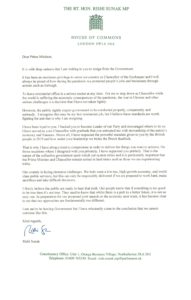
    The letter of resignation from Rishi Sunak, the Chancellor of the Exchequer, sent to Boris Johnson, the Prime Minister, on 5 July 2022.

  • Rishi Sunak – 2022 Statement on Cost of Living Payments and Welfare Cap

    Rishi Sunak – 2022 Statement on Cost of Living Payments and Welfare Cap

    The statement made by Rishi Sunak, the Chancellor of the Exchequer, in the House of Commons on 23 June 2022.

    In accordance with HM Treasury’s obligations to operate the welfare cap, set out in the charter for budget responsibility, the Treasury is required to determine items of welfare expenditure within scope of the welfare cap. Today, I would like to inform the House that the cost of living payments, which I announced to this House on 26 May 2022, are outside the scope of the welfare cap.

    The welfare cap plays a key role in the fiscal framework, underpinning the Government’s commitment to sustainable public finances over the medium term by setting a predetermined cap for welfare expenditure in a target year, together with a pathway and margin for welfare spending to reach that point. The cap, margin and pathway were last set out by the Government at autumn Budget 2021.

    The cap will be breached if spending in scope exceeds the cap plus margin at the point of formal assessment, which will next occur in 2024-25.

    The welfare cap is designed to support the management of the more predictable elements of benefit expenditure. It already categorises benefits most directly linked to the economic cycle, such as universal credit payments to jobseekers, as outside the scope of the cap.

    The cost of living payments are one-off payments, designed to support millions of the most vulnerable households facing cost of living challenges as a consequence of acute global economic pressures. Given their temporary and exceptional nature, we have therefore taken the decision to categorise these payments as outside the scope of the welfare cap. As the cost of living payments are outside the scope of the cap, they will not form part of the expenditure that will be formally assessed by the OBR against the cap and pathway.

  • Rishi Sunak – 2022 Comments on No Confidence Vote in Boris Johnson

    Rishi Sunak – 2022 Comments on No Confidence Vote in Boris Johnson

    The comments made by Rishi Sunak, the Chancellor of the Exchequer, on 6 June 2022.

    From the vaccine rollout to our response to Russian aggression, the PM has shown the strong leadership our country needs. I am backing him today and will continue to back him as we focus on growing the economy, tackling the cost of living and clearing the Covid backlogs.

  • Rishi Sunak – 2022 Commons Statement on the Economy

    Rishi Sunak – 2022 Commons Statement on the Economy

    The statement made by Rishi Sunak, the Chancellor of the Exchequer, in the House of Commons on 26 May 2022.

    The high inflation that we are experiencing now is causing acute distress to the people of this country. I know that they are worried. I know that people are struggling. I want to explain what is happening, why it is happening, and what we propose to do about it.

    I trust the British people, and I know they understand that no Government can solve every problem, particularly the complex and global challenge of inflation, but this Government will never stop trying to help people, to fix problems where we can and to do what is right, as we did throughout the pandemic. We need to make sure that those for whom the struggle is too hard, and for whom the risks are too great, are supported. This Government will not sit idly by while there is a risk that some in our country might be set so far back that they might never recover. That is simply unacceptable, and we will never allow it to happen.

    I want to reassure everybody that we will get through this. We have the tools and the determination we need to combat and reduce inflation. We will make sure that the most vulnerable and least well off get the support they need at this time of difficulty, and we will also turn this moment of difficulty into a springboard for economic renewal and growth, with more jobs, higher skills and greater investment: our plan for a stronger economy.

    Before I turn to the details of our plan, let me put into context for the House the challenge we face. This country is now experiencing the highest rate of inflation we have seen for 40 years. The Bank of England expects inflation to average around 9% this year. Our exposure to global shocks continues to explain most of the inflation above the 2% target. Supply chain disruption as the world reopened from covid, combined with Russia’s invasion of Ukraine and potentially exacerbated by recent lockdowns in China, are all contributing to significant price increases for goods and energy.

    However, over the course of the year, the situation has evolved and become more serious. There are areas of particular concern. Even excluding energy and food, core inflation has become broader-based and elevated. Of the basket of goods and services we use to measure inflation, a record proportion is seeing above-average price increases. Also, we are acutely exposed to the European energy price shock and, like the US, we have a tight labour market. Make no mistake, the lowest unemployment in almost 50 years, just months after averting a jobs crisis during the pandemic, is good news, but combined with the shock to European energy prices, it does contribute to the UK’s relatively high rate of inflation.

    Lastly, as the Bank has noted, longer-term inflation expectations have risen above their historical averages by more than they are doing in the US and Europe. We cannot and must not allow short-term inflationary pressures to lead people to expect that high inflation will continue over the long term. We can get inflation under control. It is not some abstract force outside our grasp. It may take time, but we have the tools we need and the resolve it will take to reduce inflation. We have three specific tools available to combat and reduce inflation, and we are using them all: independent monetary policy, fiscal responsibility and supply-side activism.

    First, our primary tool is a strong independent monetary policy. Since control of monetary policy was taken out of the hands of politicians 25 years ago, inflation has averaged precisely 2%. It is right that the Bank of England is independent, and I know that the Governor and his team will take decisive action to get inflation back on target and ensure that inflation expectations remain firmly anchored.

    Secondly, we need responsible fiscal policy. That means providing fiscal support where required but not making the situation unnecessarily worse, causing inflation, interest and mortgage rates to go up further than they otherwise would. Excessively adding fiscal stimulus into a supply-constrained economy, especially one in which households and businesses have built up over £300 billion of excess savings, risks being counterproductive and increasing inflationary pressures. In other words, fiscal support should be timely, temporary and targeted. Timely because we need to help people when the shock is at its worst, targeted because unconstrained stimulus will make the problem worse, and temporary because if we do not meet our fiscal rules and ensure the public finances are resilient in the longer run, we create even greater risks on inflation, interest rates and the trend rate of economic growth.

    Thirdly, we are taking an activist approach to supply-side reforms. This will increase our productive capacity, ease inflationary pressures and raise our long-term growth potential. The Prime Minister’s energy security strategy will reduce bills over time by increasing energy supply and improving energy efficiency. The Work and Pensions Secretary is moving half a million jobseekers off welfare and into work and doing more to support older people back into the jobs market. The Home Secretary is making our visa regime for high-skilled migrants one of the most competitive in the world, and in the autumn we will bring forward tax cuts and reforms to encourage businesses to invest more, train more and innovate more—the path to higher growth. Independent monetary policy, fiscal response ability and supply-side reform—the country should have confidence that using these three tools, we will combat inflation and reduce it over time.

    But of course, we know that households are being hit hard right now, so today we will provide significant support to the British people. As I have said, a critical part of how we are dealing with inflation is responsible fiscal policy. What this means in practical terms is that as we support people more, we need to think about the fairest way to fund as much of that cost as possible. The oil and gas sector is making extraordinary profits, not as the result of recent changes to risk taking or innovation or efficiency, but as the result of surging global commodity prices, driven in part by Russia’s war. For that reason, I am sympathetic to the argument to tax those profits fairly, but—[Interruption.]

    Madam Deputy Speaker (Dame Eleanor Laing)

    Order. A bit of gentle banter is fine, but when it gets to the stage that nobody can hear what the Chancellor is saying, it is counterproductive. Quieter banter, please.

    Rishi Sunak

    But, as ever, there is a sensible middle ground. We should not be ideological about this; we should be pragmatic. It is possible to both tax extraordinary profits fairly and incentivise investment. So, like previous Governments, including Conservative ones, we will introduce a temporary targeted energy profits levy— [Interruption.] But we have built into the new levy— [Interruption.] We have built into the new levy a new investment allowance similar to the super deduction, which means that companies will have a new and significant incentive to reinvest their profits.

    The new levy will be charged on the profits of oil and gas companies at a rate of 25%. It will be temporary, and when oil and gas prices return to historically more normal levels, the levy will be phased out, with a sunset clause written into the legislation. And crucially, with our new investment allowance, we are nearly doubling the overall investment relief for oil and gas companies. That means that for every pound a company invests, it will get back 90% in tax relief. So the more a company invests, the less tax it will pay.

    We understand that certain parts of the electricity generation sector are also making extraordinary profits. The reason for this is the way our market works. The price our electricity generators are paid is linked not to the costs they incur in providing that electricity but rather to the price of natural gas, which is extraordinarily high right now. Other countries such as France, Italy, Spain and Greece have already taken measures to correct this. As set out in the energy security strategy, we are consulting with the power generation sector and investors to drive forward energy market reforms and ensure that the price paid for electricity is more reflective of the costs of production.

    These reforms will take time to implement, so in the meantime, we are urgently evaluating the scale of these extraordinary profits and the appropriate steps to take. So our energy profits levy will encourage investment, not deter it. It will raise around £5 billion of revenue over the next year so that we can help families with the cost of living, and it avoids having to increase our debt burden further. There is nothing noble in burdening future generations with ever more debt today because the politicians of the day were too weak to make the tough decisions.

    I know the whole House will agree that we have a responsibility to help those who, through no fault of their own, are paying the highest price for the inflation we face. To help with the cost of living, we are going to provide significant targeted support to millions of the most vulnerable people in our society: those on the lowest incomes, pensioners and disabled people.

    First, on people on the lowest incomes, over 8 million households already have incomes low enough for the state to be supporting their cost of living through the welfare system. They could be temporarily unemployed and looking for work; they could be unable to work because of long-term sickness or disability; or they could be on low pay and using benefits to top up their wages. Right now, they face incredibly difficult choices. I can announce today that we will send directly to around 8 million of the lowest-income households a one-off cost of living payment of £650. That support is worth over £5 billion and will give vulnerable people certainty that we are standing by them at this challenging time. The Department for Work and Pensions will make the payment in two lump sums, the first from July and the second in the autumn, with payments from Her Majesty’s Revenue and Customs for those on tax credits following shortly after. There is no need for people to fill out complicated forms or bureaucracy, as we will send the payments straight to their bank account.

    Our policy will benefit over 8 million households in receipt of means-tested benefits from July. Uprating in that timeframe could only be done for those on universal credit, and our policy will provide a larger average payment this year of £650, whereas uprating the same benefits by 9% would be worth only £530 on average.

    There are two further groups who will need extra targeted support. Many pensioners are disproportionately impacted by higher energy costs. They cannot always increase their income through work and, because they spend more time at home and are more vulnerable, they often need to keep the heating on for longer. We estimate that many people who are eligible for pension credit are not currently claiming it, which means many vulnerable pensioners will not be receiving means-tested benefits. I can announce today that, from the autumn, we will send over 8 million pensioner households that receive the winter fuel payment an extra one-off pensioner cost of living payment of £300.

    Disabled people also face extra costs in their day-to-day lives; for example, they may have energy-intensive equipment around their home or workplace. To help the 6 million people who receive non-means-tested disability benefits, we will send them, from September, an extra one-off disability cost of living payment worth £150. Many disabled people will also receive the payment of £650 I have already announced, taking their total cost of living payment to £800.

    I can reassure the House that next year, subject to the review by the Secretary of State for Work and Pensions, benefits will be uprated by this September’s consumer prices index, which on the current forecast is likely to be significantly higher than the forecast inflation rate for next year. Similarly, the triple lock will apply to the state pension.

    Of course we recognise the risk that, with any policy, there may be small numbers of people who fall between the cracks. For example, it is not possible right now for the DWP or HMRC to identify people on housing benefit who are not also claiming other benefits. To support them and others, we will extend the household support fund delivered by local authorities by £0.5 billion from October.

    This is a significant set of interventions to support the most vulnerable in our country. We will legislate to deliver this support on the same terms in every part of the United Kingdom, including Northern Ireland. Taken together, our direct cash payments will help one third of all UK households with cost of living support worth £9 billion.

    We are meeting our responsibility to provide the most help to those on the lowest incomes. I believe that is fair, and I am confident that the House will agree, but many other families who do not require state support in normal times are also facing challenging times. Is it fair to leave them unsupported? The answer must surely be no.

    Although it is impossible for the Government to solve every problem, we can and will ease the burden as we help the entire country through the worst of this crisis. We will provide more support with the rising cost of energy, and that support will be universal. Earlier this year, we announced £9 billion to help with the cost of energy, including a council tax rebate of £150 for tens of millions of households.

    We planned to provide all households with £200 off their energy bills from October, with the cost repaid over the following five years. Since then, the outlook for energy prices has changed. I have heard people’s concerns about the impact of these repayments on future bills, so I have decided that the repayments will be cancelled. For the avoidance of doubt, this support is now unambiguously a grant. Furthermore, we have decided that the £200 of support for household energy bills will be doubled to £400 for everyone. We are on the side of hard-working families with £6 billion of financial support.

    To summarise, our strategy is to combat and reduce inflation over time through independent monetary policy, fiscal responsibility and supply-side activism. We are raising emergency funds to help millions of the most vulnerable families who are struggling right now, and all households will benefit from £400 of universal support for energy bills, with not a penny to repay.

    In total, the measures I have announced today provide support worth £15 billion. Combined with the plans we have already announced, we are supporting families with the cost of living through £37 billion or 1.5% of GDP. That is more than or similar to the support in countries such as France, Germany, Japan and Italy. I am proud to say that around three quarters of that total support will go to vulnerable households.

    As a result of the measures announced today and the action we have already taken this year, the vast majority of households will receive £550, pensioners will receive £850 and almost all of the 8 million most vulnerable households in the country will, in total, receive support of £1,200.

    Let me put that in context. The House will have noted the news from Ofgem earlier this week that it expects the energy price cap to rise to £2,800 in October. That implies an average increase in people’s bills this year of just under £1,200, which is the same amount as our policies will provide for the most vulnerable people this year.

    I know there are other pressures. I am not trying to claim that we have solved the entire problem for everyone—no Government could—but I hope that when people hear of the significant steps we are taking, and the millions we are helping, they will feel some of the burden eased and some of the pressures lifted. They will know that this Government are standing by them.

    Supporting people with the cost of living is only one part of our plan for a stronger economy—a plan that is: creating more jobs; cutting taxes on working people; reducing our borrowing and debt; driving businesses to invest and innovate more; unleashing a skills revolution; seizing the benefits of Brexit; and levelling-up growth in all parts of the United Kingdom. The British people can trust this Government because we have a plan for a stronger economy, and I commend it to this House.