Below is the image of the letter sent from Naz Shah, the Labour MP for Bradford West, to Priti Patel, the Home Secretary, on 12 June 2020.
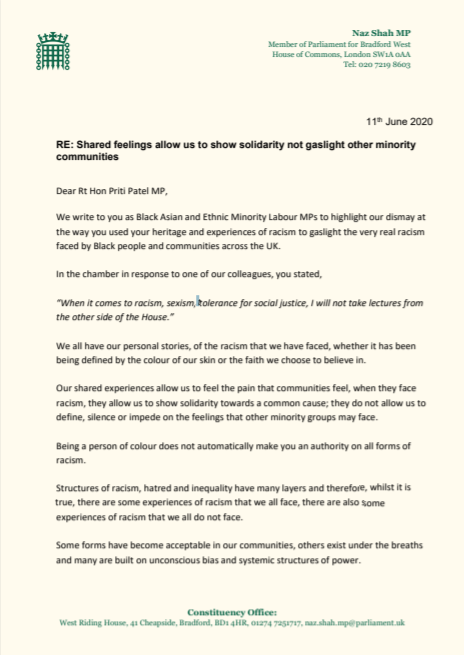
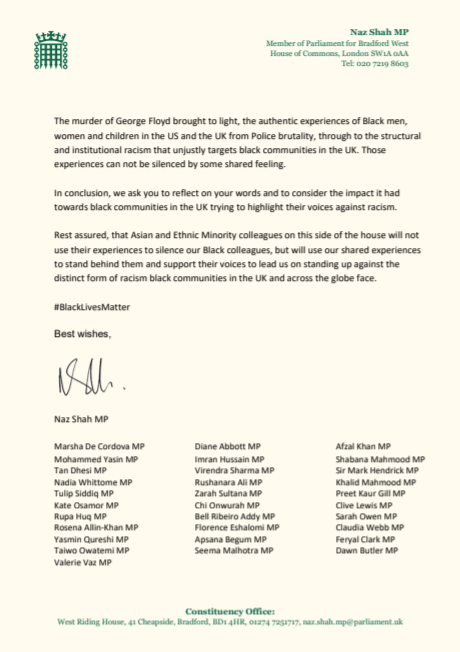

Below is the image of the letter sent from Naz Shah, the Labour MP for Bradford West, to Priti Patel, the Home Secretary, on 12 June 2020.

Below is the text of the speech made by Priti Patel, the Home Secretary, in the House of Commons on 8 June 2020.
With permission, Madam Deputy Speaker, I would like to make a statement on public order. Like all Members of this House, I was sickened at George Floyd’s tragic death. His treatment at the hands of the United States police was appalling and speaks to the sense of injustice experienced by minority communities around the world. I fully appreciate the strength of feeling over his senseless killing, the inequality that black people can sadly still face, and the deep-seated desire for change. I know that it is that sense of injustice that has driven people to take to the UK streets to protest.
This Government are clear that racism and discrimination in any form have no place in our society, and we will do whatever is required to eradicate it. Of course there is more we can do. There is more that we should all do to combat inequalities across society, to support those seeking social justice and better life chances and to offer hope, but all too often, too many are confronted by despair. It is right in any democracy, in an open and free society, that we advance these issues in a constructive, sensitive and responsible way.
The Government understand the importance of the right to protest. In normal circumstances, a large and peaceful protest would not be of concern to the authorities, because we live in a great country where our right to protest and to have our voice heard is integral to our fundamental democratic freedoms. The right to come together and express our views peacefully remains one of the cornerstones of our great democracy. Members across the House share an enduring commitment to uphold liberty and freedom of expression, on the basis of respecting the rule of law. As our nation battles coronavirus, however, these are not normal circumstances, so to protect us all and to stop the spread of this deadly disease, any large gatherings of people are currently unlawful. We cannot afford to forget that we are still in the grip of an unprecedented national health emergency that has tragically claimed more than 40,000 lives, so the severe public health risk forces me to continue to urge the public not to attend future protests. The Government’s scientific and medically led advice remains clear and consistent. No matter how important the cause, protesting in large numbers at this exceptional time is illegal, and doing so puts everyone’s lives at risk.
Let me turn to an operational update. Around 200 protests took place across the country over the weekend, attended by over 100,000 people. As many as 137,500 people have now attended Black Lives Matter protests across the UK. While the majority were peaceful, a lawless minority of protesters have regrettably turned to violence. The worst violence flared in London on Saturday evening, with missiles and flares being thrown at police officers outside Downing Street. Officers in protective equipment were deployed to arrest the culprits and to clear the area. At least 35 officers have now been injured during the protests in the capital. I salute their bravery and wish them a swift recovery. The thugs and criminals responsible are already being brought to justice. This is a fluid situation, but as of this morning the total number of arrests stood at 135.
As the ugly tally of officer assaults shows, some protestors, regrettably, turned to violence and abusive behaviour at the weekend. This hooliganism is utterly indefensible; there is no justification for it. There is no excuse for pelting flares at brave officers, throwing bikes at police horses, attempting to disrespect the Cenotaph or vandalising the statue of Winston Churchill, one of the greatest protectors of our freedoms who has ever lived. It is not for mobs to tear down statues and cause criminal damage in our streets, and it is not acceptable for thugs to racially abuse black police officers for doing their jobs. The criminals responsible for these unlawful and reckless acts are betraying the very cause they purport to serve. These protests are about injustice, but by attacking our courageous police they are acting in a wholly unjust way.
When I became Home Secretary, I vowed to back the police. I said that I would stand with the brave men and women of our police and security services, and against the criminals. I stand by that today, proudly and without apology, because, as we saw at the weekend, we ask our frontline police officers to do the most difficult of jobs: to run towards danger to ensure that we are not in danger; to put their own lives on the line to protect the public; and to uphold the rule of law and the rights of individuals against the disorder that we have seen in recent days. By doing that, the police in our country give us all the very security we need to live our lives as we choose.
That is an essential part of our freedom, because violence, disorder and crime blight communities and society as a whole. So the police need to know that they have a Prime Minister, a Home Secretary and a Government who stand with them and will give them the tools, powers and resources they need to keep us safe—and they do. Police funding has had its biggest uplift in a decade, increasing by more than £1 billion, and we are recruiting an additional 20,000 police officers to keep our streets and our country safe. They will have my full support in upholding the rule of law, and in tackling violence, vandalism and disorderly criminal behaviour. I could not be clearer: I want to see the violent minority responsible arrested and brought to justice.
I agree with the many peaceful protestors that racism has absolutely no place in our society. Black lives matter, but police brutality in the United States is no excuse for the violence against our brave police officers at home. So to the quiet law-abiding majority who are appalled by this violence and who have continued to live their lives within the rules, I say: “I hear you.” To the police, who have been subject to the most dreadful abuse, I say: “You have my full backing as you act proportionately, fairly and courageously to maintain law and order.” And to the criminal minority who have subverted this cause with their thuggery, I simply say this: “Your behaviour is shameful and you will face justice.” I commend this statement to the House.
Nick Thomas-Symonds (Torfaen) (Lab)
I thank the Home Secretary for her statement and for advance sight of it. Like everyone in the House, I was appalled by the killing of George Floyd. His fateful words, “I can’t breathe” not only haunt us, but have become a catalyst for people across America and the world to say that the racism that continues to shame everyday life must stop. People in our communities with lived experiences and family legacies of the prejudice that black people in the United Kingdom face have bravely stepped forward. I want to be absolutely clear: I hear you and, not that it should need saying, black lives matter.
Words are important, but we cannot allow this moment of global demand for justice to pass without action: we on the Labour Benches will be at the forefront of calls for change. What is never a solution, though, is violence or vandalism. The vast majority of protestors are peaceful, but some of the actions we have seen from a minority are unacceptable. I condemn those who have attacked the police, and I pay tribute to the police officers who put themselves in harm’s way over the weekend. I hope the Home Secretary will update us on the condition of the 27 injured officers, including one in hospital, and the injured protester. When it comes to the statue of Edward Colston, I do not condone an act of criminal damage to remove it, but I will not miss a public statue of a slave trader. It should have been taken down many years ago.
At a time when politicians and public health experts are rightly stressing the need for caution around protests given the risk of coronavirus—I stress that again today—and the importance of social distancing, the imperative on those in power is all the greater to show that they have listened and that they understand the scale of the anger and the desire for meaningful action. At moments like this, it is for our leaders to unite communities, heal divisions and confront the injustices in our society.
Public Health England recently published its report on the disparities in the risk and outcomes of covid-19, showing that black males are four times more likely than expected to die with covid-19. The recommendations of that report need to be made public now. Coronavirus has shone a light on inequalities that have long existed. The damning findings of the Wendy Williams Windrush review need to be heeded and its recommendations acted upon. The Home Secretary said earlier that she was looking at them, but she urgently needs to come to the House and tell us the action she is taking.
My right hon. Friend the Member for Tottenham (Mr Lammy) produced a report in September 2017 on the treatment of and outcomes for black, Asian and minority ethnic people from first point of contact with the police and then throughout the criminal justice system. It showed that black people make up around 3% of the general population but accounted for 12% of adult prisoners and more than 20% of children in custody. Those shameful statistics matter, and the Government should implement the report’s recommendations in full. In recent days, we have heard powerful testimonies from so many people on how racism continues to have an impact on daily lives in our country. Does the Home Secretary agree that now is not the moment for divisive rhetoric? Instead, this is a time for the Government to listen, to learn and to act.
Priti Patel
I thank the hon. Gentleman for his thoughtful comments and his considered response not only to my statement but to the appalling events that we have seen, and the violence in particular. He is absolutely right about the processes around the removal of the statue and the violence that was associated with it. We live in an open society and in a democracy. We have the means and mechanisms to bring statues down and to change society in the way we wish.
The hon. Gentleman is right about peaceful protest, which remains an important part of society and the way in which we have our voices heard—the way in which we come together to combat the inequalities across society, to give service to those communities who sometimes feel that they have no voice and to find ways to bring together the aspects that can help to change lives and bring social justice together, rather than causing divisiveness in the way that was alluded to.
The hon. Gentleman referred to a number of points, some of which were aired during oral questions. When it comes to the Windrush review, I could not have been clearer: I will return to this House to talk about the recommendations within the context of inequality and many of the criticisms that were levelled at the Home Office over a substantial period. It is right that we do that.
The hon. Gentleman spoke about health inequalities, life chances and the lack of opportunities—particularly for the black community—as well as violence and the criminal justice system. These are issues that we have to tackle together to understand the root causes and societal causes but also, importantly, to provide the right solutions and the right support to the community across the country.
I echo the hon. Gentleman’s words about our police officers, in particular the injured officers, who have sustained the most appalling injuries. I spoke to the Metropolitan Police Commissioner this morning and heard from her that the officers are recovering. They have sustained some awful, horrendous injuries, including a punctured lung and, where the bike was thrown at the horse, a broken collarbone. I wish all the officers a swift and good recovery. That type of behaviour is thoroughly unacceptable and is exactly what we never want to see again on our streets.
When it comes to coronavirus, our police continue to operate by consent and ensuring community engagement, which is at the heart of policing by consent in the United Kingdom. They have the support of the communities within which they operate and work with the organisers. However, the police and the Metropolitan Police Commissioner have been absolutely clear that, with the protests that we saw over the weekend, there were no community organisers to engage with. I made a plea on Saturday and urged all the community organisers behind the protests to engage with the police, so that people could protest safely and prevent the spread of the virus, and also violence and disorder could be prevented from taking place. Sadly, that did not happen. Going forward, we must work together collectively to prevent acts of violence and thuggery of the kind that we saw at the weekend and ensure that people who want their voices heard can find the right ways of doing that without necessarily coming on to the streets and protesting.
Bim Afolami (Hitchin and Harpenden) (Con)
Does the Home Secretary agree that the best way to ensure that black lives matter is peaceful protest and working to improve social justice and economic opportunities for black people and other ethnic minorities, not the lawless, senseless violence of a small minority or defacing war memorials and public monuments, which can undermine the whole message and, indeed, the Black Lives Matter movement as a whole?
Priti Patel
My hon. Friend is absolutely right. When it comes to inequalities and the injustice that has been shown and felt throughout the black community in particular, there is no doubt that racism and discrimination in any shape or form have no place at all in our country and society. That is why it is important that we work collectively to address injustice, secure social justice for the communities in question and combat inequalities across all of society, and also, importantly, improve people’s life chances, opportunity and hope, which we should all be united on.
Joanna Cherry (Edinburgh South West) (SNP)
May I thank the Home Secretary for advance sight of her statement? I extend my best wishes for a full recovery to all the police officers who suffered injury during the trouble in London and pay tribute to their brave service. I also unreservedly condemn the violence and disorder that took place. However, it is important that we do not let a minority distract us from the legitimate concerns of the Black Lives Matter movement.
The desire to take to the streets to protest is understandable, and one thing that I hope we share across the House is a cherishing of our freedom of speech, freedom of expression and freedom of assembly. The right to protest peacefully is a fundamental part of those rights. However, we are in the midst of a public health crisis. Having regard to that, the Justice Secretary in Scotland, Humza Yousaf, joined prominent anti-racism activists to urge people in Scotland to plan protests against racial injustice in a way that safeguards them and the wider public from the ongoing threat from covid-19. Protests went ahead in Glasgow and Edinburgh, but I am pleased to say that they were peaceful, and I know that the organisers and participants tried hard to maintain social distancing.
Does the Home Secretary agree that it is important that we do not let the minority who engaged in violent disorder detract from the legitimacy of the concerns of the protesters and the Black Lives Matter movement?
Does she also agree it is important that all those in public life are careful not to do or say anything that might polarise the situation, as Trump has done in America? Finally, will she use this opportunity to make a clear commitment to review all Government policies where there is evidence that they impact adversely on BAME communities? For instance, evidence shows that the no recourse to public funds policy, to which I referred earlier, clearly discriminates against black, Asian and minority ethnic communities. Will she commit not just to bringing back the Windrush report to this House, but to implementing the recommendations in that lessons learned review?
Priti Patel
I thank the hon. and learned Lady for her remarks and her support for police officers, while also respecting the right to protest in a safe, sensible, and proportionate way, as we are in this public health emergency. It is important to labour the point that these protests are about injustice. It is right that we come together to find the right way, collectively, to tackle those injustices, fight for social justice, and deliver social justice for black, Asian and minority ethnic communities. As we have seen on our streets, however, by attacking our courageous police a small minority of individuals have acted in a wholly unjust way. The hon. and learned Lady mentioned the events in America, and it is dreadful, utterly heart-wrenching, and sad to see the level of protests there as well. As we saw over the weekend, a small minority of people are subverting the cause that people are protesting about.
We will continue to fight to solve inequalities and injustices. Earlier the hon. and learned Lady mentioned the policy of no recourse to public funds, as well as the Wendy Williams review and report. She also mentioned health inequalities, particularly for black and minority ethnic communities, and it was right for the Government to address that issue in the House last week. We must collectively come together. The Minister for Equalities is looking at this issue right now, and we must find an integral, overall approach across Government, with combined policies, not just one, to look at how we can serve those communities better, and address many of the inequalities that have been brought to light over recent weeks.
Dr Matthew Offord (Hendon) (Con) [V]
We all agree there is injustice in the world, but does the Home Secretary agree with many of my constituents that images of demonstrators throwing bikes at police officers, aiming fireworks at horses, and racially abusing other people, are simply unacceptable? The irony is that public sector workers have recently been applauded, yet now those same people are being put at risk of physical harm through both violence and a pandemic. Will she take every possible step, including with the co-operation and agreement of the Mayor of London, to prevent any further demonstrations during the period of pandemic?
Priti Patel
My hon. Friend has made important points. I have already made my view abundantly clear about how unacceptable the violence was that we witnessed on the streets, and the assaults on police officers. Hon. Members will understand that operational decisions on policing come under the operational independence of chief constables, and the Commissioner of Police in London. Police and crime commissioners also have responsibility for the totality of policing in their force area.
For future protests, it is the responsibility of the Mayor of London to ensure that when it comes to policing, protests in particular do not manifest in the way they have done. He has a duty to communicate to Londoners that they should express their own views in a right and proportionate way, by sticking to the regulations that have been outlined by the Government. I made my views clear over the weekend, as did the Secretary of State for Health and Social Care: we do not want to see these protests take place. We are in the midst of a health pandemic, and by gathering in such a way, people’s lives are being put at risk. That does not help anybody; that will not stop the spread of the virus or protect the NHS. The Mayor of London has an important role to play right now, and I urge him to step up and do exactly that.
Yvette Cooper (Normanton, Pontefract and Castleford) (Lab)
I join all the Front Benchers in sending support and best wishes to all the police officers who have been injured, and in their strong sense that violence by a minority is always unacceptable and helps no one. There is a responsibility on us all to ensure that this does not prevent us from coming together to respond to the strong demands for action against racism and injustice across the country.
In that spirit, the Home Secretary will know that the Home Affairs Committee is conducting an inquiry into policing, two decades on from the Macpherson report. Next week, we will look at reports that covid-19 enforcement fines may have been disproportionately applied to BME communities. Has she looked at that, and what has she found? Will she provide for the Committee a list of all the practical steps that she and the Home Office are now taking to tackle injustice and racism?
Priti Patel
I thank the right hon. Lady for her questions and for her work on this matter with the Home Affairs Committee. I will absolutely provide the Committee with the information she asks for. I look forward to working with her to outline the practical steps and measures, particularly around fixed penalty notices and enforcement issues throughout the coronavirus crisis, and to address many policing issues 20 years on since the Macpherson report. I know from all the conversations I have had with the Met police commissioner —not only over recent days but over several months now—that when it comes to diversifying London’s police force and all our police forces, we must make sure that we do everything within our power to address cultural issues, improve training and do more when it comes to recruitment. We must also ensure that all officers, across the country and in London, understand that they serve the communities in which they police and understand the communities of which they are members.
Madam Deputy Speaker (Dame Eleanor Laing)
The House is grateful to the Home Secretary for taking the trouble to answer in great detail all the questions that have so far have been asked, but now that quite a few questions have been asked, we will have to speed up a bit, to try to get everyone in. I make no criticism—these are sensitive matters and need to be dealt with in full—but perhaps now we can go rather faster.
Robin Millar (Aberconwy) (Con)
I am pleased to say that in north Wales the protests passed off peacefully over the weekend. Does the Home Secretary agree that we have a tradition of effective, peaceful protest in this country, and can she reassure us that those who perpetrated acts of violence or criminal damage over the weekend will be brought to justice?
Priti Patel
My hon. Friend is absolutely right, and I give my thanks to his local police force and the officers that policed the protest at the weekend. He is absolutely right: we want to ensure that swift justice occurs, sending a clear message to the perpetrators of serious violence that we do not want to see a repeat of it.
Florence Eshalomi (Vauxhall) (Lab/Co-op)
Vandalism and violence should never be accepted. I too pay tribute to the hard-working officers who have been on the frontline, including officers from my borough of Lambeth, who are often the first to be called whenever there is a protest because of our proximity to central London. Does the Home Secretary actually understand the anger and frustration felt by so many people? Does the Home Secretary recognise that this protest is being led by young people? Does the Home Secretary recognise that there is structural inequality, discrimination and racism in our country? Does the Home Secretary recognise that people want to see action from the Government?
My son turned three yesterday. I do not want to have to wait until he is a teenager before we see changes in this country. Will the Home Secretary and the Government act now? Black lives matter, and we need to see the Government doing something about that.
Priti Patel
I would make a number of points to the hon. Lady. I have been very clear in my remarks about the level of injustice that is felt across the country, and that has been illustrated in what we have seen over the weekend and the very peaceful protests that have taken place, but I am really saddened that she has effectively said that this Government do not understand racial inequality. [Interruption.] On that basis, it must have been a very different Home Secretary who as a child was frequently called a Paki in the playground; a very different Home Secretary who was racially abused in the streets or even advised to drop her surname and use her husband’s in order to advance her career; and a different Home Secretary who was recently characterised in The Guardian—if I may say so, Madam Deputy Speaker—as a fat cow with a ring through its nose, something that was not only racist but offensive, both culturally and religiously. This is hardly an example of respect, equality, tolerance or fairness, so when it comes to racism, sexism, tolerance or social justice, I will not take lectures from the those other side of the House.
I have already said repeatedly that there is no place for racism in our country or in society and, sadly, too many people are too willing to casually dismiss the contributions of those who do not necessarily conform to preconceived views or ideas about how ethnic minorities should behave or think. This in my view is racist in itself. As I said earlier, both in my statement and in my answers to other colleagues in the House, to combat the real inequalities in society and to end the gross disservice to many communities across our nation who are subject to real and pressing inequalities, we must address these sensitive issues in an accurate and responsible way and by addressing prejudice rather than inciting and inflaming tensions.
Kevin Hollinrake (Thirsk and Malton) (Con)
I was going to say how good it is to hear this House so united—in the main, it is united in its support for peaceful protest, particularly one that is tackling prejudice and unfairness, and also in its support for the police. Does my right hon. Friend agree that the best way to support the police is to deter future violent crime by making sure that everybody who is guilty of things such as throwing missiles at police—we have all seen those videos, and that video footage should be studied—is arrested, charged and prosecuted?
Priti Patel
My hon. Friend is absolutely right, and those people should be in no doubt whatever that swift justice will follow, and that is exactly what the British public want to see. They want to see the rule of law applied, but also for people to express their views in a peaceful way that is in line with the democratic values of our country.
Clive Efford (Eltham) (Lab)
I want to add my voice to those who have condemned the minority of people at the weekend who were acting in a violent way towards the police, and I wish those injured officers a speedy recovery, but Secretary of State, does it not just fuel the suspicion of people from the BAME community when the recommendations of something like the Public Health England report are withheld? Are they not bound to suspect that that is the establishment feeling that it is likely to be embarrassed and made to feel awkward by those recommendations? Should they not be published?
Priti Patel
I say to the hon. Gentleman, first, that he is speaking to a Home Secretary who is from the BAME community, so there is no withholding of the data or information that he is referring to. The Government have been fully committed, and the Equalities Minister is working to not just look at the data but, importantly, work across Government—I think the House needs to fully recognise this—through all Government Departments from a policy perspective to understand the causes, whether they are health issues or housing issues, and the range of issues that basically dominate many inequalities. It is important that the Government have the time and space to do that, to actually deliver the right solutions to provide the right levels of social justice.
Owen Thompson (Midlothian) (SNP) [V]
In Midlothian and Edinburgh, there are streets, a statue and other local references to Henry Dundas, but there is no mention in any of those locations of his shameful role in delaying the abolition of slavery, which forced some 630,000 slaves to wait for more than a decade for their freedom. Does the Home Secretary agree with the leading human rights activist Professor Sir Geoff Palmer that we cannot erase parts of history, and that a more honest narrative is needed about memorialised figures in the slave trade as a crucial step in our journey to becoming a fair and inclusive society?
Priti Patel
The approach for becoming and being a fair and inclusive society also applies to the democratic ways in which we can express our views around cultural monuments, statues and street names. Whether we are talking about a statue or any other type of memorial, people should work through the correct democratic processes, with local authorities and the right individuals, to achieve the change that they want to see.
Martin Vickers (Cleethorpes) (Con)
Fortunately, my constituency has had a low infection rate from covid, but in recent weeks people have been anxious about an influx of visitors to the resort. You can imagine, Home Secretary, that they are doubly anxious this coming week—
Madam Deputy Speaker (Dame Eleanor Laing)
Order. I am trying not to interrupt people, because we do not have much time, but we must adhere to the standards of this place. The hon. Gentleman knows—a previous hon. Gentleman got this wrong too—that you cannot address the Home Secretary as “Home Secretary”; you must address the Chair. There are still new Members who do not quite know how to do this. There are good reasons for it that we do not have time to go into now, but the hon. Gentleman must address the Chair.
Martin Vickers
My apologies, Madam Deputy Speaker.
My right hon. Friend will be aware that my residents are doubly anxious because a Black Lives Matters protest meeting is planned for this Saturday. Could she assure my constituents that not only will property and people be defended but social distancing will be enforced to maintain the low infection rate?
Priti Patel
My hon. Friend makes a very important point. I reiterate the point I made earlier: we have asked protest organisers to engage with the police. That way, anybody who wishes to express their views or opinions in the right way—in a socially distanced and legitimate way—can do so. We do not want the type of scenes we saw at the weekend, with mass protests and crowds of more than six people coming together and obviously not social distancing. We are in the midst of a pandemic and it is right that we all behave responsibly and communicate the message across all our communities that social distancing matters and can and will save lives and importantly that we continue to control this virus at this very delicate time.
Fay Jones (Brecon and Radnorshire) (Con)
My hon. Friend the Member for East Surrey (Claire Coutinho) quoted Martin Luther King on social media this morning when she said:
“in spite of temporary victories, violence never brings permanent peace”.
Does my right hon. Friend agree that the violence over the weekend undermines the essential message of Black Lives Matters, which must be heard?
Priti Patel
My hon. Friend is absolutely right. I have made the point repeatedly that the violence dominated what was for the majority a peaceful protest and subverted its very clear message. People were making their voices heard and articulating the injustices they see. There is no place for violence and it should not be tolerated.
Mr David Jones (Clwyd West) (Con)
Does my right hon. Friend agree that nobody reasonable could ever conclude that accidents of thuggery by police officers on the streets of Minneapolis could ever justify acts of thuggery against police officers on the streets of London, and will she do everything in her power to ensure that there is no repetition of the events of last weekend?
Priti Patel
My right hon. Friend is absolutely right. I have spoken about the violence, disorder and criminality witnessed on the streets of London this weekend. I will continue to work with chief constables and police and crime commissioners across the country, as will my hon. Friend the Minister for Crime and Policing, to make that point again and again. While we support the right to protest, we are in a health emergency. It is right that we protect the public, but it is also right that our police forces uphold the rule of law.
John Cryer (Leyton and Wanstead) (Lab)
The violence at the weekend was simply wrong—that is straightforward —but would the Home Secretary agree that we should look at what President Trump is doing in America and do the exact opposite, and instead of encouraging bitterness, anger and even violence, which is what he is doing daily, we should be showing leadership, bringing people together and opposing racism everywhere?
Priti Patel
These protests are about injustice. What we have seen in America is dreadful—it is absolutely awful to see America tear itself apart—but, as I have said repeatedly, we can come together to address issues across all BAME communities and to address inequalities, the issue of young people’s life chances and the fact that they want more hope and opportunity. That is the type of leadership that the United Kingdom can show.
Jonathan Gullis (Stoke-on-Trent North) (Con)
Residents in Stoke-on-Trent, Kidsgrove and Talke were rightly outraged when they saw the Cenotaph graffitied and attempts to burn our Union Jack, desecrating the memories of those who paid the ultimate sacrifice for the freedoms we have today. Will my right hon. Friend back me in supporting Lewis Feilder and Conservative Friends of the Armed Forces by introducing a desecration of war memorials Bill to enable our police and courts to more easily prosecute those who damage our sacred memorials?
Priti Patel
I completely support that sentiment and the point that my hon. Friend just made.
Christine Jardine (Edinburgh West) (LD)
None of us in this place or, I believe, anywhere in the country wants to see violence and vandalism on the street. None of us wanted to see a large gathering of people at a time when social distancing is so vital for public health. More than that, none of us wanted to see the mindless violence against our police officers. But does the Home Secretary not agree that the answer to that is not to ramp up the rhetoric and throw more police officers into the fray? It is to look at the systemic injustice that there is in this country and invest in social programmes and in tackling that injustice. I would not suggest for a minute that the Home Secretary does not understand racism, but I ask her to rethink the Government’s strategy for dealing with the injustice that we have in society today.
Priti Patel
First, when it comes to policing, our police continue to operate by consent. They command the respect and co-operation of the British people by acting with integrity and accountability, and they do that in an outstanding way. When it comes to addressing social injustices and inequalities, as I have said repeatedly this afternoon, it is right that we come together as a Government and, in fact, as a House, because all right hon. and hon. Members have a duty to their own communities to be part of the solution in addressing the injustices. That is something that we can all collectively work to achieve.
Madam Deputy Speaker (Dame Eleanor Laing)
I must implore Members: a lot of people have bothered to come here this afternoon and they are not all going to get to ask a question because most Members have not asked questions but have made statements and told stories. From now on we will have to have short questions, and that means one question. The Home Secretary will then be able to give short answers to single questions.
Robert Courts (Witney) (Con)
I will very much try to do that, Madam Deputy Speaker.
We are lucky to live in this country under the protection of the rule of law, not least because of the actions of Winston Churchill, who defended the rule of law and defended this country against industrialised racism. Does the Home Secretary agree that under the rule of law, violence and vandalism have no place?
Priti Patel
My hon. Friend is absolutely right.
Liz Saville Roberts (Dwyfor Meirionnydd) (PC)
Black Lives Matter protests have been held throughout Wales and I, too, stand against the injustice and violence faced by black people here and elsewhere. The vast majority of protesters respected social distancing or made innovative use of communications technology. Will the Home Secretary give due credit to the peaceful majority? For example, school student—
Madam Deputy Speaker (Dame Eleanor Laing)
Order. We do not need examples. The question has been asked. [Interruption.] Order. The question has been asked.
Priti Patel
The right hon. Lady is right that we should absolutely reflect on the majority who have protested peacefully, and I commend the young people in particular. Online protests are much safer when it comes to the health epidemic that we are enduring right now. Importantly, the voices of those who protested peacefully have in effect been subverted through the violence that we saw this weekend.
Tom Hunt (Ipswich) (Con)
I wish to say how appalled I was by the damage to the Winston Churchill monument on the 76th anniversary of D-day. My constituents and I are absolutely appalled. The people who did that are ignorant fools and should be properly held to account. The big job is to get the balance right between respectful, peaceful protest and preventing criminal damage and mass destruction. Does my right hon. Friend think we have the right balance at the moment? Do the police have the powers that they need to get that balance right?
Priti Patel
The important point to note is that for those who participated in violence and thuggery, justice will follow, and the police have all the powers and tools necessary to ensure that that happens.
Margaret Ferrier (Rutherglen and Hamilton West) (SNP) [V]
I share the Home Secretary’s condemnation of anyone who engages in acts of violence, yet there remain valid concerns about the exporting of riot gear, tear gas and rubber bullets to the US, where some police forces have engaged in brutal crackdowns against peaceful protesters. Will she join the calls to her colleagues in the Department for International Trade to immediately suspend export licences for this equipment to the US?
Priti Patel
The hon. Lady will know that the Government as a whole consider all export applications thoroughly against a strict risk assessment. All exports to the United States are conducted in line with strict guidance, and the United Kingdom operates one of the most robust licensing regimes in the world.
Gareth Bacon (Orpington) (Con)
I thank my right hon. Friend for reassuring the country that the individuals who desecrated the Cenotaph, Winston Churchill’s statue and the statue of Abraham Lincoln will be held to account. Does she agree that vandalising monuments to the heroes who defeated fascism, defended our freedoms and ended slavery in the United States does absolutely nothing to further the cause of equality?
Priti Patel
My hon. Friend is absolutely right. Those acts of violence were wholly counterproductive and that is why it is important that justice follows and the police pursue the individuals who are responsible for those crimes.
Carol Monaghan (Glasgow North West) (SNP) [V]
It is important to recognise that the majority of the weekend’s protests, including those in Glasgow and Edinburgh, were peaceful, but to show that black lives really matter, we must examine the deeds of the past, so will the Home Secretary now commit to removing statues of slave traders from public places of honour?
Priti Patel
The hon. Lady is right to point to peaceful protests, which are a vital part of a democratic society, and she asks about the removal of statues of particular individuals. She will know that there are democratic processes that should be followed and respected by everybody to bring about that change, including working with councils of all colours across the country—Labour, Conservative and Lib Dem councils—with due process followed. That is absolutely the right approach to take, including following the rule of law.
Mr Richard Holden (North West Durham) (Con)
Throughout the pandemic, our police officers have put themselves in danger to uphold the rule of law, save lives and serve our communities. Does my right hon. Friend join me in condemning the actions of violent agitators over the weekend? Not only have they put our brave police officers at risk, but their actions have taken away from the reasonable, careful and important voice of lawful demonstrators.
Madam Deputy Speaker (Dame Eleanor Laing)
Order. Just before the Home Secretary answers that question, could everyone who is still to speak please just take their pen through their introductory remarks and ask a question? It is not really very difficult—just cut out the first bit.
Priti Patel
My hon. Friend the Member for North West Durham (Mr Holden) is absolutely right.
Nadia Whittome (Nottingham East) (Lab)
We will try again. Does the Home Secretary agree that the Government should remove statues of British figures involved in the slave trade? Further, does she agree that the lives of black people who have died following contact with police, such as Sarah Reed and Rashan Charles, are worth more than any statue?
Priti Patel
The hon. Lady will be well aware—perhaps she would like to lobby local authorities across the country to bring about the changes to statues. I notice that she celebrated the violence and criminal scenes that we saw across the weekend. I thought that the politics of protest and placards had left the Labour party with the departure of the right hon. Member for Islington North (Jeremy Corbyn).
Andrew Griffith (Arundel and South Downs) (Con)
I am proud that it was a Conservative Government who introduced Finn’s law to protect our service animals. Will my right hon. Friend assure me that she will not rest until the minority of thugs involved in attacking the police horse, as well as, of course, our brave officers, are brought to justice?
Priti Patel
My hon. Friend is absolutely right. What we witnessed at the weekend was utterly despicable. I look forward to visiting the mounted police section quite soon. I have had it with authority from the Metropolitan Police Commissioner that the injuries to the horse were mild, but importantly, she highlighted yet again how the acts of thuggery are disproportionate to not just police officers, but the animals.
Zarah Sultana (Coventry South) (Lab)
Edward Colston made his fortune by violently transporting 84,000 Africans to the Caribbean. At least 19,000 died en route. Statues of racist murderers like Colston can be found in cities across Britain, so I ask the Home Secretary a simple question: does she believe that it is right that black Britons have to walk in the shadows of statues glorifying people who enslaved and murdered their ancestors—yes or no?
Priti Patel
I hope that the hon. Lady will join me in lobbying councils across the country where Labour has been in charge for many years to bring about the change that black, Asian and minority ethnic people would like to see.
Laura Trott (Sevenoaks) (Con)
Does my right hon. Friend agree that we must not let the violence of a minority this weekend overshadow the majority who were peacefully protesting, and that we must bring forward practical steps to address the remaining racial inequality in our society?
Priti Patel
My hon. Friend is absolutely right, which is why the Equalities Minister is working across Government to address many of the issues around social injustice that need to be tackled.
Douglas Chapman (Dunfermline and West Fife) (SNP) [V]
Many Elizabethan British heroes used violence to enhance their wealth. Does the Home Secretary agree that violence is never part of the solution, but if we can educate our citizens in where we have been, what we have done and to whom, that will provide the basis for an equal and humane society?
Priti Patel
The hon. Gentleman makes a valid point. Violent activity can never be regarded as a legitimate form of protest. I do not just expect those who engage in violent activity to face the full force of the law; importantly, we should ensure that those who have a legitimate voice are heard through the right means.
Alec Shelbrooke (Elmet and Rothwell) (Con)
With regard to public order, may I ask my right hon. Friend to continue the policy of stop and search, and get knives off the street so it is not just black lives matter, but all lives matter?
Priti Patel
My hon. Friend is absolutely right. One of the most extraordinary—
Nadia Whittome
All lives can’t matter until black lives matter.
Madam Deputy Speaker (Dame Eleanor Laing)
Order.
Priti Patel
One of the important facts about stop and search, which I have experienced myself when meeting the parents of young black men who have been murdered on the streets of London, is its significance in taking weaponry off our streets. That is important for all Members of this House to recognise. When I have seen those parents, sat with them and heard their stories, they have called for more stop and search in order to stop more young black lives being killed, and to prevent more criminal and violent activities on the streets of our cities.
Chi Onwurah (Newcastle upon Tyne Central) (Lab)
There is no place for racism or discrimination in our society, but it is there; it is everywhere, and it is crushing the hopes and lives of millions in this country. I condemn the violence and vandalism, but the vast majority of the protests were peaceful. I want to hear from the Home Secretary what she is actually going to do to eradicate the racism that she condemns so that we do not need to have more protests in five, 10 and 15 years.
Priti Patel
The important point is that this is not down to one individual. We all have a responsibility—[Interruption.] Yes, and we all have a responsibility—across Government, across this House and across society—to understand the inequalities and the extent of the injustices. From a Government perspective, that means coming together and finding the right policy solutions, which this Government are committed to doing.
Dehenna Davison (Bishop Auckland) (Con)
Will my right hon. Friend join me in thanking County Durham residents for maintaining both peace and social distancing at the protests in Durham this weekend? Will she also join me in calling for all those who acted lawlessly and violently against our police to face the full weight of the law as quickly as possible?
Priti Patel
My hon. Friend is absolutely right. I congratulate her constabulary for the work that it has done, and the chief constable, who I have spoken to recently. Those acts of violence are not acceptable and it is right that those people face the full force of the law.
Kirsty Blackman (Aberdeen North) (SNP) [V]
No recourse to public funds is a policy that is in place at the Home Office that disproportionately affects my black constituents, as is the refusal rate of visitor visas. Will the Home Secretary commit to looking at these structurally racist policies within the Home Office, and to reforming them so that they do not disproportionately affect my black constituents?
Priti Patel
I refer the hon. Lady to my comments on this issue earlier on.
Lucy Allan (Telford) (Con)
My right hon. Friend has offered her full support to our police in tackling violence, vandalism and disorderly behaviour. Will she encourage the Mayor of London to follow her lead?
Priti Patel
My hon. Friend is absolutely right. It is the responsibility of the elected Mayor of London, the police and crime commissioner for London, to do exactly that.
Wera Hobhouse (Bath) (LD)
Many people in Bath, Bristol and the surrounding areas have said that the statue of Edward Colston should have been removed many years ago. Does the Home Secretary agree?
Priti Patel
The question is, why wasn’t it and why did the Labour Mayor not do that sooner?
James Sunderland (Bracknell) (Con)
Will the Home Secretary join me in paying tribute to the fortitude, professionalism and patience of our police forces in the face of yet more unnecessary aggression and violence?
Priti Patel
Our police officers and police forces have shown great courage over the weekend and throughout the protests. I absolutely stand with them and support them as they have faced a criminal minority with the dreadful approach that they have taken and shown.
Tracy Brabin (Batley and Spen) (Lab/Co-op)
My inbox, like many, is full of emails from constituents demanding that we decry racism and police brutality, and I absolutely applaud that. One such constituent, Zohra, a second-generation British Indian chartered accountant and mum of three children, tells me that according to INQUEST, the proportion of BAME deaths in custody where restraint is a feature is twice as many as other deaths in custody. To build trust with communities, what can the Home Secretary tell us that the Government are doing to end that injustice?
Priti Patel
It is important to understand the facts and figures around deaths in police custody. In 2018-19, there were 16 deaths in custody of whom 15 individuals were from a white background and one was black. It is important that the Independent Office for Police Conduct looks at all investigations in the right way and holds to account police forces when deaths in police custody take place, and that is exactly what happens.
Jerome Mayhew (Broadland) (Con)
It is the dehumanising of the other that makes it okay to violently attack a stranger, whether that stranger be black or white. Does my right hon. Friend agree that we should listen to the peaceful voices of the BAME communities, celebrate our civilian unarmed police who look after us all, and celebrate our common humanity?
Priti Patel
My hon. Friend is absolutely right about celebrating our common humanity, the diversity of our great country, and the people who have taken to the streets and expressed their views in a balanced, proportionate and peaceful way. When it comes to our police, I absolutely stand with them. They showed great courage and determination over the weekend.
Patrick Grady (Glasgow North) (SNP)
We will overlook the irony of the Home Secretary saying that mass gatherings are unlawful, while hundreds of us are required to gather here in Westminster. I wonder if she believes that the hostile immigration environment, indefinite detention, no recourse to public funds, destitution and no family reunion for unaccompanied minors sends a message that black lives matter to this Government?
Priti Patel
I have been very clear about the protests over the weekend, and about how the Government and all Members of Parliament should look to work together to address issues of social injustice.
Laura Farris (Newbury) (Con)
My right hon. Friend has quite properly said that residents should lobby local authorities to raise principled objections to offensive statues, but Bristolians have lamented the inconsistent response of their local authority. Will my right hon. Friend consider publishing guidance not to determine outcomes but to create uniform principles, so that law-abiding citizens who object to statues can feel sure that their complaints are heard?
Priti Patel
My hon. Friend makes a valid and important point. If people want change when it comes to their local authorities and police and crime commissioners, they can do that the democratic way, which is through the ballot box.
Lilian Greenwood (Nottingham South) (Lab)
Will the right hon. Lady congratulate both Nottinghamshire police and the Nottingham protest organisers on their efforts to ensure that yesterday’s event was peaceful and safe? In particular, will she congratulate the young protesters who stopped and set about cleaning up graffiti that they witnessed on the Council House in Nottingham? Will she tell us whether the Government have raised their concerns through official channels about the shocking and divisive reaction from the President and the United States authorities to peaceful protest there?
Priti Patel
Peaceful protest remains a vital part of our democratic society, as the hon. Lady has said, but what we witnessed over the weekend was terrible. We talk about community spirit and communities coming together when it comes to understanding the strength of feeling and people expressing their views in the right kind of way. I have already spoken about the United States of America, and what we are seeing over there is a tragedy.
Alexander Stafford (Rother Valley) (Con)
Does my right hon. Friend agree that we should push for the harshest possible sentences on the perpetrators of the violence not only for causing the violence but for undermining the key message of equality and for helping to spread the coronavirus?
Priti Patel
As we saw post the 2010 and 2011 riots, it is important that we see swift justice. We have a process of swift justice in place to ensure that justice is served for the appalling acts that we have seen over the weekend.
Bob Stewart (Beckenham) (Con)
Watching on the television, I thought the police seemed to be holding back. They will have been holding back for good operational reasons such as that they did not want too many people hurt. Will my right hon. Friend assure me that the police have every power they need to cope with future riots such as the one that they had to go through on Saturday?
Priti Patel
My hon. Friend is absolutely right. He will know of the operational independence of our police forces. Obviously, police and crime commissioners have responsibility for the totality of policing within their force areas. When it comes to resource and support of our police officers, I am unequivocal: we have given the police the highest funding uplift in more than a decade; we are equipping and training them so that they are equipped at the highest level and to the highest standard, and that, of course, will continue.
Alison Thewliss (Glasgow Central) (SNP) [V]
The use of rubber bullets in the UK is, thankfully, rare, but not so in the US. It has been identified that the bullets have a 15% rate of permanent disability and a 3% fatality rate. Can the right hon. Lady assure me that they will not be used here, and, if they will not be used here, will she end their export to the US?
Priti Patel
I have just been reliably told by the Policing Minister that rubber bullets are not authorised for use on the mainland.
Kerry McCarthy (Bristol East) (Lab)
As a Bristol MP, I want to commend the police for how they handled things yesterday; it was a very difficult situation for them. Does the Home Secretary agree that we need to look at the underlying reasons for people going out on the streets to protest yesterday, and accept that austerity, covid-19 and many other issues are factors behind that?
Priti Patel
The hon. Lady raised a number of issues. First, I have spoken to the chief constable of Avon and Somerset and the Policing Minister and I have had a considerable debrief on what happened yesterday. With regard to the protests, I have already spoken about the right to protest in a peaceful, lawful and respectful manner. What we witnessed yesterday was mob rule, which is completely out of kilter with the rule of law and unacceptable.
Gary Sambrook (Birmingham, Northfield) (Con)
The protests in Birmingham last week were very peaceful, but unfortunately the same cannot be said for the weekend’s protests in London. Does my right hon. Friend agree that there is never any excuse for thuggish and violent behaviour against our police officers?
Priti Patel
My hon. Friend is absolutely right.
Lloyd Russell-Moyle (Brighton, Kemptown) (Lab/Co-op)
I congratulate many of the peaceful protesters and the police and authorities that have helped to facilitate those protests, while acknowledging that the UK is still a racist country for many people. The Home Secretary is eager to comment on operational matters, but stays quiet, of course, when the Prime Minister encouraged lots of sunbathers, predominantly white, to mass-gather on the beaches of Brighton. Is it only black protesters who are the problem and not white sunbathers? Will she ensure that messages are coherent on this issue, and will she speak out—
Madam Deputy Speaker (Dame Eleanor Laing)
I call the Home Secretary.
Priti Patel
The Government’s position on coronavirus could not be any clearer—
Lloyd Russell-Moyle
Incoherent!
Madam Deputy Speaker
Stop shouting.
Priti Patel
It is coherent. The hon. Gentleman should understand the message of saving lives, staying alert and not participating in mass gatherings of six or more people. To do so is dangerous to public health. I have made that point today. In fact, the Health Secretary, who was in the Chamber before this statement, echoed those points as well. I say to the hon. Gentleman that we are in a public health emergency. It is down to all of us—whether as local MPs, councillors or citizens in our community—to make sure that we all uphold those standards, as the majority of the public have done, so that we can save lives and protect the NHS.
Steve Brine (Winchester) (Con)
Everyone has the right to peaceful, lawful protest, but in a pandemic they do not, whatever the cause, have the right to act in a way that could impact on others who choose not to hit the streets in a mass gathering. Does the Home Secretary take the view that as well as Ministers pleading with the public to stay away on health grounds, police forces should warn those who organise such events that they are organising what are currently illegal gatherings?
Priti Patel
My hon. Friend is absolutely right. This comes back to the point that I made earlier. Many of the organisers behind these protests are not engaging with the police. Police forces around the country have worked incredibly hard over the last 10 or 11 weeks to get the message out there by engaging with their communities, and they will continue to do so.
Mrs Natalie Elphicke (Dover) (Con)
Given the risk that the protests may cause a second wave of this virus, and given the disgraceful violence and destruction that we have seen, does the Home Secretary agree that it is time to give the police greater powers to control demonstrations and marches where police commanders believe there is serious risk to public health, public order and property?
Priti Patel
This weekend has shown that these protests are a threat to public health. On those grounds alone, our police officers are working night and day across the country to reiterate that point and communicate that message. My final comment is that the operational independence of chief constables is recognised in law, and the Police Reform and Social Responsibility Act 2011 gives police and crime commissioners responsibility for policing within their forces. It is important that they reiterate many of these essential messages.
Below is the text of the statement made by Priti Patel, the Home Secretary, in the House of Commons on 3 June 2020.
With permission, Madam Deputy Speaker, I would like to make a statement about the introduction of public health measures at the border in response to coronavirus. This is another cross-Government measure in our continued collective fight against the virus, to save lives and protect the British public by preventing a second wave of the disease. Our priority has always been to protect people’s health and to keep those in the UK safe from this virus, and introducing this measure now will play an important role in our fight against coronavirus.
The tragic events of recent months have shown that, in a world of serious threats to the UK and to global stability, pandemics have no boundaries. Throughout this national endeavour, the introduction of public health measures has been to protect the public, keep the virus under control and now to protect our hard-won progress as we move in the right direction.
The scientific advice has been consistent and clear, and thanks to the collective determination and the resolve of the British public we are past the peak, but we are now more vulnerable to infections being brought in from abroad. Some have suggested that public health measures at the border should have been introduced when the virus was at its peak. However, at that time, the scientific advice was clear that such measures would have made little difference when domestic transmission was widespread. Now, however, the transmission rate in the United Kingdom continues to decline, and international travel is likely to resume from its record low. Therefore, the scientific advice is that imported cases of the virus pose a more significant threat to our national effort and our recovery. Travellers from overseas could become a higher proportion of the overall number of infections in the UK, and therefore increase the spread of the disease. The Government are therefore taking a proportionate and time-limited approach to protect the health of the British public.
I will recap and recall to the House the key points of the public health measures that the Government are putting in place from 8 June. These temporary requirements are set out in full in the Health Protection Regulations laid today. These will apply across England, with the devolved Administrations laying their own regulations to set out their enforcement approaches.
To limit the spread of infection, arrivals must self-isolate for 14 days; this is the incubation period of coronavirus. This follows expert medical advice and is in line with the NHS test and trace service self-isolation period for anyone who has been in contact with the disease.
Working with key industries, the Government have deliberately included a limited number of exemptions to the self-isolation rules, to allow essential services and supply chains to continue, keeping food on our tables, and getting vital medicine and PPE to the frontline. The responsibility for sector-specific exemptions sits with relevant Government Departments.
Arrivals to the UK will be required to fill in a contact locator form, including details of where they will isolate and how they can be contacted. That form will be found on gov.uk and a Government-led working group, with the industry, has developed a process for carriers to inform travellers about the information they need to provide in order to travel to the UK. The form must be completed in advance of travel to provide details of the journey. Border Force will be at the frontline of enforcing this requirement. Passengers will require a receipt, either printed or on their phone electronically, to prove that they have completed the form. Border Force will undertake spot checks at the border and may refuse entry to non-resident nationals who refuse to comply. It will have the power to impose a £100 fixed penalty notice on those who do not comply. Our fantastic frontline Border Force officers are world class and are consistently working to keep our borders safe and secure.
The data collected will be used by Public Health England, which will undertake checks and ensure that people understand and are following the rules. If Public Health England has reason to believe that someone is not following the law as they should be, it will inform the police.
We trust the British people and our visitors to play their part in acting responsibly and following the rules to control the spread of coronavirus, but we will not allow a reckless minority to put our domestic recovery at risk, so there will be penalties and enforcement for those who break them. A breach of self-isolation could result in a £1,000 fixed penalty notice in England, or potential prosecution. This programme will work alongside test and trace to help us further minimise the public health threat of coronavirus.
The Minister for the Cabinet Office and the Secretaries of State for Transport, Business and Health have worked across Government and the devolved Administrations, with science and industry, carefully to develop the policy for this public health action. In line with all Government covid-19 measures, and as I announced on 22 May, the measures will be kept under regular review to ensure that they remain proportionate and necessary. I can inform the House that the first review will take place in the week commencing 28 June, and the measures will be assessed on an ongoing basis thereafter, together with all other measures to fight this disease.
We will publish in due course more information on the criteria that must be satisfied for these health measures to be lifted, but I can update the House on some factors that will be considered. These include the rate of infection and transmission internationally and the credibility of reporting; the measures that international partners have put in place; levels of imported cases in other countries where there are more relaxed border measures, and the degree to which antibody and other methods of testing prove effective in minimising the health risk.
Country-specific reports will be provided to allow us to monitor global progress, but we will consider reviewing these measures only when the evidence shows that it is safe to do so, because public health will always come first. As we have considered for all our cross-Government covid-19 measures, we will take into account the impact on the economy and industry.
The aviation and travel industry is home to some of Britain’s most successful businesses and supports thousands of jobs. Across Government, we understand how tough the public health measures to prevent a second wave of coronavirus are for this sector. The industry has a proud record of making the safety of its passengers and staff its No. 1 priority. It also has a record of dynamism and innovation. Engagement with the industry is crucial, and we are asking it to work with us on these measures.
We are liaising with bodies such as the International Civil Aviation Organisation on this and other covid-19-related issues, and we will continue to work closely with companies and carriers. That is why, with my right hon. Friend the Transport Secretary, we will tomorrow host a roundtable to work across the travel sector and the broader business sector on how we can innovate and move forward together and form a long-term plan for the industry. The Government and the industry share the same aim: to get Britain and our economy moving again in a way that is safe and practical for everyone.
Our priority has always been the safety of our people. That has driven our evidence-led cross-Government approach to this whole crisis. The Foreign Office currently advises against all but essential travel abroad, or against any travel at all to countries where the risk of covid-19 remains unacceptably high. There has been engagement with embassies representing countries around the world to explain our approach. By taking this public health action alongside our other measures, including test and trace and continued social distancing, we will ensure that we can have greater freedom in the longer term. Of course, that includes international travel corridors, a subject that has already been discussed in the House this afternoon.
Currently there should only be essential travel, but we will continue to work across Government and with the sector to explore all options for future safe travel. Any international approaches will be bilateral and agreed with the other countries concerned, and of course we will need to ensure that those countries are deemed to be safe. We are not alone in our fight against this disease or in the measures that we have taken to stop it.
These measures are backed by science and supported by the public, and are essential to save lives. We know that they will present difficulties for the tourism industry, but that is why we have an unprecedented package of support—the most comprehensive in the world—for employees and for business. We will all suffer in the long run if we get this wrong, which is why it is crucial that we introduce these measures now. Let us not throw away our hard-won progress in tackling the virus. First and foremost, we owe it to the thousands of people who have died, as well as to the millions of people across the whole United Kingdom whose sacrifices over the previous months in following social distancing have together helped us to bring this virus under control. I commend this statement to the House.
Below is the text of the statement made by Priti Patel, the Home Secretary, in the House of Commons on 18 May 2020.
I beg to move, That the Bill be now read a Second time.
We meet here today in extraordinary circumstances. Our way of life has changed beyond anything we could have imagined just a few months ago. The British people are making extraordinary sacrifices as we pull together to combat this deadly pandemic. Coronavirus is the biggest crisis this nation has faced in my lifetime, and we must do everything in our power to control the virus as we reopen society and support the United Kingdom’s recovery. Our national recovery will reflect many new norms, including how we look to the future as a confident, outward-facing, global Britain, open to the world now that we have left the EU.
The Bill will play a vital role in our future recovery plans. It will end free movement and pave the way for our new points-based immigration system: a firmer, fairer and simpler system that will attract the people we need to drive our country forward through the recovery stage of coronavirus, laying the foundation for a high-wage, high-skill, productive economy; a system that works in the interests of the British people, allowing us to attract the very best talent from right around the globe; a system that will revolutionise the operation of the UK border, tightening security and keeping criminals out while also making the experience of coming to the UK transparent, smoother and simpler; a system that, for the first time in decades, allows us, as an open and democratic country, to set our own controls and to count people in and out; a system that will attract the most talented people from around the world to boost our economy and support our public services to rebuild and thrive, including our outstanding NHS.
Since publishing the details of the new points-based system in February, our world has undoubtedly changed, but what has not changed is the Government’s unwavering support for our NHS and its incredible professional staff. They are the very best of Britain. That is why we are introducing a new fast-track NHS visa, to prioritise the qualified staff needed to provide high-quality and compassionate professional care. During these exceptional times, it is right that policies that affect our NHS workers are kept under review, including the immigration health surcharge. That is why I recently announced a free automatic one-year visa extension for those with six months or less left to stay on their visas. Our EU settlement scheme enables EU citizens who made our country their home to continue to build their lives here, including those working in the NHS.
As Britain fight back against coronavirus, controlling the virus to save lives remains the Government’s top priority, but it is also our duty to continue to serve the public by delivering on the people’s priorities so that when these darker days are behind us, we can focus on building a brighter future—a brighter future for people in cities, towns and villages across all four nations—and, as we have promised, on levelling up right across the country, especially in those areas that have been left behind in economic renewal in the past and communities that placed their trust in us back in December last year.
It is almost four years since the British people voted for independence from the European Union. This Government have already delivered that sovereignty, and we have been clear that there will be no extension to the transition period with the EU. We promised the British people that we would end free movement, take back control of our borders and restore trust in the immigration system. This Bill delivers on that.
The story of immigration in the UK is woven into our national fabric. It is at the core of our national character and has defined many traditions and characteristics of our country. It is a testament to British society that, notwithstanding the past struggles of race, ethnicity and class, today in this very House so many descendants of migrants are now representing every region of the United Kingdom. Equally, our national fabric continues to be enriched by EU citizens who have made the UK their home. From day one, despite scaremongering from those in the Labour party, we have been clear: we say to EU citizens in the UK—to all of them—“We want you to stay”.
Our successful EU settlement scheme has now seen over 3.5 million applications, with over 1.3 million concluded. This is a fantastic example of a digital and data-led project delivering real results, despite many of those who have sought deliberately to campaign against the scheme and undermine public trust and confidence in protecting the rights of EU citizens in the UK.
This is a once-in-a-generation opportunity to reform our immigration system, and we are determined to get it right. Through our extensive engagement programme, we have consulted the British people, business leaders, employers, civic groups, local government, academia and specialist organisations such as those working with vulnerable migrants. Our proposal to lift the cap on skilled workers has been supported by the CBI. The decision to widen the threshold for skilled workers has been welcomed by the Construction Industry Training Board, and the London Chamber of Commerce and Industry has spoken favourably about the plans for the salary threshold.
This responsive, people’s Government have listened to the evidence and designed an immigration system that meets the needs of our businesses, our economy and our country. To ensure that it works from the start, our extensive engagement programme continues. We are working with employers to make it a success for them. We are supporting them every step of the way to ensure that their economic needs and business needs are supported, so people know that global Britain is open for business. The Government will work with employers to develop a UK-wide labour market strategy, enabling businesses to move away from their reliance on the immigration system as an alternative to investing in the domestic labour market, and encouraging employers to invest in people, their skills and development, leading to an economy that is fit for the future, with higher productivity and wider investment in technology and skills.
The current crisis has shone a light on how we value those who provide compassionate care across health and social care. The Government’s long-term solution for social care is focused on investing in those who deliver that compassionate and high-quality care. An additional £1.5 billion has already been allocated for adult and children’s social care in this financial year, and the Government are working with the sector on a plan for the long-term recruitment, investment and training of those who are dedicating their careers to care. As the Migration Advisory Committee identified in its own report published earlier this year, the immigration system is not the sole solution to the employment issues in the social care sector.
I will now set out for hon. Members exactly what this Bill does. First and foremost, the purpose of this Bill is to end free movement. From 1 January 2021, all EU and non-EU citizens will be treated equally. The Bill repeals all EU immigration legislation retained under the European Union (Withdrawal) Act 2018, as amended by the European Union (Withdrawal Agreement) Act 2020. This means that European economic area citizens, including EU and European Free Trade Association citizens, and their family members will become subject to UK immigration law, and they will require the same permission to enter and remain in this country as people from the rest of the world—levelling the playing field and giving everybody the same opportunity to come to the UK regardless of which countries they come from.
A great deal has changed over the last four years, but the one thing that has remained stable is the Labour party’s refusal to support the end of free movement. The leader may have changed, but the dogged determination to deny the will of the people has not. From Bolsover to Blyth Valley, Darlington to Stoke-on-Trent South, and beyond, the message to this House from the British people at the ballot box was clear: they voted to end free movement and for a firmer and fairer points-based immigration system, with control over who comes into our country based on the skills they have to offer, not where they come from.
We are enormously proud of our deep and historical ties with Ireland, and of the contribution Irish citizens have made to the UK over many years, which is why the Bill will protect the rights of Irish citizens. The long-standing arrangements between our countries ensure that Irish citizens benefit from specific rights in the UK—the same rights that British citizens enjoy in Ireland—including the right to work, to study, to access healthcare and social security benefits, and to vote. The Bill makes it clear that once free movement ends, Irish citizens will continue to be able to come to the UK to live and work as they do now, regardless of where they have travelled from. There will remain limited exceptions, where Irish citizens are subject to deportation orders, exclusion decisions or international travel bans. But the wider rights enjoyed by Irish citizens in the UK that flow from the common travel area arrangements will remain, as was reaffirmed in the memorandum of understanding signed by the UK and Ireland last year. Both Governments are committed to preserving the unique status and special rights in each other’s countries enjoyed for over 100 years.
Thirdly, the Bill makes an important power to ensure UK legislation remains coherent once free movement ends. The power permits amendments to primary and secondary legislation that become necessary after the end of free movement, which means we can align our treatment of EEA and non-EEA citizens and deliver a system in which everyone is treated equally.
Finally, the Bill will enable us to make any necessary changes to our social security system as we align access to benefits for EEA and non-EEA citizens. It will also contain powers to allow the Government or a devolved authority to amend the retained EU social security co-ordination rules from the end of the transition period. We have been clear that any future arrangements on social security must respect Britain’s autonomy in setting its own rules. Social security co-ordination arrangements will change—for example, the right to export child benefits will end, as was announced in the Budget. The Bill will enable us to deliver on this commitment.
The Bill is integral to our plans to simplify and reform the immigration system. The current system has expanded over decades. It has become inefficient and difficult to navigate for those who want to come to this country. We are seizing this opportunity to change the entire system, end to end, for the better, with simple, clear and transparent routes, which is why I welcome the Law Commission’s recent report on simplifying the immigration rules, and why I have accepted many of its recommendations. Cutting through the complexity and streamlining processes will be at the heart of the new immigration system, with new, clear, consistent and accessible rules. Of equal importance will be our ability to act against those who break our rules, including through illegal migration, and our ability to remove those who abuse our hospitality by committing crime.
There are many across the House who care passionately about immigration issues, from the right hon. Member for Tottenham (Mr Lammy), who has strived to get justice for the Windrush generation, wronged by successive Governments, to the hon. Member for Glasgow Central (Alison Thewliss), who speaks passionately about immigration and asylum, and my hon. Friend the Member for South Leicestershire (Alberto Costa), who regularly raises the issue of citizenship and the rights of EU nationals, as he did this weekend with me. These are vital issues and they have all had their time on the Floor of this House, but all these issues fall outside the simple Bill before us today.
The Bill is a simple one that delivers on the promise we made to the British people. It ends free movement. It takes back control of our borders. It gives the Government the powers needed to deliver an immigration system that is firm, fair and fit for the future: the points-based system the public voted for; a system that will support our economic recovery by prioritising jobs for people here in the UK while continuing to attract the brightest and best in terms of global talent; a system that will make it cheaper, easier and quicker for global medical professionals to work in our brilliant NHS; and, as we come through coronavirus, a system that will send a message to the world that global Britain is once again open for business. I commend the Bill to the House.

Below is the text of the statement made by Priti Patel, the Home Secretary, in the House of Commons on 17 March 2020.
The risks posed to the UK and its allies from state-based threats have both grown and diversified in recent years, ranging from espionage and subversion to coercion and assassination. The use of the internet as a way for states to expand their influence poses new issues and has made it easier for attacks to be carried out, whilst making it harder to identify those responsible. We face sustained and hostile activity which is deliberate and targeted and intended to threaten our national security. Together with our allies, we are taking steps to safeguard our open and democratic societies and promote the international rules-based system that underpins our stability, security and prosperity.
My officials have been reviewing current legislation in this area. As set out in the Queen’s Speech in December, we are developing proposals for new legislation to counter the threat of hostile activity emanating from states during this Parliament.
But new legislation is not the only way we are working to counter this threat. Given the risk of state-based threats, the Government created a specialist assessment organisation to focus resource on this critical issue in 2017. The Joint State Threats Assessment Team, or JSTAT, is an independent assessment body whose function is to deepen understanding across Government of this threat and to inform the policy response. Like other assessment bodies including the Joint Terrorism Analysis Centre, JSTAT reports to a governance board comprising senior officials from across the UK intelligence community and wider policy departments, with the Director General of MI5 having ultimate responsibility for the organisation.
Until now JSTAT has not been publicly acknowledged but in order to maximise its utility to the national security community, I have taken this important step of announcing the existence of this organisation. Reaching out to all parts of the Government, our stakeholders, industry and academia offers the opportunity to gain a better understanding of state based threats and will enable more analytic challenge. It will also enable a broader communication of the threat to HMG and partners across a wide range of areas as well as enabling the private and charitable sectors to have access to information about the threats so that they can better protect themselves.
JSTAT has enhanced our capabilities and understanding of the state-based threats we face and will continue to do so now it has been made public. More information about the work of JSTAT can be found on a webpage on the MI5 website.
Below is the text of the statement made by Priti Patel, the Home Secretary, in the House of Commons on 27 February 2020.
In February last year, the former Home Secretary, my Right hon. Friend the Member for Bromsgrove (Sajid Javid), announced that Professor Dame Carol Black had been appointed to lead a major independent review of drugs. Dame Carol was asked to look at a wide range of issues, including the system of support and enforcement around drug misuse, in order to inform our thinking about what more can be done to tackle drug harms.
I am pleased to announce that today Dame Carol’s review has been published. The review provides detailed analytical insights on the challenges around drug supply and demand and I would like to thank Dame Carol for producing such an accomplished piece of research. This will be of significant value in guiding further Government action to tackle drugs as we move forward.
This Government recognise that illegal drugs devastate lives, families and communities. There are strong links between drugs and serious violence which have played out on our streets, as well as a range of wider health and social harms. The review makes clear that we face a whole system problem that should be addressed by looking at Government intervention in the round. It is therefore critical that we bring together partners from across Government and externally to build upon this work and tackle the challenging issues Dame Carol has raised.
Activity is already in place to tackle the findings in the review. The Home Office is stepping up activity to address the challenges highlighted around drug supply and county lines. We will bring the full force of the Government’s response to bear on drugs supply, with work to disrupt supply from source countries; build resilience and enhance interception at the border; improve our ability to disrupt the groups that control UK wholesale and distribution of illegal drugs; pursue associated money flows; and use interventions to divert users into treatment where appropriate.
This activity includes further investment to significantly increase the law enforcement response to county lines. Our investment is having a direct impact against high harm county lines which is why we have now committed an additional £5 million, on top of the £20 million that we announced in October 2019. This means we will be investing £20 million in 2020-21 to further increase activity against these ruthless gangs. We are also working with colleagues across Government and with key partners to develop a wider, whole system response to tackle the county lines business model and associated violence and exploitation
Alongside this, my Right hon. Friend the Secretary of State for Health and Social Care will commission a further review of prevention, treatment and recovery. Dame Carol will lead this further review with input from experts in the field. It will build on Dame Carol’s work to ensure vulnerable people with substance misuse problems get the support they need to recover and turn their lives around. It will look at treatment in the community and in prison, and how treatment services work with wider services that enable a person with a drug dependency to achieve and sustain recovery, including mental health, housing, employment, and the criminal justice system.
The Department of Health Social and Care will work closely with the Ministry of Housing, Communities and Local Government, the Department for Work and Pensions and the Ministry of Justice to ensure the review is wide-ranging.
There are also a range of wider activity across Government to address the issues raised by Dame Carol, including work to prevent drug misuse among young people.
I am pleased that the new Prime Minister-chaired taskforce on crime and justice has been announced, which will enable us to be ambitious in reducing crime, including county lines, and drug-related crime such as the acquisitive crime driven by heroin and crack cocaine use.
Given the devolved nature of many parts of the response, we will continue to work closely with the devolved Administrations to ensure drug misuse is tackled as a UK-wide problem.
With this renewed focus on drugs across Government we are determined to address the challenges raised in the review head on.
A copy of Dame Carol’s review and the executive summary will be placed in the Libraries of both Houses. It can be found at: https://www.gov.uk/government/publications/review-of-drugs-phase-one-report
Below is the text of the statement made by Priti Patel, the Home Secretary, in the House of Commons on 24 February 2020.
With permission, Mr Speaker, I would like to make a statement about the United Kingdom’s new points-based immigration system.
Last week, I announced our plans for a radical new approach that works in the interests of the British people. It will be a fair, firm and fundamentally different system in the control of the British Government that prioritises those who come to our country based on the skills they have to offer, not on the country they come from, and it will enable the UK to become a magnet for the brightest and the best, with special immigration routes for those who will make the biggest contribution. We will create new arrangements for new migrants who will fill shortages in our NHS, build the companies and innovations of the future and benefit the UK for years to come.
As this Government restore our status as an independent sovereign nation, we will set our own immigration standards and controls as an open, democratic and free country. The Government have listened to the clear message from the British public and are delivering what the people asked for in the 2016 referendum and the December 2019 general election. That includes ending free movement through the introduction of a single global immigration system that prioritises the skills that people have to offer, not where they come from, and restoring public trust in our immigration system with a system that truly works for this country. That is what people voted for, and we are a Government who will deliver on the people’s priorities.
We are ending free movement: that automatic right for EU citizens to enter and reside in the UK, which does not apply to people from other countries. Now that we have left the EU, this ambitious Government of action are ending the discrimination between EU and non-EU citizens so that we can attract the brightest and best from around the world. Our country and our people will prosper through one system and an approach that is in the control of the British Government—one that will also deliver an overall reduction in low-skilled immigration, as the public asked for.
Many of the values that define our great country originated in the huge benefits immigration has brought to our nation throughout its history. People from every corner of the globe have made an enormous contribution to the fabric of our society, which is why at the heart of this new single global immigration system will be a focus on attracting talented people from around the world and on the contribution they and their families will make, irrespective of their country of origin.
Last Wednesday, I published a policy statement setting out the new UK points-based immigration system, which will start operating from 1 January 2021 and will work in the interests of the whole United Kingdom. This will be a single, comprehensive, UK-wide system for workers and students from around the world. Our points-based system will provide a simple, effective and flexible arrangement to give top priority to the skilled workers we need to boost our economy and support our brilliant public services. All applicants will need to demonstrate that they will have a job offer from an approved sponsor. The job must be at an appropriate skill level and the applicant must be able to speak English and meet tougher criminality standards and checks.
We have acted on the advice of the Migration Advisory Committee to make the skilled workers route more flexible, as businesses asked for, and we have reduced the required skill level to the equivalent of A-level qualifications and cut the general salary threshold to £25,600.
The threshold for many NHS workers and teachers will be set in line with published pay scales to ensure that our public services do not suffer and we attract the talent that we need. Experienced workers who earn less than the general threshold, but not less than £20,480, may still be able to apply tradable points to reward vital skills and to bring us the talent that our economy needs. For example, a PhD in a relevant subject will earn extra points, with double the number of points for specialists in science, technology, engineering and mathematics. Additional points will be awarded for occupations that struggle to fill vacancies, and I am asking the Migration Advisory Committee to keep its list under regular review to ensure that it reflects the needs of the labour market.
The Government will ensure that talented employees from overseas on whom our great NHS relies can come here to work and provide high-quality, compassionate care. That means that we will prioritise qualified staff who seek to move to the UK to work in our NHS, as well as retaining our own national commitment—through the investments made by this Government—to invest in and train more brilliant nurses, doctors and public health professionals in our own country. The new NHS visa system will provide a work visa with a fast-track decision, a larger dedicated advice service for applicants, and reduced fees.
Like many other Members, I represent a partly rural constituency. Our commitment to British agriculture is clear. In addition to the reforms that I have outlined, I am quadrupling the size of the pilot scheme for seasonal workers in the horticulture sector to ensure that our farms and our horticultural sector continue to thrive. That is happening immediately.
We will continue to welcome international students who want to study in our world- class universities across the United Kingdom, and there will be no cap on their numbers. Those who apply will be accepted provided that they are sponsored by an approved educational institution, have the necessary academic qualifications and English language aptitude, and are able to support themselves financially once they are in the United Kingdom. When they have finished their studies, our new graduate route will allow them to stay in the UK and work at any skill level for up to a further two years. Let me also take this opportunity to reassure the House that the immigration arrangements for members of the armed forces, musicians and other performers are completely unchanged, and those routes will operate as they do now.
In line with the ending of free movement, there will be no immigration route for lower-skilled workers. No longer will employers be able to rely on cut-price EU workers. Instead, we are calling on them to invest in British people—as well as investing in technology and skills—to improve productivity, and to join the UK Government’s mission to level up our skills and economic growth across our country. Those changes are vital if we are to deliver a high-skill, high-wage and highly productive economy, and because we have provided certainty in respect of the new immigration system, the economy and businesses have had time to adjust.
The proposals set out in our policy statement are just the start of our phased approach to delivering a new immigration system. We will continue to refine our immigration system, and will build in flexibility where it is needed. Over time, more attributes for which points can be earned—such as previous experience and additional qualifications—may be added, which will allow us to respond effectively to the needs of the labour market and the economy. However, to be effective the system must be simple, so there will not be endless exemptions for low-paid, lower-skilled workers. We will not end free movement only to recreate it in all but name through other routes.
The world’s top talent will continue to be welcome in our country. From January we will expand our existing global talent route to EU citizens, giving all the world’s brightest and best the same streamlined access across the UK. Reforms that I introduced last week will allow us to attract even more brilliant scientists, mathematicians and researchers through that route to keep this country at the cutting edge of life-changing innovation and technology, and the points-based system will provide even more flexibility to attract the finest international minds with the most to offer. Alongside the employer-led system, we will create a points-based unsponsored route to allow a limited number of the world’s most highly skilled people to come here without a job offer as part of the phased approach, if they can secure enough points.
Our new fair and firm immigration system will send a message to the whole world that Britain is open for business as we continue to attract the brightest and best from around the world, but with a system that the British Government have control over. Our blueprint for taking back control will transform the way in which people come to our country to work, study, visit or even join their family. Our new independence will strengthen border security, allowing us to reject insecure identity documents from newly arriving migrants. We will be able to do more to keep out criminals who seek to do harm to our people, communities and country.
Finally, I am pleased to say that when it comes to EU citizens already in the UK, the EU settlement scheme—the biggest scheme of its kind ever in British history—has already received 3.2 million applications resulting in 2.8 million grants of status. Through this system, we will finally develop a true meritocracy where anyone with the skills who wants to come here will have the ability to do so. This is just the start of a phased approach to delivering a new system. I will shortly be bringing forward an immigration Bill and radically overhauling and simplifying the complex immigration rules that have really dominated the system over a number of decades. For the first time in decades, the UK will have control over who comes here and how our immigration system works. I commend this statement to the House.
Below is the text of the statement made by Priti Patel, the Home Secretary, in the House of Commons on 10 February 2020.
I beg to move, That the Bill now be read a Second time.
Members of the Windrush generation came to the United Kingdom to rebuild Britain after the war, and they have contributed so much to our country, our economy and our public services. It is no exaggeration to say that we would not be the nation we are today without the men and women who came here to build a life, to work hard, to pay taxes and to raise families. They included nurses and midwives, and their overall economic contribution helped to rebuild post-war Britain. That is why the whole country was shocked by the unacceptable treatment of some members of the Windrush generation by successive Governments over a significant number of years. They are people who have done so much for our country and who had in some cases arrived on these shores when little more than infants, yet they were effectively told that they were not welcome.
This was a terrible mistake by successive Governments, and the implications will be felt for many years. Some suffered tremendous hardship and indignity as a result of an erroneous decision. They were denied a right to work, or to rent a place to live. Some individuals were even detained or removed, leading to families being broken up and left without parents or grandparents, and it is only right that those who have experienced hardship as a result are offered proper compensation. No amount of money can repair the suffering and injustice that some have experienced, and this Bill is therefore a vital and important step in righting the wrong, but there are still many issues to be addressed.
The Windrush compensation scheme was formally launched on 3 April 2019, and it was designed to ensure that full and proper compensation could be made. The scheme rightly includes a personal apology to each person issued with the award of compensation and, most importantly, it allows those who suffered to avoid court proceedings in the pursuit of justice.
Stephen Doughty (Cardiff South and Penarth) (Lab/Co-op)
The explanatory notes for the Bill show the full scale of this scandal, and state that the estimated compensation cost based on 15,000 claimants would range from £120 million to £310 million. The Home Secretary was not in the Chamber for my question to the Under-Secretary of State for the Home Department, the hon. Member for Torbay (Kevin Foster), a few moments ago when I said that the wider issues with the immigration system and the failings of the Home Office, including unlawful detentions and deportations, are also costing millions of pounds. Will she commit to publishing the full cost of the wrongful deportations, outside the Windrush scheme, over the past few years and put that information before the House, so that we can see what has been going on in her Department? She is refusing to give that information at the moment.
Priti Patel
The hon. Gentleman has raised some significant issues here. We are still waiting for the lessons learned review from the independent—
Thangam Debbonaire (Bristol West) (Lab)
When will it be published?
Priti Patel
If the hon. Lady will let me finish instead of jumping up in such a way, I will answer her question. [Interruption.] Let me just state this, and I will answer her question if she will bear with me. The lessons learned report has yet to be submitted to Ministers in the Home Office by the independent adviser, Wendy Williams. That is not a shock to anybody, and it is right that she should have the time to undertake her review. It is a fact that the review has been going on for two years, but she will bring it forward in due course and I will receive it when it is ready. It is fair to say—I do not think anybody can question this right now—that we want to know the full scale of what has happened and the background to it, and that is the purpose of the review. At the right time, we will be able to look at everything in the round. If I may say so, this is not about publishing pieces of evidence at this stage. It is important that we look at everything. The report will come to me once Wendy Williams has had the time and space to consider everything, because this is an independent review. It is not for the Home Office to dictate anything around that report. We will wait for that, and then of course we will look at everything that is required.
Thangam Debbonaire
I thank the Home Secretary for giving way. I know she is impatient with my impatience, but I am speaking on behalf of constituents of mine who died while waiting for their compensation. They were promised that compensation before they died, and their relatives are still unclear about whether any of this is ever going to be resolved. That is why I am impatient. Can she even tell us how many people have died while waiting for their compensation to be settled?
Priti Patel
Let me say a few things to all hon. Members about not just the compensation scheme but Windrush. Many of us, including me, have made representations to the Home Office on behalf of our constituents. That is a fact and we have all worked constructively in doing so. The hon. Lady mentions being impatient. If I may say so, these cases are complicated, as I am sure she recognises. [Interruption.] The hon. Lady is shaking her head, but the cases are complicated in terms of the provision of information, background, data and evidence, and this will take time. [Interruption.] They are complicated cases. They have to be looked at on a case-by-case basis. This is not about providing a carte blanche assurance or a cheque to people. It is right that there is due process. We want to get this right and I make no apology for that.
Thangam Debbonaire rose—
Priti Patel
I have given way already. If I can just finish, it is important that we do this in the right way, provide the right amount of time and ask people to work with the Home Office to find whatever evidence is required.
Lucy Powell (Manchester Central) (Lab/Co-op)
I thank the Home Secretary for giving way. Some of the cases are, indeed, complicated, but does she agree with me and many of my constituents with whom I have spoken, that her Department has overcomplicated the issue? As she said at the beginning of her speech, we cannot put a value on some of these things. The approach being taken is arbitrary, but she could apply discretion and make it a lot simpler
Priti Patel
It is a fact that this is not about money. Money cannot compensate for the awful experience and hardship that people have been affected by. We should be very clear about that. [Interruption.] An hon. Lady says, “It helps.” There is a scheme and a process, which I will come on to as I make progress with my speech. It is right, however, that we have the right process, and I will explain how we will do that. We should never lose sight of the fact that this scheme has been established. It is difficult but there are ways in which we are going to make this simpler, undo some of the bureaucracy and make swift progress with some of the cases that have been raised.
Simon Hoare (North Dorset) (Con)
A moment ago my right hon. Friend used the word “mistake”, and I think it is right to remind ourselves that the Windrush scandal was not a conspiracy but a cock-up of the most enormous magnitude. Will she confirm that she is confident that her Department and ministerial team are now fully on top of these kinds of issues so that that sort of scandal will not happen again?
Priti Patel
My hon. Friend raises issues that go right to the heart of what happened in the Windrush scandal. No Government would want to preside over something so scandalous, and there has to be recognition that responsibility was attributed to successive Governments. It is right that we wait for the review from the independent adviser, Wendy Williams, which will have lessons for us all, including the Home Office and previous Governments. I think it will have plenty of information about what happened. We want to build on that and make sure that we learn the lessons.
Many of the comments made thus far have reflected on the compensation scheme and its complexities and design. I will now focus on its design. The Home Office’s first priority was to ensure that the scheme was accessible to claimants. In doing so, it has considered some 650 responses to the call for evidence and nearly 1,500 responses to the public consultation. The Home Office held several public events across the country to give potential claimants the chance to make their voices heard. Martin Forde QC, himself the son of Windrush parents, has a wealth of experience and complex knowledge of public law and compensation matters, and he was appointed by the then Home Secretary in May 2018 to advise on the scheme’s design. Late last year, Martin and I launched the Windrush stakeholder advisory group and met key stakeholders and community representatives to hear their personal testimonies and views. Ministers and civil servants will rightly continue to work with them, and they will continue to listen to those who have been affected to ensure this scheme works for them. Their personal views and considerations have been taken into account in the development of this scheme, and the House should note that the views of stakeholders have been instrumental to its design. That is why, last week, the Home Office announced the scheme will be extended by two years so that people will be able to submit claims up until 2 April 2023.
The Home Office also announced amendments to migration policy to apply a more flexible approach to the cases under review, and rightly so. The Home Office will now consider all evidence provided on the steps an individual will take or has taken to resolve their situation, which is an important change.
Yvette Cooper (Normanton, Pontefract and Castleford) (Lab)
The Home Secretary is being generous in giving way.
I welcome the extension for applications to the scheme, but the Home Secretary will be aware that, nearly two years ago, the Select Committee on Home Affairs also recommended a hardship scheme. We were concerned that, in practice, this compensation scheme would take too long for many people who are in urgent need of compensation and some sort of support following these shocking injustices. Our report mentioned four people: Anthony Bryan, Sarah O’Connor, Hubert Howard and Judy Griffith. Shockingly, two of them have still had nothing, despite facing great hardship, and the other two died before they could get any compensation or hardship support at all.
Will the Home Secretary urgently consider a hardship scheme, as well as a compensation scheme, because this affects too many people? I have been contacted about someone today who is currently homeless and still struggling to get any support at all. Will she look at these cases urgently to see what hardship support can be given?
Priti Patel
I will look into those cases. Of course we have the exceptional payments scheme, which should stop anybody falling through—such people should receive those payments.
Meg Hillier (Hackney South and Shoreditch) (Lab/Co-op)
I was interested to read the updated impact assessment, which reduces the assumption that there will be 15,000 claims to 11,500 claims. Will the Home Secretary explain why that is the case and whether the Bill will cover the 160,000 Commonwealth citizens who could be affected, to which the Public Accounts Committee drew attention last year?
Priti Patel
The numbers were reduced in the impact assessment due to the fewer-than-anticipated claims thus far. I will come on to Commonwealth citizens because, of course, this is not specific to Caribbean nationals.
Even though time has elapsed since individuals may have effectively been caught up in the Windrush issue—experiencing hardship, losing their job and, in some cases, also losing their home—I will, as I said to the right hon. Member for Normanton, Pontefract and Castleford (Yvette Cooper), look into any specific cases that hon. Members would like to raise with me. Our changes may help some people to qualify for a potentially higher award, particularly where it relates to the loss of employment.
“Windrush” has been used to describe what happened to a specific group, but that term and this scheme are not limited to those of Caribbean nationality. The scheme, of course, is open to anyone of any nationality who arrived and settled in the UK before the end of 1988, and to anyone from a Commonwealth country who arrived and settled in the UK before 1973. The scheme is also open to the children and grandchildren of Commonwealth citizens who arrived and settled before 1973, and to other close family members of such a person who may have been affected. In the cases of those who sadly passed away before compensation could be paid, a claim can be made by their estate.
Harriett Baldwin (West Worcestershire) (Con)
I welcome the steps my right hon. Friend is taking in this Bill. Will she outline how the measures she has just described are going to be widely publicised, to make sure that everyone who might be entitled to claim under this legislation knows about it?
Priti Patel
I thank my hon. Friend for her question. I will come on to this issue, primarily because our stakeholder advisory group has a very important role to play in it and I will explain why that is shortly. Importantly, we will continue to work with third party stakeholders, such as Citizens Advice, and many other groups that we are engaging with. I am very mindful, of course, that we have to rebuild trust with the communities that have been affected.
Several hon. Members rose—
Priti Patel
If I may, I will finish the point. To rebuild that trust, working with third parties and other stakeholder groups and organisations is vital, and we will continue to do that.
Ms Lyn Brown (West Ham) (Lab)
On that point of trust, the phone calls to my office today are about a flight tomorrow to Jamaica, and some of my constituents believe that this Bill is being used as some kind of flim-flam before that flight goes. Will the Home Secretary assure me that she will look carefully at every one of the cases that we bring to her to ensure that only those people who absolutely need to be deported are deported tomorrow?
Priti Patel
Let me make a few points on that. First and foremost, we should not be conflating this charter flight—the criminality—with the issue of the Windrush compensation scheme. The hon. Lady will know that the House has heard the Under-Secretary of State for the Home Department, my hon. Friend the Member for Torbay (Kevin Foster) respond to the urgent question earlier, and every person on the flight has been convicted of some of the most serious offences and has received a custodial sentence of 12 months or more. That means that under the UK Borders Act 2007, introduced by the Labour Government at the time, a deportation order must be made. These crimes cover manslaughter, rape, violence, the appalling scourge of drug dealing and sexual offences against children, with a total sentence for this group totalling more than 300 years. It is important to say that the suffering of their victims is incomprehensible, and these offences have a real impact on victims and their communities. It is important to recognise that the individuals being deported have criminal convictions, and that this is about the criminality of the acts they have participated in, not their nationality.
Lucy Powell
Actually, this point is not about criminality; it is about whether people are or are not regarded as British citizens. That is the key issue we are discussing this evening, because when the Windrush generation and their descendants came here before 1973, they arrived on British passports—they might have said “Jamaica” or “Trinidad and Tobago” on them, but they were British passports. We are now looking at whether their citizenship was valid from that point or not. We are not now deciding whether they are British citizens; we are saying that they have always been British citizens, so whether or not they have committed a crime is irrelevant to whether they are British citizens. If they have committed a crime, it is our problem. They are our citizens, and we need to deal with it. That is the key issue here, and the Home Secretary has completely missed that point.
Priti Patel
I do not think I have missed that point, because this is a charter flight for foreign national offenders—[Interruption.] Members are welcome to bring individual cases, but I can give the House the assurance, as my hon. Friend the Under-Secretary did earlier today, that—
Mr David Lammy (Tottenham) (Lab)
The right hon. Lady will understand that one of her predecessors resigned because she assured the House that the people involved were foreign nationals and they were not. I would urge her to tread more lightly if she wants to remain in post.
Priti Patel
I refer the right hon. Gentleman to the comments made during the urgent question by the Minister. The facts have been provided. I say again that if individuals wish to make representations to the Minister about cases in their constituencies, they are very welcome to do so.
On the Windrush compensation scheme, simplicity and ease of use has been at the forefront of designing it. Requirements for evidence have been designed to be straightforward and easy to understand and, most importantly, not too onerous for the claimant. Our priority has also been to ensure that payments are made as quickly as possible. The first payment was made in July, within four months of the scheme being launched, and the Government want to ensure that all those who have suffered come forward and apply for compensation.
Abena Oppong-Asare (Erith and Thamesmead) (Lab)
Will the Secretary of State give way?
Priti Patel
No, I will not give way.
As mentioned earlier, the Home Office is extending the length of the scheme by two years, so people will be able to submit claims up to 2 April 2023.
I have outlined some positive steps, but we need to ensure that the scheme is underpinned by the necessary financial parliamentary authority, which is exactly what the Bill is designed to provide. Payments are currently made under the ministerial direction that was issued in July last year, but the Bill offers Parliament the opportunity to give its legislative authority for expenditure under the compensation scheme. Details of the scheme are set out in the non-statutory scheme rules, which give us freedom to amend the scheme swiftly where required. That freedom proved useful last October when, following feedback from stakeholders and claimants, the scheme was amended to allow a broader range of immigration fees to be refunded.
For the scheme to be effective, it is vital that awareness is raised, as my hon. Friend the Member for West Worcestershire (Harriett Baldwin) pointed out, and that everyone who has suffered is given a fair chance to claim. Through the Windrush stakeholder advisory group, the Government are overseeing how to reach those who have been affected and hurt. There is no simple or straightforward way in which that hurt can be repaired or that trust rebuilt. It is a sorry fact that there are still members of the Windrush generation who do not have the documentation that they need. Some will not even know that they are entitled to apply for compensation. Others have been put off by false claims that funding for the scheme is capped at £200 million, or have been subject to much misinformation about the scheme, which of course needs to be addressed. We will of course work to correct those inaccuracies, rebuild trust through the advisory group and provide the compensation and justice that people deserve. The role of the stakeholder advisory group is to do exactly that and to find the best links to get back into the affected communities. In addition to that, the Home Office has, as I have already indicated, attended and hosted more than 30 engagement events to promote the scheme, and would welcome interest from Members who wish to support community events in their own constituencies.
No compensation can ever hope to undo the injustice of someone being told that they are not welcome in their homeland. Nothing that we can do or say can ever wipe out the hurt and loss that should never have been suffered in the first place, but we hope that the Windrush compensation scheme can go some way towards easing the financial burden endured as a result, and that we can begin to do justice to those who have contributed much to our country. The United Kingdom is making a start on a new era of openness, and it is a home to everyone with the talent and tenacity to contribute to national life. It is only right that we do everything in our power to redress this historic injustice, so I hope that Members from all parties will take an important step forward in doing so and join me in giving the Bill the support that it needs. I commend the Bill to the House.
Below is the text of the statement made by Priti Patel, the Home Secretary, in the House of Commons on 21 January 2020.
The Government’s first priority is to keep families, communities and our country safe. Following the terrorist attack at Fishmongers’ Hall in November 2019 we have reviewed our overall approach to counter-terrorism and the package of measures we have announced today represents a major shift in the UK’s approach to the sentencing and management of terrorist offenders.
The counter-terrorism strategy—CONTEST—was strengthened in 2018 and remains one of the most comprehensive approaches to countering terrorism in the world. But we know the threat we face will to continue to diversify and evolve as it has done in recent years and we must continually assess the effectiveness of our action and remain flexible in adapting our approach.
The package announced today includes a major overhaul of prisons and probation, including tougher monitoring conditions for terrorist offenders and doubling the number of counter-terrorism probation officers. This will also include a full independent review of the multi-agency public protection arrangements. Jonathan Hall QC will lead this review.
A new Counter-Terrorism (Sentencing and Release) Bill, will be introduced in the first 100 days of this Government. The Bill will include measures that will force dangerous terrorist offenders who receive extended determinate sentences to serve the whole time behind bars and will introduce a new statutory minimum sentence of 14 years in prison, which can be applied to those convicted of the most serious terrorist offences.
Funding for CT policing will also grow to £906 million in 2020-21, a £90 million year-on-year increase. The money will support and maintain the record high numbers of ongoing counter-terrorism policing investigations and ensure a swift and effective response to the threat.
The Government will also review the support available to victims of terrorism, including families and loved ones, and immediately invest £500,000 to increase the support provided by the victims of terrorism unit, to ensure more victims get the support and advice they need, faster.
This package of measures sets out how we will continue to build on the UK’s formidable capabilities, experience and expertise to tackle the growing and changing threat from terrorism in all its forms.

Below is the text of the speech made by Priti Patel, the Secretary of State for International Development, to the BICOM Jewish News conference on 2 November 2017.
Introduction
Lords, ladies and gentlemen; distinguished guests and friends.
Theresa, thank you for your introduction. It is a pleasure and a privilege to be speaking here today, at this event to mark the centenary of the Balfour Declaration, in the presence of esteemed colleagues. I am extremely grateful to BICOM and Jewish News for hosting this important event and for inviting me to speak – it is an honour.
100 years on from the Balfour Declaration, Britain is proud of the role we played in helping to make a homeland for the Jewish people – after so many centuries of persecution.
As the Prime Minister said last week in Parliament, we are proud of the role that we played in the creation of the State of Israel and we will certainly mark the centenary with pride. The Prime Minister said she is pleased about the good trade and other relationships we have with Israel which we are building on and enhancing.
She also said that we must be conscious of the sensitivities that some people have about the Balfour Declaration.
I agree.
It is also vital to look forward towards establishing security and justice for both Israelis and Palestinians through a lasting peace. We believe the best way to achieve this is through a two-state solution based on a negotiated settlement that leads to a safe and secure Israel living alongside a viable and sovereign Palestinian state.
Today, the United Kingdom remains a close and reliable friend of Israel.
From the strong and enduring bilateral relationship, built on decades of cooperation in education, technology medical research, business, arts and culture to the trade relationship which between our two countries is at record levels.
Within the region in particular, Israel is an important strategic partner for the UK. Britain’s commitment to Israel’s security remains unwavering as is our support of Israel’s absolute right to defend its citizens. During meetings with Prime Minister Netanyahu earlier this year, the Prime Minister reiterated the UK’s commitment to building on the strong ties that already exist between our two countries and to continue to build upon our people to people ties.
I believe there is great potential for our two countries to work together, as we work to set the foundations for a more stable and prosperous future.
A changing world
As International Development Secretary, I see and make decisions everyday about our changing world and about some of the poorest and most troubled places.
It is staggering but true that there are more refugees and displaced people now than at any time since World War Two – with over 15 million in the Middle East region in particular.
In fact, the Middle East and North Africa is the only region in the world where poverty rates are expected to rise in the coming years… if nothing changes, the number of people living in extreme poverty will continue to escalate.
There are already 29 million children living in poverty in the region and many countries in the region also have a poor track record on women’s rights; development is going into reverse.
The Middle East is therefore not just a security challenge, but a development challenge too.
Violence and conflict are pulling people back into poverty.
We are seeing the enormous potential of people squandered – because governments and leaders have failed to create the conditions for stability, opportunity and growth…conditions where fairness and human endeavour can flourish.
As a result some areas of the world have become fertile territory for extremist groups and organisations and their poisonous ideologies.
Extremist groups are seeking to control schools and what they teach by repressing all freedom of thought and a secular education.
Which is why we must invest in those people and communities so that we can end the hateful ideology that seeks to create division across countries, communities and people.
And let me say, that 100 years on from the Balfour Declaration, it is deplorable that anti-Semitism has once again raised its ugly head in our country.
We will fight it wherever it appears.
And speak out against intolerance, hatred and bigotry in all its forms.
And together we must ensure that it appears no more.
UK development
The UK has a critical role to play in development and in helping to tackle the root causes of terror and violent extremism.
Education is a critical part of this.
Education is critical to breaking down barriers, in attitudes, perceptions about people and cultures.
By investing in education and education systems we are able to go across boundaries, in a world where physical borders have less and less meaning.
Today across the Middle East in particular, we see over 10 million children out of school in a region that is experiencing the largest reversal of education progress in history.
In the Middle-East, Britain has led a global campaign to ensure there is no lost generation of Syrian children. Last year, we helped get over 700,000 children into formal education.
Protecting and educating a generation of vulnerable young people is critical to development to turn them away from the toxic messages of extremists and instead providing new opportunities through education, skills and work.
As believers in the two state solution, DFID’s work is focussed on building the institutions of a future Palestinian State through our work in education and in providing basic services from water to health.
This includes job creation through economic growth opportunities for women and young people.
But also to build and support people to people ties across communities through co-existence programmes and support.
And we are working across communities and across the region to support peace and stability.
I have seen for myself the very best of Jewish organisations and charities around the world including here in the UK doing such amazing work by investing in people.
Because education, skills and jobs are crucial to opening up opportunities and widening horizons… bringing hope and the possibility of a better future.
The case for open markets, private sector investment and technology has also never been stronger in development.
This is how we can transform the poorest and most unsecure parts of the world, and help countries stand on their own two feet.
It is to no country’s benefit if we leave millions of people without hope or aspiration… another generation locked into the vicious cycle of the politics of hate and repression.
Working with Israel
I have always been struck by the exceptional achievement that is the state of Israel.
A country that has turned desert into fertile and plentiful land.
A country that started with nothing, in a struggle for subsistence and survival and is now a world leader in technology and innovation.
A country that despite the challenges of a turbulent region has become a democratic success story.
A country that is at the forefront of the skills revolution, whether in technology, life skills, vocational skills and is creating the most practical solutions to enhance the lives of the poorest and most marginalised in the world.
The desire and responsibility to want to help others, coupled with a can do attitudes, is Ladies and Gentlemen, precisely the sort of Jewish Homeland that was dreamt by Herzl and was of course was supported by the historic letter – the Balfour Declaration.
I have long admired Israel’s extraordinary ingenuity and leadership in technology and innovation, and I am delighted that the UK is working so closely with Israel, in so many ways.
For example the Israel/UK Tech Hub helps the UK to ally with Israel’s status as the “Start-Up Nation” – with more start-ups per capita than anywhere but Silicon Valley – and with its incredible innovative and entrepreneurial culture.
And in turn Israel is partnering with the UK’s world-leading science, research and the fast growing tech sectors.
In my role as Development Secretary I am keen that we continue this collaboration and work together to help create jobs and opportunities in the poorest parts of the world and also to provide essential support to the most vulnerable and marginalised in society.
The UK is also committed to deepening our partnership – across trade, security, and cultural interests – and working together to tackle pressing global issues.
This is important for security and stability in the UK, and across the world.
Conclusion
On this Centenary, it is fair to say that the Balfour Declaration was indispensable to the creation of a great nation.
In the decades since its birth, Israel has prevailed over what has sometimes been the hostility of neighbours to become a liberal democracy and a dynamic hi-tech economy.
In a region where many have endured authoritarianism and misrule, Israel has always stood out as a free society.
Britain will stand by these values and stand by Israel.
And by doing so we stand up to tackling this region’s challenges in the short-term and for the long-haul – working to build a more prosperous, more stable future for us all.
These values were precisely the sort of values that were central to the historic letter we commemorate today.