Tag: Press Release

  • PRESS RELEASE : As part of the ongoing dialogue, Andriy Yermak and Valerii Zaluzhnyy held a telephone conversation with Jacob Sullivan and Mark Milley [September 2022]

    PRESS RELEASE : As part of the ongoing dialogue, Andriy Yermak and Valerii Zaluzhnyy held a telephone conversation with Jacob Sullivan and Mark Milley [September 2022]

    The press release issued by the President of Ukraine on 15 September 2022.

    The Head of Presidential Office of Ukraine Andriy Yermak and the Commander-in-Chief of the Ukrainian Armed Forces General Valerii Zaluzhny held a phone conversation with the US President’s National Security Advisor Jacob Sullivan and the Chairman of the Joint Chiefs of Staff General Mark Milley as part of the ongoing dialogue.

    The parties discussed the actions Ukrainian side is taking to de-occupy its territories.

    Jacob Sullivan and Mark Milley congratulated Ukraine on the successful counter-offensive operation in the Kharkiv region, resulting in liberation of almost 400 towns and villages.

    The interlocutors discussed in detail the provision and needs of the Ukrainian Armed Forces to continue the de-occupation of Ukrainian territories.

    Separately, Andriy Yermak emphasized the Russian missile terror attacks against civilian infrastructure on the Ukrainian territory. He said, Ukraine should get reliable security guarantees ASAP to prevent further aggression. Andriy Yermak told the interlocutors about the concept of the Kyiv Security Compact he had presented with former NATO Secretary General Anders Fogh Rasmussen earlier this week.

    Andriy Yermak and Valerii Zaluzhny thanked the USA, President Joseph Biden, Congress and the American people for supporting Ukraine in its struggle for independence and freedom of the whole of Europe.

  • PRESS RELEASE : Obtaining air defense systems is one of the priorities for Ukraine, it will ensure security to the people – Volodymyr Zelenskyy [September 2022]

    PRESS RELEASE : Obtaining air defense systems is one of the priorities for Ukraine, it will ensure security to the people – Volodymyr Zelenskyy [September 2022]

    The press release issued by the President of Ukraine on 15 September 2022.

    A priority for Ukraine today is to obtain air defense and anti-missile systems that will protect citizens and civil infrastructure from constant attacks by Russia. This was stated by President of Ukraine Volodymyr Zelenskyy during a conversation with media representatives following a meeting with President of the European Commission Ursula von der Leyen in Kyiv.

    Volodymyr Zelenskyy noted that the availability of modern air defense systems will contribute, in particular, to the return of Ukrainians home from abroad.

    “The issue is to guarantee their security. This is a complicated issue. Security is air defense. I don’t know how to solve it very quickly, but air defense and anti-missile defense are a priority for us today,” he said.

    According to the Head of State, there are certain positive decisions regarding the supply of NASAMS and IRIS-T anti-aircraft missile systems to Ukraine.

    “We expect several IRIS-T systems. We haven’t received any yet. Just as we expect NASAMS from the US – and we are grateful for approving this process,” the President said.

    According to the Head of State, Ukraine is determined to actively work on the issue of air defense systems provision with such countries as France, Italy, and Germany.

    “I have not yet received a positive response from Israel. There are not so many states capable of guaranteeing the closing of the sky for us, at least from the point of view of air defense. And this issue should be resolved with these states,” he explained.

    The President emphasized the importance of speeding up the process of providing our country with air defense systems, because Ukrainian civilians die every day from the aggression of the Russian Federation.

    “I would like all countries capable of providing Ukraine with heavy equipment to open this window. We are grateful for all the aid they provide to strengthen the Armed Forces of Ukraine,” he said.

    The President noted that the recent success at the front, primarily in the Kharkiv region, was made possible thanks to the Armed Forces of Ukraine and the fact that Ukraine received the aid it requested.

    “Not all yet, but we received it. It is very important that partners support us with what we need. All actions on the battlefield are specific operations that must be backed by specific weapons. Then there will be a concrete result. And we don’t even need to talk about the courage and intelligence of our Armed Forces, everything can be seen from the results,” Volodymyr Zelenskyy said.

    For her part, Ursula von de Leyen noted that the European Commission welcomes the joint approach of the EU countries to providing Ukraine with the armed support it needs for its defense.

    “This is a general recommendation for all member states of the European Union. The EU itself does not possess any military equipment, but facilitates this process through the funding of the European Peace Facility. But this is the responsibility of EU member states on a bilateral level,” she said.

  • PRESS RELEASE : The name of Ursula von der Leyen appeared on the Walk of the Brave in Kyiv [September 2022]

    PRESS RELEASE : The name of Ursula von der Leyen appeared on the Walk of the Brave in Kyiv [September 2022]

    The press release issued by the President of Ukraine on 15 September 2022.

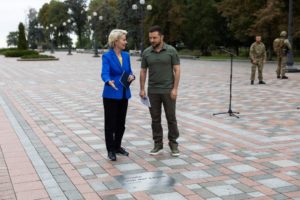
    President of Ukraine Volodymyr Zelenskyy and President of the European Commission Ursula von der Leyen took part in the unveiling of a symbolic plaque on the Walk of the Brave on Constitution Square in Kyiv dedicated to the European leader.

    “In times of war, we gather on this square not by a coincidence, as here are the names of world leaders who supported our state, our people, our economy and during this war stood by our side against the aggression of the Russian Federation. I would like the name of the honorable President of the European Commission, Ursula von der Leyen, to appear on this Walk today,” Volodymyr Zelenskyy said during the ceremonial unveiling of the plaque.

    The Ukrainian President also presented the Order of Prince Yaroslav the Wise of the 1st degree to the President of the European Commission. Ursula von der Leyen received it for significant personal merits in strengthening interstate cooperation, support of the state sovereignty and territorial integrity of Ukraine, and a significant contribution to the popularization of the Ukrainian state in the world.

    The President of the European Commission thanked Volodymyr Zelenskyy for the awards and emphasized that she was happy to be in Kyiv.

    “I sincerely thank you for the order I received today. It is a great honor for me. I accept it on behalf of millions of Europeans who support the Ukrainian people. This is a great symbol of the connection between Ukraine and the European Union,” she said.

    Since the beginning of Russia’s full-scale war against Ukraine, the European Union has stood by our country in its heroic struggle against the aggressor. The leadership of the President of the European Commission plays a key role in the broad support for Ukraine from the European Union in the defense of sovereignty, territorial integrity and common European values.

    Ursula von der Leyen personally convinces the leaders of EU member states of the need to provide Ukraine with heavy weapons and increase sanction pressure on the Russian Federation. Her dedication to the unconditional victory of Ukraine contributed to the adoption by the European Union of important decisions regarding the financial support of our country, including unprecedented macro-financial aid and recovery planning.

    She also makes significant efforts to deepen the European integration of our country and implement the key priorities of the agenda of Ukraine-EU relations.

    From now on, the name of Ursula von der Leyen on the Walk of the Brave in Kyiv will be next to the names of statesmen from Great Britain, Poland, Latvia and the Czech Republic.

  • PRESS RELEASE : President of Ukraine discussed financial and energy support for our country with the President of the European Commission [September 2022]

    PRESS RELEASE : President of Ukraine discussed financial and energy support for our country with the President of the European Commission [September 2022]

    The press release issued by the President of Ukraine on 15 September 2022.

    President of Ukraine Volodymyr Zelenskyy held a meeting with President of the European Commission Ursula von der Leyen who is on a visit to our country.

    The Head of State thanked the President of the European Commission for the visit and noted her important role in the defense and financial support of Ukraine during the war.

    Volodymyr Zelenskyy also thanked Ursula von der Leyen for her efforts on Ukraine’s acquisition of the status of a candidate for membership in the European Union.

    “Today we had a substantive conversation. It is important that Mrs. Ursula von der Leyen came to us after the annual State of the EU Report,” said the President.

    The Head of State noted that on Wednesday, during the visit of First Lady Olena Zelenska to Strasbourg, the intention of the European Union to allocate 100 million euros for the reconstruction of 74 Ukrainian schools was announced.

    “This program is big, and the destruction is big, but step by step we have to bring life back to Ukraine. And we bring it back thanks to our warriors, our people. I think that today we are very positive and motivated by the daily de-occupation of certain towns and villages. So for us, this is a big victory,” Volodymyr Zelenskyy emphasized.

    The Head of State noted that during the meeting with the President of the European Commission, the issue of energy challenges facing Ukraine and the EU was discussed.

    “We see the Russian enemy strike our CHPP and other energy infrastructure. There will be many challenges this winter, and here we all need to work together, as these are difficult challenges for both Ukraine and the European Union. We understand that we all have to help each other,” said the President.

    The Head of State noted that due to Ukraine’s accession to the common energy system of the EU, European countries will be able to receive cheap Ukrainian electricity, and our state will receive budget revenues, which will help fulfill obligations regarding the payment of salaries and pensions.

    Volodymyr Zelenskyy thanked Ursula von der Leyen for the decision of the European Commission to allocate a €5 billion tranche of financial aid from the European Union to Ukraine.

    According to the President, the parties also discussed the possibility of receiving the next tranche by the end of the current year and the preparation of macro-financial aid to Ukraine from the EU for the next year.

    In addition, the interlocutors touched upon the issue of Ukraine joining the internal market of the European Union even before acquiring full membership in the EU.

    “I am sure this will be one of our most important victories. We deserve it, and while we are still on the path to membership, we would like to join the EU internal market. This is important for us,” the Head of State said.

    Volodymyr Zelenskyy and Ursula von der Leyen discussed the continuation of pressure on Russia, in particular through the adoption of the 8th sanctions package.

    For her part, the President of the European Commission congratulated Ukraine and the Ukrainian Armed Forces on their success at the front and expressed her admiration for the bravery of the Ukrainian military.

    Ursula von der Leyen also noted that our country continues to move towards EU membership.

    “I note determination, huge progress on this path. We will support you with all our capabilities,” she emphasized.

    The President of the European Commission noted the importance of increasing the supply of Ukrainian electricity to EU countries.

    The parties also discussed the provision of macro-financial aid to Ukraine. Ursula von der Leyen said that the tranche of 5 billion euros agreed upon by the European Parliament is to be received in October, and assured that the work on support will be continued.

    Regarding sanctions, the President of the European Commission emphasized the importance of exchanging details of work in this direction between the EU and Ukraine, so that the aggressor could not circumvent the restrictions.

    In addition, the leaders discussed the issue of effective and fast recovery of Ukraine.

    “We will never be able to compensate for what you are doing, your struggle for democracy, humanity, respect for international law. But what we can do is tell you that your European friends stand with you. And we will stand with you for as long as necessary,” Ursula von der Leyen assured.

  • PRESS RELEASE : President met with representatives of think tanks of Europe and the US [September 2022]

    PRESS RELEASE : President met with representatives of think tanks of Europe and the US [September 2022]

    The press release issued by the President of Ukraine on 15 September 2022.

    President of Ukraine Volodymyr Zelenskyy held a meeting with representatives of leading think tanks of Europe and the United States of America, whose visit to our country was organized by the Polish Institute of International Affairs.

    The Head of State thanked the group of experts for visiting Kyiv during the war, which is another proof of the strong support for Ukraine from the free democratic world. The President noted that thanks to such solidarity, our country has already gained a number of important victories over the occupiers and will be able to completely liberate its territory.

    “We will win thanks to the supply of weapons, tough sanctions against the Russian aggressor. In particular, we will overcome the famine that Russia provoked by blocking Ukrainian ports. But the main thing is the unity of the civilized world. The work of experts and scientists should contribute to this,” said Volodymyr Zelenskyy.

    The Head of State emphasized the need to increase defense support of Ukraine from the partner states. Critically important in this regard is the acquisition of air defense systems.

    “Targeted shelling by the Russian aggressor of critical infrastructure facilities confirms the validity of our requests. The democratic world must provide us with the necessary defense and financial assistance. As soon as possible. This is important not only for us, but also for the world. Otherwise, all states to the west of Ukraine will be under threat. The sooner we receive such help, the sooner this war will end,” said the Head of State.

    During the meeting, there was an exchange of views regarding the package of recommendations on security guarantees for Ukraine prepared by the International Working Group under the leadership of Andriy Yermak and former NATO Secretary General Anders Fogh Rasmussen. The President emphasized that without such guarantees it is impossible to talk about a stable Europe.

    Volodymyr Zelenskyy emphasized the need to designate Russia a state – sponsor of terrorism for all the crimes it has already committed and is committing in Ukraine.

    “For us, this issue is fundamental and obvious. After Bucha, Mariupol, Vinnytsia, Olenivka. After shelling of critical infrastructure facilities,” the President said. It was noted that the situation around the Zaporizhzhia NPP is nothing more than another manifestation of nuclear terrorism by the aggressor.

    Particular attention was paid to the reconstruction of Ukraine, the creation of a compensation mechanism for the damage caused by Russian invasion, and the establishment of a special tribunal on the crime of Russian aggression.

  • PRESS RELEASE : New free schools are a popular choice for parents [September 2011]

    PRESS RELEASE : New free schools are a popular choice for parents [September 2011]

    The press release issued by the Department for Education on 5 September 2011.

    • Two thirds of schools oversubscribed for their first year
    • Demand for some schools three times more than places available

    Thousands of parents have applied to send their children to the first 24 Free Schools that are aiming to open in next month. This comes as latest analysis by the Department for Education shows that Free Schools are targeting deprivation, with half of the schools located in the 30 per cent most deprived communities.

    15 of the 24 schools are oversubscribed for their first year, with some seeing more than three applications for one school place.

    For example:

    • Moorlands School, Luton, received 420 applications for 115 places.
    • The West London Free School, Hammersmith and Fulham, received over 500 applications for 120 places.
    • Sandbach School, Cheshire, received 340 applications for 210 places.
    • St Luke’s Church of England Primary School, Camden, received 54 applications for 15 places.

    Department for Education analysis published today also shows that Free Schools are targeting deprivation. Based on Super Output Areas – the most accurate reflection of a school’s local community – the analysis finds that of the 24 Free Schools opening in the next two weeks:

    • Over a third (9 schools) are located in the 20% most deprived communities.
    • Half the schools (12 schools) are located in the 30% most deprived communities.

    The figures clearly show that the Free Schools policy has already been a success in creating schools in disadvantaged areas and where there is a need for new places. Many of the Free Schools opening this September have been set up because passionate teachers and charities want to support the very poorest pupils who live in communities where results and aspiration have been low for generations.

    Free Schools will be good, local schools funded by the Government, but have greater freedoms than local authority run schools. They are run by teachers – not local councils or Westminster politicians – and have freedom over things like the length of the school day, the curriculum, and how they spend their money. These schools are opening because of real, local demand from parents for a new or different type of education to benefit local children and their families. They will meet parents’ simple desire for good, local, state funded schools that have strong discipline and – in many cases – small class sizes.

    The teachers running the outstanding Cuckoo Hall Academy, for example, have decided to set up a Free School – Woodpecker Hall Primary Academy – so they can reach more children in a part of North London that needs good new school places, and where the number of pupils on Free Schools Meals is high.

    Patricia Sowter, executive principal of Woodpecker Hall Primary Academy, talking about her previous experience before setting up a Free School said:

    It would break my heart. I couldn’t give places to half of the children in the nursery class because of local authority admission rules. I remember one Asian family whose mother had tears in her eyes as she pleaded with me to take her daughter. I knew I had to do more to help these parents get what was best for their children. I knew these children could succeed, despite the deprivation and despite what seemed to be a mindset of low expectations at the local authority.

    Under the Coalition Government’s new plans, Free Schools will also be able to prioritise the most disadvantaged children (eligible for Free School Meals) in their school admissions arrangements. With the Pupil Premium – worth £430 per pupil this year – there will be an even greater incentive for Free Schools to attract pupils that are most in need of high-quality education.

    From initial proposal to opening, the first Free Schools will have taken between ten and 15 months to set up from submitting initial application forms. In the past, it took between three and five years to set up a maintained school, with parent-promoted schools taking up to nine years. It also took five years to open the first 50 Academies. The Government is shaving years off this to respond to the urgent demand from parents, and to drive up standards more quickly – especially for the poorest pupils.

    Schools Minister Lord Hill said:

    What parents want is the chance to send their children to a good local school with high standards. These new free schools are designed to achieve exactly that and we are committed to opening many more in the next few years.

    For too long, politicians in Westminster have assumed they know best and that more political control means better results. The opposite is true. Good schools know better than politicians how to run their own affairs and that’s why we’re confident these free schools – which give them real independence – will offer local children a great education. It’s not surprising many are oversubscribed.

    Notes to editors

    1. As of 1 September, the Free Schools that are oversubscribed this year are:
    • Aldborough E-ACT Free School, Redbridge
    • ARK Conway Primary Academy, Hammersmith & Fulham
    • Batley Grammar School, Kirklees
    • Bradford Science Academy, Bradford
    • Canary Wharf College, Tower Hamlets
    • Discovery New School, West Sussex
    • Eden Primary School, Haringey
    • Langley Hall Primary Academy, Slough
    • Maharish School, Lancashire
    • Moorlands School, Luton
    • Sandbach School, Cheshire
    • St Luke’s Church of England Primary School, Camden
    • The Free School Norwich, Norfolk
    • West London Free School, Hammersmith & Fulham
    • Woodpecker Hall Academy, Enfield
  • PRESS RELEASE : Record number of under-performing schools to become academies [September 2011]

    PRESS RELEASE : Record number of under-performing schools to become academies [September 2011]

    The press release issued by the Department for Education on 5 September 2011.

    • 1,000 new academies have opened in the last year

    More children will have the opportunity of a great education as record numbers of weak schools are turned into academies this year.

    Forty-five sponsored academies will open in September, with a further forty-nine due to open during this academic year. This is the highest ever number of new sponsored academies to open in one year.

    In addition, 185 good schools will become academies this month – on top of the 796 who have already converted. These schools can now take charge of their own affairs and enjoy the professional freedom and control that academy status brings.

    Since September 2010, 1,097 schools have become academies (116 sponsored academies, 981 converter academies), meaning that 1300 academies are now open, compared to 203 opened before the Academies Act of July 2011. This is more than a six-fold increase.

    This means that more than 40 per cent of all secondary schools are now open or in the process of opening as academies.

    As of this September:

    • there are 1,300 Academies open across the country
    • in 29 local authorities, the majority of secondary schools are academies
    • in addition to the open academies, a further 575 are in the pipeline, with more applications expected in the new school year
    • the first 12 special schools have become Academies and we are working with 25 who are interested in doing so over the next year.

    Education Secretary, Michael Gove, said today:

    Teachers, not politicians or bureaucrats, should run schools. They should be free to innovate in the classroom. That is why thousands of schools are becoming academies.

    Every child should be able to attend a good school. But we have inherited one of the most stratified and segregated education systems in the developed world.

    Thankfully, record numbers of weak schools are becoming academies this year, so we are giving more and more children opportunities that have historically been the preserve of those from wealthy backgrounds.

    Academies benefit from greater freedoms to innovate and raise standards. These include:

    • freedom from local and central government control
    • the ability to set their own pay and conditions for staff
    • freedoms around the delivery of the curriculum
    • freedom to change the lengths of terms and school days.
  • PRESS RELEASE : Lord Hill responds to The Times on free schools [August 2011]

    PRESS RELEASE : Lord Hill responds to The Times on free schools [August 2011]

    The press release issued by the Department for Education on 31 August 2011.

    Sir,

    It is disappointing that Monday’s article plays down the hard work and achievement of so many passionate teachers, parents and charities that have set up new schools to improve education for children in their area (Pupil numbers are scaled back after failure to fill places, Monday 29 August 2011).

    Contrary to the gloomy picture painted, many of the free schools opening for the first time in September report that they are oversubscribed – with some receiving four applications for one place.

    The fact that hundreds of families are putting their faith in these brand new schools – schools that do not yet have exam results or Ofsted ratings to prove their worth – is remarkable. It clearly shows that parents want a better choice of local schools – run by teachers, not bureaucrats – which offer strong discipline, excellent teaching and high standards.

    Lord Hill of Oareford CBE

    Parliamentary Under-Secretary of State for Schools


  • PRESS RELEASE : More than 160,000 disabled children now enjoy short breaks [August 2011]

    PRESS RELEASE : More than 160,000 disabled children now enjoy short breaks [August 2011]

    The press release issued by the Department for Education on 26 August 2011.

    The number of disabled children receiving short breaks more than doubled between April 2008 and March 2011, with increases in every area of the country. The findings are published today in a report by Together for Disabled Children (TDC), commissioned by the government.

    Short breaks give disabled children and their families the chance of a normal life and opportunities that other children can take for granted such as playing with their friends, learning new hobbies or going on holiday. Short breaks also give parents a well needed rest from their caring responsibilities and a chance to recharge.

    The government has now made it statutory for local authorities to provide short breaks, as of April 2011. The new regulations require local authorities to publish information to parents describing what short breaks services are on offer in their area.

    The government has committed over £800 million for local authorities to invest in short breaks between April 2011 and March 2015 through the Early Intervention Grant. This compares with £270 million which was made available between 2008 and 2011.

    The number of disabled children receiving short breaks rose from 57,383 in 2008-09 to 162,831 in 2010-11 – an increase of over 105,000 children. This has contributed to a decrease in social care interventions and a fall in the number of disabled children entering the looked after system.

    The TDC report also analysed the success of parent forums across the country between 2008 and 2011. Over 1,700 parents of disabled children are now actively involved in planning services in their area through parent forums – over three times more than in 2008.

    Children’s Minister, Sarah Teather, said:

    Disabled children and their parents rely on support and free time to have a normal family life. Weekends away, overnight care and fun activities give parents a valuable break from caring and give disabled children a chance to learn a new skill or make new friends.

    The success of the short breaks programme is clearly down to local authorities working in partnership with parents of disabled children, so that services are shaped by their needs. The families involved benefit and services are better value for money so other families get to enjoy more short breaks services.

    Short breaks provide families with early help so they can cope better in times of stress, and are less likely to need help from social care services. That’s why it’s vital that local authorities continue to invest in short breaks and make it a priority. We have backed this up with a new duty on local authorities to provide short breaks.

    We want to give parents more influence and control over local services. In our green paper on special educational needs (SEN) and disability we have set out a range of ways that parents should be involved in local decision making. Increasing parent participation means more services are being delivered that are more responsive to the needs of local disabled children.

    On short breaks the report finds that:

    • Over eight million additional hours of daytime short breaks were provided to disabled children and their families – the number of daytime hours rose from 6,079,681 hours in 2008 to 14,308,283 hours by March 2011.
    • An additional 193,000 nights of care are being provided either in the child’s own home, in hospices, holiday parks or on weekend breaks. The number of nights of care rose from 587,095 nights in 2008 to 780,827 nights by March 2011.
    • Local authorities have particularly improved activities and breaks for children with severe challenging behaviour and complex health needs.
    • Providing a range of short breaks services has led to greater satisfaction from disabled children and their parents and is more cost effective than only using expensive residential care.
    • Greater parental involvement in commissioning short breaks services has led to better value for money, and therefore more services are being delivered to more children.
    • There have been particular increases in the number of voluntary and community sector organisations, particularly small local groups, delivering services.

    Christine Lenehan, Council for Disabled Children (CDC), said:

    Short breaks are essential for families with disabled children. Caring for a disabled child can be a full time job. This often means that parents of disabled children have little time to do day-to-day tasks such as cleaning, taking a shower and sitting down to eat a meal.

    Access to regular, reliable, high quality short breaks can be life changing for families, providing time to do day-to-day activities, to rest and to build their relationships. Even more importantly, they give disabled children and young people themselves the opportunity to take part in positive activities, to build friendships and to play an active part in their communities.

    CDC warmly welcomes the increase in access to short breaks, particularly for children with the most complex needs. However, this is not the end of the story. It is crucial that the Government continues to monitor local delivery of short breaks under the Early Intervention Grant.

    The government today announced that Contact a Family, a charity providing advice and support for the parents of disabled children, has won the contract to strengthen parents’ involvement in local decision making across the country. Contact a Family will carry through the commitments in the SEN and disability green paper to give parents more control over the support their child and family needs, and to fund parent forums in every local area.

    Parent forums have been developed in almost all local authorities to help parents have a say in the range and quality of services for disabled children. This includes, for example, the supply and delivery of equipment, therapy services, and the local SEN transport policy.

    An increase in parent participation and the active involvement of parents in shaping services has resulted in:

    • Lower stress for families, helping them feel in control of their child’s wellbeing.
    • An increase in value for money services.
    • Better, more coordinated local information for families of disabled children.
    • Some parents have personally benefitted and have returned to work as a result of the confidence of being part of a group.
    • Three pilot projects in Leicester, Hull and Tower Hamlets successfully increased the number of black and ethnic minority parents by tackling barriers such as lack of information and language differences.

    Srabani Sen, Chief Executive of Contact a Family, said:

    We are delighted the government has committed to continue funding parent forums which have played a vital role in shaping services to meet the needs of families with disabled children over the last three years.

    The results speak for themselves: more and more parents’ voices are being heard, parents feel more in control and this has led to a range of improved outcomes for children, young people and their families.

    Strengthening parent participation is at the heart of Contact a Family’s work and we look forward to supporting parent carer forums to continue their excellent work.

    Local parent forums share experiences, provide peer support, and get updates on national developments via the regional parent forum networks. A National Network of Parent Carer Forums (NNPCF), established in March 2010, supports local and regional forums. This has helped ensure that parents are engaged in shaping national policy, and that their voices are heard.

    The NNPCF has worked closely with the government in formulating national policy. Specifically they are involved in the selection of green paper pathfinders that will test the single education, health and care plan and personal budgets.

    Anna Gill and Carrie Britton, co-chairs of the NNPCF, said:

    We are delighted that the government values the unique and crucial perspective that Parent Carers can bring to strategic decision making at all levels, from national commissioning and policy making through to the local allocation of scarce resources; the ongoing commitment to support the development of all Parent Carer Forums through Contact a Family will help us ensure that the voice of even more families will be heard.

    Voluntary and community sector and other organisations have been invited to bid to support local areas, including their ongoing provision of short breaks.

  • PRESS RELEASE : Nick Gibb comments on the English Baccalaureate [July 2011]

    PRESS RELEASE : Nick Gibb comments on the English Baccalaureate [July 2011]

    The press release issued by the Department for Education on 28 July 2011.

    Responding to the Education Select Committee’s report on the English Baccalaureate, Schools Minister Nick Gibb said:

    We believe very strongly that all children have the right to a broad and balanced education that includes English, maths, science, a language and a humanity.

    These academic subjects reflect the knowledge and skills young people need to progress to further study or to rewarding employment. It cannot be right that children from the poorest backgrounds are significantly less likely to have the opportunity to take GCSEs in these subjects than children from more advantaged areas. Just 8% of children eligible for Free School Meals were entered for the E-Bacc subjects next last year compared to 22% overall.

    Closing the attainment gap between children from wealthier and poorer backgrounds is a key objective of the Government and the E-Bacc measure plays an important part in helping to deliver that objective. The E-Bacc is not compulsory but it is about closing the attainment gap between rich and poor and about increasing opportunity.