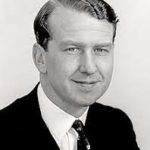
Tag: Peter Walker

  • Peter Walker – 1967 Speech on the Government’s Transport Policy

    Peter Walker – 1967 Speech on the Government’s Transport Policy

    The speech made by Peter Walker, the then Conservative MP for Worcester, in the House of Commons on 6 November 1967.

    I beg to move, at the end of the Question, to add: but humbly regret that the Gracious Speech contains proposals to nationalise further large sections of the transport industry instead of concentrating on practical measures to improve conditions for the travelling public and for industry. I am sure the House regrets that this debate is taking place under the shadow of a major railway disaster. I assure the House that any criticisms of the management or policies of British Railways are in no way connected with the railway’s safety record, which has been outstanding over the years, or the diligence with which our railwaymen apply themselves to seeing that railway travel is safe and secure.
    Last week’s by-election results are perhaps a reflection on the fact that the Government’s performance contrasts vividly with their plans. If the plans which have been published week by week, and month by month, had been fulfilled, or even started to be fulfilled, the Government’s popularity would be very much higher, but instead we have had a long series of plans contrasting vividly with performance, and this is particularly true of transport.

    An examination of the various forms of transport shows that in every sphere Government policies are hindering progress. In aviation one finds that B.E.A.’s future is in jeopardy as a result of the constant delay and indecision of the Government on replacing the present B.E.A. fleet. If one considers future developments in aviation, internal air services, the development of freight air services, and the indecision, and probably wrong decision, on matters such as Stansted, one sees aviation once again being affected by the Government. It is remarkable that this industry, which could perhaps best be quoted as an industry of the future, is completely and utterly without investment grants as a result of the Government’s policies.

    When one considers shipping, and ports and docks, one sees that only last week the Confederation of British Industry and the British Shippers’ Council gave their verdict on the Government’s policy. Their verdict is summarised in a statement issued last Wednesday or Thursday: To face the industry with an administrative revolution when it is already grappling with great changes would surely reduce operating efficiency, retard evolution, increase costs, and thus, by raising the price of exports, damage the economy. No case has been made for fundamental change now or in the future. The Minister’s proposals establish no reasoned case for a further change of ownership or control. On the railways, we see a fast increasing deficit, obviously completely out of the Minister’s control. Indeed, it was the Minister herself who said in reply to a Question on 25th January of this year, at col. 1471 that the railway deficit this year would be £130 million, but we were told in a debate in another place that the figure was now likely to be £150 million. Labour relations on the railways have never been worse than they are at the moment, and the position of top management is in complete chaos.

    One of the most fundamental needs is an improvement in the road building programme, but we see the Minister complacently going up and down the country boasting that at the moment expenditure on road building is higher than it has ever been in our history. This is a boast which every Minister of Transport has been able to make every year since 1950, but the real test of the Minister’s performance—and that of the Government—is to see how the right hon. Lady has carried out the road building programme which she inherited.

    The programme was laid down in great detail in July 1964. It proposed Government expenditure of £1,200 million on road building in the years 1965 to 1970. The party opposite said that it was an electioneering offer, and something to entice the voters. Indeed, the right hon. Member for Vauxhall (Mr. Strauss), who at that time was the shadow Minister of Transport, stated categorically in the Press and in speeches that the programme announced by the Tories for the period 1965–70 was too little and too late.

    Let us examine what has happened to the programme which the present Government described as too little and too late. We can establish the exact figures because my right hon. Friend the Member for Barnet (Mr. Maudling) published a White Paper setting out the Government’s investment programme for 1967–68. He said that in that year at 1963 prices, £470 million would be spent by the Government and local authorities on roads in this country. Adjusted to 1963 prices, it would be necessary to spend £53 million this year to fulfil the promise which hon. Gentlemen opposite described as too little and too late. This year the Government and local authorities will spend £450 million on the roads, so this year alone they will spend £81 million less than that set out in a programme which they described as too little and too late.

    The Government have stated categorically that in the period 1965–70—this information was given in reply to a Question—they will spend £1,100 million. This is £100 million less than the sum laid down in the programme which they described as too little and too late, and during this period the motorist has had an extremely bad deal. Comparing this year’s figures with those for 1964–65, one sees that this year the Government will spend £70 million more on roads, but from the owners of motor cars they will get an extra £350 million in increased petrol tax, in increased Purchase Tax, and in increased motor vehicle licences. Thus, for every £1 extra which they are spending on reads they are taking an extra £5 from the motorist. This is the Government’s record for the motorist and the roads.

    The Government’s record on the railways, in aviation, in shipping, and in the road programme is bad, and what do they offer for the future? They have put forward a programme—which received enthusiastic support at the Labour Party conference as a good Socialist one for tackling transport problems—substantially to increase the nationalisation of public transport.

    First, I turn to the proposals for passenger transport authorities. These proposals have no friends. Local authorities do not like them; industry does not like them, and the bus industry in particular does not like them. Everybody is opposed to them. The Minister says that this is not nationalisation, and describes me as illiterate for speaking of it as such. She claims that it is local ownership and not nationalisation. The only real ownership which will be given locally is the ownership of losses.

    How can the Minister claim that these P.T.A.s will have local control? Let us consider some of the features of the proposal. These authorities will be very much in the hands of the Minister of Transport. First, the Minister will designate the boundaries of the P.T.A.s, and she has specifically stated that not only will she designate them but will allow no form of public inquiry into them, and there will be no appeal from her decisions. So much for local control of the boundaries.

    Secondly, local control will consist of immediately confiscating the assets of all municipal bus companies—a very odd and peculiar way of giving local control—and doing away with local bus companies.

    Thirdly, there will be considerable investment control in the hands of the Minister. Grants will depend on her being satisfied with the way P.T.A.s are run. Then, the Minister will have nominees on the boards of the P.T.A.s. Her first suggestion was that one-third of the representatives should be appointed by the Ministry of Transport and that the chairmen should also be so appointed. We are pleased to know that as a result of considerable criticism and pressure she has reduced her demands for representation, and the chairmen will now be appointed by the P.T.A.s. But let us remember that even if, for example, her representatives consisted only of 20 per cent. of the Board, this would be 20 per cent. more than the representation on the boards which are now running local government transport. Also, if, in a public transport authority area, 60 per cent. of the authorities were Tory-controlled and 40 per cent. Labour-controlled, with the Minister’s nominees and the Labour-controlled representatives the Minister’s nominees would have a majority on the P.T.A. Under the P.T.A.s, many major boroughs will have no appeal on the question of fares or timetables.

    There is much evidence that there is no great advantage in size, in respect of bus operations; indeed, the public will vouch for the fact that the bigger the size the less efficient is the bus company, the more inferior its labour relations, and the less direct contact it has with the public.

    It is becoming more and more clear that all the local authorities in the major conurbations and elsewhere are becoming bitterly opposed to this project. The Minister will say that this is due to briefing and interference on the part of the Conservative Central Office and the leaders of Tory councils, but she should remember that last May the people of this country overwhelmingly voted Tories to their local councils, and they did not vote for them to give back into public ownership private and municipal bus companies.

    But not only Tory councils are opposed to this scheme. One of the Minister’s civil servants—a person who is particularly responsible for P.T.A.s.; a Mr. Locke—spoke to municipal operators, and if he reported accurately to the Minister he will have told her that local authorities are passionately opposed to her proposals. At the M.P.T.A. conference five Labour chairmen of local authority transport committees spoke in the debate upon the P.T.A. proposals. Every one was opposed to those proposals. Perhaps their objections were most appropriately put by Councillor Williams, chairman at St. Helens, who said: It would be a voice in the wilderness. I am second to none as a supporter of the Labour party, but this is not one of the things they ought to be doing. Another opinion—and I am sure the Minister will appreciate this, as she represents a Lancashire division—was expressed by Alderman Walsh, vice-chairman at Bolton, who said that the whole programme could only be called a load of codswallop. It is understandable that local authorities should be strongly opposed to P.T.As. First, the ratepayers will have to bear the service charges necessary to compensate for the taking over of privately owned bus companies. Secondly, they will lose their municipal assets. Thirdly, they will have to make a contribution to the deficit of passenger railway services in their areas. Fourthly, fares will increase as a result of the levelling up of wages and conditions of all those employed in bus companies which are taken into P.T.As.

    One of the proposals which will be greeted with great alarm is a clear undertaking that P.T.As. will have control over coaches and coach excursions going out of their areas. Many people travel by coach because of the cheap fares. To travel from Birmingham to London costs 34s. by coach, but £3 6s. by second-class railway fare. We can understand this Minister, for what she will describe as good transport planning, deciding that it is wrong to take this traffic from the railways and therefore placing considerable restrictions on coach services.

    Alternatives to this programme are quite clear. They are immediately to repeal some of the policies which the Government have pursued, which are directly opposed to the efficient running of our bus companies. It was this Government who took away investment allowances for buses and coaches, immediately resulting in increased fares. It is this Government who made bus companies create an interest-free overdraft for the Government, in the form of S.E.T., and it is this Government who are dragging their feet on trade union reform, which would help to bring single manning and do away with some of the overmanning which exists today.

    It is a remarkable thing that if there was one proposal which should have waited for the report of a Royal Commission it was the P.T.A. proposal, which should have waited for the report of the Royal Commission on Local Government. But the Government were determined to hasten through these proposals before the published. What a different attitude to their attitude on trade union reform. The creation of passenger transport authorities will result in considerable increases in road fares and a great loss of freedom of choice in terms of transport for the individual, and we shall oppose this proposal.

    The post-war history of the railways is that from the early 1950s, as people began to own more and more motor cars, and passengers turned from the railways to the roads, and as a great modernisation programme was required to change from steam to diesel electric, the railways ran into increasing deficits. It was then that a Conservative Government appointed Lord Beeching and a major reorganisation started to take place. The success of this was reflected in the last two years of Tory Government, when the railway deficit was reduced by £37 million. In the first three years of Labour Government it will have increased by over £30 million.

    Today we have had published a White Paper. I say that it has been published today but, like all Government documents, it was really published many weeks previously in the Press. It is remarkable that every major proposal in the White Paper appeared in The Times of 26th June. That newspaper’s transport correspondent described the proposals of the Joint Steering Group under the chairmanship of the Parliamentary Secretary. He described its conclusions in respect of subsidies for services of social importance; he described the recapitalisation of the railways and the writing off of a great deal of capital. He described in detail the proposals for reorganisation of the main board and the doing away with regional boards, and he went on to describe the special subsidies for bridges, level crossings and railway police.

    If that same correspondent wanted to summarise the Minister’s White Paper he could not do better than repeat his article of 26th June. This is a terrible reflection upon Her Majesty’s Government.

    One political correspondent suggests today that the right hon. Lady should become the next Foreign Secretary. On Press leaks, she puts Lord Chalfont completely in the shade, because every major proposal from the Ministry since she has been Minister has been leaked, in one way or another, beforehand. If these proposals were not leaked by the Ministry itself, the Ministry should have done something to give this House the White Paper, the details of which appeared in the Press in June, some time before November, a few hours before this debate. Instead, with the normal sense of priorities of this Government, the Press came first and Parliament came afterwards.

    The White Paper carries the report and recommendations of a very distinguished firm of accountants, Cooper Brothers, who have done a great deal of work, and of the steering group which contained a number of distinguished men from industry and the British Railways Board, and a distinguished professor of finance, under the chairmanship of the Parliamentary Secretary. The whole House will want to examine carefully its proposals, and we obviously have not had time to study some of the background facts and statistics; some of the figures, of course, are not available in the White Paper. But there are some questions which I should like to ask the Minister.

    First of all, she states in the White Paper, in rather strange wording; that, after consultation with British. Railways, the Government have decided to adopt the proposals. Do British Railways agree with the proposals? I know that they had representatives on the Steering Group, but it has been said that the Chairman and many of the Board disagree with the proposals. We should like to know whether this is true or whether it was purely consultation, without the Board fully supporting the proposals.

    One of the things which will dramatically affect British Railways is the Minister’s proposals for a National Freight Authority. This Steering Group contains the advice of one of the best firms of accountants in the world, with men of considerable ability who have looked in depth into the management and financial problems of British Railways. I therefore challenge the right hon. Lady to ask this same Steering Group, with all its knowledge, whether or not it is in favour of the creation of the National Freight Authority. If it is, that will give great support to her case. If it is not, it will show that her proposals are thoroughly irresponsible and against the future interests of British Railways. If the right hon. Lady declines that challenge to put that question fairly and straightly to the Steering Group, the country will realise why?

    The real problem for the railways is not the proposals in the Report, interesting though they are and correct as many probably are. It is easy to study and decide what should be done, but the test is implementing that study. Everything that has so far happened has given us absolutely no confidence in the Minister’s ability to bring this Report into being, because the essence is the attraction of top and good management. The railways today have labour relations problems, and a rising deficit, yet, for more than a week, 350,000 men employed by British Railways— an industry losing £150 million a year—have known that their chairman has been under notice to quit, but have had no idea who his replacement is to be. That is an appalling situation for any major industry.

    Also, almost every national newspaper reported that, in the middle of the most crucial negotiations with the unions, in which a major strike was a possibility, the chairman of British Railways was called out to be hold by the Minister that she was going to offer him another job. What a way to handle top management. If this did not happen, the Minister should immediately have issued a statement saying that it did not, instead of leaving this situation for a week.

    Everyone knows that the chairman has been offered another job but does not know his replacement. The vice-chairman has said that he will join a shipping company and has given notice to quit. Did the Minister tell Mr. Shirley that she would like him to go, after which he found another job, or did the reverse happen? As the Minister has constantly praised Mr. Shirley in the country for the wonderful way in which he has organised freight liner trains, why can she not provide him with the terms and conditions under which he could stay? Either he was important and successful, in which case it was her duty to see that he was kept or enticed to stay, or else he has been inefficient for some time, in which case she has been wrong to praise him all over the country. As well as the chairman and vice-chairman, Mr. Fiennes, one of the most creative thinkers of all the general managers of British Railways, has been sacked and has left the service.

    This is the position of top management in British Railways after the Minister has been in charge for a couple of years. She says in the White Paper that the real need is for stability of British Railways. What a lot of stability there is at present—an army without a general, a major industry not knowing exactly what will happen in terms of top management.

    Who will be attracted to take on the jobs of top management? What is this Minister’s record in this respect? Just look at the treatment of top management. First of all, the road construction units were created so that the county surveyors, who had been vocal critics of all Governments, would no longer have that same say. Then, Sir Alexander Samuels was removed from his position as road traffic adviser to the Minister because, as we knew, he was having a number of disagreements with her. Then, Sir Alfred Owen had views on the 70 m.p.h. speed limit and was removed from his position as chairman of the National Road Safety Advisory Council and replaced by the Parliamentary Secretary, Lord Rochdale, who was Chairman of the National Ports Council, opposed nationalisation and was in favour of developing Portbury, so he was given another job and replaced by someone from one of the nationalised boards. This is a complete record of any person who disagrees with the Minister being removed to another job.

    Who will take on the job of Chairman of British Railways, with this sort of background—[HON. MEMBERS: “George will.”]—when the Minister has already stated that the track will remain at 11,000 miles, no matter what the commercial considerations? The new chairman will immediately inherit that fixed position. She has also said that she will take away from British Railways its most expanding element, the freightliner trains, and give it to the National Freight Authority. So the new Chairman will be told. “You will have to keep the track as it is and I am taking away the best potential for the future, but, apart from that, you have every freedom and may get on with the job.” This is an impossible position for top management.

    Any top management coming into British Railways while the present Minister remains will, of course, remember her words at the Labour Party conference. When pressed to set up various organisations, she said: No, friends, when it comes to transport planning, I have got to be the overall authority. The real trouble is that any person working under this Minister knows that he will always be subject to considerable political interference.

    The other proposal which will be in the Government’s Bill, the National Freight Authority itself, also has no friends and no supporters in industry. No one in the railways supports it, either. There has been no pronouncement from the Railways Board or from the railway unions saying that it wants such an authority. Sir Donald Stokes, who would not be quoted as an enemy of the present Government, has made his position clear. He said: If we are going to have restrictions for Socialist doctrinaire reasons, it is absolutely crazy. He went on: … if they are going to restrict road transport, it is still worse, because in Great Britain we need above all a competitive transport system. This is the biggest machine tool of industry. Sir Donald Stokes has clearly stated his view, and so has the C.B.I.

    The proposal for a national freight authority is a proposal to allow the nationalised industries to take over a large section of the road haulage industry without compensation. Seventy thousand vehicles will be subject to new tribunals. How many bureaucrats will be employed on those tribunals? What sort of people will decide, and what criteria will those people use?

    The Minister has stated that licences will be taken away or refused only if it can be shown that the railways are faster, less expensive and more reliable. Those are the three criteria. Will all three have to apply or will it be a matter of balance? Who will judge the speed of British Rail? Will British Rail have to prepare a time-table? A lot of tribunals would not take much note of that. Who will decide whether the reliability will be better or worse? Is this to be based on promises? Who is to decide on cost in its relationship with time?

    We on this side of the House have made our position quite clear. We believe that the best people to decide how best to send their goods are the customers themselves, and not some bureaucratic tribunal trying to decide for them. The position is that £150 million worth of assets belonging to private road hauliers are in jeopardy without any form of compensation.

    Let us just look at the handicap which the Government have put on those in the road haulage industry before they start: three increase in fuel tax, graduated pension contributions up, National Insurance contributions up, Selective Employment Tax, postage and telephone costs up, industrial training 1.6 per cent. up, road vehicles licences increased by 50 per cent. and investment allowances on road haulage vehicles completely taken away by this Government. The Minister has said that the N.F.A. would give the road haulage industry a good run for its money, and so I should think, with the handicap put on the road haulage industry before ever it starts.

    In every sphere of transport the performance is bad, and instead of the Government offering remedies for these performances they are embarking on a programme of public ownership of all our ports and docks, considerable ownership of the bus industry, interferences in the ancillary services such as taxis and coaches, and a considerable extension of the public section of long distance road haulage. We on this side believe that this will make no contribution to efficiency. It is yet another attack on free enterprise by a Government that by now should realise that they are doing great harm to the country by their constant attacks on free enterprise, and that they will bring about a considerable worsening, and not an improvement, of the nation’s transport system.

  • Peter Walker – 1967 Speech on the Transport Bill

    Peter Walker – 1967 Speech on the Transport Bill

    The speech made by Peter Walker, the then Shadow Minister for Transport, in the House of Commons on 20 December 1967.

    I must, first, comment on the right hon. Lady’s opening remark, that she wished that we had had two days to debate this Bill, but that it was the fault of the Opposition that we had not. It is remarkable that the Government should now consider that the Opposition should give some of its limited time for a Bill introduced by the Government. It is particularly unreasonable of the right hon. Lady when she knows full well that what she has done with this Bill is to put under one title eight Bills in an attempt to steamroller the whole lot through the House—[Interruption.] The right hon. Lady laughs at this, but she knows quite well, for example, that this Bill is three and a half times as long as the Steel Bill, which got into Committee at the beginning of November, and is 80 per cent. bigger than the Transport Bill of 1962, which went into Committee two months earlier and received the Royal Assent on 1st August.

    Therefore, it is perfectly clear that the Minister is trying to push on to Parliament a Bill which it will not have sufficient time properly to debate and amend. The reason is quite obvious to anyone who examines the Bill, when he realises its effect, the enormous extension of public ownership and increase in public expenditure which is involved.

    This is an outrageous Bill to introduce within a few weeks of having had to devalue. Within two days of the Prime Minister telling the House from that Despatch Box that this Government would make a determined review of public expenditure, they introduce a Bill which, in terms of capital write-offs, fresh loans to nationalised industries and new grants, adds up to a total bill of £1,900 million. This is the action of a Government who are trying to give the impression abroad that they are serious about public expenditure.

    When one considers the difficulties of properly amending the Bill, one can obviously examine only its major facets. It would be irresponsible of me to comment on all the various parts of the Bill, because there will be a limited time for hon. Members on both sides to discuss them. But very little in the Bill is concerned with the real problems of transport—the provision of proper management and planning. What really obsesses the right hon. Lady is not management or planning but ownership. All through the Bill there is the one theme of extending the public sector as quickly as possible.

    First, let us consider the proposals for railway reorganisation. This Minister’s record over the railways does not give us much confidence in their future so long as she remains Minister of Transport. Since she has been Minister, the railway deficit has soared. Indeed, only eight months ago the right hon. Lady was predicting in the House what this year’s deficit would be, and already she has been proved more than £20 million wrong. Was that the Tory policy? Did she not know the conditions in which she was operating? In fact, since Labour came into office, the deficit has gone up by more than £30 million.

    Not only that, but everyone knows that labour relations on the railways have never been worse than in recent months as a result of the right hon. Lady. They also know that the morale of top management has never been lower. What a remarkable sense of proportion the right hon. Lady shows when she can at the same time write off more than £1,250 million-worth of capital and yet refuse to pay the Chairman more than £12,500 a year. This is a remarkable sense of proportion which the right hon. Lady has of the Chairman of British Railways, who anyway was her second choice. She wanted Mr. Peter Parker first, and from her answer this afternoon it is clear that a considerable number of other people were approached to see if they were interested in the job and, if they were asked, whether they would accept. It is no use her saying that, only Mr. Parker was asked, because others were approached, as she well knows.

    At present, therefore, British Railways is making a deficit this year of more than £150 million, with considerable labour troubles and great difficulties; yet for six weeks the right hon. Lady allowed the newspapers every day to be full of speculation about who the Chairman would be and whether Mr. Parker would accept or get the salary which he wanted. What support is there for the new Chairman when he has to say at his first Press conference, “Yes, I was the second choice; the Minister really wanted Mr. Parker, but he was unwilling to agree to the salary conditions”.

    Mr. Raphael Tuck (Watford)

    Is this in the Bill?

    Mr. Walker

    The hon. Member may not like it, but this affects the Bill in as much as this Minister will be administering it and I am trying to prove that she has shown herself completely incompetent at handling British Railways.

    How are the Government tackling the problem of the railway deficit? Not by improving management and by trying to recruit the right management at the right salaries. The Government are tackling the deficit by a series of accounting procedures to put the deficit elsewhere on the taxpayer. In fact, the taxpayer will still pay for the railways, but instead of it being called a railway deficit it will be called part of the national debt or a Government subsidy to the railways, or a tapering-off grant or part of the grant to the National Freight Authority, or a precept on the roads to the P.T.A. If the Minister were able to say in five years’ time that the railways were no longer incurring a deficit, in fact it would mean that she was probably losing on the railways about £20 million more than when Labour came to power in 1964, if we added all the costs of the various accounting procedures that fell under those headings. It will all be disguised under different headings. Is that the way to make management face the realities of its task? There is no pressure for better management and no question of better salaries to attract the best management.

    Next we have the concept of a subsidy. The right hon. Lady says, “Look at the way in which Conservative Members complain about the closure of railway lines”. As she knows, during her period of office she will be responsible for more closures than those for which we were responsible. She knows that the closures which have taken place and which she will allow to take place—several thousands of miles of closures—were and are needed and were and are sensible. But she also knows that once she gets into a subsidy position the pressures will start building up. Every time it is suggested that fares should be raised the areas concerned will ask, “Why cannot we have the service on the subsidy basis which the Government are operating in other areas in order to keep lines open? Why do we have to pay higher fares?”

    I turn to the P.T.A. concept. Putting the railways on a cost-plus contract is not the way to get the best management. The Minister’s proposals show no indication at all that she will attract the right management to the railways. She will take the biggest asset—the freight liner trains—from them. She says that her proposals for quantity licensing will reinforce the sales drive of British Railways. What she means is that it will be a substitute for any sales drive which is in existence. Instead of British Railways achieving their marketing by management skills, they are to achieve it in future by Ministerial direction.

    What of her statement about 11,000 route-miles? She knows that I have always made my position clear about it. It is nonsense, and she must know it to be nonsense, to say that in a railway system we are fixed to a rigid 11,000 route-miles. Patterns will change, and demands and needs will change. The only reason that the right hon. Lady chose the figure of 11,000 route-miles is that in the lifetime of this Government it is unlikely that it will ever fall below that figure—and when it reaches that figure it will, quite rightly, be reviewed in the light of existing demand. That figure is a piece of propaganda to give a false impression.

    There is no indication that the right hon. Lady has any intention of tackling the problem of over-manning on British Railways. She knows that it exists. She announced the winding up of the Joint Steering Group. I dare her to publish the report of Cooper Bros, which was given to the Joint Steering Group. I dare her to refer two questions to the Group. I challenge her to ask them, before she winds up the Group, whether the members are in favour of the National Freight Authority as a concept. Let us get them to answer that question one by one. Let her also ask them what they estimate could be the reduction in the manpower force of British Railways if sensible managerial techniques were adopted. Let her publish that figure. But neither of those answers will ever be given by the Government.

    It is impossible to talk about subsidies until British Railways are working efficiently under good management and with the proper labour force that is required. Every estimate which has been given by the experts who know the problems recognises that there is considerable overmanning on British Railways. I am the first to appreciate that if it is tackled it will create a social problem, and I should be the first to support every possible aid being given in terms of retraining and redundancy payments. But it is a nonsense for railwaymen to continue with an inflated labour force, because that will never get British Railways on a proper managerial basis.

    I turn to the National Freight Authority. I said that it had no friends, and the right hon. Lady quoted in reply Professor Day in the Observer. I have the greatest respect for Professor Day’s views, but I do not think it is surprising that an Observer commentator should be friendly to some of the right hon. Lady’s views—particularly Professor Day, who is on one of the Government’s Transport Planning Councils and, I believe, is Chairman of it.

    Mrs. Castle

    Of which Council?

    Mr. Walker

    The South-East Planning Council. I understand that he is Chairman of the Transport Consultative Council. If not, I apologise, but I believe that he is.

    The Joint Parliamentary Secretary to the Ministry of Transport (Mr. John Morris)

    Is the hon. Member suggesting that Professor Day’s judgment is altered in any way because of some office that he holds?

    Mr. Walker

    Not a bit of it. If I have given that impression, I completely withdraw it. I respect Professor Day, although I disagree with him in many of his views. But I respect him as a distinguished man and, I am sure, as an academic of integrity.

    The right hon. Lady also quoted the Economist. I do not know whether it affects his views, but the Minister no doubt knows that the transport correspondent of the Economist was at the last election Labour candidate at Folkestone and at present is Chairman of the Soho Labour Party. I am told that the Soho Labour Party is one of the few remaining branches.

    The Minister was unable to quote any friend apart from that. Industry does not support the Authority. There is no vocal support for it from the National Union of Railwaymen. [HON. MEMBERS: “Oh.”] They have certainly not said so; indeed, a. their conference they were very critical of it.

    Mr. Ron Lewis (Carlisle)

    The N.U.R. support the main provisions of the Bill.

    Mr. Walker

    I am talking about the National Freight Authority.

    What is wrong with the Authority? It does not integrate road and rail. It integrates nationalised rail with nationalised road and, by so doing, it positively avoids a proper integration with all the free-enterprise road services. This is where the Minister has allowed her critical prejudices to affect her judgment. During our last debate, she accused me of wanting British Railways to be an iron bridge to be used by the free enterprise hauliers whenever it was economic for them to do so. That is exactly what I want them to do, and it is a great pity that the Minister did not try to get this form of integration. Her policy is by handicapping road haulage to shift freight to rail, not by increasing the efficiency of rail but by further handicapping road haulage.

    The Minister is well aware of the previous handicaps, for she has approved them all. They include three increases in the price of fuel, a 50 per cent. increase in vehicle licence fees, the effect of S.E.T. and the abolition of investment allowances on all commercial vehicles. In their Report last week, the National Board for Prices and Incomes pointed out that in three years the imposed charges on road haulage had put up their costs by 7s. in the £.

    The Bill introduces two new handicaps in case the other handicaps have not been enough. The first is the new tax, and the second is quantity licensing. Estimates of the new tax vary between £30 million and £40 million as to the total effect. And what a way to announce the new tax—to say, “We are doing this for reasons which we cannot yet publish”. What a disgrace to the Minister that before the Second Reading of the Bill she has not published the Report on which she bases this tax. The whole argument is based on a Report which has been in her hands for some weeks, but which she has not made available to the House before Second Reading. One of the reasons for her failure to do so is that if the findings of the Report supported a £40 million tax, they would be more than questionable. Total expenditure on road construction and maintenance in this country, including expenditure by local authorities, was last year about £450 million. We know that from motor vehicle taxation of one sort or another the Government obtain almost three times that amount. Therefore there can be very little justification for such a drastic tax, which amounts to £15 a mile for some abnormal loads.

    Consider the adverse effects this new tax will have, not to speak of the complacent way in which the Minister swept aside the adverse effects of it on our exports. “This will put up transport costs by only a few per cent.”, she said. The Government should be concerned about any increase in export costs, particularly at this time. After all, two-thirds of our exports go to the ports by road, and that is bound to be affected by this new imposition.

    Then consider the development areas, especially Scotland. The Parliamentary Secretary spent most of Question Time today arguing that there was no case for Scotland and the development areas complaining about this proposal, because these lorries were wearing out the roads in Scotland just as they were all over the country; they were causing congestion and, therefore, the tax should apply in Scotland in exactly the same way as south of the Border.

    This and former Governments have encouraged firms to go to the development areas. They have offered them aid, grants and subsidies. To add a tremendous tax on their communications—which is what this is; let it be remembered that some of the industries that will be most hard hit will be the heavy industries, which are situated primarily in the development regions—is ridiculous.

    One of the largest projects in Scotland in the post-war period has been the establishment of big paper mills. I have seen a telegram saying that this Bill will do tremendous damage to that industry and to its future prospects in Scotland. The same can be said of the building industry. The Government have said that they are in favour of encouraging industrialised forms of building, but that will be adversely affected by the new tax since many of the components used in this form of building comprise abnormal loads.

    So we have the paper industry, timber, agriculture, coal, local authorities and many other interests being adversely affected by these measures. Local authorities will be greatly affected because their vehicles will have to bear the appropriate increase which will have to be passed on to the ratepayers.

    As if this tax were not enough, we have the quantity licensing system. The way in which the Minister defended this—as a great simplification and a dash for freedom—was amazing. We understand that 100,000 vehicles will be subjected to this form of licensing. That will apply if they wish to travel over 100 miles. For bulk carriers, if they wish to travel any distance at all—I refer to vehicles of 5 tons unladen weight or 16 tons gross—they will have to apply for special authorisation.

    Did the Minister consider the effect of this on the motor industry? Did anyone tell her that, for example, Leylands and some other great companies have invested large sums of money to develop the articulated vehicle, which is becoming the most popular vehicle throughout Europe? Did anyone tell her that the result of her licensing system will be that whereas today firms may use the articulated vehicle of 30 tons gross—a flexible vehicle which is more manoeuvrable than the rigid type; and is 25 per cent. more efficient carrying loads—the hauliers concerned, instead of using the 30-ton articulated vehicle, which is made by British firms, will go in for two 16-ton vehicles and so completely avoid these licensing procedures? This means that instead of having one 30-ton vehicle on our roads we shall have two 16-ton vehicles. What a wonderful contribution to halting congestion! These are come of the direct results of the Minister’s interference with the proper mechanism of the development of the road vehicle.

    Then consider the unique Socialist system which the Minister has thought up for other vehicles. If one wants to travel over 100 miles one must send to the licensing authority the details of the vehicle, the details of the goods and the place to which they are being sent. When the licensing authority has received those facts it will send copies of them to British Rail and the National Freight Authority. Those two organisations will then have 14 days in which to object. The basis of their objection will be that, in terms of speed, reliability and cost, they are as good as the private haulier and that therefore they should carry the load.

    Who will decide how the matter should be discussed? The answer is that those authorities will not be left to judge these matters for themselves. The Minister will make Regulations on how they must be judged—and we know what those Regulations are likely to be. And if by chance at the end of this procedure they are in doubt, the Minister has laid it down that the benefit of doubt must go to the National Freight Authority and the railways. It is a remarkable thing to have in legislation in this country that, if there is a dispute between an enterprise, an individual and the State, the benefit of doubt must go to the State in all cases.

    I accept that the individuals concerned will have a right of appeal. They will be able to go to the Transport Tribunal. The chairman will have a background of transport or commerce and members of the Tribunal must have knowledge of finance or economics. They will decide, and any person may be made to attend. If he does not attend he may be fined £25 for non-attendance. What a monstrous licensing system to impose. It is completely unnecessary.

    Who are the friends of this proposal? Has the Minister heard of anyone who is prepared to support it? Certainly industry does not support it. Indeed, industry generally has come out violently against it. Agriculture is violently against it, and so are drivers throughout the country. The motor industry is strongly opposed to it, and, most of all, the customer is strongly opposed to it.

    The customer is opposed to it, because his choice will be taken from him. Even if the management of our railways was so deficient that it was unable to market its goods and was unable to bring to the attention of potential customers its services—even if that were so, we would object; steps would have to be taken to improve its management—the Minister could adopt the Dutch system whereby the services which the railways can provide must be brought to the attention of potential customers. My hon. Friends and I believe that these proposals are dangerous and that their object is to create State management on the long distance side.

    Consider the dangers of direct action. Only a few weeks ago we were faced with a possible go-slow on the railways. British Railways contacted private hauliers throughout the country, asking them to stand by and, if required, to make the necessary arrangements. When the Minister has had her way and when there is one National Freight Authority, there will be no alternative. There will be no free enterprise hauliers for her to contact to make these stand-by arrangements.

    We are left with the higher costs that this will bring about, the loss of choice to the customer and an enormous extension of public ownership. The House should make no mistake about realising that this is an extension of public ownership, for in the Bill the Minister—the right hon. Lady did not mention this—has made provision for the borrowing powers worth £300 million for the National Freight Authority. Will that sum be used for acquiring road haulage firms? Certainly the Minister has always been an advocate of an authority which would be able to acquire on a large scale. British taxpayers are being asked in this Measure, a few weeks after devaluation, to find £300 million for a buying spree by the right hon. Lady to extend nationalisation still further.

    We have the other nationalisation proposal which the Minister has already achieved in the Transport Holding Company. It has already made a bid—we are told a successful one—for the bus companies of the B.E.T. It was a good way of making a bid. One publishes a White Paper saying that the bus companies will be taken over by compulsory purchase—[Interruption.] One says that the routes can be taken over by compulsory purchase, and then the Transport Holding Company says, in effect, “Why wait for it to be done in this way? Sell out now”—and the bid is successful. However, the matter must come before Parliament and, although the Minister is loath to provide time for a Parliamentary debate, my hon. Friends and I will certainly need at least a day in which to debate that issue.

    The £35 million to be paid for that exercise is all part of the P.T.A. concept, with the Minister saying that this is a shot in the arm for local government. I suggest that it is a shot at local government. The Minister knows—whatever references she might make to the G.L.C. —that Mr Desmond Plummer will be violently opposed to a P.T.A. for London—[Interruption.] He has made it clear that he would be. The right hon. Lady must not say that Mr. Plummer will in any way support her idea. As a result of conversations that I have had with him, I assure the House that the one thing that he wants to avoid is the Government imposing a P.T.A. on London, and I am delighted that he is succeeding.

    The Minister knows the views of the local authorities. The Municipal Passenger Transport Association left no doubt at its annual conference about how strongly opposed it was to this idea. The A.M.C. in its last report stated categorically its view that any P.T.A.—bus companies and transport—should be operated only after local government reform. The A.M.C. has made its position quite clear there. What will the Minister do if she finds that wherever she wishes to impose this scheme the local authority is opposed to it? Will she then say that it is a wonderful shot in the arm for local government, in spite of the fact that none of the authorities concerned wants it? Or will she consider why they do not want it?

    The reasons why the local authorities do not want it are obvious. First, fares will be substantially increased—and the right hon. Lady knows it. She may say: “The hon. Member for Worcester says that fares will be increased, but look at the capital grant I shall give”, but she knows full well that in Manchester, for example—and if she does not know this it is very remiss of her—the members of the Transport and General Workers’ Union have already said to their negotiators, “We must negotiate not only to see that when the P.T.A. is formed our members get the best wages currently being paid by any bus companies and the best conditions currently being provided by any bus company, but we must also ask for more. The Minister is boasting that these authorities are more efficient, so we, the workers, should have more of the benefit of the extra efficiency they will create.” The Minister knows, and she must be very worried about it, that there will be an enormous increase in fares as a result of this levelling-up process in wages and conditions—and further demands beyond that.

    If the right hon. Lady wants examples of where this has happened she need only look at two P.T.A.S abroad—one in Ulster and one in Massachusetts. The P.T.A. in Massachusetts, almost identical in principle to that proposed by the right hon. Lady, is now the subject of study by a Senate Committee because it is doing so badly. It is making a loss of £10 million a year, and is having to increase fares by 100 per cent.

    What of the precept on the rates? None of the local authorities wants to meet the railway deficit in its area. That is quite reasonable. Local authorities do not want to meet that deficit from the rates because they will have no influence on how efficiently or inefficiently the railways are being run.

    What about planning? The right hon. Lady’s great boast is that this is connected with planning, but how does she argue that? A county borough that now has planning powers will have only one member on the P.T.A. A city like Worcester, a county borough, will have one member on a P.T.A. in Birmingham, dominated by members from British Transport or the Birmingham conurbation. How will that link up with the planning demands of the county borough of Worcester? The same could be said of other local authorities. They remain independent for planning, but are joined for transport.

    Above all, there is the domination from Whitehall. The Minister may well look to the heavens, because no Bill has ever been put forward which gave more power to a Minister over local authority affairs than does this Bill. Let me list the powers, and if the Minister wants to deny any of them, I will gladly give way to her.

    First, the Minister will designate the areas in which the P.T.A.s will operate, and local authorities will have no right to a public inquiry. That is unlike the 1947 Act. Local authorities will not be able to go to public inquiry and in any way refute the boundaries drawn by the Minister.

    Second, the Minister will have the power to approve or disapprove the chairman of a P.T.A. Third, the Minister will have the power to fix the salary of the chairman. Fourth, the Minister will have complete power over the authorities’ capital expenditure. The right hon. Lady listed this as one of the powers she would not have, but if she looks at her own Bill she will know that that is untrue. The Bill categorically states that at any time the Minister can have the capital expenditure of P.T.A.s reduced, and the authorities must obey her directive on how it shall be reduced. There is no power there for local authorities.

    Fifth, the Minister will have power to authorise or refuse the compulsory purchase of land by the authority. Sixth, the extent of the power to precept on the rates will be completely with the Minister. By Clause 13, the Minister is able to reduce the amount to be precepted on the rates. If the Minister is able to do that, she is able to influence the level of fares. Seventh, the Minister will lay down the form in which the accounts of an authority will be prepared, and will lay down the particulars they shall contain and the manner in which they will be compiled. All these are the powers of the Minister, who has just stood at the Dispatch Box and said the local authorities will have wonderful control over the P.T.A.s.

    Let us go on—there are many more powers. About Clause 16, the Minister will take power to direct the P.T.A.s on how they will conduct the business of their subsidiaries. She will also have the power to direct the executives to discontinue the activities of their subsidiaries. No capital grants will be provided to the PT.A.s as of right, but only at the discretion of the Minister.

    No investment grants for buses will be provided as of right—discretion there lies with the Minister. The right hon. Lady talked of investment allowances, but under that system every bus proprietor, municipal or otherwise, had the certain knowledge that he would get the investment allowance. The Minister knows that when the Government replaced investment allowances with investment grants, she and all her Parliamentary Secretaries went into the Division Lobby to do away with the investment allowances for buses, and then voted for a Bill on investment grants that provided no investment grants for buses. So even her last minute repentance on investment grants for buses, though pleasant, is rather sad, because it was not until the Minister had bought up the biggest private operator that she decided to give the bus operators the grant they deserve.

    The Minister will be the sole arbitrator on arrangements between the P.T.A.s and British Railways. The Minister decides any dispute between the two bodies. A P.T.A. will be unable to transfer any part of its undertaking or property to a private operator without the permission of the Minister—not the permission of the local authority. No money can be raised by local authorities for the purpose of P.T.A.s without the approval of the Minister. The Minister will have complete power over what property and which employees of the local authority undertakings are transferred to the P.T.A.

    Finally, just in case the Minister’s powers are not complete, in the provision for the Minister making Orders setting up the P.T.A.S., the following words are added: Any order … may contain such supplementary, incidental and consequential provision as the Minister thinks necessary or expedient. … It is nonsense for the Minister to maintain that this is in any way local authority control. It is control from Whitehall. Whereas local authorities have previously been able to run their own bus services or make their own contracts with private enterprise operators, in future all the direction and power remain with the Minister and her representatives on the P.T.A.S.

    It is not just the bus companies that are referred to. We have many other nationalised proposals. As to nationalisation, I say that Clause 45 should have been a Bill on its own—and the Minister knows it. But if it had been a Bill on its own instead of being just Clause 45 of this Bill, it would have been the most controversial nationalisation Measure in British history. It would have been a Bill of 22 or 24 Clauses, and it would have been debated throughout the country as a mammoth nationalisation Measure. In fact, the famous Clause IV of the Labour Party has been put completely into the present Clause 45. That will please hon. Members opposite below the gangway and, I believe, depress the rest of the country.

    Let us look at the powers given by Clause 45 to each of the authorities concerned—British Railways, Inland Waterways, National Freight Corporation, and the rest. Subsection (2) states: Each of the authorities to whom this section applies shall have power… to manufacture for sale to outside persons and to repair for outside persons, anything which the authority consider can advantageously be so manufactured or, as the case may be, repaired by the authority by reason of the fact that the authority or a subsidiary of theirs have materials or facilities for, or skill in, the manufacture or repair of that thing in connection with some existing activity of that authority or subsidiary … Hon. Members opposite cheer, but let them notice that the word is “advantageously.” The word is not “profitably” or “efficiently,” but “advantageously”—in the Minister’s view. In the Minister’s view, anything is advantageous which destroys free enterprise. We know that that is exactly how the Clause will be operated.

    It continues to provide that the authorities shall have power— (b) to sell to outside persons, and for that purpose to purchase, anything which is of a kind which the authority or a subsidiary of theirs purchase in the course of some existing activity of that authority or subsidiary”. So these authorities will be able to go into the retailing business for all the commodities they buy as authorities. The Bill goes on to provide specifically for the sale of accessories for motor vehicles and for the provision of car parks by these authorities. It deletes powers not yet given to this nationalised industry.

    I wonder whether the Minister mentioned to the cabin cruiser manufacturer, who, she said, was so delighted about her inland waterways provisions, that under Clause 45 in future the Inland Waterways Board will be allowed to make cabin cruisers. I wonder whether he was particularly pleased with that piece of news.

    The authorities will have power to manufacture road vehicles, bodies or chassis for road vehicles or major components of road vehicles”. These powers will all be given to the nationalised industries in future. The Bill gives powers as to garages, motor accessories, repair shops and shipbuilding. The Clause provides the Government with the possibility of the largest extension of nationalisation in British history without ever again having to come to the House of Commons for legislation to do it. I defy any hon. Member to name one industry or one form of manufacturing or retailing that the Government cannot enter into as a result of Clause 45. The taxpayers’ money will be used in all the acquisitions necessary.

    In total the Minister has £550 million, which she will take from the taxpayers, in borrowing powers to speed up her acquisitions as a result of the powers to be conferred by the Bill. This is the policy of a Government who are reviewing all forms of public expenditure and who are endeavouring to say that we want to improve our export position. In the whole of the Bill no consideration is given for the consumer. Fares will rise. Freight costs will rise. Choice is lost between one company and another. The economy is not considered. Public expenditure, higher costs of exports, extension of public ownership—these are the great themes of the Bill.

    I do not condemn the right hon. Lady for this. She has always been a Left-Wing, extreme Socialist. Those who I do blame strongly are the Prime Minister and the new Chancellor of the Exchequer for allowing this piece of legislation to come forward at this particular time. There is nothing in the Bill which will improve confidence in Britain. What the Bill proves beyond doubt is that the Government do not intend to use devaluation as a means of changing their course. They do not mean to use it to show that they have learned their lesson from the failure of the last three years. They intend to use it to go even further with their wrong-minded and Left-wing Socialist schemes. I believe that it is an immense criticism of the new Chancellor of the Exchequer and of the Prime Minister that the major piece of legislation in this Session of Parliament following devaluation should be a Bill that puts up the cost of transport and which goes in for a savage extension of public ownership.

    There is obviously to be an attempt to steam-roller the Bill through. We shall certainly see that in the time which is given to us every bad proposal—and, my word, there are many—is exposed and debated. We shall unfortunately have to show that the Government have shown by introducing the Bill that they have no intention of pursuing policies which will stimulate the sector of our economy most necessary for our exports, namely, the free enterprise sector. Indeed, the Bill illustrates that it is the Government’s intention to use the loans from abroad and the effects of devaluation to intensify their pace towards destroying a free economy. The Bill will cost Britain dearly, but the one advantage that it will have is that in the months in which it will be debated, both in Parliament and throughout the country, it will illustrate more clearly than ever the desperate need for this Government to go.

  • Peter Walker – 1974 Speech on Industry and Energy

    Below is the text of the speech made by Peter Walker, the then Conservative MP for Worcester, in the House of Commons on 13 March 1974.

    I congratulate the Minister, first, on being returned to the House of Commons in what was considered to be a marginal constituency against a diversity of opponents and, secondly, on taking up his new and important Cabinet office. It is said that when Winston Churchill returned to the Admiralty a message was immediately radioed to the Fleet “Winston is back”. Unfortunately, two-thirds of what would have been the right hon. Gentleman’s fleet sailed off to other commands the moment he returned. I am not certain whether that was at their request or at the instigation of the Prime Minister. One thing is certain: it was not at the suggestion of the Secretary of State for Industry.

    It is surprising that such a change should have taken place with no comment yesterday by the Prime Minister and no comment today by the Secretary of State for Industry. When in the past considerable changes have taken place in the construction of Whitehall there has been in-depth discussion with the Civil Service and sometimes White Papers have been published. The fragmentation of the former Department of Trade and ​ Industry in this way without discussion and without consultation will result in some considerable disadvantages to the Government.

    I bring this to the Government’s attention in the hope that they will be able to overcome the harm which fragmentation will do to the regional set-up of the Department. During the last two or three years there has been a considerable strengthening in the quality and grade of staff at the regional offices, and this has had a considerable impact upon the development of industry in the regions. In the regional offices there is a combination of staff capable of applying the various facets of the Industry Act, who can look after the export potentialities of the region and the industrial development certificate policy and positively encourage small businesses. To weaken those regional offices by splitting them up between three Departments will prove to be a considerable disadvantage.

    As Secretary of State for Industry the right hon. Gentleman will find grave disadvantage in not having in his Department information about the export and import substitution potential that automatically comes from the trade side of Government. There were many instances where we applied the Industry Act on the basis of information that we had from the trade side of the Department. That will no longer be available to the right hon. Gentleman.

    Likewise, in the development of major industrial investment programmes, it was of tremendous advantage in the Department of Trade and Industry—for example, when we embarked upon the steel modernisation programme—to call in the steel plant managers and link them with the international potentialities of exporting steel plants on the back of a healthy domestic demand. That type of linkage between domestic demand in industry, for which the right hon. Gentleman will have responsibility, and export potential will be severely handicapped by the new structure.

    The right hon. Gentleman has mentioned monopolies and mergers and the importance of having a positive policy to pursue the proposals that he has in mind. I presume that monopolies and mergers are no longer his responsibility ​ as they have been moved to the new Secretary of State for Prices and Consumer Protection. In the old Department consumer aspects were looked into by the Minister responsible for consumer affairs; likewise, industrial policies and rationalisation aspects were very much concerned with the industry part of the Department. To have monopolies and mergers firmly with the consumer affairs side of government and not in the right hon. Gentleman’s hands will prove a considerable disadvantage.

    Another remarkable break-up has taken place as a result of the move without any form of consultation or national dialogue. The right hon. Gentleman will be responsible for the aircraft industry and the Secretary of State for Trade will be responsible for civil aviation. I am sure that the aircraft industry will be quick to tell him that its most important consideration is the procurement programme from the civil aviation side of what used to be the Department of Trade and Industry. Here again is an important break which will prove to the disadvantage of the future development of our economy.

    The right hon. Gentleman has said very little about inward investment. I think he will be advised by his right hon. Friend the Member for Manchester, Central (Mr. Lever) that one of the most important aspects of any Government policy over the next few years will be the encouragement of inward investment into this country. The right hon. Gentleman has no international presence in his new post. To have no international presence at a time when we want to encourage inward investment will be a grave and serious disadvantage.

    I turn now to the Government’s outward investment policies. There may come a time when the Secretary of State for Industry should be actively engaged in encouraging outward investment from this country. The right hon. Gentleman’s new Department will not have the strength to carry out that function.

    Mr. George Cunningham (Islington, South and Finsbury)

    Does the right hon. Gentleman agree that the outgoing Government intended that there should be large foreign investment in the energy industry in this country and yet decided ​ to hive off the energy side from the Department of Trade and Industry?

    Mr. Walker

    I know of no decision to have large outside investment in the energy industry in this country. It was not the policy of the then Government.

    On all these aspects there is no doubt that seemingly this decision was taken not on the basis of any logic about Whitehall or any improvement in the efficiency of developing commercial strategy, but on the basis of trying to find separate Cabinet posts for three Ministers.

    I welcome the Prime Minister’s approach in 1974 as opposed to the approach that he made on forming a Government in 1964. We do not know whether this new approach is due to the size of his minority or to the lessons that he learned from the experiences of 1964. It is interesting to note that in 1964 his first task was to maximise the importance of the £800 million deficit, and, having got this out of perspective, his actions in increasing consumer demand soon shattered confidence abroad. He has not made that mistake on this occasion. Yesterday he recited how stagnation, the rising unemployment that took place in the regions during the period of the last Labour Government and the lack of achieving the social service success that he endeavoured to obtain was the price that he paid for the manner in which he handled the situation then.

    The Prime Minister was right to emphasise the record export order books of British industry at this time. I am pleased that the Secretary of State for Industry today followed the Prime Minister’s example by correctly emphasising the potential opportunities that now exist instead of emphasising that the size and magnitude of the deficit on trade which faces the country has to be met by massive deflationary policies.

    Now that the Government recognise the true reality of the deficit on our trade, resulting from a massive increase in the importation of new machinery, vital raw materials and, the biggest factor, the enormous increase in world prices, they must consider the approach that they will bring to the economic scene. There is no doubt that if we had pursued the policies that the then Opposition advocated of going for heavy deflationary ​ policies over the last 12 months, we would have crippled the investment potentiality of this country for a generation. It was right not to pursue that policy.
    I hope that the Government will genuinely pursue the twin objectives outlined by the Secretary of State for Industry of exports and investment as the two main priorities.

    Mr. Dennis Skinner (Bolsover)

    As a man who started his business career by running off with the Co-op divi and finishing up in Government, leaving us with a deficit on 31st December of £2,348 million, and rising every minute, may I ask the right hon. Gentleman whether, in his more relaxed way of life, he will now be going back to Slater-Walker to reorganise its many disparate interests not only here but abroad?

    Mr. Walker

    No. I shall be staying here to listen to the eloquent speeches so constantly made by the hon. Gentleman. One would miss his wit far too much if one lost any opportunity of being in the House.

    I wonder how the Government hope to give priority to exports and investment when they are already advocating having no statutory wages policy. To have a free-for-all in wages, to increase taxation on potential savers in this country and to increase consumer demand by various items of public expenditure in combination is a policy which will be of considerable disadvantage both to exports and to investment.

    I hope that the new Secretary of State for Trade will get into perspective the importance of Common Market trade to the future of our export programme. When the previous Labour Government left office our exports to Common Market countries were £2,355 million a year. They are now over £4,000 million a year, comprising nearly a third of our total exports. Therefore, the Secretary of State for Trade, with his hostility to Europe, must be very careful in his negotiations not to endanger that considerable proportion of our trade. Not only is it a substantial proportion, but it is one of the fastest rising areas of our trade. Whereas our exports nationally went up by 26 per cent. last year, our exports to the Community went up by 39 per ​ cent. It was a major contribution to our export drive, and for the Government to negotiate on Europe on a basis that would handicap that trade would be of considerable disadvantage to us.

    I hope, too, that, on the question of exports, the Government will pay far greater respect to new markets in the world—such as Iran—than they did when they were in opposition. I say that because these markets in the Middle East will be of considerable importance to our future trade potentiality. The comments made by hon. Gentlemen opposite when we were negotiating trade agreements with Iran were anything but friendly and tended to be hostile to such arrangements, and I hope that there will be moves by the Government to repair the bad reputation which they have in those countries.

    I hope that the Secretary of State for Industry will do everything in his power to encourage the maximum increase in export prices because there is an immense opportunity for us to increase and improve our export performance. Our goods are exceedingly competitive in world markets, and it must be in our interests to raise prices to the maximum levels obtainable in those markets. That means that the profits of the companies concerned will rise. When ICI declared record profits recently many hostile remarks were made about them, but I hope that the Government will recognise that a great deal of that increase resulted from exports. It would be disastrous if the Government were to do anything other than encourage the maximum profits from export markets, but so far there is no indication that they intend to encourage exporters in that way.

    The Government must encourage investment. The Secretary of State for Industry said that a prime task would be to get far more investment into British industry and re-equip it. The Prime Minister has described himself as the custodian of the manifesto. Fortunately, judging from his speech yesterday, the right hon. Gentleman interprets his rôle of custodian as that of seeing that the manifesto’s proposals are kept under lock and key, and we commend him on that decision.

    I hope that the Secretary of State for Industry realises that real damage is done to investment by the existence of nationalisation proposals. One cannot illustrate ​ that better than by considering the record of investment in the steel industry. Yesterday the Prime Minister mentioned steel as one of the potential shortages which could handicap future economic growth. Any student of the steel industry will recognise that from 1964 to 1966 steel investment went down from £180 million a year to £50 million because of the threat of nationalisation. During the period after nationalisation the industry was unable to start its investment programme, and that meant that from 1963 to 1970 steel investment was more than halved, and not under me but under you. [Interruption.] I apologise, Mr. Speaker, because you certainly would not be guilty of such policies. The Prime Minister was responsible for the biggest drop in steel investment since the war, and the Conservative Government inherited the problem of the lack of steel capacity.

    The Prime Minister (Mr. Harold Wilson)

    The right hon. Gentleman was most kind to refer to what I said yesterday about the steel shortage. I said that it was due to the three-day week. I cannot understand why no one from the Opposition Front Bench has mentioned that in this debate.

    Mr. Walker

    If the right hon. Gentleman had taken an interest in these matters during the week before the General Election he would have known that long before the three-day week was introduced there was a shortage of steel because of the lack of investment due to his policies. The Prime Minister made it clear yesterday that no nationalisation proposals would be introduced without going through the full parliamentary process. The right hon. Gentleman is well aware that no nationalisation proposal could go through the full parliamentary procedure in this Parliament. He has, by that commitment, shown that during this Parliament he does not intend to proceed with any nationalisation proposals. If that is so, it would be in the interests of encouraging investment in the aircraft, shipbuilding, pharmaceutical, road haulage and machine tool industries if the Government were to make it clear that they have no intention of introducing such proposals.

    Mr. Laurie Pavitt (Brent, South)

    The right hon. Gentleman mentioned the pharmaceutical industry. Is he aware ​ that 75 per cent. of National Health Service purchases are from foreign-owned companies?

    Mr. Walker

    That industry is one of our major exporters, and I believe that if the Secretary of State for Industry consults the workers before introducing nationalisation proposals he will not proceed with its nationalisation.

    Mr. Benn

    As the right hon. Gentleman was associated with the take-over of a number of firms without any pretence of consultation with the people whose futures were at stake, perhaps he will recognise that our proposals for public ownership follow long and deep consultations with the workers involved and that in every case the industry concerned has suffered from private management.

    Mr. Walker

    I still remember the telegram that I received from the shop stewards of Rolls-Royce about the complete lack of consultation by the right hon. Gentleman on his nationalisation proposals. That was to be done without any consultation with anybody, and originally without compensation. We know how shallow is the consultation by hon. Gentlemen on the Government side.

    Nationalisation proposals cannot be anything but a discouragement to investment in a number of vital spheres, such as the machine tool industry. I hope that, in the climate of this Parliament, instead of hiding behind the words in the Gracious Speech and saying that the full parliamentary process will be adopted for any nationalisation proposals, the Government will come clean and say that they have no intention of nationalising this industry during this Parliament.

    The Government will have to deal with the manner in which they will raise money for their proposals to increase public expenditure. They must face the reality of some of the myths which they created when in opposition about where the money would come from. There was the myth that it would all come from North Sea oil. It was interesting to hear the Secretary of State for Industry say this afternoon that we should have to wait for that and that people must not rely on it too much as it is very much in the future, because during the election campaign, whenever it was asked where the money would come from, it was said that ​ more money would be obtained from North Sea oil. The Government now know that it will be several years before there will be a chance of taxing profits from North Sea oil, because it will not be available for about that period.

    The same comment applies to company profits. Another bogy was that the big corporations would be taxed far more than they are now, but, with dividend restraint and price restrictions limiting profit margins at home, the only possible scope for increasing taxation is in company profits made from exports, and that is not the way to encourage people to export.

    On the question of capital gains, the Financial Times ordinary index is lower than it was four years ago or 10 years ago, and the Government will not have a great source of revenue there. The fact is that if the Government embark on the heavy increases in taxation which they have in mind they will have to tax savings, and that is not the way to encourage investment.

    The Secretary of State will soon discover that with the present problem of liquidity and of trying to compete abroad it is vital to maintain a healthy capital market here. If the right hon. Gentleman does not do that he will lose the confidence of industry, which is vital to his programme to increase investment. In addition, he will lose confidence abroad. I hope that the more commonsense approach to the problem of the right hon. Member for Manchester, Central in his new rôle will influence the decisions that the Government take.

    During our three and a half years in office we accepted that the Government had many functions to perform in a modern free enterprise society. The Government have a duty to pursue fiscal policies that will encourage growth. They must help shape the economy so that it is equipped to benefit as fully as possible from the changing pattern of world trade. The Government must set parameters for the protection of the natural environment and improving wherever possible the manmade environment. They have to decide upon the proportion of resources to be allocated to the social services. They have to provide an education system that not only enriches people’s minds throughout their lives but opens up more possibilities of equality of opportunity. They have to see that the framework of law in which the corporation operates is equable, open and fully accountable to the nation as a whole. They have to see that the power of the consumer is strong enough to have its proper impact upon the quality and diversity of products.

    The Government have to see that forward-looking regional policies are pursued so that the fruits of the new capitalism are not concentrated on any one region but are shared fairly throughout the nation. They have to see that training and retraining facilities for those engaged in industry are tackled to meet the challenges of technological change.

    In three and a half years we did bring growth back to the economy; we did help to reshape the economy to meet new challenges overseas; we did bring about a build-up of the major investment programme from which the economy will now benefit.

    Mrs. Elaine Kellett-Bowman (Lancaster)

    Will my right hon. Friend accept the thanks of my constituency for restoring growth to that area by giving it intermediate status?

    Mr. Walker

    It was indeed the regions of the North-West and North-East and Wales and Scotland, where unemployment was rising during the last years of the previous Labour Government, which benefited most from the growth in the economy which we achieved. We devoted far more of the nation’s resources to the social services and education than our predecessors did. We prepared the legislation to make corporations more accountable. We substantially improved the power of the consumer and we brought many new jobs and opportunities to the regions most in need of them.

    But in all these areas we have much further progress to make, and it is our intention to use such period of opposition as is available to us to prepare for further progress towards the creation of a society enjoying all the advantages from man’s enterprise and initiative and harnessing the economic growth he creates to bringing about a better quality of society.