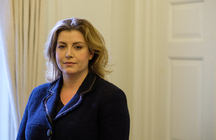
Tag: Penny Mordaunt

  • Penny Mordaunt – 2018 Speech at Kenyan Chamber of Commerce

    Below is the text of the speech made by Penny Mordaunt, the Secretary of State for International Development, at the Kenyan Chamber of Commerce on 19 January 2018.

    Thank you.

    Principal Secretary, Professor Low, Mr Chairman, members of the Chamber.

    I am delighted to be here today to contribute to your discussions on the future of Global Britain and to celebrate the UK’s flourishing economic relationship with Kenya.

    I want to begin by thanking the Chairman and members of the British Chamber of Commerce Kenya for hosting us here today; for the enormous contribution you make to the economies of Kenya and the UK; and the inspiring example that you are setting here in East Africa.

    As members of the British business community here in Kenya, you have a unique understanding of the strong economic ties between our countries.

    You see the potential for these ties to grow and develop.

    You understand that the UK must move away from a relationship with Africa that is dominated by aid, and towards one that embraces the power of economic growth and delivers mutual prosperity.

    And you understand that sustained, job-creating growth will play a vital role in lifting people out of poverty, and allow Kenya to realise its ambition of economic independence.

    You know that great changes are underway, both here in Kenya and at home.

    This is a really exciting moment for the UK’s partnership in Africa and around the world.

    As we prepare to leave the EU and enter a new phase of international engagement, we will renew our focus on our African relationships.

    There are abundant opportunities across the continent, and nowhere more than in Sub-Saharan Africa. These opportunities will only grow over the next twenty years.

    We want to ensure complete coherence on our approach, and we are determined to ensure that our efforts across the continent become more than the sum of their individual parts.

    We are also determined to ensure that our renewed focus on Africa’s economic development delivers jobs, investment and trade.

    For both the UK and Kenya, this presents a tremendous opportunity.

    When we talk of growth in Africa, we risk limiting our outlook to the large economies at either end of the continent. But Kenya should not be overlooked.

    In recent years, it has dramatically improved its ‘ease of doing business’ rankings, rising 30 places in the last three years on the World Bank’s global index.

    The country has an impressive growth rate – greater than most of its neighbours and many developing countries.

    It has an immense appetite for economic expansion and diversification. It acts as a critical regional hub, providing trade access to 200 million people across seven countries.

    And Kenya’s reputation for innovation spreads across the continent. It is leading the charge in sectors, such as mobile money, and transforming lives across Africa.

    As with all growing economies, we know that there are still hurdles to jump. But no one can deny that Kenya is a profound success story – the largest and most diverse economy in East Africa. Throughout this journey, the UK has stood beside Kenya every step of the way.

    The British government’s support has driven essential policy and regulatory changes that have helped Kenya and its neighbours power ahead in recent years.

    We have delivered transformational reforms to the country’s ports, borders and infrastructure; to facilitate trade across the region; and have helped harness the use of technology to improve services and help businesses to reach their customers, including those who might otherwise have been left behind.

    Our commercial impact in Kenya is without equal.

    The UK is the largest cumulative investor in Kenya, and the fourth exporter of goods.

    British companies, both local and global, rank among Kenya’s most successful and respected firms.

    We contribute an enormous proportion of tax revenue to Kenya; seven of the top ten corporate tax payers in this country are British companies, and the revenue they generate delivers investment across the breadth of the Kenyan government’s priorities, changing the lives of Kenyans as their country grows.

    British companies directly employ a quarter of a million Kenyans and are growing the job market. Just recently, Chamber member East African Breweries Ltd / Diageo announced a new site that will bring over 100,000 jobs to the Kenyan economy and shows that British investment is not limited to the major cities.

    Our investment travels through Kenyan society more than other countries, because our firms reinvest significant revenues in their local communities and value chains.

    Unilever, which was recently rated Kenya’s top employer for the fourth time in a row – an incredible achievement that demonstrates the company’s commitment to its workforce.

    And GSK, which has reinvested 20% of profits from its African interests to train community healthcare workers and combat childhood mortality.

    These are just two examples of the tremendous work of members of this Chamber.

    These companies represent the best of British investment. They set a gold standard with their business practices, and in doing so they send a powerful message about British standards and our commitment. They demonstrate the real impact of British commercial engagement on the country’s economic and social progress.

    Across the UK government, we are determined to ensure that we support British companies abroad in every way possible, to boost the economies of both countries and the lives of Kenyan people. On the way here from the airport this morning, I was delighted to visit the Hela garment factory.

    Opened just 18 months ago it already employs over 4,000 people. It has invested heavily in corporate social responsibility, introducing a safe water programme, child care facilities and free lunches for its staff. Other companies in the export zone now follow their example, and Hela’s team already provides training and support for its fellow companies to deliver their own CSR programmes.

    Hela is a world leader in responsible manufacturing and sets the standard for others in East Africa to follow. They are working in partnership with the British government to advise Kenya on how it can grow the manufacturing sector to deliver the best conditions, not just for businesses like theirs, but for the Kenyans who work for them.

    To ensure that this ripple effect is also felt beyond the manufacturing sector, UK aid is also partnering with the government to create more comprehensive Special Economic Zones, allowing companies – not only those who export – to flourish and grow, bringing jobs and wealth to Kenya.

    We want British commercial and government expertise to play its part in preparing Kenya’s economy for its next phase of growth.

    We will continue to invest and scale up our trade initiatives like Trade Mark East Africa, to tackle barriers and to increase the potential for trade success across the region. And we will continue to grow CDC.

    We will increase our infrastructure development funds, building the crucial pathways for trade and investment and removing obstacles to the economic expansion we all want to see.

    We will launch our five-year urban programme to unlock both development and commercial opportunities at the sub-national level, responding to the opportunities that Kenya’s devolution brings.

    And we will enhance our modern partnership with the Government of Kenya to strengthen the bilateral economic relationship and long term prosperity of both countries.

    We are building a great team to do this work, including experts on trade policy, export finance and investment.

    I am delighted that many government colleagues and implementing partners are here with us today, demonstrating our commitment to a whole of government approach on this important issue.

    I hope you will take the opportunity to talk to them about opportunities to partner in your areas of expertise. You are part of the team too. We cannot do this without you.

    The support of the British business community will be crucial to the success of a new, modern UK-Kenya partnership.

    We need you to keep doing all that you are doing. Keep growing the economy, keep creating jobs, keep setting world class standards.

    Please share your success stories. The British are famously bad at ‘blowing our own trumpets’ – but I ask you to promote your successes. This will build confidence in Kenya’s potential and show others what can be achieved. And tell us what you need. If there are changes that need to be made or areas where you need support, talk to our team. They are there to help.

    We have a huge opportunity to shape the health, wealth and prosperity of the nation in a way that grows and protects the economy of the UK too.

    Our development, diplomatic and commercial investment here has helped to create a self-sufficient economy and a powerful trading partner for the future. The UK should be enormously proud of that.

    Kenya now stands strong and we must transition our relationship to a new, modern footing, for the mutual prosperity of our two great nations.

    Thank you for the part that you are playing in that and the part you will play in the future.

  • Penny Mordaunt – 2017 Speech on Disability Inclusion

    Below is the text of the speech made by Penny Mordaunt, the Secretary of State for International Development, in the House of Commons on 30 November 2017.

    I am delighted to be here to mark International Day for Persons with Disabilities in advance of this Sunday.

    I want to start by saying a huge thank you to Microsoft for hosting us today and also a big thank to you to BOND Disability and Development group for arranging this event.

    Thank you Microsoft for your leadership as well and the example that you are setting.

    You recognise that employing people with disabilities is not just the right thing to do, but the smart thing to do.

    You recognise the virtuous circle that comes from employing people with disabilities.

    The insight they bring to your workforce. Their ideas and entrepreneurial skills. Their drive to raise expectations around what is possible.

    And that sends a powerful message.

    You are inspiring other organisations and businesses and in turn you are benefitting from the talents and gifts of so many people.

    And so it is fitting that the message I have today is delivered under your roof.

    I worked with Microsoft in my previous role as Minister of State for Disabled People.

    And in handing over the baton to my successor the wonderful Sarah Newton who is down the end I said to the sector that they were not losing a Minister, just gaining another one because I am committed to this agenda.

    We need to tackle the extra costs of disability. We need to push money into healthcare and early interventions and use the data from that to stop doing assessments on people. We need to enable people to become economically active. Just because all of that is in our in tray domestically, it doesn’t mean we should ignore how we can help the rest of the world raise their game too.

    One of the most memorable meetings I had in that role was with a young man who taught coding to people with autism and Tourette’s.

    He did this in the UK and overseas. When I met him he had just returned from a trip to Bangladesh. He was eleven years old. Eleven.

    He himself had a disability. But he was using his talents uninhibited by physical or mental obstacles.

    I often think about what the world will be like when he is older. What will he be doing in the years to come?

    I think about his care for others around the world, his hunger to share what he knew with them, and the power of the message he was sending to those around him.

    What a force for good he was. And what a force for good he will continue to be, if given more opportunity.

    Today the UK Government has launched the Health and Work roadmap, a new plan to transform disability employment over the next ten years. to get one million more disabled people, and people with long term illnesses, into work in the UK.

    Its premise is simple: unless every one of our citizens can reach their full potential, our nation never will.

    Whatever a person’s abilities, whatever their talents, whatever their gifts, all of them have something to offer.

    And it is our job to ensure that they can. To ensure that they thrive, fulfil their ambitions, make their ideas a reality and contribute to their community.

    That makes complete sense, doesn’t it?

    It makes sense not just in the UK, but in every nation on earth.

    If we are in the business of helping nations prosper, and if we want them to succeed, then people with disabilities must be central to all that we do.

    They are the group most discriminated against in society.

    Too often, people with disabilities are forgotten.

    Too often, their needs are unfulfilled.

    Too often, the opportunities they bring are not fully appreciated.

    In many parts of the world, people with disabilities simply don’t count.

    They are neglected and isolated. They are attacked and abused. They are invisible.

    Waldah, a four year-old Ugandan girl with cerebral palsy, became isolated from her family and her wider community because of her disability.

    This forced her mother Lucy to hide her away. For Lucy, the strain was too much. She became depressed and ended up losing her job.

    All this because of society’s refusal to accept a four year-old girl for who she is.

    There are countless stories like this all over the world, and much worse.

    Stories of people with disabilities who are denied the love, the support, the education, the healthcare services and the opportunities that they have a right to.

    Stories of people with disabilities in developing countries fighting every day just to survive. Their resilience is as impressive as it is humbling.

    It is harder, often impossible, for children with disabilities to go to school.

    When they grow up, it is more difficult for them to find a way to make a living.

    In many instances, they are completely cast out from the rest of society.

    And in conflict zones, these problems are compounded.

    There are one billion people in the world living with disabilities.

    That’s more than one in eight of us.

    1 in 8 being excluded from the workforce.

    Facing discrimination at every turn. Being unrepresented.

    Being unable to build a business. Being precluded from bringing your problem solving skills, your insights, and your resilience to bear.

    Imagine not having the tools to contribute to your household, your family, the world, and thrive as a human being.

    For many, this is the reality. It short-changes humanity. And it must stop.

    We need to break down the barriers that people with disabilities face in their everyday lives.

    People with disabilities must have the opportunity to fulfil their true potential and to help their countries prosper.

    As Secretary of State for International Development, this will be one of my top priorities.

    As a department, we will put disability at the heart of everything that we do. We know that we all have a long way to go, but we are determined to get there.

    As our commitment to the Sustainable Development Goals promises, we will leave no one behind.

    My vision is that people with disabilities are consistently included in, and benefit from, the opportunities that are available to everyone in society.

    I want to see a world where people with disabilities can access a quality education, productive employment and the chances in life that they deserve.

    I want to eliminate the appalling stigma and discrimination that they face.

    I want to ensure that the international system delivers for people with disabilities.

    And crucially, when it comes to finding solutions to these challenges, I want to ensure we learn more about what works, where, and why.

    Good data is essential.

    We must use the power of evidence and reason to ensure that we unearth solutions that don’t just do good – but do the most good possible for every penny spent.

    And there is a lot to do, but DFID has already made a good start.

    UK Aid is crowdsourcing new ways to make societies more inclusive for people with disabilities.

    We have supported over 40,000 girls with disabilities, helping them access an education in Kenya and Uganda.

    In Bangladesh, we are providing jobs and skills for people with disabilities in the garment industry and in small businesses.

    We are also helping people to start their own businesses.

    Sok Khoen is a young woman in Cambodia who now owns her own grocery shop thanks to a programme run by ADD International and funded by DFID. She has been steadily growing her business ever since.

    Vision for a Nation, a UK-based charity, has distributed innovative adjustable glasses for those with visual impairments in Rwanda. The glasses cost just £1 for patients, and are giving some of the world’s poorest people back their sight.

    D-Rev, a small business supported by UK Aid through its Amplify programme, is developing and scaling up a ground-breaking low-cost prosthetic knee for young adults in rural Africa and Asia.

    Thanks to funding received through the Google Impact Challenge, Bristol-based charity Motivation is exploring how 3D printing can be used to develop and produce tailored mobility solutions for wheelchair users in the developing world.

    It is exactly this kind of invention and creativity that UK Aid wants to encourage.

    That is why we will be matching pound-for-pound donations to Motivation’s Ready, Willing and Able appeal, launching this Sunday.

    It will help reinforce the British public’s efforts to help people with disabilities live with dignity, earn a living and create lasting opportunities for themselves.

    These inspiring organisations are leading the way. Now we must all match their ambition and entrepreneurial spirit.

    We must also expand the circle of people working in this area, and build a wider and even more ambitious movement for change.

    That’s why today I am proud to announce that the UK Government will host its first ever Global Disability Summit in London this summer.

    We will work with disabled people’s organisations, governments, companies and charities to find creative and lasting ways to help transform the lives of all people living with disabilities around the world.

    And crucially, we will work with the International Disability Alliance to ensure that people with disabilities are at the centre of this work. – from its planning and focus, right through to delivery.

    At the Summit, we will need to tackle the big questions.

    How can we help people with disabilities build a livelihood in the world’s poorest countries?

    How can we make proven solutions available as widely as they are needed?

    How can we all – governments, businesses and civil society around the world –share our experiences?

    How can we make use of the new opportunities that technology brings?

    And how can we challenge discrimination and stigma, so that people with disabilities live with dignity, and become the leaders we need them to be?

    I am asking these questions to you. All of you.

    DFID wants to hear from you.

    We must all share our best ideas, and put them to the test. Then we must share what we learn.

    It is vital that we harness the smartest solutions from every sector – from government and business through to civil society and academia.

    As well as getting the basics right for all people with disabilities – access to healthcare, livelihoods, a good education and freedom from fear and violence – I know that technology will be at the heart of many solutions that we create.

    Thanks to technology, we have opportunities that previous generations did not.

    We have the power to eradicate poverty.

    To enable a person to participate fully in society.

    To overcome barriers.

    To be connected.

    To be empowered.

    Technology reduces our costs, extends our reach, and helps us realise our dreams.

    It will take this, and all of us, to ensure that people with disabilities are at the heart of all we do in development.

    It will take ingenuity and creativity.

    And it will take resolve.

    At DFID, we are resolved.

    I believe in the power of aid to tackle the problems we face – to end disease, hunger and extreme poverty.

    And when it comes to supporting people with disabilities, I believe they must have the freedom and opportunities they need to thrive.

    There is a long way to go for us all. But with the work the UK is doing, we are beginning to fulfil the promise to leave no one behind.

    I now call on others to follow suit. Governments, companies and civil society must join us, and step up their commitments.

    Together, we will ensure that all people with disabilities fulfil their potential.

    Unless they do, humanity will not.

    Thank you.