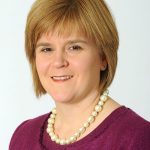
The statement made by Nicola Sturgeon, the First Minister of Scotland and the Leader of the SNP, on 15 February 2023.
Being First Minister of Scotland is in my – admittedly biased – opinion the best job in the world.
It is a privilege beyond measure – one that has sustained and inspired me, in good times and through the toughest hours of my toughest days.
I am proud to stand here as the first female, and longest serving, incumbent of this great office.
And I am proud of what has been achieved in the years I’ve been in Bute House.
However, since my first moments in the job, I have believed that part of serving well would be to know – almost instinctively – when the time is right to make way for someone else.
And when that time comes, to have the courage to do so – even if, to many across the country, and in my party, it might feel too soon.
In my head and my heart I know that time is now;
That it is right for me, for my party, and for the country;
And so today, I am announcing my intention to step down as First Minister and leader of my party.
I have asked the National Secretary of the SNP to begin the process of electing a new party leader, and I will remain in office until my successor is in place.
I know there will be some across the country who feel upset by this decision, and by the fact I am taking it now.
Of course, to balance that, there will others who – how should I put this – will cope with the news just fine!
Such is the beauty of democracy.
But to those who do feel shocked, disappointed, perhaps even a bit angry with me, please know that, while hard – and be in no doubt, this is really hard for me – my decision comes from a place of duty and of love.
Tough love perhaps – but love nevertheless, for my party and above all for the country.
Let me set out – as best I can – my reasons.
First, though I know it will be tempting, unavoidable perhaps, to see it as such, this decision is not simply a reaction to short term pressures.
Of course, there are difficult issues confronting the government just now. But when is that ever not the case.
I have spent almost three decades in front line politics – a decade and a half on the top or second top rung of government.
When it comes to navigating choppy waters, resolving seemingly intractable issues, or soldiering on when walking away would be the simpler option, I have plenty experience to draw on.
So if this was just a question of my ability – or my resilience – to get through the latest period of pressure, I would not be standing here today.
But it is not.
This decision comes from a deeper and longer term assessment.
I know it might seem sudden but I have been wrestling with it – albeit with oscillating levels of intensity – for some weeks.
Essentially, I have been trying to answer two questions.
Is carrying on right for me?
And – more importantly – is me carrying on right for the country, for my party and for the independence cause I have devoted my life to?
I understand why some will automatically answer ‘yes’ to that second question.
But in truth, I’ve been having to work harder in recent times to convince myself that the answer to either of them – when examined deeply – is ‘yes’.
And I’ve reached the conclusion that it’s not.
The questions are inextricably linked but let me take them in turn.
I’ve been First Minister for over 8 years; and I was Deputy First Minister for the best part of 8 years before that.
As I said earlier, these jobs are a privilege.
But they are also – rightly – hard.
And, especially in the case of First Minister, relentlessly so.
Now to be clear, I am not expecting violins – but the fact is, I am a human being as well as a politician.
When I entered government in 2007, my niece and youngest nephew were babies, just months old.
As I step down, they are about to celebrate their 17th birthdays.
Exactly the age to be horrified at the thought of your devoted auntie suddenly having more time for you.
My point is this.
Giving absolutely everything of yourself to this job is the only way to do it. The country deserves nothing less.
But in truth that can only be done, by anyone, for so long. For me, it is now in danger of becoming too long.
A First Minister is never off duty.
Particularly in this day and age, there is virtually no privacy.
Ordinary stuff that most people take for granted, like going for a coffee with friends or even for a walk on your own becomes very difficult.
And the nature and form of modern political discourse means there is a much greater intensity – dare I say it, brutality – to life as a politician than in years gone by.
All in all – and for a long time without it being apparent – it takes its toll, on you and on those around you.
And if that is true in the best of times, it has been more so in recent years.
Leading this country through the Covid pandemic is, by far, the toughest thing I’ve done.
It may well be the toughest thing I ever do. I certainly hope so.
Now, by no stretch of the imagination – to be clear – was my job the hardest in the country during that time.
But the weight of responsibility was immense.
And it’s only very recently, I think, that I’ve started to comprehend, let alone process, the physical and mental impact of it.
So, what I am saying is this.
If the only question was, can I battle on for another few months, then the answer is yes. Of course I can.
But if the question is can I give this job everything it demands and deserves for another year, let alone for the remainder of this parliamentary term – give it every ounce of energy that it needs, in the way that I have strived to do every day for the past 8 years – the answer, honestly, is different.
And as that is my conclusion – hard though it has been for me to reach it – then given the nature and scale of the challenges the country faces, I have a duty to say so now.
I feel that duty, first and foremost, to our country – to ensure that it does have the energy of leadership it needs, not just today, but through the years that remain of this parliamentary term.
And, right now in a very particular sense, I feel that duty to my party too.
We are at a critical moment.
The blocking of a referendum as the accepted, constitutional route to independence is a democratic outrage.
But it puts the onus on us to decide how Scottish democracy will be protected and to ensure that the will of the Scottish people prevails.
My preference of using the next Westminster election as a de facto referendum is well known.
I’ve never pretended it is perfect – no second best option ever is – nor that there are no alternatives.
That is why I have always been clear that the decision must be taken by the SNP collectively, not by me alone.
But I know my party well enough to understand that my view as leader would carry enormous, probably decisive, weight when our conference meets next month.
And I cannot – in good conscience – ask the party to choose an option based on my judgment whilst not being convinced that I would be there as leader to see it through.
By making my decision clear now, I free the SNP to choose the path it believes to be the right one, without worrying about what it means for perceptions of my leadership, and in the knowledge that someone else will lead, successfully, along whatever path is chosen.
There are two further reflections that have weighed in my decision – these, I suppose, are more about our political culture and the nature and impact of the dominance and longevity that comes from success in politics.
The first, I hope my party will take heart from.
One of the difficulties of coming to terms with this decision is that I am confident I can and would lead the SNP to further electoral success.
Even in a time of challenge, we remain by far the most trusted party in Scotland.
And while for every person in Scotland who ‘loves’ me, there is another who might not be quite so enthusiastic, the fact is we remain firmly on course to win the next election – while our opponents remain adrift.
But the longer any leader is in office, the more opinions about them become fixed and hard to change. And that matters.
Individual polls come and go, but I am firmly of the view that there is now majority support for independence.
But that support needs to be solidified – and it needs to grow further if our independent Scotland is to have the best possible foundation.
To achieve that we must reach across the divide in Scottish politics.
And my judgment now is that a new leader would be better able to to this.
Someone about whom the mind of almost everyone in the country is not already made up, for better or worse.
Someone who is not subject to quite the same polarised opinions, fair or unfair, as I now am.
The good news – as the country will now get to see more clearly perhaps – is that the SNP is full of talented individuals more than up to that task.
My second reflection is related – and I think there is ample evidence of this in our current debates.
I feel more each day just now that the fixed opinions people increasingly have about me – as I say, some fair, others little more than caricature – are becoming a barrier to reasoned debate.
Statements and decisions that should not be controversial become so when it’s me making or taking them.
Issues that are controversial end up almost irrationally so – and for the same reason.
Too often I see issues presented and as a result viewed – not on their own merits – but through the prism of what I think and what people think about me.
It has always been my belief that no one individual should be dominant in any system for too long.
But while it’s easy to hold that view in the abstract as a leader, it is harder to live by it.
With this decision, I am trying to do so.
Indeed, if all parties were to take this opportunity to try to to de-polarise public debate just a bit;
To focus more on issues than on personalities;
And to reset the tone and tenor of our discourse;
Then this decision – right for me and, I believe for my party and the country – might also prove to be good for our politics.
I live in hope.
Now, a couple of final points before I take a few questions.
While I am stepping down from leadership, I am not planning to leave politics. There are many issues I care deeply about and hope to champion in future.
One of these is The Promise – the national mission, so close to my heart, to improve the life chances of care experienced young people and ensure that they grow up nurtured and loved.
My commitment to these young people will be lifelong.
And, obviously, there is independence.
Winning independence is cause I have dedicated a lifetime to. It is a cause I believe in with every fibre of my being.
And it is a cause I am convinced is being won.
I intend to be there – as it is won – every step of the way.
Yesterday I attended the funeral of a dear friend and long standing independence activist, a wonderful man by the name of Allan Angus.
It was actually during that service that I went from being 99% certain about this decision to 100% certain – though I know Allan would not be at all happy to have played any part in my departure.
But his funeral reminded me that the cause of independence is so much bigger than any one individual; that all of us who believe in it contribute in different ways, at different stages of our lives.
Since I was 16, I have contributed as an activist, a campaigner and a leader.
And so now, as we look to what I firmly believe is the final stage in Scotland’s journey to independence – albeit a hard one – I hope to use all the experience and perspective I have gathered over these years to help get us there.
Lastly, there will be time in the days to come for me – and others – to reflect on what has been achieved during my time as First Minister. I am sure there will be plenty of commentary on my mistakes too.
I will have more to say before I demit office, but allow me some brief reflections now.
Scotland is a changed country since 2014 – and in so many ways it is changed for the better.
Young people from deprived backgrounds have never had a better chance of going to university than now.
Our investment to double early learning and childcare is transforming opportunities for the youngest children. It is also enabling more women to return to work.
The baby box is enshrining our aspiration that every child should have an equal start in life.
Scotland is fairer today than it was in 2014. We have a more progressive approach to taxation and a new social security system, with the Scottish Child Payment at its heart.
As the Institute for Fiscal Studies confirmed last week, the poorest families with children in Scotland are now £2000 better off as a result of our policies.
For many – in this cost of living crisis – that will be the difference between food on the table and a warm home, or not.
There are stronger protections for victims of domestic abuse, and Parliament will soon consider legislation to improve access to justice for victims of rape and sexual offences.
To be clear, I will be the strongest possible backbench advocate for these reforms.
We have also shown over these past few years what can be done with the full powers of a nation – creating new institutions that are part of the transition to becoming independent.
New tax and social security agencies, a network of trade hubs across the world, and a state owned investment bank ready to help the country reap the industrial benefits of our vast renewable resources.
There is so much that I am proud of.
But there is always so much more to be done. I look forward to watching with pride as my successor picks up the baton.
There will also be time in the days to come for me to say thank you to a very long list of people, without whom I wouldn’t have lasted a single day in this job, let alone 8 years.
I won’t do so today – I might inadvertently forget someone or, perhaps more likely, start to cry.
But there are a couple of exceptions.
Firstly, my husband and family. Few people understand the price families of politicians pay for the jobs we choose to do. Mine have been my rock throughout.
And, of course, the SNP.
Since I was 16 years old, you have been my extended family. Thank you for the honour of being your leader.
And I don’t know about you, but it seems to me that 8 emphatic election victories in 8 years ain’t a bad record together.
Finally – and above all – the people of this beautiful, talented, diverse, at times disputatious, but always wonderful country.
We faced the toughest of times together.
I did everything I could to guide us through that time, often from my very familiar podium in St Andrews House.
And in return I was sustained through that period by a wave of support from you that I will remember and value for the rest of my life.
So to the people of Scotland – to all of the people of Scotland – whether you voted for me or not – please know that being your First Minister has been the privilege of my life.
Nothing – absolutely nothing – I do in future will ever come close.
Thank you from the bottom of my heart.