
Tag: Nicola Richards

  • Nicola Richards – 2023 Speech on Holocaust Memorial Day

    Nicola Richards – 2023 Speech on Holocaust Memorial Day

    The speech made by Nicola Richards, the Conservative MP for West Bromwich East, in the House of Commons on 26 January 2023.

    I thank my right hon. Friend the Member for Bromsgrove (Sajid Javid) for securing this debate.

    Nobel laureate and holocaust survivor Elie Wiesel famously said

    “whoever listens to a witness becomes a witness”.

    Seventy-eight years on from the liberation of the former Nazi extermination and concentrations camp at Auschwitz-Birkenau, as we gather here today to mark Holocaust Memorial Day, those words could not be more important.

    As a society, we have taken the incredible work of organisations such as the Holocaust Educational Trust for granted. The trust and its incredible staff have worked day in and day out for the past 30 years to ensure that as many people as possible have the honour of being able to sit in awe and listen to a holocaust survivor tell their testimony. Today, through the Holocaust Educational Trust’s annual webcast, tens of thousands of schoolchildren from across the country logged on to hear the testimony of holocaust survivor Ruth Posner BEM.

    It is sad but true that we are the last generations who will know the holocaust not as a historical period but as something that happened to someone we met or knew. With holocaust survivors now in their 80s and 90s, we, the people who have heard their testimony, have become their witness. We must now carry the mantle of continuing their legacy.

    If holocaust denial and distortion can thrive when there are survivors as proof, what will happen when there are none? If antisemitism and hatred can thrive even while survivors warn where it can lead, what will happen when there are none? And when individuals say that Jewish people should not have their own homeland, when survivors are still retelling how no other country would accept them, what will happen when there are none?

    In the past month, we have seen the release of two shocking reports. First, two weeks ago, the Tuck report on antisemitism in the National Union of Students found that it was a hostile environment for Jewish students. I have heard stories from my Jewish staffer of what he and his friends experienced at NUS conferences, and it is truly shocking. Secondly, just last week, we received the campus antisemitism report from the Community Security Trust, which found that antisemitism at UK universities has risen by 22% to its highest recorded total. Put simply, Jewish students on UK campuses are receiving death threats and abuse while the National Union of Students, their supposed representative, invites an accused antisemitic rapper to its conferences. How can the Jewish community hope for a better future when this is what its children are having to put up with?

    I pause to recognise the amazing work of the Community Security Trust and the Union of Jewish Students, which are on the ground at universities to protect and represent Jewish students. I also thank the Antisemitism Policy Trust and declare an interest as the co-chair of the APPG against antisemitism. Sadly, the work they do only becomes more important as time goes on.

    I was recently at the United States Holocaust Memorial Museum and saw a Nazi-era antisemitic book that is currently on sale online. Just last year, we were reminded again that antisemitism is alive and kicking thanks to Kanye West, the now disgraced rapper turned Hitler fan. There is nothing cool, and certainly nothing acceptable, about that. I live in hope that, one day, he might realise that. He has more followers on social media than there are Jews in the world, which puts this debate starkly into context.

    The theme of this year’s Holocaust Memorial Day is ordinary people. It is strange to use the word “ordinary” in the same sentence as the word “holocaust.” There is nothing ordinary about the unprecedented attempt to murder all European Jews and to extinguish their culture, history and traditions. This cannot be ordinary, yet the holocaust was only possible because ordinary people did not speak up when hatred was taking over.

    It was ordinary people who met at the Wannsee conference to discuss the need for the final solution, which is the term given to the extermination of the Jewish population. It was ordinary people who rounded up the Jews of Europe and forced them into ghettos. It was ordinary people who drove the trains on their journey to the camps. It was ordinary people who thought of their work at death camps as just that—nothing more than work. They would finish their shift and go home to their families and children, who often lived just a few hundred metres away from the camp perimeter. Most importantly, it was ordinary Jewish people who had their humanity stripped away for the crime of being Jewish.

    As the late Rabbi Lord Sacks said:

    “Jews were hated in Germany because they were rich and because they were poor, because they were capitalists and because they were communists, because they kept to themselves and because they infiltrated everywhere, because they believed in a primitive faith and because they were rootless cosmopolitans who believed nothing. Hitler believed that Jews were controlling both the United States and the Soviet Union. How could they be doing both? Because they were Jews.”

    I end this speech by paying tribute to Zigi Shipper BEM, who sadly passed away last week. I am proud to be, as Elie Wiesel put it, his “witness.” I had the pleasure of meeting Zigi many times and I will never forget his charisma, strength and big smile, which he always had on display. I witnessed the eruption of applause when he finished delivering his testimony, having transported students in a school in London through time, painting a picture of the fragile child who was lucky to survive this all, not least the death march where he developed typhus. When he finished speaking, he was a legend, a mensch. He was one of the many capable of condensing the pain of those involved into a service to better the world. At the end, he was treated like a celebrity and he loved it. He high-fived all the students down the aisle of the hall on his way out, and those students will never forget it. I echo the words of his grandson, Darren Richman, who wrote:

    “Shaping minds—in a very real sense—changing the world, and I have no doubt the world was a better place for having had Zigi in it.”

    May his memory be a blessing.
  • Nicola Richards – 2023 Parliamentary Question on the Ownership Structure of Football Clubs

    Nicola Richards – 2023 Parliamentary Question on the Ownership Structure of Football Clubs

    The parliamentary question asked by Nicola Richards, the Conservative MP for West Bromwich East, in the House of Commons on 26 January 2023.

    Nicola Richards (West Bromwich East) (Con)

    What steps she is taking to review the ownership structure of football clubs.

    The Parliamentary Under-Secretary of State for Digital, Culture, Media and Sport (Stuart Andrew)

    The Government do not assess the ownership arrangements with individual clubs. However, the Government response to the recommendations made in the independent Fan-Led Review of Football Governance sets out our view that tests of new owners and directors are needed to ensure the future sustainability of football clubs and the stability of the game in total.

    Nicola Richards

    Thousands of West Bromwich Albion fans are deeply concerned about the actions of the club’s ownership. The owner took a £5 million loan from the club to fund his other business—money that is yet to be repaid. The club has now taken a high-interest loan of £20 million to fund day-to-day business secured against the club’s name and stadium. Will my right hon. Friend bring forward the Government’s response to the Fan-Led Review and introduce a regulator to give fans the power to stop owners abusing the club’s assets in this way and to penalise owners whose business decisions are not in the best interests of the football club?

    Stuart Andrew

    I add my congratulations to my hon. Friend on her recent wedding and praise her for the work she has been doing in this area in support of her local football club, working closely with fans’ groups such as Action4Albion and Shareholders for Albion. We will set out our plans for reform in the White Paper, which will be published in the next few weeks and will include strong action on owners and directors to ensure that they are suitable custodians for clubs and to avoid harm to fans and local communities such as she has described.

    Clive Efford (Eltham) (Lab)

    Sustainable ownership in the long term can only be achieved if we sort out football finance. There are negotiations going on at the moment between the English Football League and the Premier League around the issue of parachute payments, which create a financial imbalance, particularly in the championship. There are 14 clubs in the premier league that will not move on the issue of parachute payments, because they are the most likely to fall into the championship. Are the Government going to act on that, or will it take a Labour Government to do it?

    Stuart Andrew

    We have had extensive engagement with both the EFL and the Premier League, encouraging them to get on with the negotiations. Sometimes they have progressed and sometimes they have stalled, but I am pleased to say that they have been progressing somewhat more rapidly in recent weeks—I think the prospect of the coming White Paper may have encouraged that—and we hope they will come up with a solution that will bring financial stability to the whole of the pyramid.

  • Nicola Richards – 2022 Speech on World AIDS Day

    Nicola Richards – 2022 Speech on World AIDS Day

    The speech made by Nicola Richards, the Conservative MP for West Bromwich East, in the House of Commons on 1 December 2022.

    I thank the hon. Member for Brighton, Kemptown (Lloyd Russell-Moyle) for leading this debate and for his commitment to this cause. As the number of new HIV cases in this country falls, the importance of the issue does not. We stand on the shoulders of giants and of the 38 million globally lost to AIDS-related illness. Their early passing will not be forgotten. In fact, it inspires us to work harder and quicker.

    This Government are proud to be one of the first in the world to commit to ending new HIV cases by 2030, and we are proud to put our money where our mouth is. This time last year, my right hon. Friend the Member for Bromsgrove (Sajid Javid), as Health Secretary, provided £20 million to fund opt-out testing in London, Brighton and Manchester. Thanks to the campaign of the Terrence Higgins Trust and my hon. Friend the Member for Blackpool South (Scott Benton), Blackpool was also rightly included. This investment has had remarkable results and is already garnering savings for the NHS.

    In the first 100 days of this programme, around 128 people were newly diagnosed and roughly 65 people who were previously diagnosed returned to the care of an HIV clinic. On top of all the standard HIV testing, that is almost 200 people who no longer have HIV attacking their immune system and who cannot pass on the virus to others. What a triumph. Adding that half the hospitals also tested for hepatitis and found 325 cases of hepatitis B and 153 cases of hepatitis C, the success only builds. Well over 500 people have been prevented from becoming very unwell on our watch.

    Having spent about £2.2 million on four months of testing, the savings are calculated at between £6 million and £8 million. These are not pipe-dream savings but a real reduction in the pressure that accident and emergency departments and hospitals face this winter. When Croydon Hospital started opt-out testing, the average hospital stay for a newly diagnosed HIV patient was 34.9 days. Two years later, it is 2.4 days. I know a few hospitals that could also do with such pressures being released.

    In the west midlands we have five areas of high HIV prevalence, and my borough of Sandwell is among them with a prevalence of 2.92 cases per 1,000 adults, which is well above the national average. The National Institute for Health and Care Excellence says that areas such as Sandwell should

    “offer and recommend HIV testing on admission to hospital, including emergency departments, to everyone who has not previously been diagnosed with HIV and who is undergoing blood tests for another reason.”

    Such testing is not yet happening in Wolverhampton, Coventry, Sandwell, Birmingham or Walsall. We have to find our undiagnosed and lost-to-care residents and get them into treatment as soon as possible.

    The Mayor of the west midlands, Andy Street, has written to the Health Secretary asking for this “invest to save” resource for our region, and I add my voice to his call and ask the Minister if he can help level up the HIV response outside London. With funding for opt-out HIV testing, we can put the west midlands on track to end new HIV cases by 2030.

    Andy Street rightly said

    “This is not a World AIDS Day stunt but a serious call for action. I don’t want ‘The Ribbons’ to simply be a tribute. It needs to be a reminder that HIV is still happening to many”.

    I know my hon. Friend the Member for Birmingham, Northfield (Gary Sambrook) and local councillors in Sandwell, such as Councillor Scott Chapman, join Andy and me in asking for an extension to opt-out testing to cover my West Bromwich East constituency.

    We have made such incredible strides. As well as remembering the devastation that HIV has caused for so many around the world, we have to celebrate how far we have come. We have preventive drugs available on the NHS—drugs that stop any trace of HIV so that those who contract it cannot pass it on to others—and we are now seeing the major success of opt-out testing in some of the country’s worst HIV hotspots. In an odd way, the medical question is not really the problem; it is the stigma.

    I recently met Harry Whitfield, also known as Charity Kase, who last year made his debut on “RuPaul’s Drag Race UK” to showcase his incredible talents. He talked about how hard it was to deal with his HIV diagnosis. For last year’s World AIDS Day, Harry said:

    “The stigma around HIV is far worse than the disease itself. I take one tablet per day to stay healthy and completely undetectable so I can’t pass the disease on. I’m thriving in my life every day, but that’s not the narrative that gets told when talking about HIV.”

    Last year, like so many, I was completely engrossed in “It’s A Sin.” Until then, I had not thought that much about HIV. Probably because of my age, I had not properly considered how terrifying that period of time was for so many. When I was sent an HIV test to raise awareness during testing week, I took the test and posted about it on social media. I knew it had the potential to create some odd feedback, but I felt it was important. Some of the comments came from people who thought HIV was a thing of the past, and they accused me of talking about it only as a means to control people now that we are out of the covid pandemic. It showed me the importance of keeping this issue alive.

    My experience is similar to that of my right hon. Friend the Member for Romsey and Southampton North (Caroline Nokes), with people questioning why I thought it was necessary to take a test and what I had been up to. However, one constituent thanked me. He said:

    “I’m a victim of this myself. I was fortunate to be born at the right time for effective treatments. But only just. These new tests were not around when I was diagnosed. I just happened to randomly find out through routine MOT as they call it.”

    He also said told me that the stigma is the main issue.

    Mr Tanmanjeet Singh Dhesi (Slough) (Lab)

    I congratulate my hon. Friend the Member for Brighton, Kemptown (Lloyd Russell-Moyle) on securing this important debate on World AIDS Day. Like the hon. Member for West Bromwich East (Nicola Richards), my Slough constituency has a relatively high prevalence of HIV. It is vital that our town is properly supported in the fight against HIV and AIDS in order to meet the 2030 target, which is why I wrote to the Health Secretary to request that Slough be included in the opt-out HIV testing scheme.

    Does the hon. Lady agree it is important that the Government support areas like ours so that we get the right level of support? Without that support, we could experience a resurgence that none of us wants.

    Nicola Richards

    I completely agree with the hon. Gentleman. Opt-out testing is one of the easiest ways to end the transmission of HIV and become the first country to be HIV-free by 2030, which would be incredible. Opt-out testing is clearly a great route to do that.

    “It’s A Sin” has helped to bring this issue back to life, not just as a reminder of the 38 million people around the world lost to AIDS-related illness, but as a reminder of how far we have come. The series also makes it glaringly obvious that we have more to do to tackle the stigma.

    I place on record my thanks and appreciation for the Terrence Higgins Trust. It is 40 years since the death of Terry Higgins, one of the first to die of an AIDS-related illness. The trust does incredible work to end the stigma around HIV, which is one of the biggest barriers that stops people getting testing, and therefore one of the biggest barriers to ending the transmission of HIV by 2030.

    HIV is no longer a death sentence. It is no longer the terrifying disease that “It’s a Sin” so intensely brought to life for people like me who did not live through those incredibly difficult times. I thank the Government for supporting opt-out testing, and I call one last time for the pilot to be extended to other hotspots, including the west midlands.

  • Nicola Richards – 2022 Comments on Penny Mordaunt Becoming Prime Minister

    Nicola Richards – 2022 Comments on Penny Mordaunt Becoming Prime Minister

    The comments made by Nicola Richards, the Conservative MP for West Bromwich East, on Twitter on 21 October 2022.

    I’m backing Penny Mordaunt to unite our party, deliver our 2019 manifesto and win the general election.

    I know Penny will be the stabilising, calm and collected figure we need to see us through the turbulent times ahead.

  • Nicola Richards – 2022 Speech on Holocaust Memorial Day

    Nicola Richards – 2022 Speech on Holocaust Memorial Day

    The speech made by Nicola Richards, the Conservative MP for West Bromwich East, in the House of Commons on 26 January 2022.

    I quote:

    “I have a request of you: this is the real reason why I write, that my doomed life may attain some meaning, that my hellish days and hopeless tomorrows may find a purpose in the future.”

    These chilling words are those of Zalman Gradowski, a Polish Jew deported to Auschwitz-Birkenau and forced to be a cog in a factory of death. Zalman was forced to be a member of the sonderkommando, a group of Jewish prisoners forced to perform a variety of duties in the gas chambers and crematoriums. In October 1944, Zalman led this group in revolt and managed to destroy one of the crematoriums. He was murdered during this revolt. Knowing he would soon be killed, Zalman wrote his first-person account of what he described as the “inferno of death” that he was living in and hid these words in the ashpit of crematorium 3, hoping that one day a citizen of the free world will find them and tell the story of him and his family. Zalman asks in his writings:

    “Can the dead mourn the dead? But you, unknown ‘free’ citizen of the world, I beg you to shed a tear for”

    my family

    “when you have their pictures before your eyes. I dedicate all my writings to them—this is my tear, my lament for my family and people.”

    I wish to now grant Zalman’s wish and list the names of his murdered family members for all to hear, know and remember in this place: his mother, Sarah; his sister, Libe; his sister, Esther Rokhl; his wife, Sonia; his father-in-law, Raphael; and his brother-in-law, Wolf. They were all killed on 8 December 1942, gassed and incinerated. They have no grave. Zalman also mentions his father, Shmuel, his two brothers, Eber and Moyshl, and his sister Feygeleh, who were all taken and never seen again. This was his entire family, and they will never be forgotten.

    An estimated 1.3 million Jewish people were deported to Auschwitz-Birkenau, and 1.1 million were murdered. When allied troops liberated the concentration and death camp 77 years ago today, just 9,000 prisoners were found alive. All in all, an estimated 6 million Jewish men, women and children were murdered in the holocaust.

    The holocaust was not the birth of antisemitism, and sadly neither was it the end. It is the world’s oldest form of hatred and has taken on many forms over the centuries. However, the same themes always seem to prevail: Jews are made scapegoats, forced to answer for the actions of others, and they are depicted as both weak and all powerful.

    Just two weeks ago, a British man walked into a synagogue in Texas and took the rabbi and three congregants as hostages. Why? Because he believed that the Jews of that small congregation had the power to grant his demands. I saw the effect that the incident had on my Jewish friends: they stayed glued to their phones and TVs all night praying for a peaceful outcome; they went to sleep not knowing whether they would wake up to yet another massacre of fellow Jews in their sacred house of worship.

    It is a sad state of affairs when synagogues all over the world are still forced to be guarded by soldiers, police or security and when Jewish schoolkids in this country must still take part in regular terrorist drills and be prepared for the worst in case it happens. I pay tribute to the incredible work of the Community Security Trust and its volunteers, who work tirelessly to keep the UK Jewish community safe.

    The Secretary of State for Education rightly calls antisemitism a virus that continues to mutate. As we know, the best way to deal with a mutating virus is to vaccinate. Education will always be the vaccine against all forms of hatred. For that reason, I commend the work of the amazing charities, organisations and their staff who dedicate their time to ensuring that the next generation are taught about the evils of antisemitism and where that hatred can lead.

    The Holocaust Educational Trust is an amazing charity and one I was proud to work for myself. I am glad that two of my staff members, Alex Moore and Bradley Langer, are ambassadors for the trust; Bradley also works for them. Holocaust Memorial Day might just be one day a year, but the staff of the trust work hard all year round, travelling to schools across the country and teaching about the horrors of the holocaust. They have now taken over 41,000 young people to visit Auschwitz-Birkenau through their Lessons from Auschwitz project, giving them the opportunity to see that historical site for themselves. They campaign tirelessly against those who try to deny or distort the holocaust and they help survivors share their testimony with anyone who will listen.

    I also commend the innovative work of George Salter Academy, in my own constituency, as part of the University College London Beacon School programme—a flagship initiative led by the UCL Centre for Holocaust Education. They are truly leading the way in holocaust education in West Bromwich East.

    I also pay tribute to Freddie Knoller BEM, who very sadly passed away yesterday aged 100. Freddie was an Auschwitz survivor and a resistance fighter, and his work and fight against antisemitism will never be forgotten.

    Sadly, one day in the near future, the holocaust will move from being living history to just history. All of us who have had the honour of hearing a survivor share their testimony are now their witness. It is up to us to carry on their legacy, to say to our children, “I met a Holocaust survivor; I listened to their testimony. It happened to them and their family, and it must never be allowed to happen again.”

    I would like to end this speech on a positive note by also celebrating the incredible Lily Ebert BEM. At age 20, when she was deported to Auschwitz, she made herself the promise that if she survived she would tell everyone the truth of what happened to her and her family. She has made millions of people around the world her witness and continues to jump at every opportunity to share her story. I wish Lily a huge “Mazal tov” on the arrival of her 35th great-grandchild, and I echo her remark that the Nazis did not win.

  • Nicola Richards – 2021 Comments on Fairness and Belonging Role

    Nicola Richards – 2021 Comments on Fairness and Belonging Role

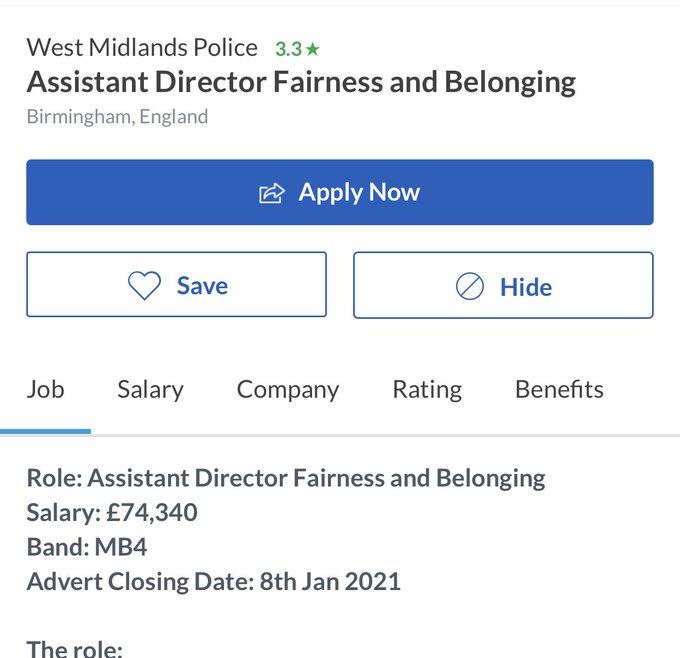
    The comments made by Nicola Richards, the Conservative MP for West Bromwich East, on 3 January 2021.

    New year, new Police and Crime Commissioner? Our current PCC thinks it’s acceptable to waste £74k a year on roles like this while he cries ‘government cuts’ as an excuse for unacceptable levels of crime in West Bromwich.

    Image