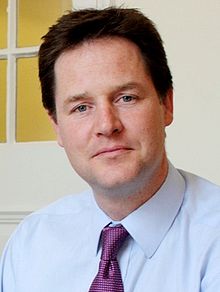
Tag: Nick Clegg

  • Nick Clegg – 2011 Speech to Liberal Democrat Spring Conference

    nickclegg

    Below is the text of a speech made by the Leader of the Liberal Democrats and Deputy Prime Minister, Nick Clegg, at the Liberal Democrat Spring Conference, held on 13th March 2011.

    This weekend is just the second time we’ve been together as a party again since those momentous events last May.

    I’ve really enjoyed fielding questions, queries – yes, some criticisms too – from many of you over the last couple of days.

    But it was a passing remark from one delegate that took me most by surprise.

    ‘It’s so nice to see you back’ she said. ‘I thought we’d lost you when you walked through that door of Number 10’.

    Let me reassure you.

    David Cameron hasn’t kidnapped me. Although I gather some people were planning to this weekend.

    My life may have changed a fair bit since the last election. But I haven’t changed one bit.

    We all know that we did not take the easy path last May. But we did take the right path.

    Yes, being in Government with the problems we inherited is hard.

    Explaining why we’re having to make cuts is hard.

    And being in Coalition with another party isn’t always easy either.

    Making compromises, settling differences, and going out to explain decisions which aren’t exactly the ones we’d make on our own.

    But every single day I work flat out to make sure that what we’re doing is true to our values.

    Because that’s what I owe to the country. To the millions of people we represent.

    And I owe it to you.

    I never forget that it is because of you, your tireless work, that Liberal Democrats are now in Government. I never forget that we are a party of fairness, freedom, progress and reform.

    We cherished those values in opposition. Now we’re living by them in Government.

    So yes, we’ve had to toughen up. But we will never lose our soul.

    The slogan at this conference says: In government, on your side.

    Some people have asked me: whose side, exactly?

    My answer is simple.

    We’re on the side of the people I call Alarm Clock Britain. On the side of everyone who wants to get up and get on.

    People who, unlike the wealthy, have no choice but to work hard to make ends meet.

    People who are proud to support themselves but are only ever one pay cheque from their overdraft.

    People who believe in self-reliance but who don’t want to live in a dog-eat-dog world.

    Who want everyone who can to work hard but they want children, the elderly and the vulnerable to be looked after too.

    People who believe it is as wrong to opt out of tax as it is to opt out of work.

    People who want the best for their children and need good local schools.

    Who rely on our NHS.

    Who want great public services but can’t stand seeing government waste.

    People who don’t want politicians lecturing them on how to live.

    And who are fed up with politicians taking their votes for granted.

    These are the people liberals have always fought for.

    Fought to get them votes, wages, jobs and welfare.

    Lloyd George’s People’s Budget to make the wealthy pay their fair share and give a pension to all those who’d worked hard.

    Keynes’ plans to make our economy work for everyone and provide jobs for all.

    Beveridge’s radical blueprint for a welfare state to give security and dignity to every citizen

    They may not have called it Alarm Clock Britain but they had the same people in mind.

    The people liberals have always fought for. And we always will.

    Those of you who were at the rally on Friday will remember that Ros Scott passed on to our new President, Tim Farron a copy of a book:

    On Liberty by John Stuart Mill.

    A reminder that we are the inheritors of a century and a half of radical liberal tradition.

    We’re not the heirs to Thatcher.

    We’re not the heirs to Blair.

    We are the heirs to Mill, Lloyd George, Keynes, Beveridge, Grimond.

    We are the true radicals of British politics.

    That was true a hundred and fifty years ago and it is still true today.

    In government, especially in difficult times, it is more important than ever to know whose side you are on.

    When money is tight you have to make choices. And the only way to get them right is to know who you are making those choices for.

    We are on the side of Alarm Clock Britain.

    They have been failed for generations.

    Failed by the tired tribalism of left and right.

    Failed because both of those political traditions forget about people and place their faith in institutions.

    For the left, an obsession with the state.

    For the right, a worship of the market.

    But as liberals, we place our faith in people.

    People with power and opportunity in their hands.

    Our opponents try to divide us with their outdated labels of left and right.

    But we are not on the left and we are not on the right.

    We have our own label: Liberal.

    We are liberals and we own the freehold to the centre ground of British politics.

    Our politics is the politics of the radical centre.

    We are governing from the middle, for the middle.

    In government. On your side.

    The first order of business for this Government has of course been to tackle the budget deficit Labour left behind.

    There is no hiding place.

    There can be no ducking out.

    But let’s be honest, this is not what we’re in politics for.

    I didn’t get into politics to balance the books.

    It is what we have to do – so we can do what we want to do.

    When we came into office, we were borrowing an extra £400m every single day.

    £400m we were asking our children to pay back.

    Everything I want for Britain –

    Great schools.

    World class hospitals.

    A balanced economy.

    Can only be built on strong foundations, and on sound public finances.

    Now, some people say to me: I understand we have to stop spending so much.

    I understand we have to sort out the deficit. But aren’t we doing it too quickly?

    In other words, why now?

    Here’s why:

    By cutting the deficit decisively we have restored confidence in Britain.

    Essential – because without confidence there can be no growth.

    We have helped keep interest rates lower for longer, helping families, helping businesses.

    It has meant making difficult choices.

    But at least they have been our choices…

    Not forced on us by the bond markets as they have been in Greece and Ireland.

    And the risks of delay far outweigh the risks of swift action.

    Labour’s delay would certainly be costly and could be deadly.

    And do you know what really annoys me about them?

    They refuse to set out how they would make their own cuts.

    Ed Miliband even boasted that their plans are: and I quote

    “A blank sheet of paper.”

    They call for us to produce a Plan B.

    But they haven’t even got a Plan A.

    Labour won’t take responsibility.

    They say they would cut but they won’t tell us where.

    They say their plan would be easier but they don’t admit their plan would mean three extra years of cuts.

    They want to be saying to the people in 2015: ‘more cuts are needed’.

    We want to say: we’ve done what needed to be done.

    This is a question of fairness.

    Above all, fairness to our children.

    Racking up £400m of debt in their name every day is not right:

    Our generation has a responsibility to the next.

    When it comes to the deficit, the real question is not when, or if.

    The real question is how.

    We have protected spending on schools, on science and on health.

    Found extra money for the pupil premium and apprenticeships

    Given councils more financial freedom than they’ve ever had before

    And we are increasing the amount we spend on overseas aid.

    We won’t turn away from the task of fixing the deficit.

    But nor will we ever turn our backs on the world’s poorest people.

    We are not just fixing the deficit

    We are laying the foundations of a stronger Britain and a fairer world.

    In local government, I know the cuts are difficult.

    But our councillors are showing what imagination, compassion and a bit of liberalism can do.

    I cannot tell you how proud I am that not a single Liberal Democrat-led council is closing a single Sure Start children’s centre.

    Sheffield has had a budget cut of more than 8%

    Every lost job is a loss we all feel keenly:

    But the Liberal Democrat council here has kept compulsory redundancies down to 270.

    And they have kept open every children’s centre, library and swimming pool.

    But cross the Pennines into Manchester, a council having to make almost identical savings.

    You’ll find a Labour council letting nearly 2,000 people go.

    So don’t let Labour take the moral high ground:

    In councils up and down the country they’re the ones making the decisions to cut services that could be protected.

    Some people say Labour are making cuts for political reasons…

    So they’ve got something to blame the coalition for in their local election campaigns.

    Let me say this:

    Anyone who sacks a member of staff or shuts down a public service for political purposes is a disgrace to politics and a disgrace to Britain.

    So yes, we have to tackle the deficit. But we are not a cuts government.

    If we get to 2015 and all we’ve done is pay off Labour’s deficit, we will have failed.

    Deficit reduction is just a fraction of the work we are undertaking.

    Bit by bit, step by step

    We are putting in place the cornerstones of a fairer, more liberal Britain…

    The four cornerstones we put on the front of our manifesto:

    a fair politics a fair, sound economy fair taxes and fair chances for all our children

    Maybe those changes don’t make the news every night like the cuts do.

    But they will be the liberal legacy of this Government.

    The legacy each and every one of us will be proud to share.

    Part of that legacy is proving that a new politics is not just possible –

    It’s better.

    The old political establishment, on the left and on the right, hate what’s happening to our politics.

    The old left screaming betrayal every time politicians work across party lines or make a compromise.

    The old right simply horrified to see Liberal Democrats in government at all.

    We are showing that new politics, plural politics, coalition politics, can work for this country.

    And it terrifies them.

    There are enemies of reason across the political spectrum.

    But there are friends of progress too – and the future of politics belongs to them.

    It belongs to us.

    People used to say coalition governments weren’t British.

    I am sure our coalition partners will forgive me for reminding them of their attempts, in the last days of the election campaign, to portray the horror show of a hung parliament.

    Remember what they said? A hung parliament and coalition government would mean.

    “Indecision”

    “Weak government.”

    “A paralysed economy”

    Well, it hasn’t turned out like that, has it?

    The Coalition Government is strong and it is radical.

    The main criticism now made of the government is that we are doing too much.

    That we are too ambitious.

    Perhaps the new complaint about coalition governments is that coalitions are too strong.

    But two parties sharing power in Westminster is just the start.

    We need to share power with the people.

    Let me quote you some words that inspired me many years ago:

    ‘The old politics is dying.

    The battle to decide what the new politics will be like is just beginning.

    It is possible, just possible, that it will be a politics for people.”

    Shirley Williams wrote that three decades ago, as she and others set out to change the shape of British politics.

    Shirley was an inspiration then, and is an inspiration today.

    Shirley, perhaps it has taken longer than you thought, but here we are.

    A new politics is beginning at last.

    We must make it what you dreamt of: a politics for people.

    The Coalition Government is shifting power from state to people:

    Restoring civil liberties

    Protecting personal freedom and privacy

    Crushing the ID database

    We’re ending the house arrest of Labour’s Control Orders

    Guaranteeing freedom of the press

    Undertaking the biggest devolution of financial power to Scotland since the formation of the United Kingdom

    Tearing up the Whitehall rules that dictate to Town Halls how to spend local people’s money

    Running a successful referendum to give more power to Wales

    Putting public health in the hands of local authorities.

    Reforming party funding

    Giving voters the right to sack corrupt MPs

    Creating an elected House of Lords, finishing the job this party started a century ago

    We passed the policies, conference after conference…

    Now, finally, we’re passing the laws.

    And, of course, a referendum to change our voting system…

    For the first time ever, the people of Britain choosing how to choose their MPs.

    You can tell the ‘No’ campaign are desperate.

    Making up ludicrous stories

    Basically making it up as they go along.

    What are they so scared of?

    AV is a small change that makes a big difference.

    It keeps what people like about the current system, like constituency MPs.

    It simply puts people, rather than politicians, in charge.

    Makes MPs work harder for your vote.

    And helps end the scandal of safe seats for life.

    On the Yes campaign we have the Liberal Democrats, Labour party supporters, the Green Party, UKIP, Plaid Cymru, the SNP, Friends of the Earth, Colin Firth, Eddie Izzard and Helena Bonham Carter.

    On the No side of the argument are the BNP, the Communists, the Conservative Party.

    John Prescott, Norman Tebbit and David Owen.

    Tricky one.

    It’s simple.

    If you want more duck houses: vote no.

    If you want more democracy: vote yes.

    In seven weeks, the British people can sound the last post for first past the post.

    So we have seven weeks to get our message across:

    If you want MPs to work harder for your vote, vote yes.

    If you want politicians to listen to whole country, not just swing voters in marginal seats: vote yes.

    If you want an end to jobs for life in safe seats, vote yes.

    If you want a new politics, vote yes.

    But it’s not just a new politics we need.

    We need a new economy.

    The deficit is the most obvious symptom of an unbalanced, unsound, unfair economy.

    An economy based on speculation and debt, rather than growth and investment.

    We need an economy that works for Alarm Clock Britain, not just for the financial elite

    We need an economy that works for us all.

    Dealing with the deficit is just the first step to making that possible.

    We have to get growth going again.

    A new kind of growth.

    The budget ten days from now will be a budget for growth:

    For green growth.

    For balanced growth.

    Building the homes our children will need.

    Getting young people into work.

    Investing in the low carbon economy of the future.

    No more dependency on the City of London and its coffers:

    A flourishing future for the great cities of the North and the Midlands…

    Cities which will be the engines of growth in our economy.

    As they were in the past and as they will be again.

    As for the banks, I agree with Mervyn King.

    The Governor of the Bank of England says that it simply isn’t sensible or right to have banks which are so big that if they fail we have to bail them out.

    It’s not good for the economy.

    It’s not good for taxpayers.

    And it’s not good for Britain.

    Under the old model, a handful of financial institutions were able effectively to hold the country to ransom.

    And who paid the biggest price for Labour’s failure to regulate the banks properly?

    Ordinary, hard-working taxpayers, that’s who.

    We will not let that happen again.

    So we are fixing the banks.

    We are going to take £10 billion more than Labour planned in taxes off them this parliament.

    We’re making sure they lend £10 billion to ordinary businesses this year alone.

    Making them come clean about how much they pay their top people with the toughest disclosure regime in the world.

    And – most importantly of all – we set up an independent Banking Commission to advise us on a sustainable future for the whole banking industry.

    And we will act on what it recommends.

    The banks must go back to being the servants of the economy, not the masters.

    And people are fed up with a system where those on ordinary incomes have to pay taxes they can’t afford.

    While people at the top accumulate vast wealth no questions asked.

    Forget the tired arguments of the left and right focusing solely on top-rate tax.

    We need proper tax reform. Liberal tax reform.

    My philosophy on tax is simple:

    Less tax on aspiration, enterprise and hard work.

    More tax on pollution and unearned wealth.

    These are the principles which are already shaping government tax policy and will continue to do so in the years to come.

    From next month, 900,000 people will stop paying income tax altogether.

    Every basic rate taxpayer will pay £200 less a year in tax.

    We will take real steps every year, including in the Budget in ten days time, towards our goal that nobody earning less than £10,000 pays any income tax at all.

    From the front of our manifesto to the pay-packets of 23 million people.

    Do you know who did that?

    You did that – everyone of you in this hall.

    You did it.

    You designed the policy.

    You voted for it at a conference like this one.

    You campaigned for it.

    And now it’s happening.

    So get out there and tell people about it.

    On every doorstep and in every town.

    An extra £200 in your pay packet starting next month.

    By 2015, no tax on the first £10,000 you earn.

    Labour think fairness means taking money off people and then making them fill out forms to get it back again.

    We say no.

    We say that you shouldn’t pay tax until you’ve got enough to get by.

    Work has got to pay.

    So we’re fixing welfare to make sure it always does – to break open the poverty trap Labour created.

    As Beveridge himself said: “The State should not stifle incentive, opportunity or responsibility”

    So our universal credit will send a simple, clear message:

    Work pays.

    Even an hour of work pays.

    Do what you can, and we will help you.

    There are of course some difficult welfare cuts coming.

    We are building a system of welfare that is fair to recipients, and fair to the taxpayers.

    A system Beveridge would be proud of.

    And for pensioners, from next month our ‘triple guarantee’ will mean that everyone will be protected in retirement.

    Never again the indignity of Labour’s 75p pension rise.

    Under our plans, pensioners will get £15,000 more in state pension over their retirement than under Labour.

    And who did that?

    You did that.

    So tell every pensioner in your community, on your street, about it.

    About the difference you made.

    And let me also be clear.

    Responsibility goes all the way up the income scale.

    So we’re going to make the top bankers come clean about their own pay and bonuses.

    And we’re going to make sure they pay their taxes.

    We will always be just as tough on tax evasion at the top as on benefit fraud at the bottom.

    Because ordinary workers in alarm clock Britain don’t set up offshore trusts to avoid paying tax:

    They pay their way – and that’s a standard everyone should live by.

    They also deserve world-class public services,

    That will mean change, some of which may feel uncomfortable.

    But we have to open up our public services if we want them to improve.

    I know that many of you have concerns about the Government’s plans for the health service.

    What I need you to know is that all of us in Government are listening, and that we take those concerns seriously.

    We have campaigned for years for an NHS that gives more power to professionals and to patients.

    Do not believe for a moment Labour’s scare-mongering about privatising the NHS.

    No government of which I am part will tamper with the essential contract at the heart of the NHS: to care collectively for each other as fellow citizens.

    World-class health care for all.

    Publicly funded. Free.

    Centred on patients, not profit. So yes to health reforms.

    But no – always no – to the privatisation of health.

    We want a great NHS.

    And we want great schools, too.

    A fair start for every child.

    Under Labour, the opportunity gap widened – even as billions of pounds were invested in our public services.

    That’s their legacy of shame; the wasted money that could have made a difference.

    We must do more, even though they left us with less.

    Life chances should not be determined by background.

    Prospects should never be narrowed by the postcode of the home you are born into.

    Birth should never be destiny.

    As liberals, we believe in an open society

    Where the power to shape your own future is in your hands

    Where all roads are open, to all of our children.

    That is why Sarah Teather is providing free pre-school education to every two year-old from a poor backgrounds.

    That is why we have introduced a pupil premium putting £2.5 billion extra into schools that take on the children most likely to fall behind.

    That is why we are creating 350,000 new apprenticeships, helping people get a trade and get ahead.

    And that is why we are opening up our universities to poorer students.

    We are introducing a national scholarship scheme.

    So that young people from any background can go to university.

    It is no secret that we could not deliver our policy to abolish tuition fees.

    And I know how deeply people regret that.

    But though we have been divided, we can now unite, together, behind one clear mission:

    To make university access fair, fair for all.

    Right now, our best universities are almost monopolised by the better-off.

    A pupil at a private school is fifty-five times more likely to get into Oxford or Cambridge than a pupil who qualifies for free school meals.

    But what’s even more scandalous is that there are still some people in these institutions who shrug their shoulders and say:

    That’s just the way things are.

    They are wrong and they will have to change.

    We are insisting that universities wanting to charge more for courses have to open their doors more, more than ever.

    And let me be clear to the universities…

    Open your doors or we will cut your fees back down to size.

    No more blaming the system.

    Fair access: fair access now. It isn’t just the universities.

    Many of our liberal ambitions will be opposed by powerful interests.

    But we are used to it.

    We have faced them throughout our party’s history.

    Let’s face them again.

    The reform-blockers in the House of Lords, clinging to their unaccountable powers

    The MPs in Westminster opposing voting reform that threatens their safe seats

    The political party machines, afraid to wean themselves off big money

    The unions standing in the way of reforms to give patients and parents more power

    The financiers in the City of London, resisting fairer regulation and transparency

    All looking out for themselves, protecting their turf, trying to close the doors against change.

    Well, we’re not having it.

    Who stands up for the interests of the people without a lobbying group?

    I’ll tell you who does.

    We do.

    And we are not going to let them down.

    I do not underestimate the scale of the tasks we face.

    These are testing times for the country.

    Testing times for the Government.

    Testing times for us as a party.

    Let’s be honest, after seven decades in opposition, 2010 was not the easiest time to return to Government.

    But we have shown ourselves to be up to the task.

    We will not shrink from our responsibilities as a party of government.

    We will not flinch from taking the difficult decisions to put this country back on track.

    We will not miss this opportunity to build a more liberal Britain.

    I know that being in the Coalition Government means us having to take some difficult, even painful, decisions.

    But clinging to the comfort blanket of opposition would not have made life more comfortable for our fellow citizens.

    It would have been an abdication of responsibility.

    Never, ever, doubt the value of being in Government.

    Would a Government without Liberal Democrats have ended child detention?

    Got an extra ten billion out of the banks?

    Would it have held a referendum on the voting system?

    Or put up capital gains tax?

    Ordered an inquiry into torture?

    Brought in a pupil premium?

    Or replaced Control Orders?

    Would a Government without Liberal Democrats have cut taxes for the poorest?

    I don’t think so.

    In just a few weeks time, we’ll be taking the liberal message to Scotland and Wales, and in council seats up and down the land.

    When you go into this election campaign – and people are asking what difference we have made to government –

    You go ahead and tell them.

    Tell them that this government is getting our economy moving.

    Tell them that this government is getting the banks lending.

    Tell them that we are cutting income tax.

    And raising the state pension.

    Investing in our children.

    Renewing our political system.

    And restoring civil liberties.

    Tell them how we are working to build a liberal Britain:

    Tell them:

    We are in government.

    And we are on your side.

  • Nick Clegg – 2011 Speech in Brazil on the Green Economy

    nickclegg

    Below is the text of a speech made by the Deputy Prime Minister, Nick Clegg. The speech was made in Brazil on Tuesday 21st June 2011 and was on the subject of innovative business in the green economy.

    “I have to confess: this is my first trip to Brazil. But I have wanted to come here for many years.

    “Like all of your visitors, I’ve been struck by Brazil’s beauty, your hospitality. But, more than anything, by your sense of pride, of confidence. By the sense that right here, right now, so much is possible.

    “It’s no real surprise, of course.

    “In just a few decades Brazil has undergone a transformation that takes most countries centuries.

    “Democracy, growth, economic development. Millions lifted out of poverty – 24 million in just eight years. A voice on the global stage that grows stronger by the day.

    “In all of history has a country ever risen so dramatically, so peacefully, attracting such global goodwill?

    “Brazil was once described as a country of the future; clearly now it’s the future that belongs to Brazil.

    “And it’s our shared future I want to talk about today. A new partnership between Brazil and the UK. A partnership for prosperity, where we work together to generate wealth and opportunity for our people.

    “Trading more, learning from each other as we reform our economies, but also standing shoulder to shoulder in the world to advance our common values: democracy, fairness, economic openness, multilateralism.

    “Because, in the long-term, that’s how we create the peaceful and stable world in which we both can thrive.

    “Before I talk about how we can work together more closely, let me set out why I believe we can.

    “History shows that UK-Brazil relations matter.

    “In the nineteenth century Britain supported and helped in Brazil’s war of liberation and negotiated Portuguese recognition of Brazilian independence.

    “A hundred years later, as Europe was torn apart by unprecedented destruction, Brazilian soldiers fought with us, helping to defeat the forces of fascism. Making sacrifices for which we will always be grateful.

    “Ours has long been a reciprocal friendship, a two-way friendship between nations that stand together when it counts.

    “Our ties are not new, but they have been allowed to slacken.

    “We don’t trade enough. We don’t share knowledge in the way we could. We don’t automatically think of each other as allies in the world.

    “True, recent years have seen some improvement – in business and investment; in cooperation in defence, and on development policy.

    “We worked together effectively on biodiversity at Nagoya, and on climate change at Cancun.

    “I don’t want to downplay that progress. But we must be much more ambitious about what we can achieve together.

    “There remains great potential for Brazil and the UK to do more.

    “That’s why I’m here.

    “As part of a new and lasting period of engagement between our great nations. Modern nations. Reforming nations. Nations that do not look at the world as it once was, but who see it for what it is today, what it will be tomorrow.

    “And who understand that, on all of our big challenges – tackling global warming, setting the world on a path of sustainable growth, eliminating poverty and disease, fighting terrorism and organised crime – on all of them we are stronger together than we are apart.

    “At the heart of this partnership are our values.

    “The world is often carved up according to imaginary lines: North/South; East/West; Developed/Developing.

    “But the real divide is about what you believe.

    “There are closed societies: where power is abused, liberty curtailed, opportunity hoarded, and governments look inwards as the rest of the world is shut out.

    “And there are open societies: internationalist in spirit, committed to fairness, freedom and democracy.

    “Brazil and the UK stand on the same side of that divide.

    “Of course, in any genuine, equal partnership there will be give and take. Moments when we don’t agree.

    “We look, for example, for the same outcomes in the Arab world, yet we sometimes differ on the best way to achieve them. And, when we disagree, we should be upfront about it.

    “However, I believe, ultimately, we can be confident about navigating those moments.

    “Confident that, while we may differ on the means, we nearly always agree on the ends and, in our heads and in our hearts, we are usually coming from the same place.

    “So how do we deepen our ties?

    “The first part of the answer is trade.

    “For the UK, this visit is, ultimately a trade mission. If that sounds hardheaded, that’s because it is.

    “Trade means jobs. That’s what the people of the UK want.

    “But never underestimate the cohesive power of trade.

    “It brings people together, fostering new understandings. Not between governments, or diplomats, but people; businesses; their staff; and their communities too.

    “Trade ensures nations have a stake in each other’s success. In working together peacefully, constructively, and towards the same goals.

    “So I’m delighted to unveil new business contracts between UK and Brazilian companies worth £2.5bn to the UK economy – a significant boost.

    “BT, BP, BG – British companies, doing more business in Brazil, bringing the benefits home.

    “Contracts that boost the bright futures of some of our most iconic businesses, like Rolls Royce and JCB, both of which are expanding operations here in Brazil.

    “Contracts that filter down the supply chain.

    “For example, by underwriting a credit line for Brazilian steelmaker Gerdau, the UK government has secured £270 million worth of exports from the UK, with orders placed with dozens of companies around the country.

    “And contracts that help the UK rebalance our economy away from our previous overreliance on a limited number of sectors, with deals in telecoms, manufacturing, pharmaceuticals – some of the key industries to the UK’s future success.

    “I’m accompanied by a business delegation, representing energy, infrastructure, engineering, financial services, to name a few. Here to promote the UK as one of the easiest places on the planet to do business – that’s according to the World Bank – as well as a gateway to global markets.

    “And we are deeply ambitious about what we want to achieve.

    “Nothing short of a new era in expanded trade and booming business between our two nations.

    “It is true that the UK was hit hard by the global financial crisis, and the UK Government is having to implement a decisive plan for fiscal consolidation, cutting spending and raising some taxes too.

    “But, by doing so, we have retained the confidence of international markets and gained the backing of major international institutions, including the IMF, the EU, and OECD.

    “We are also reforming our financial sector so that risk is better managed, and the wider economy is better insulated from shocks.

    “So the UK should be an attractive destination for Brazilian investment. And we offer a different kind of deal.

    “We know what the Brazilian economy already excels at.

    “We know too how many international partnerships you have forged.

    “But the great challenge for all advanced economies in the 21st century is to stay smart. To get ahead of the curve – in technology, in education, in energy efficiency, effective regulation and public services.

    “That is where we can help. Ours is a dynamic, agile, and innovative economy.Where we value sustainability, where we recognise the need to confront structural barriers to growth.

    “That’s why we’re focusing resources on schools and training. We’re reforming higher education to keep our universities world class, and we’re building on our world-class research base to get further ahead in the industries of the twenty first century: green technology, renewable energy, aerospace, and many more.

    “It’s a long-term view. Looking beyond the next year, or the year after. Looking decades ahead.

    “Because that is the key to growth that lasts.

    “I know Brazil is also thinking not only of today. That you are lifting your sights to the horizon. And on that we can help each other too.

    “We can learn from each other to diversify our economies, drawing on each others’ expertise.

    “Your success in biofuels and renewable energy. Our experience in carbon trading and our new Green Investment bank – a world first.

    “Your groundbreaking welfare programmes. Our insights in education.

    “We can pass on lessons from our preparations for London 2012 to help deliver a successful Rio 2016.

    “Perhaps, in return, you can tell us the secret of how to win five world cups.

    “It’s a new way of working together – a step change in our relationship.

    “This week we are agreeing UK/Brazilian cooperation that – in its scope and depth – has never been seen before.

    “On crime, to tackle drugs here in Brazil and help get cocaine off the UK’s streets too.

    “On international development, to combine our efforts and help some of the world’s poorest.

    “On the upcoming Rio +20 conference – twenty years on from the 1992 Earth Summit – to set out a plan for sustainable global growth.Never have our nations agreed to work so closely, on so many issues…Coming together for our common good.
    And as we move forward together, we must recognise that this partnership is not just about what we can do, directly, with each other, but also what we do, together, in the wider world.

    “Because our fortunes do not exist in a vacuum. They depend on the health of the global economy within which we operate and, following the global financial crisis, that economy is still not in a good state.

    “Different countries have weathered the storm differently. Brazil has dealt with it extremely well.

    “You were the last into recession and the first out – and, again, there are lessons we want to learn.

    “And the challenges nations face are also different.

    “In the UK we are dealing with the consequences of years of excessive debt, private and public.

    “In Brazil, you are thinking more about the dangers associated with rising inflation.

    “In the UK we are having to rebalance our economy by moving away from private consumption and government expenditure, towards net exports and investment. That, along with fiscal consolidation, will help deliver sustainable growth.

    “For so-called emerging nations, on the other hand, rebalancing means deepening domestic markets to increase consumption and spread the benefits of prosperity.

    “But what is the same is that, for either of us to meet those challenges, we both need a global economic environment able to withstand shocks.

    “Where we strive for steady and sustainable global growth based on stable finances, built on responsible financial markets and underpinned by political stability.

    “That means effective international institutions. And it’s on that point that I would like to finish.

    “In our interdependent economy, multilateralism is not a luxury, it’s a must.

    “But our institutions must be more nimble. Better equipped to guard against risk, respond to crises, enforce rules and norms that advance our shared success.

    “That will be impossible until those institutions are reformed to suit the modern world. Until they reflect today’s geography of power, with all of the major powers properly heard. Nations – like Brazil – who should be shaping the agenda, offering unique insights, being part of the big decisions, and then using your power to see those decisions through.

    “Huge strides have been taken in establishing multilateral cooperation over the last sixty years, but the reality is, unless new actors are brought fully into the multilateral system, they will increasingly look for other ways to operate and our international institutions will become increasingly defunct.

    “The UK doesn’t want to see that happen.

    “That’s why we actively support a permanent seat for Brazil at the UN Security Council.

    “We pushed for the recent changes to IMF voting weights, to more fairly distribute influence. Changes we’re ratifying through our Parliament, without delay.

    “And we want the G20 to continue as an effective, inclusive forum where we address global economic challenges.

    “So it’s time for old powers to make space.

    “We want you with us, fully represented.

    “But – of course – fully responsible too.

    “Being a full member of the club is one thing, but it becomes meaningless unless we all make sure that club works.

    “So our nations must be activists for the things we believe in.

    “We see Brazil doing that more and more, whether by standing up for human rights or helping deliver peace and stability – not least through your leadership of the UN Stabilisation Mission in Haiti.

    “That increased engagement bodes well for the future. Because the world needs an active Brazil, fighting for progress on a fair, global trade round.

    “Using your experience and growing influence to help secure stability in the Middle East. Helping implement the climate change commitments agreed in Cancun. And building on them to deliver a successful Durban Summit at the end of the year.

    “Promoting democracy because you know from your own experience that in underpins stability and success.

    “It’s no coincidence, after all, that of the world’s top twenty economies only three are not fully democratic.

    “On every big question facing the world today, there is no answer without Brazil. And the UK wants to stand alongside you to find the best solutions.

    “So, to conclude – a new partnership for prosperity between Brazil and the UK.Built on trade, on sharing knowledge and expertise. Where we fight for our values – democracy, fairness, openness.

    “Working alongside each other in international institutions fit for the 21st Century.

    “It’s a different kind of relationship, with Britain and Brazil partners for prosperity and social progress, and partners in a fairer, more responsible global system.

    “And we must now make a choice:

    “We can drift along as before. Friendly, but not very close.

    “Working together sporadically, but not building deep and lasting bonds.

    “Or we can commit to a real, meaningful, strategic partnership, coming together as a new force.

    “One that will be good for the people of the UK, good for the people of Brazil. And, I believe, good for the wider world.”

  • Nick Clegg – 2010 Speech to the United Nations Millennium Development Goals Summit

    nickclegg

    Below is the text of the speech given by the Deputy Prime Minister, Nick Clegg, to the United Nations Millennium Development Goals Summit on the 22nd September 2010.

    It is an honour for me to address the General Assembly today for the first time as Deputy Prime Minister of the United Kingdom.

    And it is a privilege to be here with you to discuss how together we can reach the Millennium Development Goals;

    To make the necessary commitments towards eradicating the problems that blight the world we share:

    Poverty, hunger, disease, and the degradation of our natural environment.

    This week we are reviewing progress, assessing obstacles, and agreeing a framework for action to meet our targets.

    These are the technocratic terms in which governments must necessarily trade.

    But let us be clear: behind the officialese of summits lies our single, common purpose:

    To uphold the dignity and security that is the right of every person in every part of the world.

    Development is, in the end, about freedom. It is about freedom from hunger and disease; freedom from ignorance; freedom from poverty.

    Development means ensuring that every person has the freedom to take their own life into their own hands and determine their own fate.

    The last decade has seen some important progress.

    That progress has, however, been uneven, and, on a number of our goals we remain significantly off track.

    Britain’s commitment

    So my message to you today, from the UK government, is this – we will keep our promises; and we expect the rest of the international community to do the same.

    For our part, the new coalition government has committed to reaching 0.7% of GNI in aid from 2013 – a pledge we will enshrine in law. That aid will be targeted in the ways we know will make the biggest difference.

    And I am pleased to announce today that the UK will be stepping up our efforts to combat malaria.

    In Africa, a child dies from this disease – this easily preventable disease – every 45 seconds. So we will make more money available, and ensure that we get more for our money, with the aim of halving malaria-related deaths in ten of the worst affected countries.

    The UK government is also proud to be boosting our contribution to the international drive on maternal and infant health. Our new commitments will save the lives of 50,000 mothers and quarter of a million babies by 2015.

    The case for development

    The UK makes these commitments at a time of significant difficulty time in our domestic economy.

    The new government has inherited a £156bn budget deficit, so increasing our international aid budget is not an uncontroversial decision.

    Some critics have questioned that decision, asking why, at a time when people at home are making sacrifices in their pay and their pensions, are we increasing aid for people in other countries?

    But we make this choice because we recognise that the promises the UK has made hold in the bad times as well as the good – that they are even more important now than they were then.

    Because we understand that, while we are experiencing hardship on our own shores, it does not compare to the abject pain and destitution of others.

    Because we take seriously the fact that the new coalition government is now the last UK government able to deliver on our country’s promises in time for the 2015 MDG deadline.

    And because we know that doing so is in our own, enlightened self-interest.

    When the world is more prosperous, the UK will be more prosperous. Growth in the developing world means new partners with which to trade and new sources of global growth.

    And, equally, when the world is less secure, the UK is less secure within it.

    Climate change does not somehow stop at our borders.

    When pandemics occur, we are not immune.

    And when poverty and poor education fuel the growth of global terrorism, our society bears the scars too.

    Twenty two of the thirty four countries furthest from reaching the MDGs are in the midst of or emerging from violent conflict.

    Fragile spaces – like Afghanistan – where hate can proliferate and terrorist attacks can be planned, where organised criminals can harvest the drugs that ravage our streets, where families are persecuted, displaced, pushed to seek refuge with us.

    So we do not see the Millennium Development Goals just as optimistic targets for far away lands; they are not simply charity, nor are they pure altruism.

    They are also the key to lasting safety and future prosperity for the people of the United Kingdom, and of course, for people right across the globe.

    On what we expect of others

    We welcome the General Assembly’s agreement to annually review progress made against the commitments agreed at this Summit.

    The UK will stand up to that test.

    Today I call on others to show equal resolve.

    The Millennium Development Goals must be a priority for each and every nation present in this room. Developed nations must honour their commitments.

    And developing nations must understand that they will not receive a blank cheque. Developing countries and donors must work together – as equal partners – towards securing our common interest.

    They will be expected to administer aid in ways that are accountable, transparent, and responsible – creating the conditions for economic growth and job creation.

    Prioritising national budgets on health, infrastructure, education and basic services.

    Managing natural resources, particularly biodiversity, in an environmentally sustainable way. Improving the lives of women and girls: empowering them; educating them; ensuring healthy mothers can raise strong children. There can be no doubt that women and girls hold the key to greater prosperity: for their families, for their communities, and for their nations too.

    Conclusion

    If we each step up, we can meet the Millennium Development Goals.

    We can liberate millions of people from daily suffering, and give them the resources to take control of their lives, and their destinies.

    So let future generations look back and say that they inherited a better world because – at this critical moment, at this difficult moment – we did not shrink from our responsibilities.

    Let them say that we rose to the challenge, that we kept our promise.

  • Nick Clegg – 2010 Speech on Social Mobility

    nickclegg

    Below is the text of the speech made by the Deputy Prime Minister, Nick Clegg, on 18th August 2010.

    As of today, the new Coalition Government is 100 days old. Inevitably there is a plenty of discussion about our performance to date. Everyone will have their own view about the start we have made.

    I am proud of our achievements so far, from civil liberties, to political reform, to steps to reshaping our public services. And of course, our first Budget, which set out our plans to repair the public finances.

    Our critics characterise us as being solely defined by our public spending cuts. So let me be clear: tackling the deficit is our immediate priority. But is it not our be-all and end-all. This Government is about much more than cuts.

    This Government is committed to the long term – to making decisions today that will promote a better future: a more prosperous economy, and a fairer society. Our determination to fix the deficit is matched by our determination to create a more socially mobile society.

    Today I will set out:

    – How we are a Government focused on the long-term;

    – Why our long-term social policy goal is social mobility;

    – The key obstacles we face in promoting social mobility; and

    – The next steps we will be taking as Government to overcome them.

    Let me start by outlining what it means to be a government for the long-term.

    My colleague David Willetts in his book, The Pinch, focuses on the theme of intergenerational justice. In the book David explains that the Tribal Council of the Iroquis, a North American tribe, believed that all tribal decisions should be considered in light of their impact on the next seven generations. The contrast with modern politics – in which, famously, seven days is seen as a long time – could not be greater.

    I am not going to promise the introduction of a 7-generation rule into the British legislative process. But I am going to argue that the Coalition government’s approach to politics, and to policy-making, is moving beyond the short-termism that has disfigured politics in recent years.

    Governing for the long-term means thinking not only about the next year or two, or even the next parliamentary term. Governing for the long-term means recognising that the decisions of one generation profoundly influence the lives and life chances of the next.

    In economic policy, this means taking the difficult decisions to tackle the deficit and provide the conditions to create the jobs and opportunities of the future. There is no doubt that many of these decisions are painful. But let me tell you, there is nothing fair about saddling the next generation with our debts.

    That is why we have set out a five-year trajectory for the public finances, and established an independent Office for Budget Responsibility. These are evidence of our determination to put economic policy – as well as the economy – onto a more sustainable footing.

    Decisive action to address the deficit is what we have to do in order to do what we want to do. And what we want is to build a fairer nation. This means, in particular, creating a more socially mobile Britain. And this, by definition, is a long-term goal.

    I am acutely aware that it is very much easier to declare political support for social mobility than it is to improve it. If social mobility were improved every time a politician made a speech about it, we’d be living in a nirvana of opportunity.

    This is a complex and contested area of both research and policy. And action to improve social mobility will take many years to take effect. In policy terms, it is like turning the wheel on an oil tanker.

    Promoting social mobility is a long-term business. And it is precisely for that reason that it is vital to establish now, at the beginning of our time in office, that promoting social mobility is at the top of our social agenda.

    Given this commitment, it is very important to be clear about what we mean by social mobility, and why it matters so much.

    As a term, social mobility has a more than slightly wonkish feel. It sounds – with apologies to my kind hosts – very much like a think-tank phrase.

    And yet I think social mobility is the mark of a good society, the badge of fairness. My particular focus is on inter-generational social mobility – the extent to which a person’s income or social class is influenced by the income or social class of their parents. Social mobility is a measure of the degree to which the patterns of advantage and disadvantage in one generation are passed on to the next. How far, if you like, the sins of the father are visited on the son.

    There is of course plenty of argument within the social science community about precise measures, international comparisons and preferred metrics. But I think intergenerational social mobility speaks to most people’s definition of fairness.

    Fairness means everyone having the chance to do well, irrespective of their beginnings. Fairness means that no one is held back by the circumstances of their birth. Fairness demands that what counts is not the school you went to or the jobs your parents did, but your ability and your ambition.

    In other words, fairness means social mobility.

    And social mobility matters for both ethical and economic reasons. For me, an important strand of liberal ethics is that opportunities are detached from origins. As a liberal, I am optimistic about the capacity of people to shape good lives for themselves and deeply committed to tearing down the barriers – whether they are barriers of class, attitude, wealth or bureaucracy – that stand in their way.

    Liberal optimism is founded on a conviction that children have unimaginable – unpredictable – potential. A socially mobile society is one that is waiting for them, open to their talents, ready for their determination.

    As things stand, the evidence on social mobility is not encouraging, either historically or internationally. There is some evidence of a worsening in rates of social mobility between income groups for people born in 1958 compared to 1970. Other studies show that, at best, social mobility rates have flat-lined over the last two or three decades. Data collected by the OECD shows that, of 12 developed countries, the UK is the one where the earnings of individuals are most strongly related to the earnings of their parents.

    Every minute, another baby is born in this country. The question is: what future lies ahead of them. What will their lives be like? We should not already know the answer to this question. But, tragically, we can already predict the likely fortunes of too many of these children, because of the clear influence of social background.

    For too many, birth and destiny are closely intertwined.

    This is not to say that everybody’s life is determined from day one. But it is clear that the odds are stacked against some of those newborns, and in favour of others. And when that is the case, we are not just talking about inequality, but about what amounts to social segregation.

    Social segregation occurs when inequalities become frozen across time, when people are trapped in the position of their birth.

    As well as this clear ethical demand for social mobility, there is also an economic argument for action. If a talented person is unable to rise because of the barriers to opportunity, it is not only their life which is damaged, but the prosperity of the nation.

    The Sutton Trust, for example, estimates that if we could narrow educational inequalities to the levels of countries with a better record on social mobility we could add significantly to the size and dynamism of the UK economy.

    The relationship between social mobility and a high-skill economy cuts both ways. One of the main engines of upwards social mobility is the creation of more professional and highly-skilled jobs, creating what social scientists call ‘more room at the top’. And this, in turn, increases the opportunities for people to move up.

    It is also important to be clear about our objectives in social policy, and the difference between, for example, poverty reduction and the promotion of mobility. The goal of improving social mobility overlaps with other objectives for social policy, such as reducing poverty or narrowing income inequality. But it is not the same.

    Labour, despite 13 years of government, billions of pounds of investment and a plethora of initiatives, schemes and credits, appears to have failed to move the needle on social mobility.

    I think this was for two principal reasons:

    First, they were confused about what they were trying to achieve. Sometimes social exclusion seemed to be the focus, sometimes poverty, occasionally income inequality. Social mobility only gained prominence towards the very end of Labour’s period in office – and by this time it was too late.

    They were confused about their ultimate aims in social policy, which meant a diffusion of effort. It was stop-gap policy-making in an area where absolute consistency and a relentless focus on the main goal is required if the long term changes are to be delivered over time.

    Second, there was too much reliance on standardised, centralised, universal solutions rather than putting power and resources in the hands of those who need them most. Draw a line here, set a target there, tick boxes everywhere. All with good intent, but too often, with precious little long-term effect.

    We saw this in the approach to targets for exam results, where, all too often, disproportionate emphasis was placed on  getting borderline cases over the Whitehall-determined 5-GSCE line, rather than on releasing the potential of all young people.

    But it was visible in Labour’s approach to poverty, too. Poverty in the sense of current income levels can be tackled through the transfer of cash. And of course reducing poverty, at any particular point in time is hugely important in building a fairer nation.

    This Government has made clear its commitment to tackling poverty. And I am delighted that Frank Field is working with the Government on the way that deprivation links to life chances.

    But we also recognise that poverty reduction is not enough in and of itself.

    Under Labour huge sums of money were spent pushing low-income households just above the statistically defined level of household income – sometimes by just a few pounds a week – but with no discernible impact on the real life chances of the next generation.

    Tackling poverty of opportunity requires a more rounded approach. Welfare reform, for example, should be based on the need to improve people’s lives, not just raise their incomes. And I know this is what is animating the work of Iain Duncan Smith at the Department for Work and Pensions.

    So the result of the last thirteen years has been lots of government activity, but too little social mobility. An important CentreForum report on this issue in 2006 concluded: ‘the rate of intergenerational social mobility has stabilised at levels in the UK that are unacceptable’. I agree.

    Of course, no single political party should attempt to claim the moral high ground on this issue. This is not an area where any party or political philosophy can claim a monopoly of wisdom. But I do want to argue today that this government will take a distinctly different approach.

    That means, above all, understanding the nature of the problem we face. Our national failure on social mobility, in spite of years of economic growth and investment in public services, has to be properly understood in order to be reversed.

    I am not today going to offer you any definitive answers to the complex questions that have exorcised social scientists for decades. You would be rightly sceptical if I did. But I will identify what this Government believes to be five key sources of social segregation.

    First, the diverging paths of different children in the early years. We now know a good deal about the widely varying rates of development for children, long before they hang up their coat for their first day at school. This is again an area where CentreForum has produced excellent analysis.

    Early years investment also illustrates the distinction I made earlier between anti-poverty and pro-mobility measures. High quality pre-school education will not alter the statistics on income distribution or household poverty levels. But it will change the lives of the children who benefit.

    Second, the different degree to which different parents invest in and engage with their own children’s development and progress. Parents are in the frontline when it comes to creating a fairer society, in the way that they raise their children.

    According to one study, the amount of interest shown by a parent in their child’s education is four times more important than socio-economic background in explaining education outcomes at age 16.

    This is not an area where the state can simply pull a lever or two and put things right. These are also potentially perilous waters for politicians. But at the same time we must not remain silent on what is an enormously important issue. Parents hold the fortunes of the children they bring into this world in their hands. All parents have a responsibility to nurture the potential in their children.

    I know, like any mother or father, how difficult it can be to find the time and the energy to help, for example, with your children’s homework at the end of a busy day.

    But the evidence is unambiguous: if we give them that kind of attention and support when they are young, they will feel the benefits for the rest of their lives.

    Third, the impact of parental background on educational attainment in the school years. Formal educational outcomes remain profoundly shaped by the socio-economic backgrounds of young people.

    A young person from a household in the top fifth of the of the income distribution is three times more likely to get 5 GCSE’s between grades A and C than a young person brought up in a household in the bottom fifth. Our education policy is squarely aimed at reducing these inequalities.

    Fourth, the roles of Higher and Further Education.

    The expansion of Higher Education has brought many benefits to the nation, and to those individuals who have become graduates.

    But there is evidence, from Jo Blanden and others at the Centre for Economic Performance to suggest that – contrary to expectations – increased levels of attendance at university have not translated into higher levels of social mobility.

    This is for two important reasons:

    One: a disproportionate number of university students come from the middle and upper classes.

    Two: higher education remains the primary entry route to high-quality jobs.

    This is why I feel so passionately that we need to attack the educational apartheid that currently exists between vocational and academic learning in general, and between Further Education and Higher Education in particular. It also graphically demonstrates the need to reform the funding of Higher Education in a way that promotes greater social mobility.

    Fifth, the closed nature of so many professions. We know that professions such as medicine, law, journalism – and yes, of course, politics – have become narrower in their social representation.

    David Willetts writes that in the professions, ‘the competition for jobs is like English tennis, a competitive game but largely one the middle classes play against each other’.

    Again, this an area where it is up to the professions themselves to get their houses in order, supported by appropriate government action. I therefore welcome the involvement of the expanded Gateways to the Professions Collaborative Forum, in which a considerable number of professional bodies have come together because they have realised that for too many professions, the dial is going the wrong way.

    In each of these areas, there is a huge amount of work to be done. We are in the process of formulating a comprehensive social mobility strategy for the government.

    But I just want to pick out two particular areas of reform that already make clear our direction of travel.

    First: Tax reform. We are determined to reform the tax system so that it encourages social mobility, rather than entrenches social segregation. That means a tax system that rewards work and makes fairer demands on unearned wealth.

    We took a first step towards that tax system at the Budget by raising the personal threshold for income tax by £1,000. This will remove 880,000 people from income tax altogether. At the same time, Capital Gains Tax has risen by a full ten percentage points to 28 per cent. And we are looking hard at the case for a General Anti-avoidance rule to ensure that large companies and wealthy individuals pay their fair share of tax.

    Now as I said earlier, raising household income is not the same as raising mobility. But the income tax reform is targeted at those who are in paid work, which is the surest route out of poverty. Given the strong relationship between parental employment status and social mobility, the income tax reform should be seen not only as a measure to boost fairness today, but also as an investment in fairness tomorrow – in other words in social mobility.

    Secondly: in education, we are committed to focusing resources on the most disadvantaged, both in the early years and during schooling.

    We have learnt from other nations, like the Netherlands, that by targeting investment at disadvantaged children, especially when they are young, we can improve social mobility.

    So we are introducing a Pupil Premium – explicitly designed to channel greater investment to the children and the schools who need it most.

    The level of the premium will be announced as part of the October spending review. And we are currently consulting on how best to operate the premium, including which deprivation indicator to use. The outcome of that consultation will determine the number of children to benefit from the premium.

    Schools will be able to spend the money as they see fit –  like, for example, on catch up classes and one-to-one tuition, the things we know can make a difference – but under the clear proviso that its purpose is to help pupils overcome the accidents of birth.

    We are also committed to taking Sure Start back to its original purpose of early intervention, increasing its focus on the neediest families.

    These policies will not have an instant impact. We know that they will have to be carefully implemented, and that the results of these investments will take years, perhaps decades, to bear fruit. But as I said right at the beginning, we are a government committed to the long-term.

    The depth of this Government’s commitment to social mobility should, I think, be clear both from what I have said today and from our actions to date. But clearly what matters most is what we do from now on.

    To drive the social mobility agenda across Government, I will be chairing a new ministerial group, devoted to Social Mobility, which will have as its first task the development of a Social Mobility Strategy.

    We are also taking steps to ensure that we are held to account on the progress we make, as well as the progress made by other institutions. For the benefit of anyone who was on their holidays over the weekend, I can formally announce today that I have appointed an independent, expert reviewer. And I am delighted that Alan Milburn – respected across the political spectrum for his tireless work on social mobility – has accepted this role.

    Building on the enormous contribution he made in his report for the last government on fair access to the professions, Alan will now be holding the coalition Government’s feet to the fire.

    Each year for the whole of this parliamentary term, Alan will consider our success in delivering that strategy, as well as identifying other work that needs to be done, and assessing the contribution being made by business, the professions and civil society.

    Beginning in September 2011, Alan’s wholly independent findings will be laid before Parliament and will, I hope, form the basis of an annual debate social mobility debate in the House of Commons.

    Alan is someone for whom the questions of fairness in general, and social mobility in particular, run very deep. I am in no doubt of his personal commitment to this cause, or indeed of his fierce independence in its promotion. I don’t think Alan will mind me saying that he is not somebody you appoint to this kind of role if you are in search of a quiet life!

    To conclude: we are a government taking measures for the long-term. I believe that the governments that are most effective in the long-term know what they are about from the outset. And in social policy, we are about promoting a fairer, more open, more mobile society. That, for us, is the long game.

    So when the history books are written, we want them to say that we successfully paid down Britain’s budget deficit and that we restored stability to the economy. That while we acted decisively to restore the public finances, we also acted in a way that laid the foundations for economic prosperity in the years to come.

    But in five years time we also want to be able to look back and say that the children born in 2015 are less constrained by the circumstances of their birth.

    We want to be able to say that true progress was made in making opportunity a right of the many, rather than a privilege of the few.

  • Nick Clegg – 2010 Speech on the Constitution

    nickclegg

    Below is the text of the speech made by Nick Clegg, the Deputy Prime Minister, on 19th May 2010.

    I have spent my whole political life fighting to open up politics. So let me make one thing very clear: this government is going to be unlike any other.

    This government is going to transform our politics so the state has far less control over you, and you have far more control over the state. This government is going to break up concentrations of power and hand power back to people, because that is how we build a society that is fair. This government is going to persuade you to put your faith in politics once again.

    I’m not talking about a few new rules for MPs; not the odd gesture or gimmick to make you feel a bit more involved. I’m talking about the most significant programme of empowerment by a British government since the great enfranchisement of the 19th Century.

    The biggest shake up of our democracy since 1832, when the Great Reform Act redrew the boundaries of British democracy, for the first time extending the franchise beyond the landed classes.

    Landmark legislation, from politicians who refused to sit back and do nothing while huge swathes of the population remained helpless against vested interests. Who stood up for the freedom of the many, not the privilege of the few. A spirit this government will draw on as we deliver our programme for political reform: a power revolution. A fundamental resettlement of the relationship between state and citizen that puts you in charge.

    So, no, incremental change will not do.

    It is time for a wholesale, big bang approach to political reform. That’s what this government will deliver. It is outrageous that decent, law-abiding people are regularly treated as if they have something to hide. It has to stop.

    So there will be no ID card scheme. No national identity register, no second generation biometric passports. We won’t hold your internet and email records when there is just no reason to do so. CCTV will be properly regulated, as will the DNA database, with restrictions on the storage of innocent people’s DNA.

    And we will end practices that risk making Britain a place where our children grow up so used to their liberty being infringed that they accept it without question. There will be no ContactPoint children’s database. Schools will not take children’s fingerprints without even asking their parent’s consent.

    This will be a government that is proud when British citizens stand up against illegitimate advances of the state. That values debate, that is unafraid of dissent.

    That’s why we’ll remove limits on the rights to peaceful protest. It’s why we’ll review libel laws so that we can better protect freedom of speech.

    And as we tear through the statute book, we’ll do something no government ever has: We will ask you which laws you think should go.

    Because thousands of criminal offences were created under the previous government… Taking people’s freedom away didn’t make our streets safe. Obsessive lawmaking simply makes criminals out of ordinary people.

    So, we’ll get rid of the unnecessary laws, and once they’re gone, they won’t come back.

    We will introduce a mechanism to block pointless new criminal offences.

  • Nick Clegg – 2009 Speech to CBI

    nickclegg

    Below is the text of the speech made by the Leader of the Liberal Democrats, Nick Clegg, to the CBI. The speech was made in London on 23rd November 2009.

    We are in the teeth of one of the most difficult and unpredictable recessions we have ever face. The origins of the recession, at the heart of the financial services sector on which we have relied too heavily for far too long, begs profound questions about how we can rebuild the British economy on a different, more sustainable footing in the future.

    As the CBI said this morning – this recession can be a catalyst for positive change. In the short time we have today, I want to run through the five main areas where I believe urgent action is required not only to foster a rapid recovery in the short term, but to shape a new competitive, sustainable economy for the long term.

    First: stabilise, decontaminate and re-balance our financial industry. Second: a strong, credible plan to sort our Britain’s finances, to maintain confidence in our credit-worthiness. Third: invest in infrastructure, to create jobs now and the right environment for sustainable growth later. Fourth: decentralise decision-making and business support to drive growth in industries and regions that have been left behind. And fifth: change our tax system to put money into the pockets of people who both need it and spend it, helping rebuild consumer demand.

    Number One: The Banks 

    First, financial services, and especially banking.I believe we need to revisit the fundamentals of our banking industry. We need to ask ourselves: what are banks for? The simplest answer, in my view, is this: banks are there to keep depositors’ money safe, and to provide credit on a prudent basis to individuals, households and businesses. That simple vocation was lost in recent years as the deregulatory Big Bang of 1986 gave way to overleveraged and highly risky financial services innovations which put the whole financial system, and so our whole economy, in jeopardy. The first thing we must do now is get the banks lending – not to excess, as before, but responsibly.

    It is unacceptable that, when taxpayers actually own a huge proportion of the banking industry, credit still isn’t flowing as it should.

    Of course, in the long term, we should be looking to divest ourselves of these banks.

    And government shouldn’t make a habit of interfering in the day-to-day running of businesses.

    But at a time like this, when smaller businesses that don’t have access to capital markets often cannot get credit at reasonable rates…

    When banks are upping charges, fees and rates even for businesses they’re already lending to…

    Taxpayers’ representatives at these banks shouldn’t just be suggesting a change of strategy, they should be insisting on it.

    Next, we must ensure that the high street banks on which consumers, households and small businesses depend are never again put at risk by the casino culture of investment banking.

    As the governor of the Bank of England has repeatedly recommended, we need to separate high street and investment banking for good.

    There are of course many people who claim this is either undesirable or impossible to achieve in practice.

    I believe they are deluding themselves about the scale of change needed if we are to ensure that the implosion in banking which has taken place does not occur again.

    Of course, no single model of banking provides a guarantee against failure.

    But it seems to me that the refusal to properly insulate low risk banking from high risk banking serves as an invitation for history to repeat itself.

    Until this split can be introduced, the banks will remain the beneficiaries of a unique, open ended guarantee against failure from the taxpayer.

    I believe they should have to pay for that guarantee.

    That’s why last week, we proposed a new, temporary banking levy of 10% on the profits of the banks until such time as they can be split up.

    Finally, we need far greater competition and devolution in the way our whole banking system operates.

    We should be using the taxpayers’ stake to break up the big banks so that we can rebuild the kind of local banking and lending infrastructure we need in which banks are once again in closer contact with their own customers. We need more of the building societies and credit unions that used to be the bedrock of British financial services – a power shift from the big beasts of global finance back to local people, businesses and their communities.

    Number Two: Credible plan to reduce the deficit

    The second area of action is a credible plan to reduce the deficit. It is vital that we maintain the credit-worthiness of Britain with a clear and convincing plan to reduce government borrowing and to eliminate the structural element of the deficit – that part of the deficit which will not be eliminated by future growth… Currently estimated to be in the region of £90bn.

    Unfortunately, the debate over deficit reduction is currently generating much more heat than light. The British people are being confronted with a false choice: Labour says they will eliminate the deficit over the next eight years. But they are living in a state of denial about the need to cut public spending to achieve that.

    Meanwhile the Conservatives are talking a tough game about how inadequate Labour’s plans are. Yet they are playing hide and seek with British taxpayers because they won’t announce their plans until after the election. The British people deserve better. They deserve to be treated like grown ups. I know the CBI believes eight years is too long over which to eliminate the deficit. It may prove to be – and it may also be that the structural deficit is larger than current Treasury estimates.

    None of us yet know. We have to be flexible as well as responsible in our approach. In my view, credibility is the most important thing. It would be foolish and dangerous to propose rapid cuts that would cause so much economic and social disruption that they simply cannot be delivered.

    Remember: the structural deficit is about £90bn – almost enough to pay for the entire NHS. Removing it will be painful, come what may. And while the economy may be at the start of recovery, it could be on the edge of a double-dip recession. A premature fiscal contraction could cause a lot more harm than good.

    In that context, I think eight years is a reasonable starting point. The big question, the one to which neither of the other parties has yet provided an adequate response, is how to achieve it. In meeting this challenge, Liberal Democrats will be guided by three basic principles.

    First: A preference for spending cuts rather than tax rises. As I said earlier, we will introduce a new tax on the profits of banks, to ensure they pay for their taxpayer guarantee. That will raise about £2bn of what’s needed. But otherwise our focus is on public spending. The second principle is to focus on big areas of state expenditure, not relying on vague promises of efficiency savings.

    We are looking for big areas where the government simply shouldn’t be involved, or should be radically scaling back spending. Savings in paperclips, pot plants and general efficiencies are not enough. The third principle is rigour. We will provide costed plans with as much realistic detail as we can.

    Some of the big decisions which have to be made – like reforming public sector pensions or not renewing the Trident nuclear missile system – will take time to produce major savings. Others, like public sector pay, ending tax credits to above average income families, or cancelling some high profile Government schemes like the Baby Bond, will have a short term impact but will be very controversial.

    We have already gone far further than any other political party in spelling out in detail a series of proposed cuts and savings. We will build on that work with further specific proposals for additional savings and cuts. Anything less will rightly be regarded with scepticism by businesses and the public alike. Anything less will make it all the more difficult to protect front line public services even as we pay down this enormous structural deficit. I hope that when we spell out our plans in further detail we will have the backing of the CBI.

    I recall from my days as an international trade negotiator that businesses tended to be in favour of free trade for every sector except their own. I suspect the same might apply to public spending: we shall have much enthusiasm for cuts in general but howls of protest if it affects particular contracts or sectors – be it IT systems, defence procurement or business support schemes.

    You are rightly urging the political class to get real – it is a realism which we will all need to accept.

    Number Three: Investment in infrastructure

    Third, improving Britain’s infrastructure. It is important, as we reduce the deficit, that we do not put Britain’s long term future into jeopardy by cutting back capital spending. That would be a false saving, costing less today but costing us all a lot more tomorrow.

    Good infrastructure is crucial to competitiveness and growth. But our built environment, transport and energy infrastructure show badly the effect of neglect. The most expensive train infrastructure in Europe. The worst insulated homes. An energy infrastructure barely capable of dealing with new generation technologies, and so outdated we risk blackouts in coming years.

    And yet, astonishingly, the government is about to make it worse, slashing back capital spending by nearly £17bn next year. It is economic madness to put infrastructure spending first on the list for cuts. It should be a priority if we want to put in place a framework for future sustainable growth.

    So, in our manifesto, Liberal Democrats will be proposing a switch from current spending to capital investment in our first year – protecting the vital investment our country needs. And later this week, we will be spelling out in some detail our ideas for a National Infrastructure Bank, to leverage government investment, so that the money available goes further, and private and institutional investors can be part of building Britain’s future, while making a decent, reliable return.

    Number Four: Decentralise

    Fourth, the need for radical economic devolution. Infrastructure investment, in particular in transport, will give an economic boost to parts of the country outside London. But there is more we should do to ensure growth returns more broadly across the whole country.

    Earlier this year, Richard Lambert proposed re-establishing the old Industrial and Commercial Finance Corporation, a public-private partnership investment fund that provided equity and debt backing to small and medium-sized businesses from the 1940s on.

    It filled the gap between where banks left off and the Stock Exchange could take over. The ICFC invested through a network of regional offices, which had strong local and sector knowledge. In its lifetime ICFC provided investment capital to over 11,000 businesses.

    So I’ve asked Vince Cable and my business team to look into how we could re-establish an ICFC-like investment fund, with a strong local and regional basis. It could look to provide venture capital, including from private investors, as well as equity and loan backing, adding a new string to the bow of the old ICFC. And it could work in concert with a new network of regional stock exchanges offering a route for regional businesses to move into public equity without the huge risks and costs of a London listing.

    Creating sustainable, diverse growth across Britain and across our industries.

    Number five: Tax

    The final building block of the Liberal Democrat recovery plan is tax reform. My basic philosophy on tax is this: a fair tax system should reward hard work, enterprise and initiative. It should penalise pollution or other threats to the common good.

    It should bear down on unearned wealth. And it should be simple to understand and administer so that everyone, from small businesses to large, from low paid workers to the very rich, play by the same rules. At the moment, we have a tax system which fails every one of those tests.

    That is why the Liberal Democrats will make fundamental tax reform one of the key planks of our General Election manifesto. And let me reassure you: we will be proposing a tax switch, not a tax rise. With the exception of the new, temporary banking levy, the changes we propose will be tax neutral – they raise money from one part of the tax system to give money away in lower taxes elsewhere.

    And the money will be overwhelmingly moved into ordinary working people’s pockets to help increase consumer demand at a time when it is heavily suppressed. Helping your businesses and so boosting rather than suppressing economic growth.

    I believe all these changes are both necessary and possible. That is why, despite the continuing anxieties of this recession, I remain optimistic. Britain is struggling – yes – but we are also an extraordinarily resilient, diverse and innovative nation.

    We should have all the confidence in the world that – if politicians get the playing field right – we have the potential we need for a fresh start and a bright future. By dispersing power, giving a boost to local and regional businesses and industries which have long been neglected in favour of finance, we can create a stronger, more sustainable economy which encourages creativity and innovation, and creates opportunities for people, no matter their background, their home town or their choice of industry.

  • Nick Clegg – 2009 Speech to Liberal Democrat Party Conference

    nickclegg

    Below is the text of the speech made by the Leader of the Liberal Democrats, Nick Clegg, to the party conference on the 23rd September 2009.

    In the last eight weeks, 28 British soldiers and Royal Marines have been killed in Afghanistan. However easy it may be to forget, we are a nation at war. Already more than 75,000 British men and women have done tours of duty in Afghanistan.

    Thousands upon thousands of our compatriots, putting their lives on the line in the burning heat and the frozen winters of a country on the other side of the world. I want to pay tribute, on behalf of all of us, to the tenacity, bravery and extraordinary professionalism of every one of them. Their families, too, have borne with incredible fortitude the separation, the fear, and the anguish of bereavement. We salute them.

    I’m afraid the hardship has been deepened, for all of them, by the enormous difficulties of this war. After nearly 8 years, victory not only seems more distant than ever, failure seems inevitable unless we change course.

    I know some of you believe we should call for British troops to withdraw now. If things continue on the present disastrous course, then sooner or later that is a judgement which we may need to make. That is why we must change course. We have one more chance, one only, to turn things around.

    Success cannot be secured through military means alone. Development assistance must be bigger and faster. Talks with moderate elements of the Taliban network must commence. The international community must at last agree to a single plan in place of the present patchwork of duplication, disunity and muddle.

    The threadbare legitimacy of the government in Kabul must be strengthened by reaching out across ethnic and tribal divisions. And here at home Gordon Brown must change gear, too. He must now show the leadership and conviction that has so far been so disastrously lacking in making the case to the British people.

    You cannot win a war on half horse power. We owe it to the young men and women serving in Helmand to give them all the political leadership and all the resources they need to do the job. We should either do this properly or we shouldn’t do it at all. So I say to the Prime Minister: time is running out.

    Unless you change course, there will be no choice but to withdraw, and that would be a betrayal of the servicemen and women who have already made such enormous sacrifices on our behalf. I do not want British troops to come home defeated by political failure. I want them to come home, mission successfully completed, with their heads held high.

    Today is the beginning of real change in Britain

    Let me tell you why I want to be Prime Minister. It’s because I want to change our country for good.

    Because I want to live in a country where prejudice, insularity and fear are conquered by the great British traditions of tolerance, pluralism and justice. Where political life is not a Westminster village freak show, but open, accessible and helpful in people’s everyday lives. Where fine words on the environment are translated into real action.

    Where every child can grow up safe and secure, able to flourish, no matter their background, their income, or the colour of their skin. Where we make sense of the complex, globalised world of our times and play a creative role in shaping it.

    Where rights, freedom and privacy are not the playthings of the government but safeguarded for everyone. I want to be Prime Minister because I want to be the first Prime Minister in my lifetime to be on the side of the weak against the powerful, on the side of freedom against conformity, on the side of human innovation against government decree.

    I want to be Prime Minister because I have spent half a lifetime imagining a better society. And I want to spend the next half making it happen.

    I was lucky enough to be brought up in a large, warm family that had almost no time at all for the status quo. By parents who encouraged us, required us, as children always to ask why. Always to assume that there is a better way of doing things. If you only bother to look for it. That’s the spirit I found in the Liberal Democrats. It’s why I joined, and why I wanted to lead our party.

    Friends, this has been quite a week for us. I’ve been called a number of names. Even “a good leader”. By Evan Harris. I am never going to duck asking the important questions, however difficult they are. But I am immensely proud to lead a party that actually debates things, openly and democratically. Let’s always remember: we are in this together.

    So let us not look back any longer. Let us look forward. From this point on, keep your eyes on our goal. Let today mark the beginning of real change in Britain.

    These are extraordinary times. A global recession. Mass unemployment. A broken political system. Government finances in crisis. And still: inequality rising and climate change spinning out of control. Faced with these extraordinary challenges; We need an extraordinary government.

    Blue-Red, Red-Blue

    Because one thing, above all others, is certain. The way we got here is not the way out. The blue-red, red-blue politics that got us into this mess cannot clear it up. The way we got here is not the way out. Britain needs a change of direction. Let today mark the beginning of real change in Britain.

    Look at what the old red-blue politics offers. Back in 1997, Peter Mandelson told us to judge Labour after 10 years in government. It’s been twelve years. And we have made our judgement.

    If you’re poor, you’re still far less likely to go to university than if you’re better off.

    If you’re from an ethnic minority, you’re more likely to be stopped by the police, even when you haven’t done anything wrong.

    If you’re a woman, you’ll probably be paid less than the men you know. And if you’re a child born in the poorest neighbourhood of my city, Sheffield, you will probably die 14 years before a child born the same day, just up the road, in a more affluent part of town. We have made our judgement of Labour. They betrayed the best hopes of a generation.

    People are hungry for change. So the question now is: what change? David Cameron talks about change. But is it real change?

    He talks about broken Britain but campaigns for tax breaks for the very rich. He says he cares about the environment but then teams up with climate change deniers in Europe. He claims he wants to clean up politics but won’t tell you whether his biggest donor pays taxes in Britain. That isn’t real change, it’s fake change. And Britain deserves better.

    To be fair, the Conservatives do have one belief. That it’s their turn to govern. They think power should come easily. You get the sense from so many of them that they became Conservatives mostly because it looked like the simplest route to a job in the cabinet.

    I chose the Liberal Democrats. Not because I thought it would be an easy route to power. I knew it would be hard. But because I wanted to fight for what I believed in, however hard, however long it took.

    The Conservatives want to inherit power; I want us to earn it.

    The thing about David Cameron is – the PR might be good, but what’s behind it? It’s like my grandmother would have said. There’s less to him than meets the eye.

    As for me? Well, occasionally I’m a bit too blunt in interviews – but at least you know I’m not just spinning you a line. I speak out.

    On the Speaker of the House of Commons.

    On Afghanistan.

    On bankers’ bonuses.

    On citizenship rights for the Gurkhas.

    And I am so honoured that some of you have been able to be here with us today.

    People are turning to the Liberal Democrats. Because they see there’s something different about us. It’s our pioneering spirit.

    It was a liberal, Gladstone, who helped develop the concept of universal human rights. It was a liberal, Lloyd George, who introduced the world’s first universal state pension. It was a liberal, Beveridge, who invented the NHS.

    Ours is the party of Paddy Ashdown, the first person to put climate change on the national agenda. Ours is the party of Charles Kennedy. Of Ming Campbell. Who used all the courage of their convictions to oppose the illegal invasion of Iraq. Ours is the party of Vince Cable, the first to see problems brewing in our economy, the first with a vision of how to take us to recovery.

    It’s because Liberal Democrats are different that, when Gordon Brown let casino investment banking loose on our economy. The Conservatives said yes, and only Liberal Democrats said no.

    When Gordon Brown let house prices rocket and personal borrowing get out of control, the Conservatives said yes, and only Liberal Democrats said no. When the contracts were being drawn up for new polluting runways. When our civil liberties were being torn up. When our troops were massing on the borders of Iraq. The Conservatives cheered from the sidelines, and only Liberal Democrats said no.

    We are the only party that offers real change at the next election. Labour is dying on its feet. We are replacing them as the dominant force of progressive politics. We are the alternative to a hollow Conservative party that offers just an illusion of change.

    Make no mistake. There is only one party that will bring real change to Britain. The Liberal Democrats.

    The Challenge

    The biggest challenge for the next government will be sorting out the public finances. It’s a challenge neither exhausted Labour nor fake Conservatives are fit to take on. This year’s deficit is likely to be one of the highest in Europe. We will borrow £175bn this year alone – £5,550 every single second. Total national debt could hit £1.2 trillion next year – £20,000 for every man, woman and child.

    I’ll be straight with you. There is no easy solution. There isn’t a serious economist in the world who agrees with the Conservatives that, right in the grip of recession, with two and a half million unemployed, we should pull the rug out from under the economy with immediate spending cuts. But, once the economy recovers, we are going to have to control spending tightly for many years to come.

    We were right, in years gone by, to campaign for new spending to help people, to support them, as children, as young adults, as parents and as pensioners. As Charles Kennedy rightly says: our commitments demonstrate generosity of spirit. And those manifestos were right for an age of plenty. Now something different is needed.

    But let me make something very clear. I am not going to abandon our vision for a better Britain because money’s tight. It makes me more determined. Balancing the government books isn’t a maths test.

    Fiscal discipline is not an end in itself. We offer discipline for a purpose. Not just austerity, but progressive austerity. Reducing the deficit, yes, but also building a fair society and a green economy. Still driven by generosity of spirit, but fit for the circumstances of the day. It’s the only way to deliver real change in Britain.

    That’s why our approach is completely different from the two other parties’. We aren’t going to salami-slice budgets like Labour and the Conservatives. Pretending that you can save billions of pounds just by using fewer paperclips and putting up the price of Parliamentary salads.

    It isn’t true, and everyone knows it isn’t true. We know what happens when you simply squeeze budgets, across the board, until the pips squeak. We know, because we lived through it before, under the Conservatives. We remember the tumble-down classrooms, the pensioners dying on hospital trolleys, the council houses falling into total disrepair. We remember, and we say: never again.

    Liberal Democrats will do things differently. Not shaving a bit off everything, but asking fundamental questions about what the government should and shouldn’t be doing. Working out, openly and publicly, what works and what doesn’t. So we can completely cancel the things that don’t work. In order to protect, and even in some cases extend, investment that really matters. That is progressive austerity.

    We’ve already identified big areas where substantial long-term savings can be made. Reducing the bureaucracy of Labour’s centralised state, databases and agencies. Cutting the cost of politics – changing our electoral system and having 150 fewer MPs. Reforming tax credits so they go to the people who really need them. Spending less on defence procurement.

    We heard yesterday Gordon Brown is considering taking one of the Trident nuclear submarines out of service. I welcome that step in the right direction. But if you want to lead nuclear disarmament around the world, you need to be more decisive. That is why we say no to the like-for-like replacement of Trident.

    Some people have asked me why we’ve talked so much about identifying cuts. I know it doesn’t feel comfortable some of the time. But we’re doing it because we know that the more we save, the safer our schools and hospitals will be. And we know that if we save enough, we will still be able to include in our manifesto, despite these difficult times, some of the pledges for new investment that we hold so dear.

    Because if we end the child trust fund, we can pay for smaller classes for five, six and seven year olds. If we stop the waste of money on the useless NHS IT system. We could improve maternity services so every new family gets a great start.

    If we substantially reform politics, with fewer MPs, government ministers, departments and quangos, we could save billions. And we could put the money into insulating homes and improving public transport, creating thousands of new, green jobs. Building up Britain’s infrastructure not our bureaucracy.

    Many of these decisions will be difficult. Taking them is the price of fairness. But if we are brave enough to take them. It will be the beginning of real change in Britain.

    I want to say something to teachers, doctors, nurses, police officers, social workers, in fact to everyone who works in our public services. Britain depends on people like you and the services you provide. I know these are anxious times for you.

    Everyone is talking about cuts. But neither Labour nor the Conservatives has come clean about what that means for you. They’re not treating you like grown-ups. I want to work with you, hand in glove, to agree the way forward on pensions and on pay.

    On pensions. Of course, we will guarantee every penny of entitlements you’ve already built up. But we do need to have a proper, independent review of what’s fair, not just for public sector workers, but also for the taxpayers who pay your salaries. Let me reassure you: my particular focus will always be on the gold-plated pensions enjoyed by senior civil servants, quangocrats, judges – and MPs. At a time of pressure for everyone, it’s only right for those with the broadest shoulders to take the greatest weight.

    Next: pay. We will never go back on an existing pay deal. That would be a betrayal. But in future, we need to work together to agree strict, disciplined limits. Again, I believe people with the most generous salaries should take the brunt of cuts so their lower-paid colleagues don’t have to. But if it comes down to discipline on pay or mass redundancies. I think we all agree: protecting jobs must come first.

    Young people are bearing too much of the burden of this recession. Imagine how it must feel to have slogged your way through school, college or university, maybe racking up thousands of pounds in debt, only to find there isn’t a job, any job, at the other end. This is supposed to be one of the most hopeful, optimistic moments in your life.

    Imagine sitting at home day after day, no money, nothing to do but wait for your fortnightly appointment at the JobCentre. We used to worry about getting our children onto the property ladder. Now we have to worry whether they’ll ever get a job. There can be nothing more dispiriting at this formative moment. It destroys your self-confidence, perhaps for good.

    I want to say, to young people. I am sorry. I am sorry that you have been, already, let down so many times. I am sorry that you will spend your working lives burdened by the debts of a previous generation.

    But sorry isn’t good enough. Our job isn’t to feel bad about problems, it’s to fix them. My commitment to the next generation is simple. The Liberal Democrats will not fail you.

    A New Promise

    So today we make a new promise to young people that they will not be unemployed for longer than 90 days before we find them work or training. Let me spell out what that would mean: If you lost your job today, we’d find you work, training, or a paid internship by Christmas. Right now, we would cancel Labour’s VAT cut and use the money to invest in young people’s futures.

    We would pay for 10,000 more university places and 50,000 more college places this year. And we would introduce a new “Paid Internship” scheme to give people real job experience. With an allowance of £55 a week. Young people would get experience that could make all the difference when it comes to looking for a job.

    And you know. We could pay for 800,000 placements. for 800,000 young people. For the cost of just one weekend’s VAT cut. If it’s between 15p off a cinema ticket and a decent future. I know what we should choose.

    I have always believed that you can’t make progress as a society unless every generation tries to do better for its children. That’s an idea that’s at the core of Liberal Democrat values. Providing opportunity for our children, even as we provide dignity and security in retirement and old age.

    To build a fair society, you have to start with children. And you have to start young. In Britain today, a poor, bright child will be overtaken by a less intelligent, but wealthier child by the time he is seven. This has to change. The first few years are the most important in determining a child’s future. Those first few years when their character, their personality are being shaped.

    The first few years are the most important ones. That’s why we’ve always said: scrap the Child Trust Fund, which gives people a cash handout on their 18th birthday. And invest the money when it can really make a difference. With classes of just 15 for five, six and seven year olds. The beginning of real change in Britain.

    If you want to know how fair a society is. Look at its tax system. Britain’s is painfully unfair. The poorest pay a bigger slice of their income than the richest. Polluters are allowed to get away with harming our environment without paying for the clean-up. And we lose as much as £40 billion a year to tax dodgers.

    That’s why the Liberal Democrats are going to reinvent the tax system to make it fair. Not changing the amount we raise, but changing who pays.

    We will raise the income tax threshold to £10,000, funded by closing loopholes that the wealthy exploit. And by making sure polluters pay for the damage they cause. I’ll be honest. If you’ve got a house worth over a million pounds. If you fly trans-Atlantic a couple of times a month. If you get a seven-figure bonus paid in share options to get round income tax. You will pay more.

    That is what is fair. Why on earth should you get tax subsidies paid for by people whose salaries are just a tiny fraction of yours? I don’t want to penalise people who work hard. If you can make it big: all credit to you. But what it should win you is respect, not exemption from your tax bill.

    In exactly the same way as on public spending. Many of these decisions on tax will be difficult. Taking them is the price of fairness. If we are brave enough to take them. It will be the beginning of real change in Britain.

    So if there’s one policy you take away from this conference. One policy to mention on every doorstep, in every phone call, in every leaflet. Let it be this one.

    We will deliver fair taxes Under a Liberal Democrat government, people will not pay a single penny of tax on the first £10,000 they earn. Millions of people will find themselves with an extra £700 in their pocket, and up to four million low earners and pensioners will pay no income tax at all. The beginning of real change in Britain.

    After the expenses scandal, people are crying out, rightly, for something different at Westminster. Labour and the Conservatives have betrayed them. They offered warm rhetoric about change when the scandal was at its height. And then did nothing. They will defend the status quo to the last breath.

    Only the Liberal Democrats will clean up Westminster, reform expenses, end big donations and elect the Lords. Only the Liberal Democrats will give people the right to sack MPs who are found guilty of serious wrongdoing. And only the Liberal Democrats will secure, once and for all, fair votes for everyone.

    That means radical electoral reform, argued for from first principles. Not just some minor tinkering, put forward by a dying Labour government as a last, desperate attempt to save its skin.

    We must do away with safe seats. Did you know, nearly half of Britain’s constituencies have elected the same party in every election since I was born? These are seats where you could put a red or blue rosette on the back end of a donkey and it would still win. Only when every MP has to do a decent job and win the trust of the people they represent will we ever clean up politics for good. It will be the beginning of real change in Britain.

    Imagine a Liberal Democrat Cabinet

    Imagine a Liberal Democrat cabinet. Maybe the odd heated meeting. But imagine Liberal Democrats at work.

    Dr Vince Cable, of course, in his office at the Treasury. Ushering in fairer taxes.

    Cutting the banks down to size. Tearing up the Treasury red tape that strangles local government. And that’s all between breakfast and lunch before he rattles off another book for the day.

    I tell you, when it comes to bankers’ bonuses, I can’t think of anyone better to send into the negotiating room. You think Vince would listen to those reckless bankers demanding their millions? He’d say what we all believe: There will be no bonuses for failure, not today, not tomorrow, not ever again.

    Then there’d be David Laws at the schools department, hunting down all those boxes and boxes of bureaucratic rules and paperwork that get in teachers’ way, and throwing them out. I mean, recycling them. And if the civil servants say the pupil premium is too complicated. They can’t work out how to invest the extra money to the benefit of the most deprived children. You know David will do the maths himself.

    Chris Huhne at the Home Office. Restoring the civil liberties so shamefully discarded by this Labour Government on his first day with a Freedom Bill. Cancelling ID cards to help fund 10,000 more police on the streets. You know Chris won’t be put off by technocrats saying it can’t be done. He’ll produce volumes of statistics showing he’s right and look sternly over his glasses until they cave in.

    Norman Lamb reinventing our NHS for modern times, giving communities and patients a real say. Professor Steve Webb getting to work at the crack of dawn to improve pensions for women. Sarah Teather and Norman Baker, building Britain’s infrastructure – the homes we need and the public transport we deserve. Julia Goldsworthy, devolving so much power to local communities she finds she can halve the size of her department.

    And, Simon Hughes, taking charge of environment and energy policy. This is a man who’s faced death threats to bring a killer to justice. Who’s been involved in every environmental campaign you can think of since the 1980s. He isn’t going to listen to vested interests who say “it’s too difficult”. He’d set our course for the zero carbon future we need. The beginning of real change in Britain.

    The Beginning of Real Change for Britain

    Climate change is the greatest challenge of our age, no doubt about it. But it’s also, very much, a challenge of our age. Like so many of the problems governments have to deal with. From financial regulation to terrorism and internet crime.

    It crosses borders.

    You can’t stop the weather at the cliffs of Dover. That’s why the big deals, the ones that matter, are struck at international forums – like Copenhagen this December. A summit that must, must agree an international plan of action to keep global warming not just below 2 degrees, but below 1.7 degrees. Because that’s what the best science tells us is now needed to prevent catastrophic climate change.

    Who do you want representing Britain at a crucial summit like that? Labour? They have let us down internationally. It wasn’t just Iraq. It was their disregard for European colleagues, refusing to attend summits, grandstanding about how superior they were. It was their disregard for international law. Their backroom deals with Saudi Arabia over BAE, with Libya over Lockerbie, with America over torture. Labour has undermined Britain in the world.

    But what’s the alternative? William Hague? David Cameron and William Hague think the nineteenth century state still makes sense in a twenty-first century world. They simply do not understand that in an age of globalisation power must be exercised by nations together, not squandered by nations going it alone.

    William Hague gives speeches about the enduring importance of the English speaking world. When everyone knows the new power centres are China, India and Brazil. A Cameron-Hague foreign policy would be the most insular and self defeating in modern times. How much influence would they have in Berlin, in Paris, in Brussels? Not a gram. Or even an ounce. And because they wouldn’t stand tall in Europe, they would count for little in Washington too.

    But there is a third option. Imagine Liberal Democrats around the negotiating table.

    Ed Davey, our outstanding shadow foreign secretary. Drawing on the wisdom of Shirley Williams. Paddy Ashdown. Ming Campbell. We would secure Britain a stronger role in the world. By putting us at the heart of the European Union and committing us to abide fully by international law.

    The beginning of real change for Britain.

    Go with Your Instincts: Vote Liberal Democrat

    You know, before I went into politics I managed development aid projects in Central Asia. I led negotiating teams on international trade deals with China and Russia. I worked on new rules to help create the largest single market in the world, here in Europe. I’ve seen how different things could be if Britain would only play its cards right.

    I know there are people who agree with a lot of what we’ve got to say. But who still don’t vote Liberal Democrat. You don’t think we’re contenders. I urge you to think again.

    If you don’t agree with our policies. If you don’t want big change in Britain. Then don’t vote for us. But if you like what you hear. If you share our vision for a different kind of future. Then go with your instincts; vote Liberal Democrat.

    Elections are decided by your cross on the ballot paper. Power is not any party’s to be inherited. Power is yours to give to whoever you choose.

    So don’t turn away, don’t stay at home, don’t vote Conservative just because you think it’s the only option. This is Britain. We don’t settle for second best because we think it’s inevitable. We don’t compromise on our beliefs because people might not agree with us. We stand up for our values with our heads held high.

    So when you enter that polling booth, choose the future you really want.

    Make no mistake: the Liberal Democrats will do things differently in Britain. But if you want real change in Britain, you have to take a stand. If you want what we propose, you have to vote for it.

    If you want tax cuts for ordinary people, paid for by closing loopholes for the very rich. If you want the right to sack your MP if they’re proved corrupt. If you want children to start out at school in classes of just 15. Then vote for it.

    If you want our prisons to work, so there’s less crime. If you want a lasting job in a new, green economy. If you want Britain to stand tall again in the world. Then vote for it. This is a vital moment in the history of our country. And you have the power to shape it.

    Labour is lost. They haven’t the ideas, energy or vision to start again. If you voted for them in the past, you have a choice. You can give away your vote to a fringe party. You can stay at home in despair. Or you can join with the Liberal Democrats and make the difference.

    If you supported Labour in 1997 because you wanted fairness. You wanted young people to flourish. You wanted political reform. You wanted the environment protected. Or you simply believed in a better future. Turn to the Liberal Democrats. We carry the torch of progress now.

    The choice at the next election is fake change from the Conservatives. Or real change from the Liberal Democrats. At a time like this.

    A time of real crisis. Britain cannot afford to be taken in by David Cameron’s illusion of change. Britain needs leadership from a party with real passion, and it’s the Liberal Democrats.

    There is hope for a different future, a different way of doing things in Britain, if we are brave enough to make a fresh start. So let today be the first day of the future of British politics. It may be only the beginning. But it is the beginning. The beginning of real change in Britain.

    If you want things to be different, really different, choose the party that is different.

    Choose the Liberal Democrats.

  • Nick Clegg – 2008 Speech to Liberal Democrat Party Conference

    nickclegg

    Nick Clegg made his first leader’s speech to the Liberal Democrat party conference, which was held in Liverpool in 2008. He set out his personal beliefs and the need to change Britain’s political system:

    My grandmother was a Russian exile.

    She fled the Russian revolution as a child, escaping through Europe and finally settling here in Britain.

    My mother spent part of her childhood in a Japanese prisoner of war camp in Indonesia.

    My mother and my grandmother – their lives torn and reshaped by the great wars and upheavals of the twentieth century.

    And they found a home in Britain because ours is a nation of tolerance, of freedom, and of compassion.

    And what my mother and grandmother endured taught me the extraordinary, precious value of those beliefs.

    They understood that beliefs matter. They make all the difference between war and peace. Beliefs shape our world, for better and for worse.

    And my family taught me never to give up on problems, and no matter what the odds or opposition, always to seek to do what’s right.

    And there are problems in Britain today.

    Too many.

    Families stuck in grinding poverty.

    Liberty taken and abused by government officials.

    Climate change starting to tighten its deathly grip.

    But they aren’t problems with the British people.

    They’re problems faced by the British people.

    We are not the problem.

    It’s the system that’s the problem.

    And that’s what gives me hope.

    Because there is nothing we cannot change.

    Our party is growing.

    We’re going from strength to strength.

    More supporters, more members, more MPs.

    It’s not that long ago, if 13 MPs wanted to rebel, we’d have had to borrow some from the other parties.

    You want to know the great political story of our generation?

    It isn’t New Labour.

    It isn’t New Conservatives.

    Those are just the dying sparks of a fire that’s running out of fuel.

    No. The great political story of our time is the story of the vast and growing army of people who look at the two main parties and say “no thanks.”

    People who, like me, like you, want something different.

    In 1951, only 2% of voters chose someone other than Labour or the Tories.

    At the last general election, it was 32%.

    Now a gimmick here, or a lucky break there may boost Labour or Conservative poll ratings for a few weeks or months.

    But it cannot, and will not reverse the trend.

    Who seriously believes that the British people, offered so much choice in every aspect of our daily lives, will ever again settle for a two-party system?

    If you have two parties, you only ever have two ideas.

    Actually that’s on a good day.

    Most of the time they can’t even rustle up a single good idea between them.

    No wonder people are tired of politics.

    Tired of a system that swings like a pendulum between two establishment parties.

    Tired of the same old politicians, the same old fake choices, the same old feeling that nothing ever changes.

    But this isn’t a story of indifference.

    People do care about issues. Climate change. Poverty. Their local school or hospital.

    There are marches and campaigns and petitions launched every day of the week.

    People care. They just don’t care about politicians.

    So this is the end of the line for politics-as-usual.

    If we want a political system that works for the future, we need to start again.

    From scratch.

    I am not just talking about electoral reform.

    A change in our voting system is a vital part of what we need, but it isn’t enough.

    First, let’s clean up politics.

    Scandals over pay and expenses have shattered confidence.

    Thousands of voters have seen their MP exposed for corruption – and been told there’s nothing they can do about it.

    I want a Derek Conway Clause.

    So if an MP is suspended for serious misconduct there is an automatic recall ballot so people can call for a by-election.

    If your MP lets you down, you should have the power to fire them.

    Second, let’s give people the say they deserve.

    I hold town hall meetings up and down the country every couple of weeks – where I answer any question, on any topic, and anyone can come along.

    I say to Gordon Brown and David Cameron: do the same.

    Today I’m writing to invite them to join me at any one of the town hall meetings coming up.

    Not as a media stunt, but a direct conversation with people – no spin, no hand-picked audiences, no planted questions.

    And our plans for the NHS, approved this weekend, would give every citizen an even more direct say.

    The power to run their local health service, by standing for election to their local health board.

    This is real democracy in action.

    Giving local people the chance to run services which really matter to them, and being held accountable at the ballot box by their own communities.

    It’s our health service – it’s time to put it back in our hands.

    Third, let’s design a new political system for the 21st century.

    It shouldn’t be hammered out in secret, smoke-filled rooms, by the powers that be.

    I want a citizens’ jury of 100 people to sit in a Constitutional Convention with all the political parties, churches, civil society groups and more – to look across the board, and redesign the way Britain is governed.

    I wrote to David Cameron and Gordon Brown proposing such a Convention just after Christmas.

    Their replies were laughable.

    Dave suggested he and I gang up on Gordon.

    And Gordon sent me six pages of legalistic waffle.

    Willie Goodhart, Anthony Lester and the rest of our top legal experts are still locked in a Committee room trying to decipher it.

    You see, only the Liberal Democrats will ever champion the sort of change we need.

    Only we can transform the system, because we aren’t part of it.

    I joined the Liberal Democrats because we’re independent.

    When I was a teenager, Labour were in the pockets of the trade unions.

    Conservatives in the pockets of big business.

    What drew me to the Liberal Democrats was that we weren’t in anyone’s pocket.

    It’s still the same.

    The establishment parties will manipulate the system to get the power they want.

    But they’ll never change it.

    They like having power and privilege sewn up between a few chums in the Westminster bubble.

    That’s why they won’t do what’s needed and get the money out of politics.

    They don’t see we’re heading for the skids.

    If we don’t act, Britain will end up like America, where political influence is all about cash.

    That’s why I want a universal £25,000 cap on donations.

    A real cap on spending.

    And yes, an end to big union donations, and an end to offshore finance from Belize.

    Transparency. Openness. A new constitutional settlement. And an end to big money politics.

    That’s what Britain needs and we will get it done.

    I’m not shy about doing whatever it takes.

    If it means walking out of Parliament when the big parties collude against us, I say: fine.

    If it means boycotting banquets that celebrate our relationship with dodgy regimes, like Vince Cable did, or speaking up to expose corruption like Chris Davies did, I say: so be it.

    If it means risking court, and refusing to sign up for an Identity Card, I say: bring it on.

    And you can expect more – much more – of that from me

    It’s a high-risk strategy.

    And I warn you, we can only make it work if we are united and if we are disciplined.

    United and disciplined in the face of attacks from the establishment parties and the establishment media.

    If we are not the radical force in British politics, who will be?

    Not Gordon Brown.

    Until last summer, we all thought we knew what Gordon Brown was all about.

    We knew he’d signed the cheques for Iraq.

    We knew he had an arrogant, centralising obsession with controlling everything.

    And a steely determination to get his hands on the keys to Downing Street.

    But at least people thought he would be able to manage things with a little competence.

    Then look what happened.

    A bottled election.

    Northern Rock.

    Party funding scandals.

    Data losses.

    This government had the audacity to advise every family in Britain to get a paper shredder, to protect them from identity fraud – and then proceeded to lose more of our personal data than any government in the history of the world.

    But there’s worse.

    Remember last autumn, after the election-that-never-was?

    Alistair Darling stole a policy from the Tories and announced an inheritance tax cut that will help only the richest 6% of people.

    And do you know where they found the money?

    If the reports are true, they scrapped a plan they’d been developing all summer.

    A plan to cut child poverty.

    The future of hundreds of thousands of children sold down the river because the Labour party sold its soul and became the second Conservative party.

    Money taken from the poorest kids and given to the richest adults, no questions asked.

    Gutless, heartless, incompetent.

    Gordon Cameron. David Brown. What’s the difference any more?

    I’ve actually found out why it’s going so wrong for Gordon.

    I’ve got my hands on a secret memo.

    Drafted by Ed Miliband, redrafted by Ed Balls, leaked by Charlie Whelan.

    Gordon Brown’s masterplan.

    Number one: get into Downing Street.

    Number two: don’t leave.

    Number three: errr, that’s it.

    No vision. No agenda. No hope.

    And the Conservatives are just the same.

    They’re in favour of winning, they’re against losing, and that’s it.

    David Cameron has taken a conscious, strategic decision? not to have any policies.

    They have commissions, and papers, and ideas, and possibilities.

    But not one concrete promise.

    This is sham politics from a party bereft of belief, that will say anything to get elected – and Britain deserves more.

    You know their proposals for tax breaks for marriage are so ill-thought out, they would even give cash to a man who’s ditched his stay-at-home-wife and shacked up with his secretary.

    Think about the alternatives to Alistair Darling.

    In the yellow corner: Vince Cable, former chief economist at Shell.

    In the blue corner: George Osborne, former Tory research assistant.

    On tax: Vince Cable has carefully costed plans for a fairer, greener Britain.

    And George Osborne has a review by Lord Howe, famously described as a dead sheep.

    On Northern Rock, Vince Cable had a sensible plan for temporary national ownership.

    And George Osborne has had more positions than the Kama Sutra.

    On every issue, Vince is streets ahead, the Liberal Democrats are streets ahead of the Conservatives.

    But have you heard the latest wheeze from the Tories?

    It’s the extraordinary claim that David Cameron wants to mimic Barack Obama and be “anti-establishment”.

    That’s like Margaret Thatcher claiming to be the champion of the unions.

    Or Boris Johnson giving a master-class in the art of diplomacy.

    This is a man who’s still not welcome in the great city of Liverpool. Or Portsmouth. Or Papua New Guinea.

    And we must keep him out of City Hall too.

    Ken Livingstone has let London down and the only man fit to replace him is Brian Paddick.

    An outstanding candidate who will transform London.

    It’s not just in London where we’re facing elections in May.

    There are three thousand seats to be won.

    So let’s campaign as we’ve never campaigned before.

    Win more votes and more seats so even more British people can have the opportunity of a Liberal Democrat council.

    The day before I was elected leader, Mr Cameron suggested we join them.

    He talked about a “progressive alliance”.

    This talk of alliances comes up a lot, doesn’t it?

    Everyone wants to be in our gang.

    So I want to make something very clear today.

    Will I ever join a Conservative government?

    No.

    Will I ever join a Labour government?

    No.

    I will never allow the Liberal Democrats to be a mere annex to another party’s agenda.

    But am I interested in building a new type of government? Yes.

    Based on pluralism instead of one party rule? Yes.

    A new system, that empowers people not parties? Yes.

    We want a new, more liberal Britain.

    And the Liberal Democrats will be the gathering point for everyone who wants that liberal Britain too – no matter their background, no matter their party.

    So for anyone who shares our ambitions I have two words: join us.

    What will it look like, this new Britain?

    First the great monoliths of centrally-run bureaucracies must be opened up – and run for the sake of the people, the patients, the pupils.

    These days individuals are powerless in the face of the rules and regulations that run everything.

    Every sensible request is met with a mindless “Computer Says No”.

    Who hasn’t got stuck in the nightmarish world of an automatic phone service they laughably call a “helpline”?

    The lift music. The menus. The mechanical voice that tells you “your call is important to us”.

    It’s frustrating when you’re trying to sort out your gas bill.

    But what if that helpline’s your only route to getting money for food, heating, clothes for your kids?

    That’s what happened to Hayley Sandford, a young single mum from Camborne, in Cornwall.

    She didn’t want to be stuck on benefits.

    So she took a job over the summer.

    She and her friend Donna spent six weeks doing face-painting for kids.

    But the season ended, the crowds went home, and the job stopped.

    Hayley’s tax credits had been mistakenly stopped too. And now she had no wages either.

    Just imagine. No money, and a young son to feed.

    She was desperate.

    Tipped into financial chaos because the system couldn’t keep up.

    Because bureaucrats were interested only in forms and rules.

    They couldn’t see the human tragedy emerging in front of them.

    In the end, Hayley was lucky. Her MP, Julia Goldsworthy, stepped in and helped sort out the chaos.

    But it shouldn’t have to be like this.

    We can’t all rely on Julia.

    We want services that are human-sized, personal in nature, and designed for real people.

    We don’t want these services handed down by the faceless state.

    Gordon Brown is obsessed with building bigger and bigger database systems.

    I sometimes wonder if it’s a mid-life crisis thing.

    You know – instead of buying a Porsche or trying to climb Everest.

    It’s an international game of “mine’s bigger than yours”.

    They’re actually proud of the fact Britain has more innocent people’s DNA on file than any other country in the world.

    Proud that Britain is leading the world in fingerprinting children at school.

    Proud that the Identity Card database will be the biggest and most complex the world has ever seen.

    They shouldn’t be proud, they should be ashamed.

    Our civil liberties are a hard-won inheritance from our forefathers who fought and died for our freedom.

    And our party will defend them to the end.

    It’s a funny thing, freedom.

    It ought to belong to everyone, in equal measure.

    But in Britain today, some people are still more free than others.

    Pensioners spending a whole winter in the bedroom, because it’s the only room they can afford to heat.

    That isn’t freedom.

    Children shunted from one damp, temporary flat to another – sharing a bed with their parents because there’s no space for a room of their own.

    That isn’t freedom.

    Teenagers trapped in a cycle of drink and drugs and crime, because they have never known anything different.

    That isn’t freedom.

    And it doesn’t have to be like this.

    A better Britain would put education and opportunity at its very heart so no child, no parent, is ever trapped in poverty.

    These days, a clever, but poor child, will be overtaken at school by a less clever, but wealthier child by the age of six.

    The age of six.

    Just two thousand days old, and already let down by the system.

    We cannot let this go on.

    I met a remarkable young man a couple of months ago in Southwark.

    Ashley had the kind of drive and charisma that fills you with hope – and the kind of childhood that makes you want to weep.

    Passed about from one set of foster parents to another.

    These days, the government calls kids in care “looked-after children”.

    Too often, “looked-after” is just a painful euphemism for a childhood on the scrap heap.

    You know how many looked-after children go to university?

    Five percent.

    But Ashley defied the system, defied the statistics, and got into Cambridge.

    By sheer force of personality, and with the help of a good school, he has conquered circumstance.

    But it shouldn’t be so hard.

    The system should pave the way for people like Ashley, not set up roadblocks.

    That’s why our idea for a Pupil Premium is so important, to get investment in education for the poorest children up to the levels of private schools.

    And I will find the £2.5 billion it will cost.

    I want to build an education system where the people who need the most help get the most help.

    Where schools that take on children who are harder to teach get extra cash to fund catch up classes, Saturday school, one-to-one tuition – whatever it takes.

    I’ve seen it work.

    In the Netherlands, classes in deprived areas are half the size of classes in more affluent areas.

    And as a result everyone gets a good education, no matter what their background.

    We can have that here.

    We can have a better education system, and through it a better Britain.

    But, inequality today isn’t just about what happens at school.

    The crisis reaches so deep that where you are born, and who your parents are, affects everything about how your life will pan out.

    It even affects how long that life will be.

    Some day, if you’re in London, get on the tube at Westminster, on the Jubilee line.

    Take an eastbound train towards the Docklands.

    Every station you pass, every time the train stops, every time the doors open and close, for every stop you travel east, life expectancy drops by a year.

    It’s the same across Britain.

    In Sheffield, a child born in the poorest neighbourhood will live 14 years less than a child born just a few miles away.

    The NHS is a great national institution.

    But it isn’t good enough.

    It isn’t good enough when the very number of days you will spend on this planet are determined by the place and circumstances of your birth.

    So let us build a new NHS – a People’s NHS.

    That’s why this week we’ve committed ourselves to a patient guarantee.

    Treatment within a specified waiting time – or we’ll pay for you to go private.

    That’s the way it works in Denmark – not to undermine the public health system, but to guarantee patients’ rights.

    And patients should have more control over their care – with budgets in their own hands to treat long term and chronic conditions.

    Nowhere is this more important than in mental health.

    People are waiting for literally years for help.

    In Plymouth you’ll be stranded for three and a half years before you even get to see a therapist.

    So people languish on incapacity benefit, and stuff themselves with pills that might not even work.

    And sometimes, help never comes.

    Like for Petra Blanksby.

    A childhood of sexual abuse. Beatings from her mother. Repeatedly locked with her twin sister in a cupboard with the dogs.

    In a last desperate cry for help, she set fire to her own mattress.

    Instead of receiving help, she was convicted of arson and sent to prison where she tied a ligature around her neck and hanged herself.

    She was 19.

    And what makes the tragedy even more agonizing is that her twin sister, locked as a child in the same cupboard, but given help and therapy in her teens, is OK.

    That’s how it should be. People should get a second, a third, a fourth chance at life – however many chances it takes.

    Take our criminal justice system.

    It doesn’t have to be just a dustbin for people who’ve been failed by everyone else.

    It should be a place where people and communities come together to tackle crime and deal with problems.

    Where criminals are punished, of course, but also steered away from crime.

    I visited a great drugs court in West London last year run by a Judge called Justin Philips.

    He wants the drug addicts he sees to really feel they’ve achieved something when they’re staying away from drugs and crime.

    He cajoles, encourages, admonishes, and praises the offenders as if they were from his own family.

    And it makes such a difference.

    I met a young man called Aaron. His story was like that of almost every drug addict.

    Stealing to buy drugs.

    Failed attempts at rehab.

    A never-ending cycle of crime, punishment, cold turkey, falling off the wagon.

    And then he was sent to Judge Justin.

    Who – quite literally – held his hand through the huge task of getting clean, and keeping clean.

    Aaron told me – “Justin was the first person I ever met, my whole life, who cared about what happened to me.”

    It makes a difference when you treat a human being like a human being.

    And it can be this way.

    We don’t have to have to have tens of thousands of young people hooked on drugs.

    We don’t have to have women selling themselves on the streets to fund their desperate need for a hit.

    We can care for people as we punish them, not only for their sake but to make British communities safer too.

    Change the system, and we can change Britain.

    Education, health and crime.

    The top three concerns of the British people.

    They have been for decades.

    But I want us to get the environment up there too.

    Our planet is sick.

    And we will only heal it if people – if millions of people – demand action.

    Climate scientists trade all sorts of terrifying numbers and statistics: degrees of warming, metres rise in sea levels, numbers of people who’ll be driven from their homes.

    But there’s one number that worries me most.

    Just one in fourteen people thinks the environment is a big problem.

    Everyone in this room knows the Liberal Democrats have the best policies on tackling climate change.

    But I am not content to sit around, burnishing our policy credentials so that, some time in the future – if the apocalypse comes – we can say “I told you so”.

    We’ve got to make concern about the environment a mass movement – now.

    We must provide an optimistic, empowering case for action to tackle climate change.

    You can’t hector people – they must be motivated and inspired.

    Especially when they’re already struggling to meet their council tax bills, the gas, the electric, childcare.

    When you’re struggling to keep your head above water, buying a wormery or going organic seems like a luxury for someone else.

    We all need to feel like the system’s on our side.

    There are too many rules, too many blockages, too many obstacles to making life greener.

    It’s even difficult to make small steps.

    It actually took me a year – a whole year – to get the Labour council in Sheffield to put a recycling bin in the playground of a primary school in my constituency.

    Now, I’m an MP. It’s my job to campaign for this sort of thing sometimes.

    But how many parents are there, across the country, who had the same idea – let’s get a recycling bin at school – and gave up?

    By changing the system, to support people who want to do their bit, we can get business, government and people to act together.

    If we all begin today, we can still save the planet.

    We can harness environmental leadership to drive our economy too.

    We will need it, if we’re to withstand the global downturn that’s on the doorstep.

    Britain is in no fit state to endure the impact of a recession in the US.

    Our government has created a system propped up on cheap credit.

    We’ve been building castles on the sand. And the tide is coming in.

    Poor Alistair Darling has become the chief mourner at his own political funeral.

    But outside Westminster, we all know who will suffer first, and most.

    It isn’t the hedge fund managers. It isn’t the wealthy tax exiles.

    It’s ordinary families, already struggling with rising council tax, soaring gas and electricity bills, and the merciless upwards creep of the price of food.

    Why is it that those ordinary families still pay more tax than the richest people in Britain today?

    What kind of messed-up system is that?

    If we want a better Britain, with opportunity for everyone, we’ve got to have fair taxes.

    Cutting income tax by 4p in the pound is a great start.

    But we must never stop thinking about how we make taxes fairer, greener and – if possible – lower.

    Not loopholes for people with clever tax accountants and offshore trusts.

    But lifting the burden on ordinary families.

    We mustn’t be a party that taxes for the sake of it.

    I have no interest in taxing people to “send a message”.

    Taxes should be fair, and they should be green.

    They should raise the money we need? and not a penny more.

    So if, before the General Election, we find we can deliver our objectives with money to spare, we shouldn’t look for new ways to spend it.

    We should look for new ways to hand it back, especially to those who need it most.

    We have called for tax rises in the past, when investment in our public services was intolerably low.

    We were right to do so.

    But after a decade of unprecedented increases in spending the problem now is not “how much” – it’s “how”.

    We need to think radically about how we improve our public services.

    Change funding systems so there’s fair access for everyone.

    Deliver services efficiently, instead of wasting money on massive centralised systems that do more harm than good.

    And devolve control to councils, communities, families, parents, patients and pupils.

    Change will upset some people, I know.

    Change always does.

    There are vested interests at play – in the establishment parties, in the big central bureaucracies that run things in Britain today.

    Someone’s got to take on the vested interests?

    Someone’s got to challenge the established order of things?

    And it’s got to be us? it can only be us.

    I don’t just mean vested interests determining government policy here at home.

    Our whole international political system – and Britain’s role within it – is twisted and warped by powerful people determined to promote their own interests.

    What better example is there than Iraq?

    If there is one thing this illegal war has taught us, it is this –

    That when others choose to ride their tanks over the top of international law, our government must not roll over or join in.

    Iraq was Bush’s war – and supporting it is Labour’s greatest shame.

    Our whole political establishment is in thrall to the might of the Pentagon and the White House.

    Only the Liberal Democrats say no.

    Britain must embrace our relationship with other allies – especially Europe.

    That’s why I will always be a passionate promoter of the European Union and Britain’s place at its heart.

    But the Bush administration is coming to an end. At last.

    We have a real chance now to break with the past.

    Set priorities here in Britain, not in the Pentagon.

    No more nods and winks to the abuse of human rights.

    No more secretive deals to host American missile systems on British soil.

    No more neo-con wars.

    Now is the time for change.

    Of course there will be times when military action is necessary.

    We supported, and continue to support, the intervention in Afghanistan – and we must do more to make it a success.

    But Britain’s response to threats must always be ethical, measured and legal.

    Under Labour, quite simply, it isn’t any of those things.

    This is a government which identifies twenty ‘major countries of concern’ for human rights abuses, then exports record levels of arms to nineteen of them.

    This is a government which cancels an investigation into corrupt arms sales to Saudi, then rolls out the red carpet for a state visit from its king.

    This is a Prime Minister who refuses to speak up on human rights abuses in China, then picks up his reward in the form of special trade deals.

    For too long, vested interests have triumphed over doing what’s right and it’s got to stop.

    Sometimes it makes you feel so helpless – and yes, angry too – when there’s so much you want to change.

    I bet you’ve all felt like that once in a while.

    Like there’s a mountain to climb, and it’s just too much to do alone.

    The cynicism of so much public debate doesn’t help.

    A cynicism that mocks anyone with the nerve to speak with sincerity about what they believe.

    A cynicism that’s given up believing in hope.

    But I am not embarrassed by sincerity.

    I am not ashamed of believing in things.

    I want to believe in a better Britain.

    Every one of us is here today because we believe in a better Britain.

    It’s time for a party that isn’t cowed by the system, or afraid to challenge it.

    Because the chance for change is there – within our reach.

    The chance to prise open, once and for all, the rotten old system, and build something new.

    The chance is there.

    It’s ours to take.

    So let’s seize it.