Tag: Maiden Speech

  • Lord Saatchi – 1996 Maiden Speech in the House of Lords

    Below is the text of the maiden speech made by Lord Saatchi in the House of Lords on 18 December 1996.

    My Lords, it is a very great honour to address your Lordships’ House for the first time. I must thank the noble Lord, Lord Chalfont, for giving me this opportunity to make my maiden speech in this important debate on the media which he has initiated. My remarks touch upon just one aspect of the matter; that is, the question of how best to communicate with the public at a time when the media are such a dominant force in our society.

    It could be said that in the Garden of Eden, in approaching the forbidden Tree of Knowledge, humans felt a need to know for the first time. Six thousand years after the Garden of Eden, the need to know has been replaced by the right to know and the media have inherited the role of asserting mankind’s democratic right to know.

    The media have brought into being a new form of democracy, a democracy of information where information is knowledge and knowledge is power; where information is for the benefit not only of the elite but is properly to be shared among all the people. Indeed, today there is very little that we do not know. We know the income of Her Majesty the Queen; we know the pension of the chairman of ICI; we know which schools produce the best A-level results; we know which hospital has the best record in hip replacements; we know how much tar and nicotine there is in a cigarette; and we know the precise contents of a packet of cornflakes.

    That is well and good but perhaps one of the unintended consequences may be that people have so much information that they no longer have time to listen to a long detailed argument. How then should the public be addressed in this “mediaocracy”? Winston Churchill once quoted Mark Twain’s letter to a friend which began: I wanted to write you a short letter but I didn’t have time”. Churchill understood that simplicity is all; but he knew also that to achieve simplicity is very difficult. It requires what Bertrand Russell called the painful necessity of thought. That is why it took longer.

    We should remember that the earlier forms of mass communication were not complicated; they were extremely simple. That is why they worked. When President Roosevelt wanted to persuade a profoundly isolationist America to help our country in its darkest hour, he invented one phrase of two words to help him to do that. He called his policy “lend lease”. He explained it very simply too; Your neighbour’s house is on fire. He comes to you, and asks if he can have your hose. You say, ‘I will not give you my hose. But I will lend it to you. You can borrow it to put out your fire. And when the fire is out, you will return it to me”. A simple image of a fire and a hose.

    The history of the world is built on such simple and precise use of language. Let us think of the most effective messages over the years. There was nothing long-winded about “Libertë, egalité fraternityé, nor about “Workers of the world unite. You have nothing to lose but your chains.” No one had to explain what it meant when they heard John Kennedy say: A torch has been passed to a new generation of Americans”; or when they read on the Statue of Liberty: Give me your huddled masses yearning to breathe free! When they said, “Go west, young man”, they did so in their millions. No one needed further elucidation when Jesus said: Do unto others as you would be done by”, or when Martin Luther King said, “I have a dream”.

    The great communicators in history have always made things simple: “Your country needs you”, “No taxation without representation” or, “One man, one vote”. These are not just slogans; they encapsulate whole philosophies, aspirations and political systems. In this media-driven world, which is the subject of today’s debate, the public expect and demand that those who come before them to express a view have, before they speak, eliminated vagueness from what they say and distilled their argument down to its essence. It is, in fact, a mark of respect for the listener—a modern form of good manners.

    This search for simple language actually has an excellent effect upon the idea being advanced. Its action is that of the threshing machine. It sorts the intellectual wheat from the chaff. It is more than a discipline, it is a test. It forces exactitude or it annihilates. It accelerates failure when a cause is weak, and it clarifies and strengthens a cause that is strong. And that is the best argument I know in favour of its use in all forms of public communication today.

    I shall always endeavour to apply that test, with what success your Lordships may judge, to my own contribution in this House. I am grateful to your Lordships’ House for giving me the opportunity to make my maiden speech today. I look forward greatly to the comments and ideas that we may hear during the rest of today’s debate.

  • Robert Maxwell – 1964 Maiden Speech in the House of Commons

    Below is the text of the maiden speech made by Robert Maxwell in the House of Commons on 3 November 1964.

    It is with a great sense of humility that I rise to speak here for the first time. I am the representative for Buckingham, one of the nicest constituencies in the Home Counties. Our people are known for their warm-heartedness, hospitality and responsibility.
    It would be fitting for me to pay tribute to my predecessor, Sir Frank Markham, who championed well the cause of Buckingham over the past thirteen years. He is a courageous man. During the recent battles on the Resale Prices Bill, he did not hesitate to vote against his Government in the cause of social justice.

    My constituency, like the rest of southern England, by and large, is prosperous. It contains five towns, Bletchley, Wolverton Urban District, Newport Pagnall, Linslade and Buckingham, as well as over 100 of the loveliest villages of England, which, as a result of the recent railway closures, suffer from a severe lack of adequate bus services, a situation which is causing great hardship to many private individuals as well as to farmers and to businesses.

    Many of our villages lack ordinary amenities such as sewerage and lighting systems. Most of our roads are not capable of handling modern traffic. There are hardly any amenities for our young people, and a great deal remains to be done to make the lives of our retired citizens more in keeping with life today in a highly civilised and prosperous industrial society.

    In my constituency, the two major industries, in addition to the railways and railway workshops, are brick and cement manufacture. These industries are daily discharging into the atmosphere millions of cubic feet of harmful gases and dust, polluting the air in a way dangerous to health and often making life quite intolerable for many thousands of my constituents.

    Working conditions in the brick industry leave a tremendous amount to be desired. In many respects, brick manufacturers, as the House knows, have failed the nation time after time by not providing sufficient capacity to produce the bricks we require and, more particularly, by their failing to explore and introduce quickly new scientific techniques of manufacture. Working conditions in the brick industry are shocking, with the consequence that manufacturers cannot attract sufficient labour from home and have to import large numbers of people from abroad to man their works. This brings serious social and housing problems on all the people and communities living around brick and cement works.

    I earnestly hope that the new Government, jointly with the brick industry, will take urgent steps to increase brick output and improve working conditions, as well as to tackle on a multidisciplinary scientific basis the grave problem of air pollution. It is not enough for the inspectorate of the Ministry of Housing and Local Government to say that the industry is doing all that it can to abate the nuisance. The time has more than arrived for it to be tackled in a really serious way through the new scientific disciplines which are available, if there is the will in the industry and in the Government to do so.

    I hope that the Minister of Transport will confirm soon that he will refuse to sanction the closure of the Oxford Bletchley-Cambridge line. People in my constituency have already suffered grievously from Beeching closures, and, because of the considerable expansion of population in this part of Buckinghamshire, it would be social as well as economic madness to close this important line. An example of the last Government’s mistaken economics, which, I hope, the present Minister of Transport will re-examine, was the recent closing of Castlethorpe railway station in my constituency. The Government are paying a subsidy of about £3,000 per annum to a private bus company to provide an unsatisfactory bus service to the village, whereas Castlethorpe station could be kept open at a cost of only £1,300 per annum. My constituents and I do not understand why this valuable modern station, on which many tens of thousands of pounds of taxpayers’ money were recently spent, was closed down, particularly as it is on the main line along which trains continue to run.

    I look forward to the Government lifting the restrictions on the railway carriage workshops which in the past have prohibited them from accepting contracts from private industry or from abroad. I hope and expect also that the Minister of Transport will use his good offices with the Railways Board to have its workshops division substantially improved working conditions in railway workshops.

    I very much welcome the Government’s proposals to help our industries to gain the full benefit of advances in scientific research and technology. At this point, I wish to refer to the strictures which the Leader of the Opposition seemed to think it right to cast on the creation of the Ministry of Technology and on the Government’s examination of the Concord project. The House may wonder what authority I have to deal with these matters. I was chairman of one of the working parties appointed by my right hon. Friend the Member for Coventry, East (Mr. Crossman) in his previous capacity as Opposition Front Bench spokesman on science and education, and I had the responsibility and privilege of chairing the committee on science, Government and industry. Also, I am a publisher of scientific magazines and books, and I earn my living by being in the closest touch with scientists from all over the world. I can say without any doubt that many leading American scientists have advised the American Government not to enter into a project such as Concord because of grave scientific doubts about its real feasibility and its cost, and I very much support the Government in their determination to review this costly project for which there does not appear to be any real social or economic demand.

    I hope to be able to prove to the House that the new Ministry of Technology is certainly one of the answers that the Government needed in order to get British industry to apply the results of research faster and better than it has done in the past. It is now well understood that the growth of our economy, the welfare of our citizens, our national security and the aid that we can afford to give to under-developed countries all depend to a growing extent upon the effective use that our industries make of new technology.

    In recent years the rate of increase in our gross national product per worker and per capita has slowed down and has been substantially less than the increase of almost all highly industrialised nations. It is apparently not fully realised that scientific discovery followed by technological research and development produces nothing, other than knowledge, for society. They must be followed by their applications through the combined use of capital, and equipment and human resources—labour and management—to produce an economic good.

    It is commonly accepted that management in British industry, both private and nationalised, by and large has failed badly to make use of science and technology as an aid to increased productivity and profitability. For example, of the first fifty ethical drugs prescribed by doctors under the National Health Service, in order of sales value used in this country, only three were discovered and developed in this country—ordinary penicillin and the new Beecham penicillins, Broxil and Penbritin.

    It is generally agreed that one of the major obstacles preventing the wider application and use of science and technology in British industry is that there does not seem to be, at present, an effective organisation or method to convey to individual companies, their management and foremen, the new technology in a form which points the way to its practical applications.

    The other major problem is the great gulf, and lack of communication that exists between the pure scientists and the applied scientists, the universities, the technical colleges, the trade research associations, industry and government, and, finally, the gap that exists between management and scientists in individual firms.

    The whole issue may, therefore, be summed up as being a problem in communication of information and the need to change attitudes of mind. I submit that the creation of the Ministry of Technology is a massive and positive step in bringing about the necessary alteration and to obtain the needed change of attitude.

    The Government should provide something which has been lacking in our country for a long time—a sharp and independent means for recognising when the mission of a Government research and development establishment has lost its validity, and the practical means for re-directing the establishment into more productive channels either within or outside the Government Department that originally sponsored it. When the independent nuclear deterrent is abolished, the problem of what to do with the Aldermaston Weapons Research Establishment is a good example of the kind of problem that I have in mind.

    The present system of awarding development contracts tempts private companies to talk their way into a development programme with promises of results which wise technical judgment would deem unattainable. Blue Streak and various other failed home-produced missiles and weapons come to mind. The present arrangement does not provide for adequate penalties for failure to achieve promised results, nor does it give sufficient incentives for a high level of technical performance. It also offers incentives to contractors to make systems complex and expensive or to prolong the development work. All this is most wasteful of our vital scientific and engineering manpower as well as of the taxpayer’s money.

    Finally, the present defence research contract arrangement with its built-in competitive incentives and inadequate penalties for poor technical performance leads to the proliferation of many research and development groups in private industry of sub-critical size or quality. This is another important example of where the new Government’s changes in the organisation of science and engineering may prove to be most helpful and valuable both in saving taxpayers’ money and in making better use of our scarce national resources in science and engineering.

    The Government and our scientific and engineering community should make it one of their major joint tasks to employ our new-found ability to combine the great diversity of scientific and engineering skills and disciplines to make a massive assault on very large-scale national problems. The effectiveness of employing this new Government tool has been demonstrated during the last war and in the massive U.S.A. and Russian space programmes. The social innovation of use in peacetime of this new Government tool is of even greater consequence in the long run than the scientific and technical innovations on which most of our attention is presently focussed. This is the spill-over from defence of the greatest national and social consequence, and we as a country have so far failed to use this instrument in peacetime. There can be no doubt that the development of this new capability has endowed us as a nation with great new powers. I am sure that the new Government will use this social invention for peaceful purposes and not just confine it to the defence sector.

    The Government should show the way how to use research and development in the modern inter-disciplinary way through industry to improve and raise the quality and excellence of the environment in which we work and live. Familiar examples of the material waste and erosion of the aesthetic environment which are very complex and which can only be solved on a multidisciplinary basis are traffic congestion and air and water pollution.

    The strength of British science depends on the initiative, imagination and intelligence of individual working scientists and engineers. The best possible programme formulated at the top can be made entirely ineffective by the people who are carrying it out. The purposes of organisation for science and engineering in the Government must be to ensure quicker identification and support of new ideas and maintain support for basic research and development to guarantee that the most important national technological jobs are tackled by the most able people. I am convinced that the Government’s arrangements for the organisation of science and technology will do that.

    In conclusion, I wish to thank you, Mr. Deputy-Speaker, and hon. Members for tolerance shown to me this day.

  • Alan Duncan – 1992 Maiden Speech in the House of Commons

    Below is the text of the maiden speech made in the House of Commons by Alan Duncan on 2 June 1992.

    I am obliged to you, Madam Deputy Speaker, for giving me the opportunity to utter my first words in the House.
    I am pleased to speak in the same debate as my right hon. Friend the Member for Shropshire, North (Mr. Biffen), whom I have watched for many years with great respect. Even though he has momentarily left the Chamber, I am also glad to follow my constituency neighbour, the Financial Secretary to the Treasury, who I am pleased to see so happily installed in his new job. I congratulate the hon. Member for Wolverhampton, North-East (Mr. Purchase) on his maiden speech, and I look forward to sparring with him across the Chamber on many future occasions.

    Rutland and Melton is an oasis of traditional England between the M1 and the A1. It is surrounded by towns such as Leicester, Nottingham, Grantham—perhaps not so much a town as a shrine—Stamford and Corby. The agricultural interest remains important and, although it may not please some hon. Members, hunting remains not only popular, but a living force for the interests of conservation.

    The constituency also has light industry. Indeed, if one owns a pet, the chances are that one will have fed it with a brand name from Europe’s largest canning factory in Melton Mowbray. The constituency also includes Syston and Thurmaston on the edge of Leicester, and the spectacular vale of Belvoir.

    Perhaps the constituency is best known for containing the valiant county of Rutland. I took a look at the history books, one of which says: although Rutland had a distinct status in the Anglo-Saxon period, its rise to the status of shire and the dignity of a sheriff was the product of a confused process in the twelfth century”. That same book states that the 1974 local reforms removed elements of disorder on the map, such as the foolish county of Rutland. I say of that author, the more fool him.

    Those local government reforms created a hateful mix of the urban and the rural. They trampled over traditional boundaries and ignored community identities. Feeling in Rutland still runs very high indeed and most people want the return of unitary status for the county. And why not? If the cost is not punitive, they should be entitled to the status for which they are asking. I am pleased to say that, thanks to legislation passed by my party, including the Local Government Act 1992, and with the Royal Commission just starting its work, Rutland is given a chance. I implore hon. Members to take Rutland’s case seriously and not to dismiss it as a quixotic campaign or to disqualify Rutland simply on the grounds of its size.

    I take up the cudgels for Rutland and Melton behind a line of distinguished parlimentarians. For a long time, Rutland was represented by Sir Kenneth Lewis. He still lives in the constituency, and I sometimes think that he has as many friends as there are people in the county. He is a popular figure, always ready with some fatherly advice and a good yarn to tell.

    But for 18 years Melton, and then Rutland and Melton, were served by Michael Latham. From a personal point of view, I could not have been more fortunate in the person I shadowed for two years as prospective candidate. All in the area talk of the diligent and conscientious manner in which Michael Latham handled constituency problems. He entered the House with a particular expertise in housing, and Ministers came to value his advice. He developed a reputation for being independent-minded. He was not one to seek office at all costs.

    His religious views, and his opinions on the state of Israel particularly, are well known, and it is appropriate that he should have moved on from here to run the Council of Christians and Jews. Contrary to reports, I do not believe that he intends to take holy orders. I hope that that will mean that Michael will not be entirely lost to politics in the years ahead. I am sure that hon. Members join me in wishing him and his wife Caroline every good fortune.

    My purpose in speaking today is to welcome the measures in the Finance Bill. The measure marks the continuation of the economic progress that we have made since 1979. Indeed, the determination to tackle economic collapse spurred me above all to enter political activity in the first place.

    Particularly welcome are the inheritance tax proposals. They are based on the belief that the successful accumulation of wealth should be allowed to be passed on. Why—as it appears many Opposition Members would have it—should every generation be required to go back to square one, based on some misplaced understanding of what equality of ‘opportunity involves? The Bill will benefit family farms and family businesses, and I welcome the measures so well defended by my hon. Friend the Member for Bridlington (Mr. Townend).

    Any Bill designed to alter the rules of taxation inevitably provokes a litany of special pleading, and it is the unenviable task of the Chancellor and his team to distinguish naked self-interest from a good case. In his original Budget statement, the Chancellor referred to surplus advanced corporation tax—to some, perhaps, a rather abtruse matter. Some companies are taxed in the United Kingdom on estimates of their earnings overseas. Indeed, they are overtaxed, but they are stuck with the position.

    The effect is to reduce the research and development that such companies would carry out in this country, and it works against their wishing to set up their headquarters in the United Kingdom. That was not intended to flow from the imputation tax system that developed in the 1970s, and I hope that the Chancellor will reconsider in the years ahead the effects of the measure.

    The Bill contains many welcome measures affecting the operation of VAT, especially the removal of fiscal frontier controls. But there remain some simple, practical difficulties in the administration of VAT that should be addressed particularly as no cost would be involved.

    I could cite the example of a haulage contractor based in Melton Mowbray who pays VAT on his fuel purchases in other EC member countries. As a business, he is entitled to reclaim it, but he does not get it back, as least not for months and sometimes even years. We decent Brits repay overseas claimants quickly, but that efficiency is not reciprocated. So again, our comparative sense of fair play works more to the benefit of our competitors than to that of our exporting businesses. I urge the Revenue to take a good look at the fair working of the refunding of VAT elsewhere in the Community.

    I hope that the Finance Bill is but a prelude to our addressing certain long-term objectives for the economy. Some of the nastier consequences of the recession flow from the extent to which the fortunes of businesses and individuals are critically affected by changes in interest rates. We have a structural problem, in part a cultural one. Far too much of our investment funding in based on debt rather than on equity. It should become one of the major challenges of this Parliament to address the question of how to shift investment from debt to equity, because part of the problem arises from the simple fact that debt servicing is tax-deductible, while the cost of equity servicing is not.

    Hand in hand with that is the objective of overseeing recovery without massive house price inflation. As many of my hon. Friends know, wary though I am of taking further steps towards monetary union, I believe that the ERM might yet prove a blessing, in that its effect will be to iron out the peaks and troughs which in the past have been damagingly extreme.

    I am all for people owning their homes, but we do better to persuade them not to look on their houses as a tax-free source of easy riches on which they can regularly draw. I would rather we promoted a savings culture in which individuals increasingly had a genuine stake in the economy, and the key to that is pensions.

    At present, our pensions rules are unfathomable. A personal pension attaching unequivocally to the person who has invested in it will lead to private capital accumulation in areas other than housing. Why cannot employees in the public sector pay their contributions into private schemes? We should take a long-term view, for the time has come when people should be allowed to do that.

    By tackling such structural deficiencies in the economy, we could provoke a major change in the economic fortunes of individuals. I share the Chancellor’s vision of a capital-owning democracy. I hope that we can see an economy in which individuals increasingly build their own stake in it. I hope that we can promote a savings culture out of which dependency on the state will be reduced and self-reliance increased. If, to set the tone, a strict settlement of our public expenditure commitments is demanded, the Chancellor and his team will have vigorous support in their efforts from this quarter.

  • William Waldegrave – 1979 Maiden Speech in the House of Commons

    Below is the text of the maiden speech made by William Waldegrave in the House of Commons on 24 October 1979.

    It seems to me to be bad luck for a maiden speaker to be followed by another maiden speaker, since in such circumstances he misses the opportunity of having paid to him those rounded tributes that years of experience in the House teach one to deploy. However, I am sure that other hon. Members will join with me in paying tribute to the hon. Member for Manchester, Central (Mr. Litherland), who has provided the Labour Party with a formidable new voice to succeed the attractive voice which preceded him, and which I always thought would have been more in order coming from the Conservative Front Bench than from the Labour Benches.

    My ancestor, Richard, had to be dragged to your Chair, Mr. Deputy Speaker, being the first so to be dragged, according to family tradition. My delay in finding the courage to speak to the House might have led you to believe that those nerves were inherited. I am particularly nervous about speaking to the House on one of those days of fierce and formidable debate, when although perhaps each side does not terrify the other much, perhaps both terrify the outside world a good deal. I promise that the enforced truce of my maiden speech will be only a brief interruption of the dialectic, which can then continue between those who say the cuts are essential to the economy and that, what is more, there have not been any, and those who say that the cuts are quite unacceptable and, what is more, were never accepted by them when they were making them.

    Into this brief period of truce, I would like, first, to insert my tribute to my predecessor, now Sir Robert Cooke. Many of those whom he served in Bristol, West for so many years perhaps did not know of the work that he did here for the House, but I have been left in no doubt about the affection and gratitude in which he is held by many hon. Members, and by those who work in the precincts of the Palace of Westminster, because of the work on the fabric of the House with which he had so much to do. The ghost of Sir Christopher Wren will, I am sure, forgive me if I borrow from the walls of St. Paul’s, and translate, his tribute to himself and apply it to Robin. Should any hon. Member be in the Library or the Committee Rooms, I suggest that he looks around him, and he will see Robin’s monument there.

    Bristol is too ancient and proud a city to need my tributes. It was once the second county borough in the land, until the march of time alleged that we had become a district council within Avon. We are a city with a tremendous history of contribution to the culture of the English-speaking world. We have a great radical tradition going back beyond Sir Stafford Cripps and Augustine Birrell to our key part in the history of Methodism and of the Society of Friends.

    We also have a fine Tory tradition. If the conflict has at times become a little heated—we burnt down most of the city and pursued the bishop over the rooftops in order to make a point or two about the 1831 Reform Bill—we have, none the less, normally managed to reconcile our differences and to demonstrate in a practical and sensible way a continuity of policy in the city’s administration. I am sure that the present exponent of our great radical tradition, the right hon. Member for Bristol, South-East (Mr. Benn), has no intention of treating my friend the present bishop in a similar way.

    Our Tory tradition has at its head Burke. Burke is perhaps over-quoted by hon. Members from Bristol, since his famous letter on the proper definition of the relationship between himself and Bristol was followed rather rapidly by his becoming the Member for Malton—a pocket borough in the gift of Lord Rockingham. More recently, in Oliver Stanley, we had a fine example of House of Commons skills. And in Walter Monckton we had a patient practitioner of the skills of negotiation and reconciliation in dealings between the Government and trade unions. Both those examples deserve study.

    Bristol, with its long history, shows in two particular respects how we can live with the future. First, Bristol is a successful multi-racial city. It has been multiracial successfully for many years, and has largely solved—or thinks it knows how to solve—the problems of being so. In achieving this, quietly and without fuss—although some problems remain—it perhaps has something to offer to others.

    Secondly, we can show from our origins as a commercial city how science and technology can serve the interests of the community. Bristol has unrivalled traditions in science and technology. It has a university whose chancellor, Dorothy Hodgkin, is Britain’s greatest living woman scientist, a polytechnic of outstanding excellence and first-class colleges and schools.

    We know we can live with the future and we intend to play a decisive part in its shaping. Strangely enough, our tolerance of immigrants is not unconnected with our scientific and technical skills. We played patron to an immigrant French engineer called Brunel. We bred and educated Paul Dirac—probably Britain’s greatest living theoretical scientist, whose father came from Switzerland.

    Mr. Deputy Speaker, this House is not perhaps at its best when it comes to limiting the growth of public expenditure. Disraeli, I think, said that everyone was more or less in favour of public spending cuts in the generality and no one was in favour of them in the particular. That is perhaps particularly true of hon. Members. I am already guilty myself, as I welcome the hints in today’s edition of The Daily Telegraph that the threat hanging over the BBC’s external services may be lifted.

    There can seldom have been a time when—putting aside the protection of special interests and the promotion of admirable causes to which individual hon. Members are dedicated—there has been a wider agreement on the necessity of holding down the growth in public expenditure. The last Government knew that it had to be done and started the process with considerable courage and effect. This Government enjoy the advantage of having a mandate to do what the last Government found themselves compelled to do. Indeed, there can seldom have been a Government elected with a clearer mandate, or a mandate so unpleasant to carry out.

    The truth is inescapable. Government spending of £70 billion a year cannot be financed without taxes so heavy that they begin to destroy the economy that pays them, without interest rates so high that new investment is impossible, or without catastrophic inflation—or perhaps all three. The old Keynesian formula of public expenditure as a way out of recession is of little relevance to this situation. It derived from a time when prices were actually falling and when the money supply was decreasing.

    But our commitment to the unpleasant job for which we were elected should never be allowed to become tinged with fanaticism. There is an essential place for spending by the State in wide areas of modern national life. That area is wider than was necessary 100 or even 50 years ago. It is essential that the Government have a philosophy which includes solid justification for positive action by the State, as well as negative abstention from action.

    The allegiance of citizens to the State does not derive from mere proximity. It will grow only if the State effectively does the modern version of the primordial just ruler’s proper job of protecting the weak and pulling down the over-mighty. Government is possible in a free society only if that allegiance between citizen and State is maintained. If that means spending on poverty, or on the mitigation of industrial failure or on anything else where a sensible judgment might be that the State can helpfully act, we should not be frightened of exercising our common sense by economic theory grown too big for its boots.

    Nor should we fall into the equally-ridiculous error of increasing expenditure by the State for its own sake in order to satisfy an opposite economic theory of even less intellectual interest. It is possible to do things because they are the right things to do on a particular occasion without any grand theoretical structure of justification.

    The authority of Government in a free society depends on the success with which it makes respectable, and then voices, a concept of common national good. In terms of this debate and this subject, that means showing the many people who are genuinely upset by cuts and postponements that they should accept them—although they are not inclined to do so—for the benefit of the common good. That means winning and retaining people’s trust. And that means saying, where it is true, that the present austerity means the loss or postponement of some good and valuable things. Not every saving can come from the elimination of waste or the cutting down of administration.

    There will, of course, be some exaggerated lobbying, and hon. Members on the Opposition Benches would be inhuman if they did not join in the uproar—and we know that they are by no means inhuman. But there will be some real losses, and if we deny that we will undermine the authority that we need to explain why the cuts are necessary in the first place. And more important even than that is the fact that to get people to accept unpleasant things now, in order that there will be benefits in the future, means reminding them of their membership of a common community—the nation—as well as of their rights as individuals, or as members of competing groups. That in turn entails occasionally talking in the now rather unfashionable language of national unity, as well as in more fashionable jargons.

    Having listened to many maiden speeches, I concluded that the House was so tolerant that it would put up with a good deal of teaching of right honourable grandmothers how to suck right honourable eggs. I have continued that tradition and I am grateful to the patience of the House for allowing me to do so.

  • Edwin Wainwright – 1959 Maiden Speech to the House of Commons

    Below is the text of the maiden speech made by Edwin Wainwright in the House of Commons on 10 November 1959.

    I have waited a long time to speak, Mr. Speaker, but I am very grateful to you for selecting me, even though at such a late hour. As this is my maiden speech, I ask the House to grant me its forbearance. I am supposed to be non-controversial, and obliging, and I expect reciprocity on this occasion. If, inadvertently, I break that rule I trust that hon. Members will forgive me.

    I should be very remiss if, on this occasion, I did not say a few words about my predecessor. I refer to the Right Hon. Wilfred Paling, formerly Member of Parliament for Dearne Valley. He came into this House in 1922 and remained here until just recently, except for a period in 1931–33, when, unfortunately, an hon. Member opposite defeated him at Doncaster. Wilfred Paling is a man of very high integrity. He is sincere and has a great honesty of purpose. He also has a great ability. This House has rung many times with his voice on behalf of the working people. In fact, he, along with the Right Hon. Tom Williams and Tom Smith, were considered to be “the terrible three”.

    Mr. Wilfred Paling has recently had an attack of pneumonia, from which, I am glad to say, he is recovering. On behalf of every right hon. and hon. Member of the House, I think that I can say to him the next time I see him that we wish him and his good lady good health and a long retirement.

    During the last two days we have been discussing the Local Employment Bill. When we read new Bills, it is often hard to discover why they were necessary. The Distribution of Industry Act, 1945, and the Distribution of Industry (Industrial Finance) Act, 1958, give sufficient powers to the Government to carry out and maintain a policy of full employment. In view of the fact that the Bill has been introduced, and the Government have assured us that they will maintain full employment, we must accept what they say in good faith. I hope that that good faith will be with us in twelve months’ or two years’ time and that they do not treat the Bill, when it becomes an Act, as they have treated other Acts in the past.

    There are three things that I should like to say about the Bill. The first concerns Part I, where the words a high rate of unemployment exists or is imminent appear. What do the Government mean by “a high rate of unemployment”? Do they mean 7, 8 or 9 per cent., or 30 or 40 per cent., which we experienced during the depression period, or do they mean what the Board of Trade says is a reasonable percentage of 4 per cent.? The Government should tell the House what they mean by a “high rate of unemployment”.

    Secondly, what do the Government mean by the word “locality”? Do they mean that where there are high pockets of unemployment the term “locality” covers a wide expansive area, thus ensuring that the average rate of unemployment is low, or do they mean that they will consider each pocket of high unemployment on its own?

    Thirdly, in Part III the Government promise “to be responsible for the difference of 85 per cent. between the cost of the erection of a building and its market value after completion. In a Development Area, one appreciates that there would be a difference between those two values and this provision probably would encourage private enterprise to come along and erect a factory or plant. In an area where there is only a little unemployment, 400 or 500 unemployed could be absorbed if two or three factories were erected. If there is a stable economy, about which we have heard so much from the Government, the difference between the cost of erection and the market value may be insignificant. If it were so insignificant that it would not attract private industrialists, what would the Government do to encourage the erection of factories?

    In my division we have 3 to 4 per cent. unemployment. Sixty-five per cent. of the industry is coal mining, but the employment of mine workers has been restricted, with the result that at present 540 men are out of work. In addition, 81 boys, 348 women and 46 girls in the Dearne Valley, which is supposed to be an area of practically full employment, are unemployed. What perturbs me particularly is that we have boys and girls who are unemployed. In fact, 21 boys and 5 girls who are still unemployed left school in July. If we waste our youth like that, what is the good of our educational programme? What is the good of attempting to train technologists and scientists if we allow our youths to be unemployed?

    In my neighbouring constituency—and I mention this with the permission of my hon. Friend the Member for Don Valley (Mr. Kelley)—72 school-leavers have been unemployed since the end of July. The position, therefore, in that area is worse than the position in my own constituency.

    The West Riding County Council administrative area has had no help from the Government under the Distribution of Industry Act or the 1958 Act. Personnel are going out of the West Riding County Council administrative area into the large towns and cities for employment. Girls are travelling by bus from my own constituency at 5.15 in the morning to the Halifax and Bradford areas for employment and are returning late at night, between 7 and 8 o’clock. That is not a good thing.

    We say, therefore, that light industries should be allowed to come to my division to make certain that there is employment for our female workers, for our aged and sick miners and for persons not physically fit to work in heavy industries. We hope that the Bill will help us to obtain the light industries which are needed in the Dearne Valley area. The contraction of the mining industry, unless it is planned contraction, can have a grievous effect on the economy. I would remind hon. Members opposite that 80 per cent. of the oil that comes into this country comes from a politically unstable area, and in the event of anything untoward happening in that area the economy would immediately be in a very parlous state.

    I ask the Government to do a bit of rethinking about their present attitude towards the coal mining industry. Coal is our indigenous fuel, and we should make certain that it plays its full part in the fuel supplied to industry. If it is necessary that the coal mining industry is contracted, let us carry out the purposes of the Bill and ensure that employment is maintained in the mining areas before the pits are closed. Once a mine is closed it is too late to say that we will build a plant or factory there. It is essential to ensure that chaos, social upheaval and degradation do not occur in our small towns and villages.

    It has been said by an hon. Member that there is nothing worse than unemployment, except war. To a fit and able man unemployment is degrading. A man feels that it besmirches his character. It upsets his soul and warps his opinions. It is the duty of any Government to ensure full employment wherever labour happens to be at any given time.

    I may have been a little controversial. If so, I hope that hon. Members will forgive me. I will save any further comments, caustic or otherwise, for some future occasion. But I must impress upon the Government and upon hon. Members generally that we in the mining industry desire—I nearly used the word “demand”—the Government to consider fully a national fuel policy. I regret that the Minister of Power is not in the House today. It is essential that coal should play its part if we are to make full use of our indigenous fuel.

    I suggest that opencast mining should be stopped immediately. Compensation for loss of contracts, which would be the responsibility of the Coal Board, should be taken over by the Government. The situation could be eased by making certain that the personnel and machines at present used in opencast mining were transferred to building our roads, thus making certain that our roads were such that when factories were built the materials required in those factories could be delivered there. If the Government will consider that suggestion and will put it into effect, I am certain that we can build up our economy and maintain full employment.

    I hope also that the Government will bear in mind the question of residual oil. The Secretary of State referred to finance in connection with the stocking of coal, oil dumping and opencast mining. We are waiting to see what the Government intend to do on each of those three points.

    I am grateful to the House for having listened to me so patiently and I hope that hon. Members will take note of what I have said.

  • David Waddington – 1968 Maiden Speech in the House of Commons

    Below is the text of the maiden speech made by David Waddington in the House of Commons on 23 July 1968.

    If I may crave the indulgence of the House, I should like at the outset to pay a tribute to my predecessor at Nelson and Colne. One thing he certainly had was political courage. There were, perhaps, not many occasions when I agreed wholeheartedly with the political opinions which he expressed, but I always admired the completely fearless way in which he expressed them. I am sure that the House will long remember his relentless campaign to bring about the end of capital punishment.

    I trust that the House will also bear with me for a little time while I speak about my division. I do not think that there are many hon. Members—excluding, of course, the right hon. Gentleman the Minister of Housing and Local Government—who know very well that part of the world. I find that many people in London imagine that it is a very bleak, drab and damp place in the centre of industrial Lancashire with very little to commend it. The recent by-election in Nelson and Colne may at least have educated many of the journalists who then visited our town.

    The division is, in fact, a very grand place in which to live and work. One has only to travel for a very few minutes from the centres of our towns and one is in the most beautiful unspoilt countryside. Beyond that, a very great deal has been done in recent years to improve the amenities of the towns. Thus they are no longer composed of serried ranks of “Coronation Streets”, and no longer do those towns lack all amenities. I understand that not long ago hon. Members received from the local paper a coloured supplement which set out in great detail how good a place it was in which to live and work.

    In recent years we have been confronted with very real and special problems, first of all because of the contraction of the cotton textile industry and, secondly, because of the very strong—and, as I believe, far too strong—inducements offered by the Government to industry to go to the development areas, which are not so very far from the boundaries of the Nelson and Colne division. This is a subject about which I hope I may have an opportunity to speak on another occasion.

    On this occasion I must direct my attention to housing, and it is right to say that even there our part of the world has its special problems. It is interesting to note that although over England as a whole about 48.5 per cent. of all dwellings are owner occupied, the figure in Colne is 62.1 per cent. and in Nelson it is no less than 72.3 per cent. There must therefore be many people in Nelson and Colne who are extremely disturbed at the high level of the mortgage interest rates, and I hope that I am not being too controversial in a maiden speech in saying that I am bitterly disappointed at the non-fulfilment of the election promise of 3 per cent. mortgages. I suppose that the non-fulfilment is partly responsible for my presence in this Chamber now.

    There are two or three specific points that I should like to make. What we all want, of course, is an end to the crisis conditions in which we have lived since 1964 so that we can move away from crisis rates of interest and thus allow the mortgage interest rates to fall. Obviously, however, the crisis will not end in the twinkling of an eye—indeed, I doubt very much whether it will end before the end of this Parliament.

    In those circumstances, therefore, it cannot be in anyone’s interest for the Government to try—and I hope that they will no: seek to do so—to prevent the building societies from charging such a rate of interest as will enable them to pay investors what is necessary to pay them in order to get the money needed in the movement. At the moment, I understand that at least twice as many people are wanting mortgages as the societies can provide for, and the Government are not providing a service to those people who are waiting in the queue— and it is often people with the more slender means who are waiting in the queue and who have not yet been provided for—when they carp at and try to prevent increases in the mortgage rate.

    Secondly, I consider—as does my right hon. and learned Friend the Member for Hexham (Mr. Rippon)—the mortgage option scheme to have been a monumental flop. Only 10 per cent. of new borrowers have opted, and the reason is quite obvious. One needs a crystal ball to know whether or not it will be to one’s ultimate benefit to opt into the scheme. One has to bear in mind the possibility of the standard rate of Income Tax going up, in which case the benefit of mortgage option will diminish. One has also to bear in mind the unlikely eventuality of the standard rate of Income Tax coming down. One has to bear in mind that one’s earnings may increase, but one has also to bear in mind that one’s earnings may increase, but one has also to bear in mind the possibility that one may encounter trouble and one’s earnings decrease.

    One has to bear in mind that after one has opted for the scheme the Government may, as the Government have done this year, increase family allowances and draw more people into the tax net. Perhaps—one never knows—the day may arrive when the mortgage interest rate will drop below 6 per cent. when, again, the advantages of having opted into the scheme will diminish. One really has to bear in mind the innate optimism of the British working man which must in itself militate against the success of the scheme. It is a rare bird who does not hope that either through his own efforts or good fortune—by winning the pools, perhaps—his means will increase, yet he now has to make the best calculation he can of his ultimate prospects and earnings.

    One has to recognise also that the booklet advertising the scheme is very complicated as, indeed, it must be because of the complicated calculations that have to be made when a man is deciding whether or not the scheme will be to his benefit. There must be some better way of giving help to those with smaller means, and perhaps in the long run if not in the short run we should consider allowing everyone, whatever his means and whether he pays the standard rate of Income Tax or a lower rate, the right to withhold the equivalent of tax at standard rate in respect of mortgage interest payments.

    I finish with a positive suggestion for the encouragement of home ownership. I think that the best incentive and the best way of encouraging people to improve their own homes would be by the introduction of some sort of tax allowance for improvement. Not only would that be a positive encouragement to home ownership, but it would also have one very beneficial side effect. One would remove a lot of the built in antagonism to re-rating and make more sense of the rating system if people knew that they could spend up to the annual value of their houses on repairs and improvements and get tax relief on those sums.

    I hope that I have not trespassed for too long on the time of the House, and I am grateful for the patient way in which hon. Members have listened to me.

  • John Roper – 1970 Maiden Speech in the House of Commons

    Below is the text of the maiden speech made by John Roper in the House of Commons on 13 November 1970.

    The hon. Member for Bedfordshire, South (Mr. Madel) now has behind him the ordeal which I face. He had a much more distinguished career than I as a debater at university and, to judge by his speech this morning, I am sure that he will have a distinguished career here, too. I was surprised by how much of what he said found my agreement.

    I speak in the House for the first time mindful of the high standard set by my predecessors. Ernest Thornton, whom I follow, represented the constituency for 18 years and he was as widely liked in the division as, I am sure, he was in the House. His lifetime of experience in the cotton industry, including many years as a trade union official, and his experience in local government were a formidable background for his Parliamentary career. His integrity and kindness ensured that he was universally respected. I, personally, am most grateful to him for all the help and guidance which he has given me in recent years. I have learned greatly from him of the responsibilities and requirements for service in the House.

    The Farnworth division of Lancashire is made up of four Lancashire local authorities. Three of them, the borough of Farnworth itself and the urban districts of Kearsley and Little Lever border the River Irwell. That river had a reputation for pollution. Indeed, there was an anonymous couple: ‘I’ stands for Irwell, for Irk and for Ink But none of those liquids is wholesome to drink”. This summed up the position at one time, but I am glad to say that the most recent report of the river authority said: the reputation of the river which was nationally, if not internationally, known for its grossly polluted condition, is now unjustified. The state of the river is still not satisfactory, but it can no longer be described as notorious. The fourth authority in the division, the Urban District of Worsley, in the eighteenth and nineteenth century was the hub of the canal network which James Brindley built for the Duke of Bridgewater. Today, the division is the hub of a motorway network which serves industrial Lancashire and links us to Yorkshire. We are proud to have one of the most complicated motorway junctions in Europe under construction which has gained locally the name “Spaghetti Junction”. One loop of that spaghetti, the M63, stretches from Worsley to the borders of Altrincham and Sale, the constituency of the Chancellor of the Exchequer. Thus it is perhaps not inappropriate that I should make my maiden speech in this debate. I do so with some trepidation, knowing the pitfalls facing Members dabbling in matters of finance.

    In my constituency there will no doubt be some who will welcome the Bill, the wealthy, healthy bachelors who will gain substantial advantages from the tax reductions. There will be others who will welcome it in ignorance, ignoring the other part of the Chancellor’s package which will raise the charges for school meals, evening classes, council-house rents, drugs, spectacles and dental treatment. But I am sure the majority of my constituents, while welcoming the extra 4s. or 5s. a week it may bring them, will see that it does not go very far towards dealing with the extra expenditure their families will be involved in as a result of the package announced earlier.

    The Measure is openly and avowedly redistributive. The bigger the income then the fewer the responsibilities and the greater the benefits. It compares very unfavourably with the Budget brought in by the noble Lord, Lord Butler, on the last occasion the Conservative Party returned to power after a period in opposition. In the 1952 Budget, which was bitterly attacked from the Opposition benches for the cuts in food subsidies, at least when it came to income tax the then Chancellor used such relief as was available to increase personal allowances and to widen the scope of the reduced rate bands. On that occasion the Chancellor concentrated relief, as my hon. and learned Friend the Member for Lincoln (Mr. Taverne) suggested, at the bottom of the scale, and this had its effect throughout.

    Apart from the social objections to the Bill, I am sceptical as to whether taxpayers will eventually benefit from it. If the economic situation deteriorates over the next four months as it has over the last five months, it will be difficult for the Chancellor to permit the inflationary injection of £300 million into the economy in the year beginning next April. I cannot see how this Measure can be compatible with any Budget strategy he may be planning. There is no evidence that the rate of increase of wage-earnings will decelerate in the next 12 months. It is now running at a rate of 14 per cent. or 15 per cent. a year and there is unfortunately very little evidence of any industrialised country which has reached this sort of level of wage inflation being able to return to more normal rates of wage inflation without a serious economic crisis. Such evidence as one can find is that prices will rise faster over the next 12 months. An estimate of 8 per cent. price inflation does not appear to be exaggerated at present. In those circumstances the additional reflationary measure which the Bill provides could only be harmful. I suggest that either this Measure will never be implemented or that the Government will have to eat their words and introduce an incomes policy. It is most likely that they will have to do both.

    If the Chancellor had wanted to honour his election promise he would surely have done better to start with selective employment tax. I must declare that my association with the Co-operative Movement may colour my views in this regard, but the same sum as is being distributed through the reduction in the standard rate of tax could have been used to reduce selective employment tax by 50 per cent. I suggest this would have had a far less inflationary effect. I am certain that such a reduction would have had some effect in moderating the rise of retail prices and could have proved part of a strategy to deal with the problem of inflation.

    I should apologise to the House if I have strayed from the convention of non-controversial maiden speeches in what I have said so far. The two final points I should like to make are, I hope, more in keeping with that tradition.

    We have heard already a good deal about incentives and disincentives. My hon. and learned Friend the Member for Lincoln has made considerable reference to them. As he said, the evidence is by no means clear. What is clear, however, is the extent to which people overestimate the rate of tax which they are paying. The pilot study by C. V. Brown reported in the Scottish Journal of Political Economy shows that this is largely due to a misunderstanding of the earned income allowances. Hon. Members on all sides of the House will have had the experience of being assured repeatedly by constituents that they are paying 8s. 3d. in the £ out of every extra £1 they earn.

    In spite of the propaganda of the Revenue, as long as people are earning less than £80 a week, the fact that they are paying 6s. 5d. in the pound at the most just has not got across. Now we have a Bill which will make the marginal rate for wage-earners 30.138 recurring new pence in the pound. It is very unfortunate that the Chancellor did not include in the Bill provision to establish an earned income rate of 30 per cent., 6s in the pound, and in place of earned income relief an unearned income surcharge of two-sevenths. I know this would have had consequential problems about allowances and the particular problem of the advantage given to those with incomes beyond the present earned income limits, but those could perhaps have been ignored up to the level of surtax and included in an adjustment to surtax rates above that level. If there is anything in the incentive arguments, such a clear statement as to the rate—6s. in the £—would surely have an effect of stimulating effort. Perhaps the Bill is not the place for such a change, but I hope that the Chancellor will bear it in mind for the future.

    The other omission from the Bill is that there is no Clause modifying the claw-back provision. There would have to be such a Clause if the Government had honoured their pledge to raise family allowances. We have heard in other debates a number of reasons why such action was not taken. I believe that one reason is that claw-back is unpopular, and that it has the reputation with the Revenue and Treasury for being unpopular. This is because of the administratively clumsy way it was handled when initially introduced in 1968. People suffered increased claw-back or deductions from tax in July of 1968 in anticipation of getting increased family allowances in September 1968. They had no explanation of what was happening at the time and therefore claw-back became undeservedly unpopular. It was not properly explained to taxpayers. I hope that in any future use of family allowances and claw-back from the better-off this administrative clumsiness will not be repeated.

    It is as easy to suggest modifications to income tax law and practice as it is for the Revenue to reply that they are too overworked at the moment to take them into account. I think that there is a vicious circle about tax reforms. There is never time to make a substantial reform to the system, and a succession of modifications is made which result in the situation becoming worse.

    The Bill does nothing about improving the structure of the tax system, and as I have suggested, it is socially and economically mistaken. I thank the House for its indulgence.

  • Joe Ashton – 1968 Maiden Speech to the House of Commons

    Below is the text of the maiden speech made by Joe Ashton to the House of Commons on 7 November 1968.

    Mr. Speaker, I request the indulgence of the House to introduce myself. I am the new Member for Bassetlaw, and I am very honoured to be here. I am grateful for this opportunity to make my maiden speech.

    Bassetlaw was represented by the Right Hon. Frederick Bellenger for about 33 years. In that time, he became very well known and liked in the constituency. Eventually, his popularity was acknowledged just before his death, when he was made a Freeman of the Borough of Worksop.

    In Bassetlaw, a very varied constituency, the main industries are mining and agriculture. Currently, about 6,000 miners are employed there, and many more retired miners live there. Obviously, the subject that we are debating is one of great concern to them.

    Fortunately, it is a mining area which is developing. The most modern mine in the country, Bevercotes, is in the constituency, and, although there are geological problems there, we expect a very long life for it. One mine, at Firbeck, is closing at Christmas, though I am glad to say that it is not due to a shortage of coal or to economic reasons, but merely because of the presence of gas in the seam.

    The modern mines in my constituency give rise to an interest in tips and their safety because they will be producing material for tips for many years to come. At Manton, extensive experiments have been conducted to grow vegetation on tips and so improve their visual appearance. This is very important from the point of view of attracting new industry, because, in a mining and agricultural area, where more and more mechanisation is taking place and there are fewer opportunities for school leavers, new industry must be attracted. In that connection, we await eagerly the Report of the Hunt Committee, but that does not mean that nothing has happened in that direction in the past.

    If we hope to attract new industry to an area, potential industrialists must be convinced that there is no danger from tips and that something can be done to make them less of an eyesore than they have been for many years. We have a flat terrain in Bassetlaw. There are no slopes, as there are in Wales, and there have been no problems of tip safety. At Harworth Colliery, an overhead conveyor has been constructed, and wastage is carried in large buckets to the tip. It has been found necessary to develop an industrial site in the area and, though it is unsightly to carry slag across it by cable, if we can convince potential industrialists that there is no danger they will be reassured. In time, we hope to be able to make the site more attractive to industrialists and find some other way of disposing of the slag.

    The problems of mine and tip safety and of clearing derelict sites are very important to Bassetlaw, and I am pleased to have been able to make my first speech in this House on the subject.

    Mr. Speaker, I want to thank you, my right hon. and hon. Friends and right hon. and hon. Gentlemen opposite for being patient with me not only during this speech, but during the past three days in the House. I have received a great deal of help from everyone.

  • Denis Healey – 1952 Maiden Speech to the House of Commons

    Below is the text of the maiden speech made by Denis Healey to the House of Commons on 14 May 1952.

    In rising to address the Committee for the first time, I am very conscious of the need for that indulgence which the Committee is accustomed to afford so generously to maiden speakers. I have noticed that long familiarity with this peculiar ritual of the maiden birth has given the Committee the somewhat clinical attitude of a midwife towards a maiden speech. But I can assure the Committee that for the initiate concerned the act of parthenogenesis is quite as painful an experience as any that he is ever likely to endure in his life. And I count myself very fortunate in enduring this agony at a time when the midwife is in a state of twilight sleep induced by an all-night Sitting the night before.

    Although I have chosen to speak on a subject which is bound to be controversial, I hope that I shall not be considered unduly partisan in anything I say, because I agree very much with the right hon. and gallant Member for Kelvin-grove (Lieut.-Colonel Elliot) that opinion on the problem of Germany is divided irrespective of party lines, and I hope I may succeed in steering a course some way between the obvious and the offensive.

    The present policy of the Western world is to prevent a third world war by deterring Soviet aggression. I suggest that this policy will not be possible if the manpower and industrial resources of Germany are lost to the Western side and become available to the Soviet side, because if that happens, the balance of world power would shift to the Soviet side, and a third world war would become inevitable.

    The Western world might lose Germany either through force or through the free choice of the German people themselves. The immediate danger, of course, is that we should lose Germany through force, and it is because of that danger that we of the Western world are committed to build up on the ground in Europe sufficient armed strength to defend Western Germany; that means very heavy burdens on us now, and I fully agree with those hon. Members who have expressed the view that sooner or later the Germans themselves must carry their share of that burden.

    But we can also lose Germany to the Western camp through the free choice of the German people themselves, and we should be very unwise indeed to underestimate that danger when we look at the history of the last 30 years from Rapallo to the German-Soviet Pact of 1939 and watch the activities of the Soviet Union with certain nationalist and right-wing German circles at the present time.

    I do not think that it is sufficiently recognised in this Committee that the destiny of Germany, now that seven years have passed since the defeat of Hitler, is certain to be decided in the last resort by the German people themselves. The victorious Powers are no longer in the position of deciding the destiny of Germany against the wishes of the German people—indeed, Western Germany alone is already, in fact although not in law, the strongest single Power on the continent of Europe—and if and when Germany is united, as in my view is certain and is desirable, Germany will once again be a world Power of the same order as Britain herself.

    The problem we face in the Western world now is not, as once it was, to ensure that Germany will never be powerful again. The time for that has gone, if it ever existed. The problem we now face is how to ensure that a Germany, which is certain to become powerful, works with the Western side by its own free choice and not with the Soviet Union. As I say, it is only the German people themselves who can make that choice.

    No one has realised that better than the Soviet Government because its recent notes, although ostensibly addressed to the Western Powers, were in fact directed to the people of Germany herself. We should be unwise also to underestimate the difficulty of keeping Germany on the Western side. National unity will soon become the over-riding aim of the Western German people, and Germany will go to the side which offers her the best chance of getting national unity on acceptable conditions, and she will leave any side which denies her the chance of unity under conditions which she considers acceptable.

    In the long run, Russia holds all the cards because it is only Russia which can give back to Germany her unity, including not only the Soviet zone but also the provinces lost to Poland. And she would not hesitate to do so if she thought she could get an agreement with Germany.

    Moreover, we have to face the additional difficulty that any agreements we make now with the Western German Government are bound to be provisional. The Germans themselves do not regard the Federal Republic as a permanent affair any more than they regard Bonn as the permanent capital of Germany. Dr. Adenauer has recently stressed this point, greatly to the dismay of the French, that any agreement accepted by Western Germany will have to be negotiated again if and when Germany becomes united, even if unity comes about under the Basic Law, because we cannot bind 70 million people to agreements which were accepted by only a majority of 47 million people.

    On the other hand, the cards which Russia holds are by no means so strong at the present time, because Western Germany is extremely conscious of its weakness and its inability to defend itself. Hatred and distrust of the Soviet Union are the dominating emotions throughout Western Germany, and for that reason the German people would not at this time accept national unity if the price of national unity were the rupture of their lifeline to the West.

    Like the right hon. and gallant Member for Kelvingrove and other hon. Members, I also visited Germany recently and had an opportunity of discussing this question with members of all German parties. I was surprised to find that there was almost unanimity between the Government and the opposition on the fact that a united Germany at this time could not afford to be neutral, nor could Germany accept unity without the guarantee of security.

    The only thing I would suggest, and on which there is disagreement in Germany, is that we should not now commit ourselves to a united Germany having security in the form of a military alliance with the West. One criticism I would make, if it is permitted to a maiden speaker, of the reply to the Soviet note is the reference to the all-German Government being allowed to make “such defensive arrangements as it wishes.” I think that we would be unwise to insist on that, if the phrase means a military alliance. If, on the other hand, it means security against the possibility of a Soviet coup or invasion, we must insist on it, and the Germans would be united in supporting us in insisting on it.

    My conclusion is that, at the present time, German unity will only be acceptable to the German people on conditions that we ourselves would be the first to insist on. Indeed, as the Foreign Secretary has already said, the Western reply to the Soviet note in insisting on these conditions has been welcomed unanimously in Western Germany.

    I am extremely glad that I should be able to make my maiden speech on a day when all the doubts created by Western policy in the last few weeks have been dispersed by the reply to the second Soviet note. There has been a great danger that the Western Powers’ reluctance to enter on a new series of Palais Rose discussions with the Russians will be interpreted in Germany as a reluctance to see Germany united again. I would say that at this moment, above all, we can afford to take the offensive on the question of German unity. We shall gain much and lose nothing by doing so.

    There has been a good deal of discussion in the Committee this afternoon about the dangers in the delay of the carrying out of E.D.C., and there is no doubt that many people are concerned lest the delays inevitably imposed by talks with the Russians on German unity will lose us what is considered to be the last chance of getting an early German defence contribution to E.D.C. Here I come on to ground which may be considered very controversial, but I assure the House I have no intention whatever of being polemic or partisan, and I hope that my contribution will be received as a sincere effort to think the problem out.

    The first point is that if it is really true, as the Foreign Secretary seemed to suggest in his speech, that public opinion is moving so rapidly against E.D.C. that unless we can get the agreement in the bag within the next 12 months we shall lose the chance for ever—if it is a question of now or never—then the agreement will be worthless even if we get it. I apologise if I have misinterpreted the Foreign Secretary’s remarks on that matter.

    The second point is that both the demand for an early German defence contribution and the agreement to treat E.D.C. as the right framework for a German defence contribution—I hope it is not impertinent to remind the Committee of this—were accepted against the will of the British Government of the day and only under very heavy pressure from our Allies.

    The decision taken by N.A.T.O. in 1950 to seek an immediate German defence contribution at a time when almost none of the European peoples wanted it, including the Germans themselves—the only exceptions were the Dutch and the Danes—would never have been taken then had it not been for very strong and insistent—and legitimate—American pressure. The agreement last September to treat the European Defence Community as the right framework for a German contribution would never have been accepted by N.A.T.O. had not our French ally said that they would not accept a German defence contribution in any other framework.

    I hope it is not impertinent to remind the Committee of that fact, because my view is that the present commitment of the Western world to E.D.C. and to an immediate German defence contribution arises out of the panic induced by Korea. It represents a false start in solving the German problem, and we should be prepared to welcome the pause imposed by events in order to get back on the right road.

    On the question of a German contribution, I believe that General Eisenhower was quite right in his immediate and instinctive response to the suggestion when he took up his command, when he said, “I do not want any unwilling soldiers under my command.” It is the case that, for whatever reasons—and for very many varied reasons—at present the majority of the German people, and the overwhelming majority of the Germans of military age, do not want a German defence contribution. Incidentally, the Western Powers have got into appalling difficulties by treating the Contractual Agreement, as the Foreign Secretary said, as a sort of bribe in order to buy unwilling German soldiers. We should have got the agreement through without the slightest difficulty if it had not been tied to the European Defence Community.

    On the other hand—I disagree with some of my hon. Friends on this point—although public opinion in Germany is at present opposed to a defence contribution, public opinion will change very rapidly and very dramatically, possibly within the next 12 months, and once the Germans want to re-arm we shall not be able to stop them even if we want to. In other words, German re-armament in the short run is impossible; in the long run it is inevitable. It is entirely a matter of timing. “Ripeness is all” in the case of the German defence contribution.

    What I suggest we should do is use the time still available to us, before the Germans want to make a defence contribution, in order to consider very seriously and quietly, and not in a panic, what framework will be best suited to contain a German defence contribution. No one can fail to recognise that, although a German defence contribution would bring great gains to the West, it would also carry very great dangers. We must choose a framework which will be strong enough and large enough to attract the Germans and to hold them for good. It is no good trying to force Germany now into a mould which she will crack when she becomes stronger.

    Last September the Western Powers agreed to use E.D.C. as the framework for a German defence contribution only because France would accept no other. However, I suggest that it is becoming quite clear that the French themselves, who were the only people who wanted it in the first place, have now lost faith in E.D.C. as a means of controlling German re-armament.

    E.D.C. can control a German defence contribution only if the non-German components are stronger than the German components. It is already evident that Western Germany alone would be stronger in E.D.C., in fact if not in form, than France, because of France’s great commitments outside Europe in Indo-China, and, indeed, stronger than all the other members of E.D.C. put together. The result is that the French are beginning to realise that E.D.C., which they first saw as an instrument to control Germany, will turn out to be an instrument by which Germany can militarily dominate Western Europe.

    In any case E.D.C. cannot offer a longterm solution to the German problem because, as Dr. Adenauer has said, when Germany is united she will have to renegotiate all the agreements which she has made, whether E.D.C. or otherwise, and it would be very dangerous if we got into a position where the importance of a German defence contribution through E.D.C., once it was set up, became such that we were compelled to oppose German unity for fear of losing that contribution under those conditions.

    There is a French proverb—I shall not try to give it in French—which says, “There is nothing which lasts like the provisional.” That proverb will not be very popular in Germany, and there is a very great danger in creating at this stage vested interests in a provisional solution which cannot possibly last into the future

    The French see only one way out of their dilemma, and that is to get Britain into E.D.C. to balance the power of Germany. But Britain cannot join E.D.C., first, because of its federal structure and secondly, because it has become a cardinal principle of British policy since the war not to accept additional commitments in Europe which might be treated by America as an excuse for reducing American commitments. That principle can be differently expressed as “We should try to avoid accepting new commitments in Europe which we cannot get the Americans to share.”

    The French are quite right in thinking that, if Germany is to be controlled in the future, Britain and America must have a hand in the controlling, but a guarantee from Britain and America to E.D.C. of such a nature as to prevent a German secession would be both impossible to frame and impossible to fulfil. There is only one way by which the French can get what they want, and that is by having Germany re-armed within the only framework in whose integrity Britain and America have a direct and vital interest, and that framework is the North Atlantic Treaty Organisation.

    I see the Foreign Secretary pursing his lips. He is right. That prospect at the moment dismays the French. But surely it is not beyond the resources of the Foreign Secretary’s diplomacy to show the French that, if they really want Britain and America involved in the longterm control of re-armed Germany, they must put Germany into the organisation in maintaining whose integrity Britain and the United States have an absolutely vital and permanent interest.

    I do not suggest that we should now invite the Germans to enter the Atlantic Pact. This is entirely a matter of timing. It will be some time before the Germans themselves want to be re-armed under any circumstances. What I suggest is that we should use that time to strengthen N.A.T.O. so that it is capable of receiving this formidable new recruit. On the other hand, we must have more N.A.T.O. troops in Europe and, in particular, more French troops; and, on the other hand, we must tighten and more closely integrate the structure of N.A.T.O. I personally would not exclude tightening the military structure of N.A.T.O. in S.H.A.P.E. on the technical lines already found practical in E.D.C. That is the only way out of the problem.

    To sum up, the problem of keeping a united Germany in the Western camp and out of the Soviet camp is the most crucial and urgent problem facing the whole of the West for many years ahead. In my opinion, in the panic following Korea, the Western Powers made a false start; but a pause is now imposed by events. It is our duty to make it creative. I am one of those who believe that the ever closer unity of the Atlantic peoples is one of the most fruitful developments of the postwar era. And I am convinced that it offers to us the one real chance of solving the perennial problem of Germany.
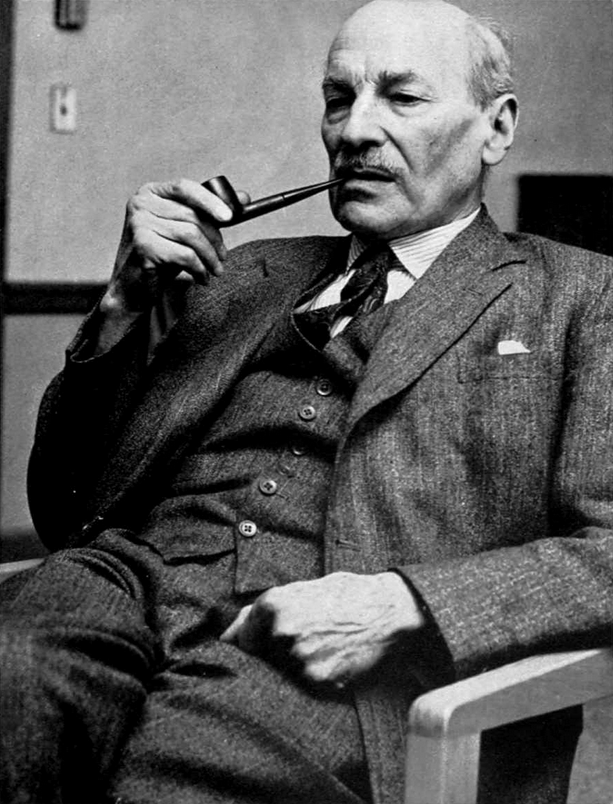
  • Clement Attlee – 1922 Maiden Speech in the House of Commons

    Clement_Attlee

    Below is the text of the maiden speech made in the House of Commons by Clement Attlee on 23 November 1922.

    I want to call the attention of the House to one or two matters, which I think are matters of omission, in connection with the speech to which we have just listened. I did not notice that there was any mention of economy. We have had a great deal of talk about economy up and down this country, and we have had a great deal of talk about waste. But there is one particular waste that is never mentioned, and that is the waste of the man-power of this nation. When I throw my mind back to the War period, I remember how we were told that every man in this country was valuable, how we were told that every man was wanted either in munitions or in the trenches—men of every character, men of every capability. I heard of men who usually would not be considered sufficiently good to do any work, but who were sent to us in the trenches, because they were said to be serviceable for fighting. At that time— I think the only time in 500 years of English history—we were practically without any unemployment at all. In the district from which I come, the borough of Stepney, we always have unemployment. You may have a Free Trade system, or such a system as we have at the present time under the Safeguarding of Industries Act, which practically amounts to high Protection; but you will still have unemployment in East London. In East London we stand at the gate of England. Wealth flows through our borough up to London, but precious little stays there. We always have unemployment. The only time when unemployment was practically non-existent was the time of the War; and, despite all the rationing, despite all the food substitutes, on the whole the living conditions of our people were actually better during the War period.

    I am speaking of waste from the point of view of the waste that is going on to-day of our man-power and woman-power, and of the children who are going to be the men and women of the future. In my district every day men are coming to me whom I have known years ago, and I see how they have fallen off through unemployment. You see men who were fit to be sergeant-majors in the Army —fine, upstanding men—reduced to dragging along the streets with their hands out for anything they can get. That is an enormous waste. It is not only waste, but absolute folly. We are told, and I believe it, that there is sympathy on the other side with the unemployed. I do not suppose that anyone on the benches opposite is going to get up and say that he is prepared to put the unemployed men, and their wives and families, into a lethal chamber and kill them. I think that everyone on all sides is agreed that they are to be kept alive, and the only question we have to face is whether they are going to be kept alive in fine and fit condition, or upon a dole which means that they are going steadily downhill.

    The true wealth of this country is its citizens, and the finest of them, the very cells that build up our community, are the families that have a certain standard of life. Such a man, with his wife and family, with their home, represent, after all, the basis of our society, which is based upon the family. If that man falls out of work, if he comes down to a miserable wage, it means that his home is broken up, and his whole standard of life goes down and down. What you are doing with our industrial machine is allowing the spare parts to be absolutely wasted and rusted. I daresay there are hon. Members opposite who have motor cars. Perhaps they keep spare parts for them, and I expect that they look after and care for them, or their chauffeur does. The Stepney wheel is cared for as much as that which is on the car. I represent, so to speak, the Stepney wheel, the wheel which is temporarily unemployed, but which you will require in the future. My claim is that we have got to see that that reserve of labour is kept fit. When we were in the Army during the War we did not have our rations docked because we went into the supports or reserves. Our rations were the same whether we were in the front line or in the supports.

    That is the first item of waste. The second great item is the loss of the services of these 1,300,000 men who are unemployed to-day. These men are capable of productive work, and there is productive work that wants doing. In my borough, which is a borough of 250,000 inhabitants, we had a very close inspection of the houses. We endeavoured to get our housing conditions bettered, and we were told that over two-thirds of our houses were not repairable in any true sense of the word. Under such powers as we had we insisted that every landlord should put his house in repair, but those houses are so utterly worn out that they cannot be repaired, but must be replaced. At the present time the country is supporting out of public funds, either national funds or local funds or funds provided by the contributions of employers and employed—I care not which you say it is; it is all coming out of the productive powers of the nation—some 100,000 men in the building trade who are not allowed to build, who are actually being paid not to build. We are almost following the bad example of the London County Council, who got out a housing scheme and then paid the contractors a sum of money in respect of every house which they did not build. We are keeping these people, though not in a state of efficiency, when we have this urgent need of housing.

    The hon. Member for the Sutton Division of Plymouth (Viscountess Astor) quite properly stressed that point of housing and the intimate way in which housing is bound up with morality. We know it very well down our way. We know, too, the results of the census, which showed that in the London area alone there are 600,000 persons who are living in one-room tenements. You are not going to get an A1 nation under those conditions: you are not going to get a moral nation under those conditions; you are not going to get a sober nation under those conditions. I quite realise why the hon. Member for Dundee made the speech that he did, because, with his heart bound up with the temperance question, he knows, as we do, that we have to deal with these causes. You may produce a case here and there of abuse of the dole: you may produce an occasional man who marches with the unemployed and has a bad record; but every Member of this House who has been in a contested election and has come into personal contact with the unemployed knows that the great mass of unemployed men are those same men who saved us during the War. They are the same men who stood side by side in the trenches. They are the heroes of 1914 and 1918, though they may be pointed out as the Bolshevists of to-day.

    Why was it that in the War we were able to find employment for everyone? It was simply that the Government controlled the purchasing power of the nation. They said what things should be produced; they said, “We must have munitions of war. We must have rifles; we must have machine-guns; we must have shells; we must have ammunition; we must have uniforms; we must have saddles.” They took, by means of taxation and by methods of loan, control of the purchasing power of the nation, and directed that purchasing power into making those things that were necessary for winning the War. To-day the distribution of purchasing power in this nation is enormously unequal. I recall a speech by the present Prime Minister, in which he said that one of the greatest reforms in our national life would be a better distribution of wealth among the individuals composing this nation. I entirely agree with him. While the purchasing power of this nation is concentrated in the hands of a few, there will be production of luxuries and not of necessaries. It was found necessary during the War for the Government to take hold of the purchasing power—which, after all, determines what goods shall be made—and deliberately to say that certain things were essential because we were at war, and that those things and no others should be made. They said to those who were running industry that their factories must be turned away from producing luxuries and must produce those sheer necessities. That is what we are demanding shall be done in time of peace. It is possible for the Government, by methods of taxation and by other methods, to take hold of that purchasing power, and to say that, exactly as they told manufacturers and workers that they must turn out shells and munitions of all sorts to support the fighting men, so they must turn out houses and necessities for those who are making this country a country of peace.

    As the nation was organised for war and death, so it can be organised for peace and life if we have the will for it. That is why we reject all these facile assumptions that you can wait until trade is a little better. You cannot wait. The waste is going on all the time. You have only to look at the state of the children in our streets to see how that waste is going on; and if, as I hope may never happen, we should have another war in 20 years’ time, and if the Government should begin, as they did, by calling up for various years, when you come to these last three years and look at the classes of 1920, 1921 and 1922, you will not be surprised to find that a very large proportion of them are C.3. But it will be too late for yon then to complain; it will have been by your policy of tranquillity that these classes have been produced. I am not, however, concerned with producing men for war; I am concerned with producing citizens for life. I stand for no more war, and for development in peace; and I say that you are to-day in this country ruining future generations as you have ruined the present generation. It is not the fact that character is formed by unmerited suffering and privation. It simply means what I have seen for 17 years in the borough of Stepney—the boy or the man getting unemployed and sinking, sinking, sinking right down to the unemployable. We do want an economy campaign, but it must be a true economy campaign—economy in mankind, economy in flesh and blood, economy in the true wealth of the State and of the community, namely, its citizens. That can only be brought about by deliberately taking hold of the purchasing power of the nation, by directing the energies of the nation into the production of necessities for life, and not merely into the production of luxuries or necessities for profit.