Tag: Lisa Nandy

  • Lisa Nandy – 2014 Parliamentary Question to the Cabinet Office

    Lisa Nandy – 2014 Parliamentary Question to the Cabinet Office

    The below Parliamentary question was asked by Lisa Nandy on 2014-05-06.

    To ask the Minister for the Cabinet Office, how much was spent by the Office of the Deputy Prime Minister on tea and biscuits in (a) 2012-13 and (b) 2013-14.

    Mr Francis Maude

    The Office of the Deputy Prime Minster is an integral part of my department.

    The information requested is not held centrally.

  • Lisa Nandy – 2022 Speech to Labour Party Conference

    Lisa Nandy – 2022 Speech to Labour Party Conference

    The speech made by Lisa Nandy, the Shadow Secretary of State for Levelling Up, Housing and Communities, on 26 September 2022.

    Conference. Comrades. Friends.

    We meet today in one of the country’s historic northern cities.

    Where at the water’s edge so much of modern Britain was shaped.

    Dockers who looked outwards to the world to build Britain’s wealth through difficult, often dangerous work and fought the longest battle for dignity, respect and fair reward in the history of Britain.

    Those were the struggles that formed the backdrop to my childhood.

    I grew up not far from here with a Tory Government that waged war on its own people.

    Brought up by my mum when the Tories were attacking single mums.

    With an Indian dad when they said Britain was being swamped by immigrants.

    They came for us, they came for our jobs and they came for our community.

    But we stood together, we fought together and we won together.

    Now they’re at it again.

    So when your boss earns £3.5m and gives themself a 32% pay rise – and you ask for a below inflation rise –you’re the one to blame for inflation.

    And when you keep our country moving during a pandemic and then they cut your pay, threaten your job and refuse to get round the table to discuss it – you’re the one who’s militant.

    Conference this country’s problem isn’t militant workers. It’s a militant government.

    This is Tory Britain where the foundations of a decent secure life have been slowly eroded leaving us with an economy we work hard for every day – but doesn’t work for us.

    Where the contribution of most people and most places has been written off.

    So in towns across the country, too many young people, have to get out to get on.

    Taking with them the spending power that once sustained our high streets, banks, buses and post offices.

    People are left to grow old hundreds of miles from children and grandchildren.

    And our cities are plagued by soaring housing costs, air pollution and strain on public services.

    Now, Liz Truss says her government will grow our economy by turning the North into Singapore on Sea.

    So they can stash their wealth in our towns and cities, pushing up the cost of housing and dodging tax.

    Slashing taxes for big corporations so the rest of us can grind for a living in an Amazon warehouse.

    Handing £55,000 to millionaires while people can’t afford to pay their rent, feed their kids and heat their homes.

    More money for millionaires than the whole North of England.

    In the words of Liz Truss – that.is.a.digrace

    Conference. It’s time to stand up and fight again.

    Not just to see off the Tories.

    But to build the country I’ve believed in all my life – where everyone can contribute and everyone has a stake in our future.

    It will be about the real wealth creators – the women and men who work in our shops, who drive our buses, who deliver our mail, who produce our food, who care for our families and teach our children – who make sure we have what we need to live every day of our lives.

    To those people we say you are the foundation of our economy.

    We believe that when people have a stake in the outcome, they work harder, they try longer, they think more creatively and they do more.

    The people of our country are our great untapped asset.

    Labour will tilt the balance of power back in their favour.

    In the first 100 days we will end fire and rehire, repeal the 2016 anti- trade union Act and raise wages for the lowest paid.

    And we’ll usher in a great rebalancing of power, with wealth, security and opportunity spread across the whole country.

    They say you can power a modern economy using only a handful of people in a handful of places in one small corner of the country.

    We say that’s like trying to fly a jet on one engine.

    This country doesn’t belong to a few of them, it belongs to all of us.

    So we will invest to bring clean energy jobs to the industrial and coastal towns across Britain, so that young people in places that were once the engines of Britain can power us through the next century like their parents and grandparents powered us through the last.

    The road to net zero is paved with a million good jobs and we’ll bring them to Britain.

    Empowering our brilliant leaders – Steve, Tracy, Andy, Marvin, Shaun – with new powers to drive growth in every part of Britain.

    And handing power back to our people with a community right to buy land and assets – the football clubs, historic buildings and pubs that make a place home.

    So those with skin in the game, who are in it for the long haul, will feel the whole system pulling in behind them.

    That – Liz Truss- is how you grow the economy.

    But I have learnt that progress is not inevitable.

    If we want to live in a country where children don’t have to go to school too hungry to learn.

    Where people with disabilities can live the richer, larger lives they deserve.

    Where people don’t have to fear growing old without dignity or warmth.

    If we want that country, we have to go out and fight for it every single day.

    So I am asking you today to get ready.

    Because together, with every person, in every place we’re going to rebuild this country from the ground up.

    And I can say to you today that in Government I will make it my priority to tackle the housing crisis because nothing, nothing is more important than a home.

    The Tories have turned housing into a racket.

    Incentivising speculation and profiteering while millions languish on waiting lists in cold damp homes.

    So we will mend the deliberate vandalism of our social housing stock.

    Because the idea of a home for life handed on in common ownership to future generations.

    Is an idea worth fighting for.

    Council housing is not a dirty word.

    So today, I can announce we will be the first government in a generation to restore social housing to the second largest from of tenure.

    This will be our mantra.

    Council housing, council housing, council housing.

    We’re going to rebuild our social housing stock and bring homes back into the ownership of local councils and communities.

    With home ownership opened up to millions more.

    And for private renters we will tilt the balance of power back to you through a powerful new renters charter and a new decent homes standard – written into law.

    Because security in your home, the right to make your home your own and most of all the right to live in a home fit for human habitation.

    Is non-negotiable.

    Because housing isn’t a market it’s a fundamental human right.

    It’s tempting at a time of national crisis, to retreat and to play it safe.

    That’s not who are.

    It was with ambition, courage and conviction in the darkest times.

    That out of the devastation of war, we built more council houses than any Government in history.

    We built the NHS, the Race Relations Act, the Equal Pay Act and the Minimum Wage.

    And rebuilt our great northern cities from the ashes of Thatcherism.

    Conference, we led global action on climate change and flew the pride flag in countries where love is a crime.

    A light on the hill at home and overseas.

    And we are going to finish the job.

    Because we know – we are the only party that knows – that by the strength of our common endeavour we achieve more than we achieve alone.

    So Conference let’s rise to meet this crisis in a great national mission to rebuild our country.

    We have done it before.

    We’re going to do it again.

    And we will do it the only way that counts – together.

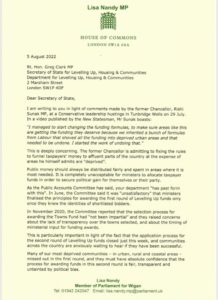
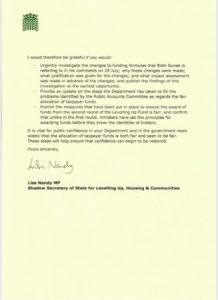
  • Lisa Nandy – 2022 Letter to Greg Clark after Rishi Sunak Admitted to Diverting Money from Deprived Areas

    Lisa Nandy – 2022 Letter to Greg Clark after Rishi Sunak Admitted to Diverting Money from Deprived Areas

    The letter sent by Lisa Nandy, Shadow Secretary of State for Levelling Up, Housing and Communities, to Greg Clark, the Secretary of State, on 6 August 2022 following the comments made by Rishi Sunak.

  • Lisa Nandy – 2022 Comments on Admission by Rishi Sunak he Removed Funding from Deprived Areas

    Lisa Nandy – 2022 Comments on Admission by Rishi Sunak he Removed Funding from Deprived Areas

    The comments made Lisa Nandy, the Shadow Secretary of State for Levelling Up, Housing and Communities, on 5 August 2022 following the comments made by Rishi Sunak in Tunbridge Wells.

    This is scandalous. Rishi Sunak is openly boasting that he fixed the rules to funnel taxpayers’ money to rich Tory shires. This is our money. It should be spent fairly and where it’s most needed – not used as a bribe to Tory members. Talk about showing your true colours.

  • Lisa Nandy – 2022 Speech on Social Housing and Building Safety

    Lisa Nandy – 2022 Speech on Social Housing and Building Safety

    The speech made by Lisa Nandy, the Labour MP for Wigan, in the House of Commons on 9 June 2022.

    On 14 June 2017, every single person in this country watched in horror as a blaze in London became, within hours, one of the worst disasters of modern times. Some 72 people lost their lives that day and dozens more were injured. Among them, as the Secretary of State has said, were young children, GCSE students, retired couples and entire families. As the family of 78-year-old Ligaya Moore poignantly put it, it was a tragedy that turned “laughter into silence”.

    I join the Secretary of State in welcoming some of those families to the Chamber today. It always feels uncomfortable, at moments such as this when we stand here and speak, that their voices are not heard and ours are, but I have heard from many of the families affected by this appalling tragedy over the past few years that what they want most is to hear from us the action we will take to honour those lives and build a fitting legacy. I am determined that we will work with the Secretary of State and with all political parties across this House in order to turn that commitment that we have all respectively made into reality.

    There has rightly been much soul-searching about how such a tragedy was possible in modern Britain. The public inquiry is still under way and must be allowed to do its work without political interference. However, that must never be allowed to become an excuse for delay or for justice denied, because this was not the first fire in a block with similar cladding. The Government were aware of problems as early as 1986, well before a block of flats in Merseyside caught alight in 1991. That fire, at Knowsley Heights, was followed by similar fires spanning three decades, from Irvine in Scotland to Southwark in south London, where six people lost their lives. In those intervening decades, the alarm was raised many times. One parliamentary inquiry led by the former Member for Southend West, David Amess, who is much missed in all parts of this House, warned that it should not

    “take a serious fire in which many people are killed before all reasonable steps are taken towards minimising the risks.”

    This series of failures spanned all political parties and successive Governments over many decades. We should have heard that and we should have acted. I therefore join the Secretary of State in saying, on behalf of my party, that we are sorry that we did not hear it and sorry that we did not act sooner.

    But how did those warnings go unheeded by so many for so long? The Government’s lawyer told the official Grenfell inquiry that

    “within the construction industry there was a race to the bottom, with profits being prioritised over safety.”

    It makes me angry to hear that that can be admitted with such candour now but nothing was done before. I share the Secretary of State’s passion to go after those who recklessly disregarded people’s lives and put their profits and their own interests before safety. If they broke the law, acted recklessly or acted immorally, then I will join him in going to the ends of the earth to make sure that they pay a heavy price for doing so.

    We have to ask ourselves, too, standing here in the centre of power: who permitted that to happen? Over 30 years and five different Governments—Labour, coalition and Conservative—how did it come to pass that profits were allowed to matter more than people. How could the concerns and lives of people in the centre of one of the wealthiest boroughs in the wealthiest city in one of the wealthiest countries in the world be ignored—effectively rendered invisible by decision makers only a few short miles away? The appalling tragedy suffered by the people of Grenfell is undeniable evidence of the unequal society that we live in, where lives are allowed to be weighed against profit on a balance sheet and come out the worst, and where those who lack money also lack power. When I talk to social housing tenants up and down the country, this what I hear so often—that they are not seen or heard by decision makers, and that when they raise their concerns and bang on the doors of the corridors of power, those concerns still go unheeded. One social housing tenant said to me: “We simply do not count.” This has to be the day when we stand up together and say, “This ends now.”

    There are 4 million families in rented social housing in England. Every single one of them deserves a decent, safe home, and, more than that, the power to drive and shape the decisions that affect their own lives. We should be scandalised that so many homes are not up to a fit standard, not just on fire safety but in being cold, damp and in a state of disrepair that shames us all in modern Britain: homes with black mould and water running down the walls; homes that are unsafe; homes that are damp and overcrowded. I recently heard from a teacher about a child who was coming to school covered in rat bites. The school is using its pupil premium to send people round to make sure that these children are clothed, fed and protected from rats. What have we come to in Britain in the 21st century? It is an absolute disgrace.

    The Secretary of State is right that we should take a zero tolerance approach to social landlords who do not live up their obligations—who do not do everything within their power to make sure that those issues are dealt with. But I also gently say to him, in a constructive tone, given the gravity of what we are dealing with today, that the Government have to do their bit as well. That means reversing some of the cuts that have been made to councils and housing associations in recent years which mean that repair budgets are virtually non-existent in many parts of the country, and that good people have been lost and expertise has gone.

    We welcome the decision to publish a social housing reform Bill to try to tackle some of these issues, although we are concerned that it has not materialised in advance of this debate. We were led to believe that we would have that Bill before we stood up to speak today. If there are problems within Government—if there are wranglings taking place behind closed doors—my offer to the Secretary of State is this: we will work with him and support him in whatever battles he has to make sure that this Bill sees the light of day, and quickly. That also goes for the renters reform Bill, which must, as my hon. Friend the Member for Brentford and Isleworth (Ruth Cadbury) said, deal with the appalling standards in many private rented homes up and down this country. Some of that, I have to say to the Secretary of State, has been caused by Government policies such as the bedroom tax, which forced many people out of the secure social home that they had lived in for many years, close to friends, family and children’s schools, and into private, rented, often overcrowded and substandard accommodation that, absurdly, cost the public more than it did to house them in their own home.

    We welcome some of the measures that the Secretary of State has proposed, particularly the promise to beef up the role of the regulator. This is a welcome step forward giving it the power to inspect, to order emergency repairs, to issue limitless fines, and to intervene in badly managed organisations. But we have to do more to tilt the balance of power back towards tenants to give them not just a voice but real power to shape and drive the decisions that affect their lives, their homes, their families and their communities. The measures on tenant satisfaction and a residents’ panel that meets Ministers three times a year are welcome, but well short of a dedicated tenants’ organisation that is put on a statutory footing and exists to be a voice to champion their interests. Such a body existed under the last Labour Government but was scrapped by the Secretary of State’s Government in 2010. I ask him please not to close his mind to perhaps revisiting previous methods that worked. Let us work together with tenants to get this right once and for all.

  • Lisa Nandy – 2022 Speech on the Ukraine Sponsorship Scheme

    Lisa Nandy – 2022 Speech on the Ukraine Sponsorship Scheme

    The speech made by Lisa Nandy, the Labour MP for Wigan, in the House of Commons on 14 March 2022.

    We were so relieved to hear that the Secretary of State was going to announce a scheme to allow Ukrainian refugees a route to safety after weeks of delay, but a press release is not a plan, and we are really deeply concerned about the lack of urgency. Yesterday, he went on TV to claim that Ukrainians could be here by Sunday, but he has just told us that they will still need a visa under the current application process. These are 50-page forms that have to be completed online, asking people who have fled with nothing to find an internet café to upload documents they do not have—water bills and mortgage documents—to prove who they are. The Home Office has been incredibly slow in issuing these visas. As of this morning, only 4,000 have been issued. We are lagging way behind the generosity of other countries. We could simplify this process today. We could keep essential checks but drop the excessive bureaucracy. He knows it; why has it not been done?

    For weeks the British people have been coming forward in large numbers to offer help. It has been moving and heartwarming to see the decency and spirit on display in every corner of this country. But what exactly will the Government be doing, especially in relation to matching families to sponsors? On the Secretary of State’s tour of the TV studios, he suggested several times that people who are willing to sponsor a Ukrainian family need to come to the Government with the name of that family, and they will then rubber-stamp it. He cannot seriously be asking Ukrainian families who are fleeing Vladimir Putin, and who have left their homes with nothing, to get on to Instagram and advertise themselves in the hope that a British family might notice them. Is that genuinely the extent of this scheme? Surely there is a role for the Secretary of State in matching Ukrainian families to their sponsors, not just a DIY asylum scheme where all he does is take the credit. Will he please clarify what the Government’s role is going to be?

    There has been a lack of urgency in getting people here and there is still a lack of urgency in ensuring that we support them when they do get here. Earlier today, my right hon. Friend the Member for Normanton, Pontefract and Castleford (Yvette Cooper) and I spoke to council leaders, who stand ready and willing to help. Why has not anyone from the Secretary of State’s Department picked up the phone to them? Last week, I spoke to charities that he will ask to act as sponsors. They are acutely aware that the people who are coming will be quite unlike previous refugees.

    Two million people are on the march—children alone, mums with very young kids and older people. The brutal reality of what is happening in Ukraine is that working-age people have stayed behind to fight. Those leaving will have healthcare needs, and they will need school places, maternity care and social care. One council leader told me today that his city, which traditionally plays a major role in welcoming refugees, has only nine secondary school places available. Has it not occurred to the Secretary of State until this point to pick up the phone to leaders such as the one I spoke to before he went into the TV studios and promised the earth?

    These charities and council leaders are the same people who stepped up during covid. They spin gold out of thread every single day, and what is keeping them awake at night right now is how we do right by people and keep them safe. It was only a few months ago that the Home Office placed a child into a hotel in Sheffield that it had been told was unsafe without even bothering to tell the council, and he fell out of a window and died. Will the Secretary of State ensure that every council is contacted by close of play today? Will he work with them to do the vetting checks that are needed? They are experts in safeguarding children. Will he not only trust them, but support them?

    Will the Secretary of State put a safety net in place, in case a placement breaks down? His Department confirmed over the weekend that families left homeless in that situation will not be able to claim their housing costs under universal credit. Surely that cannot be true. Surely we are not going to ask people who have fled bombs and bullets to lie homeless on the streets of Britain.

    I suspect that the Secretary of State has felt as ashamed as I have to watch how this Government have closed the door to people who need our help. He shakes his head, but people have been turned back at Calais. They have been left freezing by the roadside with their children. We have had planes leaving neighbouring NATO countries packed to the rafters, except those to London, because this Government have turned people away. The British people who have come forward have shown that we are a far better country than our Government, but unless he gets a plan together—a real plan, not just a press release—all he is effectively announcing is plans to fail the people of Ukraine twice over. He said today that they have our total admiration, and they do, but they need more than that; they need our total support.

  • Lisa Nandy – 2022 Speech on Building Safety

    Lisa Nandy – 2022 Speech on Building Safety

    The speech made by Lisa Nandy, the Shadow Secretary of State for Levelling Up, Housing and Communities, in the House of Commons on 10 January 2022.

    May I thank you, Mr Speaker, for your kind words about Jack Dromey, who should have been with us here today? There is a space over there that I know Jack would have occupied. Back in the 1970s, horrified by the spectacle of a skyscraper in London that lay empty while people slept rough underneath it, Jack was one of those who occupied Centre Point tower in protest. He was never afraid to speak truth to power, and I hope that today marks the start of all of us across the House invoking his spirit.

    Four and a half years after the appalling tragedy at Grenfell, and with a road paved with broken promises and false dawns, hundreds of thousands are still trapped in unsafe homes, millions are caught in the wider crisis, and the families of 72 people who lost their lives are waiting for justice. It is a relief that we finally have a consensus that the developers and manufacturers who profited from this appalling scandal should bear greater costs, not the victims, and that blameless leaseholders must not pay. After a year of hell of the prospect hanging over leaseholders, we welcome the decision to remove the threat of forced loans, but can the Secretary of State tell us what makes him think that he can force developers, who have refused to do the right thing for four years, to pay up? We have been told there is a March deadline and a roundtable, but there is not a plan. If he has one, can we hear it? He will find an open door on the Opposition side of the House, if he has a credible proposal to bring.

    Today the Secretary of State warned developers that if negotiation fails,

    “our backstop…what we can do…is increase taxation on those responsible”,

    but that is not quite right, is it? I have in front of me the letter from the Chief Secretary to the Treasury. May I remind the Secretary of State what it says? He was told that

    “you may use a high-level ‘threat’ of tax or legal solutions in discussions with developers”

    but

    “whether or not to impose or raise taxes remains a decision for me”

    —the Chief Secretary—

    “and is not a given at this point.”

    If I have seen the letter, I am fairly sure that the developers have too. Furthermore, it appears that what the Secretary of State has told the public—that tax rises are the backstop—is not what he has told the Treasury. The letter says that

    “you have confirmed separately that DLUHC budgets are a backstop for funding these proposals in full…should sufficient funds not be raised from industry.”

    That is not what the Secretary of State told the House a moment ago, so can he clear this up? Has the Chancellor agreed to back a new tax measure if negotiations fail, or is the Secretary of State prepared to see his already allocated budgets—levelling-up funding, or moneys for social or affordable housing—raided? Or is his plan to go back to the Treasury, renegotiate and legislate, if he fails in March? If that is the case, it will take months, and there is nothing to stop freeholders passing on the costs to leaseholders in the meantime. Does he even have an assessment of how many leaseholders will be hit with whacking great bills if he delays?

    If the Secretary of State is serious about going after the developers—I hope that he is—why is he not putting these powers into the Building Safety Bill now? The only trick that he has up his sleeve, as he just confirmed to the House, is to ban them from Help to Buy, and we know that the impact of that, though welcome, will be marginal. Can he see the problem? He will also know that there is a gaping hole in what he has proposed. A significant number of buildings have both cladding and non-cladding defects, and leaseholders in them face ruinous costs to fix things such as missing fire breaks and defective compartmentation. One cannot make a building half safe. Given that the Secretary of State recognises the injustice of all leaseholders caught up in the building safety crisis, why is he abandoning those who have been hit with bills for non-cladding defects, and why will he not amend his Bill so that all leaseholders are protected from historical defects in law?

    The truth is that the pace of remediation has been painfully slow. The Secretary of State is now on track to miss the deadline to fix all Grenfell-style cladding by over half a decade, and there are huge delays when it comes to building safety fund applications, so will he get a grip on what is going on in his own Department and ensure that the progress of remediation is accelerated markedly? As he knows, this has been a living nightmare for affected leaseholders, and we owe it to them to bring it swiftly to an end.

    What the Secretary of State has given us today is a welcome shift in tone and some new measures that the Opposition very much hope will succeed, but the harder I look at this, the less it stands up. We were promised justice and we were promised change, to finally do right by the victims of this scandal, and that takes more than more promises. It takes a plan.

  • Lisa Nandy – 2021 Speech on Afghanistan

    Lisa Nandy – 2021 Speech on Afghanistan

    The speech made by Lisa Nandy, the Shadow Foreign Secretary, in the House of Commons on 6 September 2021.

    These have been a painful and sobering few weeks. Had it not been for the heroic efforts of the armed forces as well as the brave diplomats and civil servants involved in Operation Pitting, many more lives would have been lost and many more people left behind. They reminded us what courage looks like. I want to put on record my thanks to them and to all those who have served in Afghanistan over the last two decades, and also to add my condolences to the families of all those killed in the horrific bombing at Kabul airport.

    If more lives are not to be lost, we need some urgent clarity today. What, specifically, is the advice to people trying to leave? Should they stay put and be hunted by the Taliban, or should they make their way to a border and risk being turned back?

    Could the Foreign Secretary take care of some basic issues? The Home Office phone number provided for Afghans asks people to hold on for hours, and it is still chargeable. That is pretty easy to fix. Could he have a word with the Home Secretary and get it dealt with? He was not able to tell us how many British nationals are still there, but I imagine he must know by now, so can he tell us? We know that only one security guard from the embassy got out, so what is his plan for the rest? I did a quick check before I left my office today; there are still hundreds of unanswered emails from MPs, and many of them raised that question with the Prime Minister this afternoon. How many staff are now working on this in the Foreign Office, and why has it not been dealt with? If those Members are to get an answer by this evening, can the Foreign Secretary assure us that it will be a real answer and not just a holding response?

    Can we have some clarity about who is actually eligible, especially under the ARAP scheme—it is welcome that the Secretary of State for Defence has stayed for the statement—because without clarity about who is eligible, people cannot risk heading to the border? It would be useful to have a much tighter idea of who the eligible people are, particularly the special cases. What is the assurance about safe passage that the Foreign Secretary believes that he has from the Taliban? Does it apply to all those with documentation, or just to the British nationals?

    I understand that the technical problems at the airport have now been overcome, and that is welcome, but can the Foreign Secretary tell us a bit more about the diplomatic progress that has been made? How, for example, does he intend to square the circle to comply with the Taliban’s refusal to allow a foreign military presence, while also ensuring that those technicians from Turkey or Qatar, or whichever other country is chosen to oversee that operation, can be safeguarded? I very much support his view that it would be wrong to recognise the Taliban as a legitimate Government, but that presents a practical challenge to the countries that are considering stepping in to oversee the airport in respect of how guarantees can be upheld.

    May I just say to the Foreign Secretary that the co-ordination between the Foreign Office and the Ministry of Defence, despite some very hard-working civil servants on the ground who are working round the clock, is still appalling? My office is in touch with a small number of Afghan workers, for example, who have been attached to intelligence and to MI6 in recent years. They are being treated as special cases under ARAP, and many of them have been waiting for months. I want to place on record my thanks to the Secretary of State of Defence, and also to the Minister for Afghan Resettlement, the hon. Member for Louth and Horncastle (Victoria Atkins), who have made themselves available to many of us at all hours and at short notice to assist with some of these cases. Their personal intervention has made a difference, although that is no substitute for a system.

    Could the Foreign Secretary also clarify some comments that he made to the Select Committee? He suggested that those who had been cleared to travel as part of Operation Pitting would now have to undergo security checks before being accepted on to ARAP. Were those checks not initially done, or is he now reneging on his promise? I have to say that both those scenarios concern us greatly. These are practical issues that are within the Foreign Secretary’s gift, and the fact that they have still not been dealt with sends a strong message that he has been more focused in recent days on keeping his job than on actually doing it. I want him to prove us wrong, because a lot rides on this, including the lives of many Afghans who assisted us.

    Will the Foreign Secretary say a bit more about how the UK is going to get aid into Afghanistan to those who need it? I have been in touch with aid workers on the ground, many of whom are female and who have been banned from working by the Taliban. Those aid agencies are understandably saying that they will not operate with those conditions in place, but that means that they are not operating at all. On the refugee crisis, I say to him gently that countries in the region are not hugely impressed by the Home Secretary’s decision to cap the number of refugees that the UK will accept at 5,000 when they are dealing with a far greater refugee crisis. A bit of generosity from the UK would go a long way to helping to resolve the issues at the borders.

    These are immediate concerns, but we are also concerned that for a generation of young Afghans, the future that they had expected is unravelling in front of their eyes. Can the Foreign Secretary say something about how the rights of the LGBT+ community will be upheld, as well as those of religious minorities? Can he outline the measures that he intends to take to set conditions for the Taliban regime, particularly that the situation of women and girls will be the cornerstone of any future engagement?

    Our intelligence has been downgraded, our diplomats and troops are no longer on the ground and the Prime Minister appeared to say in his statement just now that the risk posed to the UK was unknown. The Foreign Secretary has suggested in a media interview that we would rely on open-source intelligence. Could he say some more about that, and about the possibility that we might be in a position where we are sharing intelligence with countries such as China and Russia? Given the significant national security implications of that, the House has a right to understand the Government’s strategy on it, if there is one. This has been nothing short of a disaster, so I ask him now to turn with humility to the world and to start to repair some of those broken relationships, trashed alliances and broken promises that have reduced us to a position where we are reliant on the Taliban for permission to safeguard our own citizens and negotiating with China and Russia in our own interests? In the cold, hard light of what has unfolded over this summer, surely it is time for him to rethink his approach to the way that Britain engages with the rest of the world.

  • Lisa Nandy – 2021 Letter to Dominic Raab over Unread Emails at Foreign Office

    Lisa Nandy – 2021 Letter to Dominic Raab over Unread Emails at Foreign Office

    The letter sent by Lisa Nandy, the Shadow Foreign Secretary, to Dominic Raab, the Foreign Secretary, on 29 August 2021.

    Dear Foreign Secretary,

    Now that the airbridge has closed and the UK military drawdown is complete I am writing to ask for your support with the safe evacuation of the British nationals and Afghans who have been left behind. It was welcome to hear the Prime Minister commit to move heaven and earth to help those who are currently in hiding or trying to reach the border but I am increasingly concerned that, even now, few practical measures have been put in place to achieve this.

    The scale and complexity of the operation

    I understand the Government is working on the assumption that there are 800-1,100 people who will need assistance. Based on our caseload, this is likely to be a significant underestimate. My office is currently tracking cases related to 5,000 people from Labour MPs alone, including British nationals, high profile public figures, people with serious disabilities and children separated from their families – which may give a sense of the complexity of evacuation. I was also extremely concerned to read in today’s Observer that many of the emails MPs have sent to the crisis centre in recent weeks haven’t been opened. Could I ask that those are now dealt with urgently in order to get a sense of the scale of this operation? I would strongly suggest that you plan for a significantly larger number than 1,100.

    At the height of the evacuation we were told less than a dozen people in the Foreign Office had been tasked with processing the details of those trying to flee. They were so under-resourced and overstretched that by the final days the only realistic route to assist people was by sending WhatsApp messages to the Defence Secretary or the Minister for Afghanistan. The evacuation efforts cannot have been helped by the range of email addresses and phone numbers that were provided by the Foreign Office, Ministry of Defence and Home Office, most of which either did not work or were not answered. Can you work with colleagues in Government to establish one cross-departmental unit with adequate resources to take responsibility for this next phase?

    Border crossings

    Given the recent remarks by Taliban leaders and the practical barriers to continue to operate an airport, I presume you are planning for the majority of people to attempt to leave via border crossings. I was concerned to hear from Pakistani diplomats on Thursday that no agreement has yet been reached to take in UK nationals or people eligible for evacuation to the UK.

    They raised concerns about the ability to provide public health checks, including testing and quarantine procedures, for those arriving over the border in large numbers. Could the UK alongside allies provide practical support to Pakistan and other countries in the region to help with this?

    The adoption of e-visa systems for entry to Pakistan – as India has done – could reduce pressure at Embassies and reduce the risks of crushes and stampedes.

    I am also acutely aware that there are an estimated 3 million Afghan refugees already in Pakistan and it will be difficult to urge the Pakistani authorities to take responsibility for large numbers of new Afghan refugees without broader support from the international community. The country lost development assistance from the UK earlier this year. Could you now explore expanding development assistance to support the significant number of refugees in Pakistan, in particular through the UN and NGOs helping refugees on the ground directly?

    I also understand you hope to extend the UK’s capacity to process people who would be eligible under the ARAP scheme in Pakistan. There could be an obvious benefit to increasing UK diplomatic capacity on the Pakistan side of the border, to help identify and process those in need. Could you provide further details on additional capacity you are considering deploying to the country?

    Safe passage

    We are in touch with a number of people who are in hiding following threats to themselves or their families. Aid workers on the ground have raised with me the shortage of those spaces given that local families fear reprisals if they provide shelter to those who have assisted the UK. I am told they are keen to expand these facilities but are unable to do so because they are funded by your department via the CSSF, and the funds cannot be used for this purpose. Could you look into this urgently to see if flexibility can be applied? I suggested this in my letter a week ago but I am told there has been no movement on this.

    Clearly, many individuals will have no prospect of reaching a border without the permission of the Taliban. If the UK isn’t in direct communication with Taliban leaders, could you prioritise speaking to regional partners to see if a civilian corridor, possibly overseen by a neighbouring country, could be arranged?

    Could you pass on my thanks to the FCDO staff and diplomats who have worked tirelessly in recent days to try to evacuate as many people as possible. I am only too aware of the agonising decisions they have had to make about who to prioritise. Now with this new crisis looming, I hope we can work together to ensure they have all the support they need.

    I look forward to hearing from you.

    Lisa Nandy MP

    Shadow Secretary of State for Foreign and Commonwealth Affairs

  • Lisa Nandy – 2021 Comments on Boris Johnson’s Talks on Afghanistan

    Lisa Nandy – 2021 Comments on Boris Johnson’s Talks on Afghanistan

    The comments made by Lisa Nandy, the Shadow Foreign Secretary, on 24 August 2021.

    This is a dark moment for the UK Government and for Afghans. The Prime Minister has failed to persuade President Biden to agree to extension to evacuation efforts and the painful reality is that people will be left behind – that’s appalling and unconscionable. With 18 months to prepare for this, we are left with a desperate scramble, with heroic soldiers and diplomats on the ground trying to move mountains while the clock keeps ticking.

    The urgent priority remains the evacuation. The next few hours are vital. There are still so many desperate people on the ground. All possible resource should be placed into getting as many people out safely as possible.

    We need to confront the new reality of Taliban control. This is a difficult situation and it is hard to swallow. But it does not mean we can give up on the Afghan people or on the things they and our troops fought so hard to build over two decades. Afghanistan is facing a humanitarian crisis and a refugee crisis. We need to do all we can with regional partners to keep land routes open and work together to ensure people can access food, water and basic essentials and those in danger can flee. We should agree a common approach to the Taliban and seek a UN Security Council resolution to set the parameters of the world’s expectations.

    We should use every lever we have, especially economic, to try to protect the gains of the last 20 years, including protecting our security and preventing Afghanistan becoming once again a safe haven for international terrorism.