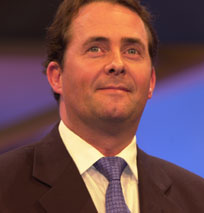
Tag: Liam Fox

  • Liam Fox – 2016 Speech in Chicago

    liamfox

    Below is the text of the speech made by Liam Fox, the Secretary of State for International Trade and President of the Board of Trade, in Chicago on 26 July 2016.

    I am delighted to be here at the Sage Summit talking to so many exciting and innovative businesses.

    Sage’s story is nothing short of inspirational.

    Beginning as a start-up 30 years ago in the great northern city of Newcastle, it has now 14,000 employees serving millions of businesses across 23 countries.

    In fact, employees in over half of all UK businesses get paid thanks to Sage.

    A big responsibility if ever there was one.

    I wonder if I am actually one of them!

    And I am also delighted to be here in Chicago. There is actually much in common between the UK and Illinois’ most famous son – Abraham Lincoln.

    The stovepipe hat, which Lincoln popularised, was actually designed on the streets of London in the 1790s; and he famously wrote to workers in Manchester saying, “the peace and friendship which now exist between the two nations will be, as it shall be my desire to make them, perpetual.”

    And I’m here, in my first overseas visit as Secretary of State for international trade, to draw on this enduring friendship.

    To ensure the UK and the United States strengthen our already close trading ties.

    So today, my message to you is simple: the UK is open for business like never before.

    They say a week is a long time in politics.

    The last month has seemed like a lifetime, but it has been transformative for the UK.

    A vote to leave the European Union and a change in government means we now have a golden opportunity to make Britain a truly global trading nation: a nation that businesses around the world want to do business from and with.

    And there are 3 key reasons why I am confident we will achieve this, which I will explain.

    Firstly, I want to talk about investment, and why the UK is and will remain one of the world’s most attractive destinations for foreign direct investment (FDI).

    Secondly, I’ll address the British people’s historic decision to leave the EU and the exciting opportunity now facing us.

    And finally, I’ll talk about my new department for International Trade and the role we will play in boosting exports and attracting investment.

    Since 2010, 300,000 new jobs have been created by companies that have chosen to locate in the UK.

    Last year saw Britain achieve a record share of the EU’s foreign direct investment.

    Why should a country that represents only 13% of the EU’s population succeed in getting 21% of the total investment?

    The answer, as is so often the case, lies in strong underlying economic fundamentals.

    In Britain, we have seen numbers in employment rise to an all-time high and unemployment fall to an 11-year low of below 5%.

    These are the result of levels of growth that, even post Brexit, the International Monetary Fund (IMF) expects to be the highest in the EU.

    We have a system of contractual law that gives investors the highest possible levels of confidence, overseen by an internationally respected and totally independent judiciary.

    We have a skilled workforce and low levels of industrial disruption.

    People rightly talk about London as an international financial and cultural powerhouse but how many people know that the north-east of England, as a region, now exports more cars than the whole of Italy?

    We have a low tax economy with some of the lowest business taxes in Europe and have one of the least regulated economies.

    Our corporate tax rates are among the lowest in the G20 and are set to get even lower.

    We have an internationally respected research base and some of the best universities in the world.

    We are home to 18 of the world’s top 100 universities, and 4 of the top 10.

    In areas such as financial services we have an unrivalled professional class able to give support.

    We have the natural advantage of speaking English and we are in the perfect time zone for global trade – we can conclude business with China in the morning and resume business with the US in the afternoon.

    None of these elements is dependent on our membership of the European Union and this is before taking into account the quality of life issues that make living in the United Kingdom so attractive to those outside.

    These are the UK’s unique selling points (USPs) and if we continue to harness these properly, investment will keep flowing to our shores.

    Last week’s record inward investment of £24 billion by Japan’s Softbank was a resounding vote of confidence in Britain as a future hub of open trade, prosperity and stability.

    On my first full day as Secretary of State for International Trade, I visited Farnborough International Air Show: 6 years after my last visit as Defence Secretary.

    And on the opening day we saw Boeing pledge to double its workforce in the UK, and Virgin announce a multi-billion pound deal to buy 12 planes from Airbus, which makes wings in the UK.

    Further afield in China, we have heard incredibly bullish sentiments from companies like Fosun, Wanda Group and JD Mall – who are not only committed to continuing their business in the UK, but in some cases considerably ramping it up.

    Just last week, a leading Chinese building company announced it would invest £220 million in several significant development projects in Sheffield.

    But what is important to realise is that investment is a two-way street.

    We welcome foreign direct investment for the jobs it creates and the societies it transforms, but we must not forget that the UK is a significant global investor in its own right.

    Between the UK and US, nearly $1 trillion worth of investment flows across the Atlantic: making us each other’s largest investor, and each other’s largest foreign job creator.

    UK companies employ one million people in America and US companies employ a similar figure today in the UK.

    Our hosts Sage are a wonderful case in point, employing 2,000 people across the US.

    And here in Illinois, over 55,000 people go to work everyday for British companies – with BP, First Group and WPP being among the biggest employers.

    Sectors in the US which receive the most UK investment are Business and Financial Services; software and IT; and pharmaceuticals.

    In 2013, the UK invested $7 billion in research and development (R and D) as well as helping the US export over $55 billion worth of goods.

    This is what open trade is all about, something I’d like to hear more of in the current American electoral cycle.

    It’s about countries coming together to set the conditions so that businesses, skilled people, goods and services can move easily. This creates stability, enriches our cultures, and spreads prosperity.

    I want the UK and USA together to lead the world as shining beacons of open trade.

    The second reason I am confident of our future is the opportunity awaiting us as we prepare to exit the European Union.

    The British people made by historic and brave decision to take back control of our own destiny and we must honour it for the instruction to government that it represents.

    I am delighted that our new Prime Minister has affirmed that “Brexit means Brexit”.

    There will be no backtracking.

    No second guessing and no second referendum.

    There are many issues that affected the referendum outcome on 23 June.

    Sovereignty or governance was certainly one, immigration was another and the economics and trade played a part.

    In terms of trade, if we look at the top 10 export markets where the United Kingdom has a trade surplus only one, Ireland, is in the EU.

    If we look at the 10 export markets with the United Kingdom has a trade deficit 7 out of the 10 are in the EU.

    Why should this be?

    Well, with growth in the UK having been much more robust than the rest of the EU we have been an expanding market to the extent that the EU as a whole sells nearly £70 billion worth of goods and services more to the UK than we do to them.

    Germany alone has a £30 billion trade surplus with the UK.

    That is why it is in the interests of fellow European Union members that we leave in a way that creates minimal disruption for the Continent as a whole.

    While we are still members over the next 2 years we will continue to support Transatlantic Trade and Investment Partnership (TTIP) and Comprehensive Economic and Trade Agreement (CETA) and encourage an ever more liberal approach to the service sector, including financial services.

    As we enter a new era, however, we need to take account of the changing patterns of trade across the globe.

    We are moving away from an era when multilateral agreements dominate the landscape to one where bilateral free trade agreements (FTAs) and plurilateral agreements between small numbers of countries are becoming more common.

    In the last 20 years, the number of free trade agreements in place has increased more than four-fold.

    As we leave the European Union, the United Kingdom will want to play a full part in global trade liberalisation utilising all the tools and arrangements available.

    Flexibility and agility will be the key to economic success in the 21st-century.

    We will need to seek out markets that are functionally similar rather than geographically proximate in an increasingly globalised environment that will make geographical blocks increasingly less relevant.

    I have often thought that if Francis Fukuyama had called his book ‘the end of geography’ rather than ‘the end of history’ it would have provided a better description of the era in which we now find ourselves.

    Leaving the EU gives us back control of our trade policy to set our own terms with the rest of the world.

    We will have the opportunity to make our tax systems even more competitive, take an axe to red tape that can hinder businesses, and shape a bright future for the UK as a beacon for open trade.

    And in due course, we will set out a very ambitious programme of free trade areas (FTAs) with some of the most important and growing economies.

    I have already had conversations with foreign counterparts who are keen to strike deals with the UK as soon as possible.

    And we will recruit and train many more trade experts so we are match fit to negotiate the best for Britain.

    What will also continue is our dedication to providing market access to some of the world’s poorest economies.

    And our ability to change external tariffs will enable us to help some of the world’s poorest countries to trade their way out of poverty.

    A world of open trade will not only generate prosperity, but also peace and stability.

    Throughout all of this, we will draw on the quintessential British values of democracy, freedom and the rule of law which have already transformed much of our world.

    And finally, I am delighted that our ambitious vision for an open and outward looking UK economy is now reflected in a new government structure in Whitehall.

    I am honoured to be the Secretary of State for the new department for international trade.

    We will coordinate and implement trade and investment policy as well as, in time, negotiating free trade and market access deals around the world.

    We will provide operational support for exports and facilitate inward and outward investment.

    And that includes growing our footprint in the most important markets around the world.

    Which is why I am pleased to announce today that the UK government plans to open 3 new offices right here in the United States, in Minneapolis, Raleigh and San Diego.

    Renowned for their economic productivity and well-established research and development institutions, these 3 cities offer exciting opportunities to boost trade and investment.

    Each office will work to promote UK business, economic and political ties in support of the Consulate General in the region, building on a model has been shown to work well in Denver and Seattle.

    The Seattle office alone has supported delivery of approximately £8 million in capital investment and 1,000 UK jobs in the past year.

    By bringing together trade promotion with policy, we will be much better able to champion British business around the world.

    And I will work closely with my cabinet colleagues, in particular the Foreign Secretary and the Secretary of State for Exiting the EU, to ensure we take a whole of government approach in maintaining Britain’s status as a great trading nation.

    Before I close, I want to reiterate that we have nothing to fear from forging our own free-trade environment and breaking out on our own.

    We can start afresh, and use our unique attributes to create a fairer, prosperous and more open trading future for the UK and the rest of the world.

    The UK will remain a fantastic place with which to do business: investment will continue to flow and British goods will still adorn the supermarket shelves and homes of customers around the world.

    We can be a beacon of hope for open trade….

    …We will seize the world of opportunity out there waiting for us…

    …And we are very much open for business.

    We are optimistic, and we are confident.

    Thank you.

  • Liam Fox – 2016 Speech on the EU

    Below is the text of the speech made by Liam Fox, the Conservative MP for North Somerset, on 2 June 2016.

    All across the country, local authorities are facing huge challenges to meet additional housing targets set by Central Government. Local communities are facing the loss of green spaces in the rush for housebuilding, often failing to take into account the limitations on existing infrastructure.

    Take the village of Yatton, in my own constituency of North Somerset, for instance. Despite having no surplus school places, fully saturated GP surgeries and an already overstretched road system, it is typical of innumerable of villages across the country, where local communities are being asked to absorb large numbers of extra houses without any realistic possibility that the money will be found to provide the extra infrastructure required.

    It is a story being repeated time and time again in more and more places. People rightly ask, “how much of our green space will disappear, possibly forever?” and “how much of our quality of life will be compromised to deal with problems often created far away?”

    And they are right that the problem that is being faced at the local level begins well away from our communities at the level of national policy failure. It lies in the failure to control the growth of our population through immigration, including immigration from the European Union.

    As the Government fails to control the increase in the population due to migration, it forces local authorities to build more and more houses to deal with the ripple effect.

    If we remain in the European Union we will be forced to accept unlimited free movement of people – but there will be no free movement of space coming with them. The inevitable result will be worsening overcrowding in our land limited country.

    Most of the focus in the housing debate has been on supply. There is a relatively broad consensus that the UK needs to build around 250,000 additional homes every year to meet current demand. In the last ten years an average of only 170,000 have been built and the debate has largely been around how changes to planning can facilitate the level of house building required.

    Yet, what this approach to the problem fails to understand is that it is not merely an issue of supply, but one of demand.

    For much of the 20th century, the number of households grew at a faster rate than the population as a whole. Changes in social behaviour, such as divorce and the increased tendency for people to live alone, as well as demographics, meant that the average household size fell. In recent times, however, average household size has changed little, and the key factor driving the growth in household numbers has been population growth.

    The total non-British net inflow of immigrants is close to 350,000 with migration from the EU now accounting for about half of that figure.

    The outcome of the recent renegotiation of benefits will make no significant difference to these numbers, as the office for budget responsibility, the government’s advisory body has confirmed.

    This implies continued total net EU migration to the UK of the order of almost 200,000 people per annum.

    This number is growing dramatically and has already more than doubled since 2012.

    The continuing failure of the Eurozone and the tragically high levels of unemployment in Southern Europe is likely to mean that more and more young people will head to the North of Europe, including the UK, in search of work.

    And all this does not include those countries who may join the EU in the coming years.

    All these factors could considerably boost the numbers and we are powerless to stop it. Staying in the EU is likely to mean continued high levels of immigration over which the UK would have no control while leaving the EU would give back control of immigration policy to the UK government so enabling the number of immigrants to be reduced while, at the same time, being more selective about who can come to the UK.

    Continuation of net migration on the current scale would mean an increase in our population of almost 5 million in 15 years’ time.

    This would be the equivalent of adding the combined population of the cities of Birmingham, Glasgow, Manchester, Liverpool, Leeds, Sheffield, Bradford and Bristol.

    60% of this increase would be from future migrants and their children. This is not a scare story, simply an extrapolation of how today’s immigration figures will impact on our society in the years ahead if changes are not made to policy. Half of this huge figure is attributable to the EU.

    Official figures show that in the last ten years, two thirds of additional households in the UK have been headed up by an immigrant (that is to say that they had a foreign born “Household Reference Person (HRP) – what used to be known as head of household) [c]. Households with a foreign born HRP have increased by around 120,000 a year during this period.

    In London, despite the rapid growth in population the number of households headed by a British born person has actually fallen in the last ten years.

    This is a particular problem in England which takes over 90% of immigrants to the UK despite the fact that it is is already nearly twice as crowded as Germany and 3½ times as crowded as France.

    Yet population growth on the present scale means making our urban areas still more overcrowde or building over valuable green belt or farmland with all the loss of amenity involved.

    At current levels of immigration, the Office for National Statistics project that our population will continue to grow by around half a million a year – a city the size of Liverpool every year.

    This will mean that, in England, we will have to build a new home every six minutes, or 240 a day, for the next 20 years to accommodate just the additional demand for housing from new migrants. That is before we take into account the needs of those who were born here.

    Of course, it would be wrong to imply that most newly built housing is occupied by immigrants. Many immigrant households move into existing properties. The need to build a new home every 6 minutes it is to deal with the additional demand for housing, it is obviously not that these new homes will be occupied directly by immigrants.

    To be even more specific, the difference in projected household growth between ‘high’ net migration and ‘zero’ net migration is 95,000 households per year or more than one additional household every 6 minutes.

    These patterns create consequences for almost all sections of society.

    Most new immigrants move into the private rented sector which has grown as the immigrant population has grown. Competition for rented accommodation obliges all those in the private rented sector to pay high rents which take a large share of income and makes saving to buy a home even harder.

    These resulting high rents and a shortage of housing make it much more difficult for young people to set up home on their own so they have to spend more time in house shares or with their parents.

    The problem in the private rented sector may well be exacerbated by recent moves to clamp down on the buy to rent sector.

    High rents and high house prices resulting from an imbalance of supply and demand in the market often means that families have to live in overcrowded conditions or move away from their local area to find suitable accommodation that they can afford.

    Those living in the parts of the UK with lower housing costs cannot afford to move for work leaving, them trapped in areas with fewer opportunities.

    Of course there are other drivers to housing demand, some of which will have been hidden by the recent undersupply in the market.

    For example, if supply were to be increased some younger people would leave their parents’ home or house shares thus adding to effective demand.

    But this cannot get away from the fact that a huge increase in population is driving a demand for housing that we are finding difficult to cope with, at least without potentially damaging the quality of life for those who already live in our country.

    A satellite survey by a research team at the University of Leicester between 2006 and 2012, found that between 2006 and 2012, 22,000 hectares (54,000 acres) of green space in Britain was converted to “artificial surfaces” – mostly housing, but including the roads, other infrastructure required to support the houses themselves.

    More than 7,000 hectares of forest was felled, 14,000 hectares of farmland concreted and 1,000 hectares of precious wetland was drained to make way for urban sprawl.

    That’s a landscape twice the size of Liverpool, transformed forever, in just six years.

    Without a substantial change in policy, the same thing will happen – again and again and again.

    Membership of the European Union is usually measured in monetary terms but there are other ways of measuring the cost.

    A constant unchecked flow of migration will inevitably result in more of our open spaces and natural greenery being turned over to housing.

    Some of that may be inevitable, with growth of our own population, or changing social behaviours, but simply because some of this pattern may be inevitable is no reason to be resigned to it.

    My message, especially to the young and those with young families is this – if we remain in the EU, if we have uncontrolled migration year after year after year after year, you will find it harder to get a home of your own.

    You will find it harder to see a GP or you will find it harder to get a school place and you will see our green spaces disappear at an even greater rate.

    If we are unable to control immigration and registered from its current levels, then we will pay a much more subtle and long-term price than money can measure.

  • Liam Fox – 2000 Speech to Conservative Party Conference

    liamfox

    Below is the text of the speech made by Liam Fox, the then Shadow Health Secretary, to the 2000 Conservative Party Conference on 3 October 2000.

    At our conference this week voters don’t need us to remind them that health has actually got worse under Labour.

    They don’t need us to remind them that their tax has gone up with nothing to show for it.

    They don’t need me to remind them about the increased number of people waiting to get treated, the jobs for Labour cronies, the repeated announcements, the PR stunts, sound-bites, photo opportunities, re-launches, postcode rationing, trolley waits, cancelled operations and the elderly ‘not for resuscitation’.

    And all at the hands of a Prime Minister and Secretary of State who represent the most smug, arrogant, complacent, out of touch, ‘blame someone else’ and downright incompetent administration the NHS has ever known.

    No, they don’t need to be reminded – so I won’t.

    But disillusionment with Labour is not enough. What people rightly want to know is what we would do differently. We are the Government in waiting. It is our duty to outline our approach.

    Let’s begin by dispensing with Labour’s great lies in leaflets like these. We will match Labour’s spending plans for health pound for pound. We believe in a comprehensive National Health Service funded from taxation free at the point of use.

    When Alan Milburn was still peddling CND propaganda in his socialist bookshop, I was one of those overworked junior doctors in the NHS.

    I spent all my working life before politics as a doctor in the NHS so when Tony Blair says that we intend to cut doctors and nurses, he is not only lying but he knows he is lying.

    Unlike Labour’s NHS, ours will be one with proper priorities, where the sickest patients are treated first.

    Where the value of our care is measured by more than just the numbers treated.

    Where doctors decide which patients are treated, and not bureaucrats and where politicians stop interfering.

    Where new partnerships are formed inside the NHS and between the public and private sectors.

    It doesn’t matter to us where a patient is treated but when a patient is treated and the quality of that treatment.

    Patients have a right to expect us to arrange the best treatment we can . If we can use the private sector to speed up the treatment of NHS patients then we should do so.

    We should not be treated by the State like some Dickensian paupers having our gruel dispensed and expected to say thank you because it’s all there is. We are citizens and taxpayers in the world’s fourth biggest economy at the beginning of the 21st century. We have a right to expect something better.

    But rights also imply responsibilities. Patients who make emergency night calls for trivial complaints, who use ambulances as a taxi service, or who fail to turn up for their hospital appointments are denying others potentially life saving services. And it can not continue.

    REMOVING POLITICAL INTERFERENCE

    Sometimes when I look at the NHS, I think that only a fool would believe that you can run a service that employs almost a million people from behind a Minister’s desk in London.

    It is crazy to believe that one person can tackle the different and detailed health needs of Penzance, Preston and Peckham with a single ‘one size fits all’ solution dreamed up in Whitehall.

    And it is unacceptable that a party political Secretary of State can decide who sits on every health authority and pack it with his own supporters. We will bring this disreputable and shameful practice to an end.

    Actually, by letting the experts run the NHS I intend to be the least over worked Health Secretary in history.

    SETTING THE RIGHT PRIORITIES

    Next, we must change the targets we use. For too long, under Conservative as well as Labour Governments, we have been obsessed with targets based on input or throughput. In other words, you are doing a better job if you spend more money irrespective of how you spend it or if you treat more patients, irrespective of whether or not they are the right patients. That is not a sensible approach.

    We need to have targets which are based on the outcomes for patients.

    That means we need to raise our cure rates and survival rates to match those in neighbouring countries. It is not acceptable that if we develop lung cancer or breast cancer or colonic cancer or heart disease that our chances of survival are sometimes only half of the Dutch or Germans or Americans.

    But meaningful targets need investment and not just slogans. That is why, although we will match Labour’s spending plans for health we will spend that money very differently. Our plans mean that investment will be directed towards priority areas beginning with cardiac and cancer services as a first step in delivering our Patients Guarantee. And we will abolish Labour’s iniquitous waiting list initiative which so distorts clinical priorities.

    Am I the only one who believes it is unethical and immoral to deny lifesaving treatments in order to speed up more minor ones?

    Am I the only one who finds it repulsive that patients have their cancer or cardiac surgery cancelled while surgeons are forced to carry out more hernia surgery so that ministers can claim better figures?

    Am I the only one who believes that the sickest patients should be treated first?

    It is time we had a system based on sound values, not sound bites.

    Yet there are those who urge us to reject this approach. They say “Don’t do it. You may speed up cancer care and improve cardiac care but there are more people with ingrowing toenails, varicose veins and sebaceous cysts and they all have votes.”

    Has our society really become that shallow?

    Do we really believe that people really think of no one but themselves ?

    I don’t believe so. Too many of us here today will have had family, friends or neighbours who have died prematurely as a result of the failure to prioritise our health care.

    I believe that in the British people there is a sense of fairness and decency which is offended by this Government’s approach. We Conservatives must be their voice.

    Politics is not about following focus groups but informing and leading public opinion.

    It is time we got back to doing what is right not just what is popular in the short term.

    THE BEST USE OF OUR STAFF AND RESOURCES

    Of course, the NHS cannot only be about life threatening conditions and, in time, we want to see all waiting times reduced. That is why, as a first step, we support the idea of “stand alone” surgical units for procedures such as cataract surgery or hip replacements. These units, dedicated to a single type of treatment, could work more efficiently (perhaps even round the clock) enabling us to end the scandal of operations being cancelled at the last minute.

    Under Labour the NHS is increasingly being run British Leyland in the 1970s where you don’t want to be sick after five o’clock or at weekends and heaven help you if it is a public holiday.

    Indeed there is a general need to use our staff more efficiently. As a GP, I spent a lot of time doing things for which I was over-trained. We don’t need someone with nine years training to take blood pressures or blood samples. Doctors and nurses need to be used at the ceiling of their abilities.

    For example in my own area of general practice I want to see GPs develop specialist skills to complement their generalist role. When a parent takes their child to the doctor with a problem it would be nice to see someone who had experience in paediatrics or if a woman goes with post menopausal bleeding she should be able to see someone who has trained in gynaecology.

    Many of our GPs already work as clinical assistants in hospital out- patients clinics. It makes sense to develop a new level of care in general practice, with semi specialist GPs so that patients can be seen more quickly and locally and hospital outpatient clinics are used for those who genuinely require a Consultant level service.

    In the same way, I believe nursing has come of age. In breaking down the territorial barriers we will offer nurses a real opportunity to make full use of their skills.

    These developments will have impacts on training.

    We need to recruit nurses from a wide spectrum and training must be flexible enough to accommodate a whole range of skills from simple patient care to further academic development.

    We must never forget that holding the hand of someone who is afraid can be just as important as operating complex equipment.

    And it is time that we all got back to recognising something we seem to have forgotten – that nursing and medicine are not just jobs but a vocation, and should be valued as such.

    EXPANDING THE PRIVATE SECTOR

    Despite the lies being perpetrated by the Labour leadership, we have repeatedly made it clear that we will match Labour’s planned health spending. It will be welcome and it will allow a vital expansion of our health care. But it will not be enough in itself.

    If we want to see total spending on health care brought up to European levels we will need to see the private sector increased as well as the NHS. That means making private health care more attractive.

    To be blunt, the private sector also needs a shake-up. Too many products for individual private health care are too expensive, inflexible, with too many exemptions and covering you for everything except anything you have ever had.

    This is especially difficult for the elderly made worse by the Government’s removal of their tax relief on private health. This is a government that seems to have entirely abandoned the elderly.

    Labour have also hit company schemes too adding yet another burden to the NHS.

    We must not back away from the challenge to make private health care more attractive in addition to the extra NHS spending.

    A bigger cake benefits everyone if a real partnership is introduced. In order to encourage company schemes we will abolish disincentives in the taxation system where and when we can afford to do so.

    This will ensure that additional provision is available to as wide a range of our fellow citizens as possible.

    Choice in healthcare should not just be for the well-off.

    By improving choice within the NHS and making access to the private sector cheaper and easier we can bring our spending on health up to the levels of other western countries and close the real health gap.

    Labour will oppose us, just as they opposed Conservative trade union reforms which gave individuals more power and just as they opposed Margaret Thatcher’s council house sales which gave so many a share in prosperity.

    Our instincts were right then and they are right now. Labour support the state. We support people. A better NHS and an expanded private sector working in a real partnership can benefit all our people.

    MATRON’S VALUES

    But health is not just about structures and money. It is also about values. I want to see a return to what I would call ‘Matron’s Values’.

    It seems ludicrous to me that ward sisters are not in control of cleaning wards and feeding patients.

    When the ward sister says jump the response should be “How high?”, and not “I need to call my supervisor.”

    We need to give those who have the responsibility for patient care the authority as well.

    One of my elderly neighbours has just come out of hospital. She was very unwell and unable to eat as well as being extremely deaf. For dinner she was given some rock-hard battered fish. There was a time when someone would have said make this lady some scrambled eggs which she can eat. But no, half an hour later the offending fish was simply whisked away untouched.

    I’m sure you all know similar examples. It is not about major policy initiatives. It is about seeing patients as people not illnesses with a nametag. Sometimes in health it’s the little things that matter most.

    And another thing. I cannot bear this habit of calling people, especially elderly people by their first name when they don’t want it.

    My grandmother was never called Sarah in her life, not even by my grandfather. (I won’t say what he called her). She was always known as Mrs. Young. When she became confused she didn’t know who this Sarah was. And it’s not good enough.

    We must understand that we are dealing with individuals who have their own identities, sensitivities and pride which should be respected. The Cabinet may call one another Tony and Jack and Mo. Our patients have earned greater respect. Dignity is their irreducible core.

    TELLING THE TRUTH

    We have a great challenge ahead in the debate on health – to tell the truth.

    There is no endless flow of money. We cannot do everything we would like as quickly as we would like. Medical science is expanding faster than our ability to fund it. In the real world choices must be made, priorities must be set. There has always been rationing and there always will be.

    We must have the courage to say what we know to be true.

    And yes that means if doctors from overseas are not properly qualified and do not have adequate communication skills, then we will say so, irrespective of the knee jerk reaction of the PC brigade and their media allies.

    You know promising things you cannot deliver in politics is cynical and creates resentment.

    But promising things you know you cannot deliver to the sick and vulnerable is wicked and cruel. That is the charge at Labour’s door.

    We must show that we are not just a party of pounds, shillings and pence. We must show what sort of Britain we want to live in and how we will achieve it.

    Our way will be different.

    Where health care is run for the patients not the politicians.

    Where decisions are made by doctors and nurses not bureaucrats.

    Where heart bypasses are not given the same priority as in-growing toenails.

    Where vocation is once again valued.

    Where we treat patients with dignity as individuals, where we tell the truth and do what we believe is right in tune with our beliefs, our experience and our values.

    It is time to restore faith in health.

    Let Labour play follow the focus group.

    Let us say what must be said and do what must be done.

    Let our party prepare again to lead our Nation.

  • Liam Fox – 2015 Speech on Syrian Air Strikes

    Below is the text of the speech made by Liam Fox, the former Secretary of State for Defence, in the House of Commons on 2 December 2015.

    It is very important that the whole House is clear about what this debate is not about. It is not about provoking a new confrontation with Daesh, given that it has already confronted peace, decency and humanity. We have seen what it is capable of—beheadings, crucifixions, mass rape; we have seen the refugee crisis it has provoked in the middle east, with its terrible human cost; and we have seen its willingness to export jihad whenever it can. It is also not about bombing Syria per se, as is being portrayed outside; it is the extension of a military campaign we are already pursuing in Iraq, across what is, in effect, a non-existent border in the sand. I am afraid that the Leader of the Opposition’s unwillingness to answer the question from my hon. Friend the Member for Enfield, Southgate (Mr Burrowes) will give the clear impression that he is not just against the extension of the bombing campaign into Syrian territory, but against bombing Daesh at all, which is a very serious position to hold.

    To understand the nature of the threat we face and why it requires a military response, we need to understand the mindset of the jihadists themselves. First, they take an extreme and distorted religious position; then they dehumanise their opponents by calling them infidels, heretics and apostates—let us remember that the majority of those they have killed were Muslims, not those of other religions; then they tell themselves it is God’s work and therefore they accept no man-made restraint—no laws, no borders; and then they deploy extreme violence in the prosecution of their self-appointed mission. We have seen that violence on the sands of Tunisia, and we heard it in the screams of the Jordanian pilot who was burned alive in a cage.

    We must be under no illusions about the nature of the threat we face. Daesh is not like the armed political terrorists we have seen in the past; it poses a fundamentally different threat. It is a group that seeks not accommodation but domination. We need to understand that before determining our response.

    Daniel Kawczynski (Shrewsbury and Atcham) (Con):

    My right hon. Friend will know of concerns that Daesh fighters are leaving Syria for Libya in greater numbers. Does he believe that when we are tackling Daesh in Syria, we will have to confront it in Libya at some stage as well?

    Dr Fox:

    My hon. Friend is absolutely right. As I said, we have not chosen this confrontation; Daesh has chosen to confront us—and the free world, and decency and humanity. It is a prerequisite for stability and peace in the future that we deal with the threat wherever it manifests itself.

    There are two elements to the motion: the military and the political. On the military question of whether British bombing, as part of an allied action in Syria, will be a game changer, I say, no, it will not, but it will make a significant and serious contribution to the alliance. The Prime Minister is absolutely correct that some of our weaponry enables us to minimise the number of civilian casualties, and that has a double importance: it is important in itself from a humanitarian point of view, as well as in not handing a propaganda weapon to our opponents in the region. Britain can contribute: we did it successfully in Libya, by minimising the number of civilian casualties, which is not an unimportant contribution to make.

    We must be rational and cautious about the wider implications. No war or conflict is ever won from the air alone, and the Prime Minister was right to point out that this is only a part of the wider response. If we degrade Daesh’s command and control, territory will need to be taken and held, so ultimately we will need an international coalition on the ground if this is to be successful in the long term. There may be as many Syrian fighters as the Joint Intelligence Committee has set out, and they may be co-ordinating with the international coalition, or be capable of doing so, but we must also recognise the need for a wider ability to take and hold territory. To those who oppose the motion, I say this: the longer we wait to act, the fewer our allies’ numbers and the less their capabilities are likely to be, as part of a wider coalition. If we do not have stability and security on the ground in Syria, there is no chance of peace, whatever happens in Vienna.

    On the political side, our allies think it is absurd for Britain to be part of a military campaign against Daesh in Iraq but not in Syria. It is a patently militarily absurd position, and we have a chance to correct it today. But we must not contract out the security of the United Kingdom to our allies. It is a national embarrassment that we are asking our allies to do what we believe is necessary to tackle a fundamental threat to the security of the United Kingdom, and this House of Commons should not stand for it. Finally on that point, when we do not act, it makes it much more difficult for us diplomatically to persuade other countries to continue their airstrikes, and the peeling off of the United Arab Emirates, then Jordan and then Saudi Arabia from the coalition attacking Daesh is of great significance. We have a chance to reverse that if we take a solid position today.

    This motion and the action it proposes will not in itself defeat Daesh, but it will help, and alongside the Vienna process it may help to bring peace in the long term to the Syrian people. Without the defeat of Daesh, there will be no peace. We have not chosen this conflict, but we cannot ignore it; to do nothing is a policy position which will have its own consequences. If we do act, that does not mean we will not see a terrorist atrocity in this country, but if we do not tackle Daesh at source over there, there will be an increasing risk that we have to face the consequences over here. That would be an abdication of the primary responsibility of this House of Commons, which is the protection and defence of the British people. That is what this debate is all about.

  • Liam Fox – 2011 Value for Money Speech

    Below is the text of the speech made by the Secretary of State for Defence, Liam Fox, at Civitas in London on Tuesday 22nd February 2011.

    Introduction

    Being the Secretary of State for defence was always going to be one of the toughest jobs in the new Government.

    Defence was the worst in a grim set of inheritances.

    As the Chancellor said, Defence was the “most chaotic, most disorganised, most over-committed” budget he had seen.

    Labour had avoided a strategic defence review for 12 years.

    As a consequence we were always going to need a step change not incremental reform.

    The black hole in the MoD budget by the end of the decade was more than one year’s entire defence spending.

    This had resulted from the serial failure of Labour ministers to take difficult decisions and what Bernard Gray described as ‘the conspiracy of optimism’ in the department’s planning.

    On top of this was the need to contribute to the deficit reduction.

    Next year’s interest payment on the national debt will be bigger than the defence, foreign office and the international aid budgets combined.

    Unless we deal with the deficit it will become an increasingly dangerous national security liability as more and more money is swallowed up in interest and less is available to spend on the safety of our country.

    In less than a year huge progress has been made in turning these problems round.

    The SDSR set a clear direction for policy, implementing the National Security strategy.

    It decided on an adaptive posture for the UK – neither Fortress Britain nor overcommitted expeditionary forces on the other.

    We had inevitably to divest ourselves of some legacy to enable us to invest in dealing with the threats of the future, not least in cyberspace where government will now spend an extra £650m.

    But the SDSR was not a single event, it was part of a cycle of five yearly defence reviews designed to constantly adapt to changing global security circumstances.

    The 12 year gap in defence reviews, the budgetary black hole and the need for deficit reduction inevitably meant that we would have to take tough and sometimes unpopular decisions.

    But we were able, nonetheless, to show a path to the Future Force 2020 where Britain’s defences will be coherent, efficient and cutting-edge.

    But the change cannot stop there.

    Across Government, we must transform the way public services are delivered.

    For years successive Defence Secretaries have failed to get a grip on the equipment programme and failed to hold the department and industry to account for delays and poor cost-estimation

    Only today we are reminded by the Public Accounts Committee of Labour’s desperate legacy.

    In their final year in office just two programmes reported an increase of cost by a staggering £3.3 billion.

    The MoD must fundamentally change how it does business and today I want to set out how this change will come about.

    The drivers of structural financial instability and the institutional lack of accountability, from ministers down, must be tackled if we are to avoid history repeating itself.

    The constant postponement of difficult decisions created a bow wave in the department’s finances which became increasingly difficult to handle.

    It would be folly to tackle this, as are doing, only to allow the systemic failures which created it to continue.

    We need greater accountability and transparency to ensure that our resources genuinely match our ambitions and cost control is rigorously enforced.

    Too often when ministers have wanted to pull levers they find themselves pushing string instead.

    So there are a number of changes that are crucial.

    First, the so-called conspiracy of optimism, through which the risks and costs in new projects are under-estimated, only to find mushrooming costs later, needs to end.

    Second, future programmes should not be included unless there is a clear budgetary line for development, procurement and deployment.

    Third, we must end the lack of real time cost control with tight budgetary discipline.

    And fourth, we must rebalance our relationship with industry so that we achieve maximum value for money, remembering that the primary purpose of the procurement process is to give our Armed Forces to the need when they need it at a reasonable cost to the taxpayer.

    Dealing with the Conspiracy of Optimism

    For too many years projects have been included in the future defence programme without a proper appreciation of the risks or costs.

    The conspiracy of optimism based on poor cost estimation and unrealistic timescales, across the Department has – to be frank – involved politicians, the civil service, the military and industry.

    Too often in the past, in order to get pet projects included in the programme, unrealistic costs have been accepted at the outset knowing that they can be recovered later due to what are euphemistically called ‘cost overruns’.

    These practices in the MoD would not be tolerated in the private sector and they cannot be tolerated in the MoD.

    By looking at and approving programmes in isolation from the totality of departmental spend any programme can be made to look affordable.

    But when they are considered together, the cumulative risk and cost become unmanageable.

    So a risk-aware and cost-conscious mentality must permeate every level at the Ministry of Defence, civilian and military alike.

    Now more than ever, every penny counts.

    Value for money is not about compromising your defence aim. It is about realising that aim in a sustainable way.

    From now on, guarantees of realistic budgets for development, procurement and deployment must be presented to ministers before spending can begin on new programmes.

    At the same time we must examine the future programmes we currently have to ensure risks and costs are well understood and that they remain affordable.

    I have asked the Permanent Secretary, Ursula Brennan and Bernard Gray to carry out this process immediately.

    Real Time Cost Control

    If we are to achieve real budgetary discipline we must also have better real-time control of project budgets.

    How often have we had to listen to the National Audit Office detailing projects which run over time and over budget?

    Too often the MoD has simply presided over a post-mortem on programs — in my previous profession a post-mortem was not considered a good professional outcome and it will not be so in the MOD.

    There are a number of changes we need to make.

    We need to give project managers the right resources and authority to deliver what we ask of them and hold them to account.

    We also need to keep them in post long enough to deliver, ensuring that they have the skills available to make the tough calls necessary.

    The private sector would view the rapid turnover of project managers in the MoD – with what I call the repetitive loss of expertise – as crazy.

    It is for all these reasons that I am establishing the Major Projects Review Board.

    This will be chaired by me as the Secretary of State and will receive a quarterly update on the Ministry’s major programs to ensure that they are on time and within budget.

    This will begin with the 20 biggest projects by value and will rapidly expand to the 50 biggest projects.

    There must be a real sense of urgency about achieving this goal.

    Where projects are falling behind schedule or budget we must take immediate remedial measures.

    Those responsible will be brought to account in front of the project board.

    And in addition we will publish a list every quarter of the Major Project Review Board’s ‘Projects of Concern’.

    That way the public and the market can judge how well we and industry are doing in supporting our Armed Forces while offering value for money to the taxpayers.

    I want shareholders to see where projects are under-performing so that they can bring market discipline to substandard management where required.

    Rebalancing Our Relationship with Industry

    But change cannot just be internal.

    This government showed from the outset its commitment to the defence industry and an understanding that the best way to sustain defence jobs in the long term is to widen the customer base through enhanced defence exports.

    A great deal of energy has already been devoted to this across government departments with substantial results.

    It will ensure that skills and employment are retained in some of our most technologically advanced areas, that SMEs can compete as equals and we keep British industry at the cutting edge on the world market.

    In the Ministry of Defence we established the new Defence Exports Support Group to ensure that MoD, alongside our UKTI colleagues, is focusing its efforts in support of defence exports.

    This way, the MoD can be at the forefront of the Government export led growth strategy.

    In December we published a Green paper on equipment support and technology for UK defence and security and we are currently consulting on this.

    The defence industry is a major source of revenue, jobs and exports and can play an important role in the government’s growth agenda.

    But industry must also play a role in reducing costs at a time when budgets are constrained by the need to control the deficit we inherited.

    Following the SDSR, we have entered into a period of intense negotiation with a number of our major industrial suppliers.

    This is already looking at 130 contracts relating to SDSR decisions to ensure they are both necessary and give greater value for money for the taxpayer.

    For the first time these negotiations are taking place at a company level as well as a project level.

    The number of these contracts will soon be expanded by around 500 contracts and we will complete this work over the next 18 months releasing significant cost savings across the Department.

    We must also have a relationship with industry that is open, transparent and reflects the realities of the current business environment.

    We have recently launched an independent review, led by Lord Currie of Marylebone, into the pricing mechanism – called the Yellow Book – which the MoD uses for single source contracts.

    Some of you may never have heard of this.

    But these are arrangements have been in place since 1968 without a fundamental update from either Conservative or Labour governments.

    They reflect an entirely different industrial era and they need to be updated.

    Under the Yellow Book we currently place around 40% of our contracts on a non-competitive basis, worth around £9 billion annually.

    We will set out the first stage of this review, recommending changes in consultation with industry, in the summer.

    This will affect all future non-competitive contracts and is intended to save the taxpayer hundreds of millions of pounds.

    The MoD is also working through the Centralising Category Procurement Initiative, run by the Cabinet Office, which will transform how government buys common goods and services through centralised management, standardisation of specification and aggregation of spend.

    This again will deliver significant and sustainable cost reductions across government.

    Finally, we need to update the way in which the MOD engages with industry itself.

    The relationship must take into account both the overlapping interests and the differences which government and industry have.

    We have a synergy to bring in areas such as defence exports where profits to industry also result in relationships and influence which can benefit the national interest.

    Yet we must also remember that industry is ultimately answerable to shareholders for their profits while government is answerable to the taxpayers for the management of their money.

    At present, the National Defence Industries Council acts as the body that represents the interests of the defence industry to Ministers.

    This body, however, is self appointed and excludes some of the department’s major suppliers.

    And though our defence industry relies on many thousands of Small and Medium-Size Enterprises (SMEs), I believe they are currently under-represented.

    I can announce today that I am establishing a new Defence Suppliers Forum that I will chair which will include representatives of the full range of the Department’s defence suppliers from the UK and overseas and which will better reflect the defence industry as a whole.

    Conclusion

    We need to have the mechanisms to ensure value for money in the Ministry of Defence.

    The SDSR took the necessarily tough decisions to correct years of mismanagement under Labour.

    The Ministry of Defence needs to have the structures and mechanisms to deliver the conclusions of that Review and ensure value for money for the tax payer.

    We need a new, frank and honest relationship between government and industry based on the national interest, mindful of commercial realities and sensitive market mechanisms.

    The measures I have set out today will help towards achieving these goals.

    Change, let’s face it, is seldom popular but the case for change in these areas is overwhelming.

    Let us just remember that there is no such thing as government money.

    There is only taxpayers’ money — money raised from individuals and from businesses large and small.

    They expect us to spend money wisely and properly and to enter into contracts that will deliver the equipment that our Armed Forces need when they need it while protecting taxpayers’ interests and sustaining industrial growth.

    Successive Labour Defence Secretaries have played pass the parcel with the black hole in the defence program.

    Each one has made the situation worse for their successor by failing to take the difficult decisions necessary.

    Well this is where the music stops.

    It has fallen to this government and to me as defence secretary to deal with Labour’s appalling defence legacy.

    It cannot be done overnight and it cannot be done painlessly.

    But it can and will be done.

    In the first nine months of government we have already started implementing a programme of fundamental change and will not rest until the job is done.

    And the changes I have announced today will continue that process.

    In the months ahead we will set out further reforms-for the Armed Forces, including the Reserves and Senior Rank structures and for structural change within the Ministry of Defence itself, including as a result of Lord Levene’s work on Defence Reform.

    Our National interest requires that we continue to take difficult decisions.

    And, as promised, we intend to govern in the National interest.

  • Liam Fox – 2011 Speech on Protecting National Security in the 21st Century

    Below is the text of the speech made by the Secretary of State for Defence, Liam Fox, on Thursday 19th March 2011 at Chatham House.

    INTRODUCTION

    The true test of Government is to act not for party political advantage, but to act in the national interest.

    The Coalition Government inherited a level of debt and economic mismanagement that represents a national economic emergency.

    To deal with it we have had to take difficult and potentially unpopular measures.

    But they are essential if we are to put Britain back on track in the long-term.

    This is as important for national security as it is for national prosperity.

    This requires not only dealing with the here and now, but charting a course 10, 15, 20 years ahead – acting to position the country for the safety and prosperity of future generations.

    ACTING IN THE NATIONAL INTEREST

    So in no area is this more important than in Defence and Security.

    Our Armed Forces remain at a high and sustained operational tempo.

    The requirement to fight, and win, the wars of today is not optional but necessary to protect national security and meet the national interest.

    And when our Armed Forces are committed, they deserve and the country expects that they get the support they need to do the job we ask of them.

    That is why current operations in Afghanistan and in Libya remain the priority for the Ministry of Defence and the men and women of our Armed Forces fighting on the front-line get first call on MOD resources.

    But the requirement for strategic thinking, for strategic planning and preparation – the requirement to play the long-game – is equally necessary.

    Why?

    First – because conflict and threats to national security do not fit neatly into electoral cycles.

    The hunt for Osama bin Laden and the campaign against al-Qaeda’s brand of violent extremism has been taken forward under three American Presidents and three British Prime Ministers of different political persuasions.

    For the long watch of the Cold War – it took 10 different US Presidents and 9 different British Prime Ministers.

    Second – the character of conflict evolves and new threats arise, but the complex military equipment required to meet these challenges can take a decade or more to design and build.

    So we must constantly scan the horizon and prepare for the world as it will be, not as we hope it will be.

    In Defence, contingency planning is central to ensuring that we are prepared for what may come – even if we can’t predict exactly when and where threats may emerge.

    This drives a continuing requirement for Armed Forces that are agile, adaptable and of the highest quality.

    Third – building and sustaining the power, influence and prosperity of a country in the long flow of history – particularly in our age of rapid change and unpredictability – requires action now to ensure the country can succeed in the future.

    Energy security is one example.

    Climate change would be another.

    So today I want to set out what we have achieved in Defence over the last year to set in place a long-term strategy for the safety, security and prosperity of our citizens.

    The Strategic Defence and Security Review has ensured that we will remain in the premier league of military powers.

    It is not an agenda for retrenchment; it’s an ambitious agenda for transformation over time.

    It is not an agenda for the next general election; it’s an agenda for the next generation.

    This long-term vision for Britain’s Defence depends upon a sound economic base that enables sustainable military power to be built – together economic power and military power are the foundation of global influence.

    A proper strategy for the long-term health of our country must balance ends and ways with the means available.

    That is why tackling the crisis in the public finances is not just an issue of economics but an issue of national security too.

    It is central to sustaining in the long-term Britain’s reach, military power and influence.

    THE LESSONS OF HISTORY

    Let us not forget our own history.

    The contraction of European influence in the 20th century was driven as much by the economic exhaustion of European nations over two World Wars as it was by political enlightenment in support of decolonisation.

    As a result of the First World War in the 1920s and 30s, Britain’s national debt was regularly over 150% of GDP.

    After World War Two, it peaked at around 250% of GDP.

    As examples of the effect, economic considerations underpinned both the British withdrawal from Palestine in 1948, and the abandonment of the Suez campaign in 1956.

    It wasn’t until the 1970s that the debt position recovered to under 50% of GDP – a quarter of a century after the end of the War.

    Britain’s so-called ‘East of Suez’ moment in 1967 when the Wilson Government announced a major withdrawal of UK forces from South East Asia, was a response to the decline in the country’s relative economic strength.

    Equally, the Cold War was won because the Soviet Union collapsed under the weight of an economic system that could not sustain the myth of communism’s superiority – nor sustain the military forces required to hold it together.

    During the early 1980s for instance, the Soviet Union was spending around 20% of GDP on Defence – roughly four times the level of the US and wholly unsustainable in the long-term.

    The lessons of history are clear.

    Relative economic power is the wellspring of strategic strength.

    And conversely, economic weakness debilitates every arm of government.

    Structural economic weakness, if not dealt with, will bring an unavoidable reduction in our ability to shape the world.

    ECONOMIC WEAKNESS IS A NATIONAL SECURITY LIABILITY

    Let’s relate these lessons to our situation today.

    Speaking at Chatham House last week, Niall Ferguson said:

    “fiscal and monetary stimulus, no matter how much it may take and how many times you read aloud the collected works of John Maynard Keynes, sooner or later brings a hangover.”

    It has fallen to this Coalition Government to nurse Britain through the hangover of the decade of financial mismanagement that put us where we are today.

    When, as Chancellor, Gordon Brown abandoned sticking to the previous Conservative Government’s strict spending policies, Britain’s national debt began an inexorable rise.

    Despite the benign economic environment of most of the last decade, from 2002-2007 under Labour, UK national debt as a percentage of GDP increased not decreased – from around 31% to around 37%.

    On the back of the financial crisis it has ballooned to around 60% of GDP.

    The Coalition Government inherited from Labour a record peacetime annual deficit equal of over 11% of GDP – in 2009/10 alone that meant a spend of over £150bn more than the Government brought in in income.

    Until the structural deficit is eliminated, Britain’s national debt will only continue to grow.

    Even with the Coalition’s aggressive action, the Office for Budget Responsibility forecasts public sector net debt to peak at over 70% of GDP in 2014/15.

    It currently stands at over £900bn – equivalent to almost a quarter of a century of spending on Defence at the level of this year’s budget.

    By 2015 it is likely to reach well over 1.3 trillion pounds.

    The interest, just the interest, paid out last year alone was £43bn – greater than the annual budgets of the MoD, FCO and DfID combined.

    £43bn pounds a year of taxpayers’ money that could pay for a tax cut to each taxpayer of almost £1,500 a year.

    Or it could pay for a million teachers or over a million nurses.

    In Defence – a dozen Queen Elizabeth Aircraft Carriers or 33 Astute Class submarines.

    And the bad news is, next year the interest payments will be £50bn.

    This is all while we are tackling the deficit and before we even begin reducing the national debt.

    So let me boil down this barrage of statistics to my central point.

    The Chancellor doesn’t just sit on the National Security Council to tell us how much everything costs, he does so because this Government recognises what the last did not – that our national security is linked to the health of our economy.

    Creating military power on the back of borrowing at times of extreme or existential threat, such as during the World War Two, is understandable and reasonable.

    But if you continue to do so as a matter of routine, as Labour did over the last decade, you set off a ticking fiscal time bomb that if not defused will inevitably result in strategic shrinkage.

    I didn’t come into politics to cut the defence budget, but neither did I come into politics to be fiscally irresponsible – because the consequences of that are written deep in the historical record.

    To be a hawk on defence, you need to be a hawk on the deficit and the national debt too.

    THE DEFENCE DEFICIT

    Defence spending represents the fourth largest chunk of public expenditure, so the MoD must play its part in addressing the current economic challenges.

    In the MOD we face a particularly tough job.

    The Defence budget was perhaps the worst inheritance of all – before the SDSR the forward defence programme was overextended to the tune of £38bn over the next decade.

    That was spending on all the equipment, programmes and all other variables previously planned over and above a budget rising at the rate of inflation.

    Everyone knew the Defence Budget was running hot and that addressing this would have been required regardless of fiscal tightening.

    This is one of the reasons why, in relation to the vast majority of government departments, the MOD is contributing less to deficit reduction.

    And this is also why the transformation of Defence will have to take place over a longer-term period too.

    This cannot be done overnight – with sunk costs, kit in build, contractual liabilities and other inherited committed spend, room for manoeuvre in the short-term is limited.

    So it’s a process charting a course for the recovery of Defence capability and the sustainability of its funding.

    The Strategic Defence and Security Review has set the right direction – and I will return to this and Future Force 2020 in a moment – but staying the course will require sustaining the strict cost-control regime I have put in place at the MOD.

    This will inevitably require that tough decisions are taken on a regular basis to keep the budget on track.

    Following the SDSR we made it clear that there would be a series of complicated second order consequences including the basing and reserves reviews, as well as the emerging work from the Defence Reform Unit.

    Having completed the current planning round, we have started the next Planning Round to take forward the work needed to balance defence priorities and the budget over the long-term.

    The Department has recently initiated a three month exercise as part of that work to ensure we match our assumptions with our spending settlement.

    This allows us to draw all this work together to inform the next planning round and to avoid the mistakes of the previous government in building up to an unsustainable Defence programme

    We have made it clear that while the SDSR had made substantial inroads into the £38bn funding deficit, there is still more to be done.

    Given the mess we inherited putting Defence on a sure footing, with a predictable budget, was always going to take time, but we believe it is better to be thorough than quick

    The Prime Minister has set out his personal view, with which I strongly agree, that achieving our vision for the future structure of our Armed Forces will require year-on-year real growth in the Defence Budget after 2015.

    As we approach the next General Election, and as we prepare for the next Defence Review in 2015, a commitment to meet Future Force 2020 will be a key signifier for those political parties dedicated to the vision of a Britain active on the world stage and protected at home.

    BUILDING FOR THE FUTURE

    As the National Security Strategy clearly sets out – our national interest requires our continued full and active engagement in world affairs

    Our trade and economic relationships are global.

    A threat that appears in one part of the world can swiftly be felt at home.

    In order to protect our interests at home, we must project our influence abroad.

    Coming together as they did, the National Security Strategy, the Strategic Defence and Security Review and the Comprehensive Spending Review, set us on a course to maintain our strategic reach, renew military capability on a sustainable basis, and address the structural weakness of the economy.

    In the MOD it was not only a budgetary deficit that we inherited.

    It was also a capability deficit.

    We had failed properly to adapt to meet future challenges.

    We had scores of tanks on the German plains, but insufficient cyber capability.

    We were committed to an expeditionary policy, but increasingly dependent on ageing strategic airlift.

    So we have embarked on a long-term programme of renewal and revitalisation in Defence that maintains our strategic reach.

    In doing so we have rejected alternative postures quite strongly advocated by some.

    One was that we should invest in what you might call ‘Fortress Britain’, withdrawing back closer to home and investing in the appropriate assets in that direction.

    Under such a posture there would be no requirement for expeditionary capabilities on our current scale, for example.

    There were others who said to go exactly the other way, and that we should have a highly committed posture and just assume that the conflicts of the future would be like the one we currently face in Afghanistan.

    Under such a posture there would be no requirement for widespread maritime capabilities, for example.

    Something that is difficult is to quantify but undoubtedly real is Britain’s invisible export of security and stability carried out by our Armed Forces, including the Royal Navy.

    Clearing mines in the Arabian Gulf, anti-piracy actions in the Gulf of Aden, protecting our own sea lanes – all contribute to international stability and the free movement of goods upon which our prosperity relies.

    So neither a fortress nor a committed posture would have met the requirement in the National Security Strategy for continued engagement in a world where threats are evolving and unpredictable.

    The adaptable posture we have embraced gives us the best capability to respond with agility to changing threats in an uncertain world.

    This means keeping our forces ready to react swiftly to those things we cannot easily predict.

    It means upgrading strategic lift capability.

    It means investment in Special Forces.

    It means being efficient, cutting down on duplication and numbers of equipment types to shorten the tail.

    And it means investing in areas of capability that suit the future character of warfare – such as cyber, intelligence and unmanned technology.

    It also means investing in activities, such as conflict prevention and aid, that prevent the development of threats ‘upstream’, before they require a more demanding military response.

    But in doing so we are not ignoring conventional military power required for flexible, multi-rolled, deployable forces.

    By 2020, The RAF will be built around hi-tech multi-role combat aircraft Typhoon and the Joint Strike Fighter, surveillance and intelligence platforms such as Airseeker, and a new fleet of strategic and tactical transport aircraft including A400M and Voyager.

    The Royal Navy will have new aircraft carriers with the JSF carrier-variant, a high readiness amphibious capability, a new fleet of Type 45 destroyers and Astute class submarines – and ready at that point to accept the new Global Combat Ship.

    The Army, based on Multi-Role Brigades, will be powerful, flexible, fully equipped for the land environment and able to operate across the spectrum of conflict.

    We will remain one of the few countries who can deploy and sustain a brigade sized force plus its air and maritime enablers, capable of both intervention and stabilisation operations almost anywhere in the world.

    And we will remain a nuclear power, maintaining a minimum credible nuclear deterrent.

    I am absolutely clear, as I said in the House of Commons yesterday, that a minimum nuclear deterrent based on the Trident missile delivery system and continuous at sea deterrence is right for the UK.

    We still have the fourth largest defence budget in the world and will continue to meet the NATO target of spending 2% of GDP on Defence over the spending review period.

    CONCLUSION

    Of course, pursuing the necessary long-term strategy set out in the SDSR is not the only mark of renewal in Defence over the last year.

    For years successive Defence Secretaries have failed, often through no fault of their own, to get a grip on the equipment programme and failed to hold the department and industry to account for delays and poor cost-estimation

    The drivers of structural financial instability and the institutional lack of accountability, from ministers down, must be tackled if we are to avoid history repeating itself.

    That is why the work of Lord Levene and his Defence Reform Unit to reform the operating model of Defence is so important along side the work of the Chief of Defence Materiel, Bernard Gray, to set the forward equipment programme on a sustainable basis.

    We are also acting to redraw and rejuvenate the relationship with industry to ensure the tax payer gets the best deal from the investment in Defence.

    These are all measures in support of the long-term transformation of Defence and the vision set out in the SDSR.

    Labour’s Defence Green Paper published just months before the election admitted with what I have to say is spectacular understatement that:

    “the forward defence programme faces challenging financial pressures”

    It said in particular that the MOD:

    “cannot proceed with all the activities and programmes we currently aspire to, while simultaneously supporting our current operations and investing in the new capabilities we need. We will need to make tough decisions”.

    Well, we have made those tough decisions, and I stand by them.

    I believe in setting your strategic direction and sticking to your plan unless the facts change.

    Since we completed the SDSR, the financial position of the country has not changed nor substantially have the nature of the threats we face.

    Let us be honest about this.

    Those who are arguing for a fundamental reassessment of the SDSR are really arguing for increased defence spending.

    But they fail to spell out the inevitable result – more borrowing, more tax rises, or more cuts elsewhere.

    The bottom line is that a strong economy is a national security requirement and an affordable Defence programme is the only responsible way to support our Armed Forces in the long term.

    There are no easy answers.

    There are no silver bullets.

    There are only tough decisions, hard work and perseverance.

    To pretend otherwise is to fail in our duty to our country and its people.

  • Liam Fox – 2003 Speech to Conservative Spring Conference

    Below is the text of the speech made by Liam Fox to the 2003 Conservative Spring Conference on 16th March 2003.

    Our proposals need to be seen against the backdrop of one simple, stark and shocking fact. The British people do not enjoy the standard of healthcare we deserve.

    During our extensive and detailed analysis of healthcare provision in more than a dozen countries over the last two years, we have seen systems which share our ideals, but which offer a considerably higher standard of care and much better clinical outcomes than the NHS.

    Unless there is fundamental and radical reform, the NHS will never produce the quality of care we have a right to expect in the World’s fourth largest economy.

    That reform must occur on three broad fronts:

    – taking politicians out of running the NHS;

    – giving real freedom to health professionals; and

    – ensuring patients have real choice in health.

    Only the Conservatives will be able to undertake that reform. The result will be an NHS which offers high quality care, free at the point of use and irrespective of the ability to pay.

    There is a clear ideological difference between the Labour Party and the Conservative Party over where power should lie in the NHS. Labour believes that the best way to achieve a quality agenda is for Ministers to determine clinical priorities and to try to enforce them through a rigid target culture.

    Conservatives believe that politicians should be taken out of the running of the NHS, that clinical staff should be given more power and that only by giving patients greater freedom about where and when they are treated can the NHS produce quality care better tailored to the needs of individuals.

    We believe that the NHS is there to service the patients not vice versa.

    We will give new freedoms to patients, empowering them to take more control over the health care they receive. We also intend to develop new capacity by encouraging more spending on health on top of that already spent in the NHS.

    The principle will be that we will want to see total spending on health increase, but we will want to see the proportion of that spending that comes from other sources increase at a greater rate than that coming from the state.

    In today’s NHS choice is highly restricted. Freedom of choice cannot be limited just to those who opt to pay for extra care on top of what they contribute to the NHS. Choice must be available for all patients whether they receive their health care from the NHS or from another provider. Unlike Labour, we do not believe that this choice should only become available after the system has already failed you.

    There needs to be a profound improvement in the overall quality of healthcare available.

    This can be brought about only by increasing the volume of treatment carried out, and raising the standard of such treatment.

    Increasing the volume of treatment carried out can be achieved only by either increasing the output of existing suppliers or introducing new suppliers. Under Labour, despite vast increases in expenditure on the NHS, the total output of the system has barely increased. All the indications are that further huge increases would not be matched by increases in output, since Labour refuse to introduce the radical reforms needed to encourage diversity and innovation. In order to create new capacity and to encourage diversity, it will be necessary to persuade new, non-NHS suppliers of healthcare to invest.

    At present, the state holds a near-monopoly on the supply of healthcare. The most recent available data on health expenditure in the UK shows that it comprises 85% from the NHS, 4% from Private Medical Insurance (PMI) and 11% from a variety of self-pay sources.

    Over recent years, whereas there has been minimal growth in PMI, the number of people opting for self-pay has increased by an average of over 20% per annum.

    In order to increase the quality and quantity of healthcare undertaken, we will need to take a number of steps:

    – Create an environment in which the private and voluntary sectors believe it is worth their while to invest, in order to generate extra capacity.

    – Reform the NHS, removing political interference and giving clinical freedom back to professionals

    – Funding the NHS on the basis of real activity not block contracts

    – Allow patients the option of moving between any NHS provider based on a national tariff system which would define set costs for specific procedures

    – Allow NHS patients to take some or all of the NHS tariff with them if they decide to have treatment outside the NHS.

    The most effective way of stimulating the creation of new, non-NHS capacity is to make it more attractive for individuals to supplement what is already being spent by the state through the NHS. This will allow total expenditure to rise in a pattern more like that in neighbouring European countries where the amount of money spent on health by private citizens is higher than in the UK.

    There are three main candidates which might be incentivised:

    – Personal private medical insurance (PMI)

    – PMI available through company schemes

    – The pay-as-you- go market where patients pay for a single procedure or item of care.

    Other countries use a combination of cash rebates, tax incentives and reductions of the cost at source with the state reimbursing providers.

    PMI offers a chance to insure against unforeseen circumstances in a way that self-pay cannot do. Experience in Australia with the use of financial incentives has resulted in a large increase in those carrying PMI.

    Company PMI schemes have the attraction of greater risk sharing, and thus better value for money and a wider income distribution than personal products provide.

    The self-pay market accounted for 250,000 procedures last year; if these patients did not opt to offload themselves in this way the NHS would be unable to cope with the extra demand. It is vital that this number is maintained or increased. It will therefore be necessary to produce a carefully balanced system of incentives to prevent the NHS (with its tiny increases in recent capacity) from becoming swamped.

    We want that choice to be extended to as many as possible.

    We will introduce a Patients Passport which will enable patients to move around a number of providers, NHS, not-for-profit, voluntary or independent. This freedom is essential if we are to see greater plurality and diversity in both the funding and provision of healthcare that we seek. We intend to move away from the state monopoly with its increasing centralising targets and standardization of supply.

    The changes to the organization of care set out in “Setting the NHS free” will enable us to move towards an NHS where the patient as a consumer is sovereign for the first time.

    Knowing the cost of all NHS procedures and treatments and funding providers on the basis of activity will enable us to radically change the balance of power in the direction of the patient.

    Our Patients Passport would enable patients to move around the NHS and to take the standard tariff funding with them. This would set them free from dependence on block contracts agreed between PCTs and agreed providers. The NHS is there to service the patients not to control the patients.

    It would seem sensible that the point of entry to this passport system should be the GP who is best able to determine the type of referral and the level of clinical urgency. GPs could act as independent professional advocates for patients advising them on factors such as waiting times, outcomes and different options on locality. This counters the argument that patients would be unable to make decisions about their own treatment- a view that is both patronizing and outdated.

    We will extend the “Patient’s Passport” system to those services beyond current NHS hospitals – in the voluntary, the not–for-profit and private sectors.

    This will yield two important benefits. It will become a realistic option for a much larger proportion of the population to have access to a very much wider range of healthcare providers than is now the case. Further, those who choose to have their health care provided within the NHS will reap the benefit of shorter queues if more patients choose to access care elsewhere. Patients will, of course, be able to stay entirely in the NHS if they choose.

    The proportion of the standard tariff funding that patients can take beyond current NHS hospitals will need to take account of several factors: the total cost to the public purse, the level of available capacity from other providers, the predicted effect on NHS demand, the effect on the current private insurance market and the need to promote greater diversity in provision.

    We will produce a level relevant and suited to the UK and the varied, pluralist and consumer responsive health service that the Conservative Party would like to see.

    Only by raising our sights can we achieve the level of care that the people of this country deserve.

  • Liam Fox – 1992 Maiden Speech in the House of Commons

    Below is the text of the maiden speech made by Liam Fox in the House of Commons on 12th May 1992.

    It is with no little pride and a great sense of honour that I speak for the first time in the House. I must immediately make known the debt that I feel to my constituents for sending me here. I hope that the faith that they have shown in me will not be misplaced over the years.

    My constituency is Woodspring. Like many hon. Members, I have received several hundred letters since the election saying, “Congratulations on a wonderful Conservative result—by the way, where is Woodspring?” Those who have been in the House before will not be surprised to learn that the reason they have not heard the name of the constituency more often is that it was represented by Sir Paul Dean, who spent a record length of time as a Deputy Speaker. He gave record service both to the House and to the country. I am sure that hon. Members on both sides of the House join me in wishing him a happy retirement. After the length of time that he spent as Deputy Speaker, I am sure that he more than deserves it.

    One of the questions that is of immense pertinence to Woodspring is its location. After the reorganisation of local government in 1974 the people of Woodspring, who had always belonged to north Somerset, found themselves in the much loathed county of Avon. The quicker Avon is abolished, the better—and the quicker my constituents are returned to Somerset, which is where they belong, the happier they will be. Any Minister who can push that through quickly will be assured of a warm welcome when coming to speak in Woodspring.

    Woodspring extends from Portishead, south of Bristol in the north-west of the constituency, through Clevedon, Nailsea, the Chew valley and down to Paulton, a town which has particular difficulties in the wake of the Robert Maxwell affair. Like many of my hon. Friends, I shall he trying my best to get a fair deal for those who have suffered from the scandalous behaviour of Robert Maxwell and what he has done to those poor people.

    There are several other problems in the constituency, courtesy of Avon county, not least of which is shared by many of my hon. Friends, and that is the problem of traveller sites. We require urgent reform of the Caravan Sites Act 1968. It is becoming scandalous that law-abiding citizens who work hard to improve their community and their homes and surroundings should be discriminated against by a piece of legislation which gives priority to those who have no semblance of regard for local community and no community spirit, and who contribute nothing. I urge the Government to undertake a far-reaching and rapid reform of that legislation.

    It is with some sadness that I speak in this debate. I am one of the many doctors who qualified under the Conservative Government and their far-reaching reforms of the health service. I was disappointed—indeed, disturbed—to find that the Opposition, who a few weeks ago told us that health was the single most important issue facing the electorate and that the election was a referendum on the NHS, chose not to debate the subject in the six days of debate on the Loyal Address. Why has it slipped so far down the Opposition’s agenda? Could it be that they were rumbled during the election and were shown to be posturing in the extreme, with no solid policies to oppose the reforms that the Government have made? That is the case.

    Conservatives do not need any lessons from our opponents about caring. We heard the word “caring” used today during health questions as though it were the exclusive preserve of the Labour party. As a junior doctor and a medical student during the health workers’ strike, organised by caring NUPE and COHSE and supported by the caring Labour party, I took blood samples in taxis through picket lines. That was the extent of their caring. In this spirit of great caring, dredging up personal cases of misery to try to find the one case that has gone badly in the national health service and overlooking all the reforms and successes that we have had, they have resorted to the lowest form of political debate. To try to say that every case that has gone wrong is typical is loathsome.

    For the first time since its inception, Conservatives have introduced into the health service the idea that preventive medicine is important. Before the GP contract was introduced, we were told by our opponents—by the British Medical Association and by those who now oppose the new Home Secretary, whose bravery in introducing the reforms should be attested to—that we would lose the ability to see elderly patients and that people would riot get the medicines that they require. We have seen record immunisations, record numbers of women having cervical smears, and record numbers of visits. Yet when our opponents are asked to say what is good about Conservative health reforms, they are not able to give any examples.

    I look forward to giving many examples and I am sorry that the hon. Member for Livingston (Mr. Cook) is not here to listen to some of the positive aspects of Conservative health policy. It is time he realised that not everything that the Government do—even in his view—is bad.

    It is a great honour to speak in the House. I hope that in the coming months and years the health debate in the House will be more constructive than in the past, but, in the words of the Leader of the Opposition, I fear that it will be a triumph of my fears over my hopes.

    I hope that Conservative Members will contribute constructively. The Queen’s Speech was excellent and Conservative Members, especially the newcomers, look forward to the legislation that follows it, which will be good not only for our party but, more importantly, for the country.