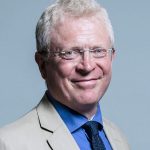
Tag: John Cryer

  • John Cryer – 2021 Speech on Holocaust Memorial Day

    John Cryer – 2021 Speech on Holocaust Memorial Day

    The speech made by John Cryer, the Labour MP for Leyton and Wanstead, in the House of Commons on 28 January 2021.

    I would like to pay tribute to all the Members who secured this debate. We really should have an annual debate to mark Holocaust Memorial Day.

    The indications are, and the figures back this up, that antisemitism is on the rise not just in Britain but across Europe and perhaps elsewhere. For many of us, our own personal experiences, for example those just recounted by my right hon. Friend the Member for Barking (Dame Margaret Hodge), back that up. Our personal experiences support the notion that antisemitism is on the rise in this country and elsewhere. The question is why is that?

    I suspect that the reason is at least partly because the events of the holocaust of the 1930s and 1940s, and of World War Two, are slipping from memory and into history. I am thinking of all the Holocaust survivors who spent their lives touring schools and colleges, writing and speaking, such as Leon Greenman, who lived most of his life in Ilford, close to my constituency. After world war two, Leon spent his life writing and talking about the holocaust. That generation is passing into history.

    We know that historically racism often starts with the Jewish community and then spreads to other communities. Even in the middle ages, the crusades started by massacring Jewish communities across Europe before they started their genocidal mayhem against Muslims in the Holy Land. We also know that holocaust denial, or perhaps not so much holocaust denial but a tendency to say, “Well, there are a number of interpretations you can make of the holocaust,” is a sort of academic approach to moral relativism. There is a tendency, which is more widespread now than it was a few years ago, to put forward that pseudo-academic view. The question is: is that acceptable? The answer is no, it is not acceptable. The fact is that the holocaust was about one thing: the attempt to wipe an entire race off the face of the planet. It was not about anything else. It was simply that: genocide on a scale that has not been seen before or since. The crucial thing is that every time someone takes a moral relativist approach to the holocaust and its memory, it chips away at its historical integrity and undermines the beliefs of people such as those speaking today who want to remember how it really was.

    I pay tribute to the Holocaust Educational Trust and its work in widening and deepening the knowledge of the holocaust. We all have a duty to widen that knowledge and to make sure that in the hearts and minds of future generations that collective memory is carried forward.

  • John Cryer – 2020 Speech on Free School Meals

    John Cryer – 2020 Speech on Free School Meals

    Below is the text of the speech made by John Cryer, the Labour MP for Leyton and Wanstead, in the House of Commons on 16 June 2020.

    I will be brief, Mr Deputy Speaker, because I have no choice. I pay tribute to the maiden speech by the hon. Member for Rother Valley (Alexander Stafford). For a moment, I thought I was in The Old Vic towards the end of it, but it was a superb speech and we all look forward to hearing from him repeatedly in the future. I also pay tribute to his predecessor, Kevin Barron, who is a friend of mine and of many people on this side of the House—and, indeed, on the other side of the House. Kevin was a miner for many years at Maltby colliery. As the hon. Gentleman mentioned mining, I should say that Kevin had his arm broken during the miners’ strike, on the picket line at Maltby colliery. The hon. Gentleman did not mention that, but he might be aware of it.

    Returning to the subject of the debate, I want to speak entirely about my constituency. In Leyton and Wanstead, just over 2,000 children are entitled to free school meals. They are concentrated in the four or five poorest wards in my constituency, which means they are among the poorest wards in London, which means they are among the poorest in the country.

    This is not an area that has been de-industrialised. It is one that is fairly near the heart of one of the richest cities in the world, in one of the biggest economies in the world, yet we have 2,000 children entitled to free school meals. Communities such as the communities I represent will find it inexplicable that the Government had to be dragged kicking and screaming into making a U-turn four hours ago, after days and days and days of pressure from outside this place, from within this place and most notably from Marcus Rashford, as has been mentioned frequently. If Ministers had not finally done the right thing and decided to make this U-turn, that would not have been inconsequential for the people living in Leyton and Wanstead among those poorer communities, because, as my hon. and right Friends have mentioned, it comes on top of a history of deprivation and of working long hours. Many of those children, and many of the children who are not entitled to free school meals but who nevertheless are not among the richest people on the planet, have parents or single parents who work at two or three jobs, who work all the hours that God sends, and who were already facing financial difficulties before the virus struck and before the lockdown.

    Leyton and Wanstead is the fifth highest constituency in the country in terms of people furloughed: 33%—one in three—of people living in Leyton and Wanstead are on furlough at the moment. If we put that together with all the other financial constraints, and with zero-hours ​contracts and with vulnerable working—across the country that runs to about 4 million people at the moment—and if we add on top of that an end to free school meals across the summer holidays, it is clear those families and those children would have been facing a vista that is too appalling for many of us to contemplate.

    I will finish on the following comment. The Government should bear this in mind. It is not a direct quote from Winston Churchill, but it certainly paraphrases something he said in the 1930s: no British Government can make a better investment than putting food into British children. Bear that in mind.