Tag: Ian Byrne

  • Ian Byrne – 2023 Speech on the National Police Response to the Hillsborough Families Report

    Ian Byrne – 2023 Speech on the National Police Response to the Hillsborough Families Report

    The speech made by Ian Byrne, the Labour MP for Liverpool West Derby, in the House of Commons on 1 February 2023.

    Since that awful day on 15 April 1989, 97 people have died directly from the actions of South Yorkshire police and other agencies, including the emergency services, the Football Association and Sheffield Wednesday Football Club, with families destroyed and survivors traumatised—so traumatised that many have since taken their own lives.

    The lies and smears from the cover-up by the establishment, which acted with impunity and arrogance because it could, meant that justice was never delivered for all those who have died and suffered since. In 2017, Bishop Jones delivered the report “The patronising disposition of unaccountable power: A report to ensure the pain and suffering of the Hillsborough families is not repeated.” Shamefully, we have not yet had a Government response to his recommendations in the report commissioned by the then Prime Minister, the right hon. Member for Maidenhead (Mrs May).

    Yesterday, Bishop Jones said that the delay was intolerable. His recommendations are, in essence, the Hillsborough law, which so many in this place and outside have since campaigned for. We must always remember that these recommendations are to ensure that no other community goes through the suffering that we have endured since 1989. They will hopefully futureproof the ability to gain justice.

    Yesterday, we finally had the response to the report from the College of Policing and the National Police Chiefs’ Council. This was the first apology from the police force for its actions since the disaster 33 years ago. For so many, including myself, it is far too little and far too late.

    Yesterday’s recommendations from the police did not go anywhere near far enough to change the culture that we came up against in our quest for justice. I ask the Minister whether this Government will do the right thing for future generations in our nation and implement a Hillsborough law containing Bishop Jones’s recommendations with immediate effect. The families and survivors of so many disasters and consequent state cover-ups deserve nothing less, and these injustices must never again be allowed. If a Hillsborough law had existed in 1989, we would have had a chance of justice for the 97; without it we had none.

    Chris Philp

    I fully understand and respect the sentiments that the hon. Member so powerfully expressed in his remarks. On the timing and the years that have passed since the bishop’s report, for much of that time there were ongoing legal proceedings and, of course, no one wanted to prejudice those for obvious reasons. That accounted for about four years—from 2017 to about May 2021—but about 21 months have passed since then and I agree that the Government response does need to come out quickly. Indeed, since my appointment a couple of months ago I have asked for it to be sped up, and I want to make sure that that happens this spring, following, of course, consultation with the families, which is extremely important. That will include responses to the points that the hon. Member made.

    I reiterate that the statutory changes made to the professional standards for policing in 2020 include a duty of co-operation on police officers in relation to inquiries, which, as he has said, is very important. He is right: we do need to get on and respond comprehensively to the bishop’s recommendations, which is what I am working on.

  • Ian Byrne – 2022 Speech on the Cost of Food

    Ian Byrne – 2022 Speech on the Cost of Food

    The speech made by Ian Byrne, the Labour MP for Liverpool West Derby, in Westminster Hall, the House of Commons, on 14 December 2022.

    I beg to move,

    That this House has considered the cost of food.

    It is an honour to serve under your chairship, Mr Gray. I would like to start this debate on the cost of food by speaking about the situation today in my constituency of Liverpool, West Derby. Food prices have increased by 16.4% in the year to October, and one in three people in my great city are in food poverty. One in six constituents in West Derby are missing meals or going without food, and two in three are cutting back on hot water, heating or electricity. The situation is getting worse by the hour.

    I am here today to deliver a message to the Minister, the Government and this House: the rising cost of food, coupled with falling wages and a completely inadequate system of welfare support, is a catastrophe for my constituents and my community, and its long-term effects will be catastrophic for generations to come in Liverpool, West Derby.

    Like many Members present, I have been contacted by constituents who have never been so scared about their future and their situation. We have workers in almost every industry taking strike action as a last resort, because work does not pay and does not meet rising costs, such as those for food. In West Derby, there are nurses, educators, firefighters, postal workers, rail staff and civil servants using food banks. What have we become?

    This is one of the gravest and most frightening crises seen in our lifetimes, and my constituents tell me they feel abandoned and ignored by the Government, whose job it is to protect them—a Government who commissioned the national food strategy and ignored it when it reported back. For all the report’s shortcomings, its author, Henry Dimbleby, attempted to answer some of the failings in Government policy and proposed changes that would have immediately lifted many people out of food poverty if they had been implemented.

    Food insecurity levels have doubled since the start of 2022, affecting an estimated 10 million adults and 4 million children in September alone. If the Government cannot ensure that everyone has enough to eat and cannot guarantee their right to food, they are a Government who are fundamentally broken. The 16.4% rise in the price of food in the past year is the highest since 1977, and we have seen the sharpest fall in wages since that year. These catastrophic statistics have a devastating impact on our communities, which I am sure we will all speak about today.

    Munira Wilson (Twickenham) (LD)

    I congratulate the hon. Gentleman on securing this important debate. A recent survey by the trade association for school caterers found that food ingredient prices for schools have gone up by 20% in just two months. Schools are having to subsidise free school meals from their own budgets or to charge struggling families more, for those who are entitled to free school meals. Does the hon. Gentleman agree that the Government should not only extend free school meals to every child on universal credit, but fund schools properly to provide free school meals?

    Ian Byrne

    The hon. Lady makes an excellent point. I would go further and call for universal free school meals for every child, but I will speak about that later.

    Calorie for calorie, healthier foods are now nearly three times more expensive than less healthy foods. Terrifyingly, the cost of baby formula has soared over the last year, with the cheapest brands increasing by 22%. We have seen pictures of baby milk locked away and put on the highest shelves in supermarkets—images that surely epitomise this entirely broken system.

    Inflation hits the poorest hardest. The poorest fifth of the population would need to spend 43% of their disposable income on food to afford the Government’s recommended healthy diet in “The Eatwell Guide”. How is that achievable with so many pressures and so little income?

    Chris Stephens (Glasgow South West) (SNP)

    The hon. Gentleman is making a number of excellent points. Tomorrow, Good Food Scotland will open the Linthouse Larder. Does he agree that what we want to hear from the Government is how they are going to assist organisations that provide affordable food at affordable prices for so many of his constituents and my constituents, so that they can survive from week to week?

    Ian Byrne

    The hon. Gentleman makes an excellent point, and I fully agree with everything he said.

    I want to highlight the appalling impact that the cost of food is having on children in particular. Professor Ian Sinha, a paediatrician at the fantastic Alder Hey Children’s Hospital in my constituency, told me:

    “We see the almost Dickensian effects of poor nutrition in children in Liverpool and other working class cities. We see rickets, poor growth, and deficiencies in minerals and vitamins that reflect that their nutrition revolves around getting enough calories to survive…not around developing optimal health…We have seen malnutritioned children so anaemic as a result of poor nutrition, and so acutely sick, that we thought they had leukaemia. We see children sharing food portions, in schools and in houses, and so no wonder they are falling asleep and struggling to concentrate in class. Paediatrics is about ensuring children live their best life—as per the UN Convention on the rights of the child—and their lack of food is shackling them and their opportunities.”

    Beth Winter (Cynon Valley) (Lab)

    I congratulate my hon. Friend on the outstanding work he is doing on the Right to Food campaign. Does he agree that the Welsh Government are leading the way on food, particularly for children? We have already introduced free school meals in primary schools, and hopefully that will be extended to secondary schools at some point, despite the fact that Wales does not get a fair, needs-based funding formula. Wales really does care and is compassionate about the needs of people and future generations. Does my hon. Friend agree that the UK Government need to take the lead from Wales?

    Ian Byrne

    I fully agree, and I commend Mark Drakeford and the Government in Wales for absolutely leading the way on this issue and showing that a different way is possible.

    Professor Sinha goes on to say:

    “When I tell families in my asthma clinic that nutrition is crucial, they tell me that by the time they can get to the foodbank any fresh fruit and vegetables have gone. When we explain the importance of how food is prepared, they tell us that the only mechanism of heating food is a kettle. They are limited to ultra-processed, calorie dense foods that are cheap and easy to store. When we see analyses such as those in the British Medical Journal last month, showing associations between ultra-processed food and the risk of death, we know that the children coming to our clinics are often on this path, but they can’t afford to get out of it.”

    It is a disgrace that my constituents face this appalling and grave situation, and yet at the same time we read reports that global food companies have paid out £15 billion in profits to their shareholders. Supermarkets are not doing too badly either: they have also paid out vast dividends during covid and the cost of living crisis.

    At a recent Environment, Food and Rural Affairs Committee session, we heard evidence from the United Nations special rapporteur on the right to food, who told us:

    “Corporations have a significant amount of power in markets and there is not much being done to hold corporations accountable. Food prices are at the mercy of speculation…Governments have tools in place to stabilise prices.”

    At the same time, research from the Bakers, Food and Allied Workers’ Union highlighted that the workers who produce the food and enable those profits are some of the hardest hit by the rising cost of food.

    Hunger and out-of-control food inflation are not inevitable. They are a political choice made by this Government and compounded by cutting away vital protections from rising fuel costs, dismantling the social safety net, cutting universal credit, imposing benefit sanctions, eroding workers’ rights and presiding over a decade of austerity that has cut to the bone our vital services, which are needed now more than ever. The time for sticking plasters to address the rising cost of food—such as the reliance on thousands of food bank and food pantry volunteers and donors—is over. We need systemic change so that all our people have the opportunity of health, happiness and dignity.

    That is why we need to legislate for the right to food. We need enforceable food rights to ensure that the Government of the day are accountable for addressing the cost of food and making sure nobody goes hungry, and that they are prevented from making decisions that lead to people being unable to afford to put a meal on the table. A right to food should be not a safety net but a rope ladder, with ever-higher standards of provision.

    I propose the following as an extremely modest and deliverable beginning. There should be a duty on the Secretary of State to ensure the food security of our nations, which should be taken into account when setting competition, planning, transport, local government and all other policies. We should be eradicating food deserts, not enabling them. Ministers should be under a duty when setting the minimum wage and any relevant social security benefits, including pensions, to state how much of the prescribed sum has been calculated for food, because right now it is nowhere near enough.

    Finally, we must legislate for universal free school meals—a nutritious free school breakfast and lunch for every child in state education. We heard powerful evidence at the EFRA Committee recently about the benefits that that would bring for children’s learning, happiness and health and about how that investment would allow our children to enjoy futures that are far brighter than what they are looking forward to now. Crucially, from the Government’s perspective, it would pay for itself in the long run. The benefits far outweigh the costs.

    I urge the Minister to come forward with action now and not to repeat the indifference they have shown when I have raised this issue repeatedly in the House. Constituents are starving, and we need political leadership that guarantees and realises everyone’s right to healthy food. If reliance on charity alone was a sufficient guarantee for basic human needs in the UK, previous generations would not have legislated for universal state schooling or a national health service. This horrific situation demonstrates that we need the same vision and ambition when it comes to food security—and it cannot wait a moment longer.

  • Ian Byrne – 2022 Parliamentary Question on the Closing of Defence Business Services Offices in the North West

    Ian Byrne – 2022 Parliamentary Question on the Closing of Defence Business Services Offices in the North West

    The parliamentary question asked by Ian Byrne, the Labour MP for Liverpool West Derby, in the House of Commons on 12 December 2022.

    Ian Byrne (Liverpool, West Derby) (Lab)

    Whether his Department has made an impact assessment of the planned closure of Defence Business Services offices in the North West.

    Alex Chalk

    A regional economic impact assessment was undertaken during downselection but did not form part of the decision-making criteria. The consolidation into the Blackpool site meets key user requirements, is an opportunity to bring 700 posts to Blackpool from our other north-west sites, and contributes to the redevelopment at Talbot Gateway through the building of the new Government hub.

    Ian Byrne

    I thank the Minister for that answer, but I have had many constituents contact me about the planned closure of the Ministry of Defence Business Services office in Liverpool. The movement of jobs will affect them and their families. The new commute of more than two hours—especially with the train service at the moment—will be completely unworkable for many staff, particularly those with caring responsibilities or disabilities. Will the Minister meet me as soon as possible to discuss this situation so that I can share the deep concerns of my constituents with him?

    Alex Chalk

    Yes, of course, I will meet the hon. Gentleman. But there have actually been some good and constructive conversations with the unions, I am pleased to say, about trying to assist individuals who may want to go—we will try to assist and provide expenses. For those who do not, there is lots of work going on to ensure alternatives should they want to take them. But let us discuss it further—I would be very happy to do so.

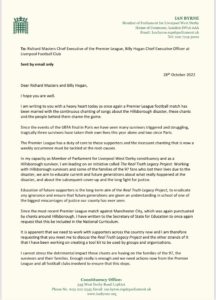
  • Ian Byrne – 2022 Letter to Premier League Over Offensive Hillsborough Chants

    Ian Byrne – 2022 Letter to Premier League Over Offensive Hillsborough Chants

    The letter sent by Ian Byrne, the Labour MP for Liverpool West Derby, on 31 October 2022.

  • Ian Byrne – 2022 Speech on Employment Agencies and Trade Unions

    Ian Byrne – 2022 Speech on Employment Agencies and Trade Unions

    The speech made by Ian Byrne, the Labour MP for West Derby, in the House of Commons on 11 July 2022.

    I would like to put on record that I am proud member of Unite the union and the GMB. I start by paying tribute to all those in Liverpool, West Derby and indeed across the country who are facing real-terms cuts to their pay, attacks on their conditions and security of work, attacks on their pensions, redundancy and attacks on health and safety in the workplace, and are having to take industrial action as their absolute last resort. I stand in absolute solidarity with them.

    While the workers worry about their families and their families worry about their futures, as they are forced to leave the industry they have dedicated their whole lives to and are forced into poverty and using food banks, we have the disgraceful spectacle of a morally bankrupt Government using this Parliament to attack fundamental workers’ rights—and this is in the middle of a cost of living crisis, when workers are fighting against real-terms cuts to a wage so that they can actually put a meal on the table.

    Mick Whitley (Birkenhead) (Lab)

    My hon. Friend is making a fantastic speech. Does he not think that to be a working person in Britain today, to have lived through a decade of stagnating wages, to have seen their pay collapse in real terms while prices soar and to know their own Government refuse to lift a finger forces people on low pay to take strike action to try to force—

    Madam Deputy Speaker (Dame Eleanor Laing)

    Order.

    Ian Byrne

    Absolutely. I agree with everything my hon. Friend said.

    This is a Government who furiously defend the class interests of those they represent in this place, and that is never the working class. The Trades Union Congress has pointed out that the action is a violation of trade union members’ right to strike, which is safeguarded by international law. Make no mistake, this is a risk to public safety, and standards will be lowered. Any consequences of these actions will lie at the foot of this Government.

    The Government’s cynical regulations that we are debating tonight put agency workers, who they know have limited rights, in the position of having to turn down an assignment with the prospect that they will be denied future work by the agency if they do not want to cross a picket line. Many agency workers, such as supply teachers and bank nurses, will be trade union members themselves, and they have suffered terribly in this pandemic.

    The regulations highlight the insecurity of the labour market, the erosion of workers’ rights and how flawed and immoral it all is. The pandemic shone a light on this immorality when workers with covid had to continue working because they had no sick pay. The employment model is broken for millions. We should be legislating and learning lessons from covid, and enhancing worker protections, including sick pay. Instead, tonight we are voting on a scab charter for bad employers from a Government who have picked their side.

    Trade unions are the transformational vehicle for positive change—they have been for centuries and, despite the efforts of this wretched Government, will continue to be so for future generations. I will always be proud to stand shoulder to shoulder with them supporting workers in the struggle who refuse to be poor.

    Tonight is yet another sad day for democracy in this place. I stand in absolute solidarity with all those trade unions and trade union members who are fighting so hard for our communities and the rights of workers everywhere. Their fight for economic and social justice has never been needed more.

  • Ian Byrne – 2022 Speech on the Cost of Living Crisis

    Ian Byrne – 2022 Speech on the Cost of Living Crisis

    The speech made by Ian Byrne, the Labour MP for Liverpool West Derby, in the House of Commons on 17 May 2022.

    Last week should have been an extremely sobering moment in this House. The Food Foundation figures widely quoted in this Chamber should chill the souls of every Member who serves here, with millions going hungry in our communities. A few days before the Queen’s Speech was delivered, I spoke to a disabled constituent who explained to me how the cost of living and the huge increase in energy bills had left him choosing between heating his home or powering his electric wheelchair. The fifth richest country in the world! There was nothing in the Queen’s Speech to make sure he does not have to face that unjust situation a day longer.

    Instead of sober reflection on how we fix the crisis, we had grotesque suggestions from those on the Tory Benches on cookery classes—maybe an hour with Mary Berry would fix the problem of millions of going hungry. We had the Government suggesting that it is the fault of the person in poverty and that they just need to pack in their zero-hour minimum wage contract job and maybe become the CEO of Apple. We need to hear less condescending rhetoric that lays the blame on people facing hardship and poverty from commentators and politicians who have got about as much experience of poverty as I have of attending the annual reunion of the Bullingdon club.

    Let us be clear that the blame for this crisis lies with this failing Government, who could make the political decisions that are needed if they wanted to. The Government could decide to put a right to food into legislation. They could ban fire and rehire, ban zero-hours contracts and raise the level of universal credit, legacy benefits and the minimum wage. They could protect pensioners and deliver justice for the 9,000 women in Liverpool, West Derby who have been impacted by the change to the women’s state pension age.

    Hunger is a political choice. Fuel poverty is a political choice. Those choices are currently being made by this Government. This is an emergency—life and death for many—that demands serious solutions, not tinkering with a system that is utterly broken for millions. That is why we need to legislate for the right to food. We need enforceable food rights so that the Government of the day are accountable for making sure that nobody goes hungry. They must be prevented from making decisions that lead to people being unable to afford to put a meal on the table or to put the heating on.

    That is why I have tabled an amendment to the Queen’s Speech to enshrine a right to food in UK law. I thank every Member from right across the House who has supported it, and I urge all others to do so.