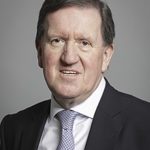
Tag: George Robertson

  • George Robertson – 2022 Tribute to HM Queen Elizabeth II (Lord Robertson of Port Ellen)

    George Robertson – 2022 Tribute to HM Queen Elizabeth II (Lord Robertson of Port Ellen)

    The tribute made by George Robertson, Lord Robertson of Port Ellen, in the House of Lords on 10 September 2022.

    My Lords, ordinarily on such occasions the repetition of words and sentiments can be tedious and unproductive. Too often we hear, “Everything’s been said, but not yet by everyone”, or the House of Lords equivalent, which is, “Everything’s been said, but not yet by me.” However, in the last 48 hours the repetition of such words as duty, service, honour, decency, commitment and dedication does not jar at all; it seems both appropriate and fitting when they apply to the 70 year-long reign of the late Queen Elizabeth. She set a standard and a vector against which all who serve in public life can and indeed should be measured, and we should be profoundly grateful for that example, as well as for so many other things. Indeed, she was the gold standard—the glue that kept a fractious country together when multiple pressures of populism and extremism were tearing, but never destroying, our communal fabric. With our latest Prime Minister and the nation facing serious crises in energy, the cost of living, health and a foreign war, her example of cool, clear thinking is more necessary than ever it was.

    As these two days of debate have shown, we all have memories of Her Majesty the Queen, especially those of us who had the opportunity to meet her. My latest one was of returning last year the insignia of the Chancellor of the Order of St Michael and St George by Zoom. I have to say that she was a lot more comfortable with the situation then I was. “Come forward”, she demanded, “I can’t see you”, as I nervously walked towards the screen at the end of the long room.

    However, I have another vivid memory, of her visit in 1996 with the Princess Royal to Dunblane after the ghastly murders in the primary school. The noble Lord, Lord Forsyth, was the Scottish Secretary at the time and the local MP. I was his shadow and both a local resident and a parent. We were, at that time anyway, tough political adversaries, but we had been welded together by the tragedy in that small community. We witnessed that day the monarch, with just her presence and simple words, speak to and for a grieving town and indeed a shell-shocked nation. It helped immeasurably to bind some of the gaping wounds of that time, and that was her powerful effect.

    Another, more pleasant memory I have is of when, as Defence Secretary, I brought the then Crown Prince of Saudi Arabia, Crown Prince Mohammed, to Balmoral to meet the Queen. After our lunch, he accepted an offer from her to see the estate but, boy, was he astounded, coming from a country which banned women from driving, to find the Queen behind the wheel of the Land Rover and rolling off without the rest of the party. I was at the castle entrance when they all came back. She looked at me and said, “I think he thought I was driving too fast.” I said nothing at all. Then she said, “I also think he thought I was lost.” I bravely said, “Well, you can’t get lost. You’re the Queen, and where you are is where you’re supposed to be.” She frowned at me and then said emphatically, “Quite right”, and marched away. Soon after that, the Crown Prince became King of Saudi Arabia, and belaboured every visiting Brit with stories of the Queen’s mad driving.

    My final point is to talk about the Queen’s deep loyalty to the Commonwealth; my noble friend Lord Boateng also mentioned that. When she made that famous pledge to preserve and protect the Commonwealth at the point when she took the Throne, it was not some nominal pledge or promise, it was to her a sacred commitment. That passionate commitment to the unique and precious club of like-thinking nations that is the Commonwealth was to matter to her over all her years, especially those years when not a few irritated politicians would quite happily have strangled the organisation. Getting past the Queen, dispassionate and non-partisan as she might well have been, would have required a lot more tenacity and political force than is possessed by any mere politician yet to be born. The Commonwealth survives and thrives because of Her Majesty and her promise.

    Last night, as so many have said, the new King spoke to the nation with raw personal feeling about the loss caused by the Queen’s death and what it meant to the Royal Family. It was a moving and incredibly significant address. The fact is, however, that we are all her family, and he spoke for us in our loss as well. He becomes King at a momentous time and we must, with memories of his mother fresh in our minds, wish him the very best in his demanding new role. The family that is his nation is with him.

  • George Robertson – 1986 Speech on Seatbelts

    Below is the text of the speech made by George Robertson, the then Labour MP for Hamilton, in the House of Commons on 13 January 1986.

    At a social occasion last summer in my constituency a young man came up to me and said that he had started to wear a seat belt because the law said that he had to do so, but that he had resisted it until then because he believed many of the arguments advanced by some hon. Members. A notable example of those arguments has been reiterated by the hon. and learned Member for Burton (Mr. Lawrence). However, this young man said, “Last week I was in a road accident and there is no doubt in my mind that as a consequence of that road accident, had I not been wearing a seat belt, I should be dead or so severely injured that I would not be out and about tonight. So I suppose I have to thank you, and the likes of you, by persuading me, through the law, to wear a seat belt, for the very fact that I am here and able to speak to you this evening.” That spoke more eloquently to me than anything else that I have heard, certainly this evening, about what the general public believe has been the advantage of the law that Parliament passed three years ago.

    Reference has already been made to the hon. Member for Wallasey (Mrs. Chalker) and I, too would congratulate her this evening on her apparent elevation to the Foreign Office, even if the consequence of that will be that she will suffer the attacks, not of my hon. Friend the Member for Wigan (Mr. Stott), but of myself in another incarnation. We believe that it is being seen as promotion, and we wish her well because she has supervised this issue with great assiduousness.

    I have a slight interest to declare in this debate. As chairman of the seat belt survivors club, I have been in contact with a large number of people who have had their lives saved and who have been saved from serious injury because over the years they have worn a seat belt in accidents that would otherwise have rendered them dead or infirm.

    I admit that over the years I have become a zealot on this issue. I wore my seat belt for many years because I thought that it made common sense. Nine years ago this Sunday I was involved in a head-on collision with a Land Rover, and only as a consequence of wearing a seat belt was I saved from almost certain death. That certainly concentrated the mind and gave me an enthusiasm for the issue.

    I have always believed, and I know that hon. Members on both sides of the House who have supported the measure have believed, that this was a matter of common sense. We are reassured by the fact that over the three years since the law came in, what was a matter of great controversy, of almost endless debate in the House and repeated votes, with large majorities in favour, is now a matter of no controversy at all. The vast majority of motorists put on their seat belts now with no more thought than they give to making sure that the doors of the car are firmly closed behind them.

    Ninety four per cent. of motorists are now using seat belts. The statistics that the Minister gave are eloquent testimony to the success of the measure. The Minister is a brave man this evening to come to the Dispatch Box and admit that he was one who was not convinced but has now had conviction forced upon him. He is not alone in that. One of the most vivid speeches in all the debates on the subject that I can remember was that by the hon. Member for Bury St. Edmunds (Sir E. Griffiths), who gave his personal testimony to his scepticism on the issue and the conviction that was imposed upon him by his experience as a Minister at the Department of Transport and the vivid recollections that he had of the casualty wards in hospitals and the sight of the road accident victims within them.

    This is without doubt the single most successful road safety measure that Britain has ever seen. It costs nothing in civil liberty and financial terms, and it has saved so much. It has saved the suffering and the pain that goes with the road casualty figures every day of this life. It has saved our nation at least £130 million. More than that, it has saved countless numbers of maimings, blindings and cripplings, which are the real human manifestation of the road accident statistics that are represented in the savings that have been put forward over the past three years.

    The hon. and learned Member for Burton made virtually the same speech tonight as we heard three years ago and in practically every other debate beforehand. [Interruption.] My hon. Friend the Member for Huddersfield (Mr. Sheerman) says that the hon. and learned Member did not vote.

    Some have chosen to support Dr. John Adams’s theory of risk compensation, and this is an attractive and eloquent theory, put forward by somebody whose mastery of the statistics gives him a bogus authority. Is his theory worth anything? If it works in this case, why does it not work in every other case where preventative measures have been taken in road safety? Are we to abandon all safety measures for people on the roads and in their cars simply because a questionable, flimsy, tendentious theory suggests that those who are belted have more confidence and start knocking down pedestrians, cyclists and motor cyclists? I am sure that the vast majority of the population would reject that theory, and they have shown that they have done so by the act that they continue to wear their seat belts.

    Some have said that the numbers saved from death and serious injury are smaller than was suggested by the proponents of the measure when this issue was last debated in Parliament. That is so, but the estimates were never likely to be precise, any more than the statistics used this evening are precise. We know that if the usage rate were to go from 94 to 100 per cent., the chances are that the targets established on the guesses and best estimates would be met.

    At least 200 more people a year are alive who would otherwise be dead, and at least 7,000 who would otherwise ​ be seriously injured are able to get around. We are told that there has been a 25 per cent. reduction in admissions to hospitals of front seat road accident victims, and a 30 per cent. reduction in hospital inpatients from road accidents. There has been a 40 per cent. reduction in major and minor brain injuries among those injured in car accidents. Are these not testimony enough to the valuable and life-preserving measure?

    Three years ago, thanks to the skill and opportunity of Lord Nugent, a former Conservative Transport Minister, in the other place, this House had a chance to embrace this life-saving legislation. As it always has done, the House gave the measure its support. The evidence has been clear. People have been saved, and we must therefore consolidate that success.

  • George Robertson – 1978 Maiden Speech in the House of Commons

    Below is the text of the maiden speech made in the House of Commons by George Robertson, the then Labour MP for Hamilton, on 14 June 1978.

    I do not need to underline to this House the pride I have in being elected as Member of Parliament for Hamilton. I hope that my presence here and the result in that constituency are of some little relevance to this debate.
    It is a great honour for me to follow in the footsteps of the late Member for Hamilton, Mr. Alexander Wilson. I knew him well and I know that he was widely respected in the House. He was a man of dignity and integrity, who worked quietly and without fuss in his constituency and in the House pursuing the interests of the people of Hamilton and of Larkhall. He did so diligently, without publicity and with honour.

    The work which Mr. Wilson did quietly was all designed to help the people of the area and to further the interests of his constituents. I know from the volume of work which is there and the catalogue of achievement mentioned to me during the by-election that he was a man who clearly made an impact in the House and had much to offer.

    Although I am proud to be the new Member for Hamilton, I am aware that that is possible only due to the tragic and untimely death of Alex Wilson. I know that he also made a considerable contribution within the parliamentary mining group. That is an industry which he knew well and from which he came. He is well remembered within the industry in Scotland, throughout Scotland and in the mining group.

    At this stage in history it is also a pleasure for me to represent Hamilton because the features of that part of Lanarkshire show all the promise of the new Scotland which lies ahead. It is an exciting mixture of ages, of classes, of population and of industry. In that mix it has changed dramatically from the older and more traditional industries of the past—especially that of mining, on which Scotland’s economy previously relied—to light engineering, electronics and the production of sophisticated clothing. In those areas it is excelling. The character of Hamilton is an indication of the way in which Scotland will go in future—not just electorally but in the areas of industry and of technological progress.

    During the by-election, as perhaps during any by-election, local circumstances and problems were highlighted. Although there is much of promise in the area, one of the greatest causes for concern is unemployment. As an aspiring Member, I made it my duty and obligation to pursue the subject of joblessness in the community. We cannot rest, in the House or throughout the country, as long as the present level of unemployment continues.

    At 11 per cent., unemployment in Hamilton is considerably above the Scottish and national average. It is a substantial problem. The most serious aspect is youth unemployment. The prospects for young people leaving school this year and in future without jobs are a matter of concern for them, for their parents and for us in society as a whole, because the future of the country and the future stability of society will be largely dependent on the sort of future that we can offer to young people.

    I feel that we have in the country as a whole to make a concerted effort to ensure that the problems of unemployment that we now face are purely temporary, and that we can build a future prosperity which will mean that especially the young people will be assured the jobs, the training and the prosperous future that they would wish for themselves, and that their parents would wish for them.

    However, I fought a campaign based on the Government’s record. I did it not uncritically but not apologetically, and I asked the people to give their assessment of the situation and their view of the future and to say which party they would trust to run the country’s affairs in the future. In the context of this debate, it is instructive and relevant to remember the answer that the people gave.

    However strongly we feel about the present position of the economy, we must recognise that locally and nationally much has been done to alleviate the problems of unemployment, and especially to look after the needs of young unemployed people. In the Hamilton area, much has been done about unemployment as a whole. In the past five months there has been a positive increase in employment and a very clear decrease in unemployment which has been greater than the national trend, which in itself is welcome. As for youth unemployment, over half those between the ages of 16 and 17 registered as unemployed are already involved in job creation schemes and Government-assisted programmes. We were able to show that, although there was a level of concern that we should not in any way attempt to disguise, there has also been positive Government action to make sure that the impact was the least that was possible in the circumstances.

    The area also shows other signs of Government intervention, and of the intervention of a Government in regional policy which has made a serious impact on the problems of Central Scotland. The Scottish Development Agency—of which I was privileged to be a board member until I came to Parliament—had quite a significant impact in the area. Its industrial estates employ the vast majority of the people in the area, and in companies in which investment has taken place in surrounding areas jobs have been safeguarded for people who work within Hamilton. In the steel industry—one of the largest employers in Hamilton, although it is marginally outside the constituency—investment by the Government has assured the future of Ravenscraig and associated industries.

    Although temporary Government measures are not an answer, there are all the signs in the area that the jobs which are necessary for the future, the growth that is needed and the hope that is desired by the people are being promised by the Government. The people in my area gave a pretty clear and decisive answer as to which party they would trust for the conduct of their affairs in the future.

    The acid test at the end of the day is the will of the people, and there have not been very many tests of public opinion in Scotland where the issue has been put to the country. Not only has the Government’s record been judged and, I think, honourably tested in this election. The future of the constitution of the country was also put to the test in the circumstances here. The policies of separation and of the disintegration of the United Kingdom as we know it were clearly put to the electorate. The electorate gave an answer which shows that people in that area, as throughout Scotland, want to see Britain united and the problems faced head on.

    I also feel that one of the lessons of that by-election, and its result in my presence here today, is that the people of Britain and of Scotland are tired of the cynical manipulation of policies by whichever party may choose to pursue them. They have rejected confrontation quite clearly and precisely whether it be in industry or within the separate parts of this country. If there is an answer to be taken from any of the election results that we have had recently, it is that the constitutional settlement proposed by the Government is necessary, desirable and in keeping with the desires of the peoples of this country, who are looking for a different constitutional set-up.

    The Government’s resolve in this area of the constitution, despite the frustrations with which they have clearly met so far, has been of enormous consequence in stemming the tide towards the break-up of the United Kingdom. I believe that the lesson of the present period is that the British people are tired—and clearly tired—of confrontation, and that they will in future continue to put their trust in this Government, believing as they do that only this Government’s competence, conviction and philosophy will be relevant to the problems of all these islands in the 1980s.