Tag: Fire Brigades Union

  • PRESS RELEASE : FBU hails “historic moment” for trade union movement as coordinated day of action takes place [February 2023]

    PRESS RELEASE : FBU hails “historic moment” for trade union movement as coordinated day of action takes place [February 2023]

    The press release issued by the Fire Brigades Union on 1 February 2023.

    Around half a million workers have today taken strike action for decent pay across rail, schools, central government and higher education.

    It was also a day of action organised by the Trades Union Congress (TUC) to defend the right to strike, following the passage of the Strikes (Minimum Service Levels) Bill on Monday at Third Reading.

    The Fire Brigades Union has this week achieved a decisive mandate for strike action on pay, with 88% of members voting Yes on a 73% turnout. In Northern Ireland, the result was even stronger, with 94% of members voting Yes.

    Responding to the day’s events, Fire Brigades Union General Secretary Matt Wrack said:

    “This is a historic moment for the labour movement. Trade unions are fighting not to disrupt public services, but to save them.

    “In the fire service, pay has fallen by at least 12% in real terms since 2010, and it’s a similar story elsewhere. Striking workers have the support of the public because it is only by standing together that we can win decent pay for everyone.

    “The new anti-union legislation is an attempt shut down the debate about pay and living standards. It’s an attack on our right to organise and on our democracy as a country. It’s an attempt to stop workers from standing up for themselves.

    “I’m proud that the FBU is supporting today’s day of action. We still hope to resolve our dispute without a strike, but if that’s not possible, we will call action ourselves. We will stand shoulder to shoulder with other unions in the struggle ahead.”

  • PRESS RELEASE : Firefighters deliver decisive mandate for industrial action [January 2023]

    PRESS RELEASE : Firefighters deliver decisive mandate for industrial action [January 2023]

    The press release issued by the Fire Brigades Union on 30 January 2023.

    Firefighters across the UK have delivered a decisive mandate for strike action, with 88% voting Yes on a 73% turnout. The strike ballot opened on 5th  December and closed on 30th January. 

    Two separate simultaneous ballots, in Northern Ireland and among control room staff in the North West of England, also delivered strong results. In Northern Ireland, the result was even stronger, with 94% of members voting in favour of action.

    In the hope of averting strike action, the Fire Brigades Union has given the government and employers ten days (until Thursday 9th February) to come forward with an improved offer which could be put to a vote of members.

    If they go ahead, the strikes would be the first nation-wide fire strike over pay since 2003. FBU members rejected a below-inflation 5% pay offer in November last year.

    The vote on industrial action follows more than a decade of real terms pay cuts. It comes as fresh research shows that firefighters are significantly more likely to develop cancer than the general population.

    Polling shows that public support for strike action by firefighters is strong – by around 2 to 1. 58% of the public back action, while only 33% oppose it.

    Matt Wrack, General Secretary of the Fire Brigades Union, said:

    Firefighters across the UK have spoken. The Fire Brigades Union has a decisive mandate for strike action.

    This is an overwhelming vote for strike action against an offer which would mean further significant cuts to real terms wages for firefighters and control room staff. They have already lost at least 12% of the value of their pay since 2010.

    This is an absolute last resort for our members. The responsibility for any disruption to services lies squarely with fire service employers and government ministers.

    Rishi Sunak’s government has refused to make funding available for a decent pay offer to firefighters and control staff.

    Firefighters were among Britain’s Covid heroes who kept frontline services going during the pandemic. The Prime Minister has badly misjudged the public mood by imposing pay cuts on key workers.

    Our members risk their health and safety, and sometimes their lives, round the clock to keep people safe and serve their communities. However, with inflation and energy bills rocketing, they are now increasingly struggling to pay the bills or to afford the basics.

    The government and the employers have the power to stop strikes from happening by making a credible offer that can resolve this dispute. The ball is in their court.

    We have delayed calling strikes to allow the employers to meet us and to make a new offer. I hope they take that opportunity. Otherwise, in the coming weeks, we intend to announce a series of strike dates and industrial action.”

  • PRESS RELEASE : European Public Service Union challenges UK government’s anti strike law [January 2023]

    PRESS RELEASE : European Public Service Union challenges UK government’s anti strike law [January 2023]

    The press release issued by the Fire Brigades Union on 30 January 2023.

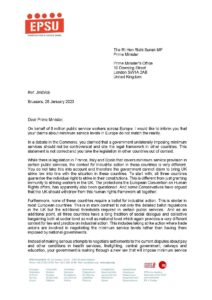
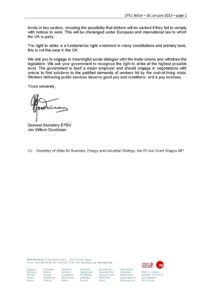
    General Secretary of the European Public Service Union, Jan Willem Goudriaan, has sent Rishi Sunak a letter disputing the government’s claims that imposing minimum service is ‘in line with European countries’.

    The letter makes it clear these claims are false:

  • PRESS RELEASE : FBU responds to the death of Firefighter Barry Martin [January 2023]

    PRESS RELEASE : FBU responds to the death of Firefighter Barry Martin [January 2023]

    The press release issued by the Fire Brigades Union on 27 January 2023.

    The Scottish Fire and Rescue Service has now confirmed that Firefighter Barry Martin has passed away following serious injuries sustained at a fire in the Jenners Building in Edinburgh on Monday 23rd January.

    Responding to this news, Matt Wrack, general secretary of the Fire Brigades Union, said: 

    Everyone in the Scottish and UK Fire and Rescue Service will be devastated by today’s events. Our hearts go out to Barry’s family, colleagues and friends, and to all those who mourn his loss.

    Barry was a dedicated firefighter and a well-loved member of the firefighting community. We are very proud that he was a member of our union. Like so many firefighters, he put himself at risk to save the lives of others.

    In due course, we will investigate the events that led to his death. Today, we are grieving for a colleague and a friend.”

  • PRESS RELEASE : Firefighters’ strike ballot set to deliver result [January 2023]

    PRESS RELEASE : Firefighters’ strike ballot set to deliver result [January 2023]

    The press release issued by the Fire Brigades Union on 27 January 2023.

    A national strike ballot by the Fire Brigades Union is set to close on Monday 30th January, with results expected late that afternoon. If firefighters vote for strike action, the UK will see its first nation-wide fire strike on pay since 2003.

    Since 2010, firefighters have suffered a 12% drop in real terms earnings – around £4,000 a year on average. In the same period, around one in five firefighter jobs have been cut.

    FBU members have already rejected a below-inflation 5% pay offer in November last year, and the union opened its formal strike ballot on 5th  December.

    Because of anti-strike legislation, the ballot will only give a mandate for strike action if more than 50% of the FBU’s roughly 30,000 members vote in it.

    The vote on industrial action comes as fresh research by the FBU and UCLan shows that firefighters with 15 years of service are 1.7 times more likely to develop cancer than those who have served less time. 

    Polling shows that public support for strike action by firefighters is strong – around 2 to 1. 58% of the public back action, while only 33% oppose it.  

    Matt Wrack, general secretary of the Fire Brigades Union, said:

    Firefighters have faced a sustained attack on pay for more than a decade, with average pay falling by about £4,000 in real terms.

    Our members face hazardous situations every day, and sometimes risk their health to do the job. Facing double-digit inflation and rocketing energy bills, they are now being told to put up with an even bigger real terms pay cut. Meanwhile, the UK is home to record number of billionaires.

    People join the fire service because they want to help people and serve their community. We have been pushed to the point of balloting by a government that is refusing to listen.

    On Monday, we will learn our members’ verdict on this derisory pay offer.”

  • PRESS RELEASE : ‘Disappointing and ill-judged’ – Fire Brigades Union response to HMICFRS State of Fire report [January 2023]

    PRESS RELEASE : ‘Disappointing and ill-judged’ – Fire Brigades Union response to HMICFRS State of Fire report [January 2023]

    The press release issued by the Fire Brigades Union on 20 January 2023.

    The Fire Brigades Union has responded to His Majesty’s Inspectorate of Constabulary and Fire & Rescue Services State of Fire and Rescue 2022 report.

    The report, conducted by new Chief Inspector Andy Cooke, endorsed the ongoing attacks on firefighters’ right to democratically organise outlined in the government’s Fire Reform White Paper.

    Matt Wrack, the general secretary of the Fire Brigades Union, said:

    “The FBU is disappointed with the new State of Fire and Rescue annual report, which continues its ill-judged commitment to the White Paper.

    The FBU hoped that the Inspectorate, under new leadership would abandon the misguided White Paper that seeks to give chief fire officers a free hand to instruct the workforce, ignoring their contracts of employment and conditions of service. These ‘reforms’ are aimed at undermining the FBU, despite the vast majority of firefighters choosing to belong to the union.

    HMICFRS has chosen not to listen to rank and file firefighters. The FBU would again urge Mr. Cooke to map his own course to achieve what we all want: a properly funded fire service that includes decent resources and fair pay for firefighters, and that reflects the extraordinary job they do.

    The Inspectorate claims to sympathise with firefighters during this cost of living crisis yet unfortunately provides nothing more than warm words. Firefighters want their contribution to society recognised with a fair pay rise, not continued political attack that seeks to abolish their collective bargaining structures.

    Mr. Cooke does recognise that services are falling short of response standards they themselves have set and describes a postcode lottery that the FBU has warned about for years. Despite the correct diagnosis, he doesn’t prescribe the correct course of treatment – national standards. Neither does the report address more than a decade of central funding cuts, 11,500 firefighter posts lost and years of pay cuts.”

  • PRESS RELEASE : Fire contaminants linked to significant physical and mental health issues among UK firefighters [January 2023]

    PRESS RELEASE : Fire contaminants linked to significant physical and mental health issues among UK firefighters [January 2023]

    The press release issued by the Fire Brigades Union on 10 January 2023.

    • Firefighters confirmed to be four times more likely to get cancer
    • Firefighters almost three times more likely to suffer with depression and twice as likely to have anxiety
    • Research supports ruling from the World Health Organisation body, the International Agency for Research on Cancer, which states that occupational exposure as a firefighter is carcinogenic.

    New research has found that toxic contaminants in fires are directly linked to increased rates of cancer and mental health issues among firefighters.

    The findings support last year’s ruling from the International Agency for Research on Cancer, which says that exposure through working as a firefighter is carcinogenic – and goes a step further, by also highlighting the mental toll that firefighting can take.

    The research, commissioned by the Fire Brigades Union (FBU) and independently carried out by the University of Central Lancashire (UCLan), is based on a survey of over 10,000 firefighters across the UK, representing almost a quarter (around 24%) of the UK’s total firefighter workforce.

    The findings, published in the Scientific Reports journal today, show that 4.1% of surveyed firefighters were found to have a cancer diagnosis. Instances of cancer among firefighters aged 35-39 is up to 323% higher than in the general population in the same age category. UK firefighters who have served at least 15 years are found to be 1.7 times as likely to develop cancer than those who have served less time. Skin cancer is by far the most prevalent cancer reported – 36% of those firefighters with cancer have been diagnosed with skin cancer.

    Furthermore, firefighters are at least twice as likely to be diagnosed with cancer if they notice soot in their nose/throat or remained in their personal protective equipment (PPE) – which is often contaminated – for more than four hours after attending a fire.

    UCLan’s research, which has been led by Professor Anna Stec, professor in fire chemistry and toxicity, also explores the link between firefighters’ exposure to fire effluents and mental health. 20% of respondents reported having a mental health condition. The rate of anxiety among surveyed firefighters was twice that of the general population, while the rate of depression was nearly three times that of the general population.

    In addition, firefighters who noticed soot in their nose or throat for a day or more after attending incidents and firefighters who remained in their (often contaminated) protective equipment (PPE) for over four hours after incidents were also 2x as likely to report mental health disorders.

    Firefighters were also significantly more likely to report any mental health condition if they identified noticing the smell of fire smoke on the body even after washing (1.3x more likely), or eating with sooty hands (1.3x).

    Firefighters who worked in stations with no designated clean and dirty areas were more likely to report any mental health condition (1.2x more likely), as were firefighters working in stations which smell of fire (1.2x).

    Riccardo la Torre, Fire Brigades Union national official said:

    “We already knew that fire contaminants were very likely causing cancer and other diseases in firefighters. Now, we have evidence that cements that belief and also shows that contaminants can impact their mental health. No firefighter should suffer unnecessarily and there is much more that fire services can be doing to reduce exposure to fire contaminants. We demand to see more action on prevention, health monitoring, and facilities and contracts for proper PPE and workwear cleaning. Ministers and Fire Bosses can no longer bury their heads in the sand on this life and death matter. It is of absolute urgency that they act and this research only reinforces that point.

    “These are independent, statistically significant, peer-reviewed findings that are specific to the UK. I’m proud that the Fire Brigades Union commissioned this project to properly address such an important issue. The evidence is now undeniable and the days of hearing that we are behind other countries on this matter must surely end. We must act now to make firefighting a safer profession. This is an occupational hazard and no one should get ill, or worse, just for going to work. It’s important we learn and make the improvements in memory of every firefighter we have ever lost to these terrible diseases.”

    Professor Anna Stec, Professor in Fire Chemistry and Toxicity at UCLan, said:

    “The findings of the UK Firefighter Contamination Survey not only confirm what we already know, that firefighters face a higher risk of cancer than the general population, but also brings to light new challenges firefighters have to face. Previous research on the mental health of firefighters has focused on psychological factors, but we now have evidence that there is a strong relationship between mental health and exposure to fire effluents. Everyone deserves to feel safe at work, and these studies show that measures such as health monitoring and reducing exposure from contaminants at the workplace will play an important part in protecting firefighters, both mentally and physically.”

    Accompanying reports focussing on the impact of PPE and firefighters’ culture when it comes to fire contaminants and firefighters’ health have also been published.

  • PRESS RELEASE : Firefighters far more likely to die from cancer and heart attacks than public [January 2023]

    PRESS RELEASE : Firefighters far more likely to die from cancer and heart attacks than public [January 2023]

    The press release issued by the Fire Brigades Union on 10 January 2023.

    • Research commissioned by the Fire Brigades Union (FBU) finds firefighters significantly more likely to die from cancer, heart attack, stroke and several other diseases
    • FBU calls for thorough health monitoring from fire toxins exposures and financial and medical support for those affected
    • The research comes in the context of World Health Organisation body the International Agency for Research on Cancer ruling that occupational exposure as a firefighter is carcinogenic

    A new study commissioned by the Fire Brigades Union (FBU) and independently carried out by the University of Central Lancashire (UCLan), has found that firefighters’ mortality rate from all cancers is 1.6 times higher than the general population. The same study also revealed that firefighters are dying from heart attack at five times the rate of the general public and almost at three times the rate from a stroke.

    The study, led by UCLan’s Professor Anna Stec, was carried out by obtaining mortality records from the National Records of Scotland, although the results are relevant to the United Kingdom as a whole due to the same conditions faced by firefighters in Scotland and the rest of the UK, with operational procedures consistent across the whole of the country.

    The research also shows the mortality rates for certain types of cancer are significantly higher in firefighters, including:

    • Prostate – 3.8 times higher
    • Leukaemia – 3.17 times higher
    • Oesophageal – 2.42 times higher

    In instances where cancer with an unknown origin has spread, the rate was 6.37 times higher than the general population.

    The excess cancer mortality observed in Scottish firefighters for several types of cancer are likely linked to different kinds of exposures, and/or fire toxins. For example, cancers of the oesophagus and digestive organs point to at a potentially significant contribution from ingestion, which may occur when firefighters swallow mucus in which fire effluent has become trapped, or if they have eaten food with contaminated hands. Meanwhile, mortality rates from leukaemia cancer are linked to exposure to other chemicals such as benzene from contact with skin or inhalation.

    The study concludes that health monitoring for firefighters; reducing their exposures from contaminants at their workplace; and financial and medical support for those already affected are urgently needed.

    Riccardo la Torre, Fire Brigades Union national officer, said:

    “This is a study that should horrify fire services and the government. This is about firefighters dying who did not need to. We know that there are clear ways we can make things better for firefighters. We need health surveillance. We need monitoring of exposures. We need legislation that will ensure that affected firefighters are given the compensation they deserve. At the moment we are sorely lacking in all of these areas. It is high time that ends. We cannot lose any more firefighters unnecessarily. Lives are being lost amongst our friends and colleagues and it must stop. We need to catch problems early and mitigate problems early.”

    Professor Anna Stec, Professor in Fire Chemistry and Toxicity at UCLan, said:

    “This is the first study of its kind in UK and the research brings to light the wide range of occupational hazards that firefighters face. It’s important that firefighters can continue to do their jobs as safely as possible, and the research shows that measures such as health monitoring and reducing exposure from contaminants at the workplace will play an important part in protecting firefighters.”

    The issue has also been raised in the Scottish Parliament, with Maggie Chapman MSP bringing a motion to Parliament and both Chapman and Pauline McNeill MSP raising the issue at First Minister’s Questions.

  • PRESS RELEASE : FBU slams “insulting” Tory MP comments on firefighters [January 2023]

    PRESS RELEASE : FBU slams “insulting” Tory MP comments on firefighters [January 2023]

    The press release issued by the Fire Brigades Union on 6 January 2023.

    The FBU has hit back after a Tory MP commented on reports of firefighters being forced to foodbanks by saying “£32,244 and using a food bank? Never heard such a ridiculous thing in my life… I suggest learning how to budget”.

    FBU general secretary Matt Wrack has said that the comments are “a disgrace and insulting to firefighters, who were among Britain’s Covid heroes”.

    Brendan Clarke-Smith MP’s full comments read “I respect the profession, but £32,244 and using a food bank? Never heard such a ridiculous thing in my life.

    “I earned a lot less than that for most of my teaching career, and so do many of my constituents. If true, which is unlikely, I suggest learning how to budget and prioritise.”

    The comments come in the midst of an ongoing pay dispute in the fire and rescue service. Firefighters have been forced into a strike ballot after a 5% pay offer, with inflation currently at 10.7%.

    Matt Wrack said:

    These remarks from an out of touch Tory MP are breath-taking and an insult to Britain’s firefighters.

    In Britain, it’s routine to see people dressed in work clothes, who are waiting in food bank queues at the end of a day’s shift.

    Firefighters and other key workers in our public services are often unable to afford the basics, due to real terms pay cuts imposed by the Tories.

    The comments from this Tory MP are a disgrace and insulting to firefighters, who were among Britain’s Covid heroes, who kept services going during the pandemic.

    It’s time the Tory government abandoned its attacks on the pay and conditions of firefighters and other Covid heroes, and instead paid them a decent wage during the cost of living crisis.

  • PRESS RELEASE : New data reveals “hypocritical” fire bosses on six figure sums whilst firefighters forced to foodbanks [December 2022]

    PRESS RELEASE : New data reveals “hypocritical” fire bosses on six figure sums whilst firefighters forced to foodbanks [December 2022]

    The press release issued by the Fire Brigades Union on 29 December 2022.

    Fire service bosses are being paid six figure sums as firefighters face ‘real terms’ pay cuts and ‘In Work’ poverty.

    Chief fire officers are paid an average pay of £148,000, with the highest being £206,000 – over six times more than an ordinary firefighter (basic annual pay for a competent wholetime UK firefighter).

    The stark inequalities in pay for firefighters and management were revealed in data released as a result of Freedom of Information requests.

    The staggering sums are paid to top level management while some firefighters have to rely on food banks and take on additional jobs to afford the basics.

    Meanwhile, firefighters and control staff working under senior management are being forced into a ballot for industrial action.

    Firefighters and control staff have rejected a 5% offer, with inflation currently at 10.7%.

    After a decade of below or at-inflation pay settlements, the Fire Brigades Union has had reports of firefighters and control staff being forced to foodbanks and struggling to pay their bills.

    This most recent pay offer, a ‘real terms pay cut’, has led to a ballot for strike action.

    The news comes against a background of fire bosses undertaking a number of activities on the pay dispute including meetings and written communications to FBU members.

    Much of this interference has been with the intention of dissuading firefighters and control staff from taking industrial action. These communications have included seeking expressions of interest in working during strikes and highlighting pay that would be lost.

    In North Yorkshire the fire and rescue service provided a calculator to staff to highlight how much they would lose in pension and pay if they took strike action. The chief fire officer there is on at least £128,647.

    In London commissioner Andy Roe has held meetings with staff, and issued a circa 20 page memorandum seeking to persuade against rejecting the 5% pay offer. He is paid £206,040 a year.

    Many other services have undertaken similar activities.

    A competent wholetime firefighter is paid £32,244.

    11 chief fire officers are paid more than the prime minister, and every single chief fire officer in the country is on £100,000 or more. There is a chief fire officer for each of the UK’s 48 fire and rescue services.

    Matt Wrack, Fire Brigades Union general secretary, commenting on the findings, said:

    “Firefighters and control staff are facing yet another real terms pay cut while fire chiefs rake in huge salaries. FBU members are increasingly facing real ‘In Work’ poverty, with firefighters having to rely on foodbanks and take on additional jobs to afford the basics.

    “At the same time, some fire chiefs are also trying to persuade firefighters and control staff to step back from industrial action, to simply shut up about salaries that are several times smaller than their bosses.

    “It’s insulting and stinks of hypocrisy of some chief officers who refuse to make the case for better pay for their workers. Chief fire officers are not worth six times more than firefighters, it was the latter who were called key workers during the pandemic delivering vital services including moving the bodies of the deceased. Firefighters and control staff are being left with no other choice but to take action.”

    Pay Details (Pay is for 2022 or latest/most recent available figure given)

    Avon

    £148,238

    Bedfordshire

    £100,490

    Berkshire

    £153,570

    Buckinghamshire

    £153,717

    Cambridgeshire

    £153,828

    Cheshire

    £168,993

    Cleveland

    £167,810

    Cornwall

    £103,818 to £112,139

    Cumbria

    £124,470

    Derbyshire

    £157,876

    Devon and Somerset

    £162,660

    Dorset and Wiltshire

    £165,296

    Durham

    £149,190

    East Sussex

    £150,150

    Essex

    £150,001 – £160,000

    Gloucestershire

    £135,000 – £139,999

    Greater Manchester

    £172,205

    Hampshire & Isle of Wight

    £167,223

    Hereford & Worcester

    £136,050

    Hertfordshire

    £131,730 – £177,879

    Humberside

    £151,790

    Kent

    £160,273

    Lancashire

    £157,651

    Leicestershire

    £135000 – £139999

    Lincolnshire

    £124,404

    London

    £206,040

    Merseyside

    £174,241

    Mid and West Wales

    £157,749

    Norfolk

    £115,173 and £133,521 per annum.

    North Wales

    £138,060

    North Yorkshire

    £128,647 – £136,250

    Northamptonshire

    £123,259

    Northern Ireland

    £130,187

    Northumberland

    £135,000-139,999

    Nottinghamshire

    £145,000

    Oxfordshire

    £145,765

    Scotland

    £185-195k

    Shropshire

    £132,666

    South Wales

    £139,831

    South Yorkshire

    £159,278

    Staffordshire

    £144,873

    Suffolk

    £129,000 – this is a spot salary.

    Surrey

    £114,405 – £137,286

    Tyne and Wear

    £157,745

    Warwickshire

    £132,228.00

    West Midlands

    £184,961

    West Sussex

    £142,450

    West Yorkshire

    £172,123.00

    NB. If pay band given the upper bound has been taken

    Source: FBU FOI requests

    FOIs were sent in July 2022 and responses received over the following 3-4 months.