
Tag: David Trimble

  • David Trimble – 2001 Speech to Conservative Party Conference

    David Trimble – 2001 Speech to Conservative Party Conference

    The speech made by David Trimble, the then Leader of the Ulster Unionist Party, to Conservative Party Conference on 10 October 2001.

    May I thank you for the invitation to speak here today. I have always wanted to see Ulster Unionism closer to the heart of British politics. Today will mark a further step in that direction. I am also glad to see this invitation has been noticed elsewhere. I happened to be in Downing Street last week and someone said to me, “I see you’re addressing the Tory Conference.” I said that it was nothing odd, after all he had a guest at his. Indeed I remarked that his guest Gerhard Schroeder said he had come to the Labour conference as part of his quest to unite Europe. My object today, however, is much more modest.

    Obviously we meet at a very special time. May I say how proud I am at the contribution Britain is making at the moment. The attack on the World Trade Center was the greatest terrorist attack on the British people since the defeat of Hitler. It affected people from all parts of the British Isles – at least three of the dead came from Northern Ireland. We all know there may be greater challenges ahead for our armed forces and indeed for society here in Britain and our thoughts and prayers are with our servicemen and all those who protect us at home or abroad.

    But the Government today is doing precisely what we would want and expect a British government to do and it will be supported.

    In a situation like this we know the need to act and act decisively even though, inescapably, one must act on imperfect information producing results that may fall short of the ideal.

    But if I can digress, Britain and America find it easier to act because they have governments capable of taking decisions. The hesitant and sometimes uncertain responses of our European partners are because in most cases they are governed by coalitions. Inevitably they are less capable of quick and resolute decision. And, of course, coalitions are the inevitable consequence of proportional representation. I have had experience of more than one form of proportional representation. But I must resist the temptation of telling you of the drawbacks of PR.

    But if the response to Bin laden and the Taleban is clear-cut, unfortunately at home in Northern Ireland, the position is not so clear. The problem is uncertainty and the Government’s reluctance to grasp the nettle.

    I still think John Major was right when he began the process. Whatever one might think of the character of those involved in terrorism, if they were saying that they were prepared to turn their back on terrorism and embrace peace and democracy, then, if only for the sake of the people who identified with them politically, it was right to explore the chance of peaceful evolution.

    The problem is that the terrorists have tried to have it both ways – the ballot box and the armalite. They have delayed a clear and unequivocal commitment to peace.

    We can all go back over the last few years and say we would have done this or that differently. But the point today is that I and my party are now bringing matters to a head in order to force Sinn Fein and the IRA to decide. We are not doing this cynically to exploit the mood after 11 September. We have been steadily, patiently, building the pressure since last October. On Monday we took the final steps, which will result, by about today week, in the resignation of the Unionist Ministers from the Northern Ireland Executive. This will be shortly followed by the removal therefrom of the Sinn Fein Ministers until they prove by decommissioning that they have left violence behind.

    We have waited a long time – three and a half years since the Agreement – seventeen months since the IRA itself promised to put their weapons beyond use. If they are ever going to do it, it must be now. If they do, fine. Then the new institutions will bed down. If they do not it will be clear that we must change the institutions so they can survive Sinn Fein’s failure. There may be reluctance to make those changes, but the need will be inescapable.

    Either way I look forward to greater certainty and stability in Northern Ireland. But Northern Ireland does not exist in isolation. It is part of the United Kingdom. There is a wider context, which we should consider.

    So it is natural to consider our relationship with national politics. Because I am here, some have speculated that I am going to talk about future links between Conservatives and Ulster Unionists. And of course there was for a long time a structural relationship between our parties and there is a strong continuing friendship. But this is too big an issue to be approached simply in a sectional way. I would prefer to reflect first more broadly.

    There is a communal aspect to party structures in Ulster. This has some unfortunate consequences. Some who do not want a united Ireland will vote nationalist out of a perceived need for communal solidarity. On the other hand some opt out of politics completely because they dislike the communal background of most parties. Most Ulster Unionists would think of themselves as small “c” conservatives. But some would identify more with labour and are Unionist for communal reasons.

    Once it was different. In the nineteenth century, both the Liberal and Conservative parties organized throughout Ireland. In the early twentieth Labour too organized there. But in response to Irish nationalism those involved in those parties coalesced to form Ulster Unionism. It was understandable and for decades it gave us stability. But it has this disadvantage – politics in Northern Ireland are based on a nationalist framework of reference. Parties are based on the fundamental issue of whether they are for or against a united Ireland.

    Compare Scotland. Parties there are based on a British framework of reference. The major British parties are there providing to the Scottish people the full range of British politics and then, alongside them there is a Scottish nationalist party. To a British person who wants to see and take part in British politics, the Scottish model is preferable to that we have in Northern Ireland.

    To its credit the Conservative Party has recognized this. Moreover it is important that the decision in the late 80s to organize in Northern Ireland was taken in response to pressure from the grassroots of the party. They felt, rightly, that some of the party’s policies on Northern Ireland were wrong, and they wanted to send a message of sympathy to the British people of Ulster.

    But a move by Conservatives alone could not break the mold. If things are to change, if we are to move from a Irish nationalist to a British pluralist basis of politics, then we need two things.

    First all the national parties must move. I am sure that this party will do its bit. The problem is Labour. It too must be prepared to move. There is an element in Labour sympathetic to Irish nationalism who have resisted this. But they must realise that, with the acceptance by the Irish government and by all the Irish nationalist parties of the consent principle, their attitudes must change.

    If Tony Blair was right when, on his first visit to Ulster as Prime Minister in May 1997, he said to some primary school children, that there would not be a United Ireland in their lifetime, then Labour has a duty to provide political opportunities for those children throughout their lives. And Labour members with Irish nationalist sympathies should remember the considerable contribution to the positive development of community relations in Scotland that resulted from Wheatley’s decision to take the Irish nationalist organization in Scotland into the Labour party there.

    The second thing concerns the party politics in Northern Ireland. Clearly it will be radically affected. I know there will be many in all parties, my own included who will be cautious. And we will not want to give up our capacity to exercise our own judgment on local issues. Moreover it is not until there is a sense of stability, a sense that Ulster’s place within the Union is secure, that the Assembly and the new arrangements have bedded – not until all that is settled will folk focus fully on these wider issues.

    But I am sure that they will want to address these wider issues. I am sure that the basic concepts of the Agreement are sound – the consent principle to settle the constitutional issue – a regional assembly to give democratic accountability on local issues – an Irish dimension to acknowledge the identity of nationalists.

    But more is needed. The Assembly is limited. It has to operate within the context of the overall economic and social policy of the national government. If the Assembly is all there is the people will not fell that they are properly involved in politics. Taxation, expenditure, defence, foreign policy, are still determined in London. Unless there is a sense of involvement and accountability on those issues, the electorate in Northern Ireland will not be satisfied.

    This problem does not exist with regard to Scotland and Wales. There the people can vote for the national parties who decide these matters. I do not think we will have a healthy political system until the people of Northern Ireland have a similar opportunity to “turn the rascals out”. And it is in the interests of the people of Great Britain, and in the interests of the people of the Republic of Ireland to encourage the development of healthier politics in Northern Ireland.

    There is another aspect too. The present structures prevent a person in Northern Ireland participating in British national politics. The last two governments contained Ministers from Northern Ireland. But Sir Brian Mawhinney and Kate Hoey had to leave Northern Ireland in order to be able to participate.

    It reminds me of the comparison between Belfast and Bangkok. The question is what can you do in Bangkok that you cannot do in Belfast? The answer of course is join the Labour party. Northern Ireland is the only place on the globe where you cannot join Labour. It is a civil rights issue.

    This is not something that is going to change overnight. It is not on the agenda today. But it is something we should think about. It will probably be on tomorrow’s agenda. It is right that it should for in a sense it is just filling in the British dimension to the Agreement. When the time comes I believe this party will be ready. I hope mine will be. Together I think we can meet the need. The real challenge, however, is for New Labour and Tony Blair.

    Mr. Blair made a good beginning on Northern Ireland. That May 1997 speech was sound on the basic principles. Without him there would not have been an Agreement in April 1998.

    But then came the implementation. Understandably he left much of that to others. To an extent he took his eye off the ball. Expediency slithered into appeasement. Confidence in the Agreement ebbed as people felt that the concessions were all one way.

    But there is the chance now to recover – indeed to fulfill the original promise. The paramilitaries can be faced down – the Assembly stabilized.

    And by moving forward with this party he could offer a range of political alternatives to the people of Ulster.

    It is often said that we are the prisoners of history.

    But the key on outside.

    Mr. Blair it is time to turn it.

    Time to treat the people of Northern Ireland as fully part of the United Kingdom.
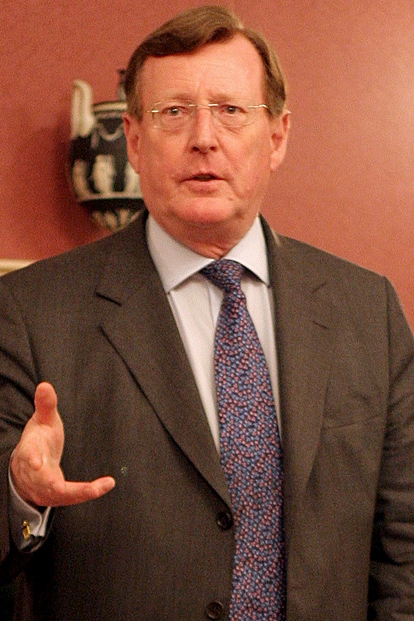
  • David Trimble – 1990 Maiden Speech in the House of Commons

    By https://www.flickr.com/photos/altogetherfool/ - https://www.flickr.com/photos/altogetherfool/3674015778, CC BY-SA 2.0, https://commons.wikimedia.org/w/index.php?curid=39319835
    By https://www.flickr.com/photos/altogetherfool/ – https://www.flickr.com/photos/altogetherfool/3674015778, CC BY-SA 2.0, https://commons.wikimedia.org/w/index.php?curid=39319835

    Below is the text of the maiden speech made by David Trimble in the House of Commons on 23 May 1990.

    I understand that it is customary for me to begin by paying tribute to the previous Member for Upper Bann, which I do gladly. Mr. Harold McCusker can be aptly summed up as a man of the people. He worked extremely hard for the people of Upper Bann and cared deeply for their welfare. I know from canvassing in the recent by-election that he was held in high regard and with deep affection by the people of Upper Bann. Harold, characteristically, was a fighter. He fought for those people and he fought in personal terms. His illness would not have been so prolonged if he had not fought so strongly against it. As many hon. Members know, Harold’s surname literally means “a son of Ulster”, and he was a son of Ulster. He was conscious of the soil from which he sprang and the traditions of the area and its people.

    The Upper Bann area is proud of its Unionist heritage, and many elements within the area express that heritage. I had some pleasure in reading a recent publication by the Public Record Office, edited by David Miller. Hon. Members will be familiar with his earlier work, which was extremely enlightening, on Unionism and loyalism. That publication included a copy of the account by Colonel Blacker of the formation of the Orange Order, of which I am proud to be a member. We find within it not only the Armagh area—sometimes the Armagh people, it being the County of the Diamond, forget that other counties contributed—but particularly in the west Down area. I am thinking particularly of the Bleary boys who contributed to that and to the successful defeat of the 1938 rebellion shortly afterwards.

    The Unionist heritage of the north Armagh area is in some ways epitomised by the statute of Colonel Saunderson, which stands in the centre of Armagh. I shall refer again to Colonel Saunderson in a way that is particularly apposite to other matters.

    Upper Bann is significant not only for its Orange heritage but for the way in which its character was formed largely through the plantation processes of the 17th and early 18th centuries. The major towns in the area are plantation towns. We see that from the contribution of the Brownlows to the creation of Lurgan and of the Warings to Waringstown and other towns in the area.

    That plantation had a significant heritage in other repects, because directly from it sprang the Ulster custom, which after the Ulster land war of the 1770s provided a basis from which the industrial revolution was able to occur. The industrial revolution in Ulster, which was centred on the Lagan valley, was an indigenous growth. Ministers may be interested in this, because it owed nothing to Government contribution or significant landlord patronage. It was indigenous and arose out of the customary rights that the tenants had won for themselves. We find the traces of one of the first major industrial developments in the area—the textile industry—through the middle Bann valley, running from Gilford down to the town of Banbridge, which lies in the centre of the constituency.

    During the recent by-election in Upper Bann, attention focused on the intervention of what are called national parties. I want to reflect on that for a moment. I mentioned Colonel Saunderson, whose statue stands in the centre of Portadown. The inscription refers to him as the leader of Ulster’s Unionists in the House for more than 20 years. As hon. Members will know, he first sat in the House as a Liberal, representing the constituency of County Cavan, and in the 1880s was returned for North Armagh, including Portadown, as a Conservative. Of course, he is noted as the leader of the Ulster Unionists.

    The term “national parties” which has been bandied about in recent times is misleading. It was misleading for some people who call themselves Conservatives to intervene in that election and call themselves the national parties. They claimed that their arrival was something new. Of course it was not new. Nor are they right to refer to themselves as solely national parties as distinct from provincial parties. We in the Ulster Unionist party are the British national party in Ulster. We were formed historically by an alliance between Ulster Liberals and Ulster Conservatives, with Ulster Labour representatives too, to combat Irish nationalists. We are the national British parties in Ulster. In that context, one must put a large question mark against the aims and motives of a group calling itself Conservative which contested the election with, it seemed to us, the object of dividing and diminishing the Unionist voice and, by so doing, diminishing the voice of the British people of Ulster.

    Since my arrival in the House, several hon. Members have expressed to me their regret at the decision of the Conservative party to contest the Upper Bann election. I did not regret it during the election. While canvassing, I repeatedly told the electors that the election was an opportunity for them to vote against the policies of the Government. The results show that the electorate of Upper Bann seized that opportunity with both hands. Hon. Members will not need to be reminded that the candidate representing the policies of the Government scored a total of 2.9 per cent.—less than 3 per cent.—of the valid votes cast in the election. That is a clear rejection of the policies of the present Administration. That demonstrates—indeed, it confirms, because we had demonstrated it on many previous occasions—that the policies pursued by the Northern Ireland Office have no mandate from the people of Ulster. That is significant.

    People cannot say that a majority elsewhere in the United Kingdom in favour of the Government’s policies legitimises those policies. A clear distinction can be drawn between Northern Ireland and, say, Scotland. In Scotland, where again the Government have no mandate for their policies, they can say that their policies are applied on a Great Britain basis and that they have a majority in Great Britain. However, the policies pursued in Northern Ireland are applied, not on a United Kingdom basis but specifically to Northern Ireland. Northern Ireland is treated differently from the rest of the United Kingdom and its constitutional status in the kingdom is diminished.

    A mandate for the Government’s policies can be obtained only from the people of Ulster. Clearly that mandate does not exist. In the light of that, the only honourable course for the Government is to reconsider their policies and accept the offers made by my colleague to extricate them from the position in which they have put themselves. They should adopt policies that reinforce the position of the kingdom of Ulster within the kingdom.

    At least the Conservative party came to seek a mandate in Upper Bann, even though that mandate was refused. If listened with interest to the speech of the hon. Member for Leicester, South (Mr. Marshall). I find his detailed interest in matters relating to Northern Ireland interesting. I agreed with several of the points that he made. Surely he must find it a little strange to take such a detailed interest in Northern Ireland matters and discuss them at length in the House when he belongs to a party that not only does not contest elections in Northern Ireland but refuses people in Northern Ireland the right or opportunity to join it. A member of a party which deliberately boycotts the people of Northern Ireland must surely find it inconsistent to take such a detailed interest in Northern Ireland.

    Tonight we are discussing the Appropriation (No. 2) (Northern Ireland) Order 1990. The measure is dealt with in the form of an Order in Council. Order in Council procedures are less than satisfactory. Indeed, that is an understatement. The hon. Member for Belfast, East (Mr. Robinson) referred a few moments ago to defects in the planning legislation on article 22 inquiries. As hon. Members will know, a planning and building regulations order has been tabled and is shortly to be debated. If that was legislation dealt with in the normal way, the hon. Member for Belfast, East could table an amendment to provide a remedy for the defects to which he referred. Of course, he cannot do so. That is not right. The procedures should not operate in the way that they do. Significant changes are needed.

    I support the comments made by the hon. Member for Antrim, South (Mr. Forsythe) on the Payments for Debt (Miscellaneous Provisions) Act (Northern Ireland) 1971. Order in Council procedure is objectionable partly because it is described as temporary. It is a temporary procedure stemming currently from the Prevention of Terrorism Act 1974 and originally from the Northern Ireland (Temporary Provisions) Act 1972. One wonders what the meaning of the word “temporary” is in that context.

    That is even more appropriate in the context of the point raised by the hon. Member for Antrim, South. He dealt with a temporary measure introduced in 1971, which is still operating. Not only is the measure objectionable because it was a temporary measure which lasted 19 years, but the provisions made for deduction of benefits under the Act were made as the result of administrative action.

    I should have thought that hon. Members who are interested in the rights of persons subject to the law of the United Kingdom would want people’s property rights determined in the courts or through some form of judicial procedure, rather than civil service actions. Civil servants may decide to withhold benefits in order to pay debts owed to other persons. That is particularly strange when, through the Enforcement of Judgments Office and its provisions for attachment of earnings and other assets, procedures have to be followed and some independent judgment is placed between the debtor and the creditor by the operations of the enforcement officers.

    Surely, at least on those grounds, something should be done. Even if it is still felt necessary to make deductions from people entitled to claim benefit, surely something should be done to enable people to make representations before a third party. It would be appropriate to provide something analogous to the procedure for enforcement judgments.

    My first point about the order concerns planning policy in the Craigavon district. That area is unique in Northern Ireland as the only area that does not have in force a development plan or area plan. The original, non-statutory plan, which is now some 20 years old, is not relevant, because the position has changed drastically in the past 20 years, with the failure of the new city project contained within it. In that area, we are operating with the detritus of the new city project.

    While canvassing during the election campaign, I was struck by the desolation of the estates in the central Craigavon or Brownlow area. I hope that some thought has been given to planning policies that could help to regenerate that area. I was also struck by the way in which many areas of the town of Lurgan have been badly blighted because of road proposals which, I am told, have since been abandoned. Again, I hope that some serious planning policies will be evolved to regenerate those areas.

    I was also struck by one of the consequences of the 1960s housing policies which I hope will not be repeated. I refer to the not very well built medium and high-rise flat developments. Nearly all the developments that I saw were semi-derelict and unoccupied. They were eyesores and worse—especially in the Portadown district, where properties that were originally constructed by the local Housing Executive have been bought by the tenants under the right-to-buy procedures, which the Government encouraged.

    The owners have found that, to some extent, their properties have been devalued by the derelict medium-rise flat developments just across the road. I hope that some urgent action will be taken on that. I was told by the occupiers—the purchasers—that they had been told by the executive that they would have to wait two or three years simply for a decision on the flat developments, let alone for any action to be taken.

    My second point about the appropriation order relates to the community relations cultural traditions programmes. As the Minister said, the programmes are being expanded considerably. That is a good thing, and I very much welcome the existence of those programmes. However, I should like an assurance that they will be genuinely representative and even-handed. I must confess to being uncertain about the Northern Ireland Community Relations Council. Technically, it is not a Government body, although in the first instance all its members have been appointed by the Government. It has been given a budget of £300,000. We must ask, how was the body formed? How representative of the community are the people who serve on it and how balanced is that representation? It seems that that representation does not rise above the level of tokenism as far as the majority tradition in Ulster is concerned. Many of the people who serve on it cannot be regarded as truly representative.

    Finally, I refer to an item of expenditure relating to the Northern Ireland Assembly. I note that there is a provision for £274,000 to be spent—over £200,000 of which will be spent on maintaining a cadre to provide the basis for an Assembly, should one be called in the future. I welcome that expenditure because there is a great need for representative institutions in Ulster. Hon. Members will know that there is a virtual absence of representative institutions and that what are called “local authorities” are not really what are normally understood by that term. They rarely get above the level of English parish councils. There is a huge gap between them and this House. We need representative institutions.

    Although I welcome that expenditure on the Northern Ireland Assembly, I do not want my comments to be taken as implying my approval of the proposals in the Prior Act—the Northern Ireland Act 1982. I am not sure that those proposals ever were workable. If we ever have an Assembly—or devolution on any significant scale in the future—I hope that it will be much more substantial than that of the Northern Ireland Assembly, if it is to be regarded as worthwhile devolution as distinct from what is essentially local government restructuring, which is another matter.

    Devolution is said to be the Government’s policy. I find it curious that a Government with that policy have not made any proposals that would advance that policy. That is to be contrasted with the experience or the actions of the Ulster Unionist party because it is now almost two and a half years since the Ulster Unionist party made detailed proposals for developments in Northern Ireland to the previous Secretary of State, to which there has not yet been any response. The Government do not make any proposals of their own. Their attitude is passive. If we were to have discussions on the proposals, I suspect that the Government would not advance any proposals of their own, but would simply adopt the role of picking holes in the proposals of ourselves and others.

    I wonder why that should be the case. I suspect that, despite its protestations to the contrary, the Northern Ireland Office actually prefers the present position. I suspect that it does not really want devolution, but prefers to sustain the present direct rule. Under that system, it is effectively insulated from any form of democratic control. Ministers can speak for themselves, but civil servants in the Northern Ireland Office give the impression that they are not really interested in devolution, and that they enjoy the freedom from accountability that direct rule gives them. That is another reason for ending direct rule at the earliest opportunity.