
Tag: Damian Hinds

  • Damian Hinds – 2023 Speech on the Future of the Parole Board

    Damian Hinds – 2023 Speech on the Future of the Parole Board

    The speech made by Damian Hinds, the Minister of State at the Ministry of Justice, in Westminster Hall, the House of Commons on 18 January 2023.

    It is a great pleasure to see you in the Chair and serve under your chairmanship, Mrs Murray. I congratulate the hon. Member for Blackley and Broughton (Graham Stringer) on securing this important debate. His speech was thoughtful, deliberative and balanced. He spoke in the light of some of the most appalling and horrific crimes, murders and rapes that we have known in our lifetimes. The thoughts of all of us in this House are with the victims of those terrible crimes and their families. Their loss—their tragedy—does not dim with time. As the hon. Member for Strangford (Jim Shannon) said, victims must always be paramount in the system. The system must work for them and must be seen to do so.

    I am pleased to have the opportunity to speak about the vital and difficult role that the Parole Board plays, as the hon. Member for Blackley and Broughton said, in protecting the public by making decisions about the release of some of the most serious offenders in our system. It is critical that the parole system works as effectively as possible to keep the public safe. That is, and must be, the top priority. The hon. Gentleman mentioned the September hearing of the Science and Technology Committee, of which he is a member. I have read the transcript of that hearing and agree that it was important and useful. He rightly said that statistics are important, as is understanding the statistics. He also said, and he was right, that statistics can only ever take us so far, because a serious reoffence is the most complete catastrophe—I think those were the words he used—for an individual and their family.

    He made a specific point about reoffending statistics. I want to clarify that under the probation serious further offence procedures, His Majesty’s Prison and Probation Service captures data on every serious further offence that is committed by an offender who has been released by the Parole Board, regardless of how long afterwards that serious further offence was committed. I will write to him with the data behind that.

    As has been mentioned by Members, including the Opposition spokesperson, the hon. Member for Stockton North (Alex Cunningham), the Government conducted a root-and-branch review of the parole system, which was published last year. It set out our proposals for making further improvements. I will say a little about the measures that we are taking, as well as seeking to address some of the points that colleagues have made.

    We have heard about the impact on victims when offenders are considered for release by the Parole Board. I pay tribute to the hon. Member for Blackley and Broughton for his unfailing support for constituents who have been so dreadfully affected by serious offending. These are difficult and deeply distressing times for them, and I want to apologise to any who have not received the service that they should have. Their experiences demonstrate why it is so important to ensure that they, and the victims of other terrible crimes, are properly supported.

    To that end, I will explain the measures that we are taking to improve the way the victim contact scheme operates, particularly when it comes to tracing and working with victims of offences that were committed before the scheme was established. I hope my comments about the action that we are taking will reassure colleagues about how seriously we take these matters and that, despite the problems that sometimes regrettably occur, we do have an effective system for keeping victims informed about the parole process.

    One of the Government’s priorities, as set out in the root-and-branch review, is to improve openness and transparency. We want to enhance public understanding and bolster confidence. It is clear that in all cases, victims need to be kept updated on what is going on in their case, and we are looking at ways to improve that.

    Before I say more about our plans to reform the system, it might be helpful if I first briefly go through the legislative framework within which the Parole Board operates. The Parole Board’s purpose is to decide whether prisoners convicted of serious, violent or sexual offences, who are serving certain types of sentences, can be safely released into the community on licence. The sentences dealt with by the Parole Board include life sentences, indeterminate sentences for public protection, extended determinate sentences and the sentences of those who are recalled to prison for breaching the terms of their licence. When passing sentence, the trial judge will set a minimum custodial period, which the offender must serve in prison for the purposes of punishment and deterrence. Once the minimum period has been served, the Secretary of State is required to refer these cases to the Parole Board so that the prisoner’s suitability for release on licence can be considered.

    That decision is about the offender’s current risk, having completed the part of the sentence that the judge has said must be spent in prison for the offences committed. The wording of the statutory test for release is clear. The Parole Board must not give a direction for a prisoner’s release unless the board is satisfied that it is no longer necessary for the protection of the public that the prisoner be confined in prison. When applying the public protection test, the Parole Board needs to consider whether there is a risk of serious harm. If release is directed, the Secretary of State must comply with that direction unless it appears legally flawed, in which case the Secretary of State has the power to ask for the decision to be reconsidered.

    The Parole Board is an independent body with expertise in risk assessment. It takes robust and fully-evidenced decisions. The board takes public protection very seriously. In around three out of four of the cases that are referred to the board, it decides to keep the offender in prison for the protection of the public. Where the board does direct release, less than 0.5% of the people in those cases go on to commit a serious further offence within three years. Any serious further offence is, of course, a tragedy and is fully investigated. The vast majority of offenders released by the board do not go on to cause serious further harm.

    The hon. Member for Blackley and Broughton raised the Worboys case. That awful case highlighted the need for improved transparency, especially for victims, about the reasons for a Parole Board release decision. As the hon. Gentleman will know, in 2018 we introduced decision summaries, which are now routinely provided to victims and others to explain why the board has directed a prisoner’s release. The case also highlighted the need for a better and easier way to challenge parole decisions if they can be shown to be flawed. That led to the introduction in 2019 of the reconsideration mechanism, which the Secretary of State uses in cases in which he considers that a release decision should be looked at again.

    We intend to go further to ensure that the system is as robust as possible. The root-and-branch review set out key proposed reforms that aim to ensure that public protection is the overriding consideration for release decisions and to introduce additional safeguards into the system.

    Graham Stringer

    I thank the Minister for his kind remarks. Will he respond to the two points that I made in the area that he is considering at the moment? One was that there seems to be an unexplained and dramatic increase in the 25% of prisoners who, as he just mentioned, are being released. The other was that category A, B and C prisoners are also being recommended for parole, which was not previously the case.

    Damian Hinds

    I will respond to the hon. Gentleman on the precise numbers in correspondence, if I may. The important point is that every case is considered individually on its merits; that has to be at the heart of how the Parole Board goes about its business.

    We will make the release test more prescriptive, so it is absolutely clear that prisoners should continue to be detained unless it can be demonstrated that they no longer present a risk of further serious offending. Secondly, for a top tier of the most serious offenders—I think that the hon. Member for Stockton North asked for clarification on what the tier consists of; it is those sentenced for murder, rape, causing or allowing the death of a child, and terrorist offences—we will legislate to give Ministers the power to refuse a release decision made by the Parole Board if they disagree with the board’s view that the release test has been met. That will provide an additional safeguard and, I hope, further reassurance to victims that for the most serious offenders, including murderers and rapists, there will be oversight by Ministers, who will be able to prevent release if that is considered necessary to keep the public safe.

    Thirdly, we will legislate to ensure that the Parole Board’s membership includes more people with law enforcement backgrounds, who will sit on panels dealing with the most serious cases. Having more members who are, for instance, ex-police officers with first-hand experience of tackling crime in our communities and dealing with serious offenders will further enhance the Parole Board’s expertise in assessing the risk such offenders present. The measures that I have described will require primary legislation, which, to respond to the hon. Member for Blackley and Broughton, we will introduce at the earliest opportunity.

    We have already taken other steps within the system to enhance public protection and increase confidence. For example, we have reformed the way indeterminate sentence prisoners are moved to open prison conditions, and Ministers can block such moves if they do not meet new, tougher criteria. Also, we have introduced a new system whereby Ministers can submit an overarching view to the Parole Board about release in some of the most serious and troubling cases before any decisions are taken. That ensures that it is made very clear to the board at the outset if there is a case where Ministers would be opposed to the prisoner’s release.

    I return to the important issue of victims’ experience of the parole system, which is at the heart of the case that the hon. Member for Blackley and Broughton made, and the measures that we are taking on it. When offenders are being assessed for release by the Parole Board, it can be a very difficult and distressing time for victims. We want to improve the way victims are engaged in that process, give them additional opportunities to hear about what is going on, and make them feel and know that they have more of a voice.

    The mechanism by which victims are kept informed about parole is the victim contact scheme, which is operated by the probation service. It was first established in 2001 and applies to victims of sexual and violent offending where the offender is sentenced to imprisonment of 12 months or more. Victims who have signed up to the contact scheme should always be notified when a prisoner is coming up for potential release.

    Victims have a choice about joining the victim contact scheme. If they choose to join, they will be kept up to date with key developments, including prisoners’ parole reviews, parole decisions and release decisions, by a dedicated victim liaison officer. During parole cases, victims can make a victim personal statement to the board, setting out the impact of the offence against them, and they may read it aloud to the Parole Board panel if an oral hearing is convened.

    Victims also have the legal right to make requests about licence conditions, including a no-contact condition and an exclusion zone that prohibits the offender from entering areas where the victim lives, works or travels to frequently. Victims can also request a summary of the Parole Board decision and, where the Parole Board has directed release, they can ask the Secretary of State to consider applying to the Parole Board for the decision to be reconsidered.

    It should be noted that some victims choose not to sign up to the victim contact scheme. Understandably, they may seek to do what they can to put the events of the case behind them. If there is no response to a second and third invitation to join the scheme, the probation service will properly respect their wishes and not keep contacting them. Victims can, however, join the scheme at any time, even if they have previously said no. A system in which all victims are notified about parole releases would not be practical for a number of reasons. For example, as I have said, not all victims will want to receive information, and unwanted contact from the service could retraumatise them.

    The scheme was set up in 2001. For cases in the system before then, in relation to the victims of offences committed many years ago, it does not operate retrospectively. However, in the most serious and notorious of cases, such as some of those that have been referred to in this debate, the probation service should ask the police, through multi-agency public protection arrangements —known as MAPPAs—for support with tracing victims. In the Andrew Barlow case, which the hon. Member for Blackley and Broughton talked about, the Greater Manchester probation region is working with Greater Manchester Police to trace victims of the offences that Mr Barlow committed in the 1980s and 1990s and invite them to join the victim contact scheme. I should also confirm that, as has been said, my right hon. Friend the Deputy Prime Minister and Secretary of State is applying to the Parole Board to reconsider its decision to direct Mr Barlow’s release on life licence. Probation victim liaison officers will keep victims in the scheme informed of progress with the application for reconsideration.

    As for the measures we are taking to make further improvements, particularly to increase transparency and the information available to victims and others, we committed in the root-and-branch review to allowing victims to observe parole hearings for the first time. We also confirmed that we would change the rules to allow for public hearings in some cases. I know that that has come up this morning, and I will say a little bit about the progress that has been made on both those commitments.

    Since October last, victims have been able to observe Parole Board hearings as part of a testing phase that is running in the south-west probation region. During the hearings, victims are supported by probation staff, who discuss the parole process with them and ensure that they are directed to relevant support. We are working closely with the Association of Police and Crime Commissioners to ensure that tailored local support services are readily available, should victims require. We recognise that it could be retraumatising for a victim to hear the evidence that is explored during a parole hearing, so we are initially conducting a relatively small-scale testing phase to ensure we get the processes and support arrangements right. My paramount concern is to ensure that victims can observe the hearing in a way that is safe for them while not compromising the Parole Board’s ability to conduct a fair and rigorous assessment of risk.

    The hon. Member for Stockton North asked for an update on progress. During the testing phase so far, victims have welcomed the opportunity to observe hearings. Following their feedback, we are working to improve the process to prepare for its expansion across England and Wales.

    Last year, having made changes to the Parole Board rules, we also saw the first public Parole Board hearing, which was in the case of Russell Causley in December. A second public hearing has been agreed by the board and will take place this year in the case of Charles Salvador, formerly known as Charles Bronson. These changes will help to improve public understanding and awareness of the parole process.

    In the root-and-branch review, we also committed to reviewing the current guidance and requirements for providing victims with information about the parole process. Our review will identify areas for improving the information that victims currently receive through the victim contact scheme. We will ensure that, where victims have requested it, they receive effective, clear and timely communication about the parole process so that they are sufficiently informed as their case is progressed.

    As part of the primary legislative reforms that I referred to earlier, we intend to require the Parole Board to consider written submissions from victims about the release of the prisoner. That will be in addition to the victim personal statement that victims are already permitted to make to the board. Again, that is about doing more to give victims a voice and an opportunity to put their concerns and views to the Parole Board.

    I want briefly to cover a few other points that came up during the debate. The hon. Member for Blackley and Broughton raised the sex offender treatment programme. The SOTP was discontinued in the light of research evidence, and a new treatment programme has been introduced, which relies less on group work.

    The right hon. Member for Dwyfor Meirionnydd (Liz Saville Roberts), who is no longer in her place, indirectly raised a couple of points—one of which was also raised by the hon. Member for Stockton North—about the important issue of what is in the dossiers that are brought to the Parole Board and the content that comes from different perspectives and analyses. They both asked about not having individual staff recommendations. Reports will continue to provide all the same information, evidence and assessments about the prisoner as they currently do, with the exception of a recommendation or review from the report writer. The reason for that is that it is the Parole Board’s responsibility to decide whether the prisoner is safe to be released or should stay in prison for the protection of the public, based on the entirety of the evidence received. The written reports, including those from prison, probation and psychology staff, and the questioning of witnesses at oral hearings, will continue to provide all the evidence the board needs to enable it to reach fully informed decisions.

    Alex Cunningham

    The point about the information staff provide and how confident they are that it is being shared is important. I mentioned that staff appear to be concerned that we are releasing prisoners they would never have recommended be released. What does the Minister have to say to them about the credibility of information that is before the Parole Board, and the confidence in the decision?

    Damian Hinds

    As I am sure the hon. Gentleman recognises, the situation he describes could have happened anyway. I reassure him and other colleagues that this is not a diminution of the information that goes into the risk assessment. All of that information is still there, and that totality of information will be considered in the round.

    The right hon. Member for Dwyfor Meirionnydd and the hon. Member for Stockton North asked about the impact assessment on changes to the recommendation system. The right hon. Lady specifically asked about impact on minority ethnic offenders. I want to reassure them that that impact is being monitored, though it is too early to assess on a segmented basis. It is important that we keep such matters under review.

    I hope I have been able to provide some reassurance that, through the actions the Government are taking, victims’ concerns and the protection of the public are at the heart of our vision for the future of the parole system. I am grateful for the opportunity to respond to this important, thoughtful and measured debate, and thank everybody who has taken part—in particular the hon. Member for Blackley and Broughton, who secured it.

    Graham Stringer

    I thank the Secretary of State for applying for reconsideration, and I thank the Minister and right hon. and hon. Members who have participated in the debate, which I agree has been thoughtful. I hope it has brought to light some of the procedural failings of the past that need to be put right, and that there are worrying gaps in the information available, the statistics and the trend in those statistics, particularly the increase in the number of prisoners getting parole. There appears to be no obvious reason for that, and we need to understand it. Thank you for chairing the debate, Mrs Murray.

  • Damian Hinds – 2022 Statement on Prison Capacity

    Damian Hinds – 2022 Statement on Prison Capacity

    The statement made by Damian Hinds, the Minister of State at the Ministry of Justice, in the House of Commons on 30 November 2022.

    Thank you, Mr Speaker. May I open with a sincere apology for what you have just referred to? With the way timings have worked out today, we got this wrong, and I apologise for it. I assure you and the Opposition that it was not deliberate. I appreciate that that does not help with the practicalities of this, but I want to assure you and the Opposition that this was not a deliberate move on our part.

    The first responsibility of Government is to keep people safe. That means taking dangerous criminals off the streets, and to do that we must always ensure that we have sufficient prison places available to serve the courts. This Government have been decisive in our tough approach to crime. We are well on our way to the recruitment of 20,000 additional police officers. We have legislated to introduce tougher sentences for the most serious crimes, with rape prosecutions having increased by 3% between the year ending June 2021 and now, and by 49% since 2019, and we are committed to driving down the backlog of outstanding court cases following the pandemic.

    We have long anticipated the prison population rising as a result of those measures, and that is why we are delivering the largest prison building programme since the Victorian era, with 20,000 additional places. We have already created over 3,100 of them, including the recent change of use of His Majesty’s Prison Morton Hall and our brand-new prison, HMP Five Wells. A further 1,700 places are due to come online with occupation in tranches from next spring with the opening of HMP Fosse Way. This is in addition to the thousands of further places that will become available through additional house blocks—for example at HMP Stocken, which is due to finish construction next year—and major refurbishment programmes across the existing estate. Just a few weeks ago, I attended a ground breaking ceremony at the site beside HMP Full Sutton in Yorkshire, where we have started construction for the next new prison, which will hold 1,500 category C prisoners when it opens in 2025.

    However, in recent months we have experienced an acute and sudden increase in the prison population, in part due to the aftermath of the Criminal Bar Association strike action over the summer, which led to a significantly higher numbers of offenders on remand. With court hearings resuming, a surge in offenders is coming through the criminal justice system, placing capacity pressure on adult male prisons in particular.

    The public rightly expect us to take the action necessary to hold offenders who have been sentenced by the courts. That is why I am announcing today that we have written to the National Police Chiefs’ Council to request the temporary use of up to 400 police cells, through an established protocol known as Operation Safeguard. That will provide the immediate additional capacity we need in the coming weeks to ensure the smooth running of the prison estate, and to continue taking dangerous criminals off the streets. I thank the National Police Chiefs’ Council for its support in mobilising this operation. We already routinely work hand in glove with police forces across the country to occasionally use police cells to hold offenders overnight. The triggering of Operation Safeguard is not an unprecedented move. It is an established procedure that has been used before to ensure that our prison system can operate effectively and safely during periods of high demand. It last happened in 2006, and then in 2007 to 2008.

    With the expected increase in offenders coming into the estate over the coming weeks, it is right that we give police forces as much notice as possible of the short-term need to use their cells, so that together we can safely and adequately ensure availability of the spaces needed. The activation of Operation Safeguard will ensure that His Majesty’s Prison and Probation Service and police forces can jointly plan how and where those places will be accessed. We are working with prison governors across the estate to ensure that we safely maximise the places available within our prisons. This plan, alongside our existing plan to provide 20,000 modern places, will ensure that we have enough places to cut crime and keep the public safe.

    The capacity pressure is specific to the adult male estate, and there is ample capacity in the women’s and youth estates. We have delivered on our commitments to reduce the number of young people and women in our prisons, helping us to tackle the drivers of crime by focusing on rehabilitation. The Government are working to drive down reoffending, and we are investing £200 million a year by 2024-25 to get prison leavers into skills training, work and stable accommodation. We are investing to make prisons safer and more secure, rolling out almost 7,900 next-generation body-worn video cameras to 56 prisons. In March we completed our £100 million security investment programme to fight crime in prisons, including tackling the smuggling of illicit items such as drugs and mobile phones.

    In conclusion, I thank the police for their support and pay tribute to the frontline prison staff and police officers who work tirelessly every day to keep the public safe. Taken together with our programme to expand the prison estate, I have every confidence that the commencement of these measures will ensure that we continue to deliver justice, protect the public and reduce reoffending, as the public would rightly expect, and I commend this statement to the House.

  • Damian Hinds – 2014 Parliamentary Question to the Northern Ireland Office

    Damian Hinds – 2014 Parliamentary Question to the Northern Ireland Office

    The below Parliamentary question was asked by Damian Hinds on 2014-03-25.

    To ask the Secretary of State for Northern Ireland, what recent discussions she has had with the Northern Ireland Executive on economic development in Northern Ireland.

    Mrs Theresa Villiers

    I regularly hold discussions with Executive ministers on a range of economic issues.

    Last week, I chaired a meeting of the Joint Ministerial Task Force on Banking and Access to Finance which was established to help Northern Ireland businesses access finance.

  • Damian Hinds – 2014 Parliamentary Question to the Department for Energy and Climate Change

    Damian Hinds – 2014 Parliamentary Question to the Department for Energy and Climate Change

    The below Parliamentary question was asked by Damian Hinds on 2014-04-10.

    To ask the Secretary of State for Energy and Climate Change, what information his Department holds on the incidence of power cuts by (a) county and (b) parliamentary constituency.

    Michael Fallon

    Statistics on the number of power cuts are held by Ofgem. Ofgem measure the number and duration of power cuts based on the number of customer interruptions (interruptions per 100 connected customers) and customer minutes lost (minutes of supply lost per connected customer). The statistics, broken down by Distribution Network Operator, can be found in tables A10.1 and A10.2 of Ofgem’s Assessment of the RIIO-ED1 business plans document, pages 86 and 88:

    https://www.ofgem.gov.uk/ofgem-publications/84945/assessmentoftheriio-ed1businessplans.pdf

    Ofgem do not collect a more detailed regional breakdown than what is presented in both of these tables.

  • Damian Hinds – 2014 Parliamentary Question to the Department of Health

    Damian Hinds – 2014 Parliamentary Question to the Department of Health

    The below Parliamentary question was asked by Damian Hinds on 2014-06-04.

    To ask the Secretary of State for Health, what progress his Department has made in improving maternity and early years care.

    Dr Daniel Poulter

    We have made improving maternity services a key objective in our Mandate to NHS England. Over the past two years we have also invested 35 million pounds of capital funding to improve the physical environment of over 140 maternity units.

    We have increased the numbers of midwives and health visitors. There are 1,700 more midwives and over 2,000 more health visitors than in 2010. In addition, there are more than 6,000 midwifery students in training. And we are committed to having an extra 4,200 health visitors by 2015.

    We are expanding the Family Nurse Partnership programme – which provides dedicated one to one support to young, at risk first time mothers – to 16,000 places by 2015.

    We launched the NHS Start4life Information Service for Parents, a digital service for parent-to-be and new parents in May 2012. Take up has already exceeded the sign-up target of 300,000 parents by 2015 – as of 1 June over 339,000 parents had signed up to the service.

  • Damian Hinds – 2022 Comments on Rishi Sunak Becoming Prime Minister

    Damian Hinds – 2022 Comments on Rishi Sunak Becoming Prime Minister

    The comments made by Damian Hinds, the Conservative MP for East Hampshire, on Twitter on 21 October 2022.

    For confidence, trust and unity; to lead our country through difficult times – the choice is clear. I’m backing Rishi Sunak.

  • Damian Hinds – 2022 Speech on Economic Crime and Corporate Transparency Bill

    Damian Hinds – 2022 Speech on Economic Crime and Corporate Transparency Bill

    The speech made by Damian Hinds, the Conservative MP for East Hampshire, in the House of Commons on 13 October 2022.

    I support this important Bill, which seeks to tackle this most international of criminal problems. The scale of global financial crime is mind-boggling, accounting for up to 5% of gross world product and, depending on which estimate we look at—we cannot say absolutely for certain—worth between $2 trillion and $5 trillion. On an optimistic view, the confiscation rate runs at around 1%.

    Economic crime is sometimes thought of as being in a separate category from other crime but, no, it is part of those other crimes. There is a particularly close link between fraud and cyber-crime. Money laundering, fraud and cyber-crime collectively—distance crime—make up the majority of crime by volume in this country. More broadly, virtually all crime with a financial motivation touches on money laundering at some level. There is a mix of organised crime groups pulling off huge cyber-crimes, down to individually small but cumulatively very large-volume frauds. Some groups have undergone a sort of vertical integration, controlling every part of the chain; others specialise in one particular part of the chain, such as ransomware as a service. There is a merging of criminal actors with a nexus to states. Then, of course, there are the kleptocrats who got filthy rich on plunder from their fellow citizens.

    There is a huge amount that needs to be done in this area. Much of it needs to be done globally, but countries such as ours need to be in the lead. The world has made quite some progress in this area, and in key aspects we have been a leader, but we have also had our lacunae. High on that list is transparency about who is really behind and ultimately benefits from corporate structures and economic assets.

    For some time, we have had a substantial and, in many ways, effective architecture to tackle money laundering, but there is an important question whether the suspicious activity reports regime is sufficiently efficient, and whether it is focused enough to make the most difference while minimising dead-weight. There is also the question whether we are fully harnessing the power and capabilities of banks, particularly if we compare our legislation with section 314(b) of the American Patriot Act. Should there be more direct intelligence sharing between banks, and if so, how do we manage the competition policy aspects of that? Finally, however much we improve and innovate, the criminals are doing the same, with ever more sophisticated technology, and they are increasingly bypassing the systems that we have been used to in the past by using cryptocurrency and cryptoassets.

    The most important thing about the Bill is that it moves to plug the transparency gap, with reforms to Companies House and limited partnerships as its backbone. It modernises seizure by bringing cryptoassets into scope of the civil forfeiture powers, and it moves from a compliance-driven anti-money laundering system to one that is more proactive and intelligence-led, with rationalised SARs and DAML—defence against money laundering—requirements.

    I welcome all the aspects of the Bill, but especially the information-sharing provisions, and in particular their broad scope to include all types of economic crime, including, importantly, volume fraud. I ask the Home Secretary and the Under-Secretary of State for Business, Energy and Industrial Strategy, my hon. Friend the Member for Watford (Dean Russell), to really test whether these powers go as far as they productively can. I press not just the Home Office and BEIS Ministers we have here today, but the Treasury, regulators and the private sector, to come together to ensure that we link up the different parts of our financial services sector and the wider professional services sector to best effect.

    Information and intelligence sharing could be so much more powerful if we reformed the way that payments are made so that in certain circumstances, where suspicious activity is detected, it is possible to slow down or pause payments and use the system not just to track down money laundering payments or fraudulent payments after the fact, but to stop them happening before the fact. That could be a genuine game changer. As I say, I strongly encourage the two excellent Ministers present today to communicate with the Treasury and others about that.

    I support the Bill and I wish Ministers well with it. It is of course part of a wider set of reforms that includes the sanctions regime, the creation of the National Economic Crime Centre, the kleptocracy cell, the overall economic crime plan, and, importantly, our international work with like-minded partners, the Financial Action Task Force, and the Crown dependencies and overseas territories. The reform of visas, which came up, is part of this too, and of course we recently passed the Economic Crime (Transparency and Enforcement) Act 2022. There will be more to come, I am sure, including on corporate criminal liability.

    Kevin Hollinrake rose—

    Damian Hinds

    On that point, I give way to my hon. Friend.

    Kevin Hollinrake

    I am very supportive of that, as my right hon. Friend knows, but I rise to make another point. He mentioned that putting some friction in the payments system might reduce instances of economic crime. At the moment, banks are refunding a much higher proportion of authorised push payment fraud, but all the onus is on the sending bank. Nothing is reimbursed by the receiving bank, yet it is the receiving bank where the dodgy account is held. Does he agree that we should look at that and create an incentive for the companies that host those bank accounts to tackle it more effectively?

    Damian Hinds

    I do think we need to look at this more closely, although it is even more complex than my hon. Friend suggests, because we get this ping-on system as well, where a body can be both a receiving bank and a sending bank, and so be a sort of transmission mechanism. We certainly need to look at this more broadly. Madam Deputy Speaker might get cross with me if I try to unpack it too much now, because it is a broader subject. However, as my hon. Friend rightly mentioned, we also have to address the questions of who is liable and how much of the liability now sits within the banking sector, full stop, as opposed to other parts of the consumer interface—different channels through which people come—that might reasonably be expected to share some of that burden too and be properly incentivised.

    I am going to close my remarks by saying that these reforms are important and they are not in tension with the success of our financial services sector—quite the reverse. These reforms are about enhancing the reputation of both British financial services and, more broadly, the UK and our reliance on and respect for the rule of law. They are about protecting and growing our business; and doing the right thing, ceding no space to the criminals and the kleptocrats. In the unlikely event that we divide this afternoon, I will be proud to vote “Aye” for this Bill.

  • Damian Hinds – 2022 Tribute to HM Queen Elizabeth II

    Damian Hinds – 2022 Tribute to HM Queen Elizabeth II

    The tribute made by Damian Hinds, the Conservative MP for East Hampshire, in the House of Commons on 9 September 2022.

    On behalf of my constituents in East Hampshire, I want to convey our sincere sympathies to the royal family and express our heartfelt thanks for the life of Her late Majesty.

    My own first consciousness of the Queen, like that of many others of roughly my age who have spoken, was in 1977, although unlike others who have spoken, I was not actually in the same place as the Queen at the time. My consciousness was just through the street parties, the bunting, the mug—which by the way I still have—and, if people remember them, the little round badges that we got to sew on to our Cub uniforms. I did not yet quite know how, but for the first time I got that sense that as Britons we are especially blessed.

    I could not possibly have known that, decades later, I would have that rare opportunity, as others have mentioned, to meet the Queen. It was the honour of my life to be admitted to the Privy Council, but most especially to be able to attend one of those lunches at Windsor castle, which have come up a few times today, and to have the opportunity to talk directly with our monarch about the subject that I was representing, which was education. I have to say that the level not only of her knowledge about current issues, but of her interest to discuss it further, was remarkable.

    Speaking of education, I find when I visit primary schools in East Hampshire that there are actually three questions that are guaranteed from the kids. The first is, “What is your favourite colour?”, the second is, “What’s the Prime Minister like?”, and of course the third is, “Have you met the Queen?” I love that opportunity, because it is wonderful to talk to those children, the next generation, about her values, and I always take away a lot from it too.

    We have heard some wonderful tributes today—some beautiful tributes, actually—to Her late Majesty, but I think probably the biggest tribute of all that any of us could pay, particularly those of us in this place, is to seek to learn from and to emulate her example: her selflessness; her steadfastness; her commitment above all to service; her readiness to forgive; her appreciation of every individual she met; and her valuing of custom and tradition, but equally her adaptability and openness to change.

    Our constitutional monarchy is unique and special—I found myself last night trying to explain to my own children exactly why and how. This family, through no choice of their own, carry a great burden and the unity of nationhood, and a much, much wider world role. Of course, with her passing that role carries on. The Crown endures.

    So we mourn our beloved Queen Elizabeth, and we celebrate, too, her life of service.

    “Eternal Rest grant unto her, O Lord,

    And let perpetual light shine upon her”.

    And may the Lord bless and guide our sovereign King Charles. God save the King. Long may he reign.

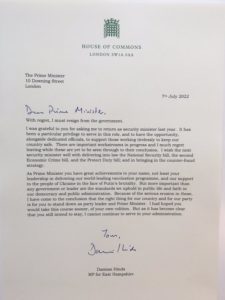
  • Damian Hinds – 2022 Letter of Resignation as Security Minister

    Damian Hinds – 2022 Letter of Resignation as Security Minister

    The letter of resignation sent by Damian Hinds, the Security Minister, on 7 July 2022.

  • Damian Hinds – 2022 Speech on the HM Passport Office Backlog

    Damian Hinds – 2022 Speech on the HM Passport Office Backlog

    The speech made by Damian Hinds, the Minister for Security and the Borders, in the House of Commons on 14 June 2022.

    While 98.5% of UK passport applications are being processed within 10 weeks, it is clear that some of our constituents have not received the level of service that they rightly expect. I assure colleagues that the efforts to improve delivery of passport services continue. The further 550 staff still to be added going into the summer will further increase the capacity for processing applications and build on the record numbers being processed now. HM Passport Office’s current projection suggests that by the end of this month more applications will have been processed in 2022 than throughout the whole of the previous year.

    I am grateful to colleagues across the House for their contributions to this debate. We heard from the hon. Member for Gordon (Richard Thomson), my hon. Friend—and almost neighbour—the Member for Eastleigh (Paul Holmes), and the hon. Members for City of Durham (Mary Kelly Foy), for Blaenau Gwent (Nick Smith), for Weaver Vale (Mike Amesbury), for Bradford East (Imran Hussain), for Blackburn (Kate Hollern), for Lewisham East (Janet Daby), for Birmingham, Hall Green (Tahir Ali), for Glasgow Central (Alison Thewliss), for Bedford (Mohammad Yasin), for Merthyr Tydfil and Rhymney (Gerald Jones), and for Newport West (Ruth Jones). Many of them, including the hon. Member for Newport West, rightly paid tribute to staff working in HMPO offices. I echo what they said to hard-working staff working in difficult circumstances.

    Many colleagues across the House rightly asked what we have done and what we are doing on resourcing to make sure that the operation is commensurate with the task at hand. I can tell them that 650 additional staff have been added since April 2021 and 550 more are being recruited. The hon. Member for City of Durham helpfully outlined the use of agency staff and overtime in order to increase the capacity. I think at one point she was suggesting that we should not be deploying extra agency staff and overtime, which would of course make matters worse. The telephone operator, Teleperformance, has also added hundreds of staff, and other suppliers have increased their capacity, too. We have opened an eighth service counter and run extensive proactive communications, including issuing 5 million reminder texts to people with passports expired or soon to expire.

    A couple of colleagues asked whether staff working from home is causing delays, and it is not. Whether staff work from home or from the office does not impact on the capacity within the digital system, which is accessible from home. The hon. Member for Halifax (Holly Lynch) asked from the shadow Front Bench specifically about courier services. I can confirm that through constructive work with FedEx, which is the parent company of TNT, delivery delays have been resolved and TNT is currently delivering within the contractual service levels.

    In anticipation of the surge in demand and to provide greater resilience to the delivery network, a percentage of domestically delivered passports are now also arriving via HMPO’s partner for international deliveries, which she will know is DHL, with supporting documents being returned by Royal Mail. More than one Opposition MP asked about the TNT contract. It would not be appropriate for me to comment on such commercial matters from the Dispatch Box, but I will say that the relationship between the Passport Office and FedEx is constructive and the current performance is as required.

    The hon. Member for Halifax also asked about Sopra Steria and the back-office processing. I confirm that it has doubled its workforce supporting Her Majesty’s Passport Office since the start of 2022, alongside opening up a number of new processing centres. Its efforts have enabled the registration of applications and supporting documents on our system and the return of supporting documents to keep pace with the unprecedented demand.

    The question of privatisation or otherwise has been raised multiple times in the debate. Again, to be clear, elements of the process, such as the printing and the delivery of the passports, are already contracted to private suppliers. We are committed, naturally, to ensuring that public services are run as efficiently and effectively as possible, and that gives me an opportunity to pay tribute to our hard-working staff.

    We are living through the aftermath of a pandemic that has been at once an unprecedented medical and healthcare shock, an unprecedented peacetime economic shock and an unprecedented travel and movement of people shock. It is one with multiple uncertainties, adverse turns and false dawns. It has disrupted supply chains, interrupted business continuity and thwarted projections at every turn throughout this country and throughout the world. It has specifically thrown the travel trade off course and everyone’s planning of its usual pattern far off course.

    In 2020, there were roughly 4 million passport applications in this country. In 2021, it was about 5 million. This year—2022—we project it will be 9.5 million. In the face of this enormous change, everyone’s focus has been on trying to make sure that Britain—our constituents—can get back travelling, whether that is taking their hard-earned holidays or doing that business travel, which underpins our national prosperity, or those visits to be with loved ones, both in the happiest of times and in the saddest of times, when their personal in-person support is so important.

    Amid the overwhelming volumes, it is true that sometimes things have not been fast enough and call waiting times have been too long, and I am sorry for that, but it is not for want of will, effort or commitment. I pay tribute to the dedicated staff of Her Majesty’s Passport Office working under this pressure.

    I also want to say a word about the Under-Secretary of State for the Home Department, my hon. Friend the Member for Torbay (Kevin Foster). I must say that I am rather disappointed by the wording of the motion. What is happening with passport applications is an entirely legitimate, worthwhile and relevant subject for debate, but it is quite wrong to channel that into a personal criticism of him. He is an extremely engaged and active Minister working with officials to deal with these unprecedented issues. I have heard many accounts, and we have heard more today, of his personal work to help to expedite some of the most difficult cases by doing casework out of hours and at weekends for hon. Members on both sides of the House.

    Mary Kelly Foy

    My constituent went to Durham passport office to collect his passport only to be told that there was an issue with the photo that had previously been approved. He has just been to deliver new photos, but staff told him that they have no record of his interview, despite the Home Office telling me two hours ago that it was on the system. He flies to America on Monday. What do I tell him?

    Madam Deputy Speaker (Dame Eleanor Laing)

    Order. This is the Minister’s winding-up speech; it is not the place for a new speech. I let the hon. Lady finish because—[Interruption.] Do not argue with me. I let her finish because she was speaking on behalf of a constituent, and it matters, but that is not how we conduct debate.

    Damian Hinds

    I think the hon. Lady will appreciate that it is impossible—literally impossible—for me to comment on the details of that case and the particular issue with the photograph and so on from the Dispatch Box of the House of Commons, but if she speaks to our colleagues in the hub in Portcullis House, or with me or the Under-Secretary of State for the Home Department, my hon. Friend the Member for Torbay after the debate, we will be sure to pick it up.

    The difficulties that we have heard about today absolutely must be taken with great seriousness, and that is happening. I assure hon. Members that we will continue to look at ways to further improve performance. I also remind them that 98.5% of UK applications across March, April and May were processed within the published processing time. Indeed, the overwhelming majority were processed more quickly than that, with more than 91% of those completed in May having been processed within six weeks.

    I certainly do not seek to minimise the frustrations that have been raised by hon. Members on both sides of the House during the debate, but I assure the House that everybody at Her Majesty’s Passport Office is completely focused on meeting the needs of customers ahead of their long-awaited and hard-earned summer holidays.