Tag: Chris Skidmore

  • Chris Skidmore – 2023 Speech on the Independent Review of Net Zero

    Chris Skidmore – 2023 Speech on the Independent Review of Net Zero

    The speech made by Chris Skidmore, the Conservative MP for Kingswood, in the House of Commons on 9 February 2023.

    I beg to move,

    That this House has considered the Independent Review of Net Zero.

    I draw the House’s attention to my entry in the Register of Members’ Financial Interests, and should declare that I am the chair of the independent review of net zero that we are discussing. I thank the Backbench Committee and its Chair for agreeing to this debate. We had an excellent debate in the other place, led by Baroness Hayman, on the recommendations in the “Mission Zero” report, which was published on 13 January. Members may recall that the review was commissioned by the previous Administration, and the previous Prime Minister, my right hon. Friend the Member for South West Norfolk (Elizabeth Truss), in September 2022. The review’s remit was to allow us to understand how we can transition to net zero in a more affordable, efficient manner that is pro-business and pro-growth.

    Having been appointed chair of the review, I undertook what I understand is perhaps the largest ever engagement exercise specifically on net zero conducted in Government. We received 1,800 written responses to our consultation. I held 52 roundtables, virtually and in person. I toured every region of England and every devolved nation of the UK, and spoke in person to around 1,000 people to understand directly the challenges and opportunities of energy transition for the UK. In that consultation, the message that I heard from the overwhelming majority of respondents was that when it comes to the opportunities that net zero and energy transition can bring to the UK, Westminster, Whitehall and Government are falling behind the curve. Thousands of infrastructure projects are ready to take place, and thousands of businesses see the opportunity in net zero.

    The opportunities are not just national; 2022 marked a tipping point in international opportunities for green technology. First, Russia’s illegal war in Ukraine woke countries up to their dependency on foreign-owned gas and oil. We have to be able to provide domestic sources of energy in future. That is why interest in renewable and clean technologies has escalated. Not least, as the report was being prepared, the US passed its Inflation Reduction Act, which provides for $369 billion of investment in green and climate technologies for the future, and sets out a clear direction of travel, and a programmatic approach to investing in carbon capture, utilisation and storage technology, hydrogen, renewable power and new nuclear power. At the same time, the European Union has taken forward its “Fit for 55” programme, and has provided further detail of how it will invest up to €1 trillion in the European green deal.

    The review comes at a time when we are at a crossroads. On the one hand, we could continue on our trajectory as leaders on climate policy. We were the first G7 country to sign net zero into law. We could carry on showing leadership, as the only major industrial nation that has been able to reduce its emissions by 40%. Or we could take the other turning—a turning that is not zero and would see us resile from our climate commitments, and from the investments that we have made. Ultimately, the choice of not zero will cost more than continuing in the direction of working towards net zero. That is the choice. I was the Minister at the Dispatch Box 43 months ago, taking forward legislation to ensure we could be the first G7 country to sign net zero into law. I thank the Under-Secretary of State for Energy Security and Net Zero, my hon. Friend the Member for West Aberdeenshire and Kincardine (Andrew Bowie) for his commitment and congratulate him on his new role. I understand that this is probably his first debate as a Minister in the new Department for Energy Security and Net Zero. It may even be the first debate that the new Department responds to. I am delighted that we have a new Department with “Net Zero” in its title. I hope he enjoys reading the “Mission Zero” report. I am sorry it is 340 pages. I am not holding him to having read every page for this debate, but hopefully it will form part of his weekend box.

    The Parliamentary Under-Secretary of State for Energy Security and Net Zero (Andrew Bowie)

    Recess reading.

    Chris Skidmore

    It needs to be sooner than that. Basically, we have an opportunity now for the Government to look at the recommendations in the report.

    The report is divided into two sections. The first part is a new narrative on net zero. As the chair of the net zero review team, I put on record my thanks to my fantastic team of 22 dedicated civil servants who were drawn from across all Departments. I can see one in the Box now, who is working with the Minister. If it was not for the team, we would not have produced a report of such quality. We set out a new narrative on net zero. It is not some kind of eco-project or religion, and I do not stand here thinking that I want the imposition from the centre of top-down policies. I recognise that the challenge we face is to ensure that everyone in society is able to see the opportunities of the energy transition for the future. There will be challenges, and the report is open about those challenges and costs. At the same time, there is an international opportunity: we are now in a global net zero race. We can either continue to lead or we will follow, and the cost of following will always be greater than the opportunity of showing first mover advantage. There are no free rider opportunities here.

    Jim Shannon (Strangford) (DUP)

    The right hon. Gentleman said that he had been to all regions of the United Kingdom of Great Britain and Northern Ireland to ascertain opinions for the independent review. Can he tell us what the opinions were in Northern Ireland? Were they similar to everywhere else, so we can go forward collectively? If we can do that, we can achieve our goals. We cannot achieve them if we are divided.

    Chris Skidmore

    I had a fascinating opportunity to visit Belfast to hold two separate evidence roundtables. The first was with Belfast City Council, which gave me the public sector perspective on the challenges of decarbonisation and the public estate in Northern Ireland. The second roundtable was with private business and industry, with the Belfast chamber of trade and commerce. What I took from that opportunity to speak specifically about Northern Ireland’s concerns and opportunities was that there are challenges in Northern Ireland. In particular, it will probably achieve net zero later than 2050. On our overall UK net zero target, that is the case for both Northern Ireland and Wales. For Scotland, it will be a bit sooner, in 2045, as I am sure the Minister knows given that his constituency is at the forefront of bringing forward some of the green opportunities that will allow Scotland to go further and faster.

    Andrew Bowie indicated assent.

    Chris Skidmore

    A really important part of the report, which I will come on to in the moment, is taking a place-based approach to net zero. We will achieve net zero in a more affordable and efficient way if we allow local communities, whether they are cities or rural areas, the opportunity to be more empowered to understand how to achieve net zero in a way that suits their local communities.

    In Northern Ireland, I listened to concerns about how agriculture could be decarbonised. Northern Ireland wants a whole raft of new biomethane plants. At the same time, there is a new fleet of hydrogen buses in Belfast—it is really pushing forward on fully decarbonising public transport. There was a fascinating discussion on how Northern Ireland wanted to be a leader on green hydrogen. It may not have much offshore wind, but there is a huge opportunity for onshore wind and for the use of hydrogen to drive a whole new economy. Picking up all the pieces that come together that demonstrate the opportunities in every region is exactly what the report tries to reflect.

    The report sets out the new narrative that net zero is the primary economic opportunity of this century, but if we do not invest now—that investment is primarily private sector investment, but it needs certainty, clarity, consistency and continuity from the Government on policy—we will turn our backs on a potential £1 trillion of investment by 2030 and turn our backs on up to 480,000 new jobs by 2035. In a way, the net zero review is a bit of a misnomer. I was keen to look at the targets that have been set and to understand how we will realistically meet them. The worst thing one can do in politics is overpromise and underdeliver; it completely undermines confidence in the ability to deliver on our climate commitments and the energy transition.

    Wera Hobhouse (Bath) (LD)

    First, I congratulate the right hon. Gentleman on the report. It is very welcome, and was very ably chaired and put together by him, so I put my thanks to him on record. On delivery, is it not the case that some kind of delivery authority is needed—a body that combines all the quite difficult and complex strands we face on net zero?

    Chris Skidmore

    Yes. I thank the hon. Member for that point. One of the key recommendations of the report is that we have an office for net zero delivery, which will be able to join all Government Departments to ensure they speak with one voice on the policy commitments that are needed. We have the new Department for Energy Security and Net Zero. That is fantastic news. I hope it will be given the powers and the mandate to enforce an understanding of what we need to do to achieve net zero across all Departments, because it is certain that Departments are falling behind.

    On net zero, I am a realist. I understand that on delivery we must be able to provide public confidence in our ability to achieve some of the ambitions that at the moment are just words on paper. The document is very much about delivery and implementation. I created a structure of six pillars to inform the report. The pillars strengthen the foundations of the pathway towards net zero by 2050, but also refer to some sub-commitments such as decarbonising power supply by 2035 and looking at our electric vehicle mandate by 2030. How will we achieve those targets if we do not get the basic under-the-bonnet issues right, such as infrastructure or grid? Delays in the planning system mean that current targets are way off beam and will not be achieved. Unless we are realistic now about what we need to do to unblock those problems and get, as I called it during the review, the debris off the tracks, we will not be able to reach our commitments in time.

    Making decisions now is absolutely critical for this Administration. I include 129 recommendations in the report, but I set out 25 key recommendations for 2025, recognising that this Administration probably has about 300 legislative days left in Parliament until October 2024. That is not to say I would not urge them to take on all 129 recommendations. I understand that the Government will respond to the report by the end of March. Coincidentally, as I was taking forward the work on the review, the Government decided not to challenge the High Court judgment that their net zero strategy was illegal and they have agreed, in secondary legislation, to respond to the High Court judgment and the Committee on Climate Change by 31 March. I hope that their response to the judgment will also form part of the response to the “Mission Zero” report, but the more we can do now, the more we will reduce the costs of the transition overall. The report sets out that if we delay action on net zero by 10 years, we add on 23 base points of GDP to our public debt.

    There are huge challenges to achieving net zero. I recognise that, which is why we set out in pillar 1 that securing net zero must be a priority—understanding how we will be able to have in place the materials, supply chains and skills to ensure we can deliver on time. The sooner we act, the sooner we will be able to achieve net zero in an affordable and efficient manner. Other pillars cover powering net zero. I asked each sector how it could achieve net zero in a better way. A third pillar looks at net zero and the economy, and how we could work with those hard-to-abate sectors, whether energy intensives or agriculture, to make sure they can also achieve net zero on track.

    Robert Courts (Witney) (Con)

    I am very grateful indeed for my right hon. Friend’s report. The House will remember my interest: I was the aviation Minister responsible for the jet zero strategy. My right hon. Friend referred to hard-to-decarbonise sectors, which include aviation. He also referred to economic opportunities, and sustainable aviation fuel springs to mind. Would he like to comment on that sector? If sustainable aviation fuel can be provided, if we have the feedstocks and if we provide price stability, there will be an opportunity for the UK economy, as well as an opportunity to decarbonise that crucial yet hard-to-decarbonise sector. Does he think it as important as I do?

    Chris Skidmore

    My hon. Friend’s point is very well made. Our mandate for 10% SAF by 2030 is one of our greatest opportunities to decarbonise in the short term to meet our 2030 nationally determined contribution. If we are to do that, we need to build out the supply chain and take advantage of opportunities to use biogenetic materials and waste materials for SAF, so we need the processing plants in place. My point about what happens under the bonnet is vital to SAF. That is why a circular economy is one of the 10 missions in “Mission Zero”.

    I have set out for the Government what I believe needs to happen now in order to unblock the immediate challenges and keep net zero on track, but if as politicians we are to succeed—both in government and as Members of this House—in delivering our long-term net zero goal over a 28-year period, we need to retain the cross-party consensus that it is the right thing to do not just to tackle the climate crisis, but to ensure the future of the British economy and to ensure that the UK plays a leading role in future transition.

    I have set out ten 10-year missions, because I believe that tackling energy transition, just like tackling climate change, requires a long-term vision of programmatic certainty, ensuring that businesses and investors have the confidence to invest and to grow, because they know that things will not continue on a start-stop, chop-and-change, project-by-project basis. Germany has a 10-year plan for hydrogen and the US has just set out 10-year visions for its climate technology programmes as part of its Inflation Reduction Act. We, too, need 10-year missions. The ten 10-year missions that our report sets out would start in 2025, after we have got the basics right, and be carried through to 2035.

    In writing the report, I took my role as independent chair very seriously. I nearly became an independent MP on the back of the fracking no-confidence vote that happened during the review. I had meetings with every political party, including the SNP and the Liberal Democrats, and several with the Labour party. Whoever wins the next general election and whoever forms the next Administration come 2024, I want them to see the report as a road map not just to delivering net zero, but to delivering it for the benefit of the British people and the British economy.

  • Chris Skidmore – 2014 Parliamentary Question to the Department for Education

    Chris Skidmore – 2014 Parliamentary Question to the Department for Education

    The below Parliamentary question was asked by Chris Skidmore on 2015-01-14.

    To ask the Secretary of State for Education, what the per pupil funding for (a) primary and (b) secondary school pupils in Kingswood constituency was in (i) 2010 and (ii) 2015.

    Mr David Laws

    Funding from the Department for Education is not allocated at a parliamentary constituency level. Figures for South Gloucestershire local authority, within which Kingswood lies, are given below.

    The average per-pupil revenue funding for South Gloucestershire in financial year 2010-11 was £4,490.

    This figure is calculated as the sum of Dedicated Schools Grant (DSG) allocations plus other school related grants for pupils aged 3-15, namely, the school standards grant, the school standards grant (personalisation) and the standards fund (rounded to the nearest £10). Most of the additional grants were mainstreamed into DSG in 2011-12.

    The changes to DSG funding in financial year 2013-14, with funding allocated through three blocks; ‘schools’, ‘early years’ and ‘high needs’, mean that there is no longer a comparable overall figure with previous years. The DSG schools block unit funding figure for South Gloucestershire local authority for financial year 2014-15 was £3,969 per pupil. This has risen to £4,189 for financial year 2015-16 as the authority was one of the beneficiaries of the extra funding provided under minimum funding levels for the least fairly funded local authorities.

    Since 2011-12, schools have received the pupil premium which targets funding at pupils from the most deprived backgrounds to help them achieve their full potential. In 2011-12 the pupil premium was allocated for each pupil known to be: (a) eligible for free school meals (FSM); (b) a looked after child; or (c) a child of parents in the armed services. In 2012-13 coverage was expanded to include pupils known to have been eligible for FSM at any point in the last six years. The per-pupil amounts for each type of pupil are shown in following table in cash terms:

    Pupil premium per pupil (£)

    2011-2012

    2012-2013

    2013-2014

    2014-2015

    2015-2016

    Free School Meal Pupil Primary

    £488

    £623

    £953

    £1300

    £1320

    Free School Meal Pupil Secondary

    £488

    £623

    £900

    £935

    £935

    Service Children

    £200

    £250

    £300

    £300

    £300

    Looked After Children

    £488

    £623

    £900

    £1900*

    £1900*

    *Also includes children adopted from care

    Schools and academies in South Gloucestershire local authority have been allocated £7.652 million through the pupil premium for financial year 2014-15.

    Schools and academies in Kingswood constituency have been allocated £2.782 million through the pupil premium for financial year 2014-15.

    Allocations for financial year 2015-16 are not yet available.

    These include funding through the deprivation, service child and the children adopted from care elements, but exclude the looked after children element for Kingswood as this is not available at a parliamentary constituency level.

  • Chris Skidmore – 2014 Parliamentary Question to the Department of Health

    Chris Skidmore – 2014 Parliamentary Question to the Department of Health

    The below Parliamentary question was asked by Chris Skidmore on 2015-01-14.

    To ask the Secretary of State for Health, what funding was allocated for the NHS in Kingswood constituency in (a) 2010 and (b) 2015.

    Dr Daniel Poulter

    The information is not available in the format requested. Such information as is available is in the following table.

    South Gloucestershire Clinical Commissioning Group (CCG) programme allocations and per capita funding for 2013/14, 2014/15, 2015/16.

    Financial year

    Programme allocation (£ million)

    Funded £ per head of population

    2013/14

    239

    921

    2014/15

    249

    946

    2015/16

    263

    997

    Source: South Gloucestershire CCG

  • Chris Skidmore – 2014 Parliamentary Question to the Department of Health

    Chris Skidmore – 2014 Parliamentary Question to the Department of Health

    The below Parliamentary question was asked by Chris Skidmore on 2015-01-14.

    To ask the Secretary of State for Health, what the per capita spend on NHS services was in Kingswood constituency in (a) 2010 and (b) 2015.

    Dr Daniel Poulter

    The information is not available in the format requested. Such information as is available is in the following table.

    South Gloucestershire Clinical Commissioning Group (CCG) programme allocations and per capita funding for 2013/14, 2014/15, 2015/16.

    Financial year

    Programme allocation (£ million)

    Funded £ per head of population

    2013/14

    239

    921

    2014/15

    249

    946

    2015/16

    263

    997

    Source: South Gloucestershire CCG

  • Chris Skidmore – 2014 Parliamentary Question to the Department for Education

    Chris Skidmore – 2014 Parliamentary Question to the Department for Education

    The below Parliamentary question was asked by Chris Skidmore on 2014-06-04.

    To ask the Secretary of State for Education, in how many schools no pupils were entered for GCSEs in (a) history and (b) biology, chemistry and physics in the latest period for which figures are available.

    Mr David Laws

    Of the 3,024[1] state-funded mainstream schools:

    a) 19 schools entered no pupils for GCSE history or ancient history in 2012/13.

    b) 299 schools entered no pupils for biology, chemistry and physics in 2012/13

    This information can be downloaded from the Performance Tables website[2].

    [1] State-funded mainstream schools included in Performance Tables only. This includes academies, free schools and city technology colleges but excludes independent schools, special schools, alternative provisions and pupil referral units.

    [2]http://www.education.gov.uk/schools/performance/download_data.html

  • Chris Skidmore – 2022 Statement Confirming Vote Against Fracking

    Chris Skidmore – 2022 Statement Confirming Vote Against Fracking

    The statement made by Chris Skidmore, the Conservative MP for Kingswood, on 19 October 2022.

    As the former Energy Minister who signed Net Zero into law, for the sake of our environment and climate, I cannot personally vote tonight to support fracking and undermine the pledges I made at the 2019 General Election.

    I am prepared to face the consequences of my decision.

  • Chris Skidmore – 2022 Comments on Defecting from Supporting Rishi Sunak to Liz Truss

    Chris Skidmore – 2022 Comments on Defecting from Supporting Rishi Sunak to Liz Truss

    Some of the comments made by Chris Skidmore on 10 August 2022, with the full article at the Daily Telegraph.

    Do we seek to continue with business as usual on the economy, knowing that this approach has led us to where we are now, or are we prepared to face the future and recognise that we, along with the country, must embrace change and innovation if we are to succeed?

    The status quo cannot be an option. Initially, I had backed Rishi Sunak during the MPs’ stage of the contest. Yet over the past few weeks, I have grown increasingly concerned by his campaign’s consistently changing position, especially on the economy, to chase votes. I am convinced that we need a bolder, more positive approach to the UK’s future.

    Above all, we need a leader who will unite the party. Liz Truss has demonstrated that she has the leadership and personal ability to bring us all together. We cannot afford to be seen as a divided party, and I now believe that Liz is the best person to unite us and the country in meeting the challenges we face.

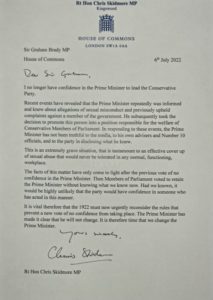
  • Chris Skidmore – 2022 Letter of No Confidence in Boris Johnson

    Chris Skidmore – 2022 Letter of No Confidence in Boris Johnson

    The letter written by Chris Skidmore, the Conservative MP for Kingswood, to Sir Graham Brady on 6 July 2022.

  • Chris Skidmore – 2021 Speech on Essay Mills

    Chris Skidmore – 2021 Speech on Essay Mills

    The speech made by Chris Skidmore, the Conservative MP for Kingswood, in the House of Commons on 10 February 2021.

    I beg to move,

    That leave be given to bring in a Bill to prohibit the operation and advertising of essay mill services; and for connected purposes.

    Companies that encourage students, researchers and even school pupils to part with money in return for work that can be passed off as their own should have no place in a modern society that recognises the power of knowledge to improve individual lives, train young people for their role in society and achieve their potential, yet in the UK those services and their operations currently remain entirely legal. It is that unacceptable feature of the British education system that my Bill seeks to change.

    These so-called essay mills are a rot that infects the very discipline of learning and has the potential to damage academic integrity beyond repair. It is sad to say that it is a rot that is spreading, not only in higher education but across all forms and levels of education, from schools to further education colleges. The online presence of essay mills and their websites, which encourage contract cheating, is all-pervasive.

    Three years ago, it was estimated that 115,000 students at UK universities were buying essays. Then, 46 vice-chancellors wrote a joint letter calling for these websites to banned. This call is now supported by Universities UK, the Russell Group, GuildHE, the Quality Assurance Agency for Higher Education and indeed most, if not all, of the higher education institutions and organisations that I have had the privilege of working with both as Universities Minister, and now as co-chair of the all-party university group. For me, the most passionate advocates of ending essay mills have been the students themselves and student unions, which have campaigned determinedly against their operation.

    For each week that passes during the covid pandemic, the situation is only growing worse. Students have been forced to study remotely from home, away from campus welfare and support, and in taking their studies and exams online, they are extremely and increasingly a prey to essay mills, of which the number has increased dramatically. The QAA has revealed today that there are at least 932 sites in operation in the UK, up from 904 in December 2020, 881 in October 2020 and 635 back in June 2018. Their increased presence is even boasted of on a website, www.uktopwriters.com, which provides a “compare the market” service.

    It is not just the number, but the nature of the threat that is expanding. Recent research published this month by Professor Thomas Lancaster and Codrin Cotarlan in the International Journal for Educational Integrity points to the extremely concerning phenomenon of students using file share websites, such as Chegg, to request exam answers in real time and to receive answers live during the course of an examination. Indeed, the number of STEM—science, technology, engineering and maths—student requests for this practice has risen by 196% over the past year.

    In this year of all years, be in no doubt that essay mills are seeking to ruthlessly take advantage of the pandemic. One site is even offering cut-price deals for essays, declaring that:

    “to help you fight these tough conditions caused by the Coronavirus outbreak, we have reduced the price of our services by up to 50 percent—grab the offer now!”

    That website proudly boasts of offering services in 21 university towns or cities in the UK, and this is the point: essay mills and their use is not an exception to the rule; essay mills are becoming normalised.

    This point was underlined in several Zoom conversations I have had in preparation for the Bill after I put out my own call for evidence to Research Fortnight. I would like to put on record my thanks to the individuals who attended these seminars on behalf of the National Union of Students: Anglia Ruskin, Loughborough, UClan and Worcester student unions; academics from the Universities of Coventry, Leeds, Northampton, Swansea, Kent and Loughborough; and organisations such as Jisc, the QAA, Prospects, Turnitin, the Scottish Funding Council and the Higher Education Funding Council for Wales.

    I heard stories of students now being recruited on campus as influencers and being paid to leaflet student halls with fliers offering essay mill services. I heard tales of students being blackmailed by these companies after having paid for essays, with threats of being reported to their universities or employers, and stories of international students being targeted on Facebook, Twitter and WhatsApp and encouraged to sign up to academic support services before they started university without even realising that what they were doing was wrong.

    Time and again in this dark underworld of essay mills and the companies that seek to make a profit out of the insecurity and desperation of students, the common theme that emerged was of exploitation. There is the exploitation of students, particularly vulnerable students under pressure to do well in their studies, and students who are the first in the family to attend university, on whom the pressure to succeed is immense. There is the exploitation of international students away from home for the first time, not to mention the exploitation of graduates abroad, who in some of the poorest countries in the world are forced to work 12-hour shifts writing essays for $1 an hour. There is also exploitation of graduates and students at home who are so desperate for extra money that they are selling their essays for £10, which in turn will be sold on for £300.

    I wish to make it clear that my Bill would not seek to criminalise students themselves for using essay mills. Instead, I propose that universities need to look at new strategies for creating second chances and educating students about their mistakes, following the example of the courageous conversations programme at the University of New South Wales, which gives students the opportunity to own their mistakes before formal investigations begin.

    Although we need to be tough on contract cheating, we must also be tough on the causes of contract cheating, which would not exist if there were not a market to exploit. Legislation to ban essay mills and their advertisement is long overdue. Australia, New Zealand, South Africa and, most recently, Ireland have already taken action to make essay mills illegal in their countries, and the Quality Assurance Agency has been in close contact with the countries that have banned essay mills to monitor the effect of the ban. The ban is already making a difference. In Australia, following legislation, the Edubirdie, EssayShark and Custom Writings websites, for instance, now all state “Our service is not available in your region”; yet, in contrast, they all still thrive in the UK.

    I know that Lord Storey has already introduced the Higher Education Cheating Services Prohibition Bill in the other place, calling for similar measures to those that I am proposing, but I recognise that the Department for Education may have specific issues with the legal text of that Bill. What I hope to achieve today is to demonstrate that there is the support of both Houses for legislation against essay mills. Indeed, my Bill is supported by: Members from all the major political parties; the Chair of the Education Committee, my right hon. Friend the Member for Harlow (Robert Halfon); the chair of the all-party parliamentary group for students, the hon. Member for Sheffield Central (Paul Blomfield); and two former Secretaries of State, including the former Education Secretary, my right hon. Friend the Member for East Hampshire (Damian Hinds).

    I say to the Minister for Universities, my hon. Friend the Member for Chippenham (Michelle Donelan), who is listening today, that I would welcome a meeting to discuss how to take forward these proposals and legislation together with the Members, students and academic experts I have assembled for this task, including Professor Michael Draper, who has helped to draft similar legislation for other countries that is now in operation. I have been grateful for the dedicated work of the professionals I have worked with. Indeed, I am grateful for the work of all those who are involved in stamping out contract cheating at universities and other education institutions, and I know that they stand ready to help the Department for Education to take forward legislation that is sorely needed.

  • Chris Skidmore – 2021 Speech on the UK Space Industry

    Chris Skidmore – 2021 Speech on the UK Space Industry

    The speech made by Chris Skidmore, the Conservative MP for Kingswood, in the House of Commons on 4 February 2021.

    My hon. Friend the Member for Morecambe and Lunesdale (David Morris) is right that three minutes is not a long time to discuss the enormous potential of the UK Space Agency but, then again, it takes only two minutes and 30 seconds for a rocket to leave the earth’s atmosphere, passing the Kármán line, and go into orbit, so Members can do better than that. I am proud to have been the UK’s Space Minister—twice actually—between 2018 and 2020. Not only is it the best job title in Government, but my daughter used to call me the “Minister for the Universe”, confusing that with my other title of Universities Minister.

    There are enormous opportunities ahead in the 2020s. As Space Minister I created the idea of the National Space Council, with the promised national space strategy that has been talked about. I also managed to deliver a record uplift in the UK’s contribution to the European Space Agency—nothing to do with the EU—of £1.9 billion a year over the next four years. However, we can and must do more. I am sure that the Minister will recognise that this role is a huge opportunity for her as well.

    Space is involved in every aspect of our lives. It is probably involved in this debate today, with satellites passing information back from various constituencies. The economic output for space in the UK is estimated to be £300 billion, rising to £340 billion by 2030. Worryingly, however, only 10% of that activity is actually UK owned. There is a huge issue of sovereignty that we need to tackle when it comes to the UK space industry. Ninety per cent. of our satellite activity is through foreign-owned satellites, so we need to look again at what we can deliver for the future.

    As for Government investment in space, yes we are doing well, but we spend roughly £500 million a year, which is a third of the French Government’s budget and half of the German budget. When it comes to a new national space strategy and the future, we need to consider a few things. First, looking at the UK Space Agency, we need to create a separate UK space delivery agency so that the Space Agency is a commissioner that pushes through projects such as horizontal launch down in Newquay. Secondly, we need to double our space budget up to £1 billion a year. We should have a national procurement fund for space worth £250 million a year and a space innovation fund worth £150 million a year. That would ensure that the UK can really be on a par with other European nations and other countries, putting the space industry right at the centre of our vision for a new global Britain.