Tag: Chris Philp

  • Chris Philp – 2022 Statement on the National Security Vetting Policy

    Chris Philp – 2022 Statement on the National Security Vetting Policy

    The statement made by Chris Philp, the Minister for the Cabinet Office and the Paymaster General, in the House of Commons on 21 October 2022.

    I am pleased to announce the introduction of a new level of national security vetting on 31 October 2022.

    Level 1B will run alongside, and in due course replace, the existing counter-terrorism check (CTC), and will allow access to sensitive materials, assets and locations, or proximity to public figures assessed to be at particular risk from national security threats, and will provide a strengthened level of assurance against these threats. The launch of level 1B follows the successful launch of the accreditation check (level 1 A) for roles in the aviation industry on 1 January 2022.

    An updated statement of the HMG personnel security and national security vetting policy, which details level 1B and updates to the appeal process, will be published within the personnel security controls on gov.uk. I have requested that a copy of the updated personnel security controls be deposited in the Libraries of both Houses.

  • Chris Philp – 2022 Comments on Rishi Sunak Becoming Prime Minister

    Chris Philp – 2022 Comments on Rishi Sunak Becoming Prime Minister

    The comments made by Chris Philp, the Conservative MP for Croydon South, on Twitter on 21 October 2022.

    After a lot of thought I’ve decided to support and nominate Rishi [Sunak] as the next PM. I think he will serve our country’s national interest very well in the months and years ahead, through globally turbulent times. I hope the party unites around whoever wins, in the national interest.

  • Chris Philp – 2022 Statement on the Economic Situation

    Chris Philp – 2022 Statement on the Economic Situation

    The statement made by Chris Philp, the Chief Secretary to the Treasury, in the House of Commons on 12 October 2022.

    The Chancellor of the Exchequer is in Washington, having meetings with the IMF, and is—[Interruption.]—which have been—[Interruption.]—routine meetings, which have been long scheduled.

    Mr Speaker

    Order. I know it is the first Wednesday back; we are all excitable. Let us have a little calm, so that I can hear the Minister. Come on, Minister.

    Chris Philp

    Thank you, Mr Speaker. They are routine meetings that have been long scheduled, and are certainly not a cause for exuberance or over-excitement from the Opposition.

    As we know, the world has faced surging energy prices since Putin’s illegal invasion of Ukraine. We have seen very high inflation across the western world, and we have seen a cycle of increasing interest rates across western economies as well—across many western economies. But let me reassure the House that the fundamentals of the United Kingdom’s economy remain resilient. Unemployment, at 3.5%, is the lowest it has been in my lifetime—and for the record, I was born in 1976. Economic growth last year, the calendar year 2021, was the highest of any G7 country—7.5%. Just yesterday the IMF forecast that economic growth—GDP growth—this current year in the UK would be at 3.6%—once again, for the second consecutive year, the highest of any G7 country. So our economy is in resilient condition.

    But I know that many families are worried about the challenges we face, and that is why, just a few weeks ago—two or three weeks ago—we introduced the energy price guarantee. Families were genuinely fearful that they might face this winter energy bills of three, four, five, six or even seven thousand pounds per year, but that energy price guarantee will ensure that the average household sees energy prices no higher than £2,500 on average—not for six months, like the Labour plan, but for two years.

    We also introduced a growth plan to get our economy growing, to see wages sustainably rising, to see good jobs created and to create a sustainable tax base to fund our public services. This Government have a growth plan; the Opposition have no plan.

    We intend to do this in a way that is fiscally responsible, and that is why—[Interruption.]—and that is why, on 31 October, in less than three weeks’ time, the Chancellor of the Exchequer will set out the medium-term fiscal plan, explaining to the House exactly how he will do that, and how we will continue the UK’s track record of having the highest growth in the G7, not just last year but this year as well.

  • Chris Philp – 2022 Statement on the Health and Social Care Levy (Repeal) Bill

    Chris Philp – 2022 Statement on the Health and Social Care Levy (Repeal) Bill

    The statement made by Chris Philp, the Chief Secretary to the Treasury, in the House of Commons on 11 October 2022.

    I beg to move, That the Bill be now read a Second time.

    Let me start by reiterating that the central and defining mission of this Government is growth. This Government are completely and unashamedly committed to achieving that objective—economic growth. However, we are not committed to it simply for its own sake or for some abstract reason; we are committed to growth because of the impact it will have in so many ways on people’s lives.

    Growth brings higher wages, bringing prosperity to our constituents. Economic growth will create new and better-paid jobs and, critically, economic growth will create a sustainable tax base that will fund public services into the future. Without strong economic growth, we cannot have well-funded health services, education and police. It is quite clear that, with economic growth, everyone benefits—not in some trickle-down sense, but because it will elevate salaries for everybody, create jobs the length and breadth of the United Kingdom, and generate the tax income that will fund our public services.

    Crucially, this growth agenda set out by the Chancellor two or three weeks ago will pursue growth in a way that is fiscally responsible, and on 31 October—in just under three weeks’ time—the Chancellor will set out in detail how that will take place, buttressed by a full scoring and forecast produced by the Office for Budget Responsibility.

    The growth plan announced by the Chancellor just a fortnight ago is crafted to achieve 2.5% growth year on year. It aims to do so in a host of different ways. First, it will do so through lower taxation, because with lower taxation we incentivise companies to invest, we incentivise people to get into work, and we encourage companies and high-potential individuals to choose to locate in the United Kingdom as opposed to somewhere else. Many successful companies, and indeed successful people, have a choice about where they locate, where they do business and where they work, and by having internationally competitive rates of personal and corporate taxation we are encouraging them to make the choice to locate in the United Kingdom, all of which improves and increases economic growth.

    There is of course more to the growth plan than just that. We are working on infrastructure—whether road, rail or energy infrastructure—and speeding up its development, as well as supporting skilled employment, removing barriers to investment, getting the housing market moving and removing obstacles, such as the recent IR35 changes that have caused difficulties for many self-employed people and contractors. Critically, the growth plan has moved at pace to help both households and businesses with the terrible crisis posed by Putin’s illegal invasion of Ukraine and its consequences for energy bills.

    Just a few weeks ago, households and businesses in the United Kingdom were faced with the realistic prospect of domestic energy bills going up to £5,000, £6,000 or even £7,000 per year. The energy price guarantee takes that possibility off the table, not just for six months but for two years, ensuring that the average household will pay no more than £2,500.

    Peter Grant (Glenrothes) (SNP)

    Does the Minister accept that, regardless of what the Government have done, my constituents can expect to pay double for their energy bills this year compared with what they paid last year?

    Chris Philp

    The energy price guarantee ensures that the average household pays no more than £2,500 a year. The hon. Gentleman is correct that that is higher than average bills this time last year, and that is why the comprehensive package was put in place earlier this year. It amounts to a further £37 billion, and ensures that households on the lower one third of incomes receive £1,200 per year, which pretty much fills the gap that he described. The energy price guarantee, combined with that £37 billion intervention, is the kind of thing we can do as a Union and as a United Kingdom. It is the kind of thing we can do together that would be so much harder apart, and that is one of the benefits of our precious Union. There is a lot more in the growth plan, but I will not labour the point because we are here to talk about the health and social care levy.

    Hywel Williams (Arfon) (PC)

    Growth in Wales has for a long time—for many decades before and after devolution—been based partly on the idea of attracting high-worth individuals to invest in Wales. The mixed result of that gives me pause for thought as to that strategy. Does it do the same for the Minister?

    Chris Philp

    We will deliver growth if we encourage people across the whole income spectrum—people doing jobs on lower incomes, those on higher incomes, businesses big and small alike. We need to encourage the entire economy, which is why tax cuts in the growth plan are broadly based, like the tax cut we are debating now. We need to encourage them all, which includes companies and people who are internationally mobile. I used to be technology Minister, and most technology businesses have a choice about where they locate. They are very internationally mobile. They could go to New York, San Francisco, Singapore—they could go anywhere in the world. We need to ensure that every part of the United Kingdom is attractive to such businesses, and the growth plan intends to create those conditions that make us attractive as a nation.

    Alex Cunningham (Stockton North) (Lab)

    The Minister seems to have mentioned everything except the need for a healthy workforce. Local authorities spend £1.2 billion every year on social care needs caused by smoking, and that will get more expensive if the Government fail to address the issue of tobacco. This morning the Health and Social Care Secretary hinted that she will do less, not more, to tackle the dangers of smoking. Will the Minister join me and press her to bring forward the tobacco control plan, to help protect the health of the nation and save health and social care costs?

    Chris Philp

    I do not think I should trespass into the realm of my right hon. Friend the Secretary of State for Health and Social Care and Deputy Prime Minister. She will make her own views and policy on that issue without intervention from me. We are ensuring that the NHS is well funded so that it can provide the treatment our constituents need. Our commitment to NHS funding is undiminished.

    Let me turn to the Bill, which repeals the health and social care levy. Members will recall that the health and social care levy was originally announced in September last year, and the Health and Social Care Levy Act 2021 received Royal Assent on 20 October last year. The levy had two phases: first, a temporary 1.25% increase for employers and employees in the current tax year; and then from April 2023 a formal surcharge of 1.25%, which would have affected not just those of working age but also those of state pension age. The Bill repeals that Act with elegant simplicity. Clause 1 states simply:

    “The Health and Social Care Levy Act 2021 is repealed.”

    James Cartlidge (South Suffolk) (Con)

    This is my first opportunity to congratulate the Chief Secretary on his appointment. What he said on the energy support for my constituents and all our constituents is very important, and I very much welcome that. However, on repealing the levy, he is of course aware that one of the most important things that it was going to fund was the welcome cap on care costs introduced by the Government, which had been promised by successive Governments with many a White Paper and many a Green Paper. How will we now pay for that?

    Chris Philp

    I thank my hon. Friend for his kind words. We are long-standing colleagues, and I look forward to working with him for many years to come. To be clear, the funding that was to be provided via the levy for both health and social care, which in the case of social care amounted to £5.4 billion over the three-year spending review period, is completely unaltered. There is no change to that funding at all.

    My hon. Friend asked about funding for social care. The funding envelope for all public services will be set out by my right hon. Friend the Chancellor on 31 October via his medium-term fiscal plan. We will ensure that we are responsible custodians of the public finances by sticking to the spending plan set out in spending review 2021. We will be disciplined about doing that. We will ensure that we generally exercise spending restraint, mindful of the fact that we cannot have public spending forever increasing at faster and faster rates. We will be disciplined about how we manage the public finances.

    I also point to economic growth. If, or rather when, we are successful in delivering the growth plan’s mission to elevate trend growth from 1.5% to 2.5%, with an extra 1% per annum over a consistent period of time—for example, five years—by the fifth year that additional growth will deliver about £47 billion of extra tax revenue, as set out in the table on page 27 of the Blue Book that accompanied the growth plan. I hope that gives my hon. Friend a hint about our thinking, but really the medium-term financial plan on 31 October will provide the most complete answer.

    Hywel Williams

    The Chief Secretary is being generous with his time. I should say that the table on page 27 shows a target, rather than anything that will stand closer examination. However, in respect of the decision to increase national insurance to pay for social policy—in England, I might add—the Welsh Government had no say whatsoever, just as they had no say in the now paused policy of scrapping the additional rate of income tax. Does the Minister not think that the Welsh Government, who are, after all, responsible for social care in Wales, warrant consultation on a fundamental matter such as this?

    Chris Philp

    I do not think that the Government in Wales complained too loudly when they were provided with extra money to fund social care in Wales. On the hon. Member’s point about page 27 of the growth plan, he is right that it is a target, but it is a target accompanied by a plan to deliver it. There is a clear path to how we will achieve the increase in growth that I referred to.

    Let me return to the repeal of the health and social care levy. To be clear, the Bill will repeal the legislation from last year, reversing the temporary increase in national insurance contributions from 6 November—in just a few weeks’ time. Additionally, it will ensure that no new levy comes into force in April 2023. Members will understand that it takes a little time for His Majesty’s Revenue and Customs and businesses to prepare their systems for such tax changes. That is why we chose 6 November as the date of implementation, but that will ensure that the extra money gets into people’s pockets as quickly as possible.

    That brings me to the rationale for why we are repealing the levy. First, it is so that people can keep more of their own money, particularly at this time when that is so critical with the cost of living. In Treasury questions earlier today, many Members on both sides of the House referred to the cost of living challenges, most of which follow from Putin’s illegal invasion of Ukraine. By reducing this tax and urgently alleviating the tax burden on our constituents, that will immediately assist with cost of living pressures. I am not saying that it will solve them, but it will certainly assist with them.

    John Glen (Salisbury) (Con)

    I, too, congratulate my right hon. Friend on his new role.

    I acknowledge the narrative of growth and the therapeutic effect of the combination of supply-side reforms and tax cuts to generate growth. My concern is the interval between his assertions today and the medium-term fiscal strategy that will be announced on 31 October, and the markets’ confidence in that interval. Today we see a welcome announcement by the International Monetary Fund on the enhancement to growth, but we also see reference to the enduring effect of inflation. We have also seen in recent weeks the effect of interest rate changes on the cost of living challenges for families up and down this country. Will my right hon. Friend please take account of the interaction of those two conflicting realities?

    Chris Philp

    I thank my hon. Friend for his question. I pay tribute to him for his extraordinary service as City Minister. I think I am right in saying that he is the longest-serving City Minister ever—I think it was four years—and, I should say, he is the best to date. I pay tribute to him for his long and distinguished service.

    My hon. Friend raised a couple of points. One was the interaction between the announcements and the OBR’s scoring. There was a desire to get the growth plan done quickly and with a sense of urgency, and the energy price guarantee was something we wanted to do straight away. Families were genuinely worried. They had huge anxiety about the prospect of facing £6,000 or £7,000 bills this winter. We wanted to take that off the table immediately. We also wanted to alleviate the tax burden that we are discussing today as quickly as we could. By doing this so quickly, assuming the Bill passes, on 6 November—in just a few weeks’ time—our constituents will be alleviated of this burden at this time of cost of living challenges.

    As companies make decisions about where to invest—in the UK or elsewhere—they can do so in the knowledge that corporation tax in the UK will remain low. That is why we acted so quickly. I do, however, recognise my hon. Friend’s point about the need for market confidence, and that is why my right hon. Friend the Chancellor announced just yesterday that the medium-term fiscal plan would be brought forward from 23 November to 31 October. He recognised exactly the point that my hon. Friend made and similar points made by my right hon. Friend the Member for Central Devon (Mel Stride), the Chair of the Treasury Committee.

    The point about inflation came up repeatedly in Treasury questions earlier. We should be clear that we are in a global interest rate up cycle. In, for example, the United States of America, base rates set by the Federal Reserve have increased by three percentage points this year—from 0.25% in January to 3.25% now. The equivalent interest rate set by the Bank of England, the base rate, has also increased, but only by two percentage points from 0.25% to 2.25%. So we have seen higher base rate increases in the USA in the year to date than we have here. As a consequence, the base rate in the USA is a full percentage point higher than in the United Kingdom, and we should keep that international context firmly in mind.

    As I explained, we are repealing the levy so that people can keep more of their own money and so that we can help with the cost of living challenges at this time as a matter of urgency on 6 November and not delay any longer. I and the Chancellor think it is also important to boost incentives to work. We want to make sure that working is as attractive as possible and, by lowering the taxes on work, I believe that we will do that.

    Steve Brine (Winchester) (Con)

    I add my voice to those who have welcomed my right hon. Friend to his role. I think he will do a good job.

    Here is what is worrying me. Yes, we want work to pay, but we also want work to be available. There are lots of vacancies in the labour market, but there are also labour shortages. Lots of people, as we have heard today, are economically inactive, many of them because they are on the NHS waiting list. As my right hon. Friend the Chief Secretary will know, the first part of the levy was to fund the catch-up programme. I was in my local hospital on Friday to see how we are getting on with the catch-up programme. We are still waiting for news of our elective hub at the Royal Hampshire County Hospital in Winchester, which would help with the catch-up and get people back into the workforce. Is that affected by my voting for this repeal today?

    Chris Philp

    I can categorically assure my hon. Friend that that is not affected. The £8 billion that was allocated over the spending review period to catch up on the elective backlog is completely unchanged by this measure, and the funding for social care—£5.4 billion over three years—is also unaffected. The rest of the money, because that is not all of it, will continue to be available to the Department of Health and Social Care to spend on the NHS and social care precisely as was intended. As a result of repealing the Health and Social Care Levy Act 2021, not a single penny less will go to social care or the NHS, or in particular the elective programme that he refers to. I cannot answer on Winchester hospital, but I am sure that the Health Secretary would be delighted to discuss that with him.

    My hon. Friend also made a good point about vacancies. We have a lot of vacancies in the economy. Earlier this year, I believe for the first time in history, there were more vacancies than there were people in unemployment. If we are keen to tackle poverty and help people into a more prosperous future, getting them off benefits and into work is clearly the answer.

    Karin Smyth (Bristol South) (Lab)

    To follow on from the former Health Minister, the hon. Member for Winchester (Steve Brine), if it is true that the levy was essentially not needed for the social care reforms and the catch-up, and that everything is still staying, will the Minister tell us what advice he has had from the DHSC about what it will not do now that, presumably, there is less money for the other things that it was going to do?

    Chris Philp

    The funding provided by the Treasury to the DHSC is completely unchanged as a result of the reversal of the NIC increase. That applies both to the money that was essentially hypothecated to the DHSC and its other budget. It is completely unaffected, so we are not moving money from one part of the health service budget to backfill something else. The complete health service budget is unchanged. There is not a penny less for the health service in any way as a result of the changes, but we are changing the way we fund the expenditure. Instead of funding it from the health and social care levy, it will be funded differently, partly by general taxation and other means, which will be set out in the medium-term fiscal plan. However, not a single penny less will go to the health service as a result of this change.

    Several hon. Members rose—

    Chris Philp

    I am spoilt for choice; I will start with my hon. Friend the Member for South Suffolk (James Cartlidge).

    James Cartlidge

    I am lucky to have a second intervention already. I know that as a former businessman, the Minister cares passionately about growth, and I respect that. However, as a businessman, he must also know that the single most important factor for business is confidence and stability. When we speak to businesses at the moment, we hear that they are worried about the lack of stability. They want certainty and confidence. He needs to explain the basic question about the £17 billion of revenue from the levy to fund social care and the NHS. If the levy is going, surely that implies that borrowing fills the gap or some other change fiscally. Is it the case that that will be confirmed on the 31st?

    Chris Philp

    Yes, it is. My hon. Friend is asking entirely reasonable questions, but we have to look at this issue in the round across the entirety of public expenditure. The Chancellor will set that out in detail on 31 October to the House, accompanied by the OBR scoring.

    Alex Cunningham

    The hon. Member for South Suffolk (James Cartlidge) has made this point: if £17 billion is being removed from the Exchequer, how can we have all that extra spending on the NHS and on social care if there is no additional taxation?

    Chris Philp

    As I pointed out, we will set that out on the 31st. The Chancellor has a number of measures in mind to make sure, over the medium term, that this is fully funded, and critically, so that we can do this and the other things in the growth plan—this is obviously only one measure among many—to make sure that we get debt falling as a proportion of GDP. Hon. Members are asking entirely reasonable questions, but the point of the medium-term fiscal plan, and the details that will accompany it on 31 October, is to answer precisely those questions.

    Let me set out the benefits that the move will confer on employees earning more than £12,570 and self-employed people earning more than £11,909. The average saving for people in work who are earning more than those thresholds will be approximately £330 next year. Combined with the increase in the threshold that took effect last July, the saving for the average worker earning above those thresholds will be £500 next year. That will clearly be welcome at a time of economic challenge. Moreover, almost a million businesses—920,000—will get an average tax cut of just a shade under £10,000 next year: £9,600, to be precise. That will be very welcome indeed.

    It is worth being clear that the increase in the threshold that was put through a few months ago means that people on lower incomes pay very little in national insurance or income tax these days. I am sure that Members of this House who want to see the burden of taxation made as light as possible, particularly for those with lower incomes, will strongly welcome the increase in the threshold. It follows the very substantial increases in the income tax threshold over the past 12 years, from about £6,500 back in 2010 to £12,500 today, which have lifted people on the lowest incomes out of national insurance and out of income tax entirely.

    I have already made the point that the reversal of the levy is part of a much wider plan. Over the coming days and weeks, my colleagues the Secretaries of State for various Departments will announce further supply-side measures to stimulate growth in our economy, including by making the planning system faster, making sure that business regulations are not unduly onerous, improving childcare, addressing questions concerned with immigration and agricultural productivity, and improving digital infrastructure. As I have said, we will do so in a way that makes sure that debt over GDP falls over the medium term.

    Alex Cunningham

    Will the Chief Secretary give way?

    Chris Philp

    I was about to finish, but as the hon. Member is an old friend, I will give way one last time.

    Alex Cunningham

    I am grateful; I enjoyed my time dealing with justice issues opposite the right hon. Member. Twelve years ago, one of his predecessors—a Lib Dem, in fact—cancelled the new hospital for Stockton. The need for one is far greater than ever and the Chief Secretary seems very capable of splashing the cash, so will he finally approve funding for a new hospital in Stockton?

    Chris Philp

    The Government have a commitment, which we stand by, to build I think 40 new hospitals in the coming years. Of course, the details of that programme are in the hands of my right hon. Friend the Secretary of State for Health and Social Care. I am sure she would be happy to discuss a hospital for Stockton with the hon. Member, who is an eloquent advocate for his home town, as ever.

    Making sure that we act in a fiscally responsible way is a responsibility that falls partly on me as Chief Secretary. I have already said that we intend to stick to the limits set out a year ago in the comprehensive spending review—a three-year spending review, of which we are in the first year. We will exercise restraint in public expenditure, because we simply cannot have a state that continues to consume ever larger proportions of national income. Of course we need to make sure that public services are properly funded, but we need to do so in a way that does not impose excessively onerous burdens on taxpayers—our constituents who work hard day in, day out to earn a living and pay their taxes.

    Growing our economy is our central and defining mission. The United Kingdom needs a Government who are wholeheartedly and unequivocally committed to economic growth. We stand committed to growth in a way that the anti-growth coalition arrayed against us does not. This Government have a very clear growth plan. The reversal of the levy and of the temporary national insurance increase is an important part of that growth plan, which is at the heart of this Government’s mission. I commend the Bill to the House.
  • Chris Philp – 2022 Statement on the Foreign Interference Offence

    Chris Philp – 2022 Statement on the Foreign Interference Offence

    The statement made by Chris Philp, the Parliamentary Under-Secretary of State for Digital, Culture, Media and Sport, in the House of Commons on 6 July 2022.

    This is a joint statement with the Home Office.

    Some states seek to further their strategic interests by going beyond overt political influence towards more covert influencing activity. These ‘interference’ activities are typically not conducted transparently and are outside the norms of diplomacy. Some hostile actors from foreign states use covert and malign political interference activities to undermine the UK’s interests, such as using disinformation to manipulate our political debate or weaken the integrity of our democratic institutions.

    The UK has a strong record of responding robustly to state threats, in collaboration with our international partners. Alongside our existing operational response and the current disinformation provisions in the Online Safety Bill, the Government have also introduced the National Security Bill to Parliament. This Bill brings together vital new measures to protect the British public, modernise counter-espionage laws and address the evolving threat to our national security, including by introducing a new foreign interference offence which will capture a number of state-sponsored disinformation efforts.

    This offence will target malign activity carried out for, on behalf of, or with the intention to benefit, a foreign power. This includes foreign interference intended to manipulate public discourse, discredit the political system, and undermine the safety or interests of the UK, with state-sponsored disinformation being a prime technique for attempting this kind of interference.

    While the National Security Bill will seek to disrupt and deter foreign actors engaging in disinformation campaigns against the UK, it is important that our information environment is also protected from those who would seek to interfere in UK society by exploiting social media platforms and manipulating online spaces towards the objectives of state actors. That is why the Government are going further to address concerns about the threat posed by state-sponsored disinformation by linking the offence of foreign interference in the National Security Bill to duties in the Online Safety Bill. The Security Minister, Damian Hinds MP, has tabled an amendment to the National Security Bill which, if passed, will designate the offence of foreign interference as a “priority offence” in Schedule 7 to the Online Safety Bill.

    This amendment will mean that online platforms need to act against foreign interference in line with their safety duties on illegal content, where it meets all three limbs of the foreign interference offence. These are as follows:

    a person engages in conduct for, on behalf of, or with intent to benefit a foreign power;

    the conduct is intended to interfere in the exercise of rights, manipulate the way people use public services or participate in political and legal processes in the UK, or prejudice the UK’s safety or interests;

    the conduct constitutes an offence, involves coercion of any kind, or involves making a misrepresentation for example, is a representation that a reasonable person would consider false or misleading. This includes information which is true but presented in a way which is misleading.

    These three tests will capture state-sponsored disinformation that is of most concern: covert attempts by foreign state actors to manipulate our information environment to interfere in UK society and undermine our democratic, political and legal processes. For example, material spread by foreign state entities via fake accounts pretending to be real UK users to influence discussions about the future of the Union. Other examples of online content and activity that would be covered by the new offence, and for which platforms in scope of the Bill would have illegal content duties, could include:

    Russian attempts to use disinformation to interfere in future UK elections.

    Attempts by state actors to use disinformation to manipulate the legal processes of the UK, such as court proceedings.

    The use of false profiles by state actors to spread hacked information online to undermine UK democratic institutions.

    This amendment will force companies to take action on a wider range of state-sponsored disinformation and state-linked platform manipulation than they would have to under the Online Safety Bill as it is currently drafted. Should the amendment pass, the offence will be listed as a priority offence, meaning companies will be required proactively to put in place proportionate systems and processes to prevent individuals from encountering content that amounts to this offence, minimising the length of time it is on their service and removing any illegal content on user-to-user services once they become aware of it. They will also need to consider how their design, functionality and algorithms might impact these efforts.

    In the context of the foreign interference offence, this could include measures to ensure that platform manipulation—such as misleading users about the ownership of an account, or artificially co-ordinated messaging campaigns—is more difficult, thus mitigating the risk of platform manipulation and disinformation more broadly. We have seen a number of successful efforts by service providers to disrupt state-linked disinformation and hostile influence operations relating to Ukraine on their platforms. We see this amendment building on platforms’ existing work to ensure systems and processes are in place so that these safeguards can be applied more widely and consistently when it comes to online interference aimed at the UK.

    Like other offences in scope of the Bill, companies would have to assess whether content amounts to foreign interference. Assessment of foreign interference activity could include judgements based on patterns of behaviours and tactics used, and contextual judgments about the intended effect of the content, which may be aided by relevant knowledge of the political and geopolitical context. In particular, we would expect platforms to consider whether repeated and persistent conduct from particular users or accounts might meet the offence. To help platforms in carrying out this duty, companies will also be able to draw on Ofcom’s codes of practice and any supplementary guidance.

    Our approach is a proportionate and effective way to address the threat posed by state-sponsored disinformation while still protecting freedom of expression in the UK. Both Ofcom and in-scope companies will have duties relating to freedom of expression, for which they can be held to account. There are already journalistic protections in the Online Safety Bill which address concerns about media freedom. News publishers’ content on their own sites is not in scope of the Bill and recognised news publishers’ content shared on these platforms will also be exempt from companies’ safety duties. There will also be duties on category 1 companies to protect journalistic content and content of democratic importance.

    It is incumbent on us to safeguard our democracy and society from manipulation by state actors online while also retaining the rightful protections for freedom of expression and media freedoms. The proportionate approach I have set out here tackles the most concerning state-sponsored disinformation activity while striking a balance with freedom of expression.

  • Chris Philp – 2022 Letter of Resignation as Technology and Digital Economy Minister

    Chris Philp – 2022 Letter of Resignation as Technology and Digital Economy Minister

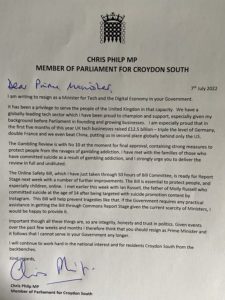
    The letter of resignation sent by Chris Philp, the Minister for Technology and the Digital Economy, on 7 July 2022.

  • Chris Philp – 2022 Statement on the UK’s Digital Strategy

    Chris Philp – 2022 Statement on the UK’s Digital Strategy

    The statement made by Chris Philp, the Parliamentary Under-Secretary of State for Digital, Culture, Media and Sport, in the House of Commons on 13 June 2022.

    I am pleased to lay before the House the UK’s Digital Strategy, a wide-reaching and inclusive statement of the Government’s vision for the future of the UK’s digital economy. The digital strategy harnesses our strengths in knowledge and R&D-intensive industries to further our position as a global science and technology superpower, and support the UK’s future prosperity and security.

    This is a cross-Government strategy which aims to bring cohesion to the various important digital policies being driven by different parts of Government. Bringing these initiatives together in one place enables us to take the Government’s vision of the digital economy and turn it into reality by exploring new technological frontiers and delivering tech innovation on a scale the country has not previously seen.

    This Government champion the UK as a global hub for digital talent and growth. Data suggests that, last year, a new UK unicorn was created every 11 and a half days, with £27.4 billion of private capital flowing into UK tech in 2021. That is more than any other European country. We are committed to continuing to support our fantastic venture capital investment initiatives such as the enterprise investment scheme and the seed investment scheme to ensure that UK companies continue to grow and raise capital to scale up.

    The UK is presented with an important opportunity to draw on our position as a world leader in emerging fields such as AI, advanced semiconductor design and quantum computing to become a force for digital good on the global stage. The digital strategy makes clear our intention to work toward a global consensus with like-minded partners and allies to shape a system of digital standards and trade that enables UK businesses to innovate and thrive. We have the opportunity to build on our status as a science and technology superpower, to take advantage of our regulatory freedom, and to champion the dynamic businesses and start-ups that have helped make Britain a focal point for digital skills and innovation.

    As well as championing the UK as a global digital hub, the Government also recognise the power of digital technology to transform our own economy, boost jobs and help to level up regions across the UK. Britain’s digital might has given us the flexibility to adapt to unprecedented challenges, such as the covid-19 pandemic, and will be vital in our fight against climate change. Indeed, the UK’s economic future, our security, our standard of living and our place in the world are all reliant on our continued success in digital technology. We can take steps now to futureproof our economy, to invest in developing world-class expertise, to build our evidence base, to boost innovation, to grow employment opportunities across the UK and to strengthen transnational ties.

    The future of our economy, of UK jobs, of every region of the country, is digital. Over 80% of all jobs advertised require digital skills, and the rate of tech gross value added has grown on average by 7% per year since 2016. It is vital that we equip businesses and citizens with the skills and tools they need to navigate this rapid change. That means not only rolling out world-class digital infrastructure across the UK, but also ensuring that the benefits of the digital economy are felt by all members of society.

    A copy of the UK Digital Strategy will be placed in the Libraries of both Houses.

  • Chris Philp – 2022 Statement on Online Safety and Cyberflashing Offences

    Chris Philp – 2022 Statement on Online Safety and Cyberflashing Offences

    The statement made by Chris Philp, the Parliamentary Under-Secretary of State for Digital, Culture, Media and Sport, in the House of Commons on 14 March 2022.

    I wish to inform the House that the Government are legislating through the Online Safety Bill to create an offence related to the behaviour known as cyberflashing.

    It is important that we effectively criminalise this behaviour, which usually involves a person sending an unsolicited photograph or film of genitals—be it their own or another person’s—to another person or persons. Photographs and films can be sent in a variety of ways, including on peer-to-peer platforms, on dating or meeting apps, and social media. The recipients of such unsolicited images can experience significant humiliation, alarm, or distress.

    The Government plan to implement the Law Commission’s recommendation for how this offence should be constructed as laid out in the Law Commission’s “Modernising Communications Offences” report, published in July 2021. This will involve inserting a new section 66A into the Sexual Offences Act 2003 to create a new criminal offence of intentionally sending or giving a photograph or film of any person’s genitals to another person with the intention that that person will see the genitals and be caused alarm, distress or humiliation, or for the purpose of obtaining sexual gratification and reckless as to whether the recipient will be caused alarm, distress or humiliation.

    We hope it will address increasing public concern expressed about behaviour of non-consensual sending of images of genitals, especially over electronic networks, and the harms associated.

    I would like to express my sincere thanks for all the work that the Commission has carried out as part of this review over the past four years.

  • Chris Philp – 2022 Statement on Online Advertising

    Chris Philp – 2022 Statement on Online Advertising

    The statement made by Chris Philp, the Parliamentary Under-Secretary of State for Digital, Culture, Media and Sport, in the House of Commons on 9 March 2022.

    I am today, along with my right hon. Friend the Minister of State for Security and Borders (Damian Hinds), announcing a package of work regarding the regulation of online advertising.

    Recognising the devastating impact of scam adverts on people in the UK and the need for immediate action, the Government will be making a change to the Online Safety Bill to require the largest online platforms and search services to implement proportionate systems to prevent the publication of fraudulent adverts on their service.

    This change responds directly to calls from the Online Safety Bill Joint Committee, the Treasury Select Committee and the Work and Pensions Select Committee, as well as others, who recommended that the Online Safety Bill be used to combat online fraudulent advertising.

    The new duty will apply to the services that are designated as category 1 and 2A services: the largest user-to-user and search services. This will ensure that people using the largest platforms and where there is greatest risk of harm are protected from scams, and ensure these services do not profit from illegal activity. Ofcom will create and publish specific codes of practice that will set out how services can comply with the new duty.

    In addition, the Government will publish a consultation on the Online Advertising Programme, to seek views on a range of options for regulatory reform to improve transparency and accountability across the online advertising supply chain. Led by my colleague, Julia Lopez MP, the Minister for Media, Data and Digital Infrastructure, the aim of the programme is to create a more holistic approach to regulating online advertising that builds trust and tackles the underlying drivers of harm in online advertising.

    In relation to fraud specifically, the Online Advertising Programme will address whether other actors in the supply chain, such as intermediaries, have the power and capability to do more. It will focus on the role of intermediaries in onboarding criminal advertisers and facilitating the dissemination of fraudulent content through using the targeting tools available in the open display market. This will ensure that we close down any vulnerabilities and add defences across the supply chain, leaving no space for criminals to profit.

    The Online Advertising Programme’s wider objective is to determine whether the current regulatory regime is sufficiently equipped to tackle the challenges posed by the rapid technological developments in online advertising. The consultation identifies a broad range of both illegal and legal harms to consumers, including misleading and offensive content, as well as fraudulent adverts. It also looks at the impact of targeting and placement of adverts and how these practices can exacerbate harmful content for consumers. The roles and responsibilities of all actors involved in the supply chain of online advertising will be considered as part of the consultation.

    Any subsequent changes to regulation of online advertising as a result of the consultation will build on the fraud-specific duties in the Online Safety Bill. This will ensure a coherent, comprehensive regulatory framework for all actors across the online advertising supply chain, where individuals are protected from harmful online advertising content, wherever they encounter this.

    Together, the Online Safety Bill and Online Advertising Programme will complement the Government’s wider reforms on competition, data protection and user-generated content, ensuring that the online advertising market—which is at the heart of our digital economy—protects consumers and users while continuing to thrive.

  • Chris Philp – 2022 Statement on Online Safety

    Chris Philp – 2022 Statement on Online Safety

    The statement made by Chris Philp, the Parliamentary Under-Secretary of State for Digital, Culture, Media and Sport, in the House of Commons on 25 February 2022.

    The Government recognise the impact that online abuse, including anonymous abuse, has on people and their online experience. Too many people experience online abuse and protecting users is a priority for this Government.

    The Online Safety Bill introduces vital new protections from online abuse. The legislation will require all companies in scope to manage the risk of criminal abuse effectively, including anonymous abuse, on user-to-user services. Companies will need to assess the functionality of anonymous and pseudonymous profiles and the role they play in allowing illegal abuse and mitigate the risk associated with such functionality.

    All services likely to be accessed by children will also have to put in place appropriate measures to protect children from cyber-bullying and other forms of abuse, whether anonymous or not.

    Category 1 companies—those which are high risk and high reach—will also have to set out clearly what abusive content they accept on their platform for adults and have effective systems in place to enforce their terms and conditions.

    The Government recognise concerns that have been raised by the Joint Committee during pre-legislative scrutiny of the Bill, alongside the Digital, Culture, Media and Sport Committee, the Petitions Committee and others regarding the impact of online abuse and ensuring users have more control over whom they interact with online, while protecting the right of individuals to be anonymous if they choose. We thank the committees and campaigners for their scrutiny of the Online Safety Bill.

    As a result, I am pleased to announce that we will strengthen the duties in the Online Safety Bill by adding two new additional duties on category 1 companies to provide adults with optional user verification and user empowerment tools.

    The user verification duty will require category 1 companies to provide their adult users with an option to verify their identity. Ofcom will set out in guidance how companies can fulfil this new duty and the verification options companies could use. In developing this guidance, Ofcom must ensure that the possible verification measures are accessible to vulnerable users and consult the Information Commissioner, as well as vulnerable adult users and technical experts.

    The user empowerment tools duty will require category 1 companies to provide tools to give adults more control over whom they interact with and the legal content they see. Under the proposed new duty, for harmful content that category 1 companies do allow, they would have to provide users with the tools to control what types of harmful content they see. This could include, for example, content on the discussion of self-harm recovery which may be tolerated on a category 1 service but which a particular user may not want to see.

    In addition to the existing provisions in the Bill, the new duties will help provide robust protections for adults, including vulnerable adults, while protecting freedom of expression online.