Tag: 2022

  • PRESS RELEASE : Peter Robinson in no position to lecture given the strategic errors made under his leadership – Steve Aiken [October 2022]

    PRESS RELEASE : Peter Robinson in no position to lecture given the strategic errors made under his leadership – Steve Aiken [October 2022]

    The press release issued by the Ulster Unionists on 27 October 2022.

    Responding to comments made by former DUP leader, Peter Robinson, Steve Aiken OBE MLA, said:

    “I noted Peter Robinson`s comments about the Ulster Unionist Party.

    “It`s time to set the record straight about how unionism got into the position it is in today. Unlike the DUP, the Ulster Unionist Party has always opposed the Protocol. When Boris Johnson first published his proposals for an amended protocol on 2 October 2019 which stated that ‘the proposal set out in this note would see regulatory checks applying between Great Britain and Northern Ireland’ and ‘Agri foods entering Northern Ireland from Great Britain would do so via a Border Inspection Post or Designated Point of entry as required by EU law’, the then DUP leader Arlene Foster welcomed them as ‘a serious and sensible way forward.’

    In contrast, on the 2 October 2019, the then UUP leader, Robin Swann MLA, stated that ‘this new protocol should be deeply concerning for all those who have the long term economic and constitutional welfare of Northern Ireland and its people at heart.’

    “I warned the DUP on 3 October 2019 that they were ‘playing Russian roulette with the future of the United Kingdom.’ Yet the DUP ploughed on regardless.

    “In an interview with BBC`s Spotlight programme on 2 March 2020, Sir Jeffrey Donaldson MP said, ‘in the end customs checks doesn’t mean that you change the constitutional status of a part of the United Kingdom, that’s not going to happen.’

    “Then in an interview with BBC Good Morning Ulster on 27 May 2020, when Edwin Poots was asked by Chris Buckler, ‘Do you think that has the potential of damaging trade or do you think that there are opportunities with what is to come? With this ability to trade with the EU as well?’, Edwin Poots` response was to say, ‘we need to maximise the advantages and to minimize the disadvantages.’

    “The DUP`s fingerprints were all over the Protocol whilst our record in opposition to it has been consistent since the day it was published. I welcome the fact that they had a road to Damascus conversion and have come over to our way of thinking. The Ulster Unionist Party said the Protocol was a bad deal from the very start and we brought forward alternatives and solutions to the break the impasse, some of which were included in the UK Government`s Command Paper from July 2021 and form the basis of the potential landing zone for negotiations.

    “Whilst we have common ground with the DUP`s latest position on the Protocol, in opposition to it, where we differ is tactics. We have brought forward alternatives, we have engaged with the UK Government, EU, Irish Government and US State Department, and believe that negotiations are the best way forward. The DUP have brought down Stormont. I don`t think that it is in the best interests of the people of Northern Ireland in the face of a cost-of-living crisis nor for the long-term benefit of Unionism.

    “It is ironic that Peter Robinson is now stepping forward to give advice to the DUP. It was under his leadership that the Belfast Agreement was changed at St Andrews, amending the way in which the First and deputy First Ministers are elected in the Assembly. If those changes hadn`t been made, a DUP MLA would today be First Minister designate, not Michelle O`Neill. And that is down to the DUP. Peter Robinson is in no position to lecture the Ulster Unionist Party given the huge strategic errors made whilst he was leader of the DUP which have harmed unionism in the long run.”

  • Doug Beattie – 2022 Statement Rejecting Joint Authority in Northern Ireland

    Doug Beattie – 2022 Statement Rejecting Joint Authority in Northern Ireland

    The statement made by Doug Beattie, the Leader of the Ulster Unionists, on 26 October 2022.

    The Ulster Unionist Party has already very firmly rejected the notion of Joint Authority between London and Dublin in Northern Ireland.

    As Unionists we are clear that only the United Kingdom has the right to exercise sovereignty over Northern Ireland.

    We would advise anyone seeking the imposition of Joint Authority to read the Belfast Agreement, especially the section ‘Constitutional Issues’ where it states that ‘it would be wrong to make any change in the status of Northern Ireland save with the consent of a majority of its people.’

    Joint Authority would clearly be a massive change in our constitutional status.

    The Belfast Agreement has already been damaged by the NI Protocol and the imposition of a border in the Irish Sea between Northern Ireland and the rest of the United Kingdom. Clearly any attempt to impose some form of Joint Authority between London and Dublin on Northern Ireland would run contrary to that, breach the Principle of Consent and deal a fatal blow to the Belfast Agreement.

    We need to focus our efforts on getting Stormont back up and running again and working the Belfast Agreement. That is what Northern Ireland needs right now.

  • Doug Beattie – 2022 Comments on Joint Authority in Northern Ireland

    Doug Beattie – 2022 Comments on Joint Authority in Northern Ireland

    The comments made by Doug Beattie, the Leader of the Ulster Unionists, on 25 October 2022.

    The Ulster Unionist Party wants to see the restoration of devolved government at Stormont.

    One of the key reasons this party supported the Belfast Agreement in 1998 was to ensure the replacement of the 1985 Anglo-Irish Agreement which permitted Dublin to have a consultative role in the affairs of Northern Ireland.

    In the section ‘Constitutional Issues’ the Belfast Agreement recognised ‘it would be wrong to make any change in the status of Northern Ireland save with the consent of a majority of its people.’

    Clearly any attempt to impose some form of Joint Authority between London and Dublin on Northern Ireland would run contrary to that and be another very serious breach of the Belfast Agreement.

    We need to focus our efforts on getting Stormont back up and running again so that locally elected politicians, with local knowledge and an understanding of this place and who are therefore best placed to make decisions affecting the lives of people here, can get on with that job. That is what Northern Ireland needs right now, not any talk of Joint Authority.

  • Doug Beattie – 2022 Statement on Rishi Sunak Becoming Prime Minister

    Doug Beattie – 2022 Statement on Rishi Sunak Becoming Prime Minister

    The statement made by Doug Beattie, the Leader of the Ulster Unionist Party, on 24 October 2022.

    I congratulate Rishi Sunak on becoming leader of the Conservative Party and the next Prime Minister of the United Kingdom. The United Kingdom is desperate for a strong and stable Government which will focus on doing what`s right for all four corners of our Nation.

    Northern Ireland needs better Government and that means the restoration of the devolved institutions. One of the new Prime Minister`s priorities must be resolving the political impasse and dealing with the issues caused by the Northern Ireland Protocol. Northern Ireland cannot continue to be used as political football between the United Kingdom and the EU. The Protocol must be replaced with a deal that works for everyone. There should be no checks on goods moving between Great Britain and Northern Ireland that are staying here. Everyone knows what needs to be done and now is the time to be getting on with it.

    If there is another Assembly election, the Ulster Unionist Party will be ready to fight it. However an election will do absolutely nothing to deal with the foremost challenges facing Northern Ireland. An election won`t deal with the Protocol and it won`t provide an easier path to the restoration of an Assembly and an Executive. It will only cause the trenches to be dug deeper and make the path to political progress even more difficult. The Prime Minister should use the next few days to reflect and consult on what is the best way forward for Northern Ireland. Too many decisions have been taken in the past which destabilise this part of the United Kingdom rather than helping its people.

  • PRESS RELEASE : DfI maligns and ignores 100,000 motorcyclists – Ian Paisley [October 2022]

    PRESS RELEASE : DfI maligns and ignores 100,000 motorcyclists – Ian Paisley [October 2022]

    The press release issued by the DUP on 28 October 2022.

    North Antrim MP Ian Paisley has accused the Department for Infrastructure of continuing to malign and ignore 100,000 motorcyclists in Northern Ireland. He called on them to use proper data so that motorcycling is not presented as being more dangerous than it is.

    His comments follow the recently published the consultation outcome report on the New Road Safety Strategy for Northern Ireland to 2030.

    The DUP MP is chair of the APPG on Motorcycling in Parliament and he said, “This latest report suggests that motorcyclists suffered a 36% increase in KSI collisions per 100 million kilometres travelled in 2021. That level of increase not only lacks credibility, but would suggest that motorcycling in Northern Ireland is grossly more hazardous than in Great Britain.

    I know that the Motorcycle Action Group (MAG) have pointed out flaws in the DfI statistics in the past and how data is collected, using a small questionnaire sample rather than real-world traffic data which is used by the Department for Transport in Great Britain. The Department is maligning motorcycling as being significantly more hazardous than it is.

    Not content with maligning motorcycling, it then ignores the 100,000 motorcyclists in Northern Ireland. Whilst painting it as grossly unsafe, the Department and the outgoing Minister refused to introduce any measures to improve safety. The suggestion was made of an Enhanced Rider Scheme as happens in Great Britain. This was rejected yet the draft Road Safety Review lays out plans to introduce training for safer tractor driving, cycling and for newly qualified drivers. Virtually every road using group is provided for with the sole exception of motorcyclists

    This report was quietly released in the last few days, presumably in the knowledge that it would receive little scrutiny. It will not be ignored by anyone involved in motorcycling however and it certainly is an issue that I intend to pursue with the Department.”

  • Diane Forsythe – 2022 Statement on Desecration of War Memorials

    Diane Forsythe – 2022 Statement on Desecration of War Memorials

    The statement made by Diane Forsythe, the DUP MLA for South Down, on 28 October 2022.

    This year we unveiled the VC statue in Kilkeel, such was the fear of attack a local organisation installed CCTV. Only this week, the war memorial and service memorial have been attacked twice. This is vile. For anyone to wreck the wreaths and be urinating on the memorial is grotesquely offensive.

    I am calling for political leadership from all parties in South Down for the arrest and prosecution of those causing criminal damage to the war memorial and I also want to see a more proactive policing operation to ensure the people who feel this is acceptable are brought before the courts.

    There is no place for such intolerance in Kilkeel.

  • Diane Dodds – 2022 Statement on Power Sharing in Northern Ireland

    Diane Dodds – 2022 Statement on Power Sharing in Northern Ireland

    The statement made by Diane Dodds, the DUP MLA for Upper Bann on 27 October 2022.

    The recall of the NI Assembly by Sinn Fein was a stunt rather than any serious attempt to restore powersharing. If those who petitioned the Assembly sitting truly wanted to restore fully functioning devolved government, they would have joined us in campaigning for the Protocol to be replaced by arrangements that unionists can support. Progress is only made with the support of unionists and nationalists.

    The Protocol has polluted every area of government:

    •  As we try to fix our NHS, the Protocol is jeopardising the supply of medicines to Northern Ireland.
    • As we try to improve our infrastructure, the Protocol has triggered a costly 25% tariff on the steel used to build our schools, roads, hospitals, and houses.
    • As we try to help people with the cost of living, the Protocol is driving up transport costs and the prices on our shelves.
    • As we encourage people to install green energy, Treasury tax breaks are not available in Northern Ireland because of the Protocol.

    Devolution can only flourish when there is a solid foundation with cross-community support. We want to see fully functioning devolved government restored in Stormont but that can only happen when the Protocol is replaced by arrangements that unionists can support.

  • PRESS RELEASE : Alliance Party dancing to SF’s tune – Phillip Brett [October 2022]

    PRESS RELEASE : Alliance Party dancing to SF’s tune – Phillip Brett [October 2022]

    The press release issued by the DUP on 27 October 2022.

    DUP North Belfast MLA Phillip Brett has challenged the Alliance Party over why they refused to participate in a recall of the NI Assembly for three years when Sinn Fein was protesting about the Irish language yet now they want an Executive without unionists.

    Mr Brett said:

    “We want to see fully functioning devolved government, but we are facing an election because the Protocol has not been dealt with. Despite lengthy discussions, London and Brussels have so far failed to replace the Protocol with arrangements that Unionists can support. Devolution needs stable foundations with the support of unionists and nationalists.

    When SF blocked devolution for three years, we sought to recall the Assembly, not only did the Alliance Party not support our recalls, but they also didn’t even turn up to the sittings.

    The Alliance Party now tell us they want majority rule and a devolved government without unionists yet when Sinn Fein was blocking devolution, there was no such call.

    Why the two-tier approach? Why is the Alliance Party dancing to Sinn Fein’s tune? One approach to the DUP and another approach to Sinn Fein. There were all kinds of pressures in hospitals and schools for those 1044 days, yet never once did the Alliance Party even attempt to stand up to Sinn Fein.”

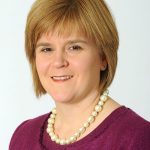
  • Nicola Sturgeon – 2022 Article on How Scotland “Can Do Better”

    Nicola Sturgeon – 2022 Article on How Scotland “Can Do Better”

    The article written by Nicola Sturgeon, the Scottish First Minister, on 27 October 2022.

    Here we are again – watching, with a depressing sense of deja vu, utter chaos reign at Westminster.

    It’s hard to believe that it is just two months ago that I wrote about the Tory leadership election that followed the resignation of Boris Johnson.

    I said then that if the people of Scotland had been given a say, it was almost certain we would have chosen neither Liz Truss nor Rishi Sunak to be Prime Minister.

    As it happened, the tiny number of Tory party members who did get a say chose Liz Truss.

    And the rest, as they say, is history.

    Within two weeks of her appointment, the new Prime Minister’s disastrous policy of tax cuts for the richest had crashed the economy, sent mortgage rates soaring, and brought pension funds to the brink of collapse.

    All of it heaped even more misery on people who are already struggling with the cost of living crisis.

    There is no doubt that the mess the UK is now in is the fault of the Tory party – but it is people and businesses who are paying the price of their incompetence.

    People are struggling to pay mortgages, heat their homes, buy food, and pay bills. More and more are being forced into abject poverty.

    Indeed, all that Liz Truss achieved in her short tenure as Prime Minister was to make an already difficult cost of living crisis so much worse.

    Unfortunately for her – and more importantly the country – that will be the dreadful legacy of her short period in office.

    But the circus has already moved on. Rishi Sunak is now in Downing Street, the fifth Prime Minister in my time as First Minister.

    And yet again, he’s a Tory politician that Scotland didn’t vote for, and doesn’t want.

    For Scotland, a new Prime Minister does nothing to solve the fundamental democratic problem we face.

    Scotland hasn’t voted Tory since the 1950s, and yet time and again, we have to put up with governments we don’t vote for.

    The bottom line is that Scottish votes don’t decide the outcome of UK elections.

    So for as long as Scotland is part of a broken Westminster system, we will always be vulnerable to getting governments we don’t vote for, implementing policies that do real damage to our country.

    Indeed, as the news of Liz Truss’s resignation started to emerge, I was chairing a summit of energy companies, advice organisations, and anti-poverty campaigners to discuss what more can be done to tackle high energy bills.

    Unfortunately – as is so often the case – Westminster decisions are making that more difficult.

    For example, the curtailing of the Energy Price Guarantee by the new Chancellor last week – in what was yet another U-turn – has removed any certainty people and businesses had.

    Even the current cap of £2,500 – in place until April – is a very significant increase for households already struggling to pay bills and heat their homes.

    And yet there is now no clarity at all on the support with bills that will be provided after April next year.

    Whilst the Scottish Government will continue to work hard within our limited powers and finite budget to support people, businesses, public services and the economy, it is clear that the UK government needs to do more to help in the short term – and that in the longer term, more substantial reform of the energy market is needed to address sky-high bills.

    But while action from the UK government is badly needed, it simply lurches from one crisis to another.

    Remember how, in the 2014 independence referendum, the Westminster parties often framed the choice as being between the strength and stability of the UK on the one hand, and the risk and uncertainty of independence on the other?

    Well, if that was ever the case – which it wasn’t – it certainly isn’t now. No one can now argue that the UK economy offers strength, stability or certainty.

    Now, more than ever, it’s clear that the UK is heading in the wrong direction.

    The economy is stuck in a cycle of low growth, low productivity and rising inequality. And we are continuing to feel the damaging impact of a Brexit that Scotland didn’t vote for.

    Last week, the Scottish Government published the third paper in our ‘Building a New Scotland’ series.

    In the paper, we argue that a stronger, fairer, more sustainable economy is much more possible for Scotland with independence, than it ever will be as part of the UK.

    By combining Scotland’s many economic strengths and abundant resources – particularly our vast renewable energy potential – with the powers that come with independence, an economic model built on social partnership, and good, stable governance, we can build an economy that works for everyone, everywhere.

    There can’t be many people – if any – who look at Westminster right now and think this is as good as it gets. It is not.

    Scotland can do so much better, and the SNP will continue to make the case for how and why.

  • PRESS RELEASE : Mayor renews pledge to fight toxic air street by street [October 2022]

    PRESS RELEASE : Mayor renews pledge to fight toxic air street by street [October 2022]

    The press release issued by the Mayor of London on 27 October 2022.

    • Over a quarter of a million more children are breathing cleaner air thanks to London’s growing network of school streets
    • Despite progress, air pollution levels around 97 percent of schools and colleges in outer London still exceeds the latest (2021) World Health Organization (WHO) guideline for NO2.
    • Sadiq calls on Government to set much more ambitious targets for the Environment Act before 31 October deadline

    The Mayor of London, Sadiq Khan, today revealed that more than 260,000 children are breathing cleaner air as a result of the capital’s growing network of School Streets.[1] Following the agreement of a funding deal for TfL to secure the transport network’s future, £69m per year will now go to boroughs to help them deliver even more School Streets. In the past five years, 373 school streets have been funded by City Hall and TfL, with the rest funded by the London boroughs.

    School Streets restrict car access to streets outside a school at drop off and pick up times, making it safer, cleaner and easier for children to get to school on foot, by bike or by scooter. First introduced in Camden in 2017, there are now 547 across nearly every London borough with a quarter of primary schools now located on School Streets.

    Despite the Mayor’s interventions meaning progress has been made, 97 per cent of schools and colleges in outer London still exceed revised air quality targets set by the World Health Organization, [2]. In around 75 per cent of these areas in outer London, air pollution remains so high that it exceeds even lower air quality targets set in 2005.

    That is why the Mayor is also calling on the Government to set much more ambitious air quality targets under the Environment Act ahead of the deadline on 31 October. Sadiq is now urging ministers to work with him as he redoubles his efforts to protect Londoners from the lethal consequences of pollution and the environmental damage caused by fuel emissions.

    Toxic air caused by traffic can lead to children growing up with stunted lungs and adults suffering from illnesses such as asthma, lung disease and dementia. Thousands of Londoners a year die prematurely because of long term exposure to air pollution – with the majority of deaths in London’s outer boroughs. This is why the Mayor is consulting to expand the Ultra-low Emission Zone London-wide, which could significant improve air quality for a further 5 million Londoners.

    The Mayor of London, Sadiq Khan, said:  “School Streets are a key tool in helping to reduce air pollution around schools. They have made a massive difference to the way our children travel and there are now more children than ever in London benefiting from cleaner air, less congestion and safer roads.

    “Despite progress being made, air quality around schools in outer London is still unacceptably poor which is why I have consulted to expand the Ultra-Low Emission Zone London-wide – to help save lives and build a better, greener and cleaner London for everyone.

    “Even so, I can’t do it alone. The Government must stop disregarding the dangers of air pollution and act now to introduce bolder air quality targets under the Environment Act, to protect the next generation from the scourge of toxic air.”

    Penny Rees, TfL’s Head of Healthy Streets Investment, said: “Enabling parents and children to walk, cycle or scoot to and from school has so many benefits and is a vital part of making our capital safer, healthier and more sustainable. We’re delighted to see the School Streets network continue to grow, improving air quality across our capital. We’ll continue to work closely with schools, local communities and boroughs as we deliver further schemes across London so that all children can breathe cleaner air on their journey to and from school.”

    Enfield Council’s Cabinet Member for Environment, Cllr Rick Jewell, said: “We are committed to improving air quality across our borough and are working with the Mayor of London and other partners to identify and introduce initiatives to reduce and prevent pollution and improve the health and wellbeing of our communities.

    “School Streets have proven to be one of the most effective and popular ways of improving air pollution and encouraging school children to walk, cycle or scoot to school and we are committed to rolling out many more of these schemes in the months and years to come.”