The comments made by Adrian Ramsay, the Joint Leader of the Green Party, on Twitter on 31 October 2022.
Huge congratulations to @LulaOficialon his election as President of Brazil. His victory marks a real sense of hope for the people of Brazil and for protecting the Amazon.
The comments made by Keir Starmer, the Leader of the Opposition, on 31 October 2022.
Congratulations to @LulaOficialon the great news of his election as President of Brazil. This win must also be the start of a new era of global cooperation and action in the fight against climate change.
The comments made by Rishi Sunak, the Prime Minister, on 31 October 2022.
Congratulations to @LulaOficialon his victory in Brazil’s election. I look forward to working together on the issues that matter to the UK and Brazil, from growing the global economy to protecting the planet’s natural resources and promoting democratic values.
The comments made by Suella Braverman, the Home Secretary, on 30 October 2022.
There was a distressing incident in Dover earlier today. I am receiving regular updates on the situation. My thoughts are with those affected, the tireless Home Office staff and police responding. We must now support those officers as they carry out their investigation.
The comments made by Mark Spencer, the Minister of State for Food, on Sky News on 31 October 2022.
INTERVIEWER
[Asked about danger of personal mobile phones being listened into and secrets overheard]
MARK SPENCER
We all talk on personal phones don’t we? I ring my wife and maybe there’s some little man in China listening to my conversations between me and my wife. You just have to be careful about what information you use on which phone.
The press release issued by the Department for Business, Energy and Industrial Strategy on 31 October 2022.
The government has today (Monday 31 October) decided to take no further action under its national security powers on the proposed increase in shareholdings by Vesa Equity Investment in Royal Mail.
The proposed acquisition of increased shareholdings in Royal Mail by Vesa Equity Investment was called in for a full national security assessment by the previous Business Secretary on 25 August 2022.
The government has powers under the National Security and Investment Act (2021) to scrutinise and, if necessary, intervene in qualifying acquisitions on national security grounds.
Following careful consideration, the government will take no further action on the acquisition of increased shareholdings by Vesa Equity Investment in Royal Mail and a Final Notification has been issued to parties.
The government will not hesitate to act to prevent risks to the UK’s national security where we judge action is necessary. Under the National Security and Investment Act (2021) acquisitions are assessed on a case-by-case basis, so any future acquisition could be subject to a separate assessment under the Act if deemed necessary.
The press release issued by the Trussell Trust on 27 October 2022.
Over recent weeks, opinion polls about the popularity or otherwise of our political leaders have animated debate, shaped decisions and filled many pages and screens of media content.
As Rishi Sunak takes up the role of Prime Minister, we are calling on him to turn his attention to the public’s opinion on a different matter, and one which is of critical importance at this time.
Eighty-five percent of adults in the UK agree that ensuring everyone has enough money for basic needs should be a high priority for the UK Government.1
And in a period when the cost of essentials including food and fuel are spiralling, only 20% of UK adults believe our benefits system is doing a good job of protecting people from poverty.
We urge the new Prime Minister to take action on this. Protecting people from destitution, which means not being able to afford the essentials we all need to stay warm, fed and dry, clearly matters to the UK public, and we know this is a concern for MPs across all parties too.
Sadly, this isn’t just a matter of opinion. Our data on food bank use over recent months give us reason to expect this will be our network’s busiest ever winter, worse even than the levels of need we saw during the pandemic. Food bank use data is a barometer, and what it tells us is that hundreds of thousands of households across the UK are already struggling or unable to afford the essentials, often going without meals in order to make ends meet, and that many more will fall deeper into poverty this winter if further action is not taken.
“I want to build a country where ideally nobody needs to use a food bank”
As Chancellor he remarked that it was his job to ensure that people didn’t need to turn to food banks for support. As Prime Minister he now has the opportunity to make this aspiration a reality.
Measures introduced during Sunak’s time as Chancellor, including the £20 uplift to Universal Credit and the Cost of Living payments being made to people who are entitled to certain benefits or tax credits, have had an important impact for people on the lowest incomes. But with 40% of people on Universal Credit reporting in August that they had skipped meals during the previous three months to keep up with other essential costs, much more support is needed to protect people from destitution this winter and beyond.
The circumstances are undoubtedly extremely challenging, globally and domestically. But in the face of very difficult choices, this government must place a high priority on protecting people most at risk of harm in this crisis: namely people on the lowest incomes who are at risk of being unable – or indeed are already unable – to afford the essentials.
Three areas we urge the new Prime Minister to take action on as a priority are:
Guarantee that the promise to uprate benefits in line with inflation in April will be kept.
Act to limit deductions from benefits, to ensure that the repayment of debts to the Department for Work and Pensions does not leave people unable to afford the essentials.
Make the Household Support Fund a long-term commitment, and work with local government to ensure that this is effectively meeting the needs of individuals and families facing financial hardship.
We stand ready to work with the Prime Minister and his government, and with politicians of all political parties, to make our vision of a UK where nobody needs to use a food bank a reality.
“Everyone should be able to afford the essentials and we’re committed to ensuring that’s the case.”
He must honour this commitment.
1This survey was conducted by YouGov Plc UK. The survey was completed online. The total sample size for this survey was 12,338 UK adults. Fieldwork was undertaken between 24th August and 13th September 2022. The figures have been weighted by age, gender, social grade, ethnicity and UK region, and are therefore representative of all UK adults (aged 18+).
The press release issued by UNICEF on 25 October 2022.
559 million children are currently exposed to high heatwave frequency, according to new research from UNICEF. Further, 624 million children are exposed to one of three other high heat measures – high heatwave duration, high heatwave severity or extreme high temperatures.
During a year in which heatwaves in both the southern and northern hemispheres broke records, The Coldest Year Of The Rest Of Their Lives: Protecting Children From The Escalating Impacts Of Heatwaves highlights the already extensive impact of heatwaves on children and reveals that, even at lower levels of global heating, in just three decades, more regular heatwaves are unavoidable for children everywhere.
The report estimates that by 2050, all of the world’s 2.02 billion children are expected to be exposed to high heatwavefrequency, regardless of whether the world achieves a ‘low greenhouse gas emission scenario’ with an estimated 1.7 degrees of warming in 2050 or a ‘very high greenhouse gas emission scenario’ with an estimated 2.4 degrees of warming in 2050.
Produced in collaboration with The Data for Children Collaborative and launched in partnership with UNICEF Goodwill Ambassador Vanessa Nakate and Africa-based Rise Up Movement, these findings underscore the urgent need to adapt the services children rely on as unavoidable impacts of global heating unfold. It also makes a case for continued mitigation, to prevent the worst impacts of the other high heat measures, including sustained and severe heatwaves and extreme high temperatures.
“The mercury is rising and so are the impacts on children,” UNICEF Executive Director Catherine Russell said. “Already, 1 in 3 children live in countries that face extreme high temperatures and almost 1 in 4 children are exposed to high heatwave frequency, and it is only going to get worse. More children will be impacted by longer, hotter and more frequent heatwaves over the next thirty years, threatening their health and wellbeing. How devastating these changes will be depends on the actions we take now. At a minimum, governments must urgently limit global heating to 1.5 degrees Celsius and double adaptation funding by 2025. This is the only way to save children’s lives and futures – and the future of the planet.”
Heatwaves are especially damaging to children, as they are less able to regulate their body temperature compared to adults. The more heatwaves children are exposed to, the greater the chance of health problems including chronic respiratory conditions, asthma, and cardiovascular diseases. Babies and young children are at the greatest risk of heat-related mortality. Heatwaves can also affect children’s environments, their safety, nutrition and access to water, and their education and future livelihood.
The report found high heatwaveduration currently impacts 538 million, or 23 per cent of, children globally. This will rise to 1.6 billion children in 2050 at 1.7 degrees warming, and 1.9 billion children at 2.4 degrees warming, emphasising the importance of urgent and dramatic emissions mitigation and adaptation measures to contain global heating and protect lives.
Millions more children will be exposed to high heatwaveseverity and extreme high temperatures depending on the degree of global heating reached. Children in northern regions, especially Europe, will face the most dramatic increases in high severity heatwaves and, by 2050, nearly half of all children in Africa and Asia will face sustained exposure to extreme high temperatures.
Currently 23 countries fall into the highest category for child exposure to extreme high temperatures. This will rise to 33 countries by 2050 under the low emissions scenario and 36 countries under the very high emissions scenario. Burkina Faso, Chad, Mali, Niger, Sudan, Iraq, Saudi Arabia, India and Pakistan are among the countries likely to remain in the highest category in both scenarios.
“The climate shocks of 2022 provided a strong wakeup call about the increasing danger hurtling towards us,” said Vanessa Nakate, climate activist and UNICEF Goodwill Ambassador. “Heatwaves are a clear example. As hot as this year has been in almost every corner of the world, it will likely be the coldest year of the rest of our lives. The dial is being turned up on our planet and yet our world leaders haven’t begun to sweat. The only option is for us to continue to turn up the heat – on them – to correct the course we are on. World leaders must do this at COP27 for children everywhere, but especially the most vulnerable children in the most affected places. Unless they take action, and soon, this report makes it clear that heatwaves will become even harsher than they are already destined to be.”
UNICEF is calling on governments to:
PROTECT children from climate devastation by adapting social services. Every country must adapt critical social services – water, sanitation and hygiene (WASH), health, education, nutrition, social protection and child protection – to protect children and young people. For example, food systems must be strengthened to withstand hazards and ensure continued access to healthy diets. Increased investments must be made in the early prevention, detection and treatment of severe malnutrition in children, mothers and vulnerable populations. At COP27, children and their rights must be prioritized in decisions on adaptation.
PREPARE children to live in a climate-changed world. Every country must provide children and young people with climate change education, disaster risk reduction education, green skills training and opportunities to meaningfully participate and influence climate policy making. COP27 must see countries strengthen the focus on children’s climate education and empowerment in the ACE action plan, adopt it, and implement previous commitments to build youth capacity.
PRIORITIZE children and young people in climate finance and resources. Developed countries must deliver on their COP26 agreement to double adaptation funding to $40bn per year by 2025 at a minimum, as a step to delivering at least $300bn per year for adaptation by 2030. Adaptation funding must make up half of all climate finance. COP27 must unlock progress on loss and damage, placing the resilience of children and their communities at the center of discussions on action and support.
PREVENT a climate catastrophe by drastically reducing greenhouse gas emissions and keep 1.5 degrees Celsius alive. Emissions are projected to rise by 14% this decade, putting us on a path to catastrophic global heating. All governments must revisit their national climate plans and policies to increase ambition and action. They must cut emissions by at least 45% by 2030 to keep heating to no more than 1.5 degrees Celsius.
The press release issued by Hope Not Hate on 26 October 2022.
Aside from any political considerations, Sunak’s appointment as the first British Asian Prime Minister – and the first Prime Minister from any ethnic minority since Benjamin Disraeli in the 1870s – is a historic moment for the UK. That Britain now has a Prime Minister who is Hindu and a Mayor of London who is Muslim is certainly a sign of progress.
However, minority representation in high places does not in itself solve the very real experience of racism and oppression faced by people of colour in the UK. It does not, as some have claimed, mean that Britain is now a post-racial society and it also does not mean that this new Conservative government won’t make things worse. Sunak’s reappointment of Suella Braverman as Home Secretary, who has described deporting refugees to Rwanda as her “dream” and “obsession”, is yet another depressing reminder of that.
Nevertheless, the decision of so many Tory MPs to endorse Sunak for leader is something that could not have occurred in previous decades, when it was often taken as a given that the electorate would reject non-white candidates at constituency level, let alone as Prime Minister.
Sadly, but not surprisingly, there remains a section of British society who very much reject Sunak on the grounds of his ethnicity and religion. Many on the UK’s far right have made clear that, aside from any political considerations, Sunak’s ethnic and religious identity alone should be enough to disqualify him from office.
For overtly race-focussed fascist groups like Patriotic Alternative and the British Freedom Party, the selection of the UK’s first Asian Prime Minister is a useful illustration of their central platform: that white people in the UK are being “replaced” by minority groups.
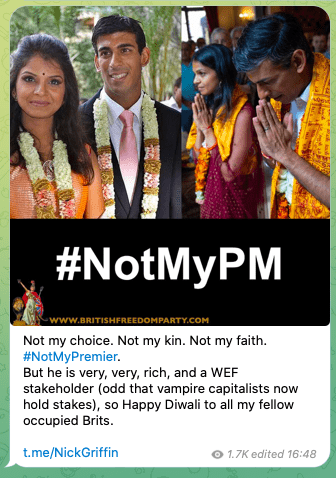
A Telegram post from former BNP leader Nick Griffin
Emphasising his belief that no non-white person can ever be British, even if born in the UK, PA’s leader Mark Collett claimed that “white Britons are so terrified of discussing race and ethnicity that they dare not even confront the fact they are now officially and openly under foreign rule”.
Yet others on this wing of the far right were also quick to downplay the significance of the event, which they see as just another example of the “anti-white” ideology of the Conservative Party. As PA’s deputy leader Laura Towler put it:
“As a nationalist, perhaps I should be angry at the thought of a non-British PM but I actually feel nothing […] Rishi Sunak epitomises the Conservative Party. He’s a rich child of immigrants. He is exactly what his party wants for this country: to replace the British people and generate more wealth for the wealthy.”
For supporters of Collett and Towler, Sunak’s Indian heritage and Hindu religious beliefs are largely irrelevant – they see the entirety of the UK’s non-white population as being unwelcome and dangerous, and often dismiss the efforts of less committed racists to distinguish between “good” and “bad” minority.
The issue of Sunak’s ethnicity is more complicated for the UK’s anti-Muslim activists, who from the late 2000s onwards moved away from the explicit racism of the British National Party and attempted to portray themselves as solely concerned with fighting Islamic extremism and other issues within the Muslim community.
For groups like Britain First and the now-defunct English Defence League, the UK’s Hindu and Sikh populations were often held up as a “model minority”, which could be praised in order to denigrate the Muslim community and also deflect accusations of racism. In response to the recent violence in Leicester, Britain First’s deputy leader Ashlea Simon asked “where are the marches to protect the Hindu community?”
It is for that reason that Britain First felt unable to condemn the first Hindu Prime Minister in explicit terms, instead inviting their followers to make their own racist comments by posting two references to his Hindu faith along with an Indian flag emoji:
Their supporters delivered exactly the response in the comments that you’d expect. While one commenter responded that “Hindus are good guys”, others quickly laid bare their bigotry: “A pagan in No.10. It will need a future exorcism” said one, while another called it “the end of our judeo Christian country”.
Similar sentiments were on display from supporters of Stephen Lennon (AKA Tommy Robinson), with comments on his Telegram including “Disgusting that a Indian is the pm of my beautiful England” and “all planned and fixed INDIAN PM IN ENGLAND couldn’t make this **** up unbelievable”.
Yet Lennon himself, who has recently courted far-right media outlets in India, has levelled his own criticism of Sunak not on ethnic or religious grounds but wider conspiratorial allegations, sharing links that claim his wife’s family own “a China-linked, World Economic Forum partner company pushing digital ID and social credit scores”.
This conspiratorial view – in which all current events are blamed on a shadowy global coup by woke/globalist/remainer elites – is not limited to those on the extreme fringes of the right. It is one that has had considerable airtime on GB News since its inception, with most of its hosts in seeming agreement that the self-inflicted political wounds suffered by Johnson and Truss were in fact part of a conspiracy to impose a “WEF-endorsed” candidate.
HOPE not hate has documented the efforts by the established far right to influence and recruit from the protest groups and online communities that developed in opposition to lockdowns and vaccines. We will doubtless see continued efforts to convert hostility to the premiership of Sunak, whether on the grounds of his actual policies or conspiracy theories about his role in a “globalist coup”, into a wider paranoia and hostility towards ethnic minority representation in politics.






![PRESS RELEASE : Government to take no further action under the National Security and Investment Act (2021) on Royal Mail share acquisition [October 2022]](https://www.ukpol.co.uk/wp-content/uploads/2022/08/businessenergy-150x150.png)
![PRESS RELEASE : Trussell Trust Top Priorities for New Prime Minister [October 2022]](https://www.ukpol.co.uk/wp-content/uploads/2022/10/trusselltrust-150x150.png)
![PRESS RELEASE : 559 million children currently exposed to high heatwave frequency, rising to all 2.02 billion children globally by 2050 [October 2022]](https://www.ukpol.co.uk/wp-content/uploads/2022/10/unicef.png)
![PRESS RELEASE : The Far Right Response To Rishi Sunak, Britain’s First Hindu Prime Minister [October 2022]](https://www.ukpol.co.uk/wp-content/uploads/2022/10/hopenothate-150x141.png)