Tag: 2022

  • Volodymyr Zelenskyy – 2022 Speech to the Joint Meeting of US Congress

    Volodymyr Zelenskyy – 2022 Speech to the Joint Meeting of US Congress

    The speech made by Volodymyr Zelenskyy, the President of Ukraine, in the United States on 22 December 2022.
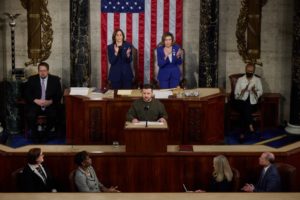
    Dear Americans!

    In all states, cities and communities. All those who value freedom and justice. Who cherish it as strongly, as we, Ukrainians, in all our cities, in each and every family. I hope my words of respect and gratitude resonate in each American heart!

    Madam Vice President, I thank you for your efforts in helping Ukraine! Madam Speaker, you bravely visited Ukraine during the full-fledged war, thank you very much! It is a great honor, a great privilege to be here!

    Dear members of the Congress – representatives of both parties – who also visited Kyiv! Esteemed Congressmen and Senators – from both parties – who will visit Ukraine, I’m sure, in the future! Dear representatives of diaspora – present in this chamber and spread across the country! Dear journalists!

    It’s a great honor for me to be at the U.S. Congress and speak to you and all Americans!

    Against all odds and doom and gloom scenarios, Ukraine did not fall. Ukraine is alive and kicking.

    And it gives me good reason to share with you our first joint victory – we defeated Russia in the battle for minds of the world. We have no fear. Nor should anyone in the world have it.

    Ukrainians gained this victory – and it gives us courage, which inspires the entire world.

    Americans gained this victory – and that’s why you have succeeded in uniting the global community to protect freedom and international law.

    Europeans gained this victory – and that’s why Europe is now stronger and more independent than ever.

    The Russian tyranny has lost control over us and it will never influence our minds again.

    Yet, we have to do whatever it takes to ensure that countries of the Global South also gain such victory.

    I know one more thing – the Russians will stand a chance to be free only when they defeat the Kremlin in their minds.

    Yet, the battle continues! And we have to defeat the Kremlin on the battlefield.

    This battle is not only for the territory – for this or another part of Europe. This battle is not only for life, freedom and security of Ukrainians or any other nation, which Russia attempts to conquer. This struggle will define – in what world our children and grandchildren will live and then – their children and grandchildren. It will define whether it will be a democracy – for Ukrainians and for Americans – for all.

    This battle cannot be frozen or postponed. It cannot be ignored hoping that the ocean or something else will provide a protection.

    From the United States to China, from Europe to Latin America, and from Africa to Australia – the world is too interconnected and interdependent to allow someone to stay aside – and at the same time – to feel safe when such a battle continues.

    Our two nations are Allies in this battle.

    And next year will be a turning point. The point, when Ukrainian courage and American resolve must guarantee the future of our common freedom. The freedom of people, who stand for their values.

    Ladies and Gentlemen!

    Americans!

    Yesterday – before coming here to Washington DC – I was at the frontline, in our Bakhmut. In our stronghold in the East of Ukraine – in the Donbas.

    The Russian military and mercenaries have been attacking Bakhmut non-stop since May. They have been attacking it day and night. But Bakhmut stands.

    Last year seventy thousand people lived there in Bakhmut and now only few civilians stay.

    Every inch of that land is soaked in blood. Roaring guns sound every hour. Trenches in the Donbas change hands several times a day in fierce combat and even hand fighting. But the Ukrainian Donbas stands.

    Russians use everything they have against Bakhmut and our other beautiful cities.

    The occupiers have a significant advantage in artillery. They have an advantage in ammunition. They have much more missiles and planes than we ever had.

    But our Defense Forces stand. And we all are proud of them.

    The Russian tactic is primitive. They burn down and destroy everything they see. They sent thugs to the frontlines. They sent convicts to the war…

    They threw everything against us – similar to the other tyranny, which in the Battle of the Bulge threw everything it had against the free world. Just like the brave American soldiers, which held their lines and fought back Hitler’s forces during the Christmas of 1944, brave Ukrainian soldiers are doing the same to Putin’s forces this Christmas. Ukraine holds its lines and will never surrender!

    So, here is the frontline – the tyranny, which has no lack of cruelty – against the lives of free people.

    And your support is crucial – not just to stand in such fights, but to get to the turning point. To win on the battlefield.

    We have artillery. Yes. Thank you. Is it enough? Honestly, not really. To ensure Bakhmut is not just a stronghold that holds back the Russian army – but for the Russian army to completely pull out – more cannons and shells are needed.

    If so, just like the battle of Saratoga, the fight for Bakhmut will change the trajectory of our war for independence and freedom.

    If your «Patriots» stop the Russian terror against our cities, it will let Ukrainian patriots work to the full to defend our freedom.

    When Russia cannot reach our cities by its artillery, it tries to destroy them with missile attacks. More than that, Russia found an Ally in its genocidal policy – Iran.

    Iranian deadly drones, sent to Russia in hundreds, became a threat to our critical infrastructure. That is how one terrorist has found the other. It is just a matter of time – when they will strike against your other allies, if we do not stop them now. We must do it!

    I believe there should be no taboos between us in our alliance. Ukraine never asked the American soldiers to fight on our land instead of us. I assure you that Ukrainian soldiers can perfectly operate American tanks and planes themselves.

    Financial assistance is also critically important. And I would like to thank you for both, financial packages you have already provided us with, and the ones you may be willing to decide on. Your money is not charity. It’s an investment in the global security and democracy that we handle in the most responsible way.

    Russia could stop its aggression if it wanted to, but you can speed up our victory. I know it.

    And it will prove to any potential aggressor that no one can succeed in breaking national borders, committing atrocities and reigning over people against their will.

    It would be naive to wait for steps towards peace from Russia – which enjoys being a terrorist state. Russians are still poisoned by the Kremlin.

    The restoration of international legal order is our joint task. We need peace. Ukraine has already offered proposals, which I just discussed with President Biden – our Peace Formula.

    Ten points, which should and must be implemented for our joint security – guaranteed for decades ahead.

    And the Summit, which can be held.

    I am glad to stress that President Biden supported our peace initiative today. Each of you, ladies and gentlemen, can assist in its implementation – to ensure that America’s leadership remains solid, bicameral and bipartisan.

    You can strengthen sanctions to make Russia feel how ruinous its aggression truly is.

    It is in your power to help us bring to justice everyone, who started this unprovoked and criminal war. Let’s do it!

    Let the terrorist state be held responsible for its terror and aggression, and compensate all losses done by this war.

    Let the world see that the United States is here!

    Ladies and Gentlemen!

    Americans!

    In two days, we will celebrate Christmas. Maybe, candlelit. Not because it is more romantic. But because there will be no electricity. Millions won’t have neither heating nor running water. All of this will be the result of Russian missile and drone attacks on our energy infrastructure. But we do not complain.

    We do not judge and compare whose life is easier.

    Your well-being is the product of your national security – the result of your struggle for independence and your many victories.

    We, Ukrainians, will also go through our war of independence and freedom with dignity and success.

    We’ll celebrate Christmas – and even if there is no electricity, the light of our faith in ourselves will not be put out. If Russian missiles attack us – we’ll do our best to protect ourselves. If they attack us with Iranian drones and our people will have to go to bomb shelters on Christmas eve – Ukrainians will still sit down at a holiday table and cheer up each other. And we don’t have to know everyone’s wish as we know that all of us, millions of Ukrainians, wish the same – victory. Only victory.

    We already built strong Ukraine – with strong people, strong army, and strong institutions. Together with you!

    We develop strong security guarantees for our country and for entire Europe and the world. Together with you!

    And also – together with you! – we’ll put in place everyone, who will defy freedom.

    This will be the basis to protect democracy in Europe and the world over.

    Now, on this special Christmas time, I want to thank you. All of you. I thank every American family, which cherishes the warmth of its home and wishes the same warmth to other people.

    I thank President Biden and both parties at the Senate and the House – for your invaluable assistance.

    I thank your cities and your citizens, who supported Ukraine this year, who hosted our people, who waved our national flags, who acted to help us.

    Thank you all! From everyone, who is now at the frontline. From everyone, who is awaiting victory.

    Standing here today, I recall the words of the President Franklin Delano Roosevelt, which are so good for this moment: “The American People in their righteous might will win through to absolute victory”.

    The Ukrainian People will win, too. Absolutely. I know that everything depends on us. On Ukrainian Armed Forces! Yet, so much depends on the world! So much in the world depends on you!

    When I was in Bakhmut yesterday, our heroes gave me the flag. The battle flag. The flag of those who defend Ukraine, Europe and the world at the cost of their lives. They asked me to bring this flag to the US Congress – to members of the House of Representatives and Senators, whose decisions can save millions of people.

    So, let these decisions be taken!

    Let this flag stay with you, ladies and gentlemen!

    This flag is a symbol of our victory in this war!

    We stand, we fight and we will win. Because we are united. Ukraine, America and the entire free world.

    May God protect our brave troops and citizens! May God forever bless the United States of America!

    Merry Christmas and a happy victorious new year!

    Слава Україні!

  • PRESS RELEASE : Randall Kroszner appointed to the Financial Policy Committee [December 2022]

    PRESS RELEASE : Randall Kroszner appointed to the Financial Policy Committee [December 2022]

    The press release issued by HM Treasury on 21 December 2022.

    The Chancellor of the Exchequer, Jeremy Hunt, has today (21st December) announced the appointment of Randall Kroszner as an external member of the Financial Policy Committee (FPC).

    Dr Kroszner is Professor of Economics at the University of Chicago Booth School of Business. He previously served as a Governor of the US Federal Reserve System from 2006 until 2009. Dr Kroszner has expertise on financial stability and regulatory policy issues with experience in both the public sector and academia. His appointment fills the external position previously held by Anil Kashyap, who stepped down from the Committee at the end of September 2022. He will serve a three-year term, which will begin in February 2023.

    The Chancellor of the Exchequer Jeremy Hunt said:

    “The Financial Policy Committee is key to protecting and strengthening the UK’s financial stability. I want to thank Anil Kashyap for his contribution to the work of the Committee over the past six years, especially during the pandemic.

    “I am pleased to announce the appointment of Randall Kroszner. His leading academic voice in macroprudential policy, built over a decade at the University of Chicago, and his experience at the Federal Reserve during the global financial crisis will be of real value to the committee.”

    The Governor of the Bank of England Andrew Bailey said:

    “I am delighted to welcome Randy to the FPC as an external member. His significant international policy experience and extensive research on the financial sector will be an asset to the FPC. I look forward to working with him on the Committee and benefiting from the wealth of expertise he will bring to our discussions.”

    Further information

    Randall Kroszner is the Norman R. Bobins Professor of Economics and previous Deputy Dean of the University of Chicago Booth School of Business, where he has had a distinguished 30-year career. Prior to this appointment Dr Kroszner served as a Governor of the Federal Reserve System, where he chaired the Committee on the Supervision and Regulation of Banking Institutions and took a lead role in developing responses to the global financial crisis to improve consumer protection and broader financial regulation. He has made important contributions to international financial stability policy over his career, representing the Federal Reserve Board at the Financial Stability Board and the Basel Committee on Banking Supervision, and as a member of the President’s Council of Economic Advisers from 2001 to 2003. Dr Kroszner has published academic papers and spoken on a broad range of issues, including regularly at global academic and policy conferences and appearing on Bloomberg, CNBC and CNN. Since 2018, Dr Kroszner has served as Chairman of the US Treasury Office of Financial Research advisory committee.

    About the appointment process

    Randall has been appointed following an open recruitment process. As part of this process, HM Treasury recruited an executive search agency. A panel comprising of Gwyneth Nurse (non-voting member of the FPC and Director General of Financial Services, HM Treasury), Elisabeth Stheeman (external member of the FPC) and Martin Taylor (external member of the FPC from 2013 to 2020) interviewed a number of candidates and made recommendations to the Chancellor, which informed his decision.

    There were 41 applications, of which seven candidates were shortlisted for interview. The gender breakdown for this appointment is below:

    Application stage Shortlisted for interview
    FPC External Member 10 women, 28 men, 3 undisclosed 2 women, 5 men

    About the Financial Policy Committee

    • the FPC is the UK’s macroprudential regulator: its objective is to protect and enhance the stability of the UK’s financial system by identifying, monitoring and addressing systemic risks
    • the FPC has thirteen members. Six of them are Bank of England staff including the Governor and four Deputy Governors
    • there are also five external members who are selected from outside the Bank for their experience and expertise in financial services
    • the Committee also includes the Chief Executive of the Financial Conduct Authority and one non-voting member from HM Treasury
    • external members sit on a part-time basis and are employed on the basis of having knowledge or experience which is likely to be relevant to the Committee’s functions. The Bank have robust procedures in place to monitor and manage any actual or potential conflicts of interest to ensure the independence, integrity and impartiality of the Committee, and avoid any perception that a Committee member may obtain an unfair advantage through their association with the Committee.
  • PRESS RELEASE : Historic child abuser, Michael Egan, to face time in prison after referral to the Court of Appeal [December 2022]

    PRESS RELEASE : Historic child abuser, Michael Egan, to face time in prison after referral to the Court of Appeal [December 2022]

    The press release issued by the Attorney General’s Office on 21 December 2022.

    A man found guilty of child cruelty and assault is facing jail after the case was referred to the Court of Appeal for being unduly lenient.

    Michael Egan, now 77, abused the child over 30 years ago when he was aged between 42 and 47. Among the offences, Egan would tell the victim her mother didn’t love her, force her to take cold showers and throw cold water over her when she was in bed. He also kicked her repeatedly in the ribs and burnt her with a lit cigarette. Egan had previously been convicted of wounding the child by throwing a cup at her face.

    On 17 October 2022, he was sentenced to 24 months’ imprisonment suspended for 24 months and ordered to pay £1,000 costs.

    Following the sentencing at Norwich Crown Court, it was referred to the Court of Appeal under the Unduly Lenient Sentence scheme for being too low.

    On 21 December 2022, the Court found his original sentence to be unduly lenient and increased it to four years’ imprisonment.

    Speaking after the hearing, the Solicitor General Michael Tomlinson KC MP said:

    Egan’s cruel and unspeakable physical and mental abuse have left a significant and lasting impact on his victim’s life.

    Child cruelty is never acceptable so I welcome this increased sentence showing that those that commit such cowardly crimes will face significant punishment as a result.

  • PRESS RELEASE : Arrivals to the UK warned to prepare for disruption at the border [December 2022]

    PRESS RELEASE : Arrivals to the UK warned to prepare for disruption at the border [December 2022]

    The press release issued by the Home Office on 21 December 2022.

    The UK government is making preparations ahead of Border Force strike action at the end of the week, including training military personnel to step in and keep our border safe.

    Since strikes, due to begin on Friday 23 December, were announced by the Public and Commercial Services (PCS) Union, Border Force and the government have undertaken extensive planning to minimise the disruption this action will cause.

    Thousands of people, including civil servants and military personnel are ready to support Border Force over this period, many of whom are sacrificing their Christmases to ensure passenger’s travel plans are protected and they get to where they want to be this Christmas.

    The government has also been working closely with ports, airports and the travel industry to understand the impact of strike action, to minimise delays for passengers and ensure the flow of goods through the border.

    While the government is taking action to minimise disruption, travellers due to arrive in the UK over the Christmas period are warned to expect delays and disruption over the strike action affecting border control.

    Passengers should be prepared for longer wait times and should check with their travel agents, tour operators and airlines/carriers about possible disruptions to their journey prior to travelling.

    Our eGates will continue to function as per normal and we encourage all those eligible to use them to do so, as the quickest and most efficient way to pass through border control.

    Steve Dann, Border Force Chief Operating Officer, said:

    We apologise for any disruption caused to travellers entering the UK.

    Border Force’s number one priority to is keep our citizens safe and borders secure. We are working together with partners across the travel industry to ensure we can continue to meet critical demand and support the flow of passengers and goods through our border.

    During the periods of industrial action, travellers should be prepared for disruption.

    We encourage everyone to check the latest advice from your operators before travelling.

    Notes to Editors:

    Border Force Strike Dates:

    • 23rd December
    • 24th December
    • 25th December
    • 26th December (until about 7am)
    • 28th December
    • 29th December
    • 30th December
    • 31st December (until about 7am)

    Border Force Strike Locations

    • Birmingham Airport
    • Cardiff Airport
    • Gatwick Airport
    • Glasgow Airport
    • Heathrow Airport – Terminals 2,3,4,5
    • Manchester Airport
    • Port of Newhaven

    Strikes are not the only factor that might cause disruption, for example adverse weather or flight delays may impact journeys, meaning it is essential for passengers to plan ahead and keep up-to-date with the latest information, through relevant sources including airport and carrier websites.

  • PRESS RELEASE : Star Pubs & Bars is cooperating with the Pubs Code Adjudicator after it reports breaches of the Pubs Code [December 2022]

    PRESS RELEASE : Star Pubs & Bars is cooperating with the Pubs Code Adjudicator after it reports breaches of the Pubs Code [December 2022]

    The press release issued by the Department for Business, Energy and Industrial Strategy on 21 December 2022.

    The Issue

    Regulation 46 ensures transparency for tied tenants in relation to premises insurance and gives them the right to find a cheaper policy.

    Star Pubs and Bars’ Code Compliance Officer – whose role it is to verify compliance with the Code – reported to the PCA in August 2021 that information provided to tenants about premises insurance had not complied with regulation 46. Star said this had caused no detriment to tenants. The PCA has since confirmed this compliance issue runs from the start of the Code in 2016.

    Under regulation 46, the pub company must provide the tenant with information about the premises insurance where it intends to charge the tenant in respect of the premium. This ensures full transparency and allows the tenant to look for a cheaper policy. If they find one that is suitable and comparable, the pub company must buy that policy or agree the tenant will not have to pay the difference.

    Specifically, the information supplied under regulation 46(2) must include whether the amount the pub company charges the tenant to insure the premises is more than it pays in respect of the insurance premium, and how much more that is. The pub company must also say whether it will receive any commission or rebate in connection with the policy.

    Star took the view that it was not possible to comply with regulation 46(2) due to its self-insurance arrangements through a company owned by the Heineken group (which also owns Star). Star told the PCA that at the point it had to write to tenants under regulation 46, it was unable to say whether there was information it needed to provide under 46(2), particularly as it did not hold information on the insurance premium for a particular premises.

    Star also admitted that correspondence sent to tenants in December 2020 about the insurance recharge had not included necessary detail about the identity and operation of its policy and the option to price match. Further information was sent to tenants in March 2021 to address this and Star has since updated its Guide to Insurance Responsibilities to make the position clearer. Star has also assured the PCA that in future such correspondence will be signed off by its Code Compliance Officer and legal team.

    The PCA continues to work with Star to ensure there is transparency for tenants as required by regulation 46 and to assess the extent of previous breaches of regulation 46 and any impact on tenants from non-compliance. Enquiries are also being made with other pub companies to ensure compliance where there are similar self-insurance arrangements. Further information will be published as appropriate.

  • Nusrat Ghani – 2022 Speech on Entrepreneurs from Ethnic Minority Backgrounds

    Nusrat Ghani – 2022 Speech on Entrepreneurs from Ethnic Minority Backgrounds

    The speech made by Nusrat Ghani, the Minister for Industry and Investment Security, in Westminster Hall, the House of Commons, on 20 December 2022.

    It is a pleasure to serve under your chairmanship, Mr Hosie. First, I congratulate the right hon. Member for East Ham (Sir Stephen Timms) on securing the debate, and on raising this important issue. I do not want anyone to think I am consumed by Christmas spirit, but I very much respect him, as does everyone in the Department for Business, Energy and Industrial Strategy. We take every point that he raises very seriously.

    The right hon. Member talked about his constituents, the fact that the majority of them were not born in the UK, and the challenges they face. That is me and my community. I am delighted to speak on behalf of the Under-Secretary of State for Business, Energy and Industrial Strategy, my hon. Friend the Member for Thirsk and Malton (Kevin Hollinrake), who is responsible for enterprise, markets and small business, because I want to make sure that we take all the issues raised incredibly seriously.

    To continue with the Christmas spirit, we can certainly agree on the importance of ethnic minority entrepreneurs and their valuable contribution to our vibrant business landscape. I will not disagree with the right hon. Member on the challenges that have been mentioned. It is testament to the dynamism and resilience of ethnic minority entrepreneurs that they continue to adapt, and that they overcome so much, especially during covid. From small retail stalls to tech unicorns, the value of ethnic minority founders must not be understated. I am pleased to have an opportunity to shine a light on this community and what they do for the broader community.

    On all of the issues raised, there are no challenges from this side of the House, but let me focus on some of the barriers that were mentioned, and talk about what the Government are doing to support ethnic minority businesses and to encourage an inclusive entrepreneurship environment for all. As has been said, if we get this right, and fundamentally get finance right as well, we could make that environment incredibly dynamic, which would be a boost to all our local economies.

    The economic impact of ethnic minority entrepreneurs is far-reaching, with some estimating the contribution to the UK economy to be worth up to £25 billion. However, the crucial role of these businesses is much more than just economic. Their impact reaches much further than across the business ecosystem. As was mentioned, these businesses are most likely to invest in innovation, which is critical in helping us to achieve our ambitions around research and development investment and making the UK a science superpower. With more innovation comes improvement in productivity, so building on the potential of these businesses will be crucial to improving our productivity record.

    What really matters to me is that these businesses operate in every region of the UK, including the most deprived parts. I doubt that East Ham is different from where I was brought up, Small Heath—an area often overlooked and underestimated. The efforts of black and Asian businesses are invaluable to ensuring that we level up across the country. Even more excitingly, these businesses are most likely to export, which puts them at the forefront of our efforts to harness global opportunities, which include our changing how we do business and diversifying our business models, especially now that we have left the EU.

    Let me respond to some of the questions raised, starting with those about opportunities to access finance. Despite the impact of ethnic minority businesses, there is evidence to suggest that there are still barriers preventing them from reaching their full potential. Access to finance is regularly raised as one of the most significant issues holding those businesses back; there are reports of ethnic minority entrepreneurs keeping reservations about accessing financial assistance from traditional lenders.

    As noted in the latest “Black. British. In Business & Proud” report from the Black Business Network and Lloyds Bank, 67% of black business people state that they have experienced some form of discrimination in their past entrepreneurial efforts, with only 40% trusting banks to have their best interests in mind. That has to change. The report’s recommendations rightly focus on improving the link between financial institutions, Government and the ethnic minority community as the best way forward. I will come back to some of the points raised to show how we are supporting ethnic minority entrepreneurs in accessing finance.

    The issue of data was raised. In addition to the difficulties in accessing finance, the ongoing lack of data collection continues to inhibit funding opportunities for ethnic minority business leaders. Greater information sharing is crucial for bolstering our understanding of lending patterns, and this Government are committed to securing this transparency.

    Sir Stephen Timms

    I am grateful for the case the Minister is making, and I agree with what she has said. On the point about Companies House, would it not be a welcome step if it recorded the ethnic origin of company directors, so that we had some sense of the scale of what is happening?

    Ms Ghani

    That is a very important point. As I am not the Minister responsible for that portfolio, I do not have an exact answer. Let me get through this speech; if the right hon. Gentleman is not satisfied, I will ensure that he is written to with that information.

    Turning back to action 55, the Department for Business, Energy and Industrial Strategy is working with the Investing in Women code signatories and with trade associations to pilot data collection on the ethnicity of entrepreneurs applying for finance.

    Trust in institutions is low in many ethnic minority communities, who often struggle to get the experience or even the exposure required, or the support that they need to run a business effectively. One way that we are trying to help is by improving the communication flow between Government and the ethnic minority business community, engaging with businesses and the organisations that represent them directly to understand their specific needs. In terms of business support, black, Asian and ethnic minority business leaders value mentors more than any other ethnic group; they are more likely to want a mentor and more likely to value the impact of having one. It is reassuring to see organisations such as Be the Business championing the role of mentoring. Furthermore, our Help to Grow Management programme, with its delegated mentorship component, offers businesses a subsidised training course designed to improve leadership and management skills and address firm-level productivity challenges.

    While we should celebrate the success and impressive contributions of these businesses, we must acknowledge our role in helping to tackle the remaining barriers to growth and prosperity, which were mentioned. Off the back of the British Business Bank’s “Alone together” report, which emphasises the difficulties faced by ethnic minority entrepreneurs in accessing funding, we are working with stakeholders to understand what further interventions we can take.

    Since its launch in 2012, the Government-backed start-up loans programme has issued around 20% of its loans to black, Asian and ethnic minority businesses. The future fund has also approved 1,190 convertible loans, totalling more than £1.1 billion. More than half—61.6%, to the value of £683.5 million—of the convertible loan agreements approved have been for companies with management teams consisting solely of ethnic minority team members and those with both ethnic minority and white team members. This is promising progress, but, of course, there is no denying that we have much further to go.

    As previously mentioned, we are also delivering actions 55 and 56, set out in the inclusive written report, which aim to support and encourage those from less-advantaged backgrounds to thrive—this is where I am thinking of those from my community of Small Heath and the community represented by the right hon. Member for East Ham. Through these specific actions, we will support ethnic minority entrepreneurs in accessing finance more effectively and becoming more productive.

    The Procurement Bill includes a new duty on contracting authorities to have regard to the barriers facing small and medium-sized enterprises. Among other things, they must consider whether there is a diverse representation of businesses in the pre-market engagements. We are always looking to engage with ethnic minority business leaders and networks to better understand the issues facing them. There was a recent opportunity to do so: the Under-Secretary of State for Business, Energy and Industrial Strategy, my hon. Friend the Member for Thirsk and Malton, was asked to speak at the third anniversary reception for the all-party parliamentary group for black, Asian and minority ethnic business owners. The Department is dedicated to continued engagement with ethnic minority entrepreneurs through valuable events, including those hosted by the APPG, as well as through the ethnic minority business group, a forum that convenes bimonthly to discuss priority issues affecting entrepreneurs from diverse backgrounds to see how we can work together to find practical solutions.

    Ethnic minority leaders want to see themselves represented in the business landscape. That could be through their mentors, or through wider representation in senior leadership positions. The value of visibility and its longer-term impact on entrepreneurs cannot be overstated. Through the Parker review, we acknowledged that building a fairer economy means ensuring that the UK’s organisations reflect the nation’s diversity. The latest figures show that the number of FTSE 100 companies with an ethnic minority director on their board has increased to 89, with 42 companies having exceeded the target. The progress made so far is encouraging, but I argue that we have much further to go. We look forward to those figures increasing further, to reflect the real diversity of talent in the UK.

    A question was raised by the hon. Member for East Kilbride, Strathaven and Lesmahagow (Dr Cameron) on dealing with disability and other issues—I would expect that question from her, as she is the chair of the APPG for disability. Of course, that is another issue that we need to explore. The Father of the House talked about unkinking the pipeline of black talent, and I do not doubt that the Department will now be looking very closely at the report that he mentioned.

    The right hon. Member for East Ham raised the Government’s update on the ethnicity pay gap data. As the Government have set out, ethnicity pay gap reporting continues to be voluntary. We will not be legislating for mandatory ethnicity pay reporting at this stage, but good firms, obviously, will want to make sure that their data is on record.

    Again, I thank the right hon. Member for East Ham for introducing this important debate. Separately, I congratulate him, in his role as Chair of the Work and Pensions Committee, on today’s publication of the “Universal Credit and childcare costs” report. Affordable, accessible childcare is key to enabling parents to work and to increase their working hours; that is linked to today’s debate on entrepreneurial activity.

    I conclude by reiterating the importance and the wealth of ethnic minority talent across the UK, which we are committed to nurturing and celebrating. On the one point that the right hon. Gentleman raised that I could not respond to, I will ensure that he is written to by the appropriate Minister with a formal response. I reiterate that we want to work closely with parliamentarians across the House, and with business and financial institutions to ensure that access is equitable. We want to improve our understanding of the issues faced, and to identify practical solutions that we can offer. I remind all colleagues from across the House that we are committed to bolstering the potential of ethnic minority entrepreneurs who, in turn, will help the UK economy to thrive.

    I thank the right hon. Member for East Ham for raising this issue and, if I may be so bold, I wish you a happy Christmas, Mr Hosie.

  • Stephen Timms – 2022 Speech on Entrepreneurs from Ethnic Minority Backgrounds

    Stephen Timms – 2022 Speech on Entrepreneurs from Ethnic Minority Backgrounds

    The speech made by Sir Stephen Timms, the Labour MP for East Ham, in Westminster Hall, the House of Commons, on 20 December 2022.

    I beg to move,

    That this House has considered support for entrepreneurs from ethnic minority backgrounds.

    I am delighted to serve under your chairmanship, Mr Hosie. I am grateful to Mr Speaker for granting this debate, and I am very pleased to see the Minister in her place.

    I represent in Parliament the eastern half of the London Borough of Newham, which is probably the most ethnically diverse community on the planet. Last year’s census showed that just 45% of residents were born in the UK, and that 52% identify as Asian, compared with 9% nationally, and another 14% identify as black. Some 25% identify as white, compared with 82% nationally, so ethnic minority entrepreneurship is very important for the prosperity of the community that I represent. I regret the closure of the Department for Work and Pensions support programme for self-employment, with no sign of a replacement as yet. That programme gave helpful support to a significant number of my constituents to start up in business for themselves.

    Minority-led businesses have made a lot of progress. Minority Supplier Development UK, a not-for-profit membership group that champions diversity and inclusion in public and private sector supply chains, highlighted in a report last year called “Minority Businesses Matter” that of the UK’s 23 unicorns—start-ups valued at $1 billion or more—eight had ethnic minority founders, including Deliveroo. That gives a sense of the huge potential in this area, which we need to realise much more. In May, the London Chamber of Commerce and Industry published the report “Ethnic Diversity in Business”. I commend the work of Esenam Agubretu and her colleagues. That report identifies the barriers that minority-led businesses face.

    In 2021, about 14% of the UK population was from an ethnic minority background, but ethnic minority-led businesses constituted just 5% of small and medium-sized enterprises in 2020, and those businesses also tend to be in lower-paying sectors. We need to be doing much better than that. The economic contribution of ethnic minority-led businesses is large, but the potential is larger still. Baroness McGregor-Smith’s 2017 review, “Race in the workplace”, concluded that

    “If BME talent is fully utilised, the economy could receive a £24 billion boost.”

    We need to realise that opportunity. The Social Market Foundation has found that ethnic minority-led businesses are often more innovative, with a lot to contribute to levelling up the economy, and that the economy is weaker because those businesses lack support.

    I want to highlight two main points arising from the London Chamber of Commerce and Industry report: the need to address the barriers that ethnic minority businesses face in accessing finance, and the need for better data on how those businesses are getting on. The key barrier, and the focus of that report, is problems accessing finance. Black entrepreneurs in particular report bad experiences with banks, and Asian entrepreneurs struggle to access funding outside their own communities. Those who do apply for funding are far less likely to receive it. The London Chamber of Commerce and Industry quotes Ismail Oshodi describing his experience:

    “we had different people dealing with us and I had to repeat myself on several occasions, even with all of that, we were unable to get the amount we needed. We weren’t given a clear reason why, we was just told we did not meet their criteria.”

    The LCCI says that 44% of black African business owners and 39% of black Caribbean business owners fear prejudice from financial providers, compared with just 4% of white owners. Let us be frank: racism is part of the problem. It is not that the banks do not recognise the problem; they do, and they are trying to do something about it. UK Finance published a report in July, “Supporting Ethnic Minority Entrepreneurship in the UK”, which profiled numerous initiatives. HSBC sponsored last year’s Black Business Week and Black Business Show. Santander works with a network of women of colour in business and supports a black inclusion programme. NatWest has a racial equality taskforce and an ethnicity advisory council. Barclays has a black founders accelerator.

    The initiatives that I have seen most of are those supported by Lloyds bank. It has a black business advisory committee, chaired by Claudine Reid MBE, whom I first met when I was a Minister in the Department of Trade and Industry 20 years ago. I had embarked on a tour of social enterprises and found myself at PJ’s in Croydon, set up and run by Claudine and her husband. I also know the work Lloyds does with the Black Business Network, founded and chaired by Shari Leigh, which was highlighted to me by my former constituent Shi Dolor, whom I knew when she was a teenager and whose Noir Squared branding business has worked with the network.

    In September, the network published the second of three annual reports called “Black. British. In Business …and Proud!” As a Lloyds executive recognises in her foreword, it makes for “uncomfortable reading”. The report refers to a

    “breakdown in trust of formal institutions”,

    and reports that 67% of black business owners have been negatively discriminated against in their past entrepreneurial efforts, that 84% of business owners see racism and society’s attitude to black entrepreneurs as a barrier to their business, and that black business owners turn to their friends, black business community groups or social media groups rather than banks for advice and support.

    Dr Lisa Cameron (East Kilbride, Strathaven and Lesmahagow) (SNP)

    I thank the right hon. Gentleman for bringing this vital debate to the House. Does he agree that where there is intersectionality between ethnic minority groups and disability or gender, the barriers faced by people can be multiplied, and that banks and the Government should also take that into account?

    Sir Stephen Timms

    I very much agree with the hon. Member. That point is made in the London Chamber of Commerce and Industry report, and she is right to highlight it.

    Over half of black business owners say that they have seen banks taking action to deal with the problem, but only 12% think that that action taken is significant. Minority-led businesses also account for very little venture capital investment, less than 2% of which went to all-ethnic founder teams in 2019, according to the London Chamber of Commerce and Industry. Black African firms are four times more likely than white firms to be refused a loan, according to the British Business Bank. Mainstream services do not seem to be working for ethnic minorities. Ethnic minority groups have less wealth than their white counterparts, and there is a strong correlation between that and business success. They have fewer savings, so they are more reliant on external financial support.

    Given that, it is no surprise that minority-led businesses do less well. According to London Chamber of Commerce and Industry research, 38% of Asian and other minority business owners and 28% of black business owners reported making no profit, compared with 16% of white business owners. Thirty-nine per cent. of black entrepreneurs and nearly half of Asian and other ethnic minority entrepreneurs stopped working on their business idea because of “difficulties getting finance”, compared with a much smaller proportion—just a quarter—of white entrepreneurs.

    We need to be doing better than this, for the sake of not just business owners but the wider prosperity of our society. I welcome the Labour party review of start-up funding, led by Lord O’Neill, who was a Treasury Minister in the coalition Government. The review will consider how to ensure that ethnic minority entrepreneurs can access the finance, support and networks they need. Newham-based Shpresa is a community organisation supporting self-help among London’s Albanian community. It was founded and led by the remarkable Luljeta Nuzi, a social entrepreneur I first met when she came to the UK seeking asylum from Kosovo. She went on to graduate from the School for Social Entrepreneurs, and when today’s debate was announced, she drew my attention to the school’s match trading initiative, which provides enterprise grant finance, supported by Lloyds bank; the aim is that racially minoritised social enterprises should be early adopters.

    When the Minister responds, can she give us the Government’s assessment of the lending practices of financial institutions to ethnic minority businesses, and say whether she sees real progress being made? It is welcome that between 2012 and 2018, over 11,000 ethnic minority entrepreneurs received Government-backed start-up loans. The additional action that is needed is largely for the financial services industry, but there is one area where Government action is particularly needed: public procurement. A big section of the report by the London Chamber of Commerce and Industry is devoted to this area, and it calls for a Government taskforce to work on increasing public procurement from ethnic minority businesses.

    The LCCI wants the Government to move beyond merely “best endeavours” to introducing, for example, minimum target percentages for procurement from minority-owned businesses, in order to simplify procurement procedures and increase public purchasing from micro-businesses. It also wants tenders to be scored, in bid assessments, on supply chain diversity, and the Government to establish prestigious awards to highlight the achievements of minority-owned businesses.

    In the LCCI’s report, a quote caught my eye from Demi Ariyo, founder of a funding platform:

    “It became clear to me that there was a problem to be solved upon witnessing my church’s experience and hearing the first-hand experience of other minority ethnic entrepreneurs who had tried to seek funding.”

    As the chair of the all-party parliamentary group on faith and society, I would like there to be greater support for entrepreneurship among people who are coming together in faith groups. Britain’s history is replete with great businesses that have their roots in religious faith. Let us have more of them, and newer ones.

    My second point is about the lack of reliable data on ethnic diversity in business, which the report describes as “a recurring theme”. Here again, we need action by Government and by business. Companies House does not record the ethnicity of company directors. There is no legal requirement for businesses to publish their ethnicity pay gap, although they are rightly obliged to publish their gender pay gap. In 2017, the then Prime Minister, the right hon. Member for Maidenhead (Mrs May), promised to ask large employers to publish their ethnicity pay gap data. It has not happened yet. Can the Minister tell us whether that 2017 commitment still stands, and if so, when it will be implemented?

    The paucity of data means that there is a lot that we just do not know. Without detailed and reliable data on ethnic minority entrepreneurship, we cannot fully understand the barriers that exist, as we must if we are to remove them. In this recession, the gap between ethnic minorities and others in business may well get worse. We need to grip this issue now, so that trends can be monitored and support appropriately targeted. We cannot meet the needs of minority-led businesses without having adequate information about their characteristics and their performance.

    In the LCCI report, Dr Tony Matharu, chair of the LCCI’s Asian Business Association, and Lord Michael Hastings, chair of its Black Business Association, call for financial institutions to collect data about their support for ethnic minority businesses, as they do for women-led businesses under the Investing in Women code.

    The two issues that I have highlighted are part of a much bigger set of challenges. When the Minister responds, can she assure us that the Government recognise the need, spelled out by the LCCI, for strategic engagement between the business community, Government and ethnic minority entrepreneurs?

    Sir Peter Bottomley (Worthing West) (Con)

    I support the right hon. Gentleman’s efforts on faith and society. As one of the officers of the all-party parliamentary group on black and minority ethnic business owners, I am supported by Diana Chrouch. I direct hon. Members’ attention to an article in The Sunday Times of 14 February 2021, by Oliver Shah, talking to Wol Kolade, who has the initiative 10,000 Black Interns. He talks about unkinking the pipeline of black talent. It seems to me that letting people get through and do what they are capable of is what we should be aiming for.

    Sir Stephen Timms

    I completely agree with the Father of the House. I had not seen that article, but it sounds to me as though it makes exactly the case that needs to be made.

    I wonder whether the Minister will commit to better engagement between the groups I mentioned, in order to boost diversity in business. Bridging this large and persistent ethnic diversity gap is not straightforward. Realising the potential to which the Father of House has rightly drawn our attention is a long-term challenge. We need to be determined to end racial and ethnic inequality across UK society, including when it comes to start-up support, and to closing gaps that have persisted for far too long.

    I hope that the Minister can reassure us that the Government recognise the importance of the issue, and will set out plans to make sure that we can all benefit from the skills and contributions of all those who want to set up in business but are too often excluded by unfair and unnecessary barriers.

  • Richard Holden – 2022 Speech on the Expansion of the Ultra Low Emission Zone

    Richard Holden – 2022 Speech on the Expansion of the Ultra Low Emission Zone

    The speech made by Richard Holden, the Parliamentary Under-Secretary of State for Transport, in Westminster Hall, the House of Commons, on 20 December 2022.

    It is a pleasure to serve under your chairmanship, Mr Hosie. I congratulate my hon. Friend the Member for Dartford (Gareth Johnson) on securing the debate. On ultra low emissions, we heard quite a few emissions from the hon. Member for Wythenshawe and Sale East (Mike Kane), but I am not sure that any of them were really relevant to the broader debate. He seemed to praise the Mayor of Greater Manchester for what he is up to. The Mayor stopped his ULEZ. I not sure that the Leader of the Opposition and the hon. Member for Wythenshawe and Sale East are on the same page regarding the Mayor of Greater Manchester, given the Leader of the Opposition’s recent jokes at the Mayor’s expense.

    The need to tackle air pollution is something on which I hope that Members on both sides of the House—and indeed the Government and the Mayor of London—agree, to answer the question from the hon. Member for Putney (Fleur Anderson). Air pollution is a big environmental risk to human health, and the Government are determined to tackle it. As my hon. Friend the Member for Old Bexley and Sidcup (Mr French) said, that is why we have invested more than £800 million to tackle air pollution in 64 local council areas. Much more can be done, although we can be proud that air pollution has reduced significantly since 2010, with emissions of particulate matter down by 18% and nitrogen oxides down by 44%, to their lowest level since records began.

    As my hon. Friend the Member for Orpington (Gareth Bacon) made very clear in a tour de force speech, ULEZ will have only a minor or negligible impact, as the Jacobs report has said. My hon. Friend the Member for Runnymede and Weybridge (Dr Spencer) put forward various sensible solutions. My hon. Friend the Member for Ruislip, Northwood and Pinner (David Simmonds) also reflected some of the issues, particularly around accessibility of public transport. As my hon. Friend the Member for Dartford said, the expansion to the London boundary was not in the Mayor’s manifesto—a point reflected by my hon. Friends the Members for Sutton and Cheam (Paul Scully), for Orpington, and for Watford (Dean Russell). It was against the Mayor’s manifesto and against his own consultation. Those are not political points, as some Opposition Members would like to suggest; they are facts, eloquently put forward by hon. Members.

    David Simmonds

    I commend the Minister on the work that he has been doing on buses. Does he agree that the fact that the Labour group in Hillingdon Council supports the Conservatives’ campaign against ULEZ is evidence that this is not a matter of party politics but one of people putting their constituents and residents first?

    Mr Holden

    I thank my hon. Friend for that point. It was interesting to hear from the hon. Member for Feltham and Heston (Seema Malhotra), who is not in the Chamber at the moment. She seemed to be on a slightly different page from some of the other Labour Whips’ remarks from the other hon. Members present.

    Many hon. Members have spoken clearly and eloquently about the anger that their constituents feel about what is going on. I hope that the Mayor, the Labour party in London, the Lib Dems and the Greens hear that too. The Mayor of London, however, needs no agreement from the Government to pursue his proposed expansion of ULEZ. He is doing so using powers granted to him under section 295 and schedule 23 of the Greater London Authority Act 1999 to implement any road schemes that charge users within greater London. He has previously used those powers to introduce the congestion charge, the low emission zone, and the current ultra low emission zone. While he has notified my Department of his intention, he is not obliged to consult us. As hon. Members will also be aware, the Department for Transport will not provide any of the £250 million that the scheme needs in order to be set up.

    I thank my hon. Friends the Members for Sevenoaks (Laura Trott), for Mid Sussex (Mims Davies) and for Bromley and Chislehurst (Sir Robert Neill), my right hon. Friends the Members for Bexleyheath and Crayford (Sir David Evennett) and for Epsom and Ewell (Chris Grayling), and other hon. Members from across the south-east of England who have also made representations to me on this matter, and who met with me recently. Sadly, the Government do not have the power to veto the Mayor’s decision. There has been some suggestion that the Secretary of State has powers under section 143 of the GLA Act to block the measure.

    Geraint Davies

    The Minister will know that it is the 10-year anniversary of the death of Ella Kissi-Debrah, who was the first person to have air pollution listed as the cause of death on her death certificate. Will he support the Clean Air (Human Rights) Bill that went through the Lords completely, with the support of Conservatives, and its ambition to introduce World Health Organisation air quality standards, ideally by 2030?

    Mr Holden

    As I have said to the hon. Gentleman, we have already made substantial progress in that area. On the specifics of any legislation, I will write to him.

    I have been advised by my officials in the strongest terms that section 143 of the GLA Act is focused on correcting inconsistencies between national policy and the Mayor’s transport strategy. It is not intended to be used to block specific measures that the Mayor would like to introduce under the devolution settlement.

    Hon. Members raised two specific issues about councils and their land and about council consent and the environment. I will write to Members on those issues, as well as the other issues that they raised with me recently. In fact, I will write to Members across the House in the coming days.

    I understand the concerns of hon. Members. Estimates show that approximately 160,000 cars and 42,000 vans that use London’s roads would be liable for the £12.50 ULEZ charge on an average day—approximately 8% of cars and 18% of journeys. But it is not just about the charge of around £1 million a day, as hon. Members have said. It is also about the fines, as my hon. Friend the Member for Dartford said.

    In spite of the hundreds of millions of pounds that it is proposed will be raised annually, the Mayor has announced a new £110 million pound scrappage scheme to help certain Londoners prepare for expansion. The scheme will launch at the end of next month, but it will be open only to certain residents and to Londoners, not those from outside London who are affected and travel in every day, including 50% of people who work in blue light services. They will not be touched by that scheme at all. Moreover, it will only be for those on specific benefits, including universal credit. There will be no help at all for the majority of Londoners affected, with many small and medium-sized businesses, as my hon. Friend the Member for Sutton and Cheam said, left to bear that heavy burden alone.

    As the hon. Member for Putney quoted from the FSB report, I will cite it as well. For businesses that do not currently comply with the zone, 25% said that they will immediately pass any increase on to customers directly, creating further inflationary pressure, and 18% of firms—almost one in five—said that they would close their business. That is from a Federation of Small Businesses press release today.

    Fleur Anderson

    The Federation of Small Businesses has asked the Government to deal with this by topping up the scrappage scheme. Will the Minister consider topping up the scrappage scheme to help more people, as he has outlined?

    Mr Holden

    It is interesting that the Labour party would like the Government to fund that out of general taxation. I suggest that the Mayor of London should look at that. If it is his policy, he should seek to fund it.

    Mike Kane

    No leadership!

    Mr Holden

    There is certainly no leadership from the Mayor of London, as we can see from all the hon. Members here, and there is certainly no leadership from the Lib Dems, who were too scared to turn up to this debate. I think the hon. Gentleman and I can agree on that.

    My hon. Friend the Member for Carshalton and Wallington made a really important point about grace periods, because the exemptions are very limited. Points were also made by the hon. Members for East Kilbride, Strathaven and Lesmahagow (Dr Cameron) and for Feltham and Heston (Seema Malhotra), and by my hon. Friend the Member for Watford (Dean Russell), who spoke passionately about charities. Grace periods will be extended for disabled and disabled passenger vehicles as well as wheelchair-accessible private hire vehicles. Those categories will be exempt only until October 2027. Minibuses used for community transport, the charities my hon. Friend spoke about, will be exempt only until October 2025. Some of those charities are in outer London and many work across the south-east—they will not even be able to apply for the scrappage scheme.

    In addition, NHS patients may be eligible to claim back under the Mayor’s plans, but only if they are clinically assessed as too ill to travel to an appointment on public transport. It is not about whether the transport is available, but about whether they are too ill to travel on it. My hon. Friend the Member for Ruislip, Northwood and Pinner made the really good point that it is not available at all in many parts of outer London. As he said, the choice just is not there for many of his constituents, and it is not there for many other Members’ constituents, either.

    Currently, emergency vehicles are exempt from ULEZ and LEZ charges. However, the sunset period lasts only until October 2023, which is months away. Has an assessment been made of the impact on London services, including the ambulance service, the Metropolitan Police Service and the fire service? It will be interesting to see that, if there is one. There will also be an impact on the council tax bills of Londoners.

    Several Members, including my hon. Friend the Member for Dartford, asked questions about the Mayor’s authority. Specifically, they are concerned that the Mayor may apply ULEZ charges to motor vehicles that are current under the scheme today, such as compliant petrol, diesel and hybrid vehicles.

    Geraint Davies

    Will the Minister give way?

    Mr Holden

    I am sorry, but I will make further progress.

    I reassure Members that if that were to occur, the Government would explore what more could be done and consider whether the Mayor was using his authority properly and fairly, without detriment to even more people. It is clear that the Mayor is prepared to go well beyond any pledges or manifesto he was elected on in order to pursue his own objectives.

    The hon. Member for Wythenshawe and Sale East made an interesting point about there being no Government support for TfL or transport. He needs to look at the amount of support that the Government provide to the Labour Mayor of London. We understand that the pressure on Transport for London has been huge. Before covid, 70% of TfL’s revenue came from passenger fares, but passenger journeys reduced by as much as 95%. Fare income has recovered, but it is still less than nine tenths of what it was previously.

    The TfL long-term funding settlement of 30 August provided TfL with £1.2 billion until the end of March 2024. That takes total Government funding of TfL to more than £6 billion since the beginning of the pandemic, or £650 for every Londoner. What has the Mayor done with the money? The £1.2 billion matches the Mayor’s own pre-pandemic spending. It will ensure that London’s transport network remains protected against potential lost revenue and the uncertainty of post-pandemic demand. Furthermore, it will enable the delivery of a number of projects set to revolutionise travel across London, including supporting £3.6 billion-worth of critical infrastructure projects, which will benefit not just London but the wider economy.

    The Government have supported and helped passengers to benefit from major upgrades to our world-class transport network, including the Elizabeth line, which opened recently. The settlement also requires the Mayor and TfL to control their operating costs and to continue to progress initiatives to modernise, reform and become more efficient. We have been clear that the Mayor needs to put TfL on to a financially sustainable footing. In no way, however, does that require ULEZ expansion. That is clear. Taxpayers across the UK have had to support TfL continually. It is imperative that they get a fair deal.

    The purpose of devolution is that decisions are taken by elected local politicians, not in this House or in Whitehall. Labour, the Lib Dems and the Greens need to know that political decisions have political consequences, and that there are political solutions to them. Were I the Mayor of London, I would not be going down the path he has chosen—but I am not. If Londoners do not like the decisions that he has taken, they will have the opportunity to have their say in 2024. In their local elections, I am sure that hon. Members will make it clear about the Mayor of London’s policies.

    I thank my hon. Friend the Member for Dartmouth for bringing this matter to the attention of the Government. I thank hon. Members from all across the south-east for their ongoing work, and I will continue to use my role in Government to work with them. As I said, in the coming days I will write to all hon. Members across London and the south-east on the important questions asked not only in the debate, but in other recent meetings and by Members who have approached me. I also assure Members that, across Government, we will continue to ensure that the Mayor of London is held accountable for his decisions in our capital city.

    Gareth Johnson

    Briefly, I thank all hon. Members for their contributions to what has been a productive and constructive debate. I am grateful to the Minister for his efforts in challenging this whole policy of the London Mayor. No one disputes the fact that we need clean air. In Dartford, we have very poor air. Frankly, however, that is a mask used by the Mayor of London to increase taxation. It is about raising money. It just so happens that it raises hundreds of millions of pounds for him. And it just so happens that he has a black hole in his finances and wants to bring in a broader charge, taxing every motor vehicle. This is about money and not about pollution.

    I feel sick to my stomach that people who cannot vote out the Mayor of London—such as Dartfordians—cannot do a thing about this. That is not right or fair. The whole thing should be stopped, but I hear what the Minister says about his inability to do so. It is the most unfair situation that I can recall ever being put into.

  • Mike Kane – 2022 Speech on the Expansion of the Ultra Low Emission Zone

    Mike Kane – 2022 Speech on the Expansion of the Ultra Low Emission Zone

    The speech made by Mike Kane, the Labour MP for Wythenshawe and Sale East, in Westminster Hall, the House of Commons, on 20 December 2022.

    It is a pleasure to serve under your chairmanship, Mr Hosie. I, too, congratulate the hon. Member for Dartford (Gareth Johnson) on securing the debate.

    I am going to scrap my speech for a second. One of the great honours of living in London for part of the week is understanding how absolutely fantastic the public transport system is. If you try to get back to Manchester today on an Avanti train, Godspeed to you all. If you have tried to get across the Pennines over the last few months, Godspeed to you all. I have had the great honour in my nearly nine years as an MP to spend one day a month walking in London. I have done the London loop, so unfortunately I have walked through most of the places represented by the hon. Members present, including Orpington, Petts Wood, Ruislip, Wallington and Watford. What a beautiful place London is. I am still astonished by the quality of the public transport system, which is second to none on this planet and the envy of everybody outside this great conurbation.

    Every year, 4,000 Londoners die prematurely due to poisonous air, and the greatest number of deaths are in outer London boroughs, with 11 Londoners dying prematurely every day. Air pollution is quite simply a matter of life and death; it makes our communities sick. Despite the Government’s promise that there would be no weakening of environmental targets post Brexit, it seems that they are refusing to match the EU standards, setting a weaker target while sentencing our children and communities to an unnecessary 10 years of toxic air.

    The challenge is threefold: we must tackle toxic air pollution, we must deal with the climate emergency, and we must deal with traffic congestion. I was at the Sutton Ecology Centre at the weekend, and I saw just how congested the A232 is and the problems there.

    Elliot Colburn

    Is the hon. Gentleman aware that the A232 is only congested because the Mayor of London has scrapped the A232 review that he promised to do?

    Mike Kane

    The A232 is actually congested because there are too many vehicles on it—that is what congestion is. London is a beautiful town, so I do not know why we allow it to happen. It is incredible to me.

    The Government’s own watchdog, the Office for Environmental Protection, says that the Government have failed to announce new targets, as they should have done under the Environment Act 2021, and that the new Government air quality targets are too weak and will condemn another generation to poor air.

    We know that around 85% of vehicles driving in outer London already meet the pollution standards. Mayor Khan has introduced the biggest scrappage scheme yet: £110 million in support for Londoners on low incomes, disabled Londoners, micro-businesses and charities to scrap or retrofit their non-compliant vehicles. He has extended the exemption period for them and for community transport. As the hon. Member for Orpington (Gareth Bacon) said, the scheme was devised under the last Mayor of London, but it has taken Mayor Khan to implement it.

    As was already pointed out, the Mayor also announced plans to add an extra 1 million kilometres to the bus network—much of that in outer London. Again, that requires leadership and support from central Government. The Government’s clean air fund excludes applications from London boroughs and the Greater London Authority. London’s share would amount to around £42 million, which would have gone a long way to expanding or supporting the Mayor’s £110 million scrappage fund.

    I am a Greater Manchester MP. We have had problems. There are nitrogen dioxide sewers—controlled by Highways England—going through my constituency. If those roads were factories, they would have been shut down. They are simply not acceptable in this day and age. Local authorities were given a legal direction to clean up the air by 2024, and like Birmingham, Bradford and Portsmouth, they had to act, but Ministers have comprehensively failed to provide the necessary funding. Ministers need to help families and small businesses switch to electric vehicles, and they must take action to expand charging infrastructure. Plumbers who use their vans for work are being priced out of this revolution. I commend my hon. Friend the Member for Putney (Fleur Anderson) for having two brothers who are plumbers—wouldn’t we all want that?

    This week, we learned that instead of charging ahead, the Government are slipping back on the charging infrastructure strategy. Rapid charging fund trials have been delayed, changes to planning rules have been kicked into the long grass, and take-up of the on-street charging scheme is anaemic. Labour’s plan for green growth will drive jobs, tackle the cost of living and help to clean up toxic air. There will be help for families with the cost of switching to electric vehicles, and we will provide the action we need to tackle toxic air. Britain is the only country in the developed world where private bus operators set routes and fares with no say from the public. That is not the case in London, but it is for bus services outside London. I was delighted to see the work that Andy Burnham has done as Mayor of Greater Manchester in setting the £2 fares, which the Government are now copying.

    I thank my hon. Friend the Member for Putney, who spoke eloquently about the problems of Putney High Street, which is one of the most polluted places in the country. As somebody who rides a bike to Richmond Park occasionally, I have to go and experience it. I also thank my hon. Friend the Member for Swansea West (Geraint Davies); he is in charge of his facts, and gave powerful personal testimony about asthma and his children.

    Let me say this to Conservative Members, genuinely and from the bottom of my heart: where there are low-traffic neighbourhoods, and where cars are tackled, electoral popularity rises. Tackling air pollution is electorally popular. I look at the percentage chances of Conservative Members winning their seats in the next election. In Dartford, they have a 64% chance of losing. The hon. Member for Runnymede and Weybridge (Dr Spencer) has a 57% chance of losing. The hon. Member for Ruislip, Northwood and Pinner (David Simmonds) has a 64% chance of losing. No wonder the hon. Member for Carshalton and Wallington (Elliot Colburn) is going on about the Lib Dems—they have a 52% chance of winning that seat.

    Stewart Hosie (in the Chair)

    Order. That is jolly interesting, but the topic is the ultra low emission zone.

    Mike Kane

    I can hear the Risographs of activists in London churning out leaflets about their Members of Parliament who do not want to support clean air. That is a clear divide, and I urge Members to get on the right side of it.

  • Dean Russell – 2022 Speech on the Expansion of the Ultra Low Emission Zone

    Dean Russell – 2022 Speech on the Expansion of the Ultra Low Emission Zone

    The speech made by Dean Russell, the Conservative MP for Watford, in Westminster Hall, the House of Commons, on 20 December 2022.

    Unlike the buses, I will be on time. I pay tribute to my hon. Friend the Member for Dartford (Gareth Johnson) for calling this really important debate.

    I hope that the Mayor has been watching the debate to hear the forensic take-down of the reasons behind the policy. It has been quite powerful hearing colleagues speak about the actual facts behind this, because it is a really important debate that will affect constituents who cannot vote for the Mayor. This is about fairness and democracy. It is unfair that situations such as this will hit my constituents in the pocket and perhaps stop them from going to work, shopping or picking up their kids from school; charging them when they have no ability to stop that happening feels utterly wrong.

    I recommend that anyone who wants to know the facts behind this should watch the forensic take-down that my hon. Friend the Member for Orpington (Gareth Bacon) presented earlier. I do not think that I will be able to match the detail that he gave, but some of his key points related to the fact that even the Mayor’s consultation said that this should not go ahead. Some of the feedback from respondents that I have read includes the point that the scheme penalises workers—correct. It comes at a time of increased cost of living; that is the case, sadly, as we are living in difficult times. This is about the affordability of daily charges, and it would be to the detriment of the local economy in London and to those who want to travel near London to places such as Watford in my constituency.

    One of the key elements here is voting. Liberal Democrat and Labour Greater London Authority members voted for this, and my constituents did not have a say; again, that is completely wrong. This is ultimately putting an invisible wall around London. Some of my constituents probably will not even realise that they have gone through that invisible wall, and will be charged and impacted by something that they may not have known was coming in. As was stated earlier, this is happening in a very short period of time; it is a matter of months. There is no long consultation or period of time when people can prepare for this or buy a new car. Hon. Members have made the point that it is not easy to just go out and buy a car; the people who think that that is one of the solutions are really speaking nonsense, because the people on the lowest incomes are those who will probably be hit the hardest.

    There are some legacy issues in Watford. For a long time there has been an argument about a Metropolitan line extension to Watford, and I understand that it was TfL and Sadiq Khan who stopped that from happening. If he really cares about people using public transport he would have helped to put in the additional funding, which was already being organised by Hertfordshire County Council and other organisations, to ensure that the line would be extended, but that did not happen. The argument is now that we should not use our cars, and that seems utterly wrong.

    As I said earlier, my constituents have commented on this issue. In my intervention, I mentioned a charity that transports emergency blood and breastmilk to premature babies, and urgent medical samples—24 hours a day, 365 days a year. Its volunteers use their own cars and time, without compensation. Many of those vehicles may not be compliant, and the charity wrote to me to share its response to the proposed ULEZ expansion. It wrote to TfL, which said that it would not discount or exempt the emergency medical transport charity, citing the importance of air quality. I am sorry, but that does not seem fair or right. I get that there might be legacy situations across the country with similar schemes, but this is a new scheme. It seems utterly wrong that TfL cannot build an exemption into a brand new scheme.

    I want to talk about the new technologies coming through. I met representatives of a business in my constituency that does carbon cleaning for engines, and they showed that they can massively reduce the amount of carbon coming out of cars and reduce emissions quite extensively. I have seen nothing in the consultation and the plans for expanding the ULEZ that will allow people to use new technology and new systems, or even to start looking at ways to get exemptions so that they could keep their cars but automatically reduce the emissions.

    I join Conservative colleagues in saying that this is not a political point; this is about hard-working people who just want to live their lives. Extending the ULEZ, which will affect places outside London—I am not a London MP—seems wrong. Measures need to be taken to stop it happening, but we have no way to do that. I would like the Minister to tell us whether there are ways for us to take this issue to the Government in order to say, “Can we say to the Mayor that this is wrong?”. We need a longer period of time to bring in the expanded ULEZ, but ultimately we need to try to stop it, because it is not going to deliver the supposedly clean air that will be used as the platform for this. Actually, it is just going to cost hard-working people more money at a time of difficulty.