Tag: 2020

  • Kate Osborne – 2020 Maiden Speech in the House of Commons

    Below is the text of the maiden speech made by Kate Osborne, the Labour MP for Jarrow, in the House of Commons on 5 February 2020.

    Thank you, Mr Deputy Speaker, for giving me the opportunity to make my maiden speech today. It is a great honour to serve in this House. It is also the greatest honour of my life to be elected to represent the constituency of Jarrow, and I would like to thank the people of Jarrow for putting their faith in me. I pay tribute to my predecessor, Stephen Hepburn, and thank him on behalf of the constituents of Jarrow for his 22 years of unwavering support for the place where he was born and raised. I wish him well for the future.

    It is fitting to be called in this debate because as a councillor for the past 10 years, I have fought for local government funding and services, hit by unending cuts to local authority budgets. I am blessed to represent such a fantastic part of our country. The constituency of Jarrow is not just the town of Jarrow; it is also Hebburn, Boldon, Cleadon and parts of Gateshead. It is also the only constituency beginning with the letter J.

    Jarrow, with its proud history, powered the industrial revolution, built as it was on coal, shipbuilding and metal works, but that was to change. Palmers Shipbuilding and Iron Company closed in the 1930s, Leslie’s yard at Hebburn stopped shipbuilding in 1982 and the last pit in Jarrow closed in the 1980s. Successive Tory Governments, from Thatcher to Johnson, have decimated industry and come after our communities—not just in Jarrow but across the whole of the north. Many good, hard-working, decent people were discarded, and we are still living with those scars to this day. The closures and the misery they caused were and will always be a tragedy. They are a constant reminder of what Thatcherism brought to our region.

    Sadly, like a lot of the country, particularly in the north-east, we now have food banks, high unemployment, poverty and struggle, but the people of Jarrow are resilient and proud of their history, community and working-class solidarity. They never give up, and I say to this House and them: neither will I.

    There is no better example of this resilience than the MP for Jarrow from 1935 to 1947, Red Ellen Wilkinson. To be the first woman MP for Jarrow since Ellen fills me with pride, and it is only right and proper that I pay tribute to her here today. Ellen, outraged by injustice and the transgression of power at home or abroad, sought to do the right thing. She was and still is a legend. As a young trade unionist, she helped to organise the suffrage pilgrimage in 1913, where more than 50,000 women marched to a mass rally in Hyde Park. In 1935, as the MP for Jarrow, Ellen played a key role in organising the Jarrow march, an iconic protest against the unemployment and poverty in Tyneside. Like me, she would be outraged that today around 2,500 people are having to claim unemployment benefits in Jarrow.

    Ellen, as an internationalist, condemned General Franco and supported the Spanish Republicans. She also, in no uncertain terms, denounced Neville Chamberlain’s appeasement of Nazi Germany. Here at home when she became Education Secretary, she had the monumental task of rebuilding Britain’s schools after six years of war. A pioneer, she raised the school leaving age from 14 to 15 and introduced the school milk Act of 1946, which gave free milk to schoolchildren. Her powerful speeches can be read in Hansard today. I would encourage all Members to have a read.

    Sadly, Ellen died a year before the Labour Government’s greatest achievement, the national health service, and she would be disgusted by the systematic dismantling of this vital service. The crisis in our NHS means that staff are overstretched, GP waiting times are longer than ever, and mental health services are lacking. I would like to assure this House and the people of Jarrow that I will never stop fighting for our NHS. I will continue the fight to save South Tyneside Hospital and to make sure we have palliative care within the constituency after the closure of Saint Clare Hospice. I will fight against precarious work, zero-hours contracts and unemployment, and I will fight for skilled, unionised, well-paid jobs.

    Like Ellen, I will fight for our children and young people to have the education they deserve. We need increased funding for our schools and investment in further education. I will not shirk one of the biggest battles still confronting us today, and that is against universal credit, a catastrophe that has had a cruel effect on our most vulnerable families. There are vulnerable children in need across the country—children without a stable environment to call their home—and it was in order to provide these children with a much-needed lifeline that I became a foster carer. I strongly believe communities should look after each other. In Jarrow, we understand what being a community really means. We know all about solidarity, collectivism, trade unionism—all values that I hold dear.

    I have been a trade union rep all my working life—I worked for Royal Mail for 25 years, on the frontline, as a Unite representative—but now I will shift my focus by holding this Tory Government to account. I will defend our public services, our NHS and our hard-won rights, and I will fight for equality and social justice—for a society in which nobody is left behind. To the people of Jarrow, I say: I won’t let you down.

  • Duncan Baker – 2020 Maiden Speech in the House of Commons

    Below is the text of the maiden speech made by Duncan Baker, the Conservative MP for North Norfolk, in the House of Commons on 5 February 2020.

    The best piece of advice I was given on delivering my maiden speech was, “Don’t worry”—easier said than done, I guess—“treat it like a love letter”—I have not written one of those for a few years—“only that it is back to your constituents.” My wife told me—I should be careful about what I say because she is watching—that I did not have a romantic bone in my body, so that might be quite tricky. But it should be easier for me because this is to my home, to where I grew up and to the place that I love so much. It is a genuine love, and it is exactly why I stood to be the Member of Parliament for North Norfolk.

    It has been said before in this Chamber quite a few times, but this time listen up: North Norfolk is the most beautiful constituency. [Laughter.] And I am going to prove it. Where else would we see some of the most iconic and beautiful parts of the country all in one area? From the miles of stunning coastline, taking in areas such as Holkham, Wells, Blakeney and down to the easterly end of Horsey, we have no fewer than six blue flag beaches. There is also the rural countryside, full of beautiful landscapes, quintessential villages and names like Baconsthorpe, Happisburgh and Sloley, which I will admit reflects somewhat the slightly easier pace of life we have in North Norfolk. We also have the glorious Norfolk Broads. It is idyllic, stunning and breathtaking in every inch of its 400 square miles.

    It is, of course, no surprise that we see 9 million tourist visitors every single year, bringing in £500 million through the tourism sector. Indeed, in this House many Members have grabbed me in the Tea Room and said, “I remember holidaying in North Norfolk when I was a child.” Even more have grabbed me and said, “Can you recommend somewhere good to go in the recess?” Sooner or later, you will have gone on holiday to Sheringham or Cromer and tasted the world-famous delights of the Cromer crab. Its heritage takes some beating, too, for this is Nelson’s county.

    Then there is my home town of Holt for which, I will agree, I have something of a soft spot. It is famed for its Georgian beauty and its independent high street. It is very much where the journey started for me to become an MP. I went into politics to help others: to help the people I grew up alongside and lived with. Over the past decade, I have cut my teeth in the cut and thrust of Holt Town Council and North Norfolk District Council, never once doing it with an eye to becoming a Member of Parliament, but getting involved because you genuinely care enough to help others and make a difference to your home. On that journey, I was at one stage the portfolio holder for revenue and benefits on North Norfolk District Council. I welcome the Government’s £2.9 billion funding, or 4.4% increase, to local authority spending, which is one of the highest in the past decade.

    I believe that the passion to help others not only led to my election success, but very much cemented my predecessor, Sir Norman Lamb, in the seat for over 18 years. There can be very few Members of Parliament who command the level of respect that Sir Norman garnered. Indeed, whether in Parliament or on the doorstep, he continues to be commended for his hard-working, considerate and kind nature. I thank you, Sir Norman, for your hard work over the years, and I know—putting all partisan colours aside—that we will work together, cross-party, on projects for the good of our constituents. Indeed, the best compliment that I got when I knocked on one door was, “Ah, you’re like a young Norman”—25 years ago maybe—but I will take that, knowing the high regard that he is held in.

    I could not fail to mention in my maiden speech the amazing people who put me here. I have worked with many incredible charities across the years, and friends and colleagues have worked so hard to get me elected—not least those who voted for me. I am truly humbled by a result that I never saw coming, which gave me the second biggest swing in the country. I pay tribute to all those people.

    All of us know that a life of public service is a sacrifice. That really hit home in the middle of last year when my young daughter was heard saying in the playground at school that she did not like the Conservative party. [Laughter.] She is getting a bit embarrassed. When her friend said, “Why is that?”, she said, “That’s because if my daddy wins, they’ll take him away to London”—so thank you.

    Now we need to set about making the constituency even better, not just for today but for tomorrow. We are the oldest constituency demographic in the country, and I will fight for the health services that we need, the right housing across our region and the infrastructure, and I will strive to protect our precious natural environment. But we can have none of that, in my view, without a strong economy of jobs and growth. That is what I want to mention because I believe that, in 2020, we will see just that: a better future for our country, with optimism, our new standing on the world stage and our ability to work in partnership with the European Union but not be governed by it.

    Business is my background; I grew up in a family that ran independent businesses—not multinationals, but small and medium-sized businesses. They are the lifeblood of the economy. I know that it probably broke every health and safety law there is, but I started off life with a broom in my hand at 10 years old, sweeping up the shop floor. I think that is where I learned the essence of hard work. That was instilled in me by my stepfather, Michael Baker, who built a business up for 46 years to what it is today. He was my inspiration. He passed away before I became an MP last year.

    Entrepreneurs like my stepfather are not alone. There are people like him up and down the country who drive small businesses forward, including those on the high street. Indeed, here in this country we have nearly 6 million private sector businesses. Three fifths of our employment comes from those types of businesses and they account for well over 95% of all businesses. To me, without business, entrepreneurs and risk-takers, we would have nothing, because we would not have the economy to pay for hospitals, schools and infrastructure, and nor would we have the jobs that give us the ability to buy a good home, settle down and live a fulfilled life. Our businesses and high streets—those that create jobs in this country—should be supported and revered, and I very much want to be a voice for them.

    There is more to do but I am confident that in this Parliament, we will achieve it. Already, business rate cuts extend from one third to 50%, as the Government commit to levelling up and supporting high streets. With better broadband across our country, a mobile signal in every corner and investment in young people, we will nurture and grow our SME sector and produce the next wave of industry that will inspire the next generation of entrepreneurs and business leaders.

    Across my constituency, I have the most incredible businesses across a raft of sectors, whether that is tourism, agriculture, manufacturing or retail. Talent abounds in every corner. I want to see more apprenticeships for young people. I want to see more opportunities for young families to excel together and promote the ability to work and live in my wonderful region. That is what I am going to do: support those entrepreneurs, those small and medium-sized businesses—those risk takers.

    Finally, I thank my family for their unwavering support—my wife is watching—and my stepfather, who inspired me and unwittingly started me on this path to Westminster but died before I could be here. I stand here wearing your shoes—my feet are killing me. [Laughter.] I am wearing your watch, so you are with me today. I know that you will be looking down and I know that your proudest achievement came true: we got Brexit done.

  • Matt Hancock – 2020 Statement on the Paterson Inquiry

    Matt Hancock – 2020 Statement on the Paterson Inquiry

    Below is the text of the statement made by Matt Hancock, the Secretary of State for Health and Social Care, in the House of Commons on 4 February 2020.

    Today the report of the independent inquiry into the issues raised by the former breast surgeon Ian Paterson has been published.

    This report follows two years of work by the inquiry, led by Bishop Graham James. The Bishop has adopted a strong commitment to a “patients and families first” approach to public disclosure, which means that the process of public disclosure began earlier this morning with the patients and families themselves.

    The report contains an analysis of the circumstances surrounding Ian Paterson’s malpractice that has affected so many patients and considers other past and current ​practices. It also tells the stories of patients who came forward to provide evidence to the inquiry, which bears testament to their courage. As such it makes for difficult reading and it is with deep regret that we have to acknowledge the failure of the NHS and the independent sector to protect patients from Paterson’s malpractice.

    The public should be able to trust that a health professional will never again be allowed to place personal gain or advancement over the best interests of his or her patients whether care is funded by the NHS or privately. It is therefore essential that the whole of the health sector responds quickly and effectively to the lessons of this inquiry. The Government will give a thorough and detailed consideration of their findings over the coming weeks.

    We expect now for all the relevant agencies and organisations both nationally and locally, and across the whole healthcare sector to give this report urgent and thorough attention.

    Once that work is done, the relevant agencies will decide what steps to take next.

    Copies of the report will be laid before the House and will be available from the Vote Office and at: https://www.gov.uk.

    An oral statement will be delivered to the House today.

  • Andrea Leadsom – 2020 Speech on Parental Bereavement Leave and Pay

    Andrea Leadsom – 2020 Speech on Parental Bereavement Leave and Pay

    Below is the text of the statement made by Andrea Leadsom, the Secretary of State for Business, Energy and Industrial Strategy, in the House of Commons on 4 February 2020.

    The Government are committed to supporting working families to balance work with their caring responsibilities. We have laid regulations in Parliament which, subject to parliamentary approval, will implement our commitment to give employed parents a statutory minimum right to time off work in the devastating circumstances where their child dies or they suffer a stillbirth.

    Parental bereavement leave and pay are the first of a raft of new employment reforms which will make the UK the best place in the world to work and to start and grow a business. As announced in the Queen’s Speech, the Employment Bill will introduce further measures to benefit employees and their employers, including carer’s leave and neonatal leave and pay.

    The Parental Bereavement Leave Regulations 2020; the Statutory Parental Bereavement Pay (General) Regulations 2020; and the Parental Bereavement (Leave and Pay) Act 2018 (Commencement) Regulations 2020 (collectively referred to as “the Parental Bereavement Leave and Pay Regulations”) were laid in Parliament on 23 January 2020. Taken together, they implement a statutory right to a minimum of two weeks’ leave for all employed parents whose child under the age of 18 dies or who suffer a stillbirth from 24 weeks of pregnancy.

    Employment law is a devolved matter in the case of Northern Ireland so the new entitlement to parental bereavement leave and pay will only apply to parents in Great Britain (GB). There are around 7,500 child deaths a year in GB, including around 3,000 stillbirths. The Government estimate that this new entitlement will help to support over 10,000 GB parents a year.

    The entitlement to parental bereavement leave will be a “day one” right which means that employed parents will be entitled to time off work to grieve irrespective of how long they have worked for their employer. Parents who have worked for their employer for six months or more at the time of their child’s death will also be able to claim statutory parental bereavement pay.

    Employed parents will be able to take their leave and pay as either a single block of two weeks, or as two separate blocks of one week each.

    The right to parental bereavement leave and pay makes GB one of a very small number of countries worldwide to recognise the impact that the death of a child has on parents and to offer such support to parents. We are the first to offer a full two weeks of leave and pay and this is the most generous offer on parental bereavement leave and pay in the world.

    Both the leave and pay can be taken at any time in the first 56 weeks after the child’s death. The ability to take time off work over a long period recognises that grief is ​a very personal matter—whilst some parents may want to take time off work immediately, others may prefer to take time off work on the first anniversary of their child’s death or to enable them to attend the funeral or inquest.

    The new entitlement will be known as Jack’s law in memory of Jack Herd whose mother Lucy has campaigned tirelessly on this important issue.

    Subject to parliamentary approval, the new entitlement will apply to parents who lose a child on or after 6 April 2020.

  • Kevan Jones – 2020 Speech on Rail Services in North-East England

    Below is the text of the speech made by Kevan Jones, the Labour MP for North Durham, in the House of Commons on 4 February 2020.

    I am very pleased to have secured the debate, but it is sad that it also gives me another opportunity to raise the poor service that constituents of mine who travel from Chester-le-Street railway station are still receiving. I initiated a similar debate on 15 January 2019, highlighting the poor service that was being generated from the change in the timetables in May 2018. The Minister who replied was the then Parliamentary Under-Secretary of State for Transport, the hon. Member for Harrogate and Knaresborough (Andrew Jones), and I think it is worth reiterating what he said. He said:

    “There will be no repeat of the processes that led to the failure of May 2018 and that timetable change.”—[Official Report, 15 January 2019; Vol. 652, c. 1139.]

    He also said that he entirely agreed with me that services offered to several parts of the country, including the north-east, had been “unacceptable”. Then, trying to strike a bright note and thinking that it was a positive gesture, he said that new rolling stock which would be brought into service in the coming months should make life easier for passengers using Chester-le-Street railway station.

    All I can say is that nothing could be further from the truth. We have now experienced the impact of the new timetable that was introduced in December 2019. Given the combination of shocking incompetence on the part of those responsible for the timetable and the blatant disregard of operators—mainly TransPennine Express—for the wishes of the travelling public, the situation is just as bad, and not just in my constituency: I know that it has been affecting others across the north-east.

    Mike Hill (Hartlepool) (Lab)

    Hartlepool is the third busiest train station in the north-east, which shows that there is great demand for rail travel, yet the trains to Newcastle run only once an hour, and even then they have only two carriages. Does my hon. Friend agree that that is completely unacceptable and that more resources should be put into stations that are well used, such as Hartlepool?

    Mr Jones

    I totally agree; it is the same story that we get all the time. If Hartlepool, a town adjacent to the two major conurbations of Teesside and Tyneside, were in the south-east of England, it would have a service every half hour, rather than the one my hon. Friend has just outlined.

    That brings me to the changes that were brought in in 2019. The timetable for my constituents got off to a flying start, because the two peak-time commuter trains, at 7.10 and 8.03 in the morning, were both cancelled on the first day. A further 11 daily TransPennine services to the north-east were withdrawn by the end of January, which left only 50% of TransPennine’s timetable for the north-east operational. TransPennine had given clear commitments to Transport for the North that there would be a seamless integration of the new timetable.

    Jim Shannon (Strangford) (DUP)

    The hon. Member is right to bring this issue forward, and he is always very assiduous for his constituency. Does he not agree that in ​order to have a thriving industry and business district, there must be a reliable, dedicated public transport service? Does he also agree that that takes funding and a forward-thinking strategy, and that more of both must go into the rail network in his area and into public transport in general throughout the United Kingdom?

    Mr Jones

    I agree with the hon. Member. Chester-le-Street in my constituency is a commuter town for Teesside and Tyneside, and it relies on good public transport.

    The timetable got worse, and by January it had still not been fixed. Between 1 January 2020 and 24 January 2020, 17 TransPennine services were out of action. The managing director of TransPennine said that performance was “not up to scratch”, but I think some of my constituents would use more forceful language to describe it. The Department for Transport said that it was “completely unacceptable”, which again is a bit of an understatement.

    Grahame Morris (Easington) (Lab)

    I congratulate my hon. Friend on securing this important debate. He is absolutely correct. It is not just in North Durham but in my constituency that the services are a disgrace. The trains are often filthy and they often have only two carriages so people cannot get on to them. We were promised that the ancient Pacer trains would be replaced by Sprinter trains, but they are actually trains of the same age. How can we address the problem of the regional disparities and level up on transport infrastructure investment in rail services, given the terrible state of the services and the terrible record that we have to cope with at the moment?

    Mr Jones

    My hon. Friend makes a good point. We have seen a lot of promises recently about investment in transport infrastructure in the north, but there is a combination of two things here. It is about cash, but it is also about competence in running the network. Before we start opening up new lines, we need to ensure that the existing ones work properly. The franchising system in this country has clearly failed. His constituency, like mine, is next to two large conurbations, Tyneside and Teesside, and his constituents should be able to travel there easily. Again, if it was in the south-east of England, they would be able to do so.

    Kevin Hollinrake (Thirsk and Malton) (Con)

    I thank the hon. Member for securing this important debate. I agree that the TransPennine service has been dire. It was already the second-worst performing franchise in the country, but in December it got much worse. Only half the trains were on time, and 33% were either significantly late or cancelled. Does he agree that there should be a more punitive system of fines to focus the attention of the management and to ensure that these services run on time?

    Mr Jones

    I will come on to my response to TransPennine, but the underlying problem is how the timetable was drawn up. Durham County Council clearly indicated what it wanted to see at Chester-le-Street, a growing commuter town, only to find that services were taken away. When I wrote to the Transport Minister, I received a letter saying, “Well, you’ve got more stopping services.” We have, but not at the times when people actually want ​to travel. For example, the popular 7.17 am train was taken off the timetable and the equally popular 5.15 pm train southbound from Newcastle was moved over half an hour later. It is no good arguing that more trains will be stopping if they stop at times when people do not want to travel. It is a fundamental flaw. Frankly, Transport for the North should be renamed “Transport for Leeds, Sheffield, Manchester and Liverpool” because it clearly does not seriously consider representations from anywhere north of York.

    The ongoing effects have had an economic impact, as the hon. Member for Strangford (Jim Shannon) mentioned. This is not just about the frustration of individuals who find that trains have been cancelled, because there is an equal economic impact. As I said in my previous debate, people have had to give up jobs or not accept promotions because they cannot get into work, and families who want to come back to look after their children find it difficult to do so. That is just not acceptable.

    I would like Transport for the North to tell me about another town like Chester-le-Street, where 30,000 people live, that has such a poor service and is totally disregarded. The facts speak for themselves, because train usage at Chester-le-Street is actually declining—it dropped by more than 9% between 2017 and 2019—and my hon. Friend the Member for Easington (Grahame Morris) saw usage at Seaham drop by 2.5%. There is this great mantra that we should be getting people out of cars and on to public transport, but the mess with the operation of the timetable is driving people off the railways, and that cannot be good for congestion in Tyneside and Teesside.

    Turning to the point raised by the hon. Member for Thirsk and Malton (Kevin Hollinrake), I have to say that TransPennine is appalling. I hate using the term, but it is not fit for purpose. It could not run the proverbial in a brewery if it was given the instructions. It does not care about passengers. There is no information when services are cancelled. People turn up and they are told the train is late, and then it is just cancelled, leaving people to their own devices. No information or alternative buses are provided. The situation is not down to any lack of trying, because I have raised the matter directly with TransPennine officials, including at a public meeting I held with them two years ago where they said they would provide information, but they just do not care. Their attitude stinks.

    I thought April fools’ day had come early last week when TransPennine put out its stakeholder newsletter. I do not know whether any other colleagues received it, but it included a big photograph showing how proud it was to win rail operator of the year at the business travel awards. All I can say is that I would hate to see what the competition was if TransPennine won, and it is quite clear that the judges did not speak to many of my constituents or those of many colleagues. It was a further insult when TransPennine announced on social media that from this week, it is going to stop people buying tickets on its trains, saying that if people get on without a ticket, they will be fined.

    Since the ticket office was closed, Chester-le-Street station only has ticket machines on the southbound platform, and they are often not working, but people getting on the train without a ticket will be fined.

    In the last week, two constituents have complained to me that they have bought tickets on trains, but have been treated in a threatening manner and told that in ​future they will be fined. I am sorry, but if the company cannot maintain a network and provide the service, it is an insult to my constituents, and other travellers, to make such threats. My constituents do not want threats. They want trains to turn up on time and, in some cases, to turn up at all.

    The hon. Member for Thirsk and Malton asked what the answer is. I have to say that TransPennine needs the franchise taken away. Northern has had its franchise taken away in the last few weeks, and we need to follow. Ironically, at Chester-le-Street, the trains that turn up on time have actually been Northern, which I know is not the experience of other colleagues. If Northern has had the franchise removed, so should TransPennine. What will happen to the investment that Norther earmarked for improvements at Chester-le-Street station, because there is clearly some doubt about what will happen now? TransPennine has been given enough chances. As I said earlier, its attitude stinks. It is not customer-focused and it is having a detrimental effect on many of my constituents.

    Finally, I want to raise a broader issue. I know that in the near future—perhaps this week—the Government will make a decision on HS2. Personally, I have never been a great fan. I do not think it will affect many of my constituents, apart from swallowing large amounts of public investment over the next decades, but there is an issue that the Government could address now. We have had various promises thrown around about opening the Beeching closure lines and others in the past few weeks, but if HS2 is to benefit the north-east—look past York, because there is more to the north than York and Leeds—what is needed is the upgrade of the east coast main line. Without that, HS2, when it finally does arrive—if it ever does—will not be able to increase capacity from the north of York to further north.

    Mike Hill

    I thank my hon. Friend for giving way again. First, I wish to correct the record as I ambitiously stated that Hartlepool was the third busiest station in the north-east: I meant on Teesside. Important to that is the condition and state of that line. The Durham coast line has needed an upgrade for years and years. Does he agree that that investment is absolutely necessary?

    Mr Jones

    I do, and my fear about HS2 has always been that investment will be sucked out of the rest of the network. Although we have now got the magic money tree—if not an entire equatorial rain forest of money trees—from the Government for HS2, plus all the investment in lines such as my hon. Friend’s, we will have to wait and see what actually happens. It is important that if the north-east is to benefit from HS2, that investment is put into capacity in the east coast main line north of York. The Government could do that now, and it would have a beneficial effect for the travelling public by helping capacity, and that should be addressed if we do have the announcement on HS2.

    My constituents are frankly fed up with the service that they have received from the rail services from Chester-le-Street. My broader concern is the one raised earlier about the economic impact on my constituents, because Chester-le-Street is a great place to live. People move there because it is a great place to bring up families, with good schools, but people need to be able to travel to jobs in the south of the region and in the ​north of the region. Without a good rail service they cannot do that. What they want is not warm words or political promises of funding tomorrow: they want action now.

  • Keir Starmer – 2020 Letter on Government Limiting Media Access

    Keir Starmer – 2020 Letter on Government Limiting Media Access

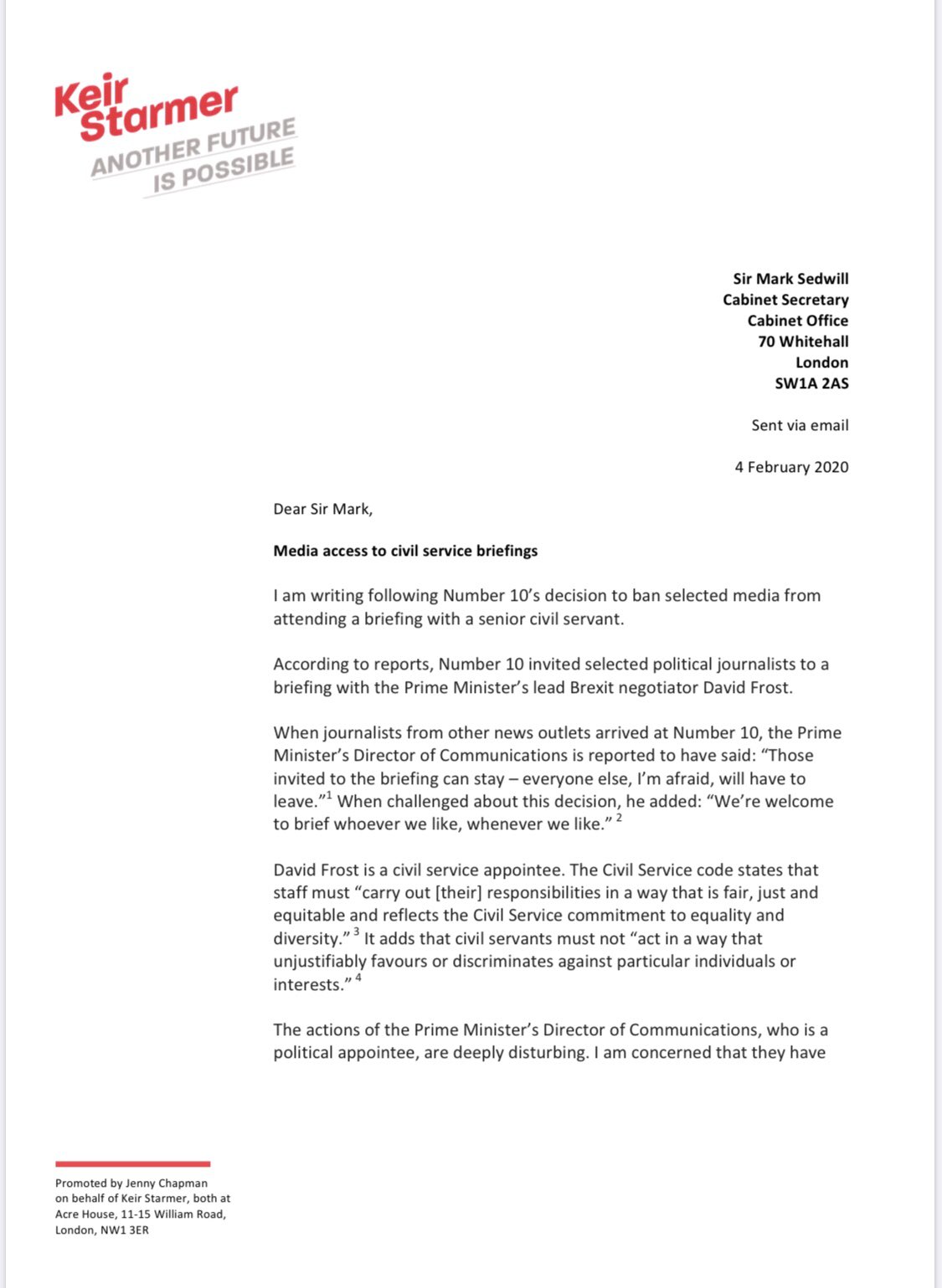
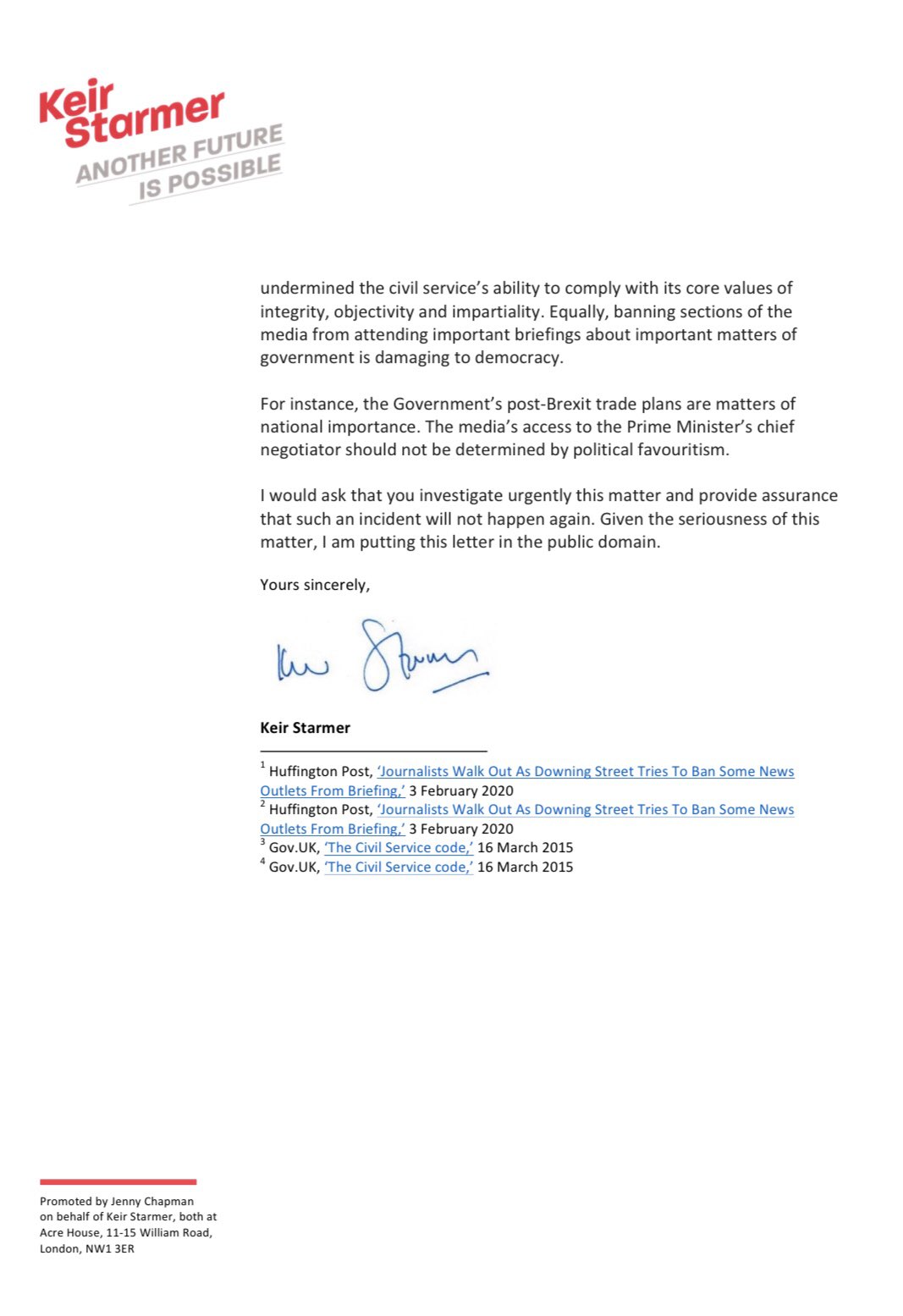
    Below is the letter sent by Keir Starmer, the Labour MP for Holborn and St Pancras, to Sir Mark Sedwill, the Cabinet Secretary, on 4 February 2020.

  • Ursula von der Leyen – 2020 Comments on Draft Negotiating Directives

    Ursula von der Leyen – 2020 Comments on Draft Negotiating Directives

    Below are the comments made by Ursula von der Leyen, the President of the European Commission, on 3 February 2020.

    I am just coming from a meeting with the UK staff of the European Commission. We had a very good continental breakfast. They are very dedicated people, great staff, very keen to work for the European Commission. My basic message to them was: Let us not look back, let us move forward now. There is a new chapter we are opening and let us be progressive with that.

    Today, as you know, the European Commission will propose to the Council the draft negotiating directives concerning our future partnership with the United Kingdom. If we are looking at these topics, one thing is for sure. We know that there is a very close cooperation that we aim at with the United Kingdom. There will be no surprises. We outlined with the United Kingdom already the future parameters we will have in our negotiations in the Withdrawal Agreement. There we are very clear: The draft directives show also that we are very ready to be very ambitious and to negotiate a new partnership unprecedented in scope.

    The draft directives cover a whole range of topics, from trade to mobility, to energy, from law enforcement to judicial cooperation, from foreign policy to security and defence. It shows that there are a lot of files to work on. The most ambitious model that could be there is membership – and this is not relevant right now. There are other models out there. You know we have free trade agreements with Singapore, with Norway, with Canada, with Australia, with Japan. Important is that all the models are an offer and every model comes with a right balance of rights and obligations. They are always together, rights and obligations in each model. There is no such thing like a free ride to the Single Market, it is always rights and obligations in a good balance.

    In any negotiations, both sides will do what is best for them. The European Union will protect of course the interests of our citizens and of the European companies. The Commission will continue to work hand-in-hand with the European Parliament and the Council, and we will stay successfully united, as we have done over the last three and a half years. We know time is short and the road is long, so we kick off the negotiations today.

  • Ursula von der Leyen – 2020 Speech on the UK Leaving the EU

    Ursula von der Leyen – 2020 Speech on the UK Leaving the EU

    Below is the text of the speech made by Ursula von der Leyen, the President of the European Commission, on 31 January 2020.

    Indeed, yesterday, when we were at Bazoches, there was a very nice quote from Jean Monnet, who has said: ‘I am not pessimistic, I am not optimistic, I am determined.’

    I think it goes very nicely with the three of us joining forces. We are not optimistic, we are not pessimistic, we are determined. It was a very good retreat yesterday at Bazoches. We discussed indeed the matters that have been named, mainly also the digitalisation and the European Green Deal.

    We know that digitalisation is happening anyways, so we must harness it and we must shape it. We are convinced that technology sovereignty is consistent with an open market. And it means to build competitiveness with our values embedded in it.

    The same goes for the European Green Deal. We have been discussing the European Green Deal as our new growth strategy towards competitive sustainability. Europe is frontrunner in this topic, and it is not only our European mobilising project, but it also requires that Europe leads in this topic as a global authority.

    Therefore, we thought that we know very well that as the sun rises tomorrow, a new chapter for our Union of 27 will start. And with it comes a once-in-a-generation opportunity to ensure that Europe leads the way on these two twin ecological and digital transformations.

    Indeed, tomorrow, almost half a century of the United Kingdom’s membership of the European Union is over. When the UK joined – I was still at school –, we were 6 Member States. Tomorrow we will be 27 Member States.

    During all these years – 47 plus years –, our Union has gained political impetus and has become a global economic powerhouse. Our experience has taught us that strength does not lie in splendid isolation but in our unique Union.

    Nowhere else in the world can you find 27 nations of 440 million people, speaking 24 different languages, relying on each other, working together, living together. This is not by accident or by chance. This is grounded in centuries of shared history, decades of shared experience and a determination and confidence to shape our common future together.

    Let there be no doubt: The challenges that Europe faces, and the opportunities that it can grasp, have not changed because of Brexit.

    – It is the climate change and the European Green Deal.

    – It is being at the forefront of the digital revolution.

    – It is managing migration in an effective and humane way.

    – It is building strong partnerships across the globe.

    And as part of this, we want to have the best possible relationship with the United Kingdom. But it will never be as good as membership.

  • Boris Johnson – 2020 Statement on UK/EU Relations

    Boris Johnson – 2020 Statement on UK/EU Relations

    Below is the text of the statement made by Boris Johnson, the Prime Minister, in the House of Commons on 3 February 2020.

    This statement sets out the Government’s proposed approach to the negotiations with the EU about our future relationship. Further details on this and other trade negotiations will be made available to Parliament as the process develops.

    The Government wish to see a future relationship based on friendly co-operation between sovereign equals for the benefit of all our peoples. There is complete certainty that at the end of 2020 the process of transition to that relationship will be complete and that the UK will have recovered in full its economic and political independence. The Government remain committed in all circumstances to securing all those benefits for the whole of the UK and to strengthening our Union.

    The question for the rest of 2020 is whether the UK and the EU can agree a deeper trading relationship on the lines of the free trade agreement the EU has with Canada, or whether the relationship will be based simply on the withdrawal agreement deal agreed in October 2019, including the protocol on Ireland / Northern Ireland. In either event the UK will be leaving the single market and the customs union at the end of this year and stakeholders should prepare for that reality.

    The Government will work hard to achieve a balanced agreement that is in the interests of both sides, reflecting the wide range of shared interests. Any agreement must respect the sovereignty of both parties and the autonomy of our legal orders. It cannot therefore include any regulatory alignment, any jurisdiction for the Court of Justice of the European Union over the UK’s laws, or any supranational control in any area, including the UK’s borders and immigration policy.

    This points to a suite of agreements of which the main elements would be a comprehensive free trade agreement covering substantially all trade, an agreement on fisheries, and an agreement to co-operate in the area of internal security, together with a number of more technical agreements covering areas such as aviation or civil nuclear co-operation. These should all have governance and dispute settlement arrangements appropriate to a relationship of sovereign equals.​

    Future co-operation in other areas does not need to be managed through an international treaty, still less through shared institutions. The UK will in future develop separate and independent policies in areas such as (but not limited to) the points-based immigration system, competition and subsidy policy, the environment, social policy, procurement, and data protection, maintaining high standards as we do so. Co-operation on foreign affairs and related issues is of course likely to be substantial, but does not in itself require a joint institutional framework.

    In its negotiations with the EU, the Government will be acting on behalf of the UK Crown dependencies and overseas territories: the whole UK family.

    The UK proposes to agree similar arrangements with the European Free Trade Association states.

    Further information is set out below. Unless otherwise stated, it should be assumed that the UK’s aspiration and level of ambition is to reach agreement on provisions which are at least as good as those in the EU’s recent trade agreements, such as those with Canada or Japan.

    Free trade agreement

    A free trade agreement between the UK and EU should reflect, and develop where necessary, existing international best practice as set out, inter alia, in FTAs already agreed by the EU.

    It should cover the following areas:

    National treatment and market access for goods

    There should be no tariffs, fees, charges or quantitative restrictions between the UK and the EU. There should be a protocol setting out appropriate and modern rules of origin, in order to facilitate trade between the parties to the greatest extent possible.

    Trade remedies

    The agreement should enable the UK to protect its industry from harm caused by unexpected surges in imports of goods or by unfair trading practices, while making the appropriate commitments to transparency, due process and proportionate use of trade remedies.

    Technical barriers to trade

    There should be provisions to address regulatory barriers to trade in goods, providing for co-operation on technical regulation, standards, conformity assessment procedures and market surveillance, building on the WTO technical barriers to trade agreement. Annexes to the agreement could include provisions facilitating trade in specific sectors, such as organic products, motor vehicles, chemicals and pharmaceuticals, as well as mutual recognition agreements focusing on conformity assessment, with full coverage of the relevant sectors.

    Sanitary and phytosanitary measures

    The UK will maintain its own autonomous sanitary and phytosanitary (SPS) regime to protect human, animal and plant life and health and the environment, reflecting its existing high standards. In certain areas it may be possible to agree equivalence provisions to reduce practical barriers to trade at the border.

    Customs and trade facilitation

    Facilitative customs arrangements, covering all trade in goods, should be put in place in order to smooth trade between the UK and the EU. These should ensure that both customs authorities are able to protect their regulatory, security and financial interests.​

    Cross-border trade in services and investment

    Significant provisions on trade in services are an essential component of a comprehensive FTA. Accordingly, the agreement should include measures to minimise barriers to the cross-border supply of services and investment, on the basis of each side’s commitments in existing FTAs. In areas of key interest, such as professional and business services, there may be scope to go beyond these commitments.

    There should be measures to support digital trade, building on the most recent precedents.

    Temporary entry for business purposes (mode 4)

    As is normal in a free trade agreement, the agreement should include significant reciprocal commitments on the temporary entry and stay of individuals, so that both EU and UK nationals can undertake short-term business trips to supply services. This is of course without prejudice to the future points-based immigration system.

    Regulatory framework

    There should be measures that reduce unnecessary barriers to trade in services, streamlining practical processes and providing for appropriate regulatory co-operation.

    Mutual recognition of professional qualifications

    The agreement should provide a pathway for the mutual recognition of UK and EU qualifications, underpinned by regulatory co-operation, so that qualification requirements do not become an unnecessary barrier to trade.

    Financial services

    The agreement should require both sides to provide a predictable, transparent, and business-friendly environment for financial services firms, ensuring financial stability and providing certainty for both business and regulatory authorities, and with obligations on market access and fair competition. Given the depth of the relationship in this area, there should also be enhanced provision for regulatory and supervisory co-operation arrangements with the EU, and for the structured withdrawal of equivalence findings.

    Road transport

    There should be reciprocal commitments to allow EU and UK road transport operators to provide services to, from and through each other’s territories, with associated rights, underpinned by relevant international agreements and commitments, and ensuring the necessary co-operation on monitoring and enforcement.

    Competition policy, subsidies, environment and climate, labour, tax

    The Government will not agree to measures in these areas which go beyond those typically included in a comprehensive free trade agreement. The Government believe therefore that both parties should recognise their respective commitments to maintaining high standards in these areas; confirm that they will uphold their international obligations; and agree to avoid using measures in these areas to distort trade.​
    Agreement on fisheries

    The UK will become an independent coastal state at the end of 2020 and any agreement must reflect this reality. The UK will, like Norway, Iceland and the Faroe Islands, have annual negotiations with the EU on access to waters and fishing opportunities, and will consider a mechanism for co-operation on fisheries matters.

    Agreement on internal security co-operation

    Protection of citizens is the highest duty of any Government. The UK believes it is in the UK’s and EU’s mutual interest to reach a pragmatic agreement to provide a framework for law enforcement and judicial co-operation in criminal matters between the UK and the EU, delivering strong operational capabilities that help protect the public. The detail of such an agreement must be consistent with the Government’s position that the CJEU and the EU legal order must not constrain the autonomy of the UK’s legal system in any way.

    Other areas of co-operation

    The Government believe there is mutual benefit in an air transport agreement covering market access for air services, aviation safety and security, and collaboration on air traffic management.

    The UK is ready to work to establish practical provisions to facilitate smooth border crossing arrangements, as part of independent border and immigration systems, and on social security co-ordination. All such arrangements should be reciprocal and of mutual benefit. The UK is ready to discuss co-operation on asylum, including family reunion, and illegal migration.

    The UK is ready to consider participation in certain EU programmes, once the EU has agreed the baseline in its 2021-2027 multiannual financial framework, and taking into account the overall value to the UK of doing so.

    Finally, there are certain areas where the UK considers agreement is self-evidently in the interest of both sides, and where early progress is a test of the constructive nature of the negotiating process. For example, there should be rapid agreement that the UK and the EU would list each other for trade in live animals, animal products, seeds and other plant-propagating material. There should be rapid progress towards a civil nuclear agreement, given the implications for both sides of not doing so and the clear benefits of co-operation. Similarly, the UK would see the EU’s assessment processes on financial services equivalence and data adequacy as technical and confirmatory of the reality that the UK will be operating exactly the same regulatory frameworks as the EU at the point of exit. The UK intends to approach its own technical assessment processes in this spirit.

    A copy of this statement will be placed in the Library of the House.

  • Michel Barnier – 2020 Speech in Belfast at William J Clinton Leadership Institute

    Michel Barnier – 2020 Speech in Belfast at William J Clinton Leadership Institute

    Below is the text of the speech made by Michel Barnier at the William J Clinton Leadership Institute at Queen’s University in Belfast on 27 January 2020.

    Ladies and gentlemen,

    Vice-Chancellor,

    It is a pleasure to be in Queen’s University, Belfast this evening. And it is an honour to deliver the William Clinton Leadership Lecture. It is a sad day for Northern Ireland. My thoughts are with the friends and family of Seamus Mallon. He played a fundamental role in the peace process. He was one of the architects of the Good Friday (Belfast) Agreement. Queen’s University shares its motto with the city of Belfast:

    “Pro tanto – quid retribuamus”,

    “For so much – what shall we give in return?”

    This captures well the societal responsibility of your university. Your dedication to cutting-edge research is a testimony to that motto. Here, researchers like Dr Joanne Murphy, Professor Richard English, and many others, address some of the world’s biggest societal challenges: food security, cancer, cybercrime, terrorism and conflict. On Brexit, researchers such as Dr Katy Hayward or Professor David Phinnemore have made an important contribution to the debate, in Northern Ireland, in Westminster, and beyond. Thanks to you, Northern Ireland’s unique political, social and economic reality is understood more broadly.

    “For so much – what shall we give in return?”

    Anyone who holds public office should reflect on this question. Including myself, as the EU’s Chief Negotiator for a new partnership with the United Kingdom.

    Over the last three years, I have had the privilege of working with an exceptional team.

    Together, we enjoyed the trust of:

    Former Commission President Jean-Claude Juncker and, now, President Ursula von der Leyen,

    Former Council President Donald Tusk and, now, Charles Michel

    27 united Member States,

    and the European Parliament, first with Martin Schultz, Antonio Tajani, now with David Sassoli.

    With such trust comes a great responsibility: the responsibility to work hand in hand with the elected representatives in the European Parliament, EU leaders in the European Council, ministers and members of parliaments in the Member States. The responsibility to clearly explain our positions to all those affected. The responsibility to engage respectfully with UK negotiators, who represent a great country – one which has been part of the EU for 47 years. We have always stuck to this line: No aggressiveness, no punishment, no spirit of revenge.

    No frustration or impatience when the House of Commons was unable to agree on what kind of Brexit it wanted. We have always respected the ongoing debate in the UK, and we will continue to do so. Lastly, we had – and we still have – the responsibility to encourage a genuine public debate on Brexit: on how it affects the EU and the UK, and in particular Ireland and Northern Ireland.

    This debate hasn’t always been easy. But it is important. People must be aware of the consequences. Because it is absolutely clear that there will be negative consequences. UK Chancellor Sajid Javid recognised last week that parts of industry will face a negative fall-out.

    Whatever agreement we reach on our future relationship, Brexit will always be a matter of damage limitation.

    Not one single person – from the UK or elsewhere – has ever convinced me of the added value of Brexit.

    At least, with the Withdrawal Agreement, which has now been ratified by the UK,we have managed to secure an orderly Brexit – for now. One that limits the destruction of value for our citizens and businesses. This is also our objective going forward.

    I am pleased to be in Northern Ireland again: to explain where we stand in the process and our position going forward, but also to listen and engage.

    This is my third visit to Northern Ireland in my current role. I have been to the border a number of times. I walked on the peace bridge in Derry/Londonderry. I have engaged with politicians of all parties, students, workers and business owners. I’m sure the Northern Ireland Rural Women’s Network in Dungannon remembers how moved I was by my meeting with them. I talk about it often. Because, Brexit is first and foremost about people. I can still hear their words: ‘Never again!’

    Ladies and gentlemen,

    The European Union has always been a peace project. We are reminded of this today on Holocaust Remembrance Day. After years of devastating war and conflict, European integration transformed the meaning of national borders. The genius of the founding fathers of the EU was to focus on open trade and economic exchange as an element of peace, not just prosperity. This was true for France and Germany in the 1950s. It was also true when the Berlin Wall and the Iron Curtain came down.

    The EU gradually became a community of 28 countries, reuniting the continent and breaking down borders. Today, people, goods, services and capital can circulate freely from one Member State to another.

    Ladies and gentlemen,

    The Single Market is much more than a free trade zone. It is an ecosystem that Europeans build together everyday, with: common laws and regulations; common rights and standards for workers and consumers; common standards for the environment; common supervision mechanisms; and, on top of this, a common jurisdiction: the Court of Justice of the European Union.

    It is an ecosystem that the UK contributed to for 47 years. An ecosystem that builds trust between countries – and with it, prosperity, fairness and, most importantly, peace. Once again, the UK contributed a lot to these achievements. And it benefitted enormously from the Single Market.

    That is perhaps why Brexit came as such a shock to so many. In June 2016, 52% of the people of the United Kingdom voted to leave the European Union. Indeed, considerably less here in Northern Ireland, at 44%. But the General election that took place in December 2019 confirmed the UK government’s mandate to ‘get Brexit done’. And so the UK will leave the EU in just four days.

    Ladies and gentlemen,

    Brexit is meant to be about ‘taking back control’. But what else does it mean? It means creating trade barriers that do not exist today. The decision to stop free movement means stopping citizens from moving freely between the EU and the UK to study, work or retire. Brexit is about diverging from EU rules. Rules, developed together with the UK, that protect the public interest, guarantee open and fair competition, and thereby allow frictionless trade. Brexit is meant to be about ‘Global Britain’. But, for us, it is the EU that helps make Member States more global. Even without the UK, the EU forms a Single Market of 450 million people – a truly global market. Our economic power allows us to stand proudly on the world stage; To speak with other superpowers as equals on questions such as the economy, climate change, security and trade.

    There is no way that any of our countries, alone, could have the same impact. Especially as other economic giants emerge around the world. As you can see in this slide: By 2050, no individual European country can expect to be among the global top five economies. Not the UK. Not even Germany. But together, as you see here, the EU27 will remain in the top 4.

    Just a few days ago, Chancellor Merkel compared the EU to a “life insurance” for her country. She recognised that in today’s global environment: “Germany is far too small to exert geopolitical influence on its own”. For that, she said, it needs the Single Market. This is why our Single Market is so crucial to us. And yet, in the UK, it seem that many still believe: That they can leave the EU institutions; Leave the biggest trading bloc in the world; Depart from regulations that they helped to put in place; Without experiencing any negative side effects.

    Ladies and gentlemen,

    Northern Ireland will be the part of the UK most impacted by Brexit. Why?

    Northern Ireland has a specific constitutional and legal set-up. Both in terms of governance, and in terms of cooperation with Ireland. The Good Friday (Belfast) Agreement set up specific cross-community, power-sharing governance structures here in Northern Ireland. Thanks to that, people like David Trimble, John Hume and, of course, Seamus Mallon, Martin McGuinness and Ian Paisley, could find solutions to accommodate the different identities and competing political views across Northern Ireland. This work needed political courage and hard work from politicians across Northern Ireland. They managed, with the help of the Irish and British governments, and notably Bertie Ahern and Tony Blair. And let us not forget the role of others like Bill Clinton, George Mitchell, or Hillary Clinton, this university’s new chancellor.

    The Good Friday (Belfast) Agreement cannot be celebrated enough. It was, and still is, indispensable for progress. The Good Friday Agreement allowed, and still allows, the people of Northern Ireland to identify themselves as British, or Irish, or both – and be accepted as such. You can choose to be British, Irish, very British with a bit of Irish, more Irish than British, Irish and European, British and European. Others might think of themselves as Northern Irish, or Northern Irish and European. Or, indeed, Northern Irish and anti-European.

    This multitude of identities is a distinctive aspect of Northern Ireland.

    Similarly, Stormont is not based on the rule of the majority, but on power-sharing and compromise – an essential element of building peace. And indeed, we missed Stormont during the negotiations on Brexit and Northern Ireland. Although I met with Northern Ireland’s leaders many times in the last years, the requests were always to meet separately, with one party. Never to meet together. This afternoon, I met with Sinn Fein’s Deputy First Minister, Michelle O’Neill, together with the DUP’s Economy Minister, Diane Dodds, representing the First Minister, Arlene Foster. So I am very glad to see the Legislative Assembly restored.

    Finally, I think it is fair to say that the fact that both Ireland and the UK were members of the EU was also very important in bringing stability to the island of Ireland, because they shared the same rules and had a common trade policy. Companies could trade in a frictionless way without checks or customs procedures.

    Ladies and gentlemen,

    Very early on in the withdrawal negotiations, both the EU and the UK acknowledged that the situation in Northern Ireland was unique. That it required a specific solution. A solution that was legally operative and could reconcile the many different interests at play, in particular:

    1. Avoiding a hard border between Ireland and Northern Ireland and preserving the all-island economy in the interest of peace and security;

    2. Preserving the integrity of the EU’s Single Market, and all its guarantees for consumer protection, public and animal health.

    3. Respecting the place of Northern Ireland as an integral part of the United Kingdom’s internal market.

    Of course, finding common ground was not easy. But the EU was tireless in its efforts.

    We listened to Irish, Northern Irish and British concerns. We mapped out North-South cooperation, with the UK. We investigated different options. We went back to the drawing table, various times, to design new measures or to reassure. With Prime Minister Theresa May, we had found an agreement on a UK-wide backstop. This meant the whole of the UK forming a single customs territory with the EU – unless and until a better solution could be found. Many people in Northern Ireland acknowledged the benefits of having a backstop. But there were also fears in Westminster that the UK could get ‘trapped’ in a customs union with the EU for an indefinite period of time, without its own trade policy. Despite reassurances that we enshrined in law, Westminster was not convinced that the EU had no intention of acting in bad faith.

    So, in summer 2019, Prime Minister Boris Johnson asked us to abandon the backstop. He wanted a permanent solution, not a temporary one. One that enables the UK to deploy its own, independent trade policy immediately after the transition period. Again, we showed flexibility and understanding. And we found an agreement.

    Ladies and gentlemen,

    The Protocol on Ireland and Northern Ireland that we have agreed on is indeed complex but operational. It allows Northern Ireland to remain in the UK customs territory and, at the same time, benefit from access to the Single Market without tariffs, quotas, checks or controls.The Protocol is not an insurance policy, but a workable system, built to last. And, importantly, it gives the elected representatives of Northern Ireland’s legislative Assembly the right to decide whether to continue applying the system or not, four years after it starts to apply. I look forward to Northern Ireland’s Executive playing a stronger role on this matter, now that it is up and running.

    Ladies and gentlemen,

    Implementing this new system will be a big challenge, in particular for UK authorities. In agreeing to the Protocol, the UK has agreed to a system of reinforced checks and controls for goods entering Northern Ireland from Great Britain. I understand the fears of negative economic fallout expressed by some about these checks. But Brexit unfortunately has consequences that we must manage. The UK has chosen to become a third country; to leave the Single Market and the Customs Union;

    to leave behind the EU’s framework of common rules, common supervision and common Court of Justice. It has chosen to create two regulatory spaces. This makes frictionless trade impossible. It makes checks indispensable. We will need sanitary and phyto-sanitary checks on food products and live animals. The EU must be able to assess risks on any product coming into its market and, if necessary, activate physical controls. These checks must take place somewhere. And as the whole point of the Protocol is to avoid a hard border and protect the all-island economy, it was clear that they could not take place at the land border between Ireland and Northern Ireland. The only real option was to use Northern Ireland’s other entry points. This is also where such checks are the easiest to implement. And controls will also take place in Dublin and other EU entry points.

    Ladies and gentlemen,

    It is now the EU and the UK’s joint responsibility to make this agreement work on the ground.

    The EU takes this responsibility very seriously. And let’s be clear: We have been creative and flexible in finding a workable solution. But this is a detailed legal text. Now is the time to implement it precisely. The Withdrawal Agreement must be applied with rigour and discipline by all sides. It cannot be re-opened under the guise of implementation. We will be monitoring its correct application very carefully.

    This is also true of the other crucial element covered in the Withdrawal Agreement: namely citizens’ rights.

    Whilst Northern Ireland will no longer be part of the EU, people born and raised here that choose to be Irish citizens will still be EU citizens. This means they can continue to move and reside freely within the EU, The UK has committed to upholding their rights. They cannot be discriminated against on the basis of nationality. And the Withdrawal Agreement will also protect the rights of all British nationals living in the EU, and their families, for life. The Commission will make sure that each and every one of the 27 Member States lives up to their commitment. But we will also be watching closely to make sure that the UK government does the same for the more than 3 million EU citizens residing in the UK. I have already raised the issue with Stephen Barclay, the UK’s Secretary of State for Exiting the EU. And we will continue to be particularly vigilant to this. In particular to the setup of the Independent Monitoring Authority. This body must be truly independent and deal effectively with complaints from Union citizens and their families. The EU will never turn its back on its citizens. And the EU will not turn its back on Northern Ireland, even as it leaves the Union. The PEACE funding programme, which I was responsible for as Commissioner for Regional Policy, since 1995, supports peace and reconciliation and promotes economic and social progress in Northern Ireland and the Border Region of Ireland will continue. This is a sign of our commitment to peace and stability here.You can continue to count on our support.

    Ladies and gentlemen,

    The Withdrawal Agreement settles all aspects of the UK’s divorce from the EU. It also provides us with at least 11 months of continuity. We need this time – and probably much more – to build a new relationship.

    Negotiating the future partnership between the EU and the UK is another huge challenge. A new clock is ticking. 11 months is extremely short. Prime Minister Johnson has said he will not extend this period. This means that the UK will leave the Single Market at the end of this year. This is the UK’s choice. We respect it. And we will do everything we can in the short time that this makes available. Never will it be the EU that fails on common ambition. But this is clearly a unique situation. Since its inception, the EU has been in the business of removing borders. Not creating them. Our aim has been to bring Europeans closer to each other – students, researchers, professionals, employees, entrepreneurs, pensioners. Now, the UK wants a stricter migration policy that may apply to EU and non-EU nationals alike – possibly as early as 2021.

    Similarly, when we negotiate with third countries, our aim is usually to remove barriers to trade.

    We do this by aligning standards and regulations. The EU has even become so good at this that many of its standards and regulations have become the gold standard internationally. Our regulatory influence goes well beyond our borders because of the size of our Single Market.

    Our high standards are the reason why our trade and investment partners trust us. They are a core part of our competitive edge. Aligning with our standards may have a price. But the return is access to our Single Market. Our standards testify to the quality and safety of our products and services: Whether it’s an EU logo on a toy or a Geographical Indication. But they are also a testimony to our dedication:

    to continuously improving working rights,

    to raising environmental standards and leading the fight against climate change,

    to fighting tax fraud and evasion,

    and to ensuring fair and open competition.

    In our joint Political Declaration on our future relationship, the UK agreed that we need common standards to avoid unfair competitive advantages.

    So when it tells us it does not want to align with EU standards and regulations in the future, it is not clear to me where, or by how much, it wishes to diverge: on standards relating to the safety and quality of products? Or on those relating to fair competition?

    It is not clear to me whether, when the UK leaves the EU and the Single Market, it will also choose to leave Europe’s societal and regulatory model. That is the key question, and we are waiting for an answer. Because that answer will be key for our future relationship. I hope that our UK friends are reflecting carefully on this issue. Because the UK cannot expect high-quality access to our Single Market if it insists on competing on State aid, social or environmental standards. I would not want to be misunderstood: Competition between our economies is not a bad thing. Countries compete with each other, also within the Single Market. But competition needs to be based on common high levels of standards to make sure it is fair.

    Once again, the UK is faced with a choice. Our ambition – the EU’s ambition – is to create a close economic partnership: One that is based on a level playing field.That is the only way we will be able to achieve a truly ambitious deal.

    A deal that that benefits both sides.

    A deal that is fair for our workers, for our taxpayers, our businesses and for the planet.

    A deal that – even if it will never match what we have now

    – lives up to our ambition to remain the best of friends and allies.

    And of course, an ambitious partnership cannot be limited to trade, but must also cover our internal and external security and defence policy.

    Ladies and gentlemen,

    It is clear that the negotiations on a future EU-UK relationship will be a prominent focus in 2020. But this will not be our only horizon. We will continue to work on strengthening the EU. Together, as 27, we will continue working to protect our citizens, and to equip them to deal with the challenges of our time.

    Among others, that will involve:

    1.An ambitious new Green Deal that will help to reconcile our economy with the planet, and turn the EU into the world’s first climate-neutral continent by 2050.

    2.We will also do more to support Europe’s most vulnerable as we transition to a clean and digital economy.

    3. We will increase funding for Erasmus so that more Europeans have the opportunity to live, study or work in another EU Member State.

    We know that education and research can be a game changer in tackling some of our biggest societal challenges upfront.

    4. We will step up our efforts to protect our external borders.

    5. And we will deepen cross-border cooperation on security including, where possible, with the UK as a third country to tackle gaps in the fight against serious crime and terrorism in Europe.

    These are just some of the priorities that Commission President Ursula von der Leyen will take forward in the next five years. These are the issues that the EU will focus on as it strives to deliver more for its citizens.

    Ladies and gentlemen,

    “For so much, what will we give in return?”

    We did not create the European Union. We inherited it from our parents and grandparents.

    It has brought us peace, opportunities, regional development and a better understanding of each other. It is now our responsibility to take this project forward, to improve it, to change it, where necessary, and to equip it for the next generations.

    On 1 February, the 27 EU Member States will open a new chapter of their history. They will continue dismantling barriers between themselves. They will do so without the UK.

    But we will be willing to build a close relationship with a country which will remain our partner, our ally, our friend. And in doing so, we will never lose sight of the unique situation on the island of Ireland. Finally, we will continue to engage as widely as possible in a spirit of openness and respect. Allow me to finish on a more personal note. For many reasons, I regret Brexit. I will always continue to believe that we are better off together than alone – especially in today’s world.

    That is why I will remain a patriot of my country and a European at the same time. But I will also always have profound respect for the UK – its people, culture, great leaders and its solidarity with the rest of Europe during its darkest hours. That is why at the beginning of this new chapter of European history, I would really like to wish the UK well. So, thank you for giving me the opportunity to do so here, tonight.