Tag: 2020

  • Jim Shannon – 2020 Speech on Organ Donation

    Jim Shannon – 2020 Speech on Organ Donation

    Below is the text of the speech made by Jim Shannon, the DUP MP for Strangford, in the House of Commons on 19 May 2020.

    Thank you, Mr Deputy Speaker, for allowing me to raise a few thoughts. The House may not be aware that my nephew, Peter, had a kidney replacement when he was a child, and that is one of the main reasons I have avidly supported organ donation. My family would have been devastated had that organ not been donated to save Peter’s life. I also absolutely believe that there must be the ability for someone to opt out if they have their own reasons for doing so, whether those are religious or otherwise.

    I commend the hon. Member for Barnsley Central (Dan Jarvis) for what he has done—we look forward to his contribution—and I commend the former Member, Geoffrey Robinson; I was very happy to support and sign his Bill and we will see some of that become law tomorrow. I thank the Minister for her contribution and for bringing this statutory instrument forward—we are really pleased to see it. I also thank the shadow Minister for his contribution, which was very ably put together.

    I will focus on one aspect of this draft legislation for organ donation. Three million people in the UK have chronic kidney disease, including some 1,000 children, and 65,000 people are being treated for kidney failure by dialysis or transplant. In the UK, 6,044 people are on the transplant list, and 4,737 are awaiting kidneys. That was data from the end of 2019, as the transplant programme is currently part-suspended. At least one person a day will die because they have waited too long. Eight out of 10 people waiting are hoping for a kidney. NHS Blood and Transplant estimated that this change in the law has the potential to lead to 700 more transplants each year by 2030—700 lives that can be changed, and 700 lives that can be saved. This may have to be extended by a year because of the pandemic.

    When kidneys fail, three things happen: dialysis, a transplant or death. Dialysis is distressing and demanding, with four to five-hour sessions three days a week and dietary and fluid restrictions. Many of my constituents have had to go through this, as my nephew did for a period of time. People are often unable to continue to work. Families and relationships are strained and depression is common. It has been reported that the levels of pain are equivalent to those of people with terminal cancer. Patients are exhausted, with aching bones, reduced mobility and constant itching. A transplant is transformational in restoring quality and quantity of life, and we recognise the selfless generosity of organ donors, both living and deceased. We commend NHS Blood and Transplant on its achievements; more than 50,000 people are alive with transplants in the UK.

    Kidney transplantation is also economically beneficial. I know that it is not always a good thing to look at the economics and the financial aspect, but a transplant has a cost of £5,000 per annum, compared with a cost of £30,800 per annum for dialysis, so there is a financial factor that we need to bear in mind.

    I am so pleased that this SI means that even during this crisis we are continuing and prioritising the ability to donate kidneys and other organs. I congratulate the Government, the Minister and the Opposition on pushing this issue. There were 28 transplants in Northern Ireland last month, so I pay tribute to the team there. This legislation is tremendous news and I hope that the ​Northern Ireland Assembly will follow the lead of this place on the opt-out issue. The figures for transplants in Northern Ireland were way above and beyond what they normally are, so again this shows the good that can happen as a result of where we are.

    We are pleased to see this legislation, but is clear that there must not be an end to the duty of care. We must also be sure to invest in new technology. There are new machines which, I am told, have shown great promise in preserving or even reconditioning donated organs. That must be investigated by the Department. Will the Minister, in her summing up, give the House some indication of how that will work and an update on those new machines and any other innovations in medicines for the future?

    It is also imperative to ensure that regular monitoring is carried out and that the impact of the new law is reported back to the House. Again I look to the Minister for those assurances, because we will doing this from tomorrow, and the House will need to know how it is progressing and whether we are achieving the figures and stats that we should be achieving. It is also essential that we have education for healthcare staff and the public. Increasing transplantation requires appropriately trained staff working with families, who will still need to allow a donation to take place. This will require comprehensive, consistent and continuous education for members of the public and healthcare staff, and these things need to happen as soon as is practicable. Previously agreed funding for NHS Blood and Transplant’s work should be made available for this work, and I ask the Minister for an update on where we are in relation to that.

    Adequate system capacity is needed to permit transplant procedures, as well as a culture that sees organ donation as the norm. I would love to see that happening. Perhaps after tomorrow we will see some of that taking place. There were already concerns, prior to covid-19, about pressure on theatre space, equipment and staff to cope with an increase in organ availability, including specialist organ donation nurses to support bereaved families. Modelling for the estimated additional transplants has been done, and NHS trusts have been asked to plan accordingly. That will need to be revisited as trusts emerge from the current crisis, and I am sure that the Minister will be all over that. In order for organ donation to be able to continue in the covid-19 age, support and discussion with bereaved families must be facilitated more than ever. We welcome the strengthened role for families in the code of practice, and we thank the Minister for bringing that forward. Technology must be harnessed to aid those vital conversations.

    I concur with the shadow Minister’s comments about BAME communities. Covid-19 has brought the need to address the health inequalities faced by BAME communities into sharp relief. There is too much inequality in transplant deaths. In 2018, 21% of the people who died waiting for a transplant were from black, Asian or minority ethnic groups. People from BAME communities wait six months for an organ despite being more at risk of kidney failure, because fewer organs are available from donors in those communities. There is a higher chance of a successful transplant if the organ comes from an individual from the same ethnic background, and it is important that those groups are the particular focus of awareness campaigns. Will the Minister give us her thoughts on that as well?​

    We welcome the revised codes of practice having a greater focus on faiths and beliefs. We believe that that will support better conversations and give greater assurances to families when a potential donor’s faith or belief is an important part of that decision making. It is important that we have that, and we thank the Government for putting it into the code of practice.

    I was pleased by the outcome of the consultation on the organs—[Inaudible.]—that deemed consent should apply to so-called routine transplants only, and that any rare or novel transplants should be subject to explicit consent. The statutory instrument is therefore limited. What we are talking about are routine transplants for heart, lung, liver, kidney, intestinal organs, small bowel, stomach, abdominal wall, colon, spleen or cornea.

    This SI is important. I absolutely agree with Kidney Care UK when it says that our NHS staff will be exhausted and that resources have been stretched by the pandemic and are likely to be for some time. However, we urge efforts to take forward implementation at the appropriate time to give renewed hope to patients waiting for a life-transforming transplant. We say thank you so much and well done to the Minister, her team and everyone concerned.


  • Alex Norris – 2020 Speech on Organ Donation

    Alex Norris – 2020 Speech on Organ Donation

    Below is the text of the speech made by Alex Norris, the Labour MP for Nottingham North, in the House of Commons on 19 May 2020.

    I have to say that I am used to clearing rooms when I start speaking, but this is quite impressive even by my own standards. Nevertheless, it is a privilege to make my debut at the Dispatch Box as shadow public health Minister on a topic as important as this one. Currently, everything we are addressing is a matter of life and death, but when we are talking about critical transplants, that could never be clearer.

    I thank the Minister for everything she is doing during this crisis, not only on this particular issue but on everything related to protecting us from the coronavirus. She and her ministerial colleagues are working around the clock and have been doing so for weeks; we appreciate that.

    This is my first opportunity to express publicly in this place my thanks to our NHS and social care staff for all the wonderful things that they are doing in my community and communities up and down the country to keep us as safe as possible.

    We clap with you on a Thursday, but we think about you always and we are really grateful for everything you are doing.

    The transplant of organs and human tissue changes and saves lives. It brings hope, it can bring happiness and it is the ultimate altruistic act. The Organ Donation (Deemed Consent) Act 2019 promises a significant breakthrough in the ability to save and change lives. Those who campaigned for it spotted the public mood and understood the British people on this issue. However, a key part of understanding that fundamental desire of the British people to do well by each other is to understand that this change has to hold within reasonable limits. It is therefore right that we are completing the process today and setting out clearly the sort of tissue that goes beyond routine transplantation. That is a critical part of maintaining public confidence in the process.

    The Opposition supported the Act during its progress and we support the regulations before us today. We have many people to thank for last year’s Act. I will start by thanking Geoffrey Robinson, the former MP for Coventry North West, for introducing the Bill. His legacy in this place is significant on a number of issues, and this legislation will certainly have long-lasting and far-reaching implications. I also thank my hon. Friend the Member for Barnsley Central (Dan Jarvis) for taking up the baton in 2019 and getting the legislation over the finishing line—he continues to be an excellent champion of the Act, and I think we will hear from him shortly—and, in the other place, the noble Lord Hunt for his stewardship of the legislation.

    Of course, I also pay tribute to Max Johnson and Keira Ball, after whom the Bill was known. Keira tragically died in a road accident, but her heart saved Max’s life at age nine, after an eight-month wait. They are truly inspirational and a huge part of why we are here today, as indeed is everyone who supported the campaign, not least the Daily Mirror and its readers. Each and every supporter has helped to bring us here today to do this important job.​
    It is impossible to talk about anything, especially anything health related, without referencing the coronavirus outbreak and its effect on all aspects of our lives. However, it is particularly pertinent when we talk about transplants, so I will touch on it now before getting into the substance of the regulations. From 1 April to 10 May, 155 transplants took place in the UK from deceased donors. In the previous year, that figure was 404, a drop of more than 60%. There have been no transplants at all from living donors, which usually make up close to a fifth of the total, and current waiting list figures will not accurately reflect the need that may have been created for organ transplant due to the pandemic, which will only cause greater strain in future months.

    I do not say these things to criticise the Government. Kidney transplants are the most common form of transplants, and in answer to a written question, the Minister for Care shared with me the fact that the early data show that both dialysis patients and those who are immunosuppressed through a transplant are more vulnerable to covid-19. The fact that transplants have been taking place at all therefore suggests that decisions are being made on the balance of need and on a case-by-case basis, an approach that I think we would all support. However, we know that, as the Minister said, patients were dying on the transplant waiting list even before the outbreak because the supply of donor organs failed to meet the demand. Fewer transplants quite simply means that the mortality rate will increase.

    What assessment has the Minister made of the impact of covid-19 on the mortality of patients waiting for transplants, and what plans do the Government have to deal with the increasing backlog? I have raised this issue with her colleague, the Minister for primary care and public health, in relation to cancer and have not yet heard clear answers. We need to know what efforts the Government will be making to deal with the bubble challenges that will be coming through the system in future weeks and months. The Minister in the other place talked yesterday about a tremendous effort to restore transplant services. Will this Minister take the opportunity today to outline what the recovery plan is likely to look like and what the timeframes will be?

    At the beginning of the coronavirus crisis we all talked of it as a great leveller and said that the virus would not recognise our differences, but we have seen in the weeks and months since just how much that is not the case. The coronavirus has exposed what many Opposition Members have said for many years. Britain is an unequal country, across regions, across gender and across protected characteristics. These inequalities are terrible for our nation’s health, and tackling them must be a post-covid priority.

    The black, Asian or minority ethnic community suffers particularly when it comes to transplants. In 2018, 21% of those who died waiting for transplants were from a black, Asian or minority ethnic group. There is a higher chance of a successful transplant if the organ comes from an individual of the same ethnic background, but that means that those from black or Asian backgrounds currently wait six to 11 months longer for an organ match. This inequality will not do, and there have to be practical things to change it, starting immediately. The culture change that the Minister talked about is at the heart of that—us all having those conversations with our loved ones—but we know that we have to be doing ​something specifically different to reach those communities experiencing the most unequal outcomes. For that reason, I would like to press the Minister on something her colleague in the other place said yesterday. He said that the Government would be following up with an awareness campaign aimed at BAME audiences. Can the Minister give a firm commitment today that this will take place, tell us when it might happen and critically—I had this conversation frequently during my time in local government—confirm that it will be developed by BAME communities, rather than on their behalf? If it is to be effective, it will have to be different from how it has been in the past.

    A key aim of the 2019 Act, which the regulations will, I hope, supplement today, was to reach an 80% consent rate in England. This will take time but certainly seems possible. In Wales, where the opt-out mechanism was implemented by the Welsh Labour Government in 2015, the consent rate has risen from 58% to 77%. In England, we start from a base line of 67%, so we are better placed, and if we reach the target, we are talking about as many as 700 more transplants a year—700 lives that can be extended, transformed or saved. The Minister has been challenged on the timing of the regulations—I have reflected on that question myself—but that number seems a strong reason to push on. As she says, the recent weeks and months have shown us how precious human life is and that we should not waste moments if we can improve lives.

    Yesterday, the noble Lord Bethell told the other place that the restoration of all transplant services would include training nurses on the new law as soon as possible after they return. I would be keen to know a bit more about that. It was not something we had heard of before, and we would want a sense of the scale of that and the precise timeline the Government are expecting.

    As I said, the Opposition are happy with the regulations as laid, but I seek to make three points. First and foremost, we agree that deemed consent should only apply to routine transplants. This is a matter of ensuring that public policy going forward matches the public’s expectation. I share the Government’s view that this would not reflect rare or novel procedures, including to create advanced therapy medicinal products, taking place without explicit consent. I will reflect on those ATMPs in a couple of seconds.

    Secondly, I welcome the Government’s response to the consultation on the statutory instrument. Following the responses received, they have rightly revised the regulations with additional clarifications on tissues from sexual and reproductive organs, which will not be subject to deemed consent. That is particularly welcome. It is nice—I dare say even novel—to see a Government consultation leading to such concrete changes. It is a good thing and long may it continue.

    Thirdly, the Government indicated in their response to the consultation that they do not expect the list of accepted tissue to need regular updates, and I agree with that in principle. The Minister mentioned how a process might happen if things were to be revised later, but I would like to understand a bit more about what would have to change for her to start such a process.

    On those rare and novel transplants, it is important that public policy matches what people expect from the legislation, but we should be proud that the UK leads the world on such transplants. It is a good sign of the ​health of our country in this regard. They are not currently included under deemed consent, but developing these new technologies and techniques enables us to save more lives. We lead the way in both development and implementation. We have pioneered the OCS—organ care service—heart system, a portable device that can preserve a donor heart in a near-normothermic beating state until it is transplanted, which is currently being used in three heart transplant centres in the NHS and is being introduced in a fourth. We have also shown that abdominal organs can be assessed and their function improved using normothermic regional perfusion technology. As is the aim with this legislation, these developments can save lives, and we should be proud of that, but we should not rest on our laurels, so could the Minister reaffirm the Government’s commitment to continuing the UK as a leader in this regard and to providing the necessary funding to transplant units to ensure they can take advantage?

    I turn now to resources, because what we are agreeing today, though very important, will have resource implications for us to pick up. An increase in the number of transplants will necessitate increased support for families who lose loved-ones. It is a difficult and emotional experience for them, and they will require high-skilled care and support, so what extra support will be available for them as these numbers increase?

    Similarly, we will need specialist nurses for donation, not just for the direct care but for the implementation, providing advice and support to families and playing the vital role of determining what the deceased’s last known decision was, so that no procedures take place without the appropriate consent. As I say, the Minister in the other place yesterday mentioned specialist training. Could the Minister here today expand further on that?

    I welcome the Government’s commitment to ensure that there are enough staff to do this. Will the Minister also commit to providing the additional funding required to ensure that the required increase in specialist nurses continues in line with the increase in transplants, so that they are not having to be begged or borrowed from other parts of the service?

    We support these regulations. This is the next staging point in a really important journey. It will make a difference to hundreds and hundreds of lives—lives of people who are completely unaware that these discussions are even taking place today, not knowing that they will need this. This is the right thing to do and the right time to do it, and we support the regulations.

  • Helen Whately – 2020 Statement on Organ Donation

    Helen Whately – 2020 Statement on Organ Donation

    Below is the text of the statement made by Helen Whately, the Minister for Care, in the House of Commons on 19 May 2020.

    I beg to move,

    That the draft Human Tissue (Permitted Material: Exceptions) (England) Regulations 2020, which were laid before this House on 25 February, be approved.

    Before I explain the draft regulations, I would like to say a few words about why we are changing the law on organ donation. Today more than 5,000 people in England are waiting for a transplant, but, sadly, by the time a suitable organ is found some people will have become too ill to receive one. Tragically, last year alone 777 patients were removed from the transplant list and 400 died waiting for a transplant. There is no option but to take decisive action to address the acute shortage of organs and save the lives of those waiting for a transplant. That is why we passed the Organ Donation (Deemed Consent) Act 2019, which amends the Human Tissue Act 2004 and sets up the new system of consent for organ and tissue donation in England, which is known as “deemed consent” or “opt-out”.

    I wish to thank the hon. Member for Barnsley Central (Dan Jarvis), my hon. Friend the Member for South Basildon and East Thurrock (Stephen Metcalfe), my right hon. Friends the Members for Maidenhead (Mrs May) and for South West Surrey (Jeremy Hunt), a previous Member of this House, Geoffrey Robinson, and Lord Hunt of Kings Heath for their work and support, which has got us to where we are today. They all started this journey for us showing immense leadership, and they continue to show their strong commitment to this cause.

    Subject to approval of these regulations, we aim for deemed consent to become legal on 20 May. While not many transplants are taking place earlier, during the peak of covid-19, NHS Blood and Transplant has already started the recovery process to get transplant units up and running as much as possible. Guidance on how best to restart or extend the transplant service was sent by NHSBT to all transplant units on 26 April. A letter was then sent on 1 May to all trusts with transplant units, asking them to actively review the situation where transplant units have reduced their services.

    To illustrate the progress that is being made to get the transplant system up and running again, on a normal day NHS Blood and Transplant would have received about 55 referrals of a potential donor and would aim for five actual donors, and it would carry out about 70 transplants a week. During the peak of the pandemic, there were days when there were no referrals, many days when there were no donors, and many days when there were no transplants. As of last week, there have been 167 referrals, 11 donors and 38 transplants. Continuing the tremendous effort to restore all transplant services will enable us to reap the benefits of the deemed consent legislation as soon as possible; by “benefits” I mean save the lives of people waiting for transplants.

    I understand that some have disagreed with the timing of going ahead with this law, but we assessed the impact of going ahead with deemed consent very carefully. This horrific pandemic taught us a lot about how precious ​human life is, and we know that the fight against it will continue for some time, while thousands of people will still be waiting for a transplant. I therefore believe very strongly that we have a duty now, more than ever, to push ahead with measures that will reduce human suffering and help people to improve their quality of life. That is exactly what this law does.

    We are of course fully aware that public confidence is important. The deemed consent legislation was first introduced to the House in July 2017, and became law in March 2019, so it has had a long process of parliamentary scrutiny, alongside three public consultations. The Government have been raising awareness of the law and the choices available for over a year, and the 20 May implementation date has been used actively in communications since late February. Putting this legislation on hold would increase the anxiety of thousands of people, who see this law as their only hope to get a new lease of life, and would confuse the communications that have already been in the public domain for some time.

    From the outset, we have been clear that deemed consent would apply only for routine transplants, to increase the number of organs and tissues available and help those that are on a waiting list. Examples of routine transplants are heart, kidneys or lungs. Novel transplants will still require express consent. The organs and tissues specified in the regulations are included because they could be used for non-routine transplants, such as a face transplant. Such transplants are outside the scope of what we want to achieve. Demand for novel transplants is very low, and people would not normally identify organ donation with them.

    During formal scrutiny of the regulations, the Joint Committee on Statutory Instruments cleared the regulations with no comments. Meanwhile, the Secondary Legislation Scrutiny Committee drew the regulations to the attention of the House, and this is testimony to how integral the regulations are for making the new system of consent work, and how important the law change will be when it is introduced.

    Let me now discuss the detail of the regulations. The Organ Donation (Deemed Consent) Act 2019 sets out that deemed consent to transplant activities in England will apply only to permitted material. The Secretary of State has a delegated power to specify in regulations what relevant material—meaning, what organs, tissue and cells—will be excluded from the system of deemed consent. To clarify, the organs, tissues and specific cells that are listed in the draft statutory instrument are organs, tissues and cells that cannot be transplanted without express consent being in place, as that would be a novel transplant.

    Regulation 2(2) sets out the detailed list of organs and tissues that will require express consent in order to be transplanted under all circumstances—such as the brain, spinal cord and face. As a result of our consultation, we expanded the list of reproductive organs and tissues in this regulation, to provide clarity and put it beyond doubt that removing any parts of a reproductive organ will require express consent in all cases. This is to ensure that if and when such transplants are carried out in future in the UK, they will be outside the scope of deemed consent.

    Regulation 2(3) sets out that some relevant material—for example, skin or bone—will require express consent if used for a novel transplant, but not if used for a routine ​transplant. This is to ensure that current practices for tissue donation, under which tissue from a leg, for example, is removed routinely, are not disrupted by deemed consent. So, although a leg transplant would require express consent, if only the skin from a leg is taken, deemed consent may apply; however, if tissue is required from reproductive organs, this will always require express consent. That addresses the feedback from our consultation.

    Regulation 2(4) allows for the trachea to be removed under deemed consent when it is attached to the lungs. This is to allow routine heart and lung transplants, which also require the trachea to be removed with the heart and lungs, to continue under deemed consent. However, the trachea is also listed in regulation 2(2), as trachea transplants by themselves are novel and therefore excluded from deemed consent.

    Regulation 2(5) excludes the removal of certain cells if they are to be used for advanced therapy medicinal products—also known as ATMPs—which are therapies made from tissue cells or genes after manipulation in a laboratory. They are used for treatment of a disease or injury, and often use human tissues and cells as starting materials. For example, an ATMP can treat knee damage by taking cartilage cells from a living patient, growing and modifying them in a lab, and re-injecting them into the patient’s knee.

    ATMPs are an exciting technology, and new therapies are being developed all the time. Current ATMPs are being developed using tissue and cells taken from living donors, but it is also possible to use material from deceased donors to develop novel ATMPs. As such ATMPs are novel, we want to make sure that the donation of such cells cannot happen without express consent being in place. Our consultation raised questions about the public’s understanding of such novel technologies, so we want to ensure that express consent is required.

    Now that I have set out the detail of the regulations, I must highlight that before deciding whether a change to the regulations would be needed in future, the Government would need to consider evidence, public acceptability and clinical need, guided by recommendations from NHSBT’s advisory group research and innovation in transplants. Any changes would need to be approved by Parliament, following the same procedure as we are now, so Parliament would have full oversight. The regulations restrict deemed consent to routine transplants, so they continue current practice, under which express consent needs to be in place for non-routine transplants. There is no additional cost to the health system, so no impact assessment has been prepared.

    In conclusion, I am glad that I am able to present these regulations to the House today. They are an important part of the implementation of the 2019 Act, as they prevent deemed consent from applying to novel transplants. The new system of consent will help to save and improve the lives of many people waiting for a transplant. Donating organs is one of the greatest gifts a person can give. I urge everybody to talk to their families and their loved ones about their wishes. I am proud that all of us present are playing a part in making something positive happen in these very challenging times. I commend the draft regulations to the House.

  • Matt Hancock – 2020 Statement on the Coronavirus

    Matt Hancock – 2020 Statement on the Coronavirus

    Below is the text of the statement made by Matt Hancock, the Secretary of State for Health and Social Care, on 26 May 2020.

    Good afternoon and welcome to Downing Street for the daily coronavirus briefing.

    I’m joined by Professor John Newton, our test and trace coordinator.

    Before I provide an update on the work we are doing to combat coronavirus, I’d like to update you on the latest figures.

    In total, 3,681,295 tests have been carried out in the UK, including 109,979 tests yesterday;

    265,227 people have tested positive, that’s an increase of 2,004 cases since yesterday.

    Sadly, of those who tested positive for coronavirus, across all settings, 37,048 people have now died. Yesterday, across the UK, 134 deaths were reported.

    But for the first time since 18 March, I am very encouraged to confirm that yesterday there were no deaths from coronavirus recorded in Northern Ireland.

    I want to pay tribute to Robin Swann, my opposite number, and all of those across the NHS and public health in Northern Ireland, and the people of Northern Ireland who have shown such resolve to be able to bend the curve down and thank them for all the work they have done.

    While the news might not be this positive every day, I look forward to continuing to work with them to keep the virus under control in Northern Ireland.

    Today’s figures from the ONS show across the UK as a whole, the lowest number of deaths from coronavirus for six weeks.

    This is a national endeavour. And whatever the headwinds, as a country we can’t let up on this.

    We are past the peak. We’re flattening the curve. We protected the NHS and the number of deaths is falling. We must keep our resolve.

    I just want to say a massive thank you to everybody, over the Bank Holiday weekend, who stuck to the social distancing rules.

    And to especially my colleagues in the NHS and in social care who are doing so much.

    Even though we are through the peak, there are still 8,802 people in hospital with coronavirus in the UK.

    And there are still 98 NHS colleagues in hospital with coronavirus, including some of whom who are seriously ill.

    So we must maintain our focus. And there are two areas I’d like to provide an update on today. PPE, and treatments. Both incredibly important for the future of tackling this disease – PPE and treatments.

    PPE

    First, we have been working hard to build our supplies of personal protective equipment.

    I know how important this is, especially to colleagues on the frontline.

    We all heard in the early weeks of this crisis, the calls from the frontline for more, and better PPE.

    And we all saw the global scramble to acquire it.

    I have been completely open about the scale and the difficulties of this challenge – building a new supply chain from scratch and of course the operational challenge of delivery.

    General Sir Nick Carter, Chief of the Defence Staff, said it himself – this is the single greatest logistical challenge he had faced in 40 years of service.

    And in response, thanks to the Armed forces and so many others, including so many in the NHS, we have seen a mammoth effort.

    We have ramped up domestic production. And I can announce that we have now signed contracts to manufacture 2 billion items of PPE here in the UK.

    I set a national challenge here. And I’m absolutely delighted that Lord Deighton has stepped up and is helping us to deliver it.

    Around the world, we have signed deals with over 100 new suppliers, including agreeing contracts for a further 3.7 billion gloves.

    Whilst we continue to improve the logistics, and work hard to get everyone the PPE they need, these new supplies mean we are not simply keeping up with demand – but are able to begin to replenish our stockpiles.

    There is a lot further to go on PPE, as on so many things, but we have made significant progress, and I’d like to thank everyone involved.

    And PPE is of course so important as it’s about protecting the people who protect us. We will do that for as long as this virus remains on our shores.

    Research and development

    Next, I wanted to update you on some of the remarkable R&D into treatments that is taking place all across the UK.

    One of Britain’s greatest strengths is our life sciences and research. And we are leading the world in the clinical trials being done here.

    As I said at this podium last week, the very nature of scientific enquiry means that not every project will bear fruit.

    But I am determined that we will explore every possible avenue.

    The RECOVERY trial is the world’s largest trial of potential coronavirus treatments.

    And because our NHS is a universal system, which we are all part of, we have some of the best data and can do some of the best research.

    Today I can announce that we are beginning a new trial, for selected NHS patients, of an anti-viral drug, called remdesivir.

    There have already been some promising early results on coronavirus patients, with early data suggesting it can shorten recovery time by about around four days.

    As you can understand, we will be prioritising the use of this treatment where it will provide the greatest benefit. This is probably the biggest step forward in the treatment of coronavirus since the crisis began.

    These are very early steps. But we are determined to support the science, and back projects that show promise.

    I’d like to thank the NHS, the MHRA, the devolved administrations because this is UK-wide, and Gilead the pharmaceutical company, for their work in making this happen.

    After all, it is worth remembering that in the battle against this virus, we are all on the same side.

    So we will keep working across the world to develop the vaccines and the treatments – and indeed the vaccines – that will help us turn a corner.

    But until a treatment or a vaccine comes good, there is no simple way to defeat this virus.

    So we must not lose our resolve.

    So please – stay alert, control the virus and save lives.

  • Joint Statement from Opposition Leaders on Behaviour of Dominic Cummings

    Joint Statement from Opposition Leaders on Behaviour of Dominic Cummings

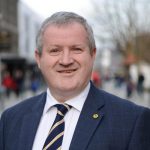
    The below letter was issued jointly by Ian Blackford from the SNP (pictured above), Sir Ed Davey from the Liberal Democrats, Liz Saville Roberts from Plaid Cymru, Colum Eastwood from the Social Democratic and Labour Party, Caroline Lucas from the Green Party and Stephen Farry from the Alliance Party, on 26 May 2020.

    It is now a matter of record that Mr Dominic Cummings broke multiple lockdown rules.

    He is yet to express any apology or contrition for these actions. There cannot be one rule for those involved in formulating public health advice and another for the rest of us.

    This is an issue that transcends politics. It has united people of every party and political persuasion, who believe strongly that it is now your responsibility as Prime Minister to return clarity and trust in public health messaging.

    We are clear that this can now only be achieved by removing Dominic Cummings from his post without further delay.

  • Boris Johnson – 2020 Statement on the Coronavirus

    Boris Johnson – 2020 Statement on the Coronavirus

    Below is the text of the statement made by Boris Johnson, the Prime Minister, on 24 May 2020.

    Good afternoon.

    I want to begin by answering the big question that people have been asking in the last 48 hours. And that is – is this Government asking you – the people, the public, to do one thing while senior people here in government do something else?

    Have we been asking you to make sacrifices, to obey social distancing, to stay at home while some people have been basically flouting those rules and endangering lives?

    And it is because I take this matter so seriously and frankly it is so serious that I can tell you today I have had extensive face to face conversations with Dominic Cummings and I have concluded that in travelling to find the right kind of childcare, at the moment when both he and his wife were about to be incapacitated by coronavirus. And when he had no alternative, I think he followed the instincts of every father and every parent. And I do not mark him down for that. And though there have been many other allegations about what happened when he was in self-isolation and thereafter, some of them palpably false.

    I believe that in every respect he has acted responsibly, and legally, and with integrity, and with the overwhelming aim of stopping the spread of the virus and saving lives.

    And I stress this fundamental aim, because it is thanks to this country’s collective resolve in achieving that aim that we continue to make progress.

    So let me give you today’s figures:

    3,458,905 tests for coronavirus have now been carried out in the UK, including 110,401 tests carried out yesterday

    259,559 people have tested positive, that’s an increase of 2,409 cases since yesterday – a smaller increase than we were seeing over the last few weeks

    8,951 people are in hospital with COVID-19 in the UK, down 11% from 10,085 this time last week

    And sadly, of those tested positive for coronavirus, across all settings, 36,793 have now died. That’s an increase of 118 fatalities since yesterday.

    And each of those fatalities represents a family in mourning, the grief of friends and relatives. And as we mourn them we resolve again to beat this virus and get our country back on its feet. We can and we will.

    Two weeks ago I set out the Government’s roadmap to begin easing the measures we put in place to control the spread of coronavirus.

    I said that we would do so in a safe and controlled way, based on our assessment of progress against the five tests we set for adjusting the lockdown.

    We’re going to set out that assessment in detail in the coming days, but today I can confirm that I do believe we will be in a position to move to step 2 of our plan.

    As part of Step 2, we set out plans for a phased reopening of schools.

    Because the education of our children is crucial for their welfare, their health, for their long term future and for social justice

    And so in line with the approach being taken by other countries, we want to start getting our children back in the classroom in a way that is manageable and as safe as possible.

    So we said this would begin with early years settings and reception, Year 1 and Year 6 in primary schools.

    Today I can announce that it is our intention to go ahead with that as planned on June 1st, a week on Monday.

    We then intend, from June 15th, for secondary schools to provide some contact for Year 10 and Year 12 students to help them prepare for exams next year, with up to a quarter of these students in at any point.

    By opening schools to more pupils in this limited way, we are taking a deliberately cautious approach.

    And this comes after a constructive period of consultation with schools, teachers and unions, led by the Education Secretary Gavin Williamson.

    I want to thank all the Education and childcare staff who have stepped up to the challenge and kept schools open throughout this crisis.

    The Department for Education will engage with teaching unions, local authorities and school leaders in the coming days, giving them an opportunity to ask questions and probe the evidence behind our plans.

    And the final decision will be taken as part of the formal review into lockdown measures which the law requires us to undertake by Thursday. We will of course continue to consider all the evidence (as we said we would do), and will continue to work hard with those bodies over the course of the coming week.

    However, I think it is important for us to be clear about the Government’s intentions now, so that teachers and parents can plan in earnest for schools to reopen a week on Monday.

    Now I acknowledge that a 1 June opening may not be possible for all schools, but the Government will continue to support and work with the sector to ensure that any schools experiencing difficulties are able to open more widely as soon as possible.

    Detailed guidance has been published by the Department for Education on how schools can open in a way which is safe for children, teachers and parents.

    While of course we recognise that full social distancing may not be possible, especially when teaching young children, our guidance sets out a range of protective measures to keep children and staff safe. This includes:

    reducing the size of classes and keeping children in small groups without mixing with others

    staggered break and lunch times, as well as drop offs and pick ups

    increasing the frequency of cleaning, reducing the used of shared items and utilising outdoor space

    All children and staff, and their families, will have access to testing if they display symptoms. This will enable children and staff to get back to school if they test negative, and if they test positive we will take the appropriate reactive measures.

    We will continue to work with the sector to support them to prepare for wider opening and ensure all children and young people can continue to receive the best care, education and training possible.

    We will set out what moving to step 2 means for other areas, such as non-essential retail and more social contacts, over the course of the next week.

    And let me stress once again: we are making good progress.

    But that progress is conditional, provisional.

    We must keep reducing the incidence of this disease.

    We must keep that R down below 1.

    And that means we must remember the basics.

    Wash our hands, keep social distance, isolate if you have symptoms – and get a test.

    We are beating this thing, but we will beat it all the faster if we stay alert, control the virus and save lives.

  • Boris Johnson – 2020 Statement on the Coronavirus

    Boris Johnson – 2020 Statement on the Coronavirus

    Below is the text of the statement made by Boris Johnson, the Prime Minister on 25 May 2020.

    Good evening and welcome to the Number Ten Coronavirus Press Conference

    Before I turn to this evening’s announcements, I want to update you on the latest data

    3,532,634 tests for coronavirus have now been carried out in the UK, including 73,726 tests carried out yesterday;

    261,184 people have tested positive, that’s an increase of 1,625 cases since yesterday;

    8,834 people are in hospital with COVID-19 in the UK, down (12%) from 10,092 this time last week;

    And sadly, of those who tested positive for coronavirus, across all settings, 36,914 have now died. That’s an increase of 121 fatalities since yesterday. This new figure includes deaths in all settings not just in hospitals.

    And once again my deepest condolences go out to all those who have lost their loved ones before their time. We must not, and will not, forget them.

    Two weeks ago, I set out our road map for the next phase of our fight against Covid 19.

    It is a cautious plan, informed by the evidence about what is safe, and conditional upon our continued progress against the virus.

    And we are making progress. Thanks to this country’s collective efforts, the key indicators are heading in the right direction. The daily number of deaths is down, the number of new cases is down, our survey evidence suggests the infection rate is falling, and the R has not risen above one.

    So just over 2 weeks ago, we moved to step 1 of our plan, encouraging those who are unable to work from home to go back to work, with new guidelines setting out how workplaces can be made COVID-secure.

    At the same time, we allowed people to spend more time outdoors and to meet one member of another household outside, provided they remain 2 metres apart.

    I also said we would be able to move to step 2 of our plan no earlier than Monday 1 June – a week today.

    We will set out our formal assessment of the 5 tests that we set for adjusting the lockdown later this week, as part of the 3 weekly-review we are legally required to undertake by Thursday.

    But because of the progress we are making, I can, with confidence, put the British people on notice of the changes we intend to introduce as we move into step 2.

    And I think it is important to give that notice, so that people have sufficient time to adjust and get ready before those changes come into effect.

    Yesterday I set out our intention to begin reopening nurseries and particular years in primary schools, reception, year 1, year 6, from 1 June, followed by some contact for those secondary school pupils with exams next year from 15 June. Some contact for years 10 and 12 from 15 June with their teachers.

    This announcement has given schools, teachers and parents clarity about our intentions, enabling them to prepare in earnest. The Department for Education is now engaging with teaching unions, councils and school leaders to help schools get ready.

    Today, I want to give the retail sector notice of our intentions to reopen shops, so they too can get ready.

    So I can announce that it is our intention to allow outdoor markets to reopen from June 1, subject to all premises being made COVID-secure, as well as car showrooms, which often have significant outdoor space and where it is generally easier to apply social distancing.

    We know that the transmission of the virus is lower outdoors and that it is easier to follow Covid Secure guidelines in open spaces. That means we can also allow outdoor markets to reopen in a safe way that does not risk causing a second wave of the virus.

    Then, from 15 June, we intend to allow all other non-essential retail, ranging from department stores to small, independent shops, to reopen. Again, this change will be contingent upon progress against the 5 tests and will only be permitted for those retail premises which are COVID-secure.

    Today we are publishing new guidance for the retail sector detailing the measures they should take to meet the necessary social distancing and hygiene standards. Shops now have the time to implement this guidance before they reopen. This will ensure there can be no doubt about what steps they should take.

    While the vast majority of businesses will want to do everything possible to protect their staff and customers, I should add that we will, of course, have the powers we need to enforce compliance where that is required.

    I want people to be confident they can shop safely, provided they follow the social distancing rules for all premises.

    The food retail sector has already responded fantastically well, enabling supermarkets to be kept open in a safe way – and we will learn lessons from that experience as we allow other retail to open.

    These are careful but deliberate steps on the road to rebuilding our country.

    And we can only take these steps thanks to what we have so far achieved together.

    We will only be successful if we all remember the basics – so wash your hands, keep social distance, and isolate if you have symptoms – and get a test.

    I will now hand over to Yvonne Doyle, Medical Director of Public Health England, to take us through today’s slides.

  • Douglas Ross – 2020 Statement on Resignation Following Behaviour of Dominic Cummings

    Douglas Ross – 2020 Statement on Resignation Following Behaviour of Dominic Cummings

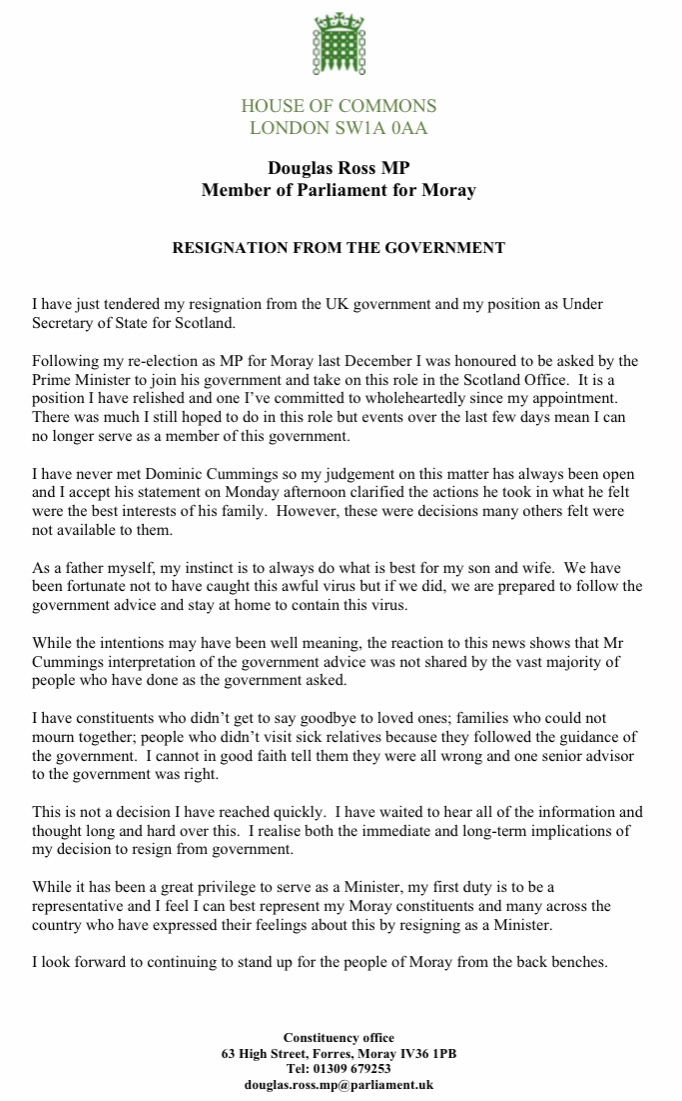
    Below is the PDF of the statement made by Douglas Ross, the Conservative MP for Moray, on 26 May 2020.

  • Grant Shapps – 2020 Statement on the Coronavirus

    Grant Shapps – 2020 Statement on the Coronavirus

    Below is the text of the statement made by Grant Shapps, the Secretary of State for Transport, on 23 May 2020.

    Opening remarks

    Good afternoon, and welcome to today’s Downing Street press conference.

    I’m pleased to be joined today by Dr Jenny Harries

    Latest data

    Let me start by updating you on the latest information from the government’s COBR data file.

    As of today (23 May 2020):

    3,348,507 tests for coronavirus have now been carried out in the UK, including 116,580 tests yesterday.

    257,154 people have tested positive, that’s an increase of 2,959 cases since yesterday.

    9,331 people are currently in hospital with coronavirus in the UK, down 11% since last week.

    And tragically 36,675 people have now died. That’s an increase of 282 fatalities since yesterday and that’s across all settings.

    Not just a list of statistics, but a devastating reminder of the cruelty of coronavirus.

    Our thoughts are with the friends and families of the victims.

    Transport context

    As we start to relax the restrictions, we must plan our route to recovery….

    Allowing people to resume their lives where possible…

    Getting businesses up and running again…

    And building beyond coronavirus.

    In the short term, we will need to bring back more public transport to keep families safe.

    That process has already begun.

    Rail and tube services increased at the beginning of this week – and they’ll ramp up more next month.

    And to ensure that more buses, trams and light-rail networks return to service today I can announce new investment of £283 million to start moving back to a full timetable.

    However, I do want to stress this funding does not mean we can go back to using public transport whenever we like.

    Remember…

    Those who can should still work from home…

    Those who can should still avoid all public transport.

    Even a fully restored service will only be capable of carrying – at best – one fifth of normal capacity, once social distancing is taken into account.

    So only if you need to travel, and you can’t cycle, or walk or drive, should you take a bus, tram or train.

    But please; avoid the rush hour.

    Marshals

    We’re managing the transport network to make it as safe as possible.

    This week saw the deployment of nearly 3,500 British Transport Police, Network Rail and Transport for London employees.

    These marshals worked with the public to prevent services from becoming overcrowded.

    From 1 June at the earliest – as we move to Phase 2 of the unlock – we will start to deploy twice as many marshals with the assistance of groups like the charity – Volunteering Matters.

    These Journey Makers will help provide reassurance, advice and friendly assistance to commuters.

    The last time we did this, at the 2012 Olympics, it was a great success.

    While these are altogether more serious times – if we show the same public-spirited concern for one another, it will go a long way towards helping transport and passengers cope.

    ZipAbout

    As I have said, it’s essential we stagger journeys and avoid the rush-hour.

    That’s why, at a recent roundtable, we asked the tech sector to come up with innovative proposals to help passengers avoid congestion.

    One good example is ‘Passenger Connect’ from Birmingham start-up ZipAbout.

    A personalised information service which tells rail users how disruption and crowding may affect their journey, while providing alternatives and helping people to maintain social distancing.

    The service has been successfully piloted over the past 12 months and it will be rolled out soon.

    Building for the future

    We’re not just dealing with the immense challenges of the present.

    We’re building for the future too.

    Transport is not just about how we get from place to place.

    It also shapes the places; for good or bad…

    Towns. Cities. Whole nations.

    We now have an opportunity to use the power of transport to improve long-standing national weaknesses, and create something better.

    Rebalancing the economy

    The UKs unbalanced economy is one such weakness.

    Our mission is to level-up Britain.

    The COVID-19 outbreak must be the catalyst to get it done.

    Levelling up. And speeding up.

    So, while roads and railways are less busy, we’re accelerating vital projects.

    Take the North, for example.

    This bank holiday weekend, we’re carrying out vital work to fix Leeds station.

    Continuing to build a new platform…

    … Installing new points and switches…

    … And improving the track to Wakefield.

    Just part of 490 separate engineering projects happening around the country this bank holiday weekend.

    Work that would normally take months of weekend closures are much quicker on these quieter railways.

    Beeching cuts

    And we’re getting on with plans to reverse some of the so-called Beeching rail cuts too.

    Dr Beeching wrote a report back in the 1960s which led to the closure of one-third of our railway network.

    2,363 stations, 5,000 miles of track identified for closure.

    Many of the places removed from the map never recovered.

    That report was perhaps the origin of the ‘left-behind town’.

    But we’re working to reverse Beeching.

    The process has already started in Blyth in the North East and Fleetwood in the North West….

    I visited in January, and also took the opportunity to visit Horden Peter Lee to see the building work.

    There used to be a train station 200 yards away, but it was closed, and the town cut off by the Beeching axe.

    This new station will connect a community of over 50,000 people, improving their quality of life.

    And today, the next 10 schemes to benefit are announced.

    It’s development funding…

    … But if they stack up, then we’re going to build them fast.

    Amongst the many schemes is the reinstatement of the Ivanhoe line in the East Midlands, from Leicester to Burton, via Coalville and Ashby.

    And branch lines on the Isle of Wight, and a new station at Wellington in Somerset.

    Roads

    But no matter how great we make the railway of the future, millions will still rely on the car.

    That’s why today I’m publishing the preferred route to complete the dual carriageway on the A66 from Scotch Corner to Penrith.

    The first new all dual-carriageway across the Pennines in 50 years.

    This is a £1 billion programme that will transform capacity by upgrading junctions and widening the road.

    These road and rail schemes will be the first of many…

    Binding our country together, and connecting people with jobs.

    Towns and cities

    But it isn’t just the balance between regions that we need to reshape.

    It’s hard to see millions who – until a few weeks ago – commuted by train into Manchester, London, Birmingham every day – immediately going back to the same old ways.

    So we have to reshape our towns and cities too…

    The Prime Minister once said:

    Cities are where inspiration and innovation happens … because people can bump into each other, spark off one another, compete, collaborate, invent and innovate. That’s when we get the explosion, or flash of creativity and innovation.

    And yet – with social distancing – it makes all that rather more difficult…

    So we have to find new ways of making it happen.

    Therefore – as conditions allow and not until July – we will be looking to support creative ways for businesses to reopen, whilst maintaining social distancing.

    We know restaurants and bars will want to start trading again, and we will work with them so we can enjoy an outdoor summer in a safe and responsible environment.

    Car parking

    For those who live too far to cycle and walk, and must drive to major conurbations, we will repurpose parking in places just outside town centres…

    … so people can park on the outskirts and finish their journeys on foot or bike or even e-scooter.

    Our aim with many of these measures is not merely to get through the lifting of restrictions, and then return to how things were…

    … But to come out of this recovery stronger, by permanently changing the way we use transport.

    Cycling

    Take the bike for example, previously we announced the introduction of a scheme to help bring bicycles back to a roadworthy condition…

    … relieving the pressure on public transport, and improving the nation’s health.

    Today I can provide the detail of the new £50 bicycle maintenance voucher.

    Available from next month, the scheme will help up to half-a-million people drag bikes out of retirement.…

    … Speeding up the cycling revolution…

    … Helping individuals become fitter and healthier…

    … And reducing air pollution, which remains a hidden killer.

    Clean air should be as big a priority for us in the 21st century as clean water was to the Victorians in the 19th.

    Closing remarks

    The measures discussed today will help…

    … more passengers use trains, buses and trams safely….

    … More commuters to take up active travel….

    … And more people to benefit from infrastructure improvements in the Northern Powerhouse, and across the country.

    They give us all an opportunity to harness the power of transport…

    Not just to help us return to the lives in the post-COVID-19 world…

    … But to make our economy more resilient.

    Our population healthier.

    And to change our nation for the better.

  • Matt Hancock – 2020 Statement on the Coronavirus and Care Homes

    Matt Hancock – 2020 Statement on the Coronavirus and Care Homes

    Below is the text of the speech made by Matt Hancock, the Secretary of State for Health and Social Care, in the House of Commons on 19 May 2020.

    One of the first things we knew about coronavirus as it began its dismal spread across the world was that it reserves its greatest impact for those who are physically weakest, especially the old. In the UK, 89% of all deaths have been of those aged above 65. From the start, we have worked hard to protect those in social care. In early March, we put £3.2 billion into social care—half through the NHS and half through local authorities—and we have repeatedly set out and strengthened guidance for infection control and support.

    For anyone who has a loved one living in a care home and for all the residents and staff, I understand what a worrying time this has been. I am glad that we have been able to protect the majority of homes, and we will keep working to strengthen the protective ring that we have cast around all our care homes. As I said in the House yesterday, last week we set out a further £600 million to strengthen infection control, and this comes on top of a substantial programme of support.

    First, on testing, from the start we have tested symptomatic residents of care homes, even when testing capacity was much lower, and this has always been a top priority. We are now testing all care home residents and staff in England—those with symptoms and those without—and this is being done according to clinical advice, starting with the most vulnerable, and extending to working-age residents, too.

    Secondly, we have strengthened the NHS support available to social care. We are putting in place a named clinical lead for every care home in England and have brought NHS infection-control expertise to the sector.

    Thirdly, we are making sure that local authorities play their part. Councils are conducting daily reviews of the situation on the ground in local care homes, so that every care home gets the support that it needs every day.

    Fourthly, we are supporting care homes to get the PPE that they need.

    Fifthly, we have increased the social care workforce during this crisis and provided more support. Altogether, this is an unprecedented level of support for the social care system. I thank colleagues across social care for their hard work.[Official Report, 20 May 2020, Vol. 676, c. 2MC.]

    We have also broken down some of the long-standing barriers, including between health and social care, and we have learned the importance of making sure that money for social care is ring-fenced specifically for social care, as the £600 million agreed last Friday has been. On top of that, we are requiring much better data from social care, because partial data has bedevilled the management of social care for many years and made ​policy making more difficult. Regular information returns are required in return for the latest funding, and we are looking to change the regulations to require data returns from every care provider, so that we can better prepare and support social care.

    Our elderly care homes provide for people towards the end of their life. They do an amazing job and deserve the praise that they have received from the public during this crisis. Residents are looked after when they need care the most: their hands are held, their brows are mopped and they are made comfortable. As a collective result of our efforts—especially the efforts of care colleagues throughout the country—62% of care homes have had no reported cases of coronavirus.

    The figures released today by the Office for National Statistics show that the number of deaths in care homes has fallen significantly and is down by a third in just the past week, from 2,423 to 1,666. This morning’s statistics confirmed that 27% of coronavirus deaths in England have taken place in care homes, compared with a European average of around half, but whatever the figures say, we will not rest in doing whatever is humanly possible to protect our care homes from this appalling virus, to make sure that residents and care colleagues have the safety and security they deserve.