Tag: 2020

  • Nicola Sturgeon – 2020 Statement on the Coronavirus

    Nicola Sturgeon – 2020 Statement on the Coronavirus

    Below is the text of the statement made by Nicola Sturgeon, the Scottish First Minister, on 12 June 2020.

    Good afternoon, and welcome to today’s briefing.

    I am joined today by the Cabinet Secretary for the Economy, Fair Work and Culture Fiona Hyslop and our National Clinical Director, Jason Leitch.

    Let me start, as always, with an update on some of the key statistics in relation to Covid-19.

    As at 9 o’clock this morning, there have been 15,709 positive cases confirmed through our NHS laboratories, and that is an increase of 27 from yesterday.

    A total of 914 patients are in hospital with confirmed or suspected Covid-19. That represents an increase of 5 overall from yesterday. However, the number of confirmed cases within that has reduced by 20.

    A total of 23 people last night were in intensive care with confirmed or suspected COVID-19, and that is an increase of two since yesterday.

    I am also able to confirm that since 5 March, a total of 3,873 patients who had tested positive and needed hospital treatment have since been able to leave hospital. I wish all of them well.

    In the last 24 hours, 3 deaths were registered of patients confirmed through a test as having the virus. That takes the total number of deaths in Scotland, under that measurement, to 2,442.

    Even as we see these figures decline – thankfully so – it is nevertheless really important that we don’t lose sight of the fact that they are not just statistics. They all represent unique loved individuals whose loss is a source of grief to many people. So once again, my condolences are with everyone who has lost a loved one to this illness.

    I will also express again my thanks to our health and care workers. Your efforts are enormously appreciated and, again, even as we see numbers in hospital and intensive care reducing, we know that you are still working incredibly hard in difficult circumstances, and you have our deep gratitude for that.

    There are two items I want to update on today.

    The first relates to the economy. Today’s GDP figures show that in April the UK economy contracted by more than 20%. That is – by some distance – the largest decline on record. And it confirms the scale of the economic crisis that has inevitably been caused by the health crisis that we face.

    I have previously welcomed the UK Government’s interventions, especially the furlough scheme which has helped to preserve jobs during this period but, in my view, it is now time to signal a further extension of Treasury support.
    Other countries have already made this move, including France where plans are being put in place for a long-term partial activity scheme covering possibly, as long as the next two years.

    The alternative to extended support being put in place is either that businesses are forced to re-open before it is safe to do so – and that of course could damage health and it could cost lives – or businesses have to take an even bigger hit, and that will cost jobs.

    In my view neither of those two alternatives is acceptable so I hope we will see further action from the UK Government and we look forward to working constructively with them, playing our full part in making all of that happen.

    The fall in GDP is obviously something we discussed in this morning’s weekly meeting of the Scottish Cabinet’s economic sub-committee.

    We also looked ahead to the publication of the latest statistics on Scotland’s labour market, next Tuesday. Those figures will cover February to April of this year – so that’s a period which obviously includes the first full month of lockdown.
    I don’t want to pre-empt that publication, I’m not able to pre-empt it, but we do expect to see a significant impact on employment, and a rise in unemployment. And sadly, despite all of our best efforts that situation is likely to remain challenging in the period ahead.

    And of course, all of that is before we factor in any potential impact on the economy from Brexit.

    That is why I have today joined with the First Minister of Wales in writing to the UK Government calling for an extended Brexit transition period – to take away the risk of a ‘no deal’ outcome and also to make sure that all of us remain focused on supporting business through the post-COVID recovery, and not making the challenges that the economy and our businesses face any worse than it already is.

    That is the action I believe we need from the UK, but I am acutely aware of the responsibility I have as First Minister, and that the Scottish Government has, to make sure we are doing everything within our power, and resources.

    That is relevant to the announcement I’m making today because we are incredibly focused on making sure we are taking action to protect jobs and, hopefully in the future to create jobs, as we lead our economy through the post-COVID recovery.

    The impact of this crisis is of course felt across our whole economy. I had discussions yesterday with the tourism sector – a sector particularly hard hit. And we know there are other sectors that are particularly badly affected too.
    For example, Scotland’s energy sector is facing a massive decline in global demand, and that is having a very serious impact on our economy.

    The Scottish Government wants to do everything we can to support the energy sector through this crisis.
    We want to protect jobs and businesses in the north-east of Scotland and across the country. And in doing that we want to make sure that the sector is able to continue to lead, and indeed to benefit from Scotland’s necessary transition to a net-zero economy.

    That’s why today, I’m announcing a new £62 million energy transition fund.

    Over the next 5 years the Fund will support key energy projects which will help Scotland’s move to net-zero.

    For example, one project – the Global Underwater Hub – brings together engineering expertise from academia and industry. And it will help our oil and gas sector to use its existing subsea and underwater expertise in new areas such as marine renewables.

    Another project receiving support will be the Energy Transition Zone – a new business park adjacent to the Aberdeen South Harbour. That will provide state of the art facilities for the manufacturing and development of renewable and low carbon technologies.

    Almost inevitably, given the focus of the fund is the transition from oil and gas to renewables, the projects which directly benefit from this fund are currently based in the north east of Scotland. But by securing Scotland’s place as a world leader in key technologies for the future, they will help businesses right across the country to diversify, to attract new investment, seize new opportunities and both protect and create jobs.

    We know that the energy transition will shape our country’s economic future. That was true before the COVID crises and it remains true during and after the COVID crisis.

    Through these investments not only will we shape that energy future and economic future, we will also help with the economic recovery from the crisis currently afflicting so many businesses across Scotland.

    The second issue I want to touch on today concerns the Scottish Government’s approach to easing restrictions.
    As I’m sure many of you know and will be eagerly anticipating, the current restrictions will be reviewed again on Thursday next week.

    Our considerations will be informed, as they will always be, by the scientific evidence and advice and the clear principles we have set out.

    However, I have been acutely aware throughout this crisis that it’s not, and never will be, enough for me simply to tell you what I want you to do.

    I also have a duty to explain to you, on an ongoing basis, the reasons behind what we are asking you to do.

    In fact the reason that I conduct these press briefings on a daily basis is to ensure that you get clear and direct information – on the impact of COVID-19 and on the country’s response.

    That’s vital to ensuring that people understand the threat this virus poses – but also how we can all work together to reduce and mitigate that threat.

    I’ve spoken before about some of the research we undertake to check that the messages we’re trying to convey are getting across.

    We’re going to publish the latest research today so that you are able, if you are interested, to read it for yourself.
    It shows, amongst other things that the vast majority of people in Scotland continue to support a careful and gradual easing of the restrictions.

    But the aspect of the research I wanted to particularly highlight today is around public attitudes to our new Test and Protect system.

    The research shows that 90% of people say that they would be willing to isolate for 14 days if someone they had come into contact with had symptoms of the virus.

    90% said they would be willing to undergo Coronavirus testing if asked to do this.

    And 88% are happy to provide details of people they had been in contact with if they develop coronavirus symptoms
    That’s important and it’s also really encouraging because, as I’ve said to you before, Test and Protect is going to be a vital tool in keeping the virus suppressed as we ease more restrictions.

    But Test and Protect can only work if all of us across the country are willing to comply with the measures that it sets out – if we’re willing to get tested when we have symptoms, if we’re willing to isolate if we have the virus, and if we’re willing to self-isolate if we’ve been a close contact of someone with the virus.

    So these research findings, showing that willingness to make personal sacrifices for the common good, are really encouraging and I want to thank everybody for that spirit of collective endeavour that I think we all still have.

    Now I want to conclude today with a key point about the critical juncture that we are at in fighting this virus.

    I know that as cases, hospitalisations, numbers in intensive care, deaths, and the R number all decline, many will think that means we should speed up our exit from lockdown. And I understand that.

    We are all deeply, deeply anxious about the impact on the economy. But the fact is this; the reason we are making such good progress now is that we are carefully, following a plan.

    And if we depart from that plan we will risk the progress we’re making.

    On the other hand, if we’re prepared to stick with the plan I believe we will keep making further progress.

    And the more we suppress this virus, the more lives will be saved and the fewer people will suffer the long term health consequences that increasingly we fear that it might leave some people with.

    But also, if we suppress this virus sufficiently, we will be able to restore a greater degree of normality to all of our lives.
    So while I understand the desire for speed of recovery, the sustainability of our recovery also really matters.

    The simple fact is if we go too fast now we risk a resurgence of the virus that will then set us back, and that is a risk, in my view, we must be careful not to take.

    So I very much hope that we can and will take more steps forward at next week’s review, but I want to be very clear that we must continue to do that carefully and cautiously. And if we do, we will continue to suppress this virus, and it will mean that we get back to more normality than we will otherwise do.

    All of you can help us in moving in the right direction by sticking with the rules.

    So as we head into the weekend I want to briefly reiterate again the key public health guidance that is in place for now.
    We should all still be staying at home most of the time and meeting fewer people than normal.

    If your life feels like it is getting back to normal think about whether you’re complying with the guidance as you should be.

    When you meet people from another household you must stay outdoors and you must stay two metres apart from them.

    Don’t meet up with more than one household at a time. Don’t meet up with more than one a day. And please keep to a maximum of eight people in a group.

    Wash your hands, often. Wear a face covering when you are in a shop or public transport – or in any enclosed space where it is more difficult to physically distance.

    Avoid touching hard surfaces and clean those that you do touch.

    And, as I have said already, if you have symptoms of COVID-19 ask for a test immediately – go to the NHS Inform website and follow the advice on self-isolation.

    Above all else we all have to remember that we are still in a situation where our actions as individuals have an impact on the health and well-being of everybody.

    So I want to end again today by thanking you sincerely for your patience, for your forbearance, and for making the sacrifices you are making so that collectively as a country we continue to get through this crisis.

    My thanks to all of you and I will now hand over to the Economy Secretary to say a few words before handing over to Professor Leitch.
  • Kit Malthouse – 2020 Statement on Offensive Weapons

    Kit Malthouse – 2020 Statement on Offensive Weapons

    Below is the text of the statement made by Kit Malthouse, the Minister for Crime and Policing, in the House of Commons on 11 June 2020.

    As part of the Government’s continuing action to tackle serious violence and keep dangerous weapons off the streets, we have on 9 June laid draft regulations—Surrender of Offensive Weapons (Compensation) Regulations 2020—before Parliament.

    These regulations are required as part of our plans to bring in the weapons prohibitions that are provided for by the Offensive Weapons Act 2019. These prohibitions will apply to specified rapid-firing rifles and certain other offensive weapons—for example, zombie knives

    The Offensive Weapons Act provides for the Government to put in place arrangements for the surrender of those items that will become prohibited under the Act and requires that regulations be made to provide for the payment of compensation to those who surrender items.

    The regulations which have been laid set out a scheme for compensation, in particular making provision as to eligibility for compensation and the making and determination of claims. The regulations are subject to the affirmative resolution procedure in both Houses. It ​is our intention to bring the regulations into force at a time when it is safe and reasonable to expect the owners of these weapons to be able to travel to designated police stations in their areas in order to surrender the items.

    We will finalise and publicise full details on the surrender and compensation arrangements before they commence. This will include the details on when the scheme will go live and information on how to surrender and make a claim. This will help to ensure that all those who possess the items in question are well informed and are given sufficient opportunity to surrender their lawfully held items to the police and claim compensation for them.

  • Grant Shapps – 2020 Statement on the Coronavirus

    Grant Shapps – 2020 Statement on the Coronavirus

    Below is the text of the statement made by Grant Shapps, the Secretary of State for Transport, on 12 June 2020.

    Good afternoon.

    Welcome to today’s Downing Street press conference.

    I’m pleased to be joined today by Professor Stephen Powis, National Medical Director of NHS England.

    And again by Sir Peter Hendy, Chair of Network Rail, directing the restart of our transport system.

    Let me begin by updating you on the latest information from the Government’s COBR file.

    The first slide shows the latest information on infections.

    Results from the ONS infection survey published this morning estimate that the number of people who tested positive for coronavirus in England fell from 152,000 between 27 April and 10 May, to 33,000 between 25 May and 7 June.

    This is encouraging progress and suggests that around 1 in 1,700 people in the community had coronavirus during the latest period of the survey.

    SAGE has also confirmed today that their estimate of the R rate for the UK is unchanged on last week, at 0.7-0.9. We want to keep the R number below 1.0. R is the average number of additional people infected by each infected person.

    The second slide shows cases confirmed with a test:

    6,434,713 tests for coronavirus have now been carried out or posted out in the UK. This includes 193,253 tests carried out or posted out yesterday.

    292,950 people have tested positive, an increase of 1,541 cases since yesterday. The graph shows a steadily falling number of identified cases on a 7-day rolling average, despite the increase in testing.

    The third slide shows the latest data from hospitals.

    535 people were admitted to hospital with coronavirus in England, Wales and Northern Ireland on 9 June, down from 722 a week earlier, and down from a peak of 3,432 on 1 April.

    392 coronavirus patients are currently in mechanical ventilation beds in the UK, down from 571 a week ago, and down from a peak of 3,301 on 12 April.

    The fourth slide shows what is happening in hospitals across the country.

    There are now 5,607 people in hospital with coronavirus in the UK, down 20% from 7,036 a week ago and down from a peak of 20,697 on 12 April.

    As the graphs show, while there is some variation, most nations and regions of the UK are broadly following a similar pattern.

    The fifth slide shows the daily figures for those who have sadly lost their lives after testing positive for coronavirus.

    Across all settings, the total number of deaths now stands at 41,481. That’s an increase of 202 fatalities since yesterday.

    When measured by a 7-day rolling average, the daily number of deaths currently stands at 174, down from a peak of 943 on 14 April.

    Although the number of deaths is now firmly down, our deepest sympathies go out to all those who have lost loved ones.

    Transport is instrumental to our recovery….

    To connect people with jobs…

    To help level up Britain….

    And even to make us a healthier, and more active nation.

    But as people start to travel, transport also presents one of our biggest challenges…

    How we protect passengers. Prevent the spread of the virus. Even as we become more mobile.

    Transport use may be the first occasion since the onset of COVID that we’ve shared confined spaces with others.

    So it’s critical that we all take a vigilant and cautious approach over the next few weeks.

    I’m just going to say this…

    If you can work from home, you should continue to do so.

    If you cannot work from home, you should try to avoid public transport.

    If you must use public transport, you should travel at quieter times of day.

    And if you’re an employer, you should do everything in your power to prevent staff from travelling… unless it’s absolutely vital…

    …and please do allow staff to travel at quieter times.

    From Monday, it becomes mandatory in England to wear a face covering on public transport – that includes trains, buses, trams, ferries and planes.

    A ‘face covering’ does not mean a surgical mask.

    Face coverings can be made at home and you can find the guidance at GOV.UK.

    As we move to recovery, it’s more important than ever to protect each other…

    Preventing those showing no symptoms from infecting others.

    I know there’s huge public support for compulsory face coverings…

    They show respect for our fellow travellers.

    But for clarity, transport operators will be able to refuse permission to travel where someone isn’t using a face covering…

    And this weekend I am taking powers through the Public Health Act leading to fines for non-compliance too.

    We’ll take a gentle approach to enforcement during the first couple of days.

    And help will be at hand.

    In addition to British Transport Police, and staff working for Network Rail, TfL and Transport Operators…

    In the coming weeks we’ll also deploy Journey Makers to assist and remind commuters of the need to wear a face covering…

    Plus the Safer Transport campaign will provide plenty of reminders at bus stops, rail stations and on social media.

    Remembering your face covering should be the same as picking up your phone, wallet or purse when you leave home.

    Please read the guidance, ensure you have a face covering and protect your fellow commuters.

    This crisis has tested our nation. Yet through adversity comes possibility…

    A greener transport future within our grasp.

    For example, through the £2 billion investment we’re making through the cycling and walking programme.

    The challenge is to make transport…

    Currently our biggest emitter of greenhouse gases…

    Part of the solution, not the problem.

    Take the aviation sector, which has had an impossible few months…

    Yet, despite the obvious challenges, there’s a real determination within the industry to have a greener restart.

    So we’re bringing together leaders from aviation, environmental groups and government…

    To form the Jet Zero Council.

    This group will be charged with making net zero emissions possible for future flights.

    Our goal – within a generation – will be to demonstrate flight across the Atlantic, without harming the environment…

    And today we’re backing a company called Velocys who are building a plant for aviation biofuels in Lincolnshire.

    I’m also excited about a Cambridge University and Whittle Labs project to accelerate technologies for zero carbon flight.

    The shared experience of fighting coronavirus has changed us in many ways.

    Although it has forced us apart, it has also brought us together.

    Although it has tested us, it has also shown us at our very best.

    And although it has made us reflect on the past, it’s focussed on those plans for the future.

    But now, as we become more mobile, we must not forget that this insidious virus is still a threat.

    That not only means avoiding public transport if you can…

    It also means from Monday, wearing a face covering on public transport.

    Avoiding gatherings of more than 6 people…

    Including to protest.

    I understand that people want to show their passion for issues that they care deeply about.

    And we must never be complacent about stamping out racism and discrimination in this country.

    But please. For the sake of your health, and that of your friends and families. Don’t attend mass gatherings.

    We’ve come a long way.

    As we move towards recovery, let’s protect lives, as well as livelihoods.

  • Rebecca Pow – 2020 Speech on the Reopening of Zoos, Aquariums and Wildlife Sanctuaries

    Rebecca Pow – 2020 Speech on the Reopening of Zoos, Aquariums and Wildlife Sanctuaries

    Below is the text of the speech made by Rebecca Pow, the Parliamentary Under-Secretary of State for Environment, Food and Rural Affairs, in the House of Commons on 11 June 2020.

    What a tremendous afternoon! It takes me back to what I think was the most exciting debate in the Chamber since I have been here, which was about hedgehogs. The House was full, wasn’t it, Madam Deputy Speaker? It shows what a nation of animal lovers we are. This is what gets us out. Our constituents are great animal lovers too, and they galvanise us into action. I think it shows that things can work through Government and we are listening.

    I thank everybody for taking part, and in particular my hon. Friend the Member for Romford (Andrew Rosindell) for raising the matter. As chair of the zoos and aquariums all-party parliamentary group, which I was a member of as a Back Bencher, he has long promoted the cause of well-run zoos, and I know that he has been actively promoting their cause during the pandemic when they have had to close. I thank him for his passion and determination.

    What a wonderful story that was about the blue iguana. I do not know if you were in the Chair for it, Madam Deputy Speaker, but what a great tale that was, and congratulations. I thank all Members from across the House who have taken part and mentioned so many zoos, wildlife sanctuaries and aquariums. Just out of interest, there are 269 licensed zoos in England and 338 if exemptions are included, so it is a lot of enterprises.

    I will touch first on some of my own experience. Chester zoo has been mentioned so much in the debate. I was fortunate to go there when I was the Tourism Minister briefly. Although it was a brilliant huge open space, with so much education, the thing that I was so impressed with was the conservation work and how, like many of our zoos, it plays such an important role on the global stage. The zoo does incredible work on black rhinos and the greater one-horned rhinos, on Andean bears and, as mentioned by the hon. Member for City of Chester (Christian Matheson), on sustainable palm oil. It is about not just the animals but food products, too. That is so important.

    I want to thank the other Members who mentioned Chester zoo: my hon. Friends the Members for Eddisbury (Edward Timpson) and for Warrington South (Andy Carter), as well as the hon. Member for Ellesmere Port and Neston (Justin Madders), who is no longer in the Chamber. I also thank all the other Members who mentioned other zoos: my right hon. Friend the Member for Sutton Coldfield (Mr Mitchell) mentioned Twycross zoo; my hon. Friend the Member for South West Bedfordshire (Andrew Selous) made such a strong case for Whipsnade zoo; we heard about Yorkshire Wildlife Park from my hon. Friend the Member for Don Valley (Nick Fletcher); and my hon. Friend the Member for South Cambridgeshire (Anthony Browne) mentioned Shepreth Wildlife Park.​

    The contribution from my hon. Friend the Member for Southend West (Sir David Amess) was more of a waxing lyrical about all animals, but we finally got to the aquarium. My hon. Friend the Member for Isle of Wight (Bob Seely) mentioned the enterprises on the Isle of Wight; my hon. Friend the Member for Stockton South (Matt Vickers) mentioned Butterfly World, which does sound rather captivating; the hon. Member for Edinburgh West (Christine Jardine) mentioned Edinburgh zoo; and my hon. Friend the Member for Dudley North (Marco Longhi) mentioned Dudley zoo. So many places were mentioned.

    I wish to voice the Government’s appreciation of zoos—among which I include aquariums and wildlife sanctuaries if they are licensed as a zoo under the Zoo Licensing Act 1981—and all the work that they do. The Government recognise that as well as providing such high welfare standards for animals—which my hon. Friend the Member for Romford voiced so well—many zoos in the UK contribute to so many other things: the conservation work that is so important on the global stage, with so many species under threat because of the pressures on the environment; the education work; and, of course, getting people out into open spaces and engaging with nature, which has a big health and wellbeing impact. On that note, the Government recognise that zoos are excellent for engaging people with nature—a zoo often might be somebody’s first engagement with wider nature, so plays such a vital role.

    I am delighted to support the Prime Minister’s announcement yesterday that safari parks and the outdoor parts of zoos will be allowed to reopen from 15 June. It has been necessary, for public health reasons, for the Government to proceed with caution, but we have listened to the many arguments about the benefits of zoos and the access to controlled outdoor spaces that they can provide, which is why we believe now is the appropriate time to allow safari parks and the outdoor parts of zoos to reopen. For the moment, indoor attractions—such as reptile houses and aquariums—at zoos will remain closed for public health reasons. The Government are aware of the work that zoos and aquariums have been doing to prepare for reopening while adhering to the strict social guidance. The Department for Environment, Food and Rural Affairs is working with the main industry body, BIAZA, on the reopening guidance.

    I wish briefly to set out the Government’s rationale for requiring zoos to close from 1 June, as set out in the Health Protection (Coronavirus, Restrictions) (England) (Amendment) (No. 3) Regulations 2020, because colleagues did talk about this. Previously, zoos were not required to close, but given the fact that visiting a zoo was not a reasonable excuse to leave home, zoos took the inevitable decision to shut their doors. Most zoos closed at the end of March, as a result of lockdown. Rather than adding to the number of reasons that people had to leave home, from 1 June the Government switched the focus of the regulations to allow people to leave their homes unless there was a specific reason why they could not. The Government’s primary concern was that we should not open up too many activities at the same time, because the cumulative effect of opening everything up at once would see the number of cases of coronavirus start to ​increase again. While each zoo can be made safer, it was vital that we did not move too quickly in reopening to ensure that public health is protected. I am sure that all hon. Members understand that step-by-step process. As a result of progress, the announcement on zoos and safari parks was made yesterday. I hope that that reassures the House.

    The Government recognise that visitor numbers may not bounce back to the levels zoos would have expected for this time of year. I therefore reassure hon. Members that Government support schemes, which zoos can continue to access, remain in place. Zoos are eligible to apply for VAT deferral, business rates relief, the business interruption loan schemes, the option to reclaim the costs of statutory sick pay, and hospitality and leisure grant funding of up to £25,000. In addition, on 4 May, the Government introduced the £14 million zoo support fund for licensed zoos in England, specifically for zoos in severe financial distress. The fund is open for another five weeks and DEFRA has already awarded grants to many zoos and aquariums.

    Some hon. Members, including my hon. Friend the Member for Romford, mentioned the rules for the zoo support fund. It has been suggested that they need to be changed so that zoos can access the fund before being at the point of closure. The fund was specifically set up to avoid unnecessary additional euthanasia of zoo animals and capped payments at £100,000. It can be accessed only when a zoo is in severe financial difficulties. However, we are monitoring its operation. Clearly, we are listening to the comments that have been made today. We are keeping the scheme under review in relation to how soon we can provide support when a zoo is running out of funds.

    Bob Seely

    The Minister is talking about the DEFRA fund. It is not necessarily needed now, but it may be needed in a few months, when zoos and charitable entities start to run into worse financial problems.

    Rebecca Pow

    I hear what my hon. Friend says and that has been noted. I also get the message loud and clear that there are calls for a wide range of other wildlife enterprises, including farm parks, and places such as the Cotebrook Shire Horse Centre and Crocodiles of the World near Witney, to open.

    Greg Smith (Buckingham) (Con)

    I am grateful for my hon. Friend’s commitment to looking at the matter again. I double underline the urgency for the Green Dragon rare breeds farm in my constituency, where the animals are now getting fed only as a result of the local community’s generosity in making food donations. If the animals do not get that food urgently, I fear that they will be put down.

    Rebecca Pow

    That is noted. The exact scope of easing restrictions is being discussed as we speak. We will consider whether other outdoor animal attractions can open safely in future and at the same time. Clearly, many larger zoos face real long-term issues. Discussion about that is also ongoing.

    I thank all the zoos and aquariums that played such a key role in the discussions with DEFRA, particularly in highlighting the crucial animal welfare implications. Thanks must go to BIAZA and our hard-working DEFRA team. I also thank my colleague Lord Goldsmith for all his work. He has kept me fully informed of what is happening.​
    I want to assure colleagues that weekly meetings will continue with the chief executive officers of the largest charitable zoos and aquariums, so that we are fully aware of the situation. I am also happy to meet my hon. Friend the Member for Romford to discuss his further thoughts and ideas, which he has clearly been thinking on very much.

    In closing, I want to reiterate—

    Madam Deputy Speaker (Dame Eleanor Laing)

    Order. Let me just say to the Minister that, although I will have to put the Adjournment again at five o’clock, she can go on speaking after that. It is all right.

    Rebecca Pow

    Oh, I am terribly sorry. I was informed that I had to stop at five. Anyway, I have almost finished, Madam Deputy Speaker.​

    I just want to end by thanking absolutely everybody involved and to recognise the role that zoos, wildlife sanctuaries and aquariums play in this nation—the huge conservation role, the animal welfare, the getting people out into green spaces, the health and wellbeing impacts, the jobs, the impact on the economy and all of that. I assure Members that we will continue to assess the situation. I would like once again to thank my hon. Friend the Member for Romford for his terrific work. We will all be the better for it.

  • Peter Aldous – 2020 Speech on the Reopening of Zoos, Aquariums and Wildlife Sanctuaries

    Peter Aldous – 2020 Speech on the Reopening of Zoos, Aquariums and Wildlife Sanctuaries

    Below is the text of the speech made by Peter Aldous, the Conservative MP for Waveney, in the House of Commons on 11 June 2020.

    I start by paying special thanks to my hon. Friend the Member for Romford (Andrew Rosindell), who is such a champion for zoos in chairing the all-party parliamentary group, as he was in his inspirational speech. He set the scene so well and provided the framework within which we are all now talking.

    I want to speak for a few minutes about Africa Alive! in Kessingland, just south of Lowestoft in my constituency, which is run by the Zoological Society of East Anglia, which also has Banham zoo in the constituency of my right hon. Friend the Member for South West Norfolk (Elizabeth Truss). This organisation does great work in so many aspects, as I shall explain.

    The best part of my job—this tremendous job we all have—is that each summer, I spend half a day at Africa Alive! It is a wonderful experience and probably the thing I look forward to most. My hon. Friend the Member for Southend West (Sir David Amess) referred to zoos being controversial. I sense that, in many ways, we have moved on from that; we have moved on from the cages. Zoos used to be very inward-looking, and they are not now. Africa Alive! is outward-looking, and that is what so special about it and why it is a linchpin of the local community and the local economy. I want to highlight five points about it.

    Africa Alive! does great conservation work, looking after and supporting species from that wonderful continent of Africa. I have never been on a safari, and I do not think I ever will, but Africa is there on the doorstep of places like Lowestoft, Beccles and Bungay for people who will never have the opportunity to go and see those animals.

    Africa Alive! also provides employment opportunities, with highly specialist jobs as keepers. For so many people in the area I represent, it is their first rung on the employment ladder—that first job that can lead on to others. So many people I have met say, “I did my first job at Africa Alive!” There is also the education and outreach work. Schools come to it, but it also goes to the schools. The Zoological Society of East Anglia gets out across East Anglia into 1,000 schools.

    It is a tremendous tourism attraction. Tourism is very important on the Suffolk and the Norfolk coast, reaching out into the Norfolk and Suffolk broads. As part of someone’s week in our area, they want things to do, and they go to Africa Alive!, which is one of the biggest tourist attractions in East Anglia.

    I will make one final point about what Africa Alive! does. I got a number of emails over the last week. One of them was from someone I had not heard from or seen for over 40 years and who is now working in Thailand, saying, “Come on! Pull your finger out! We need to save this wonderful treasure.” The email that struck me most was one that said, “Me and my mother have had tremendous mental health anguish. Going to Africa Alive! and walking round that 70-acre wildlife park gives us the comfort, the rest and the assurance that we need to get away from some very difficult challenges for us.”

    The announcement this week was extremely welcome, and it is very good news. I think Africa Alive! would say that it gives it a fighting chance of survival, and that is wonderful. But as my hon. Friend the Member for ​Romford said, more needs to be done. Animals are not like rides—you cannot turn them off, and flexible furloughing is therefore very important. The zoos support fund is welcome, but as we heard from my hon. Friend the Member for Isle of Wight (Bob Seely), there is an issue with the conditions of it. A lot of zoos are charities, and they have requirements for the amount of money they have in the bank, which automatically precludes them from being able to access that fund. We need to look at that again, and I urge the Minister to do that. As I said, the best part of my job is going to Africa Alive! every summer. I want to be able to do that for the next few summers as well.

  • Andrew Rosindell – 2020 Speech on the Reopening of Zoos, Aquariums and Wildlife Sanctuaries

    Andrew Rosindell – 2020 Speech on the Reopening of Zoos, Aquariums and Wildlife Sanctuaries

    Below is the text of the speech made by Andrew Rosindell, the Conservative MP for Romford, in the House of Commons on 11 June 2020.

    It is with great pride that I rise today to speak up for all those magnificent institutions, organisations and charities throughout the United Kingdom who work tirelessly in the cause of conservation, education and research, the protection of endangered species, and animal welfare. Indeed, our great British zoos, aquariums and wildlife sanctuaries demonstrate the very best our nation has to offer to the world in looking after the amazing creatures of land, sea and air with whom we are so privileged to share this planet.

    However, I do so with great sadness and fear—fear of what may be to come as our zoos, aquariums and wildlife sanctuaries now face some of the most challenging times they have ever had to deal with. That is why I call upon all Members of this House, and especially the Prime Minister and Her Majesty’s Government, to take action this day to ensure that these magnificent institutions so dedicated to the survival and welfare of the animal kingdom do not face extinction themselves.

    As chairman of the all-party parliamentary group on zoos and aquariums, may I thank the Minister and the Government for the excellent co-operation they have shown in liaising with so many of our animal welfare organisations in recent weeks? The Prime Minister, as we all know, is someone who supports with gusto the fantastic conservation, education and research work being undertaken by zoos and aquariums across the country. It is with great pleasure that I invite the Minister here today, along with the Prime Minister, to visit London zoo with me, as soon as it is possible to do so, to see at first hand our British conservation sector at work here in the United Kingdom, and to learn about all their tremendous achievements in protecting endangered species across the globe. I am proud to support a Government who hold animal welfare in the highest regard, along with the conservation of the natural world.

    Mr Andrew Mitchell (Sutton Coldfield) (Con)

    I know my hon. Friend is aware, having just mentioned London, of the very great importance in the scheme of things of Twycross zoo, which is very well run by its chairman and chief executive but is facing significant problems of financing at the moment. What advice does he have for the Government on how an institution like Twycross could be helped?

    Andrew Rosindell

    I thank my right hon. Friend for his intervention. I have visited Twycross zoo. It is an excellent zoo. I have met the chairman and chief executive, Geoff Hoon, a former Member of this House, on many occasions. It is an example of a great zoo that is in desperate need of additional support at this time. I hope the Minister will address that very point when she speaks at the end of this debate.

    With British families looking for a safe day out from their homes, as they can now do, when we face a mass-extinction crisis that we have never seen before in our history, when the fate of our natural heritage is ​reliant on the work of zoos, safari parks, aquariums and wildlife sanctuaries, and when the Government have rightly committed to improving the natural environment and supporting conservation, we must not fail to arm and equip this country’s arsenal of conservationists.

    Bob Stewart (Beckenham) (Con)

    I thank my great friend for allowing me to intervene. I do so because my hon. Friend, our colleague, puts a heck of a lot of effort into conservation of species. For example, he raised one hell of a lot of money to look after blue iguanas in the Cayman Islands. I know because I went there with him and they had increased from 20 and 200, largely thanks to my hon. Friend.

    Andrew Rosindell

    My hon. Friend is too generous. The blue iguana was on the brink of extinction in the Cayman Islands, which is a British overseas territory. I am pleased to say that that risk of extinction has now passed, with the support of many hon. Members. I pay tribute to the Government of the Cayman Islands for their work in ensuring that the wonderful blue iguana species continues to survive and thrive there.

    We must support our zoos to carry on their incredible work, which is so admired around the world and supported so strongly by the British people. We are a nation of animal lovers.

    Duncan Baker (North Norfolk) (Con)

    I am glad that, wonderfully, our zoos and safari parks can open again on Monday, but we must also think of our animal welfare charities and sanctuaries. They also need enormous support. Many—80%—are in the open air and they should be included in the opening, but they also need to be looked after financially because many are suffering, and the welfare of our animals in those sanctuaries that do such good work must be considered too.

    Andrew Rosindell

    I thank my hon. Friend for his comments. He is absolutely correct. The Government have allowed zoos and safari parks to open, but they are just the tip of the iceberg. Huge numbers of animal charities and organisations that care for animals all year round need the opportunity to open up, with social distancing, because they are in desperate straits. This is not just about zoos; it is about all animal welfare institutions across the country. Many Members have them in their constituencies and they all need guidance as soon as possible so that they can open and get back to normal.

    Edward Timpson (Eddisbury) (Con)

    Despite the fantastic news for zoos, particularly Chester zoo, does my hon. Friend share my concern that there is a risk that the narrow drafting of the regulations on reopening means that the likes of Cotebrook Shire Horse Centre in my constituency will be forced to remain closed for what are, I have to say, spurious reasons: it is not a business whose main activity is keeping for exhibition animals not normally domesticated in England? If those horses were from Ireland, I suspect it would be all right, but the centre faces potential financial ruin. It can open the retail shop on Monday, but has to keep its open fields closed.

    Andrew Rosindell

    My hon. Friend makes exactly the point that I will make later and that many Members feel strongly about. The matter needs to be resolved for ​organisations such as the shire horse centre in my hon. Friend’s constituency. They need clear guidance. It is not acceptable that there has been permission only for safari parks and zoos to open, when other organisations are perfectly able to do that and are in dire financial straits at this time. They need the Government to be much faster in their reactions to allow things to reopen as soon as possible.

    Mr Mark Francois (Rayleigh and Wickford) (Con)

    I congratulate my hon. Friend on securing this important debate. I join him in welcoming the Government’s decision to allow zoos and aquariums to reopen on Monday. Does he agree that, on the wider issue of regulations, we are now in the most terrible muddle? The Office for National Statistics dip-test survey of the population that was announced at the weekend mercifully revealed that only one in 1,000 people now has covid-19. That is massively to be welcomed, but in that case, should not we start lifting restrictions much more widely to allow other types of business to reopen to get the country back to work while there is still an economy left that is worth saving?

    Andrew Rosindell

    We probably cannot extend the debate to other types of business—I am sure you would stop us doing so, Mr Deputy Speaker. However, I sympathise strongly with my fellow Essex MP. We need to get Britain working again; we have been through a terrible trauma, but we now need to get our economy back on its feet. I am delighted that zoos and safari parks are allowed to get back to working again and to open their doors, but we need to widen things further and as fast as possible.

    Robert Courts (Witney) (Con)

    I am grateful to my hon. Friend for giving way—he is being exceptionally generous with his time. Like him, I welcome the fact that zoos are reopening, and Cotswold Wildlife Park and Gardens in my constituency will also be glad to hear that. However, I also have Crocodiles of the World, which is the UK’s only crocodile zoo and which does essential conservation work. It will probably also be able to put in place social distancing. Should we not also look to see how we can help institutions such as that?

    Andrew Rosindell

    My hon. Friend is completely right. I did not know that he had Crocodiles of the World in his constituency. That is certainly one animal organisation I would love to visit. I have been to Crocodylus Park in Australia, but I did not know that Witney had such a great collection of crocodiles. However, I agree entirely with my hon. Friend. All these organisations are lacking guidance; they need clear leadership from the Government. All of them need the opportunity to open as fast as possible; otherwise, they will go bankrupt, and we will see animals euthanised. It would be a tragedy if that started to happen.

    Anthony Browne (South Cambridgeshire) (Con)

    I congratulate my hon. Friend on securing the debate. I, too, welcome the news that zoos and wildlife parks are allowed to open from Monday. One of the most popular attractions in my constituency is Shepreth Wildlife Park, which is popular with not just my family but families across my constituency—so much so that when it had to close because of the coronavirus crisis, it was largely kept going by regular visitors coming in and giving ​donations of money. It really has been touch and go, but the park will survive, and I am committed to making sure it does. Zoos can reopen from Monday—they cannot completely reopen, because bits such as the aquariums and the insect facilities cannot reopen—but it does not end there. My question to my hon. Friend and the Minister is, will the Government commit to giving support to zoos in the future to ensure that they are not so indebted that they cannot carry on?

    Andrew Rosindell

    I am sure the Minister will respond to that point at the end of the debate. Suffice it to say that I agree with everything my hon. Friend has said. There needs to be a much more widespread reopening of all these animal institutions. It is not fair to single out some but leave others. Some of them are in desperate straits, and the Government need to act as soon as possible.

    This is a precarious time, but thanks to the timely work of the Government, and the tireless dedication of the British and Irish Association of Zoos and Aquariums, some zoos and safari parks, as has been mentioned, are now able to reopen from 15 June—and not before time. As members of BIAZA, our zoos and aquariums are world-leading in the care, conservation and research they carry out with their animals. They would normally be inspiring over 35 million visitors a year. That is clearly not going to happen this year, but now our zoos and aquariums will at last be allowed to welcome some people through their doors to inspire them with the wonders of the natural world, while supporting the protection and advancement of nature that we are all so passionate about it in this House.

    Mr Gagan Mohindra (South West Hertfordshire) (Con)

    I commend my hon. Friend for this debate. Seeing so many Members in the House during an Adjournment debate is a reflection of the importance of this issue. My hon. Friend correctly pointed out that the number of visitors to zoos and aquariums is markedly lower than normal, but a lot of us have spent a lot more time during this global pandemic reaching out to nature. However, our children and schoolchildren are not yet able to benefit from going to zoos and aquariums. If anything, that makes it even more urgent for these establishments to be reopened.

    Andrew Rosindell

    My hon. Friend makes an excellent point. Many children will not be returning to school, so this would be an ideal time to allow them and their parents to visit zoos and animal welfare organisations, given the educational benefits involved. That is another good reason why the Minister needs to hurry up and allow all these organisations to open as quickly as possible.

    The limited reopening on 15 June will mean that visitors can once more hear the roar of the lions at Longleat, be inspired by the monkeys at Banham zoo and—my personal favourite—look up upon the astonishing beauty of the giraffes at such places as Twycross zoo, which was mentioned earlier. Of course, Twycross is one of Britain’s leading zoos, doing magnificent work, and is well represented by my hon. Friend the Member for Bosworth (Dr Evans). He cannot be present, but I pay tribute to him. He has been a great champion in working with me to highlight the plight faced by the zoo community.​

    In 2019, BIAZA members contributed more than £31 million directly to conservation, supported field conservation projects in 105 different countries around the world and protected many native species that would otherwise be on the precipice of extinction, including our own Scottish wildcat and pine hoverflies. I pay tribute to Edinburgh zoo, which I visited two years ago. The new director, David Field, used to be the director of London zoo. I pay tribute to the work that Edinburgh zoo is doing, particularly with the pandas. I do not know whether any Members have had the chance, but I recommend a visit to Edinburgh zoo to see the wonderful pandas. That is one import from China that we do not mind, isn’t it, Mr Deputy Speaker?

    Zoos, aquariums and all animal welfare organisations will be essential if our Government are to meet their international obligations towards biodiversity, including the post-2020 global biodiversity framework, as well as the commitments that they made to the British people during the election in the 25-year environment plan. I am sure the Minister will refer to those in her closing remarks.

    The reopening is something to be truly celebrated. However, we are not out of the woods by a long way. Many zoos, aquariums and tropical houses are still unable to open, as has been mentioned already. Being predominantly indoors, I freely accept that there is a higher risk from visiting those places, although I know that the Government have been listening to the sector very closely and so will understand that there is a pathway forward for those places that needs to be addressed sooner rather than later.

    The species survival commission of the world’s leading authority in conservation, the International Union for Conservation of Nature, recognises the burden to zoos and aquariums resulting from covid-19 closures. It is urging local and national authorities in the UK and devolved Administrations to reach out and prioritise those facilities for reopening and financial relief.

    Jersey zoo is a splendid example of a British zoo that is not under the jurisdiction of the United Kingdom, being within a Crown dependency. This zoo does not have to obey UK Government guidelines, as Jersey has its own laws, and it has been a great example of a zoo that has opened much earlier than ours, and done so safely and with much success. Is it not wonderful that one of our Crown dependencies is leading the way? Perhaps we should follow that example.

    In its letter to the Prime Minister, the European Association of Zoos and Aquaria highlights the fact that 25% of its European endangered species breeding programmes are managed by UK zoos and aquariums. It is therefore vital that, as one of the leaders in the field, we ensure that things are moved forward much faster than at present. Such facilities include Hull’s fantastic The Deep aquarium, a linchpin of the local tourism economy, the National Marine Aquarium in Plymouth, London’s own Sea Life aquarium and Somerset’s Tropiquaria zoo. Without visitors, their incomes have dropped to zero. That is despite the exceptionally high costs of continuing to provide excellent welfare to some of the world’s most endangered species.

    As a closed building with staff furloughed, The Deep—one of the UK’s best aquariums—still has operating costs of £200,000 a month, and lockdown is expected to set back its business by £2.5 million by the end of this year. ​Sea Life London Aquarium has vet bills, utility bills, food bills and wages to pay, adding up to £100,000 per month to operate over the River Thames, just a few yards from this House. The National Marine Aquarium—the largest aquarium in the UK—which cares for creatures as diverse as barracudas, sharks and sea turtles, says that it costs £10,000 a day to run. The National Marine Aquarium and others need help now. They need help as soon as possible, Minister, or the real fear is that they will be lost.

    All these organisations maintain very high standards of animal welfare and conduct vital conservation work. At the aquariums, the costly life-support systems are constantly running, and the operating costs are depleting any financial reserves that they had. Wildlife sanctuaries up and down the country are also caring for thousands of neglected animals. They need clarity and support, as organisations dedicated to animal conservation.

    I am proud to be a member of the Wellgate Community Farm, which is located on the boundary of my constituency, in Collier Row, and promotes the care of farm animals in Romford and the surrounding area. I am also honoured to serve as a patron of the Remus Memorial Horse Sanctuary in Essex, which cares for many abandoned horses and farm animals. Those types of organisation need to be allowed to reopen too, and I hope that the Minister will feel able to clarify that point in her remarks.

    Reopening is welcome, but it does not fully address the problem that our zoos, aquariums and wildlife sanctuaries are facing. Lockdown has left zoos, safari parks and aquariums reeling from its financial impact. Normally, these institutions receive 80% of their visitor income between the spring and the end of the summer—so we are right in the middle of the season—and they have lost a considerable proportion of that, putting their future in a deeply precarious position. The chief executive of the Yorkshire Wildlife Park recently revealed that lockdown had led to a £5 million loss in revenue for it. Chester zoo has announced that it will likely see a staggering £24 million of debt by the end of the year. The hon. Member for City of Chester (Christian Matheson) will hopefully say a few words later, and I thank him for all his support as a vice-chairman of the all-party group for zoos and aquariums. We work so well together because we are passionate about this issue, as I know so many Members are.

    While safety restrictions limiting the numbers of visitors are required to maintain public safety, for some zoos that further reduces their ability to recuperate from the financial blow of lockdown. Normally, Chester Zoo would be receiving 20,000 visitors through its gates per day at its peak, whereas it is now reopening with restricted entry to only 3,000 visitors.

    Already, these organisations have undergone drastic changes in a bid to survive. The Zoological Society of East Anglia, a charity that looks after Banham Zoo and Africa Alive!, is undergoing enormous restructuring, which has included job cuts, as the pandemic has left it with a £1.5 million deficit. Weather conditions in the preceding winter have further rocked the financial starting point. It is fair to say that, in many ways, these fantastic conservation organisations now face back-to-back winters, with not much of a break in between.

    I am grateful to the Government for the support they have offered thus far, such as the zoos support fund and the guidance on job retention. But I have to tell the ​Minister that, while I appreciate it, that support just will not be sufficient—a lot more needs to be done. The time is right for the Government to introduce new, expansive and comprehensive financial aid for the sector, which can then continue its fight for the nature that we all cherish and must not take for granted.

    Bob Seely (Isle of Wight) (Con)

    I congratulate my hon. Friend on securing this important debate. Does he share my concern that the Department for Environment, Food and Rural Affairs turned down the zoo-fund application by the Isle of Wight zoo in Sandown because it had more than six weeks of operating income? The qualifying period was far too short and has left many zoos under extreme financial pressure.

    Andrew Rosindell

    My hon. Friend makes an extremely valid point. There are a lot of anomalies in the whole system: some zoos seem to be getting support while others are not, for various reasons, technical or whatever. The reality is that some of these organisations will close permanently if the Government do not rethink the extra support that they need at this time. I thank my hon. Friend for that extremely valid point. I had a great time when I visited the Isle of Wight, including the donkey sanctuary there; I know that my hon. Friend wants me to visit the sanctuary again, which I would be pleased to do.

    BIAZA has helpfully suggested a number of ways that the Government could support this essential sector. I know the Minister will carefully consider the proposals, and I am sure she would be willing to meet me and BIAZA to discuss them in greater detail as soon as possible. Grant-based solutions will be the most effective for the sector, but there are a number of other suggestions, too. First, loans with longer repayment periods and more favourable terms would be welcomed, as the repayment plans for coronavirus business interruption loans and other loans are currently unachievable at a time when zoos and aquariums cannot predict how many visitors they will be able to welcome over the coming months.

    Secondly, flexibility in the furlough scheme would also allow zoos and aquariums to adapt the scheme to their needs. As it stands, 60% of staff are estimated to have been furloughed across BIAZA zoos and aquariums. That is significantly less than other sectors, as keeping staff are essential to the maintenance of high standards of animal welfare. I can understand the Chancellor’s reticence in not allowing furloughed staff to volunteer their time, but given that we cannot put a lion on furlough, and therefore neither can we furlough its keeper, I wonder if an exception might be made for those hard-working keepers to support critical animal welfare at this time. Why can they not come back as volunteers to help in the zoos and care for the animals that they are used to? The animals are familiar with their keepers. To say that they are furloughed and therefore banned from entering the zoo, even as volunteers, is absolutely wrong. The policy has been wrong right the way through and needs to be changed as a matter of urgency.

    Charities are liable to pay 20% of the business rates chargeable, and local authorities have the ability to waive those rates. I ask that across the nation we see that discretion removed and charities given the lifeline of having the charges waved at this time of crisis. The system enabling the deferment of VAT has to be welcomed; however, zoos and aquariums are unlikely to be able to make the deferred payments on the current timetable. ​Extending the timetable would be most welcomed by conservation organisations. Allowing zoos and aquariums to claim gift aid on 2019 visitor levels would provide a substantial boost to the financial viability of the charities and trusts that run zoos, aquariums and wildlife sanctuaries. There are more suggestions and I could go on for a lot longer, but I know the Minister will explore them all in depth, and I hope we will come back to the matter very soon.

    Thanks to the Government’s decisive action and the fortitude of the great British people, we are today meeting the challenges of coronavirus. That means that we can carefully open garden centres, markets and gardens, and, now, some of our essential wildlife organisations. Zoos throughout the country have followed the most up-to-date guidance and shared best practice between themselves. I implore Members of this House to support their local zoos at this time and arrange a visit as soon as they can to see for themselves the amazing work happening, which deserves our enthusiastic support.

    I am pleased to be able to extend BIAZA’s invitation not only to the Minister but to the Secretary of State and the Prime Minister to visit one of its member zoos to see for themselves the transformative adaptions of these places to fight against coronavirus and the amazing conservation work they do, and to witness how visitors can enjoy acres of open outdoors without putting themselves or their loved ones at risk. I am sure you will be pleased to hear, Mr Deputy Speaker, that when visiting these zoos, different households will be maintaining a social distance of the length of roughly one average zebra, or the wingspan of a golden eagle, or two thirds of a common hippopotamus from one another. It is possible to visit, and I hope that Members will take that opportunity.

    The Government have taken steps to address what was quickly becoming an emergency in our animal sanctuaries, but this is not the end of the story. Financial support must be forthcoming for all zoos and aquariums, because whether they care for big cats or coral reefs, whether they are a sanctuary for native wildlife or reintroducing endangered species, they are still in trouble, and they need our help. We must not let coronavirus make the United Kingdom’s proud record on conservation become endangered itself.

  • Naz Shah – 2020 Letter to Priti Patel

    Naz Shah – 2020 Letter to Priti Patel

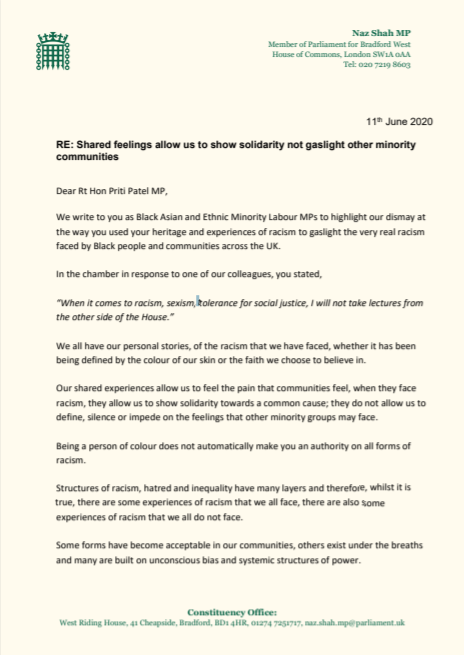
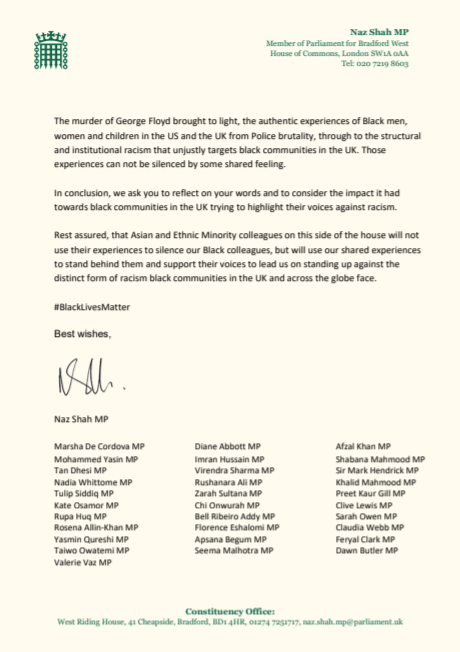
    Below is the image of the letter sent from Naz Shah, the Labour MP for Bradford West, to Priti Patel, the Home Secretary, on 12 June 2020.

  • Anneliese Dodds – 2020 Comments on the GDP Figures

    Anneliese Dodds – 2020 Comments on the GDP Figures

    Below is the text of the comments made by Anneliese Dodds, the Shadow Chancellor of the Exchequer, on 12 June 2020.

    These figures are deeply worrying. They come a day after the OECD suggested that the UK’s fall in GDP for this year will be worse than that of every other industrialised country.

    As a constructive opposition, Labour has been pushing the Government to take the action that is needed now to prevent an even deeper recession. That means above all getting a grip on test, track and isolate, so that people can safely return to work and consumers can have confidence in entering businesses. It also means changing its one-size-fits-all approach to support packages, which risk additional waves of unemployment.

  • Boris Johnson – 2020 Twitter Comments on Winston Churchill Statue

    Boris Johnson – 2020 Twitter Comments on Winston Churchill Statue

    Below is the text of the Twitter comments made by Boris Johnson, the Prime Minister, on 12 June 2020.

    The statue of Winston Churchill in Parliament Square is a permanent reminder of his achievement in saving this country – and the whole of Europe – from a fascist and racist tyranny.

    It is absurd and shameful that this national monument should today be at risk of attack by violent protestors. Yes, he sometimes expressed opinions that were and are unacceptable to us today, but he was a hero, and he fully deserves his memorial.

    We cannot now try to edit or censor our past. We cannot pretend to have a different history. The statues in our cities and towns were put up by previous generations.

    They had different perspectives, different understandings of right and wrong. But those statues teach us about our past, with all its faults. To tear them down would be to lie about our history, and impoverish the education of generations to come.

    As for the planned demonstrations, we all understand the legitimate feelings of outrage at what happened in Minnesota and the legitimate desire to protest against discrimination.

    Whatever progress this country has made in fighting racism – and it has been huge – we all recognise that there is much more work to do.

    But it is clear that the protests have been sadly hijacked by extremists intent on violence. The attacks on the police and indiscriminate acts of violence which we have witnessed over the last week are intolerable and they are abhorrent.

    The only responsible course of action is to stay away from these protests.

  • Liam Byrne – 2020 Speech on the Living Wage at the Birmingham Commonwealth Games

    Liam Byrne – 2020 Speech on the Living Wage at the Birmingham Commonwealth Games

    Below is the text of the speech made by Liam Byrne, the Labour MP for Birmingham Hodge Hill, in the House of Commons on 11 June 2020.

    I will speak in favour of new clause 1 in slightly blunter terms than my hon. Friend the Member for Wirral South (Alison McGovern). The message to the Minister is pretty simple: this is his last chance to tell the House that he shares our ambition that the Commonwealth games organising committee will be accredited as a real living wage employer. He has hummed and hawed about this throughout the passage of this Bill and during his time as a Minister. Today is decision time, and we are looking for a clear commitment from him that the organising committee will be accredited as a real living wage employer.

    The Commonwealth games, as my hon. Friend said, is an extraordinary opportunity for our city at an extraordinary time. It will be the greatest Commonwealth games that we have ever seen. I join others in putting on record our profound thanks not only to the chair, John Crabtree, and Mr Ian Reid and the team, but to Ian Ward and Yvonne Davies and the teams at Birmingham and ​Sandwell councils, as well as the team at West Midlands Combined Authority, for doing the impossible—bringing forward these games in four and a half years, against a timetable of normally seven years, which is what it normally takes to put a Commonwealth games in place. They stepped up when Durban stepped out, and that is why we will be the host—because people were prepared to have that ambition for the festival that my hon. Friend spoke of.

    Opposition Members know that we will be judged not just by the medals that we win, but by the lives that we change. This great festival of Commonwealth sport is also for us a great festival of civic spirit. It is a chance for us to reanimate the spirit of one of the great founders of our city, the most extraordinary civic entrepreneur of the 19th century, Mr George Dawson. He was the author of the civic gospel and he inspired six Lord Mayors, including someone called Joseph Chamberlain. He was one of the reasons why we became known as the best governed city in the world, but one aspect of his genius was that he knew that culture, like sport, should be an entitlement for all, not just a privilege for some. But that civic spirit that we want to celebrate with great pride demands that the Commonwealth games organising committee is accredited as a real living wage employer.

    Why is this important? Because 571,000 people across our region are paid less than they actually need to live on each week, including, I might say, many of the carers we have been clapping for every Thursday night. Let me tell the Minister the real-world consequences of living in a place where about one in five people are not paid enough to live on. It means that, in constituencies such as mine, more than half of children grow up in poverty. Fifty-three per cent of the children in my constituency live a life of poverty. That means that during the summer holidays, the food banks run out of food—literally. In the second city of the fifth or sixth richest country on earth, food banks are running out of food because people are not paid enough to live on. I challenge the Minister to stand, as I have done, in a food bank in Birmingham and watch the little arms of a nine-year-old boy strain as he picks up the food bags to help his mum carry them home. I ask the Minister to tell me that that experience is not going to scar that child for life, and tell me how many thousands of children in our city, Britain’s second city, are in exactly that position, because so few people are paid enough to live on.

    Across our region, only one in 1,000 businesses are accredited as real living wage employers. We need all of them to be accredited, and if we are to achieve that, we need to set an example and that example—the best example available—is the Commonwealth games. That is why we need the organising committee to accredit as a real living wage employer.

    The time has come in this debate for a bit of honesty. We know that officials from the Department for Digital, Culture, Media and Sport have said to the organising committee, “Please don’t accredit as a living wage organisation, because it undermines the case that the Government’s so-called living wage is not enough to live on.” Well, as my hon. Friend the Member for Wirral South brilliantly rehearsed, the so-called living wage that this Government introduced is not a living wage; it is a living lie. It is £8.72 an hour, which is not enough to live on. What people need per hour to live on is not £8.72, but £9.30. I know that that 58p per hour ​does not sound a lot to many people in this Chamber, but over the course of a 40-hour working week, that is worth £23 a week. That £23 extra income a week makes a difference when it comes to taking decisions on heating and eating. That £23 a week extra in the pocket of my constituents lifts children out of poverty; it actually allows people to live. That is why this debate is so important.

    We have offered this new clause to the Minister. I am full of hope that he will stand up and cut the argument away from me, by saying that he agrees with it and that the organising committee must now accredit as a real living wage employer. Let me warn him that, if he does not, over the next year, as he knows, I will be mounting something of a political campaign across the west midlands. If this Government refuse to take on board the new clause, I will hang that decision around every Conservative running for office next year in the west midlands from the Mayor down. This is an opportunity for the Government to do the right thing—the right thing against the judgment of history, the right thing for the people of the west midlands and the right thing for those who live their lives in poverty today.