Tag: 1966

  • Martin Redmayne – 1966 Speech on Abolishing 70 Miles Per Hour Speed Limit

    Martin Redmayne – 1966 Speech on Abolishing 70 Miles Per Hour Speed Limit

    The speech made by Martin Redmayne, the then Conservative MP for Rushcliffe, in the House of Commons on 23 February 1966.

    I beg to move, That an humble Address be presented to Her Majesty, praying that the Motorways Traffic (Temporary Speed Limit) (England) Regulations 1965 (S.I., 1965, No. 2063) dated 3rd December, 1965, a copy of which was laid before this House on 16th December, 1965, be annulled. I hope that it may be convenient, Mr. Speaker, to discuss at the same time the three other Motions standing in my name and the names of some of my hon. Friends: That an humble Address be presented to Her Majesty, praying that the Motorways Traffic (Temporary Speed Limit) (Scotland) Regulations 1965 (S.I., 1965, No. 2078), dated 9th December, 1965, a copy of which was laid before this House on 16th December, 1965, be annulled. That an humble Address be presented to Her Majesty, praying that the Motorways Traffic (Temporary Speed Limit) (Wales) Regulations 1965 (S.I., 1965, No. 2083), dated 9th December, 1965, a copy of which was laid before this House on 16th December, 1965, be annulled. and That an humble Address be presented to Her Majesty, praying that the Traffic Signs (Motorways Speed Limits) Regulations, 1965 (S.I., 1965, No. 2085), dated 9th December, 1965, a copy of which was laid before this House on 16th December, 1965, be annulled.

    Mr. Speaker

    If the House has no objection, so be it.

    Sir M. Redmayne

    We have little time and I shall try to be brief on a subject on which I would have a good deal to say. I want to devote my time almost wholly to the speed limit on the motorways because I believe that it is here that the limit is most subject to criticism. Some people outside have expressed surprise that we should pray against these Orders during the course of the experiment. They fail to realise that the procedures of the House compel us to do so and before the end of this week if we are not to lose our only opportunity of contributing a corporate view before the Minister makes up her mind whether or not to impose a permanent limit.

    We shall not seek to divide the House, because it is pointless to do so in the middle of a review, but I make it clear that we reserve our position at a later stage. It is also worth noting that the general speed limit on roads other than motorways does not appear before the House at all. That is how it is laid down in the Act and if necessary we shall have to seek remedies for that if we wish as a later stage to debate the limits as a whole.

    I hope the House will forgive me if a lot of what I say is in the first person, because I constantly drive on the M.1 and the M.4 and have driven on the M.6 since the limit was imposed. In using the first person I am repeating also views put to me in much correspondence on the subject. The letters I have received on the subject have been most moderately expressed and most clearly argued when they have been against the limit. I particularly want to put that on record because it has been suggested that those against the limit are in some sense irresponsible.

    I want to enumerate flatly and without embroidery a number of dangers which have become common on the M.1. It is my impression that the speeds in the slower lane have increased since the speed limit was put on and certainly the centre lane driving seems now to be seldom more than five miles an hour slower than in the fast lane. I think that is a smaller differentiation than used to exist.

    In the fast lane, few seem to travel over 70 miles an hour but they do travel at that speed and are noticeably frustrated if held up by someone whose speed drops even by a mile or two. Therefore two situations arise. First, one finds that more drivers stick to the outside lane than used to and this also applies in the case of a 40 m.p.h. limit. It is a feature of limiting speed. Some drivers appear to think, it seems to me, that they can go into the outside lane merely because they have as much right to be there as anyone else and some also seem to take the view that there is no need for them to look behind in their reflecting mirrors because, if they are travelling at 70 m.p.h. legally they cannot be overtaken.

    Secondly, since the differentiation in speed between the outside and the centre lanes is now so much less than it used to be, the available space to move into the centre lane from the outside is both less and is harder to find because, as those driving on the motorways know, in looking for a space to move into the centre lane one cannot accelerate beyond 70 because, if one does so, one is breaking the law.

    The result of this is a strong tendency for traffic to bunch and quite frequently one finds oneself in bunches of cars three abreast in the three lanes and six or so deep, all travelling at near enough the same speed. This happens two or three times in a journey between London and Nottingham, for example, and two or three times is enough. This happens in winter traffic and it will happen very much more when we get to the holiday traffic in the summer if the limit is continued. All the time these cars tread on each other’s heels much more than they used to and it is only those who break the law who can ease the pressure.

    But there are other dangers. We all know that cross-winds are very tricky on the motorways and the more vehicles are abreast, the more risk of danger there is and in wet weather—and this is a point which must be taken into consideration—vehicle spray, at all times a menace on the motorways, in these conditions of compulsory bunching is positively dangerous.

    Even if there is no bunching, the dangers arising from reduced differentials of speed are still considerable. Before the limit, both passing and regaining one’s position on the motorway were long-term operations—a long swing out and a long swing in—and this is much safer for all concerned. But the same manoeuvre now that we have the lower differentials of speed is in nearly every case too quickly out and too quickly back. This is very often accompanied—and I have seen this time and time again—by a reduction of speed as soon as the centre lane is regained, because the man passing has so often gone up to 72 or 73 m.p.h. and at once conscientiously comes back to 70 m.p.h., with the result that he immediately pancakes with the car behind.

    There is a very good film put out by the right hon. Lady’s Ministry showing how passing on the motorway should be done, and it makes the very point that the driver should look first for the car which is coming up fast from behind and let it go. But now, for the majority of drivers on the motorways, nothing comes up fast. Everything creeps up and I say flatly that it is often infernally difficult to know what is safe and what is not.

    Equally, I dislike intensely driving with another car running at the same speed as myself tucked away behind my right or my left shoulder. It does not matter how many mirrors one has—and I have as many as anybody else—in certain conditions there is always a point at which it is far too hard to see that car, not passing one, but just sitting there hoping to slip through if one slows down a little and he can ease his way past.

    I do not like the hooting which one now finds going on, nor the flashing of lights. I do not like to see cars passing others on the inside, or creeping up on the inside, and this is happening all the time. Most of all I dislike those who obstruct others with a self-conscious virtue and I believe that speedometer watching for the purpose of keeping within the 70 m.p.h. limit when the eyes of the driver should be on the road is itself dangerous.

    There is no question but that a man drives best at his car’s best cruising speed and today many are driving less well and less safely only because the limit forces them below their natural cruising speed, or in the case of others—and I am sure that this is so—because of the existence of the limit they are persuaded to cruise up to that speed.

    What one wants is for drivers on the motorway to have nothing to do except look far ahead and see where trouble is coming, both so that they can avoid it and so that they can help others behind them to avoid it—and that is enormously important. Some of the multiple crashes which we have had and perhaps because of which the limit was imposed—I am talking about crashes in clear weather and not in the fog—occurred because drivers were not looking far enough ahead and did not have the sense to slow up ahead of trouble, or the sense to keep touching their brakes so as to keep their lights flashing as they were slowing. Unless this kind of technique is adopted, there will be no safety and in these conditions the danger is greater than before.

    Instead of that we get motorists sweating along because they are worrying about the cars immediately in front of them, immediately behind and lurking on their flanks. This cannot be safe. I am going to say nothing about speed as such, nothing about the need to manufacture fast cars for the export trade, and nothing about the motorways being built for speed. All of these subjects tend to be emotive arguments and I want to keep on a practical basis.

    All I want to try to do is to put the arguments of the ordinary motorist driving an ordinarily fast car. If this debate were to go on long enough—but it will not—someone would be sure to say that speed is a killer. It is not speed that kills; it is foolhardiness, impatience, bad temper. All of these killing faults are as common at low speeds as at high speeds.

    I want to deal with the advertisements which the previous Minister of Transport used to launch the limit. In those advertisements the National Opinion Poll was quoted as showing 60 per cent. of motorists in favour of the limit and 38 per cent. against. I am not elaborating the arguments, but I doubt very much whether 60 per cent. of motorists drive at over 70 m.p.h. anyhow, and they are automatically in favour of the limit. Equally, I know that 40 per cent. of motorists do not drive over 70 m.p.h. as a matter of habit and that in the 38 per cent. there is a very large proportion of sensible people who consider that it is perfectly reasonable and safe for the others to be allowed to drive at those speeds if they wish to do so.

    Since I am going to refer to the American survey, which is another part of these advertisements, I would point out that in the survey the number of drivers habitually driving at 70 m.p.h. in America—and, after all, this limit has been largely based on American experience—is only 5 per cent. In these advertisements there is a statement which runs as follows: There is evidence that the average casualty rate for drivers exceeding 70 m.p.h. is about three times that for drivers travelling between 65 m.p.h. and 70 m.p.h. I put a Question down to the Minister asking on what information this statement was based and I was told that it was based on an American publication called “Accidents on Main Rural Highways.” There is now a copy in the Library. I say quite baldly that, in that the advertisement makes this statement, it is an outstanding example of the selective use of statistics, particularly in respect of motorways in this country because it says that the survey undertaken was expressly confined to two-and four-lane roads of the non-freeway type. In other words, it was confined to ordinary roads as we know them. It also says that the design speed of those roads was never more than 70 m.p.h. and mostly 55 m.p.h. or 60 m.p.h., sometimes as low as 45 m.p.h. Thus it gives no useful information about motorways of the kind we have which are designed for much higher speeds.

    It also shows that the rate of accidents on four-lane highways, the largest road with which it deals, is considerably lower than on two-lane, and one understands that. It permits the obvious assumption that the accident rate on six-lane motorways of high speed design would have been shown to be lower still, as it is in this country.

    With direct reference to this figure of three times the accident rate mentioned in the advertisement I want to say that, having studied the report, both its graphs and tables, if the Minister wishes to advertise that the injury rate per 100 million miles over 70 m.p.h. is three times that at 65–70 m.p.h., she, or her predecessor, should in all honesty have made it clear that the injury rate at speeds of 30 m.p.h. to 40 m.p.h. is also three times as much as 65 m.p.h. to 70 m.p.h. It is an inverse curve. At lower speeds still, the injury rate is very much higher. If it is put in straight figures taken from the report it is shown that by day, of a sample total of 2,151 drivers, the number injured at speeds over 73 m.p.h. is 68, or 3.5 cent. The number injured at speeds between 63 and 72 m.p.h. is shown as 180, or about 9 per cent., and the remainder of the sample, numbering 1,900 injured persons, were all travelling below 63 m.p.h. and the majority considerably below. This was, therefore, a peculiar use of a random statistic taken from a report which reached very different conclusions.

    That is all I want to say about motorways. As to other roads, much of these arguments equally apply.

    Mr. Deputy Speaker (Sir Samuel Storey)

    The right hon. Gentleman cannot deal with other roads on this Prayer.

    Sir M. Redmayne

    Thank you, Mr. Deputy Speaker. That will save the time of the House. I have said enough even in that one sentence to make my point and I can return to it on some other Parliamentary occasion.

    My remaining comments refer to the 30 m.p.h. advisory limit. It has been little used since it was enforced, and that is a good thing, because conditions have not made it necessary. When it was used, I was rather surprised that so much comment was made of the fact that drivers were on occasion driving faster than 30 m.p.h. Newspaper comments pointed out how many vehicles swept past their reporters who were driving at 30 m.p.h. Clearly, they misapprehend the purpose of the Order, as is clearly set out in Regulation 4, that a driver shall obey the flashing signs and drive at a speed which does not exceed 30 miles per hour and is safe having regard to any hazard which he may encounter until it is safe for him to drive at a greater speed. That is clearly set down. It means simply that having had warning of a hazard, if the hazard is observed the driver can therefore judge what speed is safe, or if, for example, the hazard is fog and the fog is sufficiently clear for him to drive at more than 30 m.p.h., he is at liberty to do so with reasonable caution So much for that point. It needs to be made clear.

    On previous occasions, I have put to the Minister a different suggestion about how the fog hazard could be met: that was, by a chain of lights down the centre divide. I should like to draw the attention of the House and of the Minister to a very good article by Raymond Baxter in the Autocar of 31st December describing a chain of low voltage lights, which were an improvement on what we talked about previously, which would achieve a desirable form of fog lighting in getting the driver’s eyes away from over-concentration upon a close object—probably another car’s rear light or the shadow of his own headlights in the fog—and keeping them searching out into the fog at a distance which would give him a reasonable chance of avoiding trouble.

    We are highly critical of the 70 m.p.h. speed limit on the motorways. We believe that it will be proved that other roads should be treated on their merits. That is what I was not allowed to say, Mr. Deputy Speaker, but now, thanks to you, I have said it. Thirdly, we suggest that the advisory 30 m.p.h. limit should be interpreted as laid down in the Order and not in the advertisement, because the advertisement says nothing about the driver’s judgment in the matter.

    We all know that the point has been made that the Minister is not a motorist, and I would not dream of making a point of that, except this. I ask her to be sure that when she makes up her mind, she is advised by those who are best able to give her expert, sane, unprejudiced advice—thousands of sensible people, of whom I am only the spokesman.
  • Cledwyn Hughes – 1966 Statement on Aberfan

    Cledwyn Hughes – 1966 Statement on Aberfan

    The statement made by Cledwyn Hughes, the then Secretary of State for Wales, in the House of Commons on 24 October 1966.

    All Members will have already shared in the nation’s grief over the disaster that overtook the small community of Aberfan on Friday morning, when a coal tip avalanched into a farmhouse, 20 houses and two schools.

    Despite the efforts of the rescuers, few lives could be saved. The bodies of 111 children and 32 adults have been recovered. It is difficult to give precise figures of the persons who are still missing, but about 49 are unaccounted for.

    Alongside the rescue efforts, other work has been going on to stabilise the tip and to prevent further slippages. The Chairman of the National Coal Board, Lord Robens, who has been personally directing this work, has reported to me that the tip can now be regarded as generally stable. While there may be local adjustments of portions of the tip itself and of its widespread extensions lower down, these should not give cause for concern. In the unlikely event of a major movement, the alarm system that has been installed should give adequate warning.

    As regards other tips of the National Coal Board that might constitute a hazard, the Board has intensified its inspection procedures and in certain cases has put special precautionary measures in hand. Local authorities have been asked to inspect pit heaps not owned or operated by the Coal Board, to identify which of these might constitute a hazard.

    It is possible that the present legal responsibilities and powers of the appropriate authorities in relation to the safety of pit heaps need to be extended and this will be one of the important questions that will be considered by Lord Justice Edmund Davies.

    I have discussed his inquiry with Lord Justice Edmund Davies today. He is travelling to South Wales this afternoon and will spend tomorrow at Aberfan. I shall be having a further meeting with him on Wednesday. As the Prime Minister has already made clear, he will have wide terms of reference to cover all aspects of the disaster, and he will be given all the powers that he considers necessary. After discussion with Lord Justice Edmund Davies it has been decided to ask Parliament for the inquiry to be conducted under the Tribunals of Inquiry (Evidence) Act, 1921, and the necessary Resolutions will be moved later this week.

    Those of us who have had to be at the scene of the disaster will never forget its horror and tragedy; nor shall we forget the selfless and unremitting efforts of the thousands who, since last Friday morning, have been engaged on the appallingly difficult tasks of rescue, recovery and reclamation.

    The House will wish to express its own deep sympathy with the bereaved. The House will also wish to record its appreciation of the work of Merthyr County Borough Council, other local authorities and national and local organisations and services and the public.

    Hon. Members

    Hear, hear.

    Mr. Davies

    Will my right hon. Friend accept from me that the bereaved relatives and all my constituents will be most grateful to him for his assurances and, may I add, for the long days and nights which he personally has spent in the stricken village, and to the Prime Minister for his visit and for his great encouragement to those who are still fighting the battle in Aberfan?

    May I express my own sympathy to the bereaved relatives and, on their behalf, great appreciation for the thousands of people who have volunteered their services and their resources to the people in Aberfan who need so much help?

    Mr. Hughes

    I am grateful to my hon. Friend, who is so closely identified with the people he represents.

    Mr. Gibson-Watt

    On behalf of my right hon. and hon. Friends, may I record our deep sympathy with those who have suffered bereavement in this tragic disaster at Aberfan? We wish also to praise those many thousands of helpers who have worked and who are still working on the job of recovery with such gallantry. We support the Secretary of State for Wales in his appointment of Lord Justice Edmund Davies to head the public inquiry and, of course, we will support steps taken by the Government to prevent a repetition of such a tragedy in Wales.

    There are certain disturbing features about this tragedy, but, in view of the inquiry, I will put only two questions to the right hon. Gentleman. First, to allay public anxiety, as he quite properly went out of his way to do in his statement, can he say what other tips owned by the National Coal Board at present give cause for concern? Secondly, will the court of inquiry be prepared to issue an interim report if it feels that to be necessary so that any lessons learned may bring immediate benefit?

    Mr. Hughes

    I am grateful to the hon. Gentleman. The inquiry has full power to do what he suggests in his second question and I will certainly discuss that with Lord Justice Edmund Davies on Wednesday.

    The National Coal Board has informed me that there are three tips which it regards as presenting a hazard. These are in the Aberdare area. The first is the Albion Colliery, at Cilfynydd. The colliery is now closed and tipping has ceased. The tip is burning and a continual watch is being maintained. There is no cause for concern.

    The second is the Mardy Colliery, where, in exceptionally wet weather, some movement of fine slurry has been noted, although there is no danger to property, the nearest of which is about three-quarters of a mile away and is not in line with any possible slip. Continual observation is being maintained here as well.

    The third is Penrhiwceibr, where the old tips have consolidated and have a considerable cover of vegetation and where work has now ceased. Present rubbish disposal is on the other side of the mountain and there are no signs of any danger, although a continual watch is being maintained.

    Mr. James Griffiths

    May I, on behalf of all of us, express our deep regret at this awful tragedy and our sympathy with the bereaved and our considerable thanks to the very courageous people who have worked so well? We are very proud of the way in which, once more, our people have shown their traditional courage in times of distress.

    I wholeheartedly welcome the appointment of Lord Justice Edmund Davies as chairman of the inquiry. He carries with him the confidence of all of us who know him and who know that he will do a thorough job. Will my right hon. Friend provide for him a complete record of all the coal and slag tips in South Wales? Secondly, as the Coal Board is responsible for some but not all of them, can my right hon. Friend say what is the number of tips in Wales and who is responsible for them and whether information of that kind will be put before the inquiry?

    Mr. Hughes

    I am grateful to my right hon. Friend. As he is aware, under the 1921 Act the inquiry will have full power to summon witnesses and call for papers. It is estimated that there are some 500 coal tips in South Wales. Ownership is divided among the Coal Board for all tips on its property, and local authorities and private landowners on whose land disused tips stand. Only 80 tips are at present in use, but the Coal Board has a regular inspection procedure for all tips on its land, whether these tips are in use or not.

    However, in the light of events at Aberfan, the Board has intensified its inspection procedures. The Board states that there is no imminent danger from any of its tips, but in the three cases I have mentioned, because of the experience at Aberfan, special measures are being put in hand forthwith. This involves continual inspection, and not inspection once a day, which is a statutory requirement.

    Mr. Finch

    Can my right hon. Friend say what warning system is involved in those pits in the South Wales coalfield where the tips are regarded as a hazard?

    Mr. Hughes

    A 24-hour watch is being kept at Aberfan. There are klaxon hooters and the men on watch have walkie-talkie sets, keeping them in constant communication with the base.

    Mr. Hooson

    On behalf of my right hon. Friend and my hon. Friends I would like to be associated with the expressions of sympathy which have followed this appalling tragedy. It is an appalling tragedy for the Welsh nation apart from anything else.

    May I also congratulate the right hon. Gentleman the Secretary of State for Wales on his appointment of Lord Justice Edmund Davies to conduct the inquiry. No one is better qualified to carry it out.

    I would also like to associate myself with the thanks and appreciation expressed in the House to all of those who have given such unstinting help in this terrible situation.

    Does the right hon. Gentleman not feel that it would be wiser, since this inquiry has now been ordered, if no one made statements as to the cause of this tragedy? It should be a matter for the tribunal to investigate rather than for anyone, however eminent, to make statements. Would he also reassure the House that the inquiry will not confine itself to the dangers from existing slag heaps in South Wales? From my own knowledge I can tell of one slag heap in North Wales, not owned by the National Coal Board, which gave some trouble some years ago. I am sure that the House is very pleased to hear the Secretary of State say that the legal position with regard to responsibility for these tips is being investigated by the Lord Justice Edmund Davies committee.

    Mr. Hughes

    The possible causes of the accident are a matter for the inquiry, and it is inappropriate and improper for me or anyone else to comment upon them.

    We are taking similar action in relation to tips in North Wales.

    Mr. Berry

    As a member of a Merthyr family and as one who had the privilege of holding an ancient office in the county only a short time ago, may I add my sympathies to those already expressed. May I also express my admiration for the people of Merthyr for the way in which they have struggled through these past few days, so typical of them in times of adversity.

    Finally, may I express the hope that the inquiry, under Lord Justice Edmund Davies, than whom there could be no more suitable chairman, may find a solution which will ensure that never again will such a disaster occur, either in Wales or any other part of the country.

    Mr. Arthur Pearson

    While associating myself with the entirely appropriate condolences and tributes, and although welcoming what the Secretary of State has said about intensified inspections, may I ask him whether the inspections will be regular and in association with the engineering departments of local authorities who are closest to the people in these areas? Is he aware of the growing anxieties of people living near to these tips, and of the danger in mentioning the three dangerous tips, since this will cause greater anxiety?

    Mr. Hughes

    As I have informed the House, the Coal Board is inspecting and maintaining a continual watch on the tips which it regards as presenting a hazard. Local authorities are very much aware of the problem and I have asked them to look carefully at all tips which do not belong to the Coal Board and which lie in their areas. I can tell the House that local authorities who may feel that they do not have the expert advice to look carefully at a tip and assess whether it is a hazard will be able, on request to the Coal Board, to obtain the advice of the Board’s engineers. I am grateful to the Board for making this offer.

    Mr. Probert

    While welcoming what my hon. Friend has said, may I ask him if, when asking local authorities to report on this matter, he will impress upon them the urgency of such reports, in view of the prevailing anxiety? In addition, will he recommend that local authorities should obtain, not only the advice of the Coal Board’s experts, but of outside experts, for obvious reasons?

    Mr. Hughes

    Certainly. I have asked for reports from the Coal Board and I have discussed this matter with my right hon. Friend the Minister of Power. We shall be working in close collaboration to obtain up-to-date and urgent reports of all the spoil heaps in South Wales, in order to allay the anxieties which I know my hon. Friend and his constituents feel.

    Dr. David Kerr

    I am perhaps not the most appropriate person to say this, but on behalf of a constituency which does not live under the constant threats, and the ugliness of a bygone age, and on behalf of most of us in this House, may I say that this tragedy has reminded people a long way from Wales that we are still one nation.

    May I also offer the Secretary of State for Wales an assurance that, whatever the Government decide to do, first, to ensure that this sort of tragedy never recurs and, secondly, to see that the children of Aberfan have a fitting memorial in the future, he will have the fullest support from everyone all over the country.

  • Hugh Jenkins – 1966 Speech on Pirate Radio Stations

    Below is the text of the speech made by Hugh Jenkins, the then Labour MP for Putney, in the House of Commons on 22 June 1966.

    I rise to draw attention to the Government’s attitude to pirate radio and television. I think that the adjournment of the House has never been more welcome. As I stand here we see dawn coming in through the windows. I hope that this debate may be seen, looking at it in retrospect, as heralding the dawn of a new attitude by the Government to this whole question.

    There has been a tendency perhaps to dismiss pirate radio as a matter of no great importance and no great significance, as something which is a passing episode, but the extraordinary and tragic events of the past 24 hours have perhaps impressed everyone, the Opposition as well as the Government, that piracy is piracy in whatever aspect it occurs. We have seen the hi-jacking of a pirate station, Radio City, and the taking over of that illegally occupied tower by another group equally illegally occupying it. We have seen this culminate in the shooting to death of the chief of one of the pirate ships and the captain of another accused of murder.

    We might have been more prepared for this had we considered that piracy is an aspect of anarchy. When the Government condone anarchy, as in effect they have been doing in the last two years, the gangsters soon take over. We might have been warned of this as this is not the first time that murder has taken place as a result of radio piracy. There was a murder on a Dutch ship some time ago. This is not something to be regarded as unimportant and a sort of pleasantry.

    When the circumstances of the financing and management of Radio Caroline and of Radio City are investigated, we shall find that some respectable newspapers, notably the Financial Times, have been weaving a romantic web around some operations which will not look too well when the light of examination is brought to bear upon them.

    The Government presented us more than a year ago with a document in which they set out the decisions of the European Agreement For The Prevention of Broadcasts Transmitted From Stations Outside National Territories. Article 2 of that Agreement said: Each contracting party undertakes to take appropriate steps to make punishable as offences, in accordance with its domestic law, the establishment or operation of broadcasting stations referred to in Article 1, as well as acts of collaboration knowingly performed. 2. The following shall, in relation to broadcasting stations referred to in Article 1, be acts of collaboration:

    (a) the provision, maintenance or repairing of equipment;

    (b) the provision of supplies;

    (c) the provision of transport for, or the transporting of, persons equipment or supplies;

    (d) the ordering or production of material of any kind, including advertisements, to be broadcast;

    (e) the provision of services concerning advertising for the benefit of the stations.”

    The Government have announced their intention to implement this agreement and to make these things illegal. It is extraordinary that, since that announcement, organisations which are normally regarded as respectable business organisations should continue to support these pirate stations although in full knowledge that the Government were to introduce legislation to make them illegal. One would have thought that it would have been proper for these business organisations to have ceased to support these pirate radios by discontinuing advertisements. That they refused to do so reflects discredit on them. Other countries have found it possible to get rid of pirate radios, but the United Kingdom is being regarded as a sort of refuge for buccaneers who have been rejected by more resolute Governments in Holland, Scandinavia and elsewhere and who have found shelter in and around our shores.

    If we can, by international agreement, stop tankers reaching a port in Africa surely we can, with equal international agreement, prevent ships nearer our own shores breaking the European agreement to keep the air free from piracy.

    The Postmaster-General has told us of the possible dire consequences of the usurpation of wavelengths, but the Government continue to find excuses for doing nothing to stop that which my right hon. Friend condemns.

    When the pirates get into difficulty all available services are deployed to enable them to get back to their stations to continue their piracy. I understand that in the recent fracas on Radio City one group of pirates actually appealed to Scotland Yard to help them to resist the infiltration or attacks of the other group of pirates. According to last night’s Evening Standard senior Scotland Yard officials are considering whether they should go to the aid of one side to help them resist the hijacking of the other. The only thing that Scotland Yard should be considering, but what they have not considered, is how to help the Government to eject the pirates. They should not be intervening in what is an internal competition in illegality.

    Many of these pirates are not even on ships. The towers from which they operate have been brought inside territorial waters. They have no licences, and last December the Postmaster-General decided that the time had come to act. In February the Ministry of Defence said that it was too dangerous for the Armed Forces. Perhaps the police could help, but my right hon. Friend said no, the magistrates did not have proper jurisdiction. I am advised that this is not so. They have jurisdiction under the Wireless Telegraphy Act and under the Magistrates’ Courts Act of 1952. I am advised on good authority that the arguments advanced to this effect by Sir Alan Herbert are legally valid. Why is it that the Government have not decided to act? Why is it too dangerous for the Navy or even marines to do here what the policeman regards as part of his job—going in and arresting law breakers?

    Why did the Chancellor of the Exchequer refuse to consider my own proposal that the cost of advertising on pirate radio should be disallowed as an expense for tax purposes, thus starving the pirates out if they are too dangerous to arrest? The consequence of that refusal is that the advertising organisations have now recognised the pirates, and the audience must be substantial, for they are paying up to £80 for a 30-second spot.

    Here, perhaps, lies the secret of the Government’s inaction. A lot of people are listening to the pirates, and the B.B.C. has lost its grip on the audience for popular music on sound radio. Perhaps the Government do not really know what to do about it.

    I hope that my right hon. Friend will comment on the following proposals which I put forward as a possible solution to the problem. The Government should set up a new public authority, called, perhaps, the Television and Radio Authority. It would be quite separate from the existing authorities, which would continue as at present. The new authority would run the fourth television channel, which is needed if the University of the Air is to get off the ground in a big way, and it might also transmit some pay-television programmes, which have had a surprising success in their first test.

    The new authority’s immediate task would be to set up a national radio network in competition with the B.B.C. It would replace the pirates, who should be given immediate notice to quit and evicted. The new service would aim to be popular. It would, in the first instance, transmit the same sort of programmes as the pirates are transmitting. It would do that, perhaps, on a medium wavelength which, if necessary, could be borrowed from the B.B.C, though it might be found by international agreement. It would transmit simultaneously on v.h.f., and on these wavelengths would act as a national feeder station for local radio stations which would be set up locally under local boards of directors, with local authority participation.

    The new authority would be capitalised by public finance, but it would be allowed to accept advertising. The local stations would be allowed to accept local advertising. It would, as it were, be a mixed economy of the air.

    By this means, several problems would be solved. First, we should be able to rid ourselves of the pirates, without depriving the audience of their “mush”. Second, we should break the sound monopoly of the B.B.C. The very existence of the pirates is proof that this needs to be done. Third, we should have established a parent for local radio. Local radio needs a national parent, but it should not be the B.B.C. The flavour of the B.B.C, in my judgment, is good; I enjoy it myself; but many people do not, and they should not be deprived of choice. If anyone says that the three B.B.C. sound programmes provide all the choice that one could want, I point to the success of the pirates. Clearly, the B.B.C. is not catering for that huge audience. I do not believe that the Corporation should be forced to cater for them, if it does not want to, and neither do I believe that it should be forced to accept advertising.

    Here, I suggest, is the answer: a new authority, publicly capitalised, publicly owned, but accepting advertising revenue, providing a national service and source of a local service which would provide means of stimulating interest in local activities, facilities, music, sport and so on.

    I recognise that there are difficulties. One of them is the absolute need to reach agreement with the performers’ and writers’ unions. In my opinion—I speak here entirely for myself—this would not be impossible if the new authority were prepared to transmit a proportion of live or specially recorded material and to pay for all broadcasts on a royalty basis so that every time a commercial gramophone record was broadcast, the performer or, perhaps, his union or organisation on his behalf received a payment.

    These are the lines along which, I suggest, the problem should be tackled. It should be tackled now, and not allowed to drift. The more it is allowed to drift, the more difficult it will be to solve and the less credit the Government will deserve or get for tackling it. I hope that my right hon. Friend will be able to tell us that he believes that the Government have been perhaps encouraged or shocked by the events of the last 24 hours and jerked into action which only if it is determined and quick action, will be forgiven for being belated.

  • Gwyneth Dunwoody – 1966 Maiden Speech in the House of Commons

    Below is the text of the maiden speech made by Gwyneth Dunwoody, the then Labour MP for Exeter, in the House of Commons on 8 July 1966.

    If that riveting opening phrase, “I rise to make my maiden speech and to beg the indulgence of the House” causes you to sink a little lower in your august Chair, Mr. Deputy Speaker, I hope that you will forgive me.

    I warmly welcome the Bill as a step in the right direction. With the greatest respect, I welcome it also since I rather feel that I might not always find myself in such wholehearted agreement with the right hon. Gentleman the Member for Streatham (Mr. Sandys) during the rest of my Parliamentary career.

    I represent a very beautiful city. It is one for which I have great affection. Unlike my hon. Friend the Member for Peckham (Mrs. Corbet), I represent a city that has many historic associations and many beautiful buildings. To anyone who has the opportunity to sit, as I do, on a local authority planning committee, it is sometimes a little disheartening to discover how easy it is to destroy the beauty that men have left us over the years. Although we are able to preserve individual houses, it has in the past been only too easy to destroy the entire character of streets and cities by not considering an area as a whole.

    I am delighted that a Clause is provided in the Bill to deal with that aspect. I have had the slightly disheartening experience of taking part in a discussion on how to preserve a very beautiful view on one of the most beautiful rivers in Devon. Had it not been so tragic to me, I should have been amused at the sort of solution arrived at. It was decided that it was possible to leave a gap between two large sheds; and that this would preserve a very beautiful amenity.

    We have various other problems in Exeter on which I hope to have a chance to address the House on other occasions. We face the thorny problem of what is known as development. We desperately need to marry the best of the old with the best of the new. I always feel that beautiful cities, rather like beautiful women, require a certain amount of judicious preservation—I was about to say that they do better to be lived with; but perhaps that might be misinterpreted.

    If we are to provide the sort of environment in which people can live their lives to the full, we must be able to preserve the best houses and the best architectural points of interest. We certainly must do something about the rage we sometimes seem to have in modern society only to destroy and not to preserve. I have been startled by the number of ways in which it is possible to, shall we say, evade some of the provisions of the Town and Country Planning Acts.

    If it is true to say of people Thou shalt not kill, but need not strive Officiously to keep alive it is also true of trees. I welcome the provisions for the preservation of trees because there is here one aspect that we have not considered. Trees are living things, and can be easily destroyed.

    One can judiciously find that their branches are in need of lopping, one can destroy their roots, or find perhaps that they are a danger to new developments it is necessary to do away with them. In those circumstances, it is all the more important for local authorities to have the kind of provisions contained in this Measure to require developers or builders to replace trees in areas from which they have been removed.

    Those of us who have served on local authorities want to see our cities made not merely utilitarian and as a sort of background against which can be produced better jobs and a better future for our children, but a warmer, livelier and more beautiful environment. As this island becomes more and more crowded it becomes more incumbent upon us to protect areas such as the South-West which have great natural beauty where cities have grown up in very pleasant juxtaposition one to another, but which, if they are to live and not merely to be developed, must be developed in such a way that they will provide even greater beauty than in the past.

    I know that I do not need to draw the attention of the Joint Parliamentary Secretary, my hon. Friend the Member for Widnes (Mr. MacColl), to some of the problems we have in the South-West. I live in what is called a gem town. The problem for this particular gem is that the setting is one which we are very anxious to preserve. We look to the future to provide opportunities for better planning of growing towns. It is important that they should be the sort of towns which provide the environment we want for our children.

    I most warmly welcome the Bill.

  • Queen Elizabeth II – 1966 Queen’s Speech

    queenelizabethii

    Below is the text of the speech made by HM Queen Elizabeth II in the House of Lords on 21 April 1966.

    My Lords and Members of the House of Commons:

    My husband and I look forward with pleasure to our visit to Belgium, and to the State Visits which the Federal President of the Republic of Austria and His Majesty King Hussein of the Hashemite Kingdom of Jordan will pay to this country.

    My Government, in co-operation with the other members of the Commonwealth and with our allies, will continue to work for peace and security in all parts of the world through support for the United Nations. They will sustain efforts to achieve disarmament, and, especially, agreements on the non-proliferation of nuclear weapons and on the extension of the Nuclear Test Ban Treaty.

    A particular concern of My Ministers will be to use all available means to achieve a negotiated settlement of the conflict in Vietnam. They will continue to assist Malaysia and Singapore in their defence against Indonesia, and will not relax their efforts to bring peace to this whole area.

    My Government will continue to give full support to the maintenance of the North Atlantic Treaty and its Organisation, which they regard as a necessary basis from which to promote greater stability in East-West relations. They will continue to work for nuclear interdependence in the West.

    They will also support Britain’s other alliances for collective defence, and press forward with policies designed to enable Britain to play her full part in the promotion of peace throughout the world, without overstraining her military or economic resources. A Bill will be introduced to reorganise the Army Reserve and Auxiliary Forces.

    My Government will continue to promote the economic unity of Europe and to strengthen the links between the European Free Trade Association and the European Economic Community. They would be ready to enter the European Economic Community provided essential British and Commonwealth interests were safeguarded. They will work for tariff reductions under the General Agreement on Tariffs and Trade and for an expansion of Commonwealth trade.

    Further steps will be taken to assist My peoples in the remaining Colonial territories to reach independence or some other status which they have freely chosen.

    My Government will pursue the policy of bringing the illegal régime in Rhodesia to an end, so that a peaceful and lasting constitutional settlement, based on the rule of law and acceptable to the Rhodesian people as a whole, can be achieved.

    Members of the House of Commons:

    Estimates for the public services will be laid before you.

    My Lords and Members of the House of Commons:

    A prime aim of My Government’s policy will be to restore equilibrium in the external balance of payments. They are determined to maintain the strength of sterling. They will continue to work for increased liquidity for financing world trade.

    In consultation with industry, the National Economic Development Council and the regional Economic Planning Councils, My Government will take action to stimulate progress in implementing the National Plan and in securing balanced growth in all parts of Great Britain. They will renew their efforts, in co-operation with trade unions and employers’ organisations, to increase the productivity and competitive power of British industry.

    To this same end, My Government will promote a more positive system of investment incentives to improve the efficiency of those parts of the economy which contribute most directly to the balance of payments and to encourage development where it is most needed. Legislation will be introduced to create an Industrial Reorganisation Corporation to promote greater efficiency in British industry and to develop projects of special importance.

    My Government will continue to develop, in consultation with management and unions, the agreed policy for productivity, prices and incomes. Proposals for legislation to reinforce this policy, while preserving the voluntary principle on which it is based, will be laid before you.

    My Government will continue to promote modernisation and increased productivity in farming, horticulture and fishing, and will introduce measures for the longer-term development of agriculture and the establishment of a Meat and Livestock Commission.

    A Bill will be introduced to restore public ownership and control of the main part of the steel industry.

    Legislation will be introduced and other measures taken to improve efficiency and industrial relations in the docks.

    Bills will be introduced to relieve the domestic ratepayer and reorganise Exchequer grants to local authorities; to establish a new system of Exchequer subsidies for local authority housing, and to assist those of modest means in buying their homes.

    Legislation will be brought before you to provide for the establishment of a Land Commission to acquire land for the community and recover part of the development value realised by land transactions. My Ministers will present a Bill on leasehold reform.

    A Bill will be introduced to regulate privately-sponsored construction.

    My Government will bring forward Bills to reorganise the arrangements for water supply in Scotland, and for the conservation of the Scottish countryside and the development of facilities for its enjoyment.

    Legislation will be introduced to implement the agreed arrangements for increased grants to voluntary schools in England and Wales.

    My Government will promote further progress in the development of comprehensive secondary education.

    Further steps will be taken to increase the supply of teachers. New machinery will be proposed for settling the remuneration of teachers in Scotland.

    Higher and further education will be expanded to meet increasing demand. The development of science will be continued. In the arts, My Ministers will pursue their aim of making our cultural heritage available to all.

    My Ministers will complete further stages of their major review of social security. While continuing to ensure to pensioners and other beneficiaries a fair share of the country’s rising living standards, they will seek further means of dealing with the poverty that still exists. Legislation will be introduced to create a Ministry of Social Security and to replace National Assistance by a new system of non-contributory benefits.

    My Government will continue to develop the health and welfare services and will pay special attention to the development of the family doctor service.

    You will be invited to approve a measure designed to promote greater safety on the roads.

    My Government will carry forward, where necessary by introducing legislation, the process of reforming the criminal and civil law and modernising the administration of justice. They will introduce legislation to make further reforms in the penal system; and to amend the law relating to the return of fugitive offenders to other Commonwealth countries.

    Other measures will be laid before you.

    My Lords and Members of the House of Commons:

    I pray that the blessing of Almighty God may rest upon your counsels.

  • Michael Heseltine – 1966 Maiden Speech in the House of Commons

    Below is the text of the maiden speech made by Michael Heseltine in the House of Commons on 14 July 1966.

    I was deeply aware of the regard in which my predecessor, Sir Henry Studholme, was held in this House. It is matched by the affection extended to him in the Tavistock Division. He represented that Division with great distinction for 23 years. I am particularly conscious, as I am honoured to rise for the first time to speak in this House, of the standards he set when he was a Member of Parliament.

    I know from what I have heard in this debate:hat we shall hear objections to the working of the Bill. We have heard some of them expressed by my right hon. Friend the Member for Barnet (Mr. Maudling). As a director of a company in the recruitment field, I saw something of these difficulties and I wish to make reference to them, but before I raise those questions I should like to raise what to me are questions which are fundamental not only to the Bill, but to the thinking of hon. Members on both sides of the House.

    I wish to ask what right the House has to assume that there is a concept of national interest to which each of us as citizens owes a prime obligation in the every-day conduct of our job or business. If such a claim can be made of us I ask whether the making of that claim will so stimulate our energies and talents that the country will derive the greatest benefit from our endeavours.

    There are two conditions which would be necessary to be fulfilled if we are to accept the concept of true national interest. The first condition is that it is capable of definition and that that definition must be acceptable not only to a political party, but to hon. Members on both sides of the House.

    The second is that all sections of the nation shall be expected to share in any sacrifice which might be required by serving the national interest. I believe that on these two counts the Bill is unacceptable. By keeping the economy in its present over-heated state, many hon. Members would believe that we are acting against what we would term to be the national interest. There is no consensus on this subject today.

    On the second point, only statutory control would enable the trade unions and the large industrial concerns to have the confidence that they were not embarking on an experiment from which the less controllable parts of the private sector would opt out. Even if the First Secretary were able to introduce legislation of the sort which would ensure control, I do not think that this would encourage on the part of each of us the sort of endeavours that the right hon. Gentleman would require. The First Secretary is concerned to involve the public in the problems facing the country. The overwhelming majority of the public are now aware—the First Secretary of State must take some of the credit for having educated them—that the only way in which the country can enjoy increasing benefits is if we can get faster growth.

    There are two other considerations which I ask the First Secretary to bear in mind. First, a policy of full employment does not mean that each one of us is entitled to expect that the same job will be available to us in the same place throughout our lives and industries cannot automatically expect Government protection from historical trends and from overseas competition. Secondly, the only way to extract the maximum effort from the majority of our citizens is to reward by financial incentive. Businessmen will respond to one thing, and one thing only—the opportunity to increase their salaries, their profits, and the capital value of their companies.

    If we wish, as I am sure we do, to enlist the nation’s greatest efforts, tangible rewards must be placed within the reach of everyone. There is no doubt that the First Secretary is one of the most persuasive and eloquent members of the Government. He has gained remarkable success in persuading people to say that they agree with the targets he has set, but I urge him to realise that it is one thing to persuade people to say that they agree. It is quite another thing for those people to go away and carry out what they have said they agree with. If the First Secretary could be present at every management meeting, if he could stand behind all the retailers’ counters, and if he could travel daily with the men going to work in Britain’s factories, then I believe that in a short term such a policy would be credible. The fact is that such an idea is patently absurd and, therefore, an alternative solution is required.

    There can be few hon. Members who have not engaged in some negotiation which, in theory at least, would now fall within the purview of this legislation. There must be few who have not negotiated a salary increase, who have not evolved a pricing structure, or who have not disposed of capital in order to secure the maximum return. These are commonplace activities. I do not believe that behind the closed doors of human motivation considerations of the national interest weigh in the balance. I believe that it would be unhealthy if they did.

    There is involved in this discussion this afternoon an obligation as fundamental as any that we may owe to the nation. We have obligations to ourselves. There are many hon. Members on this side of the House who believe that we serve our community best by maximising the return on our own endeavours. Of course there are exceptions to every generalisation, but for the generalisation I would say that the community grows stronger where its members set out to maximise their earnings and where its companies strive to maximise their profits.

    It is the Government’s duty to establish beyond any doubt what they consider the national interest to be and, once they have so defined the national interest, not to urge or to beg or to plead, but to legislate on behalf of that national interest. That must be the purpose of the Government. Responsibility for interpreting the national interest cannot be spread into every trade union conference room, into every board room, nor, indeed, into every private home. Surely it is the responsibility of us in the House to lead. If we surrender that right we shall fail in our obligations to those who have sent us here.

    There are many practical difficulties facing this legislation. I want to say something about the problems which confront anybody trying to hold or recruit salaried staff today. The shortage of skilled and trained management staff is acute. The temptations facing them to move from one job to another are intense. A small but significant group of these people are particularly tempted by the carrots dangled in front of them from America. I know of one occasion only this week when a telephone call out of the blue offered a man a 300 per cent. increase on the salary he was earning.

    Even the employee devoted to his own job cannot avoid the £8 million worth of recruitment advertising which will appear in the national press in 1966. Indeed, it is indicative of the problem that in 1961 recruitment advertising in the national Press amounted to £4,193,000. By 1965, the figure had more than doubled to £8,535,000. It is now widely accepted by employers that, to recruit a suitable candidate for middle management, the advertising costs alone in the national Press can exceed or amount to up to £250.

    I mentioned earlier the temptations on employees to seek increases by changing their jobs. These employees are sought by specialist registers which are prepared to distribute their names to company after company until they are offered another, and usually higher paid, job. Job changing, which is usually synonymous with an increase in salary, is increasing.

    It is further encouraged by the growth of employment agencies. Between 1956 and 1965 in the whole of the London County Council area licences were issued to 300 new employment agencies. This was an annual rate of 37. In the year ended 31st March, 1966, the Westminster City Council which took over most of the responsibilities in this respect from the London County Council, issued 93 licences to new employment agencies.

    The latest development of this activity in this country is the establishment of the professional head hunter. There is nothing new in companies making offers to employees of outside organisations, but I believe that it is a new practice new being established that lists of highly qualified, specialised staff are approached, without any indication of dissatisfaction on their part, and offered new jobs, often at a greatly increased salary.

    Against this background, the background which has built the job-changing market into a highly specialised operation, it s simply of no value to tell employers that they should try to hold their staff to a 3 per cent. or 4 per cent. norm, or even lower—the figure is now to be reduced. Employees often do not want to leave the companies that employ them; but they will not, as a general rule, remain with their employers if their salary scales fall below the national average. As we all know, every application for an increase in salary or for a new job is a special case for the person submitting it. Today, no employer can lightly refuse one of his good staff an increase in salary of £100 or £150, because he knows that the replacement will almost certainly be more expensive and probably not of so high a calibre.

    I have seen it argued that, although this section of the market cannot really be controlled by a prices and incomes policy, it is not a section which ought to concern us particularly because of its size. It is undoubtedly a fairly small market, but it is not obscure. What is happening in this market is an example to the majority of people in other sections of the community. The ripples spread out and the majority cannot be expected to accept readily a policy which they know does not apply to the minority.

    Further, although the highly volatile section of this market is probably restricted to the younger, more highly qualified personnel up to 40 years of age, this section of the salary market is the dynamic for a much larger market. Forty per cent. of employees are now salaried. Part of the 40 per cent. covers the public sector and is, therefore, theoretically, under Government control. But this sector is directly linked with the private sector because interchangeability of career patterns is considerable. One of the most thorough and accurate salary surveys is based on co-operative research between private sector companies and nationalised industries. No major industry can afford to develop the reputation that its pay scales have fallen behind those of other industries.

    There are further independent salary surveys caried out by recruitment agencies. These concentrate on people who are basically job changers and are, therefore, more likely to be bidding up the market. The purpose of the surveys is to enable companies to discover whether they are falling out of line with national trends. Throughout a given period, these surveys consider thousands of salary standards and the pattern of all new and usually rising levels of remuneration developments. The surveys are then distributed widely to personnel managers, encouraging them to bring their existing staff into line with the salaries being commanded by those changing their jobs.

    There is only one impression that one can see from the salary market. Under present conditions of demand for staff, it is in a totally uncontrollable state. There are so many employees and employers that any form of control that is not imposed and not seen to be imposed cannot work. The Bill substitutes statutory exhortation for Ministerial exhortation, but the force of that exhortation is no stronger.

    Indeed, I believe that we are acting out a charade, because by the time the Bill becomes law the measures that the Chancellor of the Exchequer has taken, and those he is to take, will have removed the need for the Bill. The Government have committed themselves to a policy of deflation and if the steps not taken up to now are not sufficient to raise the level of unemployment the Government will take further steps. I believe that they have accepted that as the policy they must pursue.

    In the short run, it is simply not necessary for hon. Members on this side of the House to answer the question,”What would you have done?” The Chancellor has answered it for us. The core of the problem is the need to pursue policies which can obtain growth on which the ability of the Government and the public to have a choice must be based. We need a major redeployment of our resources and to retrain labour. I accept that this means paying higher unemployment benefits in order to remove the fear of unemployment but we must inject a wider degree of competition and ask ourselves not what other industries we should nationalise but what nationalised industries can be denationalised. Above all, we must so adjust our taxation system that every citizen is encouraged to earn more.

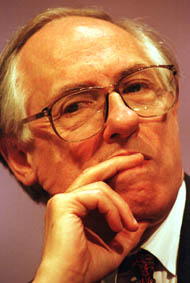
  • Donald Dewar – 1966 Maiden Speech in the House of Commons

    donalddewar

    Below is the text of the maiden speech made by Donald Dewar in the House of Commons on 4th May 1966.

    It is with some trepidation that I find myself on my feet at this early stage. Many of my hon. Friends counselled a longer wait, but a maiden speech is an ordeal which does not improve with contemplation and I decided to take my courage in both hands and rely on the traditional tolerance of the Committee.

    I am the first Member of the Labour Party to be returned for South Aberdeen, and I suppose it is fair to ask why the people in that area have decided to turn their backs on a well-entrenched Conservative tradition which has been energetically represented for 20 years by my distinguished and in some ways rather formidable predecessor, Lady Tweedsmuir.

    I think that the answer is fairly clear. It is that in South Aberdeen, as in many other parts of the country, they were impressed by the priorities and programmes of the last Labour Administration, and particularly in my area by an Administration which could deal energetically with a serious financial crisis and at the same time manage to reduce unemployment and so eliminate that endemic plague, the unemployment spiral dictated by external balance of payments difficulties. It is that in particular which ensured the return to Parliament of myself and many of my hon. Friends with increased majorities. It is because I think that the Budget will continue these sensible and flexible policies which have brought about this increase in prosperity and stability in my part of the world that I welcome the Budget.

    I think it is only fair and right that the basis of the taxation system should be broadened. I think it is right that the imbalance which allowed the non-manufacturing sections of the economy to escape their fair share of the burden of taxation should be put right. It is equally right and convenient that the Chancellor’s catchment area should be increased. It is difficult to quarrel with any of these things.

    I am impressed with the general engineering of the tax which will bring about a desirable switch in the deployment of labour in this country. I do not think that it will be dramatic, but it will be a trend which we can all welcome. I am very clear in my own mind that the objections coming fierce and fast from the Opposition benches on the subject of hoarding of labour are misplaced and wildly exaggerated. We know that in British industry there are many firms with old-fashioned ideas. We know that there are people who are not interested in the desirable movement towards capital-intensive as distinct from labour-intensive firms, and we all accept that there are people with the old-fashioned idea that one cannot install a machine until the plant it replaces has been written off at a rate of depreciation which is often arbitrary and ill-advised. All these things we accept, but it is a long step from saying this to saying that a marginal supplement for the employment of labour in manufacturing industry will radically encourage this state of affairs. Taking the tax overall, and looking at the employment picture, and the Government’s policy on, say, investment incentives, there is no doubt that the merits of the measure far outweigh what is a very marginal argument against it.

    I enjoyed my first Budget, because when I arrived at the House I got the impression that many hon. Members opposite were coming to gloat. They were looking forward to hearing a Labour Chancellor of the Exchequer having the unfortunate experience of having once more to flog the old pack horses of the economy, to increase direct taxation, to “have a go” at tobacco, beer, and so on. I got the impression that their smugness—I think that that is a fair term to use—began to turn to dismay as the proceedings wore on and they realised that that was not happening, and their minds were being asked to grapple with something which was new, something which was modern, and which they began dimly to realise was tailor-made to meet the requirements of the British economy.

    At the end they were bemused, and some of them have not recovered from the attack and are using the same arguments and the same slogans which they have shouted against every Labour Budget for many years, and the tragedy is that as the ground has shifted, and as the arguments are different, their old slogans are even less appropriate than in the past.

    Having said that I welcome the Budget, I must make it clear that as the Member for South Aberdeen I have certain reservations about specific facets of it which it is only fair openly to express. Some of the reservations have been mentioned by the right hon. Member for Orkney and Shetland (Mr. Grimond). I accept them to some extent, but only to some extent. I am one of the representatives of a city of 180,000 people which is almost entirely dependent on administration and service industries connected with a considerable agricultural hinterland, and although we have two important, though small, shipyards—important in the local sense—whose future we watch over anxiously, and certain pockets of machine tools and paper manufacturing industries in the area, it is basically true that the number of employers who will get the premium can be counted on the fingers of one hand, and it is therefore fair to concede that this tax will be initially unpopular and much misunderstood in my constituency.

    The second great pillar and prop of South Aberdeen is tourism, and already we have heard sounds of grumbling discontent from the tourist industry which has been excluded from the Government’s incentives, and I have no doubt that in the near future the discontent and grumbling will increase and will be a considerable embarrassment to Members like myself.

    With this I sympathise and must say that I am worried about the tourist industry. In a city like Aberdeen, there will be a temptation to pass on to the customer the increases due to this taxation. If that is done this tourist trade which basically depends on internal tourism with people coming from other parts of Britain to Aberdeen, will become even more vulnerable to the ever-increasing plethora of cheap Continental holidays. I hope that the people in the industry will realise that it is in their interests to try to absorb most of these costs. But, on the other hand, I hope that the Chancellor will be receptive to what I know will be a great deal of pressure from both sides of the House to try to do something to help the tourist trade, particularly in areas like this.

    Again, the service industries may also be tempted to pass on the increased costs. I hope that they will not do so, because thanks to the efforts of a Labour Government, the real problem in Aberdeen is not unemployment. The real problem is uncompetitive rewards, and a man in the North-East knows that he can get half as much again for the same job, and the same hours, by going to the Midlands or to the prosperous south of England. The result is that we are an open society in the sense that we can be raided, and are being raided by foraging parties for labour which drain off on enormous amount of the skilled manpower in our part of the country. I.C.I. and Stewarts and Lloyds are two recent examples, and I am worried that people, by unthinkingly passing on these increases in the service industries, will raise costs, even if nothing like as spectacularly as people say, but still significantly so, with the result that the level of wages will be even more uncompetitive.

    There is a further danger that employers will use this as an excuse for keeping down the level of wages. If there is one section of the Aberdeen community which deserves criticism it is the industrial and commercial community, which has for too long been willing to accept comfortably low labour costs at the price of continuing local stagnation and emigration. I hope that local employers who will be affected by this tax will carefully examine their profit margins and the situation in which they find themselves before they glibly victimise their customers and ultimately themselves by just raising prices.

    It has been said that the answer is to attract manufacturing industries to areas like Aberdeen. This is easily said, and I pay tribute to the great success of the Labour Administration in this field. The fact that I am here is a tribute to that success. The First Secretary reeled off a very lengthy list of such measures this afternoon, and I do not wish to repeat it, because it is familiar to us all. But I feel this will inevitably be a long-term business. It is by no means hopeless to talk about diversifying industry in Aberdeen. We can do it ultimately, but the basic shape of our economy will remain unmodified for a considerable time. Because of that we cannot look for a quick change, and we must face the possibility that this tax will have some unfortunate repercussions in the short term.

    This will sound like special pleading, and so it is, but it will be heard not only from people in the north-east of Scotland but in the Highlands, in the Scottish Borders and probably in many parts of England from areas with similar problems. I hope that these pleas will be listened to carefully by the Chancellor. There are the real difficulties for the tourist and also the fishing industry, the status of which I believe is still a matter of discussion in relation to the new tax. I hope that the Chancellor will look at the whole problem of regional development. This new and imaginative tax—this novel weapon in the Chancellor’s armoury—is a great improvement on the old rigid deflationary machinery in terms of flexibility, and it is used at the moment to favour manufacturing as against service industries. It could be used to encourage regional development as against the over-eager growth in more geographically favoured parts of Britain.

    The point to grasp is that these two objectives are not incompatible, and it is wrong to try to pretend that we cannot achieve both. I hope that in the near future the Chancellor will listen with sympathy to the plea of the development areas, and see whether he cannot make this kind of concession. We have made enormous progress in areas where there has been traditionally little Labour support, because we have been able to convince the electorate that we stand for a controlled steady and all embracing growth which will benefit all sections of the population. We have an enormous record of achievement in this respect.

    While I welcome this enlightened and important tax, which will do something to increase mobility of labour, stimulate productivity and bring economic sanity to this country, I hope that my right hon. Friend will slant it in such a way that it will not interfere with the general trend of Labour policy, which has been to help regions like mine. My right hon. Friend has an enormous amount to his credit. He can increase this by a few minor adjustments in this Budget. I hope he will make the effort and continue to aid, encourage and inspire growth and effort in areas for which he has so rightly done so much in the last two years.