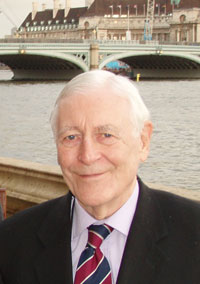
Below is the text of the speech made by Eric Lubbock (later Lord Avebury) in the House of Commons on 27 March 1962.
I understand, Mr. Deputy-Speaker, that there are two conventions which are generally followed by hon. Members in making their maiden speeches. The first of these is that they should make some general references to their constituency. In view of the fact that a great many things have been written in the national Press about my constituency which hon. Members may have had an opportunity of reading, I think that I need not deal with that subject. Indeed, several hon. Members have paid visits to my constituency within the last few weeks. Some of them came away with some curious ideas.
The right hon. Gentleman the Leader of the House, from his researches, concludes that there are—and I think that I have the figure correct—22,846 people out of an adult population of 55,000 who do not possess features. I happen to be an example of them, but I have, as you can see, Mr. Deputy-Speaker, a perfectly good nose and ears and I have, not only in the literal sense but also in the metaphorical sense, teeth—as the right hon. Gentleman may discover.
The second convention which is generally followed by maiden speakers is that they should say nothing controversial. But we are speaking about nurses’ pay, which is a subject on which I feel very strongly—as, indeed, do many of my constituents—and, therefore, if it is necessary to transgress this rule slightly I am sure that hon. Members will understand.
There is another factor, which is that I have already been attacked from the Treasury Bench before I had an opportunity of speaking and when I did not have an opportunity to reply. But this is a thing which I welcome. I hope that it will happen on many future occasions, because it proves conclusively to me that I have been saying the right things.
In speaking about nurses’ pay, I would like to refer to a reply given on 12th March by the Parliamentary Secretary to the Ministry of Health to the hon. Member for Stoke-on-Trent, Central (Dr. Stross). The hon. Lady told him that it was mistaken to compare the salaries and conditions of nurses with those of ancillaries. It may be mistaken, but that is what I intend to begin by doing today.
A male ward orderly in the London area receives £10 0s. 8d. basic pay for a 42-hour week, which was the figure the hon. Lady gave. He also gets 100 per cent. extra for Sundays; 25 per cent. extra for nights; 50 per cent. extra for Saturday afternoons; 100 per cent. extra for Bank Holidays, and, of course, if he works on a Bank Holiday, he has another day off in lieu as well. He also gets overtime for all hours over 42.
A State enrolled nurse at the top of the scale receives £11 13s. 3d. for a basic week which is two hours longer, and does not receive one penny extra, no matter if he or she works round the clock. Two pay slips have been shown to me by a constituent, and they have been sent to the Parliamentary Secretary. I hope that she will have seen them by now. They were sent to her by a nurse in Orpington Hospital. One of them was the pay slip of the nurse. He received the maximum figure of £11 13s. 3d.—and he is a man with twenty-five years’ service in the profession. Also sent to the hon. Lady was the pay slip of a ward orderly who had been in the hospital five weeks, who worked for two hours less and who received £13.
The hon. Lady also said that we should not compare these two because the nurses receive better conditions of service—among other things, better holidays. I can prove that that statement is false, because they work a greater number of hours in the course of the year than do the ancillaries. The nurse, indeed, has five weeks holiday. But if my arithmetic is correct, he or she is working 47 weeks at 44 hours a week. Multiply these, and the total is 2,068 hours. The ward orderly works 50 weeks of 42 hours, but he gets five Bank Holidays, each of eight hours, so that his total comes to 2,060 hours. In fact, there is hardly any difference, in spite of the fact that, on the face of it, nurses get longer holidays.
In one respect, indeed, there should be no comparison between trained nurses and ward orderlies. The ward orderly has no responsibility whatever, whereas the trained nurse has the greatest responsibility which any person can possibly undertake—that of protecting human life.
The consequences of this situation are much more grave than the Minister would lead us to suppose. I must talk about my own constituency in this because, obviously, I know more about it than I do about other parts of the country. But I think that the situation which we have in Orpington is a microcosm of the whole country, and many of the aspects of our situation are repeated in other places, as the hon. Member for Abertillery (Mr. L Williams) has already said.
We have trained nurses who are leaving the service in Orpington and are going to industry—to Morphy Richards, or to Tip Top Bakeries, or whatever we have in Orpington—and there are nearly as many trained nurses in Orpington’s factories as there are in Orpington Hospital. This is because we have presumed on the spirit and devotion of the nurses for far too long. But if we want to look at this not from the point of view of equity, but from the point of view of how public money is spent, then the present policy is entirely wrong because public money is being spent on training these people. They take several years to acquire their skills and then leave to work at a factory bench.
The hon. Member for St. Pancras, North (Mr. K. Robinson) said that 30 per cent. of those who enrol in the nursing profession fail to complete the course, but the Guardian of 12th October last gave the figure of 40 per cent., and in the same article said that 50 per cent. of the nurses who had completed their training had left for other work.
The students are already doing a shorter week, and they spend less time in the wards nowadays than they used to because there are more lectures in the course. Therefore, it becomes all the more important that those who enrol remain in the profession, because the ward sisters have less time to give attention to the students in the wards, because there is a more rapid turnover of patients, and because there is a shortage of ward sisters. It is extremely important for those who enrol in the profession to complete the course and stay with it.
What inducements are there? I have already quoted the figure of the maximum which a State enrolled nurse can attain. Also of interest is that a staff nurse’s maximum is £656 and a ward sister’s £840. This maximum of a State enrolled nurse of £578 per annum is after two years’ training and six years of qualified service.
When one considers that this is £1 a week less, roughly, than a shorthand typist gets right at the beginning of her professional career, one can see how ridiculous these salary scales are. The Minister has been unwarrantably complacent about the staffing situation in hospitals. He sees the situation as being adequately covered in the nation as a whole. I can tell him that, in Orpington Hospital, there are 58 vacancies in its establishment of 168 trained people. In the country as a whole, there are 25,000 such vacancies.
This is borne out by looking through the pages of journals such as the Nursing Mirror. I was looking through its issue for 23rd March, and I counted 56 pages of situations vacant. Someone asked the Parliamentary Secretary the other day how much money was being spent on advertising vacancies in the National Health Service. I therefore did a little sum and I found that the Nursing Mirror was receiving £150,000 a year in advertising revenue for nursing situations vacant—and this is not the only journal in which these vacancies are advertised.
I have spoken of shortages of staff and the danger particularly as it refers to Orpington Hospital, which has three night sisters on duty for 23 wards, in which there are between 500 and 530 patients. As a result of this situation, first-year students are in charge of the wards after only nine months’ training and in other cases, nursing auxiliaries are in charge of the wards.
That is not a situation about which the hospital authorities can do anything. They would like to be able to get the extra trained staff to which their establishment entitles them, but there are 74 part-time and 30 full-time auxiliaries working in the hospital and it would be impossible to function without them. They are not trained, however, to recognise an acute condition when it occurs. Moreover, even if they recognise it, they have to summon help in a crisis, because, obviously, they are not themselves allowed to give treatment. This constitutes a danger to human life.
The danger is increased by the expansion of the geriatric side of the general hospitals. To ease overcrowding in the mental hospitals—this is an arrangement which dates back some years—a great many senile dementia cases were diverted to the general hospitals which took geriatrics and were rechristened cerebral arteriosclerosis cases. In Orpington Hospital, there are 350 geriatric patients in a total of 510, many of whom are totally incapable and require constant skilled attention. It may well be imagined that in these circumstances superhuman efforts are necessary to cope with any emergency.
During the summer, accident cases are brought in nearly every weekend and this happens frequently even in the winter and spring. Nurses have to be recalled to duty in their time off and from their beds. I should like to quote an instance of this which happened on Sunday, 11th March. A particularly serious motor accident occurred at Badger’s Mount and the casualties were brought into Orpington Hospital. The theatre sister had already done two spells of duty that Sunday, from 7.45 a.m. to 1.15 p.m. and from 4.30 to 8.15 p.m. She was summoned back to the hospital, where she attended from 10 p.m. until 7 a.m. next day, having assisted at two major operations.
That is not the end of the story. Monday is a busy day in Orpington Hospital and it was not possible to allow that sister to go home. She then had to do another spell of duty from 9 a.m. until 1.15 p.m., at the end of which time she had been on duty on and off for 22½ hours without sleep. How many professions or occupations are there in which people would not only stand for this kind of treatment, but would do so without asking for a penny extra?
The 2½ per cent. which has been offered to those in nursing is an outrageous insult and is presuming on the noble ideals of service of the profession. The Minister knows of the reluctance of these people to take positive action by striking in defence of their legitimate rights. Perhaps he thinks, like the Minister of Aviation, that striking terror into the hearts of a potential enemy is a mission which should be fulfilled at the expense of those sections of the community who are least able to protest.