Category: Wales

  • Claire Hughes – 2025 Speech on Littering from Vehicles (Offences)

    Claire Hughes – 2025 Speech on Littering from Vehicles (Offences)

    The speech made by Claire Hughes, the Labour MP for Bangor Aberconwy, in the House of Commons on 22 April 2025.

    I beg to move,

    That leave be given to bring in a Bill to increase penalties for civil offences relating to littering from vehicles; to make provision about the use of technology in detecting and identifying persons who have committed such offences; and for connected purposes.

    I start by thanking the Minister for Food Security and Rural Affairs, my hon. Friend the Member for Cambridge (Daniel Zeichner), for being here today. When I was first elected last year, I did not expect that litter would be one of the first issues I would be campaigning on in Parliament, but over the past nine months it is something that constituents have raised with me again and again, because frankly, they are fed up. Roadside littering has become more than just an eyesore. For many, it is a visible sign of a lack of respect for our environment, for our communities and for each other. Right now, too many people seem to think it acceptable to buy a takeaway from a drive-through, to eat it, drink it on the go, and then throw the rubbish out the window.

    Research backs that up. The road safety charity IAM RoadSmart found in February this year that nearly 40% of motorcyclists had experienced car drivers or passengers throwing litter out their window while overtaking. National Highways found that 65% of drivers who admit to littering have thrown food and drink packaging from their vehicle. Keep Wales Tidy reported that fast-food litter hit its highest-ever levels in its latest annual report in 2023.

    It appears that while some people care a lot about keeping their cars clean, they are not nearly as bothered about keeping our communities clean. Scientific litter mapping carried out on road networks in and around Cardiff showed that litter was dropped every three seconds. That is the equivalent of 28,800 pieces of litter every day in just one city. When roadsides are already strewn with litter, it signals that littering is acceptable and it encourages more of the same. In rural and coastal areas, such as those I represent in north Wales, roadside litter adds to the growing sense that tourism, while vital to our local economy, places a disproportionate burden on local residents and the authorities tasked with cleaning up.

    To be clear, littering is already a criminal offence in England and Wales under the provisions of the Environmental Protection Act 1990. Local authorities can issue fixed penalty notices in lieu of prosecution of up to £500 in England and £150 in Wales. In England, if someone is caught throwing litter from a vehicle, litter authorities can also issue a civil penalty, even if they cannot establish the identity of the person who threw the litter. It is evident, though, that the current penalties are not acting as a sufficient deterrent. We only need to look out of our car window the next time we slow down near a roundabout or traffic lights to see the evidence.

    Litter is not just ugly; it puts those tasked with clearing it up at risk, and it costs UK taxpayers a massive £1 billion a year to clear it up. Many of us would agree that money could be better spent elsewhere, including on our NHS. Litter also has serious social and environmental consequences. It is estimated that 3 million animals die due to litter in the UK every year. Discarded food attracts wildlife such as deer and foxes to the side of the road, where they are more likely to be hit by cars. Small mammals get trapped in bottles and die. The Royal Society for the Prevention of Cruelty to Animals receives about 10 calls a day about animals injured or killed by waste, and it believes the actual number to be far higher. We are said to be a nation of animal lovers, but the figures suggest otherwise.

    Litter from vehicles makes its way to the sea. A staggering 350 kg of litter was collected in just one day by North Wales Wildlife Trust volunteers during their annual beach clean-up in January. Not all of that will have been thrown from vehicles, of course, but a significant proportion of that which gets thrown from cars ends up getting blown into watercourses and ends up in our rivers and streams. Microplastics are another huge concern as litter degrades in the environment. Bangor University conducted some of the world’s first-ever research looking at microplastics in the UK’s rivers and lakes and even found them in a remote lake near the summit of Yr Wyddfa.

    I am therefore pleased that both the UK and Welsh Governments are taking action to tackle this kind of pollution, including by restricting single-use plastics and introducing deposit return schemes. To truly get a grip of this problem, we need a multi-pronged approach, and tackling roadside littering has to be part of that. Some people might say that a lack of litter bins is to blame, and I do not disagree that more bins would help. The Road Haulage Association, which I have met, is calling for better facilities for long-distance lorry drivers, and I fully support that ask. However, a lack of bins does not make it okay for anyone to throw cans, food packaging or empty bottles on our roads knowing that somebody else will have to pick it up.

    I am sure that every Member of this House would join me in thanking the army of volunteers up and down the country who dedicate their time and energy to litter-picking week in, week out. In my constituency, groups such as the Friends of Mostyn Street in Llandudno, Trash Free Trails and Keep Bangor Tidy—to name just a few—remove huge quantities from our communities. We owe them all a huge debt of thanks, but we cannot keep expecting volunteers to clear up after the minority of people who have refused to act responsibly.

    One of the central missions of this Government is to take back our streets, tackling crime and restoring a sense of order. I strongly welcome the measures being introduced in the Crime and Policing Bill to crack down on antisocial behaviour and to stop turning a blind eye to what the last Government deemed “low-level crimes”. In a similar vein, this Bill proposes increased civil penalties for littering from vehicles, because I strongly believe that we need stronger deterrents. The Bill also allows for an expansion in the use of technology for the identification of offenders, which is currently a barrier to enforcement and further weakens the deterrent powers of fixed penalty notices. We need to ensure that the law keeps pace with advances in technology, which will not only increase the detection rate, but reduce the costs of enforcement.

    To conclude, this Labour Government are relentlessly focused on the priorities of working people in our country, and 81% of people in the UK say that litter makes them feel angry and frustrated. There are many pressing issues in the Government’s in-tray inherited from the last 14 years, but tackling roadside littering will help restore pride in our communities, protect biodiversity and support nature restoration. I hope that the House will support this Bill. I thank the House for giving its time and attention to this important matter.

    Question put and agreed to.

    Ordered,

    That Claire Hughes, Mr Alex Barros-Curtis, Andrew Ranger, Ann Davies, Becky Gittins, Catherine Fookes, Kanishka Narayan, Llinos Medi and Sarah Coombes present the Bill.

    Claire Hughes accordingly presented the Bill.

  • Jo Stevens – 2024 Speech at Labour Party Conference

    Jo Stevens – 2024 Speech at Labour Party Conference

    The speech made by Jo Stevens, the Secretary of State for Wales, on 23 September 2024.

    Thank you.

    Conference – it’s a huge privilege to address you for the first time as the Secretary of State for Wales.

    And, as the first woman to be Labour Secretary of State for Wales.

    I’m so proud to be working alongside my friends and colleagues, Eluned Morgan and Dame Nia Griffith, in a new era for Welsh Labour and for women’s representation at the top of Welsh politics.

    We earned a resounding mandate at the General Election.

    27 of 32 Members of Parliament in Wales are now Labour MPs.

    And there’s not a single Tory MP left in Wales.

    That result is in large part because of the dedication of members, volunteers, trade union friends and Party staff, in this room and across the country.

    So I want to say, thank you for pounding those pavements, for every door you knocked and every conversation you had.

    You have helped deliver on the once in a generation opportunity to have two Labour governments at both ends of the M4, working together to deliver on the priorities of people across Wales with a mission-driven government.

    But with that special opportunity comes a huge responsibility to deliver, and to do so quickly.

    And that’s what I want to talk about today.

    Because, Conference, the inheritance the Conservatives left us is worse than we could have imagined.

    A £22bn black hole in the public finances just for this financial year.

    Pie in the sky commitments that the Tories made to the people across Wales with no money to pay for them.

    A toxic legacy of distrust between both governments.

    And a Wales Office that had been deliberately led to by-pass Welsh government.

    But even in those difficult circumstances we’ve already found ways to demonstrate the difference two Labour governments can make.

    We’ve fundamentally reset the relationship between the UK government and Welsh government.

    Eluned and I are forging a new partnership based on respect, cooperation and delivery.

    We’re securing a sustainable future for steel in Wales – the lifeblood of so many in our communities.

    In just ten weeks this new Labour government negotiated a better deal with Tata that:

    • secures the immediate future of Port Talbot
    • lays the foundations for future investment
    • and enhances protections for the workforce in Port Talbot, Llanwern, Trostre and Shotton

    But I’m all too aware it remains a difficult time for affected workers, their families and our steel communities.

    Under the Conservative government, not a single penny of the money promised to support our steel communities went out the door.

    Just a month after taking office, I was proud to announce the release of £13.5m in support.

    We’re putting a safety net in place because this Labour government will always back workers and businesses, whatever happens.

    Working with Transport Secretary Ken Skates, we’ve announced we will boost the number of trains running on the North Wales mainline by 50%.

    That will be a key improvement passengers will see on the platforms – not some half-baked promise that never leaves the station.

    We’ve established the publicly owned GB Energy – which will supercharge the strides the Welsh Government has already made.

    Our investment will unleash the potential we have for clean power in Wales. From new nuclear in Ynys Mon, to Floating Offshore Wind in the Celtic Sea and development of ports at Milford Haven, Port Talbot and across south Wales.

    We will seize the golden opportunity of this new industrial revolution for Wales, drive down energy bills for good and place Wales at the forefront of the industries and jobs of the future.

    But we know there’s more to do to deliver the positive change in people’s lives we promised.

    And that’s why, today, I am proud to announce a new partnership between our two Labour governments, to drive down NHS waiting lists on both sides of the border.

    UK government will take inspiration from Wales on dentistry, where reforms have unlocked almost 400,000 appointments in the last two years.

    And the Welsh Government will benefit from best practice shared by NHS England, as my colleague Wes Streeting oversees the roll out of new, more productive ways of working across England to deliver 40,000 extra appointments every week.

    This is the beginning of a new way of working together that will help improve outcomes in both nations, and deliver on our missions.

    And it has only been possible because a changed Wales Office under Labour has a strong voice across government.

    I will always be our fiercest advocate in Westminster, leading a recharged Wales Office and a brilliant team of Welsh Labour MPs.

    From Penarth to Pembrokeshire to Prestatyn. Reaching into every part of Wales and back across Welsh and UK governments to make sure Wales gets what it needs.

    We will deliver on our missions to create wealth from every community for every community.

    Because, conference, this job is personal for me.

    I was born in Wales.

    I grew up in Wales.

    And now, as a privileged member of this new Labour government, I’m ready to deliver for Wales.

    Thank you very much.

  • Vaughan Gething – 2024 Resignation Statement

    Vaughan Gething – 2024 Resignation Statement

    The resignation statement made by Vaughan Gething, the First Minister, resigning from the role on 16 July 2024.

    I have this morning taken the difficult decision to begin the process of stepping down as leader of the Welsh Labour Party and, as a result, First Minister.

    Having been elected as leader of my party in March, I had hoped that over the summer a period of reflection, rebuilding and renewal could take place under my leadership. I recognise now that this is not possible.

    It has been the honour of my life to do this job even for a few short months. To see the dedication to public service from our civil service, and the dedication to civility from the Welsh public.

    To see the election of a new government in Westminster, and the fresh hope that brings to Wales. I have always pursued my political career to serve Wales.

    And being able to show underrepresented communities that there is a place for them, for us, is an honour and privilege that will never diminish.

    It’s what drew me into public service. Before becoming an MS I fought employment cases for people who’d been mistreated at work.

    I wanted to give power those without a voice. That has always been my motivation. I also campaigned to help create the Senedd, clocking up 30 years of work to support Wales’ devolution journey.

    This has been the most difficult time, for me, and my family. A growing assertion that some kind of wrongdoing has taken place has been pernicious, politically motivated and patently untrue.

    In 11 years as a Minister, I have never ever made a decision for personal gain. I have never ever misused or abused my ministerial responsibilities.My integrity matters. I have not compromised it.

    I regret that the burden of proof is no longer an important commodity in the language of our politics. I do hope that can change. I will now discuss a timetable for the election of new leader of my party.

    Finally, I want to say thank you to those who have reached out to support me, my team and my family in recent weeks. It has meant the world to all of us.

    To those in Wales who look like me – many of whom I know feel personally bruised and worried by this moment, I know that our country can be better. I know that cannot happen without us. There will – and there must be – a government that looks like the country it serves.

    Thank you.

  • Jeremy Miles – 2024 Resignation Statement

    Jeremy Miles – 2024 Resignation Statement

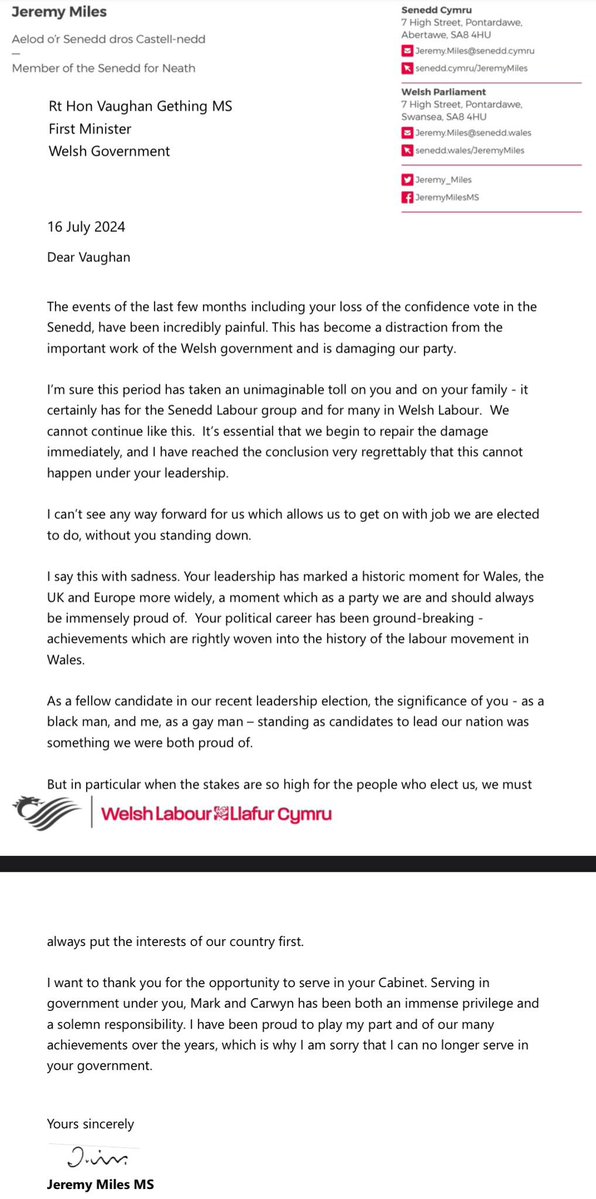
    The resignation statement by Jeremy Miles, issued on 16 July 2024.

  • Vaughan Gething – 2024 Response in the Senedd to No Confidence Vote Against Him

    Vaughan Gething – 2024 Response in the Senedd to No Confidence Vote Against Him

    The speech made by Vaughan Gething, the Welsh First Minister, in the Senedd on 5 June 2024.

    Diolch, Llywydd. I regret that the Conservatives have brought forward this motion today. I do not regret it because I think I’m above criticism. I do not regret it because I think I have made and will continue to make mistakes. I am human, I am fallible. I do not even regret it because of the issues it raises, because I have nothing to hide. I regret the motion because it is designed to question my integrity.

    Like so many of you in this Chamber, I have dedicated my adult life to public service and to Wales. Even in the midst of an election campaign, it does hurt deeply when my intentions are questioned. I have never, ever made a decision in more than a decade as a Minister for personal or financial gain—never. I do not doubt the sincerity behind some of the questions that the motion touches on today, even if the motion is transparently designed for another purpose. I hope the people in this Chamber and beyond will take a moment to reflect on the sincerity with which I have answered and continue to answer these questions. I will not shy away from scrutiny and challenge. I have reflected on donations and, as Members know, I’ve instigated a review into how that is handled in the future in my party, and I’ve asked the cross-party Standards of Conduct Committee to look at Senedd rules for all of us.

    We cannot, of course, retrofit new rules to old campaigns where we don’t like the result. That is not how democracy works, but I do take seriously what people have said to me outside the cut and thrust of this Chamber. The support that I’ve received in recent weeks from Labour Party colleagues across Wales and the UK has been overwhelming, and I’m grateful for their incredible generosity of spirit and solidarity. More than that, I want to thank the many members of the public for their support in person, online and in a variety of means. Diolch o galon i chi. I also want to recognise that, like me, so many people of colour have been traduced and vilified merely for raising concerns about how some of these debates have been handled. Our lived experience should matter and be respected. We still have a very long way to go.

    Mae gennym ni ffordd bell i fynd.

    We still have a long way to go.

    Pairs are a normal part of how this Parliament and many others work. It preserves the democratic balance determined by the electorate. Welsh Labour has always paired with other parties during ill health absence. We did so for three months with the leader of the Welsh Conservatives. The refusal to do so today when two of our Members are unwell reflects poorly on opposition parties. This is meant to be a motion about confidence, but we know that it is not. The timing tells you everything that you need to know.

    If Andrew R.T. Davies and his colleagues were genuinely concerned about the issue of political donations, they would have spoken out at a different time. They would have stood up when it really counted. They would have rejected the millions of pounds given to their party by a man who boasted about wanting to shoot a black female MP, or the millions given to their party by a man who served as a Minister in a foreign dictatorship.

    If that party had genuine concerns about how decisions were made and actions taken during the pandemic, they would have stood up when it counted. They would have walked away from the party that partied in Downing Street whilst the country was on its knees; walked away not defended a Prime Minister served with a criminal fixed-penalty notice.

    If that party had genuine concern for the integrity of devolution and democracy in Wales, then they would do well to look to their own benches before casting the first stone—to demand of anyone else standards they have no intention of meeting themselves. They can talk about confidence until they are blue in the face to match their blue rosettes. If they want a real confidence motion, then table one properly in line with Standing Orders.

    I will tell them what I have confidence in. I have confidence in Wales and in our younger generation. I have confidence in our campaign to change our country. I have confidence that we do have brighter days ahead of us, and the kind of populist politics that are being promoted day after day by the Tories, I hope, is about to be dealt a hammer blow at the ballot box.

    I know that some will try to reframe this confidence as arrogance. It is absolutely not the same thing. And if that word did pop into your heads, I challenge you to ask why. I can make apologies for many things, but I will never shy away from a positive approach to politics, our country and our Government. I want us to to be a confident Cymru.

    To Plaid Cymru I say this: we have worked together in the past. I have offered you the hand of friendship, practical action and co-operation. I continue to do so. You yourself recognise the hypocrisy of the Tories. You say you want to see an end of the Tories in Wales, yet you come here today to link arms with them. There is nothing progressive about joining the Tory lead in an anti-Labour alliance. It is the very opposite of the co-operation that we have worked through. It is of course for you to explain to your voters, members and potential supporters why now, of all times, you would side with a party that makes enemies of the vulnerable, that smashed our economy and treats Wales as an afterthought.

    Gwlad dros blaid. I will continue to put Wales first; first in thought, deed and ambition, as I serve and lead my country. Diolch yn fawr.

  • Andrew Davies – 2023 Speech at Conservative Party Conference

    Andrew Davies – 2023 Speech at Conservative Party Conference

    The speech made by Andrew Davies, the Leader of the Welsh Conservatives in the Senedd, in Manchester on 1 October 2023.

    Well it’s great to be here in Manchester, and to see you all once again. And I want to start by saying a big thank you.

    A big thank to our hardworking party members who put in the graft to deliver our message across Wales.

    A big thank you to our team of Welsh MPs, led by our brilliant Secretary of State David TC Davies.

    A big thank you to our Senedd members, who work tirelessly every day holding Mark Drakeford and Labour to account.

    And a big thank you to our Prime Minister.

    Taking the tough decisions is never easy.

    But that’s exactly what Rishi is doing:

    Taking long term decisions for a brighter future.

    As a Party, we all want to protect our environment and reduce emissions. But we must do it in a way that doesn’t hit working families in the pocket. Rishi’s common sense approach will achieve that.

    The contrast with Wales, the only part of the UK where Labour are in government, couldn’t be more stark.

    Rather than take a common sense approach, they’re motivated by an extreme ideology.

    In the past month, they’ve introduced blanket 20mph speed limits across Wales.

    Labour’s own figures show it’ll cost the Welsh economy up to £9billion.

    The cost of changing the road signs alone is up to £40million.

    And nearly half a million people have signed a petition calling for Labour’s blanket 20mph speed limits to be scrapped.

    But Mark Drakeford won’t listen.

    And the Labour minister who imposed blanket 20mph speed limits on Wales arrogantly dismissed the decent Welsh people who signed the petition as “anti-road safety”.

    What’s worse, blanket 20mph speed limits aren’t the only extreme policy Labour have imposed on Wales.

    They’ve also banned all major new road building projects. And that’s not all.

    Our Prime Minister has introduced tough measures to secure our borders through our Illegal Migration Act.

    But in Wales, Labour want to pay illegal immigrants £1,600 a month.

    And Labour’s other big priority in Wales? Spending £120million on 36 more politicians.

    This extreme ideology Labour has imposed on Wales isn’t just dangerous in itself.

    It also distracts from the things that matter.

    Let’s take our Welsh NHS, which has been run by Labour for the past 24 years.

    Waiting lists are far longer than in England.

    Ambulance response times are slower.

    And cancer outcomes are worse.

    And unlike in England, where Conservatives have protected the health budget, Mark Drakeford and Labour voted to cut our Welsh NHS.

    And just a fortnight ago, Welsh Conservatives once again voted to protect our Welsh NHS from cuts, while Labour and the nationalists voted against.

    Their priority isn’t our Welsh NHS – it’s spending £40million on blanket 20mph speed limits and £120million on 36 more politicians.

    They are out of touch.
And their extreme ideology is also hurting our Welsh economy. Their barmy road building ban has deterred investment.

    And their toxic tourism tax has hit a key Welsh industry.

    But there’s one other thing you mustn’t forget, and this matters to everyone across our United Kingdom.

    Keir Starmer has described Mark Drakeford’s Wales as his “blueprint for the whole UK”.

    That’s right.

    Starmer will deliver longer NHS waiting lists.

    He’ll deliver open borders.

    And he’ll wage a war on motorists.

    Drakeford has cosied up to the Welsh nationalists, who prop up his administration.

    And Starmer would do exactly the same with the SNP.

    That’s what’s at stake at the next General Election.

    And why as Conservatives, it’s our duty to win.

    So as we leave Manchester, we must all get out on the campaign trail and hammer this home.

    I’m as proud a Welshman as they come.

    It pains me to see what Labour have done to Wales.

    And I don’t want to see them do it across the UK.

    So together, let’s stop that happening.

    Let’s take the fight to Labour.

    Together, we’re taking long term decisions for a brighter future. And we’re delivering for our great country.

  • Julie James – 2023 Statement on Renewable Energy Developer

    Julie James – 2023 Statement on Renewable Energy Developer

    The statement made by Julie James, the Welsh Minister for Climate Change, on 2 August 2023.

    When I announced that Welsh Government would establish a Welsh state developer to benefit Welsh citizens, I committed to updating the Siambr on progress. I am happy to say that we are making progress at pace towards our launch date of April 2024.

    One of the early questions is about how people see the company. The name is an important first step in making sure that it is an organisation people can recognise and understand the role it has in delivering for the people of Wales. Our new developer will be called Trydan Gwyrdd Cymru, making it absolutely clear that its intent is to power Wales into a clean and more prosperous future.

    I am also very pleased that we have secured an excellent and highly skilled Chief Executive to lead the company, following an open and fair competition that attracted a strong and able field of candidates. We have appointed Richard Evans, who has both a strong professional background as a developer and has worked across the public sector helping us deliver our energy ambitions through the Welsh Government Energy Service. I look forward to working with Richard to deliver the ambitions I have for this company to make a real difference to our communities.

    Our recruitment campaign is continuing throughout this year, as we look to staff the company with people with experience in energy development who want be part of this new and exciting company. We will also be searching for a Chair for an independent Board, which will have the important role of steering the company as it establishes itself and its projects.

    A key focus of the company is supporting value creation for the people of Wales. Procurement is a hugely powerful tool in driving the changes we want to see. We have successfully contracted with some very skilled organisations to support the Trydan team in establishing well-designed renewable projects. We have focused on involving Welsh companies and delivering social value to Wales, and I look forward to reporting on how we realise these immediate benefits as the development process begins.

    Though this is just another step in a long-term process and there is still much to do, I hope you will welcome these milestones on the way to the birth of Trydan Gwyrdd Cymru.

    This statement is being issued during recess in order to keep members informed. Should members wish me to make a further statement or to answer questions on this when the Senedd returns I would be happy to do so.

  • Michael Gove – 2023 Statement on Freeports in Wales

    Michael Gove – 2023 Statement on Freeports in Wales

    The statement made by Michael Gove, the Secretary of State for Levelling Up, Housing and Communities, in the House of Commons on 23 March 2023.

    Today the UK and Welsh Governments have jointly announced that there will be two new Freeports in Wales: Celtic Freeport and Anglesey Freeport.

    This is an important moment for people across Wales. Freeport status will support the creation of high skilled jobs, drive growth and level up parts of our great country that have been previously overlooked. Each freeport, subject to business case, will be backed by up to £26 million in UK Government funding, and a range of tax incentives, including locally retained business rates to upgrade local infrastructure and stimulate regeneration. This is alongside a generous package of trade and innovation support for businesses locating there.

    These two new freeports will unlock significant funding for Wales, helping to boost the economy and ensuring the benefits are felt from Anglesey to Port Talbot and Milford Haven. They will help to create tens of thousands of new jobs, boost business, and unleash potentially billions of pounds of investment in the local areas and beyond. The strong bids from the Celtic and Anglesey sites compellingly demonstrated how they will use freeport status to regenerate their local communities, establish hubs for global trade, and foster an innovative environment.

    Freeports are at the vanguard of levelling up: driving growth and bringing opportunity and prosperity to the communities that surround them. The new freeports in Wales will build on the UK Government’s successful freeport programme in England, where all eight freeports are open for business, and in Scotland where two new green freeports have recently been announced.

    The Government remain committed to ensuring that the whole of the UK can reap the benefits of our freeports programme. As well as freeports being set up in England, Scotland and Wales, we also continue discussions with stakeholders in Northern Ireland about how best to deliver the benefits associated with freeports there.

  • Lee Waters – 2023 Statement on Rural Transport in Wales

    Lee Waters – 2023 Statement on Rural Transport in Wales

    The statement made by Lee Waters, the Welsh Deputy Minister for Climate Change, on 8 February 2023.

    Wales’ rural communities make up around a third of our population, and are spread across all parts of the country. Providing access to sustainable, safe and reliable public transport is vital not only to achieving our climate change goals but to help people access the services, employment, cultural and education opportunities to enable them to thrive.

    I was pleased to be able to host a series of round tables with local authority leaders and transport experts from across Wales at the end of last year to discuss our plans in more detail, and would like to thank them for helping to shape our approach.

    We recognise that the transport needs of communities in rural Wales will be different to those in more urban areas, and it is important to work with those communities to plan the types of public transport services they will need. It can’t be a ‘one size fits all’ solution; each community has its own requirements and challenges that will impact what works best for the people that live, work and visit them.

    I was heartened to see the focus on rural transport in the North Wales Transport Commission, who identified the need to prioritise schemes that demonstrate better handling of key rural-to-rural connections. It recommends that new and more sustainable travel options such as car clubs, car sharing, cargo cycles, e-scooters and e-cycles. It also suggested effective workplace travel planning should be considered, an essential step in enabling people to think and act differently about the way they travel.

    Llwybr Newydd – the Wales Transport Strategy – sets out our approach to developing a series of pathways centred on topics which are of strategic importance. They cut across different modes and sectors and are designed to pull together our commitments and plans on these topics in a way that allows people to easily track the progress both we as Welsh Government are making along with our local, regional and national delivery partners.

    It is vital that we seek to find sustainable public transport models which are both tailored to the needs of rural communities, but also interface with more urban transport networks so that people can travel from urban to rural areas and vice versa with as little friction as possible.

    Our Rural Pathway takes a hub-and-spoke approach. It will help those in the most isolated communities better access their local village or town. From there they will have a wider range of public transport and active travel choices to travel locally or to connect them to their nearest transport interchange for longer journeys.

    The development and delivery of our rural pathway is already underway. We will be submitting a proposal shortly to the UK Government’s Union Connectivity Fund to develop plans to increase capacity along the Cambrian and Heart of Wales rail lines, and in doing so increase cross-border connectivity.

    Working with Sustrans, our e-move pilot has shown the potential of free medium-term e-bike and e-cargo bike loans to support local communities. We will continue to develop out long-term approach to support people to take advantage of e-bikes for local journeys across Wales, including support for them to purchase them.

    The new Sherpa service in Snowdonia, which sees electric busses minimising the use of cars within the National Park, is already providing new opportunities for local residents and visitors to see Snowdonia in a new and greener way. It is an approach which we will take and look to roll out in other areas of outstanding natural beauty and national parks across Wales.

    Buses are the backbone of our public transport service. They carry three times as many passengers as trains, getting people across Wales to work and school, allowing us to meet family and friends, and offering a key lifeline for people in Wales who do not have access to a car. Our Bus Reform legislation will enable us to deliver a bus system which is governed and designed to serve the public interest, not just those routes which are commercially viable.

    As well as new technologies, new service models will play an important part in allowing people to access public transport in a way and at a time that best suits their needs. Our Fflecsi pilots have shown that demand-responsive travel can provide a more flexible and adaptable service, with particular success in rural communities. We will examine the findings of this pilot carefully and embed them into our rural pathway framework for regions across Wales to exploit.

    Electric car clubs also offer a new way of looking at car usage; both for those who want to use their car less, or may only use it some of the time, and for people who may struggle to afford the high cost of running a car. We are working in partnership with Powys County Council, Transport for Wales, and a range of partners to look at how we can increase provision of community-based car clubs.

    Community transport is an important part of our transport system in Wales, supporting vulnerable people to access essential services. We will, through Transport for Wales, work with our Community Transport partners to look at ways we can best support both the people who use this vital service and those who give their time to run it.

    We understand the importance of the strategic road network for rural Wales. Our roads are important assets and must be maintained. They also play a vital part in enabling modal shift to active travel and public transport. We will shortly publish the report from the independent roads review plus our position on the future of road investment to ensure that projects we fund are aligned to the delivery of our transport strategy ambitions and priorities.

    Our delivery pathways also provide a framework to support the development of Regional Transport Plans, which will be developed for North, West, Mid and South East Wales by the regional Corporate Joint Committees (CJCs). It will allow each region to easily identify the different range of interventions they could make, and how they can implement them in a way that is consistent with Llwybr Newydd. These will be live frameworks, being updated as we test and develop new and innovative services and infrastructure solutions.

    We are literally taking a Llwybr Newydd – a new path. The Wales Transport Strategy sets out a new way of thinking that places people and climate change at the front and centre of our transport system. This is something that we have to do; if we are going to protect the lives of our children, we need to achieve net zero by 2050. And in order to do that, we need to both change the way we travel, and rewire the system so it supports us to do this. Our rural pathway is one of many steps on the journey to achieve this.

  • Jane Hutt – 2023 Statement on HMP Eastwood Park and Report on an Unannounced Inspection

    Jane Hutt – 2023 Statement on HMP Eastwood Park and Report on an Unannounced Inspection

    The statement made by Jane Hutt, the Welsh Minister for Social Justice, on 8 February 2023.

    Members will be aware of the report published by HM Inspectorate of Prisons following its unannounced inspection of HMP/YOI Eastwood Park, Gloucestershire.

    Whilst the prison service is the responsibility of the UK Government the findings are of great concern, especially as many Welsh women in custody are held at Eastwood Park.

    I have requested a meeting with the Chief Inspector and HMPPS to discuss the report as a matter of urgency. The report makes for harrowing reading and identifies substantive gaps in care, and a lack of support for distressed and vulnerable women. It is vitally important Welsh women in custody are held in safe and secure facilities, which are fit for purpose.

    Following publication of the report, HM Prison and Probation Service have informed us about some of the action taken since the inspection that was carried out in October. This includes refurbishing the houseblock where many of the most shocking issues were found. In response to staffing resources additional staff have been appointed, comprising of experienced prison officers from other local prisons. A dedicated Safety Taskforce Group, to improve the outcomes for women in the prison’s care, has also been established along with newly designed care plans identifying the key needs of the individual and offering bespoke care.

    I am aware of the continuous journey the prison is undertaking to improve the care for women in its custody. The Counsel General and I visited HMP Eastwood Park on the 19 January and had concerns following feedback raised, including lack of access to education. I am aware that the Equality and Social Justice committee has raised shortage of staff and similar concerns through its Senedd inquiry on the experiences of women in the criminal justice system. We will continue to seek regular updates on action to address the identified issues and

    The findings underline the importance of diverting women away from custody wherever possible. The Women’s Justice Blueprint, which was developed jointly by the Welsh Government, HMPPS and Policing in Wales, supports initiatives such as the Women’s Pathfinder diversion scheme and engagement work with magistrates to help ensure women are not faced with unnecessary and hugely disruptive prison sentences for minor offences.

    In my recent visit I saw first-hand the value of some of the Blueprint initiatives referenced positively in the HMIP report, including the Visiting Mum Scheme, which helps children to visit parents in custody, and the important role played by the Independent Domestic Violence Advisor for Welsh women at Eastwood Park.

    There is much more to be done to improve outcomes for women in contact with the justice system. As justice remains at present a reserved matter, we will continue in our commitment to reducing crime and reoffending to create a better Wales for all under the current system, alongside work to progress the case for the devolution of justice in Wales.