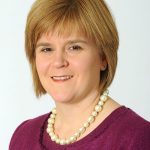
The statement made by Nicola Sturgeon, the Scottish First Minister, on 3 August 2021.
Thank you Presiding Officer.
In updating Parliament today on the Government’s decisions about further easing of Covid restrictions, I will confirm that from next Monday, Scotland will move beyond the current level 0 restrictions, and I will set out the basis for that decision.
However, in line with the cautious approach we have taken throughout this pandemic, I will also set out a number of mitigation measures that will remain in place.
I will then outline changes to the requirement for self-isolation of close contacts of positive Covid cases.
And finally, I will summarise the key points from new guidance being published today on arrangements for the start of the new school year.
However, let me start by summarising today’s statistics.
The total number of positive cases reported yesterday was 1,016 – which is 8.1% of all tests.
There are 406 people receiving hospital care – one fewer than yesterday.
And 61 people are receiving intensive care, which is one more than yesterday.
Sadly, nine further deaths were reported over the past 24 hours, taking the total number of registered deaths, under this daily definition, to 7,952.
And as always, I want to convey my sincere condolences to everyone who has lost a loved one.
I can also report that 4,014,212 people have now received a first dose of vaccine.
And 3,231,331 have now had both doses of vaccine.
So all of these figures are broadly in line with the trend that has been evident for the past four weeks.
The number of new cases in Scotland reached a peak in early July.
At that time, more than 400 new cases per 100,000 of the population were being recorded each week.
That has now fallen by two thirds – from 425 per 100,000 at the peak to 144 now based on our most recent figures.
And although as we can see today this fluctuates on a daily basis, the average proportion of tests that are positive has also fallen – from more than 10%, to now less than 6%.
Thankfully, the number of people in hospital with Covid is also falling – in the past two weeks it has reduced from 529 patients to 406.
And the number of people in intensive care also now seems be declining, albeit gradually, as well.
So all of this is good news. And I think it demonstrates the value of taking a careful and steady approach to easing restrictions.
Another reason for this progress is, of course, the continued success of the vaccination programme.
All over 18-year-olds have now had the opportunity to receive at least one dose of the vaccine.
And all over 40-year-olds have been offered both doses. These were key milestones for moving beyond level 0.
These milestones have been met. And take-up of vaccination has been exceptional by any previous standard, or indeed by comparison with our expectations.
90% of over 18 year olds have now had at least one dose of the vaccine, and 72% of all 18 year olds have had both doses.
93% of over 40 year olds have had both doses of the vaccine. And indeed for those over 60, take-up for both doses is as close to 100% as could reasonably be hoped for.
There is of course still more to do, and I want to stress this point, especially amongst 18- to 29-year-olds. Take-up in that age group has been good, relative to our initial expectations, but we want it to be better.
That is why, for example, we are deploying walk-in and mobile vaccination centres across the country.
I can also confirm that preparatory work is underway for the next phases of vaccination.
Invitations for vaccines are now going out to 12- to 17-year-olds with specific health conditions that make them more vulnerable to Covid. And this follows recent advice from the Joint Committee on Vaccination and Immunisation. And we expect to have offered first doses to this group by the end of August.
In addition, I can advise Parliament that we are hoping to receive in the next few days updated advice from the JCVI on possible vaccination of others in the younger age groups.
And we stand ready to implement any recommendations as soon as possible.
And we are also preparing to deliver booster jags during the autumn for those already vaccinated, if that is indeed recommended.
The vaccination programme, therefore, is likely to continue for some time to come. It may become a feature of life. But it has already saved many lives, and achieved a huge amount of success. And I am grateful to everybody who has and continues to help deliver it.
Presiding Officer, Ii is the combination of the steady decline in cases, the success of vaccination helping to weaken the link between cases and serious illness, and of course our understanding of the social, health and economic harms that continued restrictions cause – all underpinned by our obligation to ensure that any restrictions that remain in place are lawful, in other words that they are both necessary and proportionate – that forms the basis for our decision today to move beyond level 0.
The move beyond level 0 will entail the lifting of most of the remaining legally imposed restrictions – most notably on physical distancing and limits to the size of social gatherings.
It also means that from 9 August, no venues will be legally required to close.
This change is significant and it is hard-earned. The sacrifices everyone has made over the past year and a half can never be overstated.
However, while this move will restore a substantial degree of normality, it is important to be clear that it does not signal the end of the pandemic or a return to life exactly as we knew it before Covid struck.
Declaring freedom from, or victory over, this virus is in my view premature.
The harm the virus can do, including through the impact of long Covid, shouldn’t be underestimated. And its ability to mutate may yet pose us real challenges.
So even as we make this move, care and caution will still be required. Which is why I now want to focus on the protections and guidance that will remain in place after 9 August.
Firstly, it will continue to be the law, subject to existing exemptions, that face coverings must be worn in all the same indoor settings as is the case now.
We will keep this under review, but my expectation is that face coverings are likely to be mandated in law for some time to come.
Second, Test & Protect will continue to contact-trace positive cases.
To assist with this, there will be an ongoing requirement for indoor hospitality and similar venues to collect the contact details of customers.
And while – as I will set out shortly – there will be a change in the approach to self-isolation for close contacts of positive cases, anyone who is required to self-isolate will, if eligible, continue to have access to support.
Thirdly, we will continue to work closely with local incident management teams on appropriate outbreak control measures, including the use of localised restrictions in future if necessary.
We will also continue to use travel restrictions, as and when necessary, to restrict the spread of outbreaks and protect against the risk of importation of new variants.
Fourthly, we will continue to advise home working where possible for now. I know most businesses are not planning a wholesale return to the office, but recognise that a return for some staff will be beneficial to them and to employers. But it is vital that this gradual approach continues.
We will also encourage employers to consider for the longer term, as indeed the Scottish Government is doing, a hybrid model of home and office working – which may, of course, have benefits beyond the need to control a virus.
Fifth, while we expect to see the careful return of large scale events, we will for a limited period, keep in place the processes through which organisers of outdoor events of more than 5,000 and indoor events of more than 2,000 will have to apply for permission. And this will allow us and local authorities simply to be assured of the arrangements in place to reduce the risk of large scale gatherings.
And last – but by no means least – we will continue to issue clear guidance to assist individuals and businesses to reduce the risk of transmission as much as possible.
Rigorous hygiene, including regular hand washing, will continue to be essential.
Good ventilation will also be important. I will set out shortly our intention to strengthen guidance on ventilation in schools, but we will also work across the public and private sectors to ensure an approach to improved ventilation.
And even though the law will not stipulate physical distancing from Monday, we will continue to advise the public that – especially indoors – keeping a safe distance from people in other households and avoiding crowded places will minimise risk.
We will also engage with businesses – and issue guidance as necessary – to ensure that safe environments for staff and customers are provided, and that all reasonable steps are taken to reduce the risk of outbreaks.
Presiding Officer, I can also confirm that we continue to consider very carefully the possible, albeit limited, use of Covid status certification for access to certain higher risk venues in future.
We are currently developing an app to make access to Covid status certificates – which will include vaccination details – easier for international travel. This will be launched next month.
The app will have functionality to support the use of such certificates for domestic settings should we decide that this is appropriate.
However, I want to assure Parliament that we do not underestimate the ethical, equity and human rights issues associated with Covid status certification, and we will keep members updated and consulted on our thinking on this issue.
The decisions I am confirming today reflect the fact that – principally due to vaccines – we are now in a different stage of this pandemic.
Vaccination has weakened the link between case numbers and serious health harms, and that means it is no longer appropriate or necessary – and therefore not necessarily even lawful – for us to rely as heavily as we did previously on blanket rules and regulations.
That’s something that will be welcome for many, but a source of anxiety for some.
The Chief Medical Officer will be writing to those who have been at the highest risk from Covid – who might previously have been asked to shield – to provide advice and information, and to give assurance that they too can return to a much greater degree of normality. The needs and concerns of this group will not be ignored, now or in future.
I want now to turn to the change that we propose to the current rules on self-isolation – to ensure that they remain reasonable and proportionate.
Let me be clear at the outset that those who have symptoms of, or who test positive for, Covid will still be required to self-isolate as now.
However, from 9 August, an adult who is identified as a close contact of someone who has tested positive for will no longer be required automatically to self-isolate for 10 days.
Instead, if someone is double-vaccinated – with at least two weeks since the second dose – and if they have no symptoms, they should get a PCR test as soon as possible. And if the PCR test is negative, self-isolation can then be ended.
And as PCR results come back quickly – frequently within 24 hours – this will greatly reduce the amount of time that many people will need to spend in self-isolation.
We are proposing a similar change for people aged 17 or under – most of whom, of course, are not yet eligible for vaccination.
If a young person aged 5 to 17 is identified as a close contact, they will need to take a PCR test – but they can end their self-isolation if they test negative. Children under the age of five will be encouraged but not required to take PCR tests.
In addition, Test and Protect will implement revised guidance for under 18s, including in schools.
This means that the blanket isolation of whole classes will no longer be routine. Instead a more targeted approach will identify close contacts at highest risk of infection.
So fewer young people will be asked to self-isolate, and most will be asked to self-isolate for a much shorter period of time.
Obviously his is especially important as we approach the start of the new school year. So let me turn to the wider arrangements for the return of schools. And updated guidance is being published today.
As a consequence of the new approach to self-isolation – which is important to minimise disruption to education – and in line with advice from our Expert Advisory Sub-Group on Education, we have decided to retain, for the first six weeks of the new academic term, most of the other mitigations that are currently in place in schools.
This also reflects the unique environment of schools, where large numbers of unvaccinated children and young people mix with adult staff.
So for up to six weeks – subject then to review – there will be a continued requirement for staff to keep at least a metre distance from each other and from children and young people while on the school estate.
And we’ve also decided, after careful consideration, to retain the current requirements for face coverings in schools for staff and for children aged 12 or over. That includes asking young people and staff in secondary schools to wear face coverings during lessons, and while inside school buildings.
I am acutely aware that many, many young people find this difficult – and it will be kept under review. But for now, we consider this an important protection for them, and for others in the school.
The Expert Advisory Sub-Group has also emphasised the importance of good ventilation, and we are therefore strengthening guidance in this regard.
Many local authorities have already taken steps to improve ventilation in the school estate, and this work has highlighted the value of CO2 monitors.
These devices are useful in assessing how well ventilated a space is, and therefore how likely it is that the virus could be present.
The new guidance, published today, makes clear that all schools and daycare services for children must have access to CO2 monitoring – through either fixed or mobile devices – and that these should be used to assess the quality of ventilation in schools and childcare settings, and identify any necessary improvements.
These assessments will be ongoing obviously over the coming weeks, but we expect them to be completed – and necessary improvements identified – by the October half term.
And I can also confirm today that we are making available to local authorities an additional £10 million to support this work.
Ventilation is one of the most important ways in which the risk of Covid transmission can be reduced – and so improving it will be vital, now and in the future, to ensure that schools and childcare centres are as safe as possible.
Finally, local authorities and schools will ask all secondary pupils, and all school staff, to take a lateral flow test one or two days before returning after the holidays, and then to take tests twice a week after that.
This continues to be an important additional way in which Covid can be identified, even in people who do not have symptoms.
We are also working with the further and higher education sector on plans for the year ahead. Specific guidance on operating beyond Level 0 for universities and colleges has now been published. In addition, students will be encouraged to take a PCR test before any move to term-time accommodation, and then to test twice a week after that.
Presiding Officer, the last year and a half has been – and this inevitably will be an understatement – it has been difficult and stressful for children and young people, parents, and all staff working in education settings. I am so grateful to them for the understanding and cooperation shown. The new school and academic year will still bring challenges, I think there is little doubt of that. But I hope it will also bring fewer disruptions, and also allow a much more normal learning environment for young people.
Presiding officer, today’s decisions are – in my view, and I hope those listening will agree – positive. They are possible only because of vaccination and the prolonged sacrifices of people across the country. Once again, I want to convey my deep appreciation of that to everyone across the nation.
The last year has reminded all of us just how precious some of the simplest things in life really are, and many of us I suspect will resolve not to take them quite so much for granted in future.
Undoubtedly, the best way of doing that in the short term is to continue to be careful, cautious and sensible, even as legal restrictions are lifted. The government will continue to provide guidance to help get that balance right.
We all hope – I know I certainly do – that the restrictions we lift next Monday will never again have to be re-imposed. But no-one can guarantee that.
This virus remains a threat – and as we enter winter, it may well pose challenges for us again.
So as we have done throughout, the government will seek to take whatever action is necessary to keep the country safe.
But as has also been the case throughout, we all have a part to play in keeping the virus under control.
And as always, although counter-intuitive perhaps, it is when we lift restrictions – and inevitably give the virus more opportunities to spread – that it becomes even more important for us to remember the basic actions that can reduce risk.
So I want to end by stressing again what all of us can do to help ensure that this next step forward is a sustainable one.
The first and most important thing is to get vaccinated. If you haven’t done so already – particularly if you are in these younger age groups, looking forward to resuming a more normal social life – then please do so. You can register through the NHS Inform website, or by going to a drop-in centre.
Second, please test yourself regularly. Free lateral flow tests are available by post through NHS inform, or collection from test sites and local pharmacies.
If you test positive through one of these – or if you have symptoms of the virus – you should still self-isolate and get a PCR test.
Third, stick to the rules which remain in place – for example, on face coverings. And keep being sensible about the things we know can help to keep ourselves and each other safe.
Meet outdoors as much as possible – especially for as long as we have reasonable weather. If you are meeting indoors, open windows – the better ventilated a room is, the safer it will be.
Remember that keeping some distance from people in other households and avoiding crowded indoor places – even if no longer legally mandated – these are still sensible precautions.
And continue to wash your hands and surfaces as much as possible.
In short, enjoy being able to do more and meet up more. We’ve all waited a long time for that. But please protect yourself as you do so, principally through vaccination, and continue to take the greatest of care.
If we all do that, we will increase our chances of keeping the virus under control. We will protect ourselves and our loved ones.
And we will safely and securely return to the ways of life that we all value so much.