Category: Parliament

  • Karin Smyth – 2022 Speech on the Resignation of Lord Geidt

    Karin Smyth – 2022 Speech on the Resignation of Lord Geidt

    The speech made by Karin Smyth, the Labour MP for Bristol South, in the House of Commons on 21 June 2022.

    It is a pleasure to follow the hon. Member for Hazel Grove (Mr Wragg), the Chair of the Public Administration and Constitutional Affairs Committee, of which I am one of the so-called illustrious members and very pleased to be a part.

    Only two weeks ago, I spoke in another debate about the importance of standards in political life and how important they are to my constituents. At that time, the Government were trying to move us on, and that has not worked terribly well, but the issues that we are talking about today are important and do matter to our constituents. I said then, as a member of the Committee, that not many members of the public knew about our work—the long hours of deliberation, reports and inquiries, and how we had a certain Lord Geidt coming before us shortly. I ended up by saying that because of how our constitution now works and how the Government have behaved, all roads lead back to the chap at the top of the structure. The culture emanates from there, including the non-attendance before Select Committees, the late publication of documents, and the many other examples that were outlined in that debate—so here we are again.

    As well as reviewing the evidence that Lord Geidt gave to the Committee last week, it is worth reviewing his post-appointment hearing evidence taken on Thursday 13 May 2021, his name at that point having been alighted on by the Prime Minister following the resignation of his predecessor. In that session, we explored the lessons from Sir Alex Allan’s resignation and the issue of independence and advice. In response to questioning led by my colleague and friend, in this regard, the hon. Member for Thurrock (Jackie Doyle-Price)—she is in her place—who asked about recognising that we all have a view on and understand what is good and bad behaviour and what is constitutionally appropriate, Lord Geidt said:

    “As I have heard other people say recently, good behaviour is a very difficult thing to legislate for. I join those who suggest that it really needs leaders—of course, the Prime Minister, Parliament and civil servants—to set the necessary example. I hope very much that the work that I do in this role, which is described as “adviser”, will be in the service of advising the office of Prime Minister in the furtherance of that behaviour, taking the Ministerial Code as its point of reference. I agree with you that rules are absolutely not sufficient to stimulate good behaviour.”

    We fast-forward to earlier this year and the warnings that Lord Geidt was then moved to give, in the strongest terms he possibly could, in the introduction to his annual report. Before our session last week, on 14 June, I was not sure which Lord Geidt would be before us. Were we to get the one who appeared before us in May 2021, believing, as a chap of the system, I think it would be fair to say, that the system had worked, that his predecessor’s resignation showed that it worked, that updates to his terms of reference gave the independence that was necessary, and that leaders, crucially from the top, set the necessary example; or were we to get the one who was the author of the annual report? Following a fairly intense session of questioning on a number of different issues in the inquiry, we clearly found out just the very next day which Lord Geidt we now had.

    Our post-appointment session in May 2021 focused on the issue of wallpaper. Our last session was about a number of things, including the legal advice on the breaking of international agreements. That really is quite a leap, isn’t it, in only a year? I asked particularly about the leaking of legal advice on the breaking of the Northern Ireland protocol. We know that that advice has been leaked. We know that it is a serious breach of the code. We know that this has a profound impact on the UK’s constitution and domestic politics as well as on our international standing. We know that the legal advice is disputed. We know that the doctrine of necessity is extreme. We heard again this morning from experts on international law quite how unusual the new doctrine of necessity that we now have in the protocol is.

    In a series of questions, which I am going to refer to, I asked Lord Geidt about where this advice had been leaked from—essentially, whether it was from the Prime Minister or from the Attorney General. I asked him whether he had been asked to investigate that situation. I said that

    “we do have a recent leak with regard to the legal advice on the Northern Ireland protocol”,

    and asked him whether that constituted “a relevant example” for him to investigate. Lord Geidt said:

    “It may well do. You will recall that my new powers are squeaky new and I have not either been asked to or, indeed, pressed my own interest in giving advice in that example.”

    I asked Lord Geidt if the Prime Minister

    “has not asked you to investigate why that legal advice was leaked”.

    Lord Geidt said, “No, he had not.” I asked if the Attorney General was asked how the advice had been leaked? He asked me, “Have I asked?” I said yes, and he said, “No, I have not.” I said:

    “But your new powers do allow you to ask”

    the Attorney General. Lord Geidt responded:

    “I think that my new powers would allow me, unrestricted, to ask questions of the entirety of Government and others.”

    I said:

    “You raised the issue of the leak”—

    he had done that earlier—

    “The leak is clearly very serious… I would suggest it breaches the ministerial code, point 2.13. Would you agree?”

    Lord Geidt said:

    “I have not formed any advice and I have not brought an inquiry to bear on the situation.”

    I then asked if he thought it breached the ministerial code. He said:

    “Again, I would want to ensure that I could consider that fully before reaching a determination. By the way, as you know, the determination is then only advice to the Prime Minister.”

    I asked:

    “Have you looked at reaching a determination before?”

    and he said, “In this case, no.” We would seem to have been going round in circles.

    Part of that emanated from some correspondence from the shadow Attorney General, my right hon. Friend the Member for Islington South and Finsbury (Emily Thornberry). She had written to Lord Geidt to ask for advice, and he said he had responded to her, but that had not been received at the time. She has now received an answer, and again we are somewhat going round in circles. Lord Geidt responded to her finally, saying: “In the event of an allegation of unauthorised disclosure of information by persons unknown, it is open to the Government to commission an internal leak investigation where the Government in the circumstances considers it is appropriate, but that would be a matter for the Government to take forward and would not, at least in the first instance, be a matter for the independent adviser.”

    We are left on a circuitous route of trying to understand where a very serious leak has occurred. It is a clear breach of the ministerial code that seems to be no one’s job to investigate or move forward. That is simply one example of the very many outstanding breaches of the code now lurking behind the doors of Downing Street. Where do we now go? Ideally, we would like to return to decency in politics. This motion provides an interim solution. As I said when I intervened earlier, it is up to other hon. Members in this place to come forward with other solutions if they do not think this solution is suitable. The Government are being given a window, should they wish to take it, to do something decent.

    Our Committee, as the Chair has outlined, has a long list of current inquiries and a future work programme. We are not particularly looking for extra work, and this is clearly a matter for the Government under our constitution. However, I know that Parliament takes this seriously, and Parliament can and will step up. We will find a way through this to bring decency back into our politics. Again, at the end of these very long days, our commitment is essentially to our constituents. This is being taken seriously by a number of Members of the once great Conservative party. Our commitment remains on the Opposition Benches, and we will continue to pursue bringing back good standards of government, despite what the Prime Minister wishes to happen.

  • William Wragg – 2022 Speech on the Resignation of Lord Geidt

    William Wragg – 2022 Speech on the Resignation of Lord Geidt

    The speech made by William Wragg, the Conservative MP for Hazel Grove, in the House of Commons on 21 June 2022.

    It is a pleasure to be called to speak in the debate.

    The motion in the name of the Leader of the Opposition is deeply flattering to me—presumably—and to the Committee that I have the great pleasure of chairing. I appreciate the Opposition’s confidence in us, but would gently encourage them to have more confidence in themselves rather than deferring entirely to my Committee.

    In the exposition with which he responded to the deputy Leader of the Opposition, my right hon. and learned Friend the Paymaster General remarked that the motion was unconstitutional, and I have to say that perhaps it is. However, I increasingly find that the Government themselves advance all sorts of propositions that could be described as unconstitutional in the first place, not least the assertion by some members of the Cabinet that we now have a quasi-presidential system of government. That, I imagine, would be news to Her Majesty. I might ask whether the reading of choice in the Cabinet is indeed Dicey and Bagehot nowadays, or perhaps something a little lighter.

    The Public Administration and Constitutional Affairs Committee has not requested these powers, but I understand the sentiment behind them. It is the imperative to appoint a new adviser to the Prime Minister on ministerial interests, which, if I am to decipher what my right hon. and learned Friend said earlier, is something that they are keen to do.

    I will, if I may, briefly reflect on what happened last week. Lord Geidt appeared before the Committee on Tuesday. He went through an astonishing transformation, it seems, over the course of that week—those who may have been a little critical of his appearance on Tuesday were regarding him as a great national folk hero by Wednesday. I am sure that he was touched by that change of heart. None the less, he certainly had a difficult time, not on the basis of him as an individual—a man of flawless reputation, I might advance, with a distinguished record of public service not least to Her Majesty—but probably because he was defending a sticky wicket. He found the need to bring clarification to the motivation behind his resignation in a letter to me on Friday. It is clear that Lord Geidt is not a political creature, but that is exactly the kind of quality that is needed in the independent adviser.

    It should not go without challenge in this House when Ministers appear in the media, but some unhelpful perceptions have been created. I am afraid to say that the Secretary of State for Digital, Culture, Media and Sport was wheeled out on the radio on Friday—presumably for the nation’s entertainment rather than its edification. Her appearance was quite astonishing. I agree with her on one thing though. Let me paraphrase what she said. “Never heard of him”, she said. That is quite right. I do not think that the independent adviser to the Prime Minister on ministerial interests should be heard of, because the sort of the work that they undertake should be done thoroughly, but discreetly. It should never capture the public imagination—I think that that is more of a reflection of the times in which we are living, which, largely, are of our own making.

    I would further question why my right hon. Friend, the Secretary of State for Digital, Culture, Media and Sport, felt the need to observe that Lord Geidt had been complaining about the amount of work that he had to do. Well, we know what could be done about that perhaps. All I would say in praise of my right hon. and learned Friend on the Treasury Bench is that he is a complete contrast to the Secretary of State for Digital, Culture, Media and Sport, and I welcome his sensible and considered approach to these matters and indeed the emphasis that he placed in, I think, the urgent question last week, which was that it was vitally important to have such a position filled.

    On the question of whether people care, I think that, yes, they do care. The British public are, on the whole, capable of having two thoughts in their minds at once. Yes, they are able—by their own painful experience quite often—to understand the cost of living crisis. Yes, they are entirely able to have empathy and grave concern about the situation in Ukraine, but they are also able to judge the Government on whether they think that they behave—not perfectly, because that is not what people expect—with at least an adequate degree of propriety. I say to colleagues that we might gently remember the Standards Committee report from the autumn, which I thought would have shown that, for many, this was an area of interest that the public thoroughly understood.

    I shall conclude briefly, the House will be relieved to know, as this matter does not really need a great deal more from me. Why do we have an independent adviser? It comes from a 2006 recommendation from the Committee on Standards in Public Life. There are practical reasons why these advisers are necessary. It is that they can give objective advice to the Prime Minister of the day. In fairness to the Prime Minister of the day, or the Prime Minister at any time, they have a difficult role in forming a judgment on close colleagues and, indeed, even friends. They need to be able to draw upon and be able to back up their decision with that advice.

    I completely support the idea that the Prime Minister has ownership of the “Ministerial Code”. It is his code, and it is right that it should be so. We should not be upsetting that constitutional principle. However, we need to make sure that there is an adviser, with the Prime Minister as final arbiter, in a way that allows for that transparency in the difficult decisions that they make.

    So, although personally deeply touched by the Opposition’s confidence in me, and indeed in the illustrious members of my Committee, I am afraid that I will not actively support their motion, which I know will upset them dearly. But as the right hon. Member for Ashton-under-Lyne (Angela Rayner) and I go back an awfully long way, to the time when she was union representative at Stockport Council and I was a mere humble councillor for the Hazel Grove ward, I trust that she will take what I have said in the spirit that it is intended. I look forward to hearing the rest of the debate.

  • Michael Ellis – 2022 Speech on the Resignation of Lord Geidt

    Michael Ellis – 2022 Speech on the Resignation of Lord Geidt

    The speech made by Michael Ellis, the Minister for the Cabinet Office and the Paymaster General, in the House of Commons on 21 June 2022.

    I thank the right hon. Member for Ashton-under-Lyne (Angela Rayner) for choosing today’s motion. It is a great pleasure, as always, to appear on the other side of the House from her, and I will endorse the opportunity she gave to call her a friend likewise.

    The Government remain steadfast in their absolute commitment to upholding standards in public life and the critical role of the ministerial code in supporting those standards. It is on account of that commitment that the Government cannot support today’s motion, for the simple reason that it attempts, by proxy, to change the British constitution by the back door; what it does, without consultation or consideration, would be unreasonable. What would be unreasonable is for any Opposition party to say all this on what is, as they know, a national strike day, when many Members are hindered from attending this House, because Labour Members are on the picket lines for a strike caused by Labour’s union backers.

    I have set out repeatedly and exhaustively in recent weeks that the Government fully recognise the importance of the ministerial code and its role in maintaining standards in public life. What we wish to do, therefore, is to protect the code. It sets out the Prime Minister’s expectations of his or her Ministers, detailing the standards of conduct in public life expected of those who serve government and the principles that underpin them. The code has performed this role for successive Prime Ministers since it was first published by the Conservative Prime Minister John Major as “Questions of Procedure for Ministers” in 1992, 30 years ago. Throughout that time, it has been an evolving document. It is customarily issued—it is customarily released or re-released—when warranted, by the Prime Minister of the day to reflect changes and to update the guidance. So this business about what is said in the foreword of the document is, frankly, a red herring. What is said in the foreword is very often a reflection of the current affairs at the time the document was released. What it is not is a reflection of the contents of the document, which are as they were before.

    Since 2006, recognising the need for independent support on the application of the code, the Prime Minister of the day has appointed an Independent Adviser on Ministers’ Interests to provide independent advice on how Ministers manage their interests and to assist with the investigation of alleged breaches of the code. But if Labour’s motion were to succeed, it could mean in the future a Labour-chaired Committee choosing one of the Prime Minister’s advisers or a Conservative-chaired Committee choosing a future Labour Prime Minister’s advisers. That would lead to dysfunction and, frankly, gridlock, and it would be entirely impractical and unconstitutional. It simply would not work.

    David Linden

    The right hon. and learned Gentleman spoke about the fact that the code was designed under John Major in the 1990s, although John Major’s Government were not exactly without scandal and sleaze, so perhaps it is time to revisit that. Given his knowledge of history, can he think of any Prime Minister who has lost not one but two advisers on the ministerial code since the days of John Major?

    Michael Ellis

    There are exceptions in every case and, of course, we know that in the past 30 years Prime Ministers of all political parties have decided for themselves when Ministers have their confidence and when they do not. The Government are very grateful to all those who have served in the role of independent adviser since 2006. It is a challenging role, and increasingly so today. Let me repeat my particular thanks to Lord Geidt for his contribution to the office, but the Prime Minister has also made it clear that the resignation of Lord Geidt and the issues that he and PACAC raised last week demand a moment of reflection. They demand some consideration. Frankly, we think it is right to step back and take some time to consider what we have heard from the former independent adviser and from this House. This is a complex matter and one that touches on Executive functions and the royal prerogative in relation to the appointment of Ministers. As I have said before to this honourable House, we cannot have a situation where we expect any Prime Minister of any political party not to have confidence in a Minister that he or she has serving in their Cabinet. It is crucial that each Minister has the confidence of the serving Prime Minister.

    Sarah Owen (Luton North) (Lab)

    The Paymaster General talks about exceptional times, but unfortunately this is not exceptional behaviour from this Prime Minister. This is not the first time that we have heard allegations that the Prime Minister has sought to spend hundreds of thousands of pounds of taxpayers’ money on his girlfriends. Just look at his time as Mayor of London. Does the Paymaster General not agree that this is a pattern of behaviour and the role of any new ethics adviser should be, for a start, to get the Prime Minister out of the gutter and find some ethics in the first place?

    Michael Ellis

    I am not going to dignify that with a response.

    Geraint Davies

    The Minister mentioned that the ministerial code and the guidance change with the times, but is it reasonable to delete references to integrity, objectivity, accountability, transparency, honesty and public interest? Obviously, these are enduring values and they cannot just be airbrushed out by a PM who chooses to break all the rules for his own self-interest.

    Michael Ellis

    I respectfully advise the hon. Gentleman to read the document he is quoting. First, those lines were only included in the foreword of the document since August 2019. They are still within the body of the document. What it says in the foreword is very often topical and should not be taken as inclusive of every item that follows in the substantive document.

    Sir Robert Buckland

    Further to that, are not the Nolan principles set out in annex A to the ministerial code? All this nonsense about their removal is factually wrong. However, will my right hon. and learned Friend commit today to do the process of the appointment of a successor to Lord Geidt as soon as reasonably practicable?

    Michael Ellis

    My right hon. and learned Friend is absolutely right about the code. I think it is annex A, and it may even be 1(c), although I may be wrong. The foreword is a topical document and how and by whom Lord Geidt is replaced are being worked through in detail.

    The Government have only very recently made a number of significant changes to the remit of the independent adviser and to the ministerial code, and those changes were made in response to recommendations from the Committee on Standards in Public Life, as the former Attorney General, my right hon. and learned Friend the Member for Kenilworth and Southam (Sir Jeremy Wright), mentioned only a few moments ago. They represented the most substantial strengthening of the independent adviser’s role and office during the lifetime of that post. The role has been strengthened and increased substantially. I will not run through all the details of those changes again. In the light of last week’s events, it strikes us as reasonable to not rush in, but pause and reflect on how to do it properly.

    Mr Alistair Carmichael (Orkney and Shetland) (LD)

    If the changes that the Government recently brought forward are so significant and substantial, why do they feel it is necessary to have a pause for reflection again now, so soon?

    Michael Ellis

    Those are two different things, as the right hon. Member knows. We are talking about strengthening the role of the independent adviser, on which we had time to reflect and which we then did.

    In no way do I suggest that the Government do not regard the role with the utmost importance; we do. In no way do I suggest that something of this importance will be left unaddressed; it will not. All I suggest is that we take a period of time to assess how best to perform that function. I appreciate that the motion allows a limited period of time, as it does not take effect until the independent adviser role has been unfilled for two months, but that timing presents two issues.

    First, two months, with a deadline of 14 August, is simply an unduly short period to recruit for a role of such significance and sensitivity. Secondly, the motion allows for no time to think about how the role is delivered. By proposing the creation of a sort of shadow adviser on Ministers’ interests, the motion simply demands the same model again without consideration of any alternative options. It also unwisely, if I may say so, innovates to expand the remit of an existing Committee without considering the impact that that will have on the operation of the ministerial code. As I said, the Government think that the time is right to reflect on this matter more carefully.

    Mr Carmichael

    Will the Minister give way?

    Michael Ellis

    In a moment; I will just make some progress.

    Let me move on to the detail of the motion, which is constitutionally rather important. It is predicated on a misplaced worry about the Government’s intentions, and that anxiety has created a jumble of misguided ideas. First, the creation of the new specialist adviser position stands directly at odds with the principle of separation of powers and the necessary distinction between Members and Ministers of the Crown. It would be an extraordinary shift of power from the Executive to the legislature, which would upset the long-established balance in that aspect of the United Kingdom’s constitution. It would be a reckless change that has not been thought through.

    Her Majesty’s Government would not dream of appointing advisers to this House—that is for the House to do, and Mr Speaker would rightly protect the legislature’s independence—but the Opposition want the legislature to interfere with the independence of the Executive by appointing one of its own advisers. Effectively, that is a recipe for gridlock and confusion.

    It is a fundamental constitutional principle that the Prime Minister of the day, as head of Her Majesty’s Government and the sovereign’s principal adviser, has sole responsibility for the overall organisation of the Executive and for recommending the appointment of Ministers. The Prime Minister, not Parliament, advises Her Majesty on the appointment of her Ministers. In turn, the Government of the day are accountable to the Commons and must command its confidence. That is our system. The ultimate responsibility for decisions on matters of ministerial conduct is therefore, quite properly, the Prime Minister’s alone, who draws his authority from the elected House of Commons. As an elected politician, those are matters for which he or she is accountable to Parliament and, ultimately, the electorate.

    Flowing from those arrangements, the ministerial code is the Prime Minister’s document. It belongs to the Prime Minister and sets out the standards of behaviour that he expects from his Ministers. Likewise, the appointment of others to advise on the ministerial code is a matter for the Prime Minister. It would be similar to me appointing an adviser to the Leader of the Opposition, which would, of course, be absolute nonsense and would not be accepted by the Opposition.

    Lloyd Russell-Moyle (Brighton, Kemptown) (Lab/Co-op)

    As a member of PACAC, I would of course welcome being able to have further advice, but the Minister seems to have misinterpreted that issue. The motion proposes to appoint an adviser not to the Prime Minister, but to a Committee that can make independent judgments on the conduct of different areas of the Executive. The International Development Committee has an independent auditor who reports to it on the functions of the Department. Other Committees have independent people who report to them on the functions of the Executive. There is no suggestion in the motion that it would be an adviser to the Prime Minister, or that it would take away from the Prime Minister’s responsibility to do the hiring and firing. The Minister has misread the motion, has he not?

    Michael Ellis

    The intent of the motion, as the hon. Gentleman well knows, is to stymie the Prime Minister’s power to have his own Ministers. [Interruption.] He knows full well that that is the intention behind this reckless motion, which seeks by proxy to turn those constitutional principles on their head, and would surely be a recipe for constitutional gridlock and confrontation. Hon. Members should perhaps consider for a moment what would happen under this new regime when the Prime Minister of the day disagrees with the parliamentary adviser. If the Prime Minister were to disagree with that adviser, he would be put under pressure to not have one of his own Ministers.

    Andy Carter (Warrington South) (Con)

    I heard the point made by the hon. Member for Brighton, Kemptown (Lloyd Russell-Moyle). Could the Minister clarify that, if that Select Committee should wish to appoint an adviser, it does not need a motion of the House to do so?

    Michael Ellis

    Clearly, it is for that Select Committee to decide how it conducts its own affairs, but certainly as far as this motion is concerned, it would be unconstitutional. Rather than allowing the Executive to reflect on the role of the independent adviser, this motion is preoccupied—as I think the House knows—with immediate and short-term considerations seeking to capitalise on a current vacancy, which the Opposition are seeking to do for politically expedient reasons, without taking full account of the constitutional implications. The now repealed Fixed-term Parliaments Act 2011 is a prime example of what happens if one alters critical parts of the constitution without care.

    According to the motion, referring back to what the hon. Member for Brighton, Kemptown (Lloyd Russell-Moyle) said, it would be for the Public Administration and Constitutional Affairs Committee to appoint an individual to the new position of adviser on Ministers’ interests—not “adviser on the Committee’s interests”, but “adviser on Ministers’ interests”—and it would be for PACAC to refer matters that that Committee believes warrants consideration to its new adviser. With or without PACAC, that adviser would be able to instigate consideration of a matter, so the motion is an attempt to give the impression that powers have been transferred from the Executive to the legislature.

    Given its novel character, perhaps it does not come as a surprise that the proposal stands in direct contradiction to the principle acknowledged in the code of conduct for MPs and the associated guide to the rules. That current document, which the House has approved, clearly states that

    “Ministers are subject to…guidelines and requirements laid down by successive Prime Ministers in the Ministerial Code”.

    The guide to the rules clearly recognises that those requirements

    “are not enforced by the House of Commons”.

    The Opposition are seeking to reverse that agreement by the House.

    The challenge to constitutional norms is not confined to the operation of the Executive. The motion also proposes to change the way in which Parliament and its Committees conduct their work.

    Jackie Doyle-Price (Thurrock) (Con)

    My right hon. and learned Friend is absolutely right when he quotes the code of conduct. However, without an ethics adviser to the Prime Minister, we as Members of this House are held to higher standards of behaviour through the code of conduct than Ministers are, including the Prime Minister. What can my right hon. and learned Friend tell us about how, going forward, the Prime Minister and the Government intend to ensure we can expect all Ministers to be held to the highest possible standards, just as we in this House are?

    Michael Ellis

    I can certainly say to my hon. Friend that those sorts of questions are being worked through now in detail.

    As I said, the challenge to constitutional norms is not confined to the operation of the Executive. The motion specifies that

    “the Adviser may advise the Public Administration and Constitutional Affairs Committee on the appropriate use of its powers to send for persons, papers and records”.

    The power of Select Committees to send for persons, papers and records is delegated to Select Committees from Parliament itself, and exercised by Members of this House as directly elected representatives. Although Select Committees already have the ability to appoint specialist advisers, introducing a requirement to appoint an adviser whose remit includes advising the Committee on how to use its powers would be different, unusual and undesirable. Although Select Committees may wish to draw on the advice of experts from time to time, this expertise does not ordinarily extend to advising Committees on how to use their historical powers to gather evidence.

    Geraint Davies

    I am listening carefully to the right hon. and learned Gentleman’s argument, but does he accept we are in unusual territory? The conduct and behaviour of the Prime Minister himself have been called into question, supported by the evidence. It would therefore seem inappropriate for the Prime Minister to appoint his own ethical adviser. Given that we have an independent judiciary, does the right hon. and learned Gentleman not think we should investigate the possibility of an independent appointment through the judiciary to enforce ethical standards in our democracy?

    Michael Ellis

    I am in the business of protecting our judiciary from becoming politicised, which would be a danger with the hon. Gentleman’s suggestion.

    Select Committees already have a vital role to play in scrutinising and holding the Executive to account, which is why the Standing Orders provide the power to send for persons, papers and records. The creation of this new position would not augment the powers held by Parliament and its Committees but would serve to undermine the fundamental principle of the separation of powers.

    As I have outlined, the House has previously acknowledged that Ministers are necessarily subject to an additional set of standards over and above that of Members. Providing a role for Parliament to initiate investigations into potential breaches of the ministerial code would be constitutionally irregular and would pre-empt the review that is currently being undertaken.

    Lloyd Russell-Moyle

    Is it not the case that a number of Select Committees already conduct pre-appointment hearings for people directly appointed by the Prime Minister? Those Select Committees can already say whether they recommend or do not recommend appointment. The Prime Minister can go against a Committee’s recommendation if he wishes, but it will be on the public record. There will be a paper trail so everyone knows what has happened, and light and fresh air will be let in to abolish the darkness of corruption. Would this proposal not do that if it were implemented?

    Michael Ellis

    No.

    The creation of an adviser with the power to initiate consideration of a potential breach of the ministerial code is different, and we can safely predict it would open the door to a wave of frivolous and vexatious complaints. We have to think about that and the reputation of this House because, now and across all future Administrations, there would be no downside in political opponents throwing in complaints like confetti. The Opposition of the day would not face tit-for-tat complaints, because they are not Ministers.

    As we saw with the failed Standards Board for England in local government, a culture of petty complaint would undermine not strengthen confidence in democracy, which is precisely why such arrangements need to be thought through, to consider and avoid the unintended consequences that will ultimately afflict both sides of the House.

    Sir Robert Buckland

    My right hon. and learned Friend is being generous in taking interventions. I agree about the importance of balance between the Executive and the legislature. May I press him on the need for a mechanism to appoint a successor to Lord Geidt? I understand that he cannot give us dates or commitments, but can I have an assurance that a successor will be appointed as soon as practicable?

    Michael Ellis

    What I can say to my right hon. and learned Friend is that the matter is being given very careful and full consideration. I hope that answers the point.

    John Penrose (Weston-super-Mare) (Con)

    I am gravely concerned about what I have just heard. A number of us were given to understand, before the debate began, that the Government were willing to say that there is a strong commitment to finding a replacement for Lord Geidt in short order. I have not heard the Minister say that. Will he please make that very clear right now?

    Michael Ellis

    I do apologise if I have not made that clear; I thought that I had. I can confirm that that is the position.

    Let me conclude by reassuring hon. Members that it is the Government’s intention to act swiftly. I emphasise that to hon. Friends around the House. We will act swiftly to undertake a review of the arrangements in place to support the ministerial code and ensure high ministerial standards. During that period, the process of managing ministerial interests will continue in line with the ministerial code, which sets out that the permanent secretary in each Department and the Cabinet Office can provide advice to Ministers and play a role in scrutinising interests. The latest list of ministerial interests was published just two weeks ago, and the Government’s publication of transparency information will of course continue unaffected.

    Joanna Cherry (Edinburgh South West) (SNP)

    I want to clarify what the Minister said in that last passage. His own Back Benchers seem very keen to establish on the record in Hansard that the Government have given them some sort of undertaking that they will act swiftly to appoint an adviser, but what the Minister said there was that he would act swiftly to institute a review. Which is it? Are the Government going to act swiftly to institute a review, or to appoint an adviser? I think that might affect how his Back Benchers vote this evening, so he needs to be clear.

    Michael Ellis

    It is very kind of the hon. and learned Lady to be interested in how the Back Benchers vote, but she ought to be concerned about her own party in that regard. The reality of the matter is that I have made my position perfectly clear: the position will be dealt with in good time. The how and when are being worked on—[Interruption.] I cannot be any clearer than that.

    Simon Hoare (North Dorset) (Con)

    May I gently say to my right hon. and learned Friend that he will appreciate that, whether we like it or not, this issue of ethics is proving to be a bit of an Achilles’ heel with the Government. It is in the interests of the Government to have a replacement to Lord Geidt as quickly as possible. I have heard what he has said in response to a number of interventions, and so it may be me, but could he say once again for the record that an adviser in this important area of the mechanism of government will be appointed as swiftly as possible? A review of the terms of reference is ancillary.

    Michael Ellis

    Whether it be the phrase “as soon as reasonably practicable” or “as soon as possible” is somewhat immaterial, but I think I have made it clear. I am trying to emphasise that, while the how and when are to be worked out, the Government will work with every possible expedition.

    On this motion, I would say it is in the Government’s interests and intentions to bring their review or the arrangements into play efficiently and in good time. As my hon. Friend says, it is in the Government’s interests, but it is also in the interests of the whole House, because the matter of ethics and standards is of relevance to all of us. Frankly, Labour’s high moral tone is perhaps not quite appropriate when its members find themselves under police investigation in Durham—

    Angela Rayner

    Your Prime Minister broke the law!

    Michael Ellis

    My friend intervenes from a sedentary position, but was she or was she not having an Indian meal in Durham? It is something of a korma, korma chameleon, one might say.

    Karin Smyth

    If we could return to the matter in hand, we are trying to establish whether the Government are swiftly moving to instigate a review, or swiftly moving to appoint. When Lord Geidt came before the Public Administration and Constitutional Affairs Committee in May 2021, he told us that his name had been “alighted on” by the Prime Minister. Can the Paymaster General tell us whether the Prime Minister will be alighting on a new name, reviewing the alighting on of a name, or reviewing an open application process? Can he give us a little bit more about that?

    Michael Ellis

    The Prime Minister intends to appoint a new ethics adviser. We will announce how that is to be done, who it is and how it works in due course, but it has to be done properly to ensure that Parliament and the public have confidence. This motion pre-empts that review process and unnecessarily seeks to hold the Government to an entirely arbitrary timetable. We firmly believe that it is better to undertake this work with proper diligence and attention than to conclude it in haste, without proper consideration of the issues raised by Lord Geidt and the Public Administration and Constitutional Affairs Committee. It is for those reasons that the Government would oppose the motion.

    David Linden

    The Minister’s repeated reference to “in due course” has piqued the interest of those of us familiar with the work of Sir Humphrey Appleby. Will he go a little further and define what “in due course” means? For example, would it be before the conference recess, or the summer recess? [Interruption.] Maybe his Parliamentary Private Secretary is telling him right now.

    Michael Ellis

    I think that the hon. Member knows what “in due course” means, and, if he does not, he will have to work it out.

    Labour chose this debate on a day when the Labour rail strike is in progress. It is utilising its valuable time in the Commons not to discuss policy—Labour Members do not discuss policy because when they do, they lose—as it would rather talk about personality, and I am surprised that it chose this debate at this time when half of its Members are apparently on the picket lines.

  • Angela Rayner – 2022 Speech on the Resignation of Lord Geidt

    Angela Rayner – 2022 Speech on the Resignation of Lord Geidt

    The speech made by Angela Rayner, the Deputy Leader of the Labour Party, in the House of Commons on 21 June 2022.

    I beg to move,

    That the following Standing Order be made:

    “(1) Following any two month period in which the role of Independent Adviser to the Prime Minister on Ministers’ Interests remains unfilled, the Public Administration and Constitutional Affairs Committee shall appoint a specialist adviser, entitled the Adviser on Ministers’ Interests, whose role shall be to advise the Committee on the effectiveness of the Ministerial Code and on any potential breaches of that Code.

    (2) The Adviser may initiate consideration of a potential breach of the Ministerial Code, and shall consider any such potential breach referred to him by the Public Administration and Constitutional Affairs Committee.

    (3) When considering potential breaches of the Ministerial Code, the Adviser may advise the Public Administration and Constitutional Affairs Committee on the appropriate use of its powers to send for persons, papers and records in order to secure the information needed to consider any such potential breaches.

    (4) The Adviser shall submit a memorandum to the Public Administration and Constitutional Affairs Committee reporting conclusions relating to a potential breach of the Ministerial Code.

    (5) The Adviser shall have leave to publish any memorandum submitted to the Committee under paragraph (4) which has not been published in full and has been in the Committee’s possession for longer than 30 sitting days.”

    What a pleasure it is to open this debate, especially as it is with the Minister for the Cabinet Office and Paymaster General. I will call him my right hon. and learned Friend now because I see him more often these days than I see my friends. It is always a pleasure to stand opposite him. Hopefully, he will be able to give us some answers today, so that we can build on that friendship.

    The truth is that, to lose one ethics adviser is an embarrassment, but to lose a second, just days after the Prime Minister’s anti-corruption tsar walked, too, means that it has become a pattern—a pattern of degrading the principles of our democracy; a pattern of dodging accountability; and a pattern of demeaning his office. The Prime Minister has now driven both of his own hand-picked ethics advisers to resign in despair—twice in two years. It is a badge of shame for this Government and it should be for the rogue Prime Minister, too. If he was capable of feeling any shame, Lord Geidt has described the resignation as a “last resort” that

    “sends a critical signal into the public domain.”

    Well, he has certainly sent that signal, Madam Deputy Speaker. In his damning resignation letter, Lord Geidt spoke of the “odious” and “impossible” position that he had been put in. He said that the Prime Minister had made a “mockery” of the “Ministerial Code” and that he would play no further part in this. It was not about steel at all; it was about this Prime Minister’s casual and constant disregard for the rules. Lord Geidt could not stomach it any longer, and I do not blame him. To this Prime Minister, ethics is a county east of London.

    The truth is that the Prime Minister behaves as though it is one rule for him and another for the rest of us, because that is what he thinks. Scandal after scandal has hit him and his Government. His previous adviser on ministerial interests, the respected Sir Alex Allan, resigned when the Prime Minister chose to excuse the Home Secretary despite the fact that she had breached the ministerial code by bullying civil servants. Sir Alex could not stand by and condone bullying, and the Prime Minister was more than happy to. After losing his first independent adviser, it took five months to appoint a new one—five months during which ministerial misconduct was left unchecked, creating a huge backlog of sleaze and misconduct by Tory Ministers. Lord Geidt himself complained about this backlog.

    This House should not tolerate a repeat performance. We cannot endure another five months with no accountability in Downing Street. We cannot endure another five minutes of it. Since Lord Geidt resigned, the Government have refused to confirm if or how his ongoing investigations will continue. I hope my new right hon. and learned Friend the Minister can tell us today whether the investigation into the shameful allegations of Islamophobia experienced by the hon. Member for Wealden (Ms Ghani) will now be concluded. She was due to meet Lord Geidt on the day that he resigned, but the Government have been silent on the issue and have failed to say anything about what will happen when any further suspected breaches of the ministerial code occur.

    Take, for example, reports that the Prime Minister, while Foreign Secretary, tried to make an inappropriate appointment to his own office. He reportedly spoke to his aides about a taxpayer-funded position—just another case of dishing out jobs to those close to him. Lord Geidt has suggested that such allegations are ripe for a new investigation, and I agree. As everyone knows, I love a letter, but who should I write the request to? There is no ethics adviser in place to hold Tory Ministers to the standards the British public expect. We all know that Ministers will not do it themselves. Under this Government, more rule-breaking is simply inevitable, unfortunately. Lord Geidt has already said that his role was “exceptionally busy”.

    Sir Jeremy Wright (Kenilworth and Southam) (Con)

    I happen to agree with the right hon. Lady that there should not be a long gap before the appointment of a new independent adviser, but let me put something else to her. Two weeks ago, when she opened a debate on a similar subject, she prayed in aid extensively the Committee on Standards in Public Life, of which I am a member, as she knows, and she did so rightly, in my view. Does she accept, though, that she cannot do that today, because her motion does not accord with what the Committee on Standards in Public Life has said? We believe that the ministerial code must remain the property of the Prime Minister because that is how it derives its authority, and it therefore makes sense that the adviser should give advice to the Prime Minister and not to any Committee of Parliament, however eminent. How is it that the Committee on Standards in Public Life was so right two weeks ago but wrong now?

    Angela Rayner

    I commend the work of the Committee on Standards in Public Life and its report, which I absolutely agree should be implemented in full, but that is not what has happened: it was cherry-picked in what the Government have done with the changes to the ministerial code. This is an emergency measure because we cannot carry on for months and months without the adviser being present, as I am sure the right hon. and learned Gentleman agrees. I hope the Minister comes to the same conclusion. I have written to him and had a response today in a written answer about when the appointment will be made. I understand the right hon. and learned Gentleman’s position and what he is saying, but I say categorically that I absolutely agree with the report and want to see it implemented in full.

    Aaron Bell (Newcastle-under-Lyme) (Con)

    I have sympathy with the thrust of the right hon. Lady’s motion in that we do not want a long delay, and I am sure the Government have sympathy with it, too—I am sure the Prime Minister would like to appoint as soon as possible—but the rest of her motion seeks to create a new Standing Order. Traditionally in this House, the Procedure Committee would advise on Standing Orders, so would she be amenable, should the Opposition motion pass today, for the Procedure Committee to look at this as a matter of priority, given the timelines involved?

    Angela Rayner

    I thank the hon. Member. The thrust of what I am trying to do today, and hon. Members need to understand this, is just to have some probity, standards and ethics we can all agree on. One of the things I think is very damaging, and this has been very damaging for all hon. Members of this House, is conduct that the public out there see as inappropriate not being scrutinised and dealt with. This does not just affect the Prime Minister; it affects each and every one of us in this place, so I am happy to continue further dialogue to ensure we get to such a point. However, this is about making sure that something happens now, because we have seen conduct and standards from this Prime Minister that, quite frankly, I have never seen before from any Prime Minister of any political persuasion.

    David Linden (Glasgow East) (SNP)

    In response to the point made by the hon. Member for Newcastle-under-Lyme (Aaron Bell), I accept that the Procedure Committee does have a role—and I was a member of the Procedure Committee—but given that Brexit was supposed to be about Parliament taking back control, there is absolutely nothing at all disorderly about the motion on the Order Paper for Parliament to take control and set up its own Standing Order. The right hon. Lady is right: the problem is that the Prime Minister’s behaviour will almost certainly start to be interpreted as a plague on all our houses, and that is why Parliament must support this and must vote for this motion tonight.

    Angela Rayner

    This is about us trying to make sure that we do take back control, and also that we gain the respect of the public. Quite rightly, when they elect us and bring us into this place, they expect us to have the highest standards. Especially when we create the laws that they have to follow, they expect us to have the highest possible standards.

    Liz Saville Roberts (Dwyfor Meirionnydd) (PC)

    Of course, the resignation of yet another ethics adviser will do little to quieten public concerns that there is something very rotten at the heart of this Government. Next week, I will be presenting a ten-minute rule Bill that would make lying in politics illegal and give our constituents confidence that we are serious about forcing a change of culture within our political system. Does the right hon. Member agree with me that the present culture is corroding trust in politics and democracy?

    Angela Rayner

    I absolutely agree with the right hon. Member that trust is being corroded in politics, and I do not like that. I do not like that for any of us hon. Members in this place, because I believe that the vast majority of Members who come to this place do so for great public service. Therefore, when hon. Members do not behave to the standards I think the British public expect of us, that actually makes it difficult for all of us. The hon. Member for Glasgow East (David Linden) mentions the procedures of this place, and sometimes it is challenging for the public when they see people “inadvertently mislead” the House. The public do not always see it as “inadvertently misleading” the House, and therefore they do not understand exactly why we have such a debate on that matter.

    Geraint Davies (Swansea West) (Lab/Co-op)

    Would my right hon. Friend accept that the debate between an independent appointment and an appointment by the Prime Minister has been cast into a different light by partygate, by the appointment of somebody’s girlfriend for £100,000, by the breach of international law with the Northern Ireland protocol and even by what has happened on steel tariffs? Therefore, there is a compelling case for independence or at least for Parliament to decide on those issues, not the Prime Minister, who people, frankly, do not trust for good reasons.

    Angela Rayner

    Absolutely. During Lord Geidt’s time as ethics adviser, he was swamped—swamped—with allegations of ministerial misconduct. During his session with the Public Administration and Constitutional Affairs Committee, referring to the ministerial code, Lord Geidt said that

    “as you look through the calendar, a great deal of the year has potentially had the Prime Minister in scope.”

    It is astonishing that we are in these circumstances, but we are where we are.

    The Prime Minister’s official spokesperson has refused to confirm when the independent adviser will be replaced, or even if the independent adviser will be replaced at all. It is pretty clear that, if the Prime Minister had his way, he would dispense with the nuisance of transparency and the annoyance of accountability altogether.

    Sir Robert Buckland (South Swindon) (Con)

    I agree with the right hon. Lady about the need to appoint a new adviser but I have looked carefully at her motion, which talks about an adviser. What would the status of that adviser to the Committee be? Would they be an employee of this House? If they were an Officer of this House, there would be an obvious conflict between their duty to Parliament and any involvement they might have in Government affairs. Does she not see that that is quite a problem that needs to be addressed by her and the motion?

    Angela Rayner

    I do not see the wording of the motion creating a conflict or causing problems in that way. It will allow us to have the scrutiny and probity that we need, because the Government at the moment are not forthcoming in giving us the assurances that I have tried outside this place to get on whether we are going to get a new adviser. That is the thrust of what I am trying to do today. I can see that Members are passionate about this issue, and I am happy for them to work with us to try to get there. I am sure that my friend the Paymaster General would be willing to do that as well. We all want to see standards in public life, and Ministers of the Crown in particular need to have that authority when dealing with matters of office so that the public can have confidence in them. That is what this motion is about today.

    David Linden

    Does the right hon. Lady understand the irony of Conservative Members complaining about a conflict of interest when the Prime Minister’s own chief of staff, whom he appointed, is simultaneously an MP, the Chancellor of the Duchy of Lancaster and the chief of staff—a role that is traditionally undertaken by a civil servant?

    Angela Rayner

    This is part of the problem. We all need to have confidence that processes are being followed and that there is accountability. Nobody is above the law in this country, but the Prime Minister seems to think that he can be. It is astonishing that we are in those circumstances.

    Karin Smyth (Bristol South) (Lab)

    I thank my right hon. Friend for introducing this debate. I think the point she was making very well earlier in response to questions from Conservative Members who have been good lawyers in their previous life is that the thrust of what she is trying to do today is to suggest that we all in this place want to do better, and that we are willing to look at ways to do better. If the thrust of this motion does not meet that high standard, it is open to Conservative Members who have experience and expertise in this area to suggest other ways of doing this, perhaps by bringing forward amendments, and to work with the Opposition in that way. I think she is saying that that is something she welcomes.

    Angela Rayner

    The last time the Paymaster General was sent here to defend the indefensible, he claimed that the Prime Minister’s recent changes to the ministerial code represented

    “the most substantial strengthening of the role, office and remit of independent adviser since the post was created in 2006.”—[Official Report, 16 June 2022; Vol. 716, c. 429.]

    He must think I was born yesterday. Removing any reference to honesty, integrity, accountability and transparency is not strengthening standards; it is cherry-picking parts of the recommendation and watering it down before our very eyes. Within hours of the Paymaster General saying those words at the Dispatch Box, No. 10 was already refusing to repeat his commitment to that system—a system that the Prime Minister himself had put in place just weeks before.

    Now the Government do not even deny the plans to abolish the role of the independent adviser entirely. Today, the Minister answered my written question about his plans to fill the post and said that the Government were “taking time” to consider the matter. Just how long does he expect us to give him? Should we expect half a year of sleaze and scandal without accountability? For more than a year, the Prime Minister used Lord Geidt as a human shield, citing his independence and integrity as the Government desperately staggered from one scandal to the next. Now the Culture Secretary takes to the airwaves to mock and belittle him. That is what they do to decent people. Conservative Members who continue to prop up this Prime Minister and keep his self-preservation society afloat would do well to note that. That is where this House must come in.

    Labour’s proposal today would put this Prime Minister into special measures, where he needs to be. If he fails to appoint a new independent adviser, the Public Administration and Constitutional Affairs Committee will have the power to appoint one. We will give the Committee the proper powers to launch investigations, to send for papers, persons and records, to report on breaches and to make its judgments public. This Prime Minister has ridden roughshod over the rules. He will not show any regard to ethics, but this House can do that today. The motion before us is a limited, simple measure to address any refusal by the Prime Minister to enforce the ministerial code by allowing Parliament to step in.

    Of course, we would like to go much further, which is why we backed the package of recommendations from the CSPL as the first step in our plan to clean up politics. We want to see full independence granted to the adviser to open his or her investigations—without that, it is left to the whim of the Prime Minister. As I said, the Prime Minister cherry-picked the CSPL recommendations and conveniently chose not to introduce this crucial one. While he maintains the power of veto over the independent adviser, there is an inherent risk that he will overrule his own adviser. Today, it is time to show the Prime Minister that he is not above the rules and for this House to draw a line in the sand. If the Prime Minister will not appoint an ethics adviser, we must do so. I commend this motion to the House.

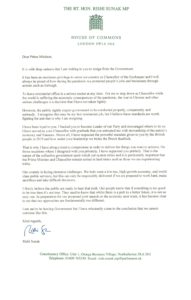
  • Boris Johnson – 2022 Letter to Lord Geidt Following Resignation

    Boris Johnson – 2022 Letter to Lord Geidt Following Resignation

    The letter sent by Boris Johnson, the Prime Minister, to Lord Geidt on 16 June 2022, in response to his letter of resignation.

    Letter (in .pdf format)

  • Lord Geidt – 2022 Resignation Letter to the Prime Minister

    Lord Geidt – 2022 Resignation Letter to the Prime Minister

    The letter sent by Lord Geidt to Boris Johnson, the Prime Minister, on 16 June 2022.

    Text of letter (in .pdf format)

  • Lindsay Hoyle – 2022 Statement on Government’s Position on Rwanda

    Lindsay Hoyle – 2022 Statement on Government’s Position on Rwanda

    The statement made by Lindsay Hoyle, the Speaker of the House of Commons, in the House on 13 June 2022.

    I did offer to convert the following urgent question to a statement but I got a message that that was no longer agreed. The Minister will say that he cannot say much at this stage, but we were happy to work with the Department and put on a statement at 7 o’clock. What bothers me is the mixed messages coming out of the Department, which said, “We want a statement,” so I granted it, then, “We don’t want a statement,” so I had to go back to a UQ. There we are; at least we are all now aware of what has gone on today.

    There are a number of live court cases on the policy of relocations to Rwanda. Some of them might not formally be engaged by the sub judice resolution, because they concern ministerial decisions, but for the avoidance of doubt, I am exercising a waiver in relation to the sub judice resolution on this matter, on the grounds that it is of national importance. That means that Members are able to refer to the issue on an ongoing basis.

  • Fleur Anderson – 2022 Speech on Standards in Public Life

    Fleur Anderson – 2022 Speech on Standards in Public Life

    The speech made by Fleur Anderson, the Labour MP for Putney, in the House of Commons on 7 June 2022.

    I thank all Members who have contributed to this important debate and to the underlining of the importance of standards, which so many have mentioned. Last night, 148 MPs stood up for standards in public life and it is disappointing not to see more of them in their place today. Each one of us is elected to this place based on trust: the trust of everyone who voted for us; the trust of the British people that we would act with selflessness and integrity in every decision we make; the trust that when the country has to rise to a challenge we in this place would set the highest standards; and the trust that if we were found to be failing to live up to those standards, we would take action, decisively and urgently, with transparency, to rectify that.

    The standards system now is broken, so it is up to Labour to bring this motion to push forward the action needed to live up to that trust. The Opposition have tabled this motion now because integrity and trust in politics has never been more under threat. While families up and down the country face the cost of living crisis, they deserve to know who is making the decisions and in whose interests Ministers are acting. These measures are urgently needed to stop the Tory slide into sleaze; to stop the culture of wasting taxpayers’ cash to give a mate a lucrative Government contract; to stop the politicisation of appointments from institutions that have never been political before; to regain our pride as a country that stands up for integrity and decency in public life; and to stop rules being made by convention, which can all too easily become a mate’s rates version of standards. The wink and a nod; the “He’s all right”; the turning of a blind eye; the “Help yourself,” “I’ve earned it,” or “Other people do it”—it is all a short journey from bending the rules to breaking them to bringing all MPs and our democracy into disrepute.

    The report by the Committee on Standards in Public Life is the focus of the motion. As the committee says:

    “Erosion of standards does affect public trust in the democratic process”.

    The polling and focus group research conducted for the committee found:

    “The public have a firm belief that ethical standards are integral to democracy itself, and that politicians have a fundamental duty to the public to abide by ethical codes and rules. However, the public lack confidence that MPs and ministers abide by such standards, and see some politicians as possessing neither the core values expected from leaders in public life, nor matching up to the higher ethical standards displayed by other respected public sector leaders, such as judges, doctors and teachers.”

    What a state we are in and what action we need to take.

    We have heard in the debate excellent speeches laying out the significance of standards. My right hon. Friend the Member for Derby South (Margaret Beckett) talked articulately and movingly about grandmother’s footsteps and the stealthy movement to undermine the health of our democracy, and about ministerial standards, control of the media and public appointments.

    My hon. Friends the Members for Eltham (Clive Efford), for St Helens South and Whiston (Ms Rimmer), for Ellesmere Port and Neston (Justin Madders), for Bristol South (Karin Smyth), for Chesterfield (Mr Perkins), for Warwick and Leamington (Matt Western) and for Ilford South (Sam Tarry) all underlined the importance of standards and the Nolan principles; the slow death of democracy by the degrading of those standards; the damage done by partygate; and the lack of action up till now.

    Today, Labour asks all Members to support the motion—not to abstain, to support it—to recognise the importance of the ministerial code, which has been damaged by the Prime Minister’s rewrite last month. The publication of a new ministerial code was the opportunity to include many of the 34 recommendations in the report from the Committee on Standards in Public Life; instead, we got a watered-down code.

    In the week when the Prime Minister’s misleading denials to Parliament about industrial-scale rule breaking at the heart of Government were finally exposed by the long-awaited Sue Gray report, the Prime Minister should have been tendering his resignation, but instead he was rewriting the rules. He moved to introduce a range of sanctions for minor breaches of the code, a new website and an office for the adviser, but he made no move to make the adviser more independent from the Prime Minister, which was the report’s core recommendation.

    The Prime Minister’s own anti-corruption tsar, the hon. Member for Weston-super-Mare (John Penrose), who is in his place, resigned yesterday, saying it was “pretty clear” that the Prime Minister had broken the ministerial code and:

    “That’s a resigning matter for me, and it should be for the PM too.”

    The second focus of the motion is the endorsing of the report by the Committee on Standards in Public Life and its 34 recommendations. Back in September 2020, the committee’s review opened with the publication of terms of reference. The starting point was that the existing systems were not fit for purpose and were being increasingly scrutinised and criticised. They were not fit for purpose then and they still are not.

    During 2021 there were expert evidence sessions; there was a public consultation; there was an academic roundtable; there was a public sector survey; and there was polling and focus group research. In November 2021, the committee published the report based on all the feedback and all its deliberations. This was not just a small group in a room somewhere, coming up with its own ideas; it was a considered, deliberate report. But we had to wait for seven months for any action at all, and that was the reviewing of the ministerial code. It was seven months of more sleaze and misconduct, including the Owen Paterson scandal, the vote to keep the hon. Member for Delyn (Rob Roberts) in Parliament and the failure to act against the former Member for Wakefield. We need to clean up this culture of sleaze and cover-up.

    The 34 recommendations include: greater independence in the regulation of the ministerial code, which has been talked about in this debate; strengthening the independent appointment and remit of the independent adviser; expansion of the business appointment rules to employment by companies with indirect as well as direct relationships with Government; the introduction of meaningful sanctions such as the five-year lobbying ban, because there are just too many loopholes in the current system; and stopping Ministers from overriding public appointments without having to account for why—side-stepping assessment panels means that things can go unrecorded and unnoticed.

    We need to know what is happening behind closed doors. The recommendations also include bringing in greater transparency when it comes to who is lobbying whom. We need a central register; a wider definition of who is a lobbyist; and monthly, instead of quarterly, reporting of all lobbying meetings that includes all methods of lobbying, including those on Zoom and WhatsApp.

    Those recommendations came out seven months ago. There has been no word on any action for most of them. Earlier, the Minister told us that he would reflect the thinking of the Committee on Standards in Public Life in the rewrite of the ministerial code, but he should not just be reflecting the thinking of the CSPL; he should be including the actual recommendations. If those recommendations are not in the ministerial code, where should they be? When will we see these changes?

    This motion today is just the necessary first step. Once the Committee’s recommendations are implemented in full, the Government should then do more. Labour would go much further. It would introduce an independent integrity and ethics commission—not a convention, not an adviser, and not another Tory MP. And it would not be in the gift of the Prime Minister to decide whether an investigation is carried out.

    This independent commission would bring the existing Committees and bodies that oversee standards in Government under a single, independent body. It would have powers to launch investigations without ministerial approval, to collect evidence and to decide on sanctions. The current system is just too disjointed, too convoluted and too little understood, as the report showed in its polling and evidence sessions. It does not have the transparency or the teeth needed to ensure that high standards are met by everyone all the time, and it is too entirely dependent on the integrity of the Prime Minister—the chap at the top.

    I hope that all Members will vote for this motion today. I do not see how they could not unless they are against the ministerial code and against the recommendations on standards in public life. The truth is that standards have not just been diluted under this present Government; they have evaporated. A vote for this motion is a vote to endorse honesty, integrity, and decency. Let us mark an end to the current system right now. This is the line that we should be drawing underneath things. We want an end to the slide away from the highest standards; an end to rule-breaking by Ministers; an end to the revolving door between ministerial office and lobbying jobs; an end to corruption and waste of taxpayers’ money; and an end to Members of Parliament being paid to lobby their own Government. Let us clean up politics. Let us win back the trust of the British people and do what we came here to do: to serve the British people without fear or favour and never, ever to compromise on the highest standards of public life. I commend this motion to the House.

  • Sam Tarry – 2022 Speech on Standards in Public Life

    Sam Tarry – 2022 Speech on Standards in Public Life

    The speech made by Sam Tarry, the Labour MP for Ilford South, in the House of Commons on 7 June 2022.

    It is somewhat ironic that we are debating standards in public life, given the Prime Minister appears to have no standards and no moral compass whatsoever. It is now blindingly apparent to our constituents that, after many months of rule-breaking, the Prime Minister is fundamentally dishonest, or has at least given the appearance of being dishonest. He is constantly mired in scandal and feels so entitled that he believes his own rules do not apply to him. That is not just Opposition rhetoric or a mere one-off; it is a pattern of behaviour that has emerged not recently but over the past two decades.

    A perception of dishonesty, if not actual dishonesty, has been repeated time and again in this House, and it is bringing our democracy into disrepute. My constituents are pretty angry about this. My constituent Dani is angry and contacted me to communicate her disgust at this behaviour. She described her young daughter, who was very unwell during lockdown and who suffers from a rare condition called listeria monocytogenes meningitis and severe mental trauma from her ordeal. She told me:

    “I can’t express my anger and disappointment that Mr Johnson thinks it’s acceptable to make up excuses the way he…has done. I no longer have faith… Please pass my story on to whoever that would want to hear it. As I also am raising awareness about listeria meningitis because it’s a strand that is not known much about… Let’s get a Prime Minister in that would treat us as equals. And not feel the need to lie to us. I watch everything, and it doesn’t sit well when we all know his apologies are worth nothing.”

    Another constituent, Anuja, wrote:

    “At a time when I was forced to go into labour…with my son on my own without a birthing partner, Boris Johnson and his colleagues thought it was an appropriate time to host a party going against all rules they had set themselves. A few days after I gave birth, my closest Uncle passed away and not only were we unable to attend his funeral, his immediate family were not allowed to see him one last time and had to part ways with him all on their own with not a single shoulder to cry on.”

    How much more needs to happen before Conservative Members, specifically the 211 who voted to keep the Prime Minister in office, decide to take action and oust him? He has the support of less than a third of the House of Commons. In 1979, before my time, Prime Minister Callaghan, with the support of 310 MPs, called a general election on that basis. Our current Prime Minister has less support than any Prime Minister in living memory.

    This situation goes far deeper than partygate. The Prime Minister recently abused the ministerial code by redrafting it to reduce the potential sanctions for Ministers who break rules, and he was castigated by the former local government ombudsman, who served on the Committee on Standards in Public Life for five years until last December. Jane Martin went on to say that Mr Johnson had wrongly used a report by her committee as a spur to weaken the code.

    I remind the Minister of the comments made by previous speakers about ACOBA. The Government are yet to respond to Lord Pickles’s letters, sent in July and September, about Dominic Cummings’s breaches of business appointment rules. That is exactly why today’s motion to back the full package of recommendations by the CSPL would strengthen transparency and integrity, and improve accountability in our democratic institutions. It is only by making those necessary changes, in particular, with the independent integrity and ethics commission, that we can safeguard our democracy and look our constituents in the eye. This would, I hope, mean that debacles such as the Owen Paterson scandal could be avoided in future. The Prime Minister not only defended Mr Paterson’s clear and egregious breach of lobbying rules, but, disgracefully, attempted to remove the Parliamentary Commissioner for Standards for doing her job. That is behaviour we would expect to see in an authoritarian state, not in one of the oldest and proudest democracies on earth. So it is no surprise that the Prime Minister’s own anti-corruption tsar resigned yesterday for those repeated failings.

    Just last weekend, the Prime Minister was making obscene hand gestures to shocked members of the public who had taken it upon themselves in the Morito restaurant, Hackney to question his actions. That is the latest in a long line of well-documented offences. What we have seen in the past couple of years is something that, I am afraid to say, has been part of the Prime Minister’s character for nearly two decades. In 1990, he was secretly recorded, in a previous job, agreeing to provide the address of the News of the World reporter Stuart Collier to his friend Darius Guppy, who wanted to arrange for the journalist to have his ribs cracked as revenge for investigating his activities. That is the true mark of the man behind the door of Downing Street.

    Then we come to the Prime Minister’s record in public office. In perhaps one of the most scathing assessments of his time as Foreign Secretary, a London Conservative mayoral candidate, Steve Norris, pointed to ill-informed comments of the now Prime Minister that undoubtedly led to Nazanin Zaghari-Ratcliffe facing many years in incarceration. Mr Norris’ telling comments were that, in addition to being “lousy on detail” during his time as London Mayor, his consistent failure to “read the paperwork” was exactly the sort of behaviour that led to his sloppy and inaccurate comments about Mrs Zaghari-Ratcliffe. He is not a jovial character, as many of us have been led to believe; this behaviour has affected people’s lives for decades, most angering, recently, those hundreds of constituents who did abide by the rules and were not able to be with their loved ones, attend weddings or attend funerals in times of need over the past few months and years.

    The Prime Minister has said that it will take a tank division to drag him out of Downing Street, which means that, even after last night’s vote, he still is not going to leave of his own accord. So I urge colleagues, on both sides of this House, to continue to explore all options to force this position—to make a change—so that democracy and integrity can be restored, and so that this House can rightfully be restored to its place as a pre-eminent symbol of democracy around the globe. If there is an appearance of dishonesty in our Prime Minister, at a time when the country needs to be navigated through the most economically uncertain years ahead that we potentially face, with misery already being caused to millions, surely that trust has to be restored in one way or another. We cannot have someone with their hand on the tiller steering this country who has no trust, from not only this House, but from the vast majority of people in this country.

  • Marion Fellows – 2022 Speech on Standards in Public Life

    Marion Fellows – 2022 Speech on Standards in Public Life

    The speech made by Marion Fellows, the SNP MP for Motherwell and Wishaw, in the House of Commons on 7 June 2022.

    If the House divides at the end of this debate, I shall be voting with the Opposition. Standards in public life are a foundation of our democracy. We must be able to have trust in those in public life, and we need Ministers, and especially a Prime Minister, to adhere to the ministerial code. Breaches of the Nolan principles and the ministerial code affect us all. It is fundamental that those in positions of power are honest and truthful; otherwise, we lose the trust of the public who elect us.

    Independence is a word I am extremely fond of—indeed, I am wedded to it for Scotland’s sake—but we also need independence because we need a brake on this Prime Minister. He must not be judge and jury on the ministerial code, and I shall lay out my reasoning on this using the Nolan principles. Selflessness—denying yourself what you want for the greater good—is not what our current Prime Minister is noted for. My constituents showed selflessness during the pandemic for the common weal—the greater good. Our current Prime Minister did not. He carried on regardless, and permitted an ethos in Downing Street in which those working for him believed, as he did, that the rules did not and should not apply to them. They allowed guardians and security staff who knew wrongdoing was afoot to be belittled. Nae selflessness, then.

    Again, the rules do not apply to the PM. His ethos was, “I want my flat refurbished, but I don’t want to pay for it myself.” But donations and loans were not registered with the Electoral Commission during the statutory time limit. Nae integrity there. This Government acted illegally, as judged by the High Court, by having a covid VIP lane to give money to individuals and companies run by friends and donors to the Tory party. Nae objectivity. Then there was the Owen Paterson debacle, where the Prime Minister tried to condone egregious lobbying and contracts awarded to Tory donors—a running theme. This Prime Minister and his Government believe they can do what they like, and there is nae accountability.

    The Prime Minister knew he had attended parties at No. 10, but he used weasel words to try to deny it. He breached the ministerial code by using “terminological inexactitude”. For my constituents’ benefit: that is sometimes known by you as lying.

    Mr Deputy Speaker (Mr Nigel Evans)

    Order. We are not having the word “lying”. That was stressed by the Speaker at the beginning of the debate, so please will you withdraw the word “lying”?

    Marion Fellows

    I will withdraw the word “lying”, and thank you for your guidance, Mr Deputy Speaker, but I think my constituents struggle a bit with “terminological inexactitude”.

    How does this Prime Minister deal with breaches of the ministerial code? Simple. You change it, or ignore it. So, nae openness. Partygate damaged our democracy, according to the Health Secretary, and since St Andrew’s day last year—189 days ago—we have heard nothing but, “We must move on. The Prime Minister saved us all during covid and he will save Ukraine. Nothing to see here, move along.” No acceptance of wrongdoing apart from set-piece apologies that were allegedly recanted at private meetings of the 1922 Committee. So nae honesty, either. To be a good—or even middling-to-good—leader, you need to have a moral compass. This Prime Minister has a well-hidden moral compass—

    Mr Deputy Speaker

    Order. Was the hon. Lady trying to say that certain members of the Government were being dishonest when she said “nae honesty”?

    Marion Fellows

    Yes, I think that the Prime Minister—

    Mr Deputy Speaker

    Were you are accusing the Prime Minister of being dishonest? If so, can you withdraw that, too, please?

    Marion Fellows

    Sorry. Yes, of course.

    Forty-one per cent. of the Prime Minister’s own MPs want him gone, a majority of his Back Benchers want him gone and even the Scottish Tories want him gone. It is worth repeating that former Tory MSP Adam Tomkins, a professor at the University of Glasgow, said:

    “When a government asserts that the laws do not apply to it…such an assertion offends not only the law itself but our very idea of constitutional government.”

    The former head of the Scottish Tories, Baroness Davidson, said the Prime Minister’s position is “untenable.” The Tory party knew what it was getting when it elected this Prime Minister as party leader, as he has a track record.

    The current Tory leader in Scotland, the hon. Member for Moray (Douglas Ross), has been doing the hokey-cokey on the Prime Minister: in, out, in, out. He has not been able to make up his mind, but apparently he knows now that the Prime Minister should not be in office because he has not exhibited the correct leadership.

    We in Scotland have not voted for a Conservative Government for 60 years, but we keep getting them, and this one is the worst so far. The only way forward is independence. We need to break free of this corrupt Government and their leader, who does not think truth matters and who thinks the rules do not apply to him.

    I never expected to be a Member of Parliament, but I have been honoured to be returned three times. During that time, I have seen for myself how the public have lost faith in politicians. We need strong, enforceable standards for those in public life, and we need stronger, more enforceable standards for Ministers, and especially the Prime Minister. We need to build back trust in politics. In Scotland we will do that best by achieving independence; and here we will do it best by supporting this motion.