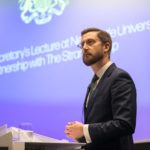
The speech made by Simon Case, the Cabinet Secretary, on 13 October 2021.
I’m delighted to be here with you all this evening and I’m grateful to Newcastle University for hosting this lecture in partnership with the Strand Group.
You might be wondering why I’ve come to Newcastle to give a lecture about the effectiveness of central government! I’m here because the conduct of central government shouldn’t be a rarefied matter for those of us that spend too much time in the SW1 postcode – it is a matter that affects everyone, everywhere. In my view, the debate is only enhanced with the injection of views from beyond the hallowed halls of Westminster.
Earlier today I had the pleasure of meeting students and academics in the history department – taking me right back to my own days as a PhD student. It’s been a few years since I delivered a lecture to such a scholarly audience, so treat me kindly!
On a visit to Sheffield last week, I was asked an excellent question.
What keeps you awake at night?
Of course there is always something that keeps sleep at bay – particularly during a pandemic and our current economic circumstances. But in this role, I find myself asking the same question again and again:
How are we going to avoid the ‘Curse of the Missed Opportunity’?
Now if that doesn’t sound too alarming, it is because you didn’t have Peter Hennessy as your PhD supervisor.
Peter, the legendary Whitehall historian – and great friend and mentor – has drummed into me and a good few others here today, all that he discovered in 50 years of observing the Civil Service.
Peter argues that ‘The Missed Opportunity’ is the quintessential government mistake – the mistake we make when we fail to hold on to the lessons we learn as we go along.
Politicians and officials, Westminster and Whitehall, have recognised that the pandemic is an inflection point in our history.
So ‘How do we avoid the curse this time?’. We should take heart from the successes of our response: those areas where ministers and civil servants – even the nation – can take pride in a job well done.
Of course; the rapid development and rollout of vaccines; the furlough scheme which has supported 11 million livelihoods; the swift expansion of Universal Credit; the ‘Everyone In’ campaign that saw homeless people given shelter.
Successes pulled off by diverse teams, working together with common purpose.
These achievements, and the part we played in them, reveal the best that the Civil Service can be. Skilled, innovative, ambitious. More confident, more spirited. Less risk averse – less hostage to process.
Working in partnership across organisations and in lockstep with the private sector. We’ve shown we can be the best in the service of our country.
Alongside this, we also need to acknowledge our weaknesses – none of which will come as a surprise to those who know the Civil Service.
Cumbersome processes and siloed working, slowing us down and hindering best practice. Confusion at times about who was responsible for what.
Failing to work consistently well across national and local government, and missing the value of expertise on the ground. Weaknesses in how we gather, handle and present data. And our longstanding lack of specialist scientific and technical knowledge.
We need to fix these weaknesses – and I know we can – to help spearhead a recovery from COVID and truly deliver levelling up.
For the sake of our great country – and the communities we serve – we want to move ahead stronger.
To the people of the United Kingdom – who have lost loved ones and had their lives upended – we owe the very best of us – and I truly believe this is what civil servants up and down the country want to give.
Since the modern Civil Service was established, through national triumphs and crises, there have been no areas of public life where we have not been asked to serve.
That is our privilege – our honour – and our responsibility. Peter identifies the era immediately after the Second World War as Whitehall’s greatest ‘Missed Opportunity’.
The Government had corralled the nation’s best talents for the war effort: scientists, engineers, mechanics, linguists, cryptographers – yes, even historians – whomever was necessary.
After victory, we could have applied their specialist skills, their expertise and knowledge, to rebuild the country.
Instead, they were encouraged to disperse. There was never a formal examination into how the state as a whole had performed in the war.
Which meant no one realised just how much government had been boosted by this rapid infusion of external expertise.
To avoid the curse of the ‘Missed Opportunity’ now, we must hold on to the lessons we have learned – good and bad.
You see, any debate about government, the Civil Service and their effectiveness should never be binary.
It is absolutely possible to be a passionate defender of the role of the Civil Service, to recognise the remarkable commitment to our country displayed by my colleagues.
To applaud those many things done well and, at the same time, be determined to address our weaknesses.
My colleagues want to be respected personally and see their contribution valued; so many of the greatest advocates for reform are actually civil servants.
Some of the loudest voices for change are coming from within. We know what frustrates us; what holds us back. We know what makes it harder for us to do our jobs.
We know what we have to do. We must make sure that in the next five years we learn the lessons of the pandemic and we seize the opportunities to bank our wins and fix our weaknesses.
So that together, we can get on with the job that the country expects of us.
I’ve seen in the past 18 months how ready my colleagues are to rip up the old ways of doing things and try something fresh.
It has been exhilarating and exhausting. But our eyes must remain open to what we can achieve.
Ministers and civil servants are steadfast in their resolve to renew and rewire government.
Earlier this year, we set out our vision in a Declaration on Reform, which reflected the views of civil servants and ministers – and took in the critiques of external commentators.
The Prime Minister and I signed it off on behalf of ministers and permanent secretaries, following a joint meeting of Cabinet.
Let me be clear: we are only in the foothills of these reforms and there is much more to do.
Tonight, if you’ll allow, I am going to explore our direction of travel a little more. But first, I hope you will permit me – still a historian at heart – to indulge my passion for the past.
A century-old tradition dictates that I always sit to the Prime Minister’s right at Cabinet, as his most senior adviser from the Civil Service.
The man who began this tradition, as the first ever Cabinet Secretary, was called Maurice Hankey.
Although separated by a hundred and four years, both of us took on the job in the midst of crisis.
Lieutenant Colonel Hankey was not a politician or a bureaucrat. He was not a diplomat, or even a civil servant.
He was a Royal Marine with a background in naval intelligence and an instinctive understanding of how to grasp and resolve the knottiest organisational challenge.
And his legacy to the nation is our enduring system of Cabinet Government.
Hankey’s initial intervention was under Asquith’s administration when government mechanisms were in disarray.
Without an agenda or a Secretary, Cabinet meetings, discussions and decisions went largely unrecorded.
And so follow-up action was haphazard. It was no way to wage a war, let alone win one.
As the nation reeled from the appalling losses on the Somme, Allied leaders convened in Paris, in November 1916.
Hankey accompanied the then War Secretary, Lloyd George, on the trip, which proved to be a turning point in British governance.
Lloyd George describes a walk through the streets of Paris, during which Hankey – keen, I think, to seize the opportunity – suggested that a small but powerful War Committee be set up for the day-to-day conduct of the war.
Lloyd George – by then losing faith in Asquith’s leadership – saw merit in the plan, which he hoped would help compensate for an unfocused Cabinet.
Within weeks of course, Lloyd George was Prime Minister and enacting Hankey’s plan was among his first acts.
While it didn’t resolve everything, the partnership of Lloyd George and Hankey is recognised for energising the higher command of government.
It brought focus, rigour and accountability. I hesitate to use that distinctly 21st century epithet – ‘disruptor’ – of Maurice Hankey. But his very background and experience allowed him to think and act differently.
He was the sculptor who looks at a block of stone and sees it not as it is, but as it could be. Lloyd George described Hankey as no less than the ‘Organiser of Victory’.
Now as I turn up on a Tuesday morning for weekly Cabinet, I sometimes find myself thinking how very familiar Hankey would still find the rituals that fall to me.
Preparing the agenda; the circulation of papers; the Prime Minister’s brief; the handwritten notes and the official minutes.
The human side: the chat in the margins of the meetings, making sure the right people are sitting in the right places; assessing the value of the contributions made.
Right down to where I sit – a position which has come to symbolise the unique interlocking and trusting relationship between politicians and officials that is at the heart of our system of government.
So now, back to the 21st century: and how is it, you might wonder, that the principles of the paper-based Hankey model have survived into the Digital Age?
The immediate answer is that even in the era of ever-present social media and global financial markets that never sleep, when it works well Cabinet Government and the committee system still deliver effective government.
Within that system, policy perspectives and political considerations are debated, and the data and evidence interrogated.
That’s not to say the system doesn’t face constant challenge – of course it does.
There’s technology: which is both an enabler and a taskmaster. When something happens, everyone – Government, public, media – can hear about it at much the same time.
Government cannot count on having prior information, leading to a reactive rather than a proactive position.
Also thanks to technology, we can find ourselves with too much information, creating the ‘signal versus noise’ conundrum: How do we determine what is significant in the mass of information?
And this system of government leads to another challenge, which is more cultural: the danger that in each conversation or policy debate, you go over every possible risk factor – who will be the winner, the loser: what are the upsides/the downsides – until you reach the lowest common denominator position.
Which can be the enemy of radical solutions and reform.
So let me set out a few of the things we are doing to address these challenges.
Some are necessarily about the top of the pyramid of government: the relationships between Number 10, Cabinet Office and the Treasury with the rest of government.
And some are about the broader base of government and the civil service, the vast majority of the people who contribute to decision-making and service delivery.
Taken together, they are the machine that takes decisions and implements them. Every person in the chain matters: who we are, and how we work more effectively and efficiently makes a difference to the people of the United Kingdom.
Better decision-making
So first: let me say a little bit about how we are adapting our approach to top-level decision-making.
And how we borrowed an idea that originated with Hankey; one we also used to prepare for Brexit – namely the creation of a layered approach to Cabinet committees.
First to take strategy decisions and then to drive through actions and operational outcomes.
The principle at the heart of this approach is actually very simple:
Make sure you have the right people in the room for the right discussion – to reach the most urgent decisions or remove the most critical barriers to real-world progress.
For our Brexit preparations, we ran two committees: XS, for Exit Strategy, and XO, for Exit Operations.
A core of five ministers attended the Strategy meetings: their focus was to set the high-level direction and resolve strategic questions.
By contrast, the cast list for the Operations meetings was a more eclectic affair. It changed by the day, depending on which pressing delivery problem was on the agenda and who was best placed to tackle it.
And as well as having experienced officials at the table next to their ministers, we invited outside partners to contribute their expertise – including the devolved administrations, business leaders, local government and third sector organisations – all interested parties with frontline experience that would play a vital operational role.
This was the model we decided to mirror for the COVID response: COVID (Strategy) to handle high level strategy decisions; and COVID (Operations) to oversee operational delivery.
Exactly the same principles applied. And this model of strategy committees and operational committees is one which the Prime Minister has now decided to repeat across the waterfront of government business.
Delivery
The second area I want to cover is how we organise and assess delivery.
As you will have heard, the Prime Minister has made clear to us all that delivering on its promises is now the government’s Number One priority.
Here, too, we have taken direct inspiration from the past – albeit, the more recent past. Michael Barber, the creator of Tony Blair’s Delivery Unit, advised us on the creation of a similar set-up for this government. The new Unit is now working closely with ministers and their departments on our post-pandemic priorities: Levelling Up; Net Zero; Education, Jobs and Skills; Health and Social Care; and, Crime and Justice.
In each of these areas, we are defining the missions; working out the goals and metrics; identifying the players involved in making things happen; and, busting through barriers to progress.
The Prime Minister holds regular stock-takes to review all of the above, with Secretaries of State and key officials.
These tried and tested approaches directly connect the Prime Minister and his ministers to the realities experienced by the people who use public services every day.
Inconvenient truths are hard to duck. Accountabilities are laid bare. A lack of progress is plain to see.
And at the same time, the collective spirit and desire to overcome obstacles is fostered. Of course, we need to take these broad delivery goals and turn them into individual responsibilities.
Secretaries of State and their permanent secretaries have to be clear about what is expected of them, what resources they need to succeed and the like.
On appointment, Cabinet ministers receive clear instructions from the Prime Minister, setting out what he expects them to deliver.
To accompany this, we have introduced a more rigorous appraisal system for permanent secretaries, to align priorities and work through the specific challenges they face in their departments.
We meet multiple times a year in sessions that are supported by data and evidence. First to agree overall objectives across delivery, leadership and management of resources; then at mid-year, to take stock. And finally at the year-end, to review performance.
The sessions involve officials from the relevant department, from the Treasury, Cabinet Office and No10, as well as the departmental lead non-executive director. Reports are then sent back to the Secretary of State and the Prime Minister.
This approach – the Delivery Unit, the stock-takes, the Mandates, the permanent secretary appraisals – takes huge amounts of time and effort to get right. But this is the level of effort that’s required to organise effective delivery.
Data collection and skills
The third area I want to touch on tonight is data.
We won’t improve decision-making if we don’t improve our data collection and analysis. It is fitting to be here this evening, at the home of the National Innovation Centre for Data, whose mission is to ensure that organisations up and down the country are equipped to reap the benefits of the global data-driven revolution.
In the context of the pandemic, we learned some important lessons. We started off with officials emailing Excel spreadsheets back and forth late at night, to be turned into Powerpoint slides for ministers the following morning.
We didn’t know where cases were or how they were spreading.
Within months, however, we had automated feeds and digital dashboards showing aggregated tallies from the NHS and Public Health England of new cases; hospitalisations; and mortality rates.
Thanks to the Office for National Statistics and its Infection Survey we had great insights into the incidence of asymptomatic infection; regional variations in prevalence, and the spread across demographics.
Our coders and analysts looked at anonymised data sources to create a more accurate picture of what was happening in the country, in terms of health, the economy and public services.
This more sophisticated use of data gave ministers confidence to take the necessary, but hard, decisions needed to tackle the virus.
And this should be the norm: innovative use of data in policy-making.
Our new entities such as 10DS, a data science team in Downing Street; the National Situation Centre; as well as the Delivery Unit – are starting to bring better evidence into policy and delivery discussions at the heart of government.
And they are working with departments to shape their use of data and bring about system change – because of course the really big data guns sit in departments – not in the Centre.
Departments are the real catalysts of change through their use of data in designing and delivering better public services. It’s quite the challenge.
The problem is that all too often we don’t have the data we need at all. Or we don’t have the data where we need it, when we need it. Or we don’t know how to interpret and display the data we have.
The upshot is frustration for decision-makers. Now – as we all know, while data itself is crucial, it is what we do with it that ultimately matters.
It is through the application of expertise and specialist knowledge that we identify opportunities, shape policy and refine its delivery.
Our levelling up programme, for example, will be all the more robust, if data is collected and, crucially, used, with place at the heart of the approach. We need to have better analytical skills.
How we interpret, use, display and communicate data are essential parts of the mission.
We need to put rocket-boosters under our plans to equip our own people with these skills, or plug the gap by bringing them in from outside.
Our people
Of course, our people are at the heart of the government machine. So, this brings me to the fourth topic this evening: training and skills.
Our workforce needs technical competence, alongside individual confidence and curiosity, supported by the necessary zest and flair in our leadership that stimulates creative thinking and innovative ideas.
And so the new Curriculum and Campus for Government Skills, launched in January this year, was an important milestone – a signifier of the long-term change for which we are planning.
It sets out the technical skills, training, knowledge and networks that civil servants – as well as ministers and advisers – need to do their jobs better.
Because for all the investment we have hitherto put into training, our specialist and generalist knowledge remains patchy.
The Curriculum and Campus recognises that effective government needs collective effort and leadership, and that the gravitational pull of top quality training will attract and retain premium talent – something as relevant for our new apprentices as our senior leaders.
Even so, our internal talent alone cannot provide all the solutions. While we want our people to pick up valuable experience through private sector secondments, we also want to bring in external expertise to reinforce our ranks.
We want it to be natural for people who have built a career in business, industry, academia or the third sector to serve, even for a relatively brief time – just as it will be as valuable for those presently in public service to experience life in another organisation.
That is why a new secondments unit has been established in the Cabinet Office to increase the two-way traffic at a senior level; for the long-term national good.
All done, of course, within a clear and rigorous propriety framework.
Partnerships aren’t just about secondments, of course. We still need to talk more; work more; across different layers of government – relationships with local government are all the more important now for invigorating communities.
It is my great privilege to be building on the hugely energetic efforts of my predecessors, who were also focused on getting the right people, working in the right places, spurred on by the right incentives.
If I look back now to when I first joined the Civil Service, the received wisdom was that it was good at policy and poor at delivery.
Over the course of my career, I believe this has been inverted.
And we saw this during the pandemic in the feats of our colleagues working in what we call Operational Delivery.
Their passion for making a difference to the country, communities and their fellow citizens was unleashed in a wonderful way – absolutely enabled by data, expertise, technology – but inspired, I know, by the timeless value of taking pride in public service.
At the same time, the pandemic revealed that the effective policy official of today must be an expert orchestrator: part of a multidisciplinary team that brings the right skills – be they in finance, data analysis, science and engineering and more – to bear on any challenge.
And my focus in all this is underpinned by making sure that the Civil Service as a whole reflects the country we serve.
In other words, making sure that we are valuing in the Civil Service – alongside gender and ethnic diversity; and people with all types of disabilities – a profound commitment to diversity of thought.
And we achieve this by employing a broad range of people from a wide range of backgrounds, so avoiding an echo chamber of like-minded people talking to themselves about subjects on which they are inherently likely to agree.
We have pledged to move 22,000 roles, and half of our senior Civil Service, out of London by 2030.
Some of the jobs are heading up to the north-east: Darlington is home to the Treasury’s new campus. The Department for Levelling Up, Housing and Communities has recently opened a new office in Wolverhampton; and the Cabinet Office has a second HQ in Glasgow.
We will be recruiting from the communities where the decisions made by our people will have the most immediate impact.
And we will also be opening a network of hubs across the country to give people more places to work from.
They’ll allow someone in Manchester to advise a minister in London or Glasgow – no longer any need to move lock, stock and barrel to the south-east to have a successful Civil Service career.
Like everyone in the country, civil servants have had to adapt to enormous changes in a short space of time.
Over the last 18 months the state has determined who people can see, when and where.
Large chunks of our high streets were forced to close with the taxpayer picking up the wage bill.
I don’t believe any of us could have imagined these sorts of interventions before the pandemic.
It is hard to believe that they would have garnered public and parliamentary support.
And yet because of the country’s compassion, and its desire to protect the NHS and save lives, people have accepted these extraordinary policy injunctions that ministers and civil servants have found themselves having to design and legislate for at speed.
Now, as we head towards a new normal, transitioning from pandemic to endemic, we will see a shift from the highly protective and directive state that has developed to a more enabling or facilitative state.
The challenge for the Civil Service – returning to Peter’s Curse of the Missed Opportunity – is, as ever: how to equip ourselves for what is ahead?
Now – students of history will know that we have a tendency to prepare for the last war.
But the changes that I have spoken about tonight, and the measures in our Reform Declaration, will help us perform better both in the here-and-now and also prepare ourselves for the future challenges, known and unknown.
On their own, of course, neither the focus on data science, the injection of external expertise, the additional investment in our leaders or clearer accountabilities – none of these will be the miracle individual component that allows us to be better prepared for the future. And of course there are other things I haven’t touched on this evening which are equally important – for instance, how we reward people and support their careers.
But taken together, they do make it more likely that in a whole range of future scenarios better decisions are made that will have a direct, swift and positive impact. And improve people’s lives and the country as a result.
Through the pandemic we have had to adapt – there has been no choice but to change. That impetus for change has not receded.
We must think about how best to shape the Civil Service for future generations. And, if we want to preserve this organisation that many cherish, we need to embrace change, not shrink from it.
Rise up from the defensive crouch that we have assumed around reform too often in the past and instead stand tall.
We must do this for the same reason that a FTSE100 company reviews and renews its model to boost its performance. If it does not, it risks the wrath of its shareholders and customers.
The Civil Service likewise cannot take its position for granted.
The relationships we have with the public and politicians are founded on trust and our reputation – built over many decades – for delivering public services and supporting ministers with honesty, integrity and objectivity.
Trust in us is vested in the impartial advice we offer; and in the truth we speak unto power. We jeopardise this at our peril, for reputations can be lost easier and faster than ever they are won.
And while our position is one of great privilege, it is not granted in perpetuity.
Rather, ours is a role that we need to earn anew with every generation of civil servants, or risk our most important customers – the people of this country and their elected representatives – looking again at the services we offer and wondering if they are getting value for money, and whether we are too often insulated from the price of failure.
And so we must be honest with ourselves. The Civil Service has given its all during the course of the pandemic, yet must now summon its strength for another great push as we rebuild and reshape the country.
I know how much people in government care about their mission.
I feel fortunate that the initial steps that I have spoken about tonight, and the other necessary changes we will see across the Civil Service, are being driven by colleagues who care as deeply as I do about public service.
And I’ve seen for myself over the past 18 months such imagination and hard work;
Such versatility and a willingness to dig in, and to dig deep.
The Civil Service has long been the engine room of government, without which little or nothing would get done.
We have to move with the times, And become more agile and responsive with better trained people.
We do have to be clear-eyed about what has to change. Honest about what has not gone well. And then it will remain in our gift to decide how to meet the challenges ahead.
We cannot foresee exactly what will happen in the future – but we can make ourselves more resilient to the impact of future events.
And we can do this by cultivating a truly modern Civil Service – with the people, the performance and the partnerships – that will allow us to adapt, evolve and embrace change as an ally.